Cambodia is more than ever committed to human rights promotion and protection approach with its organic laws, said a government statement released on Tuesday by the Foreign Ministry's spokesman.
The statement was made after Ouch Borith, secretary of state for Foreign Affairs and International Cooperation, on Friday exchanged views on the issues of human rights with European Union's delegation led by the British Ambassador Andrew Mace, who is representing Sweden in their presidency of the EU.
During the meeting, Ouch Borith underlined that "Cambodia is more than ever committed to human rights promotion and protection approach with its organic laws."
At the same time, Ouch Borith stressed that Cambodia's democracy is based on the fundamental rights enshrined in the Universal Declaration of Human Rights.
"While individual rights, freedom of expression and a culture of debates are taking deeper roots in Cambodia, we must recognize that the exercise of these rights and freedoms in any democratic society must be within the rule of law," he said
EU's meeting with the government follows a Phnom Penh Municipal Court ruling on Aug. 4 that found opposition Sam Rainsy Party (SRP) lawmaker Mu Sochua guilty of defaming Prime Minister Hun Sen and ordered her to pay about 4,100 U.S. dollars in fines and compensation.
The EU expressed "concern over a number of instances in which criminal charges of defamation and disinformation have been used against representatives of civil society, the media and the political opposition," according to the report of the Cambodia Daily.
"Laws and regulations concerning defamation and disinformation exist worldwide, particularly in developed countries, to protect and guarantee the right to dignity of everyone," Ouch Borith said.
"The verdicts by the Cambodian Court on the recent defamation and disinformation cases are in compliance with the existing laws in relation to these offences," he added.
Admitting "the country still faces many challenges," Ouch Borith reassured the delegation of the EU that "Cambodia is firmly committed to ensuring that the country embraces the principles of democracy and human rights with the rule of law."
Source: Xinhua
Read more!

Tuesday, August 11, 2009
Cambodia committed to democracy, human rights with rule of law: official

Hundreds expected in Phnom Penh to protest land grabs
Phnom Penh - Hundreds of people were expected in Phnom Penh Tuesday to deliver to the government a petition protesting land grabs and forced evictions.
Organizers said representatives from 19 of the kingdom's 24 provinces and municipalities would hand the petition to the office of Prime Minister Hun Sen, the cabinet and three government ministries.
They said 200,000 hectares of land are at risk. The petitions contain more than 15,000 thumbprints, a standard way of signing in Cambodia, where literacy rates are low.
The land seizures are carried out by companies with government connections, politicians and the military. Development is the standard reason the government gives for granting these mining or land concessions.
In a statement, the organizers said forced evictions, displacement and landlessness are reaching 'crisis proportions.'
'Evictions and land confiscation continue in Cambodia, despite calls by the World Bank, the ADB [the Asian Development Bank], the UN and Cambodia's donors for the government to enact a moratorium on forced evictions and land confiscation until it establishes effective conflict resolution mechanisms and relocation procedures meeting international standards,' they wrote.
Organizers said communities are being driven into poverty by land grabs, and their efforts to find peaceful solutions are met with intimidation, court action and even violence from the police and military.
'When we try to protect our legal rights, we receive intimidation,' villager Pol Cheoun from Battambang province in western Cambodia said in the statement. 'We want the government and the donors to know what is happening. We are losing our land, forest and fisheries we depend on. We are getting poorer and poorer, and the rich are getting richer.'
A community activist from the northern province of Oddar Meanchey told the Cambodia Daily newspaper that he is in favour of development, 'but I don't want to see development lead people to tears,' he said.
Amnesty International wrote last year that 150,000 Cambodians are at risk of losing their land.
Read more!
Investment in Cambodian tourism reaches $354 mln in half year
The Hun Xen government have invested about 354 million US dollars in tourism. It seem is very surprised, but it doesn't very surprised in any strategy. It is the old games which those officials always used to steal money from poor Cambodians.
PHNOM PENH, The investment in Cambodia's tourism reached to about 354 million U.S. dollars in the first six months of this year and is a leading field that got the most investment, the local media said on Tuesday.
"Council for Development of Cambodia (CDC) approved about 1.22 billion U.S. dollars investment projects totally from private companies and 354 million U.S. dollars of the total is on tourism investment project," the khmer language newspaper Rasmei Kampuchea quoted the document from CDC as saying.
Agricultural field stands second row after tourism with 323 million U.S. dollars and next field is industry with 303 million U.S. dollars.
In total, Cambodia received 53 investment projects for the first half year and tourism field attracted seven projects, while agri-industry has 12 projects, garment industry with 14 projects and three in energy projects.
If we consider on the projects for the first six month of this year, it increases four projects but the investment capital went down about 3.2 billion U.S. dollars compared with the same period of last year, it said, adding that for first six month of last year, Cambodia yielded with 49 investment projects with about 4.43billion U.S. dollar.
Read more!
Monday, August 10, 2009
UTSA forms research partnerships with Cambodian universities
The University of Texas at San Antonio (UTSA) has formed relationships with two Cambodian universities that will allow faculty and staff at all three schools to collaborate in research, teaching and study abroad programs.
UTSA formed partnerships with Royal University of Phnom Penh (RUPP), Cambodia’s first and largest university, and Pannasastra University. Pannasastra is a private university that was opened in 2000 by a group of Cambodian Americans who fled the country because of the genocide that took place during the 1970s. However, they decided to return home with advanced degrees to start the university.
The collaborative efforts between the universities began earlier this year when UTSA associate professor of bicultural-bilingual studies, Wayne Wright, traveled on a Fulbright Scholarship to teach at RUPP in the master of education program.
Wright, who is fluent in Cambodian, says he chose the country in order to contribute to the rebuilding of the education system devastated by genocide and decades of civil war. Additionally, he was able to introduce his children to the Cambodian language, history and culture and reconnect with his wife’s family who live near the capital.
Wright will be supervising five master’s students working on their theses at RUPP and will be finishing up a research project that he started with one of the faculty members there.
“My hope is to find funding to support a big collaborative research project related to teacher training in Cambodia that can involve all three universities,” Wright says.
UTSA president Ricardo Romo says agreements like these are important for UTSA students.
“We would be left behind if we didn’t try to be a bit more proactive in setting up programs that would allow the students to see other parts of the world,” Romo says. “We need to take advantage of these kinds of connections with other universities and let our students reap the benefits of those kinds of networks.”
Read more!
Cambodia continues to extend visa exemptions to aid economy: official
PHNOM PENH, Cambodia will continue to extend the visa-exemption program to four additional ASEAN member states despite the loss of revenue, local media reported on Monday, citing a tourism official.
Cambodian tourism officials last week announced the loss of more than 14 million U.S. dollars in revenue generated by tourists from the Association of Southeast Asian Nations (ASEAN) since January 2008, when the government adopted a visa-exemption agreement with five ASEAN countries .
According to a report by the Ministry of Tourism, Cambodia honored 278,842 visa exemptions in the first half of this year from travelers from Malaysia, Singapore, the Philippines, Vietnam and Laos, which resulted in a loss of 5.5 million U.S. dollars in revenue, the Phnom Penh Post reported.
The report added that last year revenues declined by 8.6 million U.S. dollars after visa exemptions totaling 431,426 were issued to tourists from the same countries.
"We realize that our visa-exemption program for travelers from ASEAN countries results in lower national revenues, but we will continue it because increased arrivals can boost economic growth Kingdom-wide and will create many jobs for Cambodians," Thong Khon was quoted by the Phnom Penh Post as saying.
He added that visa exemptions would be extended to all ASEAN countries by 2015.
"Next year, we will implement visa exemptions for Thailand, followed later by Indonesia, Brunei and Myanmar," Thong Khon said.
Cambodia agreed to its first visa-exemption program with Malaysia in the late 1990s, adding the Philippines, Singapore, Laos and Vietnam in subsequent years.
The Ministry of Tourism estimates that under the visa-exemption program, at least one million tourists from nine ASEAN countries will travel to Cambodia between 2010 and 2011. (PNA/Xinhua) ALM
Read more!
US to hold seminars for Vietnamese meat inspectors
HCM CITY — The US’ Food Safety and Inspection Service (FSIS) will hold two week-long seminars for Vietnamese meat inspectors next month, Michael Riedel, Agricultural Attache at the American consulate in HCM City, told a conference last week.
One would be held in Ha Noi and the other in HCM City.
Also this [autumn], some Vietnamese food safety officials would go to the US to participate in FSIS’ training in HACCP (Hazard Analysis and Critical Control Points) implementation, Riedel added.
The US Department of Agriculture (USDA), under which the FSIS functions, is working with the Department of Animal Health in Ha Noi and the Division of Animal Health in HCM City to arrange the seminars.
"We work very hard to identify areas where Vietnamese and US organisations could work together to learn from each other," he said.
The USDA’s main task is to expand and maintain overseas markets for US agricultural exports.
It also produces reports like the annual grain report about Viet Nam and Food Retail Sector report for the benefit of American farmers and exporters.
"The HCM City office also covers Cambodia where we do many of the activities above, while also conducting some food aid programmes," Riedel said. — VNS
Read more!
DoCoMo Eyeing Acquisition in Cambodia
Japan's DoCoMo has confirmed that it is interesting in buying a mobile network in Cambodia. The country has several operators as possible targets, including Millicom's local subsidiary, Mobitel which the parent company has put up for sale.
However, DoCoMo has not decided to make a bid for Mobitel, which sources have priced at several hundred million dollars, and will consider other M&A targets in Cambodia and political and economic risks, Toshinari Kunieda, senior vice president and managing director of DoCoMo's global business told the Reuters news agency.
"It's like a marriage proposal -- you don't make an offer the day after falling in love at first sight, you look at other potential partners, too," Kunieda told Reuters in an interview on Friday. "But we will date."
Statistics from the Mobile World database shows the Cambodia ended last year with an estimated 3.77 million mobile phone subscribers, representing a population penetration level of 26%. The country has seven active network operators, along with two seemingly dormant license holders.
The Japanese operator is also seeking investments in Vietnam, Indonesia, Thailand and China. It already owns 26% of India's Tata Teleservices, 30% of Bangladesh's Aktel and 16.5% of Malaysia's U-Mobile.
Read more!
Maybank opens 5th branch in Cambodia
Malayan Banking Bhd (Maybank) has opened its fifth branch in Cambodia.
Located in Chbar Amplov town, south-east of Phnom Penh City, the branch would offer commercial and wholesale banking together with selected retail banking services.
It would also offer trade finance facilities, deposit and placement products, remittance and foreign exchange service as well as housing loans.
Maybank head of international Abdul Farid Alias said the opening of the fifth branch was part of the bank's strategy to strengthen its presence in the region as well as support the expanding Cambodian economy.
"Our Cambodian operations, which began in 1993, have shown positive growth over the years arising from the rapid economic growth there.
"In the past three years, for example, loans grew by 185 per cent while deposits grew by 27 per cent," he said in a statement today.
He said the bank would continue to increase its range of facilities and services to reach even more segments of the local market as it expanded its operations in Cambodia. -- Bernama
Read more!
Sunday, August 09, 2009
Cambodia to register 12th century temple as World Heritage Site
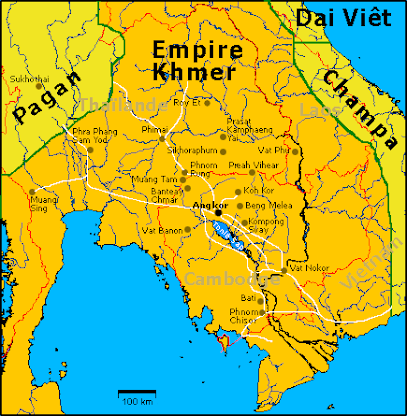
PHNOM PENH, Cambodia will submit the application form to list 12th century Banteay Chmar temple as World Heritage Site with the heritage committee of UNESCO soon, the local media reported on Sunday.
"Listing of the temple is aiming at conservation of the heritage site and its value is humanitarian heritage," according to khmer language newspaper Kampuchea Thmey Daily.
It added that Cambodia delegation led some experts from UNESCO,and delegation from Foundation for World Heritage to visit the temple on Saturday.
The temple located in Banteay Mean Chey province, about 60 km distance in northern area of provincial town.
Cambodia has already registered Angkor Wat temple, Royal Ballet, Khmer shadow theater and Khmer temple Preah Vihear as World Heritage Sites.
Read more!
Cambodia: Law On The Statute Of Judges
Press Release: Asian Human Rights Commission
Cambodia: Law On The Statute Of Judges, Not Their Retirement, Is The Right End From Which To Tackle Judicial Reform
Last June the Cambodian government ignored the jurisdiction of the nomination and discipline of judges and prosecutors of the Supreme Council of the Magistracy (SCM) when it bypassed the court and got the King, who is chairman of this supreme judicial council, to retire and replace half of the eight SCM members. The retired members were Ouk Vithun, Prosecutor General of the Supreme Court, 62, an ex-officio member; Henrot Raken, 68, Prosecutor General of the Appeal Court, another ex-officio member; Khieu Sameth, 62, President of Kandal Provincial Court, an appointed member; and Sin Dim, 66, President of Preah Sihanouk Provincial Court, another appointed member.
The government’s infringement upon the SMC’s jurisdiction is unconstitutional as it violated the independence of the judiciary of which the SCM is an integral part. Apparently the government was not happy with the lack of the SMC’s swift disciplinary action against a provincial prosecutor whose alleged faults had been widely reported in the press.
Perhaps more importantly, the government was not happy with the SCM when the latter had not retired the judges and prosecutors it had proposed. The SCM had its own reasons for not heeding the government’s proposal. It wanted to uphold its independence and exercise its authority over the nomination and discipline of judges and prosecutors.
Even more importantly, there was no law on the statute of judges and prosecutors which should set the retirement age for them. The government has not yet enacted this long overdue law and also the law on the organization of the judiciary when the country‘s Constitution has specifically stipulated the need to enact both laws since 1993. Like the law on the statute of civil servants and the law on the statute of members of the armed forces, which have not been specifically stipulated in the Constitution and which had both been enacted in the mid-1990s, this law on the statute of judges and prosecutors would determine, among other things, the age of retirement for judges and prosecutors. Without this law, the SCM would have no legal basis to retire judges and prosecutors.
The SCM did not comply with a government decree (not a law) which has been echoed by subsequent government circular letters and which fixes the retirement age of 60 for judges and prosecutors when this decree was based on no law on the statute of judges and prosecutors. This inaction has led the government to accuse the SCM of defending certain members of the judiciary who have wished to remain in active service.
Now with a new composition more amenable to the government’s wishes, the SCM sets out to retire some 27 elder judges and prosecutors, retirement which some have seen as part of the long overdue judicial reform.
However, the retirement of the four members of the SCM in June and the planned retirement of a big batch of judges and prosecutors are but palliatives to defuse mounting pressure for judicial reform. These measures have tackled this reform at the wrong end and have in no way come to address the real issue of the legal foundation of Cambodia’s entire judiciary. They have further violated the constitutional principle of the separation of powers, judicial independence and consolidated the executive control of the judiciary.
If the government is not happy with the functioning of the SCM, the Prime Minister should raise the issue with the King who is its chairman when he has an audience with him twice a month (Art.20 of the Constitution). The government should not delay any further the enactment of the law on the statute of judges and prosecutors and the law on the organization of the judiciary so that judges and prosecutors, who belong to the same body of magistrates, would have proper legal status, which they don’t have at the moment, and all courts of law would be duly established by law, which they are not at the moment. Everyone would thus be entitled to be tried by an independent, competent and impartial tribunal established by law, a right which is specifically stipulated under Article 14 of the International Covenant on Civil and Political Rights to which Cambodia is a party.
The government cannot apply the law on the nomination of judges and on the functioning of courts of law enacted in the communist days, prior to the promulgation of the current Constitution, and any decree enacted thereof when they are not among the “Laws and standard documents in Cambodia that safeguard State properties, rights, freedom and legal private properties and in conformity with the national interests, (which) shall continue to be effective until altered or abrogated by new texts” under the transitional article 158 of the current Constitution.
The absence of the law on the statute of judges and prosecutors poses a big problem of legitimacy for the composition of the SCM itself whose three judge members should be elected by their peers, an election which has been held up for 16 years, which is too long. The lack of the legitimacy of the composition of the SCM in turn questions the legitimacy of the composition of the country’s Constitutional Council which is a sort of a constitutional court, whose three members are appointed by the SCM.
The Asian Human Rights Commission (AHRC) urges the Cambodian government to prioritise the building of the legal foundation and framework of the country’s entire judiciary, its organization and the status of judges and prosecutors by enacting the law on their statute, including their retirement age, in tandem with the law on the organisation of the judiciary, two of the important laws that are specifically stipulated in the country’s constitution. This is the right end from which it should tackle judicial reform in Cambodia.
About AHRC: The Asian Human Rights Commission is a regional non-governmental organisation monitoring and lobbying human rights issues in Asia. The Hong Kong-based group was founded in 1984.
Read more!
ASEAN turns 42, looks to the future
The Association of Southeast Asian Nations celebrated its 42nd anniversary Friday with a series of activities highlighting more than four decades of strong regional cooperation. In Korea, the ASEAN Committee in Seoul, held a flag-raising ceremony and reception at the Malaysian embassy on Aug. 7.
Participants included Korean government officials, members of the National Assembly, the private sector, academia and the media.
"With its 42nd birthday, ASEAN looks towards deeper integration as it seeks to build an ASEAN Community by 2015, which will further unite its combined population of 560 million and land area of 4.48 million square kilometers," Malaysian Ambassador and chair of the ASC Dato' Ramlan Bin Ibrahim.
"The ASEAN Charter, ratified by all ASEAN members, will act as the firm foundation in ASEAN's move to become a rules-based, people-oriented and integrated entity."
Externally, Ramlan said that ASEAN aims to further intensify regional ties and enhance people-to-people exchanges through forward-looking projects and closer networks with regional partners.
"ASEAN continues to forge ahead in its relationship with its 10 dialogue partners" (Australia, Canada, China, European Union, India, Japan, Korea, New Zealand, Russia and the United States).
Korea recently hosted the ASEAN Commemorative Summit on Jeju Island at the beginning of June to celebrate 20 years of dialogue partnership.
In cementing closer ties between the two entities, the meeting also sought to further expand cooperation in new areas, including green technology.
Founded in 1967 to promote political cooperation among stakeholders, ASEAN has expanded to include more member countries and more areas of cooperation in diverse sectors such as trade, security and development.
It is composed of Brunei, Cambodia, Indonesia, Laos, Malaysia, Myanmar, the Philippines, Singapore, Thailand and Vietnam.
Malaysia is the current chairman of the ASEAN Committee in Seoul.
Read more!
Experts gather in Bali to discuss fight against AIDS
NUSA DUA, INDONESIA — Experts from 65 nations gather in Indonesia Sunday to assess progress in the battle against HIV (human immunovirus)/AIDS (acquired immune deficiency syndrome) amid concern only a quarter of those in need in Asia and the Pacific are getting treatment.
The International Congress on AIDS in the region, which will be opened by President Susilo Bambang Yudhoyono on the resort island of Bali, will look at how to ensure "universal access" to anti-retroviral treatment, congress chairman Zubairi Djoerban said.
He said that only 25% of the 1.7 million of people with HIV/AIDS in the Asia-Pacific who need the treatment are receiving it.
"We’re still far away from our target," he said. "We’re not talking 100%, which is the ideal. If Latin America can treat 62% of sufferers there, we should strive towards that."
An estimated five million Asians are living with HIV, especially in southeastern countries such as Thailand, Cambodia, the Philippines and Indonesia, according to a UN report released last year.
The congress, which runs until Thursday, will also serve to demand commitment from governments to tackle the disease that killed 380,000 people across Asia in 2007, Mr. Djoerban said.
"We ask for commitment from the countries to achieve the targets they have set and if they say they can’t, we’ll discuss new efforts to help them reach their goals," he added. "We can discuss prevention and treatment but with no leadership and commitment from countries and the community, we won’t achieve much."
While there are some bright spots in the region, such as Cambodia, where HIV prevalence has declined through condom use, new infections are growing steadily in populous countries such as Bangladesh and China, the UN report said. — AFP
Read more!
Saturday, August 08, 2009
Shipping service resumes in south China strait
HAIKOU, Shipping services across south China's Qiongzhou strait resumed Saturday afternoon as tropical storm Goni churned southward.
The maritime affairs bureau of island province Hainan ordered the resumption at 1:30 p.m. About 1,000 passengers stranded on the island by the storm are leaving.
Ferry and passenger liner services were suspended in the strait separating Hainan island and the mainland of China at 11 p.m. Thursday.
Goni, the seventh storm to hit China this year, was 19.2 degrees north and 108.3 degrees east at 10 a.m. Saturday, 30 kilometers from Dongfang City in the west of Hainan.
Packing winds of 65 kilometers per hour, it was moving southwestward at a speed of five kilometers an hour and was likely to land on the island within 10 hours, said the island's meteorological station.
Goni has already brought heavy rain to the island, affecting more than a million people and inflicting a direct economic loss of 185.7 million yuan (about 27.3 million U.S. dollars).
One thousand, two hundred people were evacuated in the island's Lingao county while rescuers are trying to help a further 5,000 surrounded by floodwaters in Haiwei township, Changjiang county.
A drowned fisherman's body has been found while nearly 100 crew members of ships from Cambodia, Vietnam and China are missing in heavy seas around the island.
Xie Chunfu, an official with the Hainan Province's bureau of maritime affairs, said 21 people from foreign-registered ships had been rescued.
Read more!
ASEAN commemorates 42nd anniversary with environment issue
JAKARTA (Xinhua) - The Association of Southeast Asia Nations (ASEAN) commemorated its 42nd anniversary with theme of "Green Asia" to reflect its care about environment that has been deteriorated by climate change, the association's chief said here yesterday.
"Today, we commemorate our 42nd anniversary, to commemorate achievements of we made to our people and the world's, just what our founding fathers wanted," said Surin Pitsuwan, the association's secretary general in his opening speech.
He said that climate change has been the top agenda of many countries, governmental bodies, inter-governmental summits et cetera.
"That's why we choose the topic for our commemorations' theme today," he said.
According to Surin, ASEAN is the home for so many species of flora and fauna that do not exist in other part of the world.
"ASEAN is just 3 percent part of the Earth but we have 20 percent of plants, animals, and marine species of the world's total," Surin said, adding that ASEAN contributed so much oxygen even though it emits much carbon dioxide too.
He said that making more comfortable and more livable Earth is the world's responsibility by preserving green environment.
According to Surin, all across ASEAN and the world that have ASEAN committee is commemorating the anniversary on Saturday.
"In London, Tokyo, Beijing, Brazil, for example, they are commemorating this anniversary. In fact, I just received messages from Moscow and Washington that they are commemorating this event, even though it's still early there," he said.
ASEAN consists of countries located in the Southeast Asia region, namely Indonesia, Brunei Darussalam, Malaysia, the Philippines, Cambodia, Lao PDR, Myanmar, Singapore, Thailand and Vietnam.
According to the association's data in 2007, ASEAN has 576 million populations who lived on 4.5 million square meters. The countries have combined gross domestic product (GDP) of 1,282 trillion U.S. dollars with total trade of 1.616 trillion dollars.
Read more!
Friday, August 07, 2009
Downturn pushes exporters to eye Cambodia
Sai Gon Giai Phong Newspaper
As the wheels of Vietnam’s export machine to the U.S. and Europe begin to slow, local shippers are turning their attention to the often overlooked neighboring market of Cambodia.
Nguyen Thi Hong, deputy chairwoman of the Ho Chi Minh City’s People’s Committee, told Sai Gon Giai Phong (Sai Gon Liberated) newspaper, the city’s total export turnover last month fell by 13.9 percent from the same period last year.
But it was a very different story in impoverished Cambodia. During the same stretch, exports from Vietnam soared 44 percent over July last year, she said.
Cambodia, home to 14 million people and one of Southeast Asia’s poorest countries recorded average economic growth of ten percent from 2004 to 2008. Much of that progress can be tracked back to the UN-backed Paris Peace Accord between the government and Khmer Rouge in 1994.
The country has opened up a great deal since then and today the free market is king.
Between Vietnam and Cambodia - which have often had a turbulent relationship - two-way trade has risen on average by 40 percent annually over the past few years, from US$935 million in 2006 to $1.2 billion in 2007 and nearly $1.7 billion in 2008.
Made-in-Vietnam goods have also gained a foothold in Cambodia through fairs and trade events held in the country.
About three years ago, Vietnam was the third largest exporter to Cambodia after China and Thailand. At present, Vietnamese exporters are offering a wide range of products in Cambodia, from construction materials to consumer goods and household appliances.
Tran Huu Duc, public relations director of Vietnamese food producer Dong Tam Nutrition Food Joint-stock Co. (Nutifood), said his company’s dairy products for the elderly are hugely popular in the country.
But in a possible case of the chickens coming home to roost, most Vietnamese exporters are still unable to gain a better foothold in the market as distribution networks in the country are firmly in the hands of Cambodian firms.
Red tape and fierce competition from Chinese and Thai imports are also among the obstacles for Vietnamese businesses to further explore the neighboring market.
Ho Chi Minh City-based multi-service Saigon Trading Group (SATRA) is working on a plan to build a duty free supermarket chain at the Moc Bai and Tinh Bien border gates between the two countries, Hong said.
A number of warehouses designed for Vietnamese goods will also be set up at Vietnam-Cambodia border gates to help Vietnamese exporters save transportation costs.
Satra is also teaming up with Cambodian business conglomerate Sokimex Group to build a supermarket for Vietnamese products in the country and provide Cambodian language courses for Vietnamese businessmen.
Read more!
Two dead as Typhoon Morakot slams into Taiwan
Taipei, Typhoon Morakot hit Taiwan Friday, leaving at least two people dead, four missing and four foreign ships grounded off its coast.
A woman walking in Keelung, northern Taiwan, was swept into the sea and drowned, and a woman cyclist drowned after winds swept her and her bicycle into a flooded ditch.
Four fishermen are listed as missing after their fishing boats overturned in choppy seas and they fell overboard, local television reports said.
Dozens of Taiwanese were injured after being hit by falling objects or when their motorbikes were blown over, according to the Broadcasting Corporation of China.
The typhoon also grounded four foreign ships, two from Cambodia, one from Indonesia and one from the Marshall Islands, the Transport Ministry said.
President Ma Ying-jeou warned the public to remain on guard as the rainfall may continue and increase. He urged islanders to stay home to prevent accidents outdoors.
Morakot, the strongest typhoon to hit Taiwan this year, formed over the Pacific Ocean earlier this week. It brought strong winds and torrential rains to Taiwan Thursday and Friday.
By 10 p.m. (1400 GMT) Friday, the eye of the typhoon was 40 km southeast of Hualien on the east coast.
Moving at 11 km per hour (kmph) in a northeasterly direction, it was packing centre winds of 144 kmph and gusts of 180 kmph.
If it maintains its course and speed, Morakot is expected to cross the Taiwan Strait and slam into China’s southeast coast Saturday night or Sunday morning, the Central Weather Bureau said.
Morakot however is expected to weaken after crossing Taiwan.
The typhoon cut off power to about half a million homes and paralyzed Taiwan’s road and air traffic.
On Friday, 144 domestic flights and 255 international flights were cancelled while several takeoffs were delayed.
Taiwan has declared Friday a “typhoon holiday” to prevent typhoon-related accidents. Several counties and cities said they will continue to have a typhoon holiday Saturday despite Morakot’s expected departure.
Read more!
Cambodia records 24 flu A(H1N1) cases
PHNOM PENH, Cambodian health ministry announced on Friday that it has confirmed 24 cases of A(H1N1) influenza in the kingdom.
"The two latest cases are a 22-year-old Khmer girl and a 38-year-old Australian man," said Sok Touch, director of communicable disease control department of Health Ministry.
"The Australian man is the father of a girl who was tested positive for the flu," he said.
"They are in stable condition and are recovering after treatment."
Nobody has died so far in Cambodia, according to Sok Touch. He said, "Cambodia will not hide the number of infected people or dead people. Everything is transparent."
"Cambodia has been trying to prevent the spread of the flu and strengthening the tracking system at airports and international border gates," he said, calling the local people to protect themselves from the flu.
"The most important thing," Sok Touch stressed, "is that the local residents should have to protect themselves." (PNA/Xinhua) FFC/ebp
Read more!
UTSA collaborates with Cambodian universities on research, teaching, study abroad
By Kris Rodriguez
(Aug. 7, 2009)--In an effort to extend global outreach, UTSA President Ricardo Romo signed agreements with two Cambodian universities, which will allow faculty and students from the three universities to collaborate in research, teaching and participation in study abroad programs.
"I think it's really important for our students to get to know the rest of the world," said Romo. "We would be left behind if we didn't try to be a bit more proactive in setting up programs that would allow the students to see other parts of the world. We need to take advantage of these kinds of connections with other universities and let our students reap the benefits of those kinds of networks."
One memorandum of understanding is with Royal University of Phnom Penh (RUPP), Cambodia's first and largest university. After opening in 1960, it was shut down from 1975 to 1979, along with all other schools and universities, by the Khmer Rouge. The university reopened in 1980. The second agreement is with Pannasastra University, a prestigious private university opened in 2000 by Cambodian Americans who fled the country because of the genocide. They returned to their home country with advanced degrees and started the university.
The collaborative efforts began earlier this year when Wayne Wright, UTSA associate professor of bicultural-bilingual studies, traveled on a Fulbright Scholarship to teach at RUPP in the master of education program. Wright, who is fluent in Cambodian, chose the country in order to contribute to the rebuilding of the education system devastated by genocide and decades of civil war. Additionally, he was able to introduce his children to the Cambodian language, history and culture and reconnect with his wife's family who live near the capital.
"I'll be supervising five master's students on their theses at RUPP and finishing up a research project I started with one of the faculty members there," said Wright. "My hope is to find funding to support a big collaborative research project related to teacher training in Cambodia that can involve all three universities."
Read more!
Thursday, August 06, 2009
Greece: Teacher spends summer break schooling kids — in Cambodia
By Jessica Spies, staff writer
Greece Post
Greece, N.Y. — A local teacher will be able to add “reinforcing English skills of Buddhist monks” to her résumé after a trip to Cambodia this summer.
Greece resident Merrill Mey, a teacher at the Rochester City School District, is spending part of her summer vacation in Siem Reap, Cambodia, with the non-profit organization United Planet.
The organization provides volunteer experiences of up to a year in more than 50 countries.
“I’ve always wanted to do something different with my summers and I always wanted to travel,” said Mey, speaking before she left for Asia.
Earlier this month, Mey boarded a 25-hour flight to Siem Reap, a more developed area of Cambodia that houses one of the largest religious temples of the world. She is teaching English to Cambodian children during her two-week trip.
“A big part of United Planet is to bridge between two cultures,” Mey said. “Hopefully they can show me the great things about their area and I hope I can do the same.”
Once she returns, she plans on sharing the cultural lesson with her students.
Mey teaches first graders at John Walton Spencer School No. 16 on Post Avenue in the city.
She’ll teach the same group of students in second grade this coming school year.
Before the end of the school year in June, Mey taught her students a little bit about her summer trip.
“I showed them where Cambodia is on the map, what the land looks like and what the buildings look like over there,” she said.
Kimberly Lee, who has worked with Mey for eight years, said, “Although some of the students may not realize just how far away Cambodia is, they are all eager to give Miss Mey advice as to what games she should play with her new students.”
Lee said the trip is not only a professional experience for Mey, but a personal one as well.
“Through this opportunity, I believe Merrill will receive much more than she anticipates,” Lee said. “In addition, the students she teaches in Rochester will grow from this experience.”
Mey said is staying in a guest house, which is more like a hotel than the homes where most Cambodians live. She will, however, eat the same food the natives eat.
“I’m very adventurous with food, but very leery,” she said. “They tell you that canned food is your friend.”
As it’s a volunteer trip, Mey has to pay for her flight, supplies and her housing in Cambodia.
To be a part of Mey’s adventure, visit www.firstgiving.com/MerrillMey.
Read more!
U.S. Senate's Webb to visit Myanmar this month
WASHINGTON (Reuters) - U.S. Senator Jim Webb will visit Myanmar this month, the first member of Congress to travel to the southeast Asian country in more than a decade, his office said on Thursday.
Webb, who chairs a Senate subcommittee on East Asia and Pacific affairs, leaves on Sunday for a five-nation, two-week trip "to explore opportunities to advance U.S. interests in Burma (Myanmar) and the region," a statement from his office said.
A Vietnam war veteran and former U.S. Navy Secretary who speaks Vietnamese, Webb will also meet government representatives and industry leaders in Thailand, Laos, Vietnam and Cambodia, his office said.
U.S. lawmakers are pushing for the release of democracy leader Aung San Suu Kyi in Myanmar, but Webb, a Virginia Democrat, is not expected to see her during his visit, an aide to the senator said.
U.S. relations with Myanmar's military junta have been strained for years. In May, President Barack Obama extended for one year a ban on U.S. investment first imposed in 1997 because of the authorities' repression of the opposition. Last week, Obama renewed sanctions targeting imports from Myanmar.
Read more!