Cambodian King Norodom Sihamoni has agreed to accept a petition from the Norodom Ranariddh Party (NRP) for a royal pardon of its president with a jail term of 18 months, NRP official said on Saturday.
"This is a positive sign from the King for a royal pardon of Prince Norodom Ranariddh," NRP spokesman Muth Chanthan told Xinhua.
The King is expected to receive and send the petition to Prime Minister Hun Sen who should then consider a pardon of Ranariddh, he said, adding that the letter bears nearly 200,000 thumb-prints from the prince's supporters.
The Phnom Penh Municipal Court in March sentenced Ranariddh in absentia to 18 months in jail for breach of trust over the sale of the co-ruling Funcinpec Party's headquarters in the capital.
Before and after the sentence was made, he has stayed overseas in order to shun trouble and embarrassment.
He was ousted as Funcinpec President in October 2006 for neglecting party affairs and being unable to cooperate with, and later established NRP.
According to law, Ranariddh can't re-start his political life unless he completes two-thirds of his term or receives a royal pardon from the King.
Ranariddh once served as First Prime Minister of the Cambodian government and President of the National Assembly of Cambodia.
Source: Xinhua
Read more!

Monday, May 14, 2007
King agrees to accept petition for royal pardon of Cambodian prince

Cambodia celebrates 54th birthday of King Sihamoni
Cambodia on Monday celebrated the 54th birthday of King Norodom Sihamoni with a three- day public holiday and various posters erected on main boulevards to highlight the monarch's image.
According to the government's notice, the public holiday ran from Monday to Wednesday all over the kingdom.
Meanwhile, huge posters of the King could be seen near the Independence Monument, and above the front gates of the Royal Palace, the National Assembly and some ministries.
Major newspapers on Monday published stories and many rarely- seen file photos of the monarch.
They also printed full pages of blessing and admiration from senior government officials and close friends of the King.
On Saturday, a diplomatic team from the Chinese Embassy met the King at the Royal Palace to wish him happy birthday.
Sihamoni was chosen as Cambodia's monarch by the nine-member Royal Council in October 2004, after his father, former king Norodom Sihanouk, announced abdication. He is the second king for the Kingdom of Cambodia in its 60 years strong of history.
Sihamoni was born on May 14, 1953, in Phnom Penh, as son of Sihanouk and former queen Monineath.
Source: Xinhua
Read more!
Land grabs leave thousands destitute in Cambodia's heartland
 Land right advocate, turned back by corrupted police
Tieng Khov has only enough food to feed his family for the next few weeks -- leftovers from last year's harvest that were brought in before the bulldozers came to plough under his crops.
CHHOUK VILLAGE, Cambodia (AFP) - The 46-year-old says he is tired, but the anger has not gone out of him; like hundreds of families in this farming community in southwestern Cambodia, he suddenly lost everything to the Koh Kong Sugar Industry Company land concession that overtook his rice fields and orchard.
"We still have a surplus of crops from last year, but when that runs out, we will die," says Tieng Khov, who lost 17 hectares (42 acres) of land.
"They've killed the animals, they've threatened the people and they've stolen the land," he said.
Behind him the 9,700-hectare (24,000-acre) Koh Kong Sugar concession, one of the largest in Cambodia, stretches in an arc along the foot of some low hills, a vast gash of bare earth and smoking brush cuttings.
A moat has been dug around the border, and armed police stand guard, turning away the curious.
Koh Kong Sugar, one of at least 57 ventures awarded "economic land concessions" since 1992 under a plan to turn fallow fields into export crop plantations, is a glaring example of how Cambodia is being parcelled out to politically connected companies, land rights advocates said.
This "land grab," as the activists call it, has dispossessed tens of thousands and fuelled a growing anger at the government's disregard for its most vulnerable people, they said.
Most of those left homeless by land seizures are poor farmers or urban slum dwellers with little or no political leverage.
Only some are compensated for their losses and of those who do get money, few are paid anywhere near fair market value for land that is often re-sold for hundreds of dollars a square metre (yard).
"Almost no economic land concessions in Cambodia involve consultations with the residents in the communities," says one lawyer with the Community Legal Education Centre (CLEC).
"We can see that land grabbing has increased every day -- evictions, conflicts between the poor and the rich taking their land," said the lawyer, who asked that his name not be used.
 Land right lawyer Seng Sokhim(L) talked with poor victims
Land records were largely destroyed by the communist Khmer Rouge, which forced most of Cambodia's population onto vast collective farms during their rule in the late 1970s.
In the chaos that followed the regime's overthrow in 1979, people simply occupied whatever land was available, and many remain where they settled at that time.
While Cambodia's 2001 land law allows people to keep land that they have worked for five years without dispute, few have obtained full title.
As land values rise sharply, they are falling prey to those with the money to buy up as much property as possible and the power to flout land rights legislation.
"The government created many institutions to resolve these problems. But none of these institutions work," CLEC's lawyer says.
Some have tried to fight these seizures in court, but few have any trust in Cambodia's notoriously inept judiciary.
"We filed papers already to sue the company, but frankly there is no action. The courts are very corrupt -- I have no idea what the outcome will be," said Tieng Khov.
More often, farmers and villagers are forced to directly confront those taking away their farms, sometimes with disastrous results.
When the Koh Kong Sugar bulldozers came to tear up their farms, all the villagers here could do was shout, said Sim Men
"It did no good. We stood and yelled but then armed police came down," the 25-year-old says. "I was visited by armed men and told to sell my land."
Since then, any cattle or buffalo caught wandering onto company land have been shot and their owners fined as much as 100 dollars for the "infraction," she said.
"I used to hear the sound of guns and I was very scared," she said, explaining that her family of six used to be able to survive on the 250 dollars they earned each year from their cashew and mango farms.
"I hear the company is coming to take my home -- right now I am in limbo," she said as she sat near the deep ditch that now keeps her from her old farm.
Guards working for Koh Kong Sugar had also opened fire last year on a crowd of villagers trying to stop the bulldozers, wounding several in the legs, said Tieng Khov.
Cambodian senator Ly Yong Phat, who owns Koh Kong Sugar, conceded that guards had acted too forcibly.
"I do not know why they opened fire," he told AFP. "We told the company to avoid this kind of problem again."
While he said "we cannot give the land back," Ly Yong Phat explained the company had set up a committee to try and deal with the farmers' complaints.
"But I don't know how much progress they have made so far," he said.
Land disputes elsewhere have been worse. The eviction of thousands of Cambodians from a slum in the capital Phnom Penh last June sparked riots, and a standoff in the northwestern border town of Poipet ended in the deaths of at least six people in 2005.
Rights groups say they received more than 100 land rights complaints last year alone.
The rising violence has alarmed international observers and the government alike.
UN envoys have repeatedly said that land disputes would destabilise the fragile country, while Hun Sen, who earlier warned of a "farmers' revolution" over land grabbing, has vowed to punish officials involved in illegal land deals.
But critics say the prime minister is merely paying lip service to the issue -- only two officials so far have been forced to relinquish land -- and that more concrete steps are needed before the government's steps against land grabbing are taken seriously.
"The government itself has recognised the ill effects of concessions, so they need to take immediate action to stop granting them," said CLEC's lawyer.
But even a suspension of concessions would do little for people like those in Chhouk and surrounding villages who have been left destitute by Koh Kong Sugar.
"Hun Sen does not know the real situation -- I'd like to ask him to come down and see the true situation for himself," said Tieng Khov.
©AFP
Vietnamese businesses get a little Seoul
by Le Hung Vong
Major foreign companies have been visiting Viet Nam for years, but now major Vietnamese companies have begun to seek opportunities abroad.
A delegation led by deputy PM Nguyen Sinh Hung with representatives of 100 companies will visit South Korea from May 21 to 24 during the Viet Nam Days in South Korea to be held by the Viet Nam Chamber of Commerce and Industry (VCCI).
The delegation includes representatives of major companies in the oil and gas, telecommunications, coal and mineral, and shipbuilding sectors. They aim to attract direct and indirect investment from South Korea to Viet Nam.
VCCI general secretary, Pham Gia Tuc, said Korean and Vietnamese security companies were expected to sign significant new agreements during the trip.
So far Viet Nam has suffered a deficit in two-way trade with South Korea. According to figures from the Ministry of Trade, in 2005 Viet Nam’s exports to South Korea totalled US$0.7 billion while its imports from RoK amounted to $3.43 billion. Tuc said these imports from South Korea included equipment and materials for production lines in Viet Nam that specialise in exports.
By the end of 2006, Viet Nam had licensed 1,263 FDI projects with a total investment of $7.8 billion by Korean companies. In 2006 alone, Korean companies were licensed for 203 projects capitalised at $2.4 billion.
Eye on Cambodia
Facing competition in the do-mestic market, some companies in HCM City have begun to look into the neighbouring market of Cambodia.
The Dong Thien Joint Stock Co, for example, has ceased its operation in Viet Nam to focus on a sand-exploitation project in Cambodia. It has set up a branch in Cambodia that will open in June.
The assistant to Dong Thien’s general director, Nguyen Phuc Son, said that the VND20 billion ($1.25 million) sand-exploitation project in Cambodia was the company’s biggest project to date.
Twenty-seven Vietnamese companies have opened branches and representative offices and invested in projects in Cambodia. The main fields of investment are health, agriculture, transport, telecoms, and hydropower production.
The Ministry of Planning and Inestment recently licenced the Si Gon Trade Corp (Satra) to form a joint-venture with the Sokimex Group to build major plants to process cashews and seafood, and to breed cows as well as construct a supermarket in Cambodia.
Four travel companies, the Sai Gon Mekong Joint-Stock Co, Saigontourist, Cho Lon Tourist and Fiditour, have cooperated with Cambodian partners to bring tourists from HCM City to Phnom Penh and Siem Reap by land, air and water.
The $10.5 million Cho Ray-Phnom Penh hospital project is also underway, in which the Sai Gon Health Investment Joint-Stock Co. is contributing two-thirds of the capital and Cambodian partners the remaining amount.
However, investment in Cambodia still faces difficulties. For example, a Build-Operate-Transfer (BOT) project to build a road from Phnom Penh to Cambodia’s international airport was cancelled at the last minute because of several problems, including site clearance. It was invested in by a joint-venture between the Viet Nga Infrastructure Investment Joint-Stock Co. and the Cambodian Mong Rethy Group.
Nguyen Van Hung, representative of a Dong Nai-based company that has a rubber plantation in Cambodia, said the company had to abandon the project because of site clearance problems.
Deputy director of the Tay Ninh Department of Planning and Investment, Tran Luu Quang, said companies investing in Cambodia also faced problems caused by Vietnamese authorities. He added that many companies in Tay Ninh wanted to grow cashews and cassavas in Cambodia but when they imported these products to Viet Nam they encountered problems at customs.
"Because of the high import tax rates and no preferential policies, many companies become discouraged and leave their projects unfinished," said Quang.
Japanese group plans resort
The Central Highlands prov- ince of Lam Dong has given the nod to a Japanese consortium to invest 100 billion yen ($831.4 million) in a luxury resort complex.
The Para Plan Joint-Stock Co, which includes four Japanese companies, Mitsui, Mitsubishi, Sumitomo and Limtec, plans to build the Dankia-Suoi Vang (Gold Stream) resort complex on a 5,100-ha area in Lac Duong District, some 22 km from the city of Da Lat.
The Japanese investors plan to turn the area outside Da Lat into an attractive urban town and a larg-scale complex of high-class resorts dubbed "Romantic Town"
However, the provincial authority has warned that if the consortium failed to submit its investment application after six months, the project would be taken off the table.
Lam Dong People’s Committee revealed that a French group proposed a 2 billion euro project for Dan Kia-Suoi Vang. But Chairman Huynh Duc Hoa said the province would wait to hear from the four Japanese groups who have pursued the project over the past three years.
Sun Wah looks skyward
The Hong Kong-based Sun Wah group is seeking a prime location for a second high-rise building in HCM City as part of its plan to expand business in Viet Nam, the group president said last week.
After his meeting with Le Hoang Quan, chairman of HCM City People’s Committee, Sun Wah President Jonathan Choi Koon-shum said Sun Wah planned to build another high-rise because the current one is fully occupied.
Sun Wah is currently the owner of the Sun Wah Tower in HCM City, and is also the developer of the $400 million Sai Gon Pearl residential-commercial complex. It is a key shareholder in the VinaCapital Investment Fund.
Choi said the company was seeking to hire consultants to list on the Vietnamese stock market this year. The group was also keen on investing in the new urban area of Thu Thiem in District 2 as well as a software park.
He said the group was also planning to build an industrial park and an eco-tourism complex in Ha Noi and Vinh Phuc Province.
Sun Wah Group, established in 1957, is a diversified conglomerate with businesses in areas related to seafood and foodstuffs, real estate, financial services, infrastructure, technology and media. The group began activities in Viet Nam in 1970.
Steel production slows
Imports of China-made steel have resulted in a sharp decline of steel production and consumption in the local market this year. According to figures from the Vietnamese Steel Manufacturers Association, the country’s steel production in April amounted to 248,979 tonnes, a decrease of 3 per cent compared with March and a year-on-year decrease of 14 per cent.
In the first four months of 2007, the association’s members produced 916,692 tonnes, an increase of 5.53 per cent compared with the same period last year. Consumption, however, decreased by 9.26 per cent over 2007.
Members such as Hoa Phat and Pomina had to halt their roll-steel production lines while others, such as Viet-Han and Vinakyoei, reduced their production by half because their products were less competitive than those imported from China.
Meanwhile, steel consumption in the local market was on the rise in April, amounting to 300,000 tonnes a month. According to the association, due to the pressure from ASEAN members and other countries, the Chinese Government abolished the refunding of the 8 per cent Value-Added Tax (VAT) on exported steel products from April 15, resulting in higher prices of exported steel from China, estimated at $35 or VND500,000 per tonne.
The association also said they would propose appropriate measures to defend their members’ production. — VNS
Read more!
Pisei Chea: Communication, Chemistry and Music

Chea, who is applying for fellowships to go to Cambodia and is an alternate for a Fulbright Scholarship, presented her senior thesis at two conferences: the 33rd Annual DePauw Undergraduate Honors Conference in March and The Theodore Clevenger Undergraduate Honors Conference last month.
Chea, 21, also has a personal connection to Cambodia as her parents are natives of the country. Although she has never been and her family hasn't visited Cambodia in the last 40 years, the Southeast Asian nation has a large influence on her life. After learning so much about the country and making it a part of her communication thesis, she plans to step on Cambodian soil for the first time in September, she said.
"I want to be able to do something about one of the biggest problems there: land mines and victims," Chea said.
Chea's other passion is community service. She has always been dedicated to helping others and finds that community service is one of her natural instincts. She is the president of Circle K, a community service organization at GW, and has been doing community service for most of her life, she said.
"Doing community service, I believe, brings a lot more to the person that's serving than the person that's being helped out," Chea said. "What keeps me going from week to week is the satisfaction it brings, or one more smile on another person's face or even inspiring others to do the same."
During her sophomore year, she combined her two passions and volunteered with the Cambodia Fund. She helped fundraise for land mine relief by selling highly valued paintings.
Before I volunteered there, they had sold about three of the prints," Chea said. "And by the time I was done, we had sold 10. It was such a unique experience."
Her passion for community service was rejuvenated during her internship at Discovery Communications, when she heard the former CEO Judith McHale speak at a luncheon. Chea distinctly remembers McHale's words: "We have to close the gap between what we do and what we know," Chea recalled.
"It struck me that that's exactly what needs to be done, and I realized that what she said made me want to close that gap," Chea said.
Eventually Chea wants to be able to take her passions to a creative level, relating it back to her communication major. She said she may go back to Discovery Communications or make her own documentaries about pressing global and social issues.
Chea is graduating from GW with magna cum laude honors. She is a member of multiple honor societies including Golden Key International Honor Society and Lambda Pi Eta, the national communication studies honors society.
Journalist who became a chronicler for modern Asia

Webb, who died yesterday at 64 after battling cancer, covered many of Asia’s seminal events of the last four decades with a keen eye for the real story and a rare empathy for the innocent victims of history.
In 1971, she became caught up in the turbulence herself when she was ambushed and taken prisoner by North Vietnamese troops in Cambodia.
She and five others were marched through the jungle in a 23-day ordeal during which she was reported killed, earning a front-page obituary in the New York Times.
“It was strange and embarrassing to see that,” said the soft-spoken Webb shortly before her death in Australia, her adopted homeland where she launched her journalism career in the early 1960s and retired nearly 40 years later.
She and the other captives were freed just as her family held a memorial service for her in Sydney.
The body of a young woman, found near the spot where she vanished during a firefight, had been wrongly identified as hers.
“It caused a bit of a stir at home,” Webb recalled a few years ago, her trademark beer and cigarette firmly in hand.
Her legend was minted in Vietnam, where she was one of only a few women to cover the war full-time and where her courage and reputation as a stickler for the facts earned her the unwavering respect of colleagues.
“Kate Webb was one of the earliest - and best - women correspondents of the Vietnam war,” said Pulitzer Prize-winning journalist Peter Arnett. “She was fearless as an action reporter, with a talent for the vivid phrase.”
Webb’s knack for being in hotspots at the right time, a fearsome wrath and her colourful bar-room antics became the stuff of folklore among fellow Asia hands who made their mark in the pre-Internet era.
Armed only with a notebook and typewriter, Webb covered the fall of Saigon in 1975, the rise of Cambodia’s Khmer Rouge, the assassination of India’s premier Rajiv Gandhi and the strife in East Timor.
She was also on hand for the ‘People Power’ ouster of Ferdinand Marcos in the Philippines, the Gulf War, the Soviet occupation and ensuing civil war in Afghanistan, the death of North Korean leader Kim Il-Sung in 1994 and Hong Kong’s handover to China.
“She was a pioneer for female reporters and a role model for all foreign correspondents. She was one of the legends,” said veteran AFP journalist Chris Lefkow, who covered the 1991 Gulf War with her.
Modest and intensely private, Webb chose the anonymity of wire journalism over other media.
Quietly probing, shy, tough, vulnerable, blunt, pithily funny and terrifying to those who crossed her, she preferred to tell the stories of ordinary people whose voices would not otherwise be heard.
“She was a classic war correspondent - chain-smoking, hard-drinking, foul-mouthed at times and always fearless,” said AFP’s Roberto Coloma, a long-time friend.
“But beneath that hard exterior was a tender, caring person. Kate always had a soft spot for the underdog.”
Webb was born in New Zealand in 1943 and moved to Australia at the age of eight when her father became a professor of political science in Canberra.
Death first shook Webb’s life when her parents were killed in a car crash when she was 18.
After studying philosophy at Melbourne University, she wanted to become an artist. Webb stumbled into journalism when she was forced to pay for a stained-glass window she shattered while working on it.
She landed a job as a secretary on Sydney’s Daily Mirror and soon became a cadet reporter.
At 23, she resigned, paid her own way to Saigon and wrangled a job as a freelancer for the United Press International wire service, where she would work for about 13 years.
Kitted out in khaki, the slight brunette covered two of the biggest battles of the war, including the 1968 Tet offensive, and witnessed much horror that would stay with her throughout her life.
In 1970, she became bureau chief in Phnom Penh after her boss and their photographer were killed.
After her captivity in 1971, which left her with two types of malaria that nearly killed her, Webb saw out the end of the Vietnam War, filing ceaselessly for 24 hours as the last Americans fled falling Saigon.
She joined AFP in Jakarta in 1985 and remained with the agency for 16 years, serving in Indonesia, India, Pakistan, Sri Lanka, Hong Kong, South Korea and Afghanistan.
She also undertook emergency assignments to other Asian nations until her retirement in 2001.
It was in Afghanistan, a country for which she held a special affection, that she had some of her closest shaves.
A furious militiaman turned on Webb following a rocket attack outside the Kabul Hotel and almost scalped her when he dragged her up the stairs by her long hair, tearing out a large clump. She escaped and spent much of the night hiding on a freezing balcony.
Webb later befriended an Afghan family that helped her out of another tight corner and helped them migrate to Australia, where she put the children through university.
She played down such characteristic generosity by saying people had given her big breaks and she was simply trying to reciprocate.
“She always felt closer to local people than to foreign journalists and operated in the nether parts of town where the cameras were not,” said Reuters correspondent Bill Tarrant, a friendly rival of Webb’s in Indonesia, India, Afghanistan and South Korea.
“She was one of a kind - formidable, irascible, self-deprecating and sometimes even insulting. She was an Annie Oakley type,” he said.
At the end, through the veil of pain that cancer brought, Webb was uncomplaining and remained fiercely witty.
When a nurse found her outside the hospital having a quiet cigarette and chided her with a warning that smoking was bad for her, Webb shot back cheerily: “Too late!” – AFP.
Sunday, May 13, 2007
Cambodian lessons

For the Appeal
May 13, 2007
By the time I'd entered Cambodia, I'd passed through a doorway.
Not of the physical type, nor the gateway to another country.
But a doorway of perception, where just beyond its threshold lay a new way of seeing.
I'd moved quickly across the landscape - 50 miles in three hours, nonstop.
That's when they'd made themselves known.
"Sok sa dai! Sok sa dai! (Hello! Hello!)," came the initial shouts from Cambodia's children. It was the first of a flood of many tiny greetings.
As I cycled through a succession of villages, they fled to the road by the hundreds. All of them seemingly waiting to greet the random cyclist. All of them running from simple huts, to the edge of the roadway, if just to hold out their hands or shout out welcoming calls of glee.
It was a scene I'd witnessed a thousand times throughout Southeast Asia. A scene, I might add, that I never tired of.
These tiny voices brought a kind of settling to my mind, and I welcomed them into my heart, as I did the falling rain.
Despite the rain, it was Cambodia's dry season, a time when the harvested rice fields gave way to a tannish-brown stubble. Near their edges stood simple stilted huts that were surrounded by a patchwork of small garden plots.
I'd cycled 105 miles that first day. A
 nd did so with a certain ease. This is how I spent my time. Pedaling through the hours, then days, until the days had turned into months. This for nearly two years. I no longer questioned it. It was simply what I did.
By midday next, I'd cycled upon the traffic-choked fringes of Cambodia's capital, Phnom Penh. Before I would navigate a tangle of intersections in the heart of the city, I would cross the Mekong one last time.
This before it flowed east, and branched like a watery sea fan through the delta lands of Vietnam.
I stopped for a moment on a small bridge to gaze out over its tea-colored waters.
When I did, my vision was hijacked by a riverside slum: a gathering of tin dwellings, and impossibly ill-constructed shacks. Catching a speck of movement from the corner of the scene, my eyes landed upon a young boy crouching above a small dirt drainage. He was evacuating his bowels into an open ditch. When he'd finished, he descended the garbage-filled slopes into the astoundingly polluted waters. There, he took his morning bath.
What I was observing was "extreme poverty," a termed coined by Jeffrey Sachs, (economic advisor to the secretary general of the United Nations).
During a recent interview about Cambodia on PBS, Sachs stated that this "extreme poverty" was "not the poverty of inconvenience, not the poverty of jealousy, not the poverty of wanting to catch up with one's neighbor. But the kind of poverty that threatens to take life. And not just threatens ... takes millions of lives (around the globe) from those too impoverished for an adequate diet, that are too impoverished to see a doctor, that are too impoverished to gain access to clean water that they need for survival."In short, he was talking about much the of poverty I'd observed for the last seven months.
Only this time I was done observing. This time, I'd come up with a plan.
Obviously I couldn't do everything for everyone, but I could do something, for someone. For me, that something meant spending a week volunteering to teach English to a group of impoverished rural children near Siem Reap.
Shortly thereafter, I stashed my bike, hopped on a bus, and made for the north-central city of Siem Reap, a city made famous by its proximity to the temples at Angkor Wat.
The volunteer program I would take part in was the brain child of Andy Booth.
Booth, a successful businessman who'd retired at age 37, was the founder of SAGE Insights, a full-service travel company whose proceeds are dedicated entirely to growing sustainable business in the region, and helping Cambodia's neediest children through educational and social projects.
Andy believes that "a lasting solution to poverty lies in providing the tools and knowledge to a population to help themselves."
I couldn't have agreed with him more.
A day later, I arrived at the Prey Chrouck School, 40 kilometers outside of Siem Reap.
The school consisted of 637 pupils, four toilets, no running water and no electricity. Most of the students were the impoverished children of subsistence farmers.
As I ducked beneath the 6-foot door frame into the classroom, all eyes widened.
"Goot monning teechaah!" they shouted in unison, after they'd jumped to their feet.
"Sok sa dai!" I bowed, greeting them with palms pressed together. This released a cascade of giggles. Their eyes began to race, setting off mumbles and murmurs around the room. My intuition told me that this was speculation. Speculation of whether the new teacher's-assistant was born of a giraffe, or more likely, about which of them was going to have to cut a hole in the ceiling to accommodate him.
With little time to waste, I went straight to it, driving home the hard work of spelling words like, "cat" and "pig." These were funkified foreign words to the native Khmer child, and they wobbled off their tongues like a row of stumbling ducks.
No sooner had we mastered those words, then we began busting out with a rendition of "Ol' MacDonald Had a Farm."
Although I'm sure they all wondered what an "Ol' MacDonald" was, when it came to the "meow, meow" here, and an "oink, oink" there part, there was instant recognition. And with this, the crowd went wild.
I finished out my short time at the school, assisting students, or performing simple tasks that included sharpening pencils, passing out papers or pinning the letters of the alphabet to the wall.
As dull as it sounds, I took pride in each tiny task.
All of it culminating into a small collection of memories of immeasurable pleasure.
When the students finally gathered to say goodbye, I reached out my hand.
Reluctant at first, they began reaching back. Before long, a small stampede moved in and began grasping, as if only to claim that they'd touched the freakishly tall stranger before he left.
• • •
Only a madman left Siem Reap without seeing the temples.
Though I'd have a hard time proving to anyone that I was actually sane, the next morning, just before sunrise, I grabbed my camera and jumped in a tuk-tuk bound for Angkor Wat.
Upon arrival, I witnessed my first spectacle.
It was not a temple, but the vision of my iPod music player after it had slid from my pocket, flew from the tuk-tuk, and skipped across the pavement at more than 20 mph. (The beginning of the end for iPod number 3.)
Scooping it from the road, I stepped into the first temple of Bayon. When I put on the headphones, I found the music player to be oddly stuck on Pink Floyd's "Dark Side of The Moon."
And thus began the other-worldly soundtrack that matched Angkor's mind-melting imagery with a type of immaculate seamlessness.
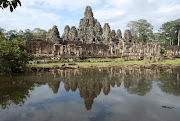
Racing the rising sun up a set of stairs, I was delivered to the foot of Bayon's 216 mammoth stone faces. I lifted my camera, and fired it like a submachine gun.
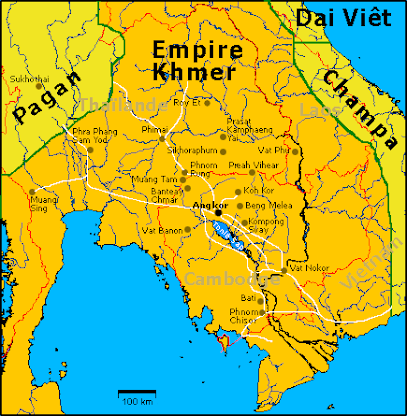
All of these temples (I'd learn later) began with King Jayavarman VII. Back in the day, he was literally "the man with the plan," who'd initiated the glory days of the former capital in about 1100 A.D.
Dedicated to the Hindu God Vishnu, then Buddha, Angkor Wat's name implies a virtual "Temple City." During its height, it was the largest city in the world, with over a million inhabitants.
Jayavarman got his architectural groove on by employing huge armies of Classic Khmer architects, all of whom became adept at utilizing sandstone as their three-dimensional canvas. Carefully carving this sandstone into countless structures, statues, murals and relics, these Khmer architects created such works of beauty that the thought of their original magnificence seemed fully capable of blowing a man's head clean off his shoulders.
In fact, had Jayavarman been alive today, surely he'd have a qualifications heading on his resume that read something like: "Building temples that have continuously blown minds for over 800 years." (Millions and millions served).
I finished my day, traipsing through the tree-enshrouded temples of Ta Prohm, and Prah Keah, then the main temple of Angkor Wat. By the end of the day, I had gazed upon such an extensive array of axial galleries, terraces, and towers that it left my feet achy and eyes crossed.
Through all of it came the crowds.
Hundreds of tourists pouring from buses, and marching throughout the temple grounds like battalions of army ants wearing matching shirts and shorts. They were joined by small roving platoons of children, who continuously pedaled postcards, trinkets or magically appeared to charge modeling fees at those picture perfect spots.
According to the Ministry of Tourism, Angkor Wat received a paltry 586 visitors in 1986. Today, that number is likely to exceed 700,000. Despite its crowds, Jayavarman's Angkor will be a multisensual experience that will forever be burned into my brain.
Siv encourages graduates to adapt

A former U.S. ambassador to the United Nations gave a lesson in adaptation to a group of Troy University graduates during the first of two commencement ceremonies on Friday.
Sichan Siv, a native of Cambodia, was nominated by President George W. Bush in October 2001 and was unanimously confirmed by the U.S. Senate as the 28th ambassador to the United Nations Economic and Social Council. From 2001 until recently, he represented the United States at the U.N. General Assembly and the U.N. Security Council.
From 1989 to 1993, Siv served as deputy assistant to the president for public liaison and deputy assistant secretary of state for South Asia affairs in the George H.W. Bush administration.
“The key to success is your ability to adapt,” Siv said to graduates during his keynote address. Siv learned about the need for adaptation as he fled Khmer Rouge rule of Cambodia in 1976, eventually starting a new life in America.
Siv said he escaped a forced labor camp by jumping off the back of a truck and fleeing to Thailand. In time, he made his way to Wallingford, Conn., where he was faced with trying to find his way in a country he knew little about.
Initially, Siv took odd jobs to get by - picking apples, working at an ice cream shop and flipping burgers, despite the fact he'd never seen a hamburger before.
“I remember once I stood there holding the lettuce because someone told me ‘hold the lettuce,'” Siv said.
In time, Siv made his way to New York City, where he continued working odd jobs until he earned a scholarship to Columbia University.
“I adapted myself to America,” Siv said.
Troy University Chancellor Jack Hawkins Jr. praised Siv's accomplishments in the face of adversity.
“He did not always enjoy the freedoms that come from being called an American ... but he has lived the American dream,” Hawkins said.
More than 500 students from 20 U.S. states and 12 nations received diplomas on Friday, which marked the first time the university has held separate commencement ceremonies for undergraduate and graduate students.
Hawkins said the dual commencements are a sign of the university's growth.
“We simply have too many graduates to place in this building at the same time,” Hawkins said.
The ceremony for students receiving undergraduate degrees started at 10:30 a.m., and the ceremony for graduate students began at 2 p.m. Both ceremonies were held in Sartain Hall.
New Light on U.S. Air War in Cambodia
United States bombings in Afghanistan have "given a propaganda windfall to the Taliban." [1] Is history repeating itself? In 1975, Pol Pot's genocidal Khmer Rouge forces took power in Cambodia after a massive U.S. bombing campaign there. New information reveals that Cambodia was bombed far more heavily during the Vietnam War than previously believed -- and that the bombing began not under Richard Nixon, but under Lyndon Johnson.
In the fall of 2000, 25 years after the end of the war in Indochina, Bill Clinton became the first U.S. president since Richard Nixon to visit Vietnam. While media coverage of the trip was dominated by talk of some 2,000 U.S. soldiers still classified as missing in action, a small act of great historical importance went almost unnoticed. As a humanitarian gesture, Clinton released extensive Air Force data on all American bombings of Indochina between 1964 and 1975. Recorded using a groundbreaking IBM-designed system, the database provided extensive information on sorties conducted over Vietnam, Laos, and Cambodia.
Clinton's gift was intended to assist in the search for unexploded ordnance left behind during the carpet bombing of the region. Littering the countryside, often submerged under farmland, this ordnance remains a significant humanitarian concern. It has maimed and killed farmers, and rendered valuable land all but unusable. Development and de-mining organizations have put the Air Force data to good use over the past six years, but have done so without noting its full implications, which turn out to be staggering.
The Bombing Database

The still-incomplete database (it has several "dark" periods) reveals that from October 4, 1965, to August 15, 1973, the United States dropped far more ordnance on Cambodia than was previously believed: 2,756,941 tons' worth, dropped in 230,516 sorties on 113,716 sites. Just over 10 percent of this bombing was indiscriminate, with 3,580 of the sites listed as having "unknown" targets and another 8,238 sites having no target listed at all. Even if the latter may arguably be oversights, the former suggest explicit knowledge of indiscretion. The database also shows that the bombing began four years earlier than is widely believed -- not under Nixon, but under Lyndon Johnson. The impact of this bombing, the subject of much debate for the past three decades, is now clearer than ever. Civilian casualties in Cambodia drove an enraged populace into the arms of an insurgency that had enjoyed relatively little support until the bombing began, setting in motion the expansion of the Vietnam War deeper into Cambodia, a coup d'etat in 1970, the rapid rise of the Khmer Rouge, and ultimately the Cambodian genocide. The data demonstrates that the way a country chooses to exit a conflict can have disastrous consequences. It therefore speaks to contemporary warfare as well, including U.S. operations in Afghanistan and Iraq. Despite many differences, a critical similarity links the war in Iraq with the Cambodian conflict: an increasing reliance on air power to battle a heterogeneous, volatile insurgency.
"We heard a terrifying noise which shook the ground; it was as if the earth trembled, rose up and opened beneath our feet. Enormous explosions lit up the sky like huge bolts of lightning; it was the American B-52s."
--Cambodian bombing survivor, Kampong Thom
The Kampong Thom Bombings

On December 9, 1970, U.S. President Richard Nixon telephoned his national-security adviser, Henry Kissinger, to discuss the ongoing bombing of Cambodia. This sideshow to the war in Vietnam, begun in 1965 under the Johnson administration, had already seen 475,515 tons of ordnance dropped on Cambodia, which had been a neutral kingdom until nine months before the phone call, when pro-U.S. General Lon Nol seized power. The first intense series of bombings, the Menu campaign on Vietnamese targets in Cambodia's border areas -- which American commanders labeled Breakfast, Lunch, Supper, Dinner, Dessert, and Snack -- had concluded in May, 1970 shortly after the coup.
Nixon was facing growing congressional opposition to his Indochina policy. A joint U.S.-South Vietnam ground invasion of Cambodia in May and June of 1970 had failed to root out Vietnamese Communists, and Nixon now wanted to covertly escalate the air attacks, which were aimed at destroying the mobile headquarters of the Viet Cong and the North Vietnamese Army (vc/nva) in the Cambodian jungle. After telling Kissinger that the U.S. Air Force was being unimaginative, Nixon demanded more bombing, deeper into the country: "They have got to go in there and I mean really go in ... I want everything that can fly to go in there and crack the hell out of them. There is no limitation on mileage and there is no limitation on budget. Is that clear?"
Kissinger knew that this order ignored Nixon's promise to Congress that U.S. planes would remain within thirty kilometres of the Vietnamese border, his own assurances to the public that bombing would not take place within a kilometre of any village, and military assessments stating that air strikes were like poking a beehive with a stick. He responded hesitantly: "The problem is, Mr. President, the Air Force is designed to fight an air battle against the Soviet Union. They are not designed for this war ... in fact, they are not designed for any war we are likely to have to fight."
.
"Anything that flies, on anything that moves"
Five minutes after his conversation with Nixon ended, Kissinger called General Alexander Haig to relay the new orders from the president: "He wants a massive bombing campaign in Cambodia. He doesn't want to hear anything. It's an order, it's to be done. Anything that flies, on anything that moves. You got that?" The response from Haig, barely audible on tape, sounds like laughter.
The U.S. bombing of Cambodia remains a divisive and iconic topic. It was a mobilizing issue for the antiwar movement and is still cited regularly as an example of American war crimes. Writers such as Noam Chomsky, Christopher Hitchens, and William Shawcross condemned the bombing and the foreign policy it symbolized.
In the years since the Vietnam War, something of a consensus has emerged on the extent of U.S. involvement in Cambodia. The details are controversial, but the narrative begins on March 18, 1969, when the United States launched the Menu campaign. The joint U.S.-South Vietnam ground offensive followed. For the next three years, the United States continued with air strikes under Nixon's orders, hitting deep inside Cambodia's borders, first to root out the Viet Cong (VC)/North Vietnam Army (NVA) and later to protect the Lon Nol regime from growing numbers of Cambodian Communist forces. Congress cut funding for the war and imposed an end to the bombing on August 15, 1973, amid calls for Nixon's impeachment for his deceit in escalating the campaign.
The Secret Bombing of 1965
Thanks to the Air Force database, we now know that the U.S. bombardment started three-and-a-half years earlier, in 1965, under the Johnson administration. What happened in 1969 was not the start of bombings in Cambodia but the escalation into carpetbombing. From 1965 to 1968, 2,565 sorties took place over Cambodia, with 214 tons of bombs dropped. These early strikes were likely designed to support the nearly 2,000 secret ground incursions conducted by the CIA and U.S. Special Forces during that period. B-52s -- long range bombers capable of carrying very heavy loads -- were not deployed, whether out of concern for Cambodian lives or the country's neutrality, or because carpet bombing was believed to be of limited strategic value.
Nixon decided on a different course, and beginning in 1969 the Air Force deployed B-52s over Cambodia. The new rationale for the bombings was that they would keep enemy forces at bay long enough to allow the United States to withdraw from Vietnam. Former U.S. General Theodore Mataxis depicted the move as "a holding action ... The troika's going down the road and the wolves are closing in, and so you throw them something off and let them chew it." The result was that Cambodians essentially became cannon fodder to protect American lives.
The last phase of the bombing, from February to August 1973, was designed to stop the Khmer Rouge's advance on the Cambodian capital, Phnom Penh. The United States, fearing that the first Southeast Asian domino was about to fall, began a massive escalation of the air war -- an unprecedented B-52 bombardment that focused on the heavily populated area around Phnom Penh but left few regions of the country untouched. The extent of this bombardment has only now come to light.
Exceeding the World War II Payload
The data released by Clinton shows the total payload dropped during these years to be nearly five times greater than the generally accepted figure. To put the revised total of 2,756,941 tons into perspective, the Allies dropped just over 2 million tons of bombs during all of World War II, including the bombs that struck Hiroshima and Nagasaki: 15,000 and 20,000 tons, respectively. Cambodia may well be the most heavily bombed country in history.
A single B-52d "Big Belly" payload consists of up to 108 225-kilogram or 42 340-kilogram bombs, which are dropped on a target area of approximately 500 by 1,500 metres. In many cases, Cambodian villages were hit with dozens of payloads over the course of several hours. The result was near-total destruction. One U.S. official stated at the time, "We had been told, as had everybody ... that those carpetbombing attacks by B-52s were totally devastating, that nothing could survive." Previously, it was estimated that between 50,000 and 150,000 Cambodian civilians were killed by the bombing. Given the fivefold increase in tonnage revealed by the database, the number of casualties is surely higher.
The Cambodian bombing campaign had two unintended side effects that ultimately combined to produce the very domino effect that the Vietnam War was supposed to prevent. First, the bombing forced the Vietnamese Communists deeper and deeper into Cambodia, bringing them into greater contact with Khmer Rouge insurgents. Second, the bombs drove ordinary Cambodians into the arms of the Khmer Rouge, a group that seemed initially to have slim prospects of revolutionary success.
Pol Pot himself described the Khmer Rouge during that period as "fewer than five thousand poorly armed guerrillas ... scattered across the Cambodian landscape, uncertain about their strategy, tactics, loyalty, and leaders."
Years after the war ended, journalist Bruce Palling asked Chhit Do, a former Khmer Rouge officer, if his forces had used the bombing as anti-American propaganda. Chhit Do replied:
"Every time after there had been bombing, they would take the people to see the craters, to see how big and deep the craters were, to see how the earth had been gouged out and scorched ... The ordinary people sometimes literally shit in their pants when the big bombs and shells came. Their minds just froze up and they would wander around mute for three or four days. Terrified and half crazy, the people were ready to believe what they were told. It was because of their dissatisfaction with the bombing that they kept on co-operating with the Khmer Rouge, joining up with the Khmer Rouge, sending their children off to go with them ... Sometimes the bombs fell and hit little children, and their fathers would be all for the Khmer Rouge."
A Cambodian witness responded to an earlier publication of this article by writing:
"I could not agree with you more based on my experiences during the bombing in Takeo around 1972. The bombings were [spreading] further into towns and villages. My parents' house was hit by the bombs, and we had to move to the opposite side of the country. We had known [that] almost the entire village that survived from the bombings had joined forces with the Khmer Rouge."
"They are murderous thugs, but we won't let that stand in our way"
The Nixon administration kept the air war secret for so long that debate over its impact came far too late. It wasn't until 1973 that Congress, angered by the destruction the campaign had caused and the systematic deception that had masked it, legislated a halt to the bombing of Cambodia. By then, the political as well as the social damage was already done. Having grown to more than two hundred thousand troops and militia forces by 1973, the Khmer Rouge captured Phnom Penh two years later. They went on to subject Cambodia to a Maoist agrarian revolution and a genocide in which 1.7 million people perished. Now the burgeoning U.S.-China alliance led Washington to quietly support the Khmer Rouge regime. Secretary of State Henry Kissinger told Thailand's foreign minister on November 26, 1975, "You should also tell the Cambodians that we will be friends with them. They are murderous thugs, but we won't let that stand in our way."
The Nixon Doctrine had relied on the notion that the United States could supply an allied regime with the resources needed to withstand internal or external challenges while the U.S. withdrew its ground troops or, in some cases, simply remained at arm's length. In Vietnam, this meant building up the ground-fighting capability of South Vietnamese forces while American units slowly disengaged. In Cambodia, Washington gave military aid to prop up Lon Nol's regime from 1970 to 1975 while the U.S. Air Force conducted its massive aerial bombardment.
Bombing Iraq
U.S. policy in Iraq may yet undergo a similar shift. Bombing is likely to play a key role in a continued U.S. occupation. Moreover, as Seymour Hersh reported in the New Yorker in December 2005, a key element of any drawdown of American troops will be their replacement with air power. "We just want to change the mix of the forces doing the fighting -- Iraqi infantry with American support and greater use of air power," said Patrick Clawson, the deputy director of the Washington Institute for Near East Policy. [2]
Critics argue that a shift to air power will cause even greater numbers of civilian casualties, which in turn will benefit the insurgency in Iraq. Andrew Brookes, the former director of air power studies at the Royal Air Force's advanced staff college, told Hersh, "Don't believe that air power is a solution to the problems inside Iraq at all. Replacing boots on the ground with air power didn't work in Vietnam, did it? "
It's true that air strikes are generally more accurate now than they were during the war in Indochina, so in theory, at least, unidentified targets should be hit less frequently and civilian casualties should be lower. In addition, many of the indiscriminate bombardment tactics used in the past, such as those that destroyed much of Tokyo and killed 100,000 of its citizens in a single night, are no longer deemed morally acceptable. Yet lessons from Cambodia's agony remain unlearned. Civilian deaths have been the norm during the Iraq and Afghanistan campaigns, as they were during the bombing of Lebanon by Israeli forces over the summer. As in Cambodia, insurgencies are the likely beneficiaries. To cite one example, on January 13, 2006, an aerial strike by a U.S. Predator drone on a village in a border area of Pakistan killed 18 civilians, including five women and five children. The deaths undermined the positive sentiments that may have been created by the billions of dollars in aid that had flowed into that part of Pakistan after the massive earthquake months earlier. A key question remains: along with its humanitarian and moral hazards, is bombing worth the strategic risk?
If the Cambodian experience teaches us anything, it is that miscalculation of the consequences of civilian casualties stems partly from a failure to understand how insurgencies thrive. The motives that lead locals to help such movements don't fit into strategic rationales like the ones set forth by Kissinger and Nixon. Those whose lives have been ruined don't care about the geopolitics behind bomb attacks; they tend to blame the attackers. The failure of the American campaign in Cambodia lay not only in the civilian death toll during the unprecedented bombing, but also in its aftermath, when the Khmer Rouge regime rose up from the bomb craters, with tragic results. The dynamics in Iraq, or even Afghanistan, could be similar.
Saturday, May 12, 2007
UNICEF helps local government build pre-schools in Cambodia

SVAY RIENG PROVINCE, Cambodia, 11 May 2007 – Every weekday morning, Nita, 5, joins her friends at the Banteay Kraing Village community pre-school. Small sandals and shoes are neatly lined up in a row outside the wooden shelter that houses the school.
Inside, the walls are adorned with bright watercolour paintings. A local volunteer teacher asks the class to name animals drawn on a whiteboard.
For children such as Nita, these simple and stimulating activities are not only fun but essential for early childhood education, helping to ensure that they will enter primary school at the appropriate age. Yet only 14 per cent of all three- to five-year-old children in Cambodia are enrolled in pre-schools – most of them in affluent urban areas.
A safe learning environment
UNICEF’s child rights programme in Cambodia, known as ‘Seth Koma’ in the Khmer language, is working with rural communities to build pre-schools that provide children with a safe learning environment, including access to clean water and latrines.
Local commune councils select the land and UNICEF supports them with funds for constructing pre-school shelters, playgrounds, wells and latrines, as well as providing basic school supplies. UNICEF also helps train volunteer teachers in nutrition, health, hygiene and early childhood development, and provides them with a small incentive payment for their efforts.
In the past year, UNICEF has assisted about 900 pre-schools in six rural provinces, helping to bring early education to some 20,000 children.
.
Preparation for formal schooling
“Currently the Cambodian Government doesn’t have the necessary funds to provide early childhood e
 ducation to all Cambodian children, especially in the rural areas,” says UNICEF’s Seth Koma Programme Officer, Tessa Rintala.
As a result, she adds, there are problems with children enrolling in school at a later age, dropping out or repeating classes.
“UNICEF believes that community pre-school education actually better prepares children for formal schooling and aids them to be more socialized and adjusted for school life,” notes Ms. Rintala.
‘The education she needs’
A two-hour pre-school class provides Nita with a positive daily routine. Her parents are divorced and her mother lives in Phnom Penh, where she works in a garment factory. Nita and her elder sister live with their grandmother and a young cousin.
Nita’s grandmother believes pre-school is giving Nita a head start in life, explaining: “Without her father she is much more vulnerable. Community pre-school gives her the education she needs.”
Nita says she is looking forward to going to primary school next year when she turns six. Having attended community pre-school since she was three, Nita will be on track to enrol at her local primary school with her friends at the right age.
TA PHRAYA A POTENTIAL NEW GATEWAY TO CAMBODIA
Shorter and more convenient route to famed Banteay Chhmar temple ruins found for tourists
Story by PLOENPOTE ATTHAKOR
A major battlefield during the peak of border conflicts with Cambodia in the 1970s, Ta Phraya has now turned into a potential gateway for tourists to visit Thailand's neighbouring country. Ratri Saengrungrueng, chairwoman of a tour operators club in this eastern province, said the route to Cambodia from Ta Phraya, which is an alternative to the Aranyaprathet checkpoint, has gained popularity with tourists wishing to visit the famous Khmer temple ruins of Banteay Chhmar _ a gigantic 12th-century Bayon sanctuary housing a four-faced monument and a magnificent bas-relief depicting a 32-armed Bodhisattva lokeshvara.
''The ancient ruins are in Banteay Meanchey's Thma Pouk district, just 47km from the Thai-Cambodian border,'' Mrs Ratri said.
She pointed out that border regulations, however, remain a major obstacle as the Ta Phraya checkpoint is open only to Ta Phraya residents, who are required to obtain a border pass from the Ta Phraya district chief for the visit.
Non-residents cannot do so and must either seek the provincial governor's written permission or enter Banteay Meanchey through the conventional route via the Aranyaprathet checkpoint, a distance of 119km altogether. [It is 49km from the checkpoint to Sisophon town, and another 70km from the town to the ancient ruins.]
''Last month our club organised a trip to Banteay Chhmar via Ta Phraya for members of tour agencies.,'' she said.
''They all agreed it was a fastastic route. The dirt road is in acceptable condition, and if open to tourism should greatly benefit the local economy,'' she added, noting that the Burapa Tourism Association _ an umbrella tourism promotion organisation for Nakhon Nayok, Sa Kaeo, Prachin Buri, Chachoengsao and Samut Prakan _ has pledged to push for its opening.
The Ta Phraya-Thma Pouk route is much more convenient than the other route as tourists can do a return trip within one day and also have enough spare time to explore the other attractions along the way, including the smaller Banteay Tuop ruins and a beautiful temple with a sacred Buddha in it, she said.
''The new route is an opportunity for local hotels and restaurants to exploit as well, as non-residents are likely to stay overnight in Sa Kaeo, either before or after the Banteay Chhmar journey. It's a trickle-down effect,'' she said.
Currently, tourists entering Cambodia through the conventional Aranyaprathet route have to stay overnight in Sisophon. Hotels in Sisophon are not very impressive, said Mrs Ratri.
It would do tourism a lot of good if the Thai government eases border regulations and authorises lower-ranking officials, like the district chief, to grant permission to non-residents, instead of waiting for the governor to do so on a case-by-case basis which is too time-consuming.
''We have to admit that Sa Kaeo itself is no tourism magnet for visitors. But the Ta Phraya route could make a difference,'' said Mrs Ratri.
However, her proposal has been given a cool reception by the provincial authorities. ''Those in power never see its importance,'' she said.
A provincial official has responded to her call by saying that the governor does not have the power to change any border regulations. Besides, he said, the change may not be worthwhile given the small number of travellers expected to go there.
However, Ta Phraya district chief Thammasak Rattanathanya has endorsed the idea.
He said the proposal is very interesting as it could help bolster the border economies of both Thailand and Cambodia if implemented.
''I will do whatever I can in my capacity to facilitate tourism,'' he said.
Governor Surapong Pongtadsirikul was not available for comment yesterday.
Read more!
Friday, May 11, 2007
Cambodia losing millions to beer smuggling
Beer smuggling cost Cambodia's Government $US22 million in lost tax revenue last year, according to an economic think tank, which warns that contraband alcohol was on the increase.
Millions of bottles and cans of beer imported from Singapore and Thailand simply disappeared at the Cambodian border before being taxed, the Economic Institute of Cambodia (EIC) said in a report commissioned by two local breweries, Cambrew and Cambodia Brewery Limited.
"With weak governance and law enforcement, 'contraband' beer has ... been booming," the EIC said, adding that the smuggled brew accounted for 29 per cent of the country's total beer market, far outstripping legal imports at 6 per cent.
The EIC says the Japanese beer Asahi, the cheapest foreign brand on the market, made-up the largest percentage of imported beer.
"It is crucial the government take energetic measures to combat 'contraband' beer, especially along the Thai border," it added.
Business experts say the losses represent about 3 per cent of Cambodia's total budget revenue, and have wider implications for anyone trying to produce locally.
According to Bretton Sciaroni, who co-chairs a monthly working group on law, taxation and good governance for the private sector, says the Swiss foods giant Nestle closed its factory in Cambodia several years ago because its locally produced products could not compete with smuggled goods.
Cambodia's Parliament has yet to pass anti-corruption legislation that has been demanded by the country's donors.
-AFP
Read more!
17 May Norweigan National day Celebration in Cambodia
" We have not yet started any preparations for it, but i am sure we will be soon get together a small group of enthusiasts and pull it together. Usually, the small Norweigan school with their teacher, Elisabeth Gjemmested, performs for the group, we always have a small parade, some games, and we eat lovely food" says Caroline Rusten the wife og the Minister councilor in Cambodia who is in charge of the 17 May celebrations last year and also this year.
Please check at the Embassy in Cambodia or visit www.emb-norway.or.th/info/consulatecambodia.htm
Organizer(s) :
Royal Norwegian Consulate
Royal Norwegian Consulate, Phnom Penh
The Honorary Consulate covers all Cambodia.
Honorary Consul: to be appointed
Postal address: P.O. Box 34, Phnom Penh, Cambodia
New office address: House No. 18, Street 57 (Corner Street 294), Sangkat Boeung Keng Kang I, Khan Chmakar Morn, Phnom Penh, Cambodia.
Opening hours: Tuesday 09.00 - 11.30 and Thursday 12.00 to 16.00
Tel: +85 5 23 211 972 / +85 5 23 216 232 / +85 5 23 217 720
Fax: +855 23 215 078
E-mail: rb.cambodia@scn.online.com.kh
Read more!
Shaven Head and Mourning from Cambodia to Virginia Tech
The connection to HOLOCAUST COMMEMORATION DAY and the Virginia Tech shooting massacre will be linked forever in some peoples hearts--because they will fall on the same day every year: April 16.
Fascinatingly, a Holocaust survivor was one of the heroes who died on April 16 protecting his classroom of students from death and horrors. His name was Liviu Librescu who was born in Romani but had lived in Jerusalem. As teacher myself I honor and mourn the victims. Thank God for heroes.
Even the pro-gun lobby Fox news noted that a 76-year-old professor who survived the Holocaust was shot to death while saving his students from the Virginia Tech assailant, students said.
Fox News continued that Liviu Librescu, was an internationally respected aeronautics engineer who taught at Virginia Tech for 20 years. Fox clarified that Librescu saved the lives of several students by barricading his classroom door before he was gunned down in the massacre, according to e-mail accounts sent by students to his wife.
Later, the Fox report added a comment from the man's son, Joe: "My father blocked the doorway with his body and asked the students to flee,"
In addition, according to Fox, one Virginia Tech graduate student Philip Huffstetler stated. "We should be in such great debt to his family for the rest of our lives."
SHAVEN HEAD AS SYMBOL OF MOURNING IN WAKE OF MASSACRE
On April 17th I [Kevin Anthony Stoda, the author] personnally learned via CNN News about the Virginia Tech massacre of 32 students--and others being left with physical and mental scars for life.
I was traveling to Angkor Wat in Cambodia the day those horrible events happened on Holocaust Day. I asked my tour guide whether he thought such a rampage of death by a single shooter could occur in his homeland?
Recall that just three decades ago, this Cambodian's family had been put in prison by the Khmer Rouge and that his other family members had suffered greatly in the era known around the world as THE KILLING FIELDS.
The guide shook his head--saying NO WAY. Today, in Cambodia not even the regular policemen have access to guns. In short, as Americans try to claim that this sort of violence could happen in any land--THE LAND OF THE KILLING says no way, not possible here anymore.
When will it be impossible in the USA--my homeland?
In recognition and commemoration for these 32 victims in Virginia, on that April 17, 2007 I took a vow to shave my head for 32 days--not 33 days which would include the perpetrator with or among the victims.
I've shaved my head before for mourning and commemorative dates. Sadly most of these dates come in April each year.
April 19 commemorates the WACO catastrophe, Ruby Ridge shootings, and the OKC Bombing. April 20 is both Hitler's birthday and the date of the Colombine High School shooting massacre in Colorado. For the victoms, the shaven head in concentration camps was a symbol of shame for men and women in Auschwitz and other Holocaust sites around Europe during the 1930s and 1940s.
On the other hand, besides shame mourning or atonement is another reason for shaving one's head--as the prophet Job performed in shaving his head after he lost nearly all his family members through a devil-inspired set of catastrophes in Biblical times.
Further, as with Buddhism in Camboida, a lot of religions use the shaving of one's head as a marking of a point of renewal in one's life or commitment to one's vowas to live better.
In short, shaving one's head is a commitment or recommitment to faith.
For example, Muslim males who go to Mecca for Haj (or for Omra), and they shave their heads. In turn, in both Hinduism and Buddhists--even females who become monks--shave their heads.
I wish to both mourn the senseless murders in Virginia and ask my country to consider a renewal of its heart, soul, and mind--especially concerning guns and the right to have them.
I think it is time for Americans to reconsider the American Constitution and its wording or miswording concerning possession of weapons.
In this way, the Consitution can join concerned American law enforcement officials in making the USA a safer place.
Historically, America has been far too slow to revise its consitution at many junctions in its history. It was, for example, too slow in banning slavery [ over 65 years] and even slower [taking over 130 years] to give women political voting rights.
Cognizant of these histories of shortcomings in our BELOVED CONSTITUION, I think hunting-guns should be permitted but more regulated than now. Other weapons need to be more completely and throughly regulated
Moreover, concerning the treatment of America's poor and isolated peoples , it is high time that universal health care--including MENTAL HEALTH CARE-- be made available to all citizens immediately.
There is good reason to believe that if American law enforcement officials and America's justices had overseen the mental health care of Cheong Song-Hui in the 2005-2007 period, this crazy and disturbed killer of 32 people at Virginia Tech in Blacksburg would never have committed those infamous acts or atrocities.
God help America improve in all these areas in 2007 and beyond!!!! .
Read more!
Vietnam grants amnesty to conspirator 22 years after imprisonment
Vietnam has granted amnesty to a local man who was sentenced to life in prison for treason and conspiring against the state 22 years ago, local newspaper Vietnam News reported Thursday.
According to an announcement on the amnesty issued by the Ministry of Public Security on Wednesday, State President Nguyen Minh Triet pardoned the man named Phan Van Ban based on his letter which pleads for clemency, and the state's humanitarian policies on amnesty.
In the letter, Ban, who had already served 22 years of his sentence, cited his advanced years and wish to be reunited with his family in the United States as the primary reasons for his request.
The letter also contains an apology to the Vietnamese government and people for his action as well as his new-found belief and confidence in the government in terms of handling socioeconomic reforms.
He pledged not to repeat his offences, vowed not to do anything harmful to the country in the future, and thanked the government and state president for his freedom.
Ban, given a life sentence by the People's Court of southern Dong Nai province in November 1985, once served as a policeman in the U.S-backed Saigon regime.
He joined an extremist organization called "The Internal Army for the country's Recovery" led by Truong Van Lan, and soon got promoted to Lieutenant Colonel of the organization in which he became personal assistant to Lan, the report said.
Ban, who led a battalion and two regimes that operated in southern Ba Ria Vung Tau province, was integral to the group's propaganda work and set out to distort information to the public on the country's direction and the government's action.
After printing documents and leaflets that his accomplice distributed in January 1985, Ban and the rest of the syndicate were arrested by local police.
Right after his release on Wednesday, Ban left Hanoi capital for the United States.
Source: Xinhua
Read more!
Dismissal of tourism minister draws mixed reaction in Cambodia
The removal of Tourism Minister Lay Prohas on Tuesday by a directive from Prime Minister Hun Sen has led to mixed reaction, local media on Thursday quoted sources as saying.
Government spokesman Khieu Kanharith refused to identify the exact reasons behind the dismissal, but explained that the replacement of the co-ruling Funcinpec Party's Lay Prohas by Tourism Secretary of State Thong Khon from the major ruling Cambodian People's Party (CPP) was a normal action to restructure the ministry and it didn't stem from any mistakes that Lay Prohas made, Cambodian language newspaper the Chakraval reported.
However, an unidentified official alleged that Funcinpec leaders suspected that Lay Prohas planned to defect to the opposition Norodom Ranariddh Party, thus making his position untenable, it reported.
Meanwhile, tourism officials said on condition of anonymity that the decision was down to Lay Prohas' indifference towards CPP officials working at the ministry, another Cambodian language newspaper the Rasmei Kampuchea reported.
Funcinpec Rural Development Minister Lu Laysreng expressed dismay on learning of the decision, saying that "I would like to express regret for the fact that Tourism Minister Lay Prohas has been removed from his position."
"Even the Funcinpec permanent committee does not know of the removal," Cambodian language newspaper the Moneaksekar Khmer quoted him as saying.
Funcinpec Secretary General Nhiek Bun Chhay declined to comment on the removal, but said that Hun Sen had the right to remove officials if he felt that they were not working properly.
Koul Panha, director of the Committee for Free and Fair Elections, said the removal of Lay Prohas was another step by CPP to consolidate its power in the more lucrative ministries, English language newspaper the Cambodia Daily reported.
Lay Prohas was appointed as Tourism Minister in 2004. The number of tourists to the kingdom has grown to 1.7 million in 2006, a 20 percent rise over 2005.
"Lay Prohas is very impressive. He is the best among the former ministers," the Cambodian Daily quoted Moeung Sonn, director of the National Association of Tourism Enterprises, as saying.
Son Chhay, director of the fifth permanent committee of the National Assembly, said that the legislative body will hold a session on May 17 to vote for the formal appointment of Thong Khon as Tourism Minister, said the Rasmei Kampuchea.
Funcinpec officials now heads seven of Cambodia's 25 ministries. According to an agreement with CPP in 2004, Funcinpec can hold 40 percent of the government posts. But the deal was no more valid in the eyes of both sides, as the political conditions have changed in the past years.
Source: Xinhua
Read more!
Four Points by Sheraton Angkor, Cambodia set to open in 2009
Starwood has signed its first Four Points by Sheraton hotel in Cambodia and the Indochina region: Four Points by Sheraton Angkor, Cambodia. Scheduled to open in 2009, the hotel will feature 150 rooms, 8,500 square feet of meeting space, 3 restaurants, a health club, spa, swimming pool and a business center. The hotel will be located on Road No. 6 which links Siem Reap international airport to Siem Reap town. The hotel is a 10-minute drive from the airport, a 5-minute drive to the city and a 10-minute drive to the heritage site of Angkor temples.
“We are thrilled about the choice location of our new hotel in Angkor and are honored to partner with TTY Corporation Co., Ltd to manage this exciting new addition to our portfolio in the Indochina region, which will provide the Four Points by Sheraton brand with a great presence.
Cambodia’s tourism industry has continued to experience very strong growth for the past few years, with an average growth rate of close to 20%. In particular, over 50% of travelers to Cambodia visit Siem Reap. Although there are a number of upper upscale international and local hotels in Siem Reap, there are no internationally branded upscale hotels present in Siem Reap.
The introduction of Four Points by Sheraton Angkor will be an exciting addition to the market and will offer travelers to this city more options in terms of guest experiences and accommodation,” said Wayne Buckingham, Regional Vice President for Starwood Hotels & Resorts, Thailand and Indochina region.
Besides Four Points by Sheraton Angkor, Starwood is currently developing eight other new hotels in Thailand and the Indochina region: Le Meridien Pattaya Resort, Le Meridien Chiang Mai Resort, Le Meridien Chiang Rai Resort, Le Meridien Bangkok, Le Meridien Suvarnabhumi Golf Resort & Spa, W Retreat & Residences, Koh Samui, Sheraton Hua Hin Resort, Vana Belle Samui Resort & Spa, a Luxury Collection hotel.
Read more!
General Electric to open office in Cambodia
PHNOM PENH, May 11 (Xinhua) -- U.S. multinational General Electric (GE) plans to open an office in the Cambodian capital of Phnom Penh this year, local media reported Friday.
GE's interest in Cambodia is mostly focused on health sector equipment and machinery, the Cambodia Daily quoted Joseph Mussomeli, U.S. ambassador to Cambodia, as saying.
Representatives from the U.S. technology and services conglomerate were part of a delegation of U.S. executives that met with senior Cambodian officials Wednesday, said Mussomeli.
In addition to GE, the delegation included representatives from ConocoPhillips, Oracle, Federal Express and ITT Defense, according to a statement issued by the group.
The GE executives discussed the possibility of bringing diagnostic machinery and materials to Cambodia, whose health facilities were still lacking such equipment, said Cambodian Health Minister Nuth Sokhom, who has met with the delegation.
Bretton Sciaroni, president of the American Cambodian Business Association, said the GE executives also expressed interest in power plants during their visit, the newspaper said.
Read more!
Wednesday, May 09, 2007
Cambodia eyes APEC membership
Cambodia wants to be a member of the Asia-Pacific Economic Cooperation (APEC), said a senior official here on Tuesday.
"We want to be an APEC member because we want to integrate our economy into the region and the world," said Cambodian Deputy Prime Minister and Minister of Foreign Affairs and International Cooperation Hor Namhong.
However, whether Cambodia becomes an APEC member or not is not important because the East Asia Forum is still very important for the country, he added.
In addition, many members of the APEC are in the East Asia Forum, and the forum is always held in the countries of the Association of Southeast Asian Nations (ASEAN), he said.
The East Asia Forum brings together the 10 ASEAN countries plus China, Japan and South Korea.
Source: Xinhua
Read more!
Tuesday, May 08, 2007
Cambodian villagers searching gold at Khmer Rouge-era grave
Hundreds of villagers are hunting for golden treasure in Southern Cambodia where a Khmer Rouge-era grave has been recently discovered, an official said Tuesday. But police are now guarding the site in Kampot province from further pillaging by the villagers, said Khieu Sokhon, a provincial district police chief.
He said the site has several small graves holding remains of Cambodians who died during the Khmer Rouge's 1975-79 rule.
He said a group of Vietnamese soldiers on Saturday excavated the site to look for remains of their fellow soldiers who died during their occupation of Cambodia in the early 1980s but found only bones of Cambodians.
After the Vietnamese soldiers left, Cambodian villagers, armed with hoes and spades, flocked to dig up the graves because they thought valuable jewelry was among the buried bones, he said.
He said the villagers unearthed some 120 bodies and found just several earrings.
"We have now deployed police at the site to prevent people from digging it up," Khieu Sokhon said.
Digging Khmer Rouge-era graves for valuables was common after the now-defunct communist movement was overthrown by Vietnamese troops in 1979.
Khmer Rouge implemented radical policies that led to the death of some 1.7 million people from starvation, disease, overwork and execution. Those who perished were mostly buried in mass graves.
Kampot province is about 130 kilometers (80 miles) southwest of the capital Phnom Penh.
Read more!