By Irwin Loy
PHNOM PENH - Cambodia's fragmented opposition parties are promising to work together rather than compete against each other for votes in the next election. All it took was another crushing victory at the polls by the country's ruling party.
Few expected the governing Cambodian People's Party, with Prime Minister Hun Sen at its helm, to lose in nationwide local elections held here June 3. Yet the way in which it won - securing 97% of commune chief seats nationwide - was particularly decisive.
If the election was a barometer to gauge the political climate ahead of key parliamentary elections scheduled for 2013, then it showed that a great deal of work lies ahead for what is still a divided opposition.
Just as troubling for the opposition is that more Cambodians than in previous elections are choosing not to vote. Election monitors say the June election drew roughly 60% of registered voters. This suggests a trend of declining voter turnout, from the 67% that voted in the previous commune elections in 2007, and the 87% who turned up a decade ago.
The sagging numbers could be hurting the opposition more than the ruling CPP. "
The CPP know how to motivate their supporters to come to vote," says Thun Saray, president of Adhoc, a local rights group. "They try to facilitate everything for the voters to come to vote."
While the CPP has controlled the political landscape in Cambodia for the better part of two decades, the two largest opposition groups - the Sam Rainsy Party and the Human Rights Party - run separate campaigns even though both promote a similar social justice agenda.
Saray says sympathetic would-be voters may be choosing to stay home, unable to see a viable alternative to the ruling party in a divided opposition.
"If they are separate, if they are divided among themselves like this, the voters don't expect to have political change through the election because they already see the results," Saray says. "One big party competes with the two small parties. You see the results."
Those results saw the Sam Rainsy Party lose ground this month, even in areas where it is traditionally strong, such as the capital, Phnom Penh. At the same time, the Human Rights Party, competing in its first commune elections, walked away with almost as many commune chief seats as the more established SRP.
Ou Virak, president of the Cambodian Centre for Human Rights, says both parties were expecting a larger return at the polls, eager for momentum before next year's important parliamentary elections. Rather than the opposition gaining ground, however, the CPP merely cemented its dominance.
Virak says the results should come as a wake-up call to the opposition. He says the parties should join forces or merge if they have any hope of mounting a significant challenge to the CPP next year.
"Smart politicians will definitely consider that and look at that option," Virak says. "That's probably the best option for them now."
The parties have floated the idea of a merger before , but failed to hammer out a deal before the election. The HRP's performance this month may give it an added bargaining chip.
In an interview, party president Kem Sokha said the low voter turnout this election is a concern. He says the two opposition parties need to cooperate "for the sake of the Cambodian people."
"For us, we want to merge into one political party," Sokha says. "Because if we remain separate, with separate voter lists, different political parties, we cannot combine our votes together against the ruling party."
The SRP, for several years the clearest opposition to CPP rule in Cambodia, appears to be more amenable to the idea than in the past. Party leader Sam Rainsy remains in self-exile in Europe after fleeing prosecution for incitement that was widely seen as politically motivated. In a telephone interview after the election, Rainsy said his goal is to "unite all the opposition forces".
The two parties plan to meet for discussions in July. But whether all the personalities can co-exist is a question mark. Rainsy, for his part, appears eager to remain the opposition figurehead.
"I don't say if. I say when I return, inevitably in the near future, the potential of the SRP will come back," Rainsy says. "If some voters were demotivated because of my being absent, when I return, my name is going to mobilize people."
Before the opposition can mount a united campaign going into next year's elections, it will have to find a compromise among its own ranks. That, says the CCHR's Ou Virak, will be no less of a challenge.
"It's so difficult to get these two parties to be strategic," Virak says. "Most of them believe they'd rather see the other parties, the other politicians, just vanish, and not participate. I don't see them being able to actually overcome this. I think it's going to be very difficult."
Either way, much would have to change in the next 13 months for the CPP to relinquish its dominance over Cambodian politics. In the June election, opposition parties attempted to exploit growing discontent around controversial land evictions. A series of violent publicized evictions before the vote left the government open to criticism.
Yet while the SRP and HRP's social justice platforms may speak to human rights concerns and the increasing number of Cambodians affected by land disputes, the election results showed that many more Cambodians are just as willing to park their votes with a government that has overseen steady economic growth and relative stability following years of war. And that may be something even a united opposition will have difficulty overcoming.
Read more!

Thursday, June 14, 2012
Cambodian opposition seeks unity

Wednesday, June 13, 2012
US calls for fair elections in Cambodia

State Department spokeswoman Victoria Nuland said Secretary of State Hillary Rodham Clinton and Cambodian Foreign Minister Hor Namhong, in talks Tuesday, discussed the importance of "appropriate participation across the political spectrum" in the 2013 elections.
But Nuland said Wednesday that it was "an issue for the Cambodians" whether opposition leader Sam Rainsy is allowed to take part in the vote. Rainsy lives in exile in France following 2010 convictions in Cambodia that he claims were politically motivated.
This year, Cambodia is the chairman of the Association of Southeast Asian Nations, a regional grouping that Washington wants to engage more actively as the Obama administration steps up the U.S. diplomatic and security presence in the Asia-Pacific.
Cambodian's prime minister, Hun Sen, has dominated the Southeast Asian nation for nearly three decades. Rights groups accuse him of squelching dissent and intimidating political opponents.
Last month, 13 women were sentenced by a Cambodian court to 2½ years in prison for protesting their eviction from the land where their homes once stood. The case was seen as emblematic of a broader problem of forcible evictions of poor Cambodians to make way for property development in its fast-growing economy.
Their houses were demolished in 2010 to make way for a Chinese company's development of a hotel, office buildings and luxury houses in Phnom Penh's Boueng Kak lake area. The women were found guilty of aggravated rebellion and illegal occupation after attempting to reconstruct their homes. Four have reportedly begun a hunger strike in prison.
Nuland said Clinton urged Cambodia grant the detainees due process, and said their release "would be a sign of support for freedom of expression." Read more!
DefenseChina Denies Delivery of Missile Launchers to N. Korea
 |
| North Korea Rocket Launch |
Beijing has denied media reports that a Chinese company allegedly supplied Pyongyang with four ballistic missile launchers last year in a breach of UN sanctions.
Japanese media reported on Wednesday that South Korean, U.S. and Japanese satellites detected the delivery of mobile missile launchers to North Korea by sea.
“Chinese companies do not supply North Korea with equipment banned by the relevant resolutions of the UN Security Council,” Chinese foreign ministry spokesman Liu Weimin said.
The spokesman said China “maintains constant dialogue with all sides [in talks] on nuclear non-proliferation in N. Korea and strictly complies with UN laws and regulations.”
In April, Washington accused Chinese company Hubei Sanjiang of selling components used in constructing missile launchers to North Korea.
The accusations came after Western defense experts spotted what appeared to be Chinese-made 16-wheel transporter-erector-launcher (TEL) at a military parade in North Korea to mark the centenary of the birth of its late founding leader Kim Il-sung.
Japan’s Asahi Shimbun said in its report on Wednesday the vehicles were transported on a Cambodia-registered ship Harmony Wish, which arrived in North Korea on August 4, 2011. Japanese coast guard officials later inspected the vehicle and found a document detailing the export of the vehicles.
North Korea, which withdrew from the six-party disarmament talks on its nuclear program three years ago, agreed in February to suspend uranium enrichment, as well as nuclear and long-range missile tests in return for U.S. food aid, opening the way for the restart of negotiations.
However, the UN Security Council tightened its sanctions against N. Korea late in April over the failed ballistic launch, which Pyongyang said was to put a weather satellite into orbit. . Read more!
Report: China Shipped Missile Launch Vehicles to North Korea
Japanese officials say China has violated a U.N. embargo by supplying North Korea with vehicles capable of transporting and launching ballistic missiles.
Local media Wednesday quoted government sources as saying that a Chinese company sent four giant, 16-wheel missile launch vehicles to North Korea last August.
The Asahi Shimbun, which first reported the story, said the U.S. has not publicly criticized China over the matter because it does not want to embarrass Beijing and because it needs China's support to help stifle Pyongyang's nuclear ambitions.
Chinese Foreign Ministry spokesperson Liu Weimin denied the allegations Wednesday, saying Beijing has not violated the U.N. resolutions prohibiting the sale of arms, training, and other assistance to Pyongyang.
“I want to stress that Chinese companies did not export items banned by relevant security council resolutions and China's own laws and regulations. The relevant reports were not true.”
In April, U.S. Defense Secretary Leon Panetta acknowledged that China has provided “some help” to North Korea with its ballistic missile program through trade and technology exchanges.
His comments came after Western defense experts spotted what appeared to be Chinese-made missile launch vehicles prominently displayed at a military parade in North Korea, which does not have the technology to make such vehicles.
The Asahi Shimbun said in its report Wednesday the vehicles exported from China were likely the same ones in the military parade.
The report said the vehicles were transported on a Cambodia-registered ship, which was tracked U.S., Japanese and South Korean spy satellites as it arrived in North Korea on August 4. Japanese coast guard officials later inspected the vehicle and found a document detailing the export of the vehicles.
After defense experts spotted the missile launch vehicles in April, China's foreign ministry vigorously denied any wrongdoing on Beijing's part, saying China had not violated the resolution.
Beijing has been uncharacteristically critical of its ally North Korea following Pyongyang's failed satellite launch in April, which Western nations said was a disguised long-range missile test – also banned under U.N. sanctions.
Read more!
China may fund Cambodia-Vietnam rail

A tuk-tuk crosses railway tracks on the outskirts of Phnom Penh last year. Photograph: Heng Chivoan/Phnom Penh Post
Cambodia was in discussions with the Chinese government on funding for a 250-kilometre stretch of rail line between Phnom Penh and Vietnam, in what Cambodian officials yesterday called a move away from a “complicated” Asian Development Bank loan.
Va Sim Sorya, director general at the Ministry of Public Works and Transportation, said the government could do without the requirements tagged to ADB loans, and fund the project with up to US$600 million in Chinese backing.
“China doesn’t have so many conditions, but Chinese technicians are still well-studied,” he said yesterday at a workshop on infrastructure, although he did not specify which conditions were undesirable.
Interest rates on ADB concessional loans averaged an annual 1.32 per cent after grace periods, according to data compiled by NGO Forum for Cambodia last year.
China’s concessional lending held the highest rates from any institution or country at an average 1.83 per cent per year.
ADB’s social safeguard policy from 2009 listed several requirements for compensating and restoring income to those affected by its rail project, although some NGOs have claimed that the bank has not followed some of the specifications.
Loans from China did not appear to have any such conditions.
“ADB stands by its very comprehensive and well-developed safeguards. That’s something that comes along with the loans,” Peter Brimble, deputy country head at ADB Cambodia, said yesterday. Projects implemented by China happened more quickly than those by “other parties”, Tram Iv Teuk, Minister of Public Works and Transportation, added yesterday.
The railway rehabilitation project on the country’s northern and southern lines – of which the majority was funded by ADB – saw substantial setbacks earlier this year when concessional holder Toll Royal quietly suspended its operation, reportedly because the project was taking too long.
Now, a 300-kilometre section of track on the northern line lacks the funding to be completed, ADB said last month.
Finding new sources of funding was the responsibility of the government, the bank noted. Yesterday’s announcement from the government met with strong opposition from Sam Rainsy Party lawmaker Son Chhay, saying Chinese companies have built low-quality roads and other infrastructure at higher interest rates.
“We don’t oppose the need to get funding to serve the national economy, but it must be done transparently,” he said, adding that no bidding process existed for such projects.
Read more!
Friday, June 08, 2012
Strongman of Cambodia
critics hoping for his demise. Brad Adams of Human Rights Watch (HRW), a New York-based NGO, recently compared Hun Sen with the series of notorious autocrats recently ousted from power in the Arab world. Ben Ali, Mubarak, Qaddafi: men who ruled by threat and force.
His sentiments were backed loudly by one of Cambodia’s long-serving opposition leaders, Sam Rainsy. He insists from self-imposed exile that his country is primed for an Arab spring and reckons he’s the man to lead it. (The Cambodian government regards him as a fugitive, having convicted him on charges of spreading false information.)
Their problem is that Hun Sen, who according to Mr Adams’s calculations is one of the world’s top-ten longest-serving political leaders, keeps on winning elections—as he did again, just this week.
In regional terms Cambodia’s commune elections are a minor affair. The country has 1,633 communes, or clusters of villagers, which choose their local leaders once every five years. Their main value for outsiders is in offering rare insight into the prime minister’s popularity and that of his Cambodian People’s Party (CPP).
The CPP already held an overwhelming majority of communes, which reflects the enormous support it enjoys among Cambodia’s predominantly rural voters. The ruling party went into the polls with control of 1,592 of the communes. It appears set to match that and also to increase its majorities within the communes. At last count it had won 11,459 seats, which is about 200 more than they took at the previous poll, five years ago.
Nine other parties contested the CPP in Sunday’s poll. More than 15,000 national and international observers were tasked with keeping watch for voter fraud, intimidation and other “irregularities”.
The complaints the observers heard were not insignificant. They included charges that the government used the police and army to help it campaign; that the opposition’s access to the media was limited; and that radio stations were instructed by the information ministry not to carry certain stories. Influential CPP officials were seen at polling booths, where they are alleged to have tried intimidating voters into supporting their candidates.
But even this hardly compared with the spate of election-related murders and bullying that plagued voting in the 1990s and early 2000s At least 20 deaths were blamed on the violence that marked the first commune polls, in 2002.
An independent watchdog organisation, Comfrel, said this election marked an improvement on previous polls. There were, at least, fewer instances of violence, intimidation and the rest.
The biggest change in this poll was a sharp drop in the rate of participation. It may have been low as 54%, compared with the 87% rate recorded 10 years ago, or the 84% seen at the general elections of 1993—when 380 people were killed in the attendant violence.
Critics contend that fewer people voted because there is widespread disenchantment with the incumbent as well as a sense of inevitability about the outcome. That may be, but it’s worth noting that only the opposition parties suffered a fall in votes.
The most obvious outcome was that the Sam Rainsy Party (SRP) lost ground in their traditional strongholds, like Phnom Penh, the capital, after failing to capitalise on the perennial issues that plague Cambodia.
Corruption, a culture of impunity among the politically connected and violent land-grabs have sullied the government’s reputation. This was underscored by the recent killing of a prominent environmentalist, Chhut Vuthy, and the jailing of 13 women who had become visible for their protests against land-grabs in the capital.
What many of Hun Sen’s critics fail to understand, particularly those who would hope to inspire an Arab-spring-like uprising, is that Cambodians remember very well what a dreadful business civil war can be. In 1998 Hun Sen achieved where UN promises had failed and ended 30 years of a conflict that had left millions dead.
For that reason many Cambodians are still prepared to overlook the bloody indiscretions and brutal tactics of the ruling party—and willing to carry Hun Sen to repeated victories. The chances of fermenting a Khmer spring are remote, and might seem plausible only to a self-imposed exile abroad.
Read more!
Cambodian airport traffic soars despite global slump .
Passenger traffic at Cambodia’s three main airports climbed by 21.8 per cent during the year to date compared to the same period last year, according to data released yesterday by Cambodia Airports.
“Despite the global economic uncertainty, traffic growth to Cambodia has been robust and consistent, a testament to the attractiveness of the country, both as a business and a tourism destination,” according to a statement from the company, which referred to Phnom Penh, Siem Reap and Sihanoukville international airports.
The airport operator expects the airport will receive more than two million passengers in 2012.
The company plans to expand capacity to 4 million passengers.
Aircraft movement was up 3.9 per cent and 8.7 per cent in Phnom Penh and Siem Reap respectively, the data showed. Passengers traffic increased by about 16 per cent and 23 per cent at the two airports.
Read more!
China donates mini-buses, office supplies to Cambodia
PHNOM PENH, June 8 (Xinhua) -- Chinese Ambassador to Cambodia Pan Guangxue, on behalf the Chinese government, handed over million-yuan worth donation to Cambodian Senate Friday, further cementing the two countries' friendly relations.
Cambodian Senate will receive three minibuses, five printers, nine scanners, 30 desktops, 30 laptops and one telephone extension system worth some 158,000 U.S. dollars.
At the handover ceremony, Pan spoke highly of Cambodia's firm and constant stance on one-China policy and appreciated Phnom Penh's support on regional and international issues concerning China' s core interests. "China sees Cambodia as a good friend, a good neighbor, a good partner and a brother. Chinese people treat Cambodian people's hardship as their own and will continue assisting Cambodia's social and economic development,"he said.
Tep Ngorn, the 2nd vice president of the Cambodian Senate, conveyed Senate President Chea Sim's gratitude to the Chinese donation to Pan, saying the office supplies will effectively improve Cambodian senators'working condition and help cement the two countries' relations.
According to Tep Ngorn, since established in 1999, Cambodian Senate had received over 14 million dollar worth assistance from China.
He expressed the hope for more cooperation in the fields of investment and tourism. "I hope that more and more Chinese investors will know more about Cambodia and pour their money into this country, and more Chinese tourists can choose Cambodia as their travel destination," he said. .
Read more!
Cambodian FM to visit US next week
PHNOM PENH - Cambodia's Deputy Prime Minister and Foreign Minister Hor Namhong, Chair of 2012 ASEAN, will lead a delegation to pay an official visit to the United States of America on June 12, according to a press release from the Foreign Ministry on Friday.
During the visit, Hor Namhong will have a bilateral talk with the US Secretary of State Hillary Clinton, said the press release. Also, he will have a separate meeting with Senator Jim Webb, Chairman of the Sub-Committee on East Asia and Pacific Affairs, and Daniel Russel, Special Assistant to the President Barack Obama in charge of East Asian Affairs.
Besides, Hor Namhong will make an address on "Cambodia's development and Cambodia-US relations" at the Center for Strategic and International Studies, it said. The visit was made at the invitation of Hillary Clinton on May 17. "Your visit would be an important opportunity to identify ways in which we can work together to broaden our bilateral relationship and advance common regional goals during your leadership of the Association of Southeast Asian Nations," she said in the invitation letter.
She added that the visit would also deepen mutual understanding and identify ways to promote regional stability and ensure shared prosperity for US and Cambodia, and the wider Asia Pacific region. .
Read more!
Thursday, June 07, 2012
North Korea To Attend Regional Talks in July

North Korea’s foreign minister will make an official visit to Cambodia in July, when Phnom Penh hosts an Asean regional forum, officials said Thursday.
The visit of Pak Ui-chun follows a five-day trip by Cambodian Foreign Minister Hor Namhong, which ended Thursday.
Hor Namhong told reporters that his trip had been to improve cooperation between the two countries, which enjoy cordial relations.
North Korea will participate in ministerial meetings at the Asean Regional Forum, which begins July 13 and is expected to include 27 countries.
Foreign Ministry spokesman Koy Kuong said he did not know whether the North Korean nuclear issues would be a part of those meetings, although Asean officials have said in the past they are dedicated to keeping the region nuclear-weapons free.
Read more!
Should Cambodian 'blood antiquities' be returned?
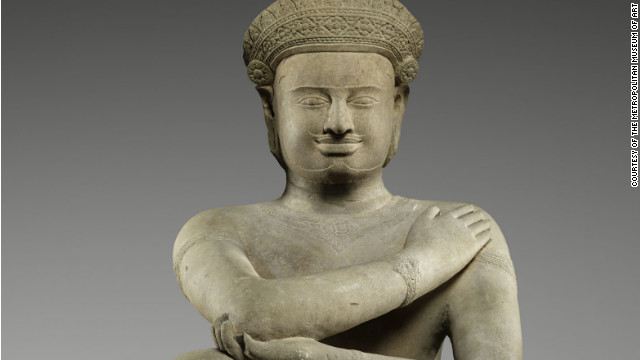 |
This kneeling figure at the Metropolitan Museum of Art was estimated to have been carved around 921 to 945
|
Editor's note: Mark V. Vlasic, a senior fellow and adjunct professor of law at Georgetown University, served as the first head of operations of the joint United Nations-World Bank Stolen Asset Recovery Initiative and leads the international practice at Madison Law & Strategy Group PLLC. Tess Davis is the executive director of the Lawyers' Committee for Cultural Heritage Preservation and is working with Cambodia to combat the illicit trade in the kingdom's antiquities.
(CNN) -- The last time most New Yorkers focused on pillaged antiquities from Cambodia was likely after the release of the Angelina Jolie film "Lara Croft: Tomb Raider," which featured the heroine's adventures through the country's famous archaeological wonder, Angkor Wat.
Now, real "tomb raiding" is making the news as the Cambodian government seeks to recover antiquities allegedly plundered from the kingdom's ancient sites during its civil war, ethnic cleansing and foreign occupation.
At Cambodia's request, the United States recently filed suit in U.S. District Court against Sotheby's in New York, demanding that the auction house forfeit a sandstone warrior that was "illicitly removed," according to the complaint, from a remote jungle temple. But according to a recent New York Times story, Cambodia has now set its sights on another Manhattan institution: the Metropolitan Museum of Art. It has specifically targeted the highlight of its Southeast Asian collection: two kneeling figures that archaeologists declare are companions to the contested Sotheby's piece.
If these stones could speak, what a story they would tell.
Carved in the 10th century by some of the most skilled artisans known to history, they originally adorned the sanctuary of Prasat Chen, at the temple complex of Koh Ker. Experts believe that with other characters, they formed a three dimensional tableau from the Hindu epic the Mahabharata for a millennium. They say that came to an end when paramilitary groups trafficked them, sculpture by sculpture, overseas.
What a strange twist of fate: Having traveled halfway around the world, quite possibly through the illicit and licit markets, the three disputed objects are now just miles apart in New York City.
Phnom Penh's forceful request for their return has alarmed the less scrupulous in the art world, and with good reason: They have a lot to lose if the art is repatriated. American and European galleries, auction houses and museums are allegedly full of Cambodian plunder. Many of these artifacts were allegedely stolen during the country's long conflict, making them "blood antiquities," little different than "blood diamonds" from Sierra Leone and other war-torn African states.
The years before, during, and after the Killing Fields decimated the Cambodian population and led to the looting of most of the nation's archaeological sites. Yet sadly, now that Cambodia is at peace and in a position to recover its rightful property, some collectors are portraying themselves as the victims.
In the wake of the Sotheby's case, one Asian specialist lamented the "crisis" now facing collectors. She warned that such legal actions "threaten the very future of collecting and collecting museums" and the "next generation of collectors, donors and patrons." Such histrionics aside, it will always be difficult and expensive for countries such as Cambodia to recover their pillaged heritage through the courts, even when in the right.
Especially when its acquisition may have been made possible by tragedies such as the Holocaust, Cambodia's killing fields or even the more recent looting of the Baghdad Museum during the Iraq war, the real issue is why any collector or museum would want to possess stolen art?
Thankfully, individuals and institutions who would argue to keep looted art are a minority and do as much disservice to their fellows as they do to victims of the illicit art trade. Indeed, many have voluntarily repatriated antiquities to Cambodia, once learning they were wartime plunder. The Met is no exception, having itself returned a valuable piece to the country in 1997 at its own initiative.
There is much common ground between archaeologists, collectors and curators, as all share a love of the past, if not an outright obsession with it. Archaeologists recognize that there will always be, and should be, a legal market for antiquities, just as most collectors and curators agree that the looting of archaeological sites and trafficking of antiquities must be stopped.
Indeed, if there is to be any real progress, both sides of the issue will likley have to make concessions. But as campaigns like Cambodia's demonstrate, the art world must reconsider what is ethically acceptable. And today, the sale, purchase and exhibition of "blood antiquities" is not only deplorable, it may actually be criminal. (The sale, possession, and transport of stolen property is illegal under the National Stolen Property Act.)
Sotheby's and the Met have a choice: They can treat Cambodia's requests as obstacles, or recognize them as the opportunities they are to right past wrongs and set the moral standard for the entire field. For Cambodia's sake, as well as their own -- and for all of humanity that finds these treasures important -- let us hope that they choose wisely. Read more!
Wednesday, June 06, 2012
Russian pedophile arrested in Cambodia
PHNOM PENH, Cambodia, June 6 (UPI) -- A known Russian pedophile was arrested in Cambodia and is now awaiting deportation, officials say.
Alexander Trofimov, a Russian national also known as Stanislav Molodyakov, was arrested Monday in Kandal province's Ponhea Leu commune, The Phnom Penh Post reported.
"We have been trying to arrest him for months. As of now, he's in detention at the Department of Immigration. We must deport him soon following the order from the [Interior] minister. But we are now discussing about the deportation," National Police spokesman Kirth Chantharith said.
Activists said they welcome the arrest and deportation, but say it didn't come soon enough.
Trofimov was convicted of sexually abusing 17 Cambodian girls from 2005 to 2007. In December, he was given a royal pardon and released from prison after serving just half of his eight-year sentence. He is also wanted by Interpol for allegedly raping six girls in Russia.
"This sends a message that there should be an amendment to the law … to make it mandatory for any child sex convict to be deported from the country," said Samleang Seila, director of Action Pour Les Enfants.
Phil Robertson, deputy director of Human Rights Watch's Asia division, said Trofimov should be extradited to Russia for prosecution there, but said further questions remained about how Trofimov eluded the authorities for so long.
"The Cambodian government cannot just wash its hands by deporting Trofimov and calling the case closed. There also needs to be a serious and impartial investigation about how these events came to pass," he said. .
Read more!
Cambodia, UN hold forum to promote women's entrepreneurship
Phnom Penh, June 6 (Xinhua-ANI): Cambodia's ministry of women' s affairs and the United Nations Development Program (UNDP) on Wednesday jointly organized a forum on women's entrepreneurship promotion to discuss challenges women are facing in business management.
The one-day forum was attended by some 80 high-level government representatives, international experts, leaders of women's business associations, women's producers groups, entrepreneurs and economic experts, Ing Kantha Phavi, minister of women's affairs, said in her opening address.
"The event is aimed at creating a platform of exchange and a network among the key players in the government of Cambodia, development partners, and private sector to identify the specific challenges that women entrepreneurs usually experience and explore some of the good practices on how to overcome these constraints," she said.
In Cambodia, more than 60 percent of micro, small- and medium- sized enterprises are owned by women, but those enterprises are very small and informal ones with only a few employees, she said, adding that those women business owners still face a different kind of challenges compared to their male fellow-entrepreneurs.
Those challenges include limited access to adequate skills training, land ownership, access to advanced education, more importantly access to markets, business information or financial resources, she added. "I believe that the forum will identify some of the key priorities for improving the economic status of Cambodian women," said the minister.
The UNDP deputy country director Sophie Baranes said at the forum that the economic empowerment of women is a key strategy to promote gender equality and poverty reduction in Cambodia and it is clearly articulated in specific targets under the Cambodian Millennium Development Goal 3 to be achieved by 2015. (Xinhua-ANI) .
Read more!
Malaysian Couple Breaks Maid’s Jaw
A Cambodian maid is hospitalized after allegedly suffering extensive abuse at the hands of her employers.
 |
Police officers speak to a group of girls after they were rescued from a human trafficking ring, Oct. 11, 2011.
|
Chea Phalla, 28, is being treated in a hospital in the capital Kuala Lumpur after having her jaw broken and being tortured by the couple that hired her to clean their home, according to an official with the Cambodian Embassy in Malaysia who met with the victim.
Third secretary at the Cambodian Embassy Chhay Kosal told RFA that Chea Phalla’s employer, hairdresser Tan Mong Huwai, had tried to send her back to Cambodia so that he and his wife, Eng Lay San, could get away with their crime.
“When she arrived at the embassy, her condition was already critical. At first she could barely speak. Her boss slapped her in the face until her jaw was broken,” Chhay Kosal said.
“They wanted to finish by sending her back to Cambodia, but the company that recruited her [Cambodia Labor Supply] knew about the torture and stopped them,” he said, adding that the company was assisting the embassy in bringing the case to court.
“We will not accept this. We will file a lawsuit against her boss.”
Chhay Kosal said that Chea Phalla is recuperating after having rested in the hospital.
The couple that employed Chea Phalla, both 36 years old, has been charged with “causing grievous hurt” to the housemaid between August last year and May.
They allegedly beat Chea Phalla with an empty bottle, a pair of shoes, a weighing scale, an iron, an aluminum rod, a kitchen knife, a plastic chair, and a pail at various times during her employment, Malaysia’s The Star newspaper reported.
In addition to refusing her food and making her work long shifts without rest, the maid claimed that her employers forced her to eat and drink her own feces and urine.
The charge of “causing grievous hurt,” under Section 326 of Malaysia’s Penal Code, provides a maximum jail sentence of up to 20 years and a fine or whipping upon conviction.
History of abuse
Malaysia employs about two million foreign workers, mostly from less developed regional countries in jobs that local workers prefer not to take, including on construction sites and in plantations. Another two million are thought to work illegally in the country.
Thida Khus, executive director of Cambodian women’s rights group Silaka, said there are no accurate statistics of how many Cambodian women are currently working Malaysia.
“The companies often dispatch maids to work without monitoring their conditions,” he said.
“We don’t know how many women are working in Malaysia because they don’t maintain contact with embassy officials.” Some estimates put the number of Cambodian women employed in Malaysian households at around 50,000.
A string of similar cases of abuse has led to strained ties between Malaysia and some of its Southeast Asian neighbors in recent years.
Cambodia imposed a freeze on sending domestic workers in October last year after activists exposed dozens of cases of sexual abuse, overwork, and exploitation among Cambodian maids in Malaysian homes.
Indonesia, which is the largest provider of domestic workers to Malaysia, had a similar ban in place since 2009, but lifted it recently after Malaysia pledged better protections for maids, including granting them one day off a week.
In May, the Cambodian Embassy in Malaysia assisted 10 Cambodians who had been ill-treated by their employers.
And in March, a Malaysian couple was charged with killing domestic worker Mey Sichan, 24, who was allegedly subjected to repeated physical abuse and starved.
Reported by Mao Sotheany for RFA’s Khmer service. Translated by Samean Yun. Written in English by Joshua Lipes. Read more!
With Votes In, High Expectations for New Commune Councils

What most voters want out of local leadership will be up to the ruling Cambodian People’s Party, which won a sweeping majority of commune chief seats—an unofficial estimated 1,592 of 1,633.
With their fingers freshly inked from Sunday’s polls, voters said Tuesday they were looking for security and good governance from their local commune councils, while Cambodia’s main opposition parties began to look ahead to national elections next year.
“I want a good commune council,” said Has Tak, 22, who is married and lives in Sambor commune, Kampong Speu province, some 40 kilometers west of the capital. Out here, many fields have yet to be plowed, and they remain dry, despite the onset of the rainy season last month.
For Has Tak and other voters like him, day-to-day needs are the most pressing, like the red-earth road, which the rain has washed away in some sections. “The road is mostly broken down, and it’s hard to ride a motorcycle on it,” Has Tak said Tuesday. “The commune council must consider this, and help the poor people.”
“I want security,” said a 49-year-old woman, who takes care of 2 hectares of rice fields and raises chickens to support six family members. “We need electricity in every commune and in every province,” she added.
What most voters want out of local leadership will be up to the ruling Cambodian People’s Party, which won a sweeping majority of commune chief seats—an unofficial estimated 1,592 of 1,633.
Despite the ruling party’s landslide, however, opposition leaders say they made gains with members on lower council seats, which will help them in their bid for parliamentary seats next year.
Both the Sam Rainsy and Human Rights parties have said they would consider joining together for the national election, hoping to leverage their grass roots popularity in next year’s national election. Each party won about 20 commune chief positions each.
Speaking to VOA Khmer by phone from Paris, Sam Rainsy said the change in local leadership will allow a change of village chiefs, and that will bring “big changes” in the national election next year. “We will bring absolute change,” he said, though he remains in exile and faces a number of criminal charges he maintains are politically motivated.
Kem Sokha, who leads the smaller Human Rights Party, said the local victories will be a key to political change, but that will require collaboration by the opposition.
“The main foundation of communists and dictators is at the grass roots,” he said. “So in this step we can change a lot of village chiefs, if the Sam Rainsy Party and the Human Rights Party work together.
In Kampong Cham, for example, the two opposition parties won some 300,000 votes in this election, he said. That could mean a big difference in national parliamentary elections if the parties join, he said.
Cheam Yiep, a lawmaker for the ruling party, said he was not concerned with the political strategy of the opposition. “This depends on the voters and their will,” he said.
Read more!
Monday, June 04, 2012
Observers: Cambodian Vote Improved but Problems Remain
PHNOM PENH - Cambodia's ruling party won the majority of seats in local elections nationwide Sunday, but observers say the vote was not without its problems.
Even going into Sunday's election, there was little doubt which party would come out on top. But critics say the dominance of the ruling Cambodian People's Party (CPP) has been aided by past irregularities at the polling booth. This year was no different.
Mu Sochua is a lawmaker with the opposition Sam Rainsy Party (SRP). Early results suggest the SRP lost ground this election, even in its traditional strongholds like the capital, Phnom Penh. .
Speaking by phone, Sochua said she witnessed subtle attempts at voter intimidation on Sunday. She said she saw influential local officials, aligned with the CPP, standing near polling stations as Cambodians arrived to vote.
"It has an effect, it does. It is one of the factors, in terms of voters not voting their conscience," said Sochua. Observers say the CPP benefits from a long-entrenched system of patronage, which rewards its supporters while shutting out its opponents.
"If they don't vote for the party, it could have some problems," said Thun Saray, president of Adhoc, a local rights group. "Normally they provide donations to every family, except if they know some families in the village, they do not support their party, perhaps they don't give the donations. That is the habit."
Saray also chairs the standing committee for Comfrel, an elections watchdog. This election was an improvement on previous polls, with fewer instances of violence, intimidation and overt irregularities, he says. But, the use of civil servants, police and the military to campaign on behalf of the ruling party, has become a major issue, according to Saray.
He says this election may be acceptable, compared to previous polls, but the country has a long way to go before it can declare its voting process free and fair.
"Free and fair, with the international standard - no, not at all. Because you see the CPP controls the important media, especially the television, all the radio, and also the newspapers," said Saray. "They control the media. And they also have a lot of the money. They donate to, not every voter, the voters that they know support them."
On election day, some radio stations reported being instructed by the Information Ministry not to carry broadcasts by specific news media. This included programming by VOA's Khmer service on two major FM radio stations.
Ministry officials could not be reached for comment. .
Read more!
Cambodian officials named over Khmer Rouge genocide
FOUR senior officials in the Cambodian government have been named as persons of interest by an investigating judge involved in the Khmer Rouge genocide tribunal, confidential documents obtained by The Age reveal.
A United Nations investigating judge who quit the court in early May, citing dysfunctional investigations into the case, has named current Cambodian senate president Chea Sim, National Assembly president Heng Samrin, the chief of the army and another senator as persons of interest.
All were officials in the brutal Khmer Rouge regime that ruled the country from 1975 until 1979 and were named by investigators into Case 003, which includes the imprisonment and murder of thousands of people at the Tuol Sleng prison.
The Cambodian government has blocked prosecutions in the case against former Khmer Rouge air force commander Sou Met and navy chief Meas Muth. Mr Meas Muth allegedly sent two Australian yachtsmen to their death at Tuol Sleng.
In the documents, the UN investigator said the four senior members of the ruling Cambodia People's Party held positions of authority in the Khmer Rouge regime and are key witnesses to atrocities committed against ethnic Vietnamese civilians living on the border with Cambodia.
The judge conducted field investigations into the conflict between Cambodia and Vietnam in the 1970s and states ''new facts'' were discovered about the war.
These ''new facts'' include ''a premeditated attack on an undefended civilian Vietnamese village'' and a supposition that other similar attacks occurred, along with evidence of repeated incursions into Vietnamese territory.
The confidential court document alleges the four are likely to have crucial information due to their positions of authority and that Mr Heng Samrin was a deputy commander of troops who committed attacks that the investigator called ''brutal and illegal''.
Many senior Cambodian government officials, including Prime Minister Hun Sen, served in the Khmer Rouge regime during its deadly reign.
The government is particularly sensitive about links between its officials and the regime and Mr Hun Sen has told the UN that any further investigations beyond the current trial of three ageing leaders are ''not allowed''.
Three of the four senior leaders named in the confidential court document, including Mr Heng Samrin and Mr Chea Sim, have previously been summonsed by investigators in the case against Khmer Rouge ''Brother Number 2'' Nuon Chea and others. The senior politicians refused to obey the summonses.
The UN investigating judge who led the recent investigations said he stepped down from the court because he had been ''completely blocked'' by Cambodian staff at the tribunal. His predecessor similarly quit the court in October last year citing government interference in the case.
The information comes on the eve of nationwide elections in Cambodia and during its year as chair of the Association of South East Asian Nations.
The trials, officially called the Extraordinary Chambers in the Courts of Cambodia, are in chaos following bitter internal disagreements, staff resignations and a budgeting crisis. .
Read more!
Malaysia/Cambodia-Islam: Aid pours in for Cham Muslims
KUALA LUMPUR, 14 Rajab/4 June (IINA) – THOUSANDS of Muslims in Cham district in Cambodia got an early Hari Raya Aidilfitri surprise when they received goodies from a humanitarian team from Malaysia recently.
The team, led by Defence Minister Datuk Seri Dr Ahmad Zahid Hamidi, presented clothes, books and generators, worth RM500,000, to residents of Kampung Rakapram and surrounding villages.
Zahid was joined by representatives from Yayasan Dakwah Islamiah Malaysia (Yadim), Polytechnic Education Department employees and reporters, who had been in Phnom Penh for the Asean Defence Ministers’ Meeting.
The arrival of the convoy was greeted by more than 1,000 Muslim Cambodians.
Zahid said the villagers were united with a majority of Malaysians by Islam.
“I feel privileged to be here with my brethren. This trip, although my first, will not be my last.
“I see a great opportunity for people here to come work in Malaysia and will discuss this issue with Human Resources Minister Datuk Seri Dr S. Subramaniam,” he said to applause from the crowd.
Read more!
Friday, June 01, 2012
Cambodian Opposition Tempers Expectations Ahead of Elections
 PHNOM PENH - Cambodians vote Sunday in elections for their local commune councils. In a country where the prime minister, Hun Sen, maintains a tight grip on power, opposition parties are trying to be realistic about the outcome.
 For opposition lawmaker Son Chhay, the local commune elections are all about lowered expectations. He is an official for the Sam Rainsy Party, but he has no grand illusions of victory on Sunday.
"When we talk about winning, it's something that is not going to be easy," Chhay said. "Currently we're only head of 28 communes, out of 1,633. So it's very small. So we're hoping we're going to get at least 10 percent of this. This could be a very good start."
It's a good start, but these are still modest goals for what is Cambodia's largest opposition party. In a country where the ruling Cambodian People's Party, known as the CPP, has maintained a grip on power since the 1990s, opposing the government at the polls has always been a struggle.
This year is no different.
For the past two weeks, the political parties have been running street campaigns throughout the country. In Phnom Penh, long, boisterous convoys promoting the CPP rumble through busy intersections, blaring campaign messages.
In contrast, the Sam Rainsy Party, or SRP, has a more modest fleet.
The party has rigged large projection screens on a handful of trucks, which are driven around the city during the evenings. The screens show videos of Cambodian villagers being evicted from their lands. With most of the country's radio and television airwaves sympathetic to the government, Chhay says this is the best opposition parties can do to get out the message.
"Normally this kind of situation would probably be shown on the television news. But not in Cambodia. We do not have access to information so the government only presents the kind of propaganda news to the public," Chhay said.
Election observers say the CPP's control also extends to civil servants, police and the military. By law, these groups are prohibited from using their influence to campaign for or against any political party. But in reality, the rules are ignored.
The misuse of state resources has become a systematic problem, said Koul Panha, the executive director of the Committee for Free and Fair Elections in Cambodia, or COMFREL.
"The ruling party tries to organize, to use, encourage and mobilize the state officials. They mobilize them, they go to the field, to conduct activities to support the ruling party," Panha said. "Sometimes this includes opposition to other people also. This happens since before, but now in this election it has increased. It's systematic. And it violates the law."
However, Panha says this campaign period has seen some improvements over previous elections. There have been fewer complaints of intimidation, threats or other irregularities. And there have been fewer cases of political violence.
"Cambodian elections have not reached the international standard for free and fair, yet," noted Panha, adding that the process remains flawed.
Despite lots of campaigning, some observers say this commune election has been short on actual policy debate. Instead, parties have been using the opportunity to promote their brand names, said political analyst Lao Mong Hay.
"It seems that they, candidates, have not concentrated on local issues. It seems that they just talk about national issues and the political platform of the party. It's more like the general election, not like local elections," Hay said. "But I doubt whether candidates can grasp the local issues very well, because they can do very little when they are controlled by the top."
Back at the SRP offices in Phnom Penh, parliamentarian Son Chhay says getting a foothold at the commune level is important. But his party is already looking beyond Sunday's vote, and ahead to next year's general election.
"Local election is a stepping stone to the national election," Chhay said. "When we have more control over the local governments, then you're able to have more resources, more people working for you to promote the party when it comes to next year's election." Those elections are now scheduled for July 2013. Read more!
Cambodia Programme Manager, with technical support to Myanmar
Description of the unit / department: Trocaire’s Cambodia office, based in Phnom Penh, has launched an important Governance and Human Rights programme, funded by the European Commission, until July 2015. It requires a Programme Manager to support a small but dynamic team, which includes a Governance Programme Officer, Finance Officer and Driver. It’s important to note however that Trócaire’s other programmes in Cambodia, and the regional office, will be phasing out by August 2013.
Trócaire also works in Myanmar where we expect to develop a new Governance programme in 2012 to support the emergence of civil society. The Programme Manager will be expected to provide technical capacity to that programme. The country team currently comprises a Country Representative, Gender Programme Officer, Humanitarian programme officer, and two support staff.
Background to the Role: Trócaire is looking to recruit a Programme Manager to lead a small team to manage risk and deliver a quality EC funded programme working on Governance and Human Rights programme in Ratanakiri Province, North East Cambodia.
From August 2013 onward, this role will be the most senior in-country, and some external representation will be required. Whilst the EC funded programme ends in February 2015 the team will be in place until July 2015 in order to complete the reporting for the programme and closing of the office.
This post holder will also be expected to dedicate at least 25 % of his/her time to provide technical support to the Governance and Human Rights programme in Myanmar which is currently being developed.
Reporting to: Assistant Regional Manager
Managing: (Individuals/Team) Governance Programme Officer, Finance Officer and Driver in Cambodia Contract Type: Fixed Term Contract Duration: July 2015 Grade and Scale: International Programme Officer scale Location of Position Based in Phnom Penh, Cambodia with frequent travel to Ratankiri province, and Myanmar Scope of the Role: The Programme Manager will take full responsibility for the delivery of a high quality Governance programme in Cambodia that complies fully with Trócaire’s policies and practices, as well as the EC contract.
He/she will performance manage the Cambodian Governance team in-country, represent Trócaire as appropriate in external meetings and be responsible for the completion of the EC grant.
He/she will spend approximately 25% of the time providing technical support to the Governance programme in Myanmar, in particular in relation to programme cycle management. Frequent travel to Myanmar is anticipated. However, given the rapidly changing environment in the country, this aspect of the role is expected to evolve over time.
Key Duties & Responsibilities Programme Cycle Management: • Manage an EC-funded Governance and Human Rights programme in Ratanakiri Province, ensuring high quality in all areas of programme cycle management. Report-writing, monitoring and evaluation, and capacity-building to partners will be key tasks; • Support the Myanmar Governance programme in an advisory capacity to strengthen programming;
• Ensure adequate links and synergy with the Governance and Human Rights team in headquarters;
• Actively contribute to organisational learning, specifically making sure that good practice and innovation from the Cambodia and Myanmar programmes across the wider organisation. Management and leadership: • Lead the Governance team in Cambodia through effective performance management and the modelling of appropriate behaviour Representation and networking:
• Represent Trócaire to the Government, Cambodian civil society, the EC delegation and other international NGOs. The Programme Manager will also work very closely with CAFOD in country to ensure that opportunities for synergy and or complementarity are not missed
• Ensure our programmes meet their advocacy potential and link with Trócaire’s Ireland Division in relation to campaigns, education and communications Financial management:
• Responsible for ensuring the EC funded programme meets all internal and external procedural compliance, with the support from a Finance Officer in Phnom Penh, as well as Head Office.
• Assist in seeking institutional funds for the Governance programme in Myanmar, where appropriate Other: • Deliver on other tasks as agreed by the Assistant Regional Manager. Person Specification – Essential Requirements (E) (E) Qualification
• Degree level education in a development studies or a relevant field (E) Experience
• At least 5 years of programme management experience
• A minimum of three years overseas experience, preferably in Asia
• Experience of working in partnership/ capacity development of local institutions and civil society
• Experience of working to fulfil donor requirements
• Experience of working on a governance and/or human rights programme (E) Skills
• Proven knowledge of programme cycle management and monitoring frameworks
• Excellent project management skills
• Excellent leadership, management and interpersonal skills
• Strong financial management skills
• Excellent computer literacy with e-mail, internet connection & file and data back ups systems/severs
• Fluent spoken and written English (E) Qualities
• Strongly committed to Trócaire’s approach
• Commitment to supporting civil society
• Self motivating and confident to make decisions
• Effective communicator and leader
• Manages time, emotions and personal growth in a positive manner
• Shows initiative and adapts to change
• Willingly takes ownership and is openly accountable (E) Other
• Availability to work outside normal hours and undertake travel within the country and outside when necessary Person Specification – Desirable Requirements (D) (D) Qualification (D) Experience
• Experience of working on EC contracted programmes
• Experience of team leadership and staff management How to apply: To apply please return completed application form to: Jason Rice HR Officer Trócaire Maynooth, Co. Kildare Ireland Email: jobs@trocaire.ie .
Read more!