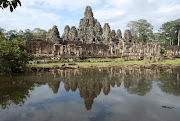
The stone remains of Preah Vihear, built nearly 1,000 years ago, are supposed to be a protected U.N. World Heritage site. Instead they are at the heart of a dangerous tug-of-war between Cambodia and Thailand.
A delegation of foreign military attaches is scheduled to visit Preah Vihear temple Thursday, military officials said.
Cambodia says the 11th-Century temple was damaged by Thai artillery in border clashes in February and has asked Unesco to assess the damage. Thai officials maintain Cambodia has troops close to the temple, putting it at risk to future damage.
The military delegation will include 19 representatives of foreign countries including the US, China and Japan and will last for two days, said Chhum Socheath, a spokesman for the Ministry of Defense.
The defense attaches will meet with Cambodian frontline commanders before touring as many areas along the border as possible, Chhum Socheath said. This will include strike sites where Cambodian officials say cluster munitions were used by Thai soldiers.
“They will see the reality, and from what they see they will have their own views,” he said. “I think a visit to Preah Vihear temple at this time will be very productive.”
Intense clashes between the two side Feb. 4 through Feb. 7 left at least 10 people dead and sent villagers fleeing for safety.
Both sides have since agreed to a ceasefire and a monitoring mission from Indonesia, the current head of Asean, but Thailand has said it does not condone a Unesco inspection of the temple while military tensions remain high.
Cambodian military officials on the border said they have been put on heightened alert for the military delegation’s visit.
Read more!

Wednesday, March 02, 2011
Military Attaches to Inspect Sites of Border Clashes

A Current of Nationalism, Not Extremism: Researcher
 Cambodians are experiencing an upsurge in nationalism thanks to a continued border dispute with Thailand, but a researcher says it has not veered toward extremism.
Lao Monghay, a former researcher for the Asian Human Rights Commission, told “Hello VOA” Monday that Cambodians are now cooperating in economy, trade and culture more closely.
However, he added, trade goods from neighboring countries like China, Thailand and Vietnam are still in high demand.
“In Cambodia, even though there is stronger nationalism, it has not been extreme,” he said. “We see that Cambodians don’t seem to discriminate or oppose the goods of their neighbors at all. Even Thai goods, there is no movement stirred up to boycott Thai goods.”
Cambodians from many walks of life have rallied around the perceived threat posed by border clashes with Thailand, with the fiercest clashes to date last month.
A border dispute near Preah Vihear temple, a cultural touchstone for many Cambodians, has elicited support for Cambodian soldiers. But there have been no violent demonstrations, such as those in 2003, when a Thai actress was rumored to have said Angkor Wat should belong to Thailand. The 2003 demonstrations escalated into a night of rioting and the burning of the Thai Embassy by a mob of Cambodian youths.
Lao Monghay said that kind of nationalism was dangerous and to be avoided.
Read more!
Cambodia accepts military observers
Cambodia has accepted terms of reference for unarmed Indonesian military observers to watch over a ceasefire along the Preah Vihear border area and now awaits a response from Thailand.
“We have clearly stated in the terms of reference letter that in the case of a Thai objection, Cambodia will receive Indonesian observers alone,” said Koy Kuong, spokesman for the Ministry of Foreign Affairs.
“We don’t know about the Thai side but our stance is that we have completely agreed to the terms of reference.”
After four days of fighting early last month left at least 10 dead, dozens injured and thousands temporarily displaced on both sides, Cambodia and Thailand agreed at an informal meeting of ASEAN foreign ministers on February 22 in Jakarta to allow Indonesian military observers to monitor a ceasefire.
The 30 observers, 15 in each country, will report to both ASEAN and the United Nations Security Council, which has called for a permanent ceasefire.
Marty Natalegawa, the Indonesian Foreign Minister, sent Phnom Penh and Bangkok the terms of reference last week.
Veerachon Sukondhadhpatipak, deputy spokesman of the Royal Thai Army, and Thani Thongphakdi, deputy spokesman for the Thai Ministry of Foreign Affairs, could not be reached for comment yesterday.
The Cambodian Ministry of Defence will lead a tour of the border area and the Preah Vihear temple tomorrow for military attachés from more than 10 embassies.
Although the move follows a similar event organised by Thailand, it has apparently annoyed at least some in the Thai army according to an unnamed military source quoted in the Bangkok Post.
Koy Kuong said there was no reason for the visit to increase tensions.
“Cambodia only brings those foreign military attachés to visit the border inside Cambodian territory, so there is not anything to cause tension,” he said.
“Thailand also brought foreign military attachés to visit the border recently, and Cambodia did not say it caused tension.”
Read more!
ASEAN and the Cambodia-Thailand confiict
The fighting and violence that have taken place in the Thai-Cambodia border area violate both the letter of solemn agreements among the members of the Association of Southeast Asian Nations (ASEAN) and its spirit, the spirit which underlies the very concept of ASEAN.
As ASEAN members, Cambodia and Thailand are both signatories to the 1976 Treaty of Amity and Cooperation in Southeast Asia (TAC), which commits them to reject the use or threat of force in the relations between states and to the peaceful settlement of inter-state disputes.
The overriding purpose in this regard is to avoid and prevent actions that result in the death or injury of human beings. Already, between ten and twenty persons are reported to have been killed and countless others injured or displaced in the border fighting between the two countries.
In addition to the provisions of TAC, certain facts have to be kept in mind to avoid the repetition of violence in the future.
The first is that the International Court of Justice (ICJ) in 1962 ruled that the temple of Preah Vihear, near where the fighting has occurred, belonged to Cambodia. Both Cambodia and Thailand had agreed to submit their dispute to the ICJ and to abide by its decision. The current dispute is not about the temple itself but over a strip of land nearby, which the ICJ saw fit not to adjudicate but which joint Cambodia-Thailand border and boundary bodies are supposed to deal with.
Another fact to remember is that in 2008 UNESCO listed Preah Vihear as a World Heritage Site. It did so upon Cambodia’s proposal but with the support of Thailand. This cooperation between the two was manifested in an agreement signed in June 2007 by Noppadol Pattama, then foreign minister in the government of Samak Sundaravej, a successor to the deposed Thaksin Sinawatra deemed sympathetic to Thaksin. Anti-Thaksin politicians have charged that the agreement violated Thailand’s constitution.
These events were also inflamed by nationalistic public emotions. It would be responsible and indicative of the value that the leaderships in both countries place on human life if they were to dampen the emotional flames instead of fanning them.
As the weaker protagonist, Cambodia has sought to multilateralise and internationalise the matter, including asking for a meeting of the United Nations Security Council on it. However, Thailand has expressed its preference for bilateral negotiations. But there are venues for mediating this conflict other than the world body, among them regional countries and ASEAN itself.
In recognition of this, Susilo Bambang Yudhuyono, President of Indonesia, this year’s ASEAN chair, has sent his foreign minister, Marty Natalegawa, to Cambodia and Thailand on 7 and 8 February, respectively. The new ASEAN Charter allows the parties to a dispute ‘to request the Chairman of ASEAN or the Secretary-General of ASEAN . . . to provide good offices, conciliation or mediation’. Marty and the foreign ministers of Cambodia and Thailand were invited to the 14 February UNSC meeting, at which all three made statements.
At the end of that meeting, the Council President, Brazil, issued a statement calling on ‘the two sides to display maximum restraint and avoid any action that may aggravate the situation’ and ‘to establish a permanent ceasefire . . . and resolve the situation peacefully and through effective dialogue’. It went on: ‘The (Council) members . . . expressed support for ASEAN’s active efforts in this matter and encouraged the parties to continue to cooperate with the organization in this regard. They welcomed the . . . Meeting of ASEAN foreign ministers on 22 February.’
The Cambodia-Thailand conflict puts to a severe test both ASEAN and Indonesia. Indonesia was one of ASEAN’s founders, its largest member and its current chair. Indonesia was where the 1976 Treaty of Amity and Cooperation was signed and the Blueprint for an ASEAN Political and Security Community was adopted, in 2003. It is the leading proponent of the Political and Security Community, which calls for the prevention of disputes and conflicts from arising between member-states.
The 22 February ASEAN foreign ministers’ meeting was called, hosted and chaired by Indonesia as ASEAN’s chair. It resulted in clever compromises among Thailand’s call for bilateral negotiations, third-party intervention, and ASEAN’s role. While the statement released at the end of the meeting underscored bilateral talks, it also repeatedly referred to Indonesia, which the ministers called on to send ceasefire observers on both sides of the disputed territory, as ‘ASEAN’s chair’.
For the sake of their peoples and of the region, not to mention ASEAN’s credibility, the efforts at mediation by Indonesia as the ASEAN chair and a cessation of hostilities must be encouraged and succeed.
Author: K. Kesavapany, ISEAS
K. Kesavapany is the Director of the Institute of Southeast Asian Studies.
Read more!
Lawmakers to boost Cambodian ties
HA NOI — The National Assemblies of Viet Nam and Cambodia needed to strengthen co-ordination and create the most favourable legal foundation for increasingly deep and effective co-operation between the two sides, said the former's Chairman, Nguyen Duc Kien.
He also confirmed the Viet Nam Party and Government's consistent policy to attach importance to developing relations with Cambodia.
He made the comments during a reception for the Cambodian Assembly's Commission on Education, Youth and Sports, Cults, Religious Affairs, Culture and Tourism chairman Mom Chim Huy in Ha Noi yesterday.
Kien suggested the two assemblies pay attention to popularisation and education work so that Vietnamese and Cambodian people, especially young generations, would continuously preserve and promote the fine traditional relationship between the two countries.
Kien said he wanted ministries, agencies, cities and provinces of the two sides to strengthen exchanges and further expand multi-faceted co-operation and relations, especially in economics, trade, investment, culture and education, based on full exploitation of potential and advantages in each country.
He acknowledged developments in the relationship between the two assemblies in the past, saying that they helped boost the traditional friendship, neighbourly relations and comprehensive co-operation between the two nations.
He thanked the Cambodian Assembly for its active support for Viet Nam as the ASEAN Inter-Parliamentary Assembly Chair during the 2009-2010 term and expressed his belief that the Cambodian Assembly would fulfil its role as the Chair during the 2010-2011 term and successfully host the 32nd AIPA Assembly in the country this September.
For his part, Chairman Mom Chim Huy affirmed the Cambodian Assembly's wish and determination to consolidate and further strengthen the exchange and co-operation between the commissions in particular and between the two legislative bodies of the two countries in general.
He stated that bilateral co-operation between Cambodia and Viet Nam had strongly developed in all fields, with two-way trade reaching US$1.8 billion last year. Vietnamese businesses have invested around $2 billion in Cambodia. — VNS
Read more!
Tuesday, March 01, 2011
Husband Remembers Fatal Night on Diamond Bridge
 Like other families of stampede victims on Diamond Bridge, Leung Porn's family decided to hold the 100-day ceremony last weekend at a Buddhist clergyman's suggestion.
Leung Porn's wife, Tor Sophal, was one of the 353 victims killed in the stampede on the bridge during last year’s water festival.
Leung Porn, who is 54 and now the single father of three children, said the ceremony will help his wife rest in peace.
“The ceremony is to stop her soul from wandering and help her reincarnate,” he said in an interview. “I pray for her to be reborn in a better life, one not as miserable as this one.”
Leung Porn is a farmer and motorcycle taxi driver from a small town in Kampong Speu province, Chbar Mon. His wife had been a commune council member and the main breadwinner of an extended family of 10 people.
“I wonder where she will be reborn,” Leung Porn said. “I still want to know in what direction, what province and what village she will be reincarnated.” He began to cry. “I love my wife so much,” he said.
Leung Porn was with his wife on the bridge on the night of Nov. 22, 2010. They had decided to walk along the bridge at the end of the Water Festival, along with many others. They found themselves trapped amid thousands of people, all sandwiched onto the small platform, pushing from two directions and unable to move either way. The crush of bodies began suffocating some, and when panic ensued, many where crushed to death.
Leung Porn said he survived by maneuvering his body to keep his chest from being crushed. He was separated from Tor Sophal and in the crush of bodies was helpless to save her.
“I was hopeless for my wife at the time, because I myself was nearly half dead,” he said. “When I saw my wife lying dead, I was confused and speechless.”
Tor Sophal’s ashes now sit on a shelf in the house, for the whole family to pray to. In the aftermath of tragedy, they received about $12,000 from the government and other donors. Some of that was spent on her funeral and subsequent ceremonies. The rest remains in savings.
“Even though you gave me gold too heavy to carry, I didn’t need it,” he said, looking at his teenage son, whose head was shaved in mourning. “I would have taken my wife back instead.”
Leung Porn said he will no longer allow any of his family members to go to Diamond Island, or even to the Water Festival, for fear of another disaster.
Cambodia University students lay down flowers during a memorial service near a bridge where festival goers were killed Monday in a stampede in Phnom Penh, Nov. 25, 2010.
“I’ve advised my children and grandchildren not to go there,” he said. “If they want to celebrate the event, I tell them to celebrate at home with the family. I’m afraid, and I swear I’ll never go again.”
Perhaps, he said, he would be willing to visit a memorial stupa for the dead if it is built near the bridge. And he wants the authorities to ensure such a tragedy doesn’t happen again.
For now, 100 days later, he remembers his wife and is sorry he had not done more for her when she was alive.
“I am regretful that I could never afford to treat her to a big meal in a restaurant,” he said.
Read more!
Cambodian Court Rejects Opposition Leader's Final Appeal
 Sam Rainsy, leader of Cambodia's opposition Sam Rainsy Party, speaks during a campaign rally in Kandal province, Cambodia, July 11, 2008.
Cambodia’s highest court on Tuesday upheld a two-year jail term imposed on the exiled leader of the opposition, Sam Rainsy. The verdict came after he uprooted border markers on the country’s boundary with Vietnam more than a year ago, claiming Cambodian farmers were losing land to their more powerful neighbor.
Judges at the Supreme Court said Tuesday that opposition leader Sam Rainsy must serve the two-year sentence that was handed down last year by a lower court.
Sam Rainsy, who lives in self-imposed exile in France, was convicted of racial incitement and damaging public property in the October 2009 incident on the border with neighboring Vietnam..
Senior members of the Sam Rainsy Party, or SRP, said on Tuesday the verdict had come as little surprise. One of them, veteran SRP legislator Son Chhay, says the courts are there to do the bidding of the ruling party.
"We all predicted the Supreme Court will maintain the verdict to send Sam Rainsy to two years in prison," he says. "And we have no hope that the judicial system in Cambodia or the court itself will be able to make any reform to gain some confidence from the public in any near future."
The ruling party’s motive, says Son Chhay, is to ensure that Sam Rainsy is unable to take part in the next election, which is scheduled for 2013.
As matters stand with Tuesday’s ruling, there is little chance that Sam Rainsy can now participate, unless, that is, a political compromise can be reached.
Son Chhay says the international community, which has invested billions of dollars in Cambodia’s political stability, has failed to grasp the seriousness of the situation.
“They seem to be being fooled that the case of Sam Rainsy is an individual case, that it isn’t reflecting the whole need for maintaining the democratic environment in the country," he says. "That is a big mistake, the donors, especially the Western countries, who have provided so much assistance to Cambodia, should look into the issue of Sam Rainsy more seriously.”
During his recent trip to Phnom Penh, the United Nations human rights envoy Surya Subedi said public figures should become more tolerant and should stop using the courts against their critics.
Opposition leader Sam Rainsy faces more legal problems.
Last year, he was sentenced to 10 years in prison after he displayed a map at a press conference that the government claimed misrepresented the border between Vietnam and Cambodia.
At the time, the government said that his actions amounted to disinformation and the falsifying of public documents.
The issue of the country’s border with Vietnam is a sensitive one for the government. Prime Minister Hun Sen maintains close relations with Hanoi, and many Cambodians are distrustful of their more powerful neighbor.
Last week, Sam Rainsy traveled to Washington to rally support from the U.S. government and human rights groups. During the trip, he sat down with VOA's Kate Woodsome, to talk about his legal troubles and the future of the opposition.
Read more!
Monday, February 28, 2011
Vietnam in Cambodia tourism push
 A man-made mountain at a resort managed by Dai Nam Resorts Area, in Binh Duong province, Vietnam. The company is looking to attract more Cambodian visitors to its attractions. A company official said 5 million people visited the site last year
Vietnamese tourism companies are linking up with Kingdom firms in order to attract Cambodian tourists to the country’s resorts and health care facilities, whilst boosting cross-border visitors.
During 2010, while the numbers of Vietnamese tourists arriving in Cambodia surged by 48 percent to 466,695 compared with 2009, some businesses within Vietnam also spotted an opportunity for growth by forging new alliances.
One such company was state-run Vietravel Co, valued at US$76 million last year, which now holds 49 percent in a joint venture called Indochina Heritage Travel (Cambodia) with Cambodian and Vietnamese partners.
While its capital investment in the new company has not been detailed, after opening two months ago, it plans to lead 100,000 Vietnamese tourists to the Kingdom during 2011 and to promote cross-border tourism.
Nguyen Quoc Ky, general director of Vietravel Co, said: “I feel confident about tourism sector growth in Cambodia, that’s why I decided to put capital forward.”
While Tran Duc Hai, director of Indochina Heritage Travel (Cambodia), added: “We try to promote tourism for both countries and will bring tourists to both sides.”
Monthly package tours are on the venture’s agenda, with trips tailored to the health tourism market also planned.
Cambodia’s Minister of Tourism, Thong Khon, acknowledged today that Cambodian citizens visit Vietnam for health consultations and treatment and that at the moment “Vietnam is trying a lot to promote tourism in Cambodia”.
While the ministry did not have specific visitor data for Vietnam, he stated: “We have a strong relationship and cooperate together on tourism for both sides benefit.”
In Vietnam, health care providers are hoping to tap into a potential market of Cambodian nationals.
Chief operation officer of Victoria Healthcare VietNam, Binh Pham Cobb, said her private clinic in Ho Chi Minh City received 200 patients a day, some of whom came from Cambodia.
“We saw that Cambodian patients came to check their health a lot at the state hospital in Vietnam.”
Through cooperation with firms such as Indochina Heritage she hopes to “get more and more Cambodian clients to come here”.
While 25-year-old Cambodian tourist Sout Vanny, a visitor to Dam Sen theme park in Vietnam, said that while on holiday she had a health consultation as “services in Vietnam are cheaper that Cambodia and they also make me confident”.
But along with health care demand, vacationing tourists are also boosting trade for Vietnam’s holiday resorts, according to businessmen.
Hoafng Van Ba, deputy general director of Saigontourist, the parent company of Dam Sen Resort in Ho Chi Minh City, said that 5 percent of visitors to his resort – which includes a theme park – were now Cambodian.
It has incorporated Cambodia into its future, as the company has plans to build a similar complex in the Kingdom with negotiations with its Cambodian partner underway.
Dai Nam Resorts Areas, the biggest resort in Vietnam which lies on 450 hectares of land in Binh Duong province, is also looking for Cambodian visitors. Tran Thanh Hai, director of its parent company Dai Nam Joint Stock Corp, said: “Last year, 5 million tourists came to our resort, most of them were local tourists. Now, we are promoting ourselves to neighbouring countries, especially Cambodia.”
According to the Ministry of Tourism, outbound Cambodian tourists increased by about 49 percent in 2010.
Read more!
China's growth is changing Southeast Asia
BANGKOK -- What has China got to do with recent bloody clashes over a 900-year-old temple in Southeast Asia?
Beijing is not a party to the conflict, nor has it any stake in the territorial dispute between Cambodia and Thailand.
And yet China, with its growing presence and influence in Indochina, is changing the power dynamics in the region.
One key result has been the weakening of Thailand's traditional economic domination in the neighborhood as China steps up trade and investment in countries of the Greater Mekong Subregion, which besides Thailand includes Laos, Myanmar, Vietnam and Cambodia.
With Cambodia less reliant on the Thai growth engine, its Prime Minister, Hun Sen, has become emboldened to put up a tough fight against Thailand in its border dispute, some analysts say. The border clashes early this month left at least three Thais and eight Cambodians dead.
Given its proximity and long-standing ties, Thailand no doubt still plays a big role in Cambodia's economy. Two-way trade last year was valued at about 81 billion baht (US$2.63 billion), up 20 percent from the previous year. Thai businessmen have over 80 projects worth over US$363 million in the country.
But the Chinese presence in Cambodia has grown rapidly in recent years. In a paper last December, Australian academic Geoff Wade, currently with Singapore's Institute of Southeast Asian Studies (ISEAS), noted that there were 360 Chinese investment projects in Cambodia totaling US$80 billion by the middle of last year.
China recently waived US$400 million worth of Cambodian debt. One of the largest Chinese-language schools in Southeast Asia is located in Phnom Penh. China also provides much of the Cambodian army's equipment, say observers who have seen Cambodia's military deployments at the disputed Preah Vihear temple site.
In turn, Cambodia has cooperated with Beijing politically, sending 20 ethnic Uighur asylum seekers back to China in 2009, for instance.
Thai historian Thongchai Winichakul, in a recent talk in Bangkok, noted China's neutrality on the Thai-Cambodia conflict, but acknowledged that “Cambodia is less dependent on Thailand than the Thais think.”
At one time during the booming 1980s, Bangkok was the “logical center” of the region, says Professor Michael Montesano of ISEAS.
Now, “Cambodia certainly, and Laos to a degree, have other options. Cambodia is more sophisticated now; they can pick and choose. In addition to China, with its huge demand and ability to penetrate markets, Singapore also comes into play.”
Cambodia also has strong economic ties with Vietnam as well as other countries like South Korea and Japan as it forges ahead with its growing network of international linkages.
China's rising profile in Indochina is not restricted to Cambodia. It is the same in Laos, where it has stepped up investments in agriculture and infrastructure.
Its investment in infrastructure in Myanmar includes laying strategic gas and oil pipelines and port development. The Myanmar-language Weekly Eleven reported recently that China poured more than US$3 billion into the country from last November through January this year, bringing its cumulative investment since 1988 to US$9.6 billion, above Thailand's US$9.56 billion.
As for Thailand, its officials have described their country's relationship with China as one between siblings. Bangkok is also positioning itself as a partner to China in the hopes of mutually benefiting from its growth. One example is the 45 billion baht China City trading complex on the outskirts of Bangkok.
When completed in two years, thousands of Chinese traders will operate from there, re-exporting Chinese-made goods from Thailand to avoid costly tariffs. The trading center is expected to create an estimated 70,000 new jobs.
“The economic might of China imposes a compelling calculation,” said an Asian diplomat of its burgeoning ties in mainland Southeast Asia. “With all these countries, because of proximity and land links, it is very difficult to ignore China.”
But that is not to say there are no limits to China's influence.
In Thailand, the Chinese community has for generations been seamlessly integrated into the rest of Thai society. But in Myanmar, distrust of China among the older intellectual and military elites remains, and Myanmar nationalism will be a brake on Chinese influence.
And there is competition too. American officials have been open about the fact that the recent re-engagement of the United States, in the shape of a development initiative for lower Mekong countries, is an attempt to balance China's surging economic influence.
Vietnam too has its own ambitions in the neighborhood, along with historical baggage, having fought a ferocious border war with China in 1979.
“They can't ignore China. But because of their status as a new tiger and with a more self-confident and outward-oriented approach, Vietnamese officials often speak against China on issues,” said the Asian diplomat.
Read more!
Cambodia beckons for midwifery chief
A MIDWIFERY boss is stepping down to carry out volunteer work in a poverty-stricken country.
Angela Oxley, head of obstetrics and gynaecology at Furness General Hospital, is leaving her post to work on improving maternity services in a hospital in Cambodia for two years.
Mrs Oxley, who also works across other hospitals within the University Hospitals of Morecambe Bay NHS Foundation Trust, will be based in Stung Treng hospital in northern Cambodia as part of a programme run by the Voluntary Services Overseas charity.
The hospital is staffed by a medical director and team of midwives, but they do not receive regular wages and must work in the markets to earn money.
In the province of Stung Treng, there are eight small clinics where births take place with only a basic qualified midwife or traditional birth attendant present. Part of Mrs Oxley’s work will involve reviewing care in these clinics and trying to improve training and referrals.
Mrs Oxley, who has 20 years’ experience working as a midwife in Cumbria, said: “I’m going out there to see what improvements can be made with a limited staff and budget.
“It will be a huge challenge, I know, but the idea is not for me just to go out there, work as a midwife and come back two years later with nothing changed.
“My colleagues at FGH have been really positive. A lot have said they could never do it, but I also hope it will encourage more people to go out there and do it.”
VSO in Cambodia has an overall aim of reducing infant and maternal mortality rates in line with the United Nations and World Health Organisation. The current maternal mortality rate is one in 260, compared with one in 12,000 in the UK.
Many of these deaths occur in the rural areas, where women often have no access to trained staff.
The VSO funds Mrs Oxley’s travel to Cambodia and her return in two years, but while she is living in the country she will be paid a basic wage of £240 a month and be expected to raise funds for the project.
Mrs Oxley will be joined by her husband Chris on the trip, who is also hoping to carry out volunteer work.
She said: “He is coming over with me to share the experience, but he is funding himself. He has done a qualification in teaching English as a foreign language and he has a background in engineering.”
The couple will keep a blog of their trip, which can be viewed at www.angelaandchriscambodia.blogspot.com.
Read more!
Sunday, February 27, 2011
Cambodia outlaws nukes
The Council of Ministers on Friday approved a draft sub-decree barring the production of materials used in the making of chemical, nuclear or biological weapons.
Cambodia’s constitution already prohibits the manufacture, use or storage of chemical, nuclear and biological weapons under articles 9 and 54.
The sub-decree was prepared by the Defence Ministry’s Chemical Weapon National Authority as a mechanism to control the production and use of chemicals in line with international treaty obligations.
It follows a draft law introduced in 2009 that similarly barred the use, manufacture or storage of such weapons.
“Our constitution has prohibited the use of chemical, nuclear, biological and radioactive [weapons], but we have prepared this sub-decree as an addition,” said government spokesman Phay Siphan today.
Chum Sambath, an undersecretary of state at the Defence Ministry, said Cambodia has no chemical or nuclear weapons and would never produce them.
“We don’t need to produce chemical weapons because we have no intention to invade any country,” he said.
Minister of Defence Tea Banh could not be reached for comment today.
In 2005 Cambodia signed the Chemical Weapons Convention, a global initiative by the Organization for the Prohibition of Chemical Weapons.
Read more!
Exiled Cambodian leader speaks to local compatriots
By Steve Huffman
The Dispatch
Sam Rainsy, a member of Cambodia's parliament, brought a message from his native land to Davidson County Saturday night.
Unless you spoke Cambodian, it was impossible to understand what Rainsy was saying, but he drew the rapt attention of about 200 Davidson County residents who are of Cambodian descent. Rainsy spoke at the Lexington Buddhist Temple off Pinelodge Road.
In a brief interview where he spoke English, Rainsy, 63, said he had been forced into exile from Cambodia, but still travels frequently to the country. He remains a member of the country's parliament, Rainsy said.
"It's not the first time," he said of his forced exile. "I'm used to it."
Rainsy was accompanied by his wife, Tioulong Saumura. Like her husband, she's a member of the Cambodian parliament, but living in exile.
Saumura said the couple lives in Paris. She said the last time they returned to Cambodia was about a month ago.
Officially, the country is a constitutional monarchy, but Saumura said its rule is a dictatorship.
"When we go to Cambodia, we don't sleep well at night," Saumura said. She said there have been recent assassination attempts against other Cambodian political leaders. Saumura said she and her husband flew Saturday to Greensboro from New York City where she had been addressing members of the United Nations concerning problems in Cambodia. She is, Saumura said, head of international relations for the Sam Rainsy Party.
The party, Saumura said, was formerly the Khmer Nation Party, but members changed the name due to harassment by the Cambodian government.
The Sam Rainsy Party is Cambodia's second-most popular, having garnered 1.3 million votes in the 2008 national election, the nation's most recent. The Cambodian People's Party is the nation's most popular, garnering 3.5 million votes in that same election. Of the 123 members
of the nation's parliament, 26 are from the Sam Rainsy Party while 90 are from the Cambodian People's Party. Parliament's remaining members come from smaller parties.
Judging by reaction to Rainsy's appearance in Davidson County, he is wildly popular among Cambodians. He was treated with the type reverence Americans typically reserve for professional athletes or rock stars.
Many flocked to have their pictures taken with him Saturday night. The show of respect transcended cultures.
Sam Bour served as an interpreter for Rainsy on occasions Saturday. He said Rainsy spoke about border wars between Cambodia and Vietnam, and warned that Vietnam is trying to swallow Cambodia.
Saumura said the respect the people of Cambodian descent showed her husband Saturday is indicative of that he attracts when he speaks at any number of locations around the world. Native Cambodians, she said, continue to worry about and seek information about their homeland, regardless of their years of separation.
"They have found a new motherland here," Saumura said, motioning to those who waited to speak to her husband. "They still care for their (native) country."
Rainsy's Saturday night address was interrupted often by shouts and applause.
Rainsy was born in Phnom Penh in 1949. His father was a member of the Cambodian government in the 1950s. Rainsy was the nation's minister of finance in the early 1990s. He founded the Khmer Nation Party in 1995 and has served as president of the Sam Rainsy Party since 1998.
Rainsy's political fortunes have in recent years alternated between exile and a desire expressed by many Cambodians that he return and lead the nation through its problems.
According to Rainsy's own website, "Sam Rainsy is the architect and founder of the Sam Rainsy Party. He leads the party through many elections. No doubt, Sam Rainsy is the second-largest party in the country. Sam Rainsy used to enjoy financial support from within the country and abroad. But 13 years in opposition is a long time. Some have even started to predict the next election will be the last for Sam Rainsy, if there is no dramatic change in the current structure."
Rainsy's most recent exile stems from an incident in October 2009 where he led residents at the Cambodia/Vietnam border in a protest against alleged Vietnamese encroachment on Cambodian territory. Rainsy is alleged to have encouraged villagers to uproot border markings that he claimed were illegally placed by Vietnam. Rainsy was charged with racial incitement and destruction of property, charges he said are politically motivated.
Cambodia is best known for the genocide of 1975-1979 that took place under the Khmer Rouge regime. It's estimated that of the nation's 8 million inhabitants, as many as 2.5 million died.
Read more!
Cambodia's deadly virus: 85% mortality rate
Ladies and Gentlemen, the next Black Death, a global pandemic of catastrophic proportions, has reared its ugly head in the Far East, home to many pandemic viruses. This time it is not a 30 per cent death rate, it is an 85 per cent death rate. It is called the Cambodian Avian Flu virus.
Avian Flu has been around for centuries. So have other pandemics. But an 85 per cent mortality rate?
Let us not invent, let us use the World Health Organization's communications:
Avian influenza - situation in Cambodia
9 February 2011 - The Ministry of Health of Cambodia has announced a new confirmed case of human infection with avian influenza A (H5N1) virus.
The 5 year old female, from Prek Leap village, Sangkat Prek Leap, Khan Reussey Keo, Phnom Penh, developed symptoms on 29 January, was admitted to a hospital on 3 February and died 12 hours following admission. The presence of H5N1 virus in nasopharyngeal specimens was confirmed by Institut Pasteur, the National Influenza Centre in Cambodia. The case had been in contact with sick poultry during the 7 days before onset of symptoms.
The Ministry of Health has been coordinating the response. Actions have included contact tracing, collecting specimens from suspected cases, and providing oseltamivir prophylaxis to close contacts; active surveillance and joint investigation with animal health authorities; community education; and public communications coordination with the assistance of WHO.
Of the 11 cases of human H5N1 virus infection confirmed since 2005 in Cambodia, 9 have been fatal.
Avian influenza - situation in Cambodia - update
25 February 2011 - The Ministry of Health of Cambodia has announced 2 new confirmed cases of human infection with avian influenza A (H5N1) virus.
A 19-year-old female, from Takong village, Ta Kong commune, Malay district, Banteay Meanchey Province, developed symptoms on early hours of 5 February, was admitted to a private clinic on 9 February, referred to a hospital on 12 February, and died on 12 February without avian influenza being considered as a diagnosis. She had travelled from her home with her husband, her 11-month old son, her mother in law and her sister in law to Rokar Chor village, Bantey Chakrey commune, Prash Sdach district, Prey Veng Province on 3 January. She had multiple exposures to sick and dead poultry between the second half of January and early February. A blood specimen collected at hospital on 12 February was transferred to Institut Pasteur du Cambodge on 22 February and tested positive by (polymerase chain reaction) PCR.
The 11-month-old son developed symptoms on 5 February, was admitted to hospital 15 February and died on 17 February. He also had multiple exposures to sick and dead poultry in the same time frame. The presence of H5N1 virus in nasopharyngeal specimens was confirmed by Institut Pasteur du Cambodge, the National Influenza Centre on 20 February.
The Ministry of Health has been coordinating the response with assistance from WHO. To date no other symptomatic contacts have been found.
Of the 13 cases of human H5N1 virus infection confirmed since 2005 in Cambodia, 11 have been fatal.
Konstantin Karpov
Pravda.Ru
Read more!
Friday, February 25, 2011
Cambodia vs. Thailand foments more conflict

Across the Middle East and beyond, kings and dictators are quaking in their castles, afraid their people will throw them from power. All except one, that is.
In Cambodia, longtime dictator Hun Sen, like his fellow potentates around the world, watched the news and figured out his own strategy. He decided to give a speech and threaten his people.
“I would like to tell you that if you want to strike as in Tunisia,” he warned, “I will close the door and beat the dog this time.”
That was last month, and all has been quiet since. Don Jameson, a former State Department official who served in Phnom Penh, just returned from a long visit there and told me, “I judge that the chances of an uprising against the Hun Sen regime similar to those in Tunisia and Egypt are close to zero.”
Next door in Thailand, meanwhile, thousands of anti-government protesters poured into the streets, demanding early elections. But they aren’t inspired by events in Tunisia, Egypt or anyplace else. Dueling groups of angry protestors have been taking to the streets in Bangkok, demanding change every few months since 2008. To all of those outraged mobs in the Middle East, Thailand’s protesters offer a shrug and say: Welcome to the club.
This is a tale of two states, who happen to be at war.
On the Thai-Cambodian border sits a small, crumbling 11th century Hindu temple called Preah Vihear. In 1962, the International Court of Justice ruled that it belonged to Cambodia. The ancient Khmer empire built it, after all. But the justices offered no opinion on the empty land surrounding it. Then in 2008, Unesco declared Preah Vihear a World Heritage Site. That’s when Thailand got angry.
For centuries, a favored Thai hobby has been kicking Cambodia around. Until a century ago, Thailand occupied the nation’s western half.
In 2008, Thailand assaulted the Preah Vihear area, asserting ownership of the land. Several soldiers from both sides died. Eventually the violence ebbed, but not before the leaders of both states learned an important lesson.
In Cambodia, the educated population (a tiny percentage of the total) generally hates their dictator, just as is the case in most authoritarian states. But when Thailand attacked in 2008, for once everyone in the nation, even Hun Sen’s opponents, rallied around him in support of the fight against Cambodia’s despised, ancient enemy, the Siamese.
It’s unclear who started the fighting. Several soldiers and civilians have been killed. But politicians on both sides benefit.
Hun Sen once sued Michael Hayes, who was founding editor of the Phnom Penh Post, an English-language newspaper. The two certainly aren’t friends. But now, Hayes writes: “I am as angry as all Cambodians are at what we perceive as a Thai-initiated conflict.”
The timing is near-perfect. Cambodia holds local elections next year and national elections in 2013. The very same holds true in Thailand. In fact, leaders on both sides appear to be encouraging the conflict.
Thailand just announced new elections by June. Sondhi Limthongkul, leader of the opposition group representing the business and political establishment, gave a fiery pre-election speech in which he called the current president weak-kneed and advocated an invasion of Cambodia.
Cambodia is weak, and “to die for a great cause, to protect the land, is worth it,” he declared, bringing cheers.
In Cambodia, Hun Sen vows to remain in office until he is 90. He’s 58 now, and already no Asian leader has served as long — 26 years. Like Egypt, Cambodia holds faux elections, but Hun Sen recently declared: “I don’t just want to weaken the opposition, but to make it die.”
In Thailand, street protests, a coup and court cases have brought frequent changes in leadership. In fact, whoever holds office now lives under the constant threat of massive street protests so that his grip on power remains ever-tenuous. But now Thai and Cambodian leaders, for their own political benefit, are ensuring that the Preah Vihear conflict, more than anything else, continues to animate events in both countries.
Vietnam, Cambodia strive to complete demarcation
The Yuon and Cambodia friendship is always weird, every cooperation in this friendship is the demanding to Cambodia to part away pieces of land to the Yuon. The border demarcation is about the Yuon digging deep border posts to Cambodian territories.
Vietnamese and Cambodian officials on border issues have affirmed a resolve to complete land border demarcation and landmark erection by 2012 as the two countries’ leaders agreed.
At the fifth round of the Vietnam-Cambodia Joint Committee on Border Demarcation in Phnom Penh on February 24-25, officials agreed to increase cooperation to fulfill six main tasks this year.
The tasks include defining of at least 100 landmark positions, delineating 500km of border line, completing the switch to the UTM map on the 1/50,000 scale from the current use of the Bone map on the 1/100,000 scale, and identification of landmark positions on the map in March.
The two sides also agreed to join hands to fulfill publication of a set of the Vietnam-Cambodia land border terrain maps and speed up compilation of a protocol on land border demarcation between the two countries.
In 2010, the two sides identified 72 positions, built 73 positions and demarcated 155 km of border line.
The Vietnamese delegation to the meeting was led by Ho Xuan Son, Deputy Foreign Minister and head of Vietnam’s Joint Committee on Border Demarcation. The Cambodian delegation was headed by Var Kimhong, Senior Minister and head of Cambodia’s Joint Committee on Border Demarcation.
VOVNews/VNA
Read more!
UNESCO special envoy supports bilateral talks to defuse Thai-Cambodian border dispute
 BANGKOK, Feb 25 -- The visiting United Nations Educational, Scientific and Cultural Organisation (UNESCO) special envoy on Preah Vihear temple Koichiro Matsuura met Prime Minister Abhisit Vejjajiva and said he supported the bilateral talks between Thailand and Cambodia to solve border disputes.
Mr Abhisit told reporters after meeting with Mr Matsuura for 45 minutes at Government House that UNESCO had expressed its support to the bilateral talks and would not visit the Preah Vihear temple, a flash point of the conflict between the two countries.
The premier said he believed the tension would be eased at certain level and UNESCO said there should be conclusion on the 4.6 square kilometre contested area near Preah Vihear temple before going to the next step of a management plan for the ancient temple which was listed as a World Heritage Site.
Thailand and Cambodia agreed not to add more problems in the area and UNESCO believes that the problem should be settled before June, whe the World Heritage Committee will meet in Bahrain.
The ASEAN foreign ministers meeting in Jakarta, Indonesia, earlier this week agreed that Thailand and Cambodia should use a bilateral mechanism to end their border conflict, including the Thai-Cambodian Joint Boundary Commission (JBC), the General Border Committee (GBC) and the Regional Border Committee (RBC).
The JBC is expected to be held in March in Indonesia.
Earlier, Thai Foreign Minister Kasit Piromya on Friday met Mr Matsuura, who admitted that [agreeing and implementing] a management plan for the ancient temple would be difficult in the current situation, according to Thai foreign ministry spokesman Thani Thongphakdi.
Mr Thani, Foreign Ministry Director-General of the Department of Information, said Mr Kasit has taken this opportunity to provide the envoy with the facts relating to the recent border clashes between Thai and Cambodian troops.
Mr Matsuura, a former director-general of UNESCO (1999-2009) and a former chairman of the World Heritage Committee (1999), was appointed by Director General Irina Bokova to discuss with Thailand and Cambodia measures to safeguard the temple, which was listed as a World Heritage site in 2008.
The UNESCO delegation will fly to Phnom Penh on Sunday for talks with Cambodian officials on ways of reducing tension and promoting dialogue on the preservation of the temple.
Tension along the Thai-Cambodian border was renewed after clashes between soldiers of the two countries erupted near the ancient Preah Vihear temple on Feb 4, leading to casualties among troops and civilians of both sides, as well as forcing the evacuation of villagers living in and on both sides of the disputed area. (MCOT online news)
Read more!
Cambodia not ready to build chemical or nuclear weapons
Cambodian government reaffirmed Friday that it has banned all kinds of production of chemical and nuclear weapons which is contradictory to international treaty.
In a press statement released after a weekly cabinet meeting, it said a sub-decree with four articles was approved Friday during the meeting at which it is designed to examine the chemical substance which is potential for the production of chemical and nuclear weapons.
The sub-decree regulates the control, management and collection of data on the need of any use of chemical substance which is required by the international convention.
The sub-decree was approved as correlation to the country's constitution.
Cambodia's Constitution, article 54, says that "The manufacturing, use, storage of nuclear, chemical or biological weapons shall be absolutely prohibited."
Cambodia is a signatory and a party to many international conventions and treaties, including the Ottawa Treaty which deals with landmines.
Source: Xinhua .
Read more!
Cambodian PM tells troops at border to be high alert and maximum restraints
Cambodian Prime Minister Hun Sen on Friday reminded his troops stationed at the frontline of Cambodian-Thai border, especially at the area near the 11th century Preah Vihear temple to be "high alert and utmost restraints" to comply with the permanent ceasefire.
The premier's remark was made during the weekly meeting of the Council of Ministers.
Cambodia and Thailand agreed a permanent ceasefire on Feb. 22 during the meeting of the foreign ministers of the Association of Southeast Asian Nations in Jakarta, Indonesia.
To monitor the ceasefire, thirty Indonesian observers will be dispatched to the Cambodian-Thai border disputed area.
The two countries has the border conflict just a week after Cambodia's Preah Vihear temple was enlisted as World Heritage Site on July 7, 2008, since then periodic clashes between both sides' troops happened, resulted in the deaths of troops on both sides.
The latest clashes, on Feb. 4-7, had killed and wounded many soldiers and citizens of both sides, and caused tens of thousands of the two countries' villagers nearby the disputed areas fleeing for safe shelters.
Source: Xinhua .
Read more!
Thursday, February 24, 2011
UN Rights Envoy Concerned About Courts, Freedoms
 Surya Subedi, U.N. special rapporteur for human rights in Cambodia, speaks during a press conference in Phnom Penh, on Thursday, concluding his 10-day mission to Cambodia.
UN rights envoy Surya Subedi expressed concern for Cambodia’s human rights situation, especially for the judiciary and a “narrowing of space” for expression.
Ending a 10-day tour on Thursday ahead of a report the UN Human Rights Council, The UN’s special rapporteur for human rights said he was “particularly concerned…by the use of the crime of incitement against human rights defenders.”
Subedi’s findings echoed concerns local groups have voiced in recent years, especially with the jailing of rights workers and journalists under criminal laws.
Subedi told reporters Thursday a functioning democracy required an effective opposition.
“I am concerned about the narrowing of space for people to express their views peacefully and without fear, including those belonging to different political parties,” he said. “Political actors and civil society organizations should work towards creating and environment which is conducive to the enjoyment of human rights by all and to economic development for the benefit of all.”
Government spokesman Phay Siphan said government leaders and Subedi had discussed better promotion of human rights through the implementation of law.
“The concerns of [Subedi] on the situation of human rights in Cambodia are the concerns of the Cambodian government,” he said. “We have a clear goal of human rights protection.”
.
Read more!
Rice Experts See Better Prospects in New Seeds
 With more than 2.7 million hectares of cultivatable land, agriculture experts hope new methods and seeds can help the country reach a goal of 1 million tons of annual rice export by 2015.
For five years now, Yin Narong has used a new method to plant rice. Instead of planting from the seeds of the previous year’s harvest, he buys new seeds from a local company.
The difference, he said in an interview, has been a boost in yield of 200 kilograms of rice each harvest on one-fifth a hectare.
“Now with pure seeds we get up to 900 kilograms,” the 52-year-old farmer in Phnom Penh’s Dangkor district said. He also uses less seeds, about 15 kilograms with the new method compared to 20 kilograms with the old.
A relatively low number of farmers like Yin Narong are using the new-seed method. But traditional habits persist, preventing the country from reaching its rice potential, agricultural economists say.
Many farmers still use rice seeds from the previous harvest to replant their paddies, instead of buying prime, new seeds from companies. Agricultural experts say the use of “pure” seeds can boost yields up to 20 percent.
“It is a challenge for Cambodia as the farmers still use their seeds saved for generations,” Nov Seiha, research manager for the Economic Institute of Cambodia, said. “Sometimes, the genes of the seeds have already died out.”
The old practice means that Cambodians harvest less rice per hectare than their regional neighbors.
A typical Cambodia harvest yields 2.6 tons per hectares, compared to 2.8 tons in Thailand, 3.5 tons in Laos and 4.9 tons in Vietnam, according to government statistics.
With more than 2.7 million hectares of cultivatable land, agriculture experts hope new methods and seeds can help the country reach a goal of 1 million tons of annual rice export by 2015.
The rice seed industry, however, remains in a nascent stage. Cambodia has only one seed company. By comparison, Thailand has 85.
Cambodia’s company, Aquip Seed Co., Ltd., sells 2,600 tons or rice seeds annually to about 160,000 households, according to research by the Cambodian Economic Institute. In a report, the institute criticized the domestic seed sector as “backward” and “afraid to modernize.”
The Ministry of Agriculture, which is charged in part with improving the sector, owns 49 percent of the company.
But company officials insist they are not interested in a monopoly.
“We need newcomers to boost demand in our country,” said Kong Vitank, chief executive of the company. “Then it also opens equal competition in the seed business.”
Ouk Makara, director of the ministry’s Cambodian Agricultural Research and Development Institute, said the ministry has “no authority” to maintain a monopoly.
“Our farmers have small plots of land, so they are not very interested in the company’s seeds,” he said.
Meanwhile, the government continues its efforts to improve the rice trade. It has introduced 10 varieties of rice paddy for farmers to grow this season, including rice that is popular in foreign markets.
Yong Saingkoma, resident of the Cambodian Center for Study and Development in Agriculture, said if farmers do not want to buy new seeds each season, they can use their own seeds more effectively by choosing the right ones to plant.
“The starting point is to make sure farmers across the country know how to purify their seeds for the next growing seasons,” he said
Read more!