The land of heroes
Our heroes
Our land
Cambodia Kingdom


Thursday, April 15, 2010

Thai Minister’s US Remarks Rankle Officials

Thai Foreign Minister Kasit Phirumya upset Cambodian officials with remarks he made at a US university last week.


Thai Foreign Minister Kasit Phirumya upset Cambodian officials with remarks he made at a US university last week.

Addressing students and others at Johns Hopkins University in a lecture on Thai politics, Kasit said Thailand had three issues pending with Cambodia: questions on the inclusion of Preah Vihear temple to a Unesco World Heritage list; a 2001 sea border agreement; and an exchange of prisoners.

Kasit said Cambodia’s management plan of Preah Vihear temple would have to include a map that Thailand considers unlawful.

The temple is at the heart of a border dispute between the two neighbors.

“We see this as putting the horse before the cart, no the cart before the horse, and that created some displeasure on the part of Cambodia,” he said.

Meanwhile, a border drawn in the sea was done more through “political expediency” than international law and is now deemed unlawful by the current government, he said.

Kasit said Thailand was still holding four Cambodian prisoners as it awaits step-by-step amnesty approval from the government.

Cambodia’s border committee head, Var Kimhong, said Thailand should leave the sea border alone, as it has been agreed on. He also said Kasit should push Thai parliament to adopt the minutes of a border committee meeting between both sides that clarifies the border.
Read more!

Lake Group Continues Push for World Bank Inspection

A group defending residents facing eviction from a lakeside development in Phnom Penh say they will continue demands for an investigation into a World Bank project.

A group defending residents facing eviction from a lakeside development in Phnom Penh say they will continue demands for an investigation into a World Bank project.

The Minnesota-based Center on Housing Rights and Evictions says residents at Boeung Kak lake, which is slated for a multi-million dollar development, lost land they had lived on for years, despite a World Bank land management project.

The World Bank’s inspection arm submitted an internal report to the bank’s board earlier this month, concerning the Land Management and Administration project, but its conclusions are pending.

“We’ll continue to call for full inspection, in order to correct the current situation regarding the LMAP, as well as to remedy past violations of human rights that have occurred in the context of this project,” Bret Thiele, a legal expert for the group, said in an e-mail to VOA Khmer last week.
Some 4,000 lake residents are facing eviction to make way for commercial and residential properties under a government deal with a private developer. But many residents say they have a right to the land, having lived there for 20 years.

More than 900 families have been removed to an area far on the outskirts of the capital. Some families took lump-sum compensation. Still others want their homes to be developed along with the area.

A World Bank representative said its board of directors has until April 14 to look into recommendations on whether to investigate the land management project, which the CHRE says failed to protect the residents.
Read more!

Wednesday, April 14, 2010

For New Year, Political Holiday Messages

As Cambodians began the first of three days of New Year celebrations, the country’s political leaders took the occasion to spread well-wishes, and messages, of their own.

“May the goddess named Mundia Devy of the New Year protect all Cambodian people, making them goodhearted and living with honor and mutual understanding,” Chea Sim, the president of the Cambodian People’s Party and the Senate, wrote in a holiday missive.

In a public message, Prime Minister Hun Sen promised his government would “make further efforts to strengthen peace and stability and push forward social and economical development.”

The government had done well in preserving peace and territorial integrity over the past year, Hun Sen said, alluding to the ongoing military standoff at the border near Preah Vihear temple and the weathering of the global economic crisis.

Opposition leader Sam Rainsy, meanwhile, said in his own New Year message that “the agricultural system in Cambodia is weak,” a reference to predictions by astrologers that Cambodia could face hot weather and damage from insects in the Year of the Tiger.

Kem Sokha, president of the opposition-aligned Human Rights Party, said in the past year Cambodia had faced political problems, attacks on parliamentarians, drug use and human trafficking.

In the upcoming year, he said, his party will work “to ensure democracy, application of the rule of law and respect for human rights.”
Read more!

Embassy Of The United States Of America In Cambodia Selects Dengue Fever To Perform Free Concert

Band Also Confirms Two Additional Live Dates in Ho Chi Minh City Vietnam, a Benefit Performance with Cambodian Living Arts Plus Phnom Penh Screening of Documentary Sleepwalking Through The Mekong and Panel Discussion with Emerging Khmer Bands

PHNOM PENH, CAMBODIA & LOS ANGELES, CA (Wednesday, April 14, 2010) - The Embassy of the United States of America in Cambodia (http://cambodia.usembassy.gov/) announced today that they will sponsor a free live show by Cambodian rock band Dengue Fever (http://www.myspace.com/denguefevermusic) in Phnom Penh, the evening of Thursday May 13, 2010 at the Cambodian Vietnamese Friendship Park. The event is part of upcoming celebrations by the U.S. Embassy to commemorate the 60th Anniversary of diplomatic relations between the United States and Cambodia.

Dengue Fever also confirmed today additional tour dates in South East Asia including two new dates in Ho Chi Mihn City, Vietnam in addition to previously announced dates in Scandinavia, Germany, Turkey, Vietnam and China. The band also will perform at a benefit performance in conjunction with Cambodian Living Arts (CLA), a screening of the bands documentary Sleepwalking Through the Mekong (http://sleepwalkingthroughthemekong.com/) and a panel discussion with emerging Khmer rock bands at the Overseas Press Club of Cambodia (http://www.opccambodia.org/index.html) while in Cambodia. Sleepwalking depicts Dengue Fever’s first trip to Cambodia in 2006 as the first western band to perform Khmer Rock, Cambodia’s lost music, since the fall of the Khmer Rouge. Confirmed tour dates are:

5/01 @ Bergenfest, Bergen NORWAY
5/03 @ Berns, Stockholm, SWEDEN
5/04 @ Atomic Cafe, Munich, GERMANY
5/05 @ IKSV Salon, Istanbul, TURKEY
5/08 @ Club for Art & Music Appreciation (Club Cama), Hanoi, VIETNAM
5/09 @ Boathouse, Ho Chi Mihn City, VIETNAM (Just Added)
5/10 @ Meta House, Phnom Penh CAMBODIA (Just Added, Screening & Q&A of “Sleepwalking Through The Mekong” documentary)
5/11 @ TBD, Phnom Penh, CAMBODIA (Just Added Benefit show for Cambodian Living Arts / CLA)
5/13 @ Cambodian Vietnamese Friendship Park, Phnom Penh, CAMBODIA (Just Added, free concert)
5/14 @ Star Wars, Ho Chi Mihn City, VIETNAM (Just Added)
5/15 @ Grappas Cellar, Hong Kong, CHINA
5/21 @ Empty Bottle, Chicago, IL
5/22 @ Baker Center, Ohio University, Athens, OH
5/29 @ Detroit Bar, Costa Mesa, CA
9/9-12 @ Bestival, Isle of Wight, ENGLAND
9/10-12 @ End of the Road Festival, Dorset, ENGLAND

“The US Embassy is thrilled to be able to host Dengue Fever for a free concert in Phnom Penh on May 13, 2010, as part of our celebration of the 60th anniversary of diplomatic relations between Cambodia and the United States,” said Carol A. Rodley, U.S. Ambassador to Cambodia. “I cannot think of a better way to kick of this celebration than to have an acclaimed American band performing music influenced by some of the great Cambodian artists of the 1960s. Sinn Sisamouth, Ros Serey Sothea, Pan Ron and many other artists perished more than 30 years ago under the Khmer Rouge, but their musical legacy lives on to inspire and delight new generations of listeners, not just in Cambodia but around the world.”

Dengue Fever is currently in the process of writing, demoing and fleshing out music for the band’s fourth full-length album of new material to be released in 2011. The band is set to launch a new online store at the end of April.

ABOUT DENGUE FEVER
Dengue Fever is Cambodian songstress Chhom Nimol, Zac Holtzman (guitar/vocals), Ethan Holtzman (keyboards), Senon Williams (bass), Paul Smith (drums) and David Ralicke (horns). The band’s music has been featured in a number of film and television shows including City of Ghosts, Must Love Dogs, Broken Flowers, True Blood and twice on Showtime’s hit series, Weeds. They have released three albums, Dengue Fever, Escape From Dragon House Venus On Earth and the DVD/CD soundtrack to the band’s documentary Sleepwalking Through The Mekong, in addition to a collection of lost Cambodian classics, Dengue Fever Presents: Electric Cambodia. They are based in Los Angeles.

To embed this press release, copy and paste the following HTML code into your webpage-

Email Contact : Click to email (Partial email = @itsalivemedia.com)
Issued By : It's Alive! Media
Phone : 323-464-6315
Address : 6381 Hollywood Blvd. Suite 540
: Los Angeles
Zip : 90028
State/Province : California
Country : United States
Categories : Music, International
Last Updated : Apr 14, 2010
Shortcut : http://prlog.org/10627121
Read more!

Tuesday, April 13, 2010

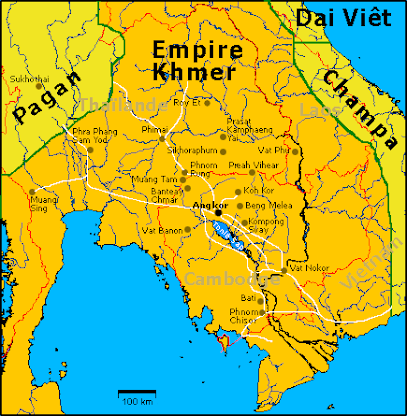
Climate change doomed Khmer empire

Who is trying to change the Khmer Empire History? Khmer People knew that Angkor Empire was not collapsed by Climate Changed ( drought).

Kalyan Ray, march 30, New Delhi:

A long-held mystery on what contributed to the demise of one of Asia's longest and the most well-known Hindu empires was revealed thanks to advanced research into the region's climatic conditions.

Scientists have now found that long spells of droughts interspersed with intense monsoon have brought curtains over Cambodia’s Khmer empire, which flourished from the ninth to the thirteenth Century.

At the Proceedings of the National Academy of Sciences on Monday, researchers said two of the worst droughts—in the middle of the 13th Century and early14th Century—combined with intermittent spells of heavy rain was one of the factors that resulted in the downfall of the empire more known for the majestic Angkor Vat temple.

Though the 13th Century drought stretched on for several decades, the dry spell that hit the region on the early 14th century was found to be the sharpest.

The drought in 1403 was reflective of moisture stress in the soil. “It was an extra-ordinarily dry event,” principal investigator Brendan Buckley from Lamont Doherty Earth Observatory at Columbia University in New York told Deccan Herald.
“Droughts of the magnitude we describe here would have had deleterious effects on the Angkor citizenry,” he said.

Scientists unravelled the weather conditions by reconstructing the monsoon period (March to May) for 759 years (AD1250-2008 ) through extraction of climate information stored inside ancient trees in a Vietnam national park.

Vulnerable infrastructure
The Khmer empire relied on a sprawling water supply system that covered an area of nearly 1000 sq km and connected the main city with its extensive suburbs. By the end of the 12th century, it became a vast and convoluted web of canals, embankments and reservoirs.

The infrastructure was huge by any stretch of imagination. The largest reservoir, West Baray, has an area of 16 sq km.

Such a massive infrastructure is “resistant to change” and “vulnerable to the risk of massive damage,” says the team comprising researchers from the US, Australia, Japan, Vietnam and Thailand.

While successive droughts weakened the water supply, the rain that fell heavily in the intervening years had only extended the damage.

The collapsing infrastructure was hard to bear for an empire that struggled to withstand war and other social factors.

“The climate factor was seldom mentioned among the causes of Angkor collapse. The society was already under stress and had very limited strategy to manage a vast and complicated water system that was impossible to rework. They also found themselves under the climate variability that far exceeded their ability to cope,” explained Buckley.

Scientists believe El Nino, the unusually high sea temperature in the Pacific that disturbs climatic conditions across the world, could have been responsible for Cambodia’s seesawing climate. However, they feel more research is required to ascertain this.
DH News Service .
Read more!

Market Hopes Property Law Will Boost Growth

The passage of a new law for the ownership of property by foreigners could give a boost the stagnant real estate market as well as bring in more investment, industry experts say.

The passage of a new law for the ownership of property by foreigners could give a boost the stagnant real estate market as well as bring in more investment, industry experts say.

The much-anticipated Foreign Ownership Property law was passed by the National Assembly last week and must now move through the Senate before being signed by the king.

“This foreign property law will benefit both foreign investors and Cambodians and will increase confidence in the legal framework for foreign property ownership in Cambodia,” Daniel Parkes, Cambodia country manager for CBRE Richard Ellis, told VOA Khmer.

Parkes called the law “a revolution in property investment” and one more step for Cambodia toward becoming a destination for international investors and property developers. “It goes a long way toward improving confidence and improving investment in Cambodia,” he said.

The law, which was drafted in December in a bid to improve ownership rights, allows foreigners to own residential property such as apartments, so long as they are above the ground floor.

Parkes said investors should consider coming in now, to take advantage of an expected upswing in the economy in 2011.

“The next six months is a good time to buy,” he said. “Comparatively, it’s more appealing than Thailand and Vietnam for foreign investors.”

Cambodian law does not allow foreigners to own land. Previously, if a foreign wanted to own any property, he would have to seek out a Cambodian partner, which deterred investment.

“My wife is Cambodian; she owns her own home here,” said Paul Luchtenburg, chief executive officer for Angkor Mikroheranhvatho Kampuchea, a microfinance institution. “But I know a lot of friends who want to find an easier, legal way to buy an apartment in Cambodia.”

With more foreigners able to buy apartments, the demand will increase, which could bring higher prices to property investors, he said.

“It should bring more money into the country,” he said. “So I think that is a very good thing.”

Jeremy Ha, director of Phnom Penh Commercial Bank, said South Korean developers and construction companies were optimistic about the new law.

“So I guess the number of companies [who want to] build apartments or condominiums will steadily increase in the future,” he said. “I am also optimistic as a foreigner, because I can buy an apartment or a villa in my own name.”

Sung Bonna, president of the National Valuers Association, told VOA Khmer in an interview the law will boost the economy.

Overall economic growth in Cambodia ground to a halt in Cambodia during the global economic downturn. The real estate market, which had been experiencing a boom, suffered heavily.

“It’s an opportunity for foreign investors to buy their own houses in Cambodia, for investment and for residence,” he said.

The sub-decrees that implement the law should be easily because the law is clear, he added.

Im Chhun Lim, Minister of Land Management, said the implementation of the law “will be fair and proper for all sides.”
Read more!

Monday, April 12, 2010

Breaking into Southeast Asia’s largest “tiger den”

VietNamNet reporters investigate wildlife trafficking from Laos into Vietnam.


The Muang Thong tiger farm is located on Highway 13 about 30 kilometers from Thakhek town. From the outside, nobody would think that behind that small gate is an immense world of wild animals.


It took VietNamNet reporters several months of tracking down information and making contacts before, after a memorable journey to Laos’ Thakhek province, they successfully infiltrated the largest tiger farm in Southeast Asia.

Purporting to be people who had come to Laos to buy tigers to make tiger bone glue, VietNamNet reporters crossed into Laos at the Cau Treo border gate (Ha Tinh) and then proceeded to Thakhek, once a major node on the so-called Ho Chi Minh Trail.

The Muang Thong tiger farm is located on Highway 13 about 30 kilometers from Thakhek town. From the outside, nobody would think that behind that small gate is an immense world of wild animals.

The 200 hectare farm is surrounded by a five meter high fence with sentry boxes set 100 meters apart. It is said that guards are allowed to shoot anybody who enters the farm uninvited.

Luckily, two of the five owners of this farm are Vietnamese people from Ha Tinh province. A tiger trader introduced the reporters to them so we got into the farm by the main gate.

The gate opened and the scowls the guards had given us disappeared. We saw a number of cages with tall iron fences a world of tigers appeared in front of us. There are all kinds of tigers and tigers of all sizes in this farm.

Phan Anh D, one of the two Vietnamese owners, led us to a cage near the farm gate that held two big tigers. He said that this pair of tigers are put into the same cage for breeding. “We don’t sell only this tigers. You can choose any of the 720 animals in this farm, including bears, panthers and African lions. We are willing to sell them”, D said.


One of the two breeding tigers at Muang Thong tiger farm.

According to this man, around 100 tigers were born right on this farm. The remaining animals are transported from Malaysia, Thailand and Myanmar. Tigers, both alive and dead, are transported to this farm on daily basis.

D is a Thai citizen of Vietnamese origin. He opened this farm six years ago. He said he initially contributed three million dollars to this farm to learn how to breed tigers in captivity.

“At the beginning, many tigers died and we suffered huge losses in the first year,” D related. “We began earning a profit from the second year, once we knew how to make tigers give birth in this farm. I have heard that it is a big deal in Vietnam whenever a tiger gives birth in cage. At our farm, several dozen tigers are born annually.”

He said the total value of the tigers in this farm is around $7.5 million.

The tigers at the farm need food worth around $1800 a day. Each adult tiger eats about five kilos of chickens daily. “We spend around $2000 a day but our profit is very high,” D said.

The major markets for tigers, according to this man, are Vietnam and China. “Vietnamese people come to our farm to buy tigers to make glue from tiger bones,” he said.

The value of a tiger of 100 kilos is about $14,000. Smaller tigers are cheaper. About a dozen tigers have been slaughtered to make bone glue right at the farm.

“Perhaps the smell of tigers is too strong, for within a one kilometer radius, no animal dares to come, not even the trained hunting dogs that we breed here,” said a farm worker who is specialized in slaughtering tigers.

The VietNamNet reporters asked D how to get tigers to Vietnam and he said the farm will deliver the carcasses to a customer’s address in Vietnam. The price for tigers without viscera is 3.3 million dong per kilo, COD to the central provinces of Nghe An, Ha Tinh and Quang Binh, and 4.4 million dong per kilo if the tiger is delivered in Hanoi.

He said tiger viscera weigh from eleven to thirteen kilos and a 100 kilo tiger can yield fifteen or sixteen kilos of bone.

The reporters still wondered about the means of transportation of tigers to Vietnam. “Don’t worry about it,” D assured them. “We have transported thousands of tigers to Vietnam. I will take your deposit worth 20 percent of the tiger in Vietnam. Three days later we will deliver you the goods (tiger)”.

When VietNamNet reporters expressed their wish to return to Vietnam with the tiger carcass, D said: “I don’t want to hide anything here, but this is my job. Set your mind at rest! I’ve taken thousands of tigers to Vietnam!”

Read more!

ASEAN AFTA Free Trade Meeting

Despite this week’s ASEAN summit being dominated by issues surrounding Burma and the domestic tensions in Thailand, the group’s finance ministers did get another opportunity to discuss the goal of an integrated free trade area within five years.

Critics say the likelihood of realising a South East Asian bloc with free movement of goods, labour and capital within the hoped for time frame doesn’t seem promising.

Presenter: Scott Alle
Speaker: Charles Adams, Lee Kuan Yew School of Public Policy and former regional director of the International Monetary Fund.

ALLE: On paper, an ASEAN trading bloc could be a major force in world trade. If it was a single economic entity, the grouping of South-east Asian nations would rank as the world’s 10th largest economy, and with a population of around 600 million, the third biggest global market. But ASEAN’s diverse membership from Laos, one of Asia’s poorest nations to Singapore with its180 billion dollar economy, has meant progress toward the stated goal of economic integration by 2015 has been, well, slow.

ADAMS: What’s been lacking up until now has been the translation into concrete action plans, steps and measures.

ALLE: Professor Charles Adams from the Lee Kuan Yew School of Public Policy is a former regional director of the International Monetary Fund, and has represented the organisation at ASEAN forums. He says while the focus remains on moving the process toward, the concept of an ASEAN free trade area remains loosely defined.

ADAMS: What they have done if you like is define the objective in terms of freer trade, freer movement of labour and capital etc. Now they’re going well they began with some of the at the border issues in manufacturing and yes we’re now looking at this range of behind the border issues and issues to do with services liberalisation and those are in the best of circumstances tough areas

ALLE: Behind the border refers to a country’s domestic policies, in particular the regulatory framework affecting importers and exporters, the degree of government red tape. The meeting of ASEAN finance ministers did agree to act on some trade matters. A internal free trade deal signed last year intended to boost trade by streamlining and simplifying procedures will come into effect next month, while investment agreement aimed freeing -up investment flows and reducing investment costs will come into force in August. The meeting which was also attended by representatives of the World Bank, the IMF, and the Asian Development Bank also put out an updated forecast for South-east Asia raising growth estimates to five-and-a-half per cent for this year. Professor Charles Adams from the National University of Singapore.

ADAMS: I think the overall message that came out that was number one the regional seems to be bouncing back quite strongly from the global slowdown but there’s are still some concerns. My understanding is that they discussed what we call exit strategies which basically has to do with the pace at which some of the stimulus measures introduced during the global crisis are unwound.

ALLE: Just how quickly those stimulus funds, 950 billion dollars across Asia, will be wound back continues to be a challenge for policy makers, but as economists have noted there’s increasing signs of overheating in China and India.
Read more!

Cambodia's new battle: Reconciling with the Khmer Rouge - Feature

By : Robert Carmichael

Anlong Veng, Cambodia - Twelve years ago the town of Anlong Veng in north-west Cambodia surrendered to the government in a move that marked the end of the infamous Khmer Rouge movement.

Today most residents in the district are former Khmer Rouge cadre and their families. On Friday, 150 of them came together in a unique effort to discuss reconciliation, justice and reintegration.

Trying to reintegrate the supporters of one of the 20th century's most brutal regimes is vital to rebuilding Cambodian society, says Daravuth Seng, a Cambodian-American who heads a local non-governmental organization called the Center for Justice and Reconciliation (CJR), which organized the meeting.

"Our focus is to try to get victims and perpetrators to start talking in an effort to really understand one another, and in an effort to really work on reconciliation in Cambodia," he says.

He says he feels that most of the country's reconciliation efforts to date have been one-sided, excluding the Khmer Rouge.

The irony of setting the meeting in Anlong Veng was enhanced by holding it at the compound of the late general Ta Mok, the movement's final leader and one of its most brutal and intransigent members. Ta Mok is still well-regarded here.

Seng, who fled the killing fields of Cambodia as a boy with his family, acknowledges that what the organization is trying to achieve is "a huge, huge task," but says reconciliation must be inclusive.

"And with the Cambodian context, that must include a lot of the former perpetrators as well," he says, since understanding their perspective is central to reconciliation.

It is no small task. The Khmer Rouge were responsible for the deaths of around 2 million people during their rule of Cambodia from 1975-79. Many of those who died were executed, while others succumbed to starvation, overwork and illness.

After the movement was driven from power in 1979, it regrouped on the western borders with Thailand and fought the government in Phnom Penh until finally capitulating in the late 1990s

In Phnom Penh, 300 kilometres south-east of Anlong Veng, the formal process is underway to provide some measure of accountability for crimes committed by the Khmer Rouge regime. That process is the Khmer Rouge Tribunal, a joint Cambodian-United Nations court.

Four former leaders of the movement, including its head of state and foreign minister, are in pre-trial detention. A fifth person, the regime's former security chief, was tried last year and judgment in his case is due in the coming months.

Early on at Friday's meeting, which was sponsored by Germany's development arm DED, it becomes clear that some former Khmer Rouge are concerned the court is looking to prosecute five more suspects.

The participants tell the meeting they are satisfied that justice and reconciliation require the prosecution of the five already in custody, but say the tribunal must stop there.

Im Chaem, a deputy council chief in Anlong Veng, says she and other elderly residents are concerned the court will investigate more and more suspects.

She says when they crossed over to the government in 1998, Prime Minister Hun Sen promised there would be no losers.

"Now we don't know when our turn will be because we lived and served during that time," says Im Chaem, who has previously denied allegations of extreme cruelty levelled at her when she was a Khmer Rouge district chief. "There might be another five, and then five more and then 10."

The tribunal's public affairs officer Lars Olsen says the exchange highlights the contrast between victims and perpetrators of violence. He says that most Cambodians he encounters around the country are victims and want more prosecutions, not fewer.

Olsen tells the participants that the court is not looking to add further names to its list of suspects, and says a maximum of 10 in total are to face trial.

His answer reveals the limitations of the tribunal's work. The inevitable political and practical compromises mean thousands of people will get away with murder - including possibly some of those present at the meeting.

The former cadre broadly agreed on a number of points about reconciliation. One was that more than a decade after the movement's collapse they want other Cambodians to stop referring to them as "former Khmer Rouge."

"The term 'Khmer Rouge' is associated with killing and persecution," says one. "We are finished if we are referred to as that. Our children's lives will be ruined, and no one will let their children marry ours. We should just say we are all Cambodian now."

They also called for more economic development in the area, and said all people should be equal before the law.

There is recognition too that their lives have improved since reintegration. Anlong Veng today has schooling, medical care, tarred roads, and the opportunity for educated young people to go on to university.

It is a far cry from what went before, when thousands of Khmer Rouge lived in the mountains and were constantly on the move.

"Now it has changed from bitterness to sweetness - this is very important," says another attendee. "During the war we were always changing our position, unable to stay together and even eat together. Now that the war has ended we are able to gather at the same table and have a meal."

CJR's Seng is encouraged by the day's exchanges, and says one old lady cried as she told him she regretted what she had done as a Khmer Rouge cadre.

Seng says it is vital to understand the psychology behind what happened in order to prevent future atrocities.

"There is no quick fix for reconciliation, but I honestly believe this is moving in the right direction," he says. "We can't leave out a huge group from the reconciliation process."
Read more!

Cambodia rice output rises

PHNOM PENH (Commodity Online) : Southeast Asian nation Cambodia said its rice production registered a marginal increase during 2009-10 farm year.

According to an Agriculture ministry report, the country produced 7.58 million tonnes of paddy during the period, an increase of 5.7 percent over last year.

The country grew 2.33 million hectares of rice, yielding 6 million tonnes of paddy in the wet season, and 380,000 hectares for 1.58 million tonnes of paddy in the dry season.

The Ministry of Agriculture said Cambodia could have 3.5 million tonnes of paddy left over for export, a 10.75 percent rise on the 3.16 million tonnes left over last year.

Prime Minister Hun Sen said this year’s success in paddy output helped ensure food security and lessen the impact of the global economic crisis.

Cambodia plans to raise yields to as much as 3 tonnes per hectare by 2012 to increase exports of processed rice to international markets.

The Ministry of Agriculture said Tuesday that Cambodia could have as much as 2.24 million tonnes of rice for export, after farmers brought in 2.83 tonnes of paddy per hectare this year.

In the farming year 2008-09, Cambodia grew 2.61 hectares of rice, an average paddy yield of only 2.74 tonnes per hectare.

The Supreme National Economic Council said last month that Cambodia could produce as much as 15 million tonnes of rice paddy, leaving 8 million tonnes for export.

However, rice millers and other industry insiders say the quality of processed rice remains low, keeping Cambodia out of a market that has proved lucrative for neighbouring Vietnam and Thailand
Read more!

Sunday, April 11, 2010

Challenges ahead for visions of an ASEAN community

By Ian Timberlake (AFP)

HANOI — Street vendor Ta Thi Huong has never heard of the "ASEAN Community" which Southeast Asian leaders spent two days last week trying to refine.

"ASEAN? I don't know what it is," says Huong, 40, who wears a traditional conical bamboo hat as she sells apricots on the streets of the Vietnamese capital Hanoi. "What community?"

Making the Association of Southeast Asian Nations (ASEAN) meaningful for the region's 590 million citizens is one of the bloc's challenges but observers say the vision faces even more fundamental issues.

Analysts say it is weighed down by wide development gaps within the region, entrenched domestic interests and the perennial distraction of Myanmar's failure to embrace democracy.

Focused on economic issues for most of its existence, ASEAN's 10 members in 2008 adopted a charter committing them to tighter links.

The group aims to form by 2015 a "community" based on free trade, common democratic ideals, and shared social goals including a common identity.

Senior government officials admit that progress has been greatest in the economic sphere, while the political and social "pillars" of their community need strengthening.

"It's easy to have a harmonisation of interests on the economic sphere," said Christopher Roberts, an expert in Asian politics and security at the University of Canberra.

But he said that creating a cohesive community was a task better carried out over decades and that the 2015 goal was unrealistic.

Political, security and human rights issues are "the real point of contention" between the very diverse group of countries, Roberts said.

ASEAN's membership ranges from communist Vietnam and Laos -- one of Asia's poorest nations -- to the Westernised city-state of Singapore, the absolute monarchy of Brunei and the vibrant democracy of Indonesia.

Other members are Thailand, Cambodia, the Philippines, Malaysia and military-ruled Myanmar.
An ASEAN summit in Vietnam's capital Hanoi which ended Friday was again overshadowed by Myanmar, and by protests in Bangkok which prevented Thai Prime Minister Abhisit Vejjajiva from attending.

Thailand's long-running political drama is among the domestic issues within ASEAN nations which are distracting it from moving forward collectively, analysts say.

The group has been divided over how to respond to Myanmar, which is under United States and European Union sanctions.

But on Friday it urged Myanmar to ensure that this year's planned elections, which have been boycotted by the opposition, are fair and include all parties.

"You talk of a community, it means that there must be some degree of commonality within the region but as you know ASEAN is made up of countries of varying nature," said Indonesian Foreign Minister Marty Natalegawa.

"Economically less so, but certainly in the political area, we have different political systems working in our neighbourhood."

He said that should not be a problem as long as everyone is committed to the same universal principles including human rights and democracy.

At their summit, foreign ministers fleshed out their vision of a rules-based regional community by signing a protocol to help member nations resolve conflicts.

Scarred by wars in the 1960s and 1970s, Southeast Asian nations have largely lived peacefully together for at least two decades, but smaller-scale conflicts and sovereignty disputes persist.

Cambodia and Thailand have been locked in nationalist tensions and a troop standoff over a disputed temple on their border since July 2008. Soldiers have died on both sides.

Although ASEAN has helped the region avoid war and has allowed its members to get to know each other better, it "has not been really effective" on bilateral issues like the Thai-Cambodia dispute, said Pavin Chachavalpongpun from the Institute of Southeast Asian Studies in Singapore.

"It it comes down to national interest, some members, they are not willing to rely on ASEAN... so at the end of the day the term 'community' is rather superficial," he said.

Ahead of the summit, ASEAN took another step towards building the social aspect of its community with the inauguration of a commission to address the rights of women and children.

Natalegawa, who says the ASEAN Community cannot be fairly compared with the much longer-established European Union, said one of group's challenges is how to make a difference in ordinary people's lives.

If it can do that, Huong, the Hanoi apricot seller, will take notice.

"I will like it if it makes our country better," she said, laughing.
Read more!

Thailand clashes leave 18 dead

By Patrick Winn and Mark Magnier

Anti-government protesters clash with troops in Bangkok, the capital. Prime Minister Abhisit Vejjajiva vows to restore peace and order.


"Red Shirt" protesters clash with soldiers in central Bangkok. Protest leader Nattawut Saikua said the deaths were the fault of Prime Minister Abhisit Vejjajiva for his refusal to step down and call new elections. (Rungroj Yongrit / EPA / April 10, 2010)

Reporting from Bangkok, Thailand, and Phnom Penh, Cambodia -- Anti-government demonstrators and Thai troops battled in the streets of Bangkok on Saturday in a conflagration of grenades, gasoline bombs and rubber bullets, leaving 18 people dead and more than 650 wounded.

Five soldiers and 13 civilians, including a Japanese journalist, were killed, the Associated Press reported.

As protests that have dragged on for a month sharply escalated, hundreds of the demonstrators also forced their way into government offices in two northern cities, raising the stakes for Prime Minister Abhisit Vejjajiva and his military-backed government.

"The situation at the moment is so confused," said Pranee Thiparat, a political science professor at Bangkok's Chulalongkorn University. "Anarchy rules Bangkok!"

In a televised address, Abhisit vowed to restore calm.

"The government and I are still responsible for easing the situation and trying to bring peace and order to the country," he said.

The "Red Shirt" protesters, mostly drawn from rural and working-class communities, are demanding that Abhisit dissolve parliament, step down and hold a general election.

The demonstrators, many of whom support former Prime Minister Thaksin Shinawatra, want an end to what they see as entrenched rule by the rich and powerful. Thaksin, a billionaire, was ousted in a 2006 coup, charged by military officials with corruption and abuse.

As the riots spread Saturday night toward an area popular with backpackers, the army pulled back to Bangkok's old quarter and called for a truce.

"If this continues, if the army responds to the Red Shirts, violence will expand," army spokesman Sansern Kaewkamnerd said.

But protesters raised the ante, calling on Abhisit to leave the country immediately. They also displayed a protester's corpse draped in a Thai flag, and held up pictures of several others, prompting cries of anger and weeping from the crowd.

Several soldiers who had been relieved of their weapons were marched onto a stage Saturday night. Protest leader Nattawut Saikua urged followers to detain more soldiers but to avoid hurting them, even as he blamed Abhisit for the deaths.

"This has resulted from the prime minister's refusal to step down," Nattawut said, referring to the dead protester. "This is Thai society's most serious loss."

Demonstrators believe that Abhisit, who came to power in a 2008 parlia- mentary vote, lacks a popular mandate.

With their demands unmet and the prime minister ostensibly willing to consider an election in a few months, the Red Shirts had risked seeing momentum dwindle among their hard-core supporters, said Don Pathan, a columnist for the Nation newspaper.

"It's definitely an escalation," he said.

Before Saturday's riots, police and soldiers, many from working-class backgrounds similar to the protesters', hadn't used deadly force.

A number of police officers expressed sympathy, some by hugging protesters, shaking hands and even waving Red Shirt paraphernalia.

Some analysts, meanwhile, said the unrest could prompt the military to step in, as it has several times before.

"There might be a coup," Chulalongkorn University's Thiparat said. "There's a real split both in the military and police forces, a serious one. That partly explains why the Abhisit government hasn't really been able to enforce law and order during the past three weeks."

mark.magnier @latimes.com

Read more!

Cambodia asks to convene ASEAN summit to help defuse Thai's extremely tense situation

PHNOM PENH, Cambodian Foreign Minister Hor Namhong on Saturday night proposed to hold an urgent ASEAN summit to help defusing Thailand's extremely tense situation.

In his letter to Pham Gia Khiem, Vietnamese deputy prime minister and minister of foreign affairs, Hor Namhong said "in light of this very grave development which no one knows when it will end and whether it will lead to more bloodshed, I think that we, as fellow ASEAN member states cannot stand idle and leave ASEAN image at stake any further."

Hor said he refered to the current "extremely tense political situation in Thailand, which has already claimed many human casualties."

"Therefore, I would like to propose that Vietnam as Chair of ASEAN should issue a Declaration on the situation in Thailand, or convene an urgent special ASEAN Summit in order to help looking for any appropriate ways to defuse such an extremely explosive situation in our friendly Thailand," he said.

ASEAN comprises of Brunei, Cambodia, Indonesia, Laos, Malaysia, Myanmar, the Philippines, Singapore, Thailand and Vietnam.
Read more!

'I will fight,' says girl, but denies report

The "Cambodian female" was accused of instigating the S. Phila. High assault.
By Jeff Gammage and Kristen A. Graham

Inquirer Staff Writers

For six weeks, since the release of the official Philadelphia School District report on the Dec. 3 violence, she has been the mystery girl of South Philadelphia High:

The rogue student identified only as "the Cambodian female," singled out as an instigator and assailant who joined predominantly African American youths in a series of assaults on Asians.

At 1:30 p.m. that day, the report said, two to four African American girls accompanied by a "possibly Cambodian" female attacked an Asian girl, then dragged her downstairs by her hair.

In a massive after-school assault on Broad Street two hours later, the Cambodian girl was "the first to attack" and "the most violent," identified by the principal as kicking a Vietnamese girl, the report said.

Who is she? Few know.

School District security chief James Golden said he didn't know who she was. Philadelphia police investigators said they didn't know her. The local Cambodian association has been unable to contact her.

After weeks of searching, however, The Inquirer has identified and interviewed the girl, who is 15. She denied any role in the violence of Dec. 3.

"I didn't do nothing wrong," she insisted. "Why, of all the people that's involved, they pick me out?"

She acknowledged being in a brawl the previous day. And she said no one should doubt her toughness when provoked. "I will fight."

The newspaper is withholding her name because of her age.

The district report, issued Feb. 23, cited the girl 10 times in its findings and twice in footnotes.

Cambodian leaders and Asian advocates question why a lone Cambodian girl is cited again and again among so large a group of assailants - at least 10 to 20 inside the school and 20 to 40 outside, according to the report.

They say it's a district attempt to portray the events of Dec. 3 not as "anti-Asian violence" specific to South Philadelphia High, but as general violence that could have happened anywhere.

"We won't make excuses for her, but I want to know how she's tied to the whole thing," said Rorng Sorn, executive director of the Cambodian Association of Greater Philadelphia. "Why is this Cambodian female student being highlighted multiple times?"

Sorn questioned whether the girl had been mentioned so "she can be the scapegoat, and it can be, 'OK, the attackers also had Asians. Maybe it's not racially motivated.' "

Cecilia Chen, a lawyer with the Asian American Legal Defense and Education Fund, agreed.

"The district has made a very strong effort to portray the attacks as multiracial, and the fact that they focus so heavily on a single Cambodian female really speaks to that," she said. "It was only Asian immigrant students who were attacked on Dec. 3."

District officials vigorously denied there was any attempt to use the Cambodian girl as a means to broaden the races of those involved.

"That is absolutely not true," spokeswoman Evelyn Sample-Oates said. Asian and African American students were identified and suspended, she said.

James T. Giles, a retired federal judge, conducted the district inquiry at the request of School Superintendent Arlene Ackerman. The report named no students.

In an interview, Giles said his description of the Cambodian girl's actions had been based solely on the facts. She was deemed the "most violent" on Broad, where about 100 mostly African American youths surrounded 10 Vietnamese students, because she had been seen kicking a girl, he said.

"I can assure you there was no anti-Asian intention in the report I wrote," Giles said. "But people think what they want. There's nothing I can say to dissuade them from the views they have, nor would I attempt to."

The girl's involvement in the after-school attack "counters a proposition that all the attackers on Broad Street were black," he said. "If it's true the composition of the group was other than all black, then, as I said in the report, it requires looking at more complicated sociological issues than just black versus Asian."

The girl is a ninth grader who now attends a disciplinary school. She stands 5-foot-2 and weighs 98 pounds, all legs and long brown hair, and during the interview she wore stylish silver sandals, cutoff blue jeans, and a gray T-shirt. Her fingernails were manicured, the tips painted white.

Standing on the sidewalk near her South Philadelphia home, she slurped a cherry Popsicle. She had no idea the district existed. She said she had a long disciplinary record and had belonged to a street gang. But she said that on Dec. 3, she deliberately walked past the melee on Broad and was later shocked to be told by community liaison Wali Smith that she was being suspended.

"That's crazy," she said. "Mr. Wali Smith said, 'I saw you kick the Asian girl in the face. You ran across the street and kicked her in the face.' I said, 'No.' . . . Who's going to listen to a student? A teacher always wins."

Sample-Oates, the district spokeswoman, said Smith was not the only staffer to identify the girl. One of the victims and other eyewitnesses recognized her, she said.

The girl's mother, who speaks limited English, broke into tears at the mention of her daughter's name. She said the teen, the third-youngest of nine children, was impossible to control.

"I called the police on her last night," she said, sitting on the front steps of her rowhouse. "When I talk to her, she screams at me."

The girl's brother-in-law, Christopher Robinson, defended her as less culpable than others involved in the violence. It's true her gang pummeled new members as an initiation rite, but none carried guns or sold drugs, he said.

"I'm not saying she's an angel," Robinson said, adding that her past made her easy to blame.

The girl nodded.

"My record is real bad. I understand," she said.

Robinson said his sister-in-law, like some Cambodians born and raised here, identified with African American culture and sided with black students in disputes with Asian immigrants.

The district report said gang influences could not be excluded as a cause of some of the violence. Giles told The Inquirer that he had not researched the Cambodian girl's associations, and that his supposition of gang involvement had been based on other information.

Since the report's release, trying to determine the identity of the Cambodian girl has been the buzz among teachers at South Philadelphia High. After Dec. 3, she was suspended and transferred to Transitions South, an alternative school.

The Cambodian girl criticized the school disciplinary process as unjust. Two other Asian students who were punished also have said they were disciplined unfairly. In one case, the district retracted its allegation that one of the two, Hao Luu, was part of a gang.

In the interview, the Cambodian girl said her mother had attended her disciplinary hearing. But neither of them went to the second, formal hearing because the district notification did not arrive until it was over, the girl said.

Sample-Oates said the district had not been told the notice arrived late. The girl never contacted school or district officials to question her new school assignment, she said.

The Dec. 3 violence has spawned three investigations, including by the state Human Relations Commission and the U.S. Justice Department.

Giles' inquiry blamed the Dec. 3 violence on rumors that circulated after a confrontation between Asian and African American youths the previous day. Asian students dispute that, saying assaults against them have gone on unchecked for years.

They and their advocates say the key point is not the race of the attackers, even if one was Cambodian, but the fact that all the victims were Asian.

The Cambodian girl is first mentioned five pages into the 37-page report. Her role apparently started Dec. 2, the report said.

At 1:30 p.m. that day, a group of Asian and African American students had a verbal confrontation on the second floor of the school and were separated by school police. Afterward, at least two rumors emerged about the cause of the confrontation. One was that during third period "a Cambodian female had 'challenged' a group of three Vietnamese students to a fight."

At 3:15 p.m. that day, an after-school altercation occurred between African American and Asian students, including some who had been involved in the second-floor incident.

One of the victims to come forward publicly was Luu, a 17-year-old immigrant from Vietnam. He was beaten so badly that he vomited.

The report said one rumored assailant in that incident, which ended at a Walgreens store, was the Cambodian girl. The rumor was that "the arms of one of the Vietnamese students were held by African American females while the Cambodian female struck him in the head, rendering him unconscious."

The Cambodian girl told The Inquirer she had been involved in that fight, but only to aid a friend. An Asian boy "hit me with a shoe. I hit him back."

The first attack of Dec. 3 occurred at 8:45 a.m., when a group of mostly African American students assaulted an Asian student in Room 424, the report said.

At 10:30 a.m., eight Vietnamese youths went to school police and identified four African American assailants from the Walgreens incident.

"Apparently," the report said, "someone also identified a Cambodian female student as an assailant, as her name appears in the school police incident report."

The violence continued through the day.

The biggest attack occurred on Broad at dismissal, when the Vietnamese students were chased, surrounded, and beaten.

"A Cambodian female recognized by staff at the scene as an SPHS student was the first to attack the students," the report said, "and was reported to have been the most violent."

The victims could not identify their attackers, but "most of them did recognize the role that the Cambodian female played in initiating and participating in the attack," the report said. "The principal and other SPHS staff were close enough to the attack that they were able to clearly identify the Cambodian female."

The girl said the district had warned her that city police would charge her, but that never happened.

"We never had a court date or nothing," she said.
Read more!

Saturday, April 10, 2010

MILLVILLE: Wheaton Arts offers Cambodian Beadwork Workshop

Wheaton Arts and Cultural Center, 1501 Glasstown Road, Millville, will host a workshop, Cambodian Beadwork On Fabric, from 2 to 4 p.m. April 25.

Chamroeun Yin will be the instructor for this workshop for people age 10 and older.

Cambodian traditional beadwork is a form of bead embroidery on fabric used by the artist when making Cambodian traditional wedding and dance costumes.

Participants will create flower and diamond designs with gold glass beads and sequins on a small multipurpose purse.

Students will learn about the history and cultural significance of Cambodian costume. This class is the first in a series of workshops offered in conjunction with the Cambodian Traditions: Wedding and Court Dances exhibition.

Fee is $30 for members and $35 for nonmembers.

For more information, call (856) 825-6800, e-mail mail@wheatonarts.org or visit www.wheatonarts.org.
Read more!

Friday, April 09, 2010

Area artists head to Cambodia to combat child trafficking

ROSEVILLE, CA - A team of local artists will be leaving Sunday for Cambodia on a two-week mission of mercy, painting murals to help children recovering from sex trafficking.

Roseville artist and father of two, Shane Grammar is leading a group called "Heart for the Kids."

Grammar said his six-person team will be traveling to Svay Pak just outside of the capital of Cambodia. The area is known worldwide as a notorious red light district for child prostitution.

The team plans on painting murals for a new building used to help educate rescued and recovering victims.

Grammar said he wants "to bring hope and joy to these girls who've been rescued from human trafficking through the arts. We believe these girls are pure. They've been born pure. But they've been taken advantage of."

According to UNICEF, 55-thousand girls and young women are involved in sex trafficking. 35 percent of those girls are under the age of 16.

The local team will be working closely with a larger effort by Agape International, which is based in Rocklin. Agape has spent the past two years working to help rescue children from sex trafficking in Svay Pak.

"We're really focused on prevention efforts there in returning hope to these people," said Renne Burkhalter of Agape International. "They've had no hope for alternatives. Every family in that village is expected to traffic their girls by the time they are 9 or 10 years old."

Grammar said hope is a powerful thing for child sex trafficking victims.

"We really believe that what we're doing will show the girls something they can fight for," Grammar said.

Grammar said he plans on blogging daily, offering updates and photos for supporters at his Heart for the Kids web site.

By Suzanne Phan, sphan@news10.net
Read more!

Thai-Cambodian relations improves: Kasit

By The Nation
Hanoi


Thai-Cambodia relations have ameliorated greatly due to Cambodian Prime Minister Hun Sen's positive comment, according to Foreign Minister Kasit Piromya.

Kasit, who attended the just concluded Asean Summit here this morning, said that on the sideline of the summit, he met Hun Sen. "He was very positive. He also dismissed the report that the red shirts used the Cambodian airwave," Kasit said.

Relations between the two countries were downgraded last year when the fugitive Thaksin Shinawatra was appointed Hun Sen's economic advisor, which has set off verbal war between both sides.

Kasit said both countries are now considering tangible measures that would increase mutual confidence. Read more!

Thursday, April 08, 2010

ASEAN Protocol On Settling Inter-Regional Disputes

(RTTNews) - A protocol for resolving regional disputes among Association Of South-East Asian Nations (ASEAN) member countries has been signed at its ongoing summit in the Vietnamese capital Hanoi, an ASEAN news release said on Thursday.

The protocol would help its transformation into a "rules-based organization," the release said.

Even though Foreign Ministers from the 10-member bloc signed the protocol, its terms of reference has not yet been finalised.

The mechanism could play a pivotal role in solving the long running dispute between Thailand and Cambodia over an area located near Preah Vihear temple situated in northern Cambodia near the border with Thailand.

Maps dating back to Cambodia's colonial days under French rule showed the temple, built mainly by rulers from the famous Khmer empire in the 11th and 12th century, as belonging to Cambodia but this was later disputed by Thailand on the grounds that it was not official and therefore invalid.

The International Court of Justice (ICJ) in 1962 ruled that the temple was indeed situated on Cambodian territory, but much of the surrounding land was claimed by Thailand leaving Cambodia with access only up a steep hillside.

In 2001, Thai troops blocked access to the temple for more than a year in a dispute over polluted water at the temple site and tensions rose again in 2008 following Cambodia's bid to get the temple listed as a World Heritage Site.

Last year, at least two Thai soldiers were killed and seven wounded in skirmishes between troops across the disputed border.

Besides the protocol would be useful in settling maritime disputes among ASEAN member countries. However, it is unlikely to get involved in cases relating to internal disputes of member states.

This is probably the reason why despite Vietnam's best efforts, ASEAN is unwilling to mediate in the internal dispute between Hanoi and Beijing over maritime territory in the South China sea.

China has also objected to the ASEAN being party to the dispute and insists that separate talks be held with each of the ASEAN member countries.

by RTT Staff Writer
Read more!

Wednesday, April 07, 2010

Cambodia Opens Real Estate Market To Foreigners

Have you been hankering to buy real estate in Cambodia? OK, maybe not. But you may want to give it some thought now that a new law allows foreigners for the first time to purchase real estate in the impoverished Southeast Asian country.

Those in the know already know that some investors have long gotten around the prohibition. But do you really want to do something blatantly illegal in a place such as Cambodia? Well, now you won't have to.

The new law has passed the lower house of the Cambodian parliament. It still needs approval from the Senate there and the King, but that's considered nothing more than a technicality by the 'in the know' crowd.

There is just one small caveat you should be aware of, however, if you are thinking of buying into the Cambodian dream.

Under the new law, foreigners, says the Associated Press, will only be able to buy property at least one floor above the land. In other words, you can own the building sitting atop the land, but you can't own the land itself!

Agence France-Presse quotes Cambodia's land management minister as saying the new law would "boost the kingdom's real estate market and bring in more foreign investment."

The Xinhua News Agency quotes the minister as saying the new law will now permit foreigners to own apartments and condos above the ground, or from the first floor up. So, who owns the underground parking garage, is what I want to know?? Then again, maybe that's an LA thing. You could always take a rickshaw.

Charles Feldman is a journalist, media consultant and co-author of the book, "No Time To Think, The Menace of Media Speed and the 24-hour News Cycle." He has written about real estate related issues for several years.
Read more!

Cambodia minister says Mekong nations committed to improving living standards

Phnom Penh, April 6, 2010 AKP - The four member countries of the Mekong River Commission (MRC) -Cambodia, Laos, Thailand and Vietnam - are committed to develop sustainably the Mekong basin, aiming at increasing the living standards of some 60 million people living along this river.

The commitment was made known by Water Resource and Meteorology Minister H.E. Lim Kean Hor at a press conference held here on April 5 at Phnom Penh International Airport upon the arrival of the Cambodian delegation from the First Mekong River Summit in Hua Hin, Thailand.

The four nations also recognized the development during the past 15 years of the International Mekong River Commission and they are determined to do their best to increase their joint cooperation in the sustainable development of the Mekong River basin, he said.

For its part, China promised to strengthen cooperation with the International Mekong River Commission and supported the good cooperation between China and the commission in information exchange on water change at the upper parts.

The International Mekong River Commission was established in 1995. It has four members; the upper-Mekong basin countries - Myanmar and China -have not joined the commission yet, but remained its dialogue partners. They also sent their participants to the summit.

Regarding the negative impacts on Mekong's water due to the construction of hydroelectric dams, Lim Kean Hor, also president of the National Mekong River Commission of Cambodia, said hydroelectric dams are very necessary, especially for Cambodia. "But, we also think about the development and the sustainability of the environment and nature," he underlined.

Cambodian Premier Samdech Akka Moha Sena Padei Techo Hun Sen on April 4-5 led a high-ranking delegation to participate in the First Mekong River Commission Summit, which will be held every four years according to the alphabetic order of the member countries.

Below is the full Declaration of the Mekong River Commission:

"MRC Hua Hin Declaration'Meeting the Needs, Keeping the Balance: Towards Sustainable Development of the Mekong River Basin'" 5 April 2010

Preamble We, the Heads of the Governments of the Kingdom of Cambodia, the Lao People's Democratic Republic, the Kingdom of Thailand, and the Socialist Republic of Viet Nam, meet in Hua Hin, Thailand for the First Summit of the Mekong River Commission (MRC) on the occasion of its 15th Anniversary.

We recall the signing on 5 April 1995 of the Agreement on the Cooperation for the Sustainable Development of the Mekong River Basin (herein referred to as the Mekong Agreement) and the establishment of the MRC by the representatives of the Lower Mekong Basin Governments, and reaffirm our political commitment to its implementation;

We recognise that the sustainable management of water resources in the Mekong River Basin is crucial to the economic and social well- being of the riparian population and to the poverty alleviation efforts of Basin governments;

We note that accelerating the development of water and related resources will make a significant contribution to the socio- economic development of the region, but may also have negative impacts on the Basin environment that need to be fully addressed; and

We affirm our strong and continued commitment to cooperate and promote the sustainable development, utilisation, conservation andmanagement of the water and related resources of the Mekong River Basin and agree to the following statements.

Recognition of achievements

We, the Heads of Government, recognise that the institutional development of the MRC has advanced from its inception as the United Nations based Mekong Committee and Interim Mekong Committee to the independent knowledge-based inter-governmental River Basin Organization of today. An increasing level of ownership of the organization by Member Countries has led to a strengthening of cooperative governance and increased effectiveness over time.

We applaud the significant achievements of cooperation among Member Countries in the 15 years since the signing of the Mekong Agreement.

We are encouraged by the achievements of the MRC and its Member Countries through our joint efforts in implementation of the Mekong Agreement that include strengthening dialogue on regional water resources development; facilitating a Basin-wide, consultative planning process through an Integrated Water Resource Management (IWRM) approach; reducing the risks of regular flooding and promoting the beneficial effects of the annual flood pulse; increasing international trade opportunities through safer and more effective river transport and legal frameworks for cross-border navigation; defining a balance between the opportunities and risks of proposed hydropower projects; an enhanced understanding of the Basin's aquatic biodiversity and fisheries; providing environmental decision support; and initiating a process to help the people of the Basin adapt to the consequences of climate change.

Over the past fifteen years, the water and related resources of the Basin have been protected through the effective environmental governance of MRC and its Member Countries. Mekong partners and stakeholders now know and understand more about this complex and productive river system. We note with appreciation these positive outcomes that have come about through a strong sense of regional cooperation and continued national capacity building among the Member Countries. We acknowledge the progress made to extend cooperation between the MRC and international, regional and local partners including MRC's Dialogue Partners, namely the People's Republic of China and the Union of Myanmar, and its Development Partners. The sharing of hydro-meteorological data by People's Republic of China in the current drought situation is highly appreciated and we hope the cooperation will be continued. We appreciate the efforts of MRC to further strengthen and expand its relationships with People's Republic of China, Myanmar and all MRC partners in pursuing the organization's development goals.

We note that the MRC has forged new alliances and working relationships with a range of international organizations including ASEAN, the Greater Mekong Sub-region (GMS), the Asian Development Bank (ADB) and the World Bank to further promote the sustainable development and management of the Mekong Basin's water resources.

We welcome and appreciate the continued and extensive strategic, financial and technical support from MRC's Development Partners over the years which has allowed the MRC to successfully implement the Mekong Agreement and become a more effective organization.

We acknowledge with appreciation the outcome of the International Conference on Transboundary Water Resources Management in a Changing World held prior to the First MRC Summit as reflected in the Conference Summary.

Regional opportunities and challenges

We, the Heads of Government, acknowledge that there are both opportunities and challenges to be faced by the MRC over the next decade as a result of development pressures including expanding populations and rapid economic growth. We commit to cooperate further to tackle critical emerging challenges in the Mekong Basin that include: reducing the loss of life and assets at risk from flooding and loss of livelihoods from drought conditions; better integrating sustainability considerations into the development of the Basin's significant hydropower potential; ensuring effective management of water for agricultural production, particularly as part of drought management strategies; preparing for climate change adaptation measures to minimise poverty and food insecurity among vulnerable communities; minimising any deterioration of water quality, loss of wetlands and deforestation, which present risks to biodiversity and peoples' livelihoods; better managing the Basin's unique natural fisheries; and reducing the risks associated with expansion of river transport.

Building on the solid foundation of 15 years of capacity building, we encourage MRC to address these challenges through the preparation and implementation of the IWRM-based Basin Development Strategy and the forthcoming MRC Strategic Plan for 2011-2015. We note that significant opportunities exist through intensifying partnerships and relationships with an increasing range of Partners, including ASEAN, the ADB, the GMS, the World Bank and other transboundary river basin organizations. We confirm that the continued focus of MRC on active stakeholder participation with a range of civil society organizations and the private sector will strengthen its ability to meet its development goals.

Vision of the MRC

We, the Heads of Government, note:

The existing Vision of the Mekong River Basin as "An economically prosperous, socially just and environmentally sound Mekong River Basin"; " The Vision for the MRC as

A world class, financially secure, International River Basin Organization serving the Mekong countries to achieve the Basin Vision"; and

The Mission of the MRC, "To promote and coordinate sustainable management and development of water and related resources for the countries' mutual benefit and the people's well-being."

We resolve to enhance efforts to realize these goals through a broad consultative approach that feeds into and influences MRC's strategic directions and ensures continued relevance of the MRC for future generations.

Priority Areas of Action

We, the Heads of Government, pronounce that building on the achievements of fifteen years of implementation of the Mekong Agreement, further cooperation over the coming years between the governments of Member Countries will be required to optimise multiple-use of water resources and mutual benefits for all riparians, to avoid any harmful effect that might result from natural occurrences and man-made activities and to protect the immense value of natural ecosystems and ecological balance.

We expect the MRC to focus on and prioritise:

Adopting and implementing the IWRM-based Basin Development Strategy;

Intensifying efforts to effectively manage the risks from flood, drought and sea level rise including establishment of forecasting and warning systems across the whole basin;

Facilitating an international legal framework that encourages river navigation and trade;

Researching and addressing the threat to livelihoods posed by climate change and cooperating with other regional partners in addressing haze pollution;

Monitoring and taking measures to improve water quality in priority areas of the Basin;

Sustaining the existing and future uses of water and related resources, and aquatic biodiversity, wetlands and forests in the Basin;

Identifying and advising on the opportunities and challenges of hydropower and other infrastructure development in the Basin, especially risks as they pertain to the protection of food security and livelihoods;

Continuing to improve the implementation of the Procedures for Data and Information Exchange and Sharing, the Procedures for Water Use Monitoring, the Procedures for Notification, Prior Consultation and Agreement and the Procedures for Maintenance of Flows on the Mainstream and finalise the Procedures for Water Quality;

Exploring and identifying opportunities for expansion of cooperation between the organization's current Dialogue Partners and Development Partners, in particular to address common water resources and climate change challenges, as well as identifying new Development Partners and other stakeholders.

Way ahead We, the Heads of Government, reaffirm our solidarity and the highest level of political commitment to the implementation of the Mekong Agreement.

We commit to working together to achieve sustainable integrated water resources management for sustainable development, economic growth and the alleviation of poverty and improvement of livelihoods in the Mekong River Basin. In parallel, we recognise that efforts need to be expanded to protect the natural resources of the Mekong Basin for the sustainable management and use of the Basin's resources.

We reiterate our support for the MRC's role in promoting and facilitating coordinated and sustainable development; enhancing and strengthening the working relationships with Dialogue Partners, ASEAN, the GMS, the ADB, the World Bank, other Development Partners, civil society, the private sector and others. In this connection, we welcome other Riparian States to join the MRC in the future.

Consistent with the Initiative for ASEAN Integration, we emphasise the need to prioritise resources, funding and capacity building for those Member Countries where poverty is highest and economic need is most urgent.

Recognising that economic development is progressing in the Mekong Region, we commit to a vision for the MRC to be financially sustained by Member Countries by 2030. We refer to institutional models adopted by other international river basin organizations and encourage the MRC to increasingly explore de-centralised implementation modalities for its core river basin management functions.

We agree that progress made in implementing the resolutions of this Declaration will be monitored through the MRC Council. We decide that an MRC Summit will be convened every four years. The host country will rotate among the MRC Member Countries in alphabetical order.

We express our sincere appreciation to the host country, Thailand, for hosting the First MRC Summit.

ADOPTED at Hua Hin, Thailand on 5 April 2010 in the English Language."
Read more!