The land of heroes
Our heroes
Our land
Cambodia Kingdom


Thursday, January 14, 2010

Cambodia reinforces Thailand border amid simmering tensions

Cambodian soldiers stand guard near the Preah Vihear temple in Preah Vihear province on October 14, 2008. Cambodia says it plans to reinforce the border. [AFP]


Liam Cochrane, Alex Khun

Cambodia is reinforcing its border with Thailand, establishing new villages full of soldiers, building roads and buying new equipment.

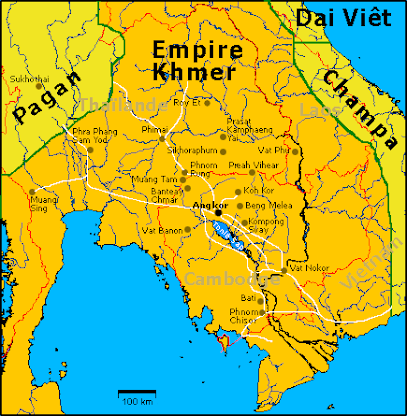
The strengthened military presence is part of an ongoing dispute over land surrounding the Preah Vihear temple on the Cambodia-Thailand border.

The 12th century temple has been the site of numerous violent clashes between the two countries in recent years.

Cambodia's Ministry of Defence made the announcement and said the program was necessary for national protection.

It says the military bulwark is part of a five-year plan, with work already underway on five new villages that will be populated with soldiers.

Preah Vihear program officer for the Wildlife Conservation Society, Tan Setha has witnessed the flurry of new construction activity.

"At the moment I can see the government establish some new village for the army family along the border."

It's believed a total of 14 new villages will eventually be established at a cost of hundreds of millions of US dollars.

A multi-ministerial committee, headed by former Phnom Penh governor and long-time Preah Vihear supporter, Chea Sophara, is driving the development.

Development

Cambodia is clearing land along the heavily-mined border so new infrastructures can be built to sustain the permanent relocation of soldiers and their families.

Heng Ratana, from the Cambodian Center for Mine Action says more than 300 de-miners are clearing land for the first five new villages being built for soldiers and their families.

"In Preah Vihear province, we've deploy more than 300 de-miners there to support demining activity which [has] tasks prioritised by local community and provincial community there."

"Our team is clearing a number of areas for supporting their development activity there, such as building new schools, new roads, irrigation system and so on."

The plan comes amid ongoing tension between Cambodia and Thailand over who owns 4.6 square kilometres of land surrounding the ruins of Preah Vihear.

Since July 2008 there have been several deadly clashes on the border and troops from both sides are prepared for a long standoff.

The paved road that leads from the Thai side to the foot of the temple, gives Thailand a distinct military advantage over Cambodia where dirt roads are full of pot holes, making the movement of troops and equipment difficult.

But that looks set to change, with this major investment to boost the number of Cambodian troops in the area and enhance their capacity to respond to any future incidents.

The troubled relationship between the two countries have been recently inflamed by Cambodia appointing former Thai prime minister Thaksin Shinawatra as an economic advisor.

It's understood Mr Thaksin will make his next visit to Cambodia later this month.
Read more!

Security Concerns Hampered FBI in 1997 Investigation

By Men Kimseng, VOA Khmer
Original report from Washington


A security threat to an FBI agent in 1997 and concerns over US cooperation with Cambodia put a grenade attack investigation on hold, according to recent media reports.

The agent, Tom Nicoletti, was sent to Cambodia to look into the attack, on an opposition rally, which killed sixteen people and wounded more than 100 others, including an American citizen.

Nicoletti, who is now retired, told the English-language Cambodia Daily that by the time he left Cambodia, the evidence he had collected was not up to US standards for prosecution. He had planned to return, he said in e-mails to the newspaper, but an unfavorable situation in the country prevented it.

Nicoletti said he had been pulled out of Cambodia for fear he may be the target of attacks for his investigation, which pointed toward possible collusion in the attack on opposition leader Sam Rainsy by members of then-second prime minister Hun Sen’s bodyguard unit.

The FBI produced nine sketches of three suspects, including Kong Samrith, also known as Brazil. In report released to the Cambodian Daily following a Freedom of Information request, the FBI said its investigation had been hampered and that agents had difficulty discerning which witnesses were telling the truth.

One witness told FBI investigators he saw a line of Hun Sen bodyguards allow two grenade-throwers to pass as they fled the carnage of the scene in front of Wat Botum, near what was then the National Assembly building.

The witness “pursued but was prevented from heading towards the wat and nearby CPP headquarters,” according to the report. “As he turned, he was kicked by the soldiers and knocked to the ground.”

However, in another interview, one of Hun Sen’s bodyguards gave a different account, according to recordings posted on www.cambodiagrenade.info. In an interview with another investigator in the case, Peter Hoffman, the bodyguard denied such an incident took place.

“When the grenade throwers were running toward your position, how many people were chasing them?” Hoffman asked the unnamed witness, who answered through a translator.

“I have no intention to count how many people [were] chasing the throwers, and I have no knowledge that those people were the grenade throwers,” the witness replied.

“Do you have good eyesight?” Hoffman asked.

“No, no problem with the eyes. The reason is that there are a lot of demonstrators.”

“So three or four people throw grenades into a crowd,” Hoffman asked, “and you didn’t see anything?”

“I see nothing.”

Ultimately, the FBI investigation became inactive and failed to identify the perpetrators.

“The Cambodian police could finish the investigation any time they want,” said Brad Adams, Asia director of Human Rights Watch. “They would have sufficient information in their files. They just choose not to do it. Maybe because they don’t want to do it, and maybe because they are afraid of Hun Sen.”

Khieu Sopheak, a spokesman for the Ministry of Interior, denied police were unwilling to pick up the case.

“We lost track when we lost Brazil,” he said, referring to one of the suspects. “At the time, it was chaotic, and Brazil died for no reason in a camp of a political party that I prefer not to name.”

He was referring to bloody street fighting between the Cambodian People’s Party, led by Hun Sen, and Funcinpec, led by Prince Norodom Ranariddh, in a coup that took place months after the grenade attack, July 5 and July 6.

Khieu Sopheak also blamed FBI agent Nicoletti for failing in the case.

“What Tom Nicoletti did was not professional,” Khieu Sopheak said. “He was assigned to conduct the investigation, but could not solve it. Once he concluded a case, he just kept it.”

“The FBI agent was very stupid,” said Mok Chito, who is now head of the criminal police division and was head of Phnom Penh penal police when the attack took place. “He does not know how to investigate. He sometimes listened to other people without knowing [who the subject was]. I remember that in one of its reports, the FBI said I was Hun Sen’s nephew and was chief of municipal police.”

Rights group and families of the victims have insisted that the FBI come back and conclude
their investigation to bring those responsible to court.

“I cannot speculate on what the FBI may or may not do in the future regarding this case,” John Johnson, a spokesman for the US Embassy, said in an e-mail. “I can only say that their original investigation was inconclusive and the US Prosecutor’s Office declined to pursue the case.”

He referred further questions to the FBI in Washington, who have not responded to written questions.

The FBI said in its 1997 report a continued investigation could threaten cooperation with Cambodia, but Adams, of Human Rights Watch, said the investigation should be concluded.

“The US doesn’t need Cambodia,” he said. “Cambodia needs the US, and I think the US should remember that. China is an increasing power, but not a superpower, and the US can work with other countries to put pressure on Cambodia to improve its human rights situation, to try to improve governance and dealing with things like corruption and the rule of law.”
Read more!

Thaksin tells followers to stay put

By THE NATION


Former Prime Minister Thaksin Shinawatra will make his third visit to Cambodia later this month, Cambodia's media reported yesterday.

Cambodian Foreign Minister Hor Namhong said Thaksin's visit as an economic adviser to the Cambodian government had nothing to do with political tensions in Thailand, where the Supreme Court will rule on Thaksin's asset case in late-February.

"Thaksin's coming or going out of Cambodia is not strange. It is a normal thing," Hor Namhong was quoted by the Phnom Penh Post as saying.

"We are absolutely not interfering in Thai internal affairs. Whatever colour T-shirts they have is up to them."

Thaksin said on his Twitter site that his supporters should not visit him in Phnom Penh just now as he is still in Dubai.


"Some want to see me in Cambodia - but hang on. I'm now still in Dubai, please do not go [ahead of] me," Thaksin said.
Read more!

Wednesday, January 13, 2010

Two Cambodian loggers shot, one missing in new Thai border incident

Phnom Penh - Cambodian authorities said two Cambodian citizens logging illegally in Thailand have been shot dead by Thai troops and a third is missing, national media reported Wednesday.

The two dead men were in a party of 26 who crossed the border on January 10 in Oddar Meanchey province in north-west Cambodia, the Cambodia Daily newspaper quoted a senior army source as saying.

It was the latest in a series of shootings in the past four months in which Thai troops were accused of shooting Cambodians logging illegally and brings the number of dead to at least four.

Last week, the Cambodian government said it would station extra soldiers along the border in Oddar Meanchey to prevent its citizens from crossing illegally into Thailand. After the latest incident was reported, Information Minister Khieu Kanharith said the government would again increase its efforts.

'The government will build more checkpoints to prevent them and warn them from crossing the border illegally to prevent shootings,' he told the newspaper.

In the most infamous case, a 16-year-old died in September after he was shot and wounded, then allegedly tied to an ox cart while alive and set on fire by Thai soldiers. The Thai government later insisted the teenager had already died from gunshot wounds when troops burned his body.

Poverty is widespread in Cambodia and drives thousands to work in Thailand, often illegally.

The relationship between the two nations has been tense for more than a year with a number of clashes reported between troops from both countries over a disputed piece of land near the 11th-century Preah Vihear temple in northern Cambodia.

Ties worsened late last year when Cambodia appointed Thailand's fugitive former premier Thaksin Shinawatra as an adviser to the government.
Read more!

Nation ups security ties with Cambodia

HA NOI—Prime Minister Nguyen Tan Dung yesterday stressed that Viet Nam’s Ministry of Public Security and Cambodia’s Ministry of Interior needed to boost their co-operation to benefit people in both countries.

He made this statement while receiving Deputy Prime Minister and Minister of Interior Sar Kheng.

Dung expressed his pleasure with the great achievements in the traditional and friendly relations between the two countries, as well as with the results of meetings between Sar Kheng and Vietnamese Minister of Public Security Le Hong Anh.

He said he hoped that in the future, the two ministries would actively implement their agreements.

Dung said that the good relationship between the two ministries would create favourable conditions for the two countries, especially for their border-sharing provinces.

The leader said that the two ministries needed to develop their mutual support and co-operation in training and the exchange of professional skills to ensure security and social order.

For his part, Sar Kheng said that the co-operation between the two ministries had contributed to boosting the development of the two countries’ relations across all fields.

He affirmed that the Cambodian Government was ready to co-operate with Viet Nam in implementing the agreements reached by the two countries’ leaders, including the co-operation agreement between the Cambodian Ministry of Interior and the Vietnamese Ministry of Public Security.

Earlier yesterday, Sar Kheng held talks with Anh about the two ministries’ co-operation last year, and on the co-operation between the two ministries this year.

On the same day, Prime Minister Nguyen Tan Dung received Professor Joseph Nye of Harvard University, the author of the theory of soft power.

Dung said that Viet Nam always appreciated its co-operation with the United States in the fields of economy, trade, investment, education and training.

He said that the relations between Viet Nam and the US on politics and diplomacy in bilateral and multilateral forums had become stronger.

The leader affirmed that the country was always consistent with building its market economy, integrating into the world economy, ensuring the social welfare system and environmental protection and developing friendship with other countries for mutual benefits.

Professor Nye affirmed that Viet Nam had been forecast to make impressive progress like Singapore and South Korea in the future.

He said that trade liberalisation and globalisation were still going on, giving the country a good chance to boost its exports and attract foreign direct investments.

Dung said he hoped that with his prestige, Professor Nye would make contributions to the co-operative and equal relationship between Viet Nam and the US, as well as between Viet Nam’s universities and Harvard University.

Nye affirmed that Harvard University always paid close attention to Viet Nam. — VNS
Read more!

U.S. help Cambodian judicial officials on IT data base

PHNOM PENH, Ninety-seven members of Cambodia's Ministry of Justice received diplomas on Wednesday after they had successfully completing an intensive information technology (IT) training program funded by the United States.

The statement released by the United States Embassy in Phnom Penh said the five-month course -- the first of its kind offered at the ministry -- provided basic technology skills to the graduates and trained them on the use of an electronic information system that is being installed at the ministry by the United States.

As more and more Cambodians come to trust the country's courts to resolve their disputes, the volume and complexity of the ministry's work will increase, an issue the new system will help address, said Flynn Fuller, the mission director.

The system consists of an office intranet for file sharing, a webpage to publicize court information such as caseloads and clearance rates, and a series of databases.

Many court officials still use hand writing for their reports and keep their information on shelves instead of using computer database.

According the statement, the United States is providing nearly two million U.S. dollars this year to strengthen Cambodia's legal system by training judges and lawyers and by providing the public with greater access to information about the courts.
Read more!

Cambodian PM says Thai govt will collapse

PHNOM PENH, Cambodia: Cambodian premier Hun Sen Tuesday stoked a diplomatic row with Thailand, saying the neighboring country’s government would not survive and branding its foreign minister the “chief of terrorists.” Ties between the two nations, which have fought a string of deadly border clashes, hit a new low late last year when Phnom Penh appointed former Thai Prime Minister Thaksin Shinawatra as an economics adviser.

Hun Sen told a student graduation ceremony that the current Thai government would “not have long to live” and vowed to wait for a new administration to take power in Bangkok before fully restoring diplomatic relations.

Thailand and Cambodia recalled their ambassadors in November and expelled senior diplomats over Hun
Sen’s appointment of Thaksin, who is living abroad to avoid a jail term for corruption in his home country.

Diplomatic tensions soared further when Phnom Penh then refused to extradite Thaksin during his first visit to Cambodia in his new role.

Thai premier Abhisit Vejjajiva took office in December 2008 and must call an election by December 2011.
He came to power after a blockade of Bangkok’s airports in 2008 helped bring down the previous, pro-Thaksin government.

Hun Sen criticized Thai Foreign Minister Kasit Piromya for his involvement in the blockade, which was carried out by the royalist “Yellow Shirt” movement that also helped spark the coup that toppled Thaksin in 2006.

“You are the chief of terrorists in the siege of the airports, because some Cambodians were also hostages at the airports,” Hun Sen said Tuesday, referring to Kasit.

Kasit is a favorite target of the Cambodian strongman after allegedly calling Hun Sen a “gangster” in a parliamentary debate last year. The Thai minister said at the time that his comments had been translated incorrectly.

Hun Sen also restated Cambodia’s claim to disputed land around an ancient temple on the border between the two countries, a row that has sparked a series of clashes since mid-2008 in which seven people have died.

Thai media reported Tuesday that Thaksin would visit Cambodia again in late January to better coordinate fresh anti-government protests in Thailand by his own supporters, known as the “Red Shirts.”
AFP

Read more!

Second Helping

By Jesse Hughey


Dallas hip-hop producer and DJ Rob Viktum is known as an impeccably tasteful sampler, a beatmaker who uses snippets of half-forgotten soul songs and boom-bap drumbeats for a sound that hearkens to the '90s Golden Era of rap and '70s movie soundtracks. And yet he still manages to sound modern.

But, in 2007, his Progress project referenced a completely different time and place: pre-Khmer Rouge Cambodia. Inspired by a treasure trove of records given to him by a Cambodian family member, he assembled a combination of hard-hitting hip-hop beats merging Cambodian classical music and pop with rappers contributing verses to a handful of the tracks. He offered the resulting collection as a free download on the Internet, and it became a minor sensation, with more than 10,000 copies downloaded in the States and in Southeast Asia.

Tuesday, meanwhile, brought the release of the follow-up, Progress Vol. 2. But, this time, Viktum is raising more than just awareness: Each $7.99 download charge for the digital album will go to a soon-to-be-determined Cambodian charity.

As with the original, Viktum used samples from some 35 or 40 records saved by his longtime girlfriend Tavy Um's father Sihourn Um, who with his wife, Sovannary Um, managed to escape the Pol Pot-led genocide. Knowing of Viktum's love of music, Sihourn gave the rare records to his de facto son-in-law. Had he not salvaged them, they would have almost certainly been destroyed, as music and other cultural artifacts were seen by the communist regime as tainted by capitalism.

"A lot of them were completely random compilations," Viktum says. "One song might be classical Oriental music, and the next will be a Credence Clearwater Revival cover."

While he was proud of the results and bolstered by the encouragement of Um's family, Viktum braced himself for criticism that he was misappropriating the Cambodian culture. To his shock, there was none.

"I figured there would be some backlash, but the Cambodian youth were so intrigued by it because all that music had been destroyed during Khmer Rouge," he says. "They're enthralled with U.S. hip-hop, and then for them to see it used in that way was exciting for them."

While she thinks it's a great album, Tavy is just as proud of Viktum's research into the dark subject. Her parents don't talk much about their experiences during the regime, but a 1999 trip to Cambodia capital Phnom Penh brought the horror to life. There, she visited a memorial at the school her parents had attended. The school had been turned into a torture camp—bloodstains on the walls were still visible, and bones exhumed from a mass grave loomed in a gruesome pile that stood two stories high.

"A lot of people don't realize that as many people were affected as were during the Holocaust," she says.

Like the first, Progress 2 is a mix of instrumental beats and songs with rappers. Each instrumental track is named for a specific date corresponding to an unnamed event, which Viktum hopes will encourage curious record buyers to do some research into the genocide. As for the tracks with rhymes, Viktum let the guest rappers come up with their own titles. In fact, he gave them no framework for their lyrics.

"I didn't want people rapping at you about the issue, because that comes off as corny," he says. " I just said, 'Do whatever the song makes you feel.'"

Despite that lack of guidance, he says positive vibes of triumph over adversity seemed to be a recurring theme.

"Problem Child [from Austin] did 'Born Leader,' which is kind of a from-the-ashes, phoenix-type story," he says. "And Caucasian [from Lubbock] sang 'Progress,' which is just one of those feel-good, moving-forward type things."

Other rappers include Damien Randle of Houston's Legendary K.O./K-Otix, original Progress alum Bavu Blakes (from Austin by way of Dallas) and Viktum's collaborator on his recent Aight, New Drink release, Elucid from Brooklyn.

Though Viktum had a beneficiary in mind, he found out some "sketchy" information about the would-be recipient. As it happened, Um's family recently left the States to visit Cambodia following a death in the family. While there, Viktum says, they plan to choose a beneficiary.

Even without that detail finalized, Progress Vol. 2 is already moving forward.
Read more!

Tuesday, January 12, 2010

China to build giant hydro project in Cambodia

Beijing has unveiled plans to build a £347 million hydroelectric power plant in Cambodia.

China's state-owned Huadian Corporation plans to begin building the 338 megawatt plant this year, the company said in a statement posted on the website of the China Electricity Council.

The announcement followed the signing last week of a financing agreement with the Export-Import Bank of China during a China-Association of Southeast Asian Nations summit in Nanning.
Cambodia's economy has grown rapidly over the past decade, but poverty remains widespread, particularly in the countryside where basic infrastructure is still lacking.

Apart from the hydroelectric plant, which will be Cambodia's biggest, Huadian said last month that it plans to build two 50 megawatt coal-fired facilities with partner Cambodia Energy Ltd.

Huadian's new energy development division recently signed an agreement to invest 26 billion yuan (£2.36bn) in building five solar projects with a total annual power output of 2 billion kilowatt hours (kWh) in Jiayuguan, Gansu province, over the next 10 years.

Read more!

Cambodian PM says Thai government won't survive

By Prak Chan Thul


PHNOM PENH, Jan 12 (Reuters) - Cambodian Prime Minister Hun Sen said indicated on Tuesday that relations with neighbouring Thailand remained tense and said "it won't be long" before a change of government in Bangkok.

The outspoken premier, who has made it clear he is unwilling to cooperate with the current Thai leadership, said ties might be restored soon -- but only because Prime Minister Abhisit Vejjajiva's embattled government will not last much longer.

"There is no need to set conditions to send back the (Thai) ambassador," he said at a graduation ceremony in Phnom Penh. "Wait for the next government -- it won't be long."

Hun Sen's comments came ahead of a planned push to unseat the Thai government by protesters and parliamentarians allied with exiled former Thai premier Thaksin Shinawatra, who was appointed an economic adviser by Hun Sen and offered asylum.

The speech followed Cambodia's decision on Monday to return control of Cambodia Air Traffic Services to its Thai owners after taking temporary control of the company and suspending its Thai staff over a spying controversy [ID:nBKK496131].

One of its engineers was sentenced to seven years in prison for leaking details of Thaksin's flight to Phnom Penh in November to a Thai diplomat. He was released after Thaksin lobbied Cambodia to pardon him in what his critics said was a publicity stunt to discredit the Thai government [ID:nBKK430205].

Thaksin's job in Phnom Penh and his visit there angered Bangkok, which is trying to seek his extradition, and resulted in a recall and expulsion of diplomats by both sides.

Thai Deputy Prime Minister Suthep Thaugsuban said on Tuesday that relations were unlikely to improve unless Cambodia reconsidered its appointment of the fugitive billionaire.

Hun Sen said Thaksin's appointment had nothing to do with the row, which he said stemmed from Thailand's opposition to Cambodia's listing of its 11th Century Preah Vihear temple as a U.N. heritage site, and a deadly skirmish between border troops, which he described as a Thai "invasion".

Abhisit's government has said the listing, which the previous administration had supported, should not go ahead until the land around the temple, which straddles their joint border, is properly demarcated.

For a Q+A click [ID:nSGE60A0B4] and related analysis [ID:nSGE5BH0EH]). (Additional Reporting by Pracha Hariraksapitak in Bangkok; Writing by Ambika Ahuja; Editing by Martin Petty))
Read more!

FM: Thailand still not to normalize relations with Cambodia now

BANGKOK, Thai Foreign Minister Kasit Piromya said Tuesday that currently, it is still not the time to normalize the relations with Cambodia, Thai News Agency reported.

If Cambodia has not ended its relationships with ousted former Thai Premier Thaksin Shinawatra, it will be difficult to improve the bilateral tie, Kasit said.

No matter what Cambodia would say, it could not change the fact that Cambodia has not respected the justice system of Thailand, Kasit said.

The diplomatic problem between the two countries has occurred after Cambodia has appointed Thaksin as an economic advisor to Cambodia's government and Hun Sen from Nov. 4.

A day after the appointment, the Cambodian government announced recall of its ambassador to Thailand in a move to respond to the Thai government's recall of its ambassador to Cambodia.
Read more!

Monday, January 11, 2010

Volunteer heads to Cambodia

By DENISE PIPER - Whangarei Leader


A young woman from Whangarei is about to spend a year volunteering with orphans in Cambodia.

Tess Guiney, 21, leaves for Cambodia on January 29 with Volunteer Service Abroad.

She is one of 12 new university volunteers, or UniVols, who are heading to Vanuatu, Papua New Guinea, Cambodia, South Africa and Tanzania this year.

The UniVols programme provides opportunities for students from Otago and Victoria universities to gain practical field experience.

Tess is doing a masters in geography at Otago University, looking specifically at development geography.

"I am especially interested in the gap which exists between countries of the developed north and those of the developing south.

"By travelling to Cambodia I will be able to see how development and poverty are actually experienced within nations," she says.

Tess hopes the programme will give her an opportunity to see real life examples of the
theoretical themes covered in her studies.

Cambodia is a largely rural economy and the second poorest in southeast Asia, causing serious disadvantages in health, education and employment, she says.

"I feel that by travelling to Cambodia I will hopefully be able to share my knowledge with them but also to gain a new understanding of development by learning from the people of Cambodia," she says.

Tess will work with the rural Economic Development Association, a non-governmental organisation in the province of Svay Rieng.

The association works with those in the community who are most vulnerable, including people living with HIV AIDS, orphans and vulnerable children, and those people with chronic illnesses.

She will be a childcare worker for orphans and will organise activities for them and help to improve their living conditions.

The work will be done alongside the Cambodian staff to ensure development occurs in a form the local community desires, a guiding principal of Volunteer Service Abroad, she says.

"Volunteer Service Abroad arranges for people to live within and work alongside local communities in an attempt to ensure more representative development, something that my own studies have firmly convinced me is the key to reducing poverty," she says.

Like other Volunteer Service Abroad volunteers, Tess will be covered for travel, initial resettlement, accommodation and utilities, a living allowance and insurance. Her student loan is interest-free for the year of the assignment.

Read more!

Cambodian govt returns air traffic firm to Thais

The Associated Press


(AP) — PHNOM PENH, Cambodia - Cambodia's government on Monday returned management of the country's air traffic control company to its Thai owners, a small concession in a dispute over its overtures to ousted former Thai Prime Minister Thaksin Shinawatra.

Control of Cambodia Traffic Air Services, or CATS, was seized in November after Cambodia arrested a Thai employee, Siwarak Chutipong, on a spying charge. He allegedly stole the flight schedule of Thaksin-who is a fugitive from Thai justice but who was visiting Cambodia as a VIP guest-and gave it to a Thai diplomat.

Other Thai employees of the company were barred from coming to its offices, but not otherwise penalized.

Samart Corp., the parent firm of CATS, said Cambodia's Cabinet returned control of the company on Monday.

In 2008, a Thai court sentenced Thaksin in absentia to two years in prison for violating a conflict of interest law, but he fled into exile before the verdict. He was ousted by a 2006 military coup after being accused of corruption and abuse of power.

In early November, Cambodia named Thaksin as an adviser to the government on economic affairs. The appointment, and a subsequent visit by Thaksin, set off a diplomatic imbroglio in which the two countries recalled their ambassadors. Cambodian Prime Minister Hun Sen said Thaksin had been unfairly convicted for political reasons.

Siwarak was convicted and sentenced to seven years in jail by a Cambodian court but was pardoned soon afterward and allowed to leave for Thailand.

The statement by Samart quoted its president, Watchai Vilailuck, as expressing appreciation for the handover and saying that it signaled "that Kingdom of Cambodia is open and fair to the foreign businesses and shall win investor's confidence in the long-term."

It said that Samart in 2001 won a concession to operate CATS for 32 years.
Read more!

Mekong Dams Could Threaten Aquatic Life

Plans to build a series of hydropower dams on the Mekong River could threaten already endangered species in the waterway.

The Mekong River is the lifeblood of Southeast Asia, with the largest inland fisheries in the world.

About 40 million people depend to some degree on the fisheries, worth about $2.5 billion a year.

But fisheries experts say plans by Cambodia, Laos and Thailand to build hydropower dams on the Mekong would block fish migration, threatening already endangered species.

Environmental activists say plans by Laos to build a dam in the Don Sahong area near the Cambodian border could doom the nearly extinct Irrawaddy dolphin.

Soung Ma earns money taking tourists for a rare glimpse of the dolphins. "Local people normally work in dolphin tourism. Everyone has a small boat and can pick up tourists and get money from tourists every day or every month depending on the season," Ma said.

The Mekong River Commission works to manage river resources among Cambodia, Laos, Thailand, and Vietnam.

Jeremy Bird heads the commission and says balancing the pros and cons of hydropower dams is the biggest challenge facing the Mekong basin. "We're talking about the livelihoods of millions of people but we're also talking about a huge potential resource of hydropower which can not only provide foreign revenues to the countries, but can those revenues can then be used to finance other development programs and help countries meet their targets on poverty alleviation and millenium development goals," Bird said.

Some dams on rivers feeding the Mekong have disrupted fish populations.

Fishermen may have to turn to aquaculture like this tilapia farm in Vientiane to make up for the lost wild catch.

Suchart Ingthamjitr, a program officer at the MRC's fishery program, says fish farms help meet demand. "The price of wild fish is higher than cultured fish. But, the problem of wild fish is seasonality," Ingthamjitr said. "Yeah, you can catch and have the wild fish depend on the time of year. But, for tilapia all year round you can buy it in the market."

As the sun sets on the Mekong, fishermen try their luck.

Environmental and fisheries experts say damming the Mekong will change some of their traditional ways.
Read more!

Sunday, January 10, 2010

Cao expected home this week from trip to Far East

The Associated Press


(AP) — NEW ORLEANS - U.S. Rep. Joseph "Anh" Cao is due back in Louisiana this week after a congressional trip that took him to his native Vietnam as well as Cambodia, Laos and Japan.

Cao, a New Orleans Republican who left Vietnam as the U.S. pulled out of the war with the communist North Vietnamese in 1975, spoke of reconciliation with the communist nation. He was elected in 2008 as the first Vietnamese-American in Congress.

He had not visited his home country since 2001.

"Many of my aspirations sometimes are not in parallel with that of the Vietnamese government's policies, but I still hope that we can continue to cooperate and work together," Cao said according to reports in the online newspaper VietnamNet.

In Cambodia, Cao spoke dismissively of the Chinese government, speaking of the country's "imperialistic intents." The comments were in response to questions about the decision of the Cambodian government to deport 20 ethnic Chinese back to China, a move that some activists fear may lead to their arrest or persecution.

China recently signed economic agreements with the Cambodian government reportedly worth $1.2 billion.

Cao traveled to the Asian nations with Rep. Mike Honda, D-Calif., and Delegate Eni Faleomavaega from American Samoa. Cao's staff said he would talk about the trip when he returns to Washington.


Read more!

Laos first stop as P Penh goes complaining

A small story sometimes has big implications. What is happening between Cambodia and Laos nicely fits this definition.

Cambodian Deputy Foreign Minister Long Visalo went to Vientiane last Tuesday. His mission to the northern neighbour was clear. The Cambodian government wanted to brief Laos about its dispute with Thailand.

In the Laotian capital, Long Visalo lectured some 200 Lao Foreign Ministry officials on the history of Preah Vihear, the ruling by the International Court of Justice in 1962 that the Hindu temple belonged to his country, as well as Cambodia's right to list it as a World Heritage Site under the United Nations Educational, Scientific and Cultural Organisation in July 2008.

The Cambodian deputy minister also told his hosts about the border dispute between his country and Thailand, which started after the latter country made a U-turn on its previous stance which had been in support of Cambodia's attempt to list Preah Vihear as a World Heritage Site.

The Cambodian campaign cannot be seen as anything but the start of its efforts to drum up backing from other members of the Association of Southeast Asian Nations to help sort out the border conflict with Thailand for good.

And Laos will not be the only stop in this tactic. On the list, of course, are Burma and Vietnam (the latter is scheduled to take the Asean chair till December).

Phnom Penh's strategy is to turn the dispute over the overlapping land boundary of 4.6 square kilometres into a regional issue by trying to bring in the involvement of other Asean members.

Thailand thinks otherwise, with its intention to keep the matter as a quarrel between two neighbours which should be settled by the two neighbours only.

The more countries jumping in, the more difficult it will be to resolve the problem.

The talks in Vientiane did not cover the issue of ousted Thai prime minister Thaksin Shinawatra - at least as far as the information made public shows.

But then again, the Thaksin issue is not a main factor at all for Cambodia.

Ending Thaksin's role as an economic adviser to Phnom Penh is Bangkok's condition for diplomatic normalisation with Cambodia. No country can stand seeing its citizen, who has been sentenced to jail, given recognition by another government.

But for Cambodian Prime Minister Hun Sen, the root cause goes beyond last year when he added Thaksin to the long list of advisers to his government. It began right there on the border between Cambodia' Preah Vihear province and Kantaralak district in Si Sa Ket province.

The whole issue is about the temple and the land dispute in that area.

"You raise the issue of Thaksin, but you forget the issue of Preah Vihear," Hun Sen said in October, during one of his verbal onslaughts on Thailand.

It is not difficult for anybody to guess that there is no way in sight for the two countries to end the sour ties, given their vastly different positions which are beyond the reach of a compromise. But, as Asean members, they cannot leave relations festering this way, either. Other countries view what is happening between Thailand and Cambodia as an obstruction to Asean's attempts to bring unity into the club which, five years from now, is to become one single community. However, what can other Asean countries do but watch and hope that there will be a miracle to end the two neighbours' quarrel?

Another worry from the Thai-Cambodian spat is that it could spill over to poison ties between Thailand and other members in Asean who are very close to Cambodia. One of them is Laos. The history of their jungle warfare to drive out, first the colonialists and then the Western-supported governments, has made Cambodia, Laos and Vietnam brothers, who also have same positions on issues in Asean. As countries with Thailand as their immediate common neighbour, Cambodia and Laos have long been aware of the rising Thai influence in their country.

So far there are no problems in the relations between Thailand and Laos. But that does not mean everything will go smoothly. Problems still exist but they have been swept under the carpet by Vientiane over the past years because it needed help from Thailand to host the SEA Games last year.

Now the Games are over. Now the Cambodian deputy minister has visited Vientiane. And now the story of Thai-Laos relations in the post-SEA Games era begins.

Read more!

RP sends more peacekeepers to world’s hot spots - Davide

MANILA - Filipino soldiers deployed with United Nations peacekeeping forces are at an all-time high with more than a thousand military and police peacekeepers serving in various conflict areas around the world, according to the country’s UN delegation.

In his year-end report to Foreign Affairs Secretary Alberto Romulo, Ambassador Hilario Davide Jr., permanent representative to the UN, said the Philippines had a total of 1,056 Filipino peacekeepers in nine UN peacekeeping missions at the end of 2009.

“We are proud of the fact that despite our limited resources, we were still able to fulfill our obligations as a member of the family of nations,” the envoy said.

He also assured the UN that it could continue counting on the Philippines as a “responsible and reliable” peace-keeping partner.

In a statement from the UN headquarters in New York, Davide said the figure, which represented a 40 percent surge in troop deployment compared to that of 2008, pushed the Philippines up to the 23rd position in the list of the top troop and police contributing countries.

The Philippines was 29th in the list with 626 peacekeepers deployed at the end of 2008.

“The 656 officers and enlisted personnel from the Armed Forces of the Philippines (AFP) and the 415 officers from the Philippine National Police (PNP) currently serving with the UN represent the largest number of Filipino peacekeepers deployed overseas since the Philippines participated in its first UN peacekeeping operation during the term of President Diosdado Macapagal,” Davide said.

The Philippines first participated in UN peacekeeping operations in 1963 when it contributed a 40-member squadron from the Philippine Air Force to provide air support for the UN mission in the Congo.

Since then, Filipino peacekeepers have participated in UN operations in Afghanistan, Cambodia, Burundi, Ivory Coast, Sudan’s Darfur and southern regions, Georgia, Golan Heights in the Palestinian territories, Haiti, Iraq, Liberia, the Kashmir regions disputed by Pakistan and India, Kosovo, Nepal, and East Timor.

Davide also reported that the Philippines remains’ on the list of the top contributors of individual police officers to UN operations. He said most PNP peacekeepers are deployed in Africa with 169 serving with the UN-African Union Hybrid Mission in Darfur ; 29 with the UN Mission in Sudan; and 26 with UN Mission in Liberia. Another 153 officers are deployed in East Timor; 22 in Haiti; and one in Afghanistan.

Read more!

Saturday, January 09, 2010

Cambodia Confronts the "G" Word

The horrors of the Khmer Rouge's rule may be in the past, but the question of whether its crimes amounted to genocide lingers on.


BY BRENDAN BRADY


The Khmer Rouge liked to say, "When pulling out weeds, remove the roots and all." Fulfilling this dogma, the ultra-Maoist regime killed the babies of supposed traitors of the revolution and "smashed" -- its euphemism for executed -- pregnant women carrying the children of men whose loyalty was in question. The term genocide is often used reflexively to describe the Khmer Rouge's rule of terror that led to the deaths of at least 1.7 million Cambodians from overwork, starvation, and murder from 1975 to 1979. It was not, however, one of the charges former Khmer Rouge leaders had faced in the three-year-old U.N.-backed war crimes tribunal. This is changing, though, and the new move is controversial.

The hybrid Cambodian-U.N. tribunal has been trying five former top regime officials for war crimes and crimes against humanity. Its first trial, of Kaing Guek Eav (alias Duch), the warden of a prison code-named S-21, where an estimated 15,000 prisoners deemed enemies of the revolution were tortured before being executed in the nearby "killing fields," concluded in November. A verdict is expected in March. Last month, the tribunal added genocide as a charge against the four remaining defendants for their alleged role in the slaughter of ethnic Vietnamese and Cham Muslims in Cambodia. The charges need to be finalized in the court's closing order, but it is widely thought that they will all be included in the formal charges against the defendants.

Duch admitted to his role in overseeing the S-21 prison. But the regime's chief ideologue, Nuon Chea (known as "Brother No. 2"), former President Khieu Samphan, former Foreign Minister Ieng Sary, and his wife and social affairs minister, Ieng Thirith, have all denied culpability for the charges they face. By all reliable accounts, however, they were the chief architects of the regime's catastrophic experiment to forge an agrarian utopia by methods that included forcing the population onto rural collectives; abolishing money, schools, and religion; and exterminating perceived enemies of the revolution.

In 1999, U.N. experts concluded that the Khmer Rouge should face charges for genocide, war crimes, and crimes against humanity. They said there was strong evidence -- including Khmer Rouge statements, eyewitness accounts, and the nature and number of victims of each group -- pointing to genocide against the Cham and Vietnamese as ethnic groups and against the Buddhist monkhood as a religious group.

In light of the denial and obfuscation of the former regime's leadership, the court's role in clarifying the historical record is now especially important. "That is part of the healing process," says David Scheffer, a former U.S. war crimes ambassador, "to confront these charges head-on inside the courtroom rather than see them abandoned forever." It was for this purpose of direct confrontation that the tribunal included an innovative "civil party" system allowing victims into the courtroom to air grievances and question the defendants.

Many advocates of minority rights applaud the addition of genocide charges as a way for these groups to reaffirm their rights in Cambodian society. Lyma Nguyen, a lawyer representing a group of 17 ethnic Vietnamese survivors, says the genocide charge would allow her clients to formally pursue the truth about why they were targeted and, in the process, "reconstitute their identity." Lawyer Lor Chunthy said the more than 200 Cham Muslim civil parties he represents are still consolidating their place in Cambodian society. "There is still discrimination against the Cham, so this sends an important message that Muslims in Cambodia are part of the country," he notes. Both lawyers said the groups they represent unequivocally think they were singled out because of their ethnic or religious identity.

Cambodian advocates of the charge also say it carries enormous symbolic weight that will help the tribunal receive local support. "The addition of genocide charges reflects what the millions of Cambodians who survived have wanted since 1979," says court spokesman Reach Sambath. The charge resonates with all Cambodians, he says, because, according to their understanding of the term, it best describes the crimes inflicted upon them. The Khmer term for genocide is pralaay puch sah, as it approximately sounds transliterated from Khmer, and literally means to "destroy from the root" or "kill the seed of the race." Given the Khmer Rouge's maniacal obsession with cleansing society of unwanted elements, it is not hard to see why Cambodians frequently use this particular expression to describe the regime's policies.

But genocide, in an international court, has a strict definition and is notoriously hard to prove. There is little doubt the Khmer Rouge led a campaign to wipe out groups it considered incompatible with the revolution. The question is whether the groups were targeted first and foremost because of their ethnic or religious identities, or because they represented perceived political and economic enemies of the state -- categories that fall outside the crime's definition. The fact that certain ethnic or religious groups suffered disproportionately and sustained severe repression of their practices does not necessarily constitute genocide.

This point is still vigorously debated among academics who study this bloody era in Cambodia's history. "They weren't mowed down because they were Cham. They were mowed down because they resisted and anyone who resisted during that time was killed," says David Chandler, a scholar on the Khmer Rouge and the author of A History of Cambodia. "They were forced to eat pork because they were Cham -- but that's not genocide."

Some observers fear that the genocide charge is being wielded by international powers for political gain. Philip Short, author of Pol Pot: Anatomy of a Nightmare, a biography of the now deceased Khmer Rouge leader, argues that the term genocide has been bandied around by foreign powers as a "political commodity." Short says that the U.S. government, whose war in Vietnam in the 1960s and 1970s is often believed to have contributed to the rise of the Khmer Rouge, has pushed for genocide to be applied to the regime so it can condemn the crimes and assume a moral high ground, while distancing itself from the circumstances that lead to the horror and terror.

"The Jews were killed in Germany because they were Jews. Not because of any resistance to the Nazis, but because they were considered detritus or scum. In Rwanda, the Hutus killed Tutsis simply because of their racial type," Short says. "But this wasn't the case in Cambodia. This regime was one of the greatest abominations of the 20th century. It's bad enough without now trying to [add] politically motivated charges."

The court's coinciding request for an additional $93 million from donor countries to finance the court over the next two years has also prompted murmurs that ulterior motives lie behind the new charge. "It smacks of a publicity stunt," says Michael Karnavas, the international defense lawyer for one of the accused, Ieng Sary. "It seems like this new charge is a way to show the importance of the tribunal and to help get funding." The court says there is no connection.

Piyamin Yusoh, an enlisted civil party with the tribunal, holds out hope that the genocide charges can draw attention to the persecution his people experienced during the Khmer Rouge's reign. He is the current Muslim leader, or hakim, of Svay Khleang village, the historical heart of Cambodia's minority Muslim community. It was here that the Cham staged a bloody, and unsuccessful, uprising after the Khmer Rouge carried out secret executions of their men. "I'm hoping the tribunal will acknowledge the particular suffering of the Muslim people," Yusoh told me in an interview I did for IRIN News. "We weren't allowed to practice our religion; we were forced to eat pork; our women couldn't wear hijabs. For us, this was humiliating. The Khmer Rouge wanted to annihilate all people who practiced Islam." The Khmer Rouge, he says, tried to "destroy us from the root," referring to what he perceived as genocidal intent.

But, as a participant in the tribunal, Yusoh is an exception -- many victims are unfamiliar with the tribunal and the legal classifications of the Khmer Rouge's crimes. A month before proceedings opened in the Duch trial last February, a survey showing that 85 percent of Cambodians had little or no knowledge of the tribunal was published by the University of California-Berkeley's Human Rights Center. That number would now certainly be lower following the publicity of the initial trial, but it nonetheless reflects the disparity between Cambodia's impoverished countryside and the highly technical legal machine in the capital, Phnom Penh.

For regular Cambodians, the tribunal's most important task may be delivering some sense of justice in the form of concrete results, rather than contributing to endless legal debates that could risk prolonging the process. "Scholars have been debating [whether the Khmer Rouge's crimes constituted genocide] for 20 years," says Youk Chhang, director of the Documentation Center of Cambodia, a custodian of primary documents on the Khmer Rouge. "For the victims, it meant watching someone take a piece of wood to the back of your husband's head. You can call it smash, crush, or whatever, but it was, most importantly, what people experienced."

That is how Ly Sarfyas, a 66-year-old woman in Svay Khleang, feels about the tribunal. "I would just like to kill them myself," Sarfyas, who was left without any family after the Khmer Rouge's rule, told me. "It's difficult to wait for the court, but it's what we are relying on."
Read more!

Ailing Cambodian toddler gets help from Long Beach group

By Greg Mellen, Staff Writer


When the toddler steepled her fingers in the traditional Cambodian greeting, she earned their smiles and good will. But it was the somber results of her physical exam and tests that put Socheat Ngor on the fast track to treatment as the newest child to receive help from Hearts Without Boundaries.

Socheat, 2, lives in poverty in a village in southern Cambodia. At the age of 4 months she was diagnosed with a heart ailment that would require surgery not readily available in her home country.

Hearts Without Boundaries, a Long Beach nonprofit that has helped bring two Cambodian children to the U.S. for life-altering surgery, learned of Socheat's ailment from family in Long Beach.

At that time, she was put on a list of children in need of help and it was arranged for Socheat and her family to meet with members of the Hearts Without Boundaries team, who were in Siem Reap with doctors from Variety Children's Lifeline who make annual trips to Cambodia to help children with mild heart ailments and diagnose and assess others.

Susan Grossfeld, a volunteer who was instrumental in brokering the deal that brought one of the Cambodian children to the U.S. last year, said she was instantly enamored of Socheat.

"She's tiny and has a tiny voice," said Grossfeld.

Grossfeld added that what the girl lacked for in size she made up for in spirit and vivacity.

"People fall in love with her right away," Grossfeld said.

In the past two years, Hearts Without Boundaries has helped arrange for two children with heart defects to come to the U.S. for life-altering surgeries they could not receive in Cambodia.
The first two patients, Davik Teng, 9, and Soksamnang Vy, 1, had congenital defects called ventricular septal defects, or holes in their hearts.

In the case of Socheat, Hearts Without Boundaries had started working with her family to raise money to send the child to Singapore or Thailand for the procedure.

However, when Socheat was examined by Dr. Paul Grossfeld, a cardiologist from Rady Children's Hospital who helped with the successful treatment of Vy, he found her ailment was worse than expected and her need for more rapid treatment became evident.

Socheat suffers from a defect known as tetralogy of Fallot.

"This is a much more complex defect and surgery," said Susan Grossfeld, who is Paul Grossfeld's wife.

In addition to having a large hole in her heart, Socheat also suffers from a second hole in the heart, an obstruction of blood flow to the lungs and other problems.

And in recent weeks, her health as suffered.

According to Dr. Luy Lyda of Angkor Hospital for Children in Siem Reap, Socheat has had difficultly breathing and has visited the emergency room three times in recent weeks.

Susan Grossfeld, who brokered a deal with the Children's Heart Center and the Sunrise Children's Hospital in Las Vegas to perform surgery on Vy, has gone back to the Nevada heart group and hospital.

They have agreed to donate their staff and facilities once again.

Because of the severity of the ailment, however, time is short. Grossfeld says the hope is to have Socheat in the U.S. and operated on within a month or two.

"We don't want to wait any longer than necessary," Grossfeld said.

It also has to be determined if the child is healthy enough to travel.

Hearts Without Boundaries is rallying to prepare and pay for travel documents, arrange lodging and find funding for Socheat and her mother to come to the U.S.

Hearts Without Boundaries founder Peter Chhun, who is still in Cambodia, was thrilled when told of the Las Vegas offer.

"I am so excited, I don't know if I will be able to sleep tonight," Chhun said via phone from Cambodia.

Anyone interested in donating to Hearts Without Boundaries for Socheat can find information on-line at heartswithoutboundaries.org.


greg.mellen@presstelegram.com, 562-499-1291 .
Read more!

Cambodia: As rickshaws get cycled out, some look back

In Cambodia a decade ago, some 10,000 cyclo drivers – as rickshaws are called here – wheeled along Phnom Penh streets. Today there are fewer than 1,500.

For six years, Porn Eab has pedaled his rusting rickshaw along Phnom Penh’s narrow lanes and wide avenues. The work leaves him exhausted at the end of the day, when the wiry man parks his rickshaw in an alleyway and beds down for the night on its bucket seat.

“It’s a hard job. It makes my legs tired,” says Mr. Porn while he waits for customers, one hand resting on his cyclo, as the vehicles are known here.

But the cyclo, once an iconic fixture in this bustling Asian city, has seen better days. Some 10,000 cyclo drivers wheeled along Phnom Penh streets a decade ago. Today there are fewer than 1,500 cyclos here, according to a local advocacy group that helps the often-impoverished cyclo drivers.

“People take pity on the cyclo drivers,” says Im Sambath, a project officer with the Cyclo Center. “They think the work is too hard for the drivers, so they are reluctant to take them.”

It’s also a sign of changing times. Although Cambodia remains one of the poorest countries in the region, its economy has pushed forward over the past decade. The city’s once placid streets have become thick with traffic. “Cambodians want to be modern,” says Mr. Im. “The economy is developing. People want to use faster vehicles because they think the cyclo is slow.”

Indeed, wheeling down Monivong Boulevard, a main thoroughfare that bisects the city, a cyclo is passed by a swarm of motorcycles, trucks, and flashy new cars. Huffing and puffing in the curb lane, traffic whizzing by just inches away, the man pedaling the cyclo is quickly left behind.

And although he would rather be doing anything but this, Roeun Rom, a part-time driver and farmer, says it’s the only way to make money for his children back home in the provinces when the rice isn’t ready to be harvested. “I have no choice,” Mr. Roeun says. “I need to keep driving cyclos.”
Read more!