By SOPHENG CHEANG
PHNOM PENH, Cambodia (AP) — The late Khmer Rouge leader Pol Pot was lying when he said he was unaware that his 1970s communist regime operated a torture center, the man accused of running it testified Wednesday.
Kaing Guek Eav told Cambodia's U.N.-assisted genocide tribunal, which is trying him for crimes against humanity, war crimes, murder and torture, that he knew of no document authorizing the notorious prison, but that "whatever Pol Pot decided everybody had to implement."
An estimated 1.7 million Cambodians died under the 1975-79 communist Khmer Rouge regime from forced labor, starvation, medical neglect and executions.
Kaing Guek Eav, 66, better known by his alias Duch, commanded Phnom Penh's S-21 prison, also known as Tuol Sleng, where as many as 16,000 people are believed to have been tortured before being sent to their deaths.
Pol Pot said in a 1997 interview he knew nothing of the prison.
According to the interview by U.S. journalist Nate Thayer for the magazine Far Eastern Economic Review, Pol Pot claimed that S-21 was set up for propaganda purposes by the Vietnamese, who invaded the country and toppled his regime in 1979. Pol Pot died in 1998.
Duch said that he decided to talk about S-21 to journalists who found him in hiding in 1999 because he could not bear Pol Pot's false account.
"Pol Pot claimed that S-21 was a fabrication of the Vietnamese. I rejected Pol Pot's statement on this topic," he said.
According to Duch, even though there was no written order establishing the prison, "Pol Pot was the one who initiated the idea, Son Sen implemented it and Nuon Chea is the one who did the follow up. This is from my observation and from the surviving documents."
Son Sen was the Khmer Rouge military commander, killed under murky circumstance by his comrades as the group fell apart in 1997. Nuon Chea, the group's ideologist, is one of the four other senior Khmer Rouge being held for trial by the tribunal.
In other testimony Wednesday, Duch said that "Christ" led British journalist Nic Dunlop to discover him after he had disappeared and went underground in 1979.
Duch became a teacher and a born-again Christian after leaving the Khmer Rouge and gave lengthy accounts of his work to Dunlop and a U.N. human rights investigator before turning himself in to Cambodian authorities.
Duch is the first senior Khmer Rouge figure to face trial, and the only one to acknowledge responsibility for his actions. The other four in custody are likely to be tried in the next year or two.
Read more!

Wednesday, April 22, 2009
Khmer Rouge defendant: Pol Pot feigned ignorance

Tuesday, April 21, 2009
A helping hand in Cambodian slums
AnneMarie Tangney
In September last year I took a month off from my normal routine of playing doctor, mother and wife and went to live in the slums of Phnom Pehn, Cambodia. I stayed with a family in a slum situated in the southeast of the city. Of course, I paid for my keep so as not to be a financial burden to them.
The idea behind going to Cambodia was for me to get out of my comfort zone, to experience real poverty firsthand and see what impact a group called Task (a local Christian organisation, funded by charities such as TEAR Fund) was doing through their various aid projects.
My host family did not speak any English and so out of sheer necessity I managed to learn more Khmer language than I would ever have dreamed possible. I started by learning to count, name everyday foods, say please, thank you and basic greetings. Then I added some adjectives and more nouns to my vocabulary.
I was surprised my ageing brain was still elastic enough to cope with language acquisition at such speed and marvelled at the value of total immersion for learning a new language. By the end of the month, in fairly basic Khmer I was able to chat and joke with my host family, teach them some card games such as Last Card, which they loved, and felt I had a meaningful relationship with them.
It was an unforgettable month. Each day started with me rising at 5.30am to the sound of the neighbourhood getting into full swing of the morning routine, which consisted of television or pop music at full volume, people washing clothes in large metal bowls and breakfast preparation. The coolness of the early morning made it definitely the most pleasant time of the day, as generally after 8am the temperatures would start to climb to levels such that I would start perspiring from then until night time. I had no real way of knowing for sure but guessed the temperatures to be about 35 to 45°C between 8am and 8pm.
After breakfast, which was rice every day, I would usually get a motorbike ride into town. It was a challenge both haggling in Khmer with the motorbike driver as to what the fare for each ride would be and holding on for dear life as we negotiated some of the most incredibly dense and chaotic traffic I have ever seen.
After surviving the ride to the city, I would meet up with someone from the Task medical team. The medical team consisted of a doctor, a nurse, a medical student (a man putting himself through medical school on the weekends) and a midwife. I would tag along with one of them as they visited various aid projects. The three projects I most frequently attended were AIDS home care which involved regular supportive home visits to people diagnosed with HIV/AIDS, a clinic for prostitutes and a women’s general clinic.
September was still the rainy season and the unbelievable rainfall along with non-existent drainage meant we were often wading through flooded alleyways of warm, blackish water to access many homes. Upon arriving at a patient’s home, I sometimes had a bit of difficulty getting up the thin wooden ladders to the rickety houses on stilts. I was sometimes worried I would break the flimsy floors made of split bamboo with my weight but luckily they seemed to be sturdy enough to cope, despite the fact I was roughly double the weight of an average Cambodian woman.
The most common medical problems I encountered when visiting people with HIV/AIDS in their homes were activated TB, dysentery, thrush and skin sepsis. A lot of emphasis went on encouraging patients to keep going with their TB treatment, to start or continue with their anti-retroviral therapy and sorting out everyday issues such as access to food and basic items such as cooking pots, blankets and mosquito nets. There was a real sense of satisfaction felt by myself and the Task team for their work. Without such work the majority of people they help would have no hope of access to medical care and basic items. It’s a pity there is so much work to be done among the very poor of Cambodia and a finite amount of time, money and man power to do it. Nevertheless, to be part of this was terribly satisfying indeed.
It was lovely getting back to my family in Dunedin and going back to my usual routine has not been as weird as I thought. I realise I tend to live in the present and try to make the most of the opportunities of the moment. Still I hope my month in Cambodia gets to have some impact on my present and future, but I am still trying to figure out how.
AnneMarie Tangney is a Dunedin GP
Read more!
Khmer Rouge defendant says guards taught to hate
By SOPHENG CHEANG
PHNOM PENH, Cambodia (AP) — The former Khmer Rouge prison commander accused of overseeing the torture and execution of thousands of men, women and children said Tuesday that his underlings were taught class hatred that allowed them to kill their enemies.
Kaing Guek Eav, 66, spoke at Cambodia's U.N.-assisted genocide tribunal, which is trying him for crimes against humanity, war crimes, murder and torture related to the Khmer Rouge's 1970s "killing fields" regime.
Better known by his alias, Duch, he is the first senior Khmer Rouge figure to face trial and the only one to acknowledge responsibility for his actions. Four more are in custody and are scheduled to be tried sometime over the next year or two.
An estimated 1.7 million Cambodians died under the 1975-79 communist Khmer Rouge from forced labor, starvation, medical neglect and executions.
During that time, Duch commanded Phnom Penh's S-21 prison, also known as Tuol Sleng, where as many as 16,000 people are believed to have been tortured before being sent off for execution.
But the court has first been hearing testimony concerning a jungle prison known as M13 that Duch ran during the 1970-75 civil war that brought the Khmer Rouge to power.
Witnesses have alleged that Duch personally took part in torture and executions — an accusation he denies. But on Tuesday, he explained how he compelled his guards to carry out such acts.
"We educated people to have a firm class stand and then we taught them to be strict about how they could interrogate the prisoners and also taught them how to smash people and to keep them from escaping," he said.
"Smash" was the common euphemism used by the Khmer Rouge for kill or execute.
Duch, who had been a schoolteacher before joining the Khmer Rouge guerrilla movement, explained that the communist theory of education was different from traditional Cambodian teachings. Buddhism opposed killing, he said, but communism justified such actions to aid the working class.
If people did not follow the Khmer Rouge's orders, he added, they feared they "would be beheaded."
The significance of the testimony appeared to be that even before they came to power, the Khmer Rouge encouraged a culture of deadly violence toward their enemies that disregarded conventional notions of justice and allowed decisions to kill people to be left in local hands.
Soon after they came to power, the group began executing its enemies from the former regime. Later, the cadre started using executions as almost ordinary punishment for anyone who disobeyed them. As the regime became paranoid, it began purges of its own followers throughout the country, leading to many massacres.
Earlier Tuesday, a guard who worked under Duch at M13 described him as someone whose life was devoted to his work, which he never took lightly.
Chan Khorn, 53, said Duch had a strict character and no one dared disobey him because they were scared of him.
"I myself was so afraid of him I could not even look him in the face," he said.
Read more!
Cambodian feast serves up tolerance
In an effort to give students an insightful look into Cambodian (Kampuchea) and Southern Cambodian (Khmer Krom) culture, nearly 120-strong gathered in the Rutgers Student Center Multipurpose Room Thursday evening for the first-ever Cambodian Food Festival.
Sponsored by the Rutgers Khmer Kampuchea-Krom Cultural Association, the club and festival were meant to raise awareness at the University of the cultural, social and political issues related to the Khmer and Khmer Krom peoples, said Daniel Yi, a club board member and a School Of Environmental And Biological Sciences sophomore.
“Although Cambodian food is often quite spicy, several of the dishes were toned down in piquancy to accommodate for all in attendance,” said Rutgers College junior Hien Tran, the club’s social outreach chair.
As one of the school’s newest organizations, the association has put on events of a smaller scale, such as movie nights. The club’s leaders worked all semester to ensure the success of this event, meant to mark the end of the club’s first year as well as to act as the commencement for a bright future.
“I just wanted the club to make a splash in the Rutgers community,” said Club President Sambo Thach. “Cambodian culture is so vast and diverse that I felt it was important [to] afford as many people as possible the chance to experience it.”
The festival featured a smorgasbord of nearly 10 traditional Cambodian dishes, including tilapia fried in chili sauce, fruit salad, chicken lollipops, fried rice, spicy prawns, spring rolls and Cambodian crepes, as well as bean cakes for dessert.
“The fruit salad is for the particularly adventuresome palate, since it includes copious ingredients not readily found in most Western cuisine, such as jack fruit and leches,” said Thach, a School of Engineering junior.
But food was not the only thing on the menu for the night. The event included a coconut dance by Tran and a performance by a Cambodian percussion ensemble. The Philadelphia-based ensemble included six drummers, a cymbalist and a gong player. Finally, students participated in a durian eating contest.
Many individuals in attendance were experiencing Cambodian culture for the first time, and other organizations such as the Vietnamese Student Association came out to show their support.
George Kotzias, one of the students new to Khmer culture, had nothing but good things to say about the club.
“As a member of other Asian cultural clubs, I found this to be a culturally and culinary enlightening experience,” said Kotzias, a Rutgers College senior. “The food was of a sweet-tangy nature that I found thoroughly delectable.”
Read more!
One in jail, one at large after Cambodian festival shootings
One man remained jailed Monday and another was sought by Dakota County sheriff's deputies after shots were fired at a Cambodian festival attended by about 2,000 people in Hampton on Saturday, the Sheriff's Office said. Nobody was hit.
The incident happened shortly after 3:30 p.m. in the parking lot of the Watt Munisotaram Temple, just off Hwy. 50, in the 2900 block of E. 220th Street. Several cars were struck, said Dave Bellows, chief deputy.
He said a 29-year-old man was arrested shortly after the incident, and deputies continued looking Monday for at least one other man. Authorities suspect that gang activity might be involved, Bellows said. The arrested man's name was not released Monday because of an ongoing investigation, and he had not been charged Monday afternoon.
Handguns used in the shooting were not recovered, Bellows said.
While most of the festival-goers were at the temple nearby, rather than in the parking lot, it was "very fortunate that no one was struck," Bellows said.
"We estimate that eight to 10 shots were fired between these two," he said.
The festival celebrated the Cambodian New Year. Such gatherings at the large temple, which opened in 2005, have been peaceful in the past, he said.
Anyone with information is encouraged to contact the Dakota County Sheriff's Office at 651-438-4720 or the TIPS line at 651-438-8477.
Read more!
Monday, April 20, 2009
Cambodia faces alien threat
 Photo by: HENG CHIVOAN Cambodia’s alien invader - the mimosa pigra, or giant mimosa, a thorny plant originally from the Amazon jungle - growing by a roadside in Phnom Penh’s Russey Keo district.
AN alien has invaded Cambodia and taken over large swaths of land, threatening the Kingdom's ecosystem, and it appears the uninvited guest is here to stay.
The alien threat is the mimosa pigra, or giant mimosa, a thorny plant originally from the Amazon jungle that is out-competing Cambodia's indigenous plants and putting the country's biodiversity at risk. It is also costing Cambodian farmers and fishermen time and money.
"It's a very strong, hardy plant. It can tolerate flooding, and it can tolerate dry [conditions]," Robert van Zalinge at the Wildlife Conservation Society (WCS) said.
Taking over flooded plains that have been cleared of natural vegetation, the giant mimosa forms dense, homogenous stands, says Chai-Aing Sopharith, the ecotourist manager at Osmose, an NGO that operates around the Tonle Sap.
Neou Bonheur, the deputy secretary general at the Tonle Sap Basin Authority, said that though studies have tended to be small, it's clear the giant mimosa problem has spread across the entire Kingdom.
Despite the threat, Long Kheng, the core area director of the Tonle Sap Conservation Project, said that at the moment, "we don't have any program to control the invasive species".
The alien plant has made only small incursions into the most biologically diverse areas around the lake, but according to Long Kheng, it still poses a serious ecological threat.
"If we don't take action, the mimosa pigra will destroy the ecosystem of the area," he said.
The rapacious plant threatens 20 percent of the Tonle Sap flood area - a "huge area", said Zalinge.
The plant has already become the bane of Cambodian farmers, who spend money and labour clearing their plots of the plant.
Srey Kong Bunna, 37, a farmer from Phsa Krom in Kampong Chhnang, said that he regularly chopped down the plant and even tried burning the plants down, but nothing has stopped it from reappearing.
"I pay at least 100,000 riels (US$25) every year to clear the giant mimosa from my small rice crop," Srey Kong Bunna said.
The giant mimosa can survive floods and fires, and can grow back from its root system, said Neou Bonheur.
It's not just the farmers who worry about the giant mimosa infestation. Fishermen fear the plant as well.
"We worry that we won't be able to catch fish in the future because the giant mimosa grows in our lake," Srey Kong Bunna said, adding that fish refuse to spawn in areas with a giant mimosa infestation.
There have been no comprehensive studies on the economic effects of the plant on Cambodia's fish stock, but fishermen, conservation groups and scientists agree the plant has a serious negative impact.
"You can imagine that vast homogenous stands - especially of a thorny species that doesn't provide much food - will be avoided by fish," said Zalinge.
There are a few ways to combat an invasive species, but they all take money and political will - both things the Kingdom is lacking at the moment, Zalinge said.
In Australia, biocontrol - the introduction of a predator of the invasive species - has been used against the giant mimosa with some success, but the initial costs required to ensure that the new alien pest will not also damage the ecosystem are very high. But as Zalinge points out, "It's a lot of work initially but once it's released, it works for free."
Manual removal has also been used effectively in Vietnam in small areas, and the WCS recommends this technique for the Tonle Sap core area where the infestation is still scattered.
There is also a Minnesota-based chemical company, MSK International Chemical, started by a Cambodian refugee, that claims to have a comprehensive plan to deal with the giant mimosa in Cambodia.
The active ingredient of the company's chemical, triclopyr - approved by the US Environmental Protection Agency for use in aquatic areas - "does not affect human health", according to Darith Sokchan, the deputy director of Mincam Cambodia, the company that imports the chemical from the US.
By using aerial photography and mapping software to prioritise treatment combined with proper training of sprayers, MSK Chemical thinks it can control the plant.
But Zalinge at WCS stressed that the most effective way of slowing the plant's spread was to protect the natural vegetation in sensitive areas and says that if native species are replanted after the giant mimosa has been removed, then perhaps they could better compete with the invasive mimosa.
With a combination of techniques to battle the invader, Preap Visarto, the deputy director of plant protection at the Ministry of Agriculture, Forestry and Fisheries, said Cambodia could become a more productive nation, liberating its farms and fisheries from the menace. But, he said, the Kingdom simply does not have the funds.
And if the money does not arrive, Zalinge predicted that "the worst is still to come".
Telecoms market in Cambodia overcrowded
Cambodia has just 15 million people, and is one of the poorest countries in the region.
And yet it has nine mobile phone operators.
ROBERT CARMICHAEL: Last year the number of mobile phones in use worldwide passed the 3.3 billion mark. That means that more than half the world's population has a mobile phone, making it the fastest-spreading technology in human history. Cambodia is not what you would call a major player in global telecoms. Its population is relatively small and relatively poor - 15 million people of whom around one-third live below the poverty line. Many millions live just above that line.
And yet Cambodia has nine mobile phone companies, with two more still to launch. So Khun is the Minister for Posts and Telecommunications and has been in his job since 1992. Asked what he thinks is the most important change in telecoms in his time, he answered: Liberalisation - allowing private companies to enter the mobile telecoms market. The government created the chance, and the participants came. And they've kept coming - five mobile phone companies have launched in the last 15 months.
THOMAS HUNDT: Well doubtless the market is competitive.
ROBERT CARMICHAEL: Thomas Hundt is the CEO of Smart, the latest entrant.
I asked him why Smart has started up. He says one reason is that market penetration is low - 25 percent. In other words, just one person in four owns a mobile phone. In fact, Hundt believes the real penetration rate is probably far lower since many people have more than one SIM card.
HUNDT: There are a couple of factors that are supporting the market. First of all the population growth. Secondly we have here in Cambodia 24-25 percent penetration. So looking at other countries in Asia we have a long way to go to penetrate the entire market.
ROBERT CARMICHAEL: Cambodia's telecoms market is hyper-competitive, but if the competitors agree on anything, it is that the market cannot sustain so many players.
Syed Azmeer is the chief marketing officer of Hello, which has been here in various guises since 1992.
SYED AZMEER: Basically it is a war of attrition. People are giving away free minutes and free SIM cards and there comes a certain point where they can't do that any more. Some of the not-so-serious players - once they amass a certain number of subscribers - will be up for sale. That's classic in any telco scenario.
ROBERT CARMICHAEL: Evidence of this war of attrition is widespread, with huge billboards across Phnom Penh, and advertising campaigns in most media - and even plastered on the tuk-tuk taxis that ferry people around the capital.
Azmeer says Hello doubled its subscriber base to 700,000 last year through an aggressive marketing campaign. Good though that is, it means Hello has just a third the number of subscribers of the country's dominant player, MobiTel.
MobiTel claims 60 percent of the market, and says it grew by one-third last year.
And where MobiTel leads, the others have to follow. The low-hanging fruit has been taken in the relatively well-off cities and large towns, so the next stage is for telecoms companies to expand their operations in rural areas, where more than 80 percent of the population live.
But that requires substantial investment. Despite operating in financially-straitened times, MobiTel's parent company last month signed a loan for USD$100 million.
The money will be used to expand its coverage in rural areas, says MobiTel's chief operating officer Kay Lot.
KAY LOT: Well I think the urban growth is still there, but it won't last. There are only so many target markets that are still out there in the urban. So the longer-term strategy is to go out more into the rural areas.
ROBERT CARMICHAEL: To that end, says Kay Lot, MobiTel is erecting hundreds of new base stations in the countryside each year. Its more established competitors are also focusing their efforts outside the cities as the push to capture subscribers moves away from urban Cambodia.
The dominant player, MobiTel, will doubtless continue to do well. And several of its competitors will certainly be around in two or three years time too. But the multi-million dollar question is which of the nine operators will by then have hung up on Cambodia's tough and overcrowded mobile telecoms market.
Read more!
Country profile: Cambodia
Facts and statistics on Cambodia including history, population, politics, geography, economy, religion and climate
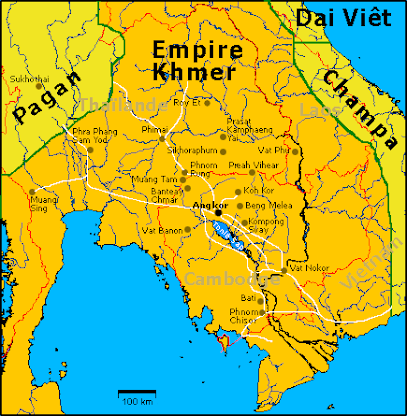
Potted history of the country: The Khmer empire stretched over south-east Asia from the 9th to the 15th century. Over the next four centuries, it was variously under Thai or Vietnamese rule, with short periods of independence in between. It became a French protectorate in 1863, and part of French Indochina in 1887, before gaining independence in 1953. After a five-year civil war, the Khmer Rouge, led by Pol Pot, won power and evacuated the cities, sending the population to work in the countryside. An estimated 1.7 million Cambodians died in Pol Pot's "killing fields". Peace was finally re-established in 1991, with the United Nations given a mandate to enforce the ceasefire.
Political pressure points: The prime minister, Hun Sen, has been in office since 1985. No stranger to controversy, the former Khmer Rouge cadre seized power from his co-prime minister, Prince Ranariddh, in a coup that brought renewed fighting. His increasing authoritarianism and corrupt capitalism has led to street clashes over sales of prime land to overseas investors.
Population mix: Khmer 95%; other 5% (Chinese, Vietnamese, Cham and smaller ethnic groups)
Religious makeup: Buddhist 93%, Muslim 3%, Christian 2%
Main languages: Khmer, Vietnamese, Chinese
Living national icons: Chhim Sothy (artist), Preap Sovath (singer), Eh Phoutong (kickboxer)
At a glance Location:
Indo-Chinese peninsula Neighbours: Laos, Thailand, Vietnam
Size: 69,898 square miles
Population: 14,655,950 (65th)
Density: 209.7 people per square mile
Capital city: Phnom Penh (population 1,466,000)
Head of state: King Norodum Sihamoni
Head of government: Prime minister Hun Sen
Currency: Riel Time zone: Cambodian standard time (+7 hours)
International dialling code: +855
Website: cambodia.gov.kh Data correct on Monday 20 April 2009
Landscape and climate: Cambodia has a long Gulf of Thailand coastline. Inland, its major features are the Tonlé Sap - the largest freshwater lake in south-east Asia - which expands and shrinks dramatically each year, and the Mekong river, which flows 300 miles through the country. Most Cambodians live along the rich alluvial plains flooded during the monsoon between May and October.
Highest point: Phnum Aora,l 1,810 metres
Area covered by water: 1,745 square miles
Healthcare and disease: One of the world's poorest countries, although its rate of HIV/Aids infection has improved in recent years. The risks from dengue fever, malaria and Japanese encephalitis are extremely high, along with waterborne diseases such as hepatitis A and typhoid. Many Cambodian children suffer from malnutrition.
Average life expectancy: 56/61
Average number of children per mother: 3.3
Maternal deaths per 100,000 live births: 540
Infant deaths per 1,000 births: 82
Adults HIV/Aids rate: 1.3%
Doctors per 1,000 head of population: 0.2
Adult literacy rate: 76.3% (m 85.8%/f 67.7%)
Economic outlook: Dependent on garment exports, booming tourism and foreign investment for construction, it is destined for a sharp slowdown. Estimates suggest GDP may grow just 1% this year, down from about 7%.
Main industries: Plywood, electric energy, cigarettes
Key crops/livestock: Rice, manioc, maize, sugar cane, banana, pigs, cattle, buffaloes
Key exports: Rubber, clothing, rice
GDP: £3,707m (119th)
GDP per head: £261
Unemployment rate: 7.1%
Proportion of global carbon emissions: 0.01%
Most popular tourist attractions: Temples of Angkor Wat, and the ruins of the ancient capital Koh Ker.
Local recommendation: Beng Mealea a 12th-century temple built to the same design as Angkor Wat. It is 50 miles north of the original complex, but a world away from the hordes of tourists thronging its famous cousin.
Traditional dish: Amok (curry, usually made with fish, containing coconut milk and turmeric)
Foreign tourist visitors per year: 1,421,615
Media freedom index: 126
Did you know ... Before ascending the throne, King Sihamoni was a classical dance instructor.
National anthem:
Temples are asleep in the forest
Remembering the splendour of Moha Nokor
Like a rock, the Khmer race is eternal.
· Information correct on date of first publication, Monday 20 April 2009.
Read more!
Sunday, April 19, 2009
‘Repair the world:’ Holocaust Remembrance Day draws attention to ending genocide
By Sue Loughlin
The Tribune-Star
TERRE HAUTE — As 12 white candles burned on a small table, those attending the Holocaust Remembrance Day ceremony bowed their heads for a moment of silence.
They remembered those who died, honored those who survived, and reflected on the part they can play in ending genocide.
More than 40 people attended the ceremony Friday at the CANDLES Holocaust Museum. Eleven candles symbolize those killed in the Nazi Holocaust, while the 12th candle was for victims of genocides in Armenia, Cambodia, Bosnia, Rwanda and Darfur.
April is Genocide Prevention Month, and Tuesday is Holocaust Remembrance Day.
Eva Kor, Auschwitz survivor and museum founder, said the annual remembrance is not just to mourn the millions of innocent lives lost through genocide.
“This museum wants to remember in order to take action,” she said. “In Hebrew, we say repair the world [tikkun olam].”
Every few years she takes groups, including teachers, to Auschwitz. The goal is to help young people understand “how important it is to try to prevent prejudice and hatred. When we see genocide anywhere in the world, it is our job and your job to do something,” Kor said.
During the ceremony, candles were lit in memory of various groups, and not just victims of genocide.
As Kor lit the first candle, Terre Haute South Vigo High School student Sarah Selby paid tribute to the 1 1/2 million Jewish children who died in the Holocaust.
“These children never again knew what it was to play with their brothers and sisters. They never got to go to school to become the scientists, teachers, doctors, performers and people they could have become,” Selby read.
Others lit candles for the political opponents of the Third Reich; for the grandparents who died in the Holocaust; for those deemed mentally and physically unfit by the Nazis; and for the “righteous gentiles” who risked their own lives to save others.
As museum coordinator Kiel Majewski lit the 11th candle, Kor dedicated it “for today’s victims, all the abused, neglected and forgotten children in the world today … They are just as innocent as the children in the Holocaust.”
Kor said she tells those children to never give up on their dreams. “You are the future, and you will make it,” she tells them.
As Kor lit the 12th candle, Majewski spoke in memory of the millions of people who have been murdered in genocides other than the Holocaust. In April, five other genocides are commemorated: Armenia, Cambodia, Bosnia, Rwanda and Darfur.
“Let this 12th candle be a light to remember those who died, a light to educate our community about the issue of genocide, and a light to ignite our hearts so that we act now to end the genocide in Darfur,” he read
The museum is creating a group committed to taking action whenever and wherever genocide becomes a threat, and Majewski encouraged those attending the ceremony to get involved.
Selby, who is studying the Holocaust in one of her high school classes, said it’s important to remember. “A lot of people don’t know anything about the Holocaust and don’t have any idea what went on back then,” she said.
It’s important to educate young people about it and all the millions of innocent lives lost. When she reads about it, “I cringe,” she said. “It’s heartbreaking.
Another South student, Samantha Madley, also participated in the ceremony. It’s important to remember the Holocaust “because even today, we still have prejudiced people. We still have genocide going on. I don’t think things should be forgotten,” she said.
Also attending was 23-year-old Justin Deal of Brazil. “I’m interested in learning more about the suffering of the Jewish people as well as others who have suffered through genocide,” he said. “I’m very concerned about the suffering of others and finding out ways of helping them and stopping this from happening anymore.”
Others speaking during the ceremony were Mayor Duke Bennett as well as representatives of 8th District Congressman Brad Ellsworth and U.S. Senator Evan Bayh.
Sue Loughlin can be reached at (812) 231-4235 or sue.loughlin@tribstar.com.
As Kor lit the first candle, Terre Haute South Vigo High School student Sarah Selby paid tribute to the 1.5 million Jewish children who died in the Holocaust.
“These children never again knew what it was to play with their brothers and sisters. They never got to go to school to become the scientists, teachers, doctors, performers and people they could have become,” Selby read.
Others lit candles for the political opponents of the Third Reich; for the grandparents who died in the Holocaust; for those deemed mentally and physically unfit by the Nazis; and for the “righteous gentiles” who risked their own lives to save others.
As museum coordinator Kiel Majewski lit the 11th candle, Kor dedicated it “for today’s victims, all the abused, neglected and forgotten children in the world today … They are just as innocent as the children in the Holocaust.”
Kor said she tells those children to never give up on their dreams. “You are the future, and you will make it,” she tells them.
As Kor lit the 12th candle, Majewski spoke in memory of the millions of people who have been murdered in genocides other than the Holocaust. In April, five other genocides are commemorated: Armenia, Cambodia, Bosnia, Rwanda and Darfur.
“Let this 12th candle be a light to remember those who died, a light to educate our community about the issue of genocide, and a light to ignite our hearts so that we act now to end the genocide in Darfur,” he read.
The museum is creating a group committed to taking action whenever and wherever genocide becomes a threat, and Majewski encouraged those attending the ceremony to get involved.
Selby, who is studying the Holocaust in one of her high school classes, said it’s important to remember. “A lot of people don’t know anything about the Holocaust and don’t have any idea what went on back then,” she said.
It’s important to educate young people about it and all the millions of innocent lives lost. When she reads about it, “I cringe,” she said. “It’s heartbreaking.
Another South student, Samantha Madley, also participated in the ceremony. It’s important to remember the Holocaust “because even today, we still have prejudiced people. We still have genocide going on. I don’t think things should be forgotten,” she said.
Also attending was 23-year-old Justin Deal of Brazil. “I’m interested in learning more about the suffering of the Jewish people as well as others who have suffered through genocide,” he said. “I’m very concerned about the suffering of others and finding out ways of helping them and stopping this from happening anymore.”
Others speaking during the ceremony were Mayor Duke Bennett as well as representatives of 8th District Congressman Brad Ellsworth and U.S. Sen. Evan Bayh.
Sue Loughlin can be reached at (812) 231-4235 or sue.loughlin@tribstar.com.
Read more!
Cambodia to provide anti-mosquito nets to counter malaria
PHNOM PENH (Xinhua): The Cambodian government will soon dispatch to the public 1,500 nets soaked with mosquito- killing liquid amid rising danger of malaria during the rainy season, national media said on Sunday.
The nets will be received by the local people in provinces of Battambang, Pailin, Kampot and Pursat, where malaria used to have higher infection rates than other provinces of the kingdom, Chinese-language newspaper the Jian Hua Daily quoted government officials as saying.
Such nets proved to be very effective in the past years to contain spread of the disease, which is mainly transmitted through biting of Tiger Mosquitoes, they said.
Two million out of the 14 million population of Cambodia face danger of malaria, and the government prepares to allocate one such net for each two persons in the rainy season, they said.
Therefore, one million nets soaked with mosquito-killing drugs will be needed this year, they added.
In 2008, some 50,000 Cambodians were infected with malaria and over 100 of them died, according to official figures.
Read more!
Saturday, April 18, 2009
Haunted by the 'killing fields'
 Survivors of Khmer Rouge slaughter in Cambodia speak out about the ghosts that still torment them
Joe Mozingo
LOS ANGELES TIMES
LONG BEACH, Calif. – At night, the old woman hears the voices of her children crying out for her. She knows they will never stop.
Um Sath is 89, and three decades have passed since the Khmer Rouge laid waste to Cambodia. She shuts her eyes and taps her temples to show where the genocidal regime still rules with impunity. "We miss you, Mama," the voices cry.
Sath spends much of her day in silence. For years, she rarely left her clapboard house in Long Beach. Although she now finds peace chatting with the other haunted figures at a seniors centre, she has kept the echoes of the "killing fields" sealed tightly inside her head.
Recently, she joined dozens of survivors at a recreation centre in Long Beach to face their memories. They longed to see a reckoning for perpetrators of one of the worst atrocities of the 20th century.
Since February, a United Nations-backed tribunal in the Cambodian capital of Phnom Penh has put on trial the first of five Khmer Rouge leaders charged with crimes against humanity, for the brutal experiment in communism that took at least 1.7 million lives between 1975 and 1979.
Activists in the United States want refugees outside Cambodia to submit testimonies to the tribunal in an effort to spur a judicial process beset by delays, limited funds and allegations of corruption. They hope, along the way, to relieve the emotional torture of survivors who rarely speak about what happened.
"I'm hoping it will allow them to tell the world what happened 34 years ago," said Leakhena Nou, an assistant professor of sociology at California State University, Long Beach who is leading the outreach effort in Southern California, home of the world's largest Cambodian refugee community. "The Khmer Rouge leaders are getting old; the victims are getting old. This is their chance to have their voices be heard before it's too late."
Sath stands up. Her eyes crinkle before she speaks.
Sath and her husband were farmers and merchants in the rich land along the Mekong River, south of Phnom Penh. In the middle class, with enough money to own a modest brick house, they were targets when the Khmer Rouge swept into power in 1975, brutally turning the country into a collective society of farm peasants. Intellectuals, teachers, doctors, businessmen, government bureaucrats and army soldiers were executed en masse.
Khmer Rouge soldiers showed up at Sath's home with rifles, took her husband and told her to walk with her eight children.
For days they wandered, following orders. Anyone who complained or asked questions was dismissed with a bullet to the head.
The soldiers barked questions about her husband: Why did he travel to Phnom Penh so often? Did he work for the national police?
Sath told them they were just poor people, doing nothing.
They let Sath and her children return to where she had lived. The family reunited with her husband and stayed for a month. Their house had been burned to the ground – just a pile of bricks and the skeleton of a stairway. They slept on the ground. There was no food, and they nearly starved, eating only watery rice soup.
The soldiers forced them back on the road, this time to a work camp near Pursat, where they lived in a straw hut with a dirt floor. The family worked to exhaustion in the rice fields day after day.
One day, soldiers locked Sath in chains and took her husband. Days later, she overheard soldiers mention his execution.
Soldiers came again to the rice paddy. This time they took her three sons.
Some time later, Sath heard that other villagers had seen the boys' clothes in the plowed-up field where bodies were routinely buried. Soldiers came for Sath next. They took her to the same field and beat her unconscious. She woke up naked, amid decaying bodies and the smell that, decades later, could bring the horror back to life.
She made it back to her hut, surviving several more near-death moments before Vietnamese soldiers ousted the Khmer Rouge in 1979.
"I lost my sons, my grandson. They took my husband away right in front of me. They killed my husband. They took my brothers and sisters away. They were all killed by the Khmer Rouge," she said.
The anguish in Sath's face reveals the loss. Women choke back sobs. Sath thanks everyone for listening.
Born Pach takes the microphone next. Now 40, Pach was a child when the black-clad soldiers came for her parents to be "re-educated."
They sent Pach to a camp in the province of Battambang to cut rice. She begged to see her parents. But she would not see them again.
One day, the guards accused her of stealing a rooster and beat her. Another time, when she was ill, they accused her of being lazy and sliced the top and side of her head with a knife, then stuck a burning piece of metal in her rectum.
She saw other children have their throats cut or get clubbed to death.
Pach, who survived the Khmer Rouge and made it to Long Beach in 1989, has nightmares that she is being burned alive. She wants her torturers to go to prison.
The stories pour out. One woman gets paper towels to hand around to wipe the tears. When they get to the government forms, 21 people fill them out. No one remembers dates. Only one victim names an alleged perpetrator. The rest do not remember their tormentors' names, never knew them or are still scared.
Trio’s health-care agency focuses on Southeast Asians
By Karen Lee Ziner
Journal Staff Writer
PROVIDENCE
Pain often robbed Seth Svay’s sleep and cloudy vision troubled her days. Like many elderly survivors of Cambodia’s “Killing Fields” — a genocide that left up to 2 million dead in her country — Svay suffered lingering emotional trauma. She rarely left the house, not even to visit the doctor.
But then Svay learned of a new home health-care agency, Independence Health Services, started in Providence by a Cambodian refugee, a Gulf War veteran and his mother, a nurse.
Their core clientele are Southeast Asians, who for cultural reasons and language barriers, often go without proper medical care. Yet national studies reflect disproportionate rates of post-traumatic stress, diabetes and other chronic conditions in that population.
The agency’s outreach coordinator, Marc “Poe” Harrison (who Anglicized his name), was tortured during the 1975-79 genocide in Cambodia. Khmer Rouge soldiers killed his father, and his brother died from suspected defoliant poisoning. Colin Hanrahan, who devotes his nights and weekends to the agency, served with the National Guard in Saudi Arabia and is a fraud investigator with the state Department of Labor. The nursing director, Joan Hanrahan, Colin’s mother, is an associate director of nursing at Rhode Island Hospital.
The three have pooled more than $70,000 of their money toward the agency, located at One Richmond Square. Harrison said he is grateful to this country for helping him and other Cambodian refugees survive, and “I want to give back.”
Harrison said that as traditional extended families disappear, many elders “are very, very isolated when their children get married and move away.” They also may ignore health issues until the situation is dire enough to call 911. Often, they retreat to the Cambodian temple — a traditional community center — rather than seek medical care. For some, “it’s too late,” he said.
HARRISON, who formerly worked as a quality-control engineer, was inspired by a cousin who started a similar agency in Ohio. But Harrison couldn’t do it alone.
Several years earlier, he met Colin Hanrahan at an art exhibit about Cambodian refugees at Brown University. As a National Guardsman, Colin Hanrahan had helped run a POW camp in Saudi Arabia during the first Gulf war. “It was kind of like a refugee mission. There were 13-year-old kids to 80-year-old men,” said Colin Hanrahan. “That’s what kind of got me interested” in attending the art exhibit.
Intrigued by Cambodian culture and sympathetic to Harrison’s story, Colin Hanrahan stepped in to help.
Harrison and the Hanrahans obtained a state operating license last October. They accept Medicaid patients and have applied for Medicare certification.
Victoria Almeida, vice chairwoman of the Rhode Island Health Services Council, said, “What we looked at and what our criteria are, is their competence, their character and their standing in the community.”
She added: “They made a point of saying sometimes the only health care available is to call 911, when a person is already ill or very ill. It seems obvious to me, that sometimes emergent treatment is too late. Or if it’s not too late, it’s expensive.”
“I think reasonable minds,” she said, “can’t differ on the premise that preventative health care is not only good for the person from a medical and holistic point of view, but it is also financially prudent for the community and for health-care systems.”Building on that, Harrison and Colin Hanrahan last fall assisted Brown University medical student Margaret Chang with a six-month study of barriers to health-care access in Rhode Island’s Southeast Asian community. They organized Cambodian, Hmong and Laotian focus groups.
The study followed a 2007 conference at Brown aimed at informing the public about “the health emergency affecting Cambodian refugees in the United States.” The conference, sponsored by Khmer Health Advocates in Hartford and Brown Medical School, underscored that population’s escalating needs, even as funding shortages were forcing Cambodian community-based organizations to close their doors.
Chang said that although there are at least 20,000 Southeast Asians living in Rhode Island, health-care providers who regularly treat them in emergency rooms and primary care clinics “don’t know how to interact with them, and don’t know their problems.”
Chang cited her own experience with an elderly Cambodian patient at a local clinic.
“He had probably one of the most grotesque looking wounds I’ve ever seen. He had uncontrolled diabetes. He’d had surgery to clean out his wound once. There was no follow-up plan, no transportation to the wound clinic,” said Chang. “In the meantime, he was just sitting at home, and the wound was getting worse.”
Chang said, “This should not have happened. The problem is there aren’t enough health-care services to make sure this gentleman kept his follow-up appointments. The Southeast Asian population is particularly marginalized. That’s something that particularly haunts me.”
Chang said the study’s findings will soon be circulated to health-care providers across the state. It recommends that the state do more to increase the number of certified Southeast Asian interpreters in Rhode Island, and encourage the start-up of home health agencies to provide care for Southeast Asians, particularly elderly patients.
The Independence Health Services, which has about eight employees in all, has recently hired two Cambodian certified nursing assistants, and plans to hire more Southeast Asians — including Hmong and Laotians, to match them with elderly from their home countries. Colin Hanrahan said they plan to hire more people within the next year. At present, they care for about a dozen patients.
The agency provides interpreter services in Cambodian, and calls on local language banks as needed for Spanish and other languages.
SVAY, who is in her late 60s, is one of the agency’s newest patients. She lives in the West End of Providence in the heart of a Cambodian settlement community that originated in the early 1980s.
With Harrison interpreting, Svay said her husband and many other family members were killed by Khmer Rouge soldiers during the holocaust. She endured forced labor. “We had to build a road and carry all the dirt. That’s why I have so much pain,” she said.
Svay said she has been so tired “that sometimes I don’t have the strength to cook at all,” and leaves the house only to walk to the grocery store or visit the Buddhist temple on the next street.
Svay is being treated for several medical conditions, including depression stemming from post-traumatic stress. A home health aid visits weekly to help with Svay’s personal needs and to ensure she takes her medications properly.
She said, “I’m very, very happy” with the treatment. “I’m feeling better.”
Independence Health Services can be reached at (401) 437-8337 or by e-mail at IHS@att.net.
Rhode Island’s
top 4 Southeast Asian populations
•Cambodian, 4,747
•Laotian, 3,334
•Vietnamese, 1,342
•Hmong, 740
Source: U.S. Census Bureau,
2005-07
kziner@projo.com
Read more!
Asia Society calls for strategy to avert water crisis
Washington (IANS): Warning that decreased access to a safe, stable water supply in Asia "will have a profound impact on security throughout the region", the Asia Society has sought a strategy to avert a crisis in countries like India.
The cascading set of consequences reduced access to fresh water will trigger include impaired food production, the loss of livelihood security, large-scale migration within and across borders, and increased economic and geopolitical tensions and instabilities, said a task force report of the Asia Society released in New York Friday.
The Asia Society is an international organisation dedicated to strengthening relationships and deepening understanding among the peoples of Asia and the US.
The task force on "Asia's Next Challenge: Securing the Region's Water Future" was chaired by Singapore's Ambassador-at-Large and Chairman of the Asia-Pacific Water Forum Tommy Koh. It included among its members Rajendra K. Pachauri, Indian chairman of the Intergovernmental Panel on Climate Change (IPCC) and Ajit Gulabchand of Hindustan Construction.
The task force report highlights the fact that although Asia is home to more than half of the world's population, the region has less freshwater per capita than any continent other than Antarctica.
It maintains that while solutions are well within reach, they will require high-level political will and significant investments. Governments need to develop policies that can address multiple problems simultaneously, with the aim of reducing security risks and vulnerabilities and providing economic benefits such as investments in infrastructure for water conservation and management.
Asian countries should forge a regional approach in which governments and other key stakeholders, including nongovernmental organisations, civil society groups, and businesses, work together to clarify responsibilities and coordination mechanisms to address water security concerns.
For instance, looking beyond India's national borders, the transboundary river systems that cut across India will drive hydropolitics in the region as India's water consumption rates continue to climb, the report suggests.
India's control of water flow along the Ganges River compromises Bangladesh's ability to monitor and predict floods, the report suggests noting that "for Bangladesh, the Ganges may be the largest and most critical source of wate, but it is only one of more than 50 rivers entering the country from India".
"While the Joint Ganges River Commission facilitates information sharing between the two nations, Bangladesh continues to demand greater cooperation."
More data - including rainfall data from farther upstream - would help Bangladesh prepare vulnerable downstream populations and improve models used to predict extreme events, the report says.
Read more!
This week’s travel dream: Cambodia’s long-lost city
 Angkor was long an unknown “wonder of the world,” said Ellen Creager in the Detroit Free Press. The mysterious complex of ruins outside modern-day Siem Reap, Cambodia, is as stunning as the “pyramids of Egypt or the temples of Maya” and as prodigiously complex as Mexico’s Chichen Itza or Peru’s Machu Picchu. More than 70 temples are scattered across the 1,000-square-mile sprawl. But the onetime capital of the Khmer empire, now a UNESCO World Heritage site, for centuries remained a secret from the rest of the world.
Angkor’s rise and fall is “dramatic enough to fill 10 history books.” Between the 12th and 15th centuries, the Khmer empire spread to encompass what are now the countries of Laos, Vietnam, Thailand, and Cambodia. But in the 15th century, the Khmers were forced to abandon their capital, after a series of Siamese attacks left the land ravaged. For the next five centuries, the ancient city lay hidden under the wild jungles of central Cambodia. “While nations rose and fell, while America was built,” Angkor stood forgotten. Only in the late 19th century did French archaeologists uncover it and begin to restore many of the tumbledown ruins.
Cambodia’s prime tourist attraction is Angkor Wat, an imperial structure built by King Suryavarman II in the 12th century in honor of the Hindu god Vishnu. Constructed with “porous clay foundations and sandstone exteriors,” its five towers are “stacked like a Jenga puzzle, each piece fitting atop the other.” Nearby sits another temple, Bayon, built a few decades later by King Jayavarman VII. Its 49 towers have been adorned with “200 or more” smiling stone faces. Yet another temple, Ta Prohm, looks much as it did when it was unearthed in the 1900s: “Giant kapok tree roots winding through the doors and windows” make it seem less a work of man than a “part of the natural landscape.” Angkor may have been forgotten for centuries, but treasures like these will ensure it is celebrated for generations to come.
Contact: Angkor.com
Read more!
Friday, April 17, 2009
Cambodia's New War
The Nobel-nominated opposition leader of Southeast Asia’s saddest, bloodiest country has brought a message for Hillary Clinton: Our democracy needs your help.
Cambodia is at war again. This time, the battles surround who will control resources—land, timber, fisheries, oil—with a corrupt elite taking over the nation’s emerging export economy, while international donors turn a blind eye and 14 million Cambodians suffer.
“Cambodia is a democracy on paper but in reality a dictatorship. Our party activists are murdered because they fight for justice—life is still cheap in Cambodia.”
A new American president, many Cambodians hope, might change all that. Sochua Mu, an opposition leader and founder of the women's movement in Cambodia, recently returned to the U.S., lobbying Secretary of State Hillary Clinton to take a firmer line on democracy and human rights in her long-suffering country. “I needed to see the people in the new administration to urge them to re-assess U.S. foreign policy,” says Sochua in an interview with The Daily Beast. “Cambodia is a democracy on paper but in reality a dictatorship. Our party activists are murdered because they fight for justice—life is still cheap in Cambodia. Human trafficking, drug trafficking, land grabbing, and forced evictions are all carried out under the nose of the government.”
Sochua Mu’s story is uniquely Cambodian. Forced to flee for her life at 18 in the early 1970s as the Vietnam War spilled over the border, she left behind her parents, who vanished, as did one-quarter of the country’s population during the Khmer Rouge’s reign of terror. Sochua wound up in America, won a scholarship to the University of California at Berkeley, and worked as a counselor and translator for the Cambodian refugees who began to trickle over. She eventually became a U.S. citizen.
During the 1980s, she returned to Southeast Asia, organizing schooling for children and social services for women in the refugee camps set up by the U.N. on the border between Thailand and Cambodia. In 1989, she was finally allowed to re-enter her homeland, “a country in ruins.” “I would take my young children on walks in streets where I learned to bike, where I wandered with my childhood friends, where I went to school, all the years of joy, of happiness, of deep feelings of comfort came back to me,” she says. “I came back to help rebuild a nation. The war and genocide also changed my people. They have lost their sense of trust for each other, they have become hard inside and desperate for just daily survival.”
Sochua started the first women’s organization in Cambodia, Khemera, designed to help poor urban women earn a better living. She campaigned to include women’s rights and concerns into the country’s new constitution, drafted in 1993, and became involved in efforts to rescue girls caught in Cambodia’s thriving sex trade. In 1998, Sochua ran for election and won a seat in parliament, taking over the women’s affairs ministry, which had previously been run by men. In a country that considers women inferior, Sochua mobilized 25,000 female candidates to run for commune elections in 2002. It was a first for Cambodia, and 900 of them were elected.
She negotiated an agreement with Thailand that allowed Cambodian women trafficked as sex workers to return to their home country instead of being jailed. She pioneered the use of TV commercials to spread the word about trafficking to vulnerable populations. Her work in Cambodia also supports campaigns to end domestic violence and the spread of HIV/AIDS, as well as women’s workplace conditions. In 2005, she was nominated for a Nobel Peace Prize for her work against sex trafficking of women.
Her position in high government put her in direct conflict with Cambodia’s long-ruling prime minister, Hun Sen. Rather than participate in the corruption she saw around her, Sochua Mu renounced the leadership and joined the primary opposition party in parliament. Last week, Sochua announced that she is considering legal action against the prime minister for allegedly using derogatory and threatening language against her in a speech he made last month during a visit to her parliamentary district. The speech, widely reported on Cambodian TV and other media, warned villagers not to seek help from members of the opposition party, but to approach the ruling Cambodian People’s Party, and allegedly referred to Sochua using a Khmer term cheung kland—a gangster or unruly person, which has an especially insulting connation for women.
Her most frequent public disagreement with Hun Sen surrounds what she sees as a failure to prevent people in her district from suffering loss of property and livelihoods at the hands of powerful investors, often with the backing of local authorities and the military. Most Cambodians still depend on small-scale agriculture, forest exploitation, and fishing for their livelihoods but, because of the country’s turbulent recent history, land ownership is generally undocumented and often contested. As a result, it is easy for the powerful to acquire land to develop. More than 150,000 Cambodians, according to Sochua, were victims of forced evictions and land-grabbing in 2007 alone. Studies have estimated that such concessions cover as much as one-third of the entire area of Cambodia.
It is now common practice for powerful corporations and government officials to utilize armed forces to push citizens off their rightfully and legally held land,” says Sochua. “These evictions are often violent, with soldiers wielding guns, tear gas and Tasers and burning houses to the ground, while citizens are beaten, maimed and arrested.”
Cambodia's economy relies on three principal sources of income: tourism, agriculture, and textiles. The United States is the largest overseas market for the latter. As former U.S. Ambassador to Cambodia Joseph Mussomeli put it, "Levi Strauss or the Gap could destroy this country on a whim."
George W. Bush's policy, as Sochua saw it, focused on military and security-centered aid. According to the U.S. Agency for International Development, the U.S. provided Cambodia $54 million last year and $700 million total since the agency opened an office in the country in 1992. Other international donors, meanwhile, have done little better in holding the Cambodian government accountable on human rights, preferring “closed-door diplomacy,” as she calls it, to public criticism. “This practice has yielded next to no reforms,” she says, “and donors continue to be satisfied with token actions taken by the government to give a façade to democracy and social justice.”
Even that oversight is at risk. Chevron discovered oil offshore several years ago, and the Cambodian government says it hopes to begin pumping oil in 2011. The IMF estimated last year that the country could earn as much as $1.7 billion from oil within 10 years of the date that pumping begins—a big deal for this poor country, which relies on donors for half of its annual budget, but also more money that won’t carry any accountability.
Some aid agencies have called for a moratorium on aid until basic governance and transparency frameworks are in place. Sochua says that won’t happen until there’s a new regime. “That can only happen when we have a real election that is free and fair,” she says. “The West should insist on that, otherwise all the aid they have poured into Cambodia will not work”.
Katrin Redfern is a writer and editor at The Indypendent in New York City.
Read more!
Not just Cambodia on trial
WITH THE first trial of a Khmer Rouge figure now underway, the people of Cambodia have an opportunity to make sense of their country's grisly past. The tribunal, created to assess the crimes of a murderous regime that was overthrown in 1979, has been long delayed, and its ambitions are too limited. Even so, the proceedings could embarrass not just Cambodia's current government, but also the United States.
The Khmer Rouge was a shadowy group of Communists that gained power in 1975 and killed 1.7 million people. The tribunal, based in Phnom Penh, is a joint effort of the Cambodian court system and the United Nations. Its first defendant, a man known as Duch, was the commander of Tuol Sleng, an interrogation center where thousands were beaten and tortured to death.
The Cambodian government is clearly undermining the tribunal in several ways. The country's current leader, Prime Minister Hun Sen, has insisted that only Duch and four other elderly defendants be tried, presumably to avoid publicizing any connections between the Khmer Rouge and people in the current government. The tribunal, funded with foreign donations, has suffered from corruption; some Cambodian staffers had to pay kickbacks for their jobs. Anticorruption initiatives should be at the heart of American policy toward Cambodia.
Then again, the United States has a poor record of involvement with Cambodian affairs. In his testimony, Duch blamed the Nixon administration for the rise of the Khmer Rouge. One should be careful about accepting historical analyses from commanders of torture centers, but the critique has some truth. At the least, American bombing helped destabilize the country and radicalize some of its inhabitants, and US support for a 1970 military coup against the country's erratic leader eventually led to a power vacuum that the Khmer Rouge managed to fill. The episode underscores how dangerous it is when a superpower makes decisions about another country in ignorance of its internal politics.
Of course, rehashing the carnage at Tuol Sleng should unsettle a more recent group of former White House policymakers. In paintings that now hang in the former camp, Tuol Sleng survivor Vann Nath documented the torture techniques that jailers used to extract confessions from prisoners. One of them is waterboarding - an act that former vice president Dick Cheney specifically defended. But no one can look at Vann Nath's paintings and conclude that these are acts Americans should emulate.
Cambodia may be intent on sabotaging the tribunal. Even so, the trials can remind the world what happens when political leaders can rationalize anything .
Read more!
Thursday, April 16, 2009
Asylum seekers die in explosion off coast of Australia
SYDNEY - Three refugees have been killed and two people are missing after their boat exploded off the northwestern coast of Australia, authorities confirmed Thursday.
The small wooden fishing vessel, containing 49 asylum seekers thought to be from Iraq or Afghanistan, was being held by Australian border patrol vessels on Ashmore Reef after it was intercepted Wednesday.
The explosion occurred at 6:15 a.m. in remote waters 840 kilometers west of Darwin in the Northern Territory and 610 kilometers north of Broome in Western Australia.
The incident happened while a Royal Australian Navy ship was awaiting another vessel to take the refugees to a Christmas Island detention facility for processing.
Western Australian Premier Colin Barnett said in a press conference, ''It's understood that persons on the boat spread petrol and that ignited, causing an explosion.''
But Home Affairs Minister Bob Debus refused to confirm the explosion had been deliberate, saying the investigation into the incident was ongoing.
More than 50 people were injured in the explosion, including all the refugees and four Australian defense personnel, with the injuries ranging from minor burns to more serious wounds.
''All of them sustained injuries to one extent or another, some very minor in the form of almost like a sunburn, others obviously of a much more serious nature,'' Rear Adm. Allan Du Toit, commander of Border Protection, said.
While details are still sketchy, those injured are expected to be flown by helicopter to either Darwin or Broome for medical treatment before eventually being moved to Christmas Island for processing by immigration officials.
Most refugees from the Middle East, South Asia and Southeast Asia travel to Australia in rickety boats from ports in Indonesia, Cambodia, Sri Lanka, China and Vietnam.
In 2007-08, 25 people arrived illegally in Australia on three boats, but there has been a sharp increase in 2008-09, with 377 people arriving on 12 boats, not including the most recent group.
The opposition has been quick to blame the government's recent softening of border protection policy as being behind the spike in asylum seekers arriving on Australia's shores.
Read more!
Wednesday, April 15, 2009
Rock Band Dengue Fever And Wildlife Alliance Partner To Preserve Cambodia's Natural Heritage
WASHINGTON, DC & LOS ANGELES, CA (Top40 Charts/ It's Alive! Media) - Acclaimed Cambodian-American rock band Dengue Fever (www.myspace.com/denguefevermusic) and the non-profit environmental organization Wildlife Alliance (www.wildlifealliance.org) are pleased to announce the launch of a partnership to preserve Cambodia's natural heritage, including threatened populations of tigers, Asian elephants, and some of the largest tracts of rainforest remaining in Asia.
'We share a common vision,' said Dengue Fever guitarist Zac Holtzman. 'We want to preserve Cambodia's rich cultural heritage, just like Wildlife Alliance is working to protect Cambodia's wildlife species and forests.
By rescuing and caring for wildlife species victimized by illegal trade, preserving habitat and educating and creating jobs for Cambodians, Wildlife Alliance's work is vital to preserving Cambodia's natural legacy for future generations.'
'We hope that this partnership will help all of us who strive to save Cambodia's unique heritage,' said Wildlife Alliance's Director of U.S. Operations, Michael Zwirn. 'Fans of Dengue Fever are naturally drawn to the artistic history of Cambodia, and we want to inform them how they can be involved in saving the country's wildlife and forests alongside its cultural treasures.'
The partnership officially kicks off at the State Theater in Falls Church, VA on Friday, April 17, 2009 during Dengue Fever's North American spring tour. While Dengue Fever perform, Wildlife Alliance will work a booth set up at the venue and educate and inform fans about Cambodian conservation.
Future goals of the partnership include benefit concerts, charity remixes, online commercials, and cross marketing on social networking sites and websites.
Dengue Fever began when keyboardist Ethan Holtzman discovered the traditional Cambodian pop music of the 60's on a trip to Cambodia. Along with lead singer Chhom Nimol, bassist Senon Williams, drummer Paul Smith and David Ralicke on horns, the band perform updated versions of classic Cambodian pop songs as well as a wide variety of new compositions. Since forming in Los Angeles, Dengue Fever has released three acclaimed albums, toured around the globe, and seen increasing attention from Pitchfork Media, the New York Times, National Public Radio and other media. The band's third release, Venus On Earth, was selected as one of the best world music records of 2008 by the iTunes Store while Escape From Dragon House was named Amazon's Best International Release of 2005.
In the documentary film Sleepwalking Through the Mekong, out April 14 on DVD/CD soundtrack via M80 Music, Dengue Fever performs their music in Cambodia as the first Western band to perform Cambodian Khmer rock since the fall of the Khmer Rouge.
ABOUT DENGUE FEVER:
Dengue Fever (http://www.myspace.com/denguefevermusic) is Chhom Nimol - who sang regularly for the King and Queen of Cambodia, Ethan Holtzman (keyboards), Zac Holtzman (guitar), David Ralicke (horns), Senon Williams (bass) and Paul Smith (drums). The band's music has been featured in film and television shows including CITY OF GHOSTS, MUST LOVE DOGS, BROKEN FLOWERS, HBO's hit series TRUE BLOOD and twice on Showtime's WEEDS. They have released three albums: Dengue Fever, Escape From Dragon House, and Venus On Earth; and are set to release their DVD/CD soundtrack to the documentary Sleepwalking Through The Mekong on April 14, 2009.
ABOUT WILDLIFE ALLIANCE:
Wildlife Alliance is an international non-profit conservation and wildlife protection organization headquartered in Washington, D.C with field offices and partnerships in Cambodia, Thailand and the Russian Far East. Our field staff trains park rangers to prevent poaching and deforestation in protected areas and works with regional law enforcement officials to stop wildlife trafficking and put an end to the illegal wildlife trade. Wildlife Alliance also raises public awareness about environmental issues and supports local communities through sustainable development and alternative livelihoods.
Read more!
Scathing media cartoon burns sensitive nerve of Cambodia about ties with Thailand
By Xia Lin
PHNOM PENH, A scathing political cartoon has angered the Cambodian government at this sensitive time of the Cambodian-Thai ties, and pushed the publisher into an awkward situation.
The government is demanding a written explanation for the recently-printed newspaper cartoon depicting Cambodian Prime Minister Hun Sen and former Thai premier Thaksin Shinawatra playing golf together, claiming that it could seriously affect the Cambodian-Thai relations.
"I need (a) written explanation. It's all. But if I don't have any response, then I will decide another step," English-language newspaper the Cambodia Daily on Wednesday quoted Information Minister Khieu Kanharith as saying.
In the hand-drawn picture published by another English-languagedaily newspaper the Phnom Penh Post on April 10, Thaksin shot a mine instead of a ball with his golf pole into the territory of Thailand, saying that "YES, IT'S MINE!!! THEREFORE I CAN DO WHATEVER I WANTN WITH IT..."
Hun Sen, beside Thaksin right outside the borderline of Thailand, said that "BUT... WHAT ARE YOU DOING? IT IS YOUR COUNTRY..."
Khieu Kanharith said that "it is not a problem of offending, but this cartoon came at the time Thailand accused Cambodia of harboring Thaksin."
Meanwhile, the Ministry of Information issued a press release last week, saying that this cartoon was politically-oriented and would make readers misunderstand the political stance of Cambodia.
Cambodia already spiked the rumor that Thaksin was hidden here, but the cartoon obviously told readers that he was temporarily living in Cambodia, Khieu Kanharith said in the release.
"This came at the most sensitive time, and it is not a joke at all," he said, adding that the Phnom Penh Post should submit its evidence for Thaksin's stay in Cambodia.
By publishing the cartoon, the newspaper had violated an article of the press law prohibiting publication of information inciting discrimination, according to the press release.
Any media should be objective and neutral in its reporting, it added.
In the mean time, Michel Dauguet, CEO of the Post Media Co. which started to publish the Phnom Penh Post as daily paper last year, issued a statement to clarify that "our editorial cartoon does not imply that Mr. Thaksin is living or has taken residence in Cambodia."
Thaksin was represented in unspecified space outside Thailand, symbolizing his exile, and exacerbating tensions at home, he said.
"The fact that some people may have interpreted that this editorial cartoon gives credit to the absurd theory of Thaksin's presence in Cambodia is an unfortunate misunderstanding," he added.
In early April, spokesman of the Cambodian Council of Ministers Phay Siphan told reporters that "Thaksin actually didn't have any presence in our country."
For anything that he did, Thaksin could observe his own country's law and the international law, he added.
Thai Foreign Minister Kasit Piromya once told reporters that the bilateral ties between Thailand and Cambodia could be affected adversely, if the ousted former premier were allowed to launch political attacks from Cambodia.
Days of demonstrations by the opposition force have led to serious instability in Thailand. The Thai criminal court on Tuesday issued arrest warrants for 14 protest leaders including ex-premier Thaksin Shinawatra.
Besides, Cambodia and Thailand still have decades-old border disputes to settle. However, two heavy armed clashes between both troops in early April just have aggravated the tension at the border area.
Read more!
Tuesday, April 14, 2009
Cambodian New Year adds religious diversity to Easter weekend
 Cambodian buddhist monk Savann Mey meditates during Cambodian New Year ceremonies at the monastic temple off Highway 63 in northern Boone County. Cambodian Buddhists from all over Missouri and beyond gathered for three days of festivities. Savann Mey has been living in Boone County for four years and is the only Cambodian Buddhist monk in the state. ¦ ZACHARY SIEBERT
Church parking lots and sanctuaries are conspicuously fuller than usual. Families and loved ones gather together dressed in their best, and children can be found running wildly, basket in hand, in search of pastel eggs. Traditions such as these help make this a joyful time of the year, but the hallowed Christian holiday wasn’t the only sacred event celebrated in Boone County this weekend.
The Wat Angkor Cambodian Buddhist Temple near Hallsville on Old Highway 63 played host to an entirely different tradition from halfway around the globe: the Cambodian New Year festival or Chol Chnam Thmey in the Khmer language.
While the temple is always an interesting place to visit in Boone County, it was an authentic and colorfully enchanting slice of Cambodia as Cambodian Buddhists from all over gathered together to commemorate the holiday.
The Cambodian New Year celebration lasts for three days beginning on New Year’s Day, usually April 13, based on the Buddhist calendar.
In Cambodia, the holiday is all-encompassing. Celebrations can be found everywhere in all aspects of daily life, but the most important rituals must take place at a holy temple. Fortunately for Cambodian Buddhists in Missouri, there is the Wat Angkor Temple in Boone County.
Occupied for the last four years by Savann Mey, the only Cambodian Buddhist monk who lives and practices in Missouri, the temple transforms into a remarkably beautiful hosting ground to Chol Chnam Thmey each year.
There are several customs that make the holiday unique, most notably the erection of sand mounds on the temple grounds representing holy burial grounds.
Participants plant incense in the mounds and leave offerings for loved ones and family who they believe have passed on to the next life while praying for their happiness and comfort.
As with all culturally significant traditions, an outsider has much to be curious about, but despite such distant origins, the Cambodian festivities share much in common with Easter celebrations elsewhere in the county.
The temple was fuller than usual. Families and loved ones were gathered together dressed in their best, and children were found running wildly around pastel-colored decorations.