By Steve Strauss for USA TODAY
Q: I own an Italian market in New York. I would like to expand, even if the conventional wisdom says it's not the right time. That said, getting a loan is hard and I'm not sure I have the resources to do it without some help. What should I do? — Max
A: Well, if it's help you need to grow your business, then you should get some. What if I told you there was an easy way to get that help, and it won't cost you hardly a cent? And what if I further told you this method is incredibly powerful and historically successful?
I thought you might be interested.
Think for a moment about all of the immigrants who have come to this country, be it Irish Catholics, Eastern European Jews, Asians, whomever. When you hear their success stories, usually it's because they were industrious, hard-working, entrepreneurial, thrifty, and so on.
They also tapped the power of their community.
Historically, when an immigrant starts a new business in this country, their first taste of success comes when members of the community begin to frequent the business. Word gets around, other members of the group start to show up, and the fledgling business takes root. If the business is really good, then the word of mouth continues to grow, and the business expands organically, seemingly effortlessly.
But it's not just new immigrants who can tap the power of community, almost any business can.
Sophy Khut and her family escaped Cambodia after the war and moved to the Portland, Oregon in 1976 when she was about 10 years old. As she became a young woman, needing to help her family, she began to work in an aunt's restaurant, doing everything from washing dishes and mopping floors to cleaning up and bussing tables. She opened her own restaurant just a year later — when she was but 22. But with the help of the local Cambodian community, it started strong. Their continued support helped the restaurant grow.
Buoyed by her success, Sophy looked around and realized that a golden opportunity lay not far away: Long Beach, Calif., has the largest Cambodian community anywhere in the world outside of Cambodia. As she told me, "it was a great opportunity and a ready market." So she up and moved to California, by herself, and started another restaurant, from scratch.
Sure, it sounds intimidating, but Sophy knew the secret: Help the community and they will help you.
So she opened Sophy's Thai and Cambodian Cuisine and immediately began tapping into the vast Cambodian community that surrounded her. She knew that a great restaurant, serving delicious, home-cooked food should be a winner.
She was right.
Sophy's is now one of the very best Cambodian restaurants in all of Southern California. Nobody does it better than Sophy's, and the mass of satisfied customers every night attest to that. That she just moved to a restaurant three-times the size, and it's already full every night, is further proof.
And how about this: It's all word of mouth. Sophy does not advertise. That's the power of community (and having a great business).
Here's Sophy's secrets to having your community support your business:
"Give, rather than take": Sophy explains that giving actually has two meanings:
• First, you have to give your customers a great product or service. Give them more than they expect.
• Second, give in the traditional sense. For instance, the Cambodian community in L.A. has a foundation called Hearts Without Boundaries, whereby they bring needy Cambodian children who have congenital heart defects to the U.S. and give them surgery and all of the medical help they need – for free. Sophy is a big a participant in the group, and in fact the team meets in her restaurant regularly.
"Get involved": In Sophy's case, she helps out every year with the Cambodian New Year parade. She has food booths at fairs and expos. She opens the restaurant up to different groups. She donates to non-profits.
All of this gets the word of Sophy's Restaurant out there. And then, when people show up, her great food and friendly restaurant makes them want to come back.
So the lesson is clear: Get involved in your community. Befriend them. Be thankful for their patronage. Help out. Just take it from Sophy: "Support your community and they will support you!"
Today's tip: Do you bill by the hour for different clients and customers? If so, you might be interested in some great software I recently learned about. Fast, easy, online, and affordable, Bill4Time can help you focus on your work, not your billing. Check it out here.
Ask an Expert appears Mondays. You can e-mail Steve Strauss at: sstrauss@mrallbiz.com.And you can click here to see previous columns. Steven D. Strauss is a lawyer, author and speaker who specializes in small business and entrepreneurship. His latest book is The Small Business Bible. You can sign up for his free newsletter, "Small Business Success Secrets!" at his website —www.mrallbiz.com.
Read more!

Monday, February 23, 2009
Ask an Expert: Tap into the power of community

Cambodia drafts sub-decree for better resettlement in development projects
PHNOM PENH, Cambodia has started drafting a sub-decree on addressing social-economic impacts caused by the development projects on implementation of involuntary resettlement, a government official said here on Monday.
"In the current context of Cambodia, we are lacking legal norms and legislations to support resettlement implementation, including limited awareness of people on law and weak enforcement of land law and other regulations," said Chhorn Sopheap, deputy secretary general of the Supreme National Economic Council and director of the resettlement department of the Ministry of Economy and Finance.
"We continue to further revise the sub-decree to cover all important issues in conformity with other laws and regulations, and to ensure efficient implementation," he said in the opening remarks of the five-day regional workshop of involuntary resettlement implementation and management, which also attracted participants from Vietnam, Laos and Indonesia.
The government is preparing this crucial sub-decree as policy guidelines for a better resettlement implementation, he said.
The project implementation is even more difficult and complicated if a third party causes problems behind because resettlement implementation is not only related to socio-economic side of affected people but also sometimes related to people's mind, especially political issues, he said.
"There were some problems occurring during the project implementation due to lack of adequate policy measures as well as experience, but we have to maintain a balance between people's rights of interest and general or public interest represented by prerogatives of public power," he said.
"We believe that good resettlement can prevent impoverishment and poverty of the affected people by turning displacement into development opportunities," he added.
Read more!
ASEAN Agrees to Boost Regional Fund by $40 Billion
Asian finance ministers pledged to uphold free trade and investment in the midst of the global economic slowdown and said they would allocate an additional $40 billion to protect falling currencies.
The ministers from 10 Southeast Asian nations as well as China, Japan and South Korea agreed to boost funding for the Chiang Mai Initiative -- an arrangement forged after the 1997 Asian financial crisis to address foreign reserve deficits through bilateral currency swaps -- from $80 billion to $120 billion.
The 10 members of the Association of Southeast Asian Nations will provide 20 percent of funding, with 80 percent from China, Japan and South Korea.
The plan is expected to be approved at an ASEAN summit in Hua Hin, Thailand, from Feb. 27 to March 1.
"We reaffirm our determination to dedicate ourselves to increasing the free flow of trade and investment, to standing firm against protectionist measures which would worsen the economic downturn," the ministers said in a statement.
The commitment to free trade echoed comments made earlier in the day by Thai Prime Minister Abhisit Vejjajiva.
"I hope that ASEAN will send a signal that in this economic downturn it will not favor protectionism," Abhisit said. "ASEAN will not survive alone while causing trouble to other countries."
In October, ASEAN finance ministers expressed confidence that the group would weather the global downturn, noting its economic fundamentals remained sound even though growth might not match last year's 6.7 percent.
But in recent months, many countries have begun to feel the effects of the downturn on their export-driven economies.
Thailand reported Thursday that exports posted their steepest fall in 12 years in January as demand for the country's cars, hard drives and electrical goods evaporated amid the global slump.
Thailand, Singapore, Malaysia and the Philippines have all announced multibillion-dollar stimulus packages that include a mix of infrastructure projects, cash handouts or tax cuts aimed at creating jobs and boosting consumer demand.
ASEAN was founded during the Cold War as an anti-communist political coalition, later evolving into a trade bloc. It consists of Brunei, Cambodia, Indonesia, Laos, Malaysia, Myanmar, the Philippines, Singapore, Thailand and Vietnam.
Read more!
Sunday, February 22, 2009
CHINA: Khmer Rouge Trials Raise Ghosts of the Past
By Antoaneta Bezlova
BEIJING, Feb 20 (IPS) - The skeletons are tumbling out of China’s cupboard of buried memories. The 30th anniversary of China’s brief but bloody war with Vietnam may have gone unmarked but for the fact that Feb.17 also saw the start of the trial of the chief torturer of Cambodia’s grisly Khmer Rouge.
China’s role in Cambodia’s bloody past is now little spoken of and this is how Beijing, Hanoi and Phnom Penh - all intent on trade and development - prefer it.
When in 1979 Vietnam ousted Pol Pot’s Khmer Rouge regime, Beijing was so incensed by what it saw as defiance in its backyard by a political party it had helped create that it ordered an attack to "teach Vietnam a lesson" and keep Pol Pot in power.
During his 1975-1979 rule Pol Pot had sought to replicate Mao Zedong’s agrarian utopia, but the experiment left Cambodia deeply scarred and a quarter of its population - some 1.7 million people - dead.
Although aware of the atrocities committed by the regime, Beijing sided with the Khmer Rouge over the Vietnamese invasion of Cambodia and launched a massive offensive against Vietnam along the two countries’ border.
The month-long border conflict claimed anywhere between 20,000 to 60,000 lives, and yet no commemorations were held on the 30th anniversary either in Beijing or Hanoi.
As the trial of Khmer Rouge’s chief investigator Kaing Guek Eav, also known as Duch, opened in Phnom Penh, China sought to downplay its role in supporting Pol Pot’s regime.
"As everyone knows, the government of Democratic Kampuchea had a legal seat at the United Nations, and had established broad foreign relations with more than 70 countries," foreign ministry spokeswoman Jiang Yu said at a regular press briefing, referring to the former Khmer Rouge government.
Duch is being tried on charges of crimes against humanity. Under his watch, as commandant of the notorious S-21 prison, some 14,000 people were tortured and sent to their deaths in the killing fields outside the capital Phnom Penh.
According to Pol Pot’s biographer, Philip Short, after the Vietnamese invasion, Duch found shelter in China, working for Radio China International in Beijing.
"China owes Cambodian people an apology," says Lao Monghay, former director of the Khmer Institute of Democracy in Phnom Penh and now a senior researcher at the Asian Human Rights Commission in Hong Kong. "It supported the Khmer Rouge before coming to power and continued to lend its support even after Pol Pot assumed power regardless of what was happening to Cambodian people."
According to Lao Monghay, China had donated one billion US dollars to Democratic Kampuchea before 1979 and another billion dollars after 1979 in order to fight the Vietnamese invasion.
China often admonishes Japan to "face up" to history, insisting that Tokyo’s unapologetic attitude regarding its invasionist politics of the past impedes relations with its neighbours. But when applied to China’s own past, reckoning of history’s fallacies is discarded as irrelevant to current and future developments.
"China and Vietnam have had a period of unhappiness in their past,’’ Jiang Yu told reporters. "But what’s important is that the leaders and people of both countries have a broad wish and consensus to create a bright future together. History has already reached its conclusions," she added.
The Khmer Rouge regime was a replica of Maoist regime, says Lao Monghay, and any probe into its record could throw unfavourable light on China’s own historical blunders. "The Chinese communist regime hasn’t accounted yet for the sufferings caused to its own people during years of political campaigns and persecutions," he adds.
During Mao’s rule China armed and trained rebel groups in almost every South-east Asian country, including Indonesia, Laos, Burma, Thailand and Cambodia, even as it fostered warm relations with their official governments.
Beijing’s generous support for revolutionary armies all over Asia rose during the Cultural Revolution when China’s rivalry with the Soviet Union intensified and they competed for influence in the region as Western colonial powers retreated.
"In the end it was realpolitik, far more than ideological affinity, which brought China and Cambodia together," wrote Short in his biography of Pol Pot, ‘The History of a Nightmare.’ "There was near-perfect symmetry to the three countries’ relations. China was to Vietnam as Vietnam was to Cambodia - a vast and powerful neighbour, which threatened hegemony."
While Beijing saw Vietnam as a Soviet bridgehead in Asia, it also saw "Cambodia as the one country on Vietnam’s western flank which might be expected to resist the expansion of Vietnamese, and hence of Soviet power," Short wrote.
Now, as then, imperatives of ideology have given way to realpolitik. Economy and trade form the basis for Beijing’s policies towards its neighbouring countries these days. China is patiently rebuilding traditional ties with all of its Southeast Asian neighbours, using foreign investment, development aid and "soft power" to draw them back into its economic orbit.
The Greater Mekong Subregion (GMS) intra-regional trade programme, launched by the Asia Development Bank (AsDB) in 1992, has provided Beijing with the framework for expanding economic ties without arousing fears among its neighbours still wary of Chinese power.
"China actively participates in the development of the GMS because it sees it as the building of a passage to all of South-east Asia," says He Shengda, researcher with the Yunnan Academy of Social Sciences.
In Cambodia these days, Chinese firms are engaged in mining and logging, and have built roads, bridges, garment factories, power plants, casinos and resorts, investing about 1.5 billion dollars in 2007.
A Cambodian investment group and a Chinese textile firm have committed three billion dollars to a joint venture, in Sihanoukville, modelled along the lines of China’s tax-free special economic zones.
In Vietnam, the old theatres of war are now bustling with Chinese traders, facilitated by new highways, such as the one linking Nanning in Guangxi province with Hanoi. Within three years, another AsDB-financed highway will shorten the drive between Yunnan capital Kunming and Hanoi to less than 24 hours.
Similar accelerated economic integration can be seen elsewhere in South-east Asia where Chinese companies are providing capital and expertise in exchange for markets and valuable resources.
"The economies of the GMS and China are highly complementary," says Zhang Guotu, an expert on South-east Asia with Xiamen University. "The sub-region has great potential in terms of resources and labour but its economies are lagging behind. This presents opportunities for Chinese state and private companies looking both for markets and investment."
Within the greater scope of Association of South East Asian Nations (ASEAN), China is pushing for enlarged economic interdependence too. In a sign of its growing ambitions, last year Beijing appointed a special ambassador to the 10-member association.
In 2010 China and ASEAN are due to launch the first stage of a trade agreement, reducing tariffs on trade between China and the five founding countries of the bloc - Singapore, Malaysia, Indonesia, the Philippines and Thailand. In 2015, Vietnam, Cambodia, Laos and Burma will also join the trade bloc. The exception is Brunei.
Nevertheless, China’s relations with South-east Asian nations remain prickly as history and politics often get in the way of economic integration.
"History should not be easily discarded," says Lao Monghay. "It only takes a look at Cambodia and China relations for example, to see that they have been like a yo-yo in the past - swinging from good to bad and back."
Read more!
Migrant workers: Last ones in, first ones out
By Manolo Abella And Geoffrey Ducanes Ilo
THE rapid growth of migration and remittances is ending.
Some of the countries that absorbed many Asian migrant workers, particularly the United States and Europe, have reported the sharpest economic downturns in the current global financial meltdown.
More than 4 million South and Southeast Asian workers in seven countries of the Organization for Economic Cooperation and Development (OECD) are expected to significantly decrease in 2009.
Substantial numbers come from the Philippines (1.2 million, mainly in the US and Canada) and India (1.1 million mainly in the US, the United Kingdom and Canada).
When the dust has settled, many Asian workers are expected to be laid off in these countries.
Much lower demand for migrant workers is expected in Asian destination countries like Singapore, Malaysia and Thailand. The jobs most likely to be affected are those in construction, finance, trade-related industries (such as export manufacturing and shipping), travel and tourism.
Contracts are unlikely to be renewed or even prematurely terminated. Migrant workers who have just recently arrived in countries of employment are going to be particularly affected since the last ones in are likely to be the first ones laid off.
Malaysia has more than 2.1 million registered foreign workers. Most of those retrenched are from manufacturing, which together with the services sector, is expected to be the hardest hit by the crisis.
About 30 percent (900,000) of Singapores workforce are foreigners, including 143,000 professionals from all over the world. The rest are low-skilled workers, mainly from Southeast Asia, China, India and Sri Lanka.
Thailand has some 1.8 million foreign workers mostly coming from neighboring Myanmar, Laos and Cambodia.
South Korea has more than 400,000 foreign workers. In December it suffered a decline in total employment for the first time in more than five years while small and medium-sized companies have gone bankrupt or shut down.
Upside
The situation is not as dire for all workers or in all destinations. The demand for health sector jobs, for instance, will likely remain strong. Foreign engineers are still very much in demand in some countries like Saudi Arabia.
Public investments in the Gulf States are foreseen to remain strong in spite of the severe drop in oil prices.
The economies of major labor-importing countriesSaudi Arabia and Kuwait along with Qatarare expected to have stable growth, although that of the United Arab Emirates (UAE), which had earlier experienced rapid growth is now expected to decline.
The Philippines has large numbers of workers in the Gulf Statessome 2.18 million workersrepresenting 43 percent of the 5.1 million Filipinos working on temporary contracts abroad. The Philippines also has substantial number of workers in North America (700,000), Europe (668,000) and East and Southeast Asia (one million).
The number of Filipino contract workers abroad continued to increase reaching a total of 1.377 million in 2008, an increase of some 28-percent over the previous year.
This means a daily deployment of some 3,772 documented migrant workers.
In recent years Asia experienced unprecedented rates of growth of recorded migrants remittances. Double-digit rates of growth were recorded for Asian countries, notably Nepal, Indonesia, Bangladesh, Pakistan and the Philippines.
In the Philippines, the annual growth of migrants remittances averaged almost 16-percent over the previous six years. For 2009, the central bank predicts that remittances are still likely to grow but at a slower rate of from 3 percent to 6 percent.
Although remittances slowed down in the latter half of 2008, overall growth for the first 11 months was 15 percent, reaching $15 billion.
According to the Department of Labor and Employment (DOLE), reported displacements up to January 20 affected 4,000 Filipino workers mainly in Taiwan (3,494), UAE (297), Brunei (69) and Macau (45).
The most common reasons cited for the displacement were bankruptcy of companies and a slowdown in operations.
Downside
There are concerns that the brunt of adjustment to the economic crisis will fall hardest on migrant workers.
Layoffs have already been reported for industries most directly affected by the crisis. But other forms of adjustments such as work-sharing and reductions in wages and benefits are not yet reflected in any formal statistics.
More foreign workers in Singapore complain about pay cuts, not being paid on time, having their working days reduced, and not being provided food, shelter and healthcare, which employers are legally obliged to provide.
Many Malaysian firms adjust to the crisis by reducing the number of working days, hours of overtime work and in some instances forcing workers to use their annual leave.
Many countries have stopped issuing new work permits to or renewing work permits of foreign workers. Some are even providing companies incentives to replace foreign with native workers.
Singapore is urging companies to avoid lay-offs by finding means to cut costs. In case of unavoidable retrenchment, foreigners will be laid off first.
Malaysia has issued a freeze on the issuance of work permits for foreign workers and has instituted a policy to terminate foreign workers first.
South Korea has stopped issuing new visas and it is unlikely that the quota for foreign workers will be increased. It is encouraging small and medium-sized companies, the primary employers of foreign workers, to hire more locals.
Thailand has announced that no new work permits will be issued and that the planned registration of undocumented foreign workers will now be put off till after 2009.The work permits of about 500,000 foreign workers will not be renewed for 2010 and authorities have threatened to deport undocumented migrant workers.
Countries have responded by close monitoring, providing immediate assistance and looking for alternative employment for those who have been displaced.
The Philippine Overseas Employment Administration (POEA) has established help desks in provinces to help match the skills of retrenched (or aspiring) migrant workers with available jobs within the country and abroad, as well as to advise them on self-employment.
President Gloria Arroyo has ordered the Overseas Workers Welfare Fund to set aside P250 million for livelihood support to displaced migrant workers. DOLE has already sent special missions to Taiwan and Dubai to assist Filipinos who have lost their jobs or are expected to lose their jobs in reintegration.
The POEA is also providing legal assistance to displaced workers seeking refund of plane ticket expenses, placement fees, etc. from recruiting agents or their employers.
Read more!
Saturday, February 21, 2009
Land grabs in Cambodia push poor out
Bill Schiller
Asia Bureau
PHNOM PENH–When military police sealed off the ramshackle, inner-city neighbourhood of Dey Krahorm at 2 a.m. one day last month – preparing to forcibly remove its remaining residents to make way for a plush, new commercial development – Lee Robinson, of Victoria, B.C., was inside.
"We knew there was going to be trouble," says Robinson, who runs a small non-governmental organization here called Licadho Canada.
Robinson and a handful of other Canadians, Americans and Germans had come to show their support for the people of Dey Krahorm, many of whom had been fighting for years to cling to what they believed was their rightful property.
Robinson and her foreign colleagues are part of a small but vocal throng of international youth that has converged on Cambodia, to press international donors and their governments to call Cambodia's government to account over its continued seizure of neighbourhoods populated by the poor and to press for civil rights.
But that day last month, they could do little when the neighbourhood of Dey Krahorm was laid to waste by the developer, with the backing of military police, the riot squad, and a band of about 100 "hired hands" clutching crowbars and clubs.
When the sun finally rose over Phnom Penh, the developer's group pushed its way through barricades of wood, metal and vendors' carts mounted by residents, and cleared a path for a massive steam shovel that swung its arm like a baseball bat, crushing every structure in its path.
Tear gas boomed, fires erupted and people were dragged screaming from their homes. Police endured a rain of rocks in retaliation.
"Everything kind of went into a war zone," Robinson recalls. "It was chaos."
By noon it was over. Dey Krahorm, a neighbourhood that began in the mid-1980s and was once home to musicians, actors, comedians and even a few civil servants, was no more.
The defeated were trucked off to a resettlement site some 20 kilometres outside the city, and once again, the development of Cambodia's capital marched on.
International human rights groups here say this is happening with increasing frequency across one of the world's poorest countries.
As international aid floods into Cambodia – aimed at reducing poverty and helping to build infrastructure – the rich elite are growing ever more powerful, while the poor are getting pushed aside.
"Cambodia is basically up for sale," says David Pred, one of the founders of Bridges Across Borders Southeast Asia, a spinoff of a U.S.-based human rights organization.
"It's being parcelled up and sold to the highest bidder."
He says it's time the international community called a halt to it. And it's in a position to do so, he adds.
"International donors provide half of this government's national budget," he notes. "It's time they demanded accountability."
Pred and a growing number of non-governmental organizations and human rights defenders say aid to the government of Prime Minister Hun Sen should be made conditional on its respect for law and human rights.
Once counted among the Dey Krahorm community's staunchest defenders was former Canadian ambassador to Phnom Penh, Donica Pottie.
"People here still remember her," says Naly Pilorge, a French, Canadian and Khmer national who heads Cambodia's largest human rights organization, The Cambodian League for the Promotion and Defense of Human Rights. "She stood up for the people of Dey Krahorm and for the poor."
While here, Pottie worked to free jailed human rights defenders and pressed the government to end forced removals and halt widespread land expropriation.
But Pottie returned to Ottawa in 2007 and Canada's mission here was downgraded from full-fledged embassy status following cutbacks from Ottawa.
This month, British-based environmental watchdog Global Witness issued a stinging report detailing what it alleges is the parcelling out of the nation's oil, gas and mineral reserves mainly to the family, friends and trusted associates of the government of Hun Sen.
Opposition parties here immediately seized on the report to demand an accounting from the government. But following national elections in July last year, in which Hun Sen's Cambodian People's Party took 91 of 123 seats – elections that were criticized by the European Union and the United Nation's Special Representative for Human Rights as seriously flawed – the opposition is weak.
The government has promised to look into the matter, but with no stated timetable.
Meanwhile, as Cambodia's rich elite get richer, the nation continues to do without.
Cambodia has no national electricity grid.
Its highways are in a shambles.
And more than 60 per cent of Cambodians have no access to clean water.
The land on which Dey Krahorm once stood – the words mean "Red Soil" – was actually granted to the community by the government as a so-called Social Land Concession in 2003, one of several under a plan announced by Hun Sen himself to provide secure land tenure and on-site upgrading for Phnom Penh's poor.
But, as is so often the case in the developing world, the developer persuaded a tiny band of community leaders to affix their thumbprints to documents, turning over the entire parcel for their own lucrative private gain and a remote relocation outside the city. The deal was done without any consultation with the Dey Krahorm residents.
Some gave in. But a rump group of more than 150 families took a stand. They fired the leaders, elected their own and refused to move. Some 250 small retailers and renters stayed with them.
"In our view it (the land grab) was completely illegal," says German lawyer Manfred Hornung, who works for Pilorge's human rights organization and is now defending the leaders of the remaining residents who have been taken to court by the developers.
He warns, too, that forced removals like Dey Krahorm come with significant social costs, costs that may simmer now – and come to a boil later.
"Resettling people so far outside the city disrupts families, forces people to abandon jobs and takes children out of school."
And it's part of a pattern in recent years, he notes.
The forced removal of other Phnom Penh neighbourhoods like Sambok Chap, Mitheapheap and Russy Keo have all forced the poor from the city. And yet another target is Boeung Kak – a lake in the city's north end that developers plan to backfill and build on, pushing as many as 4,000 families in the surrounding area out of the city.
The plans for Boeung Kak constitute a social and environmental disaster in the making, says Pred of Bridges Across Borders.
"International aid is supposed to be about poverty reduction. But this epidemic of land theft is undermining the international community's best efforts.
"We're absolutely not anti-development," he says.
"But what we're seeing here is exclusive development for the super-rich, while the poor get pushed ever deeper into poverty. It's creating conditions for instability."
Read more!
Taste Buds: Kirirom Cambodian
A.V. Crofts
In the capital of Cambodia, Phnom Penh, bakeries and noodle shops typically open for business at the crack of dawn to beat the sting of midday heat. In the early 1970s, Meng Ung’s father, a second-generation Chinese-Cambodian, owned such a bakery in Phnom Penh, where wholesalers would arrive early to purchase loaves of fresh bread followed later in the morning by local Cambodians in search of their breakfast. Today, an ocean and lifetime away in Lynnwood, Ung sits at a polished table in his spotless family bakery and restaurant that shares the name of his father’s original store: Kirirom.
As a Chinese-Cambodian, Ung has a rich appreciation for the ethnic blend in Cambodia that informs their cuisine – from the French colonial presence of the 19th and 20th centuries to Cambodia’s geographic position sandwiched between Thailand and Vietnam. “Phnom Penh is a melting pot,” Ung explains. “You have Chinese influence, you have the French. Cambodian food shares lots of spices with Thai and Lao cooking – we are like brothers.”
Kirirom’s menu reflects the kaleidoscope of cultures that influence contemporary Cambodian cuisine: French baguettes accompany rich noodle soups infused with lemongrass. Chinese donuts and humbao sit side-by-side with flaky apple and cherry turnovers in the bakery display cases. Fried rice, curries and satays all make multiple menu appearances. “Each family has a different cooking style,” says Ung. “Kirirom’s food is how I cook at my house.” Eating at Kirirom provides an education in early food fusion, made visible for the multicultural nature of Ung’s tri-lingual (Khmer, Chinese, and French) household growing up.
The first lesson involves navigating Kirirom’s extensive menu, laid out beautifully with color photographs of each dish and detailed ingredient descriptions. Starting with appetizers that range from the Kirirom Egg Rolls ($4.50 for six) to the Grilled Short Rib Lemongrass ($4.50 for three skewers), the effect is a welcome collection of many Southeast Asian favorites. My personal favorite is the Wrapped Shrimp ($5.25 for seven), a creative starter that presents crispy wanton-wrapped shrimp piping hot with a sweet chili dipping sauce. While some establishments overdo the oil on frying, Kirirom hits the mark on the shrimp without a hint of grease.
With such attractive photographs to pore over and more than 80 options to suit every taste, deciding on entrées was truly challenging. No sooner had my eyes landed on a simply gorgeous soup in both presentation and description, then a rice dish or one of the 14 Cambodian sandwiches (“Cambodians love sandwiches!”) Kirirom creates for hungry customers would pull them to their corner of the menu. Ultimately, curiosity often won out and I was duly rewarded.
The Phnom Penh Sour Soup ($7.65) arrives at your table with a nest of coarsely chopped basil and ground peanuts atop a savory broth, with delicate sections of pickled lotus root the thickness of a pencil swimming with fresh pineapple chunks, sectioned tomatoes, shrimp and egg. The pleasing pucker of the lemongrass broth and pickled lotus is complemented by the high-note sweetness of the fresh pineapple. While not as memorable as the sour soup, the Phnom Penh Noodle Soup ($4.95) starts with a delicious pork broth and is served with thin rice noodles, cilantro, green onions, bean sprouts, ground and sliced pork, wafer-thin slices of chicken loaf, fish balls and a pinch of pickled vegetables on the top.
A standout entrée is the XO Fried Rice with Chicken ($8.25) an addictive dish that combines specially marinated chicken, broccoli florettes, Chinese broccoli and celery coins, egg and juicy shiitake mushrooms. The chicken and shiitake mushrooms make the dish by far one of the best versions of a fried rice entrée my taste buds can remember. The rice is also served with a simple but satisfying pork broth soup and hot sauce.
Kirirom baguettes ($.70 for small and $1.60 for a large) enhance any meal and are baked fresh daily. “We don’t use any preservatives,” Ung says. “The shelf life of our bread is only two days.” Chinese donuts ($.65 each) are also excellent options for dunking into rich broths or sopping up one of the many homemade sauces Ung and his family create in the kitchen. Do not think sweet when it comes to Chinese donuts; these babies are a savory puff pastry that adjusts perfectly for either a swim in your soup or a plunge into your sweetened hot cup of coffee for dessert.
Along with a range of beers and soft drinks, Kirirom boasts a wonderful fresh coconut drink ($2.50), which is happily served in a hefty pint glass with a spoon, to better scoop the generous curls of coconut meat and sinfully sweet juice. Another libation of unusual variety is Kirirom’s soybean drink ($1.25), a canned sweet soy juice that has a wonderfully milky quality reminiscent of horchata and my taco trawling days. These drinks easily qualify as desserts, but if you still feel the need to indulge, Kirirom has an array of baked confections made fresh daily.
While Kirirom recently celebrated its first birthday this past March, its story really begins back in Phnom Penh at the original Kirirom, which Ung and his eight siblings and parents were forced to abandon in 1975 during the rise of the Khmer Rouge, the brutal political regime responsible for over 1 million Cambodian deaths over the course of its brutal reign from 1975-’79. The Khmer Rouge emptied Cambodian cities of its residents, forcing families like Ung’s to relocate to the countryside. Ung was only 9 at the time.
After miraculously avoiding the fate of many of his urban counterparts, Ung fled ravaged Cambodia at the age of 15 into Thailand. He spent three years in refugee camps, first in Thailand and then on an Indonesian island, arriving in Seattle through sponsorship by an aunt and uncle in 1984. Ung was part of the first wave of roughly 3,000 Cambodians to arrive in Washington state in the 1980s. Now Cambodians in the state number over 10,000. Ung has experienced some unexpected reunions since opening Kirirom, with old Cambodian friends from grade school appearing at the restaurant and discovering their shared history.
All but two of Ung’s siblings have since joined him in Lynnwood (one sister is in Sydney, Australia; another sister remains in Cambodia) and his three brothers cook at Kirirom with one sister, the eternally cheerful Davy Chea, whose smile greets each customer upon entry. Davy is so quick that she is able to reach your table, menus in hand, before you do. And Ung, the man behind it all? You’ll catch Ung at Kirirom on weekends; during the week he’s at his desk as a technical designer job at Boeing.
But perhaps the most influential presence at Kirirom is Ung’s father, who relocated with his wife to Lynnwood in 1995. “My father wants to make sure that our bread carries the same formula that we had back home,” Ung shares with me in his soft voice as I survey the restaurant, elegant in its simplicity. He grins and continues, “I want to be known for carrying on the tradition of Cambodian food.”
Read more!
Cambodia's empty dock
International justice is a farce while those in the west who sided with Pol Pot's murders escape trial
Jhon Pilger
At my hotel in Phnom Penh, the women and children sat on one side of the room, palais-style, the men on the other. It was a disco night and a lot of fun; then suddenly people walked to the windows and wept. The DJ had played a song by the much-loved Khmer singer Sin Sisamouth, who had been forced to dig his own grave and to sing the Khmer Rouge anthem before he was beaten to death. I experienced many such reminders.
There was another kind of reminder. In the village of Neak Long I walked with a distraught man through a necklace of bomb craters. His entire family of 13 had been blown to pieces by an American B-52. That had happened almost two years before Pol Pot came to power in 1975. It is estimated more than 600,000 Cambodians were slaughtered that way.
The problem with the UN-backed trial of the remaining Khmer Rouge leaders, which has just begun in Phnom Penh, is that it is dealing only with the killers of Sin Sisamouth and not with the killers of the family in Neak Long, and not with their collaborators. There were three stages of Cambodia's holocaust. Pol Pot's genocide was but one of them, yet only it has a place in the official memory.
It is highly unlikely Pot Pot would have come to power had President Richard Nixon and his national security adviser, Henry Kissinger, not attacked neutral Cambodia. In 1973, B-52s dropped more bombs on Cambodia's heartland than were dropped on Japan during the second world war: equivalent to five Hiroshimas. Files reveal that the CIA was in little doubt of the effect. "[The Khmer Rouge] are using damage caused by B-52 strikes as the main theme of their propaganda," reported the director of operations on May 2, 1973. "This approach has resulted in the successful recruitment of a number of young men [and] has been effective with refugees."
Prior to the bombing, the Khmer Rouge had been a Maoist cult without a popular base. The bombing delivered a catalyst. What Nixon and Kissinger began, Pol Pot completed. Kissinger will not be in the dock in Phnom Penh. He is advising President Obama on geopolitics. Neither will Margaret Thatcher, nor a number of her retired ministers and officials who, in secretly supporting the Khmer Rouge after the Vietnamese had expelled them, contributed directly to the third stage of Cambodia's holocaust.
In 1979, the US and Britain imposed a devastating embargo on stricken Cambodia because its liberators, Vietnam, had come from the wrong side of the cold war. Few Foreign Office campaigns have been as cynical or as brutal. The British demanded that the now defunct Pol Pot regime retain the "right" to represent its victims at the UN and voted with Pol Pot in the agencies of the UN, including the World Health Organisation, thereby preventing it from working in Cambodia. To disguise this outrage, Britain, the US and China, Pol Pot's main backer, invented a "non communist" coalition in exile that was, in fact, dominated by the Khmer Rouge. In Thailand, the CIA and Defence Intelligence Agency formed direct links with the Khmer Rouge.
In 1983, the Thatcher government sent the SAS to train the "coalition" in landmine technology - in a country more seeded with mines than anywhere except Afghanistan. "I confirm," Thatcher wrote to opposition leader Neil Kinnock, "that there is no British government involvement of any kind in training, equipping or co-operating with Khmer Rouge forces or those allied to them." The lie was breathtaking. In 1991, the Major government was forced to admit to parliament that the SAS had been secretly training the "coalition".
Unless international justice is a farce, those who sided with Pol Pot's mass murderers ought to be summoned to the court in Phnom Penh: at the very least their names read into infamy's register.
Read more!
Friday, February 20, 2009
Meeting Incentive Conference Exhibition to See Growth in Siem Riep Cambodia
Luxury Travel has just launched a MICE Department and Specializes in Planning and Organizing Incentive Trips and the Company Spokesperson Says Meeting Incentive Conference Exhibition Sees Growth in Siem Riep Cambodia.
Ho Chi Minh City, Vietnam, February 20, 2009 --(PR.com)-- Teeming with history, marvelous architecture and awash in natural beauty, Cambodia is fast becoming a must see destination in South East Asia. The largest religious monument ever built, Angkor Wat ranks at the top destinations in South Est Asia and top of globetrotting VIP business travellers - must see list of wonders in the world.
After a lengthy period of internal strife and civil war curtailed travel to Cambodia for the better part of three decades, the establishment of the peace has spurred a rise in tourism accompanies by a hotel constructions boom in the town of Siem Riep located just fine miles from Angkor Wat.
Cambodia now becomes a wonderful place to celebrate MICE smoothly, reaching both successful business meeting and negotiation and enjoyable holiday business.
Meeting Incentive Conference and Exhibition, MICE for short, is becoming increasingly important in business context as this model provides elegant facilities with a wide variety of recreational activities during the pleasure holiday business.
With its unique incredible and fabulous culture and nature destination's beauty, Cambodia can be a better place to celebrate MICE smoothly, reaching both successful business meeting, and enjoyable business stay.
“Cambodia is for everyone all sizes of MICE. The international standard hotel with modern conference facilities in a world heritage destination, resort and meeting rooms and variety of attraction suiting all taste for nature and culture lovers, golf, relaxation activities, health and spa enthusiasts, cuisine, day trip to marvelous Angkor Wat and Thom. Nature and culture is waiting to sustain ably serve and satisfy most discerning guests” said Tonny Pham, Mice Department Manager of Luxury Travel.
Luxury Travel Co., Ltd (www.luxurytravelvietnam.com) is a 100% fully registered and privately-owned Vietnamese company. Luxury Travel has just launched a MICE department and specializes in planning and organizing incentive trips and have been one of the leading MICE destination companies in the region for over 5 years.
The company’s depth of experience and large infrastructure enable it to create unique itineraries with the operational confidence to fulfill client expectations. Among Luxury Travel’s clients are ambassadors, French ministers, Deputy Prime Minister of Canada…and others.
Luxury Travel is headquartered in Hanoi and has offices around Vietnam and management offices in Laos and Cambodia. Luxury Travel has won numerous travel awards for excellence.
“Our company is the first travel company in Indochina specializing in incentive holidays. We have first hand knowledge on MICE, and excellent relations with suppliers in Mice industry for whatever event or incentive holiday you want. Name it we make it happen in style.” added Tonny.
Luxury Travel has everything you need to organize a successful MICE trip in Vietnam Cambodia, Laos, Myanmar and Thailand.
MICE planers can go to www.luxurytravelvietnam.com for meeting incentive conference and exhibition options.
Read more!
Global shrimp survey highlights ill effects of illegal trawling in Cambodia
PHNOM PENH, The weak legal framework regulating Cambodia's shrimp fishing industry has complicated efforts to curtail unlawful trawling, which has contributed to rising environmental and social hazards, national media reported Friday, citing a report published this week by the United Nations Food and Agriculture Organization (FAO).
The limited nature of available data on the Kingdom's shrimp resources, moreover, makes it difficult to enact programs that would increase the industry's profitability and sustainability, the report stated.
The 10-country survey, titled "The Global Study of Shrimp Fisheries", includes an overview of the Cambodian shrimp industry that highlights holes in the government's knowledge about it, the Phnom Penh Post said.
Researchers were unable to uncover, for example, the contribution of shrimp fishing to the GDP or the exact nature of the taxonomy of the Kingdom's shrimp catch.
But they were able to estimate that trawlers and other vessels bring in between 3,000 and 4,000 tons of shrimp annually, and the report notes that shrimp is "the most valuable fishery export of the country."
With regard to trawling, the report states that the ban against trawling in water less than 20 meters deep is not widely enforced, in part because the majority of trawlers in the Kingdom are small and thus not suited for offshore operations.
Trawling in shallow waters leads to conflicts with small-scale fishers, as trawlers destroy the equipment of small-scale fishers and operators "often do not pay compensation."
Nao Thuok, director of the Department of Fisheries at the Ministry of Agriculture, told the Post Thursday that illegal trawling was largely carried out by Thai and Vietnamese fishermen using illegal equipment.
"We will increase our efforts to fight the foreign fishermen who have invaded to illegally fish in Cambodia," Nao Thuok said.
The FAO report does point to "a significant amount of foreign trawling in the Cambodian zone" but does not say foreign fishermen are primarily to blame for illegal trawling.
Read more!
Top Chinese political advisor meets Cambodian King
BEIJING, Jia Qinglin, chairman of the National Committee of the Chinese People's Political Consultative Conference, met here Friday with visiting Cambodian King Norodom Sihamoni.
Jia spoke highly of the contribution of the Cambodian royal family to promoting Sino-Cambodian ties.
He said the China-Cambodia relationship remains solid and has been growing stronger with joint efforts of the two peoples and cultivation of leaders of the two sides.
China highly values its relations with Cambodia, and would work with Cambodia to advance high-level exchanges, promote practical cooperation, so as to realize common prosperity and cement bilateral relations, he said.
Sihamoni said China is the "most reliable friend" of Cambodia, expressing his gratitude for China's long-term support and economic assistance and for its contribution to Cambodia's national reconciliation, peace and development.
He said Cambodia would join hands with China to continue to promote the bilateral relations to a higher level.
Read more!
Thailand says sorry for mortar shell landing in Cambodia
PHNOM PENH, Thailand on Friday sent a letter to Cambodia to apologize for the wrong shooting of mortar shell into Cambodian land on Feb. 17, according to a press release from the Cambodian foreign ministry.
"I am writing to express to you my sincerest apology for the unfortunate incident that took place on Feb. 17, 2009," said Anupong Paojinda, Commander-in-Chief of the Royal Thai Army, in the letter.
"The mortar shell that landed in the Kingdom of Cambodia was a result of the miscalculation during one of our training exercises. We have since launched a full investigation into the incident," he said.
"Please be assured that the Royal Thai Army has been strictly following the Kingdom of Thailand's policy to maintain peaceful and cordial relationship with all our neighbors. I would like to reassure you that we will use all means to prevent such an incident from happening again in the future," he added.
According to the press release from the Cambodian Ministry of Foreign Affairs and International Cooperation, the letter was addressed to Meas Sophea, Deputy Commander-in-Chief of the Royal Cambodian Armed Forces (RCAF).
Also on Friday, English-language daily newspaper the Phnom Penh Post quoted a RCAF military commander based in the border region as saying that in this week's incident the shells landed two kilometers inside the Cambodian territory.
The 81mm and 106mm shells came down near the Ta Krabey temple and the Bos Thom village, 6 shells exploded in the forest, another2 failed to go off, no one was injured, and no property was damaged, the commander said in condition of anonymity.
Tension between Thailand and Cambodia ratcheted higher in 2008 when troops from both countries clashed at the Preah Vihear temple and soldiers on both sides died in fighting in October, before an uneasy peace was restored.
Read more!
KRouge court rejects leader's translation appeal
 PHNOM PENH (AFP) — Lawyers for former Khmer Rouge head of state Khieu Samphan Friday lost an appeal at Cambodia's UN-backed genocide tribunal to have his case file translated into French for his famed attorney.
The genocidal regime's leader and his lawyers have argued that in the absence of the translation of the documents into French -- one of the court's three official languages -- Khieu Samphan would not have a fair trial.
Khieu Samphan, 77, is being defended by famed French lawyer Jacques Verges, who has acted for some of the world's most infamous figures including Nazi war criminal Klaus Barbie and Venezuelan terrorist "Carlos the Jackal".
Judge Prak Kimsan, head of the tribunal's pre-trial chamber, said Friday that the "appeal is inadmissible" because the court's rules do not provide for appeals relating to translation issues.
The judge also said that the defence team already had legal assistants who understand the languages used by the hybrid international-Cambodian court, which was set up in 2006 after years of haggling with the United Nations.
Verges, who is representing Khieu Samphan along with Cambodian lawyer Sa Sovan, said during an appeal hearing last December that only 2.5 percent of the 60,000-page case file had been translated.
Sa Sovan said he was "very regretful" at the ruling.
"The suspect's rights have been violated. So there is no justice at this court," the lawyer said.
But the prosecution welcomed the decision, with Cambodian co-prosecutor Chea Leang saying it was "very important" to make proceedings move forward quickly.
Khieu Samphan is one of five Khmer Rouge leaders who have been detained by the court on charges of war crimes and crimes against humanity under the ultra-communist Khmer Rouge's brutal 1975-1979 regime.
He went before the court for the first time in April last year to appeal against his pre-trial detention.
The judges adjourned that hearing and warned Verges over his behaviour after he said he was unable to act for his client because court documents had not been translated.
A fierce anti-colonialist, Verges, who was born in Thailand, reportedly befriended Khieu Samphan and other future Khmer Rouge leaders while at university in Paris in the 1950s.
Up to two million people are believed to have been executed or died of starvation and overwork as the communist regime emptied Cambodia's cities, exiling millions to vast collective farms in a bid to forge an agrarian utopia.
The long-awaited first Khmer Rouge trial started earlier this week when the regime's notorious prison chief, Kaing Guek Eav, better known by the alias Duch, went before the court.
Read more!
Thursday, February 19, 2009
U.S. donates 36 vehicles to Cambodian armed forces
PHNOM PENH, U.S. donated Thursday 36 M35A2 trucks and 4 trailers to the Royal Cambodian Armed Forces (RCAF), said a press release from the U.S. Embassy.
U.S. Ambassador Carol Rodley turned over these vehicles to Phann Nguon, secretary of state at the Ministry of National Defense, at his ministry, it said.
The 36 M35A2 cargo trucks were part of an ongoing effort to address RCAF's transportation shortage and represented the second shipment of its kind under Cambodia's Excess Defense Articles grant program, which was funded by U.S., it added.
The vehicles handed over on Thursday were a continuation of the original order made in 2006 and brought the total number of trucks donated to 67, according to the press release.
U.S. security assistance to RCAF focused on the recommendations of a joint defense assessment meeting conducted in October 2006 by RCAF and the U.S. Pacific Command, it said.
Areas noted for improvement were border security, mobility, peacekeeping operations capability, maritime security, and communications, it added.
U.S. has pledged nearly 3.2 million U.S. dollars in assistance to Cambodia since the resumption of military-to-military engagement between the two nations in 2006, according to the press release.
Read more!
U of T Samaritans saving lives in Cambodia
 Kunthy Ok, a midwife and assistant at the University of Toronto’s Centre for International Health in Cambodia, takes a photograph of Pich Thy and her children for their health card. The centre is funded by donations.
Asia Bureau
KEP, Cambodia–Word reached Dr. Rebecca Draisey's tiny office, tucked away in this remote corner of Cambodia, late last week.
A handful of water filters were not getting to families that needed them due to a bureaucratic glitch.
And so, on Saturday morning, Dr. Draisey, the director of the University of Toronto's Centre for International Health here, strapped on her helmet, jumped on the back of her assistant's 125cc motorcycle, and together they rode off into the bush on a series of broken bi-ways and rutted red trails to sort it out.
Forty minutes later they arrived in Angkoul Commune, 25 kilometres away, where a small group of families were waiting. They wanted what people in the West take utterly for granted: clean water.
The group delivers water filters and medical help to the Cambodians on a modest budget that relies a lot on fundraising – they hope to raise $35,000 this year – and includes staff salaries and a small stipend for Draisey. Almost every dollar goes directly into improving Cambodians' health.
"We kind of knit our budget out of thin air," Draisey says.
But funding is a challenge and the financial crisis hasn't helped.
Recently, a generous contribution of $10,000, from two health-care professionals Draisey knows, had to be suspended due to the financial meltdown. "You can't blame anyone," she says. "In times like these, you definitely understand."
Recently she scored big, landing $8,000 from a U of T student organization called Earthtones to continue distributing water filters.
Draisey and the staff believe, as the late, celebrated cultural anthropologist Margaret Mead did, that individuals actually can change the world – indeed, as Mead once said, it's the only thing that ever has.
"I'd like to think we are making a difference," says Draisey.
As anyone who has worked in the developing world knows, even small sums – wisely spent – can go a long way. The filters cost about $11 each, not much for a potentially life-saving device.
So far the program has distributed 200, but Draisey's dream is to deliver 800 more by year-end. Somehow.
In a country where many drink raw water from contaminated wells, where a toilet – of any kind – is a luxury, and just 17 per cent of people have access to electricity, a good water filter is like gold.
It can mean the difference between life and death, especially for infants. "These won't filter out everything," Draisey explained as the filters were being handed out to the families at Angkoul Commune. "But they will filter out parasites and bacteria – what causes gastroenteritis. And it's gastroenteritis that often kills infants."
The distribution of water filters is just one small, but valuable project in the U of T's multi-pronged effort here, the brainchild of David Zakus, director of the university's Centre for International Health.
The university also has projects in China and in Africa.
Zakus wanted to create small-scale projects in developing countries that could provide valuable field research to local health officials, bring health education to the poor – and provide U of T students with their first experience of health care in the developing world.
Since its start here in Cambodia's remote Kep district in 2002, it has done all of that and more – on a shoestring. It has tested more than 150 wells, finding half of them contaminated; it has trained 16 midwives; it has helped organize a system of free health care for the district's poorest; and it's now trying to bring clean running water to Kep's only hospital, a facility serving the district's 37,000 people.
The hospital currently uses untreated water.
All are significant accomplishments, but all the more surprising given how small the operation is.
Draisey, a U of T medical graduate who practised medicine in Windsor, Ont., for 21 years, operates from a 49 square-metre room equipped with a refrigerator, a bicycle, two desks, two computers, and enough money to afford Internet access for three months of the year.
The grand total of staff is two: Kunthy Ok, a gifted local woman who is not only a qualified midwife but – fortunately – owns her own motorcycle, and Bunthoeun Thon, driver and program manager.
Draisey credits the idea and fundraising efforts to two U of T students who interned here: Mary Cameron, now at the University of Ottawa, and Risako Shirane, who came as an undergraduate student in global health.
For most students who get involved in the program, this is their first experience with the developing world. Many find it shocking.
"Within a very short period they end up throwing away all of their preconceptions," says Draisey. "There's shock, frustration, even anger.
"Many say, `Why isn't the world doing more for these people? Why isn't the university, the Centre for International Health, the Canadian International Development Agency? How can this be happening?'"
Dr. Draisey notes that students come from a highly structured environment while the developing world often lacks basic structure.
Most students undergo a period of reflection after the initial shock, then find there really are specific contributions they can make.
Students have helped to test local wells, gathered research on maternal health care and participated in medical outreach clinics in small villages.
One of CIH's more ambitious programs is the Most Vulnerable Family project, a pilot project aimed at ensuring the poorest of the poor in Kep have access to health services they cannot afford on their own.
CIH photographed 196 families identified by local officials, issued them health cards validated by the government, and persuaded the Ministry of Health to render services upon presentation.
Other ministries have now agreed to provide their services for free on presentation of the card, Kunthy Ok explains.
"This card will even allow a child to enter school for free," she says.
She says these words in a way meant to convey excitement, even hope.
Gov't survey finds health, nutrition problems of Cambodian children
PHNOM PENH, A recent government survey has found that the rising cost of food has halted improvements in child health and nutrition in Cambodia, English-Khmer language newspaper the Cambodia Daily said on Thursday.
The percentage of children under 5 found to be "acutely malnourished" has grown in recent years, the paper quoted the Cambodian Anthropometrics Survey, which was issued this week by the government's National Institute of Statistics, as saying.
According to the findings, 8.4 percent of children under 5 were acutely malnourished in 2005, but the number rose to 8.9 percent last year.
The report also showed a jump since 2005 in the number of young children suffering from ailments such as diarrhea, fever and respiratory infections.
"If these numbers turn out to be true, this is a very serious situation and all stakeholders involved (in food security) should take action soon," the World Food Program's recently appointed Country Representative Jean-Pierre De Margerie said.
The inflation rate of Cambodia reached a 15-year high in July 2008 at 22 percent, but gradually declined to 13.46 percent at the year-end, according to the Consumer Price Index (CPI) issued by the government in January.
"Food prices are significantly higher than a year ago, but the trend is reversing," Chan Sophal, president of the Cambodian Economic Association, was quoted by local media as saying then.
The CPI measures price fluctuations over a 12-month period of as elected basket of goods, from essentials such as food and gas to luxury items.
Read more!
Wednesday, February 18, 2009
Cambodian official: ASEAN Charter opens new era
PHNOM PENH, Ahead of the upcoming ASEAN (the Association of Southeast Asian Nations) summit in late February, a Cambodian senior official has highlighted the importance of the ASEAN Charter, saying it opens a new era for ASEAN itself.
The Charter is important because it is designed for the first time to set common goal of ASEAN on how to play its profile, how to tackle problems in the framework as a legal binding, Kao Kim Hourn, Secretary of State for the Ministry of Foreign Affairs and International Cooperation, told Xinhua in a recent interview.
"It is also a good timing to do emphasis on the start of implementation despite the fact that the Charter was already adopted and ratified by all member states," he said.
Meanwhile, he said that ASEAN leaders will discuss how to tackle the global financial crisis during the summit.
"ASEAN needs to go forwards, and it needs good cooperation and unity of all member states while facing the global financial crisis," he said.
"Each ASEAN member state has its own policy on how to respond or curb with the current financial crisis, but since the crisis may impact one after another, it is a good forum that the ASEAN leaders get together plus its dialogue partners to discuss on the matter," he added.
Thailand is scheduled to host the 14th ASEAN summit from Feb. 27 to March 1.
Read more!
ADB to open workshop on managing involuntary resettlement in Cambodia
PHNOM PENH, The Asian Development Bank (ADB) will convene a regional workshop on managing involuntary resettlement in East Asia and the Greater Mekong Sub-region (GMS) countries, said an ADB press release on Wednesday.
"The workshop will focus on sharing examples of good practice in resettlement management in the region, and also field visits to project sites," it said.
Arjun Goswami, Country Director of ADB's Cambodia Resident Mission, and Chhorn Sopheap, Director of the Resettlement Department of the Cambodian Ministry of Economy and Finance (MEF) will attend the opening session.
ADB consultants Mohammad Zaman and Aqueel Khan will conduct the workshop, which will be held from Feb. 23 to 27.
Participants include project staff, consultants, non-governmental organizations, and affected communities.
"Development projects are a critical component of any effort to alleviate poverty and promote economic growth, but they also tend to affect and displace people, especially the poor," said the release.
"Good resettlement planning and management is therefore vital in addressing the adverse effects of involuntary resettlement, and can, if done properly, open up new opportunities to improve incomes and living conditions of those affected," it added.
Read more!
U.S., EU, Canada major importers of Cambodian garments
PHNOM PENH, U.S., EU and Canada were the top three importers of Cambodian garments in 2008, national media on Wednesday.
U.S. remained as the largest market of Cambodian garment products, worth 1.95 billion U.S. dollars in 2008, rising 1.999 billion U.S. dollars in 2007, English-language daily newspaper the Phnom Penh Post quoted the 2008 annual report of the Cambodian Commerce Ministry as saying.
EU stayed at the second place, worth 631 million U.S. dollars in 2008 over 599 million U.S. dollars in 2007, and Canada the third, worth 202 million U.S. dollars in 2008 over 154.5 million U.S. dollars in 2007, according to the report.
The total garment exports in 2008 stood at 3.15 billion U.S. dollars, a 7 percent rise over that of 2007, 2.937 billion U.S. dollars, it said.
Garments were still the kingdom's largest export item in 2008, accounting for around three-quarters of the export earnings, according to the ministry report.
Read more!
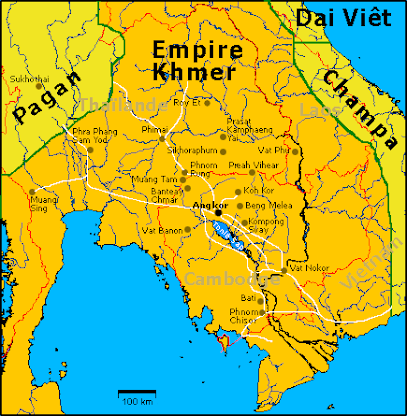
Drought might have collapsed Cambodian Angkor city
BANGKOK: Cambodia's great ancient city of Angkor Wat may have been brought to an end some 600 years ago by sudden weather changes that caused massive drought — not just by rival Siamese forces and widespread deforestation as previously suspected, a researcher said Tuesday.
Brendan M. Buckley said bands from tree rings that he and his colleagues examined show that Southeast Asia was hit by a severe and prolonged drought from 1415 until 1439, coinciding with the period during which many archeologists believe Angkor collapsed.
From the city of famed temples, Angkorian kings ruled over most of Southeast Asia between the 9th and 14th centuries. They oversaw construction of architectural stone marvels, including Angkor Wat, regarded as a wonder of religious architecture and designated a World Heritage Site by UNESCO.
While the 1431 invasion from Siam — what is now Thailand — has long been regarded as a main cause of Angkor's fall, archaeologists working at the sprawling temple site have suspected that ecological factors played a major part in its collapse.
"Given all the stress the Khmer civilization was under due to political reasons and so forth, a drought of the magnitude we see in our records should have played a significant role in causing its demise," said Buckley, a research scientist at Columbia University's Tree-Ring Laboratory in New York.
The thickness of a tree's rings provides scientists with a historical record of a region's climate. Wet periods encourage tree growth, making rings thicker, while dry periods create thinner rings.
Buckley, one of the world's top tree ring experts, has spent the past 16 years taking core samples from trees across Southeast Asia to build a record of the region's climate dating back hundreds of years.
Buckley — who spoke on the sidelines of a three-day climate conference in Vietnam_ said his data helped identify at least four mega-droughts in Southeast Asia dating back 722 years.
The Greater Angkor Project — run by the University of Sydney in collaboration with the French archaeological group Ecole Francaise d'Extreme Orient and APSARA, the body responsible for management of the Angkor World Heritage Park — concluded in 2007 that ancient Angkor had become unwieldy. Efforts to expand rice production to support a population of 1 million led to vast deforestation, top soil degradation and erosion.
Dan Penny, a University of Sydney researcher who is a director at the Greater Angkor Project, said the new findings on drought will help researchers gain a greater understanding of why the kingdom collapsed.
"Angkor was a civilization obsessed with managing water. It was an agrarian society," said Penny, who also spoke at the conference. "It's hard to imagine that a society like that could have shrugged off 20 or 30 years of drought."
Penny said the drought was likely the final blow to a kingdom already suffering the effects of deforestation and attacks from the Siamese and the Cham of southern Vietnam. Sediment samples show no evidence that Angkor was overwhelmed by a "dust bowl" like drought, he said.
"We have these droughts occurring on top of preexisting pressures," Penny said. "Climate change was an accelerant. It's like pouring petrol on a fire. It makes a social and economic pressures that may have been endurable disastrous."
Read more!