BEIJING, Jia Qinglin, chairman of the National Committee of the Chinese People's Political Consultative Conference, met here Friday with visiting Cambodian King Norodom Sihamoni.
Jia spoke highly of the contribution of the Cambodian royal family to promoting Sino-Cambodian ties.
He said the China-Cambodia relationship remains solid and has been growing stronger with joint efforts of the two peoples and cultivation of leaders of the two sides.
China highly values its relations with Cambodia, and would work with Cambodia to advance high-level exchanges, promote practical cooperation, so as to realize common prosperity and cement bilateral relations, he said.
Sihamoni said China is the "most reliable friend" of Cambodia, expressing his gratitude for China's long-term support and economic assistance and for its contribution to Cambodia's national reconciliation, peace and development.
He said Cambodia would join hands with China to continue to promote the bilateral relations to a higher level.
Read more!

Friday, February 20, 2009
Top Chinese political advisor meets Cambodian King

Thailand says sorry for mortar shell landing in Cambodia
PHNOM PENH, Thailand on Friday sent a letter to Cambodia to apologize for the wrong shooting of mortar shell into Cambodian land on Feb. 17, according to a press release from the Cambodian foreign ministry.
"I am writing to express to you my sincerest apology for the unfortunate incident that took place on Feb. 17, 2009," said Anupong Paojinda, Commander-in-Chief of the Royal Thai Army, in the letter.
"The mortar shell that landed in the Kingdom of Cambodia was a result of the miscalculation during one of our training exercises. We have since launched a full investigation into the incident," he said.
"Please be assured that the Royal Thai Army has been strictly following the Kingdom of Thailand's policy to maintain peaceful and cordial relationship with all our neighbors. I would like to reassure you that we will use all means to prevent such an incident from happening again in the future," he added.
According to the press release from the Cambodian Ministry of Foreign Affairs and International Cooperation, the letter was addressed to Meas Sophea, Deputy Commander-in-Chief of the Royal Cambodian Armed Forces (RCAF).
Also on Friday, English-language daily newspaper the Phnom Penh Post quoted a RCAF military commander based in the border region as saying that in this week's incident the shells landed two kilometers inside the Cambodian territory.
The 81mm and 106mm shells came down near the Ta Krabey temple and the Bos Thom village, 6 shells exploded in the forest, another2 failed to go off, no one was injured, and no property was damaged, the commander said in condition of anonymity.
Tension between Thailand and Cambodia ratcheted higher in 2008 when troops from both countries clashed at the Preah Vihear temple and soldiers on both sides died in fighting in October, before an uneasy peace was restored.
Read more!
KRouge court rejects leader's translation appeal
 PHNOM PENH (AFP) — Lawyers for former Khmer Rouge head of state Khieu Samphan Friday lost an appeal at Cambodia's UN-backed genocide tribunal to have his case file translated into French for his famed attorney.
The genocidal regime's leader and his lawyers have argued that in the absence of the translation of the documents into French -- one of the court's three official languages -- Khieu Samphan would not have a fair trial.
Khieu Samphan, 77, is being defended by famed French lawyer Jacques Verges, who has acted for some of the world's most infamous figures including Nazi war criminal Klaus Barbie and Venezuelan terrorist "Carlos the Jackal".
Judge Prak Kimsan, head of the tribunal's pre-trial chamber, said Friday that the "appeal is inadmissible" because the court's rules do not provide for appeals relating to translation issues.
The judge also said that the defence team already had legal assistants who understand the languages used by the hybrid international-Cambodian court, which was set up in 2006 after years of haggling with the United Nations.
Verges, who is representing Khieu Samphan along with Cambodian lawyer Sa Sovan, said during an appeal hearing last December that only 2.5 percent of the 60,000-page case file had been translated.
Sa Sovan said he was "very regretful" at the ruling.
"The suspect's rights have been violated. So there is no justice at this court," the lawyer said.
But the prosecution welcomed the decision, with Cambodian co-prosecutor Chea Leang saying it was "very important" to make proceedings move forward quickly.
Khieu Samphan is one of five Khmer Rouge leaders who have been detained by the court on charges of war crimes and crimes against humanity under the ultra-communist Khmer Rouge's brutal 1975-1979 regime.
He went before the court for the first time in April last year to appeal against his pre-trial detention.
The judges adjourned that hearing and warned Verges over his behaviour after he said he was unable to act for his client because court documents had not been translated.
A fierce anti-colonialist, Verges, who was born in Thailand, reportedly befriended Khieu Samphan and other future Khmer Rouge leaders while at university in Paris in the 1950s.
Up to two million people are believed to have been executed or died of starvation and overwork as the communist regime emptied Cambodia's cities, exiling millions to vast collective farms in a bid to forge an agrarian utopia.
The long-awaited first Khmer Rouge trial started earlier this week when the regime's notorious prison chief, Kaing Guek Eav, better known by the alias Duch, went before the court.
Read more!
Thursday, February 19, 2009
U.S. donates 36 vehicles to Cambodian armed forces
PHNOM PENH, U.S. donated Thursday 36 M35A2 trucks and 4 trailers to the Royal Cambodian Armed Forces (RCAF), said a press release from the U.S. Embassy.
U.S. Ambassador Carol Rodley turned over these vehicles to Phann Nguon, secretary of state at the Ministry of National Defense, at his ministry, it said.
The 36 M35A2 cargo trucks were part of an ongoing effort to address RCAF's transportation shortage and represented the second shipment of its kind under Cambodia's Excess Defense Articles grant program, which was funded by U.S., it added.
The vehicles handed over on Thursday were a continuation of the original order made in 2006 and brought the total number of trucks donated to 67, according to the press release.
U.S. security assistance to RCAF focused on the recommendations of a joint defense assessment meeting conducted in October 2006 by RCAF and the U.S. Pacific Command, it said.
Areas noted for improvement were border security, mobility, peacekeeping operations capability, maritime security, and communications, it added.
U.S. has pledged nearly 3.2 million U.S. dollars in assistance to Cambodia since the resumption of military-to-military engagement between the two nations in 2006, according to the press release.
Read more!
U of T Samaritans saving lives in Cambodia
 Kunthy Ok, a midwife and assistant at the University of Toronto’s Centre for International Health in Cambodia, takes a photograph of Pich Thy and her children for their health card. The centre is funded by donations.
Asia Bureau
KEP, Cambodia–Word reached Dr. Rebecca Draisey's tiny office, tucked away in this remote corner of Cambodia, late last week.
A handful of water filters were not getting to families that needed them due to a bureaucratic glitch.
And so, on Saturday morning, Dr. Draisey, the director of the University of Toronto's Centre for International Health here, strapped on her helmet, jumped on the back of her assistant's 125cc motorcycle, and together they rode off into the bush on a series of broken bi-ways and rutted red trails to sort it out.
Forty minutes later they arrived in Angkoul Commune, 25 kilometres away, where a small group of families were waiting. They wanted what people in the West take utterly for granted: clean water.
The group delivers water filters and medical help to the Cambodians on a modest budget that relies a lot on fundraising – they hope to raise $35,000 this year – and includes staff salaries and a small stipend for Draisey. Almost every dollar goes directly into improving Cambodians' health.
"We kind of knit our budget out of thin air," Draisey says.
But funding is a challenge and the financial crisis hasn't helped.
Recently, a generous contribution of $10,000, from two health-care professionals Draisey knows, had to be suspended due to the financial meltdown. "You can't blame anyone," she says. "In times like these, you definitely understand."
Recently she scored big, landing $8,000 from a U of T student organization called Earthtones to continue distributing water filters.
Draisey and the staff believe, as the late, celebrated cultural anthropologist Margaret Mead did, that individuals actually can change the world – indeed, as Mead once said, it's the only thing that ever has.
"I'd like to think we are making a difference," says Draisey.
As anyone who has worked in the developing world knows, even small sums – wisely spent – can go a long way. The filters cost about $11 each, not much for a potentially life-saving device.
So far the program has distributed 200, but Draisey's dream is to deliver 800 more by year-end. Somehow.
In a country where many drink raw water from contaminated wells, where a toilet – of any kind – is a luxury, and just 17 per cent of people have access to electricity, a good water filter is like gold.
It can mean the difference between life and death, especially for infants. "These won't filter out everything," Draisey explained as the filters were being handed out to the families at Angkoul Commune. "But they will filter out parasites and bacteria – what causes gastroenteritis. And it's gastroenteritis that often kills infants."
The distribution of water filters is just one small, but valuable project in the U of T's multi-pronged effort here, the brainchild of David Zakus, director of the university's Centre for International Health.
The university also has projects in China and in Africa.
Zakus wanted to create small-scale projects in developing countries that could provide valuable field research to local health officials, bring health education to the poor – and provide U of T students with their first experience of health care in the developing world.
Since its start here in Cambodia's remote Kep district in 2002, it has done all of that and more – on a shoestring. It has tested more than 150 wells, finding half of them contaminated; it has trained 16 midwives; it has helped organize a system of free health care for the district's poorest; and it's now trying to bring clean running water to Kep's only hospital, a facility serving the district's 37,000 people.
The hospital currently uses untreated water.
All are significant accomplishments, but all the more surprising given how small the operation is.
Draisey, a U of T medical graduate who practised medicine in Windsor, Ont., for 21 years, operates from a 49 square-metre room equipped with a refrigerator, a bicycle, two desks, two computers, and enough money to afford Internet access for three months of the year.
The grand total of staff is two: Kunthy Ok, a gifted local woman who is not only a qualified midwife but – fortunately – owns her own motorcycle, and Bunthoeun Thon, driver and program manager.
Draisey credits the idea and fundraising efforts to two U of T students who interned here: Mary Cameron, now at the University of Ottawa, and Risako Shirane, who came as an undergraduate student in global health.
For most students who get involved in the program, this is their first experience with the developing world. Many find it shocking.
"Within a very short period they end up throwing away all of their preconceptions," says Draisey. "There's shock, frustration, even anger.
"Many say, `Why isn't the world doing more for these people? Why isn't the university, the Centre for International Health, the Canadian International Development Agency? How can this be happening?'"
Dr. Draisey notes that students come from a highly structured environment while the developing world often lacks basic structure.
Most students undergo a period of reflection after the initial shock, then find there really are specific contributions they can make.
Students have helped to test local wells, gathered research on maternal health care and participated in medical outreach clinics in small villages.
One of CIH's more ambitious programs is the Most Vulnerable Family project, a pilot project aimed at ensuring the poorest of the poor in Kep have access to health services they cannot afford on their own.
CIH photographed 196 families identified by local officials, issued them health cards validated by the government, and persuaded the Ministry of Health to render services upon presentation.
Other ministries have now agreed to provide their services for free on presentation of the card, Kunthy Ok explains.
"This card will even allow a child to enter school for free," she says.
She says these words in a way meant to convey excitement, even hope.
Gov't survey finds health, nutrition problems of Cambodian children
PHNOM PENH, A recent government survey has found that the rising cost of food has halted improvements in child health and nutrition in Cambodia, English-Khmer language newspaper the Cambodia Daily said on Thursday.
The percentage of children under 5 found to be "acutely malnourished" has grown in recent years, the paper quoted the Cambodian Anthropometrics Survey, which was issued this week by the government's National Institute of Statistics, as saying.
According to the findings, 8.4 percent of children under 5 were acutely malnourished in 2005, but the number rose to 8.9 percent last year.
The report also showed a jump since 2005 in the number of young children suffering from ailments such as diarrhea, fever and respiratory infections.
"If these numbers turn out to be true, this is a very serious situation and all stakeholders involved (in food security) should take action soon," the World Food Program's recently appointed Country Representative Jean-Pierre De Margerie said.
The inflation rate of Cambodia reached a 15-year high in July 2008 at 22 percent, but gradually declined to 13.46 percent at the year-end, according to the Consumer Price Index (CPI) issued by the government in January.
"Food prices are significantly higher than a year ago, but the trend is reversing," Chan Sophal, president of the Cambodian Economic Association, was quoted by local media as saying then.
The CPI measures price fluctuations over a 12-month period of as elected basket of goods, from essentials such as food and gas to luxury items.
Read more!
Wednesday, February 18, 2009
Cambodian official: ASEAN Charter opens new era
PHNOM PENH, Ahead of the upcoming ASEAN (the Association of Southeast Asian Nations) summit in late February, a Cambodian senior official has highlighted the importance of the ASEAN Charter, saying it opens a new era for ASEAN itself.
The Charter is important because it is designed for the first time to set common goal of ASEAN on how to play its profile, how to tackle problems in the framework as a legal binding, Kao Kim Hourn, Secretary of State for the Ministry of Foreign Affairs and International Cooperation, told Xinhua in a recent interview.
"It is also a good timing to do emphasis on the start of implementation despite the fact that the Charter was already adopted and ratified by all member states," he said.
Meanwhile, he said that ASEAN leaders will discuss how to tackle the global financial crisis during the summit.
"ASEAN needs to go forwards, and it needs good cooperation and unity of all member states while facing the global financial crisis," he said.
"Each ASEAN member state has its own policy on how to respond or curb with the current financial crisis, but since the crisis may impact one after another, it is a good forum that the ASEAN leaders get together plus its dialogue partners to discuss on the matter," he added.
Thailand is scheduled to host the 14th ASEAN summit from Feb. 27 to March 1.
Read more!
ADB to open workshop on managing involuntary resettlement in Cambodia
PHNOM PENH, The Asian Development Bank (ADB) will convene a regional workshop on managing involuntary resettlement in East Asia and the Greater Mekong Sub-region (GMS) countries, said an ADB press release on Wednesday.
"The workshop will focus on sharing examples of good practice in resettlement management in the region, and also field visits to project sites," it said.
Arjun Goswami, Country Director of ADB's Cambodia Resident Mission, and Chhorn Sopheap, Director of the Resettlement Department of the Cambodian Ministry of Economy and Finance (MEF) will attend the opening session.
ADB consultants Mohammad Zaman and Aqueel Khan will conduct the workshop, which will be held from Feb. 23 to 27.
Participants include project staff, consultants, non-governmental organizations, and affected communities.
"Development projects are a critical component of any effort to alleviate poverty and promote economic growth, but they also tend to affect and displace people, especially the poor," said the release.
"Good resettlement planning and management is therefore vital in addressing the adverse effects of involuntary resettlement, and can, if done properly, open up new opportunities to improve incomes and living conditions of those affected," it added.
Read more!
U.S., EU, Canada major importers of Cambodian garments
PHNOM PENH, U.S., EU and Canada were the top three importers of Cambodian garments in 2008, national media on Wednesday.
U.S. remained as the largest market of Cambodian garment products, worth 1.95 billion U.S. dollars in 2008, rising 1.999 billion U.S. dollars in 2007, English-language daily newspaper the Phnom Penh Post quoted the 2008 annual report of the Cambodian Commerce Ministry as saying.
EU stayed at the second place, worth 631 million U.S. dollars in 2008 over 599 million U.S. dollars in 2007, and Canada the third, worth 202 million U.S. dollars in 2008 over 154.5 million U.S. dollars in 2007, according to the report.
The total garment exports in 2008 stood at 3.15 billion U.S. dollars, a 7 percent rise over that of 2007, 2.937 billion U.S. dollars, it said.
Garments were still the kingdom's largest export item in 2008, accounting for around three-quarters of the export earnings, according to the ministry report.
Read more!
Drought might have collapsed Cambodian Angkor city
BANGKOK: Cambodia's great ancient city of Angkor Wat may have been brought to an end some 600 years ago by sudden weather changes that caused massive drought — not just by rival Siamese forces and widespread deforestation as previously suspected, a researcher said Tuesday.
Brendan M. Buckley said bands from tree rings that he and his colleagues examined show that Southeast Asia was hit by a severe and prolonged drought from 1415 until 1439, coinciding with the period during which many archeologists believe Angkor collapsed.
From the city of famed temples, Angkorian kings ruled over most of Southeast Asia between the 9th and 14th centuries. They oversaw construction of architectural stone marvels, including Angkor Wat, regarded as a wonder of religious architecture and designated a World Heritage Site by UNESCO.
While the 1431 invasion from Siam — what is now Thailand — has long been regarded as a main cause of Angkor's fall, archaeologists working at the sprawling temple site have suspected that ecological factors played a major part in its collapse.
"Given all the stress the Khmer civilization was under due to political reasons and so forth, a drought of the magnitude we see in our records should have played a significant role in causing its demise," said Buckley, a research scientist at Columbia University's Tree-Ring Laboratory in New York.
The thickness of a tree's rings provides scientists with a historical record of a region's climate. Wet periods encourage tree growth, making rings thicker, while dry periods create thinner rings.
Buckley, one of the world's top tree ring experts, has spent the past 16 years taking core samples from trees across Southeast Asia to build a record of the region's climate dating back hundreds of years.
Buckley — who spoke on the sidelines of a three-day climate conference in Vietnam_ said his data helped identify at least four mega-droughts in Southeast Asia dating back 722 years.
The Greater Angkor Project — run by the University of Sydney in collaboration with the French archaeological group Ecole Francaise d'Extreme Orient and APSARA, the body responsible for management of the Angkor World Heritage Park — concluded in 2007 that ancient Angkor had become unwieldy. Efforts to expand rice production to support a population of 1 million led to vast deforestation, top soil degradation and erosion.
Dan Penny, a University of Sydney researcher who is a director at the Greater Angkor Project, said the new findings on drought will help researchers gain a greater understanding of why the kingdom collapsed.
"Angkor was a civilization obsessed with managing water. It was an agrarian society," said Penny, who also spoke at the conference. "It's hard to imagine that a society like that could have shrugged off 20 or 30 years of drought."
Penny said the drought was likely the final blow to a kingdom already suffering the effects of deforestation and attacks from the Siamese and the Cham of southern Vietnam. Sediment samples show no evidence that Angkor was overwhelmed by a "dust bowl" like drought, he said.
"We have these droughts occurring on top of preexisting pressures," Penny said. "Climate change was an accelerant. It's like pouring petrol on a fire. It makes a social and economic pressures that may have been endurable disastrous."
Read more!
Tuesday, February 17, 2009
Cambodia, Albania negotiate rice deal
Written by HOR HAB AND GEORGE MCLEOD
CAMBODIA'S efforts to diversify rice exports have taken a small step forward with a planned deal that would see 5,000 tonnes of rice sold every month to Albania, starting with a 300-tonne shipment.
"Albania has contacted us to buy 300 tonnes of 10 percent-broken rice from Cambodia as a trial purchase ... Cambodian rice has a lot of potential in the market," said Outh Renne, secretary general of Small and Medium Industry of Cambodia.
"We sent them a sample of 25-percent, 10-percent, and five-percent broken rice, and they are interested in the 10-percent broken rice," he said.
Negotiations are continuing with the Albanians having offered US$475 per tonne and Cambodia asking $490, down from its previous offer of $500, Outh Renne said. The deal could also see 4,000 tonnes of corn sold per month to Albania.
Cambodian rice has a lot of potential in the market.
The move to tap the Albanian market follows government efforts to diversify Cambodia's rice exports and increase production of milled rice. Late last year, Cambodia announced it was in talks with Senegal to sell 10,000 tonnes of rice per month. Discussions are ongoing, and authorities say they are arranging transport and waiting for the UN Development Program to reconvene the talks. "Negotiations will resume with Senegal after a two-month delay," said Mao Thora. "Our main obstacle is the price and transportation."
Trade officials say they are also in talks with Congo-Brazzaville to sell low-grade rice.
Tes Ethda, president of the national Rice Millers Association of Cambodia, said that the country is making headway tapping markets for low and medium-grade rice.
"The biggest market for rice and corn is Asia and Africa, and we have more potential to tap that market, but we still have some problems with transportation costs," he added.
Cambodia exports about two million tonnes of rice per year, but yields remain low at only 2.6 tonnes per hectare compared with 3.5 tonnes in Thailand and about six tonnes in China. Poor irrigation, a lack of fertilisers and inadequate dissemination of market information are among the challenges the sector faces. Government spending on agriculture is a low three percent of agricultural GDP, versus 10 percent in China and Thailand, say World Bank figures. .
Read more!
Chuan Wei Selects Alcatel-Lucent for Nationwide Deployment of Cambodia's First WiMAX Rev-e Network
Mobile World Congress, BARCELONA, Feb 17, 2009 (PR Newswire Europe via COMTEX) ----- Frame Agreement Underlines Alcatel-Lucent's Refocused Strategy in WiMAX and Commitment to the Enhanced Wireless DSL Segment
Alcatel-Lucent (Euronext Paris and NYSE: ALU) today announced that it has been chosen by Chuan Wei (Cambodia) Co Ltd, to deploy a nation-wide WiMAX Rev-e (802.16e-2005 standard) wireless broadband network, Cambodia's first. Commercial services are set for launch in mid 2009.
Chuan Wei, part of the Thai Boon Roong Ltd conglomerate, is counting on the Alcatel-Lucent solution to meet its target of serving one million subscribers, roughly 80% of the country's business and enterprise population,, within two years of launch. Alcatel-Lucent is providing a complete turnkey solution for WiMAX, including integration, design, installation, commissioning, and maintenance services.
"As the first provider to deploy a nation-wide WiMAX Rev-e network in Cambodia, Chuan Wei is helping shape the future of communications in the region. The network will provide significant infrastructural support to Cambodia's economic growth, improving communications for local businesses and multinationals," said Chuan Wei's president, Alan Khov. "It will support high-quality voice telephony in addition to broadband access, thanks to the end-to-end quality of service features built into the Alcatel-Lucent solution."
"This large-scale contract win with Chuan Wei highlights Alcatel-Lucent's refocused strategy to WiMAX as the wireless-broadband solution for fixed, nomadic and data-centric mobility needs," said Mike Iandolo, President of Alcatel-Lucent's Wireless networks activities. "Driven to a large degree by demand in high-growth economies like Cambodia, we see the 'enhanced wireless DSL' market growing strongly over the next five-plus years worldwide with close to 90% of WiMAX Rev-e subscribers by 2013, and we are focused on building on our leadership in this space."
In December, Alcatel-Lucent announced that it was refocusing its WiMAX R&D efforts on the technology's dominant market opportunity, enhanced wireless DSL - which includes data-centric mobility usage on netbooks and mobile Internet Devices (MIDs) as well as residential and nomadic PC use.
Alcatel-Lucent is the commercial leader in WiMAX Rev-e, with 10 networks in service out of its 35 commercial references worldwide. The vendor has shipped to date more than 10,000 Rev-e base stations, supporting tens of thousands of paying subscribers. It is also a world leader in the provision of sophisticated project management, consulting and design services, applications and software integration and the design, deployment and maintenance of next-generation networks.
About Chuan Wei
Established in June 2008, Chuan Wei was awarded the sole license to operate the only nationwide WiMAX mobility network in Cambodia. The company is focused on delivering state-of-the-art WiMAX wireless broadband infrastructure for Cambodian society, allowing the Kingdom to realize its potential via improved access to digital communications infrastructure.
About Alcatel-Lucent
Alcatel-Lucent (Euronext Paris and NYSE: ALU) is the trusted partner of service providers, enterprises and governments worldwide, providing solutions to deliver voice, data and video communication services to end-users. A leader in fixed, mobile and converged broadband networking, IP technologies, applications and services, Alcatel-Lucent leverages the unrivalled technical and scientific expertise of Bell Labs, one of the largest innovation powerhouses in the communications industry. With operations in more than 130 countries and the most experienced global services organization in the industry, Alcatel-Lucent is a local partner with a global reach. Alcatel-Lucent achieved revenues of Euro 16.98 billion in 2008 and is incorporated in France, with executive offices located in Paris. For more information, visit Alcatel-Lucent on the Internet: http://www.alcatel-lucent.com
Read more!
Cambodia begins painful look back with Khmer Rouge trials
 Moeung Sonn, who survived the Khmer Rouge regime, at the tribunal. A poll found many Cambodians did not know of the trials. (Nicolas Asfouri/Agence France-Presse)
The first defendant is Kaing Guek Eav, 66, better known as Duch, the commandant of the Tuol Sleng prison and torture house, which sent at least 14,000 people to their deaths in a killing field.
The purpose of the hearing Tuesday was to address procedural issues before court sessions begin next month.
Duch confessed to journalists before his arrest nine years ago that he had committed atrocities but said he had been acting under orders and would himself have been killed if he had disobeyed. Known for his brutality, he is charged with crimes against humanity and war crimes, and with murder and torture in his prison, known as S-21.
Four senior Khmer Rouge officials who were in a position to give those orders are also in custody, but court officials say their trials may not start until next year.
They are Nuon Chea, 82, the movement's chief ideologue; Khieu Samphan, 76, who was head of state; Ieng Sary, 82, the former foreign minister; and his wife, Ieng Thirith, 75, a fellow member of the Khmer Rouge Central Committee.
The Khmer Rouge leader, Pol Pot, died in 1998. Many Cambodians say they fear that some of the defendants may also die before they are brought to trial, and the tribunal has been providing them the best medical care Cambodia has to offer.
The trials are being held by a hybrid tribunal supported by the United Nations that includes Cambodian and foreign judges and prosecutors in an awkward legal compromise that has drawn criticism from human-rights advocates and legal scholars.
The chief concern is that the Cambodian members of the tribunal will not be independent of their government's political agenda. Questions have already been raised about the Cambodian co-prosecutor's reluctance to recommend further indictments.
Foreign and Cambodian analysts say the government, fearing that a widening circle of defendants could reach into its own ranks, wishes to limit the number of those being tried, harming the tribunal's credibility.
"We wish to see this tribunal for at least these five, and this is the minimum of the minimum," said Kek Galabru, a leading Cambodian human-rights campaigner. "A lot of people ask: 'Why only five? Why only five? Why only five?"'
In addition, the United Nations has investigated allegations of corruption among the Cambodian members of the tribunal. The trial is supported by donations from other nations, and further payments are being delayed pending a resolution of those questions of corruption.
David Chandler, the author of "Voices From S-21: Terror and History in Pol Pot's Secret Prison" (University of California Press, 1999), said that a flawed trial would be better than no trial at all.
"These guys should have to finally face some of the people and some of the evidence of what they did," he said. "It doesn't seem right that they just die in bed, tending to their chickens."
In a fanatical attempt to create a pure peasant society, the Khmer Rouge turned their country into a giant labor camp, evacuating cities, banning commerce and religion, and trying to exterminate the country's educated class.
From 1975 to 1979, at least 1.7 million people were executed or died of overwork, starvation, torture or untreated disease.
The Khmer Rouge left behind an eviscerated and traumatized society, and some human-rights advocates hope the trial can bring a measure of closure.
A survey of 1,000 Cambodians last year by the Human Rights Center at the University of California, Berkeley, found that even after three decades, the traumas and hatreds persisted.
In face-to-face interviews, nearly half the respondents said they were uncomfortable living close to former members of the Khmer Rouge. Two-thirds said they wanted to see former cadres suffer in some way. Forty percent said they would take revenge themselves if they had the opportunity.
Chum Mey, 77, who is among only a handful of people who survived Tuol Sleng, said he still feared Duch and was unable to look him in the eye at a pretrial hearing in November.
In the hearing room, he said, Duch behaved with the same air of confidence, disdain and command that had characterized his tenure as prison chief.
"They tortured me for three months," Chum Mey said, recalling his time as a prisoner. "They beat me. They removed my toenails. They gave me electric shocks in my ear - kup-kup-kup-kup, it sounded like a machine in my head, and my eyes were like burning with fire."
He is on the witness list to testify against Duch. "I want to stay alive to give evidence," he said. "Because I survived the Khmer Rouge, and if I die before the trial, what was the point of surviving?"
In an innovation, dozens of victims have enrolled as civil parties to the case. They have grouped themselves by ethnicity or by the nature of their complaints and will be permitted to demand symbolic damages.
One of them is Sok Chear, 42, an office worker whose father died under the Khmer Rouge. "We want to ask their leaders: 'Who ordered this? Why did you kill Cambodian people? For what?"' she said.
But not all Cambodians want to relive their traumas, which psychiatrists here say may be reactivated by the trial. One of them is Sok Chear's sister.
"She says the government is finding peace for the people," Sok Chear said. "'Why do you want to make trouble again? They killed our father already. Now let's just forget it."'
The trial, in a former military headquarters half an hour outside the city, is taking place in a strange social vacuum.
This is a nation that has tried, in the words of Prime Minister Hun Sen, to "dig a hole and bury the past." Its traumas lie beneath the surface of daily life, and the opening of the trial has drawn only moderate attention here.
The Berkeley study found that 85 percent of respondents had little or no knowledge of the tribunal.
It found that their main concerns were jobs, services to meet basic needs, and food. When asked what the priorities of the government should be, only 2 percent said justice.
For many in the younger generation, the Khmer Rouge atrocities are already ancient history.
"Honestly, we don't pay attention to these things," said Ung Suchida, 24, a waitress. "They are already old. Some people, they are interested. But not me."
Exchange of Thai and Cambodian citizens fails
By: SURACHAI PIRAGSA
Newspaper section: NewsBURI RAM : Thai and Cambodian security officials have failed to make progress in talks to exchange each other's nationals arrested for illegal entry along the poorly-defined border.
Talks over an exchange began after security authorities from the two countries agreed to try to secure the release of their citizens, officials said yesterday.
On Saturday, a combined Cambodian team arrested Suk Yadee and Withoon Samran in the forest along the Thai-Cambodia border opposite Surin's Kap Choeng district.
The two Thai villagers were looking for wild products when they were arrested.
They were charged with illegal entry and carrying weapons into Cambodia. They have been reportedly sent for trial at a Siem Reap court.
On the same day , police in Buri Ram's Ban Kruat district arrested Choeng Sid, 31, and Jon Mon, 22, two Cambodians, near the Bantad mountain range in Ban Huay Suk in tambon Nong Mai Ngam in Ban Kruat district.
Police said they had seized an electric chainsaw as evidence.
The two were charged with cutting down protected trees and illegal entry into the country.The two Cambodians were sent for trial to the provincial court in Buri Ram's Nang Rong district.
Read more!
Monday, February 16, 2009
Cambodia's ATM networks grow despite crisis
PHNOM PENH, Despite concerns over the impact of the global credit crunch on local financial institutions, Cambodian banks are expanding their network of ATMs to provide customers with easier access to their money, national media reported Monday.
In Channy, president and chief executive of ACLEDA Bank, told the Phnom Penh Post that the growth of ATMs has boomed in the last few years as living conditions improve and greater progress is made in modernizing the kingdom's bank sector.
"In 2007, (we) had 20 ATMs. Now, we have 60 ATMs with plans to reach 100 by the end of this year," In Channy said.
"Our ATMs have been installed in all parts of Cambodia," he said.
"Our long term expansion strategy will include an expansion of our network to 500 ATMs and 240 branch offices nationwide," he added.
Meanwhile, Kunkanel Nong, a marketing manager at the Canadia Bank, said that Canadia currently operates 48 ATMs throughout Cambodia, up from 25 in 2007, and that the bank expects to reach 60 ATMs by the end of this year.
The first ATM in Cambodia was introduced by Canadia Bank in June 2004, according to the National Bank of Cambodia's (NBC) 2007annual report.
Read more!
News leak on ex-military chief angers Cambodian government
PHNOM PENH, Cambodia, The Council of Ministers have chastised the press for publishing information from a leaked government document that revealed it began probe into the real estate holdings of recently removed military chief Ke Kim Yan, national media said on Monday.
The publishing of information contained in the official minutes of a meeting of the Council of Ministers held on Jan. 23, one day after Ke Kim Yan's ouster as Commander in Chief of Royal Cambodian Armed Forces (RCAF), amounted to "incitement and provocation of a bad political environment," English-Khmer language newspaper the Cambodia Daily quoted a statement of the council as saying.
"The government is investigating to find the people who leaked its internal documents and will take strict measures against these individuals," the statement added.
The minutes, which found their way into the hands of several media outlets late last week, revealed that Ke Kim Yan was removed in part because of his land dealings.
According to the minutes, "the Council of Ministers has been informed and commented on the termination of the position of commander-in-chief from HE Ke Kim Yan based on two reasons:
"First, reforming the RCAF rank and file by adhering to work effectiveness in the military rank and file.
"Second, involvement with land issues by a top and powerful person in the military rank and file and doing business by using the name of military for personal gain."
The minutes went on to describe a resolution by the Council of Ministers to have both military and government bodies investigate Ke Kim Yan's land dealings.
Since his removal, ruling party and military officials have repeatedly claimed that his ouster was solely to promote reforms within the military.
Read more!
Cambodia genocide trial to begin
PHNOM PENH, Cambodia: The first trial of a Khmer Rouge leader was to begin Tuesday as part of efforts by a U.N.-assisted genocide tribunal to punish those responsible for the deaths of an estimated 1.7 million Cambodians after more than three decades of delayed justice.
When the communist Khmer Rouge came to power in 1975 after five years of bitter civil war, many of their countrymen thought peace was at hand. But in their effort to remake society, they instituted a reign of terror that lasted nearly 4 years and ended only by an invasion by neighboring Vietnam.
To get even one of the Khmer Rouge leaders on trial is seen as a breakthrough, as many victims feared that the defendants, now aging and infirm, would die before facing justice. But there are real concerns that the process is being politically manipulated and that thousands of killers will escape unpunished.
"It's going to be a very big day for the Cambodian people because the justice that they have been waiting for 30 years it starting to get closer and closer," said tribunal spokesman Reach Sambath.
Kaing Guek Eav — better known as Duch, who headed the Khmer Rouge's largest torture center — is the first of five former Khmer Rouge leaders scheduled to stand trial. He is charged with crimes against humanity.
Duch, 66, is accused of having committed or abetted a range of crimes including murder, torture, rape and persecutions at S-21 prison in Phnom Penh — formerly a school — where up to 16,000 men, women and children were held and tortured, before being put to death.
The prison, also known as Tuol Sleng and now a genocide museum, provides gruesome evidence.
Khmer Rouge leader Pol Pot's Maoist plan for a peasants' paradise collapsed under a disastrous agricultural policy and rampant paranoia about supposed traitors; thousands were executed, while many more died of starvation, exhaustion and disease.
Duch's hearing before the Extraordinary Chambers in the Courts of Cambodia, as the tribunal is called, will deal with procedural issues, and testimony is expected to begin only in late March. Up to 1,000 people are expected to attend the hearing, which will last two or three days, Reach Sambath said.
The trial comes 30 years after the fall of the Khmer Rouge, 13 years after the tribunal was first proposed and nearly three years after the court was inaugurated.
The tribunal has been plagued by political interference from the Cambodian government, allegations of bias and corruption, lack of funding and bickering between Cambodian and international lawyers.
Some observers believe Prime Minister Hun Sen — a former Khmer Rouge officer himself — is controlling the tribunal's scope and reach by directing the decisions of the Cambodian prosecutors and judges.
Others in detention facing trial are Khieu Samphan, the group's former head of state; Ieng Sary, its foreign minister; his wife Ieng Thirith, who was minister for social affairs; and Nuon Chea, the movement's chief ideologue.
"I think the possibility is definitely there that this can deliver justice," said Heather Ryan of the New York-based group Open Justice Initiative, which seeks to work with the court and NGOs to ensure that international standards of justice are met.
"But ... there are hurdles that need to be overcome before we get to that point and unless and until the government of Cambodia and the United Nations demonstrates seriousness about getting over those hurdles I think there will be a serious doubt the ultimate value of these trials."
Read more!
Sunday, February 15, 2009
Document links RCAF shake-up to land deals
PHNOM PENH, The official record of a Council of Ministers meeting held the day after the Jan. 22 dismissal of RCAF (Royal Cambodian Armed Force) Commander-in-ChiefKe Kim Yan said that the government has ordered an investigation of the former military leader and his business associates over several land deals across the country, national media reported Saturday.
CPP (the Cambodian People's Party) and military officials have repeatedly claimed that the ouster Ke Kim Yan was solely to promote reforms within the military, but according to the minutes of a Jan. 23 meeting of the Council of Ministers, land issues were also at play in the decision, the Cambodia Daily newspaper said.
According to the meeting minutes, "The Council of Ministers has been informed and commented on the termination of the position of commander-in-chief from HE Ke Kim Yan based on two reasons:
"First, reforming the RCAF rank and file by adhering to work effectiveness in the military rank and file.
"Second, involvement with land issues by a top, powerful person in the military rank and file .. and doing business by using the name of military for personal gain."
The minutes go on to describe a resolution by the Council of Ministers to have both military and government bodies investigate Ke Kim Yan's land dealings.
However, newly appointed RCAF Commander-in-Chief Pol Saroeun and Defense Minister Tea Banh both said they are not looking into Ke Kim Yan's properties.
"Anything relating to Ke Kim Yan has ended since his termination from the position of RCAF high commander," Tea Banh told the Cambodia Daily.
Read more!
Cambodia's KRouge trial to test court's credibility: HRW
PHNOM PENH (AFP) — Cambodia's UN-backed genocide tribunal must resolve claims of political interference if it is to meet international standards when its first trial starts this week, a rights group said Sunday.
The court will on Tuesday formally open the long-awaited trial of the Khmer Rouge regime's former prison chief, Kaing Guek Eav, better known as Duch, who is the first of five leaders detained by the tribunal.
But the run-up to the trial has been marred by claims that the government is interfering to stop the prosecution of further suspects, as well as allegations that Cambodian court staff paid kickbacks for their jobs.
"Any hint of political manipulation at the tribunal will undermine its credibility with the Cambodian people," said Sara Colm, Cambodia-based senior researcher at Human Rights Watch.
"Until allegations of corruption and improper interference by the government are investigated and resolved, the tribunal?s integrity as a legitimate and independent court will remain in question."
Duch, 66, faces charges of crimes against humanity, war crimes, torture and pre-meditated murder for his role in running S-21, the Khmer Rouge's notorious main prison, during the 1975-1979 regime.
The other Khmer Rouge members awaiting trial are "Brother Number Two" Nuon Chea, former head of state Khieu Samphan, ex-foreign minister Ieng Sary and his wife Ieng Thirith, who was the minister of social affairs.
But rows between international and Cambodian co-prosecutors over international prosecutors' wishes to bring more suspects to trial have dogged the tribunal.
The Cambodian government has been accused of trying to scupper further trials amid fears that it could target former Khmer Rouge members currently in top posts in Prime Minister Hun Sen's administration.
"By allowing political considerations to block additional indictments, the Khmer Rouge tribunal is failing the most basic test of its independence and its credibility," said Colm of the New York-based rights group.
Colm urged stakeholders in the tribunal, including the government and the international community, "to ensure that the court is able to act independently and free of political interference or consideration."
Read more!
Saturday, February 14, 2009
Travel: Angkor, the mysterious temple complex of Cambodia
 By Ellen Creager Detroit Free Press
“Who made you?” I whispered. “Were you lonely when nobody came to visit for 400 years?”
No answer. Just a smile.
That is the fascination of Angkor, the mysterious temple complex of Cambodia. As at the pyramids of Egypt or the temples of the Maya, visitors here must infer the nature of a civilization from the astounding architecture left behind.
Angkor, located in the city of Siem Reap in central Cambodia, probably should have been a winner in 2007’s New Seven Wonders of the World contest. In scope and beauty, it easily beats Mexico’s Chichen Itza and possibly even Peru’s Machu Picchu. It likely lost because fewer people have seen it than the other attractions. Although 2 million tourists a year visit Angkor now, the site was basically covered by the jungle from 1500 to 1900, then off-limits to visitors due to war and political instability in Cambodia from the 1960s to 1998.
Its masterpiece is Angkor Wat, a funky temple built in the 12th century in honor of the Hindu god Vishnu. Stunningly original, the temple’s five towers were built using porous clay foundations and sandstone exteriors. Put together with an unknown mortar, its stones were stacked like a Jenga puzzle, each piece fitting atop the other into tall spires.
Yet Angkor Wat is only one of 72 major temples, and the Angkor ruins area is more than 1,000 miles square.
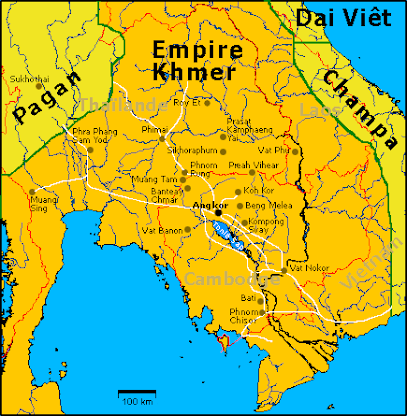
The rise-and-fall story of Angkor is dramatic enough to fill 10 history books. Between the 12th and 15th centuries, the great Khmer Empire spread over what are now parts of Laos and Thailand, Vietnam and Cambodia. Its center was Angkor, the home of the kings, temples, fountains and gold.
A series of attacks by the Siamese and exhaustion of the land by over-farming led to the abandonment of the city in the early 15th century, historians believe. That’s when most of Angkor fell victim to the jungle for 400 years. There it sat, while nations rose and fell, while America was discovered, while Shakespeare wrote Hamlet.
When French archaeologists in the late 19th century rediscovered Angkor and started pulling the vines away and looking at what remained, they were astonished. We still are.
It takes all day for even a bare-bones tour. You can start before sunrise and watch the sun come up over the towers of Angkor Wat, stay all day, then watch the sun go down from a hill nearby.
Some of the ruins have been sufficiently restored so that you can wander the halls and climb the steps. Yet most are only partly put back together, giving the ruins a tumble down feel, as if you’d just stopped by after an earthquake.
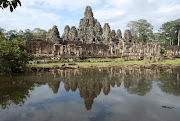
Angkor Wat, built in the early 12th century by King Suryavarman II, is the star of Angkor. But I preferred the Bayon, a nearby temple with 49 towers emblazoned with nearly 200 huge carved images of a pleasantly smiling face. Historians believe the images represent either King Jayavarman VII, who built the temple in the late 12th century, or the Buddhist “compassionate being” Lokesvara, or both.
Yet, the Bayon is not just a happy-face ruin. It’s also an ancient art gallery, with wonderful bas-relief murals depicting the ordinary life of the Angkor people — gambling, in childbirth, dancing, cooking, playing, hunting and fishing. These murals not only are a kind of Facebook posting of daily life back then, they illuminate the high standard of living at Angkor in its heyday, when people had enough to eat, safety, leisure and time to create such art.
You don’t need a guide to visit the Angkor complex, but I would recommend it. The complex is so huge that it helps to have someone show you high points you might miss on your own.
Many tourists get around by tuk-tuk, a cart with an awning pulled by a motorcycle driver. Other sightseers visit by car, van, tour bus, bicycle or even by elephant, depending on what kind of tour they book.
Inside the complex, it’s not just sightseers. Local people gather sheaves of rattan, the reed used to weave baskets. Cattle wander amid the chaos. An ice cream truck parks in a field. At most of the popular temples and sites, persistent children sell sticky rice, baskets, scarves, bracelets, guidebooks, bananas, pineapple chunks and Fanta Orange.
The average tourist needs at least two days to see Angkor, but archaeology buffs will want to stay longer.
One of the most photo-friendly sites is Ta Prohm, a temple-monastery. Today, visitors can see the temple much as it was found in the early 1900s, with giant kapok tree roots winding through the doors and windows, so that the stone temple appears to be part of the natural landscape. Also lovely is Neak Pean, a pond with a fountain as elegant as anything you’d find at Versailles.
Today, the Angkor Wat complex is in no danger of fading away. Huge luxury hotels have opened pell-mell outside the park just in the last three years. About 3,000 new hotel rooms are about to be added to the 7,000 already here.
Naturally, environmentalists aren’t happy about the unregulated hustle and bustle right next to a UNESCO World Heritage site. They worry about the water table under Angkor being sucked dry by hotel wells. They worry that the site’s fragile ruins can’t handle the traffic.
Still, I keep thinking that the kings who built Angkor would probably love all the attention.
From the 1960s to 1998, Cambodia was either at war, crippled by the genocidal Khmer Rouge regime, or unstable. Now, the fledgling democratic nation is trying to make up for lost time in expanding tourism at a frenetic pace in Siem Reap/Angkor, the destination for half of all tourists to Cambodia.
Ready or not, Tourism Cambodia expects up to 3 million tourists at Angkor by 2010.If you go . .
GETTING THERE: Fly into Siem Reap’s 2-year-old Angkor International Airport from nearby Bangkok, Thailand; Hanoi or Ho Chi Minh City, Vietnam; or Singapore. No direct flights from the U.S.
VISA: Needed but easy to obtain through Cambodia’s e-visa program. Get it before arrival for $25 at http://evisa.mfaic.gov.kh/e-visa/vindex.aspx.
LODGING: Most hotels in Siem Reap are new and less than a mile from the gates of the Angkor complex. Try Tara Angkor (about $90-up, www.taraangkorhotel.com).
MONEY: Cambodia uses the riel, but it also uses U.S. dollars; no need to exchange money.
TOURS: Most tourists to Angkor go as part of a larger tour of Southeast Asia. However, it is possible to fly in on your own and hire an Angkor guide through your hotel.
TICKETS: A one-day ticket to Angkor is $20; a 3-day pass is $40; purchase at the Angkor entrance gate; if you’re on a tour your guide will take care of this.
SHOPPING: Siem Reap has nice handicrafts at local markets and roadside shops. Look for textiles, baskets and marble statues of Buddha.
OTHER TIPS:
Take a break from the heat every two hours while touring the ruins. Weather can be humid and in the 90s. Wear a hat and sunscreen; carry water.
Read up on Hinduism and Buddhism and the history of Cambodia to better appreciate what you are seeing.
Try to shoot Angkor photos in late afternoon when the light is best. Also shoot in black and white for a quaint result.
Learn a little of the Khmer language, although most Cambodians who deal with tourists speak some English. For instance, “Angkor” means city. “Wat” means temple.