PHNOM PENH, Cambodian Prime Minister Hun Sen expressed his deep regret here on Monday over the death of Keng Vannsak, inventor of the Khmer typewriter keyboard.
Vannsak just died at 83 years old of pneumonia in a hospital at the outskirts of Paris, where he had lived since the 1970s. His funeral will be held there on Tuesday.
"I was so regretful that we lost a famous intellectual of our country," Hun Sen told the graduation ceremony of a university.
"Grandfather Keng Vannsak told me in a recent letter that he had the plan to visit Cambodia," he said, adding that he had never returned to Cambodia since the 1970s.
Vannsak invented the Khmer typewriter keyboard in 1952 and was also known as a politician, Khmer-language teacher and scholar, poet, composer and historian.
Read more!

Monday, December 22, 2008
Cambodian PM regrets death of Khmer typewriter keyboard inventor

Chinese man arrested in Cambodia on terrorism charges
Phnom Penh - A Chinese national was arrested and charged with kidnapping and terrorism offences in Cambodia, national media reported Monday.
Police on Sunday arrested Hour Ming, 33, after he allegedly held hostage Seang Youhour, 34, for 13 hours in his house in the capital Phnom Penh and threatened to set off a bomb if officers tried to raid the building, The Phnom Penh Post reported.
The man slashed the victim's face with a knife and stabbed himself in the chest as police raided the house early Sunday morning, officials said.
Police said the suspect and the victim were being treated in a Phnom Penh hospital.
Read more!
Sunday, December 21, 2008
Refugee parties after deportation scare
By REBECCA TODD
Cambodian refugee has escaped deportation after an 11th-hour government reprieve.
Friends of Sokhom Pich celebrated his return to Christchurch with a party on Saturday night.
Former associate immigration minister Shane Jones decided to release Pich and allow him to apply for permanent residency just one hour before he was to be deported on November 4.
Members of Christchurch's Cambodian community had appealed to the then Labour government to allow Pich to stay in the country after he was arrested as an overstayer in September.
After living in New Zealand for 11 years, the 47-year-old had exhausted every legal avenue in his bid to remain in the country as a political refugee despite fears he would be imprisoned and possibly killed if he was sent back to Cambodia.
Just an hour before boarding a plane in Auckland, he received the news that he could stay.
"I was really, really, really happy. I was just jumping and it was just amazing," he said.
"I was surprised because in Auckland I was feeling everything was over. For 20 seconds I couldn't say anything."
Pich said he was a member of the opposition Sam Rainsy Party in his home country which criticised the government for corruption and cracking down on political dissent.
"If the government is not good, people live without houses and food and that's not good for the people," he said.
Pich said a number of his fellow party members had disappeared or been killed and he feared a similar fate. "I felt scared and quite nervous about being sent home, but after it came closer and closer I wasn't scared, I wasn't anything."
Cambodian community adviser Bill Noordanus said Cambodian law meant Pich would have been imprisoned for more than three years if he was sent home as he had left the country illegally.
"He's a very fine man. He's an idealist and like all idealists they sometimes clash with the authorities."
Read more!
New Foreign Minister readies for ASEAN Summit, Cambodia disputes
BANGKOK, Dec 21 (TNA) - Newly appointed Thai Foreign Minister Kasit Piromya said he is ready to work on two urgent priorities, preparation for the Association of Southeast Asian Nations leader meeting (ASEAN Summit) that Thailand will host early next year and the talks to provide a sustainable settlement of the border disputes with Cambodia.
During the ASEAN Foreign Minister's Meeting at the ASEAN Secretariat in Jakarta, Indonesia, last Monday, the ministers tentatively agreed that the Summit would be held in Thailand by the end of February.
The meeting fixed the new dates of the 14th ASEAN Summit and Related Summits on February 24-26, 2008.
However, Singapore Foreign Minister George Yeo reportedly said the delayed summit may need to be rescheduled as some leaders are unable to make it. He did not mention which leaders would be unable to attend, but said alternative dates being considered include late January and early February.
Thailand, which currently holds the rotating chairmanship of the 10-member bloc, was forced to delay the ASEAN summit from mid-December to March because of political circumstances, including the blockade of Bangkok's main airports -- Suvarnabhumi and Don Mueang -- by anti-government protesters, which left hundreds of thousands of travellers stranded.
ASEAN comprises Brunei, Cambodia, Indonesia, Laos, Malaysia, Myanmar, the Philippines, Singapore, Thailand and Vietnam.
Mr. Kasit said apart from the ASEAN Summit preparation, the highest priority issue was the talks to solve the border disputes with Cambodia.
He said he believed the issue was likely to be solved as Cambodian Prime Minister Hun Sen was the first leader who sent congratulation message to Abhisit Vejjajeva after His Majesty the King had given his royal endorsement to the new Thai prime minister, which could be considered a good sign of the warm friendship between the two neighbouring countries.
As for the extradition of fugitive ex-Prime Minister Thaksin Shinwatra, Mr. Kasit said he would ask for more details from the ministry's officials when he starts working at the ministry on December 23.
As far as he knew, Mr. Kasit said, Mr. Thaksin's diplomatic passport had already been revoked and the procedure to revoke his normal passport was underway.
Mr. Thaksin jumped bail and fled into exile in August as corruption cases piled up against him, and he was sentenced on October 21 to two years in jail for breaching graft laws by helping his wife, Khunying Pojaman to buy state-owned land.
Mr. Kasit said he would like to see the details first and would decide how to bring ex-premier Thaksin back to be prosecuted in Thailand. (TNA)
Read more!
Wealthy countries seek land in Cambodia, Madagascar, and Brazil.
By David Montero Correspondent of The Christian Science Monitor
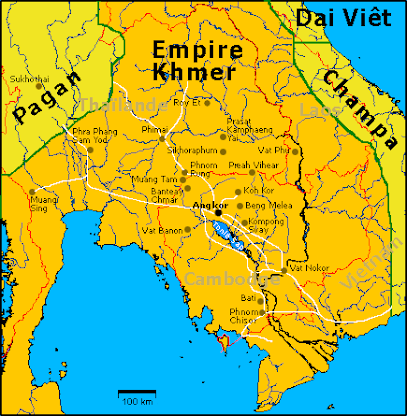
PHNOM PENH, Cambodia - The farm fields of this country once fed the legendary civilization of Angkor, the world's largest empire in the 9th century. Tomorrow they may feed the megacities of the United Arab Emirates, Kuwait, and Qatar.
Reeling from food prices that have doubled on average from a year ago, several Gulf countries are pursuing land deals worth billions of dollars in Cambodia, according to recent statements by Cambodia's government. Those countries would lease land, grow rice and corn, and then ship it home – potentially saving millions by bypassing world markets.
The race for farmland in Cambodia underscores how countries desperate to boost farming amid an ongoing food crisis are turning to global outsourcing, hoping to grow their own food on land abroad. Japan has bought up plots in Brazil, South Korea large tracts in Madagascar, in a trend poised to change global land ownership and agricultural production.
While it may bring succor to countries squeezed by high prices, it may also incite conflict and poverty, some experts warn. In August, Jacques Diouf, director-general of the UN's Food and Agricultural Organization, warned against creating a kind of food "neocolonialism," with rich countries securing food supplies at the expense of poor farmers.
From his office in Dubai, Mohammed Raouf can see the global food crisis closing in on the Gulf states. Growing food at home is not viable – in Saudi Arabia, Mr. Raouf points out, farmers have tried for 15 years, unsuccessfully, to grow wheat in the desert.
As a result, Gulf nations must import about 80 percent of staple foods. And the price of those imports has ballooned from $16 billion in 2006 to $20 billion in 2007, according to the Arab Organization for Agricultural Development.
Land acquisitions abroad are the only viable response, Raouf and others say. "For the Gulf countries ... under current technology, it is impossible to guarantee their food security internally, because they lack water resources and arable lands," Raouf, program manager of environment research at the Gulf Research Center, a Dubai think tank, writes in an e-mail. "So this [is] the best policy option now to follow…"
In recent months, Cambodia has positioned itself as a solution: of 6 million hectares (about 15 million acres) available for cultivation, only 2.5 million are currently used, the government says. It's been wooing the Gulf, hosting delegations of Arab leaders, and hopes to finalize concessions worth up to $3 billion with Kuwait and Qatar. As Prime Minister Hun Sen said in a recent radio address, "Those countries have oil but no rice. I think the Gulf can become our rice market."
The marriage of rich countries seeking land and poor countries seeking cash has accelerated since 2007, goaded by troubling statistics: as populations rise globally by 1 to 2 percent, agricultural production is not keeping pace. Investment has slumped, and farmland is disappearing as nations transform countrysides into urban centers.
The result has been a quiet but dramatic redrawing of the world's land ownership. China may have a lot of land mass, but much of the arable land it has is rapidly being turned over to industrial use, and tens of millions of its former farmers have moved to the cities for work. So it now is negotiating deals to buy more than 2 million hectares of land in countries as far flung as Mexico, Tanzania, and Australia. The United Arab Emirates is seeking some 800,000 hectares in Pakistan alone, while Saudi Arabia is negotiating for 1.6 million hectares in Indonesia, according to statistics compiled by Grain, an environmental organization based in Spain.
Such deals may look good on paper, bringing cash and possibly technology transfers. But many in Cambodia – as elsewhere – are concerned. They worry that poor countries could undercut their ability to feed themselves by selling land, especially in times of food crisis.
"We still need to develop our agricultural technology on our own land,," says Meas Nee, country director of Village Focus International, a nongovernmental organization that focuses on farmers' livelihoods. "If this kind of investment is not carefully planned, all the investment will be done at the expense of the rural poor and farmers."
Another concern is that land may be unfairly taken away from farmers. Cambodia is already reeling from extensive land disputes, and local newspapers daily report on cases of poor farmers being kicked off their land. In many cases, local police and government officials are said to be responsible, making way for private businesses to set up agricultural projects.
No one knows for certain how many people have been dispossessed in recent years, but it is estimated to be in the tens of thousands, according to several local and international human rights organizations, including Amnesty International.
In Laos, farmers are accusing Chinese of kicking them off their land. When it was announced that Egypt hoped to buy 840,000 acres of land in Uganda, a public uproar ensued, resulting in the Ugandan government denying the transaction. It remains unclear if that deal will go through.
"The land deal could trigger a conflict over land and also raise other political issues. We could see a reversal of our socioeconomic progress," says Arthur Bainomugisha, director of research at ACODE, a think tank headquartered in Kampala, Uganda.
Here in Cambodia, critics worry that land deals could be made without local consultation and could result in more people being kicked off their land.
Cambodian farmers would still be able to work on the land that foreign countries buy, but critics worry that companies would not be able to provide as many jobs as they might potentially take away. "The companies can make jobs, but in our observation, they cannot make the jobs enough," says Thun Saray, the executive direction of Adhoc, a local human rights organization.
"If the government permits land sales to foreign countries, where will Cambodians who need land go? How can they survive?"
Read more!
Australian prefers Thai jail to home
A MELBOURNE man who has been living in shocking conditions in a crowded Bangkok immigration jail cell for more than four years is refusing to accept Australian Government help to return home.
Colin Hansch, 61, has told Thai authorities he would rather stay in jail than return to Australia, even though he has only a mat to sleep on and receives a small daily serve of rice and soup.
"I've not been back to Australia for 30 years. I don't want to go back, I've got nothing to go back to," he said.
Mr Hansch, a computer engineer who left Melbourne in 1967, is worried he will not be able to obtain a passport to travel overseas again if he accepts the offer. It is believed he wants to be able to visit Malaysia or Cambodia.
"I think they [Australia] don't want to give me a passport … they don't want to set a precedent giving a passport to somebody while they are in custody," he said.
#A spokesman for the Department of Foreign Affairs in Canberra said Mr Hansch had repeatedly rejected an offer from the embassy in Bangkok to issue a limited-validity document to let him return home immediately.
Mr Hansch has been held at the immigration centre in Bangkok, just around the corner from the Australian embassy, since September 2004. He was transferred there, supposedly pending deportation, after serving two years in a Bangkok jail for assault causing serious bodily harm, which related to a dispute with a bar girl in the beach resort of Pattaya.
He shares a large cell on the immigration centre's second floor with up to 100 illegal immigrants. Fights often erupt. He spends much of his time listening to FM radio and reading books.
The department spokesman said Australian consular officers have provided assistance to Mr Hansch while he was in jail and now at the immigration centre.
For 12 years Mr Hansch worked as a computer engineer for a US firm in Thailand. He has also worked as a computer engineer in the US and at the former Woomera defence site in South Australia.
"Thai authorities have informed the embassy that Mr Hansch is subject to deportation following completion of his criminal sentence and must travel directly to Australia," the foreign affairs spokesman said.
"The embassy is not able to issue Mr Hansch with a full-validity passport as he has been unable to satisfy documentation requirements to enable the issue of a full-validity passport."
There are about two dozen Australians among thousands of foreigners in Thai jails, most of them for drug-related offences.
There is an agreement with Thailand under which prisoners can transfer to Australian jails, but the process is very bureaucratic.
A Melbourne man, Harry Nicolaides, 41, has been in prison in Bangkok since August 31 on charges of lese majeste, which can carry up to 15 years' jail. He is scheduled to appear in court on January 19.
Read more!
Saturday, December 20, 2008
Pitt's coming of age
By Lawrie Masterson
BRAD Pitt is the first to concede his life can be chaotic. He and partner Angelina Jolie have busy careers. Both are heavily involved in humanitarian issues and then there's that tribe of children.
But in the next breath, Pitt readily admits he and Jolie, 33, are keen on the idea of adding to their family.
And he doesn't seem troubled about how they might find the time.
"We have our ways," Pitt says with a smile.
"There are some dry spells. There are a few moments in the desert, but mum and dad can get very creative."
For the record, this was the roll call at the Pitt-Jolie breakfast table last time we checked -- Maddox, 7, (adopted from Cambodia), Pax, 5, (adopted from Vietnam), Zahara, 3, (adopted from Ethiopia) and biological children Shiloh, 2, (born in Namibia) and six-month-old twins, Knox and Vivienne (born in France).
"It is chaos at moments, but there's such joy in the house," Pitt says.
"I look down and there's our boy from Vietnam and our daughter from Ethiopia and our girl born in Namibia and our son from Cambodia and they are brothers and sisters, man.
"It's such a sight of elation and, given our jobs, we have the capability to provide a home. But, let me tell you, it's selfish, too, because the rewards have been extraordinary."
Pitt says the safety of his family is "the only thing that keeps me up at night" -- that and having to pitch in on the nappy-changing duties.
"Sure, there's the janitorial aspect of it all, but it's the worry, because they just mean so much to me."
The whole question of mortality and the joys and sadness that come with love and family have weighed more heavily on Pitt lately as he has absorbed the experience of making The Curious Case of Benjamin Button, his third film with director David Fincher and a hot Oscar favourite.
Adapted by screenwriter Eric Roth (Forrest Gump, 1994) from a 1920s story by F. Scott Fitzgerald, The Curious Case of Benjamin Button is about a man who is born in his 80s and ages backwards.
As the people most important in his life -- such as his adoptive mother, Queenie (Taraji P. Henson), and his greatest love, Daisy (Cate Blanchett), -- reach middle and old age, Benjamin "progresses" towards childhood.
"When we began this, David was already dealing with the death of his father and Eric had to deal with the death of his mother," Pitt, 45 last Thursday, says.
"About a month into shooting, Angie's mother passed away, so this whole idea of mortality and the family being finite and the individual being finite was first and foremost.
'T HE thing I walked away with was that time is short. I don't know if I have a day or if I have 10 days or 10 years or 40 years. Am I half way or close to the end?
"I don't know, so I've got to make sure I don't waste any of those moments on any kind of pettiness or bitterness or laziness and that I surround myself with what's most important to me and the people most important to me.
"I had a friend who worked at a hospice and he said people in their last moments do not discuss their successes, their awards, what book they wrote or what they accomplished.
"They only talk about their loves and their regrets and I think that's very telling."
Director Fincher and his team used groundbreaking computer-generated effects to transpose Pitt's heavily made-up face on to the bodies of older and sometimes much smaller actors for various scenes in the film, which clocks in at almost three hours.
"Fincher described it as me getting to drive the performance with the technology," Pitt says.
"I spent a couple of days just making faces I'd be embarrassed to show anybody else and they mapped every muscle contortion into the computer.
"I said I would never do a film with prosthetics and then what does Fincher bring me? A film with prosthetics and I can't say no to him.
"The make-up guys will tell you they got it down to 2 1/2 hours, but they're full of s---. The best we did was 4 1/2 hours. The first day I think it was, like, six hours."
A bonus for Pitt was that much of the film was shot in New Orleans, where he has been working on a project to build 150 affordable, aesthetically pleasing and environmentally friendly homes for families displaced by Hurricane Katrina, but that is not how he refers to the disaster that almost washed the city off the map in August 2005.
"I call it levee failure," he says.
"There's a misconception it was an act of God that happened down there, but it wasn't. It was man-made failure.
"We first wanted to be a catalyst to help people return, but we also saw this opportunity to be a proving ground for high-performance buildings, for a greener approach.
"When I left recently, the (power) meters were running backwards. Suddenly this is the greenest, most advanced neighbourhood in the US, so there's a template there that needs to be standardised and replicated because it works. There's no reason why some of this shouldn't work in Haiti or across Asia.
"There's something at play here that I think is bigger than just the starting point."
Pitt is working on his next movie, Quentin Tarantino's World War II film Inglourious Basterds which he describes as "outrageous, the World War II film to end all World War II films. I don't know how they do another one after this".
Pitt has not wanted to be separated from his brood, so they have travelled together between Germany, where the movie is shooting, the US and France, where they have set up another home.
"I've been dragging them back and forth from continent to continent, so I'm going to have to give them a break pretty soon," he says.
T HE new home in Nice is high on their list because, as the father of the family dubbed "most wanted" by the world's paparazzi says, the locals pay them hardly any attention.
"We were looking for a place where our kids could run free and not be hassled and there's a good relationship between us and the area," he says.
"We find it a good base for the family."
Pitt's command of the French language, however, still leaves much to be desired.
"I am in ecole (school)," he says. "But my seven-year-old rips it. He's fantastic. It's really humiliating, but we're very proud of him."
The Curious Case of Benjamin Button opens on Friday.
Read more!
One Laptop Per Child a Solar Movement
No electricity? No problem. The One Laptop Per Child project has solar-powered laptops for kids in the most remote corners of the world
By Andy Patrizio
The One Laptop per Child (OLPC) program has suffered the occasional bumps in the road due to squabbling here in the U.S., but now that it's finally out and being deployed, the program is seeing success in the most remote parts of the world.
Usually, the OLPC XO laptop requires a power outlet, but the OLPC organization also has been shipping solar-powered laptops for some of the most remote, rural and poorest locations.
According to the group, more than 500,000 Internet-capable, solar-powered laptops have been distributed to children in places like Rwanda, Ethiopia, Mongolia, Cambodia, Afghanistan, Haiti, and Nepal. These children learn, play, program, and have access to thousands of books in their language, as well as millions on the Internet.
OLPC restarted its Give One, Get One (G1G1) program last month, the second time for the program. Last year's effort supported the production of over 150,000 XOs. This year the XO laptops will be shipped to donors through Amazon.com.
Like last year's program, donors can give $199 to give a laptop to a child in the developing world and/or give $399 to give a laptop to a child in the developing world and get a laptop for themselves.
OLPC is making its pitch with two new videos on YouTube; the rather disturbing Skills video, and the more uplifting Zimi's Story, in which an African girl thanks her unknown benefactor for her laptop.
Thus far the deployments seem to be going well, at least on the recipient side. The blog maintained by people in the field handing out these laptops reported on its most recent deployment in impoverished Nepal, where 135 laptops were given out to students. None were stolen or lost, but one was seriously damaged when the child who owned it cleaned it carefully with soap and water.
Clearly the proper care and maintenance of electronics needs to be added to OLPC training classes. But the quality of the laptops is dubious, if this deployment is any indication. Of the 135, eight had a bad motherboard, five had bad microphones, and four had bad keyboards.
Read more!
Friday, December 19, 2008
Rainy-Day Rice
 Dictator, Hun Xen of Cambodia is plowing his rice field in the rainy season with lots of his ducks following him to catch minnows and snails.
It's a major step forward for weatherproof crops, increasingly touted as essential to the long-term future of the world's food supply. Advances in biotechnology have improved this ancient grain, which accounts for up to 70 percent of daily calories for people living in Asian countries. Imperiled by constant floods, rising sea levels and natural disasters, submerged rice survives just four days when deprived of light and oxygen. These new varieties last eight to 18 days.
The advance is urgently needed. "At least [58,000 square miles] of land in South and Southeast Asia are vulnerable to flooding, and floods will only increase," says Dave Mackill, a senior scientist with Manila's International Rice Research Institute (IRRI). In 2007, Cyclone Sidr destroyed 1.25 million tons of rice in Bangladesh; last year, multiple typhoons wiped out rice paddies in Vietnam.
To find a suitable template for the flood-resistant rice, Mackill turned to India's water-tolerant FR13A rice. Farmers stopped using the strain because of its poor yield, but its resilience intrigued him. To pinpoint the part of the rice genome carrying the trait, Mackill crossbred a hardy derivative of FR13A with another rice strain and derived 4,000 other rice plants from that cross. Geneticist Pamela Ronald of the University of California at Davis then searched the plants' DNA and unearthed Sub1A, a gene that triggers the grain to conserve energy when it is underwater. To create the final rice strain, Mackill cross-pollinated a Sub1A-containing plant with a high-yielding, better-tasting Indian rice variety.
In the coming years, IRRI researchers will supplement Sub1-class rice with a gene that resists flooding during the sensitive germination stage (something the Sub1 genes can't do). Also on the agenda: drought- and salt-resistant rice, now testing in nearly every Southeast Asian tropical country and China. Asia's inland and coastal areas often have salt-filled soil, which stunts rice growth.
The IRRI has already made its rice seed available to other research institutions and has been distributing it to Asian farmers for free. When sold by other seed growers on the commercial markets, the price should rival that of common varieties. "We anticipate adoption wherever submergence is a regular problem," Mackill says. If the rice is a success, climate-resistant crops may spread across the developing world, as well as the developed.
Cambodian PM urges wayward monks to follow Buddha's rules
PHNOM PENH, Cambodian Prime Minster Hun Sen has appealed to the Kingdom's Buddhist clergy to behave, saying that monk's misdeeds are causing citizens to lose respect for religion, national media reported Friday.
"If monks causing social problems, it is very difficult for me," Hun Sen said during the closing ceremony of the 17th monk congress, according to the Phnom Penh Post.
Hun Sen urged the community of monks to respect the rules by which monks must live, the Post said.
He said he had been shocked when he saw Buddhist monks dancing in a recording on one of his children's mobile phones, and mentioned an unidentified temple where the chief monk had collected money from ceremonies to buy himself a car.
However, he said this did not reflect on the overall spiritual health of the nation.
"These are individual monks making problems. Citizens should not consider it an issue of the whole religion, but equally, we must not be careless over the issue," Hun Sen said.
Read more!
China tops list of investing countries in Cambodia
PHNOM PENH, China topped the list of foreign investing countries in Cambodia in the past 14 years, with total amount reaching 5.707 billion U.S. dollars, national media on Friday quoted official source as saying.
South Korea trailed China with 2.749 billion U.S. dollars, followed by Malaysia with 2.199 billion U.S. dollars, officials of the Cambodian Investment Committee told Chinese-language newspaper the Jian Hua Daily at a commercial seminar held here on Thursday.
From 1994 to October 2008, Cambodia has attracted 24.768 billion U.S. dollars of foreign investment in all, with 24 percent of the investment used for service sector, 22 percent for industry,5 percent for agriculture and the rest for construction and others, the paper said.
Read more!
Enjoy Jolie with Cambodian Beef (VIDEO
BY GERRY WEISS
Movie: Best of Angelina Jolie
Dinner: Cambodian Marinated Beef With Lime Sauce
The Movie: Seems like there are two camps when it comes to the popularity of Angelina Jolie.
Some like the 33-year-old actress for her Oscar-winning film roles, her dedication to her family and her adopted children, and her tireless work with charities worldwide.
Some dislike Jolie, citing her secret affair and subsequent relationship with Brad Pitt, her cockiness and coldness in interviews, and her stunning movie star looks that tend to overshadow her somewhat inconsistent performances.
Either way, Jolie is someone we all take notice of. And when it comes to the big screen -- a place where she's recently hinted about retiring from -- Jolie's done plenty over the years to accumulate an impressive resume.
Her latest film to come to DVD is the slick action flick "Wanted," with Morgan Freeman and James McAvoy (co-star of both "The Last King of Scotland" and "Atonement). In "Wanted," McAvoy plays a bored office worker who discovers he's the son of a professional assassin. After his father is murdered, Jolie trains him to follow in his dad's footsteps. Let the adventure begin!
So when you go to rent "Wanted," here are some older Jolie films to check out as well.
She won the best supporting actress Academy Award in 1999 for "Girl, Interrupted," a true story in which she plays a wildly menacing sociopath in a mental hospital. Winona Ryder was the big star heading into that movie, but all the talk afterward was about Jolie's memorable turn.
Read more!
Thursday, December 18, 2008
Scientists discover green-blooded frog
 Cambodia (ChattahBox) — A new species of frog with some very unique characteristics has been living in a very rough neighborhood. The Samkos bush frog has green blood and turquoise bones has been discovered living in a former stronghold of Pol Pot’s Khmer Rouge forces.
The frog is one of four previously unknown species discovered as part of a project to rebuild the country’s science base from the devastation left by the dictator’s regime. Smith’s frog, Rana faber, the Aural horned frog, Megophrys auralensis, and the Cardamom bush frog, Philautus cardamonus, are the other three species discovered by researchers from FFI during their surveys of Cambodia in the Cardamom mountains
The Samkos bush frog is so small and well camouflaged in the jungle habitat that researchers are able to track it down only by listening for its distinctive “rising trill” call. It is thought to breed in temporary pools created by heavy rain.
The unusual color of the blood and bones is caused by biliverdin, a pigment that would usually be processed in the liver as a waste product but which in the frog is passed back into the bloodstream.
Conservationists believe that the pigment helps serve two important purposes. To help camouflage the amphibian because it shows green through the translucent skin. It is also suspected that it also serves to make the frog, Chiromantis samkosensis, taste nasty to predators.
Read more!
Cambodia bans poultry from Kandal province after human infection
Cambodian officials have banned all poultry from Kandal province outside the capital Phnom Penh, to try to contain an outbreak of birdflu which has infected a 19-year-old man.
Agriculture ministry workers have destroyed 326 birds in the past week, and say any poultry found within three kilometres of Kandal province must be culled.
The 19-year-old is recovering in hospital, after it was confirmed he contracted the lethal H5N1 form of the bird flu virus in Kandal.
"Our experts have carefully taken control of the area and looked into the issues very closely," said ministry spokesman Kao Phal.
He says a government ban on selling or transporting poultry in the area will be in force for the next 30 days.
"We are educating the residents to love their lives rather than keep going on with their dangerous businesses," he said.
Officials say residents have been cooperating with the ban, and staff from the agriculture and health ministries are continuing to monitor the outbreak.
"We will continue to search for suspected cases for the next 10 days around the area," health ministry spokesman Ly Sovann said.
The teenage patient is the first person to be infected by bird flu in Cambodia this year.
Prior to 2008, seven Cambodians have been infected with the virus since it emerged in Asia in 2003.
While all previous patients have died, health officials say the man is expected to survive.
Read more!
Wednesday, December 17, 2008
Clare pharmacist to volunteer in Cambodia
 Clare pharmacist Tim Siv will spend six weeks in Cambodia working in orphanages and schools during the Christmas holidays.
Mr Siv, whose parents fled Cambodia when he was three years old, will return to the town of his birth to give back to his former community where he also plans to build a playground for local children.
And he won’t be travelling light - planning to pack his suitcases with toothbrushes, tooth paste, tennis balls and other useful items which are normally in short supply in that country.
“It’s something I have always wanted to do (return to Cambodia) in terms of giving back,” Mr Siv said.
This is where my heritage is and it will be a big experience for me. The house I was born in is still there,” Mr Siv said.
Although this will be a personal visit for Mr Siv he will participating in local aid work, teaching English and undertaking other community work.
“I just hope to make an impact on someone’s life while I am over there,” he said.
Cambodia opens 17th annual Congress of Religion
PHNOM PENH, Cambodia on Wednesday opened the two-day 17th annual Congress of Religion in Phnom Penh to monitor the improvement of morality and behavior in the religious field and its role for reducing poverty.
"The religion field has contributed strongly to the social and political stability of the country and helped the society improve its morality, environment and poverty reduction," said Senate President Chea Sim at the opening ceremony.
"From now on, there is a good chance for us that we all join together to keep the peace and harmony of the country and stick to non-violent way to advance the society," he added.
Meanwhile, Minister of Cults and Religious Affairs Min Khin said that Cambodia not only takes care of Buddhism which is the major religion of the country, but also other sects.
Cambodia has 4,307 Buddhist pagodas with 55,583 monks, 4 Buddhist universities and 12 Buddhist high schools, he said.
The kingdom also has 320,167 Muslims with 244 mosques and 333 Islamist schools, some 800,000 Christians and about 20,000 people with other religious believes, he added.
Read more!
Cambodia kills 320 fowl after bird flu outbreak
Cambodian authorities killed some 320 ducks and chickens Wednesday southeast of the capital where a man last week became the country's eighth human case of the disease.
The Agriculture Ministry sent 30 veterinarians to kill the fowl after laboratory tests Tuesday showed that three ducks and one chicken had contracted the deadly H5N1 virus in the village where a man fell sick, said Kao Phal, the ministry's director of animal health and food production.
A 19-year-old man in Kandal province, 18 miles (30 kilometers) southeast of Phnom Penh, tested positive for bird flu last Thursday. The man fell ill after touching a dead chicken, said Ly Sovann, a health ministry expert on bird flu.
The man remained hospitalized in the capital. The seven previous Cambodian victims of the disease died.
"His health is getting better day by day, but we need him to remain in the hospital for monitoring," Ly Sovann said.
Bird flu remains hard for people to catch, but health experts worry the virus could mutate into a form that passes easily among humans, sparking a pandemic. So far, most human cases have been linked to direct contact with infected birds.
At least 246 people have died worldwide from the virus since 2003, according to the World Health Organization.
Read more!
Tuesday, December 16, 2008
Cambodian vessel detained for poaching in Russia's Far East
VLADIVOSTOK, December 16 (RIA Novosti) - A Cambodian trawler with 14 Russian crew members onboard has been escorted to the Russian port of Nakhodka, in the Primorye Territory, after being detained for poaching crab, a regional coast guard chief said on Tuesday.
"The crew members did not obey border guards' instructions to stop the vessel. The captain tried to sink the vessel and twice ordered the crew to open the Kingston valves," said Vladimir Lakizo, who heads the region's Border Guard Service for the Russian Federal Security Service.
Kingston valves allow sea water to enter a boat's fuel, water and ballast tanks, and can be used to scuttle a vessel.
The border guards discovered more than 5,000 crabs onboard the vessel, which had already been detained in early 2008 for poaching, although at that time there was not enough evidence to impound the vessel, Lakizo said.
A total of 19 boats, including 11 foreign vessels, have been detained by Russia since the start of the year, he added.
This year, Russia has launched a crackdown on the illegal export of crab and other seafood. Since January, Russia's border guards have returned to the sea more than 246,000 live crabs, with an estimated commercial value of over 170 million rubles ($6.1 million).
Read more!
Experts predict Cambodian real estate market to recover by 2010
PHNOM PENH, Dec. Economists said that the nearly one billion U.S. dollars in foreign aid pledged to Cambodia by donor nations last week could boost the country's sagging real estate market as early as 2010, national media reported Tuesday.
Kang Chandararot, president of the Cambodia Institute for Development Study, told the Phnom Penh Post that he expected the real estate market will rebound in two years, largely on the strength of foreign aid.
"If the government uses the aid to develop the country...then I think real estate may begin to stabilize," he was quoted as saying by the Post.
But he cautioned that aid would not boost prices to the unprecedented levels seen last year.
Local real estate peaked in 2007 and 2008, partly driven by South Korean investment.
The market started to drop in September, although low transaction volume and scant figures make the depth and impact difficult to assess.
Kang Chandararot said foreign investment would be key to rebuilding the sector, but that other factors, such as the global economic crisis and border tensions with Thailand, could remain obstacles to growth.
Hang Choun Naron, secretary general for the Ministry of Economy and Finance, agreed that the sector was poised to recover.
"I (think) the real estate market will return to normal within the next two or three years," he told the Post.
Read more!
Monday, December 15, 2008
Justice, Interrupted
Cambodia's Khmer Rouge tribunal risks becoming a sham.
By JAMES A. GOLDSTON
No court can be considered legitimate if its judges and prosecutors submit to political diktat. Tragically, the United Nations-backed court in Phnom Penh investigating and prosecuting those most responsible for the Khmer Rouge's crimes in Cambodia is at risk of doing just that.
The Court, called the Extraordinary Chambers in the Courts of Cambodia, has indicted a mere five people for the murder of close to two million between 1975 and 1979. Last week, the court's international co-prosecutor, Robert Petit, proposed that an undisclosed number of additional suspects be formally investigated -- a prelude to indictment. According to a Dec. 8 press release from Mr. Petit's office, his local counterpart, co-prosecutor Chea Lang, opposed the move. Because the process for resolving disputes between prosecutors is confidential, Ms. Lang's reasons for opposing additional investigations are unknown.
Mr. Petit has filed a formal "statement of disagreement" indicating his commitment to press ahead with additional charges. Under the Court's complicated structure, he can do this if authorized by the pre-trial chamber, an organ of the Court responsible for overseeing proceedings prior to trial and resolving disputes between co-prosecutors and co-judges. Prime Minister Hun Sen has in the past suggested that trying "four or five" people would be enough. Although most Cambodian officials today say that the government would not limit the number of people charged, the attitude persists that trying more people might be detrimental or destabilizing. Absent agreement between the two co-prosecutors, the Court's judges will be asked to resolve the dispute.
If ever there was a moment to show that the Court is not a tool of the Cambodian government, this is it. Unfortunately, court rules provide that this issue must be addressed out of public view. All should understand, however, that the court's very legitimacy to Cambodians and the international community is at stake. The Court must operate as transparently as possible in the coming days.
That will be difficult, given that the Court is the product of 10 years of negotiation between the U.N. and the Cambodian government. As a hybrid court, it has an awkward structure. The international and domestic co-prosecutors and co-investigating judges must agree before proceeding on major decisions. Where consensus cannot be achieved, a "super-majority" composed of at least one international judge is required for most significant action. This fragile arrangement has given rise to much skepticism about the Court's capacity to reverse a long Cambodian history of improper interference in judicial operations.
In the past year, too, serious allegations of corrupt employment practices on the Cambodian side of the court have emerged. The U.N. investigated the matter in September, but did not release its findings. A pervasive lack of openness at the Court has not helped. This is an especially serious situation as any forthcoming judgments will be potentially vulnerable to crippling legal challenges.
Yet the Court's greatest challenge by far is the new roadblock preventing further prosecutions. It has long been suggested that the limitation of charges to the five accused -- all former Khmer Rouge members, unconnected to any current senior government figures -- was a central part of the "unwritten bargain" that led the government to accept the Court. A number of senior figures in the current government apparently fear the potential consequences of establishing a model of transparency and accountability that might be applied more generally. Given the scale of the crimes and the breadth of criminal responsibility, any judicial process that arbitrarily narrows its focus to only those individuals would be a sham.
It is time for the donor governments that support the Court -- including Japan, France and the U.S., which recently pledged its first contribution -- to insist that the Court operate as a court of law. Anything less would be a betrayal of the memory of two million dead and numerous others who endured physical and psychological wounds. Both the victims of the Khmer Rouge and the next generation of Cambodians deserve an honest, judicial accounting of one of the worst atrocities of the 20th century.
Mr. Goldston is the executive director of the Open Society Justice Initiative, which provided advice and technical assistance during some early stages of the tribunal.
Read more!