Foreign Minister Tej Bunnag resigned on Wednesday, and Prime Minister Samak Sundaravej booked early morning air time for a special speech to the nation amdist signs he might quit under the pressure of militant street protests.
A reliable source disclosed that Mr Tej quit in apparent protest, the day after the premier declared emergency rule on Tuesday after clashes between his supporters and anti-government protesters killed one man and injured 43.
Mr Samak ordered TV and radio time beginning at 7:30am (0030 GMT) on Thursday, through the Public Relations Department.
Officially, he will "speak to fellow Thais about the ongoing political turmoil," PRD sources said.
Unofficially, there was high speculation he might decide to resign. Leaders of the People's Alliance for Democracy said on Wednesday that the minimum requirement for negotiations with authorities are the resignations of Mr Samak and his cabinet.
Mr Tej claimed he wanted to leave the office he only recently took over in order to care for his ailing wife. He sent his resignation letter to Mr Samak. Although the premier did not officially accept the letter, Mr Tej was not expected to show up for work at the Ministry of Foreign Affairs on Thursday, according to the source.
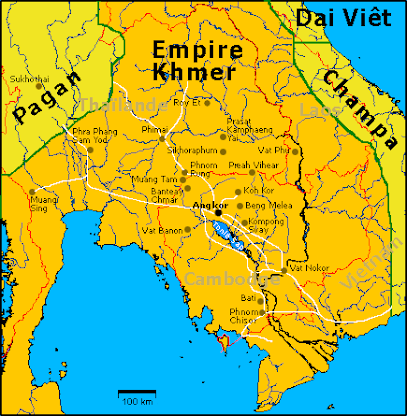
Mr Tej, a former permanent secretary for foreign affairs, replaced Noppadon Pattama as foreign minister who had been pressed to resign in the wake of the listing of the disputed Preah Vihear temple as a United Nations Educational, Scientific and Cultural Organisation (UNESCO) World Heritage Site.
Mr Tej held talks with his Cambodian counterpart over the dispute in Siem Reap, Cambodia, one day after he had assumed the ministerial post on July 27.
High-level diplomacy has been taking place to reduce escalating tension. An agreement was reached, following a meeting between Thai and Cambodian foreign ministers late August, to reduce troop numbers near the temple.
Read more!

Wednesday, September 03, 2008
Foreign Minister resigns

Cambodia casino reaps 25 mn dollars profit
PHNOM PENH: Cambodia's burgeoning economy brought casino operator NagaCorp 25.5 million dollars in profit in the first half of the year, a company report obtained by media revealed Wednesday. The profit signalled a rise of 26.9 per cent on a year earlier.
"Our operations continued to benefit from the political stability and economic development of Cambodia," the NagaCorp report said. After decades of turmoil, Cambodia has emerged as a rising economy in Southeast Asia - posting an average of 11 per cent growth over the past three years on the back of strong tourism and garment sectors.
Nagacorp reported its revenue soared 68.5 per cent from the same period last year to approximately 109.1 million dollars, in a country hosting several casinos popular with gamblers across the region.
The Malaysian-owned company is registered on the Hong Kong Stock Exchange and runs the largest casino in Cambodia's capital Phnom Penh. The government awarded it a gambling license in 1994 to promote international tourism.
More than a dozen casinos operated by other companies dot Cambodia's borders with Vietnam and Thailand, raking in an estimated tens, if not hundreds of millions of dollars each year.
The industry fuels the economies of several hard-scrabble Cambodian cities, though the country remains desperately poor with more than 30 per cent of its 14 million population living in poverty.
Read more!
Tuesday, September 02, 2008
Yamaha, Toyota Tsusho to establish motorcycle company in Cambodia
Yamaha Motor and Toyota Tsusho have agreed to establish a new company, Yamaha Motor Cambodia, to manufacture and market motorcycles with the aim of strengthening the foundation of the motorcycle business in the Cambodian market.
The new company will begin operations on October 1, 2008, and its starting capital of $11.5 million will be invested 70% by Yamaha Motor, 20% by Toyota Tsusho and 10% by Cambodia's Kong Nuon Import & Export.
Since March 2007, Asia Motors, a joint venture company between Toyota Tsusho and Kong Nuon Import & Export, has been assembling and marketing motorcycles with parts and components supplied as semi knocked-down kits by Thai Yamaha Motor.
Yamaha Motor Cambodia will begin operations by taking over operations at the Asia Motors factory and the Asia Motors sales network, and a 94,890sqm lot will be acquired in Phnom Penh's special economic zone for the construction of a new factory.
The initial target for the new company is to expand motorcycle sales to 30,000 units valued at JPY4.2 billion by 2010, after the start of production at the new factory.
http://www.datamonitor.com
Republication or redistribution, including by framing or similar means, is expressly prohibited without prior written consent. Datamonitor shall not be liable for errors or delays in the content, or for any actions taken in reliance thereon .
Read more!
China, Cambodia vow to carry forward traditional ties
 BEIJING, Sept. 2 (Xinhua) -- Senior leaders of China and Cambodia on Tuesday underscored the traditional friendship between the two neighbors.
"Let's work more closely to take our five-decade bilateral friendship and cooperation to a new high," China's top legislator Wu Bangguo told the President of the Cambodian Senate, Chea Sim.
In their talks in the Great Hall of the People, Wu, chairman of the National People's Congress Standing Committee, reviewed the sound development of China-Cambodia ties, citing political trust, substantive cooperation and support on important issues.
In response, Sim said the Cambodian leadership will carry forward the bilateral traditional solidarity that was forged by the older leaders in the previous century.
Sim said he hoped the two legislatures can step up their cooperation and share experience on governance.
Sim's visit to Beijing coincided with the 50th anniversary of the establishment of China-Cambodia ties.
Later Tuesday, Sim met with Jia Qinglin, chairman of the National Committee of the Chinese People's Political Consultative Conference, China's top advisory body.
Jia said China would like to enhance its comprehensive and in-depth cooperation with Cambodia.
The top advisor also expressed appreciation for Cambodia's adherence to the one-China policy and opposition to "Taiwan independence".
Sim said Cambodia was grateful for the assistance China had offered and would like to work more closely with China in politics, economics and other fields.
Sim reaffirmed Cambodia's one-China stance.
Read more!
CPP's control of parliamentarian seats help secure policy sustainability in Cambodia
By Xia Lin, Liu Lu
PHNOM PENH, Sept. 2 (Xinhua) -- The Cambodian National Election Committee (NEC) declared Tuesday the ruling Cambodian People's Party (CPP) has secured 90 seats, or over two thirds of the 123 seats, at top legislative body in the general election, thus enabling CPP to have stronger management of the country.
Meanwhile, the main opposition Sam Rainsy Party (SRP) won 26 seats and the Human Rights Party (HRP) received three seats, and the Funcinpec Party and the Norodom Ranariddh Party (NRP) got two seats each, according to official results declared by NEC on Tuesday.
The first meeting of Cambodia's new parliament is scheduled for Sept. 24, ahead of forming the new government.
"The CPP's dominance will secure peace and stability in Cambodia, which is very precious for the country and its people," said local economic analyst David Phat, who was born here and endured the war-torn years of Cambodia.
Phat said that primarily, continued governance by CPP can guarantee policy sustainability in its upcoming term, adding that the party in its current term has pursed political stability for the sake of economic development, and regional coordination for the sake of international cooperation.
"Political stability can lead to economic prosperity," he told Xinhua.
Under the CPP governance, the Cambodian economy is expected to remain nearly double-digit growth rate and the per capita GDP will probably top 1,000 U.S. dollars by 2014, he added.
Pen Samitthy, editor-in-chief of the country's largest Khmer-language daily newspaper the Rasmei Kampuchea, agreed that the political and economic situation will be further improved as CPP establishes the new government right after the general election.
"CPP will enjoy a larger space and better conditions, so it can lead the government more efficiently," he told Xinhua.
According to the Constitution, the party winning majority of the seats at the National Assembly will establish the government. Law can be passed with support from 50 percent plus one seat at the National Assembly.
The focus will be our economy after the political situation is settled, and especially, the foreign investment will increase, said Pen Samitthy.
"Everything will be better," he added.
Hu Jinlin, a Chinese merchant and major electric appliances dealer in Phnom Penh, echoed the above prediction, saying that national policy sustainability will stay, as CPP grips bigger power and Hun Sen himself can manipulate more development issues.
"The results are a good message for us. They will stabilize and promote the middle- and long-term investment in Cambodia. We see a clear prospect and know that the situation won't change much. Especially, more Chinese people will come to find their opportunities because the two countries have shared decades of friendly cooperation and China is Cambodia's major donor and investor," he told Xinhua.
Suy Sok Khun, senior CPP cadre and veteran reporter at Chinese-language newspaper the Commercial News, told Xinhua that the strong economic performance under the CPP governance in the past few years has boosted its electoral results.
"Hun Sen and senior CPP leaders used to like citing positive economic figures and development of infrastructure as the major achievements of the government. Most voters accepted this and deem CPP is capable," he said.
Official records showed that Cambodian had 11 percent of economic growth on average in the past three years, the highest among Southeast Asian countries; the per capita GDP rose from 448 U.S. dollars in 2005 to 594 U.S. dollars in 2007; and the foreign reserves from 890 million U.S. dollars in 2005 to 1.1 billion U.S. dollars in 2007.
Meanwhile, major national roads, bridges and power projects have also been constructed countrywide, which improved the kingdom's traffic and power network to an unprecedented level.
In addition, said Suy, there were also a big number of inertia voters, who thought that those who did well in the past should be encouraged to stay on their posts in the future.
"One more message that we can feel from the results is that CPP becomes more consolidated than ever before," he added.
However, a source close to the Council of Ministers said on condition of anonymity that any coin has two sides and the landslide victory may also push the giant party to turn a blind eye to its internal problems and govern the kingdom in a pampered way.
Alleged corruption and land grabbing have haunted the CPP government and officials for a long time and drained some voters' confidence and ballots to the major opposition Sam Rainsy Party (SRP), which in effect surpassed Funcinpec during the Commune Councils Election in April 2007 to become the second largest party of the country, said the source.
"If part of SRP members hadn't changed their flag to found the Human Rights Party (HRP) right before the general election, SRP might have been closer to CPP now," he said.
What's more, this overall victory in the election may bear out the assessment of some CPP members that occasional corruption and land grabbing are not as destructive as NGOs and opposition parties thought, and those with critic rhetoric are not worth fearing, he said.
"This frame of mind will inevitably fuel their future wrongdoings and even arrogance in its management of the country," he added.
CPP was established in 1951 and has governed the kingdom since 1993. It now has around 5 million members, over one third of Cambodia's total population.
For the general election held on July 27, 11 political parties and 8,125,529 voters were registered, while 15,255 polling stations were set up nationwide and 17,000 local and international observers watched the process going.
Read more!
Cambodia seeks UNESCO recognition of KRouge prison
PHNOM PENH (AFP) — Cambodia's government is seeking to register a notorious Khmer Rouge prison and its archives at the UN's cultural agency, according to documents obtained by AFP Tuesday.
The application to help preserve archive material from "S-21" prison, now site of the Tuol Sleng Genocide Museum, was submitted to UNESCO by government officials last Friday.
The archive contains over 5,000 photographs of the more than 15,000 prisoners, as well as biographical records of Khmer Rouge officials and inmates, torture instruments and written confessions, said a copy of the application to UNESCO's Memory of the World programme.
"Undoubtedly crucial as evidence to be use in the forthcoming Khmer Rouge trial, the archive is also an essential part of Cambodia's recent history," it said.
"Its significance as a part of the Memory of the World stems from its testament to man's inhumanity to man and its documentation of one of the most extreme examples of crimes against humanity in the 20th century with a major impact on world history," it added.
The high school turned torture centre is still littered with reminders of its brutal past, such as shackles and bare metal bed frames on which the corpses of inmates were found by invading Vietnamese soldiers in 1979.
The Tuol Sleng Genocide Museum Archive was registered by UNESCO's Memory of the World for Asia and the Pacific region last February in a step towards international recognition.
The prison was run by Kaing Guek Eav -- better known as Duch -- who is among five Khmer Rouge leaders detained by the UN-backed court for crimes committed during the regime's 1975-79 rule.
Duch's trial for crimes against humanity is expected to begin in October.
Up to two million people were executed or died of starvation or overwork as the communist Khmer Rouge dismantled modern Cambodian society in a bid to forge an agrarian utopia.
Read more!
Monday, September 01, 2008
Laos, Cambodia firm up investment, tourism ties
Written by Kay Kimsong
Officials from both countries expect new international checkpoints will help improve relations by expanding cross-border tourism and trade
CAMBODIA and Laos have agreed to open two new international checkpoints in an effort to boost tourism, trade and investment opportunities, officials from both countries told the Post.
The checkpoints will be located along the border between Cambodia's Strung Treng province and Champassak province in Laos, and between Ratanakkiri province and Laos' Attapeu province, said Sonexay Siphandone, governor of Champassak province.
"We are preparing for two international gateways in areas where we currently have few border administration offices," Sonexay said during an interview at the Laotian embassy in Phnom Penh.
He said both countries will build new terminals, border police offices and facilities for all related authorities.
The Cambodia-Laos-Vietnam (CLV) program is pushing for expanded service sector cooperation between Cambodian and Laos by making it easier for tourist and commercial vehicles to cross the border.
"In the future, we will build a modern international gateway for tourism, trade and investment," said Sonexay, who recently led a 90-member delegation on a caravan tour from Laos through Siem Reap and Phnom Penh to Ho Chi Minh City and back to Laos - a trip covering more than 2,200 kilometres.
--------------------------------------------------------------------------------
The more international border crossings open, the more trade will increase.
--------------------------------------------------------------------------------
The tour aimed to strengthen relationships and exchange experiences, as well as to explore agricultural trade opportunities, the Laotian governor said.
"We've never tried to organise a proper exchange program like this before, but now we're paving the way for greater development."
Road links between Cambodia and Laos have improved in recent years with the linking of National Road 17 in Stung Treng and Laos' National Road 13 in Champassak.
"We are urging investors, traders and companies to forge stronger business relationships," Sonexay said. "We bring tourists from Cambodia to Vientiane and Luang Prabang."
Cambodia and Laos currently allow tourists and residents with automobiles to cross each others' borders visa-free.
"We have provided easy access between the countries," he said, adding that trade relations will improve once additional agreements are implemented. "The more international border crossings open, the more trade will increase."
Om Pharin, vice president of the Cambodia Association of Travel Agents (CATA), said his organisation, which includes 166 travel agencies, is interested in promoting package tour sales for local residents and foreign travellers going to Laos.
"We have waited many years for this kind of opportunity, and now we have the infrastructure to support it," Om Pharin said.
He said both nations should add more international checkpoints and encouraged authorities to improve their service sectors with more hotels, guesthouses and other tourist-related services.
The CLV and Cambodia-Thailand-Laos (CTL) program development zones will be key to future agreements across the region, Om Pharin said.
New financial ties are also in the works. In Channy, the CEO of Acleda Bank, which recently opened three new branches in Laos, said there is considerable room for growth in the banking and business sectors, and that growth would be linked to improvements in tourism services and transport infrastructure.
Trade revenue between Cambodia and Laos currently stands at only about US$1 million, but the tourism sector could bolster this number significantly in the future, according to a commerce official.
Kong Sophearak, director of the Statistics and Tourism Department of the Ministry of Tourism, said Laotian visitors to Cambodia have sharply increased this year. In the first seven months of 2008, some 27,161 tourists visited Cambodia from Laos, an increase of more than 167 percent over the same period last year, when that number was 10,144.
"I think improvements to road access between the two countries and an increase in the availability of tour packages are the main reasons for the spike in tourism," Kong Sophearak said.
Tourism remains one of the Kingdom's few viable industries, with two million visitors bringing in more than $1 billion last year.
The government hopes to attract three million people annually by 2010.
Read more!
Cambodian tribunal worries about corruption
PHNOM PENH, Cambodia: A judge for Cambodia's genocide tribunal urged colleagues on Monday to aggressively investigate corruption allegations, saying such charges undermine the body's efforts to obtain justice for victims of the Khmer Rouge.
Accusations of graft have been leveled at the U.N.-assisted tribunal twice in the past two years and earlier this year caused donors to temporarily hold back more than US$300,000 for the monthly payroll for 250 Cambodian staff members.
Silvia Cartwright, a judge from New Zealand, called on the court to spare no effort in dealing with any future corruption issues at a planning meeting for the body, which is moving toward convening its first trial.
The tribunal is tasked with seeking justice for the atrocities committed by the communist Khmer Rouge, whose radical policies caused some 1.7 million deaths when the group was in power in 1975-79.
Cartwright, in her speech opening the meeting, described corruption in the ranks as "one of the major issues that has been troubling for all the judges.
The upcoming trials "are so important for the people of Cambodia (and) must not be tainted by corruption," she said.
In 2007, allegations arose that Cambodian nationals on the tribunal staff had paid for their jobs. An investigation ended inconclusively, though procedures were changed to safeguard against such corruption. In June of this year, charges of kickbacks surfaced again. Salaries were initially withheld but paid once a probe, which is still under way, began.
Those working in the tribunal's Cambodian component dismissed the allegations as unsubstantiated. Tribunal spokesman Reach Sambath said that Cambodian staff members are committed to curbing any corrupt acts.
"We do not want to hear such allegations again as they can be quite troubling for the court," he said Monday.
He said during this week's meeting, the judges and prosecutors plan to make some amendments to the tribunal's guiding rules.
At this week's meeting, judges and prosecutors will make some changes to the tribunal's rules and discuss "weak and strong points" of the court as it prepares for its first trial, that of Kaing Guek Eav, one of five suspects in custody. Kaing Guek Eav ran the S-21 prison, which was the Khmer Rouge's largest torture facility.
The trial of the 66-year-old, also known as Duch, had been expected to open in late September.
But there are fears it could be delayed after the prosecutors decided to appeal the recent official order for him to stand trial. They want to have more charges added against Duch, who has already been charged with crimes against humanity and war crimes.
It is not clear how long it will take to rule on the prosecutors' appeal.
Read more!
Witness to Cambodia's birth pangs
By Raphael Minder
Among his childhood memories, Sam Rainsy recalls sitting with his father on the rooftop terrace of their beautiful house in Phnom Penh, watching pelicans land next to their water tank. "In Cambodia, which is full of superstitions, friends and neighbours kept telling us that these pelicans would end up by bringing us bad luck," he writes in his autobiography, Des Racines dans la Pierre (Roots in the Stone).
Sam Rainsy and his family have certainly endured plenty of misfortune. Their ups-and-downs mirror those of a country that ranks among Asia's fastest-growing economies, but that returned to multi-party democracy only 15 years ago, after decades of war and a genocide that wiped out about a quarter of the population.
Sam Rainsy has been an integral part of Cambodia's recovery, now as the leader of the country's main opposition party. But much of his life has been spent in France and other places of exile, first because of his father's political downfall, which ended with his death in mysterious circumstances, and then because of his own clashes with Hun Sen, the country's long-standing prime minister.
Still, that geographic distance in no way reduces the insight this book provides into events that have shaped Cambodia following a century of French colonialism, starting with the 1954 Geneva conference to reconfigure the former Indochina. Sam Rainsy's father was one of Cambodia's lead negotiators there, playing off tensions among more formidable government representatives such as Zhou Enlai and Vyacheslav Molotov to ensure that another foreign power would not fill the void left by the French.
The Geneva agreement guaranteed Cambodia's independence but was followed by the bleakest period in its history, climaxing in the Khmer Rouge's terrifying attempt to establish an agrarian utopia in the late 1970s. While that tragic episode was largely domestic, Sam Rainsy says Cambodia remains the Poland of Asia, sandwiched between two bigger neighbours, Thailand and Vietnam, and prone to being drawn into wider conflicts such as the Vietnam war.
This book is an often touching family history, but it also highlights the broader challenges faced by any war-ravaged country. After a successful banking career in Paris, Sam Rainsy returned to Cambodia in 1992 and within a year was put in charge of the finance ministry. Given the limited pool of talent, his wife Saumura was forced against her wishes to become deputy governor of the central bank.
For somebody with such a strong financial background, Sam Rainsy devotes surprisingly little of his book to Cambodia's economic resurgence, during which it has attracted billions of dollars of foreign investment and achieved average annual growth of 9 per cent over the past decade. Instead, he focuses excessively on the political jockeying in Phnom Penh, complicated by feuding within the royal family.
Sam Rainsy paints a grim picture of corruption in Cambodia, starting with his short-lived crusade, as finance minister, against tax evasion and smuggling. His strategy appears to have been remarkably naive at times. One ill-prepared boat attack against smugglers on the Mekong river, which he led, nearly cost him his life after the accompanying United Nations troops refused to get involved in the gunfight.
He has harsh words for foreign powers, including his otherwise beloved France, which he accuses of turning a blind eye to killings of political associates. Sam Rainsy has himself survived several assassination attempts, including a grenade attack that killed 19 -people.
"Paris preferred to forget the bloodstains on the suits of the ruling leaders in Phnom Penh in order to strike economic and technical co-operation agreements with them," he writes.
This book was published in the run-up to July's general election, which returned Hun Sen to power with a landslide victory. Despite Sam Rainsy's claim that Cambodians "want to get out of this old, neo-communist and mafiosi regime", many pundits believe that the 55-year-old Hun Sen has never had a stronger power base, almost justifying his boast that he would run the country until the age of 90. Rather than repressing opposition in the manner of the Burmese junta, Hun Sen has benefited from Sam Rainsy's challenge, which has been crucial to Cambodia's democratic credentials.
The book's title refers to the blend of architectural and natural beauty found around Angkor Wat, Cambodia's cultural treasure, where trees grow among the ruins. Although Sam Rainsy might not like the idea, it also seems an appropriate symbol for Hun Sen's deep-rooted control over his country.
Read more!
SCG plans to raise output in Cambodia
$200m set aside for cement subsidiary
NAREERAT WIRIYAPONG
PHNOM PENH : Siam Cement Group (SCG), Thailand's largest industrial conglomerate, is planning to invest $200 million to more than double the capacity of its cement factory in southern Cambodia.
Kampot Cement Co Ltd, a joint venture in which SCG holds 93% and a Cambodian partner the rest, aims to lift its annual capacity to three million tonnes by 2010 from the current one million, according to the Thai embassy in Phnom Penh.
So far, SCG has invested $127 million in the facility located 148 kilometres southwest of Phnom Penh and within driving distance of the Cambodia-Vietnam border.
''The increase is to purely serve the domestic Cambodian market where demand for cement has risen sharply from ongoing construction projects. The property sector is also booming here,'' a high-ranking embassy official said.
Cambodia still imports cement from neighbouring countries including Thailand. But given the current high oil prices that have pushed up transport costs, local cement producers would gain more competitive advantages.
''Consequently, the expansion at Kampot has become more feasible for the time being,'' the official said.
SCG's Thai headquarters declined to confirm the expansion plan, saying the project had been studied.
According to the embassy, construction materials are the main items Cambodia import from Thailand, along with sugar and farm and consumer products.
Thailand last year recorded a 70% rise in exports to Cambodia with a total value of $1.4 billion. The figure does not include about 30 billion baht in cross-border trade.
According to SCT Co Ltd, an international trading arm of SCG, Thailand ranks third among the trading partners of Cambodia after Vietnam and China.
On the investment side, Thailand has yet to play an active role in Cambodia with South Korea, China and Malaysia taking the lead. Apart from SCG, major Thai businesses operating in Cambodia are Charoen Pokphand (CP), as well as are Siam Commercial Bank and Krung Thai Bank.
The Cambodian government provides incentives for foreign investors such as tax-free machinery imports and corporate income tax holidays. It also promotes Special Economic Zones that comprises an export free zone, container yard area and other facilities for industrial zones.
The Thailand-funded road Number 48 in Koh Kong is expected to facilitate more business links between the two countries by strategically turning Koh Kong into the gateway to Phnom Penh.
Siam Cement shares (SCC) closed on Friday on the Stock Exchange of Thailand at 165 baht, up one baht, in trade worth 65 million baht.
Read more!
US man charged with child sex in Cambodia
PHNOM PENH (AFP) — An American man has been arrested and charged in Cambodia with committing indecent acts against a 13-year-old child prostitute on a dark street, police and court officials said Monday.
Richard David Mitchell, 60, was arrested late Thursday in the capital Phnom Penh while allegedly having sex with the girl, said Urm Rathana, the municipal police chief in charge of anti-human trafficking and juvenile protection.
Mitchell, who denied the crime when police interrogated him, faces seven to 15 years in jail if convicted.
Hing Bunchea, a prosecutor at Phnom Penh Municipal Court, told AFP that he charged Mitchell on Sunday with committing indecent acts against minors and soliciting a child prostitute.
Mitchell's lawyer could not be reached immediately for comment Monday.
Dozens of foreigners have been jailed for child sex crimes or deported to face trial in their home countries since Cambodia launched an anti-paedophilia push in 2003 to try to shake off its reputation as a haven for sex predators.
Read more!
Saturday, August 30, 2008
Cambodia introduces new regulations for developers and real estate agents
New regulations are being introduced in Cambodia to protect property investors from fraud as the country's real estate industry booms.
Developers will be required to deposit a sum with the National Bank of Cambodia before being allowed to begin construction on a project under new regulations aimed at curbing fraud.
Payments from buyers will be held in this account with the aim of making the whole payment system more transparent and avoid developers using money illegally. It will also allow the government to intervene if developers fail to honour their contracts.
Real estate agents and developers will have to obtain a licence from the Ministry of Economy and Finance to sell projects and face legal action and even closure if they fail to do so.
The new rules mean developers and agents must comply by the end of September, a spokesman for the Economy and Finance ministry said.
There will be costs to the developers and agents involved but officials believe this will deter cowboys. 'Real estate developers will be required to deposit 2% of the projects' total value at the National Bank of Cambodia,' said Mao Pao deputy chief of the ministry's real estate division.
'We will require a developer to open a housing development account at any commercial bank to enable buyers to make payments through the bank,' he added.
The price for the new licences for selling or renting will depend on the scale of the project. Until now developers only needed a letter of permission from the Ministry of Land Management, Urban Planning and Construction and an investment licence from the Council for the Development of Cambodia.
There are estimated to be around 100 developers currently operating in Cambodia, many of them quite small. Some said the new regulations will be too costly and put them out of business.
Capital Phnom Penh has undergone an unprecedented construction boom over the last several years, including a number of residential and commercial mega-projects that are set to transform the capital from a sleepy backwater.
Read more!
Sri Lanka envoy for Cambodia genocide tribunal
Sri Lanka’s new High Commissioner to London Nihal Jayasinghe left for Cambodia to sit on the UN-sponsored tribunal trying former leaders of the dreaded Khmer Rouge regime for crimes against humanity.
Nihal Jayasinghe, a former Justice of Sri Lanka’s Supreme Court is one of three international judges sitting in the Supreme Court chamber, the highest tier of the three- layered tribunal.
Nihal Jayasinghe was sworn in as a member of the tribunal when he was a Justice of the Supreme Court and this is the first time he will be attending a meeting of the tribunal since his retirement from the Sri Lankan judiciary and his appointment as High Commissioner to Great Britain.
The other two international judges are Motoo Naguchi of Japan and Agnieszka Klonowiecka-Milart of Poland while four Cambodian judges make up the seven-member Bench that will hear appeals against convictions by the Trial Chamber.
High Commissioner Jayasinghe, who is due to return to London at the end of this week said that he is not due to present his credentials to the Queen until the first half of October. However he said that he has called on officials of the British Foreign Office and met with British parliamentarians and journalists besides members of several Sri Lankan organisations and associations here.
“My message to them has been that there is no quarrel or conflict between the Sinhala and Tamils communities. The conflict is with the LTTE, with a terrorist group,” Jayasinghe told The Sunday Times. He said that there is a misconception here that the Government and the Sinhala people are against the Tamil community and this had to be corrected.
Read more!
Cambodia, UN-FAO launch emergency project for farmers
PHNOM PENH, Aug. 30 (Xinhua) -- The Ministry of Agriculture, Forestry and Fisheries (MAFF) of Cambodia and UN Food and Agriculture Organization (FAO) are launching an emergency project through its Technical Cooperation Program (TCP) in Cambodia to help impoverished farmers boost agricultural production, said a joint press release received here Saturday.
The project is part of the FAO Initiative on Soaring Food Prices (ISFP) started in December 2007 and aims to boost the local food supply to soften the blow of soaring food prices, it said.
The FAO is focusing on immediate activities during this rainy season from July 2008 to Sept. 2008 and within the dry season from Nov. 2008 until Jan. 2009, so that by the next harvests there will be more food available locally at lower prices, it said.
In addition, the project is providing fertilizers, which are petroleum-based and thus out of reach of poor farmers as oil prices break new records every day, it said.
As the latest step of the project, a rice seed distribution ceremony to vulnerable farmers was held on Aug. 28 at Bati district, Takeo province, with the attendance of Chan Sarun, Cambodian Minister for Agriculture, Forestry and Fisheries, as well as Omar Salah Ahmed, FAO Representative in Cambodia, said the press release.
For the medium and long term plan, the FAO aims at a more comprehensive assistance program towards agricultural development by focusing on increased productivities, irrigation and improving the storage, it added.
Read more!
Cambodia now tops ASEAN for traffic fatalities, officials say
Phnom Penh - Cambodia is now officially home to the most dangerous roads in the 10-member Association of South-East Asian Nations (ASEAN), officials said Thursday. Cambodian drivers are infamous for their blithe disregard for traffic laws, let alone the laws of physics, and as roads improve rapidly this combination resulted in an average of 4.5 people dying on the country's roads every day, new statistics said - up from 3.7 in 2006.
Figures by the Ministry of Public Works and Transport for the first half of 2008 show 3,870 documented traffic accidents, resulting in 6,839 people injured and 956 killed - nearly 15 per cent higher than the same time last year, with 833 fatalities reported.
"We have to rush to educate people on the traffic laws," the ministry's secretary-general of transport, Ung Chun Hour, said by telephone. "And we have to enforce laws like helmets for motorbike riders and their passengers."
The ministry did not provide updated comparisons to other ASEAN countries, but said Cambodia's fatality rate puts it ahead of much larger nations such as the Philippines, also known for road chaos.
The government spent millions on driver education, taking out television and newspaper advertisements and setting up driver education centres, after the Asian Development Bank estimated accidents cost the country 3 per cent of its GDP in 2003 alone.
However, poorly paid traffic police often lack the will to enforce the law and a "fine" of 1.25 dollars (or 2.50 dollars if the driver insists on a receipt) usually makes the traffic violation go away.
Drunk driving is also rampant, but Cambodia has no more sophisticated ways of testing if a driver is over the limit than smelling his or her breath - usually after the accident.
Read more!
China and Vietnam square off in Laos
By Brian McCartan
VIENTIANE - China's growing influence in resource-rich Laos is seen by some as coming at the expense of ties with Vietnam, long the communist country's main patron and de facto security guarantor. The diplomatic recalibration is part of the landlocked country's bid to more fully integrate economically with the region and has so far served its interests well.
Laos is of increasing strategic importance to both China and Vietnam, two of Asia's fastest growing countries. Vietnam's interests lie primarily in securing its long land border with Laos and developing greater access to markets in Thailand. For China, Laos provides a growing avenue to export products to wider Southeast Asia, particularly from its remote and less-developed, landlocked southwestern regions.
Both countries have a growing interest in Laos' bountiful and largely untapped natural resources, agricultural products and hydropower to fuel their expanding economies.
Some analysts here predict that the balance of influence inside the ruling Lao People's Revolutionary Party (LPRP) could soon shift in Beijing's favor, as senior Lao leaders fade from the political scene and younger, more market-savvy cadre lacking experience in the communist revolutionary period assume positions of power.
Although 10 of the 11 member politburo's standing committee speak fluent Vietnamese - a mark of their deep personal ties to Hanoi and its political leadership - rising mid-ranking cadre are less likely to have studied in Vietnam while an increasing number have studied in the former Soviet Union, China or elsewhere.
Lao Prime Minister Bouasone Bouphavanh's appointment at the 2006 Eighth Party Congress was seen by many as the beginning of a shift towards more Chinese influence over the government. Born in 1954, he was a 21-year-old student activist and not a revolutionary war veteran when the communists took over the country in 1975. He later studied in the Soviet Union rather than Hanoi.
In apparent realization of this changing dynamic, China has adopted a long term diplomatic strategy for Laos. Rather than overly leveraging its commercial might, Beijing is simultaneously cultivating younger Lao leaders through programs that bring them to China for vocational, ideological and military training. These moves are being made in anticipation of an already dawning era when Vietnam-orientated old guard cadre fade from the political scene.
In an interview with Asia Times Online, Lao spokesman Yong Chanthalangsy showed the pragmatic side of Lao thinking. Noting that China is the new emerging power in the region, he said, "Openness and integration in the region is far better than the Cold War in the past imposed by some power. When Laos was a part of a security belt, it resulted in thirty years of war.”
Although he was referring to the broader Indochina War with the US, and earlier France, he could have just as easily been referring to the era of cool relations between Laos and China in the period between 1975 and 1988. Now, as the region's former communist countries reform their centrally planned economies with more market-driven policies, commercial imperatives are redefining how the region interacts, including with Laos.
Commercially positioned
Laos is now eager to promote itself as "land-linked" instead of "landlocked", emphasizing its potential role as a trade crossroads between China and Southeast Asia. According to spokesman Yong, "Laos has been suffering because it is landlocked and isolated. Connectivity in the region can only bring good things to Laos."
This view means that Laos sees the value in diversifying its diplomacy away from its traditional reliance on Vietnam. The balancing act has also extended to its erstwhile Western donors: while keen to accept investment and aid to boost the economy, create jobs and raise living standards, at the same time the government would rather avoid the conditions for political change and more official transparency often accompanying such aid.
Investments from China and Vietnam, on the other hand, come without pre-conditions. According to a 2005 monograph by noted Lao scholar Martin Stuart-Fox, it is not in the strategic best interests of China or Vietnam for the LPRP to lose its monopoly on political power and with both countries' commercial support there is little incentive for the LPRP to initiate political reforms.
Vietnam's strong relationship with Laos stems from the origins of the two countries' communist parties through the Indochinese Communist Party in the 1930s. This relationship was further cemented in the thirty years of struggle against the colonial French and then an American-backed regime, which was finally overthrown in 1975.
Communist Lao and Vietnamese forces fought side-by-side throughout those wars; then-North Vietnam's supply pipeline - the Ho Chi Minh Trail - famously used in its fight against the US-backed South Vietnam, ran through eastern Laos. Lao communist cadre received ideological and military training in Hanoi, while Chinese involvement in the struggle in Laos was confined to road building in the northern regions.
Laos and Vietnam entered into a formal twenty-five year Lao-Vietnam Friendship and Cooperation Treaty in 1977, underpinning what the two sides referred to as a "special relationship". Vietnam's siding with the Soviet Union against China in a doctrinal dispute meant that relations between its ally Laos and China also cooled. Relations worsened when Vietnam invaded Cambodia in late 1978 and China made a limited invasion of northern Vietnam in early 1979.
Bilateral relations between Laos and Vietnam are still strong, although the 1977 alliance was allowed to lapse in 2002. Personal ties between Lao and Vietnamese leaders remain strong enough politically for the "special relationship" to endure. Lao state-run media contains almost weekly news of bilateral socio-economic, cultural and military cooperation between the two countries. Billboards across Laos last year hailed the 45th anniversary of diplomatic ties and the 30th anniversary of the Lao-Vietnam Friendship and Cooperation Treaty.
Meanwhile, Vietnam remains Laos' second largest trading partner. The Vietnam-Lao Committee for Cooperation said in July that two-way trade hit US$240 million for the first half of this year, an increase of 58% year on year. The two countries have stated a shared goal of reaching $1 billion in bilateral trade by 2010 and $2 billion by 2015.
Investment competition
Vietnam is also clearly competing with China for investment influence. Figures released at an August 12 conference on Vietnam-Lao investment cooperation held in Vientiane showed that Vietnam's investment had grown to 177 projects valued at $1.28 billion. If accurate, this would raise Vietnam to the second-largest foreign investor in Laos behind Thailand and would move China down into third place.
Targeted investment areas include mining and expert-oriented agriculture and processing. Recent years have seen heavy Vietnamese investment in rubber plantations in southern Laos, particularly in Savannakhet and Champassak provinces. Laos is also increasingly being seen as a potential source of hydropower and state-run PetroVietnam and Electricity Vietnam are reported to be planning new projects in the country.
To facilitate trade and investment and access to markets in Thailand and the rest of Southeast Asia, Vietnam has been busy constructing roads in eastern Laos as part of the Greater Mekong Subregion's East-West Corridor road project, which aims to link Vietnam, Laos, Thailand, Myanmar and India. The most important link is the road connecting the Vietnamese central port of Danang with the so-called "Second Friendship Bridge" across the Mekong connecting Savannakhet, Laos, with Mukhdahan, Thailand.
While commercial ties are fast expanding, the two countries security links are perhaps better-established. Until at least the late 1980s, 40,000-50,000 Vietnamese soldiers were estimated to be based in Laos. Although Vietnam pulled its troops out in the 1990s, it still maintains training cadre, and according to some sources, military intelligence stations in the country. The Lao military continues to turn to Vietnam for military advice, especially concerning the ethnic Hmong insurgency. Lao military delegations to Vietnam in 1999 and 2000 went, according to some analysts, to seek advice after protests and a wave of mysterious bombings across the capital, Vientiane.
In contrast, China only resumed normal diplomatic relations with Laos in 1988 - but it is now fast making up for lost time. China was able to vastly increase its clout in Laos by bailing out the country from the 1997 Asian financial crisis through increased aid, investment and trade. Generous export subsidies and interest-free loans helped stabilize the tanking local currency, the kip.
Since then, a series of bilateral agreements have been signed covering economic and technical cooperation, infrastructure development and investment and banking. In 2000, President Jiang Zemin paid the first visit ever by a Chinese head of state to the country, paving the way for continued high-level government-to-government exchanges. According to Chinese media reports, Beijing canceled much of Laos' $1.7 billion debt owed in 2003.
China's interest in Laos is primarily economic, as both a source of natural resources and a conduit for its manufactured goods into Southeast Asia. Chinese investors are heavily involved in Lao hydropower and several dams are under construction with more in the planning stage. Mining is also an important area of investment, with concessions granted to Chinese investors for gold, copper, iron, potassium and bauxite.
So, too, is commercial agriculture, with Chinese investing heavily in corn, cassava, sugarcane and rubber in northern regions for export to China. Noting the new technology, seeds and markets brought in by Chinese investment, spokesman Yong said "Improved relations and opening up to China in those six (northern) provinces has had an immediate benefit."
Two-way trade stood at $249 million in 2007, but similar to Vietnam, China has said it hopes bilateral flows will hit $1 billion over the next few years. According to the Lao Committee for Planning and Investment, Chinese direct investment totaled $1.1 billion by August 2007, making China the second largest investor behind Thailand.
During Chinese Premier Wen Jiabao's visit to Vientiane in March, in conjunction with a Greater Mekong Subregion Summit, seven agreements were signed between the two countries covering economic issues, technology, energy and e-governance. China also offered $100 million in export purchaser credits for the vehicles and helicopters. Chinese loans have also helped to set up the Lao Telecom Company and Lao Asia Telecom, establish e-government projects and purchase aircraft for Lao Aviation.
China has paid particular attention to the development of the fast-expanding network of roads in northern Laos. Reconstruction of Route 3, connecting the Chinese city of Jinghong in Yunnan, through Laos to the town of Huay Xai across from Chiang Khong, Thailand, was completed earlier this year. Construction on a bridge - funded by China - across the Mekong River to complete the route is expected to begin later this year. The road project is a part of the Greater Mekong Subregion's North-South Corridor to connect China, Laos and Thailand. China hopes that the route will allow it to more efficiently transport goods through Thailand to the rest of Southeast Asia and provide a link with Thai seaports.
Soft and hard power
However not all Chinese investment has been strictly commercial. Considerable effort - and money - has been spent on "soft influence" projects, including the Beijing-financed construction of the $7-million National Cultural Hall, the 13-kilometer Central Avenue, renovation of the Patuxai Victory Monument and its surrounding park in Vientiane. It has also constructed a Sino-Lao Friendship Hospital just outside of the tourist town and old royal capital of Luang Prabang. In addition, increasing numbers of LPRP cadre are attending trainings and seminars in China, many in the southern Chinese city of Kunming, while more and more scholarships are being made available for Lao students to study in China.
Significantly, China has built on these economic ties to make strategic initiatives towards Laos, seen by some as a potential threat to Vietnam's position. It has recently increased contacts between the Lao People's Army (LPA) and the Chinese People's Liberation Army (PLA), while the number of Lao officers attending trainings in China has increased.
The Lao military's budget has grown steadily in recent years, according to analysts, and the government is no doubt aware that with China's huge weapons industry and Beijing's demonstrated willingness to exchange military hardware for commercial concessions is better placed to modernize its military through closer ties with China than Vietnam.
Not everyone is happy with China's growing role, however. While many Laos are happy to have access to cheaper Chinese manufactured goods, they are not always as enthused about what some see as a growing influx of Chinese migrants into the country and a perceived increase of Chinese influence over the government. Lao fears of a gradual "Chinese invasion" were perhaps most in evidence through the disapproval expressed in the wake of the government's announcement of a big land concession to Chinese investors near Vientiane's iconic That Luang Buddhist monastery.
While the land grant was apparently made in exchange for China's construction of a modern new sports stadium complex to be used when Laos hosts the 2009 Southeast Asia Games, the arrangement apparently angered some in the LPRP who were not consulted on the deal. Although the government has been at pains to dispel these rumors, they continue to persist.
Former Lao president Kaysone Phomvihan once said, "The mountains may wear out, rivers may run dry, but the Lao-Vietnam relationship will last forever." That may be true, due to geography as much as history, but China-Vietnam competition for influence in Laos is running high and so far the country has benefited nicely in balancing the two neighbors' advances.
Brian McCartan is a Chiang Mai-based freelance journalist. He may be reached at brianpm@comcast.net.
Read more!
Friday, August 29, 2008
Thailand and Cambodia trying to tie up oil contract
Negotiations involving claims to undersea oil and natural gas fields in the Gulf of Thailand are dragging on for Thailand and Cambodia.
The two countries had opened negotiations in 1995 in a bid to tap into potentially rich reserves; the talks leading to a memorandum of understanding signed in 2001 by the Thai and Cambodian prime ministers.
The two countries agreed in principle to join in development and share profits from a total of eight blocks of petroleum fields in an overlapping claims area, but the agreement still needs approval of the Thai House of Representatives to comply with international treaty agreements.
Committees and working groups are working to seek an agreeable solution for the whole 26,000-square-kilometre area which is under dispute.
Read more!
Better factories for Cambodia
By Eric Beauchemin
In 1994, Cambodia began to emerge from decades of instability, war and genocide. Companies started setting up garment factories, which today account for 80 percent of Cambodia's export earnings. Initially, most of the factories were sweatshops, but since 2001 the International Labour Organisation (ILO) has been running a unique programme to improve working conditions in the industry.
The Better Factories programme is the result of a trade accord signed between the United States and Cambodia in 1999. Washington agreed to give the Southeast Asian nation quotas in return for an improvement in working conditions in the garment sector. Neither side knew how to measure whether that was actually happening, so they approached the ILO.
Poor conditions
Initially, says Ros Harvey, the Better Factories' chief technical advisor, the conditions were quite poor. "But over the past five years," she says:
"We've seen a significant improvement. For example, wages are now regularly paid, as is overtime, and women get maternity leave. However there are still problems. It's not a perfect world in Cambodia, but we are engaged in a process of improvement that is delivering real benefits to working people."
The Better Factories programme doesn't only monitor the garment industry. It also helps factories improve working conditions. Over half of the Better Factories' budget is spent in training and education.
GATT
In 1995, GATT, the General Agreement on Tariffs and Trade, decided that industrialised countries had 10 years to open their textile and garment industries. It gave developed countries some breathing space, forcing companies in developing countries, such as China and India, but also Cambodia, to pay extra to export their products to countries in the European Union, North America and elsewhere.
Experts predicted that the phasing out of quotas would decimate the garment industries of countries like Cambodia because they wouldn't be able to compete. But that hasn't happened, says Ros Harvey.
"The government, employers and unions have agreed that they're trying to pursue a market niche, where compliance with labour standards matters. As a result, both the quantity and value of Cambodian garment exports have increased."
"I think that this creates a degree of optimism that there are companies that care about this. It shows that a developing country can capture the benefits of globalisation for its workers by insisting that the labour laws are respected."
Success story
One of the success stories in the Better Factories programme is New Island Clothing (Cambodia) Limited, which was set up five years ago by a British group on the outskirts of the Cambodian capital, Phnom Penh. It employs nearly 600 people and manufactures clothes for companies around the world.
The company has committed itself to exceeding government and international employment and labour standards. General manager Adrian Ross (photo) says:
"Our intention was to bring to Cambodia a factory that would be considered to be of a world-class standard and to create a good environment for our potential Cambodian employees. We believe that a good factory is well-organised, creating the products and environment for good quality work. When customers come along and see that the place is properly structured and looks right and feels right, they're confident to put their product in with us."
Corporate social responsibility
Cambodia is the only country in the world where the ILO publishes the names of factories and their progress in making improvements. Ros Harvey: "This is very unique, particularly in the context of corporate social responsibility or CSR. It means that international companies that are sourcing in a developing country should try to ensure that working conditions in their supply chain comply with the law. In Cambodia, we're actually monitoring that and also providing information in a transparent manner. This ensures that CSR is not just window-dressing."
Unexpected results
Most of the workers in the garment sector, which represents 80 percent of Cambodia's export earnings, are women. On average, they earn 60 dollars, compared to the average monthly salary of 20 dollars. It may not seem like much, but it can make a huge difference in the lives of these women and their families. Many of the employees send up to half the wages to their families in the countryside.
The Better Factories programme is having unexpected results, says Ros Harvey.
"The status of women has improved significantly in their families, where they are the principle breadwinner. In Cambodia, that is a very important thing. Women have very low status compared to men. There are very worrying trends in terms of domestic violence and the attitude of men to women. If this sector of the economy and these opportunities can correct some of that and create a better status for women, I think that is a really positive impact as well."
Child labour
The Better Factories programme is also helping eliminate one of the major problems in Southeast Asia: child labour. Most of the women working in factories today are over 18. According to Ros Harvey,
"The ILO puts a lot of lot of emphasis on maternity protection and the right to breast-feeding, which is protected by Cambodian law, to ensure that women really do have those options so that they can combine their family and their working life. Because this is one of the few opportunities for what are relatively good incomes in Cambodia, you're seeing more women staying in the work force rather than just leaving when they get married."
Read more!
Condom lubricant popular acne cure for Cambodian women
PHNOM PENH (AFP) - A condom lubricant designed for sex workers and gay men has become a popular acne cure among female Cambodians, women in the capital and local media said Thursday.
Number One Plus, a water-based lubricant produced by health organisation Population Services International (PSI), is an excellent cure for acne, 29-year-old vendor Tep Kemyoeurn told AFP.
"After I used it for three days, all of my acne dried up and went away," she said. "Many people believe in it," she added.
Khen Vanny, 29, from Phnom Penh, told AFP that women of all ages have taken to using the lubricant to get rid of spots.
"It is very effective. Some people don't believe in it but people who do really get a good result," she said, adding: "My youngest sister and my aunt use it too."
Another woman told Khmer-language Kampuchea Thmey newspaper that she had used many kinds of medicine to treat acne but none had worked.
"After that my friends, who work at garment factories in Phnom Penh, advised me to apply the lubricant from Number One Plus condoms on my face every night," she told the paper.
"And just within three to four nights, the acne on my face gradually and then totally disappeared," she added.
A vendor near a factory in the coastal city of Sihanoukville told the newspaper that she sold packets of Number One Plus lubricant for 500 riels (12 cents) to many women every day.
The paper urged experts to conduct research about the phenomenon.
PSI were not immediately available for comment on the apparent cosmetic benefits of their product.
Read more!
Group discovers large threatened monkey populations in Cambodia
 PHNOM PENH (AFP) — There are "surprisingly large" populations of two globally threatened monkey species in a protected area in Cambodia, a conservation group said Friday.
The US-based Wildlife Conservation Society (WCS) counted 42,000 black-shanked douc langurs and 2,500 yellow-cheeked crested gibbons in a study of Cambodia's Seima Biodiversity Conservation Area, the group said.
"At present all evidence does suggest that Cambodia has the largest populations in the world of both the black-shanked douc and the yellow-cheeked crested gibbon," Edward Pollard, a WCS scientist who worked on the census in the northeastern protected area, told AFP.
The two populations started to recover in 2002 when the Cambodian government established the Seima conservation area, and numbers have remained stable since 2005, said WCS in a statement.
Before the recent discovery, the largest known populations were believed to be in adjacent Vietnam, where black-shanked douc langurs and yellow-cheeked crested gibbons hover at 600 and 200 respectively, WCS said.
"The total population of the two species remains unknown," the organisation said.
WCS attributed the Cambodian monkey boon to several factors, including successful management of the area, cessation of logging activities and a nationwide gun confiscation programme implemented in the 1990s.
However the group warned the protected area is still at risk from growing plantations and commercial mining operations.
Read more!