PHNOM PENH, March 27 (Xinhua) -- Cambodia has unveiled a detailed plan for developing the country's oil and gas reserves that would ensure sustainable economic development and reduce poverty at an UNDP conference, officials said Thursday.
The government has set its sights on long term benefits rather than short term gains, said Sok An, Deputy Prime Minister of Cambodia and Chairman of the Cambodian National Petroleum Authority.
The plan, which includes the formation of a regulatory framework and the development of human resources, was "a vital step" towards sustained economic development, the official said in the inaugural speech of a poverty reduction conference.
The March 26-28 conference, Fuelling Poverty Reduction with Oil and Gas Revenues Comparative Country Experiences, was the first of its kind in Cambodia, which drew more than 500 participants from Cambodia and around the globe, a conference press release said.
Arne Walther, the former secretary general of the International Energy Forum, explained how Norway had become the model for prudent use of resource wealth when huge offshore resources were discovered there in the 1970s.
Transparent rules and regulations were a vital part of the process, said the advisor to Sao Tome et Principe's Minister of Natural Resources, Genoveva Jose da Costa.
She said the country had set up a National Oil Account for revenues from its natural resources.
Global energy experts also discussed legal frameworks, fiscal arrangements, contract negotiation and how to reliably assess resource bases, the press release said.
Read more!

Thursday, March 27, 2008
Cambodia unveils plan for sustainable development of oil, gas reserves

Cambodia lifts ban on importing pigs, pork to curb soaring food prices
PHNOM PENH, March 27 (Xinhua) -- Cambodian Prime Minister Hun Sen claimed Thursday that the government allows importing pigs and pork products from neighboring countries as the food prices increasing sharply.
The pig diseases in neighboring countries were over according to a report of the Cambodian veterinarian department, so the government lifted the ban on importing pigs and pork products from neighboring countries, Hun Sen said during a pagoda inauguration ceremony in Kompong Cham province.
Lacking of pork products on local markets also caused the soaring up of beef and fish prices, he said.
Hun Sen also appealed to fish lot owners to release their fish products to markets to drop the fish price.
Meanwhile, Cambodian Finance Minister Keat Chhon, in a statement released on Thursday, appealed to people to remain calm and not to stock up on foods, which could make the situation even harder.
According to the statement, Hun Sen has asked the finance and commerce ministries to address "the abnormal increase of price of goods," saying rising costs are "affecting the daily livelihoods of our citizens, especially workers, farmers and civil servants."
Since Wednesday, the Cambodian government has released surplus rice into the markets, allowing people to buy five kilograms each at reduced prices.
While rising food prices are part of a global trend, they have hit especially hard in Cambodia, where more than a third of the country's 14 million people are mired in poverty.
Read more!
Wednesday, March 26, 2008
Suspects in Elephant’s Death Arrested
Two Cambodian men have been arrested for allegedly poisoning an elephant and sawing off its tusks to sell on the black market, officials said Wednesday.
The male elephant, which was chained to a tree by its owner in Rattanakiri province, about 200 miles northeast of the capital Phnom Penh, was found dead in March 2007.
Police at the time said the alleged killers had doused jack fruit, a tropical fruit eaten by elephants, with rat poison.
The tusks of the 62-year-old elephant, measuring almost 3 feet each, had been removed.
The two suspects, Men Rattana, 42, and Klem Sam Ouen, 27, were arrested this week, almost a year after the animal's killing, said Hor Ang, the provincial deputy police chief.
They were charged with intentional destruction of private property because the elephant belonged to a Cambodian family and was not living in the wild. If convicted, they face up to three years in prison.
Police raided the suspects' homes after being tipped off by villagers who had overheard the two men discussing prices for elephant tusks, Hor Ang said.
A saw that police believe was used to remove the tusks was found at one of the suspect's homes, he said. Each tusk could fetch up to $3,000 in the illegal ivory trade.
Elephants are the main means of transport for Cambodia's hilltribes, the ethnic minorities that live in the country's northeastern highlands.
Conservationists have said that the end of years of armed conflict in Cambodia has allowed the elephant population and other wildlife to repopulate Cambodian jungles.
Read more!
World Bank approves 6 mln USD grant for Cambodia to fight bird flu
PHNOM PENH, March 26 (Xinhua) -- The World Bank Group on Wednesday approved a six million U.S. dollars grant to support Cambodia's efforts to implement a national plan to minimize the threats from avian and human influenza, and to prepare its health systems to respond to any possible outbreak in the future.
The grant, provided by the International Development Association (IDA), will be used to finance the Avian and Human Influenza Control and Preparedness Emergency Project (AHICPEP), a press release said.
Designed in support of Cambodia's Comprehensive Avian and Human Influenza (AHI) National Plan, this project aims to help the government contain the spread of the H5N1 virus, reduce livelihood losses among commercial and backyard poultry growers, limit damage to the poultry industry, diminish the viral load in the environment and prevent or limit human morbidity as well as mortality, it added.
In addition to the IDA grant, the Government of Japan has provided a three million U.S. dollars grant from its Policy and Human Resources Development (PHRD) Fund. A grant of two million U.S. dollars was approved by the Avian and Human Influenza (AHI) Facility, a multidonor grant-making mechanism supported by the European Commission and eight other donors, it said.
Both grants will co-finance AHICPEP, the press release said, adding that the PHRD Fund and AHI Facility are both administered by the World Bank.
The combined 11 million U.S. dollars project will be implemented by units within the Ministry of Agriculture, Forestry and Fisheries, Ministry of Health, and the National Committee for Disaster Management of Cambodia.
Read more!
Cambodia turns to hydropower, to villagers' alarm
CHAY ARENG RIVER, Cambodia: Along the Chay Areng Valley in the remote Cardamom Mountains of Cambodia, children still scamper barefoot through one of the last remaining tracts of virgin jungle in mainland Southeast Asia.
If they take the same paths in a few years, they will probably have to be swimming.
Faced with a rapidly growing but power-starved economy, Prime Minister Hun Sen has decided that the rivers flowing from one of the few elevated spots in a relentlessly flat country should become a source of energy.
In the past two years he has agreed to at least four Chinese-financed hydropower projects as part of a $3 billion plan to raise the country's electricity output from just 300 megawatts today to 1,000 in a decade, enough to power a small city.
The indigenous communities in the forests in the Cardamoms appear to be the ones that will pay the biggest price.
"We have been living here without a dam for many generations; we don't want to see our ancestral lands stolen," 78-year-old Sok Nuon said, lighting a fire inside her wooden hut nestled among trees near the Chay Areng River.
"I do not want to move, as it takes years for fruit trees to produce crops," she said. "By then, I'll be dead."
Few people argue that Cambodia's 14 million people do not need more power.
After decades of war and upheaval, including the Khmer Rouge "killing fields" of the 1970s, the economy has finally taken off, growing at a rate of nearly 10 percent a year.
But its antiquated power plants, fueled mostly by diesel fuel, can meet only 75 percent of demand, meaning frequent blackouts and prices around twice those in neighboring Thailand and Vietnam. Those factors inhibit faster economic expansion.
With the closer ties Hun Sen has cultivated with Beijing over the past five years, Chinese cash and dam-building expertise has become a solution to the pains of breakneck growth.
"Chinese investment in hydropower is so important for Cambodia's development," Foreign Minister Hor Namhong said in January after meeting with his Chinese counterpart, Yang Jiechi.
But critics maintain that much of the planning is taking place with scant regard for the long-term impact on the environment in a country where most people still rely on agriculture for their livelihoods.
"Poorly conceived and developed hydropower projects could needlessly and irreparably damage Cambodia's river system with serious consequences," said Carl Middleton of the U.S.-based group International Rivers Network.
But the Chay Areng project hardly appears to be a model of transparency. The deal was signed in late 2006 with China Southern Power Grid, one of the two electricity network operators in China, to build a 260-megawatt plant at an estimated cost of $200 million, with a completion date of 2015.
The first that villagers knew of the project was when Chinese engineers turned up this year to start working on feasibility studies. Officials at Southern Grid and in the Cambodian government have been reluctant to discuss the details of the studies.
The Chinese Embassy in Phnom Penh denied any shortcuts were being taken in the dam construction.
"They comply with environmental standards and are approved by the Cambodian government," said a Chinese diplomat who was granted anonymity because of the political sensitivity surrounding the project. "We just want to help Cambodia as much as we can."
Environmentalists who have conducted their own studies say the reservoir created by the dam will cover 110 square kilometers, or 42 square miles, and displace thousands of indigenous people in nine villages.
More than 200 animal species, including elephants, sun bears, leopards and the endangered Siamese crocodile, would be affected upstream, said Sam Chanthy of the NGO Forum on Cambodia, a foreign-financed group in Phnom Penh.
Downstream from the site, the delicate ecosystem of the flooded forest, home to some of the world's rarest turtle species as well as hundreds of types of migratory fish, would also be at risk from disruptions to water flow, Chanthy said.
Eng Polo, who works for the wildlife group Conservation International, agreed. "It won't take long for these invaluable assets to disappear when the dam is built," he said.
Read more!
Cambodia halts rice exports to curb rising domestic prices
PHNOM PENH, Cambodia: Cambodia's prime minister ordered a ban Wednesday on rice exports to neighboring Thailand and Vietnam in a bid to curb rising domestic prices for the country's staple food.
Prime Minister Hun Sen said Cambodia is halting rice exports for two months to help "ensure the stability of the Cambodian market."
The measure is only temporary "to guarantee food security for Cambodia," he said in a speech at a ceremony marking the repair of a road.
Cambodia is a minor rice exporter, shipping about 450,000 tons of milled rice last year, according to a U.S. Department of Agriculture estimate. Neighboring Thailand, one of the world's top exporters, exported 8.5 million tons, it said in its "Rice Situation and Outlook Yearbook."
Hun Sen said all border agencies must begin implementing the order Thursday at all crossing points along the borders with Thailand and Vietnam. Because of the small-scale of production, most if not all exports would go overland to the two countries.
Since the end of the harvest early this year, farmers living in provinces bordering the two countries have been selling rice in large quantities across the borders, attracted by high prices, said Men Sarun, owner of Men Sarun-Import-Export Co.
He said a ton of rice now sells for about US$500 (€318), twice as much as last year.
The trend, while making some farmers happy about earning greater profits, could also result in food shortages in Cambodia later in the year, he said.
Hun Sen said the rising price of rice is a global problem.
In another speech Tuesday, he blamed "economic saboteurs" for causing the surge in domestic prices. It was not clear whom he was referring to.
Without imposing the ban, Cambodian rice will "keep flowing out, and they (the alleged saboteurs) will keep shaking up the price at home," he said Wednesday.
"So keep the rice here. No more export of it for two months after which the government will see how stable the market is," Hun Sen said.
The government will inject rice from its reserve into the market to help prevent further increase of the price, he said.
Cambodia produced an estimated 3.6 million tons of milled rice last year, according to Cambodian agriculture officials. About 2 million tons was estimated to be needed for domestic consumption this year, leaving a surplus of 1.5 million tons.
Read more!
Tuesday, March 25, 2008
Chinese premier to attend Mekong summit in Laos
BEIJING, March 25 (Xinhua) -- Chinese Premier Wen Jiabao will pay a working visit to Laos from March 29 to 31, and attend the third Greater Mekong Subregion (GMS) Summit in Vientiane, announced Foreign Ministry spokesman Qin Gang on Tuesday.
Qin told a regular press conference that Wen will pay the visit at the invitation of Lao Prime Minister Bouasone Bouphavanh.
Leaders from GMS members -- Laos, Vietnam, Cambodia, Thailand, Myanmar and China -- as well as representatives from the Asian Development Bank will meet at the summit to promote economic, social, cultural, tourism and environmental cooperation within the region.
The 1st GMS Summit was held in Phnom Penh, Cambodia, in 2002, and the 2nd summit in Kunming, China, in 2005.
The GMS was established in 1992 to promote economic and social development, irrigation and cooperation within the six Mekong countries.
Read more!
Sultan Receives King Of Cambodia In Audience
By Azaraimy HH &Yusrin Junaidi
Bandar Seri Begawan - State ties between Cambodia and Brunei are further enhanced as His Majesty the King of Cambodia Preah Bat Samdech Preah Boromneath Norodom Sihamoni began a three-day State visit yesterday to the Sultanate.
The Cambodian king arrived at the IstanaNurullman for an audience with His Majesty the Sultan and Yang Di-Pertuan of Brunei Darussalam and members of the royal family.
Also present were His Royal Highness Prince Haji Al-Muhtadee Billah the Crown Prince and Senior Minister at the Prime Minister's Office, HRH Prince Mohamed Bolkiah and HRH Prince Abdul Malik.
Before the audience, His Majesty the Sultan and His Majesty the King of Cambodia proceeded to the Royal Dais to receive the Royal Salute, while the national anthems of both Cambodia and Brunei were played. The national flag of Cambodia was also hoisted.
After the 21-gun salute, the Commander of Royal Brunei Armed Forces invited His Majesty the Sultan and His Majesty the King of Cambodia to inspect the Guard of Honour.
This was followed by a second Royal Salute before His Majesty the King of Cambodia was introduced to members of the royal family by the Grand Chamberlain.
Also present at the palace reception hall were top government officials, including the Legislative Council speaker, Cabinet Ministers, Privy Council members,
Deputy Ministers, Police Commissioner, Legislative Council members, Permanent Secretaries at the Prime Minister's Office and Ministry of Foreign Affairs and Trade, as well as heads of foreign missions. His Majesty the King of Cambodia was introduced to the heads of foreign missions by the Deputy Permanent Secretary at the Ministry of Foreign Affairs and Trade.
His Majesty the Sultan was then introduced to the delegation of Cambodia.
His Majesty the King of Cambodia is accompanied by Her Royal Highness Samdech Reach Botrei Preah Anoch Norodom Arunrasmy, Ambassador of the Kingdom of Cambodia to Malaysia.
Other delegates include Cambodia's Deputy Prime Minister and Minister of the Royal Palace Mr Samdech Chaufea Veang Kong Som Ol, Ambassador of Cambodia to Brunei Mr Nan Sy, Senior Minister and Minister of Culture and Fine Arts Mr Veng Serey Vuth, Member of the Senate Mr Puth Khov, Member of the Parliament Mr Khek Sam On, Minister and Director of the Royal Secretariat Mr Srey Nory, as well as the Secretary of State and Chief of His Majesty the King of Cambodia's Secretariat, Mr Ly Song Veng, among others.
Earlier yesterday, His Royal Highness Prince Haji Al-Muhtadee Billah welcomed His Majesty the King of Cambodia at the Berakas International Airport.
Also in attendance and welcoming His Majesty the King of Cambodia were Hj Mohd Nor Hj Jeludin, Deputy Permanent Secretary at the Ministry of Foreign Affairs and Trade, as well as Mr Nan Sy, the Ambassador of Cambodia to Brunei.
At the airport, His Majesty the King of Cambodia was introduced to senior government officials. Also present were the Minister in' Attendance, the Ambassador of Brunei to Cambodia, Officers in Attendance, as well as the Military Aide de Camp by the Deputy Permanent Secretary at Ministry of Foreign Affairs and Trade. -- Courtesy of Borneo Bulletin
Read more!
Wife buyers turn to Cambodia after crack down on marriage brokers in Vietnam
PHNOM PENH, Cambodia: The brides-to-be are brought down from poor Cambodian villages and herded into city hotels, where they are lined up and put on display for prospective grooms flown in from South Korea.
Over the past four years, some 2,500 women have wedded South Korean men, passing through an underground matchmaking business that few in Cambodia knew existed until recently.
A report to be released next month by the Geneva-based International Organization for Migration sheds light on the growing phenomenon. A crackdown on marriage brokers in neighboring Vietnam is pushing the activity into Cambodia, according to the report, an advance copy of which was obtained by The Associated Press.
"It's become a big business," said John McGeoghan, an IOM project coordinator in Cambodia. "We now see that these marriage brokers are popping up in Cambodia. This is a new market for them, and there's a lot of money to be made."
Potential grooms reportedly pay brokers up to US$20,000 (euro13,000), the IOM report says. The bride's family receives at most US$1,000 (euro650), with the rest pocketed by brokers. It is unclear how many are now operating in Cambodia.
The grooms, mostly factory workers and farmers, have trouble finding wives in South Korea because they are low-income earners, IOM says. Although some of the marriages prove successful, others herald loneliness, broken promises, divorce and sometimes violence, the report says.
Kim In-Kook, a South Korean embassy official, confirmed that the number of marriage visas issued to Cambodian brides soared from 72 in 2004 to 1,759 last year. He declined further comment.
Growing South Korean investment and tourism in Cambodia is also playing "a significant role in the expansion of transnational marriages" between the two countries, the IOM report says.
Cambodia's government publicly acknowledged the issue for the first time this month, apparently alarmed that it could slide into human trafficking, in which women are tricked or forced into marriage.
Earlier this month, the Interior Ministry announced it was canceling licenses of two South Korean companies for engaging in the matchmaking business. The firms had registered as export-import firms to secure legal entry into the country, a ministry official said on condition of anonymity because he is not authorized to release information.
Interior Minister Sar Kheng denounced the firms' activities as "human trafficking."
Prime Minister Hun Sen spoke out on the problem shortly after, telling law enforcement agencies to be stricter in issuing marriage certificates "to prevent deceptive activities." He also urged parents "not to be so easygoing" about sending their daughters into brokered marriages with foreigners.
Traditionally, marriages in Cambodia are arranged by parents. Now, brokers are approaching Cambodian families. If interested, the families provide photos of their daughters, which are sent to South Korea or posted on Web sites, the IOM report says.
Brokers arrange 4-to-6 day marriage tours to Cambodia for prospective grooms, most of whom have expressed interest in more than one woman, the report says. The men are ushered through something akin to underground speed-dating, followed by a marriage ceremony.
"Most of the matchmaking occurs in restaurants or small hotels located in or near Phnom Penh," the report says, referring to Cambodia's capital city. "There the men typically select a bride from as many as 100 who are made available."
The women are mostly in their late teens and early 20s, attracted by promises of high living standards and money, the report says.
It cites one marriage in which a South Korean man promised to make monthly remittances to his bride's family, but was too poor to keep the promise. "This caused tension and arguments that resulted in domestic violence," the report says.
The woman is seeking divorce, but has received threats from the Cambodian marriage brokers, who have told her she would be charged US$1,000 if she returns and her parents would be harmed, the report says.
"It's not as romantic and wonderful as (the women) thought it would be," McGeoghan said.
Read more!
Cambodian dam plans suffer information drought
By Andrew Nette
PHNOM PENH - Cambodia has rejuvenated old plans to develop the country’s huge hydropower potential, big-ticket schemes to be led by Chinese investors which will simultaneously fill government coffers and have severe social and environmental impacts on local communities.
Like neighboring Laos in the 1990s, foreign donors, electricity-hungry neighboring nations such as Thailand and Vietnam and big business interests in China are all keen to transform Cambodia into a major hydropower generator. Previous plans for developing Cambodia's hydropower potential were put on hold due to political instability and the economic chaos that followed the 1997-98 Asian financial crisis.
But with recent rapid economic growth rates in the region - including Cambodia, which notched gross domestic product growth of around 10% in 2006 and 2007 - hydropower schemes are apparently back on the national agenda. Cambodian Foreign Minister Hor Namhong told a donor’s meeting last year that his government plans to make Cambodia into the "battery of Southeast Asia".
A 2003 plan developed by the Ministry of Mines, Minerals and Energy, with the support of the Mekong River Commission, estimated that Cambodia has the potential to generate 10,000 megawatts of energy for internal use and export. Almost 50% of that power would be generated from projects along the mainstream Mekong River, which runs through Cambodia.
Foreign donors continue to play an important supporting role, particularly the Manila-based Asian Development Bank (ADB) through its so-called Mekong Power Grid Plan, a plan it has been pushing since the early 1990s which envisages an interconnected power grid across the entire region.
The ADB predicts that Cambodia will initially be a net electricity importer but will become a net exporter once the country's full hydropower potential is realized. However, local and international environmental and other groups are warning that large-scale hydropower development could create serious problems, impacting on some of the country's most pristine ecosystems and reducing water flow and fisheries with major consequences for the livelihoods of thousands of people.
"We are not against development or hydropower," said Ngy San, deputy executive director of the NGO Forum, an umbrella body of nongovernmental organizations. "What we want to do is to ensure poverty reduction and sustainable development, which is also the government's plan.
"We are also working to ensure that Cambodian decision-makers will learn the lesson of other countries in relation to hydropower, and not repeat those mistakes," said San. What is potentially different for Cambodia is the role China is expected to play in developing the resources.
China’s and Cambodia’s political and economic ties have grown enormously over the past decade. China is the nation's single largest investor, and Chinese state companies, often financed by state-owned financial institutions such as the Chinese Export-Import Bank, are the main players in hydropower dam development.
Phnom Penh has identified about 14 priority projects, of which six are under development - all by Chinese companies. For instance, China's Sinohydro is building a 145-meter dam on the Kamchay River in Kampot province, representing Beijing’s biggest investment in the country.
There is no disagreement among officials and activists that Cambodia needs to generate more power. Currently, only 20% of the population has access to cheap, reliable sources of electricity, mainly in urban areas. Meanwhile domestic demand for electricity is estimated to be growing at around 20% per year.
"It is simple - development needs electricity," said Touch Seang Tana, an advisor to Cambodia's Council of Ministers and a fisheries expert. "Power is currently very expensive in Cambodia, particularly in regional areas that are the most disadvantaged."
The government wants to provide services to the rural communities, but this is difficult to do without electricity," he said. "The actual number of people impacted negatively [by dams] is small and overall the entire benefit to the nation is significant. The government has to balance all these factors."
Activists strike a more cautionary note. "The rush to develop our hydropower potential needs very careful study," said NGO Forum’s San. "However, it must include consultation with impacted communities, and comply with all relevant national and international laws. There are some in the government that share our concerns, but they find it difficult to act because they are not the real decision makers."
NGOs complain that the decision-making process in relation to hydropower development lacks transparency. While a plethora of departments and regulatory bodies participate in the process, observers say the agenda appears largely to be set by the Ministry of Industry, Mines and Energy, with the direct intervention of Cambodian Prime Minister Hun Sen.
The lack of transparency is accentuated by China’s involvement, critics say. "There is almost no information in the public domain on the financing arrangements for Cambodia's hydropower projects," stated a report released jointly in January by the US-based International Rivers Network (IRN) and the NGO Forum.
"The lack of information from the Chinese dam builders is very disturbing - they do not consult or share information," said Seng Bunra, country director for Conservation International in Cambodia (CIC). His organization works in the Cardamom Mountains Protected Forest Area, one of the largest continuous swathes of rainforest left in Southeast Asia and home to a number of globally endangered species.
According to the CIC, there are plans to build a number of dams in the protected area, all by Chinese companies. According to the plan’s critics, the number of hydropower projects scheduled for construction in protected forest areas illustrates the fact that existing laws are insufficient to protect the environment and affected communities.
The situation is particularly serious, notes the report by the NGO Forum and IRN, given that "compared against the already less than admirable environmental and social standards of Western bilateral donors and export credit agencies ... Chinese institutions are noticeably weaker".
One of the projects under scrutiny is the proposed Sambor dam on the mainstream Mekong in central Kratie province. A number of construction options are being studied, including one that would only block between one-quarter to one-fifth of the river and have, according to Council of Ministers adviser Tana, only "minimal" impact.
NGO Forum’s San concedes that there are mixed views about dam-building and the economic impact involved for the potential affected communities. "Is there a real need for electricity in Thailand? Yes. But have the economics been thought through, have any preliminary contracts for power export from Cambodia to Thailand actually been signed? No. We want to see a good economic analysis, including a full cost-benefit analysis before projects go ahead," San said.
Read more!
Sunday, March 23, 2008
Water, water everywhere...
Rob Sharp
Phnom Penh, March 23: In the middle of South-east Asia's largest freshwater lake ~ Cambodia's Tonle Sap ~ lives “Hot Sam”. The 55-year-old fisherman crouches in his self-built home, a shack, buoyed on a bed of bamboo and anchored to the lake bed two metres beneath him.
As he bobs above the murky water, rickety motorboats full of tourists chug past taking pictures. Gazing across his ramshackle fiefdom, Hot Sam opens his mouth and flashes a brown smile of rotten teeth.
The grinning gaze takes in the remarkable scene of the floating villages of Chong Khneas, one of the highlights of the country's burgeoning tourist industry and a natural, watery spectacle of abundance. On the surface, Tonle Sap and its natural resources ought to be a rich provider for its residents. And unsurprisingly for a fisherman living in a floating village, water is at the centre of everything in life for Hot Sam and his sizeable family. Their drinking water comes straight from the lake and the fisherman describes their little precautionary ritual before they drink it. The family collects the water, they then let it settle and drink it.
This is the same water in which they freely defecate, the same water in which they wash and the same shrinking body of water upon which they depend for livelihood. The population pressure which he has helped to create ~ with 11 family members ~ is making the pollution problem worse and helping to drive down the fish stocks on which they all rely. The spectre of climate change is starting to make itself felt in the low water levels and the precariousness of life is starkly apparent n even the houses’ anchor lines are shaken as they get snagged in the propellers of passing boats.
“The weather now changes every year and we have no idea what to expect,” bemoans Sam. “The rainy season is much more irregular than it was 15 years ago. Our catch of fish is worse than ever. We have less to sell on once we have fed ourselves, and we have to go further to get the same amount. Everything is getting harder and harder.”
The floating villages which were originally set up as a place of refuge from the genocidal madness of the Khmer Rouge find that their fate has come to reflect the less gruesome but nonetheless deadly challenges facing Cambodia now.
Hot Sam is living in the wrong half of the developing world. He is one of the 2.6 billion people on the planet who live without access to basic sanitation. Today is World Water Day, a UN-backed initiative which aims to highlight this. But sometimes the impact of such campaigns can be diluted through their over-use of meaningless jargon. The truth on the ground, or rather on the water, is that in Cambodia ~ one of the poorest countries in the world n its population of 14 million cannot get access to the basics: latrines, clean water for drinking and washing. If this continues, its high mortality rates, which mean some 83 children out of 1,000 perish before they are five, are destined to persist.
Such a bleak situation may surprise the tourists who pay a handful of dollars to take a tour around the floating villages. The 800-odd households, which accommodate some 6,000 people, can look bewitching to a newcomer. The truth is bleaker still. The eight floating villages were set up in the 1970s by farmers seeking refuge from the Khmer Rouge, who had confiscated their land. Added to the mix are a plethora of illegal Vietnamese immigrants (who make up a third of the population); they live separately and are often blamed for the overfishing problem (throwing dynamite into the lake is a common accusation). Floating past houses, villagers can be seen listless, dozing in hammocks or on straw mats. Their homes, often used to accommodate as many as a dozen people, are no bigger than average European kitchens. The walls are cobbled together using anything that lies, or floats to hand and need to be replaced regularly once the rot sets in. Once spent, they can be stripped off and used for fuel.
When fish stocks dwindle, some opt to sell batteries as a source of income, which their neighbours can use to power their televisions or music equipment. Or they can sell kerosene lamps, still used by the majority of people in the country for night light. Fish are held in place in specially-crafted pens, which are hammered to the shallow bed by men stripped to the waist, seemingly oblivious to the film of murk through which they break every time they dive.
But, despite the villagers' apparent success in adverse conditions, fresh obstacles are never far away. For one, Hot Sam's attitude towards drinking and allowing his children to play in the lake-water seems to be common among many of those living here. The area is woefully under-resourced n there is apparently only one school and one health centre and there is little evidence of the educational work and resource provisions which organisations such as the British Red Cross are carrying out in more remote parts of the country.
Read more!
Cambodian king to visit Brunei Shell Petroleum refinery
Phnom Penh - Cambodia's King Norodom Sihamoni is scheduled to receive a guided tour of the Brunei Shell Petroleum complex during his official visit next week, according to an itinerary received from a palace source Sunday. Sihamoni is scheduled to arrive in the oil-rich sultanate at the personal invitation of Sultan Haji Hassanal Bolkiah Monday for a three-day visit.
Brunei, a fellow member of the 10-member Association of South-East Asian Nations, has said it is advising Cambodia on management of potentially rich offshore oil reserves which the currently impoverished nation expects to tap by the end of the decade.
The royal visit is reciprocal after the sultan's visit to Cambodia last April.
Brunei Shell Petroleum Sdn Bhd in the oil fields of Seria is a company jointly owned by the sultan's government and Royal Dutch Shell, according to the Brunei Petroleum Unit website.
The government site says the Petroleum Unit acts on behalf of the Brunei government "as a regulatory body prudently monitors and oversees all activities that are carried out by concessionaires holding concession areas in Brunei Darussalam."
Sihamoni is scheduled to end his visit Wednesday after a series of engagements featuring meetings with Brunei Crown Prince Haji Al-Muhtader, a banquet hosted by the sultan in his honour and meetings with various officials expected to further focus on oil and gas.
Donors have voiced concern that endemic corruption may turn Cambodia's potential oil wealth into a curse.
Brunei, however, has been very supportive of Cambodia in its bid to use oil to assist it in shrugging off its donor dependency after 30 years of civil war.
Read more!
Saturday, March 22, 2008
Two new egat plants on stream in 2012
The Electricity Generating Authority of Thailand (Egat) will build two new 800-megawatt power plants worth a combined Bt36 billion in Ayutthaya and Chachoensao provinces.
Egat expects to hire a contractor for construction of the first plant in Wang Noi district of Ayutthaya by the end of the year, so that the plant can feed power to the system in 2012.
Egat governor Sombat Santijaree yesterday said the bidding would also take place early next year for the construction of another 800MW plant in Chachoengsao's Bang Pakong district, which will supply power in 2013.
"During 2008 and 2009, Egat will borrow Bt10 billion per annum to finance the construction," Sombat said. "We're discussing with the Finance Ministry about the fund-raising options, whether we should issue bonds or tap loans from financial institutions."
Yesterday, Egat officially started the engine of its plant in Chana district, Songkhla, which is one of the investment projects under the 15-year power development plan (PDP).
The plant, fuelled by 130 million cubic feet of natural gas daily from the Joint Development Area, is supplying power for the South where demand rises 10-11 per cent per annum. With an installed capacity of 731MW, it cost Bt16.9 billion.
Egat has boasted that it faced no resistance from the local community, thanks to close discussions with local leaders. It has also contributed Bt400,000 to a community development fund. After the commercial start-up, the fund will receive Bt30 million-Bt50 million a year.
According to Santi, Egat will proceed with the planned investment under the PDP, which requires the state agency to erect two coal-fired power plants.
Egat is now looking for locations for the power plants, expecting to finalise the plan in 2009 so that the facilities can start feeding in power in 2015.
"If we can't keep to the schedule, the Chana power plant could be expanded to accommodate the generation of another 700MW, or Egat could buy more power from overseas sources like the one in Koh Kong, Cambodia," Santi said.
Read more!
Angkor What??
A long bus ride to Siem Reap, well four hours so not hugly long and also not the longest we'll do on this trip but we are aiming to shorten bus journey as much as possible by stopping at small towns along the way. The largest town like place we were in was paske so Siem Reap is very much welcomed by us. Western food, an opportunity to clean our clothes (properly) and meet lots of other like minded people in bars with western music.
We managed to steal the last room at the 'Shadow of Angkor' guest house for $8, fan with warm water as the owner put it, not cold. To be honest the day sun heats the tank so the first minute or so can sometimes be quite hot. The first time you'll find us arguing over who is going for a shower first, thats for sure.
We do the usual, dump our stuff, pull out our day bag and fill it with what we need and head out to explore. By foot we scoped out the restaurants we want to try whilst here (the most important task) then strolled around the town gathering our bearings, Siem Reap isn't particularly big but very pretty.
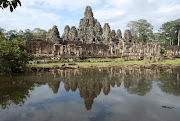
The next morning we woke early, yes again, rented our bikes for $2 each and headed in the direction of Angkor Wat. We stopped after 6km to purchase our $20 tickets each (Khemer people have free entry, we also worked out they must make $52 million a year from entry fees) before cycling a further 4km which brings you to the first ruin of the ancient and enormous city. The first being Angkor Wat, we walked around admiring the ruins and shocked we were still able to climb it and walk through. Not sure how long this will be the case but glad we had the opportunity.
We cycled further for another few km before reaching Bayon the next city of the Angkorian era, we are now understanding how large the city was. This was the one with the smilie faces on the rocks plus other beautiful wats. We continued cycling around the area stopping at particular ones and ending in the famous one where the trees are begining to over grown the ruins. Truly beautiful and more so the sun was being to set which created a glowing shade of burnt orange on all the surfaces.
We headed back for a well deserved shower and tucked into a german meat feast of sausages at one of the local bistros and enjoyed a few Angkor beers which are more expensive then the Lao beer.
The following day Daniella did her circiut around all the local artisan factories visiting ceramic workshops while Jon enjoys an extended lie in. Meeting for lunch later we booked a 'Day in the life' tour which consisted of us living a day in the shoes of a local. Starting of the day with rice havesting which I truly cannot convey in words the difficulty, mainly skill and techniques which years of practice will give you, oh and lots water. We all, including two others who decided to join the tour were sweating buckets while the locals seemed fine. This gave us a opportunity to really appreciate the rice we eat. We made a video which we will attempt to put up soon.
We then moved to another family in the village and helped them make thatched roofs with bamboo sticks and dried palm leaves before heading to a local reservor with an explantion of the villages eco system.
without another
Well an intresting a cultural time in Siem Reap and now its time for us to yet again pack our bags to move on. Not without another cake from the 'blue pumpkin' bakery though (a very modern upmarket stylish bakery) as you can imagine, we felt at home.To be honest most of Siem Reap is full boutique hotels and fancy restaurants to please the tourist trade. Every thing most backpakers aren't looking for but we enjoyed while we could.
Next stop the big smoke, Phnom Penh.
Read more!
Friday, March 21, 2008
Viet Nam, Thailand look ahead to closer ties
What is meant when for Cambodia when Thailand and Hanoi make love? is it going to be sqeezed or will be stumped to death like the year 1975-1979.
Thai Prime Minister Samak Sundaravej will pay an official visit to Viet Nam on March 24, looking to beef up economic ties, maximise the effectiveness of cooperative mechanisms and sign several cooperation pacts.
The visit is made at the invitation of Prime Minister Nguyen Tan Dung in accordance with the Association of Southeast Asian Nations (ASEAN)?s norms.
Established diplomatic ties on August 6, 1976, the two Southeast Asian countries have enjoyed a take-off in the partnership since 1991. The bilateral ties have developed strongly after Viet Nam joined ASEAN in July 1995.
The two countries? trade also got a boost, seeing the rise of 21.3 percent to reach 4.8 billion USD in turnover in 2007.
Up to the present, Thailand has invested in 169 FDI projects capitalising at 1.66 billion USD in Viet Nam , mostly involving in industrial and construction industries.
As a result, Thailand is ranking the 22 nd out of 77 countries and territories, and the third among ASEAN member countries, investing in Viet Nam .
Besides, Thailand has actively worked to boost trade, tourism and investment cooperation between its northeastern provinces with central localities in Viet Nam . In 2006, more than 120,000 Thai holidaymakers visited Viet Nam and over 200,000 Vietnamese visited Thailand .
As the two major rice exporters in the world, the two countries have created a common rice cooperative mechanism to bolster the cooperation in the field.
Apart from bilateral cooperative ties, the two Southeast Asian countries have coordinated to promote cooperation opportunities in the West-East Economic Corridor, within ASEAN, the Great Mekong Subregion, and the Ayayewady-Chao Phraya-Mekong Economic Cooperation Strategy.
Read more!
Cambodia still obtaining criminal confessions through torture: rights group
A quarter of criminal defendants in Cambodian courts are tortured or coerced into giving confessions, a statistic that has not changed since last year, according to an annual report [PDF text] released Thursday by Center for Social Development (CSD) [advocacy website]. The report found that:
Although duress is prohibited in Cambodia, CSD found a significant number of cases where defendants alleged of being victim of this inhuman practice to extract confession. At the six courts monitored by CSD, including the Appeals Court and the Supreme Court, 25.3% of defendants whose cases were monitored claimed having been coerced by judicial police officers...
Judges rarely followed up on these allegations. Adequate follow-up would include conducting further inquiry into the allegation or to prosecute perpetrator. At Phnom Penh Court, for example, with only five defendants out of a total of 292 defendants alleging coercion did the trial judges request the prosecution to prove that the confession was given freely and voluntarily.
"The CSD annual report makes clear what goes on inside Cambodia's courtrooms still falls short of what can be considered procedural justice," he said.
"CSD reported that over 25 per cent of defendants appearing in court claimed to have been tortured or coerced into giving confessions. I note that this ... is the same as reported last year, indicating there has been no significant change."
The Court Watch Project by CSD has come to be viewed as the definitive annual survey of developments in the fledgling Cambodian judicial system since it was launched in 2003.
CSD, which receives funding from a number of donors including Germany and the US, interviewed a wide range of judicial officials, witnesses, lawyers and defendants between October 2006 and September 2007.
Judicial reform of the notoriously corrupt Cambodian system has been earmarked by donors to the aid-dependant nation as a key factor in the country's development after 30 years of civil war.
The report outlined a number of concerns, including poor training of the judiciary, bribery, torture, underfunding, a lack of independence and frequent pre-trial detention of prisoners for terms exceeding the legal limit of six months.
"Not all the news is bad," Mussomeli said, but "on balance ... there remains a good deal to be done before the people of the judicial system will earn the trust of the people of Cambodia."
Read more!
Vietnam, Cambodia, Bangladesh support China's actions to stabilize Tibet
BEIJING, March 20 (Xinhua) -- Senior government officials of Vietnam, Cambodia and Bangladesh have expressed their countries' support for Chinese government's measures to stabilize the situation in Tibet.
"Vietnam fully supports the measures taken by China to stabilize the situation in Tibet," said Vietnamese Deputy Minister of Foreign Affairs Vu Dung in a meeting with Chinese ambassador to Vietnam, Hu Qianwen, on Thursday, adding that the Tibet issue is purely China's internal affairs.
The Chinese government has made great efforts for the economic developments and social progress of Tibet, and yielded tremendous achievements, said the official.
Meeting on Wednesday with Duan Jinzhu, charge d'affaires of the Chinese embassy in Cambodia, Long Visalo, secretary of state for the Ministry of Foreign Affairs and International Cooperation of Cambodia, said the incident in Lhasa, the capital city of China's Tibet autonomous region, was elaborately plotted and organized by a small group of people with ulterior motives.
Some distorted news coverages by Western media were aimed at disturbing the then ongoing sessions of the Chinese National People's Congress and the Chinese People's Political Consultative Conference and the election of new Chinese leaders, as well as undermining the upcoming Beijing Olympic Games, said Long Visalo.
"The Lhasa riot is absolutely not so-called 'peaceful demonstration,' but a serious riot incident," he added.
A spokesman of the Bangladeshi Ministry of Foreign Affairs issued a statement on Thursday, expressing Bangladesh's solidarity with China on the Tibet issue.
"All matters pertaining to Tibet are internal affairs of China," the statement said.
Bangladesh wishes the Beijing Olympic Games great success and would not like to see the games be politicized by any organizations, he added.
Read more!
Thursday, March 20, 2008
Vietnamese PM to attend GMS summit in Laos late March
Vietnamese Prime Minister Nguyen Tan Dung will attend the 3rd Greater Mekong Sub-region (GMS) Summit slated for March 30-31 in Laos, said a Vietnamese spokesman on Thursday.
The summit with theme of "Enhancement of Competitiveness via Greater Connectivity" will focus its discussion on strengthening transport connectivity and boosting cooperation between public and private sectors to develop trade and investment in the GMS, Foreign Ministry spokesman Le Dung said at a regular press briefing.
Participants to the summit will also touch upon issues on training human resources to improve the competitiveness, implementing sustainable environment management and enhancing cooperation for GMS development.
During the event, leaders from GMS members -- Laos, Vietnam, Cambodia, Thailand, Myanmar and China will have dialogues with youths and businesspeople, he said.
The 1st GMS Summit was held in Phnom Penh, Cambodia in 2002, and the 2nd summit in Kunming, China in 2005.
The GMS was established in 1992 to promote economic and social development, irrigation and cooperation within the six Mekong countries.
Source:Xinhua
Read more!
Cambodian Tribunal Rules on Appeal
By Ker Munthit
PHNOM PENH, Cambodia (AP) — Cambodia's genocide tribunal rejected an appeal Thursday by a former Khmer Rouge leader against his pre-trial detention on charges of war crimes and crimes against humanity.
The five-judge panel ruled that Nuon Chea, the Khmer Rouge's former ideologist, must remain in custody ahead of trials scheduled to begin later this year.
Nuon Chea faces charges of war crimes and crimes against humanity. He has been detained since Sept. 19 by Cambodia's U.N.-backed court. Nuon Chea is one of five former Khmer Rouge leaders detained for their involvement in the group's brutal 1975-79 rule.
The Khmer Rouge's radical policies caused the deaths of an estimated 1.7 million people from starvation, diseases, overwork and execution.
Nuon Chea, 81, has denied any guilt, saying he is not a "cruel" man.
In their detention order last year, the tribunal's investigating judges charged him with involvement in crimes including "murder, torture, imprisonment, persecution, extermination, deportation, forcible transfer, enslavement and other inhumane acts."
They said Nuon Chea faces life imprisonment if convicted and that the detention was necessary to prevent him from pressuring witnesses, destroying evidence and escaping.
Nuon Chea's own safety could also be at risk, if he were released, they said.
Nuon Chea has argued that the judges did not have sufficient grounds to detain him and called himself "a patriot and not a coward" trying to run away.
In December, the judges ruled against a similar appeal by Kaing Guek Eav, also known as Duch, who headed the Khmer Rouge's notorious S-21 prison and torture center.
The other three defendants are Ieng Sary, the former Khmer Rouge foreign minister, his wife Ieng Thirith, who was the minister for social affairs, and Khieu Samphan, the former Khmer Rouge head of state.
Read more!
Cambodia unveils new hospital for major-shot clients
PHNOM PENH, March 20 (Xinhua) -- Cambodia here on Thursday unveiled the Royal Ratanak Hospital to provide health services at international standard to rich Cambodians as well as foreigners.
Prasert Prasarttong Osoth, owner of the Bangkok Airways and the Bangkok Dusit Medical Service, altogether invested about 8.5 million U.S. dollars in building the hospital, said Prime Minister Hun Sen at the opening ceremony.
It will help VIP clients reduce payment, as they don't have to go to Singapore, Vietnam, Thailand and other countries to see doctors any more, said Hun Sen. "They will turn to use local health services as they trust this hospital," he said.
Thai investor Prasert said at the ceremony that the economic growth and development of Cambodia urge business people to invest more in the health service sector.
The Royal Ratanak Hospital will cooperate with the Bangkok Dusit Medical Services and it is also a sister hospital to the Royal International Hospital in Siem Reap, he said.
The six-floor hospital will become a main emergency referral center for local Cambodians, foreign tourists and other residents, he added.
Sat Soeurn, representative of the Royal Ratanak Hospital and wife of Tea Bahn, Cambodian Deputy Prime Minister and Minister of National Defense, said that the staff members are trying to provide a trustworthy alternative choice for the local patients who used to spend expensively for their treatment and accommodation in foreign countries.
The hospital will become a leading health sanitation center in Cambodia, she added.
According to official statistics, there are over 1,100 medical units, including major hospitals, all over the country. An average of some 5,000 Cambodians can share one doctor.
Read more!