Cambodia has officially established an Intelligence Department under the Central Security Department of the National Police General Commissioner's Office at the Interior Ministry, local media said on Saturday.
The department will collect information from abroad for purpose of national security, said newspaper the Phnom Penh Post.
The effort will include appointing operation officials attached to Cambodian embassies or other organizations overseas to perform intelligence services, it said.
It will also propose security measures to the Interior Ministry and cooperate with foreign intelligence institutions to exchange information and prevent international terrorism, it added.
Source:Xinhua
Read more!

Saturday, November 03, 2007
Cambodia inaugurates Intelligence Department at Interior Ministry

U.S. warfare ship to visit Cambodia soon
The USS Essex, one of the largest class of amphibious warfare ships in the United States fleet, will dock in Sihanoukville in late November with 1,000 U.S. marines on board, local media said on Saturday.
"They will help with health programs and engineering projects -repairing schools and bridges," Jeff Daigle, spokesman for the U.S. Embassy was quoted by newspaper the Phnom Penh Post as saying.
The USS Essex, 844 feet long, is based in Japan and will stay in Cambodia from Nov. 26 to Dec. 2.
Source:Xinhua
Read more!
Cambodia to build rail link to Thailand
Cambodia will build a rail link to Thailand after it received $US80 million ($A87.9 million) in funds from the Asian Development Bank and the Organisation of Petroleum Exporting Countries, Cambodia's transport minister says.
Work on the 48-kilometre connection between Sisophan in Cambodia and Poipet near the Thai border will start early next year and be completed by 2010, said Minister of Public Works and Transport Sun Chanthol.
The funding will also cover improvements to other parts of the Cambodian railway system, he told reporters on the sidelines of a meeting of transport ministers from the 10-member Association of Southeast Asian Nation, or ASEAN.
The link between Cambodia and Thailand is part of plans for a 5,500km railway linking Singapore to Kunming, which was first proposed by ASEAN in 1995.
The project, which envisages connecting domestic rail networks to form a continuous link from Singapore to Kunming in China, is aimed at easing travel between various Southeast Asian countries and China.
Besides the connection to Thailand, Cambodia will also have to build 257km of tracks linking its capital Phnom Penn to Loc Ninh in Vietnam.
Sun Chanthol said the Vietnam rail link will cost around $US500 million ($A549 million) and his country was seeking funding for the project.
ASEAN, which groups Singapore, Malaysia, Indonesia, Thailand, the Philippines, Vietnam, Brunei, Cambodia, Myanmar and Laos, on Friday also signed a maritime agreement with China.
Read more!
Southeast Asia remains magnet for sexual predators
Bangkok — A police warrant issued for a Canadian accused of sexually abusing children comes hard on the heels of arrests of other alleged sex offenders, highlighting concerns that Southeast Asia is a magnet for sexual predators.
Despite strengthened laws and lobbying efforts by child protection groups, child pornography and child sexual abuse continue to flourish in the region.
Several Southeast Asian countries, including Thailand, Cambodia and Vietnam, are popular with pedophiles due to lax law enforcement, corruption in the justice system and the easy availability of young boys and girls who are forced into prostitution by poverty.
Police in the Thai beach resort town of Pattaya issued an arrest warrant for Canadian Orville Frank Mader, 54, after an eight-year-old Thai boy said he had been lured to his room and then sexually abused. Police say they believe Mr. Mader abused at least three other boys.
Mr. Mader was arrested by police in Cambodia in 2004 on charges of sexually abusing two boys, ages 11 and 14, but the case apparently did not go to court. Cambodian officials said at the time that he used to teach English in Japan. His current occupation is unknown.
Mr. Mader was initially identified as from Kitchener, Ont., but it's believed he has not lived in the city for decades. Relatives have said they believe he has lived in Vancouver.
The issue of Western pedophiles was freshly spotlighted earlier, with the Oct. 19 arrest of Christopher Paul Neil of Maple Ridge, B.C., on charges of having sex with several young Asian boys. Thai police captured Mr. Neil after Interpol initiated an unprecedented worldwide appeal to identify and apprehend him.
Interpol began its manhunt after finding about 200 pictures on the Internet of Thai, Cambodian and Vietnamese boys being sexually abused by a man whose face was digitally obscured.
After German police computer experts unscrambled the photos so the man's face was recognizable, Interpol circulated them publicly. Tip-offs led them to name Mr. Neil as a suspect. He has been charged with child sexual abuse, and remains in police custody.
The charges against Mr. Neil have not been proven in court.
On Wednesday, police said they may begin making background checks on foreign teachers in Thailand, who have been implicated in several cases.
“It shouldn't be enough to wear white shirts and have a university degree. We need to know their background,” said police Col. Apichart Suribunya, head of Thailand's liaison office for Interpol, the international police agency.
Mr. Neil has also worked as a teacher in Asia, as has Paul Cornelius Jones, 39, a Briton who was arrested Tuesday after police raided his Bangkok apartment and found a computer containing photos of naked boys and girls.
Thai police acted on a tip from their British counterparts, who alleged Mr. Jones had been sending photos of naked children to Britain over the Internet, said Col. Apichart. The British government's Child Exploitation and Online Protection Centre said he was a registered sex offender in his homeland.
Mr. Jones has been charged with distributing pornographic photographs of children under age 15, which carries a maximum penalty of 15 years in prison, police said.
“This is not a new problem,” Montri Sinthawichai, a child rights advocate for Thailand's Foundation of Children's Protection, said Thursday. ”These few high-profile cases involved Western men. We have a lot of cases that involve Thai teachers, too.
In another recent case, a 74-year-old British man was arrested for allegedly sexually abusing a 14-year-old boy. Hundreds of photos and pornographic videos of naked boys and men were found when Alan Charles Mawson, of Barrow-in-Furness, was arrested on Oct. 23 in his apartment in Pattaya, said police Capt. Sorakit Thanyasri.
Mr. Mawson was charged with sexual abuse of a child under 15. He denied the charge, Capt. Sorakit said.
Thailand and Cambodia figured in another case announced Wednesday by French police.
They said they arrested 20 people in October as part of a European-wide crackdown on people who shared child pornography over the Internet, and three of those rounded up were suspected of having abused children during trips abroad.
Three of the French suspects were believed to have appeared in child pornography shot abroad, principally in Cambodia, said police, who spoke on condition of anonymity because they are not authorized to speak to the press.
A former French doctor who moved to Thailand after being thrown out of France's order of doctors was a suspect, police said. He was taken into custody when he returned to France recently, police said.
Read more!
Friday, November 02, 2007
Cambodian Police Arrest German on Child Sex Abuse Charge
By Sopheng Cheang/AP Writer/Phnom Penh
Police caught a German man in bed with a 14-year-old girl in the Cambodian capital and arrested him on debauchery charges, two of the arresting officers said Friday.
Police raided the suspect's Phnom Penh hotel room Thursday and discovered him with the teenage girl, said Keo Thea, deputy chief of Cambodia's anti-human-trafficking police.
Keo Thea declined to give any details, but one of the arresting officers, who asked not be named because he was not authorized to speak to the media, said the 61-year-old man came from Cologne in Germany.
Keo Thea said the suspect would face formal charges in a court, but he did not say when or define the charges.
The other officer said the suspect was arrested for debauchery—a legal term for the sexual abuse of children under the age of 16—a charge that is punishable by up to 20 years in jail.
He said police officers burst into the German's hotel room and found him—dressed only in his underwear—lying asleep on the bed with the fully clothed girl.
The girl later told police that she and the man had sex several times before the raid. It was not immediately clear if she also faced any charges.
A French child rights group had been watching the suspect for some time. Action Pour Les Enfants investigators saw the man hanging around with two teenage girls, including the one whom he was with during the arrest, said Samleang Seila, the group's director in Cambodia.
The detention of the German is the latest in a string of arrests of Westerners suspected of child sex offenses in Cambodia.
In March, the Phnom Penh Municipal Court sentenced two German men to a total of 40 years in prison for sexually abusing ethnic Vietnamese girls aged 10 to 14 years.
Then in April, the same court charged Walter Muze, a 62-year-old German from Stuttgart, with debauchery for having sex with a 13-year-old Cambodian girl. Last month, a Russian businessman was arrested in Cambodia on charges of having sex with at least six girls.
Read more!
DETAILS: Cambodia
GETTING THERE: The quickest way to Siem Reap is the 22-hour fight from Dulles on Korean Air (connecting via Seoul); the round-trip fare is about $1,500, with restrictions. An alternate route is to fly to the capital of Phnom Penh (various airlines, from about $2,250), spend a day or two exploring the city, then catch a short domestic flight (about $80 one way) to Siem Reap on Phnom Penh Airways.
Or to see a bit of the countryside, hire a taxi for the four-hour drive from Phnom Penh; the road is good, the views are interesting and the price (about $70) is hard to beat. There are also daily flights from Bangkok to Siem Reap (about $195 each way) on Bangkok Airways.
Cambodia requires visas, which can be obtained on arrival or online at http://evisa.mfaic.gov.kh ($25).
WHEN TO GO: Most tourists visit during the peak season of November to February, when skies are clear; avoid the brutally hot and dusty months of March and April. Start planning now if you want to visit in the rainy season (May-October), which is an excellent option to consider, especially if you don't plan to visit remote parts of the country.
WHERE TO STAY: All the hotels serving Angkor are in Siem Reap, just a few miles from the temples. It's easy to get a clean, comfortable room in a friendly guesthouse for less than $25 -- try the Villa Siem Reap (153 Taphul Rd., 011-855-63-761-036, http://www.thevillasiemreap.com) -- but luxury rooms are so cheap in the rainy season that it's hard not to splurge.
At the very top end is the Amansara (Road to Angkor, 011-855-63-760-333, http://www.amansara.com), where many of the private suites have their own pools. It's an architectural tour de force, and has the Amanresorts' trademark sophistication and attention to detail, but at $850 and up per night (no discount for off-season), you'd expect nothing less.
Five-stars geared toward mere mortals include the historic Raffles Grand Hotel d'Angkor (Vithei Charles de Gaulle, 800-768-9009, http://www.siemreap.raffles.com; about $200 per night double in the off-season) and the Sofitel Royal Angkor (Vithei Charles de Gaulle, 011-855-63-964-600, http://www.sofitel.com; about $130), set in a vast tropical garden.
But the best deals in town may be the airy, Asian-styled La Residence d'Angkor (River Road, 011-855-63-963-390, http://www.residencedangkor.com; about $150), and the jazzy Hotel de la Paix (Sivutha Blvd., 011-855-63-966-000, http://www.hoteldelapaixangkor.com; about $190); the former is more subdued than the latter, but neither will disappoint. The hip-and-we-know-it Foreign Correspondents Club (Pokambor Avenue; 011-855-23-992-284, http://www.fcccambodia.com/angkor) has contemporary-style rooms at about $120 per night but is well below the others in terms of comfort and privacy.
Note: Prices at most hotels will be at least twice as high in the dry season.
WHERE TO EAT: Khmer cuisine, which is similar to Thai but not as spicy, is coming back to life after decades of neglect. The best place to try it may be Meric, in the Hotel de la Paix, where chef Joannes Riviere is leading the revival. Try his theatrical seven-course Khmer sampler, served on pieces of slate, antique serving spoons, artfully broken pots -- everything except plates. At $30, it's pricey by Cambodian standards, but it was one of the most memorable meals we've ever had.
Dozens of great restaurants and open-air bistros are in the French Quarter; start at the main thoroughfare, nicknamed Pub Street, and explore the surrounding streets. Good bets include Khmer House (traditional Cambodian dishes for less than $5, in the alley behind Pub Street), kamasutra for Indian food and the charming Le Tigre du Papier (on Pub Street), with its free book exchange, (slow) Internet access, cooking classes in the upstairs kitchen and a grill offering everything from alligator to kangaroo ($4-$12).
If you're in the mood for "2001"-style futurism, head around the corner from Pub Street to the Blue Pumpkin, where you can lounge on bulbous white furniture and cool off with snacks and organic teas ($2-$12). And definitely try the Dead Fish Tower on Sivutha Boulevard, which has delicious Khmer and Chinese food ($2-$8), an eclectic art collection and six alligators in a tank.
WHAT TO DO: Well, temples, obviously. But skip the trip out to the "floating village" at the huge lake called Tonle Sap; it's cheesy, touristy and depressing. There are several museums; one of the most unusual is the Land Mine Museum ( http://www.cambodialandminemuseum.org; $1), on the road to the temple of Bantey Srei.
It's impossible to get out of Siem Reap without seeing some traditional Apsara dancing. This is exotic and beautiful stuff, as is the Khmer music that accompanies it. Many of the hotels host dinnertime performances, so call around to see what's available. And if you have a chance to see a traditional shadow puppet show, grab it.
For shopping, most people head to the tourist-oriented Artisans d'Angkor (Stung Thmey Street) or the huge Old Market in the heart of the French Quarter. Unless you're really into vegetables or cheap Cambodian underwear, though, skip the market and head into the warren of nameless streets and alleys that surround it. You'll find an amazing range of boutiques and art galleries; some of the best include Kokoon for silks and Hagar Design for hip, fashionable stuff made of recycled rice bags. Siem Reap has started to attract a small international artist community, and there are sophisticated, affordable works at the McDermott Gallery (on the passageway behind Pub Street) and hand-tinted photographs at the Klick Gallery next door.
And when you're worn out from climbing temples all day, check into one of Siem Reap's ubiquitous spas. There are dozens of them, from Seeing Hands, whose masseurs are all blind (about $10), to our favorite, Bodia (in the French Quarter), where the organically Space Age architecture will unwind you even before the massage (about $26) begins.
Read more!
Thursday, November 01, 2007
Cambodia coal plant planned
The Electricity Generating Authority of Thailand plans to co-invest in a new coal-fired power plant in Cambodia to source 3,000 megawatts under a project worth up to US$4.5 billion.
The new project is in line with Egat's plan to diversify its power sources across the region.
Acting Egat governor Santi Sarntijaree said the state enterprise was negotiating with potential investment partners.
''We expect the Chinese government will hold the largest stake. Other stakeholders will be Cambodian authorities and Egat,'' he said.
Under the agreement, Egat would buy all of the electricity generated from the project.
The project would require investment of $4.2 to $4.5 billion, or 142.8 to 153 billion baht.
The figure assumes an average cost of $1.4 million per megawatt.
The electricity from the project is scheduled to link with the Thai national power grid after the completion of the Hongsa lignite project.
Mr Santi said that the project is the first energy collaboration between Thailand and Cambodia after long negotiations.
Previously, the two governments discussed a smaller 1,400-1,600 mw project, but decided on a larger project for cost reasons.
''To buy power from neighbouring countries is our top choice to secure power to meet Thailand's growing demand, particularly in case we are unable to build more power plants,'' he said.
However, power supplies from neighbouring countries still account for less than 20% of total power generation in Thailand
Read more!
NKorea PM in Cambodia to boost trade
 PHNOM PENH (AFP) — North Korean Prime Minister Kim Yong-Il arrived in Cambodia Thursday under heavy security, starting a rare visit focused on boosting trade between the two impoverished nations.
Kim and Cambodian counterpart Hun Sen later oversaw the signing of the countries' first investment agreement, as well as a deal to increase trade between their sea ports.
"The main topic (of Kim's visit) is economic and trade relations. They would like to buy some more Cambodian products in the future," said Cambodian Foreign Minister Hor Namhong.
He added that while the two countries were politically close, trade relations remained very low.
Kim asked that Cambodia and North Korea exchange views on international issues and support each other "to avoid pressure from powerful countries," Cambodian Information Minister Khieu Kanharith told reporters following afternoon talks.
The North's premier blamed the United States, one of Pyongyang's biggest adversaries, for escalating tensions on the Korean peninsula, Khieu Kanharith said.
Kim, the highest-ranking North Korean official to visit Cambodia in six years, was greeted earlier in the day at the airport by Prime Minister Hun Sen and hundreds of flag-waving students.
During his four-day stay he will also call on former king Norodom Sihanouk, a long-time friend of North Korea who frequently stays in a palace in Pyongyang provided to him by the North's first leader, Kim Il-Sung.
"Our current visit will mark a significant occasion in... giving a vital and extensive boost to friendly and cooperative relations in several fields," said a statement from the North's delegation.
Last month Cambodia's Commerce Minister Cham Prasidh said North Korea wanted to build business ties with Cambodia as a way to gain access to world markets largely closed to the communist state by sanctions.
"Through investment, North Korea may see Cambodia as a bridge by which to produce goods and export to bigger countries," he said at the time.
More than 4,000 military and security personnel have deployed throughout the capital Phnom Penh during Kim's visit, the interior ministry said.
Kim visited Vietnam and Malaysia before arriving Cambodia. He will also tour Laos before returning home.
Read more!
Animal rights group threatens to protest Cambodia's KFC restaurants
Phnom Penh - An international animal rights group has urged Prime Minister Hun Sen to ban proposed Kentucky Fried Chicken (KFC) outlets from the country and threatened protests by celebrities if the fast-food chain opens, a spokeswoman said Wednesday. People for the Ethical Treatment of Animals (PETA) spokeswoman Ashley Fruno said by email that celebrities like actress Pamela Anderson and singer Morrissey were staunch supporters of PETA's campaign against KFC.
"We hope to use creative ways and colourful protests to educate Cambodians about KFC's horrific treatment of animals in the future," she wrote in an email Wednesday.
PETA has mounted a sustained campaign against KFC, dubbing it "Kentucky Fried Cruelty" for alleged infringements of animal rights. KFC would be Cambodia's first global food chain.
KFC plans to open outlets imminently in the major tourist centres of Sihanoukville, Siem Reap and Phnom Penh in partnership with Malaysian-based QSR Brands Bhd, Rightlink Corp Ltd and Cambodian partner Royal Group Ltd.
"We hope you will act to protect Cambodia's health and culture by refusing to allow KFC and the abusive farming practices it perpetuates from entering your country," PETA Asia Pacific director Jason Baker wrote in an open letter to Hun Sen.
"With every KFC restaurant comes cruelty to animals, the threat of deadly diseases and blight on the urban landscape," Baker wrote in a separate press release. "We are asking Hun Sen to do his people, his country and his legacy - not to mention countless chickens - a big favour."
Under secretary of state for the Ministry of Culture, Ching Chhorng, said by telephone Wednesday that he doubted KFC would destroy Cambodian civilization. "Cambodians need jobs. Chains like KFC can provide them," he said.
Read more!
Thai police seek another Canadian in child-sex case
TORONTO -- Thai police have issued an arrest warrant for a Canadian man for allegedly paying to have sex with an eight-year-old boy, two weeks after a teacher from British Columbia was apprehended in Thailand on similar charges.
Officials in Pattaya, about 110 kilometres south of Bangkok, confirmed Wednesday they were searching for Orville Frank Mader, a 54-year-old teacher originally from Kitchener, Ont., who was imprisoned in Cambodia three years ago on accusations of sexual crimes against children before those charges were dropped.
According to Pattaya City News, a local media outlet, Mader is accused of paying 500 baht -- roughly $15 in Canadian funds -- to have sex with an eight-year-old child at a hotel in the resort town.
The boy was reportedly abducted from a shopping centre and then sold to foreigners for sex. His mother reported his disappearance to Pattaya police on Sunday.
Two days later, she says she spotted him in the company of a 24-year-old man at a local plaza. Police arrested the man, who said he gave 100 baht ($3) to the boy each time he went with a customer.
As part of their investigation into the boy's abduction, local police released pictures Wednesday of Mr. Mader taken by security cameras at the Ben Mansions hotel in Pattaya.
The same hotel was reportedly frequented by Christopher Paul Neil, a 34-year-old Canadian who was the subject of an international manhunt earlier this month. Mr. Neil, who worked as an English teacher in South Korea, was eventually arrested in Thailand and now faces molestation and kidnapping charges.
Pattaya City News reported Wednesday that Thai police had instructed border officials to detain Mr. Mader if he attempted to leave the country.
Marina Wilson, a spokeswoman for the Department of Foreign Affairs. confirmed the Canadian government was "aware" of reports Thai police had issued an arrest warrant for a Canadian.
"Officials are monitoring the situation closely. At this time, due to the Privacy Act, no further information can be released," Mr. Wilson said.
An RCMP spokeswoman was similarly unable to comment on whether Canadian police were assisting with the investigation into Mr. Mader.
Reportedly the son of a high-school guidance counsellor, Mr. Mader comes from a large family that sprawls across southwestern Ontario.
No one answered the door at the home of Mr. Mader's parents or his brother's home in Kitchener Wednesday. Neighbours at an uncle's home said the family had received word of the arrest warrant and left to avoid media attention.
Relatives contacted by phone said Mr. Mader moved to the Vancouver area about 30 years ago and had little contact with relatives since leaving. A woman married to one of his first cousins said she had never met Mader, saying the family is not particularly close.
An aunt declined to discuss his case before hanging up while another cousin expressed surprise that Mader was still free.
Mr. Mader has been accused of similar crimes in the past.
In 2004, Cambodian police arrested him in Phnom Penh, alleging he committed sexual offences against two boys, aged 11 and 14. While he was imprisoned for five months, charges were eventually dropped against him.
At the time of his arrest, Mr. Mader's mother, Elise Mader, told the National Post it was unlikely he had committed any crime.
"I don't see how they could charge him with anything like that, because he teaches children. He's so good with children and all that," she said, adding she thought the arrest related to noise complaints at his hotel.
Elsie Mader said Mader had taught English to children in Nagoya, Japan, between 2002 and 2004. Scant additional information is available on his life since he was released from Cambodian custody.
He appears to have renewed his passport in Jakarta, Indonesia, last year. In addition, he seems to maintain a residence in Surrey, B.C., although phone calls to the home were not returned Wednesday.
-- with files from Tom Blackwell
Read more!
Wednesday, October 31, 2007
Lonely Planet guide to Cambodia
You've trusted your eyes your whole life, but visit Cambodia and you just may start doubting them.
How else to explain the unthinkable splendour of the 9th- to 13th-century Khmer temples, the tropical islands with barely a beach hut in sight and the untold adventures lurking in northern forests?
Cambodia promises a rollercoaster of emotions and experiences to the intrepid traveller. Your heart will race at Angkor Wat, one of the world's greatest achievements, only to haltingly derail when faced with the impact of humankind's darkest moments.
After two decades of war and isolation, only now is Cambodia truly starting to recover from the Khmer Rouge's genocidal 1975-79 rule.
When To Go:
The ideal months to be in Cambodia are December and January, when humidity is bearable, temperatures are cooler and it's unlikely to rain.
From early February temperatures start to rise until the killer month, April, when temperatures often exceed 40°C (104°F). Come May and June, the southwestern monsoon brings rain and high humidity, cooking up a sweat for all but the hardiest of visitors.
The wet season (May-Oct), though very soggy, can be a good time to visit Angkor, as the moats will be full and the foliage lush - but steer clear of the northeast regions during those months, as the going gets pretty tough when the tracks are waterlogged.
The country's biggest festival, Bon Om Tuk, is held in early November, and is well worth catching. Others you might like to plan around include the water festival in Phnom Penh, or Khmer New Year.
Cambodia - Fast Facts:
Full Name: Kingdom of Cambodia
Capital City: Phnom Penh
Area: 181,040 sq km / 69,900 sq miles
Population: 14,000,000
Time Zone: GMT/UTC +7 ()
Languages: Khmer (official), English (other), French (other)
Religion: Buddhist, Animist, Cham Muslim, Christian
Currency: Riel (CR)
Electricity: 230V 50HzHz
Electric Plug Details: European plug with two circular metal pins; Japanese-style plug with two parallel flat blades
Country Dialing Code: 855
Cambodia PM slammed for disowning lesbian daughter
PHNOM PENH (Reuters) - Women's rights campaigners in Cambodia lashed out at Prime Minister Hun Sen on Wednesday for trying to disown his adopted daughter because she is a lesbian.
"You do not have to agree with her decision, but you have to respect her rights," said Theary Seng, executive director of the Center for Social Development in the war-scarred southeast Asian nation's capital.
Hun Sen, a former Khmer Rouge soldier, told a graduation ceremony this week he was "disappointed" that his 19-year-old daughter, whom he adopted in 1988, was a lesbian.
"I have my own problem -- my adopted daughter has a wife," he said. "Now I will ask the court to disown her from my family."
Hun Sen has been in charge of Cambodia for the last two decades and is not known for a liberal outlook to life or politics.
He and his wife, Bun Rany, have three sons and two daughters, and had kept the adoption of a third daughter a closely guarded secret. He did not reveal her name in his speech.
"I can educate people in the whole country, but I cannot educate my adopted daughter," he added. "We sent her to study in the U.S., but she did a bad job. She returned home and took a wife."
However, Hun Sen asked Cambodia's 13 million people to be more tolerant of homosexuals.
"I urge parents of gays not to discriminate against them, and do not call them transvestites," Hun Sen said.
Read more!
Cambodia's 'demoralised' ex-king celebrates quiet birthday
 PHNOM PENH (AFP) — A seemingly despondent Norodom Sihanouk, Cambodia's former monarch, quietly passed his 85th birthday Wednesday amid muted public celebrations, the palace said.
Saying that Sihanouk was "very elderly, very weak, very demoralised," the palace said in a statement that the former king, once known for his vibrant public persona, was increasingly disturbed by "unnecessary" emails, telegrams and faxes from well-wishers.
In a separate statement, the palace pleaded with supporters "to not call on him, to not dispatch to him messages of greetings and congratulations, even on the occasion of his birthday."
Cambodia's capital Phnom Penh was decorated with only one large portrait of Sihanouk, who grandfatherly visage used to be commonplace throughout the city.
Palace officials said Wednesday he had marked his birthday with a low-key Buddhist ceremony, accompanied by family and monks.
Sihanouk, who suffers from a number of serious illnesses, including cancer, is expected to travel to China for medical check-ups during this year's Water Festival, one of the country's largest holidays which begins next month.
Sihanouk, one of Asia's longest-serving monarchs, abruptly quit the throne in October 2004 in favor of his elder son, Norodom Sihamoni, citing old age and health problems.
Despite giving up his role as king, he remains a popular figure, particularly among rural Cambodians.
Read more!
Tuesday, October 30, 2007
Cambodia's leader cuts ties with gay daughter
SUMMARY: Cambodia's prime minister severs ties with his adopted daughter, who is a lesbian, but appeals to people not to discriminate against gays.
Cambodia's prime minister said Tuesday he was severing ties with his adopted daughter, who is a lesbian, but appealed to people not to discriminate against gays.
"My adopted daughter now has a wife. I'm quite disappointed," Hun Sen said.
He made the rare revelation about his closely guarded family life during a public speech at a student graduation ceremony.
Hun Sen said he plans to file a civil court case to disown his adopted daughter so that she cannot claim any inheritance from his family.
"We are concerned that she might one day cause us trouble . . . and try to stake her claim for a share of our assets," he said.
The prime minister and his wife Bun Rany have three sons and two other daughters. He said they adopted their third daughter in the mid-'80s when she was 18 days old. She has carried his family name "Hun" just like his biological children. Hun Sen did not reveal her given name.
Although he is cutting ties with her, Hun Sen said he was not discriminating against gays and appealed to society to show respect for them.
Sam Vuthy, coordinator of Women's Agenda for Change, a nonprofit Cambodian group advocating gay rights, declined to comment on Hun Sen's decision regarding his daughter but applauded his appeal not to discriminate against gays. (AP)
Copyright 2007 Associated Press. All rights reserved. This material may not be published, broadcast, rewritten, or redistributed.
Read more!
Monday, October 29, 2007
Temples and bones
SIEM REAP, Cambodia: At sunset, many visitors to Angkor, the vast temple complex in the Cambodian jungle, go to the only hill in the area, a place called Phnom Bakeng. Hoping to have the view to myself, I hiked up in the morning instead. I reached the temple ruins at the top only to find that a tour group of French-speaking senior citizens had beat me there.
That would not have happened 20 years ago, when the area was within the reach of Khmer Rouge guerrillas who decamped to the wilds of northwest Cambodia after being driven from power in 1979. Today, the country is at peace, and its glorious temples are crowded with tourists.
A couple of miles to the south of Angkor, the dusty streets of once-sleepy Siem Reap are full of tour buses and the motorcycle-drawn taxi carriages known as tuk-tuks. Out along the road near the city's international airport, hotels are going up quickly.
Strange as it may sound in view of Cambodia's history, the country has a thriving tourism industry and ample room to develop it further.
But tourism has a downside: not just the wear on 12th-century structures or the continuing theft of antiquities, but also the uncertain effects of a fast-money industry on a poor country with a sketchy political system.
Cambodia's economic picture has improved markedly in recent years, and tourism is just about the brightest spot in it. Construction, another engine of growth, depends on infusions of foreign aid. The garment industry flourished last year, but local experts fear that over time China and Vietnam may prove to be cheaper places for clothing factories. Meanwhile, the number of foreign visitors grew 27 percent in 2006 alone, according to the Economic Institute of Cambodia, an independent research group.
It's now relatively convenient to visit one of the world's architectural marvels. Lodging, food and local transportation are easy and cheap.
The temples at Angkor aren't the only appealing sight. Cambodia's capital, Phnom Penh, has a pleasant, French-influenced downtown. The city abounds with ex-pat hipsters and bohemians lured by the possibility of adventure or the chance to do good.
In some ways, though, Cambodia remains a rather noirish place for a vacation. Despite years of mine-clearance efforts, unexploded ordnance still dots the countryside. In urban public places where tourists gather, so too do maimed land mine victims reduced to beggary.
The Khmer Rouge period still exerts its dark pull. One popular attraction outside Phnom Penh is the Choeung Ek killing field, where the clothes and bones of people thrown into mass graves are still visible in the ground upon which tourists tread.
Another attraction near the capital is Tuol Sleng, a school that became a torture center. One walks across bloodstained tiles to the metal bedframes where suspects were found shackled and bloodied. To the extent that the museum's curators offer any interpretation, it's meant to shock.
Such images serve the current government, led by the heavy-handed former communist Hun Sen, to remind Cambodians that it is a more benign presence than the Khmer Rouge. And if Tuol Sleng and Choeung Ek are popular with international visitors, so be it. The problem with tourism in Cambodia isn't the attractions themselves, but rather its potential to delay the political and economic reforms needed to move the country forward.
In neighboring Vietnam, the foreign companies investing billions in equipment, factories and other businesses are asking the government to fix an education system that, they say, doesn't cultivate scientific or management skills. In contrast, the tourism industry doesn't require the same skills, so it doesn't make the same demands, and more of the money it generates moves under the table.
This is a worrisome fit for Cambodia, a country that ranks low on the United Nations human development index and near the bottom of Transparency International's corruption index.
Sure enough, for a one-day visit to Angkor Wat and surrounding temples, foreigners pay a $20 fee that's collected by a politically wired hotel company. Critics complain that only a small percentage of ticket sales end up being used to maintain the temples. Indeed, the preservation and restoration efforts now underway depend on overseas benefactors.
As long as Cambodia is at peace, there will always be tour groups at Angkor. Whether the country can move beyond a tuk-tuk-based economy is another question entirely.
Dante Ramos is deputy editor of the editorial page of The Boston Globe
.
Read more!
Cambodia's general election to cost over 16 mln USD
Next year's general election in Cambodia will cost more than 16 million U.S. dollars, 60 percent of which will be covered by the government while the rest from donor countries, local media said on Monday.
The National Election Committee (NEC) will need 16,758,451 U.S. dollars to run the election smoothly, or about two U.S. dollars per voter, Cambodian-language newspaper the Rasmei Kampuchea quoted NEC president Im Suosdey as saying.
The 2008 election needs an increased budget from the 2007 commune council election because of additional technical preparations such as an improved registration process and voter list clean-up, he said.
Meanwhile, Interior Minister Sar Kheng also confirmed that the government has approved the budget and decided to contribute approximately about 60 percent of it.
The government has called on development partners to contribute the rest, said Sar Kheng, adding that the increase in the budget has resulted from an increase in the number of voters and polling stations and the inclusion of some new tasks to strengthen the quality of the election.
During the election scheduled for July 2008, both the National Assembly and the government will renew their members.
Source: Xinhua
Read more!
Cambodia marks third anniversary of Sihamoni s ascension to throne
Cambodia on Monday celebrated the third anniversary of King Norodom Sihamoni's ascension to the throne with media campaign and public exposure.
Best wishes from top country leaders for the king were broadcast on most television channels and radio stations and printed on some newspapers and magazines.
The exhibition of the king's portraits can also be seen at some public places in Phnom Penh to feature his charity activities.
In addition, the government will set off fire fireworks in front of the Royal Palace on Monday night.
Sihamoni, 55 years old, succeeded his father Norodom Sihanouk upon his retirement in 2004.
He is the constitutional monarch of the kingdom and does not exercise power in the government.
Source: Xinhua
Read more!
Sunday, October 28, 2007
Living in a water world
By Penny Watson
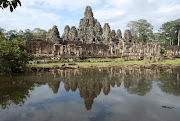
In the jungle and farmland surrounding the Cambodian city of Siem Reap, the famous Angkor temples punctuate the landscape. Remains of the ancient Khmer empire, these magnificent edifices, numbering more than 1,000, vary in scale, design and state of repair.
Tourists descend on the complexes particularly during the dry season, starting in October. But for an escape from the Angkor audience, you can take an easy side trip to the nearby floating village of Kompong Phluk. We traveled only 25 kilometers via motorbike, boat and tuk-tuk, a type of motorized rickshaw, to leave the busy tourist hub far behind. Our wooden longboat slipped through the narrow waterways, past ravaged banks battered by the wet season. As we stared in awe at this strange landscape, our guide explained how Kompong Phluk came to be.
The result is nature's own anomaly — a sunken mangrove forest, home to a curious species that survives almost completely submerged in water, and Kompong Phluk, a floating stilt village, ebbing and flowing with the coming and going of the seasons.
We pulled up beside a crude-looking jetty servicing a row of stilt houses 8 or 9 meters above us. The jetty led to a strip of dry road running up the middle of the village. In the worst of the wet season we would have been treading water, but at the start of the dry season we had the advantage of being able to explore on foot.
We climbed a bamboo ladder to the abode of a wiry old man, who was happy to receive guests for the customary exchange of a small tip. His hut was made of ad hoc bamboo scaffolding and sheets of rusted, corrugated iron. Inside, barely-there walls made of overlapping palm leaves separated three small living areas, home to a family of six, maybe seven.
We continued our walk to the pagoda, one of Kompong Phluk's few concrete buildings, where two smiling monks were biding their time, smoking and talking. Come the flooding waters, this small patch is the only dry land in the village, the only constant in an environment where water dictates a way of life.
Getting there and around: Bangkok Airways (www.bangkokair.com) and Vietnam Airlines (www.vietnamair.com.vn) fly to Siem Reap from Bangkok and Saigon, respectively. To get to Kompong Phluk, find a tuk-tuk-driving guide in Siem Reap. He will negotiate cheaper fares and establish the best route to the village depending on whether you travel in the wet season (April to September) or the dry season (October to March). It will cost $40-$75 for two people, including tips.
Most visitors stay in Siem Reap. Jasmine Lodge (www.jasminelodge.com) goes the extra mile with clean fan rooms and a free rooftop pool table by the restaurant. Hidden down the back streets, Red Lodge (www.redlodge angkor.com) is a modern villa with free bicycles. Khmer, Thai, Indian, Vietnamese, Japanese and Western eateries abound in town.
Richard I'Anson / Lonely Planet Images After rainy season, Tonle Sap Lake rises, creating floating markets and villages in Cambodia. One floating village, Kompong Phluk, is just 25 kilometers from the bustling city of Siem Reap.
Living in a water world
Read more!
Cambodian tyrant Pol Pot's limousine for sale on eBay
PHNOM PENH - CAR collectors with macabre tastes and at least £35,000 (S$104,000) to spare now have a chance to own a limousine reportedly used by Pol Pot, the late chief of Cambodia's notorious Khmer Rouge.
'For sale - one classic 1973 Mercedes Benz stretch limousine ... previously used by one infamous owner Pol Pot, who led the Khmer Rouge during its genocidal regime in Cambodia from 1975-1979,' reads a listing on the online auction site eBay.
The car, reportedly purchased in 2001 by the current owner, who used it 'for Sunday drives around Phnom Penh and the outskirts,' had attracted one bidder by Sunday afternoon, with bidding due to end Tuesday.
The seller is apparently an expatriate British banker, Paul Freer, who bought the car when he lived in Phnom Penh, but moved to neighbouring Laos a year ago. He could not immediately be reached for comment.
Whether the vehicle was actually used by Pol Pot could not be independently confirmed.
Records of virtually everything were lost during the regime of the Khmer Rouge, who abolished private ownership and attempted to turn Cambodia into a primitive agricultural society. The communist group's radical policies also led to the deaths of some 1.7 million people from hunger, diseases, overwork and execution.
'Part of the proceeds of the sale will be given to a Cambodian children's charity,' says the car's description on eBay, which added that the vehicle was originally acquired by a foreign journalist who discovered it being used by Cambodian farmers to transport watermelons to market.
The ad claims the car was also used by Hollywood movie star Matt Dillon when he filmed his movie 'City of Ghosts' in Cambodia in 2001.
The car, waiting for a new owner, has been on display at the Renakse Hotel opposite the Royal Palace in Phnom Penh for about a year now, Yan Phirun, a hotel worker, said on Sunday. He said he is a nephew of Mr Freer's Cambodian wife, Chhea Lina.
'I used to hear my aunt saying that the car used to belong to Pol Pot. She bought it from a previous owner,' he said.
Mr Sep Yan, a receptionist at the hotel, said many people have looked at the car and left because the asking price may be too high.
'I don't know the real history of the car because I was not yet born' when the Khmer Rouge were in power, he said.
Mr Youk Chhang, director of the Documentation Center of Cambodia, an independent group researching Khmer Rouge crimes, said there were quite a few black Mercedes Benz vehicles used by Khmer Rouge dignitaries.
'There is no way you can confirm which one belonged to Pol Pot,' he said. -- AP
Read more!
Cambodia given more patrol boats
China is giving Cambodia nine naval patrol boats to safeguard oil installations in the Gulf of Thailand, another sign of Beijing's deepening ties with the Southeast Asian nation, military officials said.
"These boats will enable us to prevent maritime crimes such as terrorism, but also to protect natural resources within our sea territory," said General Nim Sovath, who attended a signing ceremony in the Chinese city of Guangzhou this week.
An army-run Cambodian TV channel heralded the deal as evidence of stronger military cooperation with China, which provided Phnom Penh with six naval patrol boats in 2005 to help combat people and drug smuggling.
Beijing followed up the next year with $600 million (NZ$794 million) in aid and grants - a sum equal to the annual amount given by Cambodia's traditional donors.
Cambodia is expected to take possession of the vessels, believed to be worth around $60 million (NZ$79.4 million), early next month.
Even though Cambodian Prime Minister Hun Sen spent much of his life fighting Pol Pot's Beijing-backed Khmer Rouge, he has worked hard in recent years to build ties with China as a counterweight to Vietnam, which lies between them.
The improved relationship also works well for Beijing, keen to negotiate access to friendly deep-sea ports in Southeast Asia, its main fuel gateway.
Sihanoukville, Cambodia's only such port, will be the processing centre for oil and natural gas expected to flow from its Block A chunk of the Gulf of Thailand by 2010.
US oil giant Chevron Corp is leading exploration drilling.
Read more!
Subscribe to:
Posts (Atom)