BATTAMBANG - China will continue to help Cambodia with its infrastructure and raise living standard of its people, said Pan Guangxue, Chinese ambassador to Cambodia here Monday.
Speaking at the inauguration ceremony of Cambodia's 57 national road Battambang-Pailing section in Battambang, Pan said "The completion of the road will help elevate the country's regional economic development, especially in terms of agricultural product export, and also heighten the local people's living standard."
He noted that the 103-kilometer road, which links Battambang with Pailing on the borders with Thailand is seen as one of the traffic arteries in the kingdom's northwestern region.
The populous Battambang province, some 280 kilometers northwest of the capital city of Phnom Penh, is a major rice and fruit producer in the kingdom, better transport facilities will make farm products from the area more readily available to neighboring countries, including China, the ambassador said.
On behalf of the Cambodian government and Prime Minister Hun Sen, Deputy Prime Minister and Interior Minister Sar Kheng expressed gratitude to China's assistance in the kingdom's infrastructure construction.
The Cambodian government has given high priority to infrastructure construction, including road, electricity, and irritation facilities, in a bid to promote regional economic development and people's living standard, he said.
"The completion of the No. 57 national road with China's assistance will surely upgrade the transportation and communication with neighboring nations and reduce the local people's transport costs," he added.
Started in November 2008, the construction of 103-km road is financed by the Export-Import Bank of China and undertaken by China Road and Bridge Corporation.
Read more!

Tuesday, March 13, 2012
China to continue helping Cambodia with infrastructure

John A. Pike joins Cambodian law firm
UK barrister to drive growth at Sciaroni & Associates
PHNOM PENH, Cambodia, Mar 12, 2012 (BUSINESS WIRE) -- John A. Pike has joined Phnom Penh-based Sciaroni & Associates as Managing Partner, Senior Partner Bretton G. Sciaroni announced today.
Pike has extensive experience in commercial and investment banking and in the shipping industry in London, Tokyo, and Frankfurt, and for the last 10 years has been a practicing barrister-at-law in London. He has lived and worked in Cambodian since 2009 as an adviser to on agricultural development with VSO UK, a UK non-governmental organization.
Pike has business experience in most European countries, Asia, South and North America and also worked for the UK Government's Serious Fraud Office.
An Oxford-educated economist with practical knowledge and experience of international investment, among other experiences he has advised on a $150 billion portfolio for a major international bank. He is registered with the English Bar Council and is a member of Lincoln's Inn, specializing in commercial law, banking law and fraud.
"We are extremely fortunate to have a legal expert of John's caliber join our firm at a pivotal moment in the growth and expansion of our business," said Sciaroni.
"His expertise in key areas of law, particularly in all areas of banking, capital markets and dispute resolution, provides Sciaroni & Associates with valuable tools which will prove to be enormous assets to our clients and their business interests in Cambodian, and throughout Southeast Asia.
"John's qualifications in law, economics, arbitration, financial management and mediation add powerful skills to the firm."
Pike's published academic work includes a groundbreaking analysis of the English anti-Trust Law on 'price-fixing' criminal cartels that was extensively reviewed in high profile international cases in the British Supreme Court and Court of Appeal. In 2013, he is due to publish a lengthy academic volume on the historical origins and credibility of international law, in the context of international relations and 'realpolitik'.
In addition to his business and law experience, Pike has over two years' experience working for several NGOs in the agricultural sector, advising on commercial, management, and legal matters in a dozen provinces in Cambodia. He also served as a member of the training team that helped prepare the new Cambodian government's Anti-Corruption Unit prior to the enactment of the Anti Corruption Law 2010.
"I am delighted to be joining Sciaroni & Associates, with its strong track record of providing local knowledge combined with international excellence in legal advice to blue chip global corporations," said John Pike. "I look forward to working with partners Bretton Sciaroni and Matthew Rendall and a wonderful team of Cambodian and international professionals in extending the range and quality of legal services for new and existing clients in Cambodia's dynamic economy, as well as in Laos and Myanmar."
About Sciaroni & Associates
Sciaroni & Associates is a leading legal and professional services firm based in Phnom Penh, Cambodia, providing advice and business insight since 1993 to many of the world's leading companies as well as to the Royal Government of Cambodia. Senior Partner Bretton G. Sciaroni has nearly 20 years of experience advising clients in Cambodia and is a leading contributor to the development of the Cambodian economy. Managing Partner Matthew Rendall has worked in Cambodia since 1994 and has extensive property and labor law expertise as well as in general investment structuring. Managing Partner John Pike has more than 25 years of banking, investment and legal experience in the United Kingdom, Europe and Asia. The firm provides guidance in all facets of law and investment, including capital markets, infrastructure investment, banking and finance, oil, gas and mining, dispute resolution, company creation, licensing, labor, property and government relations. Additional details may be obtained via the firm's website at www.sa-cambodia.com .
SOURCE: Sciaroni & Associates
Read more!
Friday, March 09, 2012
Cambodia Hands Document on Disputed Area with Thailand
As ordered by the International Court of Justice last year, Cambodia has submitted additional document on disputed area with Thailand to the world's top court at The Hague in Netherlands, a senior Cambodian official said Friday.
Koy Kuong, spokesman of Ministry of Foreign Affairs and International Cooperation said that Deputy Prime Minister and Foreign Minister Hor Namhong had already submitted the additional document, the follow-up papers required by the ICJ after oral arguments were made by both Thailand and Cambodia last year.
He said Cambodia was given time to present the additional document by March 8 this year while Thailand was given time to do so late last year.
Hor Namhong left Cambodia on Monday and will return home on Saturday, Koy Kuong said.
Thailand and Cambodia had fierce military conflicts following Cambodia's ancient Temple of Preah Vihear was listed as World Heritage Site in 2008. Thailand has claimed 4.6 square km of land near the temple.
The conflicts resulted in many deaths and injuries, mostly soldiers from both sides.
Following the fighting, Cambodia has sought interventions from the Association of Southeast Asian Nations, and the United Nations Security Council and as well as the ICJ.
Cambodia was requesting for ICJ interpretation of the 1962 verdict that ruled in favor to Cambodia.
The ICJ, however, has not yet set any date when the interpretation will be pronounced, but government sources said that it will be within this year.
Read more!
India to Replicate Cambodia’s Angkor Wat
By Preetika Rana
 |
Tang Chhin Sothy/Agence France-Presse/Getty Images |
To be built by the privately-run Bihar Mahavir Mandir Trust, the temple will have five stories and stand 222-feet tall. It will be taller than Tamil Nadu’s Brihadeeswarar temple, making it the “tallest Hindu temple in the world,” the trust announced Monday. The estimated cost of the 10-year long project is about $20 million, or one billion rupees, the trust says.
So what inspired this initiative?
“I have always been fascinated by the beauty and grandeur of Angkor Wat,” Acharya Kishore Kunal, secretary of the trust, told India Real Time. “Recreating the masterpiece would be a tribute to India,” he added.
Built during the reign of Hindu King Suryavarman II, Angkor Wat is one of Cambodia’s prime tourist destinations. Spread across a sprawling campus of 203-acres, the temple was chiefly dedicated to Lord Vishnu, one of the Hindu Gods, until the late 13th century. In the years ahead, the temple became dedicated to Lord Buddha.
Its Indian replica, “Virat Angkor Wat Ram Mandir,” will be built on a 40-acre campus on the Hajipur-Bidupur road, about 20 kilometers from Bihar’s state capital, Patna, the trust says.
The place where the temple will be built is, “no ordinary site,” Mr. Kunal says. Legend has it that Hindu deity, Ram, and his brother Lakshman set foot here, he adds. Lord Ram is chiefly worshiped by Hindus across the globe and believed to be an earthly incarnation of Lord Vishnu.
Mr. Kunal claims that the temple venture will “drastically boost” tourism in India, although the country’s tourism officials appear oblivious of the initiative.
“We have not heard or seen any news reports of the temple,” a spokeswoman for India’s Ministry of Tourism said. In Bihar, Priteshwar Prasad, the assistant director of tourism, said he had, “no knowledge” of the shrine. After India Real Time informed Mr. Prasad of the venture, he was quick to add that the project will, “definitely put Bihar on the global map.”
The Ministry of Tourism in Bihar may be pleased with the venture, but not everyone welcomes the move.
An official from the Cambodian embassy in New Delhi said the trust has not gotten permission to replicate Angkor Wat. “We are quite unhappy with this development,” she said, adding that the Cambodian government may request the Indian government to stall the project.
“We won’t let anyone confuse the world that there are two Angkor Wats,” Phay Siphan, a Cambodian government spokesman, told the New Zealand Herald.
Mr. Kunal, of the trust, said his group, “did not deem it appropriate” to communicate with the Cambodian government since the temple will, “not be an exact replica” of Angkor Wat. Three key differences will distinguish the Hindu temple from its Cambodian counterpart, he added.
First, the temple’s central tower will be 222-feet long, 12 feet higher than the one at Angkor Wat, he said.
Why 222-feet? According to ancient Hindu belief, the number 222 is auspicious and brings good fortune, he says.
The second distinguishing feature, Mr. Kunal says, is that the shrine will be built using concrete and granite, not the sandstone that was used to erect Angkor Wat. “We believe the material is far superior to sandstone,” he adds.
Third, the temple will house colossal marble idols of several Hindu deities, he says. These include Lord Ram and his consort Sita, Lord Krishna and companion Radha and Lord Shiva and Goddess Parvati. Angkor Wat, on the other hand is chiefly dedicated to Lord Buddha, the founder of Buddhism.
“The Cambodian government should understand that we are not competing with Angkor Wat in any way,” he asserted.
The end objective, he says, is not to supersede the grandeur of the Cambodian shrine but to, “create a magnificent Hindu temple for our land.”
The trust plans to begin construction of the Hindu temple this May. Read more!
Thursday, March 08, 2012
Chinese firms increase investment in Cambodia at cost of environment
It was once the unspoiled jungle home for tigers, elephants, bears and gibbons. But today Botum Sakor National Park in southwest Cambodia is fast disappearing to accommodate a much less endangered species: the Chinese gambler.
“This was all forest once,” says Chut Wutty, director of the Natural Resource Protection Group, an environmental watchdog based in the capital, Phnom Penh, gesturing across a near-treeless landscape.
“But then the government sold the land to rich men.”
He means Tianjin Union Development Group, a real-estate company from northern China, which is transforming 340 sq km of Botum Sakor into a city-sized gambling resort for “extravagant feasting and revelry,” its website says. A 64-km highway, now almost complete, will cut a four-lane swathe through mostly virgin forest.
National parks and wildlife sanctuaries in Cambodia, an impoverished country known for its ancient temples and genocidal Khmer Rouge regime of the 1970s, could soon vanish entirely as deep-pocketed Chinese investors accelerate a secretive sell-off of protected areas to private companies, warns Chut Wutty and other activists.
The land sales also point to another trend: the expansion of Chinese economic interests in Southeast Asia’s undeveloped frontiers, which comes at a delicate time as tensions simmer over China’s sovereignty claims in the disputed South China Sea and the United States vows to re-engage with the region.
Last year, the Cambodian government granted so-called economic land concessions to scores of companies to develop 7,631 sq km of land, most of it in national parks and wildlife sanctuaries, according to research by the respected Cambodia Human Rights and Development Organisation.
The area of concessions granted has risen six-fold between 2010 and 2011, partly a reflection of booming Indochina trade as China’s economic influence spreads deeper into Southeast Asia. Foreign conservation groups in the country have remained silent about the sell-off for fear of wrecking their relationship with the government of mercurial Prime Minister Hun Sen. But Cambodians dislodged from concession areas are starting to find their voices.
Fishing families in Botum Sakor say that Union Group is using strongarm tactics to relocate them deep inland.
“It’s been my land since my grandparents’ generation,” says Srey Khmao, 68, from Thmar Sar. “I lived peacefully there until Union Group threatened the villagers and told them to remove their belongings.”
Such protests could ratchet up anti-Chinese sentiment in Cambodia, where China is both the largest foreign investor and source of foreign aid. That aid, often in the form of no-strings-attached infrastructure projects, has made Hun Sen less reliant on Western donors, who generally demand greater transparency and respect for human rights.
It has also eroded the influence of foreign conservation groups in Cambodia, many of whom work in the same protected areas now being sold off. Their criticism has remained muted for fear Hun Sen will do what he did to British environmental watchdog Global Witness in 2005, and kick them out.
“The days of donor-dependency are over," says a foreign conservationist working in Cambodia, who asked not to be identified. “Much more money is coming into this country through direct investment, especially from Chinese companies, so the carrot-and-stick incentive that NGOs might have had 10 years ago isn’t as powerful these days."
Land-grabbing, illegal logging and forced evictions have long been common in Cambodia. But by granting land concessions, the government has effectively legalized these practices in the country’s last remaining wilderness, say activists.
Companies from Cambodia, Vietnam and other countries are also exploiting the land sell-off, mainly to develop rubber plantations and other agribusinesses. But the most lucrative projects —mining for gold and other minerals — are dominated by the Chinese, says the Cambodian Center for Human Rights.
Read more!
Angkor Wat? Cambodia fears replica will hit tourism sector

It is often said that imitation is the sincerest form of flattery. Not so, perhaps, when it comes to ancient Hindu temples.
This week, officials in eastern India announced their plan to build a replica of Cambodia's spellbinding 12th-century temple, Angkor Wat, on the banks of the Ganges in the state of Bihar.
A religious group, the Mahavir Mandir Trust, said that when it is completed, the £13 million ($25 million) project will not only be a major attraction in its own right, but will be the tallest Hindu temple in the world.
As he laid the foundation stone, Kishore Kunal, the trust's secretary, told local media the temple's name will be Virat Angkor Wat Ram Mandir.
"The site is blessed as Ram, Lakshman and Vishwamitra were welcomed here on their arrival by King Sumati of the Vaishali kingdom," he added, referring to Hindu deities.
But while people in Bihar may be excited about the project, not everyone is happy. Officials in Cambodia yesterday said they believed the move was a shameful act that would undermine the value of the country's best-known tourist attraction which has been a World Heritage Site since 1992.
Three million foreign tourists a year visit the Cambodian temple near the town of Siam Reap.
Such is the importance of the site to the largely Buddhist nation, both culturally and in terms of the revenue it generates, that it features on the national flag.
"Angkor Wat is Angkor Wat - it is unique," Cambodian government spokesman Phay Siphan said. "They are raising this to be confrontational and it is provocative of the World Heritage principle. We won't let anyone confuse the world that there are two Angkor Wats."
The location of the Indian temple, or Angkor Nagar as some are calling it, is about 40km outside Patna.
Indian officials say it will stand 67m high. While the Cambodian temple was built to worship the Hindu god Vishnu, the replica will also invite worship of Shiva and other deities. Siphan said officials in Phnom Penh would raise its concerns with the Indian Government to try to resolve the matter.
"[The two nations] have good relations and good co-operation, so we are looking for that to solve this issue," he said.
"The tourists who come to visit Angkor Wat are not seeing it simply as a stone building. They come here to see the culture and to learn."
The Indian Angkor will have five storeys and five "shikhars" or pinnacles, like the Cambodian original. It is estimated that work on the main structure, which will sit on a 16ha site in Vaishali district, will take up to five years, while completing the project could take a decade.
- Independent
By Andrew Buncombe . Read more!
China gambles on Cambodia's shrinking forests
BOTUM SAKOR, Cambodia (March 7, 2012): It was once the unspoiled jungle home for tigers, elephants, bears and gibbons. But today Botum Sakor National Park in southwest Cambodia is fast disappearing to accommodate a much less endangered species: the Chinese gambler.
"This was all forest once," says Chut Wutty, director of the Natural Resource Protection Group, an environmental watchdog based in the capital, Phnom Penh, gesturing across a near-treeless landscape.
"But then the government sold the land to rich men." He means Tianjin Union Development Group, a real-estate company from northern China, which is transforming 340 sq km of Botum Sakor into a city-sized gambling resort for "extravagant feasting and revelry", its website says.
A 64-km highway, now almost complete, will cut a four-lane swathe through mostly virgin forest. National parks and wildlife sanctuaries in Cambodia, an impoverished country known for its ancient temples and genocidal Khmer Rouge regime of the 1970s, could soon vanish entirely as deep-pocketed Chinese investors accelerate a secretive sell-off of protected areas to private companies, warns Chut Wutty and other activists.
The land sales also point to another trend: the expansion of Chinese economic interests in Southeast Asia's undeveloped frontiers, which comes at a delicate time as tensions simmer over China's sovereignty claims in the disputed South China Sea and the United States vows to re-engage with the region.
Last year, the Cambodian government granted so-called economic land concessions to scores of companies to develop 7,631 sq km (2,946 sq miles) of land, most of it in national parks and wildlife sanctuaries, according to research by the respected Cambodia Human Rights and Development Organization (ADHOC).
The area of concessions granted has risen six-fold between 2010 and 2011, partly a reflection of booming Indochina trade as China's economic influence spreads deeper into Southeast Asia.
Foreign conservation groups in the country have remained silent about the sell-off for fear of wrecking their relationship with the government of mercurial Prime Minister Hun Sen. But Cambodians dislodged from concession areas are starting to find their voices.
Fishing families in Botum Sakor say that Union Group is using strongarm tactics to relocate them deep inland. "It's been my land since my grandparents' generation," says Srey Khmao, 68, from Thmar Sar.
"I lived peacefully there until Union Group threatened the villagers and told them to remove their belongings." Such protests could ratchet up anti-Chinese sentiment in Cambodia, where China is both the largest foreign investor and source of foreign aid.
That aid, often in the form of no-strings-attached infrastructure projects, has made Hun Sen less reliant on Western donors, who generally demand greater transparency and respect for human rights.
It has also eroded the influence of foreign conservation groups in Cambodia, many of whom work in the same protected areas now being sold off.
Their criticism has remained muted for fear Hun Sen will do what he did to British environmental watchdog Global Witness in 2005, and kick them out. "The days of donor-dependency are over," says a foreign conservationist working in Cambodia, who asked not to be identified.
"Much more money is coming into this country through direct investment, especially from Chinese companies, so the carrot-and-stick incentive that NGOs (non-governmental groups) might have had 10 years ago isn't as powerful these days."
Land-grabbing, illegal logging and forced evictions have long been common in Cambodia. But by granting land concessions, the government has effectively legalised these practises in the country's last remaining wilderness, say activists.
Companies from Cambodia, Vietnam and other countries are also exploiting the land sell-off, mainly to develop rubber plantations and other agribusinesses. But the most lucrative projects -- mining for gold and other minerals -- are dominated by the Chinese, says the Cambodian Center for Human Rights.
Cambodia's 2001 land law forbids economic land concessions greater than 10,000 hectares (24,700 acres). But China's Union Group won a 99-year lease thanks to a 2008 royal decree which carved out 36,000 hectares from Botum Sakor and redefined it.
In the same year, a contract was signed by Minister of Environment Mok Mareth and the chief of Union Group's board of directors Li Zhi Xuan. The company was granted a further 9,100 adjoining hectares last year to build a hydroelectric dam.
Union Group has big ambitions for the area, including a network of roads, an international airport, a port for large cruise ships, two reservoirs, condominiums, hotels, hospitals, golf courses and a casino called "Angkor Wat on Sea", according to the contract and its website.
It will sink $3.8 billion into its Botum Sakor resort, a figure quoted to rights groups in February by Bun Leut, governor of coastal Koh Kong province . It covers an area almost half the size of Singapore. People in the area say it will be called either "Seven-headed Dragon" or "Hong Kong II".
"Those are just rumours. It hasn't been named yet," says Cheang Sivling, a Chinese-speaking Cambodian manager for Union Group's road-building operations.
The four-lane highway, built at a cost of about $1.1 million a mile, is part of a system of roads Union Group will run across Botum Sakor, adds Cheang Sivling.
This alarms Mathieu Pellerin, a researcher with the Cambodian human rights group Licadho, who notes that newly built roads give logging operators greater access and could accelerate the destruction of forests.
"Botum Sakor is melting away," he says. The worksites along the highway house a number of Chinese engineers, and are guarded by Cambodian soldiers.
Access to the resort area itself is blocked by a provincial park ranger who, when Reuters tried to pass, threatened to radio for back-up from military police, who along with the police routinely provide security for big concessionaires.
"This is China," he says firmly. Nearby, at the picturesque seaside village of Poy Jopon, people were preparing to leave after signing away their property to Union Group -- under duress, they say.
"I'm upset, but there is nothing I can do about it," says Chey Pheap, 42, a grocery store owner. "This is the way society works." He and the remaining villagers will soon be moved to houses some 10 km (six miles) inland.
When asked to describe the new area, one of Chey Pheap's neighbours says: "No work, no water, no school, no temple. Just malaria." Nhorn Saroen, 52, was among hundreds of families who have already been moved from another fishing village, called Kom Saoi.
"We were told it was Chinese land and we couldn't cut down a single tree," he says. "Some people refused to leave. Their land was taken and now they have nothing."
He was provided with a house in a purpose-built village far inland, robbing him of his main livelihood: fishing. The houses surrounding Nhorn Saroen's are deserted. Many families cannot make ends meet in the remote area and have moved away, he says.
Passing just behind his house was a moat which delineated Union Group's land. It was three metres deep (10 ft) and twice as wide, and ran for many kilometres. For the villagers, it symbolised China's power and remoteness. "Even though we hate the Chinese, what can we do?" says Nhorn Saroen.
Union Group's website praises Cambodia for its "sound public order" and "simple and honest" people. Allegations of forced evictions are "a problem between the Cambodian government and its people", says a company spokeswoman, who declined to be identified.
Union Group obeyed Cambodian laws and worked closely with the Chinese government, she adds. Its road network was welcomed by people in the area.
"Residents said they finally saw real roads and cars," she says. "In this regard, I think we have contributed to Cambodia." She confirmed that Union Group is spending "billions" of dollars on the project.
The government granted a record number of economic land concessions in 2011, says Pellerin, but keeping track of them is impossible. Information on hard-to-reach concessions or the firms leasing them is not systematically maintained.
The government's contract with Union Group is "shocking", says Pellerin. "Cambodia is giving away 36,000 hectares to a foreign entity with little if any oversight or obvious benefit to the people."
As part of that contract, Union Group deposited $1 million with the Council for the Development of Cambodia, but pays no fees for the first decade of its lease.
Leasing protected areas generates minimal money, insisted Sem Saroeun, director general of finance and administration at the Ministry of Environment.
The government charged even deep-pocketed Chinese firms a mere $1 per hectare per year. "This is a voluntary price and the funds go to the protection and conservation of the environment," he says.
New anti-graft laws prevent additional under-the-table payments, he adds. But Seng Sok Heng of Community Peace Network, a group which helps track land concessions for the pro-transparency website Open Development Cambodia, says the government is charging up to $10 per hectare per year, and that additional bribes were common.
Environment official Sem Saroeun said he didn't know the total area leased out by the government, but added that concessions were only granted on land surrounding protected areas.
"The core areas are still protected," he says. But this claim is upended not only by Reuters' trip to fast-shrinking Botum Sakor, but also by satellite images and research by groups.
Maps produced by Licadho show huge leaseholds at the heart of wildlife sanctuaries such as Boeng Per and Phnom Aural, while 19 concessions have swallowed up almost all of Virachey national park on Cambodia's remote border with Laos and Vietnam.
With Chinese investors fanning out across fast-growing Southeast Asia, festering resentment over land-hungry projects could spell trouble for Beijing, especially after the United States signalled last year that it would strengthen economic and diplomatic influence in the region.
A new generation of Chinese multinationals is facing pockets of resistance in a region they once dominated without question. Myanmar's reformist government apparently bowed to popular discontent by cancelling a $3.6 billion Chinese-led dam project in September, marking a turning point in relations with its giant neighbour.
A similar movement opposes trans-Myanmar pipelines that will transport oil and gas to China. Through all this, Cambodia has been a reliable ally for China. Foreign direct investment from China was $1.19 billion in 2011, almost 10 times that of the United States, estimated the government's Council for the Development of Cambodia, which Hun Sen chairs.
China has also been generous with aid, pledging more than $2 billion since 1992, mostly in soft loans, according to Finance Minister Keat Chhon in February.
This "blank cheque diplomacy" threatened to "erode donor efforts to use assistance to promote improved governance and respect for human rights", a U.S. diplomat said in a cable released last year by the anti-secrecy group Wikileaks.
"There is a growing sense -- and this is not unique to Cambodia -- that Chinese investors and employers are problematic," says Sophie Richardson, Asia Advocacy Director for Human Rights Watch.
"At the same time, it's not as if the Cambodian government is stepping up to defend its own citizens." Hun Sen has publicly praised China for placing no conditions on its aid, but the U.S. diplomat noted in the cable that Chinese companies had been rewarded with non-transparent "access to mineral and resource wealth".
And land: leaseholds offer potentially strategic locations for expanding Chinese interests. Union Group's vast concession has easy access to both the Gulf of Thailand -- the traditional backyard of U.S. military ally Thailand -- and the hotly contested South China Sea.
For activist Chut Wutty, Union Group's activities smack of colonisation. "You think after 99 years that this land will be returned to Cambodia? You think they'll kick the Chinese out? No way. It's forever." - Reuters
Read more!
Monday, March 05, 2012
Dinner to help Cambodian children
BY ALECIA PINNER
RESIDENTS of Frankston and the Mornington Peninsula are invited to a dinner of spiritual awakening at which they can help raise money to provide food, education and support to needy Cambodian children.
 |
| Inspirational guess: Venerable Somnieng Hoeurn |
They visited an orphanage in Angkor Wat and saw a need to help orphans and vulnerable children.
They began providing a tonne of rice per month to one orphanage and have since expanded to support three non-government organisations in Cambodia.
Guest of honour at the dinner will be Cambodia spiritual leader and the founder of the Life and Hope Association, Venerable Somnieng Hoeurn.
The event will be held on Thursday at the Kon Thai Restaurant, 481 Nepean Highway, Frankston. The dinner is $45 per person, which includes a Thai banquet and a glass of wine or soft drink.
Details: Call Sharon on 0408 404 633 or email info@riceforcambodia.org.
Read more!
Unsung Hero: Rich Cromwell, connecting with Cambodian kids

BRUNSWICK — Rich Cromwell wrote these words in 2010 after a long bike ride through the remote corners of Southeast Asia.
Cromwell did not make the trip to Vietnam, Laos and Cambodia to have his life transformed. An adventurous sort, he had taken many bike trips since his retirement in 2005, including a ride down the Continental Divide from Canada to Mexico and a 1,000-mile ride across southern Spain.
“I spent three or four days there,” Cromwell said. “I couldn’t speak their language, but they were kind and patient people. The little they have is offered generously to strangers.”
A few days after Cromwell left the orphanage, he met Martin and Janet, a couple from Holland. He told them about the orphanage and the needs of the children. For example, although the orphanage had 26 kids, the kids had to take turns going to school because they had only eight sets of clothes and flip-flops.
Martin pulled out $60 and gave it to Cromwell, saying “Maybe this will help.” Cromwell urged the couple to return to the orphanage with him, which they did.
“We had such a joyful time buying clothes and wooden bowls for the kids," he recalled. "There wasn’t a dry eye when we left.”
After returning home to Brunswick, Cromwell kept in touch with the people at the orphanage and with his Dutch friends. He knew he would return to that village, even though it takes a grueling 40 hours to get there, using planes, trains, buses and boats.
Last October, Cromwell mentioned to some friends that he would be returning to Cambodia to help out an orphanage he had visited in 2010 as well as a satellite orphanage. In just two weeks, he received $3,000 in contributions for what he terms his “Cambodian Kids.” Stunned by the generosity, Cromwell wrote, “There is a lot of darkness in the world, but the sun was shining from Brunswick to Cambodia.”
In November, Cromwell went back to Cambodia with a buddy who had just returned from a tour of duty in Afghanistan. They accomplished a lot in just three weeks, everything from providing basic necessities (like installing a new water filter system, a new floor in the common area, new mosquito nets, and buying shoes, socks and uniforms) to contributing items to enhance the kids lives (coloring books, paints, soccer balls and Frisbees).
They even took the kids and staff on a day trip to a karaoke club in Siem Reap, a remarkable experience for kids who had seldom if ever left their village, one of the poorest in the country.
Cromwell was blown away yet again by his second visit to Cambodia. As he wrote in his follow-up report to friends and supporters: “I appreciate your kind words and I love the attention (at my age I get excited if a stray dog sniffs my leg), so your continued interest is really welcomed.
“But think it through. My friends entrust me with their hard-earned cash to help less fortunate little tykes in a far away land. Then I get to travel to this far away land to work with the wonderful and cooperative Cambodian people to help the cutest, most affectionate kids on the planet. What a life!
“The kids now have a source of clean water to drink and less mosquito-infested standing water, more sanitary kitchens and, most importantly, a volleyball court. My scruffy little buddies have a better life! I thank you on your behalf for making this wonderful trip possible.
“What we do for ourselves dies with us, but what we do for others lives on.”
Cromwell proves: Good things happen when a man with a big heart on a bike in a far off land meets kids with big smiles.
Read more!
India Starts to Build Replica of Cambodia's Angkor Wat

A foundation-laying ceremony was held at the 40-acre site in the eastern state of Bihar where the trust plans to recreate the temple’s huge structure and elaborate stone carvings.
Organizers say they intend the new building to be the tallest Hindu temple in the world.
The UNESCO-listed site in Cambodia contains the remains of various capitals from the Khmer empire and is a major international tourist destination.
The main temple was first dedicated to the Hindu god Vishnu when it was built in the 12th century before later being used for Buddhist worship.
“It will be a replica of Angkor Wat but the temple will be slightly taller than the original,” Kishore Kunal, secretary of the Bihar Mahavir Mandir Trust, told AFP by telephone.
Kunal said the plan was to “recreate Angkor Wat’s grandeur and splendor” near the town of Hajipur, 16 miles from the Bihar state capital of Patna.
The trust, which has constructed a number of temples and hospitals in Bihar, is mainly funded by donations and has put an estimated budget of $20 million on the project.
“We cannot match the original in terms of the size of the entire temple complex. But we will try what we can with the land and the means that we have,” said Kunal.
Agence France-Presse Read more!
Cambodia promotes gems and jewelry industry to boost tourism
PHNOM PENH, March 5 (Xinhua)-- Cambodia is promoting gems and jewelry industry to boost foreign tourists arrival in the Asian nation, an official said Monday. "Gems and Jewelry sector is an industry playing an important role for tourist attractions, which complements tourist activities, "said Minister of Commerce Cham Prasidh.
However, he said, it is important that "tourists are well protected from the substandard and fake products." "There is a need for having in place quality assurances program product testing, inspection and certification to ensure that all jewelry products sold in Cambodia are of specified quality and standard."
The minister made the remarks while opening the country's first gem laboratory, invested by the London-based checker of rare gems and jewelry Intertek.
Khut Sothy, country manager of Intertek Cambodia, said that to date, Cambodia had been lacking in assurances in proper quality of gems that concerns some buyers. "In Cambodian market, almost no one checks the quality when they buy gems and they usually just believe in the sellers. If the sellers say the gem is good, then just believe them."
According to Khut Sothy, there have been cases of complaints by foreign buyers.
The laboratory is established to strengthen the quality of gems and jewelry products in Cambodia, to comply with international standards and to build the trust of consumers as well as to prevent fraud of qualities.
Tourist industry provides approximately 2.5 million international tourists arrivals every year, especially at the Angkor Wat heritage temples and gems and jewelry sector plays an important role in attracting tourists in the country, he added.
Read more!
Friday, March 02, 2012
Governor Arrested as Shooting Suspect
Cambodian authorities say the official is likely behind the incident that left three workers hospitalized.
The governor of a city in southeastern Cambodia was arrested Friday in connection with a shooting that left three workers hospitalized as they took part in protests for better labor conditions at a sportswear factory that supplies goods to German sportswear giant PUMA.
Moeun Tola, head of the labor program at Cambodian NGO Community Legal Education Center, confirmed the arrest of Chhouk Bandit, governor of Svay Rieng province’s Bavet city where the shooting took place last month.
“Chhouk Bandit was arrested near the Vietnamese border,” said Moeun Tola, who had been assigned along with a PUMA executive official to investigate the incident.
“Police from the Ministry of Interior arrested him at 5:00 p.m. [on Friday]. I applaud the police for their work in the arrest and urge the authorities to bring the perpetrator of this crime to justice.”
The arrest comes one day after Minister of Interior Sar Kheng told reporters that police suspected Chhouk Bandit as the culprit.
Protest shooting
The shooting incident took place on Feb. 20 outside the premises of the Kaoway Sports Ltd. factory, located in the Manhattan Special Economic Zone (SEZ) in Bavet city, leaving three female workers injured, one critically.
An unidentified gunman dressed as a bodyguard opened fire on nearly 1,000 workers from three different factories who had been protesting for better working conditions, but escaped from the scene despite a heavy police presence.
Sportswear giant PUMA, which is one of the factory’s main purchasers, pledged to investigate and sent an official to accompany Moeun Tola to discuss the event with one of the injured workers.
The company also said it would host meetings with government and nongovernmental organizations as well as trade unions to discuss workers’ grievances in order to ensure their safety and well-being.
Kaoway officials said workers had thrown rocks at the factory and set fire to various parts of the building in an act of vandalism and plunder. It made no mention of who was responsible for the shooting or why the gunman shot at protesters.
Local rights groups said protesters had been demanding that management of the zone’s three factories raise their monthly wages by U.S. $10 per month to U.S. $71.
The three female employees, aged 18 to 23, were all treated at a nearby hospital for upper body wounds.
Following the shooting incident, Minister of Interior Sar Kheng ordered Cambodia’s National Police Commissioner to prevent police officers from using weapons in response to protests and demonstrations.
He added that the use of shields and electric batons by police during land protests and worker demonstrations was acceptable.
According to rights groups, there have been at least five incidents of armed guards, including police and military police officers, firing at villagers in land disputes in five separate provinces over the last few months.
Read more!
Wednesday, February 29, 2012
Sotheby's trying to resolve Cambodia relic dispute
By ULA ILNYTZKY Associated Press
NEW YORK (AP) -- Sotheby's is working to help return an ancient statue to Cambodia after the government claimed it had been illegally removed from the country decades ago.
The New York auction house said Wednesday it withdrew the 1,000-year-old relic a day before a March 2011 sale at the request of Cambodia, which also asked Sotheby's to arrange for its return. Sotheby's says the government did not allege that the statue had been stolen by the current owner.
The sculpture of a mythical warrior had been estimated to sell for up to $3 million.
Sotheby's says the owner is a European collector who purchased it from a London dealer in 1975.
The auction house is trying to resolve the dispute by looking for a buyer who would donate the statue to Cambodia.
Online: www.sothebys.com
Read more!
US deportations of Cambodian Americans challenged by exile community
During the violence of the Khmer Rouge regime in the late 1970s tens of thousands of Cambodians fled to nearby Thailand. Some went on to the Philippines and then to the US, where families resettled and tried to start over.
But about a decade ago, the US stepped up its deportation of Cambodians who had been convicted of “aggravated felonies” forcing many to leave the US, the only home they’ve known. Many of these exiled Americans now reside inside Cambodia. A group of them have made a short film called My Asian Americana that they’re using to advocate for changes in the US policy.
One of those involved is Kosal Khiev.
“If the world is black and white, then let me bring the color...”
That’s a clip from one of his poems, “Why I Write.” Khiev was born in a refugee camp in Thailand before moving to the US with his family. At the age of 17 he was charged with attempted murder in connection with a gang fight. He served 14 years of a 16-year sentence before being released in 2011, when he was deported to Cambodia. He joins us now from Phnom Penh.
To see a video of Khiev’s "Why I Write":
http://www.youtube.com/watch?v=xCKvWSHl_hw
To see Studio Revolt’s "My Asian Americana," which features Khiev and other American exiles in Cambodia:
http://www.whitehouse.gov/aapi/whats-your-story
Read more!
IMF Says Cambodian Economy to Grow 6.5%, But Warns of Risks
Phnom Penh (dpa) – Cambodia’s economy is expected to grow 6.5 per cent in 2012, up from 5.75 per cent last year, the International Monetary Fund said in its annual review, adding that government policies to boost the investment climate were paying off.
However, in its assessment, which was released overnight, the US-based body warned the kingdom’s economy was vulnerable to the global slowdown, adding that its narrow export base made it susceptible to “significant downside risks.”
Cambodia’s economy is based on agriculture, garment manufacturing, tourism and construction, with the last three helping to buoy the economy last year. The garment industry was the largest foreign exchange earner in 2011 worth 3.75 billion dollars in exports.
“If you look at the report there has been quite a bit of progress on several fronts and that progress needs to be continued,” IMF country director Faisal Ahmed told dpa Tuesday, adding that one key area needing attention was the financial sector.
The IMF assessment called again for a moratorium on banking licences – more than 30 banks now operate in Cambodia, making it “overbanked” – until the central bank has sufficient capacity to regulate the sector.
“The current degree of concentration and fragmentation poses risks to financial stability, while not delivering sufficient benefits from competition and innovation,” the report stated.
Stagnant tax revenues combined with increased spending following 2011’s floods had cut the government’s deposits to around 4 per cent of GDP, leaving it with limited room to tackle future challenges.
The IMF recommended the government boost efforts to increase the tax take and raise spending on infrastructure and high impact social programmes. Further improvements to the business environment would also reap rewards, contributing to an expectation of 7.6-per-cent growth over the medium-term.
The IMF again cautioned that guarantees to firms involved in build-operate-transfer power projects, particularly hydroelectric dams, could generate “potentially large contingent liabilities.”
The high cost and poor reliability of the electricity supply has long proven a brake on inward investment, which is why the government has signed deals for dozens of projects over the next decade. However it has also guaranteed to buy all of the electricity generated by at least some of those projects.
Although the risk posed by that guarantee might not seem significant given the current shortage of electricity, the IMF said, “the sheer size of these projects, and the fact that risks for complex infrastructure projects are difficult to quantify ex ante, call for continuous and careful monitoring.” dpa rmc ses Author: Robert Carmichael
Read more!
Tuesday, February 28, 2012
Ancient Statue Sits in Limbo as Rights Question Looms
By TOM MASHBERG and RALPH BLUMENTHAL
 |
| The pedestal and feet belonging to a disputed thousand-year-old statue, currently held by Sotheby's, in Cambodia. |
Hundreds Protest Dam Plans
Ethnic minorities march against the construction of a hydroelectric dam in northeastern Cambodia.
More than 500 ethnic minority residents of riparian communities in northeastern Cambodia held a peaceful protest Tuesday against the construction of a Vietnamese-led hydroelectric dam that will relocate them from their ancestral land.
The villagers, who live along the Se San River in Stung Treng and Ratanakiri provinces, marched on foot and led a boat procession to the Lower Se San 2 Hydroelectric Dam construction site, about 25 kilometers (16 miles) upstream from Stung Treng city—the provincial capital.
They donned red cloth around their waists and foreheads to honor local spirits and held prayers to protect the river ecology from the U.S. $816 million dam project, which is being led by Electricity of Vietnam.
Villagers also carried banners which read, “We must preserve the river, which is the livelihood of the people.” The Se San River is a tributary of the Mekong River.
Representative Siek Mekong told RFA that dam construction would force the ethnic minority villagers to be evacuated from their land along the riverside and would lead to the loss of their plantations and sacred graveyards and forests.
“We urge the local authorities and the government to stop the dam construction plan,” he said, adding that villagers would not take money or the promise of new property to move.
“We don’t want any compensation [to relocate] even though the authorities have promised to compensate us.”
Local authorities met with villager representatives during the protest, but were unable to come to an agreement on the dam project.
Deputy commune chief Beng Teng of nearby Sre Kor district said that authorities had initially sought to prevent the villagers from marching against the dam construction, but later allowed the protest because representatives promised to proceed in a peaceful manner.
“Local police telephoned me and told me to halt the protest or they would deploy forces to crack down on the villagers. But the villagers didn’t do anything wrong, they just prayed to their spirits,” he said.
“The villagers voted for me, so I must support them.”
Provincial governor Loy Sophat could not be reached for comment on the status of the dam, but an official with the Ministry of Industry, which issued licenses for the project, said the Cambodian government had not finalized plans for construction yet.
Dam plansIn 2007, Cambodia's Ministry of Industry, Mines and Energy, and Electricity of Vietnam signed a memorandum of understanding which included the undertaking of an environmental impact assessment and a feasibility study for the Lower Se San 2 project.
In January 2011, Vietnam’s Ministry of Planning and Investment licensed Electricity of Vietnam to make its investment into the project.
The project is being carried out by the Cambodia-Vietnam Hydropower Company, a joint company of EVN International—a subsidiary of Electricity of Vietnam—which holds a 51 percent majority stake and the Royal Group of Cambodia, which holds the remaining 49 percent.
Site preparations for the construction on the 400-megawatt dam began in 2011. Critics of the project have said that without a national grid, Cambodia will be unable to make use of the power generated by the dam and that the majority of the electricity will be sold to Vietnam.
An RFA reporter who witnessed the protest and visited the construction site said hundreds of hectares of forest had been cleared for the dam reservoir and at least three bulldozers were clearing trees through controlled burns.
As many as 2,000 people—most of whom are members of ethnic minority groups—are facing relocation because of the project and environmental activists say nearly 80,000 people will lose access to fish whose migratory paths will be blocked by the dam.
Read more!
Sunday, February 26, 2012
Buddhist temple tells tale of ancient empire
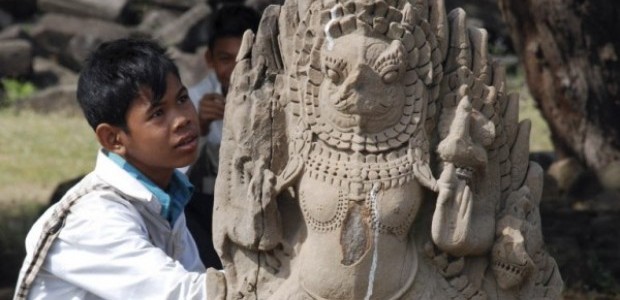
“It takes awhile to unfold this temple — and everywhere there are enticements,” says John Sanday, the team leader, as he navigates through tangled undergrowth, past dramatic towers and bas-reliefs and into dark chambers of the haunting monastic complex of Banteay Chhmar.
What drove Jayavarman VII, regarded as the greatest king of the Angkorian Empire, to erect this vast Buddhist temple about 105 miles from his capital in Angkor and in one of the most desolate and driest places in Cambodia remains one of its many unsolved riddles.
At its height in the 12th century, the empire extended over much of Southeast Asia, its rulers engaging in a building frenzy which produced some of the world’s greatest religious monuments.
Called the “second Angkor Wat,” Banteay Chhmar approaches it in size, is more frozen in time than the manicured and made-over superstar, and has so far been spared the blights of mass tourism of recent years at Angkor.
In 2011, an average of 7,000 tourists a day visited Angkor, one of Asia’s top tourist draws located near the booming northwestern city of Siem Reap. Banteay Chhmar saw an average of two a day, with no tour buses and bullhorn-wielding guides to disturb the temple’s total tranquility or traditional life in the surrounding village.
Abandoned for centuries, then cut off from the world by the murderous Khmer Rouge and a civil war, Banteay Chhmar didn’t welcome visitors until 2007 when the last mines were cleared and the looting that plagued the defenseless temple in the 1990s was largely halted.
A year later, the California-based Global Heritage Fund began work at the site under the overall control of the country’s Ministry of Culture and now spends about $200,000 a year on the project.
Sanday, a veteran British conservation architect, assembled a team of 60 experts and workers, some of whom were with him on an earlier restoration of the Preah Khan temple at Angkor. Others were recruited from the surrounding community and although barely literate, Sanday says they’re among the best he’s worked with in Asia.
Challenging them are hundreds of thousands of stone blocks from collapsed shrines and galleries scattered helter-skelter within the 4.6-square-mile archaeological site. Towers teeter, massive tree roots burrow into walls, vegetation chokes a wide moat girding the temple.
Three-quarters of the bas reliefs — rarely found at other Angkorian temples — have fallen or been looted, the most notable being eight panels depicting Avalokiteshvara, an enlightened being embodying Buddhist compassion.
Thieves sheared off four panels with jackhammers, smuggling them into nearby Thailand where two are widely believed to be decorating the garden of a Thai politician. A pair has been recovered and the others are still at the temple, although only two still stand.
“We’ve been struggling away with this gallery for nearly two years now,” says Sanday at another bas-relief, one depicting a figure believed to be Jayavarman VII leading his troops into battle. In vivid detail, the ancient sandstone wall springs to life with charging war elephants, soldiers plunging spears into their enemies and crocodiles gobbling up the dead.
Nature and time have proved the culprits: The vaulting protecting the 98-foot-long relief collapsed, exposing the wall to monsoon torrents, which seeped downwards to wash away the masonry and loosen the foundations. Pressure from the weight above toppled sections of the wall or forced it to lean.
“He’s going to have to come down,” says the 68-year-old architect of the king’s image. A section of the wall is angled dangerously outward, he explains, so it must be dismantled, the foundations reinforced and the sandstone blocks meticulously numbered, charted, then set back into place.
Nearby, two young Cambodian computer whizzes are pioneering a shortcut to another reassembly process through three-dimensional imaging. The work-in-progress is one of the temple’s 34 towers recently damaged in a severe storm.
Some 700 stone blocks from the tower have been removed or collected from where they fell and each one will be videographed from every angle. Since like a human fingerprint, no stone is exactly alike, still-to-be-finalized software should be able to fit all the blocks into their original alignment after they are repaired.
“We hope that with one push of the button all the stones will jump into place to solve what we are calling ‘John’s puzzle,’” says Sanday.
When an original block has gone missing or is beyond repair, either an original stone from elsewhere on the site is used or, as a last resort, a new stone will be inserted.
“My philosophy is to preserve and present the monuments as I found them for future generations without falsifying their history. So often people tend to guess what was there,” he says.
The Global Heritage Fund, he says, is also intent on involving the community. “We can’t protect Banteay Chhmar. They have to be the protectors. So they must gain some revenue from the temple,” Sanday says.
The Community Based Tourism group, which the fund supports, is training locals to become guides and devising ways to derive more income from tourism, part of which is funneled into betterment of the entire village.
Sanday and local organizers, however, hope Banteay Chhmar’s remote location will spare it from a mass tourist influx. Avoiding mass tourism also is why he isn’t keen to have it listed as a UNESCO World Heritage Site, something the Cambodian government is pushing.
“I often come here in the late afternoons, when the birds come alive and a breeze stirs,” Sanday says as fading sun rays, filtered through the green canopy, dapple the gray, weathered stones. “It’s peaceful and quiet here, like it used to be at Angkor. This is a real site.”
Read more!
Cambodia: PM’s Brother Wants Sex Case Dropped
The brother of Cambodian Prime Minister Hun Sen has requested a court official to drop a sexual harassment suit against two of his friends, drawing condemnation from rights groups.
Hun Sen’s older brother Hun San made the request in a letter to Banteay Meanchey Provincial Court Chief Prosecutor Phann Vanrath, a copy of which was seen by RFA. The prosecutor’s office confirmed with RFA that it had received the letter on Friday.
In the letter dated Dec. 3, 2011, Hun San, who is the director of an agency under the Ministry of Public Works and Transportation, calls the harassment claim against Cambodian Mine Action Center official Oum Socheat and businessman Thang Pisith “groundless.”
“Please forgive me that I can’t meet you in person,” reads the letter by Hun San, who is the director of the Kampuchea Shipping Agency & Brokers Department.
“I would like to request that you, brother prosecutor, please help intervene and aid Oum Socheat and Thong Pisith to put an end to the Nov. 13, 2011 accusation made by a waitress in a Stung Treng restaurant.”
Hun San questioned the accusation against the two middle-aged men, who allegedly verbally harassed and groped 25-year-old Hy Theavy while she served them, saying they would not have done so with others present at the table.
“As mentioned above, I ask that the prosecutor please intervene and drop the case. I hope that the prosecutor will help in ending the suit.”
Prosecutor Phann Vanrath confirmed to RFA that he had received the letter, but said it would not influence his decision on the case. He added that the court is investigating the matter and expects to issue a ruling in March.
“Both sides have their lawyers. The lawyers have asked for copies of the [victims] lawsuit,” Phann Vanrath said.
“I don’t know who leaked the letter, but we [the court] didn’t leak it. To do so would be against the court confidentiality code of ethics,” he said.
“I don’t bend to outside influence. I would quit my work [if that was a problem],” he said.
Potential influence
Cambodian rights group Adhoc’s Chief Investigator Ny Chakriya said he had also seen the letter, but refused to identify the source of the leak for security reasons.
He added that the letter may have already influenced the court’s decision.
“Based on the prosecutor’s statement in which he claims the letter did not influence him, Adhoc will continue to monitor the case,” he said.
“We will see via the court’s decision whether the judge can act without interference.”
Meanwhile, accuser Hy Theavy stood by her complaint of harassment, adding that if the suspects hadn’t committed any crimes then they would not have had to ask for help from the prime minister’s brother.
“Why did Hun San dare to say that Oum Socheat and Thong Pisith didn’t abuse me and decide to write a letter to the court’s prosecutor to drop my case?” she asked.
Hy Theavy said that she now fears for her personal safety.
“Is Cambodian law truly for both the rich and the poor?”
Reported by Sophalmony Soun for RFA’s Khmer service. Translated by Samean Yun. Written in English by Joshua Lipes.
Read more!
Chea Sim’s Ex-Bodyguard Chief Sentenced to 26 Years
“I didn’t commit anything. It’s injustice. I will appeal.”

The military court sentenced a former bodyguard chief of ruling party president Chea Sim on Friday to 26 years in jail.
Lt. Gen. Chhoeun Chanthan was found guilty for breach of confidence, distribution and selling of weapons and mismanagement.
Judge Pok Porn also ordered Chhoeun Chanthan to pay more than $3.6 million in compensation to three victims for their losses.
The sentence came more than a week after a court in Phnom Penh sentenced the former bodyguard chief to another ten years in prison for illegal possession of firearms and falsifying public documents.
“I didn’t commit anything,” Chhoeun Channthan told reporters. “It’s injustice. I will appeal.”
His lawyer Orn Hing says the decision is “unacceptable” as the court had mixed a civil case with a military one.
Chhoeun Channthan was arrested on August 2011 along with three bodyguards. The three have been sentenced by the Phnom Penh court to between three and four years in prison.
Read more!