By Phyllis Louise Harris, Asian Pages
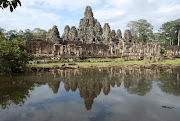
Wing Young Huie's cover photo this issue of the Cambodian man in front of the Ankgor Wat temple painting reminded me that I had not been to Cheng Heng for several years--11 to be exact. The photo is of Bunthary Van, father of Kunrath Lam who along with her husband Kevin have operated their Cambodian restaurant Cheng Heng for 13 years. Huie's camera captured Mr. Van standing in front of the restaurant's original, framed painting of the temple that they brought from Cambodia.
Kunrath Van, her parents and sister moved to Minnesota from Cambodia in 1984. She went on to finish high school, then college, married Kevin Lam, and opened Cheng Heng in 1997. They had talked of opening a Chinese restaurant in the building they owned on University Avenue in St. Paul, but then decided since there was no Cambodian restaurant in the area, to feature the cooking of Cambodia. So, they started with her mother's recipes.
From the beginning the food critics and attracted a loyal following. The menu is filled with noodle and rice dishes, substantial soups, coconut-milk curries, and multi-ingredient stir-fries. And, best of all, the food is refreshing and fresh. Like its neighbors Thailand, Laos, Malaysia, and Vietnam, Cambodian cuisine combines cooked with raw, sweet with sour, spicy with bland, and hot with cold, for some interesting dining flavors and textures. Lighter than Vietnamese and more mellow than Thai, the Cambodian food at Cheng Heng seems to appeal to a wide variety of diners. On a recent Friday lunch there were families with children, couples, singles, workers from a nearby business, retirees, and students of a wide variety of nationalities.
This time I had one of their rice noodle salads topped with warm stir-fried beef and onions, Cambodian fried egg roll, chopped peanuts, and fresh mint leaves. It is all served atop crisp, fresh bean sprouts, shredded lettuce, and slivered cucumbers bathed in a slightly sweet vinegar sauce. While I didn't see them, there was also the light flavor of licorice leaves. Add a little hot sauce and squeeze some fresh lime juice over it, and mother's home cooking is truly satisfying.
The menu is extensive and includes good descriptions of each dish along with small color photos. Many dishes can be ordered vegetarian and the prices are modest. The small, bright dining room looks out on busy University Avenue and is unpretentious...just as a neighborhood family restaurant should be. Cheng Heng, at 448 University Avenue West in St. Paul, is open daily from 9:30 a.m. to 9:30 p.m. with parking on the street. For information or take-out orders call 651-222-5577.
Phyllis Louise Harris is a cookbook author, food writer and cooking teacher specializing in Asian foods. She is founder of the Asian Culinary Arts Institutes Ltd. dedicated to the preservation, understanding and enjoyment of the culinary arts of the Asia Pacific Rim. For information about ACAI's programs call 612-813-1757 or visit the website at www.asianculinaryarts.com.
Read more!

Monday, July 26, 2010
Cheng Heng's very satisfying home style Cambodian cooking

Tribunal jails Khmer Rouge member for 35 years
PHNOM PENH, Cambodia (AP) — A U.N.-backed tribunal has found the former Khmer Rouge chief jailer guilty of war crimes and crimes against humanity and ordered him to serve 19 years in prison.
Kaing Guek Eav, also known as Duch, listened impassively as the chief judge read out the verdict Monday.
It was the first verdict to be handed down against a senior member of the genocidal regime blamed for the deaths of 1.7 million people during their 1975-79 reign of terror.
The court sentenced Duch to 35 years in prison, but shaved off the 11 years he's already spent in detention and five more for cooperating with the court.
Tribunal convicts Khmer Rouge member of crimes against humanity, sentences him to 35 years. - AP
Earlier report
PHNOM PENH, Cambodia (AP) - A U.N.-backed war crimes tribunal hands down a verdict Monday in the first trial of a senior member of the Khmer Rouge regime that turned Cambodia into a vast killing field three decades ago.
The defendant, Kaing Guek Eav, better known as Duch, ran the notorious Toul Sleng detention center reserved for "enemies" of the state. He admitted overseeing the deaths of up to 16,000 men, women and children who passed through its gates and asked for forgiveness during his 77-day trial.
Duch is widely expected to be found guilty of war crimes and crimes against humanity, but many people in this still-traumatized nation are anxiously awaiting the sentence.
Anything short of the maximum life behind bars could trigger public outrage.
Riot police lined up outside the court on the outskirts of the capital as hundreds of villagers - all of whom lost family members during the Khmer Rouge's 1975-79 reign of terror - started arriving by the bus load.
An estimated 1.7 million Cambodians died from starvation, medical neglect, slave-like working conditions and execution under the Maoist regime that sought to turn the country into an agrarian utopia. Their bodies were dumped in shallow mass graves that still dot the countryside.
The group's top leader, Pol Pot, died in 1998 and four other top members of the Khmer Rouge are awaiting trial.
Unlike the other defendants, Duch (pronounced DOIK) was not among the ruling clique and is the only major figure of the regime to have expressed remorse, even offering at one point to face a public stoning.
His surprise request on the final day to be acquitted and freed, however, left many wondering if his contrition was sincere. Some worry he will get off lightly.
Prosecutors asked that he face 40 years in prison, but because the 67-year-old has mitigated with the court and already spent 11 years in detention, there is a chance he'll get less than that.
Read more!
Sunday, July 25, 2010
Long haul for Cambodia's genocide court
By Guy Delauney BBC News, Phnom Penh
Cambodia's UN-backed genocide court has taken four years to conclude its first case
Marooned in the dusty outskirts of Phnom Penh, the Extraordinary Chambers in the Courts of Cambodia are hardly in the most auspicious of locations.
White-elephant housing projects stand half-built along the road out of the city. And for much of the time since it started work in 2006, it seemed the Khmer Rouge Tribunal would remain unfinished as well.
But the court's combination of local and international legal officials have now steered one case to its conclusion.
The former prison chief known as Comrade Duch may not rank among the senior leadership of the Khmer Rouge, but he was in charge of Cambodia's most notorious detention centre during the four years Pol Pot and his comrades controlled the country.
Duch - by his own admission - supervised the systematic torture and execution of thousands of prisoners at the S-21 prison in Phnom Penh.
His prosecution for crimes against humanity, torture and pre-meditated murder has come more than three decades after the crimes were committed, but the tribunal's Cambodian co-prosecutor, Chea Leang, believes it holds great significance.
"I feel proud that we have been able to complete this case," she says. "This is a good day for the victims and the Cambodian people as well as the international community."
'Hybrid' court
Chea Leang also sings the praises of the international standards of justice brought to the tribunal by UN-appointed legal officials, and hopes that will feed into Cambodia's much-maligned court system.
But the involvement of international funding and personnel has been at the heart of the problems which have occasionally threatened the whole process.
Donor countries have been reluctant to provide funding after repeated allegations of corruption on the Cambodian side of the tribunal. The government has criticised efforts by international officials to increase the number of prosecutions.
And there have been formal disputes between the international judges, prosecutors and defence lawyers and their local counterparts.
"When the court was established it was envisaged that there would be disagreements," says international co-prosecutor Andrew Caley, pointing out that these are handled by a process set out in the tribunal's internal rules.
He argues that the "hybrid" nature of the process - a local court supported by international officials and cash - was always likely to raise issues.
"We are required to demonstrate how the international system works - and they have to show us how the Cambodian system works. That has been a challenge - but it is the first time it has been done. And for all the problems, it has worked well."
Waiting for answers
The niceties of judicial relations are lost on some of the victims of the Khmer Rouge. They have been waiting more than 30 years for someone to be held to account for what happened to them.
Andrew Caley and Chea Leang are among the tribunal officials who have travelled around Cambodia explaining how the process works. But after so much suffering, it is little wonder that people like Chum Mey - one of only three confirmed, living survivors of S-21 - are unimpressed.
"So far there's no justice for the victims like me," he says outside the gates of S-21, where he scrapes a living as a tour guide.
"I can see they're working very hard - but there's not much justice because the perpetrators keep blaming the dead, saying they're more responsible for what happened."
Indeed, Pol Pot died in 1998 - and several other key figures have eluded justice through death. But the tribunal has charged four surviving senior leaders of the Khmer Rouge with genocide and their trial is likely to start next year.
For genocide researcher Youk Chhang, the director of the Documentation Centre of Cambodia, the conclusion of Comrade Duch's trial is merely the end of the beginning.
"Duch is a small fish, a prison chief," he says. "But his case has helped to bring about the second case - that's what's most important.
"The four senior leaders are known to all of us and they have the key information about how the regime was run, why there was starvation and forced labour. They'll have to answer all these unanswered questions."
Read more!
Saturday, July 24, 2010
Thais 'must be on hand to object'
BOYCOTT PM REJECTS PAD CALLS FOR
Prime Minister Abhisit Vejjajiva has rejected calls from the People's Alliance for Democracy for Thailand to boycott a World Heritage Committee meeting in Brazil, saying its absence would not do the country any good.
Mr Abhisit said yesterday the Thai delegation must be there to raise objections if Cambodia proposes a plan to unilaterally manage the Preah Vihear world heritage site.
Natural Resources and Environment Minister Suwit Khunkitti is taking the Thai delegation to attend the 34th session of the WHC, part of Unesco, in Brazil.
Cambodia is expected to propose a management plan for the Preah Vihear temple and its buffer zone at the meeting, which ends on Aug 3.
The suggestion to boycott the meeting was made to force a postponement of WHC consideration of Cambodia's proposed management of Preah Vihear temple, as Thailand is among the commissioners.
"It doesn't do us any good if we boycott the meeting. If [the item] is tabled for consideration, we'll make an objection as we see it," the prime minister said.
Mr Suwit had told him that Cambodia would proceed with its unilateral management plan for the surrounding areas of Preah Vihear temple.
He said the minister - who met the United Nations Educational, Scientific and Cultural Organisation director during a stopover in Paris - made it clear that Thailand would object, even though the proposal is said not to show the border demarcation between Thailand and Cambodia.
Mr Abhisit has asked Mr Suwit to keep the government informed about the WHC meeting so it can act promptly if the Thai delegation needs support.
"We have to lobby the international community on the issue and follow the meeting closely. I have also told Mr Suwit to inform the cabinet if he needs its support," he said.
The Thai delegation could meet the Cambodia delegation and inform them of the Thai government's stance.
Mr Abhisit said Thailand and Cambodia may compete for the chance to host a WHC meeting in the next two years. He said Thailand will propose to host the WHC meeting.
Read more!
Couple Brings Vietnam and Cambodia to Syosset
By Ursola Moore
Married for 54 years, retired schoolteachers Bob and Irma Mandel decided that there was no better way to spend their retirement years than traveling the world. They shared their many journeys during the presentation "Vietnam and Cambodia: From Repression to Recovery" Friday at the Syosset Public Library.
“Traveling is a great way to meet people and learn about another culture. We bring Vietnam and Cambodia right here to Syosset for all to see and learn about,” said Bob Mandel.
Dressed in native attire, the Mandels showed the audience their slideshow Travel Lights with the Mandels, a collection of pictures ranging from the natives' homes and schools to the rice fields, scenic mountains and breathtaking sunsets. They shared their unique experience of seeing these countries up close and personal.
Enlightening the crowd about the inner workings of how individuals live overseas, the Mandels spoke about the many challenges and misfortunes. Living in traditional communities and still utilizing labor-intensive farming methods, Vietnam remains in a struggle to join the industrial economies of the world. While the government embraced free enterprise in 1986, the majority of the population still lives in the countryside, where they fight for survival working in rice fields.
“Their lives are laborious. It is heartbreaking," said Irma. "I was close to tears watching them work in the rice fields. The lifespan is between 40 to 50 years old. The intensity of the hard work shortens the lifespan.”
While discussing Cambodia, the Mandels talked about how they center their lives around family, food and faith. Extended families stick together, solve problems in unison and come together to celebrate festivals. For the majority of Cambodia, survival depends on what they grow.
“Cambodia is poorer than Vietnam," Irma said. "There is a lot of child labor and a lack of education. We found out that the waiters in restaurants work seven days a week, 13-hour days with no tips. These people work and live under some of the most horrible conditions,” said Irma.
The Mandels admitted that in an effort to save money on their many adventures, they stay in hostels and in native families’ homes. Traveling early this year, the Mandels stayed in Cambodia for one week and Vietnam for three weeks.
“According to the homeowners, we were staying in the bridal suite of their home. It was a flat thin mattress on a very hard floor,” Bob said jokingly.
With artifacts such as a tobacco pipe, matrimony balls and incense displayed on the table, the crowd was invited to look over the items.
The Mandels' many travels include Australia, New Zealand, South Africa and Mongolia. They recommend traveling light.
“We never carry heavy luggage. We use our backpacks everywhere. It makes the trip so much easier,” said Bob.
For Irma, there is nothing better than traveling with her husband to foreign lands.
“We love it," she said. "We meet new people all the time and learn new things. It is wonderful.”
The Mandels are scheduled next to speak at the Port Jefferson Public Library on July 27. For more information about free programs at the Syosset Public Library, call 516-921-7161 or visit www.syossetlibrary.org.
Read more!
Friday, July 23, 2010
Ask Lonely Planet: Getting a taste of real life in Cambodia

- Matt Hollinshead
Tashi Wheeler, a former commissioning editor with Lonely Planet, writes:
Siem Reap is a gorgeous town to spend time in, but sight-wise it really is all about Angkor Wat. Heading out in a boat to some of the further-flung temples such as Banteay Srei and the river of a thousand lingas at Kbal Spean will take you out of Siem Reap. Although there isn't much in the way of village life around there.
You can't exactly watch land mine clearing in action but, if you are interested in the impact of land mines, you should definitely check out the Cambodian Land Mine Museum. It was established by a former Khmer Rouge child soldier turned DIY de-miner, Aki Ra.
.
It has informative displays on the curse of land mines in Cambodia and includes an extensive collection of mines, mortars, guns and weaponry used during the civil war in Cambodia.
Not only a weapon of war, land mines are a weapon against peace and proceeds from the museum are ploughed into mine awareness campaigns and support an onsite orphanage, rehabilitation centre and training facility.
Visiting the floating village of Chong Kneas, which is a bit of a tourist trap but still very scenic, can be a nice escape from Siem Reap and a good break from the temples.
Further afield, about two hours from Siem Reap, and more memorable than Chong Kneas, is the village of Kompng Phhluk. It's an other-worldly place built on soaring stilts. The village is a friendly place, where most of the houses are built on stilts of about 6m or 7m high, almost like bamboo skyscrapers. Check out the Lonely Planet Cambodia guidebook for more information on the villages and how to get to them.
The winning question this week is from Matt Hollinshead, who receives a copy of Lonely Planet China ($69.99).
Travelling by rail
I'm planning a backpacking tour with a friend of mine around Europe for six weeks, visiting Paris, Barcelona, Madrid, Marseilles or Nice, Munich, Rome, Naples (for Pompeii), Pisa, Venice, Vienna, Budapest, Krakow, Berlin, Hamburg, Amsterdam, possibly Rotterdam, London and back to Paris. We are wanting to travel by rail, but are a little stumped by the multitude of rail passes available and what would be best for this. We are both 22 and are planning on travelling using 2nd class youth tickets. What would be the best rail pass(es) to buy to suit this trip?
- Mathieu Wilson
Former Lonely Planet commissioning editor Tashi Wheeler writes:
Think carefully about purchasing a rail pass. In particular, prices for the multitude of Eurail passes have been going up much faster than inflation. They are pricey. Spend a little time online on the national railways sites and determine what it would cost to do your trip by buying the tickets separately. More often than not, you'll find that you spend less than if you buy a Eurail pass.
You have a lot of destinations, about 17, you want to get to and not that much time with only six weeks to spend doing it. This gives you about 2.5 days per destination and this isn't taking into account travel time on the trains or anything else that happens along the way.
Most of the Eurail passes only allow 10 to 15 days of travel within a one- to three-month period and Eurail doesn't cover the UK.
Out of all the Eurail passes, I would recommend the Eurail Youth Flexi pass. It's for those under 26 and for 2nd-class travel only: 10/15 days travel in two months for about $720-$940. Two to five people travelling together can get a saver version of Eurail passes, cutting about 15 per cent off.
Win a Lonely Planet guide book
Get the information you need to make your big trip a success. Email your travel questions to travel.info@lonelyplanet.com and they'll be answered by Lonely Planet's experts. In addition the best question each week will earn a Lonely Planet guide book. To give yourself a chance to win, add your postal address and the guide book you'd like to receive. You can find out about Lonely Planet books at LonelyPlanet.com. Not all questions are necessarily answered and Lonely Planet cannot correspond directly with readers, or give advice outside the column.
Japanese Textile Artist Drawn to Silk Mystery

The silks are a bit of a mystery, at least to Kikuo Morimoto, the founder of the Institute for Khmer Traditional Textiles, who was invited by the Smithsonian to explain Khmer silk dyeing and weaving.
Morimoto brought with him examples of hand-woven textiles that include an important twill pattern, called “hol.”
“I am interested in the mysterious story of yellow raw silk of Cambodia as material relating to Cambodian textiles,” he said, in addition to finding the source of the unique weaving technique.
An artist from Kyoto, Japan, Morimoto said he started his project to restore silkworm cultivation in Cambodian villages and to preserve a culture of weaving that is similar to that in Japan. He especially worked with weavers in Takeo province.
“I met an old woman, she is still keeping the old-day [hol],” he said. “This is the same in Japan also.”
He moved his institute to Siem Reap in 2000, after establishing it in Phnom Penh in 1996, and he hopes to find a way to teach the old methods to younger generations. He now has five hectares of land north of the temples of Angkor, a region that was the heart of the Khmer empire from the 9th to 14th centuries.
His work earned him a Rolex Award for Enterprise in 2004 and an audience with King Norodom Sihamoni in 2007. The king praised the institute for providing employment opportunities to impoverished Cambodian women and maintaining the old tradition.
Louise Allison Cort, a ceramic curator at the Freer and Sackler galleries, said she admired Morimoto for working to preserve the environment as well as the methods.
“When I wear this piece, I know that it was made completely by hand,” she said. “Somebody grew the mulberry trees to raise the silkworm; someone sponged the silk from the silk cocoons; someone used the natural dye to make the colors; someone weaved on the loom; and all of these people enjoyed their work and felt that it contributed to the whole finished result. And when I wear this I feel like I am participating in that project as well.”
The products of the silk weavers' labours are already being sold at a shop above the Siem Reap workshops. They are also available at the Freer and Arthur galleries withing the Smithsonian Institution in Washington DC.
Thursday, July 22, 2010
Journey to the East: U.S. derm leads volunteers in Cambodia
By: Lisette Hilton
Source: Dermatology Times
International report — Robert E. Kalb, M.D., made giving back a family adventure four years ago, when he, his wife and two college-aged children took their first medical mission trip with Health Volunteers Overseas to Phnom Penh, Cambodia.
The experience made such a positive impact on the Buffalo, N.Y., dermatologist and his clan that he has since become the organization’s dermatology director for Cambodia.
After searching volunteer options with the American Academy of Dermatology, Dr. Kalb says, the December 2006 two-week trip to Southeast Asia seemed the right fit.
“I wanted to go, and my kids wanted to go, so it worked out to go over the holiday break, in December and early January. That gave us time to visit Cambodia, because it’s not oppressively hot then, and it’s not monsoon season,” Dr. Kalb says.
“I contacted the Goldstone School of Hope (in Cambodia, www.gshw.org) … and my son corresponded with the principal for my family to volunteer as teachers there,” he says.
Dr. Kalb has since made the journey three times, and plans to return in January 2011. He is director of the Cambodia site for Health Volunteers Overseas Dermatology, which means he is in charge of soliciting dermatologist volunteers for trips.
Other dermatologists direct Health Volunteers Overseas programs in San Jose, Costa Rica; Bangalore, India; and Lima, Peru.
About the mission
The goal of the Cambodian medical mission is to help the local dermatologist (who is the only Cambodian native who has completed a full dermatology residency) to establish a dermatology department and residency program at the local medical school. Volunteers also work at the Preah Kossamak Hospital and/or the Sihanouk Hospital Center of Hope — the only hospital that provides free care in the country.
“You see patients with the local dermatologist and teach the physicians in training, and medical students,” Dr. Kalb says. “You assist in terms of seeing patients with diagnoses and treatment options, but, primarily, it’s an issue of education.”
The hope, according to Dr. Kalb, is that physicians in training and medical students there will take a year or a year and a half of dermatology training so they can return to their provinces and provide adequate dermatologic care.
Unlike many mission trips that require volunteering dermatologists to practice in makeshift hospitals, Heath Volunteers Overseas’ Cambodia opportunity is within the bustling city of Phnom Penh.
“It is a large city with amenities. You’re not in tents in the hinterland. You can stay in a four-star hotel, if you want,” Dr. Kalb says.
The work, however, is grueling. In addition to educating, Dr. Kalb might see 50 patients or more a day.
“You have people who drive 200 or 300 kilometers on the backs of motorcycles to go there. And the hospital can only take probably 10 percent to 15 percent of the people there on any given day, so the patients have to wait,” he says.
While most of the cases he consults on are severe manifestations of what dermatologists see in the United States — such as psoriasis or dermatitis with infections — Dr. Kalb also treats cases that rarely, if ever, present in his New York office, such as pellagra and Hansen’s disease.
Be prepared
Dr. Kalb recommends that dermatologists considering such a trip first talk with the dermatologist on site, as well as Dr. Kalb or other dermatologists who have been to that location in Cambodia. It’s also helpful to ask the local dermatologist what medications he might need at the time, and bring samples, he says.
Traveling with an organization such as Health Volunteers Overseas eases what can be challenging logistical issues. The established medical mission organization contacts the U.S. embassies and handles other paperwork, and offers insight from people at the destination and of those who have already made the trip.
Dermatologists pay their way, buying their flight tickets, hotel accommodations, etc. The trips, however, are considered charitable business deductions.
One of the most challenging aspects of volunteering, according to Dr. Kalb, is leaving one’s practice for what is often two weeks at a time. Dr. Kalb says it’s easier for him than it may be for others, because he has a physician’s assistant to see patients while he is away.
But doctors who are unable to schedule so much time away are still welcomed.
“We normally recommend that dermatologists go to Cambodia for two weeks, but if people can only come for a week, we’re not going to turn them down,” he says.
While U.S. dermatologists can do a lot to improve healthcare in developing countries such as Cambodia, Dr. Kalb says the doctors and their families who embark on these journeys tend to gain even more.
“We experience true poverty and see medical care in an entirely different light,” he says. “In the case with our family volunteering in the school, it was just such an unbelievably worthwhile experience for all of us, and that’s what keeps us coming back.”
Read more!
Cambodian Anxiety Peaks Ahead of Khmer Rouge Verdict

The trial of Kang Guek Eav, also known as Duch, has gripped this nation for almost a year and a half. Millions of people are expected to watch on television as the verdict is announced, Monday, by a United Nations-backed court.
Duch ran the S21 torture and extermination center, where thousands of men, women and children were processed before being sent to dig their own graves in the killing fields on the outskirts of the capital.
Initially, Duch pleaded no contest. Throughout the tribunal he has provided an abundance of chilling evidence into the inner workings of Pol Pot and his ultra-Maoists.
They ruled Cambodia between 1975 and 1979 and are being held responsible for the deaths of perhaps two million people, who died of murder, starvation and illness.
But, in a final legal twist, Duch changed his plea to not guilty and asked the judges to release him. He has sacked the head of his international defense team, French Lawyer Francois Roux, and asked for a Chinese lawyer to replace him.
Theary Seng survived the killing fields as a child. She was rescued from the refugee camps and raised in the United States, where she became an author and lawyer. She is the founder of the Center for Justice and Reconciliation.
"There's a lot of confusion at the moment because recently we were told Duch fired his U.N. lawyer at the 11th hour, on the advent of the verdict, which is very perplexing," Seng says. "And, it has raised suspicions again of political interference. It has raised cynicism. It has confirmed the fears of many Cambodians in thinking that Duch is not believable, in the first place - that his confession, his asking for forgiveness - aren't genuine and hopeful the fears won't turn into paranoia."
The Cambodian government has directed all domestic television networks to broadcast the verdict.
At the court, about 300 journalists and hundreds more officials, diplomats, legal observers and Khmer Rouge victims have overwhelmed authorities in seeking seats for the announcement.
Regardless of Duch's last-minute legal maneuvers, Theary Seng, along with many others, believe his admissions to overseeing crimes of torture that included water boarding and medical operations on patients without an anesthetic and the eventual murders of thousands of people will lead to a conviction and life in prison.
His evidence would also prove compelling in cases to follow. Another four surviving Khmer Rouge leaders - Khieu Samphan, Nuon Chea, Ieng Sary and his wife, Ieng Thirith - are to on trial next year.
"It's a catalyst that has broken the silence of the last 30 years of this regime, which has truly taken the lives of one-fourth to one-third of the Cambodian population. Every Cambodian alive right now is directly affected by the crimes of the past," Seng said.
After the Khmer Rouge were ousted by invading Vietnamese troops in early 1979, civil war continued for another two decades. Only then was Cambodian Prime Minister Hun Sen in a position to ask the United Nations to help broker an international tribunal to focus on the atrocities allegedly carried out by Pol Pot and his henchmen.
Further delays followed, amid bickering with the United Nations about the final make-up of the tribunal and funding issues. However, the long awaited trial eventually got underway and is expected to remain a fixture on this country's legal and political landscape for a few years to come.
New Zealander in Cambodia for Khmer Rouge verdict
By JERRY HARMER (AP)
PHNOM PENH, Cambodia — The brother of one of a handful of Westerners killed by the Khmer Rouge returned to Cambodia for a landmark verdict in a war crimes tribunal, saying there can never be adequate justice for his family.
It was not clear how Rob Hamill's brother, Kerry, fell into the hands of the brutal communist regime. The 28-year-old's yacht was captured in Cambodian waters in 1978 and he and shipmate Briton John Dewhirst were taken to S-21 prison, tortured and executed.
A third member of the crew, Canadian Stuart Glass, was apparently shot dead when the boat was seized.
When the news reached Hamill's hometown of Hamilton, New Zealand more than one year later, it tore apart what had been a close-knit family. One brother committed suicide months later; Rob Hamill became a teenage drunk. His parents never recovered.
"There'll never be justice for our family," said Hamill, 46, noting his mother died seven years ago and did not get to witness the trial or hear its verdict. "I can't quite reconcile how justice can ever be served with the nature and the way these people's lives were taken."
A U.N.-backed war crimes tribunal will issue its first verdict Monday against a senior member of the Khmer Rouge, the ultra-communist regime blamed for the deaths of 1.7 million Cambodians during their 1975-79 rule.
About a dozen Westerners were among the estimated 16,000 people held at S-21 before being killed.
As commander of S-21, Kaing Guek Eav, better known as Duch, faces a maximum sentence of life in prison if found guilty of war crimes and crimes against humanity.
Those who passed through the gates of his secret prison were deemed the worst enemies of the paranoid Pol Pot regime: spies, saboteurs, traitors — and foreigners. Many were tortured. Interrogators pulled out toenails, drained blood and electrocuted prisoners to extract confessions.
In 1979 after Vietnamese invaders overthrew the Khmer Rouge, Kerry Hamill's so-called confession of espionage was among the meticulous records discovered at S-21.
Last year Rob Hamill spoke at Duch's trial, the only Westerner to do so as a victim, and tried to convey his family's suffering.
He says confronting Duch in court has helped him deal with the grief that has haunted his life, but forgiveness for his brother's killer still eludes him.
"I wanted to forgive Duch so that it would allow me to move on — until I went to S-21 and I got to see what this guy created," he said. "Any compassion I had for him at that time went out the window.
"Since then, time has a funny way of warping things," he said. "I've got an internal battle going on and maybe this sentencing will somehow further that process."
On his first visit, Hamill says he was an emotional wreck. This time he said he feels more in control, more at peace and believes his brother Kerry would approve of the way the family is finally moving on.
"I think he'd be very proud of what we're trying to do as a family to represent him after 30 years of our own family suppressing it and not talking about what happened and the effect it had on us all as a family," he said.
"I think this is a very special time and I'd like to think he's looking down and saying 'Well, it's about bloody time.'"
Rob Hamill, a rower who represented New Zealand at the 1996 Atlanta Olympics, has requested a face-to-face meeting with Duch after the verdict to try to find out more about Kerry's fate. So far he's had no answer.
Read more!
Prison Deaths Across Cambodia Increasing: Rights Group
The number of people dying in Cambodia's prisons are increasing, according to a leading human rights group. Adhoc investigators say at least 26 prisoners have died across the country in the first six months of the year.
That number is an increase of 18 above the same period in 2009. The figures are according to a study conducted by Adhoc, which in part looked at prison documents.
The provincial prison in Kampong Cham accounted for the most deaths, which recorded at least six in the month of July, Adhoc reported.
According to a Kampong Cham prison report obtained by VOA Khmer, the prisoners died of Hepatitis B, hypertension and stroke, among other ailments. But Adhoc says the deaths can be blamed on overcrowding in cells.
“I do not believe prisoners died from disease,” Chan Soveth, an investigator for the group, said.
In Kampong Cham prison, up to 23 prisoners are kept in one room, creating conditions so crowded they are forced to sleep on their sides instead of their backs, he said.
Seak Leng Seap, deputy director of Kampong Cham prison, called the report untrue, but he declined to comment further. Officials at the Ministry of Interior's prison department could not be reached for comment.
Adhoc estimates the total number of prisoners in Cambodia at nearly 14,000, an increase of about 400 since last year.
Read more!
Wednesday, July 21, 2010
Christians Help Stem Cholera Outbreak in Cambodia
Two churches and a non-governmental organization working with the authorities have effectively stemmed a cholera outbreak in a district of Cambodia. The outbreak was part of a wider epidemic in the North-eastern Ratanakiri province that has resulted in at least 36 deaths since April.
Taveng district’s health center was overwhelmed with patients by early July. The health center expressed its need for help from volunteers to provide basic health education to prevent the spread of the disease. This was the evening of the first Sunday of the month.
As soon as churches in Ban Lung district and Ta Aung heard the plea, they mobilized their young people and trained them Monday morning. By the afternoon, volunteers were conducting a community education course with 300 people in attendance.
After the meeting, the team trained 14 health volunteers from Phaw and a neighboring village. Each volunteer received a set of materials to facilitate cholera education in outlying fields and hamlets.
In one instance, a woman living in a distant hamlet was about to die. However, local taboos prevented villagers from lending a motorized canoe to take her to the health center. The village head appealed to his Christian villagers and one of them lent his boat and the woman was saved.
Within three days, the team covered seven villages, all of them hotspots, in Taveng district. As a result of the cooperation between the Ban Lung Church, Christian development NGO ICC and district health authorities, the Taveng outbreak was brought under control.
According to official statistics, there were 96 cases and four deaths reported in Taveng during the one-week period of outbreak.
Cholera, a highly contagious disease, causes violent vomiting, diarrhea and possibly death from dehydration within four hours. More than 1,700 cases of cholera have been recorded in Ratanakiri province from April to early July.
The Cambodian province saw its last serious cholera outbreak in 1999 when 275 people died. At that time, Christians were involved in developing cholera education materials, such as pictures and catchy songs, suitable for use with illiterate tribal villagers. Multiple copies of the materials were made for health center staff and village health volunteers.
Pleased with the cooperation, the provincial health department invited the Ban Lung Church to address an official government cholera meeting held July 7.
During the meeting, the church distributed cholera education materials to staff of 29 health centers and health posts throughout the province.
The church even used creative arts in its efforts to promote health education within village communities. Young volunteers were trained to conduct educational skits and community theater. On invitation, they performed at the provincial hospital for relatives of cholera patients.
At the hospital, volunteers noticed that there were too many patients living in unsanitary conditions. Many people who came to care for their sick relatives ended up contracting the disease due to a lack of knowledge concerning hygiene. Meeting the need, the team set out to disinfect the wards with clorox.
After a successful debut in the hospital, the community drama troupe was invited to provide cholera education in the villages around Ta Aung commune, where outbreaks were still happening. The church also cooperated with officials from Kon Mum district to educate its villagers.
Villagers loved the slapstick performances in their own language. One lady, rolling over with laughter, exclaimed, “This is too real!” The performances showed how cholera is transmitted at funerals and through lack of personal hygiene.
The cooperation between Christians and the local authorities encouraged other Christian groups elsewhere. One group, inactive due to persecution, was emboldened after seeing the troupe working with authorities. Its members immediately resumed worship meetings.
Christians in the village of Sek were encouraged to see that they are part of a wider, caring community of faith. The close cooperation between Christians and authorities left a good impression on community leaders and parents of young Christians in that village.
As a result of the community service, non-Christians in the predominantly Buddhist country were drawn to learn more about Christianity. A staff from one of the health centers, who worked with the Christians, turned up for a worship service at Ban Lung Church. At that meeting, the church prayed for him and other public servants and organizations engaged in fighting cholera.
The team continues to cooperate with officials in Ta Aung and Toeum communes. It is currently visiting other hotspots in Taveng district.
Read more!
Cambodia delays stock market debut to next July
By SOPHENG CHEANG
Associated Press Writer
(AP:PHNOM PENH, Cambodia) Cambodia has delayed the opening of its proposed stock market for a second time, pushing the date back to July next year.
A statement Wednesday from the Finance Ministry said the delay was due to technical issues and the global economic crisis.
"The postponement of the stock market is to adapt to the evolving situation of the global economic and financial situation, which shows some positive signs of recovery but is still fragile," the statement said.
Last December, officials said Cambodia's stock market would open by the end of this year after initially targeting it to begin operating in 2009. After receiving the approval from Prime Minister Hun Sen, the Cambodia stock exchange is expected to kick off in July 2011, the statement said.
The Cambodian economy is small and reliant on textiles, which account for nearly 80 percent of exports, and hundreds of millions of dollars in international aid. Foreign investment has been deterred by the country's reputation for endemic corruption.
Neighboring Vietnam started its stock market in July 2000. Nearby Laos is also planning a stock exchange.
Hong Sok Hour, director general of the Cambodia Securities Exchange, said the delay was necessary because Cambodia needs everything to be in place before the opening.
"We want our bourse to be a good one when we open. That is why we need the infrastructure and human resources to be ready at the same time," Hong Sok Hour said.
In December, Cambodia awarded a contract to a South Korean firm, World City Co. Ltd., to build the $6 million, four-story, 71,900-sq. foot (6,682-sq. meter) stock market building in Phnom Penh's planned financial district on the outskirts of the capital.
Hun Sen announced plans in 2007 to launch a stock market, saying Cambodia needs to find new ways to attract international capital beyond international aid and bank loans.
Soon after, lawmakers approved a securities law on issuance and trading of nongovernment securities to pave the way for the market.
Read more!
Tuesday, July 20, 2010
Multinational peacekeeping operation kicks off in Cambodia

During the ceremony, Deputy Commander, U.S. Pacific Command, Maj. Gen. Peter Pawling said, "the Global Peacekeeping Operation Initiative training approach reflects the process as it continues to involve both conceptually and operationally to meet new and ever changing environments."
Countries participating in Angkor Sentinel include the U.S., Cambodia, Thailand, Vietnam, Nepal, Philippines, Mongolia, Tonga, Indonesia and Bangladesh.
Chief of Operations for Angkor Sentinel, Col. Ker Savoeun, Royal Cambodian Armed Forces, said the opening ceremony will help bring the Cambodian soldiers together with their leadership and allow them both to see what the Global Peacekeeping Operation Initiative is all about.
Over the course of the 14-day Angkor Sentinel exercise, participants will complete lane training in checkpoint operations, patrolling, securing a distribution site, convoy operations, conducting a cordon and search, and securing a disarmament area.
Angkor Sentinel 2010 is the latest in a continuing series of global operation initiative exercises designed to promote peacekeeping capabilities in the Asia-Pacific region.
Abuse, Rape Await Sex Workers in Detention: Human Rights Watch
 The 76-page report, “Off the Streets: Arbitrary Detention and Other Abuses Against Sex Workers in Cambodia,” is based on interviews with women and transgendered prostitutes in Phnom Penh and the provinces of Battambang, Banteay Meanchey and Siem Reap.
Citing interviews with 90 different sex workers, the international organization said the women face rape, physical abuse and robbery at the hands of authorities—charges a government spokesman denied.
“The Cambodian government should order a prompt and thorough investigation into these systematic violations of sex workers' human rights and shut down the centers where these people have been abused,” Elaine Pearson, acting Asia director of Human Rights Watch, said.
The 76-page report, “Off the Streets: Arbitrary Detention and Other Abuses Against Sex Workers in Cambodia,” is based on interviews with women and transgendered prostitutes in Phnom Penh and the provinces of Battambang, Banteay Meanchey and Siem Reap.
Sex workers are regularly arrested in sweeps of streets and parks and other sites under a 2008 anti-trafficking law that ill-defines crimes and allows the abuses to occur, the group said. Human Rights Watch found that even members of the anti-trafficking unit were culpable in some abuses.
“Sex workers told Human Rights Watch that police officers beat them with their fists, sticks, wooden handles and electric shock batons,” the group said in a statement. “In several instances, police officers raped sex workers while they were in police detention. Every sex worker that Human Rights Watch spoke to had to pay bribes or had money stolen from them by police officers.”
The group also pointed to “abysmal” conditions in the government center called Prey Speu, where it says at least three people were beaten to death between 2006 and 2008 and where a few sex workers have been detained this year. The center is a collecting point for marginalized groups such as street children, homeless and sex workers.
“The Cambodian government should immediately and permanently close down detention centers such as Prey Speu, where people are being unlawfully detained, beaten up and abused,” Pearson said in a statement. “Prosecuting those who commit these crimes will send a strong message that abuses against sex workers are not tolerated.”
Khieu Sopheak, a spokesman for the Ministry of Interior, denied the reports' findings.
“The sex trade is an illegal business in Cambodia, but our authorities do not use violence to suppress the sex trade,” he said.
Detained sex workers are kept in “social affairs centers” run by the government, where they are trained for “proper professions,” he said.
“If Human Rights Watch directly raises the names of police who committed crimes against sex workers, we will be happy to receive it,” he said. “But we regard the Human Rights Watch report as an accusation against the police that is not factual nor constructive criticism.”
He called the report an act of “defamation” against the government.
Tribunal Investigators Issue Closing Order for Second Trial
 All five of the detained leaders—Nuon Chea, Khieu Samphan, Ieng Sary, Ieng Thirith and Duch—were under investigation for crimes including genocide.
Prosecutors now have 45 days to issue their own recommendations as the second trial for the UN-backed court moves forward.
“It basically means that now the investigating judges have finished all the investigation in Case No. 002,” tribunal spokesman Lars Olsen said Tuesday. “The prosecutors will make their recommendations to the judges as to whether or not to indict any or some of the charged persons.”
All five of the detained leaders—Nuon Chea, Khieu Samphan, Ieng Sary, Ieng Thirith and Duch—were under investigation for crimes including genocide. A trial is expected in March 2011.
Latt Ky, a tribunal monitor for the rights group Adhoc, called the closing a “positive step” toward the trial.
Monday, July 19, 2010
Cambodia Needs Business Infrastructure: IMF Chief
The head of the International Monetary Fund has advised Cambodia to strengthen infrastructure that could buffer it from future economic turbulence.
“Cambodia is in a very critical situation,” Dominique Strauss-Kahn told reporters last week, following a two-day Asian economic summit in Daejoen, South Korea.
Strauss-Kahn had warned that many Asian countries need to strengthen their economic policies to protect them from future economic shocks, as economic officials met for the Asia 21 meeting. But Cambodia remains in a difficult situation, he said.
“To make progress, clearly the problem of infrastructure is the highest importance,” he said, “and it has to be stressed because trade and communication are strongly linked with infrastructure.”
Strauss-Kahn also advised increasing trade within Asian countries, so as not to rely on the West for consumers.
Cambodia is one of the smallest countries in Asia and is reliant on exports for economic growth. That made it vulnerable to the 2008 economic crisis, when orders from Western countries, especially the US, fell.
Analysts say Cambodia’s weak infrastructure limits its competitiveness. And the World Economic Forum 2010 report listed Cambodia as one of the worst countries in ease of trade.
“The government has been working on it, since infrastructure is the development priority of Cambodia,” said Sun Sanisith, secretary general of the National Bank of Cambodia, who attended the conference in Daejoen.
Meanwhile, Asian financial experts also warned of financial systems that will require more cooperation among Asian nations. Experts from South Korea, China and Japan all said the banking sectors of Asian countries can be better bolstered through increased capital reserves and better cooperation among local banks.
Read more!
After Illness, Hun Sen Issues Warning to Rivals
 Prime Minister Hun Sen walks through honorary guards as his arrives for presiding over a U.S.-backed peacekeeping exercise dubbed "Angkor Sentinel 2010" at the Cambodian tank command headquarters in Kampong Speu province, on Saturday.
Speaking in front of Svay Rieng University and appearing healthy, Hun Sen warned would-be detractors that he would tightly hold onto power, and he promised to be the leader of the country in both 2013 and 2018 general elections.
Hun Sen and five cabinet members were reported to have fallen ill with the the H1N1 virus last month, causing the cancelation of several high-level meetings, including with a delegation of German diplomats.
“The opposition party has been talking about my health since my absence,” Hun Sen said. “They say that I was kept in the house or that I fled Cambodia.”
Hun Sen said this could have inferred a coup d'etat and he warned that if such an event took place, Cambodia would erupt into open violence.
“Whoever dares to commit a coup d'etat, they should have a head of iron,” he said.
Yim Sovann, a spokesman for the opposition Sam Rainsy Party, declined to comment on Hun Sen's statements. “I want Cambodian people to judge his speech,” he said.
Cambodia To Seek Protection From Chemical Imports
 Activists say that Cambodia has become a major dumping ground of pesticides by major companies and smaller operators.
The government is considering application to the UN’s Rotterdam Convention, which outlines responsibilities of states towards each other regarding chemicals.
“The ministry is considering convention membership because we want to prevent other countries from using Cambodia as a trash bin for their hazardous chemicals and pesticides,” Agriculture Minister Chan Sarun told a meeting of government and development officials on July 14.
The meeting was to discuss a draft law to bolster protections against pesticides and other dangerous chemicals.
The Rotterdam Convention requires proper labeling and and instructions from countries of origin for chemicals, as well as disclosures on restrictions or bans of the chemicals. Both Thailand and Vietnam are among the 134 parties to the convention.
Meanwhile, Cambodia struggles with dangerous chemicals, with only about a third of all chemicals in local markets registered with the Ministry of Agriculture. Of them, only 14 percent have instructions and other labels in Khmer.
“Joining the Rotterdam Convention is a necessity, because when there is the import of hazardous chemicals into our country, we will be informed in advance,” said Keam Makara Dy, a health program manager for the Cambodian Center for Study and Development in Agriculture
First Epidemiological Study To Enroll Up To 1,000 Infants And Children In Cambodia Announced By Aeras And CHC
The Aeras Global TB Vaccine Foundation and the Cambodian Health Committee have announced the initiation of a study of tuberculosis prevalence in Svay Rieng Province, Cambodia, beginning this month. This is the first study conducted in partnership by the two non-profit research organizations and the first Aeras-sponsored study to be conducted in Cambodia.
"Enhancing the ability to diagnose TB in children is essential. The scientific knowledge to be gained from this trial will assist in global efforts while easing the suffering of children right now in Cambodia from this curable disease," says Anne Goldfeld, co-founder of CHC and professor of medicine at Harvard Medical School and Harvard School of Public Health.
One out of every three people worldwide is infected with TB. In 2007 more than nine million people became sick with active TB disease and nearly 2 million people died of the disease. Co-infection with HIV and the growth of difficult-to-treat drug-resistant forms of TB have worsened the epidemic and increased calls for new TB vaccines. Cambodia is ranked by the World Health Organization as among the 22 nations with the highest burden of tuberculosis. Nearly one million Cambodians are infected with TB and 12,000 die of TB annually.
Worldwide, infants and young children are at heightened risk for TB mortality because of inadequate prevention options, difficulties in timely diagnosis, and tendency to progress more quickly to severe and disseminated forms of TB disease. Due to resource constraints and technical difficulties in diagnosing childhood TB, the incidence of TB among infants is unknown in Cambodia.
This six month cross-sectional epidemiology study will enroll up to 1,000 infants and children under five years old. The primary objective of the study is to estimate the prevalence of tuberculosis among BCG-vaccinated children over the set period of the study in two operational districts of Svay Rieng Province.
With precise estimates of TB incidence in infants and children, strategic policies and programs for preventing, diagnosing and treating childhood TB can be developed in Cambodia and other resource poor environments. Towards this goal, this study will for the first time compare the efficacy of a state-of-the art liquid culture system donated by BD (Becton, Dickinson and Company) with traditional TB culture techniques.
"Accurate diagnosis of TB is critical to getting care to children now and to efforts to develop an effective TB vaccine. The currently available TB vaccine -- Bacille Calmette-Guérin -- provides some protection against severe forms of pediatric TB, but it does not prevent pulmonary TB, the most common form of the disease," said R. Gordon Douglas, Jr., MD, the Executive Chairman of Aeras Global TB Vaccine Foundation. "The world deserves new, more effective TB diagnostics and TB vaccines and Aeras is pleased to be collaborating with the Cambodian Health Committee in this effort."
Source:
Annmarie Leadman
Aeras Global TB Vaccine Foundation
Read more!