Bangkok - A 7-year-old tigress has given birth to four cubs at a nature reserve in west-central Thailand in the country's largest tiger delivery to date, media reports said Thursday.
Khao Chi delivered the cubs last month in the Huai Kha Khaeng Wildlife Sanctuary, which is home to South-East Asia's largest population of wild tigers, the Bangkok Post reported.
"It is unbelievable to experience the astonishing delivery of four tigers at one time," National Parks Department officer Sakit Simcharoen said.
"Usually, a tiger delivers one or two cubs at a time," he said.
The birth has given hope to park officials at Huay Kha Khaeng, 175 kilometres north-west of Bangkok, that they might achieve their ambitious goal of doubling the sanctuary's tiger population by 2022.
The park's wild tiger population of 100 is under constant threat from poachers, who killed three of the animals last month alone.
At a meeting in Hua Hin, Thailand, in January, ministers from 13 countries where Asian tigers are still found in the wild committed themselves to doubling the wild tiger population to about 7,000 by 2022 and protecting their fast-diminishing habitats.
The countries - Bangladesh, Bhutan, Cambodia, China, India, Indonesia, Laos, Malaysia, Myanmar, Nepal, Russia, Thailand and Vietnam - are scheduled to meet again for a tiger summit planned for September in Vladivostok, Russia, to map out their plans for saving the species.
There were an estimated 100,000 wild tigers in Asia 100 years ago, but now about 3,500 are left.
Read more!

Thursday, April 29, 2010
Tigress gives birth to quadruplets at Thai nature reserve

Wednesday, April 28, 2010
Cambodia tells diplomats it is no 'banana republic'
PHNOM PENH — The Cambodian government has told all foreign diplomatic envoys to avoid criticising the country, insisting it is not a "banana republic", in a letter seen by AFP Wednesday.
The foreign ministry letter sent to all diplomatic missions in Cambodia asked them to "avoid interfering in the internal affairs" of the country, regardless of the power of their home nations.
"There have been many occasions, in which some heads of diplomatic missions behaved like a 'proconsul' of his/her country to the Kingdom of Cambodia. They indulged themselves to criticise or to give lessons to the Royal Government of Cambodia," the letter said.
"Such behaviours are not acceptable for Cambodia as a sovereign country and a member of the United Nations. Cambodia is not a BANANA REPUBLIC," it added.
Asked about the letter dated April 26, foreign ministry spokesman Koy Kuong told AFP it was issued to remind all diplomats not to "exceed the limit of their mandate".
Cambodia last month threatened to expel a United Nations envoy if UN agencies continued "unacceptable interference" in the country.
The move came after UN agencies in Cambodia urged "a transparent and participatory" process as parliament debated an anti-corruption law that was criticised by the opposition and rights groups.
Ranked one of the world's most corrupt countries, Cambodia passed the anti-graft law in parliament on March 11, more than 15 years after legislation was first proposed, but only days after the draft was shared publicly.
Read more!
CAMBODIA: Strict penalties planned for acid attacks
Source: IRIN
Reuters and AlertNet are not responsible for the content of this article or for any external internet sites. The views expressed are the author's alone.
PHNOM PENH, 28 April 2010 (IRIN) - Keo Srey Vy's brother-in-law had been planning to sell his child so he could buy a new motorbike. When she threatened to tell the police, he went to the restaurant where she worked as a cook and doused her face with acid.
She reported the attack to police, but gave up after they demanded a bribe to investigate.
"I didn't consider revenge, but I wanted a law that would catch him and bring him to justice, and that law did not exist," Keo Srey Vy, who is severely scarred, told IRIN. A year after the attack, she may have reason for hope.
While countries such as Bangladesh and India have enacted severe laws and banned the open sale of chemicals, Cambodia had not taken any serious steps to curb the crime.
Under a new draft law on the use and management of acid, perpetrators of acid attacks would receive life sentences, the government said. Attacks resulting in minor injuries would come with a minimum five-year sentence.
"The law that we have today is not enough," Interior Ministry spokesman Khieu Sopheak said. "I think that stronger punishment will make them [perpetrators] more afraid of the law."
Statistics on acid attacks are unreliable since many cases go unreported. For most years since 2000, the Phnom Penh-based Cambodian Acid Survivors' Charity (CASC) [http://cambodianacidsurvivorscharity.org/index.htm] recorded 12-24 attacks. But between December 2009 and January 2010, 11 cases were recorded, raising the national profile of the problem.
Comprehensive law
The new law, according to the drafting committee, includes improved medical care and social integration programmes for survivors. The opening of a state-run medical centre for acid survivors is also being considered, although funding resources remain unclear.
Drafting committee deputy chairman Ouk Kimlek, who is also deputy national police commissioner, told local media the committee was planning to create "an acid foundation to generate money from all sources and NGOs to help provide skills and capital for them". He did not elaborate on the level of the government's contribution.
Rights groups believe acid attacks abound in part because the caustic chemicals are readily and cheaply available. The draft law thus stipulates that importers and sellers of acid have to be at least 20 years old and licensed to carry out any transaction involving the chemical.
To assist police in criminal investigations, vendors would also have to record the details of anyone who buys acid. Retailers who fail to comply would be subject to fines and lose their licence to sell the product.
Enforcement
Local rights and survivors' groups hailed the legislation as a necessary step in curbing attacks but sceptics questioned the government's ability to ensure police enforcement of the new law.
"We have impunity in Cambodia for rape and murder; most victims are paid compensation, or the criminal is never caught," Pung Chhiv Kek, president of the local rights group Licadho [http://www.licadho-cambodia.org/] said. "If you have a good law but it's not enforced, it's useless."
Illegal out-of-court settlements are common practice in Cambodia, and rights groups say they undermine efforts to discourage the crime.
"They pay US$200 or $300, which is hardly anything. When you have to eat, buy medicine, feed your family, [financial compensation] is never enough," said Chhun Chenda Sophea, CASC's programme manager. "They need to enforce the law strictly. If it's being enforced, then people will be scared of committing the crime."
Interior Ministry spokesman Khieu Sopheak agreed, saying the new legislation needed to coincide with an effort to "make the court system more responsible".
The government has yet to set a deadline for completion of the final draft, which needs approval from two government offices, followed by a vote at the National Assembly.
Meanwhile, Keo Srey Vy sold her home to pay her medical fees, and now, at 36, she depends on the CASC. Three of her children live with her mother, and another boards with an NGO.
"I was very happy to hear about this new law because it can help reduce this crime," she said. "I believe that if people know about the law, they wouldn't dare attack people."
Read more!
Cham Son Seeks Tribunal ‘Justice’ for Father
 Cambodian Muslim, known as Chams visiting Choeung Ek S21 prison of Khmer Rouge
Sann Math Ly was a villager leader, well known, and he was unhappy with the Khmer Rouge and their treatment of the Chams.
Ly Sukei’s father was a well-educated Cambodian Muslim who died at the hands of the Khmer Rouge in 1975.
Now Ly Sukei is one of 228 Chams filing as civil parties at the Khmer Rouge tribunal, as the UN-backed court prepares to try at least four jailed leaders of the regime for genocide and other atrocity crimes.
“I filed a complaint to find justice for my father,” Ly Sukei told VOA Khmer at his home in Kampong Cham province, where many Chams lived and died under the Khmer Rouge.
He remembered the day soldiers came looking for his father, Sann Math Ly, in the village of Svay Klaing in Krouch Chhmar district.
Sann Math Ly was a villager leader, well known, and he was unhappy with the Khmer Rouge and their treatment of the Chams.
By 1975, the Khmer Rouge were shuttering mosques and forcing Muslims to cut their hair, burn their Qurans and eat pork. They were not allowed to prayer or wear head-coverings. Anyone who refused was the target of arrest.
“A group of around 20 armed Khmer Rouge cadre surrounded my house, and one of them ordered me in the Cham language: ‘You, go call upon your father,’” Ly Sukei said.
As his father left the house and walked toward the waiting soldiers, he made a sign behind his back telling his son to go home and not follow. Ly Sukei, who is now 44, never saw his father again.
Sann Math Ly became one of an estimated 500,000 Chams killed under the Khmer Rouge. Tribunal judges are now trying to determine whether such killings can be prosecuted as genocide.
Ly Sukei has been haunted by that day and has frequently followed the tribunal process by TV and radio. He wants to know what happened to his father.
“He was killed without any reasons, so I cannot do nothing,” Ly Sukei said. “I must allow him to rest in peace.”
Now a father of five, Ly Sukei has tried to find out more about Sann Math Ly and even searched for his photograph among those hung at the Tuol Sleng torture museum. He found nothing there and expects to find little else.
Still, he attended the tribunal proceedings last year against Kaing Kek Iev, or Duch, who underwent a trial for atrocity crimes committed at Tuol Sleng when it was a torture center for the Khmer Rouge. Ly Sukei said he has faith the tribunal can at least help him.
“I just want one word from the tribunal: that’s ‘justice,’” he said. “For those killed, including my father.”
Read more!
Rare Khmer Bronzes To Show in Washington
An art exhibition of Cambodian bronzes to open in Washington next month, featuring Khmer sculptures and ritual objects from late prehistory through the Angkorian period.
An art exhibition of Cambodian bronzes opens for the first time in Washington next month, featuring Khmer sculptures and ritual objects from late prehistory through the Angkorian period.
Thirty-six masterworks from the National Museum of Cambodia’s collection of some 7,000 bronzes will show at the Smithsonian’s Sackler Gallery under “Gods of Angkor: Bronzes from the National Museum of Cambodia.”
“This exhibition presents the stunning accomplishments of Khmer bronze casters,” Louise Allison Cort, the gallery’s curator of ceramics, said in a statement. “These bronzes are among the most exquisite expressions of Khmer ideals of religious imagery and ritual implements.”
The works include a rare and highly valued urn and bell, seven diverse bronze figures, ritual paraphernalia and Buddhist and Hindu sculpture.
The exhibition, a collaboration between the Freer and Sackler galleries and the National Museum of Cambodia, explores significant developments in bronze casting, as well as cultural and religious developments that coalesced during the Angkor period into a recognizable Khmer style.
The exhibition will show from May 15 through Jan. 23, 2011, in Washington and is scheduled to travel to the J. Paul Getty Museum in Los Angeles in February 2011.
Read more!
Tuesday, April 27, 2010
World Bank To Inspect Lake Land Management

The World Bank’s inspection arm will conduct an inquiry into a land administration project, following complaints that the plan failed to protect the land rights of residents around the Boeung Kak lake development.
The Center of Housing Rights and Eviction says the $23.4-million Land Management and Administration Project failed to register land titles for the lake residents and in fact weakened their rights to customary land ownership.
The center requested an inquiry last year, and in a final report on the World Bank Web site, the Inspection Panel said the request warranted an investigation to assess management’s compliance with World Bank policies and procedures “and related issues of harm” with the project.
“The Panel would need to conduct an appropriate review of all relevant facts and applicable policies and procedures,” the report concludes. “This can only be done in the context of an investigation of the issues of compliance and harm raised by the Request.”
Some 4,000 families in the Boeung Kak community, the majority of them impoverished, face eviction from their land around the lake, which is slated for residential and commercial development by Shikaku, Inc. Some of them say they have lived in the area for 20 years.
The Center of Housing Rights and Eviction, which filed the complaint on behalf of the residents, welcomed the decision, but urged immediate action.
“The housing rights of hundreds of families are at stake at this very moment,” Salih Booker, the group’s executive director, said in a statement Friday.
World Bank officials have previously met with government officials, including within the Phnom Penh municipality, to address the concerns of Boeung Kak residents, but so far the sides have not been able to break the impasse.
Some residents say they have received fair compensation for moving, while others say they don’t want to move to a relocation site on the far outskirts of the capital.
Nonn Theany, director general of the Ministry of Land Management, the key government partner in the land management project, said the World Bank had a right to inspection but should inspect “its own staff.”
“The government has already terminated our partnership on the LMAP project,” she said.
The government ended the program in late 2009, claiming it contained too many conditions. Nonn Theavy said when the government worked with the World Bank on the project, “they didn’t say how we were doing.”
“But when there was an inspection team coming, they would just find our faults,” she said. “We had annual evaluation reports. Only recently, when an NGO spoke out about the eviction at Boeung Kak lake, they linked the work to that case.”
The project could only register undisputed land, she said.
“When we saw a disputed piece of land with the ownership not clearly determined, we had to skip that place,” she said.
David Pred, Cambodia’s director for Bridges Across Borders Southeast Asia, which works with the lake residents, said the Cambodian government had “walked away from these families and refused to partner with the World Bank to find a positive solution for them.”
“The Bank cannot walk away from these families now just because the government has closed the door,” he said. “The Bank has a moral and a legal responsibility to provide reparations to the people it has acknowledged have been harmed by this project. This is an important test of the accountability of the World Bank.”
Read more!
Cambodia re-allows S. Korean men to marry Cambodian women+
PHNOM PENH, April 27 (AP) - (Kyodo)—Cambodia has lifted its suspension of processing of marriages between South Korean men and Cambodian women after revising its marriage regulations in an effort to prevent human trafficking, a government official said Tuesday.
Foreign Ministry spokesman Koy Kuong told Kyodo News his ministry has notified all foreign embassies in Phnom Penh of the new marriage regulations that require a foreign man wanting to marry a Cambodian woman to be present with her in Cambodia during all stages of the marriage process.
The temporary suspension was announced last month for fear that Cambodian girls from the countryside were still being trafficked as prospective brides for foreign men, South Koreans in particular.
In 2008, Cambodia issued a similar temporary suspension on international marriage processing but it applied to all marriages with foreign men, not specifically those involving South Korean men.
That move followed a report by the International Organization for Migration that warned about networks of brokers or matchmaking businesses that had been arranging "fake, deceitful" marriages to bring Cambodian women to foreign places like Taiwan or South Korea to work as housemaids or prostitutes.
The report said from 2004 through 2007, some 2,500 Cambodian women had married South Korean men through brokers, while a Cambodian fact- finding mission sent to Taiwan in 2007 showed that 5,219 Cambodian women were living there, some of whom had been trafficked outright and many of whom claimed they had endured abuse.
Read more!
Total pays Cambodia 28 mln dollars for oil exploration: PM
French oil company Total has paid 28 million dollars for the rights to explore an area in the Gulf of Thailand, Cambodia's Prime Minister Hun Sen said Tuesday.
The Cambodian government, during a visit by Hun Sen to Paris, announced its decision in July last year to grant Total the right to search for oil and natural gas in the country's offshore "Block 3".
Disclosing the price paid by Total for the first phase of the search for oil in the area, Hun Sen said that eight million dollars of the money would go towards a "social fund".
"Total offered the highest (bid) among the companies," he said.
Total will pay an additional 20 million dollars if it starts drilling for oil in the offshore area, Hun Sen added.
At the same time the premier denied Anglo-Australian mining giant BHP Billiton paid a large bribe for an exploration contract in Cambodia, saying that money had also gone into a social fund.
Total "also has paid this kind of money," Hun Sen said during a meeting between the government and private sectors.
Following the discovery of oil in 2005, Cambodia was quickly feted as the region's next potential petro-state, but production has stalled as the government and Chevron appear to have failed to agree over revenue sharing.
Hun Sen said earlier this month he would terminate his country's contract with Chevron if the US energy giant does not begin oil production from offshore fields by late 2012.
Concerns have also been raised over how Cambodia -- one of the world's most corrupt countries -- would use its new-found oil and gas wealth.
Read more!
Monday, April 26, 2010
Thai king speaks out for first time in crisis, tells judges to work faithfully to bring peace
Thai king speaks for 1st time in political crisis
BANGKOK — Thailand’s ailing king spoke Monday for the first time since his country descended into political chaos, but the man seen by many as the best hope for securing a peaceful resolution failed to address the deadly crisis that has shut down parts of Bangkok.
Speaking from the hospital, where he has been for more than seven months, King Bhumibol Adulyadej told newly appointed judges that they should faithfully carry out their duties and help keep the country stable.
“In the country, there might be people who neglect their duties, but you can set an example that there are those who perform their duties strictly and honestly,” the 82-year-old king said.
His vague comments could be seen as a possible reference to accusations that the government has failed to keep order when faced with the militant protesters who have taken over part of central Bangkok.
The king’s lack of clear statement, however, signaled he was not prepared to take an active role in resolving the crisis, as he did in 1973 when he stopped bloodshed during a student uprising and again in 1992 during antimilitary street protests.
The U.S.-born Bhumibol, the world’s longest reigning monarch, has been hospitalized since Sept. 19, when he was admitted with fatigue and loss of appetite. The palace has said he is recovering from a lung inflammation, but not explained why he has been hospitalized for so long.
At least 26 people have been killed and nearly 1,000 wounded since protesters called Red Shirts began occupying parts of the capital, closing down five-star hotels and shopping malls and devastating the country’s vital tourism industry.
The government said it hoped to resolve the problem peacefully, despite a breakdown in negotiations, but added it could not allow the protests to go on indefinitely.
“We’re required to keep peace and return the area to normalcy,” government spokesman Panitan Wattanayagorn said.
The Red Shirts consist mainly of poor, rural supporters of former Prime Minister Thaksin Shinawatra and pro-democracy activists who opposed the military coup that ousted him in 2006. They believe that Prime Minister Abhisit Vejjajiva’s government — backed by the urban elite — is illegitimate.
The conflict has been characterized by some as class warfare, and a pro-establishment group known as the Yellow Shirts have demanded that authorities crack down on the demonstrators — even implying they might take matters into their own hands.
“The government has the responsibility to protect the people, but instead shows its weakness and inability to enforce the law,” said Suriyasai Katasila, a leader of the Yellow Shirts.
Thousands of “Red Shirt” protesters have shed their signature crimson attire as their leaders warned they should be prepared to blend in if the government cracks down on their enclave. Many Red Shirt supporters outside the capital have tried to prevent police reinforcements from moving into Bangkok.
In at least six places around the country, Red Shirt supporters scattered nails along roads, set up checkpoints and searched vans and buses for police officers headed to the capital.
Some police heading to Bangkok were forced to return to their bases, while police in the central province of Phitsanulok, impatient after a 5-hour standoff with the Red Shirts, broke through a cordon of protesters who hurled rocks and wooden sticks at them, Thai media reported.
While there was no violence in the central Bangkok shopping area where protesters remained camped for a 24th day, an explosion injured eight people late Sunday near the home of former Prime Minister Banharn Silapa-archa, who is allied with the ruling coalition.
Thaksin, who fled Thailand ahead of a conviction on corruption charges, said Monday that he is in contact with the protesters and he defended their cause.
“We just fight for democracy. Let them fight for democracy and justice,” he said in Montenegro, one of a handful of countries that have offered him a passport. Others, such as Germany and Britain, have barred him.
Meanwhile, the government appeared to have left itself few immediate ways out of the crisis.
Panitan, the government spokesman, said the government could not tolerate the protesters’ camping out in the city anymore, but appeared to rule out sending in security forces anytime soon because that would likely lead to violence.
He also said political negotiations to resolve the crisis peacefully would remain on hold until the government had arrested Red Shirt leaders accused of inciting violence. Warrants have been issued for two dozen leaders.
Over the weekend, Abhisit rejected a compromise offer by the Red Shirts, dashing hopes for a peaceful end to the standoff.
“There will be no negotiations until shadowy elements are contained,” he said.
Associated Press writer Predrag Milic in Podgorica, Montenegro, contributed to this report.
Read more!
On Island of Massacre, Chams Remember
On an island in the Mekong River in Krouch Chhmar district, about 50 km from Kampong Cham provincial town, lies a Cham village that is little more than a few bamboo, thatched-roof houses.
On an island in the Mekong River in Krouch Chhmar district, about 50 km from Kampong Cham provincial town, lies a Cham village that is little more than a few bamboo, thatched-roof houses.
The village is on Koh Phal, or “Island of Harvest,” where Cham Muslims resisted the Khmer Rouge in an uprising in September 1975, just five months after the radical Maoists took power in Cambodia.
“The reason for the rebellion was that there was no more Islam,” Chet Sman, a 75-year-old widower and the head of one of the four families living here, told VOA Khmer in an interview recently. “The Khmer Rouge collected our Quran for burning and cut women’s hair, including my mother’s. This is the reason.”
Chet Sman sat in front of an old black-and-white TV in his cottage, smoking tobacco and describing the uprising, which led to a massacre of the Chams on the island. These killings, and others like them, will be a part of the Khmer Rouge tribunal’s upcoming trial against four jailed leaders of the regime.
The Khmer Rouge shut down mosques, forbid prayer and abolished head-covering for women, he said. They also forced the Chams to raise pigs and eat the pork, a deeply offensive act to the traditional Muslims.
Before the Chams of Koh Phal were pushed to rebellion, the Khmer Rouge went house to house, collecting swords, knives and other tools that might be used as weapons, Chet Sman said. But many villagers hid theirs, or quickly constructed new ones, as they decided to resist.
“The desperate villagers who dared fight against the Khmer Rouge with their swords or bamboo wanted to die as our religion disappeared,” he said, his own long knife and axes lying nearby.
In response, the Khmer Rouge surrounded the island with artillery and weapons. Within a week, they had killed the rebellious villagers, burned down their homes, religious schools and mosques and then turned the name of Koh Phal to Koh Phes, or “Island of Ashes.”
Then, two weeks later, Cham villagers in Svay Klaing, 10 kilometers away, rose up as well, after their teachers and religious leaders were arrested by the Khmer Rouge. Many more were killed in a single day and night.
Ysa Osman, author of “The Cham Rebellion,” which chronicles the uprisings, said the Khmer Rouge then sent survivors to four prisons in Kroach Chhmar district, in areas prone to malaria.
“At that time, there were not enough prisons to put people in, as there were thousands of people both young and old,” he said in an interview last week. “So the Khmer Rouge used schools and pagodas as detention centers for the rebellious villagers.”
Among an estimated 1.7 million people who were killed or died of starvation, overwork or torture under Democratic Kampuchea, an estimated 500,000 are believed to be Chams, according to the Documentation Center of Cambodia.
In late 2009, the UN-backed Khmer Rouge tribunal added the charge of genocide for four former Khmer Rouge leaders awaiting trials. The four, Nuon Chea, Khieu Samphan, Ieng Sary and Ieng Thirith, had previously been charged with crimes against humanity, murder, torture and religious persecutions.
As part of the trial, which could begin next year, Yusos Pinyamin, a survivor of the Svay Klaing massacre, was among those who have filed complaints as civil parties, and he said recently he wants justice done more quickly.
He worries the old leaders will die before they see trial.
“I knew that I could not win, but it was not worth living any longer,” the 56-year-old “hakim,” or village elder, said of the 1975 rebellion. “I was so desperate that I could not wait to be killed.”
Read more!
Remembering 'Year Zero' when Beijing-backed regime rammed socialism through
UNITED NATIONS — Thirty-five years ago this week, the guns fell silent in Cambodia. The capital city Phnom Penh was captured by the Khmer Rouge communists and the war was finally over. Then an unfathomable reign of terror commenced pulling Cambodia into yet lower levels of the Indochinese inferno. Now a generation later, an UN-backed tribunal is trying key Khmer Rouge leaders “accused of mass killings and other crimes during the country’s genocide.”
During the rule of the Beijing-backed Pol Pot regime between 1975-1979, nearly two million Cambodians were killed by their own people in the name of communist utopianism. The Year Zero as it was called, was to forcibly transform Cambodia into a socialist state, which rivaled the radicalism even of Mao’s Cultural Revolution in Mainland China.
Neighboring Vietnam’s invasion of its old ethnic rival, Cambodia and the instillation of a puppet regime in 1979, interrupted the sanguinary rule of Democratic Kampuchea. Despite the illegality of the invasion and the dubious legitimacy of the rulers, (many of them former Khmer Rouge defectors), from a human rights perspective, and for the average Cambodian, the situation improved.
Yet Democratic Kampuchea was still the UN-recognized representative holding the seat of Cambodia. An annual political General Assembly debate brought together representatives of the Pol Pot regime, genuine nationalists, and the mercurial if bizarre Prince Sihanouk. The People’s Republic of China backed the Khmer Rouge, the U.S. Administration of Jimmy Carter had just recognized Beijing and thus was playing the China Card, and most developing countries opposed Hanoi’s invasion too. Thus there existed the political clout to produce resounding majorities contemning Vietnam’s illegal occupation of Cambodia.
In light of the condemnations of Vietnam, it almost became an afterthought that the Khmer Rouge had presided over the infamous Killing Fields, an indisputable genocide which tore the once gentle heart from this Indochina land, making the very name Cambodia synonymous with forced starvation, torture and death.
Given massive international political pressures, Vietnam withdrew from Cambodia and allowed a UN peacekeeping and political process with led to free and fair elections in the early 1990’s. Not surprisingly the old Kingdom of Cambodia was reestablished. By 2003 the UN and Cambodia agreed to a joint judicial Tribunal, tasked with trying leading Khmer Rouge figures. The Tribunal is composed of both Cambodian and foreign judges.
Recently the UN’s Chief Legal Counsel, Patricia O’Brien, visited the Phnom Penh-based Tribunal, officially called the Extraordinary Chambers in the Courts of Cambodia, (ECCC). After holding discussions with Cambodian officials, she stressed the continuing importance of the Tribunal, but called on donor countries to provide funding to support the ongoing judicial process.
The ECCC budget for 2010 stands at $45 million and is paid by both the Cambodian government and foreign donors. The Tribunal provides a full and proper legal frame- work with Trial and Appeals Chambers.
A trial of the notorious leader Kiang Guek Eav also known as “Duch” has finished and he is awaiting sentence. He was charged with crimes of torture and premeditated murder at the infamous S-21 camp. There will be at least a few more trials before the Tribunal winds down its mandate in 2015.
According to a statement, “The ECCC has confirmed its ability to conduct complex international criminal trials to international standards.” Yet the obvious question arises; with so many of the perpetuators of the Khmer Rouge genocide still alive, and many living openly in Cambodia, why is the Tribunal’s mandate so narrow?
Clearly there are large numbers in Cambodian society who are willing to turn the page on the past, or who more likely, fear returning to that past. Confronting the living ghosts of the Pol Pot regime raises fears and a specter of a Cambodia which existed before probably most of the current population was even born. The fragile peace, fractious democracy, and fluctuating economic development have moved forward but could quickly wilt in the hot-light of recriminations or perhaps worse. Revenge for the crimes of the genocidal regime is not the issue, but justice should be the indisputable goal.
Read more!
US Embassy in Cambodia Says Remains Are Not US Photographer
 The surviving journalists and photographers who covered the war in Cambodia between 1970-75 gathered in Phnom Penh last week. They are seen here at a memorial to mark the 37 local and foreign colleagues who died during that time.
In 1970 war photographer Sean Flynn, the son of legendary Hollywood actor Errol Flynn, was in Cambodia covering the country's drift into civil war.
On April 6th that year he rode out of Phnom Penh with U.S. journalist Dana Stone. The two were not seen again, and were presumed captured and killed by the Khmer Rouge.
But last month two amateur excavators said they had found Flynn's remains in southeastern Cambodia.
On Monday, the U.S. Embassy in Phnom Penh said that military scientists tested the remains and found they are not Caucasian, and therefore could not be Flynn or Stone.
"And limited analysis suggests that they may be indigenous. Further testing is underway," embassy spokesman John Johnson said.
The excavation of the remains caused controversy. It came just weeks before a group of 27 journalists and photographers who covered Cambodia in the 1970s arrived here for a reunion, the first since Phnom Penh fell to the Khmer Rouge in April 1975.
Some of the journalists, many of whom knew Flynn and Stone, were angry at the way the excavators recovered the bones, especially their use of heavy earthmoving equipment.
The Embassy's Johnson says the use of a backhoe - a mechanical digger - caused problems.
"The remains are badly fragmented due to the manner in which they were recovered," Johnson said.
During their visit here last week, the group of returning journalists unveiled a memorial to the 37 Cambodian and foreign colleagues who died or disappeared during the war.
Among the names read out at the ceremony were those of Sean Flynn and Dana Stone, whose fates still remain unknown.
Sunday, April 25, 2010
World Health Organization (WHO) recommends traveller “insect repellent”
World Health Organization (WHO) recommends traveller “insect repellent” as one of the basic medical kit.
Apr 25, 2010 – Moz Away mosquito repellent spray is a 100% natural made mosquito repellent spray with deet free and no side effect to adults, children and babies. Because it is natural, safe and effective, Moz Away mosquito repellent spray has becoming popular household brand in the market today.
Why Moz Away Mosquito Repellent Spray is your choice
• 100% natural plant oil (DEET FREE)
• Long protection hour
• Suitable for indoor and outdoor
• Non greasy, staining and alcohol free
• Safe for baby and children
• Suitable for all skins
• Easy to use and carry especially when you travel
Moz Away mosquito repellent spray is made of natural ingredients, non- greasy, non- alcohol and DEET FREE. MOZ AWAY is specially formulated to pH5.5. It is chemical free and no artificial fragrance and suitable for all skin. It is gentle on all skin and washes off easily. It is safe for children and babies.
Alert! Mosquito disease seriously reported in Africa, United States, Canada, Caribbean, Mexico, Mauritius, Brazil, Argentina, Chile, China, Korea, Philippine, Taiwan, Thailand, Vietnam, Cambodia, Myanmar, India, Nepal, Malaysia, Australia, Singapore, Indonesia, Middle East countries. World Health Organization (WHO) recommends traveller “insect repellent” as one of the basic medical kit.
Active ingredients:
Citronelle oil 15% and Neem oil 2%
Indications:
Long lasting protection from mosquitoes and harmful insects. It is suitable for indoor and outdoor use.
Direction for use:
Spray onto exposed areas such as arms, legs and face. For face and lower limbs, it is easier to spray on the hands before apply.
Quantity:
75ml per bottle
Usage instructions with tested and result provened:
1) Hand/ Leg/ Body/ Face (External only)
Spray on hands, legs and body when mosquitoes are active. For face, spray onto hands before apply.
2) Shoe cabinet/ wardrobe
Mosquitoes like to stay in the shady and windless area such as shoe cabinet and wardrobe; you may spray few times into cabinet or wardrobe to cut down mosquitoes to fly in.
3) Clothes
Spray onto clothes before wear especially when you intend to go out at night.
4) Plants/ Flowers
Mosquitoes like to hide around home plants or flowers; you may spray onto plants or flowers to repel mosquitoes and harmful insects immediately.
5) Car
Mosquitoes like to fly into car at night or early morning, spray few times into car then leave the door open for 1- 2mins before get in.
6) Bedroom
Mosquitoes are active at night, spray few times into bedroom before go to bed.
7) Window / Door
Mosquitoes always fly into house through doors and windows, spray few times to the side of doors and windows to cut down mosquitoes fly into the house.
8) Dustbin
Because of the wastage foods, other than flies, mosquitoes also like to fly into dustbin, spray few times into it to cut down mosquitoes and flies.
# # #
Moz Away mosquito repellent spray is a 100% natural made mosquito repellent spray with deet free and no side effect to adults, children and babies. Because it is natural, safe and effective, Moz Away mosquito repellent spray has becoming popular household brand in the market today.
Visit our websites for more details.
English website: http://bestmosquitorepellent.blogspot.com
Chinese website: http://1mosquitorepellent.blogspot.com
Read more!
Exploring Cambodia
 Laura Tanna, Contributor
A tear slid down his cheek as Ly Sarith described the constant battle of wits for survival. If they shout "Attention!", don't stiffen like a soldier. They'll kill you. If they ask you to read something, don't. They'll know you're educated and kill you. His father was executed. He survived.
Too often we think of Cambodia as the killing fields of the Khmer Rouge, and for us it was a rarely moving experience to speak with such a holocaust survivor, though our purpose for visiting Siem Reap was to view magnificent temples.
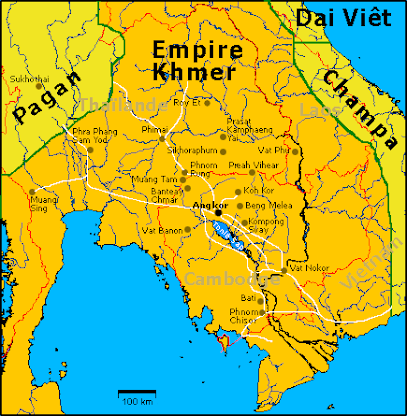
The Khmer empire once stretched in the west from the Burmese border with Siam, now Thailand, and north to Laos. Khmer kings traded with the Chinese and adopted the religion of Indian scholars. In their quest to attain benefits from the gods in this world and the next, Khmer royalty created both Hindu and later Buddhist monuments from the 9th through the 15th centuries, the ruins of which remain part of Cambodia's remarkable heritage. Frequently at war with their neighbours, the Siamese and the Viet, the Khmer kings often moved their capitals. Today the best known of these glorious Khmer temples are Angkor Wat, 'the town which is a temple', and Angkor Thom, 'the great town', located near Siem Reap, a name which translates as defeat of the Siamese.
Elegant residences
Both the Grand Raffles Hotel
d'Angkor and the boutique Amansara Hotel serve as elegant residences, while more basic hotels and bed and breakfasts also accommodate an increasing number of international visitors who fly into this city to visit these historic sites.
Our Amansara Hotel provided an experienced guide, a two-seater motorcycle rickshaw and morning and afternoon expeditions which started with the wind blowing through our hair as we sped four miles to the various temples. What I wasn't expecting was the immersion into rural Cambodian life. Our first afternoon at 3:00 we headed east of Siem Reap, past a dry countryside resembling Guyana, the wooden houses built high above ground on stilts to protect from floods in the late May to November rainy season. Then the now-parched fields become rice paddies, plowed using white bullocks whose ribs are showing. Occasionally, a brown-water buffalo appears. Rural houses have walls of woven banana fronds, sometimes blue tarps or plastic rice bags hanging side by side to supplement these.
The Peoples' Party of Cambodia enclaves always seem to be better built of proper wood. One yard enclosed in grand wrought-iron fencing with gilt prongs was identified as belonging to someone who had escaped to 'foreign' and sent money back. Poverty speaks of the brutal killing fields where the educated were butchered, over one million and a half people dying during the reign of the Khmer Rouge, from 1975 to 1979, where their extreme Communism sought to eliminate all but an agricultural peasantry from which to build a new state.
Many who survived the violence died from starvation, and though the Vietnamese overthrew the Khmer Rouge in 1978/79, civil war continued until the Viet withdrawal in 1989. After the Paris Peace Accord of 1991, Angkor Wat became a World Heritage site in 1992 and restoration of the magnificent temples slowly began. Today, small farmers have a few bananas, coconuts, maybe corn and mangoes but despite the horror of their suffering over the decades, when we walk the country lanes people wave. Lying in hammocks or gathered beneath the houses, pet dogs and children play in the dirt. Wells are cement gifts from foreign aid. Many foreign organisations provide assistance for orphanages and schools. Just as today the world is responding to Haiti's need after the devastating earthquake, the world is assisting Cambodia in small ways after ignoring the holocaust that destroyed a generation.
I first heard of Angkor Wat when Jacqueline Kennedy visited in the '60s. You may have seen Ta Prohm, the temple in the jungle where Angelina Jolie was filmed in Lara Croft: Tomb Raider. Here ancient forest consumes man's efforts to venerate his gods as huge trees with gigantic roots envelope the temples. Already I understand why the actress adopted a Cambodian son. The children are adorable - not demanding, not annoying - just delightfully asking one to buy their postcards or guidebooks, they wait by temple entrances to earn a dollar. Yes, Siem Reap uses US dollars as its main currency.
Temples are built from lava, sandstone and covered in stucco. The higher each platform level, the smaller are the repeated designs, so an illusion of great height is attained, creating temples of rare beauty. Sadly, some lay in complete ruin on the ground. Like a gigantic jigsaw puzzle, 400,000 blocks of stone are assembled in one area, awaiting restoration by dedicated archaeologists from France, Germany, Switzerland, China, Japan, India, American NGOs and other countries, each restoring different sites. The most famous, the 500-acre rectangular Angkor Wat, built from 1113-50 AD, once a Buddhist then a Hindu temple, has vast walls of bas relief carvings portraying scenes from the Ramayana and other mythological and historic themes, including depictions of King Suryavarman II's army, reminiscent of ancient Egyptian bas relief on the tombs of Pharohs. In fact, experts dispute whether this complex was actually designed as a temple or a tomb.
Favourite site
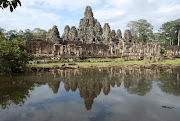
My favourite site was Bayon, in the exact centre of the last capital, the royal city Angkor Thom, built a mile north and years after Angkor Wat. As the administrative and religious centre of the Khmer empire from the end of the 12th century, with 54 towers and more than 200 huge carved heads depicting the Buddhist concept of the cosmos, Angkor Thom was reputed to outrival any European city of the time. We walk through the forest at dawn, birdsong as beautiful as the music from Buddhist temples to arrive at one site. Another night we walk through the forest under a full moon to watch the sun slowly rise above the ancient temple towers. Nothing prepares you for the awesome understanding of man's mortality, your own fleeting existence, in the presence of glory and power, diminished to ruined grandeur.
If you're going to Siem Reap, a guidebook is an absolute must as each site depicts such a complex religious and political history that even a few hours of reading will enhance one's appreciation of the art and architecture enormously. Visas may be obtained via the Internet and avoid the rainy season when malaria-spreading mosquitoes are more prevalent. The ambiance, food and service of the Amansara were excellent!
Read more!
Kent project to collect memories
Forty years have passed, but memories remain fresh of what occurred during four days in May on a pretty campus in northeastern Ohio.
That year, the gently rolling grassy hills of Kent State University were dotted not by people relaxing in the sun but by Vietnam War protesters and National Guardsmen with rifles.
Emotions ran high, spurred by news of U.S. bombings in Cambodia on one side and by exhaustion on the part of the guardsmen, fresh off a Teamsters strike.
Trouble began on Friday night, with vandalism downtown and a bonfire in the street. The ROTC building was burned on Saturday.
And on a sunny Monday, shortly after noon, guardsmen shot and killed four students and wounded nine others.
Many details of the day remain debated, but the names of the dead have become well-known: Allison Krause, Jeffrey Miller, Sandra Scheuer and William Schroeder.
Faculty members kept the situation from escalating that day. Immediately after the shootings, they received permission to speak to students and persuaded them to leave the Commons area.
Geology professor Glenn Frank pleaded: "I don't care if you've never listened to anybody before in your life. I am begging you right now, if you don't disperse right now, they're going to move in. It will only be a slaughter. Please, listen to me. Jesus Christ, I don't want to be part of this. Listen to me."
My sisters were both Kent students in May 1970. They have never liked to talk about that day. They and the 22,000 other students enrolled were ordered off the campus after the shootings. They took what they could carry and made their way through chaos, leaving the rest of their belongings in their dorm rooms, to be picked up later.
University students finished their classes by mail that quarter or by meeting in small groups in the homes of professors. A curfew was in place.
By June, normalcy was returning. About 1,200 students received their degrees in a ceremony.
I learned a lot about those days from a wonderful book - The Kent Affair - by professors Ottavio M. Casale and Louis Paskoff, the latter who became my English professor in the 1980s.
Out of print, the book sticks in my mind because of its level of detail. It describes the search of dorms and the confiscation of "weapons," including a felt-covered brick, which likely had been a doorstop.
This year, a project has been formed to record and broadcast the memories of those who were present on May 4, 1970.
Spearheaded by the sister of Allison Krause, the Kent State Truth Tribunal will operate May 1-4 from Franklin Square Deli Building at the corner of Water and Main streets. The group invites people to tell their stories on camera in front of an interviewer. For more information, visit www.truthtribunal.org.
The tribunal has a page on Facebook in which people are beginning to recount their recollections. Excerpts from a few of the postings:
"I'll never forget Sandy's blood on my hands. It was the beginning of the end of the Vietnam War. Why was such a high price paid?"
- Larry Raines
"I was at Oberlin College at the time, and Kent State students came to our campus - very close - as a refuge. Many of us feared that the country was headed for a police state."
- David Palmer
"On the afternoon of Sunday, May 3, I went out on a walk to dispel some nervous energy. I ended up over at Walls Elementary School, which was being used for a sort of impromptu military base for the newly arrived National Guardsmen who arrived the night before.
"I spoke to a guardsman on the playground and noticed the . . . strap of bullets he was carrying. I asked him if I could see one, since I'd never before seen a bullet.
"He handed it to me and it was the size of my middle finger and remarkably heavy. I asked him if he was going to shoot someone and he confessed he was ready to shoot anyone right now.
"For years, I've wondered if that one lone man and that one lone bullet I held killed or injured anyone."
- Sally Burnell
What happened at Kent State in 1970 changed a nation forever. The new walking tour will help us retrace our history, and learn from that pivotal time.
Its lessons should not be forgotten.
Cindy Decker is Dispatch travel editor. Reach her at 614-461-5027 or by e-mail.
cdecker@dispatch.com
Read more!
Brigadier to soldier on for journalists
ALISON Creagh has served in military operations in areas as hot as Afghanistan, Iraq, Cambodia and East Timor.
Now she faces a battle of another kind -- as the interface between a media hungry for information and an Australian Defence Force that is often reluctant to part with it.
The ADF's new head of "Media-Ops", Brigadier Creagh says her role is to get as much information as possible out into the public arena without placing lives or military operations at risk.
The first female serving officer to do the job, Brigadier Creagh agreed that sometimes defence did not give journalists timely responses to questions.
"But I think that what you may see as a reluctance from us is often not a reluctance at all," she said.
"It's more that we have limitations on how we're able to respond in terms of timeliness, and particularly with sensitive matters and significant issues we want to try to give you the right information."
That sometimes took time, Brigadier Creagh said. "Often it won't meet the requirements of the media in terms of deadlines. That's a real challenge for us and we know that is an issue."
Brigadier Creagh's comments came as parliamentary secretary on defence issues Mike Kelly said yesterday that Defence Minister John Faulkner "wants to create a more open culture, a more transparent administration".
But Dr Kelly indicated that tight controls on much of the information about the ADF in Afghanistan would be hard to shift.
Greater transparency remained a clear goal, Dr Kelly told the Ten Network, but it was complicated by the fact that many Australian operations in Afghanistan involved special forces.
"You can't threaten the potential success of operations, or put your personnel at risk," he said.
"It is always better to err on the side of safety and security of your personnel in this sort of environment, and I think the Australian people understand that."
Brigadier Creagh said she had all the access she needed to senior officers to do her job.
"I think if I raise issues of concern or I ask questions I'll get answers," she said.
Whether those answers could be made public would be decided on a case-by-case basis.
Brigadier Creagh has had very broad experience in the ADF, and has a chestful of medal ribbons reflecting service in Iraq, Afghanistan, Cambodia and East Timor and extensive roles in training and in buying equipment.
"There's nothing like going on a deployment,' she told Media. "It doesn't come without hazards and it's quite nerve-racking at times."
Read more!
Saturday, April 24, 2010
Czech premier postpones visits to Asia for health reasons
Prague, Apr 24, 2010 (BBC Monitoring via COMTEX) -- Czech Prime Minister Jan Fischer has postponed his visit official visit to Cambodia and Mongolia and the subsequent working visit to Armenia for health reasons, government spokesman Roman Prorok told CTK today.
Fischer was scheduled to leave along with a delegation of businessmen this evening.
"Fischer has made the decision following a recommendation by doctors who prescribed antibiotics and quiet on account of an acute respiration illness," Prorok said.
The alternative date of the visit to the states in question is being solved by diplomats, Prorok said.
In Cambodia, Fischer was to have talks with Prime Minister Hun Sen and other top politicians on 27 April.
Fischer was also to meet Cambodian King Norodom Sihamoni who recently paid a visit to the Czech Republic. Sihamoni spent his childhood and youth in Czechoslovakia. He studied ballet in Prague.
In the 1960s former Czechoslovakia participated in the development of Cambodian infrastructure. Fischer's visit was an occasion to continue with the cooperation between the two countries.
Fischer was scheduled to meet his counterpart Sukhbaataryn Batbold in Mongolia where he was to take part in a ceremonial reception marking the 60th anniversary of the Czech-Mongolian diplomatic relations.
Economic cooperation between the Czech Republic and Mongolia may further develop especially in construction, mining of mineral resources and subsequent recultivation of mining areas.
The last stop of Fischer's Asian trip was to be Armenia where he was scheduled to stay from 30 April to 1 May.
Fischer was to meet Armenian Prime Minister Tigran Sargysan in Yerevan.
Czech scientists cooperate on safety programmes of Armenian nuclear power plants. Czech companies exported turbines to the country in the past, among others.
Source: CTK news agency, Prague, in English 1243 gmt 24 Apr 10
BBC Mon EU1 EuroPol AS1 AsPol 240410 mk
Read more!
Australia is sliding down the international corruption ladder
IF, AS an Australian citizen, you perform an act of bribery offshore, you can be fined $1 million, jailed for 10 years and your company can be fined $10 million, which all sounds very proper except that nobody has ever been prosecuted.
Offshore corruption is suddenly on the agenda. Just as we recovered from the Stern Hu affair - where an Australian citizen working for miner Rio Tinto got 10 years' jail for corruption - BHP is being investigated over bribery allegations in Cambodia.
But you won't find Australian regulators doing anything here. The Rio scandal was uncovered by officials in China. The BHP case was started by America's powerful Securities and Exchange Commission.
We have the Commonwealth Criminal Code (2001), which opened up offshore jurisdictions to Australian regulators.
And it's true the fines were lifted to the million-dollar level just a few months ago - they used to be tiny - $66,000 for individuals and $300,000 for companies.
But unless you have someone enforcing the law, the bad guys go about their business undeterred. In effect, it means that if you have a brown paper bag of unmarked bills under a full moon on the beach at Far Away Island you don't really have to worry about the ''Australian'' regulator. As for the local regulator … they might just be coming down the beach to meet you.
It is logical to assume that if giant Australian companies are getting into trouble, then a host of smaller operators might usefully be monitored.
This is not conjecture; it's a safe assumption based on what has just occurred in the US where last year the Department of Justice revealed that the number of ''offshore corruption'' cases it is working on has tripled in two years. ''It's a remarkable increase in the volume of investigations,'' says Michael Ahern, executive director of Transparency International (Australia), an organisation that tracks offshore corruption.
A decade ago Australia was the top-ranked ''clean'' country in the world by Transparency International. Today it has fallen to eighth place.
Australia's worsening record in offshore corruption relates largely to the Australian Wheat Board scandal in Saddam Hussein's Iraq, which involved government kickbacks.
But the ranking is likely to deteriorate further with the Rio case and - potentially - BHP'S ''Cambodia'' case, news of which broke only in recent days and relates to alleged bribery at a former bauxite operation.
The BHP case has prompted questions about both the significance of the event and the manner in which the corporation - for all its stated ambitions to be a top-class corporate citizen - disclosed the bad news at the bottom of a production report.
''Disclosure is crucial,'' says James Thier, of Australian Ethical Investments. ''Australians have a relatively good reputation in this area. The essential issue is the policy of the companies themselves, and it could always be better.''
Although recent events have pointed towards Asia and China, the global flashpoint for offshore corruption is in Africa, where the volume of mining and exploration activity has reached unprecedented levels. And Australians are coming up against other ''offshore players'', especially China, where attitudes to bribes can differ.
Australia might not score as well as we might like in the Transparency International tables or on the OECD's offshore bribery scorecard. In fact, at the OECD we are classified as having ''little or no enforcement'', along with such countries as Mexico and Turkey. But it's worth noting that under the OECD agreement - the 2009 convention on combating bribery of foreign public officials - China is not even on the list because it has not signed up.
Read more!
Friday, April 23, 2010
Cambodia, ETimor move on
President Ramos-Horta praises reconciliation efforts, warns of oil dependency
 East Timor President Jose Ramos-Horta speaks at the University of Cambodia on Wednesday as part of his three-day visit. In an interview Thursday, he spoke about similarities between his country and Cambodia.
Jose Ramos-Horta, the president of East Timor and co-recipient of the 1996 Nobel Peace Prize, spoke to the Post on Thursday about the challenges of nation-building and development, and similarities in the evolution of democracy in East Timor and Cambodia. He is visting Cambodia on a three-day trip as part of the International Peace Foundation’s event series “Bridges – Dialogues Towards a Culture of Peace”. The programme is intended to foster dialogue between Nobel laureates and students.
Cambodia and East Timor share the challenge of having to “move on” after enduring years of mass atrocities, despite the fact that many of those responsible for the mass atrocities have yet to be held accountable. How has East Timor worked towards reconciliation domestically, and with its former occupier, Indonesia?
Rather than pushing for trials of everybody involved in past violence, we pursued different avenues through the mechanism of truth and reconciliation.
This absence of prosecutorial justice as seen from the perspective of the UN or other Western countries has no bearing with the reality on the ground in [East Timor] or [between East Timor] and Indonesia.
You don’t see in my country a single act of conflict between the pro-independence and the pro-Indonesia factions.
In the terms of the relationship with Indonesia, even though there has not been a serious effort to try anyone in Indonesia responsible for the violence in [East Timor], this has not constituted an obstacle for [East Timor]and Indonesia to normalise relations and today to have an excellent relationship.
What parallels do you see between the reconciliation processes in East Timor and Cambodia?
I am very impressed with the fact that in spite of the huge tragedy that befell the Cambodian people … and the lack of a trial not only of senior [officers] but middle-level and junior cadres of the Khmer Rouge … that there is no street violence, there is no indiscriminate persecution and killing of past enemies.
The Cambodian people have shown an extraordinary ability to let the past go. It is not a question of forgetting the past, but [of] not becoming totally obsessed and hostage to the past, particularly when the past is a very tragic one.
It is a situation that should actually be a lesson to many other post-Civil War/post-conflict countries.
The Cambodians have been able to transition from the tragedy of the past into, today, a very dynamic, robust economy with a functioning democratic system, with all its imperfections, like any democracy, particularly emerging democracies.
How are Cambodia and East Timor similar in terms of their oil and gas resources?
From what I’ve read, Cambodia also has tremendous potential oil and gas, and other minerals, [which could] significantly transform this country into an economic powerhouse in Southeast Asia. Cambodia is very fortunate that it has hard-working, resilient people … and if on top of it, it has oil and gas revenues soon, it will completely transform Cambodia.
But what is critical in [East Timor] and critical in Cambodia [is to] not allow oil and gas wealth to destroy all other areas of the economy, particularly agriculture. Oil and gas, as such, do not create jobs. We must use oil and gas revenues to invest more in agriculture to guarantee food security, as well as using the revenues to invest more in education, in health. The best investment that we can do in the long term is investment in the people … as well as in job creation to eliminate poverty.
Look at Venezuela – extremely rich in oil and gas – but the people are poorer in spite of the [government’s] efforts … and the same in Mexico,
Nigeria and a few other countries. Never fall into the trap of getting flooded with money from oil and gas and forget the rural areas, agriculture, small industries, and so on.
East Timor has a largely rural, poor population, and most of its people survive on subsistence farming. What kinds of initiatives has East Timor undertaken to create jobs and develop industry?
[East Timor] has expanded investment in the agriculture sector … expanded in the area of cultivation with the provision of hundreds of new tractors [given] to small farmers.
We are also working toward increasing productivity because up to now productivity [has been] extremely low. We produce no more than 2 tonnes per hectare, compared with Cambodia [and] Vietnam where the average is 5 to 8 tonnes per hectare. But with the new technology introduced – new seeds, new techniques – in some areas [productivity] has gone up.
Cambodia has a track record of frequently granting economic land concessions to private businesses and high-ranking government officials, some of which lead to forced evictions. As development picks up in East Timor, how will your government work to avoid these same kinds of problems, given that many people in East Timor do not possess land titles?
The government and parliament are discussing a land and property law. We hope that it will address many of the problems that we face. I do not think that [East Timor has] a huge problem of the government granting land in an arbitrary fashion. From my honest understanding, it is actually the opposite [in East Timor].
It is actually a very tedious process for any investor to try to get land for a project. Some land has been granted to some dubious individuals in my country, local [people], but these are issues that are easily overcome ... with a new law [implemented by] the Minster of Justice.
Cambodian war correspondents mourn ex-colleagues
By MIKE ECKEL and SOPHENG CHEANG (AP)
KANDOUL, Cambodia — The bodies were dumped in a shallow grave amid the untilled earth of rice paddies: five journalists who had been ambushed by Khmer Rouge and Viet Cong guerrillas on May 31, 1970.
Om Pao, then 12, remembers the stench of decay for days after. He helped his father heap more earth on top of the remains to keep the smell down, the pigs out and the bodies from floating away.
In all, nine journalists — American, Indian, Japanese, French and Cambodian — were attacked that day near this dusty village south of the capital, Phnom Penh. All are believed to have been killed. It was one of the deadliest incidents for reporters in the wars in Vietnam and Cambodia, in a year that remains one of the deadliest anywhere for journalists.
This week, 40 years later, two dozen aging colleagues trekked to Kandoul to mourn and remember. They honored the dozens of reporters, photographers and cameramen who died covering the five-year war, which ended in 1975 with the takeover by the brutal Khmer Rouge.
"It's not only sadness for our colleagues, but also for our Cambodian friends," said Elizabeth Becker, who covered the war for The Washington Post, "but the biggest sadness is that it's taken so long for this country to recover."
Impoverished Cambodia, already roiled by the fighting in neighboring Vietnam, plunged into open war in March 1970 when Gen. Lon Nol overthrew Prince Norodom Sihanouk and seized power in a CIA-backed coup.
Two months later, as Lon Nol's forces battled Khmer Rouge insurgents and their Vietnamese allies, a six-man crew from CBS News was ambushed on the morning of May 31 as the team drove south of Phnom Penh, looking for a battle. Three men from NBC News, rushing after their competitors, were also captured.
According to former CBS cameraman Kurt Volkert, who compiled a detailed reconstruction based on witness accounts, four of the CBS employees were killed instantly. The five others are believed to have been taken to Kandoul in the days after and executed. They had their hands bound and possibly were clubbed to death.
In 1992, Volkert helped a U.S. military forensics team locate the grave just outside Kandoul. Four bodies were recovered and identified as the three NBC employees and one from CBS. The fifth body was never found.
In all, more than three dozen foreign and Cambodian journalists were killed or listed as missing during the 1970-75 war. As many as 26 were killed in the war's first year, according to tallies compiled by former Associated Press correspondents.
Earlier this year, amateur searchers digging northeast of Phnom Penh unearthed what they believe to be the remains of war photographer Sean Flynn — son of Hollywood star Errol Flynn. Sean Flynn went missing nearly two months before the U.S. television crews were ambushed.
After the Khmer Rouge took over in April 1975, dozens of other Cambodian journalists — mainly freelancers for foreign media — were executed or simply disappeared.
On Thursday, reporters, photographers and cameramen who covered Cambodia's upheaval joined throngs of curious villagers, huddling from the scorching heat under an orange and yellow tent in the middle of a rice paddy.
The smell of burning incense and the chants of Buddhist monks mixed with the sound of passing ox carts. Several visitors wept as the names of the dead reporters were read aloud. Children, naked and barefoot, begged for handouts, sipped coconut juice being sold by a vendor and splashed in the nearby puddle where the four bodies had been exhumed in 1992.
"We remember those who have died seeking both truth and reality in Cambodia," said Chhang Song, the minister of information in the Lon Nol government who worked closely with many of the reporters and helped organize the reunion.
Om Pao, whose father's paddy was just yards away from the grave in 1970, said: "To hold a Buddhist ceremony like today is good for dead people, to show the gratitude to the dead and to offer their souls a chance to rest in peace."
Former AP correspondent Carl Robinson said covering Cambodia's turmoil was much more dangerous than Vietnam. Journalists were more often on their own, without the protection of the U.S. military. And, he added, he was troubled by the U.S. role in Cambodia.
"It was nightmarish to cover it all," he said. "It's too hard to look back upon. The whole thing had been a disaster. I left feeling guilty and bitter, as a reporter, as an American, it was just shameful and the Cambodians suffered."
For Jeff Williams, a former correspondent for AP and CBS, the trip was a chance to remember the collegiality of the foreign press corps at the time.
"I don't believe in closure. Maybe it's just me, but nothing ever closes," he said. "You just move ahead."
Read more!