3 March 2010 – The United Nations Educational, Scientific and Cultural Organization (UNESCO) has awarded $2.1 million for 84 media development projects from around the world, ranging from producing programmes in indigenous languages in Mexico to training journalists in Kazakhstan and Cambodia.
The bureau of UNESCO’s International Programme for the Development of Communication (IPDC) selected the projects at the group’s 54th annual meeting, held last week at the agency’s headquarters in Paris.
A total of 95 project proposals were submitted by community media organizations, journalists associations and journalism schools. The 84 selected – including 33 in Africa – were chosen on the basis of their contribution to three priorities of the International Programme: promoting freedom of expression and media pluralism; developing community media; and training for media professionals.
Among those selected are programmes to produce publications in the languages of Burkina Faso, develop investigative journalism in Colombia, and develop humanitarian news coverage in Palestine.
The Haitian Journalists Association received a special grant of $130,000 following the 12 January earthquake that devastated the small Caribbean nation.
The bureau of the International Programme also discussed nominations for the UNESCO-IPDC Prize for Rural Communication, a winner for which will be chosen by the agency’s Director-General, Irina Bokova, and awarded during the meeting of the IPDC Intergovernmental Council, which will held from 24 to 26 March.
The IPDC Council meets every two years and comprises representatives of 39 member States elected by the UNESCO General Conference.
Read more!

Tuesday, March 23, 2010
UN agency allocates over $2 million for 84 media development projects

CAMBODIA: On the road
In most countries, a road is just something you walk or drive on - not something most people spend a lot of time thinking about. But in Cambodia that is not always the case.
Take Ou Rumchek Krom village in Battambang province. Until recently, the people who lived here were too afraid to use most of the road that runs through the village. They would only follow a narrow section of it.
"It was just a small path and I was afraid to walk on it," recalls Leng Phally.
"We knew the land was mined, but we had no choice," adds her husband, Mao Rith.
The couple were right. Seventeen mines and 41 items of unexploded ordnance were found when MAG cleared the road in 2007, with support from the UK government's Department for International Development (DFID) and World Vision Cambodia.
The deputy village chief, Vanh Nhoeurn, says the villagers are happy that they have a safe, paved road for them to transport their crops to market.
"The villagers are very grateful to MAG," he says. "People can sell their crops more easily now."
Mao Rith says that people feel very differently about the road these days. "Today, I feel confident that it is safe to walk on," he says.
MAG also cleared the land immediately alongside the road, and several houses have now sprung up. The landowners were previously too afraid to build anything.
However, deputy village chief Vanh Nhoeurn says that community members still do not dare to use uncleared land.
"[This village] was a former battlefield, so we can't guarantee that the land is safe. It is surely contaminated, because there have been accidents when people were working or trying to clear the land on their own," he says.
"I talked to former members of the Khmer Rouge and they told me they had brought a truck of assorted mines to lay in this area."
He hopes that MAG can return to the village to clear more land.
For more information on MAG's programme in Cambodia go to www.maginternational.org/cambodia.
Read more!
Starting with serious handicaps
"Asia has a bright future. The region’s developing countries should be central participants and beneficiaries, tapping into Asia’s dynamic production nexus, and by moving up the ladder. To manage this transition smoothly, however, the necessary preconditions must be in place. This means establishing and sustaining macroeconomic stability while reducing infrastructure deficits and strengthening social safety nets," said John Lipsky, the International Monetary Fund’s first deputy managing director, in a forum in Hanoi last Monday.
But Asia is not a monolithic territory. Asia could grow as high as 8-1/2% if the fast-growing giants like China and India were included. Regrettably, Asia consists of many economies with varying degrees of fiscal vulnerability, states of public infrastructure, and levels of poverty.
Being part of Asia does not guarantee strong growth for any country. On the contrary, strong economic growth will depend heavily on the quality of its governance, the strength of its political institutions, and the competitiveness of its industries. An important lesson in the recent past is that China and India may grow rapidly even as the economies of its Asian counterparts contract.
Each country has to face its own handicaps. And its leaders must pursue a sensible post-crisis plan, undertake fundamental reforms, and muster the political will to complete them with the common good, rather than narrow personal interests, in mind.
THE PHILIPPINES AND ASEAN
Rather than compare with the whole of Asia, I think it is reasonable to compare the Philippines with its ASEAN-5 neighbors (Malaysia, Indonesia, Thailand, and Singapore) plus Brunei, Vietnam, Cambodia and Laos. There are complementarities in the economies of these ASEAN countries, but some of these economies are also the Philippinesí natural competitors.
Looking at the Global Competitiveness Index for 2009-2010, the Philippines ranked 87 out of 133 countries, with a score of 3.90. ASEAN countries which ranked higher than the Philippines are (score in parenthesis): Singapore, 3 (5.55), Malaysia, 24 (4.87), Brunei, 32 (4.64), and Vietnam, 75 (4.03). Lagging behind the Philippines is Cambodia, 110(3.50). There is not record for Laos.
In terms of macroeconomic stability, the Philippines ranked 76 with a score of 4.54. Ahead of the Philippines are (ranking in parenthesis): Brunei (1), Thailand (22), Singapore (35), Malaysia (42), and Indonesia (52). Lagging behind the Philippines are Vietnam (111) and Cambodia (122).
The Philippines faces an imminent fiscal crisis. Its ballooning national government debt and sputtering tax collection are serious limiting factors in the pursuit of a more aggressive public spending for public infrastructure, investment in human capital, and social protection for the poor.
"Large infrastructure gaps are present in developing Asia and the Asian Development Bank has estimated that Asia-Pacific countries need to invest about $8 trillion over the next decade," Mr. Lipsky said.
In terms of infrastructure, the Philippines ranked 98, behind all its ASEAN neighbors (ranking in parenthesis): Singapore (4), Malaysia (26), Thailand (40), Brunei (41), and Indonesia (84), Vietnam (94), and Cambodia (95). Catching up on public infrastructure is going to be a major challenge for the next president of the Republic.
And with the region’s poor remaining vulnerable, "more should be done across the board to protect the poor and vulnerable and to raise access to basic public services, including health care," Lipsky added.
On the state of health and primary education, the Philippines ranked 93. Its ASEAN counterparts that outrank the Philippines are: Singapore (13), Malaysia (34), Brunei (42), Thailand (61), Vietnam (76) and Indonesia (82). Only Cambodia (107) ranked lower than the Philippines.
The quality of political institutions matter, too. The stronger political institutions are, the higher the likelihood that the government would be able to institute real, necessarily painful, reforms. Here, the Philippines ranking is miserable —113 out of 133 countries and the lowest among all rated ASEAN countries.
Ease of doing business
The Philippines ranked poorly in terms of ease of doing business. Based on a simple average of the economy’s rankings on the 10 topics covered in Doing Business 2010 survey, the Philippines ranked 144 in 2010 from last year’s ranking of 141 in 2009. It was outranked (ranking in parenthesis) by Singapore (1), Thailand (12), Malaysia (23), Vietnam (93), Brunei (96), and Indonesia (122). Ranked one level lower than the Philippines is Cambodia (145) while Laos ranked 167.
Other governance characteristics are important, such as, political stability, control of corruption, rule of law and government effectiveness. Unfortunately, the Philippines ranked poorly compared to its ASEAN-5 counterparts.
Finally, Asia has to address climate change, which Lipsky described "as one of the greatest long-term risks facing the developing world." He warned: "Southeast Asia is one of the region’s most vulnerable to climate change, given its long coastlines, its coastal concentrations of people and activity, and its reliance on agriculture, natural resources, and forestry. The incipient effects of climate change already are notable, exacerbating water shortages, threatening food security, and increasing health risks. If nothing is done, Southeast Asia could lose the equivalent of 6-3/4% of GDP each year by the end of this century, more than twice the global average loss."
The Philippines is the most calamity prone among Southeast Asian countries. An adequate response to this long-term problem is a leadership with long-term vision, a well-performing bureaucracy, and tons of money. That sums up the herculean challenge for the next presidents.
Read more!
Monday, March 22, 2010
Bishop Schmitthaeusler, the "young bishop" long awaited by the Church in Cambodia
By Alberto Caccaro*
On 20 March this year the Episcopal ordination of the coadjutor of Phnom Penh was held. The sign of peace with the apostolic vicar has represented the ideal handover between "father and son", to strengthen the Church's presence in the country. Among the priorities to be addressed "unity" of the faithful, education of young people.
Phnom Penh (AsiaNews) - The sign of peace between Mgr. Emile Destombes, apostolic vicar of Phnom Penh, and Mgr. Olivier Schmitthaeusler represented the ideal handover between "father and son", to continue and strengthen the Church's presence in Cambodia. It was a "beautiful and moving" moment that marked the Episcopal ordination of Mgr. Schmitthaeusler, on 20 March, in the capital. The new prelate chose the words of St. Paul as his motto “Love of Christ impels us", which clearly expresses his pragmatism, never separated from a deep love for Jesus and the Church.
Born in Strasbourg in 1970, Mgr. Olivier is the young bishop the local Church was waiting for. In Cambodia since 1998, he has earned the esteem of all, Catholic and otherwise, and the presence of over 5 thousand people from around the country has confirmed and renewed this deep affection. It appears to bode well for the work that awaits the new prelate.
Bishop Emile Destombes, the current vicar apostolic of Phnom Penh, the Apostolic Nuncio Mgr. Salvatore Pennacchio, and Auxiliary Bishop of Strasbourg Mgr. Christian Kratz, were the consecrating bishops. The celebration was also attended by the archbishop of Bangkok, Mgr. Francois Xavier, Cardinal Jean Baptiste Pham Min Man of Ho Chi Minh City and seven other bishops. Also among these were a good number from neighbouring Vietnam and Mgr. Louis Marie Ling from Laos. There were 85priests. The function was also addressed by the civil authorities, including the Minister for worship and religious affairs, and two delegations of Buddhist monks with their patriarchs, representing the two streams of Cambodian Buddhism.
Bishop Olivier had been vicar general to Mgr. Emile since 2007. Their close collaboration has allowed a continuous growth of the local church in "unity, visibility and effectiveness" in the context of a society in tumultuous and rapid change. Two priorities that they now face: "the unity" of the Church between the majority of Vietnamese Catholics and Cambodian minority, and education of young people. Bishop Olivier spent the first 12 years in Cambodia by building schools for the government and the Church, a sign that education and training of new generations have always been his priority.
Addressing the faithful, the bishop used a language of affection, like someone who feels as a father speaking to his children. He loves Cambodia, its people, its history and tradition and feels called, in Mgr. Olivier’s words, to "to appreciate all that is good in this fascinating country."
The Apostolic Vicariate of Phnom Penh is rich in its variety of presences: male and female religious institutes, and NGOs Catholic and non-Catholic alike, but Mgr. Olivier definitely knows how to enhance the charisma of all involved and lead them towards a single goal, the "common good". He has built relationships with all kinds of people and groups: from the ordinary people of the villages to the ministers now in government. This style has enhanced the visibility of the Church, which has had and has the opportunity to bring its contribution to the future of new generations.
* Fr. Alberto Caccaro is a missionary with the Pontifical Institute for Foreign Missions (PIME) in Cambodia since 2000.
Read more!
Sunday, March 21, 2010
Biology students, faculty to study rice paddies in Cambodia
For THE NEWS
EAU CLAIRE — Five University of Wisconsin-Eau Claire students and a biology faculty member will spend time this summer in Cambodia studying how the use of agrochemicals in rice paddies is effecting that country’s ecosystem.
“As rice has become more valuable, the pressure has grown in Cambodia to increase the amount of rice it produces,” said Deb Freund, an associate lecturer of biology who will lead the research team. “As a result, rice farmers are using more fertilizers and pesticides. We want to study how these chemicals are affecting the fauna that live in the rice paddies.”
While exporting rice is critical to the country’s economy, Cambodian farmers also harvest and consume much of what lives within the rice paddies, Freund said, noting that the paddies are home to many diverse creatures such as frogs, birds, crayfish, snakes and insects.
Like all ecosystems, the rice paddies have food chains within them, Freund said. Introducing chemicals can disrupt the food chain and damage the ecosystem, she said.
“The farmers may get more money for their rice by using the agrochemicals, but we want to know if they are hurting their way of life as a result,” said Freund. “The paddies are evolved aquatic ecosystems populated by fish and other animals that are important to the diets of many Cambodians so there may be many adverse effects to the new farming methods.”
Snapshot of biodiversity
Freund and the students will examine 15-21 rice paddies during a five-week visit to Cambodia, a small country that sits between Thailand and Vietnam. The researchers will sample populations of fish, invertebrates and amphibians, all of which are important to the paddy ecosystem, she said. They will take samples from paddies that are managed using traditional or organic methods, and paddies that are treated with chemical fertilizers, herbicides and pesticides.
“We hope to capture a snapshot of Asian rice paddy biodiversity, preserving it in time before Cambodia succumbs to more capitalistic methods of agriculture,” Freund said.
Freund has spent significant time in Cambodia as a volunteer with the Teachers Across Borders organization. As a result, she has developed many contacts within the country and a good understanding of the country’s people and culture, she said. Her contacts and knowledge will make it easier for the research team to do their work this summer, she said.
“I’ve been to Cambodia four times to help teachers learn better ways to teach in the classrooms,” Freund said. “As a biology person, I’ve noted the changes in farming practices there and began wondering about the long-term impact these changes will have on the country and its ecosystem. When I was there last summer, I hired a biology student who spoke English, and I spent time visiting rice paddies and talking to farmers.”
When she returned from Cambodia, she began talking with biology students about her idea for the research project and found there was great interest among the students.
Perfect match
The project perfectly matches his interests, said Andrew Ludvik, a biology major and anthropology minor who is interested in zoology and conservation.
“It’ll be a great opportunity for me to gain experience in researching and learning about organisms and ecosystems in an exotic environment, and I’ll be thrown into a foreign and complex culture that I’ll learn many new things from,” said Ludvik, a senior from Weyerhaeuser. “This opportunity is really like a dream come true to me.”
Ludvik said he expects the experience to help him as he continues his education and as he pursues his career.
“This is a perfect opportunity to gain research experience that will give me an edge to get into the grad program that I’ll want and it will give me a better understanding of what I may be doing in my career,” said Ludvik. “It’ll be neat to see what implications the data we obtain will have on rice paddy fields in Cambodia.”
While Ludvik has not traveled in Asia before, he has had several international experiences as a UW-Eau Claire student. He studied abroad in Australia for a semester and traveled to Ecuador and the Galapagos Islands with Freund for a summer class.
“That also was a great experience — and my first experience with a significantly different culture,” Ludvik said of the summer class. “It was very cool to learn and explore the unique animals and plants found at the Galapagos.”
Real work in the field
The Cambodian research is appealing because it offers experience in anthropology, agriculture and in many different facets of biology, said Kathryn Prince, a senior biology major from Stevens Point.
“It offers the chance to do real work in the field and explore a new place,” Prince said. “I’ll be glad to get some extended research experience; the things learned in a classroom are of little use if there’s never a chance to apply them in the real world.”
Knowing the research could have a long-term impact on the country is exciting, said Chris Maierhofer, a junior biology major from Eau Claire.
“We’re (hopefully) going to be using our findings to educate folks about the long-term dangers of agrochemical use, with the potential for improving health and livelihood in one of the poorest places in the world,” said Maierhofer, who worked on a research project in Japan last summer. “If things go well, this will add fuel to my fire of wanting to work globally for social justice and to alleviate poverty.”
This summer’s research project will be funded through a grant from the AsiaNetwork, a consortium of liberal arts colleges to promote Asian studies. UW-Eau Claire was one of just 13 recipients of 2010 summer AsiaNetwork Freeman Student-Faculty Awards. This is the first time the organization has funded a project in Cambodia, Freund said, adding that the students wrote a significant portion of the grant that received the funding.
While much of their time in Cambodia will be spent doing field work, Freund also is ensuring the students develop an understanding of Cambodia’s history, people and culture.
“We will visit museums, temples and other sites of historic and cultural importance to Cambodia,” Freund said. “The students already are listening to language tapes and doing other things to learn about the country in preparation for the trip.”
Prince believes learning about Cambodia will be a highlight of the project.
“I want to experience living in a less developed region,” Prince said. “I want to learn about the country. A year ago, I didn’t even know Cambodia existed. It’s horrible that they’ve experienced such brutality so recently, yet their history remains little-known in America.”
Read more!
Cambodia bans citizens from marrying South Koreans
PHNOM PENH - Cambodia has temporarily banned marriages between local women and South Korean men over concerns about human trafficking, officials said on Saturday.
The ban was enforced after Cambodian police arrested a woman who had lured 25 girls from rural areas, each of whom paid money to marry South Korean men, government spokesman Koy Kuong said.
"This act was trafficking of women and children," he said, adding that the Cambodian court recently sentenced the woman to 10 years in prison.
Koy Kuong said the South Korean embassy in Phnom Penh had been notified on March 5 about the temporary ban. It was not known when the restriction would be lifted.
Cambodia is a hugely popular destination for South Korean tourists and investors. South Korea is Cambodia's second-biggest source of foreign direct investment after China.
An influx of investment from the country after 2004, mainly in garments, IT, and tourism, helped spur four years of double-digit growth in Cambodia. It has since fallen by about 50 percent as a result of the global financial crisis.
Bith Kimhong, head of the police's Anti-Human Trafficking Department, told Reuters that the convicted woman had charged $100 from every girl selected by South Korean men for marriage.
He said agents were banned from facilitating marriages, adding that the law required foreigners to first talk to the parents of their future spouses.
"Taking commission for marriage is illegal," he said. "If you want to have a Cambodian woman to be your wife, you have to ask for her hand traditionally and be registered at the village and community level."
Read more!
Saturday, March 20, 2010
Cambodia: Stepping back in time at Siem Reap and Angkor Wat
By Mark Palmer
There were no photocopy machines in Cambodia until about 1990. In those days, not even fearless entrepreneurs with Xerox contracts in their suitcases would dare venture to this beleaguered, war-torn part of Indo-China.
So, change has come fast. Cambodia is now firmly established in the tourist firmament, and offers far more than a popular diversion for backpackers looking for thrills and spills (and cheap beer) on their gap year.
Even so, I could not get the bloody image of Pol Pot and the Khmer
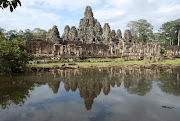
 Beautiful: The Angkor Wat temple took 37 years to build and was one of the jewels of the Khmer Empire
 Vin seemed to pick up on my unease. 'Terrible things have gone on in my country and we are sorry for that,' he said, totally unprompted.
'But now we are a peaceful people and the situation is different. I wish you a pleasant stay in Cambodia.'
It turned out to be very pleasant indeed. And Vin was right about the people: wherever we went, they were indeed peaceful and unfailingly courteous.
Siem Reap is enjoying its second coming. Following the 'rediscovery' of the temples of Angkor by French archaeologists in the 1860s, the town became a beacon for wealthy travellers.
It continued that way until the late Sixties, when the likes of Charlie Chaplin and Jackie Kennedy came to call. Then war, famine and fear kept outsiders well away right up until 1999.
 Awe-struck: Mark Palmer with his wife Joanna, who were given a rare glimpse of the temple's reclining Buddha
Everyone says you have to see Angkor Wat at sunrise to capture its full glory, but we felt relieved when Vin said we would start our tour at 10am. We were then amazed to find we practically had the place to ourselves.
'Where are all the people?' I asked as we drove around the massive moat. 'On the other side,' he replied.
He meant we had approached via the East Gate, a grand ruin of a lodge leading to a gravel drive that takes you up to the main temple.
With dappled sunlight foraging through the swaying trees and a crumbling building in the distance, we could almost have been visiting a stately home past its best in Gloucestershire.
What took me by surprise was the perfect symmetry, the motifs, the detail on the bas-reliefs — and we hadn't even set foot inside yet.
Vin ushered us into the shade and asked us to sit on giant pieces of sandstone.
We didn't move for the next 40 minutes as he went about his lecture, producing maps and plans and dealing patiently with interruptions from us that tended to start with: 'But how...?' or 'So, why...?'
Our questions were all trying to make sense of such an extraordinary feat, one that took 37 years to complete and involved stone either being dragged from a quarry 50 miles by elephant or on bamboo rafts 100 miles by river.
No wonder King Suryavarman II is such a hero.
As we moved from one level to the next, getting closer to the central shrine, Vin pointed at some scaffolding and explained that tourists had not been allowed access to the highest point for two years.
He said the reclining Buddha was a sight to behold — but sadly one that would elude us.
'Do people ever just climb up when no one's looking?' I asked, adding: 'There doesn't seem to be too much security.'
'You want to go up?' he said. Vin made a call from his mobile. Ten minutes later, a man with a walkie-talkie and bad teeth appeared. 'Come,' he said.
We made a dash for the scaffolding, ducking under some tarpaulin and climbing the steep steps. And then we climbed some more.
My new guide had two lookout men posted near the top. 'We have five minutes,' he said. 'Come.' We rushed here and there and, yes, I got to see the reclining Buddha looking majestically calm and serene.
It was almost 2pm by the time we got back to our hotel in the centre of town. La Residence d'Angkor, part of the Orient-Express group, is the place to stay. Lush and luxurious, it's recently benefited from a brand new spa, and the swimming pool is a decent size.
But Vin didn't give us much downtime.
On our first day, he wanted us to see Ta Prohm (the jungle temple where Tomb Raider was filmed) and the mysterious Bayon, where the shapes of gigantic faces are etched into stone towers, before taking our positions high above the plain to watch the sunset.
We ate spectacularly well at La Residence, but we also came up trumps at a new restaurant called Rina Rino on Pub Street. The most expensive item on the menu was £2.
We then spent an hour in the night market, where I resisted the chance to try a 'fish massage', which involves dangling your legs over the side of a plastic swimming pool while fish nibble dead skin from your feet.
Next morning, we did watch the sun rise over Angkor Wat — along with a few thousand other spectators.
The earth didn't move for me, but I liked the camaraderie of the experience: the standing and waiting at 5.30am with visitors from all over the world, the offer of cheap coffee from locals, the scent of expectation.
Later that day, we drove 45 minutes out of town to Tonlé Sap, the largest freshwater lake in South-East Asia and home to entire villages built on stilts.
Houses are erected on rafts that can be towed to different areas depending on water levels. Families can move ten times a year.
We hired a dragon boat and explored some of the channels leading to the main lake. It was utterly enthralling — and shocking. Men fish at night and spend most of the day beating the whitebait from their nets before selling it for next to nothing.
Life is hard. Average income is £300 per year and a 46 per cent literacy rate is well below the national average. At least 12 per cent of the children die before they reach the age of five.
We stopped at a floating shop where crocodiles are kept in captivity while being fattened and sold to the highest bidder.
We also came across naked Vietnamese children floating in washing-up bowls with pet snakes wrapped around their necks. They were fishing for money.
On the way back to the airport, we passed some of the hotels that have sprung up in the past five years.
If relative stability persists in Cambodia, Siem Reap will expand still further and struggle to retain its charms.
Which means if Angkor Wat is on your list of places to see before your final boarding card is issued, then you might want to do it sooner rather than later.
Travel factsThe Ultimate Travel Company (020 7386 4646, www.theultimatetravelcompany.co.uk) can arrange a tailor-made nine-day stay in Cambodia from £1,895 pp.
This itinerary includes three nights at La Residence D'Angkor, two at Raffles Le Royal Phnom Penh and three on the beach at Knai Bang Chat, plus private guided sightseeing at the temples of Angkor and breakfast, Thai Airways flights from Heathrow, flights in Cambodia and private transfers.
Cambodia to build memorial for slain journalists
Cambodia will erect a memorial to nearly 40 foreign and Cambodian journalists who died covering a savage five-year war that ended with the triumph of the Khmer Rouge 35 years ago, a government official said Saturday.
The groundbreaking for the monument will take place at the end of April, the anniversary of the Khmer Rouge victory, as foreign journalists who covered the conflict also gather for a reunion, government spokesman Khieu Kanharith said.
At least 37 journalists were killed or are listed as missing from the 1970-75 war, which pitted the U.S.-backed Lon Nol government against the North Vietnamese-supported Khmer Rouge.
They included reporters, photographers and television cameramen from Japan, France, the United States, Switzerland, Germany, Austria, India, Laos, Australia and Cambodia.
A number of the journalists were captured by the Khmer Rouge and never seen again. When the ultra-communists seized control and began their reign of terror, at least 17 Cambodian journalists were executed or disappeared.
Khieu Kanharith said the memorial, built to remember the work of the journalists, is being designed and will be erected near the hillside Buddhist monastery of Wat Phnom in the heart of the city.
The initiative for the monument came from Chhang Song, who served as information minister in the Lon Nol government, and organizers of the April 20-23 reunion, which will be followed by a similar one in Ho Chi Minh City, Vietnam, a week later.
Read more!
Late Mass. monk’s poems recall Khmer Rouge horrors
LOWELL — During Buddhist monk Ly Van Aggadipo’s final days, he wrote often in a notebook. Temple followers knew the nonagenarian spiritual mentor to many local Cambodian refugees was recording some sort of personal history, but they weren’t sure what.
"He told me, ’When I’m gone, make sure others read this so people don’t forget what happened,’" follower Sokhar Sao said. "I didn’t really understand until he was gone."
Next month, friends and followers will release a book of poetry by Ly Van, who survived the brutal communist Khmer Rouge regime in Cambodia and later led the Glory Buddhist Temple in Lowell from 1988 until his death in January 2008. The book, entitled "O! Maha Mount Dangrek," is a collection of two lengthy poems: one an autobiographical piece on the horrors of the Khmer Rouge, the other about a friend’s story of love in the time of genocide.
The title in English means "Oh Mighty Mount Dangrek" and refers to the mountainous plateau between the Cambodia-Thailand border that refugees were forced to climb in order to escape the Khmer Rouge regime.
Organizers plan a 14-city tour to promote the book with readings and accompanying musical performances by two young Cambodian artists. The tour will begin April 1 at a Middlesex Community College reading in Lowell and continue with stops in Chicago, Philadelphia, St. Paul, Minn., and Long Beach, Calif.
The publication of Ly Van’s work, printed in its original Khmer and in English, completes a two-year project by followers. The day he died, a follower found the poetry tucked under stacks of old Buddhist texts inside the temple.
On worn pages were handwritten, carefully crafted poems describing Ly Van’s memories of labor camps, starvation and infant executions and his dreams of escaping to America.
"We all said, ’Wow ... we have to publish this,’" said Samkhann Khoeun, who studied under Ly Van and served as the book’s editor. "Here was something so beautiful describing something so horrible. It brought tears to our eyes."
Khoeun then went on a campaign to get the book published. The Glory Buddhist Temple and local nonprofit groups Light of Cambodian Children and Cambodian Expressions agreed to help with the publication cost, while Khoeun worked on translation with other refugees.
Ly Van was born in 1917 in a small Cambodian village where he and his family lived through the 1970s rule of the Khmer Rouge regime, which perpetrated one of the worst genocides of the 20th century.
An estimated 1.7 million people died from starvation, disease and executions due to the group’s radical policies. According to the temple’s biography of Ly Van, he was forced to work on farms and public projects 14 hours a day. It was during this time that he witnessed mass executions and large-scale starvation.
In early 1979, when Vietnamese soldiers invaded Cambodia, Ly Van and thousands of others fled to Thailand through dangerous terrain where he and others ended up at refugee camps while hoping for asylum to the U.S. with the help of the U.N.
He and his family were granted asylum and resettled in Lowell, an old mill city less than an hour’s drive northwest of Boston.
Today about 20,000 Cambodians live in or around the city, making it second only to Long Beach for the largest number of Cambodians living in the United States.
As a refugee in Lowell, Ly Van helped establish the Cambodian Mutual Assistance Association, which promotes educational, cultural, economic and social programs for Cambodian-Americans and other minorities, before leading the Glory Buddhist Temple until his death of old age at 90.
But while counseling his fellow refugees and performing volunteer efforts, Ly Van quietly worked and reworked his long poems about horrific moments in his life that he rarely shared
Besides the epic poems, the new book also features photos of Khmer Rouge-era Cambodia and of refugee camps in Thailand.
Some of the photos are from the collection of photojournalist Jay Mather, whose images helped earn him a 1980 Pulitzer Prize for international reporting with reporter Joel Brinkley while at The Courier-Journal newspaper of Louisville, Ky. Others come from refugees’ personal collections and the Documentation Center of Cambodia, which has documented Khmer Rouge atrocities.
Khoeun said he wanted readers to see images related to Ly Van’s poetry.
"We have to face it," said Khoeun, 47. "This is what we went through."
Sao, who has a bullet wound on one of his calves from being shot at a refugee camp, agreed.
"It’s painful to see and remember," said Sao, also 47. "Every time I hear the words Khmer Rouge I get a little emotional. So you can imagine what’s going on when I read this poetry and see these images."
Around 3,000 copies of the book are planned for the first printing, with proceeds going to costs for a planned second printing, Khoeun said.
The goal is not to make money, Ly Van’s followers said, but to share the story of Cambodian refugees with others.
"I think my own children don’t believe what we went through to get here," said Sao, a father of four children who were born in the U.S. "I don’t talk about it much and can’t put it into words like this."
Read more!
Friday, March 19, 2010
EU delegation leaves Cambodia, says visit "Largely Positive"
Phnom Penh - A delegation of European Union legislators left Cambodia Friday saying they had obtained "largely positive" impressions from their two-day visit, but warned progress was needed in a number of areas.
The EU is Cambodia's largest foreign donor and one its key export markets.
During their two-day stay, the delegation met with members of the government, opposition parties, international donors and civil society representatives to learn more about Cambodia's political situation, human rights and economic position.
Werner Langen, the chair of the European Parliament's delegation for relations with the Association of South-East Asian Nations (ASEAN), said Cambodia had made significant progress in the three decades since the Khmer Rouge "terror state" was overthrown.
Read more: http://www.earthtimes.org/articles/show/314889,eu-delegation-leaves-cambodia-says-visit-largely-positive.html#ixzz0idfL8f8Y
.
But he said Cambodia still had much to do in areas such as human rights and freedom of expression.
"We have made it clear that the EU has international standards that it wishes to see applied," Langen said. "We made it clear that human rights and the state of law are part and parcel of democracy."
Ivo Belet, the delegation's deputy, said the team was also interested in closer cooperation in the field of energy.
"This is a country with enormous potential for renewable energy - solar energy and hydropower energy," he said. "The EU has a lot of knowledge on that issue."
In a reference to the government's ongoing efforts to use the law to pursue its critics, including members of the opposition Sam Rainsy Party, Belet said the delegation was convinced Cambodian democracy "is strong enough to afford an opposition."
He added that European Parliament legislators have a responsibility to monitor how the EU's money is spent, not least since it is Cambodia's largest donor.
"But as elected representatives we are accountable to our own taxpayers," Belet said. "We will out of a budgetary obligation keep on monitoring the fight against corruption, which is of course linked to the democratic process."
Langen said the country's new anti-corruption law - which was passed by parliament last week and has been criticized as vulnerable to abuse by the political elite - ought to reflect international standards.
"Even good laws are worth nothing if they are not maintained - and for that you need a reliable and independent judiciary," he said, adding that the law should be applied equally to all.
Cambodia is currently ranked by corruption watchdog Transparency International as the 158th most corrupt country in the world out of 180 nations surveyed.
Bilateral trade between Cambodia and the EU bloc was worth around 900 million dollars last year; the bulk comprised Cambodian garment exports.
Read more!
Cambodia bans marriages to South Koreans
Cambodia has suspended marriages between its citizens and South Koreans in order to curb human trafficking, the foreign ministry said.
A ministry spokesman, Koy Kuong, says the measure has been taken after a Cambodian matchmaker was sentenced this month to 10 years in prison for bringing 25 women from the countryside in an attempt to broker marriages with South Korean men.
Authorities are reviewing procedures to combat human trafficking, the spokesman added.
South Korean news agency Yonhap reported on Friday that the number of Cambodian women marrying Korean men has more than doubled, from 551 in 2008 to 1,372 last year.
In March 2008, Cambodia imposed a ban on foreign marriages to prevent human trafficking, amid concerns over an explosion in the number of brokered unions involving South Korean men and poor Cambodian women.
The ban followed an International Organisation for Migration report that said many Cambodian brides suffered abuse after moving to South Korea in marriages hastily arranged by brokers who made large profits.
The restriction was lifted about eight months later after new laws were introduced to prevent women becoming mail-order brides.
- AFP
Read more!
By Ancient Ruins, a Gay Haven in Cambodia
By NAOMI LINDT
IT was 10 p.m. in Siem Reap, and while most tourists were tucked in after a long, hot day exploring the temples of Angkor, things were just getting going at a bar called Linga. Pairs of European men in their 30s and 40s wearing unbuttoned collared shirts and checkered krama scarves sipped fruity cocktails and jostled for space with the young Khmer crowd, who huddled around small tables in anticipation of the main event: the Saturday night drag show.
A statuesque Khmer performer who went by the name Beyoncé took to the stage draped in a black, body-skimming floor-length gown and wearing a blond Afro wig. Soon, everyone was on his feet, belting out a song from “Dreamgirls.” The traffic outside literally stopped. Curious travelers, Khmer families and little girls peddling red roses craned their necks to get a better view as the song’s syrupy melody wafted into the jasmine-scented evening air.
Homosexual acts are not outlawed in Cambodia, as they are in a few Southeast Asian countries, but outward displays of affection and untraditional lifestyles are rare. Yet in Siem Reap, a small town that gets about a million tourists a year, gay visitors and locals are carving out a little haven. In the last few years, a small flurry of gay-friendly bars, restaurants and hotels has opened up in the city’s center and beyond, with wink-wink names like the Golden Banana and Cockatoo.
The scene is bolstered partly by Web sites like Cambodia Out (cambodiaout.com), which started in early 2009 and is believed to be the first commercial site in the country devoted to the gay community. Other sites like Utopia (utopia-asia.com) and Sticky Rice (stickyrice.ws), which appeal to gay people throughout Southeast Asia, have also raised the city’s profile.
But the new spots also reflect a growing acceptance, in a country that still hews to age-old Khmer values and where the concept of homosexuality seemed nonexistent until recently. In fact, there is no word for “gay” in Khmer. The most commonly used term is kteuy or ladyboys, based on the misperception by many Cambodians that homosexuals and transvestites are one and the same.
The stereotypes are slowly fading. In 2004, after watching thousands of same-sex couples in San Francisco rush to the altar, Cambodia’s much-loved King Norodom Sihanouk wrote on his Web site that gays should be allowed to marry because God loved a “wide range of tastes.”
His successor and son, King Norodom Sihamoni, holds similar views. “The Cambodian Royal Family, as a whole, share the same point of view as the King-Father,” Sisowath Thomico, a spokesman for the royal family, wrote in an e-mail message. “We’ve always been very tolerant about sexual preferences as some Khmer Royals are/were openly gays/lesbians.”
And last year, a lesbian-themed film by the Khmer novelist and director Phoan Phuong Bopha, “Who Am I?” was a sleeper hit. “Love between people of the same sex is a very new topic in Cambodia,” the director was quoted as saying in The Phnom Penh Post, in an article headlined “Who Am I? Brings Same Sex Issues Out Into the Open.”
The new open-mindedness is attributed to Theravada Buddhism, the predominant religion in Cambodia. “When you’re looking at Buddhist countries, you’re going to encounter an openness and tolerance,” said Caroline Francis, a spokeswoman for the Cambodia field office of Family Health International, a public health organization involved with gay-related health issues. “The religious teachings aren’t being used to arrest or persecute people because they’re gay or lesbian.”
One of the first gay bars to open was Linga, an airy cocktail lounge with artwork on the walls and large windows that face the Passage, a bustling and prominent street. Linga draws a mostly male crowd that’s both Khmer and Western and seems to signal a newfound openness for gay Cambodians. And like many nightclubs throughout Cambodia, prostitution and sex tourism are not hidden from view.
“I grew up in a small town, so I know what it’s like to think, ‘I’m the only one,’ ” said Martin Dishman, 48, a former hotel manager from Greenfield, Ind., who opened Linga in 2004. Perhaps not surprisingly, many of Siem Reap’s most visibly gay bars and hotels are owned by Westerners.
A more refined newcomer is Miss Wong, an old-Shanghai-themed boîte with cherry-red walls and gold silk lanterns. While its owner is gay, it caters to a broader clientele. On a typical night, a mix of men and women, expatriates and tourists, artists and entrepreneurs, and straight and gay people all mingled over lemon-grass-infused vodka concoctions and mocha martinis topped with dollops of chocolate.
But Siem Reap isn’t really a party town. Town life revolves around Angkor Wat, and by sunrise the streets hum with tuk-tuks whisking tourists to the temples. “This will never be the place to swallow four tablets of ecstasy and stay up until 4 a.m., dancing under a full moon in sequin hot pants,” said Dean Williams, an expatriate from New Zealand who owns Miss Wong.
That might explain why there are more gay-owned hotels than bars. The newest and arguably most flamboyant is a male-only resort called Men’s, which features 10 sleek rooms decorated with male nude paintings, a large outdoor swimming pool and a sprawling, black-and-gold tiled sauna and a Jacuzzi.
Upscale travelers prefer Viroth’s Hotel, a graceful seven-room haven in a renovated 1960s modernist house. While Viroth’s does not promote itself as a gay hotel per se, the owners Fabien Martial and Kol Viroth do nothing to hide their 10-year relationship.
And the word seems to be out. On a recent Friday night, the hotel’s nearby restaurant, also called Viroth’s, was filled with a sprinkling of male couples sharing bottles of French wine and dishes like chicken curry and minced pork grilled in kaplou leaves.
But for gay Khmers seeking a home, the place to be is the Golden Banana. It started as a humble B & B that opened in 2004 and has since expanded to three properties, including a stylish boutique resort with 16 rooms that feature platform beds constructed of flecked sugar palm wood and soaking tubs on the terrace.
Guests might include backpackers in T-shirts or silver-haired male couples in matching polo shirts, who mingle freely at the palm- and bamboo-fringed swimming pools, sipping lime and mint iced tea. But under the direction of Dirk de Graaff, an expatriate from the Netherlands, the resort has taken on a second role: as a sanctuary for young Cambodian men exploring their sexual identity.
IN a poor country where traditional family remains strong, young Cambodians are encouraged to marry and have children early. Many same-sex couples in Siem Reap still keep their relationship a secret; some have wives for appearance’s sake. Khmer men who visit gay saunas often conceal their faces behind motorcycle helmets until they’re safely inside. And lesbians remain largely invisible.
Still, things are looking up for the city’s younger gay generation. On a recent evening, young staff members from the Golden Banana — which include both straight and gay men in their early 20s — were laughing it up at the newly opened Heart Rock Bar, an unpretentious dance club across the street from Miss Wong that’s become a popular spot for gay men.
Beyond the glow-in-the-dark hearts on the walls and the stainless-steel cocktail tables, the dark and spacious club offered little décor or ambience, but the crowd of mostly younger Cambodian men didn’t seem to mind. They drank cans of Angkor beer, grooving to Top 40 hits by the Black Eyed Peas and Lady Gaga, smiling broadly late into the night and dancing freely with whomever they liked.
IF YOU GO
HOW TO GET THERE
Flights to Siem Reap from New York require a stopover. A recent online search found a Korean Air flight from Kennedy Airport to Siem Reap, via Seoul, starting at about $1,500.
WHERE TO STAY
Hotels in Siem Reap commonly give prices in U.S. dollars.
The Cockatoo Resort (104 Wat Damnak Village; 855-89-986-872; thecockatooangkor.com). Doubles from $80.
Golden Banana Boutique Resort (Wat Damnak Village; 855-12-654-638; goldenbanana.info). Doubles from $60.
The One Hotel and Hotel Be Angkor (the Passage; 855-63-965-321; theonehotelangkor.com and hotelbeangkor.com) are separate hotels with one owner in a single building. Doubles from $95.
Men’s Resort & Spa (near Wat Po Lanka; 855-63-963-503; mens-resort.com). Doubles from $55.
Viroth’s Hotel (Street 23; 855-63-761-720; viroth-hotel.com). Doubles from $80.
WHERE TO EAT AND DRINK
Linga Bar (the Passage; 855-12-246-912; lingabar.com).
Miss Wong (the Lane; 855-92-428-332).
Viroth’s Restaurant (246 Wat Bo Street; 855-12-826-346; viroth-hotel.com).
.
Read more!
Australian arrested for child sex in Cambodia
Cambodian police have arrested an Australian man on suspicion of paying for sex with underage girls over a number of years.
The suspect, identified by police as Michael John Lines, 52, was arrested on Thursday.
He is accused of having sex with two girls, now 17, said Major-General Bith Kimhong, the director of the interior ministry's anti-trafficking unit.
One of the girls was now the man's fiancee, General Bith Kimhong said.
"He has been committing the offences for four years," he said, adding that police suspected he had abused many children.
He said Lines would appear in court later Friday to be charged with "buying sex from children".
Dozens of foreigners have been jailed for child sex crimes or deported to face trial in their home countries since Cambodia launched an anti-paedophilia push in 2003 in an attempt to shake off its reputation as a haven for sex predators.
- AFP
Read more!
Sunday, March 14, 2010
Leader Universal helps power Cambodia growth
Leader is now charting a first in Cambodia by constructing the country's first coal-fired power plant.
During a ground-breaking ceremony for a coal-fired electric power plant in a coastal town in Cambodia last month, Malaysian cable and wire group Leader Universal Holdings Bhd (LUH) (4529) donated books to children of several villages in the area as part of its corporate social responsibility.
The smiles of wonder and gratitude on the faces of the youngsters matched the mood of the older folk in the port town of Sinhanoukville, for whom power supply is considered a luxury.
While hotels and other places of business and the homes of the rich are wired with electricity - via generators - most of the Cambodian population have to contend with either few hours of electricity or none at all.
As a small, predominantly rural nation of some 12 million people bordering the Lao People's Democratic Republic, Thailand and Vietnam, Cambodia has often been tagged as among the poorest countries in the world.
It is only in recent times that the country has emerged from many decades of war and internal conflict, which saw many of the foundations for growth and development - such as physical, human, social and economic - shattered.
The government's efforts in improving access to basic infrastructure such as water, electricity, transport and telecommunications services have seen the participation of many Malaysian companies such LUH.
Cambodia has today significant experience in power sector participation in infrastructure, ranging from major projects involving foreign investors such as Malaysia's Muhibbah Engineering Bhd and Telekom Malaysia Bhd - in the airports and telecommunications sectors.
The presence of Malaysian banks like Public Bank Bhd and Malayan Banking Bhd, via its branches scattered across Phnom Penh is yet another show of how Malaysian companies are participating actively in developing Cambodia.
In 2008, Malaysia was reported to have been the biggest investor in Cambodia for the14th consecutive year, with investments totalling US$2.19 billion (RM7.24 billion).
Apart from power generation which LUH has been an active investor for more than a decade in Cambodia, other businesses carried out by Malaysian companies include textile manufacturing, construction, hotels, restaurants, insurance, gaming, media, food and petroleum.
For Leader Universal Holdings, its legacy in Cambodia as the country's first independent power producer is one which has earned the company a position of respect and authority.
"An opportunity opened up in 1994 for us in Cambodia when one of our current partners - Cambodia Utilities Pte Ltd (CUPL) - introduced a new project to us in the form of an independent power producer power plant of 35 megawatts," said LUH managing director and chief executive officer Datuk Sean C.H. H'ng.
"We negotiated the Power Purchase Agreement together, found the returns to be commensurate with the risks of the country then, so we proceeded to develop the project," he recalled.
CUPL is a 60 per cent-owned subsidiary of LUH, which was incorporated in 1994 to develop the diesel engine heavy-fuel oil-fired power generating plant on a build-operate-transfer basis in Cambodia.
The electricity generated, is sold to Electricite du Cambodge (EDC), a department of the Ministry of Industry, Mines and Energy in Cambodia.
CUPL is the first Malaysian-owned company to have successfully ventured into Cambodia's power industry and secured the first IPP contract from the country's government.
The contract is on a take-or-pay basis for a period of 18 years from 1997 to 2015.
"When we first started CUPL, we had a workforce of some 180," said H'ng.
LUH's workforce in Cambodia today is made up of 30 expatriates and 150 Cambodians.
"Going forward with the two new projects (a 100MW power generation project in Sihanoukville and the North Phnom Penh-Kampong Cham power transmission project) under construction, we estimate the total workforce will grow to around 450 by year 2012," H'ng added.
As the first IPP in Cambodia 15 years ago, Leader is now charting a first in the country again by constructing the country's first coal-fired power plant.
"LUH has been long in Cambodia and established ourselves as a serious investor and developer, doing what others deem as not being easy, as a pioneer.
"Like in many countries, power plants attract industrial estates being built adjacent to it as their mere presence instill confidence in many downstream investors. We see an acceleration of industrial development in the Sting Hav region where the power plant is located. This will have spillover effect in terms of job creations and developments within the region," said H'ng.
The economic spinoffs to the Cambodian economy should be already seen during construction of the new plant in Sihanoukville, where employment opportunities for the locals are expected to be seen both during and post-construction.
"During construction, peak manpower requirement is expected to hover at some 2,000 people and when fully operational, at 250," said H'ng.
In pointing to the fact that power plants are often viewed at the precursor to more industrial development in the region, H'ng said: "With a port nearby and our power plant, much development will be attracted to the Kampong Som and Stung Hav regions."
"The Cambodian government's investor-friendly approach is also viewed by us as one way many investors will flock to this area, with cheaper power and expedient access to the port."
Read more!
Leader Universal will continue to make its mark in Cambodia
WITH some 15 years of investment history in Cambodia, Leader Universal Holdings Bhd (LUH) (4529) is set to continue making its mark in the country where many investors are now flocking to.
But with horror stories of how certain Malaysian investors got badly affected for focusing mainly on one country and placing their "eggs in one basket" such as Dubai, some may question whether LUH has over-committed itself in Cambodia.
"We have always invested with caution," said the company's managing director and chief executive officer Datuk Sean C.H. H'ng.
Pointing to its first independent power producer (IPP) project via Cambodia Utilities Pte Ltd which was completed and started operations in 1997, he said the investment has provided LUH with fairly good returns.
.
"We did not pursue the next two fuel oil-fired IPPs nor the hydro IPPs in Cambodia that came after this, but we pursued this coal-fired power plant (in Sihanoukville).
"There has been a span of 13 years before we embarked on any expansion in the country although we have many years of operating experience and extensive business networks in Cambodia," he added, saying that Leader is also looking at good investment opportunities outside of Cambodia but did not elaborate.
On where else in Cambodia is LUH looking to set up power plants in 10 years from now, H'ng said: "We have land for many years of expansion. We are leasing 20ha from our joint venture partner for the use of our 100MW coal fired power plant project.
"Our joint venture partner CIIDG, has sufficient land in the same area to cater for the expansion of an additional 700MW that has been planned to be implemented in the next few years."
LUH's strategic location near the deep sea for its latest power plant project in Sihanoukville, makes the area a logical site for any future expansion.
On how tough is it for a Malaysian company to be investing overseas, especially in a developing country like Cambodia, H'ng said: "I think it is always a challenge for any investment overseas, and not necessarily in Cambodia alone."
"There are many things to adapt to, from the local partners and local authorities, to local manpower capabilities and local cultures.
"Even growing the workforce can be a challenge. We have, however, been managing this aspect quite well and are confident that we can continue to do so," he said. - By Marina Emmanuel
Read more!
Saturday, March 13, 2010
Thaksin leaves Dubai for Switzerland
Fugitive, ousted premier Thaksin Shinawatra has left Dubai and is expected to join his daughters in Switzerland, said Panich Vikitsreth, Vice Minister for Foreign Affairs, on Saturday.
Mr Panich said in a telephone interview with the Thai News Agency that Mr Thaksin was not travelling to Cambodia as reported. He said the United Arab Emirates (UAE) government has informed Thailand that Mr Thaksin had left Dubai.
He added the UAE had acknowledged Thailand's request to ban Mr Thaksin, whose government was ousted in a bloodless coup in September 2006, from using the UAE as a springboard in attacking the Thai government.
“It’s still unclear which country Mr Thaksin is heading,” said Mr Panich, noting that the ousted premier was using Montenegro and Nicaraguan passports. It is believed that he would join his daughters who have travelled to Switzerland.
According to Mr Panich, Mr Thaksin’s ex-wife Pojaman Na Pombejra and her son journeyed to Hong Kong last week, while former prime minister Somchai Wongsawat, a brother-in-law of Mr Thaksin, has reportedly travelled to Cambodia.
Mr Thaksin’s latest movement comes as protesters of the United Front for Democracy against Dictatorship who are his staunch supporters are holding a major rally in the Thai capital to oust the coalition government of Prime Minister Abhisit Vejjajiva and calling for a fresh election.
Read more!
Thaksin insists he's in Europe, not Cambodia
By THE NATION
Thaksin Shinawatra last night told his red-shirt followers that he was currently in Europe, not Cambodia as speculated earlier.
During a phone-in to his supporters' People TV station, the fugitive former prime minister also dismissed a government report that the United Arab Emirates had expelled him.
Dubai, one of the seven emirates, has been Thaksin's residence over the past year.
Thaksin said he would phone in again today.
Meanwhile, the court yesterday approved an arrest warrant for Arisman Pongruangrong, a key red-shirt figure, for instigating riots.
Arisman last night joined the anti-government rally's main stage on Rajdamnoen Avenue along with other red-shirt leaders, who said he would surrender to the police on April 1.
Read more!
Friday, March 12, 2010
Roads to protect Cambodia's Angkor from fires
PHNOM PENH, Cambodia -- Seventeen new roads will provide quick access to Cambodia's Angkor complex in case of fires at the ancient temples, officials said Friday shortly before a blaze started nearby.
The roads will alleviate fears of damage to the country's greatest artistic treasure, especially during the dry season when blazes often break out, said Tan Sambu, an official of the Apsara Authority, the government agency that oversees the temples.
On Friday, a fire about 2 kilometers (1.2 miles) from Angkor Wat, the most famous of the temples, destroyed several hectares (acres) of forest and at least two village houses, said police Maj. Pheung Chandarith.
There were no reports of deaths or injuries, and Pheung said the cause of the blaze was under investigation.
Tourism is a major source of foreign currency for cash-strapped Cambodia, which hosts nearly 1.5 million foreign tourists each year, mostly from South Korea, Japan and the United States. More than half of the tourists visit Angkor, a UNESCO World Heritage site in northwestern Siem Reap province.
The temples were built when Angkorian kings ruled over much of Southeast Asia between the ninth and 14th centuries.
Earlier this month, South Korea provided $9.2 million to build a new road that will circle the temple complex and reduce traffic in the area.
Read more!
Cambodia learns lessons of its bloody history
SCHOOLTEACHER Bin Cheat has already had his lesson on the Khmer Rouge.
As a six-year-old, he saw Pol Pot's army roll into his village in Cambodia's scrappy southern countryside. Fascinated by the rare sight of a car, he trundled up to a tyre as the men stood distracted, unscrewed the cap and let out a hiss of air. Moments later he was dragged and bound, set, like many others, for death by bludgeoning.
"They tied my arms behind my back and stuffed me in a sack. I'm lucky that one of the neighbourhood women begged with them for so long that they let me go," Bin Cheat says with a laugh.
Many older Cambodians remember the brutality of the Khmer Rouge. Up to two million people were killed through executions, starvation and forced labour as the ultra-communist regime attempted to create an agrarian utopia, while erasing the history and memory of a people.
For younger generations of children, that forgetting has continued, with the four years of the Khmer Rouge regime left off the school curriculum.
Only now, after years of debate, are teachers like Bin Cheat tentatively beginning to explain Cambodia's full history. The process is delicate and painful, as former Khmer Rouge are spread throughout society, from Prime Minister Hun Sen downwards.
Key to that process is a new textbook for high school students, A History of Democratic Kampuchea (1975-1979), produced by the Documentation Centre of Cambodia (DC-CAM), a non-profit organisation given the task of recording the history of the genocide.
Other books teach the history up until the Khmer Rouge's rise in 1975 and then fall silent, only to pick up the thread long after the overthrow of the Khmer Rouge in a Vietnamese invasion, explains DC-CAM director Youk Chhang. The one concession granted over the years was a single photo of a seated Pol Pot, accompanied by a brief description of his regime and its genocide.
"I believe in prosecution to reach full forgiveness. But at the same time, for the future, to move beyond the Khmer Rouge, one way to prevent (such things from recurring) is to teach the children," Youk Chhang says.
Conceived in 1996, the idea for the book received only limited in-principle support from the government in 2004 and began being taught in a small number of schools at the end of last year. The plan is to have a million Khmer-language editions of the books in schools by the end of the year, being taught by 3200 teachers.
Re-engaging with the issue is proving a challenge. Of the country's 14 million people, only five million were alive during Khmer Rouge rule. The government of Hun Sen, a former Khmer Rouge cadre who defected to Vietnam and rose to the country's leadership after the regime's 1979 fall, has been at best a reluctant participant in efforts to bring former regime leaders to justice. "The Khmer Rouge aren't just in the government, trust me. They are in the opposition, the NGOs, the private sector, everywhere," he says.
"In the classroom I can assure you that at least 30 per cent are the children of former Khmer Rouge, another 70 per cent are the children of the victims.
"Among these 3000 teachers I can assure you almost 25 to 30 per cent are former Khmer Rouge themselves.
"This is a broken society, it is a fragile society, so I think you have to live for the future, commit for the future, teach for the future."
At Bin Cheat's school in Kampong Trach near the southern border with Vietnam, amid a landscape of red earth and lonely palm trees and sheer hills, the Khmer Rouge's shadow stretches longer than in most places.
Throughout the 1990s, Khmer Rouge rebels fighting the government in Phnom Penh lingered in the nearby hills, periodically sweeping down to abduct officials, including local teachers, and holding them for ransoms of rice, food and fuel. Those who were not ransomed were killed.
The students here respond blankly to questions of this recent history.
Ny Pagnavuth, 17, says he heard stories of the Khmer Rouge when he was growing up, including vague tales of an uncle and aunt killed. But he knew little of how the Khmer Rouge came to power or why they did what they did, and was shocked to hear the broader story in class.
"I was surprised and I felt it was strange. Why did the regime empty out Phnom Penh? Cities are where industry and the economy grows," he says.
Read more!
Cambodian govt accuses UN of 'flagrant interference'

Ranked one of the most corrupt countries in the world, Cambodia passed the law in parliament on Thursday, more than 15 years after legislation to tackle graft was first proposed, but only days after the draft was shared publicly.
Opposition and rights groups said the draft was flawed and asked for more debate, and a statement this week from the UN country team in Cambodia encouraged enough time to ensure "a transparent and participatory" process.
"This so-called 'UN Country Team' should not act out of its mandate, in flagrantly interfering in the internal affairs of a UN member state," said a statement by Cambodia's foreign affairs Ministry.
"Furthermore, it should refrain from acting as if it were the spokesperson of the opposition parties," it added.
All lawmakers from the opposition Sam Rainsy Party walked out of parliament in protest just hours before the draft law was passed by 82 lawmakers, mostly from Prime Minister Hun Sen's ruling Cambodian People's Party.
A national anti-corruption council and an anti-corruption unit will be created to oversee investigations, but critics said it was unlikely either body would be effective because both would be controlled by the ruling party.
Public figures face up to 15 years in prison if convicted of accepting bribes, according to the draft law.
The law will take effect after receiving approval from Cambodia's Senate and promulgation from King Norodom Sihamoni, which are both considered formalities.
Cambodia was ranked 158 out of 180 countries on anti-graft organisation Transparency International's most recent corruption perception index.
It was also ranked the second most corrupt Southeast Asian nation after Indonesia in an annual poll by the Political and Economic Risk Consultancy, seen by AFP on Tuesday.
Last year, a US diplomat said that graft costs Cambodia up to 500 million dollars every year, an allegation the government rejected as "unsubstantiated."