PHNOM PENH, Cambodia's Reyum Institute has documented more than 130 Khmer traditional measurements and will run a show-casing of the documentation for the public in Phnom Penh from Dec. 28, 2009 to Feb. 2010, official news agency AKP reported on Monday.
According to Research Manager of Reyum Institute Preap Chanmara, Cambodia has long been using a wide variety of measurements for length, height, weight, depth, size, substance and time. Some measurements have been standardized with human body, things, like coconut fruit and tree, and others have been adapted from French measurements; for instance, meter, kilometer, etc.
Chanmara said that sources of the documented measurements include interview with people, written documents, and observation of people's daily interaction.
Different locations may use and understand different measurements. Some locations may use the same measurements for different meanings.
Read more!

Monday, December 28, 2009
Cambodia holds Khmer traditional measurement exhibition

Vietnam and Cambodia reach US$6 billion business deals
 Vietnam and Cambodia signed investment agreements and contracts worth US$6 billion at a conference held in Ho Chi Minh City on December 26 to promote Vietnamese investment in Cambodia.
Under the documents, Vietnam will invest in power generation, food processing, fertiliser production, rubber plantation and bauxite mining in Cambodia.
Two-way trade between the two countries has increased significantly in recent years, reaching US$1.7 billion in 2008, up 40% against 2007.
Vietnamese businesses have invested in over 60 projects in Cambodia with a total capital of nearly US$900 million.
Vietnamese Prime Minister Nguyen Tan Dung and his Cambodian counterpart, Hun Sen, co-chairmen of the conference, welcomed a joint initiative to host the conference as a practical move to promote bilateral co-operation in investment and trade.
PM Hun Sen said Cambodia is calling for foreign investment in such areas as agro-forestry, industry, infrastructure, product processing for export, mining and tourism.
Cambodia will create a favourable investment environment for the Vietnamese businesses to operate in the country, PM Hun Sen assured PM Dung and nearly 600 officials and business people attending the event.
PM Dung appreciated the effectiveness of Vietnamese-invested projects in Cambodia. He said, however, that the results have not yet matched the potential of both countries and not lived up to their people’s expectations.
He recalled high-level talks and meetings between the two countries’ top leaders who had agreed to take additional measures to broaden co-operative ties. They expressed their determination to raise two-way trade to US$2 billion in 2010 and increase Vietnamese investment in Cambodia to US$6 billion in the coming years.
At the event, the Vietnamese Ministry of Planning and Investment and the Cambodian Development Council signed a memorandum of understanding on investment promotion.
The Vietnamese Minister of Industry and Trade and the Cambodian Minister of Industry, Mining and Energy signed the minutes of their meeting regarding bauxite exploration and exploitation in the Cambodian Mondulkiri province.
The Bank for Investment and Development of Vietnam (BIDV) signed deals to provide financial services to Vietnamese businesses investing in Cambodia.
Also during the event, a certificate of operation was granted to the association of Vietnamese investors in Cambodia, and investment licences were given to a number of Vietnamese businesses. (VNA
Read more!
New form of Malaria near cambodia
MARGIE MASON and MARTHA MENDOZA
PAILIN, Cambodia (AP) - O'treng village doesn't look like the epicenter of anything. Just off a muddy rutted-out road, it is nothing more than a handful of Khmer-style bamboo huts perched crookedly on stilts, tucked among a tangle of cornfields once littered with deadly land mines.
Yet this spot on the Thai-Cambodian border is home to a form of malaria that keeps rendering one powerful drug after another useless.
This time, scientists have confirmed the first signs of resistance to the only affordable treatment left in the global medicine cabinet for malaria: Artemisinin.
If this drug stops working, there's no good replacement to combat a disease that kills 1 million annually.
.
As a result, earlier this year international medical leaders declared resistant malaria here a health emergency.
"This is not business as usual. It's something really special and it needs a real concerted effort," said Dr. Nick White, a malaria expert at Mahidol University in Bangkok who has spent decades trying to eradicate the disease from Southeast Asia.
"We know that children have been dying in Africa, millions of children have died over the past three decades, and a lot of those deaths have been attributed to drug resistance. And we know that the drug resistance came from the same place."
Malaria is just one of the leading killer infectious diseases battling back in a new and more deadly form, the AP found in a six-month look at the soaring rates of drug resistance worldwide.
After decades of the overuse and misuse of antibiotics, diseases like malaria, tuberculosis and staph have started to mutate. The result: The drugs are slowly dying.
Already, The Associated Press found, resistance to malaria has spread faster and wider than previously documented. Dr. White said virtually every case of malaria he sees in western Cambodia is now resistant to drugs.
And in the Pailin area, patients given artemisinin take twice as long as those elsewhere to be clear of the parasite, 84 hours instead of the typical 48, and sometimes even 96.
Mosquitoes spread this resistant malaria quickly from shack to shack, village to village, and eventually, country to country.
And so O'treng, with its 45 poor families, naked kids, skinny dogs and boiling pots of rice, finds itself at the epicenter of an increasingly desperate worldwide effort to stop a dangerous new version of an old disease.
Bundled in a threadbare batik sarong, 51-year-old Chhien Rern, one of O'treng's sick residents, sweats and shivers as a 103-degree fever rages against the malaria parasites in her bloodstream.
Three days ago Chhien Rern started feeling ill while looking for work in a neighboring district.
So she did what most rural Cambodians do: She walked to a little shop and asked for malaria medicine.
With no prescription, she was handed a packet of pills, she's unsure what they were.
"After I took the drugs, I felt better for a while," she says. "Then I got sick again."
The headaches, chills and fever, classic symptoms of malaria, worsened. Chhien Rern's daughter persuaded her to take a motorbike taxi past washed out bridges and flooded culverts to the nearest hospital in Pailin, a dirty border town about 10 miles from O'treng.
Doctors say there's a good chance Chhien Rern was sold counterfeit drugs.
People generate drug resistant malaria when they take too little medicine, substandard medicine or, as is all too often the case around O'treng, counterfeit medicine with a pinch of the real stuff.
Once established, the drug-resistant malaria is spread by mosquitoes. So one person's counterfeit medicine can eventually spawn widespread resistant disease.
Yet in most parts of the world, people routinely buy antimalarials over the counter at local pharmacies and treat themselves.
A recent study out of neighboring Laos found 88 percent of stores selling artemisinin-based drugs, the same ones scientists are desperately trying to preserve, were actually peddling fakes.
Worse, nearly 15 percent of the counterfeits were laced with small hints of artemisinin, which could prompt resistance.
The researchers found indications that some were made in China, feeding smugglers' routes that snake through Myanmar and into Laos, Thailand, Cambodia and Vietnam.
The counterfeits, along with outdated drugs, are jumping continents. In Africa, where malaria is endemic in 45 countries, the fake drug industry is thriving.
A 2003 World Health Organization survey found between 20 percent and 90 percent of antimalarials randomly purchased in seven African countries failed quality testing, depending on the type of drug.
WHO and Interpol formed a task force three years ago to try to stop counterfeiters, seizing millions of fake malaria, tuberculosis, HIV and other pills in Southeast Asia and Africa.
But officials say the work is only as good as the countries' legal systems.
"One of the problems is that there's not really any enforcement, so what happens when they find a drug that's counterfeit or substandard?"
Says
David Sintasath, a regional epidemiologist at the nonprofit Malaria Consortium in Bangkok.
"The policy is to take it away from them. That's good until the next month when they get their next shipment, right?"
Countless unlicensed shops in Cambodia sell artesunate, a single-drug therapy that has been banned in the country.
Artesunate, a modified version of artemisinin derived from a Chinese herb, has been hailed as miracle treatment worldwide because it works so well with so few side effects.
But Cambodian surveys have shown that many patients take artesunate alone instead of mixing it with another antimalarial drug, making it easier for resistance to build.
"The drug has been around for a long time and misused for a long time and this is all encouraging the parasite to develop resistance," says Dr. Delia Bethell, of the U.S. Armed Forces Research Institute of Medical Science, whose research has been at the forefront of identifying emerging resistance on the border.
Back in western Cambodia a few miles from O'treng village, shopkeeper Nop Chen turns a flashlight on a glass case full of drugs he hawks from inside his cramped roadside house.
He digs through the many boxes and produces two different types of artemisinin-based antimalarials. Both lack the full amount of a second required medication, mefloquine, necessary to treat the strain of malaria in the area and ward off more resistance.
But Nop Chen, a former Khmer Rouge medic, points to a small Cambodian seal on the boxes and says he feels confident the drugs are the real deal.
Still, he acknowledges he is not licensed to sell the pills and he's unsure where they originated.
"I'm not concerned because it's got the sticker and the stamp," he says, squinting at the Khmer script on the labels. "Because of the logo, I trust it to not be fake, it was made in Cambodia."
Walk past O'treng's cluster of sagging huts, cross another cornfield and hike a twisted mile on a dirt track to a wooden shack where a string of smoke is curling through the wooden floor planks in a largely futile effort to keep mosquitoes away.
It's here that skinny 13-year-old Hoeun Hong Da wakes up on the floor nauseous and burning with fever.
Hong Da recovered from malaria two months ago, but now the dizziness and headaches are back.
He's been sickened by the disease six or seven times in his short life — too many to remember.
He knows that if he doesn't get to a hospital soon, he could die. With no new treatments in the pipeline, normally reserved scientists are quick to use words like "disaster" or "catastrophe" when asked what might happen if they don't contain the disease that's ravaging young Hong Da before it spreads to Africa.
There, malaria already kills an estimated 2,000 kids daily. For the past 50,000 years the malaria parasite has been evolving, and migrating, alongside humans.
It moves within the huts of O'treng, and into neighboring towns when men like Hong Da's father and older siblings float from job to job.
Some work is close enough for them to return home at night, but other jobs keep them away for stretches of time.
They sleep in tight rows, sweating and weary, in disintegrating bamboo huts with workers who are also traveling, and possibly infected with malaria.
The concept of containing drug resistance has never been tried before. Scientists wonder: How do you control the spread of a resistant parasite transmitted by mosquitoes that bite people who live and work in infested jungle areas, then scatter in all directions, all the time?
This area, the former stronghold of the murderous Khmer Rouge, has a notorious history.
Burmese migrant workers who once mined rubies and sapphires in these now deforested hills are believed to have helped transport strains resistant to the drug chloroquine back to Myanmar a half century ago.
From there it spread to India and later over to Africa until the drug was useless worldwide.
A decade later, history repeated itself when resistance to the drug sulfadoxine-pyrimethamine followed the same path.
Now, in western Cambodia, scientists are concerned because the artemisinin-based drugs are taking longer than usual to kill the parasites.
Earlier this year, an army of aid agencies and experts from the WHO began racing to this impoverished corner on the Thai-Cambodian border to divvy up a $22.5 million grant from the Bill & Melinda Gates Foundation, aimed at stopping this virulent new strain.
But grants haven't stopped lines of Cambodians, sick or not, from queuing up every morning at Thailand's border, charging past the checkpoints in search of work or goods. Some may carry resistant strains in, others may bring them home.
And grants haven't stopped the parasite from spreading in the O'treng area, despite widespread bednet distribution, awareness campaigns and enhanced surveillance systems.
Some scientists say the only sure way to fix the problem is to eradicate malaria entirely from western Cambodia.
"It's really dangerous," says Dr. Rupam Tripura,
who's conducting a study in Pailin for the Wellcome Trust-Mahidol University-Oxford Tropical Medicine Research Program. "What will happen to the mosquitoes?
Can you kill those living in the jungle? No, so you cannot kill the strain."
If O'treng is the epicenter of this emerging disease, Phoun Sokha is the point man aimed at controlling it.
At 47, Phoun Sokha is the village malaria worker who lives at the mouth of the hamlet and proudly displays an orange plastic kit that resembles a tackle box.
Phoun Sokha is serious about his packets of medicine and his rapid tests to prick blood from sick villagers' fingers to determine if they have malaria and if so, what type.
He makes sure patients are taking their free medicines and checks to see if they're improving. If not, Phoun Sokha can even arrange transportation to the hospital.
But treating O'treng's malaria patients can be frustrating.
"Some of the patients, when they went to the hospital, after one month, maybe they get malaria again," he says.
Today Hong Da, the village boy who has fought malaria so many times before, heads home from the hospital after a few days of treatment.
He clutches a new mosquito net he hopes will prevent yet another infection. Together, the recovering boy and his weathered mom shuffle past sick neighbor Chhien Rern's shack before disappearing among the tassels of the cornfield toward their home.
But all is not well. Under a tattered quilt, Hong Da's 9-year-old sister Hoeun Chhay Meth is curled on a thin mattress atop the wooden floor inside the family's open-air home.
She had malaria alongside her brother two months ago. They share a mosquito net that she burned a hole in when she stayed up one night reading by the light of a makeshift candle.
Her brother thinks that's how the mosquitoes infected them.
"Very afraid of dying," says Chhay Meth, who has started taking medicine provided by the village malaria worker. "I feel worse than before. I cannot walk myself or stand up by myself and cannot eat well."
Hong Da understands. He gently lifts his little sister's limp body, scooping her up, his strength returning.
Chhay Meth reaches weakly for her mother. Like her big brother, this child doesn't know about counterfeit drugs or antimalarials.
She only knows she's sick. And the medicines don't seem to work as well any more in this little village she calls home.
David Sintasath, a regional epidemiologist at the nonprofit Malaria Consortium in Bangkok.
"The policy is to take it away from them. That's good until the next month when they get their next shipment, right?"
Countless unlicensed shops in Cambodia sell artesunate, a single-drug therapy that has been banned in the country.
Artesunate, a modified version of artemisinin derived from a Chinese herb, has been hailed as miracle treatment worldwide because it works so well with so few side effects.
But Cambodian surveys have shown that many patients take artesunate alone instead of mixing it with another antimalarial drug, making it easier for resistance to build.
"The drug has been around for a long time and misused for a long time and this is all encouraging the parasite to develop resistance," says Dr. Delia Bethell, of the U.S. Armed Forces Research Institute of Medical Science, whose research has been at the forefront of identifying emerging resistance on the border.
Back in western Cambodia a few miles from O'treng village, shopkeeper Nop Chen turns a flashlight on a glass case full of drugs he hawks from inside his cramped roadside house.
He digs through the many boxes and produces two different types of artemisinin-based antimalarials. Both lack the full amount of a second required medication, mefloquine, necessary to treat the strain of malaria in the area and ward off more resistance.
But Nop Chen, a former Khmer Rouge medic, points to a small Cambodian seal on the boxes and says he feels confident the drugs are the real deal.
Still, he acknowledges he is not licensed to sell the pills and he's unsure where they originated.
"I'm not concerned because it's got the sticker and the stamp," he says, squinting at the Khmer script on the labels. "Because of the logo, I trust it to not be fake, it was made in Cambodia."
Walk past O'treng's cluster of sagging huts, cross another cornfield and hike a twisted mile on a dirt track to a wooden shack where a string of smoke is curling through the wooden floor planks in a largely futile effort to keep mosquitoes away.
It's here that skinny 13-year-old Hoeun Hong Da wakes up on the floor nauseous and burning with fever.
Hong Da recovered from malaria two months ago, but now the dizziness and headaches are back.
He's been sickened by the disease six or seven times in his short life — too many to remember.
He knows that if he doesn't get to a hospital soon, he could die. With no new treatments in the pipeline, normally reserved scientists are quick to use words like "disaster" or "catastrophe" when asked what might happen if they don't contain the disease that's ravaging young Hong Da before it spreads to Africa.
There, malaria already kills an estimated 2,000 kids daily. For the past 50,000 years the malaria parasite has been evolving, and migrating, alongside humans.
It moves within the huts of O'treng, and into neighboring towns when men like Hong Da's father and older siblings float from job to job.
Some work is close enough for them to return home at night, but other jobs keep them away for stretches of time.
They sleep in tight rows, sweating and weary, in disintegrating bamboo huts with workers who are also traveling, and possibly infected with malaria.
The concept of containing drug resistance has never been tried before. Scientists wonder: How do you control the spread of a resistant parasite transmitted by mosquitoes that bite people who live and work in infested jungle areas, then scatter in all directions, all the time?
This area, the former stronghold of the murderous Khmer Rouge, has a notorious history.
Burmese migrant workers who once mined rubies and sapphires in these now deforested hills are believed to have helped transport strains resistant to the drug chloroquine back to Myanmar a half century ago.
From there it spread to India and later over to Africa until the drug was useless worldwide.
A decade later, history repeated itself when resistance to the drug sulfadoxine-pyrimethamine followed the same path.
Now, in western Cambodia, scientists are concerned because the artemisinin-based drugs are taking longer than usual to kill the parasites.
Earlier this year, an army of aid agencies and experts from the WHO began racing to this impoverished corner on the Thai-Cambodian border to divvy up a $22.5 million grant from the Bill & Melinda Gates Foundation, aimed at stopping this virulent new strain.
But grants haven't stopped lines of Cambodians, sick or not, from queuing up every morning at Thailand's border, charging past the checkpoints in search of work or goods. Some may carry resistant strains in, others may bring them home.
And grants haven't stopped the parasite from spreading in the O'treng area, despite widespread bednet distribution, awareness campaigns and enhanced surveillance systems.
Some scientists say the only sure way to fix the problem is to eradicate malaria entirely from western Cambodia.
"It's really dangerous," says Dr. Rupam Tripura,
who's conducting a study in Pailin for the Wellcome Trust-Mahidol University-Oxford Tropical Medicine Research Program. "What will happen to the mosquitoes?
Can you kill those living in the jungle? No, so you cannot kill the strain."
If O'treng is the epicenter of this emerging disease, Phoun Sokha is the point man aimed at controlling it.
At 47, Phoun Sokha is the village malaria worker who lives at the mouth of the hamlet and proudly displays an orange plastic kit that resembles a tackle box.
Phoun Sokha is serious about his packets of medicine and his rapid tests to prick blood from sick villagers' fingers to determine if they have malaria and if so, what type.
He makes sure patients are taking their free medicines and checks to see if they're improving. If not, Phoun Sokha can even arrange transportation to the hospital.
But treating O'treng's malaria patients can be frustrating.
"Some of the patients, when they went to the hospital, after one month, maybe they get malaria again," he says.
Today Hong Da, the village boy who has fought malaria so many times before, heads home from the hospital after a few days of treatment.
He clutches a new mosquito net he hopes will prevent yet another infection. Together, the recovering boy and his weathered mom shuffle past sick neighbor Chhien Rern's shack before disappearing among the tassels of the cornfield toward their home.
But all is not well. Under a tattered quilt, Hong Da's 9-year-old sister Hoeun Chhay Meth is curled on a thin mattress atop the wooden floor inside the family's open-air home.
She had malaria alongside her brother two months ago. They share a mosquito net that she burned a hole in when she stayed up one night reading by the light of a makeshift candle.
Her brother thinks that's how the mosquitoes infected them.
"Very afraid of dying," says Chhay Meth, who has started taking medicine provided by the village malaria worker. "I feel worse than before. I cannot walk myself or stand up by myself and cannot eat well."
Hong Da understands. He gently lifts his little sister's limp body, scooping her up, his strength returning.
Chhay Meth reaches weakly for her mother. Like her big brother, this child doesn't know about counterfeit drugs or antimalarials.
She only knows she's sick. And the medicines don't seem to work as well any more in this little village she calls home.
David Sintasath, a regional epidemiologist at the nonprofit Malaria Consortium in Bangkok.
"The policy is to take it away from them. That's good until the next month when they get their next shipment, right?"
Countless unlicensed shops in Cambodia sell artesunate, a single-drug therapy that has been banned in the country.
Artesunate, a modified version of artemisinin derived from a Chinese herb, has been hailed as miracle treatment worldwide because it works so well with so few side effects.
But Cambodian surveys have shown that many patients take artesunate alone instead of mixing it with another antimalarial drug, making it easier for resistance to build.
"The drug has been around for a long time and misused for a long time and this is all encouraging the parasite to develop resistance," says Dr. Delia Bethell, of the U.S. Armed Forces Research Institute of Medical Science, whose research has been at the forefront of identifying emerging resistance on the border.
Back in western Cambodia a few miles from O'treng village, shopkeeper Nop Chen turns a flashlight on a glass case full of drugs he hawks from inside his cramped roadside house.
He digs through the many boxes and produces two different types of artemisinin-based antimalarials. Both lack the full amount of a second required medication, mefloquine, necessary to treat the strain of malaria in the area and ward off more resistance.
But Nop Chen, a former Khmer Rouge medic, points to a small Cambodian seal on the boxes and says he feels confident the drugs are the real deal.
Still, he acknowledges he is not licensed to sell the pills and he's unsure where they originated.
"I'm not concerned because it's got the sticker and the stamp," he says, squinting at the Khmer script on the labels. "Because of the logo, I trust it to not be fake, it was made in Cambodia."
Walk past O'treng's cluster of sagging huts, cross another cornfield and hike a twisted mile on a dirt track to a wooden shack where a string of smoke is curling through the wooden floor planks in a largely futile effort to keep mosquitoes away.
It's here that skinny 13-year-old Hoeun Hong Da wakes up on the floor nauseous and burning with fever.
Hong Da recovered from malaria two months ago, but now the dizziness and headaches are back.
He's been sickened by the disease six or seven times in his short life — too many to remember.
He knows that if he doesn't get to a hospital soon, he could die. With no new treatments in the pipeline, normally reserved scientists are quick to use words like "disaster" or "catastrophe" when asked what might happen if they don't contain the disease that's ravaging young Hong Da before it spreads to Africa.
There, malaria already kills an estimated 2,000 kids daily. For the past 50,000 years the malaria parasite has been evolving, and migrating, alongside humans.
It moves within the huts of O'treng, and into neighboring towns when men like Hong Da's father and older siblings float from job to job.
Some work is close enough for them to return home at night, but other jobs keep them away for stretches of time.
They sleep in tight rows, sweating and weary, in disintegrating bamboo huts with workers who are also traveling, and possibly infected with malaria.
The concept of containing drug resistance has never been tried before. Scientists wonder: How do you control the spread of a resistant parasite transmitted by mosquitoes that bite people who live and work in infested jungle areas, then scatter in all directions, all the time?
This area, the former stronghold of the murderous Khmer Rouge, has a notorious history.
Burmese migrant workers who once mined rubies and sapphires in these now deforested hills are believed to have helped transport strains resistant to the drug chloroquine back to Myanmar a half century ago.
From there it spread to India and later over to Africa until the drug was useless worldwide.
A decade later, history repeated itself when resistance to the drug sulfadoxine-pyrimethamine followed the same path.
Now, in western Cambodia, scientists are concerned because the artemisinin-based drugs are taking longer than usual to kill the parasites.
Earlier this year, an army of aid agencies and experts from the WHO began racing to this impoverished corner on the Thai-Cambodian border to divvy up a $22.5 million grant from the Bill & Melinda Gates Foundation, aimed at stopping this virulent new strain.
But grants haven't stopped lines of Cambodians, sick or not, from queuing up every morning at Thailand's border, charging past the checkpoints in search of work or goods. Some may carry resistant strains in, others may bring them home.
And grants haven't stopped the parasite from spreading in the O'treng area, despite widespread bednet distribution, awareness campaigns and enhanced surveillance systems.
Some scientists say the only sure way to fix the problem is to eradicate malaria entirely from western Cambodia.
"It's really dangerous," says Dr. Rupam Tripura,
who's conducting a study in Pailin for the Wellcome Trust-Mahidol University-Oxford Tropical Medicine Research Program. "What will happen to the mosquitoes?
Can you kill those living in the jungle? No, so you cannot kill the strain."
If O'treng is the epicenter of this emerging disease, Phoun Sokha is the point man aimed at controlling it.
At 47, Phoun Sokha is the village malaria worker who lives at the mouth of the hamlet and proudly displays an orange plastic kit that resembles a tackle box.
Phoun Sokha is serious about his packets of medicine and his rapid tests to prick blood from sick villagers' fingers to determine if they have malaria and if so, what type.
He makes sure patients are taking their free medicines and checks to see if they're improving. If not, Phoun Sokha can even arrange transportation to the hospital.
But treating O'treng's malaria patients can be frustrating.
"Some of the patients, when they went to the hospital, after one month, maybe they get malaria again," he says.
Today Hong Da, the village boy who has fought malaria so many times before, heads home from the hospital after a few days of treatment.
He clutches a new mosquito net he hopes will prevent yet another infection. Together, the recovering boy and his weathered mom shuffle past sick neighbor Chhien Rern's shack before disappearing among the tassels of the cornfield toward their home.
But all is not well. Under a tattered quilt, Hong Da's 9-year-old sister Hoeun Chhay Meth is curled on a thin mattress atop the wooden floor inside the family's open-air home.
She had malaria alongside her brother two months ago. They share a mosquito net that she burned a hole in when she stayed up one night reading by the light of a makeshift candle.
Her brother thinks that's how the mosquitoes infected them.
"Very afraid of dying," says Chhay Meth, who has started taking medicine provided by the village malaria worker. "I feel worse than before. I cannot walk myself or stand up by myself and cannot eat well."
Hong Da understands. He gently lifts his little sister's limp body, scooping her up, his strength returning.
Chhay Meth reaches weakly for her mother. Like her big brother, this child doesn't know about counterfeit drugs or antimalarials.
She only knows she's sick. And the medicines don't seem to work as well any more in this little village she calls home.
David Sintasath, a regional epidemiologist at the nonprofit Malaria Consortium in Bangkok.
"The policy is to take it away from them. That's good until the next month when they get their next shipment, right?"
Countless unlicensed shops in Cambodia sell artesunate, a single-drug therapy that has been banned in the country.
Artesunate, a modified version of artemisinin derived from a Chinese herb, has been hailed as miracle treatment worldwide because it works so well with so few side effects.
But Cambodian surveys have shown that many patients take artesunate alone instead of mixing it with another antimalarial drug, making it easier for resistance to build.
"The drug has been around for a long time and misused for a long time and this is all encouraging the parasite to develop resistance," says Dr. Delia Bethell, of the U.S. Armed Forces Research Institute of Medical Science, whose research has been at the forefront of identifying emerging resistance on the border.
Back in western Cambodia a few miles from O'treng village, shopkeeper Nop Chen turns a flashlight on a glass case full of drugs he hawks from inside his cramped roadside house.
He digs through the many boxes and produces two different types of artemisinin-based antimalarials. Both lack the full amount of a second required medication, mefloquine, necessary to treat the strain of malaria in the area and ward off more resistance.
But Nop Chen, a former Khmer Rouge medic, points to a small Cambodian seal on the boxes and says he feels confident the drugs are the real deal.
Still, he acknowledges he is not licensed to sell the pills and he's unsure where they originated.
"I'm not concerned because it's got the sticker and the stamp," he says, squinting at the Khmer script on the labels. "Because of the logo, I trust it to not be fake, it was made in Cambodia."
Walk past O'treng's cluster of sagging huts, cross another cornfield and hike a twisted mile on a dirt track to a wooden shack where a string of smoke is curling through the wooden floor planks in a largely futile effort to keep mosquitoes away.
It's here that skinny 13-year-old Hoeun Hong Da wakes up on the floor nauseous and burning with fever.
Hong Da recovered from malaria two months ago, but now the dizziness and headaches are back.
He's been sickened by the disease six or seven times in his short life — too many to remember.
He knows that if he doesn't get to a hospital soon, he could die. With no new treatments in the pipeline, normally reserved scientists are quick to use words like "disaster" or "catastrophe" when asked what might happen if they don't contain the disease that's ravaging young Hong Da before it spreads to Africa.
There, malaria already kills an estimated 2,000 kids daily. For the past 50,000 years the malaria parasite has been evolving, and migrating, alongside humans.
It moves within the huts of O'treng, and into neighboring towns when men like Hong Da's father and older siblings float from job to job.
Some work is close enough for them to return home at night, but other jobs keep them away for stretches of time.
They sleep in tight rows, sweating and weary, in disintegrating bamboo huts with workers who are also traveling, and possibly infected with malaria.
The concept of containing drug resistance has never been tried before. Scientists wonder: How do you control the spread of a resistant parasite transmitted by mosquitoes that bite people who live and work in infested jungle areas, then scatter in all directions, all the time?
This area, the former stronghold of the murderous Khmer Rouge, has a notorious history.
Burmese migrant workers who once mined rubies and sapphires in these now deforested hills are believed to have helped transport strains resistant to the drug chloroquine back to Myanmar a half century ago.
From there it spread to India and later over to Africa until the drug was useless worldwide.
A decade later, history repeated itself when resistance to the drug sulfadoxine-pyrimethamine followed the same path.
Now, in western Cambodia, scientists are concerned because the artemisinin-based drugs are taking longer than usual to kill the parasites.
Earlier this year, an army of aid agencies and experts from the WHO began racing to this impoverished corner on the Thai-Cambodian border to divvy up a $22.5 million grant from the Bill & Melinda Gates Foundation, aimed at stopping this virulent new strain.
But grants haven't stopped lines of Cambodians, sick or not, from queuing up every morning at Thailand's border, charging past the checkpoints in search of work or goods. Some may carry resistant strains in, others may bring them home.
And grants haven't stopped the parasite from spreading in the O'treng area, despite widespread bednet distribution, awareness campaigns and enhanced surveillance systems.
Some scientists say the only sure way to fix the problem is to eradicate malaria entirely from western Cambodia.
"It's really dangerous," says Dr. Rupam Tripura,
who's conducting a study in Pailin for the Wellcome Trust-Mahidol University-Oxford Tropical Medicine Research Program. "What will happen to the mosquitoes?
Can you kill those living in the jungle? No, so you cannot kill the strain."
If O'treng is the epicenter of this emerging disease, Phoun Sokha is the point man aimed at controlling it.
At 47, Phoun Sokha is the village malaria worker who lives at the mouth of the hamlet and proudly displays an orange plastic kit that resembles a tackle box.
Phoun Sokha is serious about his packets of medicine and his rapid tests to prick blood from sick villagers' fingers to determine if they have malaria and if so, what type.
He makes sure patients are taking their free medicines and checks to see if they're improving. If not, Phoun Sokha can even arrange transportation to the hospital.
But treating O'treng's malaria patients can be frustrating.
"Some of the patients, when they went to the hospital, after one month, maybe they get malaria again," he says.
Today Hong Da, the village boy who has fought malaria so many times before, heads home from the hospital after a few days of treatment.
He clutches a new mosquito net he hopes will prevent yet another infection. Together, the recovering boy and his weathered mom shuffle past sick neighbor Chhien Rern's shack before disappearing among the tassels of the cornfield toward their home.
But all is not well. Under a tattered quilt, Hong Da's 9-year-old sister Hoeun Chhay Meth is curled on a thin mattress atop the wooden floor inside the family's open-air home.
She had malaria alongside her brother two months ago. They share a mosquito net that she burned a hole in when she stayed up one night reading by the light of a makeshift candle.
Her brother thinks that's how the mosquitoes infected them.
"Very afraid of dying," says Chhay Meth, who has started taking medicine provided by the village malaria worker. "I feel worse than before. I cannot walk myself or stand up by myself and cannot eat well."
Hong Da understands. He gently lifts his little sister's limp body, scooping her up, his strength returning.
Chhay Meth reaches weakly for her mother. Like her big brother, this child doesn't know about counterfeit drugs or antimalarials.
She only knows she's sick. And the medicines don't seem to work as well any more in this little village she calls home.
Read more!
Asian Monetary Fund to Debut in March
By Yoon Ja-young
Staff Reporter
Korea will join in the creation of an Asian version of the International Monetary Fund (IMF) next March by teaming up with with ASEAN member countries and China and Japan, the Ministry of Strategy and Finance said Monday.
The fund based on the Chiang Mai Initiative is expected to enhance member countries' ability to cope with short-term foreign currency volatility triggered by external shocks..
Finance ministers and central bank governors of the ASEAN member states and Korea, China and Japan announced the signing of the Chiang Mai Initiative Multilateralization (CMIM) Agreement, Monday.
The multilateral financial support program, which will make an official debut on March 24, includes the 10 member countries of ASEAN - Brunei, Cambodia, Indonesia, Laos, Malaysia, Myanmar, the Philippines, Singapore, Thailand and Vietnam - and three Northeast Asian countries of Korea, China and Japan.
It is based on the Chiang Mai Initiative (CMI), in which the countries in Asia agreed to support each other with dollar liquidity in times of crisis. The need for the safety net especially increased following the Asian financial crisis, which also hit Korea in 1997.
While the CMI was a Bilateral Swap Arrangement between Vietnam, Cambodia, Laos, Brunei, and Myanmar, and Korea, China and Japan, the agreement this time is a multilateral one between the 13 countries.
"At this time, we reiterate the importance of the CMIM in strengthening the region's capacity to safeguard against increased risks and challenges in the global economy," the ministers and central governors of the member countries said in a joint statement.
"The CMIM, with the total size of $120 billion, will provide financial support through currency swap transactions to CMIM parties facing balance of payments and short-term liquidity difficulties," they added in the announcement.
If a member country seeks support, central banks of other member countries will provide dollars, while the recipient country will give its domestic currency in exchange.
For the $120 billion fund, Korea contributed 16 percent or $19.2 billion, while China and Japan provided 32 percent, each. Indonesia, Malaysia, Thailand, Singapore gave 3.97 percent, while the Philippines gave 3.07 percent. Brunei, Cambodia, Laos, Myanmar, and Vietnam accounted for less than 1 percent of the fund.
When Korea suffers a dollar shortage, it can seek up to $19.2 billion in support from the fund.
"Korea took a bigger share in the fund compared to its economic size, setting up ground to expand its influence within the region," the ministry said.
Among ASEAN plus three, Korea accounts for 8 percent of total GDP, and 6.4 percent of the region's total foreign exchange reserves.
"The launch of the CMIM is an important accomplishment upgrading intraregional financial cooperation, including the capability to cope with a short-term liquidity crisis," the ministry added.
chizpizza@koreatimes.co.kr
Read more!
In Southeast Asia, Unease Over Free Trade Zone
By LIZ GOOCH
KUALA LUMPUR — When the clock strikes midnight on New Year’s Eve, China and 10 Southeast Asian nations will usher in the world’s third-largest free trade area. While many industries are eager for tariffs to fall on everything from textiles and rubber to vegetable oils and steel, a few are nervously waiting to see whether the agreement will mean boom or bust for their businesses.
Trade between China and the 10 states that make up the Association of Southeast Asian Nations has soared in recent years, to $192.5 billion in 2008, from $59.6 billion in 2003. The new free trade zone, which will remove tariffs on 90 percent of traded goods, is expected to increase that commerce still more.
The zone will rank behind only the European Economic Area and the North American Free Trade Area in trade volume. It will encompass 1.9 billion people. The free trade area is expected to help Asean countries increase exports, particularly those with commodities that resource-hungry China desperately wants.
The China-Asean free trade area has faced less vocal opposition than the European and North American zones, perhaps because existing tariffs were already low and because it is unlikely to alter commerce patterns radically, analysts say.
However, some manufacturers in Southeast Asia are concerned that cheap Chinese goods may flood their markets, once import taxes are removed, making it more difficult for them to retain or increase their local market shares. Indonesia is so worried that it plans to ask for a delay in removing tariffs from some items like steel products, textiles, petrochemicals and electronics.
“Not everyone in Asean sees this F.T.A. as a plus,” said Sothirak Pou, a visiting senior research fellow at the Institute of Southeast Asian Studies in Singapore.
Asean and China have gradually reduced many tariffs in recent years. However, under the free trade agreement — which was signed in 2002 — China, Indonesia, Thailand, the Philippines, Malaysia, Singapore and Brunei will have to remove almost all tariffs in 2010.
Asean’s newest members — Cambodia, Laos, Vietnam and Myanmar — will gradually reduce tariffs in coming years and must eliminate them entirely by 2015.
Most of the goods that will become tariff-free in January — including manufactured items — are currently subject to import taxes of about 5 percent. Some agricultural products and parts for motor vehicles and heavy machinery will still face tariffs in 2010, but those will gradually be phased out.
In recent years, China has overtaken the United States to become Asean’s third-largest trading partner after Japan and the European Union. The overall trade balance has shifted slightly in China’s favor, although there are significant differences among Southeast Asian countries’ trade balances, said Thomas Kaegi, head of macroeconomic research for the Asia-Pacific region at UBS Wealth Management Research.
Singapore, Malaysia and Thailand have only small trade deficits with China, while Vietnam’s has grown substantially in recent years. In 2008, Vietnam exported items worth $4.5 billion to China but imported about $15.7 billion worth of Chinese goods.
In Indonesia, the textile and steel industries are particularly nervous about the lifting of tariffs, prompting the government to say that it would ask for a delay on some provisions. No time frame for submitting the request was given, but the Asean secretariat said it had not yet received an official request.
While competing with more Chinese imports may pose new challenges for Asean manufacturers, analysts say increasing their access to the 1.3 billion people of China could produce significant benefits.
Rodolfo Severino, who was secretary general of Asean from 1998 to 2002, identified Malaysia — which already exports palm oil, rubber and natural gas to China — as one of the countries that might benefit most from the removal of tariffs.
But nations like Vietnam that focus on the production of cheap consumer goods are more likely to be hurt, said Mr. Severino, head of the Asean Studies Center at the Institute of Southeast Asian Studies in Singapore.
Those countries may need to look for new export products and identify new niche markets, he said: “This is the nature of competition.”
Song Hong, an economist, expects that China will import more agricultural goods, like tropical fruit, from countries like Thailand, Malaysia and Vietnam when the trade area takes effect. That could hurt Chinese farmers in southern provinces like Guangxi and Yunnan, said Mr. Song, director of the trade research division at the Institute of World Economics and Politics at the Chinese Academy of Social Sciences in Beijing.
Mr. Sothirak, who was Cambodia’s minister of industry, mines and energy from 1993 to 1998, said the removal of tariffs might help increase Cambodia’s agricultural exports to China. Cambodia needs to diversify its export markets because its exports to the United States and Europe have declined, he said.
While he does not hold much hope that Cambodian textile exports would be able to compete with China’s highly developed garment industry, he said he believed the free trade area might entice more Chinese garment factories to set up operations in Cambodia, where production costs and labor are cheaper.
Pushpanathan Sundram, deputy secretary general of Asean for Asean Economic Community, acknowledged that there would be “some costs involved” for some countries when the free trade area took effect, but he said he believed China and Asean would “mutually benefit.”
Despite the expectations for increasing trade, Mr. Severino predicted that the introduction of the trade zone would not be a “breakthrough event” setting off a dramatic surge in commerce come January.
“There are many factors that traders and investors consider, and the trend has been going this way anyway,” he said. “What this does is to send out good signals and show the determination of governments to make things easier.”
Read more!
Sunday, December 27, 2009
US condemns violence in Iran
HONOLULU -- The Obama administration on Sunday strongly condemned the Iranian government's crackdown on protesters, offering its support to civilians "seeking to exercise their universal rights."
National Security Council spokesman Mike Hammer on Sunday denounced Tehran's "unjust suppression of civilians" in a crackdown that has killed at least five people, including a nephew of opposition leader Mir Hossein Mousavi.
"Governing through fear and violence is never just," Hammer said.
Hammer quoted President Barack Obama's Nobel Peace Prize acceptance speech, saying "it is telling when governments fear the aspirations of their own people more than the power of any other nation."
Witnesses and opposition Web sites said Iranian security forces fired on stone-throwing protesters in the center of Iran's capital Sunday.
The protests began with thousands of opposition supporters chanting "Death to the dictator," a reference to hard-line President Mahmoud Ahmadinejad, as they marched in defiance of official warnings of a harsh crackdown on any demonstrations coinciding with Shiite Islam's most important observance, Ashoura. The observance commemorates the seventh-century death in battle of one of Shiite Islam's most beloved saints.
Security forces tried but failed to disperse protesters on a central Tehran street with tear gas, baton charges and warning shots. They then opened fire on protesters, said witnesses and the Rah-e-Sabz Web site.
Read more!
Thailand moves to send Hmong back to Laos
By JERRY HARMER - Associated Press Writer
PHETCHABUN, Thailand -- Thailand sent army troops with shields and batons to evict some 4,000 ethnic Hmong from a refugee camp Monday and send them back to Laos despite concerns they will be persecuted by the Laotian government.
The Thai government claims most of the Hmong are economic migrants who entered the country illegally and have no claims to refugee status, and says it has assurances from Laos that the Hmong will be well-treated.
Hmong tribe members fought during the Vietnam War era on the side of a pro-American government in Laos before it fell to the communists in 1975, and the Hmong claim they have been persecuted by the government ever since.
The Thai army's coordinator for the operation, Col. Thana Charuwat, said 5,000 soldiers, officials and civilian volunteers were involved in the eviction. He said the troops carried no firearms and that their shields and batons met international standards for dealing with situations in which people are being moved against their will.
Two dozen trucks with about 20 soldiers each could be seen heading toward the refugee camp early Monday. A large contingent of troops already were inside the sealed-off camp. Journalists were barred from the camp and were allowed no closer than a press center about 7 miles (12 kilometers) away.
The army would ask the Hmong to go voluntarily and hoped the operation would be completed within 24 hours, Thana said. The Hmong were to be put on buses going to the Thai border town of Nong Khai, and then across to Laos, heading to the Paksane district in the central province of Bolikhamsai, Thana said.
There was no resistance about an hour into the operation, Thana said.
Human rights groups expressed fear that the Hmong would resist, as they have during smaller-scale repatriations, and that the eviction could turn violent.
Sunai Phasuk, a Thai representative for the New York-based group Human Rights Watch, said mobile phone signals inside the camp had been jammed. Soldiers, police and other security personnel are on standby near the camp with body armor, the group said.
"It never happens smoothly," Sunai said. "If the Hmong resist it and there is an eruption of violence, the army may react in full force."
The United States and human rights groups have said some of the Hmong could qualify for refugee status and should not be sent back. State Department acting spokesman Mark Toner said Thursday that to repatriate such people would "imperil the well-being of many individuals" and violate international principles.
Laos has in the past denied the Hmong are Lao citizens, describing them as Thailand's problem, though Bangkok says Laos has agreed to take this group back.
"We have assurances from the top level of Laos that these people will be safe and sound," Thai government spokesman Panitan Wattanayagorn said.
Read more!
Saturday, December 26, 2009
Where Gods and Soldiers Tend the Border in Cambodia
 Visitors, including Buddhist monks, make their way along a stone-paved pathway at Preah Vihear Temple on a mountaintop in northern Cambodia.
IN the wet season, the roads through the northwestern region of Cambodia turn into an undulating sea of muck, with potholes the size of cars and ruts as deep as truck axles. To figure out which routes were least likely to leave me wet, muddy and stranded, I buttonholed a dozen long-distance taxi drivers before settling on the toll road from Dam Dek, which had the added attraction of passing by two out-of-the-way Angkorian temples, Beng Mealea and Koh Ker.
My destination was an even more remote Angkor-era complex: Preah Vihear Temple, awesomely perched 1,700 feet above Cambodia’s northern plains, near the country’s border with Thailand. Designated as a Unesco World Heritage Site in 2008 — not without some international controversy — it makes an adventurous alternative to far-better-known Angkor Wat. While several thousand foreign tourists visit the temples of Angkor on a typical day, Preah Vihear Temple gets, on average, just five.
I was traveling with my friend and driver, Hang Vuthy, in a 1991 Toyota Camry with a surprising New York past: according to a window sticker, it had once belonged to a member of the Yonkers Police Captains, Lieutenants and Sergeants Association. Imagining the car in a mid-Atlantic blizzard, it occurred to me that wet-season driving in outback Cambodia is not entirely unlike navigating unplowed snowy side streets. Indeed, for much of our journey we avoided the most treacherous stretches of mire and snaked around potholes of indeterminate depth by religiously following a single serpentine track rendered navigable by earlier cars and trucks.
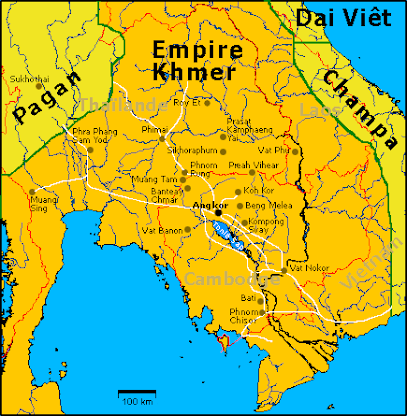
Preah Vihear Temple — the name means Mountain of the Sacred Temple — is the most spectacularly situated of all Angkorian monuments. Built from the ninth to the 12th centuries atop a peak of the Dangkrek Mountains, it occupies a triangular plateau rising from the Thailand border to a prow-shaped promontory.
An ever-changing architectural, mythological and geological panorama unfolds as visitors progress along the temple’s 2,600-foot-long processional axis, up a series of gently sloping causeways and steep staircases through five gopura, or pavilions, each more sacred than the last.
I began my visit at the bottom of the Monumental Staircase, which, according to the Angkor scholar Vittorio Roveda, “symbolizes the laborious path of faith needed to approach the sacred world of the gods.” The 163 gray sandstone steps, partly carved into the living rock, are flanked by statues of lions and, near the top, two magnificent nagas (seven-headed serpents) facing north toward Thailand. Also intently watching Thai territory were several AK-47-toting Cambodian soldiers in camouflage.
The first structure I came to, called Gopura V by generations of archaeologists, was an airy cruciform construction once topped by wood beams and a terra-cotta tile roof. Many of the stones have tumbled over, but the delicately balanced eastern pediment has survived to become Preah Vihear’s most recognizable icon, appearing on publicity posters, patriotic T-shirts and the new 2,000-riel banknote.
In centuries past, this pavilion was where pilgrims from the plains of Cambodia, having just climbed the steep, mile-long Eastern Staircase (mined and inaccessible for decades but soon to reopen), met their counterparts from what is now Thailand, who had completed a rather less-taxing ascent from the Khorat Plateau.
Alongside a group of saffron-robed monks, I continued north on a majestic, sandstone avenue, 800 feet long, to Gopura IV. There, I came upon a particularly vivid bas-relief depicting the Churning of the Ocean of Milk, a Hindu creation myth in which gods and demons churn the primeval waters to extract the ambrosia of immortality.
Although most of the splendid decorative carvings at Preah Vihear, including this one, depict Vishnu, the temple was originally dedicated to the Hindu god Shiva. In later centuries, it was converted to use as a Buddhist sanctuary, and today many of the visitors are Buddhist pilgrims.
As I continued my ascent, I walked under exquisite lintels and tympanums depicting more scenes from Hindu epics like the Mahabharata, and beneath richly carved double pediments adorned with finials and upturned gable ends — calling cards of Cambodian and Thai architecture to this day. Ancient inscriptions in Khmer and Sanskrit, bearing cryptic details about the history of the temple and the Angkorian kings who built it, were hidden here and there under a patina of lichen.
The temple’s culminating point, geographically and symbolically, is Gopura I, whose mandapa (antechamber) and Central Sanctuary, now a jumbled pile of carved sandstone blocks, are surrounded by galleries that call to mind a French Gothic cloister, except that here the windows are rectilinear and the galleries covered by corbelled vaults. (The Khmers, for all their architectural genius, never mastered the keystone arch.)
The entire structure is inward-looking, its outer walls almost devoid of openings despite the sweeping views just outside. Scholars speculate that while the site was considered holy in part because of its spectacular situation, the ancient architects may have believed that picture windows would distract both priests and pilgrims from their sacred tasks.
As I approached the rocky tip of the promontory, just beyond Gopura I, a breathtaking panorama came into view. Cambodia’s verdant northern plains extended majestically toward the horizon, and in the distance I could just make out Phnom Kulen, about 65 miles to the southwest, where the Khmer Empire was founded in A.D. 802. (Angkor itself lay hidden in the haze, 88 miles away.)
To the east, toward Laos, and the west, the Dangkrek Mountains stretched into the distance in a series of serrated bluffs. Looking north, almost everything I could see was in Thailand, rendered remote and mysterious by its inaccessibility.
Thailand ruled much of northwestern Cambodia, including Preah Vihear Temple, from the late 18th century until 1907, when the French colonial administration forced the Thais to withdraw to the current international frontier; Cambodian sovereignty over Preah Vihear was confirmed by the International Court of Justice in 1962.
Thailand, despite unresolved land claims, initially supported Cambodia’s Unesco bid for World Heritage status, but the temple soon became a pawn in Thai and Cambodian domestic politics, unleashing nationalist passions in both countries.
In July 2008, according to Cambodian authorities, Thai soldiers intruded into Cambodian territory near the temple. The Thai government denied that any border violations had taken place. Since then, a total of at least seven soldiers from both sides have been killed in intermittent exchanges of fire, according to local news reports. At the time of my visit, though, the frontier had been quiet for several months.
Curious about what the standoff actually looked like, I asked my guide, conveniently a moonlighting army officer, if I could get a glimpse of the Thais. He took me to the bottom of the Monumental Staircase, where I could hear the distant sounds of war — air-raid sirens and shooting — but the combat was taking place on a tiny television, which off-duty soldiers were watching with rapt attention.
We walked along a forest trail past a volleyball court and trenches, passing soldiers in hammocks with their wives stealing a moment of intimacy in an encampment with little privacy, to a forest clearing with a bamboo table at the center.
About 20 yards in front of us stood a line of neatly built bunkers; uniformed men could be seen among the dark green sandbags. “So those are Cambodian soldiers?” I asked, trying to get my bearings. “No,” my guide answered, “those are Thais. Over there” — he turned 180 degrees and pointed to a line of bunkers 20 yards in the other direction — “are Cambodians.” The table, I realized, marked the midpoint of no-man’s land.
The Cambodians’ front-line bunkers, made of disintegrating sandbags sprouting grass, were shaded by blue and green tarpaulins and surrounded by orderly gardens. Their raised observation post, topped by a thatched roof, looked as if it might have been on loan from “Gilligan’s Island.” I was in the middle of a very un-Korean Panmunjom, a laid-back, tropical version of Christmas 1914 on the Western Front.
I soon learned that the Cambodian soldiers stationed there call the site Sambok Kmom, or beehive, because, they say, the area’s many wild bees leave Cambodians unmolested but set upon any Thai who encroaches on Cambodian land. Moved by national feeling, domestic tourists wearing krama (traditional checked scarves that serve as something of a Cambodian national symbol) wandered by, distributing cigarettes and other morale-boosting gifts to the soldiers who were deployed to help the bees protect Cambodian sovereignty.
Around the clearing, soldiers from both sides, unarmed and without body armor or helmets, were relaxing in front of their own front-line bunkers. Cambodian officers seemed to find the bamboo table, shaded by trees tall enough to let breezes through, especially congenial. A few paces away, the Thais had strung a hammock between trees, and one soldier, lounging in a white T-shirt, black combat pants and black military boots, was engrossed in a cellphone call.
Despite the apparent tranquillity, I knew that if the order were given, the men on both sides of the invisible line would not hesitate to shoot. In fact, many of the Cambodian troops stationed around Preah Vihear are battle-hardened former Khmer Rouge fighters. For now, though, relations are casual and, I was told, some wary friendships have developed.
The best staging point for a visit to Preah Vihear Temple is Sra Em (also spelled Sa Em), 19 miles by road from the temple. Two years ago, it was a sleepy crossroads hamlet with a single grimy restaurant and one rundown guesthouse. These days, in the wake of the area’s military buildup, it feels like a Gold Rush boomtown, with haphazardly parked four-wheel-drives instead of tethered horses; karaoke bars sporting pink fluorescent lamps and colored lights, instead of saloons; and the gleanings of Cambodia’s recently doubled defense budget, instead of gold nuggets glinting in the stream. Armed men in camouflage uniforms abound.
Sra Em’s accommodation options are rudimentary, to put it politely. My room’s star amenity was a cold-water spigot for filling the plastic bucket used both to bathe and to flush, and below the cheap plastic mirror and its public access comb, dust bunnies had formed around the hair of guests past. Each time I returned to my room, I found a dead cricket, a new one every day, hinting, perhaps, at the presence of some sinister insecticide.
Preah Vihear Temple is, obviously, not quite ready for mainstream tourism. During the two days I spent at the temple in October, I saw only four other Westerners, including an unhappy German couple whose day trip from Angkor Wat had been rather more trying than expected, and perhaps 50 or so Cambodian tourists. But intrepid travelers who brave the diabolical (though improving) roads, substandard accommodations and alarming government travel advisories are richly rewarded.
For 40 generations, Hindu and Buddhist pilgrims have trekked to this temple, seeking to ascend toward the holy and the transcendent. Today, the awe-inspiring nature of this Angkorian masterpiece, accentuated by the challenges of getting there, confer on every trip the aura of a pilgrimage.
NAIL-BITING TAXI TRIPS AND A VOLCANO AT YOUR TABLE
GETTING THERE
With the visa-free crossing from Thailand closed for the foreseeable future, getting to Preah Vihear Temple requires battling Cambodia’s famously potholed roads, which are at their worst during the wet season (about June to October).
Share-taxis, which have no set schedule and depart when full, link Sra Em with Siem Reap via the former Khmer Rouge stronghold of Anlong Veng ($7.50 a person; 130 miles; three hours) and with the provincial capital of Tbeng Meanchey ($6.50; 65 miles; two hours). The U.S. dollar is widely accepted.
The taxis, usually “jacked-up” Toyota Camrys, carry six or seven passengers in addition to the driver, so if you want the front seat to yourself you’ll have to pay two fares. Ante up six times the single fare and you’ve got yourself a private taxi.
From Sra Em, a ride to Kor Muy on the back of a motorbike will run about $3.75. Then the three-mile ride up the mountain to Preah Vihear Temple, on a concrete road whose gradients will impress even San Franciscans, is $5 by motorbike or $20 to $25 by four-wheel-drive pickup.
WHERE TO STAY
Glassless windows, sinkless bathrooms, towels with the absorptive capacity of a plastic bag, fans that run only when a generator is sputtering outside your window (usually from 6 p.m. to 6 a.m.) and laissez-faire housekeeping are, alas, the norm in Sra Em’s guesthouses. I should have stayed at the 25-room Tuol Monysophon (855-99-620-757), which opened this year. A brown, barn-like structure topped with a red tile roof, it has basic rooms downstairs with private baths, mosquito nets and wood-plank floors, for $10; smaller upstairs rooms with shared facilities are $7.50. To get there from the triangular crossroads, head west (toward Anlong Veng) for 500 yards.
WHERE TO EAT
The Preah Vihear area’s best restaurant, hands down, is Sra Em’s Pkay Prek Restaurant (855-12-636-617), an unpretentious complex of open-air, fluorescent-lit pavilions with plenty of geckos. The specialty is phnom pleoung (hill of fire; $3.75), a meat and veggie feast you grill yourself at your table on an aluminum “volcano” suspended above glowing coals.
SAFETY
Before setting out to Preah Vihear Temple, check the Phnom Penh Post (phnompenhpost.com), the Cambodia Daily or other reliable sources to make sure that Thai-Cambodian tensions are not rising.
According to the Cambodian Mine Action Center (www.cmac.org.kh), the immediate vicinity of the temple is now safe, having been cleared in recent years of more than 8,800 anti-personnel mines. However, nearby areas are still heavily mined, so do not, under any circumstances, wander off the footpaths.
WHAT TO READ
The most useful guidebook in English (and Thai) to the temple’s architecture, symbolism and history is “Preah Vihear” by Vittorio Roveda (Bangkok: River Books, 2000), but it may be difficult to find.
Cambodia To Eradicate HIV/AIDS Infection From Mother To Child By 2020
PHNOM PENH, Cambodia has set year 2020 as a timeline to eradicate the spread or infection of HIV/AIDS from mother to child, reports China's Xinhua news agency on Saturday.
Mean Chhiv Vun, advisor to Cambodia's Ministry of Health and director of National Center for HIV/AIDS said Saturday that the Ministry of Health has pledged to eradicate the infection of HIV/ AIDS from mother to child by 2020.
As of now, of the total 36,077 HIV/AIDS related patients, 3,500 are children and being provided medical care by the government.
According to the government's statistics, the prevalence of infection rate has declined from 2 percent in 2006 to 0.9 percent in 2008 for adults aged 15 and 49, and is expected the rate will further decline to 0.6 percent by 2012.
Earlier this month, Bun Rany, spouse of Cambodian Prime Minister Hun Sen and Chairman of Cambodian Red Cross pledged that the government, her Cambodian Red Cross as well as other national and international organizations were committed to continue helping and supporting all activities that help combating this deadly disease.
She also urged all private companies to not condition employees ' pre-blood test prior to offering their new job, an act she says a violation to law on HIV/AIDS.
Cambodia is considered as a successful country in fighting against the spread or infection of HIV/AIDS through a 100 percent condom use campaign.
-- BERNAMA
Read more!
Friday, December 25, 2009
PM denies coup charge from hun sen
By THE NATION
The government yesterday denied Cambodian Prime Minister Hun Sen's accusation of plotting to stage a coup to topple the government in Phnom Penh.
"The Thai government will never do such a thing," Prime Minister Abhisit Vejjajiva said, and added his government had a policy to maintain good ties with neighbouring countries.
He said the Thai government would not interfere in Cambodia's internal affairs and had never criticised Cambodian politics.
Relations between Thailand and Cambodia plunged after Hun Sen appointed former Thai Prime Minister Thaksin Shinawatra as his adviser. The two countries downgraded diplomatic relations and there are no moves to normalise ties.
Prime Minister Abhisit turned down Indonesia's offer to mediate, saying he had already explained his side of the story to President Susilo Bambang Yudhoyono and hoped that such an explanation could help.
However relations look unlikely to improve in the near future. Hun Sen was quoted by Agence France-Presse as saying in a speech at a provincial ceremony on Thursday that he had seen a secret Thai government document outlining a plan to mount a coup.
"You have outlined bad scenarios, including preparing to wage war against Cambodia," Hun Sen said.
Deputy Prime Minister Suthep Thaugsuban said Cambodia might have received incorrect information from ousted prime minister Thaksin.
Suthep insisted the Thai government had never thought of intervention in Cambodian politics and Prime Minister Abhisit Vejjajiva was a champion of democracy who would never stoop to destroy the neighbouring country through other means.
The information Cambodia has received from Thaksin and opposition Pheu Thai MP Jatuporn Promphan is incorrect and it might have misled the Cambodian leader, Suthep said.
The Foreign Ministry on Thursday lodged a complaint with the police, charging key leaders of the anti-government red-shirt group with publicising confidential documents and libel following a leak of the ministry's classified document on relations between Thailand and Cambodia.
Army chief Anupong Paochinda said he did not expect any Thai people would be involved in politics in the neighbouring country.
Read more!
Thaksin popular in Cambodia, too
Cambodians living across the border from Thailand's northeastern provinces idolise ousted prime minister Thaksin Shinawatra, a study shows.
The initial findings of the research conducted by National University of Singapore senior lecturer Peter Vail for the Thailand Research Fund were unveiled on Tuesday.
They show border people in Cambodia, due to their geographical proximity to Thailand, are impressed with the former prime minister and the populist policies implemented when he was in power.
"They [survey respondents] also enjoyed discussing polarised Thai domestic politics and we could see several effigies in these areas slandering Prime Minister Abhisit Vejjajiva,'' said Mr Vail, who is also attached to the Mekong Sub-region Social Research Centre at Ubon Ratchathani University.
The northern Cambodians related to the red shirt group and found the yellow shirts were backward-looking people who wanted to steal Cambodian land and artefacts, he said, adding that they might also want to talk about Cambodian politics but they could not.
"They simply said they did not like [Cambodian Prime Minister] Hun Sen but wanted Hun Sen to introduce populist projects like Thaksin did to Thailand,'' the researcher said.
Northern Cambodians also disapproved of the Thai-Cambodian spat over Phnom Penh's campaign to list Preah Vihear as a World Heritage site.
"They just want to do business and make money,'' Mr Vail said. "They simply want better livelihoods, helped by border trade.''
Read more!
Thailand rejects Cambodian allegation of coup plot
BANGKOK — Thai Prime Minister Abhisit Vejjajiva on Friday rejected an accusation from his Cambodian counterpart Hun Sen that Thailand is hatching a plot to stage a coup in the neighbouring nation.
The Cambodian premier made the allegation on Thursday as diplomatic relations between the governments sunk to a new low.
Hun Sen said he had seen a secret Thai government document outlining the plan to mount a coup, but Suthep, who is in charge of national security, said the charge was groundless.
"We have no reason to do such a thing. My government has a clear policy to maintain good relations and we don't need to resort to violence or disrupt bilateral trade," Abhisit told reporters.
"Thailand would not interfere in Cambodia's internal affairs and Thailand never criticises domestic Cambodian politics," he said.
Relations between the countries, which have fought a string of deadly gunbattles on their border since last year, plunged last month when fugitive former Thai premier Thaksin Shinawatra became an economic adviser to Cambodia.
Both recalled their ambassadors in November and diplomatic tensions were further raised when Phnom Penh refused to extradite Thaksin during his first visit as adviser last month.
Thaksin, who was ousted in a coup in 2006, is living abroad, mostly in Dubai, to avoid a two-year jail term for corruption handed down by a Thai court in August 2008.
Read more!
Thursday, December 24, 2009
Alabama native, among nation's most decorated veterans, dies
By The Associated Press
WACO, Texas -- Retired Col. Robert Lewis Howard, a man considered to be the country's most decorated soldier, died Wednesday. He was 70.
Howard was battling pancreatic cancer and died about noon at a hospice, his friend Benito Guerrero, a Vietnam veteran and retired sergeant major, told the San Antonio Express-News.
The Army veteran died in Waco, according to Oak Crest Funeral Home. At the time of his death he was the most decorated American soldier, the funeral home obituary said. He will be buried at Arlington National Cemetery with full military honors. No date has been set, the funeral home said.
Howard grew up in Opelika, Ala., and served in the Army from 1956 to 1992. He was part of the U.S. Army Special Forces, known as the Green Berets, and ran cross-border operations in Laos, Cambodia and North Vietnam. He was wounded 14 times in Vietnam and was awarded eight Purple Hearts.
He was nominated three times for the Medal of Honor, the nation's most prestigious award for combat veterans. President Richard M. Nixon presented him with the honor at the White House in 1971 for his bravery in Vietnam during a mission to rescue a missing soldier in enemy territory.
Read more!
Cambodian PM accuses Thailand of preparing coup
CAMBODIAN Prime Minister Hun Sen today accused neighbouring Thailand of preparing a coup against his government as the war of words between the neighbouring nations worsened.
Hun Sen said he had seen a secret Thai government document outlining the plan to mount a coup, which he said he had passed to Cambodia's King Norodom Sihamoni to show the "bad character of our neighbouring leaders''.
"In your secret document it says that although the (Thai) foreign ministry does not agree to stage a coup in Cambodia... others are working on it,'' Hun Sen said.
"Don't even think about it. I know who is doing this,'' he added, during a speech at a provincial ceremony.
The Cambodian premier said he had also seen documents that showed Thailand has considered waging war against its neighbour.
``You have outlined bad scenarios, including preparing to wage war against Cambodia,'' he said.
Hun Sen's comments follow the leaking of a document in Thailand last week, written by the Thai foreign minister to premier Abhisit Vejjajiva, in which the worsening relations between the two countries are analysed.
Read more!
Thailand preparing coup?
 PHNOM PENH - CAMBODIAN Prime Minister Hun Sen on Thursday accused neighbouring Thailand of preparing a coup against his government as the war of words between the neighbouring nations worsened.
Mr Hun Sen said he had seen a secret Thai government document outlining the plan to mount a coup, which he said he had passed to Cambodia's King Norodom Sihamoni to show the 'bad character of our neighbouring leaders'.
'In your secret document it says that although the (Thai) foreign ministry does not agree to stage a coup in Cambodia... others are working on it,' Mr Hun Sen said. 'Don't even think about it. I know who is doing this,' he added, during a speech at a provincial ceremony.
The Cambodian premier said he had also seen documents that showed Thailand has considered waging war against its neighbour. 'You have outlined bad scenarios, including preparing to wage war against Cambodia,' he said.
Mr Hun Sen's comments follow the leaking of a document in Thailand last week, written by the Thai foreign minister to premier Abhisit Vejjajiva, in which the worsening relations between the two countries are analysed.
Relations between the countries, which have fought a string of deadly gunbattles on their border since last year, plunged last month when fugitive former Thai premier Thaksin Shinawatra became an economic adviser to Cambodia. -- AFP
Read more!
Cambodian new national airline makes profit
PHNOM PENH: Cambodian Prime Minister Hun Sen on Thursday said the country's new national airline, Cambodia Angkor Air, had begun to turn a profit, raising hopes it would not fail like its predecessor.
The airline, which has capitalisation of US$100 million, was launched in July following the failure of a previous effort in 2001.
Cambodia Angkor Air, a joint venture between the government and Vietnam Airlines, aims to promote Cambodia as a destination and boost tourism.
"We expected the airline to make losses for two years, but now this airline is making profit because a lot of passengers are using it," Hun Sen said during a provincial ceremony.
The last national carrier, Royal Air Cambodge, folded in 2001 after running up losses of US$30 million.
Cambodia Angkor Air flies between tourist hub Siem Reap and Vietnam's Ho Chi Minh City.
Tourism is one of the only sources of foreign exchange for impoverished Cambodia, which is recovering from nearly three decades of conflict that ended in 1998.
The kingdom aims to lure three million tourists annually by next year, and in 2009 attracted more than two million holidaymakers.
A number of foreign airlines, including Japan Airlines and Qatar Airways, currently operate direct flights to Cambodia.
- AFP/sc
Read more!
Wednesday, December 23, 2009
They were on track to kill him: Reds
By Naya Jaikawang,
Hassaya Chartmontree
The Nation
Pheu Thai MP Jatuporn Prompan yesterday alleged the government was hatching a secret plan to "get rid of" fugitive ex-premier Thaksin Shinawatra - backing up his allegation for a second time by disclosing a classified memorandum prepared by the Ministry of Foreign Affairs.
Repeating his claim of last week, Jatuporn said a memorandum on Thai-Cambodian ties, classified as secret and sent from Foreign Minister Kasit Piromya to Prime Minister Abhisit Vejjajiva, was purportedly a plot to assassinate Thaksin.
"The term "get rid of" is a codeword for killing," he said, claiming such a codeword is commonly understood by MFA officials.
At yesterday's press conference, Jatuporn focused on the five-page annex to the main document which he touched on last week.
The annex outlined responses of varying intensity to the prime minister of Cambodia, he said. The 18 measures included a ban on Thai citizens visiting Cambodian casinos, cancellation of the extradition treaty, reinforcement of troops along the borders, and cancellation of the memorandum of understanding (MOU) on maritime boundaries.
He said the MFA analysis shed light on the dilemma of memorandums of understanding previously signed with Cambodia.
In one case, the MFA urged cancellation of the 2001 MOU on maritime boundaries in order to smear Thaksin for conflict of interest, he said. But an anticipated adverse impact might have led to the questioning of the MOU on land borders, signed in 2000 by Democrat MR Sukhumbhand Paribatra, he added.
He claimed the debate about the MOUs raised two interesting facts - first, Thaksin had no conflict of interest but the government wanted to smear him; and second, the 2000 MOU highlighted the loss of sovereignty around Preah Vihear Temple, but the Democrats did not want to concede their mistake.
The two MOUs have remained in effect and Thailand will not be better off by meddling with them, he said.
The entire memorandum was 12-pages long and should be made public in order to stop the alleged plot to kill Thaksin, he said.
He insisted disclosure of the classified memorandum would neither be harmful to Thai interests nor beneficial to Cambodia.
"The memorandum is illegal with the aim to take Thaksin's life," he said, shrugging off the threat of litigation on unauthorised disclosure of classified information.
He said he might file a counter lawsuit charging the MFA with abuse of power for undertaking illegal actions.
He vowed to use the classified memorandum as a major rallying point for the red shirts to resume street protests next month designed to oust the government.
He also said he planned to censure Deputy Prime Minister Korbsak Sabhavasu for intimidating the judiciary to relocate the construction site for a court in Pai, Mae Hong Son.
Reacting to Jatuporn's claims, Deputy Prime Minister Suthep Thaugsuban said he would allow legal experts to determine appropriate counter-measures.
Suthep said the government had not planned on taking out a contract on Thaksin's life as alleged. Even though he had no access to the memorandum in question, he assumed it was just an outline of a general plan for responses to anticipated measures from Cambodia, he said.
Because of the leak, the MFA might have to rethink and redraw the plan, he added.
He said there was virtually nothing he nor the government could do to improve the bilateral ties with Cambodia since its prime minister was fully committed to supporting Thaksin in his attempts to undermine the Thai government.
The House committee on foreign relations plans to launch a hearing and will call on Kasit to testify on the classified memorandum, committee chairman Tophong Chaiyasarn said.
Meanwhile, Chavanond Intarakomalyasut, secretary to the foreign minister, said yesterday the Ministry of Foreign Affairs was preparing to take legal action against Jatuporn for making public the classified documents.
A fact-finding committee has been set up to investigate the leak of the documents, according to a ministry source.
The panel, headed by deputy permanent secretary for foreign affairs Piyawat Niyomroek, has questioned almost 20 people but still has not yet completed its work, the source said.
Read more!
Deported Uyghur Had Cambodian Visa
 A legal visitor in Cambodia was apparently swept up in a mass deportation to China.
WASHINGTON—One of 20 ethnic Uyghur asylum-seekers deported from Cambodia to China as illegal migrants entered the country legally and on the advice of U.N. refugee officials, Radio Free Asia (RFA) has learned.
Aikebaerjiang Tuniyaz, 27, left China in March 2009 after serving a one-year jail term in Liudawan prison in Urumqi for allegedly “leaking secret information abroad.”
Tuniyaz, born in Aksu and a graduate of Shanghai Jiaotong University, spoke in 2007 with RFA’s Uyghur service about the shooting of a Uyghur man by Chinese security forces in Urumqi, capital of the Xinjiang Uyghur Autonomous Region (XUAR).
Tuniyaz entered Thailand in early 2009 and sought asylum through the Bangkok office of the U.N. High Commissioner for Refugees (UNHCR), where a staff member suggested he might expedite the process by approaching the UNHCR office in the Cambodian capital, Phnom Penh, instead, he said in an earlier interview.
He obtained a visa through the Cambodian embassy in Bangkok and entered Cambodia legally, he said. Tuniyaz was in Cambodia legally when deadly ethnic rioting erupted in Urumqi on July 5 this year.
The 20 Uyghur Muslims deported Saturday under intense Chinese pressure had fled to Cambodia in search of asylum after witnessing and documenting violent ethnic riots in the restive western Chinese region of Xinjiang this summer that left nearly 200 dead.
They had warned the UNHCR that they feared long jail terms or even the death penalty if they were sent back to China, according to statements obtained by The Associated Press.
Tuniyaz had been translating for and staying with the group of 21 Uyghurs in Phnom Penh—two are said to have fled—when the group was detained.
Cambodia said it expelled the Uyghurs because they had illegally entered the country. It has since been sharply criticized by Washington, which said the deportations would harm bilateral ties with the United States, though they may have strengthened relations with Beijing.
On Monday, China signed off on more than U.S. $1.2 billion in aid to Cambodia during a visit there by Vice President Xi Jinping. The assistance, including 14 agreements for grants and loans, ranges from help in building roads to repairing Buddhist temples.
More protests
The European Union said Monday it was "deeply concerned" about Cambodia's decision to return the group of Uyghurs to China and urged Beijing to respect the rights of the returnees.
On Tuesday, U.N. Special Rapporteur on Torture Manfred Nowak slammed the deportations.
“This is a blatant violation of Cambodia’s obligations under the principle of non-refoulement as stipulated in Article 3 of the U.N. Convention Against Torture,” Nowak said in a statement.
Nowak said that he had reports of “severe torture” in Xinjiang following the unrest and that recent executions there violated “the most basic fair trial guarantees.”
“I am calling on the Chinese authorities to treat the 20 persons humanely upon return in accordance with international standards, to grant access to them in case they are detained and to afford them due process guarantees, if charged with criminal offenses”, he added.
U.N. Independent Expert on Minority Issues Gay McDougall called on Beijing to allow U.N. rights envoys to examine ethnic tensions in Xinjiang after the deadly violence there.
Original reporting by Shohret Hoshur for RFA’s Uyghur service. Uyghur service director: Dolkun Kamberi. Written in English by Sarah Jackson-Han.
Read more!
China denies linking Cambodia aid with deportation of Uighurs
China denied on Tuesday it had linked aid to Cambodia with the Southeast Asian nation’s decision to deport a group of Uighurs back to China despite protests from the United Nations and the United States.
Cambodia signed 14 deals worth an estimated $850 million with China on Monday, two days after defying international pressure by expelling 20 Uighur asylum-seekers, underlining growing trade and diplomatic links.
Uighurs are a Turkic Muslim group native to China’s far western region of Xinjiang, where ethnic rioting in July killed 197 people. Many there chafe under Chinese restrictions on their culture and religion. A group of Uighurs were smuggled into Cambodia about a month ago and applied for asylum at the United Nations refugee office. Yet Cambodia brushed off concerns they would be mistreated if returned and deported them for immigration offenses.
Chinese Foreign Ministry spokeswoman Jiang Yu declined to say where the deported Uighurs currently were, but said their case was not connected with China providing Cambodia aid. ”These accusations are groundless. These Chinese nationals’ illegal boarder crossing and entry into Cambodia violated both China’s Entry and Exit Law and relevant Cambodian laws,” she told a regular news briefing in Beijing.
“Furthermore, they are suspected of crimes. I think any country in this situation has the right to make its own decision according to domestic laws,” Jiang said. US-based Uighur leader Rebiya Kadeer, reviled by Beijing as a separatist, wrote in the Wall Street Journal that Cambodia’s deportation was “no doubt influenced by enormous Chinese pressure, backed by hundreds of millions of dollars in aid”.
The UN accused Cambodia of bowing to pressure and deporting the asylum seekers despite having given “strong assurances” it would be allowed to complete its investigation to determine their status.
Read more!
Jatuporn reveals more papers
 Puea Thai MP Jatuporn Promphan on Wednesday made public an additional nine pages of a classified document he claims to have been prepared by the Foreign Ministry and outlining proposed action against Cambodia.
The pages shown by Mr Jatuporn at a press conference proposed taking three steps to counter the actions of the Cambodian prime minister. This included delaying Thai-Cambodian cooperation projects and reinforcement of troops along the border, particularly near the Preah Vihear temple.
The papers also proposed tough action against former prime minister Thaksin Shinawatra, who is now economic adviser to the Phnom Penh government and is being protected by Cambodian Prime Minister Hun Sen.
Mr Jatuporn, a leader of the United Front for Democracy against Dictatorship, on Friday released what he said were the first pages of Foreign Ministry document. They focused on how Thailand should handle its relations with Cambodia and described Thaksin as a "key factor" in the destabilisation of the government that must be eliminated.
Mr Jatuporn interpreted it as a threat to Thaksin's life.
Mr Jatuporn said on Wednesday that he did not regard the document he had revealed as confidential since it was illegal, an interference in the judicial process and in violation of the constitution.
The UDD leader dared the Foreign Ministry to take legal action against him, saying he would launch a counter suit.
This matter would also be used to grill Foreign Minister Kasit Piromya during the coming no-confidence debate parliament and to seek his removal from office, he added.
He said the document which had been revealed would be translated into English and published on Thaksin's twitter website.
Chavanond Intarakomalsut, secretary to Mr Kasit, said the Foreign Ministry had consulted with the Office of the Attorney-General over legal action against those who made the document public.
Deputy Prime Minister Suthep Thaugsuban said he agreed with air force chief ACM Ithiporn Supawong's comment that the Information Act should be used against those who make public classified official documents.
Read more!