PHNOM PENH, Cambodia has named a multilateral peacekeeping exercise to be held in the kingdom in 2010 as "Year of Angkor," the Jian Hua Daily said on Monday.
The title of "Angkor" can be traced back to the 802-1423 dynasty, when the Khmer nationality had its most glorious period in history.
The exercise in 2010 will have at least 13 participating countries, most of them Asian ones, the Chinese-language newspaper quoted military officers as saying.
In early April, Prak Sokhon, secretary of state at the Cambodian Council of Ministers, told reporters that 2,000 troops from 13 countries will take part in the U.S.- and UN-sponsored exercise to be held in Kompong Speu province in 2010.
The event will be conducted in the framework of the Global Peace Operations Initiative (GPOI), an annual training event attended by GPOI member nations and other regional and international partners, according to the U.S. Embassy.
GPOI once held such exercises in Bangladesh in 2008 and Mongolia in 2007. Garuda Shield 09 in Indonesia is the upcoming GPOI serial exercise, for which Cambodia prepares to dispatch some60 soldiers.
According to official files, Cambodia respectively sent 40 soldiers to Bangladesh and 43 to Mongolia to take part in these GPOI exercises.
Read more!

Monday, May 04, 2009
Cambodia names multilateral peacekeeping exercise in 2010 as "Year of Angkor"

Sunday, May 03, 2009
Adventures in Angkor
 By Elaine O'Connor, Calgary Herald
Two women bicycle by in peaked straw hats, a farmer passes with a load of hay strapped to his scooter, another hauls a slaughtered hog, kids ride three to a bike, parents with toddlers sit four to a scooter.
We weave around each other, trying to avoid the worst of the road's ruts. With every teeth-rattling, spine-shattering swerve, I remember my airport taxi driver's ominous warning after I landed in Siem Reap. Three tourists die every month trying to see the wats (temples) from the back of a scooter, he said. I thought he was just trying to land a gig as my chauffeur.
Now, I'm not so sure.
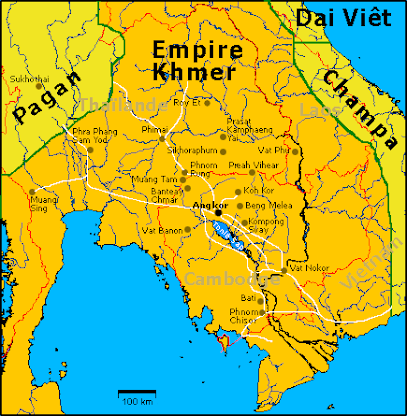
But the effort to uncover Angkor's Beng Malea --a remote 12th-century forest shrine more than 60 kilometres from the heart of the ancient city of Angkor,
which is a UNESCO World Heritage site--proves well worth my bruised tailbone.
Angkor, Cambodia's star attraction, is considered the seventh wonder of the world, and its archeological mysteries lure four million visitors a year.
The temples of Angkor ("holy city" in Khmer)were built between the 9th and 13th centuries when the kingdom was at its height, with a million people.
It was the seat of the Khmer empire, whose influence extended into Thailand, Laos and Vietnam, and it was the region's most sophisticated city for over 500 years. Archeologists believe it was the largest preindustrial city in the world.
Beng Malea is a massive, kilometre-square crumbling monument strewn with tumbled rocks the size of small cars set quietly in the jungle. It was built by King Suryavarman II, who also built Angkor Wat. But in contrast to Angkor
Wat's tourist throngs and iconic status, Beng Malea seems forsaken, lost and abandoned.
Cambodia itself has profoundly struggled, and tourism to its ruins is just beginning to help it rebuild.
The nation of 14 million was bombed during the U. S. war in Vietnam to flush out Viet Cong, creating two million refugees. A famine followed in 1975 and that same year the rebel Khmer Rouge took power. Pol Pot's Communist Party renamed the country Kampuchea and tried to return it to its agrarian roots, forcing educated Cambodians to work on farms, killing doctors and teachers and outlawing anything western.
One to three million people were tortured, slaughtered or died from lack of food or medicine. A Vietnamese invasion in the late 1970s ousted the regime, but the Khmer Rouge rebels continued to fight in pockets throughout the countryside: though 1999 was the first full year of peace in 30 years, there are reminders of the Vietnam War everywhere. On the streets, it's rare to see a man over 40. At one wat-side stall, a young girl with a stack of plastic-wrapped books offered a slim volume, reading off its title: Children of Cambodian Killing Fields.
The development and dollars that accompany tourists to Angkor Wat-- arguably the country's top renewable resource--seem to be having a positive impact.
Angkor Wat itself, the world's largest religious building, makes a profound impact.
Nearby lie more remarkable ruins. The gates of Angkor Thom, a three square-kilometre city built by King Jayavarman VII starting in 1181, are flanked with giant, Buddha-like statues--passing through can feel like entering another world. The otherworldly Bayon temple lies on the other side.
The Bayon, with its 37 towers chiselled with dozens of enigmatic, all-seeing Buddha faces offers an eerie introduction to Angkor's wonders. Eyes seem to follow you as you explore the temple, climbing over ruins, ducking under lintels, running fingers over the ancient bas-reliefs, and clambering up stone steps. The mysterious Bayon is one of Angkor's most affecting temples.
For those put off by the two-hour trek to Beng Malea, the temple of Ta Prohm is a fine substitute.
Ta Prohm is perhaps one of the most atmospheric of the inner temples, overgrown with thick vines with slabs of rock smothered in snaking tree roots. No wonder it was used in scenes from Tomb Raider with Angelina Jolie. The 12th-century temple has been left as it was found--and has become beautifully meshed with the jungle.
It can be exhausting playing amateur archeologist in the 30-degree heat but, thankfully, Siem Reap has lots to offer in the way of rejuvenation. The city comes to life after sunset and though Siem Reap is a small town, restaurants, night markets and street stalls in the tourist-centric core remain lively well after midnight.
French colonial roots run deep here, so good bread here is almost as common as rice, and vendors balance baguettes on their heads on their morning rounds.
For a taste of colonial cuisine, try Le Malraux (named for French adventurer Andre Malraux, arrested for stealing temple bas-reliefs in the 1920s), for salade Parisienne, salmon rillettes and cream puffs amid art nouveau interior. Stop for dessert at the Blue Pumpkin cafe, which offers exotic ice cream flavours like banana galangal, green lemon and Kaffir lime, and ginger and black sesame.
After dinner, take care of watwandering tensions with street-side foot massages. They're a dime a dozen (actually, about $3 US for half an hour). Or enjoy an affordable body massage ($10) or pedicure ($7). Several shops also offer massages by the blind; at Seeing Hands Massage on Sivatha Road, part of the proceeds go back into training Cambodia's vision-impaired citizens in the trade.
But for a more refined experience, step into Bodia Spa, a cool, inviting retreat across from the Old Market. A chilled ginger tea and cold herb-infused face cloth greet clients as they enter the white, high-design minimalist space en route to their oil body massages and herbal compresses.
Once refreshed, practise your bargaining skills at the Night Market off Sivatha Road--where endless rows of silk scarves beckon--or shop for social good at several local stores that support non-profit ventures. Rehab Craft near the Old Market sells handmade carvings, wallets and silks made by disabled employees and Artisan's D'Angkor trains poor youths in carving.
Top off the evening with a drink or two on the terrasse of the Red Piano, a restored French Colonial home with a sweeping corner balcony. Raise a glass of Angkor or Chang brand beers or sip a "Tomb Raider" cocktail (the restaurant was known as the place Jolie and crew hung out during filming) and toast to the spirit of Cambodia, to the beauty of Angkor, and to the adventurer in you.
Learn more at Tourism Cambodia: www.tourismcambodia.com.
Cambodia refutes U.S. underestimation of its anti-terrorism capability
PHNOM PENH, The Cambodian Information Minister has refuted a U.S. State Department report about the country's capability of countering terrorism as "not 100 percent correct," national media said on Sunday.
The recently issued U.S. report about the global anti-terrorism situation claimed that terrorists might take advantage of the weakness of Cambodia, such as corruption, poverty and lax management of the border, to carry out illegal acts in its territory, despite the government had made a clear promise to crack down on this type of crime, the newspaper Jian Hua Daily quoted the minister as saying.
In addition, Cambodia lacked training and other resources to counter terrorism, it added.
Khieu Kanharith, also spokesman for the Cambodian government, said "there is no country in the world that can control its border with 100 percent accuracy, neither Cambodia."
However, "the government has established strong and trustworthy relations with different communities in order to nip any social violence in bud," the spokesman said.
Meanwhile, the newspaper also quoted a senior official of the Interior Minister as saying that there is minimum possibility that terrorists' acts occur in Cambodia, and fighting against money laundering should be the kingdom's priority in the anti-terrorism field.
According to official reports, no major terrorism case with global connection has occurred in the country so far.
Read more!
Wolverine Hugh Jackman-declawed
 “Wolverine” star Hugh Jackman has many sides. There is the movie action hero, the Broadway musical award winner and the charming Oscar host. He also hobnobs with billionaire Rupert Murdoch’s family and visits Third World countries where microfinancing projects give people hope for breaking out of poverty.
Jackman plays the main character in superhero movie “X-Men Origins: Wolverine” that opened on Friday, reprising his role as a tough mutant with claws that spring from his knuckles.
But in real life, the 40-year-old Jackman is not likely to turn anyone into mincemeat as he does in the “X-Men” movies, including the fourth and latest film in the franchise which kicks off Hollywood’s blockbuster season.
Jackman is a married family man, whose two young adopted children have playdates with Murdoch’s kids, and who himself hangs out with the media mogul’s adult son.
Of course, the “X-Men” movies that made Jackman a star are productions of Murdoch’s Twentieth Century Fox, and both men are Aussies, so there’s a kinship there.

But Jackman, who says his most expensive hobby is wine and who splits his time between New York and Australia, also has a kinship of sorts with an impoverished woman in Cambodia, after visiting the nation to see microcredit charity work in action.
“It was unbelievable to see this woman get 200 U.S. dollars in her hand, with tears running down her face and the real first chance she and her family had ever had to escape the cycle of poverty,” Jackman told Reuters in a recent interview.
The woman planned to use the money to buy a sewing machine and some supplies to start a clothing business, he said.
Jackman made the recent trip to Cambodia as an “ambassador” for charity World Vision, which has joined in the microcredit movement, offering loans to poor residents of developing countries so they can make a living and sustain themselves.
Jackman is friends with Nobel Peace Prize-winning economist Muhammad Yunus, a pioneer in the world of microcredit and author of the 1999 book “Banker to the Poor.”
Apart from his philanthropic work, Jackman enjoys skiing, kayaking in Sydney Harbour and horse riding. Like many children, his kids enjoy tearing the limbs off the “X-Men” toy figurines that have become popular in recent years.
“Somehow, it’s saving me therapy bills for my kids down the road,” Jackman joked.
Although some reviewers have taken their shots at “X-Men Origins: Wolverine,” indications are that it will post strong box office numbers this weekend. Online ticket seller Fandango.com reported on Friday that the firm accounts for 81 percent of its ticket sales, and that it appeals to both men and women. In a survey of moviegoers planning to see the film, 48 percent were female, and 72 percent of all respondents said Jackman’s starring role was the major reason to see “Wolverine.”
Pakistan’s impending ‘Cambodian Moment’
By Harold A. Gould
The latest news from the Hindu Kush makes one thing painfully apparent: The Taliban/Al Qaeda jihadistani quasi state, “Jihadistan Emirate”, has achieved critical mass. It has now metastasized into a killer disease that threatens the survival of Pakistan’s fragile democracy.
The decisive indication that coherent political integration has been achieved by the Taliban is their successful conquest of Swat. This initial incursion outside their montane territorial fortress now shows that Taliban/Al Qaeda can call the shots regarding subsequent targets. This is evident from their deliberate and systematic expansion from Swat into the contiguous portions of Malakand Division, commencing with Buner district.
What is striking is that they are undertaking the latter in blatant defiance of agreements that were ostensibly ratified between them and the Pakistani government. It is clear, in other words, that the Taliban/Al Qaeda leadership view understandings and agreements that have been made with government authorities in the course of their politico-military expansion purely in tactical terms.
They sense the weakness and paralysis of the Pakistani government, and its consequent willingness (nay eagerness!) to engage in political appeasement, as a golden opportunity to gradually overpower and gain control of the Pakistani state.
The signs are everywhere that the Taliban/Al Qaeda strategy is working, and the authority of the Pakistan government is gradually waning despite official assurances to the contrary. Pakistani officials insist that the situation is under control when all the evidence points in the opposite direction. When US Secretary of State Hillary Clinton alluded to the “existential threat” to Pakistan’s survival posed by the extremists, Pakistan’s Ambassador in Washington, Husain Haqqani, replied that “we do not have a situation in which the government or the country of Pakistan is about to fall to the Taliban.”
His statement exemplifies the state of denial the democratically elected government of Pakistan is in. Clearly, President Asif Ali Zardari, Prime Minister Yousuf Raza Gilani, former prime minister Nawaz Sharif, and even army chief General Ashfaq Parvez Kiyani are in a state of paralytic inaction.
If one is searching for an analogy to what may be forthcoming from the Hindu Kush, in the face of the breakdown of popular government in Pakistan, it might not be far fetched to look no further than the Pol Pot phenomenon and the rise of the Khmer Rouge in Cambodia. There are disturbing similarities between the two cases.
As the Khmer Rouge germinated and perfected their retrograde Maoist extremism in the remote jungle backwater of Cambodia, so the Taliban and Al Qaeda have honed their brand of doctrinal extremism and their accompanying organizational apparatus in the remote valleys of the Hindu Kush. As in the case of the Khmer Rouge, the Americans and the purportedly more advanced segments of Pakistani society at first took the extremists lightly, slighted them strategically, and indeed played political footsie with them until it became apparent that they were a serous threat.
When it seemed to then US secretary of state Henry Kissinger that the Khmer Rouge could be useful in opposing the North Vietnamese, in January 1968 the US Army helped the Khmer Rouge establish the Revolutionary Army of Kampuchea, which materially strengthened them. Much as ISI and the CIA from time to time bolstered the Taliban when it seemed they might be of value to both countries’ regional strategic interests.
There is another horror scenario waiting in the wings should a political collapse result in a “Cambodian Moment” for Pakistan. A Taliban regime in Pakistan would not only tear at the social fabric of Pakistan and plunge millions of Pakistanis into fratricidal conflict, it would potentially place nuclear weapons in the hands of lunatics like Osama bin Laden and Mullah Omar!
This would impose on US President Barack Obama a moral dilemma beyond anything he could have imagined or contemplated when he assumed office. The only option open to him would be to take out the Pakistani nuclear facility at Chagai Hills in much the same manner, but on a grander scale, than Israel did when it feared that Saddam Husain’s Daura reactor near Baghdad would go critical by July or August of 1981.
The ramifications this would have for South Asia and indeed the entire world boggle the mind.
Yet this is a scenario whose occurrence cannot be dismissed as long as Pakistan’s civil society acting through its elected secular government, in consonance with the United States and the UN, move decisively before it is too late.
(03.05.2009 - Harold A. Gould is visiting scholar in South Asian Studies at the University of Virginia. He can be contacted at harold.gould4@verizon.net)
Read more!
Saturday, May 02, 2009
Sebelius Confirmed; Cambodian MP Countersued
By WeNews Staff
Cheers
Kansas Gov. Kathleen Sebelius won U.S. Senate confirmation on April 28 to serve as the nation's health and human services secretary. The pro-choice Democrat will be heading the agency, which oversees women's health issues and is directing the government's efforts against the swine flu outbreak.
The Senate voted 65 to 31 to confirm Sebelius, who is a two-term governor, after the Democrats urged quick action to approve Sebelius in light of the swine flu outbreak, The Associated Press reported. Sixty votes are needed in the 100-seat Senate for confirmation. Sebelius' confirmation had been stalled, as Republican opponents raised concerns over her pro-choice stances, among other issues.
Sebelius' confirmation completes President Obama's cabinet.
More News to Cheer This Week:
A California bill, called Assembly Bill 612, cleared its first hurdle this week when it was approved by the Assembly Committee on Judiciary. The bill seeks to prohibit courts from considering nonscientific theories when making decisions on child custody or visitation. Supporters of the bill say that one of these unscientific theories, the parental alienation syndrome, where a child is essentially brainwashed into thinking the other parent is the enemy, has fueled bitter child custody battles and has been used by some abusive parents to regain custody of the abused child.
The Fawcett Society, the United Kingdom's leading campaigning organization for women's rights, will launch a campaign on May 4 to encourage more black women to exercise their right to vote. Fawcett's research has found that ethnic-minority women in the U.K., particularly black women, are less likely to be registered to vote than white women and ethnic-minority men. They are also less engaged in mainstream politics: there are only two black female MPs, while there has never been an Asian female MP. The organization will also be promoting a new guide to democracy for ethnic-minority women in advance of local and European elections on June 4.
The U.S. House of Representatives passed the Local Law Enforcement Hate Crimes Prevention Act (HR 1913) this week. The vote is being applauded by organizations such as the American Association of University Women, who say it's a strong statement against bias-motivated crimes that can destroy communities. The organization also said that the current federal law does not do enough to protect victims, especially women, who are completely ignored under the federal statute and for whom statistics for such crimes aren't collected.
The number of married Filipinas using contraceptives is increasing while the incidence of infant mortality in the Philippines is declining, according to statistics released this week, the Manila Standard reported. The number of married women using any family planning method climbed to 51 percent in 2008, up from 47 percent in 1998. The same survey found that for every 1,000 live births in the Philippines, 34 children die before reaching the age of five, as opposed to 54 deaths in 1988 to 1992.
The Pakistani Government has decided to establish 39 more Shaheed Benazir Bhutto Centres for Women in various districts of the country for the rehabilitation of victims of violence and to provide temporary shelter, psychological counseling, and free medical and legal aid, The Pakistan Newswire reported. The funds to establish these centers are to be part of the budget of financial year 2009 to 2010. Twenty-five of these centers have been created at the district level during the current financial year.
Jeers
Mu Sochua, a senior MP in Cambodia's opposition Sam Rainsy Party, the largest opposition party in the country, is facing legal action and a possible suspension of her parliamentary immunity. This is in response to her announcement last week that she is suing Cambodian Prime Minister Hun Sen for defamation and insults.
Sochua is suing Sen for calling her cheung klang, or "strong leg"--a term that she says is especially offensive towards women--during an April 4 speech, the Phnom Penh Post reported. The comments made by the prime minister didn't name Sochua directly, but she says she was clearly the target.
"This is the first time, and I do this on behalf of Cambodian women. I do it on behalf of women in general, because women who are raped, who are assaulted--verbally, sexually, physically and so on--who don't have a voice, cry in silence, are ruined inside. This is a symbolic case and also an unprecedented case," Sochua, who was previously the minister for women's affairs in the coalition government, told ABC Radio Australia.
The prime minister struck back this week by filing a lawsuit against Sochua for defaming him during the news conference where she announced her legal intentions.
More News to Jeer This Week:
The United Nations said this week that the vast majority of Iraqi women face domestic violence on a regular basis and many commit suicide because of it, Reuters reported. In response to this, the UN mission in Iraq said that Iraq and the semi-autonomous region of Kurdistan should take measures to stop violence against women, including honor killings and female genital mutilation.
Saudi Arabia is clamping down on the growing number of unlicensed female gyms, Reuters reported. The Ministry of Municipal and Rural Affairs recently closed three gyms for not having a license. Gyms are sexually segregated in Saudi Arabia and female participation in sports has long been a controversial issue. While male gyms get licenses from a government sports body, female gyms have no official authority overseeing them.
U.S.-Iranian journalist Roxana Saberi, who was sentenced to eight years in prison in Tehran this month on charges of spying for the United States, has gone on a hunger strike to protest her conviction, her father told the Agence France-Presse. He added that his daughter would keep up her protest until she is released. In response to her case, Iranian human rights lawyer and 2003 Nobel Peace Prize winner Shirin Ebadi has joined Saberi's legal team, telling Democracy Now that the journalist's trial was unfair and violated Iran's laws.
Read more!
Cambodia refutes U.S. underestimation of its anti-terrorism capability
PHNOM PENH, The Cambodian Information Minister has refuted a U.S. State Department report about the country's capability of countering terrorism as "not 100 percent correct," national media said on Sunday.
The recently issued U.S. report about the global anti-terrorism situation claimed that terrorists might take advantage of the weakness of Cambodia, such as corruption, poverty and lax management of the border, to carry out illegal acts in its territory, despite the government had made a clear promise to crack down on this type of crime, the newspaper Jian Hua Daily quoted the minister as saying.
In addition, Cambodia lacked training and other resources to counter terrorism, it added.
Khieu Kanharith, also spokesman for the Cambodian government, said "there is no country in the world that can control its border with 100 percent accuracy, neither Cambodia."
However, "the government has established strong and trustworthy relations with different communities in order to nip any social violence in bud," the spokesman said.
Meanwhile, the newspaper also quoted a senior official of the Interior Minister as saying that there is minimum possibility that terrorists' acts occur in Cambodia, and fighting against money laundering should be the kingdom's priority in the anti-terrorism field.
According to official reports, no major terrorism case with global connection has occurred in the country so far.
Read more!
Friday, May 01, 2009
Cambodia plagued by epidemic of drug-resistant conjunctivitis
Written by Nathan Green
Ophthalmogists say they are keeping their eyes on a strain of the ailment that is proving particularly resistant to routine antibiotics
AN eye health specialist from the Ministry of Health warned Thursday that people suffering from a particularly tough-to-treat strain of conjunctivitis sweeping Cambodia should seek medical help rather than trying to cure it using over-the-counter medications.
Do Seiha, the coordinator of Cambodia's national eye care program and the resident ophthalmologist at Phnom Penh's Naga Clinic, said that most infections clear up on their own, but treatment with antibiotics is required if the infection persists.
However, the bacteria that are often responsible for the condition seemed to have developed resistance to the steroidal antibiotic eyedrop Maxitrol that is traditionally used.
"We don't know why, but the infection is resistant to routine treatment," he said. "It usually can be treated in one week, but now treatment is taking up to three or four weeks." He added that around 10 percent of sufferers develop a severe form of the condition.
Do Seiha recommended doctors use a two-pronged antibiotic drug response, prescribing Maxitrol drops alongside drops containing the third-generation synthetic antibiotic Moxifloxacin, which has only been available in Cambodia since December.
While these medicines can be bought over the counter, Do Seiha said they should only be prescribed by a medical doctor, as not all eye irritations are conjunctivitis, and not all conjunctivitis is bacterial. The condition can also be triggered by viruses or an allergic reaction, neither of which would respond to antibacterial treatment, while prolonged use of Maxitrol could damage the eyes.
They could also compound other conditions, such as causing ulcers in the eyes of those suffering from keratitis, an inflammation of the cornea, or worsening glaucoma.
Conjunctivitis outbreaks tend to hit Cambodia in November and December, but this dry season the epidemic came later in January and shows no sign of abating yet, Do Seiha said. He treated about 300 cases over the last three weeks in his ophthalmology practice at Naga Clinic, he added.
The infection is highly contagious and can be spread through person-to-person contact, picked up off surfaces and spread by dust - hence its prevalence in the dry season. Many people became infected when travelling to the provinces for Khmer New Year, Do Seiha said, picking it up from relatives or through exposure to dust-borne bacteria.
"Once one person in a family gets it, everybody will get it," he said. "To limit the risk, infected people must wash their hands regularly and avoid sharing towels." Recovered individuals also have a high risk of reinfection.
He expected the epidemic to persist until the rainy season arrived and reduced dust particles, which can carry conjunctivitis-causing bacteria.
Read more!
Japan donates $4 million to Khmer Rouge tribunal
By SOPHENG CHEANG
PHNOM PENH, Cambodia (AP) — Japan has donated $4.17 million to the U.N.-backed genocide tribunal trying former Khmer Rouge leaders on war crimes charges, just as the troubled court was running out of funding, a court official said Friday.
The money will be used to offset a salary shortfall for 251 court staffers until at least the end of the year, tribunal spokesman Reach Sambath said. The court has been troubled by political wrangling and allegations that some Cambodian officials were demanding kickbacks from people trying to secure jobs with it.
The tribunal is tasked with seeking justice for atrocities committed by the Khmer Rouge during their four years in power in the late 1970s. An estimated 1.7 million Cambodians died under the radically communist regime from forced labor, starvation, medical neglect and executions.
"The donation arrived on time since the Cambodian side of the court was running out of budget. We really appreciate what the Japanese government has done," Reach Sambath said.
The donation comes as Kaing Guek Eav, alias Duch, is being tried by the tribunal for crimes against humanity, war crimes, murder and torture.
The 66-year-old Duch (pronounced Doik) commanded the Phnom Penh prison, where as many as 16,000 men, women and children are believed to have been tortured before being sent to their deaths. Only a handful survived.
Four other former Khmer Rouge leaders, aging and infirm, are being held for trial on charges of crimes against humanity and war atrocities. The are likely to be tried in the next year or two.
The tribunal operates under the joint administration of Cambodia and the U.N., which have separate budgets. In January, Japan gave $21 million to the U.N. side of the operation.
In March, Japan donated $200,000 to the Cambodian side for that month's payroll.
"Japan places a great emphasis on the progress of the Khmer Rouge tribunal, as it believes that this process will promote peace, democracy, the rule of law and good governance in Cambodia," a statement from the Japanese Embassy said.
Read more!
Cambodian hip-hop dance troupe started by ex-gang member plans local fundraiser
 KK (Tuy Sobil) keeps an eye on breakdancers at Korsang, a center for returnees, in Phonm Penh, Cambodia, on February 13, 2008. (Jeff Gritchen / Staff Photographer)
A former Crips gang member from Long Beach, who was deported to Cambodia in 2004 after serving time for armed robbery, KK was still coming to grips with his own travails when word spread in Phnom Penh that he was a talented breaker.
After turning down initial pleas by kids to teach his technique, KK relented and Tiny Toones was born.
The goal was to "provide a safe, positive environment for at-risk youth to channel their energy and creativity into the arts and education" and away from the rampant drugs, gangs and criminal activity that infect the streets.
From meager beginnings, Tiny Toones has enjoyed rapid growth and become something of a media phenomenon.
The group has a drop-in center in Phnom Penh and offers educational and social services to needy kids.
Now Tiny Toones has gone global.
And a half-dozen dancers and a rapper are getting a chance of a lifetime.
On Sunday, the Tiny Toones crew concludes a U.S. tour as headliners at a hip-hop community fund-raiser in Inglewood. The event will also feature a live video conference from Cambodia with KK, who is barred from returning to the United States.
However, his dancers were granted visas and have spent the last two weeks traveling the United States, competing in hip-hop battles and packing in a lifetime of experiences that were once unimaginable.
Organizers had hoped to stage the event in Long Beach but ran into complications.
Those who can't make it to Inglewood can meet Tiny Toones at noon Sunday at Cesar Chavez Park, 401 Golden Ave. where a hip-hop/reggae community picnic will be staged with DJs, graffiti artists, b-boys, drum circles, fire dancers, and other artists.
The members of Tiny Toones may wear sideways ball caps, baggy clothes and strike American urban poses, but "Suicide," "T-Boy," "Diamond," "Fresh," "Honey, "Sokha" and "K-Dep" are pure Cambodian.
Dara Chan, a grad student and child of Cambodian immigrants, spearheaded the effort to get Tiny Toones to the U.S.
He said he was "blown away," when he saw the Cambodian crew perform.
Although the dancers, who range in age from 16 to 23, have only been at it for a couple of years, Chan says "they really pushed themselves. They created a really original show."
The routine begins as a traditional Cambodian "Monkey Dance," before transforming into a modern and urban interpretation of the classic tale.
Chan says he has been amazed at the love and welcome the Cambodian crew has received.
The idea of bringing Tiny Toones began with an invitation to an annual international dance battle called "Breakin' the Law," sponsored by the University of Wisconsin as part of its Hip Hop as a Movement week.
After strings were pulled and letters of support from numerous charities and law firms written, the Tiny Toones kids were granted visas.
Chan said efforts to get a temporary waiver for KK were unsuccessful.
After the show in Wisconsin, Tiny Toones traveled to New York, Philadelphia and Seattle. They return home after Sunday's performance.
In addition to Tiny Toones, the event will include art demonstrations and workshops, live graffiti and silk screening and performances by dancers, rappers, spoken word artists and DJs.
June Kaeswith, a student at Cal State Long Beach, organized the event.
"We want to bring back what hip-hop was originally about, which is peace, love, unity, having fun and knowledge," Kaeswith says. "This event is to revive that."
Information about the events is available by e-mail at jumakae@gmail.com. Information about Tiny Toones can be found online at www.tinytoonescambodia.com.
greg.mellen@presstelegram.com, 562-499-1291
Want to go?
What: Hip-hop community event featuring Cambodian break dancers
When: Sunday, 5 p.m. to 10 p.m.
Where: Chuco's Justice Center, 1137 E. Redondo Blvd., Inglewood
Admission: $5 - $10 donation requested
Thursday, April 30, 2009
From the Female Paul Revere to Nixon’s Drive into Cambodia
This Week in American Military
History:
Apr. 26, 1777: Just after 9:00 p.m., 16-year-old Sybil (also Sibbell) Ludington – “the female Paul Revere” – begins her 40-mile, all-night ride (much of it in the rain) across an isolated circuit of New York–Connecticut backcountry, warning villagers of a British attack on nearby Danbury, Connecticut.
The daughter of a militia colonel, Ludington will be recognized for her bravery and patriotism by Gen. George Washington.
Apr. 26, 1865: Just over two weeks after Confederate Gen. Robert E. Lee surrenders his Army of Northern Virginia, Confederate Gen. Joseph E. Johnston surrenders the once-vaunted Army of Tennessee to U.S. Army Gen. William T. Sherman near Durham Station, N.C.
Apr. 27, 1805: Following an extremely difficult march across a 500-to-700-mile stretch of North African desert; U.S. Army officer and Naval agent to the Barbary regents William Eaton,U.S. Marine Lt. Presley Neville O’Bannon and seven American leathernecks – leading an unlikely and often near-mutinying Christian-Muslim army of Arabs, Western European adventurers, and Greek mercenaries – attack and seize the fortress at Derna commanded by the ruling pasha Yusuf Karamanli, on “the shores of Tripoli” (Yes, that’s where the line comes from in the Marine Corps Hymn.)
Supported by the offshore guns of USS Argus (the first of two so-named U.S. Navy vessels), USS Hornet (the third of eight so-named U.S. Navy vessels), and USS Nautilus (the first of six so-named U.S. Navy vessels), O’Bannon’s men storm the enemy’s works in fierce hand-to-hand fighting, turn the enemy’s guns on the pasha’s palace, and ultimately raise the stars and stripes over the “Old World” for the first time.
So-impressed with O’Bannon’s leadership and heroics, newly installed pasha Hamet Karamanli (Yusuf’s pro-American brother), will present O’Bannon with a Mameluke sword. U.S. Marine officers today still carry the Mameluke sword, whereas Marine NCOs carry the traditional Naval infantry saber.
Apr. 28, 1965: Almost 160 years to the day after the storming of Derna, U.S. Marines land in the Dominican Republic.
Apr. 30, 1798: The U.S. Navy Department – parent company of the U.S. Navy and Marine Corps – is established.
Apr. 30, 1945: German leader Adolf Hitler and his new bride, Eva Braun, commit suicide in Hitler’s Berlin Bunker. German Army forces will surrender to the Allies within days.
Apr. 30, 1970: Pres. Richard M. Nixon announces, “In cooperation with the armed forces of South Vietnam, attacks are being launched this week to clean out major enemy sanctuaries on the Cambodian-Vietnam border. … This is not an invasion of Cambodia. The areas in which these attacks will be launched are completely occupied and controlled by North Vietnamese forces. Our purpose is not to occupy the areas. Once enemy forces are driven out of these sanctuaries and once their military supplies are destroyed, we will withdraw.”
May. 1, 1898: The Battle of Manila Bay opens when U.S. Navy Commodore George Dewey utters his now-famous words, “You may fire when ready, Mr. Gridley [speaking to Capt. Charles Vernon Gridley, commanding Dewey’s flagship USS Olympia].”
Within a few hours, Dewey's Asiatic Squadron – several cruisers including Olympia (the first of two so-named U.S. Navy vessels), gunboats, and supporting vessels – will destroy the Spanish fleet in the Philippines.
May. 1, 1960: Francis Gary Powers, a former U.S. Air Force officer now flying high-altitude U-2 reconnaissance aircraft for the CIA, is shot down over the Soviet Union and captured (see Military Milestones, Feb. 11, 2009. ).
May. 2, 1863: During day-two of the Battle of Chancellorsville, Gen. Thomas J. “Stonewall” Jackson’s Confederates appear out of nowhere, smashing into Union Army Maj. Gen. Joseph Hooker’s right flank and literally rolling up the encamped Federal force. But the Confederate victory proves bittersweet, as Jackson will be wounded – his left arm shattered – that night in a friendly fire incident during a leaders-recon mission.
Following the amputation of Jackson’s arm, Confederate Gen. Robert E. Lee will lament, “He has lost his left arm, but I have lost my right arm.” Worse for Lee, Jackson will develop pneumonia and die within eight days.
AUTHOR’S NOTE: “This Week in American Military History,” appears every Wednesday as a feature of HUMAN EVENTS.
Let's increase awareness of American military tradition and honor America’s greatest heroes by supporting the Medal of Honor Society's 2010 Convention to be held in Charleston, S.C., Sept. 29 – Oct. 3, 2010 (for more information, click here).
Read more!
Cambodia confronts its past with war crimes tribunal
By Dan Rivers CNN
PHNOM PENH, Cambodia (CNN) -- Cambodia is a country that throws up the most staggering barbed facts that catch the mind and should stick inconveniently in our conscience.
As I put together "Killing Fields: The Long Road to Justice" for CNN, I kept tripping across breathtaking statistics that seemed too incredible to believe.
Like, for example, a Yale University history professor's analysis of declassified military data that showed during America's bombing campaign over Cambodia from 1965-1973, the United States dropped more tons of ordnance on this tiny nation than the Allies dropped during the whole of World War II.
A total of 2,756,000 tons of explosives was dropped on Cambodia, compared with 2 million tons dropped during the Second World War, worldwide.
It goes some way to explain how and why the vicious, bloodthirsty and unstoppable phenomenon that was the Khmer Rouge came to power.
Simply put, faced with utter destruction by the United States or the promised utopia offered by Pol Pot and his ultra-communist henchmen, many Cambodian peasants chose the latter.
But that was before the killing started. Another head-spinning fact: After the Khmer Rouge swept to power in 1975 they killed a greater proportion of their own compatriots than any other regime in the 20th century. Watch a preview of "Killing Fields: Long Road to Justice" »
It's facile and pointless to make some sort of genocidal league table, but what happened in Cambodia in just three years, eight months and 20 days was certainly as awful and unfathomable as events in Nazi Germany, Stalin's Russia, Rwanda, Yugoslavia and Darfur.
I decided to revisit this terrible period, because it's now 30 years since the Khmer Rouge regime fell and finally a handful of its leaders are being put on trial at a special U.N.-backed war crimes court. It's garnered few headlines internationally. Perhaps Cambodia is just too remote, too forgotten, and too insignificant in many peoples' minds to warrant attention. But that is exactly why I felt it was vital to shine a spotlight on what happened.
Another remarkable fact: Pol Pot's men remained a potent force in Cambodia's power struggle that verged on civil war for almost 20 years after they were forced out of power by the invading Vietnamese -- a sinister culture of impunity that has strangled Cambodia while countries around it grew and prospered.
Even more incredible, the Khmer Rouge was backed by the United States, Britain, and other Western powers during the 1980s, despite the nightmarish mass-murder perpetrated by so many of the Khmer Rouge's Cadres. The United States viewed the Chinese-backed Khmer Rouge as a useful counterweight to Soviet/Vietnamese influence in Indochina. The U.S. doctrine seemed to follow the maxim "My enemy's enemy is my friend."
The impunity enjoyed by the top Khmer Rouge leaders is something the Extraordinary Chambers of the Courts of Cambodia is trying to address. But it's taking a very long time. And as I found out in making our program, the trial process itself is mired in corruption allegations, which some think may mean the entire process may collapse.
The United Nations is in a terrible bind over the issue. It's been forced into accepting a hybrid court system with the Cambodian government, which means the U.N. is not free to alone root out corruption quickly and surgically. Instead, as one defense lawyer told me, the corruption has been allowed to fester like a "cancer" eating away at the credibility of the trial. The prosecution, clearly worried about the court's credibility, also is pushing for the corruption to be addressed.
Already the costs for the proceedings are spiraling out of control: The budget will have swollen to more than $100 million by the end of this year, about $20,000,000 per defendant. Or to look at it another way: The trial is costing a mere $59 per victim.
What is also worrying is that the Cambodian Prime Minister Hun Sen, himself a junior figure in the Khmer Rouge, has said that the trial should be limited to the current five defendants -- and no more. He has said that expanding the circle of prosecution risks the stability of the country. But that means in practice that many of those involved in the slaughter during the Khmer Rouge period would remain unpunished.
The most notorious camp in Phnom Penh, called S21 or Tuol Sleng, was set up in a former school. The camp was designed to extract confessions from internal enemies of the regime, using whatever means deemed necessary. The result, according to meticulous Khmer Rouge records and survivor accounts, was the most brutal and sadistic torture camp imaginable: More than 14,000 prisoners were killed after enduring horrendous torture.
The chief interrogator at S21 was a man called Ta Chan, who led a team of interrogators. He has never officially been charged with any crime.
After quite some effort, we found out where Ta Chan lives. When we arrived at his modest wooden house in the far west of Cambodia, I got a glimpse of him. But he was apparently too scared to face our cameras, leaving his son to do the talking. His son said Ta Chan was old, and his health was bad, and that none of the family wanted to talk about the past.
By a stroke of luck we obtained and salvaged an old, barely functioning tape, shot by a Thai cameraman 10 years ago, that had never been broadcast. It contained the grinning image of Ta Chan showing off another prison he ran for the Khmer Rouge after they'd been forced to abandon S21. Here he was -- one of the most notorious figures of one of the most bloody regimes in the world -- and after twenty years, he was still in the prison business.
Now, finally Ta Chan's face will be known to the world. The question is, will he ever face trial for the heinous crimes that survivors say he committed?
Read more!
Wednesday, April 29, 2009
The Trouble With the 'Genocide' Label
The Current Discussion: Today is "Genocide Remembrance Day "in the Armenian community, a particularly strained time of year for Turkey and Armenia. What's a realistic first step forward toward reconciliation for each of these countries?
By Salil Tripathi
Turkey and Armenia have begun the slow, tentative waltz of rebuilding relations, after President Obama spoke in Istanbul, but did not use the G-word.
That was perhaps a wise decision, notwithstanding the strong emotive reason that propelled many to call a spade a spade, a machete a machete, and a genocide a genocide, leading to the Congressional Resolution. The truth is that ultimately only communities themselves can make the decision to leave the past behind. International leaders - even one as gifted as Barack Obama - can only play a limited role. (Sudan's conflict didn't stop when Colin Powell called the killings in Darfur a genocide, and few countries joined him in condemning the Sudanese leadership.)
This is a peculiar period in the world annals of our coming to terms with genocide. Cambodia is trying to account for genocide and killing fields by indicting Kaing Guek Eav, also known as Duch. India's ruling party withdrew a candidate for Parliament, partially in response to a shoe-throwing incident. (Credible human rights groups allege that the candidate was involved in the 1984 Sikh massacre, after two Sikh bodyguards assassinated former Prime Minister Indira Gandhi.) Tamils in Britain accuse the Sri Lankan army of committing genocide in Sri Lanka. Bangladesh's newly-elected government sets its sights on bringing to justice those accountable for the Pakistani Army's widespread killings of Bangladeshis in 1971.
And then there is Rwanda. This month is the 15th anniversary of the Rwandan genocide. In a recent issue of Paris Review, the French writer Jean Hatzfeld recalls the uneasy aftermath of dealing with released prisoners who had at one time massacred a community's loved ones. Hatzfeld's books - The Machete Season (2005), Life Laid Bare (2007), and The Antelope's Strategy (2009) -- are required reading for anyone who wants to understand the psyche of the perpetrator and the victim, of what makes a killer, and, as Hannah Arendt observed in the context of Eichmann, the banality of evil.
The fixation with the word 'genocide' comes from its emotive power. Among human rights abuses, genocide is arguably the worst, which is why governments fight tooth and nail to prevent others from calling their heinous acts as genocidal. The definition, developed after we discovered the horrors of Auschwitz and Buchenwald, is written bearing in mind the Nazi atrocities against the Jewish community. Those abuses made every preceding abuse seem less significant. With the definition was so precisely drafted, what were we to call Stalin's purges - or even Pol Pot's bloody rule - where a single ethnic group wasn't targeted, and where the masterminds of those genocides did not always get around to implementing policies that would prevent future generations from being born? These were mass killings, massacres, crimes against humanity. But they weren't quite like the Holocaust - just as the Holocaust wasn't quite like what happened in Cambodia between 1975 and 1979.
Genocide and Crimes Against Humanity are extremely powerful terms, which is why governments resent such characterization. The sad consequence is that diplomats then perform the delicate dance of defining the term more precisely, and argue whether a particularly horrendous abuse was genocide. Lost, amidst all this, are human impulses - of ethics, morality, revenge, justice, redemption, and compassion.
What happened in Turkey nearly a century ago - as indeed in Rwanda, Cambodia, Sri Lanka, Bangladesh, and Sudan - must never happen again. And yet Obama and other world leaders can only nudge governments to do the right thing. Ultimately communities and nations must develop the confidence and face the past, apologize where necessary, and forgive as appropriate. That requires a moral core, not legalism alone. The law helps and is of course necessary. But genocide is wrong not because the law says so, but because it is against our conscience.
Read more!
Khmer Rouge prison chief denies waterboarding
PHNOM PENH (AFP) — The former Khmer Rouge prison chief on Wednesday denied he waterboarded or suffocated detainees as he detailed his torture techniques to Cambodia's UN-backed war crimes trial.
Duch -- whose real name is Kaing Guek Eav -- apologised at the start of his trial last month for overseeing the torture and extermination of 15,000 people who passed through the regime's Tuol Sleng prison, also known as S-21.
But he said he had not used the simulated drowning technique called waterboarding, and had not put plastic bags over prisoners' heads because of the danger they could suffocate to death.
"The kind of waterboarding technique was not employed and the plastic bag was also not a kind of technique," Duch said.
Duch said he discussed interrogation tactics with Khmer Rouge cadres soon after he began working at the prison.
"There were two techniques. The normal beating technique and the electrocution technique with use of a telephone (line)... which was connected to an electric current to electrocute prisoners. That was true," Duch said.
The United States has been heavily criticised for using waterboarding to interrogate suspected Al-Qaeda prisoners, with many commentators citing it as a brutal method of the Khmer Rouge.
Duch told the court that he picked children as young as 12 years old to work as special security guards at S-21 because they were easy to train.
"I regarded those children as a clean piece of paper on which we could draw anything, write anything with communist political tendency," Duch said.
Besides Vietnamese prisoners of war and Cambodians being purged from the Khmer Rouge, Duch said an American, a Briton, an Australian and a New Zealander were also tortured and executed at S-21 on suspicion of espionage.
Duch is charged with crimes against humanity, war crimes, torture and premeditated murder over the extermination of thousands of people between 1975 and 1979 at Tuol Sleng and the nearby "Killing Fields."
However, he has denied prosecutors' claims that he played a central role in the Khmer Rouge's iron-fisted rule, and maintains he only tortured two people himself and never personally executed anyone.
"The people who were detained had to be smashed. Everyone who was arrested and sent to S-21 was presumed dead already," Duch told the court Wednesday.
"S-21 dared not to release anyone, otherwise we would be beheaded," he said, adding that even those mistakenly arrested could never be let out of the prison.
Duch faces life in jail at the court, which does not have the power to impose the death penalty.
Many believe the UN-sponsored tribunal is the last chance to find justice for victims of the regime, which killed up to two million people through starvation, overwork, torture and execution.
The Khmer Rouge were ousted in 1979 by Hanoi-backed forces who discovered Tuol Sleng and established the facility as a museum to display the regime's crimes.
The tribunal was formed in 2006 after nearly a decade of wrangling between the United Nations and Cambodian government, and is scheduled to try four other senior Khmer Rouge leaders.
But the court has been marred by corruption claims and talks between UN and Cambodian officials ended earlier this month without agreement on anti-graft measures.
Read more!
Justice won't be served by KR trial
 The wounds inflicted on so many in Cambodia by the radical Khmer Rouge in 1975-1979 are too deep to be effaced by a U.N.-backed Khmer Rouge Trial of five Khmer Rouge leaders, all in poor health.
More than half of Cambodia's current population of about 14 million were born after the Khmer Rouge regime collapsed, following the invasion of Cambodia by some 200,000 Vietnamese regular forces in January 1979. In general, young Cambodians today know little of their country's dark history, and some have shown no interest.
With hardly a Cambodian family anywhere untouched by Khmer Rouge's atrocities, the trial of those responsible for the deaths and the suffering of so many, and the destruction of so much, is long overdue.
The trial now underway may have achieved an objective by putting Kaing Khek Eav, alias Duch, commandant of the gruesome S-21 Tuol Sleng torture center, on the stand in February to answer for his actions. His trial is to be followed by the trial of four others: Brother No. 2 Nuon Chea, chief ideologue, who was granted a pardon by Premier Hun Sen; Brother No. 3 Ieng Sary, former foreign minister, who was granted a royal pardon; Ieng Thirith, Sary's wife and former minister of social affairs, a founding member of the Khmer Rouge; and Khieu Samphan, former president of Khmer Rouge Cambodia.
Still there are serious questions how the trial will attain its goals to achieve justice, promote peacebuilding, encourage reconciliation and begin healing, as a tribunal should.
Many Khmer Rouge personalities and cadres are still walking free; some are in Cambodia's leadership today.
New York-based Human Rights Watch's Asia Director, Brad Adams, said, "It's a ridiculous proposition that only five people should be held accountable" in the mass killings; Amnesty International's Brittis Edman said, "Many more need to face the court to really deliver justice to the millions of victims of these horrific crimes." Old Khmer Rouge suspects could die before facing justice.
Justice, or the rendering of what is due to the victims, or what is due to the accused, is far from being met. Many will never face justice: Brother No. 1 Pol Pot died in 1998; the feared "butcher," Ta Mok, died in 2006 while in prison; Son Sen died in 1997; Ke Pauk in 2002; among others.
In "Little closure for Cambodia," the Bangkok Post editorializes, "It is misleading for the Cambodian government and its supporters to claim that the Khmer Rouge leadership is being brought to the tribunal."
Besides Duch, the Post says, "None seems close to the courtroom steps. All are approaching the natural end of their lives. The reasons why they will escape justice are varied. Among them, long-time Prime Minister Hun Sen was himself a senior Khmer Rouge military officer, who does not want to be mentioned in defense testimony."
The Post posits, "It is a pretense of justice to claim that the trial of Duch is an accounting for that regime."
In the April 1 Cambodia Daily's "No More KR Prosecutions, Hun Sen Says," Yun Samean quoted Cambodian Premier Hun Sen's "absolute stand" not to allow prosecution of more Khmer Rouge because he fears another civil war: "I will allow this court to fail, but I will not allow Cambodia to have another war."
Thus, Sen, the chief executive, decides the judiciary's functions, tramples the principles of a democratic system, the separation of legislative, executive and judicial powers and their checks and balances, created to combat dictatorial rule.
Cambodian prosecutor Chea Leang's parroting of Sen's view -- that further indictments risk political instability -- raises questions of the court's credibility, independence and competence. U.N.-appointed prosecutor Robert Petit called for further investigations.
The mandate of the KRT is to try Khmer Rouge leaders and those most responsible for the atrocities.
Radio Free Asia of Mar. 22 reported Sen's anger at charges of "alleged corruption" of KRT employees and of his interference in the KRT. He declared: "If there is a judgment, the U.N. should be sentenced first ... including all those countries that supported Pol Pot at the U.N. between 1979 and 1991."
More than 70 countries, including China and the Association of Southeast Asian Nations, defended the right of the Khmer Rouge to their seat in the world body.
So how will justice be served, and how would the trial hope to bring the victims of brutalities and the accused to reconcile and be no longer at variance, and allow the nation to move on? And how to heal a wound inflicted so deeply, physically, emotionally and spiritually? Peacebuilding follows peacemaking.
In the final analysis, the Khmer Rouge trial may help Cambodians turn the country's dark history pages, but a process of long-lasting national reconciliation and healing will require both the victims and the accused to demonstrate compassion and forgiveness in extraordinary measure.
This may seem like a tall order, but these ingredients exist in Lord Buddha's precepts. Cambodians are Buddhists and can move on, with time and effort to make peacebuilding possible.
A. Gaffar Peang-Meth, Ph.D., is retired from the University of Guam, where he taught political science for 13 years.
Read more!
Cambodia installs scanner at airport to spot swine flu contamination
PHNOM PENH, Cambodia installed a thermal scanner at the Phnom Penh International Airport on Tuesday to monitor travelers over possible contamination of swine flu.
The equipment, which was provided by Singapore, can spot passengers whose body temperature exceeds 37 Celsius degrees, saidKet Sovanna, official at the Anti-communicable Disease Department of the Ministry of Health (MoH).
"We also have an ambulance to transport suspected patients from the airport to the Calmet Hospital in downtown Phnom Penh for emergency treatment," he said, adding that another scanner will be installed at the Siem Reap International Airport in Siem Reap province on Wednesday.
These two terminals are the only international airports in the kingdom. A third airport is situated in Sihanouk province, but only serves domestic flights.
The World Health Organization (WHO) and MoH issued a joint statement late Monday, saying that there were no reports of swine flu cases in Cambodia.
Read more!
Long Beach woman helped create library in Cambodia
LONG BEACH - One sign came when she couldn't enter the existing library because the floor was covered with six inches of rice that had been put there to dry during harvest season.
Another was the selection of volumes, such as the organic chemistry textbooks, in English, that a well-meaning but obviously clueless charity donated to the rural school in the poor farming community.
Still another was the abundance of books in French and English, but the paucity of books in Khmer.
So, Peace Corps volunteer Emi Caitlin Ishigooka from Long Beach jumped at the opportunity to create a new library when approached with the idea by the director of the Cambodian school where she was teaching high school English.
A 26-year-old UCLA and Poly High graduate who will attend USC graduate school in public administration in the fall, Ishigooka recently returned from a two-year stint as one of the inaugural group of Peace Corps volunteers assigned to Cambodia.
While she has come back to the U.S. with the usual bucketful of stories about life in a village with no running water, strange encounters with the local fauna and edible delicacies such as fried tarantulas, it is the library she built in her second year abroad that has the most meaning.
In the truest of the people, by the people and for the people tradition, Ishigooka says that from the outset she wanted the students to be the driving force.
"From the beginning they had major say," Ishigooka said. "They gave me the titles and subjects that interested them. I did keep one Norton Anthology, though."
Ishigooka applied for a grant from the Peace Corps, eventually raising about $3,500, including $300 or $400 from the students and the families themselves.
Once a new non-produce storing building was found, students began cleaning and decorating the new facility, including painting a large mural of the world on the wall.
"With the grant money, we were able to get books for all grade levels," Ishigooka said. And they were able to get them in Khmer: novels, history, poetry, even an edition in translation of Harry Potter.
The library was also outfitted with a listening center to help students with languages and other learning areas.
For Ishigooka, as important as getting the actual volumes, was giving the students a sense of ownership and responsibility for the library.
This included students volunteering to staff the library, setting schedules and actually be there during operating hours, along with maintaining the facility.
"This was built by an incredible group," Ishigooka says.
The best part, was "to see students make it their own. Now the student librarians are leaders and role models. And in the process we were promoting volunteerism, which for a Peace Corps volunteer is pretty phenomenal."
As she sits at a Starbucks near the Traffic Circle and begins to renew her relationship with coffee, finds a job, visits with friends, checks text messages, prepares for graduate school and negotiates with her mom for use of the car, the 26-year-old is very much back into the hectic flow of life of an young American woman on the upward career and educational track.
But a part of Ishigooka will always be in Cambodia, beyond the retainer a rat absconded with.
When Ishigooka looks back, she hopes she left something lasting and tangible.
"The kids are are so proud and took such good care of (the library) that I'm confident years from now it will still be there and be a big part of the school and community," Ishigooka says.
greg.mellen@presstelegram.com, 562-499-1291
Read more!
Tuesday, April 28, 2009
League Delegation Visits Laos, Cambodia and Vietnam
AMERICANS ACCOUNTED FOR: There are still 1,742 US personnel listed by the Defense POW/MIA Office (DPMO) as missing and unaccounted for from the Vietnam War. There have been no recent announcements of Vietnam War personnel identified since December 15th. The number of US personnel accounted for since the end of the Vietnam War in 1975 is 841. 90% of the 1,742 still missing were lost in Vietnam or areas of Laos and Cambodia under Vietnam's wartime control.
LEAGUE DELEGATION VISITS LAOS, CAMBODIA & VIETNAM: Executive Director Ann Mills Griffiths, Senior Policy Advisor Richard Childress and Vice Chairman of the Board Mark Stephensen recently returned from meetings with senior officials in Vietnam, Laos and Cambodia. All three US Ambassadors, JPAC, Stony Beach, the Defense Attaché and other USofficials participated, thus demonstrating a unified effort by the families and the US Government. As promised, letters received from family members were delivered to designated officials. In the order visited, following are brief summaries; however, a full Trip Report will be issued shortly and sent to League members, plus posted on the League's website.
Thailand: The morning after arriving in Bangkok, the delegation received a Country Team briefing at the US Embassy, hosted by Ambassador Eric John, and appreciated the current information that was presented. A good session was held with retiring JPAC Detachment 1 Commander LtCol Pete Huddle, USAF, incoming Commander LTC Craig Tippins, and Deputy Commander Major Marc Geller, USAF. The scope of their responsibilities is large, including primary logistics support for all Vietnam War-related joint field operations, plus command responsibility for operations in Cambodia and WWII operations in India and Burma. All were especially helpful in last-minute preparations for departure the next day for Laos.
Laos: The delegation was met on arrival by Ambassador Ravic Huso, Detachment 3 Commander LTC Brandt Deck, USA Special Forces, and other Detachment 2 personnel who facilitated arrival requirements. The Ambassador hosted a Country Team briefing, followed by a session at Detachment 3 before the delegation and Ambassador Huso were guests at a dinner hosted by Minister in the President's Office Soubanh Srithirath, a pioneer in US-Lao cooperation since 1981. We met with Deputy Prime Minister (DPM) Somsavat, DPM/Foreign Minister Thongloun, Deputy Minister of Defense Major General Somphet and many other Lao officials. Ambassador Huso hosted a dinner in the delegation's honor at his residence. Changes in Lao leadership attitudes and receptiveness to engagement and cooperation were visible and welcome. The evolving bilateral relationship - including the long-sought exchange of Defense Attachés - is very positive for broader US-Lao cooperation and POW/MIA accounting, central to the relationship since the early 1980s. A small increase in airlift funding would likely go a long way to expedite field operations in Laos.
Cambodia: After being met by Defense Attaché COL Frank Matheson, USAR, and the two Stony Beach specialists permanently assigned in Phnom Penh, Pete Loverde and Mary Dinh, a lot was scheduled into the two days in-country. US Ambassador Carol Rodley participated in high level meetings and hosted a small dinner at her residence honoring the League delegation.
Importantly, General Pol Saroeun, Chief of the Royal Cambodian Army, has retained his position as Chairman of the Cambodia POW/MIA Committee. He was joined at the dinner by Secretary of State for Interior Sieng Lapresse and Major General Kem Chan Nee. Discussions at the dinner, plus meetings with DPM/Foreign Minister Hor Nam Hong, DPM/Minister of Interior Sar Kheng, Secretary of State, Ministry of Defense, General Neang Phat and others reinforced Cambodia's already outstanding cooperation and provided insights into the current political and economic conditions. The delegation also met with a group of university students, sponsored by Sar Sithan, former Royal Cambodian Air Force and head of a nonprofit organization working to provide educational assistance to Cambodians.
Vietnam: JPAC Detachment 2 Commander LTC Todd Emoto, USA Special Forces, and some of his staff met the delegation at the airport and took us to the hotel where we were greeted by Stony Beach Vietnam Specialist Mike Najim. Following a JPAC briefing the next morning, we met with the Vietnam Office for Seeking Missing Persons (VNOSMP) and senior officials in the Ministries of Foreign Affairs, Defense and Public Security. US Ambassador Mike Michalak participated in all senior level meetings, as did the Defense Attaché, Detachment 3 Commander and Casualty Resolution Specialist, and Stony Beach.
At each meeting, the Vietnamese made a proposal to increase the pace and scope of investigations and excavations, based on the stated need to avoid destruction of incident sites being lost to increasing development projects. This proposal warrants serious consideration by the US Government.
Comments: The need for increased funding and personnel was raised at the House Armed Services Military Personnel Subcommittee by the League Executive Director and is being brought to the attention of executive branch officials. The League is not in a position to suggest the number of additional personnel required, but recognizes the need for 4-5 more field teams to prevent an adverse impact on recovery of losses from earlier wars. JPAC funding is not adequate in the current FY09 budget, nor does it include funding for operations in North Korea, if it happens to open up as hoped. An increase of at least $20+ million would likely be needed, with a plus-up of forensic anthropologists and other scientific staff. More linguists and trained Stony Beach specialists would also be needed to expedite in-country research and investigations.
Vietnam has repeatedly announced agreement that a USN ship could be used for underwater surveys and recoveries, a decision most visibly announced by Prime Minister Nguyen Tan Dung during his visit to Washington in June, 2008. The League had hoped that the announcement by the Prime Minister would overcome any remaining obstacles, but the mission was planned for March, 2009, and again postponed due to regulatory obstacles raised by Vietnam. It is now tentatively scheduled for June/July of this year. The League is cautiously optimistic that it will go forward, but there is no guarantee, and obstacles continue to be raised by Vietnam. As always, we'll have to wait and see.
EXECUTIVE DIRECTOR TESTIFIES ON CAPITOL HILL: The need for additional JPAC and Stony Beach funding was raised, as was the need to "fence" the funds to protect them from use on other issues, as before. Also raised was the League's opposition to centralized control of the issue by DPMO, a concept being advocated by some that would be very destructive at this critical juncture. Anyone wishing to have a copy of the oral and written testimonies can obtain them by contacting the League office.
JPAC OPERATIONS: The 108th JFA in Laos concluded on April 7th. It was ongoing in Houa Phan and Xieng Khoang Provinces during the League visit; thus, the delegation was privileged to again visit JPAC excavations and witness firsthand the professionalism, dedication and commitment of all involved, led by JPAC Detachment 2 Commander LTC Deck and his Lao counterparts, some of whom have worked the POW/MIA accounting effort for nearly three decades. Joint operations were also ongoing in Vietnam, but well outside the Hanoi area; the delegation was unable to get to them within time constraints. There was also one underwater effort along the northern coast of Vietnam, though using US divers from a Vietnamese platform, not a US Navy ship. No SEA operations are now ongoing, but the JPAC Commander led technical talks this week.
STATUS OF THE LEAGUE: The referendum sent to all League members - family and associate - to determine the level of interest in and commitment to the League's continuation was distributed during the last two weeks of March, with the March 12, 2009 League Newsletter. The results will be tabulated before the next meeting of the Board of Directors, scheduled for May 1-3rd. At that time, the Board will decide whether an election will be held to seat a new Board for 2009 - 2011. Every possibility is being exhausted to ensure the League's continuation, despite the worldwide economic recession. In addition to family members and veterans, many former and current US officials have contributed generously, recognizing the importance of the League's role to advocate continuing priority on accounting efforts. Members and supporters are urged to be imaginative in trying to raise funds and to contribute to the extent possible to sustain League efforts.
40TH ANNIVERSARY ANNUAL MEETING JULY 22-25, 2009: This year's annual meeting promises to be special, including commemoration of over 35 years since the end of the Vietnam War in 1975 and 40 years since the League was formed, then incorporated on May 28, 1970. Governmental transitions are taking place, and there will be much to discuss and decide in terms of the League's and the issue's future in this first year of the Obama Administration. Plan to attend, arriving early if you wish to call on Members of Congress and visit meaningful sites in our nation's capital before Opening Session begins on Thursday, July 23rd, at 9:00 a.m. ADM Tim Keating, USN, Commander, US Pacific Command (PACOM), has agreed to Keynote. The Deputy Secretary of Defense has again authorized COIN Assist travel. Reservations can now be made at the Hilton Crystal City Hotel. Call 1-800-HILTONS (800-445-8667), noting affiliation with the League's 40th Anniversary Annual Meeting, or go to www.hilton.com, and use Group Code "POW" to get the special rate of $149 per room night, single/double. Deadline to secure the special rate is June 19th.
CHECK THE LEAGUE'S UPDATED WEBSITE: www.POWMIALeague.org
Read more!
Cambodia on alert for swine flu
PHNOM PENH, The Health Ministry of Cambodia on Tuesday will equip scanners at the Phnom Penh and the Siem Reap international airports to check travelers' body temperature against possible entry of swine flu, said an official.
"We will equip scanners to target people who have temperature and breath problems related with the deadly swine flu," said Sok Touch, director of the Anti-communicable Disease Department of the ministry.
"We also observe all the people who once traveled to the infected areas of this outbreak," he added.
In addition, "we appeal to the people who catch (traditional) flu to go to hospital for diagnosis and treatment," he said.
Cambodia has noted that swine flu is danger for all of us, as it can be transmitted from human being to human being now, he said.
Meanwhile, the Health Ministry of Cambodia will use the existing equipment and system for combating bird flu to monitor swine flu, he said.
The ministry will cooperate with the World Health Organization to take actions on the pig-farming industry if necessary, but the very next step will focus on travelers from the infected areas, he said.
So far, there has been no sign of swine flu contamination on human and pigs in the kingdom, he added.
Read more!
AFC Challenge Cup Qualifiers: Myanmar Thrash Macau; Bangladesh Edge Cambodia
The White Angels are on course to qualify for next year's eight-nation tournament...
Myanmar scored a thumping start to their campaign in the AFC Challenge Cup qualifiers when they beat Macau 4-0 at the Bangabandhu National Stadium in Dhaka.
Myanmar head coach Tim Myint Aung, who had expressed confidence that his side would win the group, could not be more than pleased with the result as his charges scored two goals in each half for the win.
Khin Maung Lwin gave Myanmar the best of starts with the lead as early as the third minute, before Yaza Win Thein then added the second goal of the afternoon on 15 minutes.
The break failed to slow Myanmar down as they then grabbed their third goal of the competition just three minutes after the restart, before captain Myo Min Tun then rounded off a fine afternoon with the fourth goal in the 59th minute.
In the meantime, Cambodia did not fare as well as their ASEAN neighbours when they fell to a 1-0 loss to hosts Bangladesh.
The score at the end of the first half was 0-0.
But buoyed by more than 8,000 screaming fans, Bangladesh upped the tempo of the game after the break and duly scored the winner through Mohamed Enamul Hoque in the 73rd minute.
Read more!