In 2007 Angkor International Half Marathon was celebrated on 2 December and other related events on a day before Angkor International Half Marathon. During that time, there were 2,157 participants from 39 countries and 1 region, that's more than ever before! This race has been taking place in one of the famous world heritage, considered as a world heritage site
by UNESCO. This event composes of many types of race such Half Marathon Men/Woman, 21 km Wheel Chair, 10 km Men/Women, 5 km Women, 3 km Kids, Bike Race, and Bike Rally. The next celebration will be held on December 7th, 2008.
Apart from Sightseeing in Siem Reap there are a lot of thing to do and enjoy in their festivals and events. Surely, it can be a good idea to get involve with the real festivals and events. The race is arranged to gather money for the physically challenged, able bodied run for this honest purpose. There is no age limit of the participants, eight to eighty everybody can run. Winning or loosing does not matter at all here; participating for such a grand reason is concerned as the most honorable fact. Participants come here to take part in the Bike Race and Half Marathon from almost every part of the world. The participants receive warm welcome and are provided comfortable accommodation. Angkor half Marathon in Siem Reap (www.tourismindochina.com/siem%20reap-attractionsite.htm ), revives the spirit and bond of the Khmer people. If you are coming to Cambodia during this great opportunity, please do not miss the Angkor Wat International Half Marathon.
Beside from enjoying Angkor half Marathon in Siem Reap, you can plan for the other Festivals and Events in Siem Reap which include Chaul Chnam (Khmer New Year), (www.tourismindochina.com/cambodian-new-year.htm ) in Siem Reap and Angkor Photo Festival in Siem Reap. Rest assured that the wonderful city of Siem Reap won't disappoint you!
For more information about Cambodia: www.tourismindochina.com/history-cambodia.htm
For more information about Cambodia Visa: www.tourismindochina.com/visa.htm
For more information about Hotel in Cambodia: www.tourismindochina.com/cambodia-hotels.php?pn=hp2&tc=t2
Prepared by CHHEM Samnang
Contact Information:
Bayon Heritage Travel and Tours
#14 Eo, Street 51( Pasteur), Beong Keng kang I, Khan Chamkarmorn, Phnom Penh, Cambodia.
Tel: (855)-23 997 178 / 353 598
Fax: (855)- 23 223 299
Contact Person:
CHHEM Samnang
Auditor
Phone: (855)-92 534 366
email: email
Web: http://www.tourismindochina.com
--------------------------------------------------------------------------------
Author:
Samnang Chhem
e-mail
Web: http://www.tourismindochina.com
Phone: 855-23-997178
Read more!

Sunday, May 04, 2008
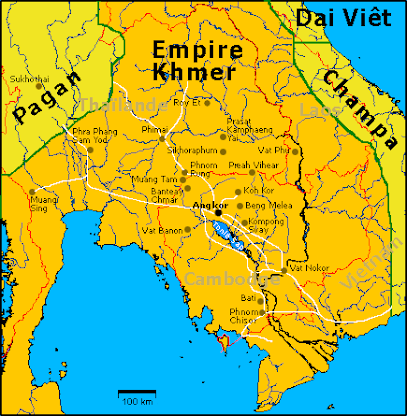
Angkor Wat International Half Marathon in December , Angkor Wat, Cambodia

Saturday, May 03, 2008
Southeast Asia's Rich Biodiversity Is Facing Threat
By Tengku Noor Shamsiah Tengku Abdullah
PUTRAJAYA, May 2 (Bernama) -- The Asean region, though covering only three percent of the earth's surface, serves as the natural habitat of up to 40 percent of the world's plant and animal species.
The region is the home to one-third of the world's coral reefs, translating to 284,000 square kilometers of coral reefs that are among the most diverse in the world.
The region is home to seven of the world's 25 biodiversity hotspots. Out of the 64,800 known species in the region, 1,312 are endangered.
The region includes three 'mega-diversity' countries: Indonesia, Malaysia, and the Philippines. The other members of the grouping are Brunei, Cambodia, Laos, Myanmar, Singapore, Thailand, and Vietnam.
But sadly today Asean's biodiversity is facing threat from mankind's activities and from the wrath of nature itself.
NATURE'S WEALTH UNDER THREAT
According to Rodrigo U. Fuentes, the Executive Director of the Asean Centre for Biodiversity, deforestation rates in the region are at least two times higher than other tropical areas.
Forest conversion is the major cause of biodiversity loss in the region. It is driven by logging activities, shifting cultivation, large-scale mining, and agricultural expansion.
These lead to loss of habitat for many birds, mammals and other animals, reduced pollination activities, decline in species richness and populations, and overall reductions in biodiversity.
If present levels of deforestation continue, Asean will lose nearly three-fourths of its original forest cover and up to 42 percent of its biodiversity by the next century.
"There will be massive species declines and extinctions which will result in catastrophic biodiversity loss. Biodiversity loss could trigger enormous effects on food security, health, shelter, medicine, and aesthetic and other life sustaining resources," Fuentes warned.
ASEAN LOSING ITS FOREST COVER
In Sumatra, for example, there has been a decline from 80 to 33 percent (1980-2001) in forest cover within 50 km periphery of protected areas. Smaller protected areas are most greatly affected as the conservation capacity of protected areas is greatly reduced.
In 1997-1998, up to five million hectares of forests in Indonesia (Sumatra and Kalimantan) were lost due to forest fires. In 2002 and 2006, forest fires destroyed several million hectares, including peat swamp forests.
He said these resulted in disappearance or population decline and high infant and juvenile mortality in many animals, as well as reduced seedling and sapling population for many tree species.
ASEAN'S WILDLIFE ALSO AFFECTED
Wildlife hunting and trade for food, pet and medicinal purposes also contribute to biodiversity loss in Asean.
In Sarawak, 2.6 million animals are hunted each year for bush meat while in Sabah, 108 million animals suffered the same fate. In 2000, Indonesia contributed about 29 percent of global exports for snake and lizard skins.
In the same year, Singapore imported 7,093 live animals and had a total net export of 301,905 animal skins.
Between 1975 and 1992, Korea imported 6,128 kilograms of tiger bones, 60 percent of which were from Indonesia.
Overall, wildlife was extracted from forests at more than six times the sustainable rate.
The marine environment did not fare any better. Almost 80 percent of coral reefs in the region are at risk due to destructive fishing practices and coral bleaching.
OTHER ASPECTS OF THREAT
Increasing human population and poverty is a primary socio-economic driver of forest biodiversity loss.
Climate change can have the largest proportional effect on biodiversity in extreme environments (e.g., arctic, boreal zones).
This phenomenon threatens the Asean region, possibly in very cold mountain environments, on small islands or low coastal areas.
Lack of financial resources contributes to biodiversity loss in the region as governments put more emphasis on budget allocation for food, health, education, infrastructure and other priorities.
ASEAN'S RESPONSE
In response to this dire situation, Asean has taken efforts to protect and save its rich biodiversity.
Asean member countries have ratified a number of international agreements concerning biodiversity, including the Convention on Biological Diversity, Convention on International Trade of Endangered Species, Convention on Wetlands of International Importance, World Heritage Convention, and the Cartagena Protocol on Biosafety.
Asean has designated 1,523 protected areas and declared 27 areas as Asean Heritage Parks.
To date, Thailand has nominated three additional parks and the Philippines nominated two to be declared as Asean Heritage Parks.
Several conservation plans have been prepared especially for endangered species, such as the Tiger, the Elephants, Gaur, Sumatran Rhinoceros, Otter, and Pheasants. The conservation plans include aspects of research, ex-situ conservation, monitoring, and enforcement activities.
Further responding to the need for concerted action to protect and conserve the region's dwindling biodiversity resources ASEAN, with funding support from the European Union (EU), has established the ASEAN Centre for Biodiversity (ACB).
ACB TO SPEARHEAD THE ROLE
As an intergovernmental regional centre of excellence, ACB facilitates cooperation and coordination among the members of Asean, and with relevant national governments, regional and international organizations, non-government organizations, private corporations and individuals on the conservation and sustainable use of biological diversity.
To contribute to the achievement of socially responsible access, equitable sharing, utilization and conservation of natural ecosystems and the biodiversity they contain, ACB builds strategic networks and partnerships geared to mobilize resources towards optimally augmenting effective programmes on biodiversity conservation.
On the occasion of Earth Day, 22 April, ACB is inviting international and regional organizations, governments, private corporations and foundations, communities, and individuals to contribute financially or in kind to its programmes.
"Join ACB and the international community in saving Southeast Asia's rich yet highly endangered biodiversity. Save humanity," Fuentes appealed.
-- BERNAMA
Read more!
Analysts: Thailand's rice cartel goal will face hurdles
NEW YORK (MarketWatch) -- Thailand's proposal for an OPEC-style cartel to control rice prices will likely face international opposition and only lead to distortions on the global rice markets at a time when the prices of rice and other food commodities are skyrocketing, analysts said.
Thailand, the world's biggest rice exporter, wants to form a rice cartel with four other Southeast Asian countries -- Laos, Burma, Cambodia, and Vietnam -- to acquire more influence over international rice prices, according to media reports Friday.
In the same way that the Organization for Petroleum Exporting Countries (OPEC) sets oil prices, members of the proposed rice cartel would cooperate on prices, thereby wielding their influence.
"Firstly and most importantly, this is not the right time to suggest a cartel," said Arpitha Bykere, an analyst at RGE Monitor
.
"With the food prices going so high, the World Bank and the United Nations have suggested it's becoming such a big crisis," Bykere said. "The international organizations will oppose this [a rice cartel]."
World Bank President Robert Zoellick has warned that high food prices are threatening recent hard-won gains in overcoming global poverty and malnutrition. The United Nations World Food Program has said that high food prices are creating "a silent tsunami" threatening to plunge more than 100 million people on every continent into hunger.
Soaring prices for agricultural commodities, including rice, wheat, corn, and soybeans, have stirred popular discontent and demonstrations around the world.
In response, Vietnam, India, Egypt, and Cambodia have imposed bans on rice exports. Thailand, the top rice exporter accounting for a third of global exports, is currently not banning or restricting rice sales.
Rice prices have tripled this year, with Thailand's benchmark 100% Grade B white rice soaring above $1,000 a ton for the first time last month, according to media reports. On the Chicago Mercantile Exchange, rough rice futures have surged over 95% in the last 12 months.
A rice cartel?
A spokesman for the Thai government said that the prime ministers of Thailand and Burma discussed the cartel idea on Wednesday, the BBC reported Friday.
Cambodia has expressed support for the idea of a rice cartel in the past and Laos has indicated it would seriously consider the idea, the BBC said.
However, Vietnam officials were quoted by The Bangkok Post newspaper rebutting Thailand's claim that a rice cartel was close and saying that Vietnam hasn't made any official reaction to the proposal yet.
Vietnam is the world's second largest rice exporter. India is the third-largest rice exporting country followed by the United States in fourth place. Asia accounts for about 90% of global rice consumption.
"Thailand, being the largest exporter of rice, would be in a position to take advantage of the current situation [of soaring rice prices]," said Divya Reddy, an analyst at the Eurasia Group. "It makes sense for them to take the lead." '
However, "I don't see it working successfully in the near term," Reddy said about the proposal to form a rice cartel. "There would be huge incentive for countries to take their own measures to deal with the problem [of soaring prices]."
Bykere of RGE Monitor pointed out that there are political disagreements and different political structures in Southeast Asia that might make it difficult to form a cartel.
For example, Thailand is a constitutional monarchy, Burma is ruled by a brutal military junta, Vietnam and Laos are communist states, and Cambodia is a young multi-party democracy.
"More importantly, their economic policies are different," Bykere said. "There is very low probability of these countries agreeing."
Also, Thailand and Vietnam are doing better economically than their much poorer neighbors Burma, Cambodia and Laos. A rice cartel would differ from OPEC, because OPEC countries have certain oil reserves, while rice harvests depend on weather conditions, Bykere said.
A cartel would distort rice prices, thereby hurting a big number of consumers both in the rice-exporting countries and globally, Bykere.
"If they set high prices, it would only benefit the farmers in these five countries," Bykere said. "Consumers within and outside the countries would suffer from high rice prices. All the other Asian and African countries will oppose it."
The Philippines, the world's biggest rice importer, has objected to the idea of a rice cartel, with Edgardo Angara, chairman of its senate committee on agriculture, saying that a cartel "will create an oligopoly and it's against humanity," the BBC reported Friday.
The president Thailand's Rice Exporters Association has also criticized the proposal, saying that "you cannot control farmers growing or not growing rice. It's not like oil."
The USA Rice Federation, an advocacy group for the rice industry, didn't have an immediate comment on Thailand's idea of forming a rice cartel in Southeast Asia.
Read more!
Pushed by higher prices, immigrants in US stocking up on rice
RICHMOND: Shoppers surveyed shelves loaded with rice at the Ranch 99 Asian supermarket, chatting in languages from Mandarin to Portuguese as they hunted for their favourite varieties and compared prices before heaving 23-kilogram bags into their carts.
Skyrocketing prices and media reports of a rice shortage are driving many people in the US, including Asian, Hispanic, and Indian immigrants, to stock up on rice - a once inexpensive staple that is reaching record-high prices across the country. In Indian corner markets and warehouse-sized supermarkets specialising in Asian goods, customers who usually take home a 9-kilogram bag are taking two, or even reaching for the 23-kilogram bag.
"It's all in the news, on TV and newspapers," said Grace Yap, originally of China, who was shopping at Ranch 99.
Emphasizing that there is no rice shortage in the United States, economists and commodity traders blame the price hikes confronting US consumers on everything from the weather in producing countries to the increased buying power of countries such as China. Chief among those factors was the decision by India, Vietnam, China, Egypt, Cambodia and Brazil to curtail exports to protect prices at home, said Nathan Childs, an economist and rice expert with the US Department of Agriculture.
"People are so worried, everything is going up so much. It's so crazy," said Mahinder Parmar, owner of Milan, a Berkeley, California store selling everything from Indian music to sweets, instruments and spices.
Seeking to tame rising rice prices, which have more than tripled since January, Thailand proposed an OPEC-style cartel yesterday with major rice exporters Laos, Myanmar, Cambodia and Vietnam to give them more control over international rice prices.
Discuss this story with other readers. Click on 'Discuss' link at the top and bottom of the story. To know more about this feature click 'here'.
Read more!
Thursday, May 01, 2008
Democrats and the Killing Fields
By ARTHUR HERMAN
Most people have never heard of Operation Frequent Wind, which ended on April 30, 1975, 33 years ago. But every American has seen pictures of it: the Marine helicopters evacuating the last U.S. personnel from the embassy in Saigon, hours before communist tanks rolled into the city. Thousands of desperate Vietnamese gathered at the embassy gate and begged to be taken with them. Others committed suicide.
Those scenes are a chilling reminder of what happens when a great power decides to cut and run. Two of the three presidential candidates are proposing to do just that in Iraq. We need to remember what happened the last time we gave up on an unpopular foreign policy, not only in humanitarian terms but in terms of American power and prestige.
Actually, the U.S. had won the war in Vietnam on the battlefield, just as the surge has done today in Iraq. Over Easter 1972, South Vietnamese forces, backed by U.S. airpower, crushed the last communist offensive, killing nearly 100,000 North Vietnamese troops.
The North was forced to sign peace accords in Paris recognizing the Republic of South Vietnam. The last 2,500 U.S. support troops went home. What they left was a fragile but sustainable peace, and an elected government in Saigon that was growing stronger every month.
But with 160,000 North Vietnamese soldiers still in South Vietnam, keeping the South free was going to require continued U.S. help, especially air support and military equipment if the North ever attacked again.
Democrats and American public opinion, however, had had enough. Much like Iraq today, the vast majority of South Vietnam had been pacified. Its government was taking on difficult but essential political changes, including land reform. The Democratic-controlled Congress, however, did not want to hear about success. They assumed failure in Vietnam would complete their rout of the hated Richard Nixon, who was already out of office thanks to Watergate, and position them for victory in the 1976 presidential election.
Meanwhile, the American public had been conditioned by the media to see Vietnam as a failed policy, and taught that America had gotten itself in the middle of a "civil war" which the Vietnamese had to sort out themselves. Once the last American troops left Vietnam, public opinion would never tolerate re-entry into a war widely seen as a blunder and endless quagmire.
In early 1975 the communists launched a massive attack. President Gerald Ford asked for $1 billion in supplemental funds to help the South Vietnamese, and Congress refused. They had already pulled the plug on the U.S.-supported government of Lon Nol in Cambodia. Ford had no choice but to order the evacuation of remaining U.S. personnel.
After nearly two decades of devastating war and 58,000 American combat deaths, the U.S. left Southeast Asia. As the last helicopter lifted off from Saigon, the New York Times's Sydney Schanberg wrote an article with the title, "Indochina Without Americans: For Most, a Better Life." And the Times's columnist Anthony Lewis asked, "what future could possibly be more terrible than the reality" of a war that had cost so much in lives and treasure?
With the North Vietnamese Communists and the Khmer Rouge taking over, the world was about to find out.
At least 65,000 Vietnamese were murdered or shot after "liberation" – the equivalent in terms of Vietnam's population at the time, of killing three-quarters of a million people in today's U.S. The new communist regime ordered somewhere between one- third to one-half of South Vietnam's population to pass through its "re-education" camps, where perhaps as many as 250,000 died of disease, starvation, or were worked to death (the last inmates were not released until 1986).
That number does not include the thousands of "boat people" who tried to flee the totalitarian nightmare of communist Vietnam, and perished at sea.
Cambodia's fate was even worse. At least one and a half million innocent Cambodians were butchered or starved to death in the Khmer Rouge's killing fields and re-education camps, put to death by a fanatical regime that believed that anyone who wore eyeglasses must have "bourgeois intellectual tendencies" and be shot.
The scale of moral collapse and suffering went beyond Indochina. The pullout had a ripple effect on U.S. power and prestige, just as the proponents of the so-called "domino theory" had warned. American foreign policy, crippled by remorse and self-doubt, stood helplessly as others rushed into the power vacuum.
Marxist-Leninist regimes emerged not only in Vietnam, Cambodia, and Laos, but in Ethiopia and Guinea Bissau (1974), Madagascar, Cape Verde, Mozambique, and Angola (1975), Afghanistan (1978), and Grenada and Nicaragua (1979). Soviet troops were welcomed in Fidel Castro's Cuba for the first time since the 1962 missile crisis. Cuban troops traveled freely to Africa to prop up Marxist regimes there.
In 1979 the Ayatollah Khomeini was able to establish his brutal theocratic rule over Iran, confident that America, having learned "the lessons of Vietnam," would never intervene.
The judgment of history, as Raymond Aron once remarked, is without pity. History will judge how America and its leaders handle global responsibility in Iraq and the Middle East in the next decade.
As Winston Churchill said of the appeasement of Hitler at Munich, in 1975 Americans were "weighed in the balance and found wanting." We have a responsibility to the Iraqis – and to the memory of those we left behind – not to let that happen again.
Mr. Herman is the author, most recently, of "Gandhi and Churchill: The Epic Rivalry That Destroyed An Empire and Forged Our Age," just published by Bantam.
Read more!
Wednesday, April 30, 2008
Golden Tulip Hospitality's Asian Subsidiary to Expand
A management subsidiary of Swiss-based Golden Tulip Hospitality Group, Golden Tulip South East Asia, is to undergo an expansion.
Three different brands- the 5-star Royal Tulip, 4-star Golden Tulip, and 3/3+-star economy business Tulip Inn are to be launched, and Mark van Ogtrop is to head the group, which is responsible for ten countries: Thailand, Malaysia, Singapore, Indonesia, Brunei, Philippines, Vietnam, Cambodia, Laos, and Myanmar.
The first five projects include a 140-room Tulip Inn hotel on Sukhumvit Soi 4 in Bangkok, to debut in July 2009; a 100-room resort on Samui's Maenam Beach, to be reflagged in July 2008 as the Golden Tulip Resort Samui; a 350-room new project to debut in 2010; a 110-room Tulip Inn in Phuket to be launched in July 2009; and a 170-room Tulip Inn hotel in Phnom Penh, Cambodia to open in May 2009.
According to Hans H.W.R. Kennedie, president & CEO of Golden Tulip Hospitality Group, 'In 2007, the Golden Tulip Group generated around EUR108 million of total revenue, with a profit of EUR1.8 million. In the same year we invested more than EUR4.4 million, while we earned approximately EUR8.4 million from a lease agreement with hotel owners. We believe in the amazing diversity of South East Asia, in particular Thailand. That's why we are investing more than EUR508 Million for the initial development of four years. With a regional office, management and marketing strategies in place we aim to achieve the targets as set.'
Mr. Mark van Ogtrop, managing director and senior vice president of Golden Tulip South East Asia, stated, 'We will expand throughout South East Asia by management contracts, lease agreements, acquisitions and joint ventures. We have had very positive feedback on economy business hotels, not only from customers, but also investors. We believe that this sector offers real potential and opportunity for us to grow in the hotel industry in the region.'
Read more!
Vietnam, Cambodia diplomats agree to hold annual meetings
VietNamNet Bridge – Foreign ministries of Vietnam and Cambodia have agreed to hold annual meetings at their first meeting in Hanoi from April 28-May 1.
The two sides during their talks on April 29 also agreed that the second meeting will take place in Phnom Penh in 2009.
On their own countries’ situation and bilateral cooperation, they noted the development of the two countries’ friendship and comprehensive cooperation, bringing practical benefits to both countries’ national construction and development.
The Vietnamese Foreign Ministry delegation is led by Deputy Minister Pham Binh Minh, and the Cambodian Ministry of Foreign Affairs and International Cooperation delegation, by Secretary of State Long Visalo.
They proudly spoke of their close ties, which contributed to the bilateral relations as well as to improving the two countries’ positions in the region and the world arena.
The two delegations agreed to intensify cooperation in exchanging information and experiences, setting up a hot line to deal with urgent problems, and training personnel.
They also agreed to serve as links to foster cooperation agreements between ministries, agencies and localities, and coordinate in regional and international cooperation projects.
The Cambodian delegation was received by Deputy Prime Minister Pham Gia Khiem on the same day.
At the reception, Deputy PM Khiem stressed Vietnam and Cambodia need to exchange more high-level visits, and hold meetings between their ministries, agencies and mass organisations.
According to Deputy PM Khiem, these activities would help tighten the two countries’ friendship and create new changes in their trade and investment ties.
Read more!
LABOUR-CAMBODIA: US Recession May Hit Anti-Sweatshop Campaign
By Andrew Nette
PHNOM PENH, Apr 30 (IPS) - Recession in the United States is endangering a unique experiment that has seen Cambodia become a leading player in the campaign to eradicate sweatshops in the textile industry.
"I think that the industry is going through a tough time," said Ken Loo, until recently secretary of the Garment Manufacturers Association of Cambodia and still closely associated with the sector.
"We export 70 percent to the U.S., so with their economy in recession we expect spending on clothing to drop."
Even a minor downturn in the textile industry will have major economic implications for Cambodia.
The industry makes up approximately 80 percent of the country’s total exports and employs a large number of people. Some estimates claim that up to a million people --out of a population of 13 million -- are either directly or indirectly dependent on the industry.
"What happens in the garment industry in Cambodia matters far beyond the country’s borders," argues Phnom Penh-based author Rachel Louis Snyder. "Whether it succeeds or fails is important because this is the one country that has tried to eradicate sweat shops in an organised way."
"If it does not work here, where is the impetus anywhere else?"
Snyder is the author of ‘Fugitive Denim: A Moving Story of People and Pants in the Borderless World of Global Trade’, which was recently published in the U.S.
The Cambodian chapters focus on the situation that arose when Phnom Penh and the Clinton administration inked a trade deal that linked Cambodia’s export quota for the textiles to the U.S. to efforts to eradicate sweatshops.
Under the deal, Cambodia had to rewrite its labour laws, welcome the formation of trade unions and allow the International Labour Organisation (ILO) to monitor factories and publish their findings.
"This made Cambodia a giant experiment," said Snyder. "The big question was whether it would work and it did. The industry grew and labour and social conditions improved enormously."
The trade deal expired in January 2005 when Cambodia joined the World Trade Organisation.
A series of transitional quotas, what Snyder calls ‘the quota system lite’ where then put in place by Washington to ensure that China could not export more than a certain volume of textiles in certain categories.
These measures, designed to safeguard Cambodia’s textile industry, will finish at the end of 2008, provoking fears that the industry, still young by international standards, could be swamped by power houses such as China and Vietnam where labour and social conditions are not as good.
"These are expiring at a time of potentially global recession when consumers will be looking for cheaper gear," said Snyder.
"Wherever you have economic pressure, the first things to go are labour laws and social conditions. This is a crucial time for Cambodia. They are at risk of losing this incredible experiment."
Observers agree that linking trade quotas to labour standards was the major impetus for Cambodia to work on improving labour conditions. Another has been an innovative programme run by the ILO called ‘Better Factories Cambodia’.
In order to get an export permit textile factories must sign up to the programme and agree to be monitored by ILO teams on a regular basis.
This monitoring process, which the employers help pay for, includes surprise spot checks and in-depth audits that assess the factory’s performance in up to 500 areas.
Although the detailed reports are confidential factories will release at the request of buyers.
According to Tuomo Poutiainen, Chief Technical Advisor for Better Factories Cambodia, the programme currently monitors 298 export garment factories and involves buyers representing approximately 60 percent of Cambodia’s textile exports.
While Poutiainen admits that they do not get everyone, particularly smaller sub-contractors that are not covered by the programme, he stresses that it "is enforced (by the government) quite rigorously, there are some time delays but all exporters get drawn in."
"When the quota system was in place the increased incentives for factories to be involved were explicit," said Poutiainen. "Cambodia’s share of exports to the U.S. was conditional on progress made on working conditions."
He believes the leverage now comes from the buyers, who request the detailed reports, including big name brands such as Nike, Columbia, Gap and Levi Strauss.
"Labour conditions are now part of the reputation niche of Cambodia," particularly for companies keen to prove their socially responsible credentials," said Poutiainen. "Ignore this and the industry will suffer."
As the assassination of high-profile labour leader Chea Vichea in 2004 graphically demonstrated, there is still a long way to go in terms of upholding labour standards in Cambodia.
Cambodian Union leaders list a number of issues that need attention, including failure to payment of entitlements and politically motivated attacks on union representatives.
Poutiainen agrees, adding issues such as double book keeping, unpaid overtime and occupational health and safety.
"It is obvious that we don’t think backsliding on labour conditions is a solution to the problem," said Loo. "Rather we want to increase productivity."
Most observes agree that the ILO programme has helped stave off the crisis that many believed would happen after the original U.S. trade deal signed by the Clinton administration expired in 2005.
It has also helped Cambodia to build a solid base in the face of significant disadvantages facing the industry.
Cambodia has to import virtually all raw materials relating to the textile industry. Power costs are high, there is a lack of extensive port facilities and corruption adds significantly to overheads.
Loo agrees that while selling Cambodia as a niche market on labour conditions has been important, the main factors for international buyers remain price, lead times and quality.
"The ILO programme is definitely a plus in that it has brought Cambodia to the surface and given us a lot of visibility to buyers all over the world."
"But compliance alone is not enough to sustain the industry. If compliance were really that important everyone would be in Cambodia. The image has its advantages. It is one of many things the buyers look at but it is not the only thing that buyers look at."
While business is supportive, publicly and privately, of the ILO’s monitoring programme, Loo says they do have concerns about how it is administered.
In the lead-up to 2010, when the ILO is scheduled to reconfigure and possibly reduce its involvement in the Better Factories programme, GMAC wants the government to make monitoring voluntary.
"If it was a purely voluntary system, most manufacturers would not sign up to it," he admits. "But the manufacturers would face pressure from the buyers. You would also weed out factories and buyers whose priority is not compliance. Those that remained would be fully supportive of compliance."
He says that GMAC has put the argument to government. "They have made it clear they want it to be compulsory.’
"One cannot expect that the industry will grow but what appears likely to happen is a consolidation, smaller, less productive producers will suffer, others will prosper," said Poutiainen. "This will effect the industry but it is not a crash."
"The buyers have worked for a long time with this programme and have invested a great deal of time and social capital in Cambodia and have a lot of relationships. They have an interest in continuing to invest in Cambodia."
"No growth in the garment industry this year in fact the industry will see a slight shrinkage of 5-10 percent," is Loo’s blunt assessment.
"I would say that in our existing state we are not well placed to compete but one factor that could turn this around is our efforts to get duty free access to US markets,’’ Loo said. "The U.S. has given this to all least developed countries except those in Asia, I don’t know why."
The Cambodia government and textile industry has been lobbying the U.S. on this issue for a number of years. Loo is hopeful that an agreement will be reached this year. "The impact of the recession will be worse this year if duty free does not happen,’’ Loo said.
Read more!
Tuesday, April 29, 2008
Cambodia's former Khmer Rouge rebels face malaria epidemic
Phnom Penh - Impoverished former Khmer Rouge fighters in north-western Cambodia have reported a spike in malaria infections, raising fears of a new epidemic along the Thai border, police said Tuesday. A senior police officer in Samlot who declined to be named said by telephone that the Thai border area had recorded 92 new cases of the mosquito-borne disease last month and 93 this month.
"The cause is heavy rain, and we are trying to educate people to go to the hospital as soon as they detect fever and not believe the cause is just a bad spirit or ghost," he said.
Samlot's rebel fighters held out against the outside world until the late 1990s, and most of its almost 14,000-strong population now eke out a living as subsistence farmers.
In October, a World Health Organization report warned that drug-resistant strains of the disease were increasingly being detected along the Thai-Cambodia border.
Experts blamed such infections on inappropriate use of anti-malarial drugs and other factors, including a postwar population boom. Children are particularly vulnerable to malaria.
Cambodia reported around 60,000 cases of the endemic disease last year with 241 deaths.
Police said no malaria fatalities have been reported in Samlot so far but they feared it was only a matter of time if the number of new infections continued to rise with the peak of the monsoon season still months away.
Read more!
Cambodia hoping to lead world rice exports
Cambodia is seeking to become one of the world's leading rice exporters, with the country's agriculture minister, Chan Sarun, saying he hopes to produce enough rice to export some eight million tonnes annually by 2015.
This follows an announcement by Thailand's prime minister that his country, the world's leading rice exporter, will not cut down on exports.
Fears of rice shortages have led to dramatic increases global prices in the price of rice have forced major producers and exporters like India, Vietnam and China to adopt protectionist measures by imposing limits on exports, further exacerbating the problem.
Although Cambodia remains one of Asia's poorest countries, the head of the Cambodian centre for the study and development of Agriculture, Yang Saing Koma, has told Radio Australia's Connect Asia program the prospect of becoming a leading rice exporter is a distinct possibility.
"There is the potential to increase the rice production of Cambodia," he said.
"Of course, we still have big land areas and the rice productivity in Cambodia is still low in those areas, and there is still the potential to expand the cultivated area."
Cambodia's ambitions to increase exports follows Sunday's announcement by Thai Prime Minister Samak Sundaravej that his country, won't cut down on rice exports.
A spokesperson for the International Rice research Institute in the Philippines Duncan Macintosh welcomes the initiatives by both government, and says such moves could help quell the panic that has gripped the international rice market.
"Clearly both ... responses by Thailand and Cambodia to try help stabilise the market - they make good sense and seem to be very good decisions," he said.
"I think most governments in Asia are looking to calm things down, because there's every reason for the markets to be stable."
Read more!
Chinese company completes restoration of Cambodia's National Road No. 7
STUNG TRENG, Cambodia, April 29 (Xinhua) -- National Road No. 7in northeastern Cambodia totally opened Tuesday, after an over-three-year restoration work by the Shanghai Construction Group of China.
The 186.648-km-long road, running through Kratie and Stung Treng provinces and directly leading to Laos, was refurbished brand new, thanks to the interest-free loan provided by the Chinese government and its construction team.
"It is the latest achievement during the 50 years of diplomatic relations between China and Cambodia," Cambodian Prime Minister Hun Sen told the inauguration ceremony on Tuesday at the end of the road bordering Laos.
The restoration of National Road No. 7 will help improve the economic development of northeastern provinces including Kratie, Stung Treng, Ratanakiri and Mondulkiri, Hun Sen told the ceremony attended by hundreds of officials and local residents.
After it has enough infrastructures, the northeastern provinces of Cambodia will be a region of development from 2015 to 2020, he said, adding there are various mines here, which are a very important factor for investment.
It will also help advance the internal integration of the road network of the neighboring countries, especially the triangle are of Cambodia, Laos and Vietnam, he said
It is part of the road linkage for the ASEAN countries and also perfects Asian Highway No. 11, he added.
Also at the ceremony, Chinese Ambassador Zhang Jinfeng said that the Cambodian-Chinese friendship bore another fruit, as the road is renovated to provide convenience for the local people, upgrade the regional road network and help materialize China's will to consolidate ties with its neighboring country and strive for common development with them.
Later at the ceremony, Hun Sen presented National Construction Medals to Zhang, some Chinese experts and Cambodian government officials.
The restoration of National Road No. 7 started on Nov. 8, 2004.It has 13 bridges, including the 1,057-meter-long Cambodia-China Friendship Bridge over the Sekong River near the border with Laos.
Currently, China is still helping Cambodia build National Road No. 8 and two bridges respectively over the Mekong River and the Tonle Sap River.
Read more!
Monday, April 28, 2008
A new political breeze in Cambodia
By Brian McCartan
CHIANG MAI, Thailand - A gathering coalition of smaller parties could give Prime Minister Hun Sen's now dominant Cambodian People's Party (CPP) an unexpected run for its money at National Assembly elections scheduled for this July.
The CPP has ruled the country either alone or in tandem with rival parties since the restoration of multi-party democracy in 1993 and in recent years has strongly consolidated its grip on political power. With its comparatively strong grassroots network, firm control over the national media, and recent successful economic policies, the CPP is widely expected to win the most seats at this year's polls. But perhaps not by the landslide many analysts had until now predicted.
To be sure, Cambodia's other main political parties are still generally in disarray. The Funcinpec party has recently been undermined by internal divisions, leading party founder Prince Norodom Ranariddh to cut ties and start up a new small political party bearing his name. Meanwhile, the major opposition Sam Rainsy Party (SRP) still lacks the numbers and resources to alone represent a real democratic challenge to the CPP. The SRP party has likewise in recent years been plagued by internal discord over strategy and leadership.
Now, faced by the near certainty of another CPP election victory, talks have begun among medium- and small-sized parties of forming a coalition to contest the elections on the same ticket. Some political analysts believe there is some hope of success for such a coalition considering that the CPP received less than half the popular vote during the last general election in 2003 and the more recent commune elections held in 2007.
The 2003 polls resulted in a political stalemate, as neither the CPP nor Funcinpec managed the two-thirds majority constitutionally required to form a government. After a full year of political wrangling and paralysis, both sides agreed to change the rules to an over 50% majority and a new coalition government was formed in July 2004, which the CPP now dominates.
An estimated 23 parties contested the general elections in 2003; as many as 57 different political parties could contest the next polls, around 20 of which are expected to officially announce their candidacy during the April 18 and May 12 registration process. The three main opposition parties now negotiating the formation of a possible coalition include the SRP, the Human Rights Party (HRP) and the Funcinpec breakaway Norodom Ranariddh Party (NRP). A united opposition would increase the individual parties bargaining power vis-a-vis the CPP and in an electoral upset could together form the next government.
The HRP, formed in July 2007 by human rights activist Kem Sokha, founder of the once influential and foreign-funded Cambodian Center for Human Rights (CCHR), cuts a particularly compelling contrast to the CPP. Sokha was jailed for publicly criticizing Hun Sen's policies and has successfully ridden that controversy, along with the CCHR's strong grassroots network, into politics.
The party claims over 10,000 supporters attended its opening congress and several well known political figures have joined its ranks, including Pen Sovann, a former prime minister of the early 1980s communist government. Kem Sokha has a grassroots reputation for fighting corruption and human rights abuses earned as a lawmaker in the dissolved Buddhist Liberal Democratic Party and later as a senator for Funcinpec before he left to create the CCHR in 2002.
With those political forces coalescing, there are already signs of a CPP rearguard defensive. Several of the newly created parties are allegedly in league with the CPP and have been launched strategically as political Trojan horses to penetrate and disrupt a possible united opposition front.
Democratic dirty tricks
The CPP has a long history of running rough and tumble election campaigns and there are growing accusations that the party is again using intimidation and threats against opposition supporters in the run-up to the polls. Senate elections held in January 2006 were criticized by local election monitoring organizations as undemocratic and slanted in favor of CPP-affiliated candidates. For the upcoming elections, 7,000 local election observers and 40 international monitoring bodies have registered to observe the elections.
Ou Virak, the current president of CCHR, believes that while overall the election environment will be better than previous polls, by international standards they still will not be free and fair. He claims that in recent months opposition activists have received threats and that a few have even been killed under mysterious circumstances.
Although there is not yet any hard evidence to indicate any political motivation behind the murders, Ou Virak sees the upshot in killings as "worrisome", particularly considering one of the main opposition parties is running under a human rights banner.
There has also been growing pressure on opposition members to defect to the CPP, particularly among SRP candidates. Where that doesn't work threats have been made against certain SRP commune chiefs and at least one, Tout Saron from Kompong Thom province, was jailed on March 18 on the some say trumped up charges of allegedly preventing an SRT activist from defecting to the CPP. The arrest of two other SRP officials is also being sought in connection with the case.
The arrest and warrants are already drumming up bad publicity for the CPP. Brad Adams, Asia director of Human Rights Watch, said in a March 23 statement, "Dubious arrests of opposition officials months ahead of an election should set alarm bells ringing. This divide-and-conquer strategy is a well-known tactic of Prime Minister Hun Sen to subdue his opponents."
In the same statement, the US-based rights advocacy group said it believes that the CPP is conducting a "concerted campaign to coerce SRP members to defect to the CPP and punish those who refuse to do so, with the intention to split and weaken the opposition party before the national elections".
Hun Sen's CPP has long harassed the SRP, according to rights groups. In 2005, SRP member of parliament Cheam Channy was convicted to seven years in prison for what many considered an unsubstantiated charge of creating a rebel army. He served one year and was released after receiving a pardon from King Norodom Sihamoni. SRP leader Sam Rainsy, meanwhile, was convicted that same year for defamation of government leaders and fled the country. That intimidation follows on the bloody and still unresolved grenade attack against a Sam Rainsy rally in 1997 which killed 16 and injured 150 people. Human Rights Watch has alleged the attack was carried out by Hun Sen's own bodyguard unit, charges the premier has strongly denied.
Faced with such strong-arm tactics, few expect the opposition to actually win the July polls. Amendments to previous election laws mean that the CPP can form a government as long as it wins over 50% of the vote, rather than the previous constitutional requirement of a two-thirds majority. In 2003, inconclusive poll results meant that neither the CPP nor Funcinpec could form a government until several months later an agreement to amend the rules was reached.
With an opposition coalition in the offing, it's unclear if the CPP will need to reach out to one of the medium or several of the small parties to form the next government. After a major split and a number of defections, the CPP's current coalition partner, Funcinpec, is not expected to win as many seats at the upcoming polls as it managed in 2003. The party currently holds 20 of the National Assembly's 123 seats.
Due to their historical antagonistic relations with Hun Sen, it seems unlikely for now that the leaders of any of the other major opposition parties - including the SRP, HRP and NRP - would be keen without major concessions to join a CPP-dominated coalition government. Whether their party representatives, many as in the case of the SRP now in the opposition for over a decade, share those views after this July's polls will represent the success or failure of a united opposition.
Read more!
Unesco calls off joint talks
Separate meetings now on Preah Vihear listing
THANIDA TANSUBHAPOL
The United Nations Educational Scientific and Cultural Organisation has cancelled a meeting with Thailand and Cambodia in Paris over efforts to put the Preah Vihear temple on Unesco's World Heritage list.
The meeting was supposed to be this Friday and Saturday, with Foreign Minister Noppadon Pattama leading the Thai side in the talks.
The meeting has been tentatively rescheduled for May 13, Mr Noppadon said.
The talks will concentrate on Cambodia's proposal to register the ancient ruins, which are right on the border with Thailand.
The only easy access is through Thailand, and some of the border is not demarcated and claimed by both sides.
Unesco will now send its representative, Francesco Caruso, for separate talks with the Thai and Cambodian governments.
The UN agency gave no reason for the change.
Mr Caruso has been appointed by Unesco as a special coordinator between Thailand and Cambodia on the issue and is due in Bangkok next month.
"The Thai government welcomes the proposal and is ready to meet and discuss in good faith with Cambodia the outstanding issues so as to facilitate the process of registration of the temple," the ministry said.
Thailand and Cambodia have agreed in principle to jointly manage Preah Vihear and other ruins in Thailand in the area, but will not allow the project to affect the plan to demarcate the border there.
Preah Vihear, called Khao Phra Viharn in Thai, is on the Cambodian side of Si Sa Ket's Kantharalak district.
But it does not look like the issue will be easily settled.
On April 10, the government handed an aide-memoire to Cambodian ambassador Ung Sean to protest against the deployment of Cambodian troops at the ancient temple.
The government said the troop deployment violated Thailand's territorial sovereignty in the disputed areas along the border, and was also against the spirit of a memorandum of understanding in 2000 concerning the area around the temple.
The Cambodian government countered by summoning Thai ambassador Viraphand Vacharathit to deny all the allegations a day later.
Read more!
Sunday, April 27, 2008
Cambodia to hold first ever Khmer Chess tournament
PHNOM PENH, April 27 (Xinhua) -- The Olympic Committee of Cambodia (OCC) and the Cambodian Chess Association (CCA) will jointly hold the First Khmer Chess Tournament from May 3 to 4 in order to standardize and highlight the national game.
Cash prize for champion is 1,000 U.S. dollars, and those for the second place and the third 700 U.S. dollars and 500 U.S. dollars, said CCA chairman Ly Hout here on Sunday.
Other top 10 winners can respectively win 100 U.S. dollars as well as trophies, he added.
Participating teams can be established on provincial or municipal basis and each team should include no more than five members, two or three of them chess players, he said.
Meanwhile, he raised 10,000 U.S. dollars to mobilize all the Cambodians to find and submit historical relics that can tell the real origin of the centuries-old sport.
Khmer Chess is a popular game among the Cambodians, but there had been no national match for it the its rules not officially certified until OCC and CCA got them done recently, said Ly Hout.
With these actions, OCC and CCA want to preserve and develop the national gem and thus benefit the coming generation, he added.
Read more!
Last Breakfast in Cambodia
CAMBODIANS and other Theravada Buddhists celebrate their New Year in mid-April. They were not always able to do so. Under Khmer Rouge and Vietnamese rule, those ancient traditions were forbidden, impossible. But now Cambodia is free again and the festivities are in the open. As I wander the country of my youth, I see people spending the long holiday praying at temples and visiting relatives.
And I remember. My family used to hold a reunion on April 13 to mark both the New Year and my mother’s birthday. In 1975, we had no idea that it would be our last. We were all apprehensive about the future, and my mother was distraught because I had missed the American evacuation.
The day before, an officer of the United States Agency for International Development had told me that I had to be at the embassy within an hour if I wanted to be airlifted out of Cambodia. (I was a manager for the American relief agency CARE and had been selected for the evacuation.) Instead, I went to a meeting to find a way to help 3,000 families stranded in an isolated province.
“Maybe I can make the meeting and get to the embassy in time,” I thought.
But as I returned to Phnom Penh, the traffic became heavily congested. Thousands of people on ox carts and overloaded bicycles were making their way to the capital to seek shelter and safety. When I finally reached the American Embassy and gave my name to the security officer, he looked puzzled.
“They are not coming back — they are gone!” The guard shouted his answer to emphasize the hard truth. And he added: “The war is over. We will have peace!”
Speechless, I went to the riverbank and looked at the horizon to see if I could spot the helicopters. The sky was blue and cloudless. I saw nothing. Years later, I learned that I had been looking in the wrong direction. The helicopters had flown westward toward the Gulf of Thailand. And I was looking east.
I was 30 minutes late. My life was going to change forever.
Everyone in the city was in a very somber mood. We prayed that our beloved country would return to the peaceful and stable life of the 1960s. What would happen to us now that the United States had closed its embassy? Two days earlier, President Gerald Ford had announced: “The situation in South Vietnam and Cambodia has reached a critical phase requiring immediate and positive decisions by this government. The options before us are few, and the time is very short.”
Five days later, on April 17, I stopped at a street-side restaurant to have a bowl of Phnom Penh noodles. A waiter took my order in Khmer and shouted in Cantonese loudly enough to be heard all the way to the kitchen: “One bowl of Kuytiev Phnom Penh, no MSG, no fat, blanched bean sprouts, hot tea for the skinny guy with glasses, white shirt, dark pants, table 13!” A different waiter brought my noodles in less than three minutes. Not once had they got the order wrong. It was going to be my last proper breakfast in Cambodia.
I had read gruesome descriptions of the atrocities committed by the Khmer Rouge against enemies of their revolution: babies thrown into the air and caught with a bayonet, children smashed into trees, villagers having their throats cut with the thorns of palm branches, merchants clubbed to death with the back of a hoe. I did not believe them.
The street was lined with city residents, a few still wearing the kramas and sarongs they had slept in. One was brushing his teeth. But all were looking north, waiting for something. They looked fearful.
I spent all day in a temporary emergency room in the Hotel Le Royal doing what I could to help. I came out for fresh air and saw the Khmer Rouge being welcomed. People seemed genuinely happy that the war had ended.
Later that day, the first day of “peace,” I and 15 of my family members left our home after the Khmer Rouge had ordered all cities immediately emptied, and walked to Pochentong, the village where my siblings and I were born. Our house was occupied by strangers, so we went to the temple. The monks were already gone and there were bodies lying around. Mother was sobbing. The women and girls in our family were choking back tears. The boys and men were all silent.
Shortly thereafter, I was separated from my family by the Khmer Rouge. After a year in slave labor camps, where I survived two death sentences, I escaped to Thailand. Following a few months in a Thai jail, in a Buddhist temple and in a refugee camp, I arrived in Wallingford, Conn., with $2 in my pocket. I later learned I was the only survivor in my close family. The Khmer Rouge had killed everyone else.
Cambodia today is not unlike the Cambodia of my youth — there is deep poverty and enormous wealth, side-by-side. There is unrest beneath the surface, the unrest that helped to make the horrors of the last century possible. And so, as I walk from one memory-filled place to another, I pray for a new year in which Cambodia’s leaders will find a way to bring about peace and stability. And, of course, I pray for my family.
Sichan Siv, a former United States ambassador to the United Nations, is the author of the forthcoming “Golden Bones.”
Read more!
Friday, April 25, 2008
Cambodia hopes to export 8 mn tonnes of rice by 2015: minister
PHNOM PENH (Xinhua): Cambodia expects to be able to export eight million tonnes of rice per year by 2015, Khmer-English language newspaper the Mekong Times on Friday quoted Minister of Agriculture and Fisheries Chan Sarun as saying.
"We will encourage farmers to crop twice or three times a year and further strengthen irrigation systems in order to increase rice production," the minister told an exhibition of natural agricultural products held on Thursday in Kampong Chhnang province, stressing that the country has three million hectares of agricultural land.
Yang Saing Koma, executive director of the Cambodian Center for Study and Development in Agriculture, agreed that the harvest could be boosted.
"Cambodia has vast tracts of land and current rice output is still low. We believe that Cambodia can achieve the goal, " he said, adding that the government must invest more in the agricultural sector so that farmers have resources and techniques to increase rice yields.
In fact, he said, the kingdom could produce up to 10 million tonnes of rice in the next four or five years.
According to official statistics, Cambodia had a surplus of over two million tonnes of paddy rice from a total harvest of 6.72 million in 2007. High-quality rice sells around one U.S. dollar a kilogram currently in Cambodia.
Last month, the government imposed a ban on rice export and released its stockpile to the market to curb spiraling rice prices.
The inflation occurred reportedly as a result of world food shortage and over purchase of Cambodian rice by Vietnamese and Thai businessmen.
Read more!
Audit says management of Cambodian tribunal has improved after calls for reform
PHNOM PENH, Cambodia: Cambodia's Khmer Rouge genocide tribunal is making significant progress in improving management problems that led to accusations of corruption, donors said Friday after a new audit.
Allegations of kickbacks and malpractice have dogged Cambodian members of the tribunal. An earlier audit initiated by the U.N. found shortcomings in its management.
The long-delayed U.N.-assisted tribunal to judge former Khmer Rouge leaders has also been plagued by political wrangling and inadequate financing.
Trials are scheduled to start later this year for atrocities committed during the 1975-79 rule of the communist Khmer Rouge, who are blamed for the deaths of an estimated 1.7 million people from starvation, disease, overwork and execution.
The tribunal has Cambodian and international staff who work jointly at every level, including prosecutors, defenders and judges.
A new audit scrutinizing the Cambodian side's operations shows reforms have been effective, two diplomats from the United Nations and the European Commission said.
"This special review has shown that we (now) have a system that can work," Rafael Dochao Moreno, charge d'affaires of the European Commission's mission to Cambodia, told reporters.
Jo Scheuer, country director for the U.N. Development Program, said the audit showed "significant improvements."
He said various audits since 2006 on management of the funds for the Cambodian side have shown "no questionable financial transactions, no misallocated resources and no incomplete or missing documentation in support of disbursements" of money.
He also added that previous auditors have found "no conclusive evidence" to support the allegations of kickbacks being paid by Cambodian personnel in exchange for their jobs.
Scheuer and Moreno are members of a committee made up of representatives of the nations and agencies funding the tribunal. It commissioned the independent review by a private Indian auditing firm to look into hiring and recruitment practices, salary scales, project assurance and a code of conduct for the tribunal's Cambodian staff.
The tribunal has been seeking additional funds for operations through March 2011. It told donor countries in January it would need US$170 million (€108 million), a sharp increase from the originally budgeted US$56.3 million (€36 million).
Rama Yade, the French minister of state for foreign affairs and human rights, told a news conference Friday that her government has pledged an additional US$1 million (€630,000) to the tribunal for this year.
Read more!
Thursday, April 24, 2008
Cambodia's tonle sap in distress
Nantiya Tangwisutijit
The Nation
Global warming and economic exploitation destabilise key lake's ecosystem
The Great Lake of Tonle Sap has always been Cambodia's spring of life. Abundant fish stock and seasonal flooding to fertilise rice fields have blessed the region long before the builders of Angkor Wat arrived 900 years ago.
But economic development policies are having the reverse effect. Locals are finding it more difficult to survive, a trend that may only worsen as climate change continues to take hold.
Tonle Sap is Southeast Asia's largest lake, and the source of protein-rich food for Cambodia's 14 million people. As such, the government has sought assistance to aggressively exploit its fisheries under the banner of poverty reduction. But Cambodian sociologist Mak Sithirith of the Fisheries Action Coalition Team said it is not the poor who are benefiting.
Under the scheme, the Cambodian government built infrastructure and introduced market economy to Tonle Sap communities. This has resulted in the end of interdependence between fishing and farming communities, Mak said. The traditional barter system between those growing rice and those catching fish disappeared after an industry of middlemen evolved to wander from village to village, exchanging rice and fish for cash.
"Neighbouring communities who used to rely on one another now compete for material consumption and accumulation obtained by cash and loans," Mak said.
The traditional small-scale fishermen are losing out entirely. The Cambodian government sold fishing concessions to large fishing businesses, banning villagers from the waters that ensured their livelihoods.
Scientists also suspect that changes of water flows caused by dam construction on the lower Mekong River and tributaries may affect the delicate relationship between the Mekong and Tonle Sap. During the rainy season, water flows from the Mekong to fill the lake, with the reverse occurring as the dry season settles in.
Climate change is adding a new level of anxiety. A coalition of Thai and Finnish scientists will soon begin a project to examine the potential climate-change impacts that those around Tonle Sap might experience in the next 50 years.
"Tonle Sap's topography makes the lake very sensitive to changes," Suppakorn Chinvanno of the Bangkok-based Southeast Asia Start Regional Centre said. "A water-level rise of just 0.3 metres can mean a kilometre more flooding on land because of the flat landscape."
This article is based in part on a presentation by Mak Sithirith at the third International Conference of the Asian Rural Sociology Association in Beijing.
Read more!
Lawyer they call the Devil's Advocate in court tirade
By Susan Bell
THE controversial French lawyer defending the former president of the Khmer Rouge stormed out of Cambodia's genocide tribunal yesterday – because thousands of pages of documents had not been translated into French.
Jacques Vergès is defending Khieu Samphan, 76, in his appeal against pre-trial detention on charges of crimes against humanity and war crimes.
Mr Vergès, who earned the nickname "the Devil's Advocate" for the notoriety of his client list, which ADVERTISEMENThas included the Nazi Gestapo officer Klaus Barbie, the Venezuelan terrorist Carlos the Jackal and the former Yugoslav president Slobodan Milosevic, declared: "French is an official language of the tribunal. There is not one page of the case file against Mr Khieu Samphan translated into French. I should be capable of knowing what my client is blamed for."
He told journalists that judges at the Phnom Penh hearing had asked Khieu Samphan to find a new lawyer. "This is a scandal," he said. "This never happens, except in dictatorships."
The Khmer Rouge leader, who has been held by the tribunal since 19 November, is charged in connection with the period his movement held power, from 1975 to 1979. About 1.7 million people died from starvation, disease, overwork and execution as a result of the Khmer Rouge's radical policies in trying to build a classless society.
The flamboyant 83-year-old lawyer is a natural choice to defend Khieu Samphan, whom he has known since both were active in left-wing student activities in Paris in the 1950s.
Biographies have documented Mr Vergès' links to the Khmer Rouge, including his meeting with Pol Pot, whom he befriended in 1949 when the lawyer was president of the Association for Colonial Students.
But there is mystery over his "missing years" – an eight-year period from 1970 to 1978 when he disappeared from public view, cutting all professional and family ties and leaving many to assume he was dead. Most of his associates now believe he had been in Cambodia during this period, a rumour that Pol Pot denied.
Born in Thailand in 1925 to a French diplomat father and a Vietnamese mother, Mr Vergès was brought up in the then French colony of Réunion. He joined the Communist Party there and in 1942 sailed to Liverpool to join the Free French Forces under Charles de Gaulle and participate in the anti-Nazi Resistance.
After the war, he did his legal training in Paris before embarking on a highly controversial career which has been shaped by his anti-colonialist communist beliefs. During the Algerian civil war, he defended many accused of terrorism by the French government, likening their independence struggle to French armed resistance to the Nazi German occupation in the 1940s.
Later, he worked on primarily political cases and has defended some of the most notorious figures of the past 50 years, including both left- and right-wing terrorists, war criminals and militants. When asked if he would have defended Hitler, he once replied: "I'd even defend Bush, but only if he agrees to plead guilty."
Read more!