When Kate Webb reported from the battlefields of Cambodia, she kept her chestnut hair cropped G.I.-short and wore jeans and loose shirts to obscure her breasts. This was 1971. Only a handful of women were full-time correspondents in Vietnam, and even fewer women roughed the front lines next door in Cambodia, where military officers believed foreign women were, at best, a distraction. At worst, they were bad luck.
Bad luck was a virus among foreign correspondents in Cambodia. Unlike in Vietnam — where Webb arrived four years earlier at age 23 with a philosophy degree, a one-way ticket from Australia, a Remington typewriter, $200 in cash and a whiskey-and-cigarette voice so soft people leaned in to hear her — there were no reliable phone lines in Cambodia to call your editor in an emergency. There were no American military hospitals to sew up your bullet wounds; no helicopters to evacuate you when things got bloody. By April 1971, several years before the Killing Fields, at least 16 foreign correspondents were missing and 9 were dead.
On April 7, it was Webb’s turn. A 28-year-old bureau chief for United Press International, Webb was covering a clash on Highway 4, south of Phnom Penh. As bullets flew from every direction between North Vietnamese and United States-backed Cambodian troops, Webb and her Cambodian interpreter plunged into a ditch. By the time they eventually belly-crawled their way out, four other refugees from the attack had joined them: a Japanese photojournalist and his Cambodian interpreter along with a Cambodian newspaper cartoonist and a Cambodian photographer.
Throughout that afternoon and night, the six of them crept through the wooded foothills of Cambodia’s Elephant Mountains, holding their breath as they stood within inches of chatting North Vietnamese soldiers. At 11:30 the next morning, tired, thirsty, their clothes and skin shredded by branches, they were crouching in the underbrush when they looked up to see two skinny North Vietnamese soldiers with AK-47’s. The soldiers bound Webb’s arms behind her back with wire, vine and tape and roped all of the captives together in a single line. They confiscated their notebooks, their ID cards, their cameras, their watches. Then they took one thing that Webb held dear: a gold Chinese charm that she wore around her neck. She had clung to that charm in foxholes and always came out alive. Now without it, she felt naked.
After a soldier tossed her and other prisoners’ shoes into the trees, laughing, Webb was forced to walk barefoot on the hot asphalt and through woods littered with bamboo splinters and stones, until another soldier brought Webb a pair of thongs. She winced, knowing they had been stripped from a dead paratrooper.
Following a week of night marches, they arrived at a military camp where Webb slept in a hammock and alternated between stretches of numbing boredom and piercing fear. Why, she wondered, hadn’t they shot her? Did they believe her during the interrogations when she said she wasn’t an American, wasn’t with the C.I.A., wasn’t a soldier? Maybe they would turn her over to the Khmer Rouge, where death — perhaps preceded by starvation — was almost certain. Maybe they planned to march her to the Hanoi Hilton, where United States pilots were being brutally tortured. There are worse things than a single bullet to the head.
As Webb would later write in her memoirs, “On the Other Side: 23 Days With the Viet Cong,” there wasn’t all that much that separated soldier from prisoner. Both subsisted on two meals a day of rice and pork fat in a salted broth and wrestled with hunger, malaria, homesickness. Webb and a soldier she nicknamed Li’l Abner compared their scarred feet (his were worse) and, in French, discussed the Renaissance, the Reformation and the Napoleonic Wars. Three weeks into captivity, Webb had lost 25 pounds — down to 105, on her 5-foot-7-inch frame — and shook with fever from two strains of malaria. She longed to take a bath, to shave her legs, to eat an orange.
She was not, however, dead. On April 21, 1971 — while Webb was sitting in the jungles of Cambodia — this newspaper ran her obituary. Near Highway 4, two Cambodian officers had found a woman they believed was Webb with a bullet in the chest. In accordance with Cambodian military procedures, they cremated the body.
Around that same time, the North Vietnamese were telling Webb about their plans to free her. They figured out a drop-off spot where Cambodian forces might rescue them. And on April 30 — following what Webb would call a “Mad Hatter’s” farewell party with tea, cigarettes, candy and bananas — Webb and the other captives made their final night march, this time with their possessions returned, save for their notebooks and cameras. In the predawn darkness, the soldiers and their former prisoners said fast farewells and Webb and the others walked onto Highway 4 waving a small piece of white cloth. “Miss Webb,” said a Cambodian officer who spotted her on the roadside, “you are supposed to be dead!”
That night Webb stayed at a friend’s empty apartment, where three hot baths washed the filth from her skin and 15 glasses of iced orange juice finally quenched her thirst. A bed with clean sheets awaited her, but Webb chose the balcony; she missed her hammock. She thought about the soldiers she had nicknamed Dad, Gold Tooth and Mr. Lib, who risked their lives to walk her to safety.
Another journalist might have parlayed three weeks of captivity into celebrity status. Webb got back to work instead. For the next three decades, she wrote for wire services from Cambodia, Sri Lanka, Afghanistan, Indonesia, Korea, Hong Kong, the Philippines and India, living outside the usual expat neighborhoods, learning the languages, outreporting many of her younger colleagues and using her own modest income to supplement the salaries of in-country wire-service staff.
When she finally retired from front-line reporting at age 58, she returned to Australia, where her family had lived since leaving New Zealand when she was a child. There, she tended her garden and sketched nature scenes. And on some nights, with a cigarette in one hand and a beer in the other, and a rapt audience of friends and family, she told stories about a few of the places she had seen.
Read more!

Saturday, December 29, 2007
She Was Supposed to Be Dead

Tuesday, December 25, 2007
Group raises $13,000 for school in Cambodia
CLINTON (AP) — Chris Willemsen and a group of friends are giving an unusual holiday gift this year — a new school to a village in the Cambodian province of Kompong Thom.
They raised the money by selling cookies and lost-andfound clothing, organizing a ride along the Erie Canal and asking for donations.
“I didn’t realize just how generous people are,” said Willemsen, a part-time instructor at Hamilton College.
A weekend holiday concert at the community arts center pushed Willemsen’s group over the $13,000 needed to pay for a school through American Assistance for Cambodia, a nonprofit organization that has built nearly 400 schools in rural Cambodia since 1999.
Ultimately, the group wants to raise $30,000 for improvements.
Read more!
Protest march urges quick trial of Khmer Rouge leaders
PHNOM PENH, Cambodia — About 600 protesters marched in the Cambodian capital of Phnom Penh on Tuesday to call for speedier trials for the former leaders of Khmer Rouge regime.
A long-delayed, United Nations-backed tribunal is seeking accountability for atrocities during the Khmer Rouge's 1975-79 rule, under which an estimated 1.7 million people died from starvation, disease, overwork and execution.
The marchers, including students and Buddhist monks, walked 3 miles to the tribunal's office on Phnom Penh's outskirts.
"If the process of the trial continues to be too slow, then the aging former Khmer Rouge leaders will be die before facing trial," said Yin Kean, a 72-year-old nun. "I wish to see these leaders taken to court soon so that they will reveal who is responsible for the deaths of Cambodians under their regime."
The genocide trials are scheduled to begin next year. Five high-ranking former leaders are in detention after being charged with crimes against humanity and other charges.
Tribunal spokesman Reach Sambath welcomed the marchers.
"Their presence here is a very significant step, showing that this court has received support from the entire Cambodian population," he said.
Read more!
Monday, December 24, 2007
Dreamcatchers: A New Day, new lives
By K.C Johnson
The garbage dump in the Cambodian village of Stung Mean Chey still exists, and the work never ends.
Children spend all day, every day sifting through the squalor and stench, hoping to find enough redeemable material within the trash to bring home $10 per month for their families.
Less than two miles away, close enough to see the dump from their rooftop deck, a new day dawns for 47 children who have escaped their dreary existence thanks to the vision of one man and the generosity of strangers.
'I have a clean place to live, new and clean clothes, enough food and I get education. A very different life from what I had.'
Davy Hem, 14 years old The day begins with a shower and shampoo, a freshly cooked meal and camaraderie throughout the six-bedroom villa. Then comes Khmer school from 7 to 11 a.m., a walk back to their new home for lunch and English school from 1:15 to 4:30 p.m.
After school comes homework and housework, not to mention play time and shared stories of what these children, ages 6 to 21, now can achieve.
'I like to go to school and study both Khmer and English. I like to learn more so I can get a good job.'
Channa Chen, 11 years old One year ago, the Tribune profiled the efforts of Bill Smith, the official photographer for the Bears, Bulls, Blackhawks and the United Center. Fascinated by the Far East since his first trip there in 1991, Smith, 57, stumbled across the horrifying conditions at the Phnom Penh Municipal Garbage Dump in February 2002.
With financial help from friends and family, Smith helped empower 37 children with schooling, clothing and food at an annual cost of $600 per child. But, like those children he wanted to help, Smith always had bigger dreams.
'I could see what we were doing was helping them, but it wasn't enough,' Smith says. 'They couldn't take full advantage of their school because they had no place to study. They still were getting sick, drinking bad water, not getting enough food or sleep because they still lived in ramshackle conditions near the dump.
'I envisioned a shelter where kids could live during the week. When you live in homemade shacks and tents, anything's an upgrade. So I envisioned an empty storefront building where we put cots and had electricity, water and meals, and it would be huge.'
Kind of like readers' response.
Hearts opened Shortly after Smith's story ran, contributions started pouring in. People who long had worked in the same building with Smith had no idea what this quiet, humble man had been achieving for years.
'That's where true charity is, when you're doing things for people and nobody knows about it,' says Joe O'Neil, the Bulls' longtime senior director of ticket operations and a close friend of Smith's for 25 years.
Some officials from the three teams Smith works for made substantial contributions, wishing to remain anonymous. More common was the retired grandmother from Iowa, who scribbled a note to the Tribune saying she didn't have much to contribute but wanted to help.
In all, 160 readers each sent in $600 to sponsor a child. Many more offered general donations ranging from $25 to $5,000. In all, Smith said people he had never met contributed more than $150,000.
'Contributions were from all over the country, too, not just local,' Smith says. 'People's heartstrings were touched, and they wanted to help the kids.'
Thus, the work began in earnest for Smith; his wife, Lauren; his sister, Sharon Powell; and O'Neil and his wife, Susan, who were now on the board of a foundation called 'A New Day Cambodia.'
Smith and O'Neil traveled to Cambodia last February to scout out and secure a house they could rent, renovate and furnish. Cary Telander, the daughter of Sun-Times sports columnist Rick Telander, lived in Cambodia and served as an initial administrator.
They began the Keystone Kops adventure of setting up a home for 47 members of their new extended family.
'We called carpenters who made bunk beds, bought refrigerators and stoves and rice cookers,' Smith recalls. 'We asked around at markets and got good prices, but we bought one small rice cooker that became a running joke. You can't cook for 50 kids like that.
'You don't realize how much space you need in the kitchen to feed 50 kids, even though they're mainly eating rice and pork. We had to feel our way through. But we figured it out.
'Our fridge even has the little thing where you can get purified water out of the door.'
And on July 9, the A New Day Cambodia center opened its doors.
More to do Smith, by now well known when he visits the dump, hand-picked the children with the help of a local motorbike driver he and his wife have known for years, along with three teenage girls he and his wife removed from the dump five years ago. Those helpers speak the language and ...
Read more!
Saturday, December 22, 2007
CHALLENGES 2007-2008: Short Shrift for Human Rights in South-east Asia
By Marwaan Macan-Markar
BANGKOK, Dec 22 (IPS) - For nearly 30 years Cambodians have grappled with a question that no one in the country could answer with certainty: will the surviving leaders of the Khmer Rouge regime face justice for the genocide they perpetrated on their own people in the mid-1970s?
The wait may be over in the New Year. Events through 2007 suggested that the special war crimes tribunal established to try the Khmer Rouge leaders for killing nearly 1.7 million men, women and children is expected to open in 2008. Significant in this regard was the arrest this year of five major leaders of that extreme Maoist movement that ruled the country during 1975-79.
The hunger for justice among ordinary Cambodians, who lost relatives to Khmer Rouge brutality, was evident in late November when large crowds gathered at the special court on the outskirts of Phnom Penh to hear the bail hearing of Kaing Khek Eav, also known as ‘Duch.’ He headed the notorious Toul Sleng prison, where nearly 14,000 people were tortured before being executed. Duch’s bail application was rejected by the U.N.-backed war crimes tribunal.
But such events are rare on South-east Asia’s political terrain. Acts by most of the ten governments in this region during the year confirm that a greater priority is placed on state security than human security. And those who campaigned for human rights and political and civil liberties were often at the receiving end of rough, and at times brutal, measures unleashed by elected and non-elected governments.
‘’Human rights have deteriorated across this region in 2007. Even the few signs of hope have vanished,’’ Anselmo Lee, executive director of Forum-Asia, a Bangkok-based regional right lobby, told IPS. ‘’Governments are still interested in protecting themselves at the expense of the rights of their people.’’
Consequently, activists like Lee are pursuing a wait-and-see approach to judge the move by the Association of South-east Asian Nations (ASEAN), a 10-member bloc of the countries in the region, to improve its human rights record through a new regional charter. At a summit in Singapore in November, government leaders backed the new ASEAN constitution’s call to protect and promote human rights and to create a regional human rights body.
‘’The inclusion of human rights in the charter and the plan to create a regional human rights body are positive developments. They offer a window of opportunity,’’ says Lee. ‘’But we have to wait and see how serious this language is and how effective the new human rights mechanism will be.’’
ASEAN’s members include Burma and Thailand, which were under the grip of military juntas, Singapore and Malaysia, which are one-party states where opposition voices are kept in check through harsh laws, and Brunei, which has an absolute monarchy.
The region also accounts for Laos and Vietnam, which have repressive communist regimes; and Cambodia, Indonesia and the Philippines, which have varying shades of democracy hampered by a culture of impunity that has enabled abuse of power by some quarters, including the military and officials in government.
Military-ruled Burma, in fact, emerged as a human rights embarrassment for the region, following a harsh crackdown of peaceful street protests in September. The anger in some South-east Asian capitals was palpable as officials, normally known for bland diplomatic statements, opted for sharp language to criticise their regional neighbour.
Vietnam escaped a similar rebuke despite Hanoi unleashing the police on anti-government protestors in Ho Chi Minh City in July. Thousands of uniformed and plainclothes policemen were used to crush a movement led by farmers demanding compensation for lands that were seized by officials for new ‘development’ projects.
Malaysia, one of the region’s more affluent countries, did not take too kindly to rare protests by the country’s ethnic Indian minority in November. Their complaints of economic, educational and cultural discrimination were met by police using batons and tear gas. Kuala Lumpur accused the leaders of this marginalised community of having ‘’terrorist’’ links and arrested them under the country’s harsh Internal Security Act, a British colonial-era relic that enables the authorities to keep detainees behind bars indefinitely.
The Philippines, on the other hand, was the subject of worry among human rights monitors for the spate of extra-judicial killings that continued unabated through the year. In November, a special U.N. investigator released a report that accused the country’s armed forces of killing leftist sympathisers in an effort to wipe out communist insurgents and left-wing activists.
The death toll in 2007 was 68 people, a dramatic drop from the 209 victims who were murdered in 2006 in that archipelago. At the beginning of this year, Filipino human rights groups like Karapatan revealed that over 830 people had fallen victim to extra-judicial killings since 2001, when the current president Gloria Macapagal-Arroyo began her term in office.
Indonesia, an emerging beacon of democracy after ending a 30-year-long dictatorship in the mid-1990s, had a mixed record in trying to deepen its human rights culture. Jakarta won some praise by human rights groups for progress on two international human rights treaties, the 1996 International Covenant on Economic, Social and Cultural Rights and the 1966 International Covenant on Civil and Political Rights. The region’s largest country took steps to implement both documents this year.
Yet Indonesian human rights activists castigated their government for dragging its feet on investigating rights violations and for failing to go after perpetrators while marking World Human Rights Day on Dec. 10. ‘’We can still see a lot of impunities; there’s no significant improvement in human rights protection in the country,’’ Soetandyo Wignjosoebroto, a leading human rights activist, was quoted as saying during the occasion in an issue of ‘The Jakarta Post’ newspaper.
And the prospect of the region having a better record in the New Year appears remote because governments are reluctant to broaden the language of human rights, says Sinapan Samydorai, president of Think Centre, a Singapore-based rights lobby group. ‘’There is very little human rights education in the South-east Asian schooling system.’’
‘’It is a way of preventing people to know what their rights are,’’ he added, during a telephone interview from the city-state. ‘’And I don’t mean only political rights, but labour rights, economic rights and the rights to information.’’
Read more!
Thursday, December 20, 2007
Cambodian ambassador criticizes UN envoy
By EDITH M. LEDERER -- Associated Press Writer
UNITED NATIONS (AP) Cambodia's U.N. ambassador complained to Secretary-General Ban Ki-moon that the U.N. human rights investigator who just visited the country insulted the Khmer government and displayed "unacceptable" arrogance.
In a letter to Ban obtained Wednesday by The Associated Press, Ambassador Kosal Sea said the government is now considering whether the U.N. special envoy for human rights in Cambodia, Yash Ghai, is "still necessary," as the 1991 Paris peace agreement between opposing factions stipulates.
During a Dec. 1-10 visit to Cambodia, Ghai heaped criticism on the government for alleged rights violations and called the judiciary "a perversity." He predicted that Cambodians eventually were "going to rise" against the government.
Cambodian Prime Minister Hun Sen has vowed to never meet Ghai, accusing him of focusing only on the negative and ignoring the government's efforts to address human rights concerns. Hun Sen shunned the Kenyan constitutional lawyer during his recent trip.
International human rights groups on Tuesday backed Ghai and urged the government to engage with him. The groups include Human Rights Watch, the Asian Human Rights Commission, the Asian Forum for Human Rights and Development, the International Federation for Human Rights and the World Organization Against Torture.
Read more!
Cambodian PM says ex-Khmer Rouge officials have comforts in detention
PHNOM PENH, Cambodia (AP) - A U.N.-backed tribunal is holding former Khmer Rouge head of state Khieu Samphan in a comfortable room that bears no resemblance to the notorious torture cells his regime operated, Cambodia's prime minister said Thursday.
Khieu Samphan, 76, has been detained at the tribunal in the capital Phnom Penh since his arrest Nov. 19. The genocide trials are scheduled to begin next year, and Khieu Samphan is one of five high-ranking former Khmer Rouge members detained.
«He was offered a place with good conditions but he still complains about the difficulties of staying there,» Prime Minister Hun Sen said, noting the facility was nothing like the murderous Khmer Rouge's infamous torture center, Tuol Sleng.
«He ordered people jailed at Tuol Sleng for interrogation and torture, but he never discusses the difficulties of those people,» Hun Sen said.
Khieu Samphan's lawyer had complained the room was too small, according to tribunal spokesman Reach Sambath.
Detention cells at the tribunal have fans, beds with mattresses, radio, television, a window and a private toilet, he said.
The long-delayed tribunal is seeking accountability for atrocities during the Khmer Rouge's 1975-79 rule, under which an estimated 1.7 million people died from starvation, disease, overwork and execution.
Khieu Samphan was arrested at a Phnom Penh hospital after undergoing treatment for a stroke. He has been charged with crimes against humanity and war crimes.
He also faces charges related to his support of the Khmer Rouge policy of committing «murder, extermination, imprisonment, persecution on political grounds and other inhumane acts.
Four other surviving Khmer Rouge officials are in custody at the tribunal, including Kaing Guek Eav _ alias Duch _ who ran Tuol Sleng, Ieng Sary, the Khmer Rouge's ex-foreign minister, and his wife Ieng Thirith, its social affairs minister. All three were charged with crimes against humanity; Ieng Sary was also charged with war crimes.
Former Khmer Rouge ideologist Nuon Chea is also awaiting trial for war crimes and crimes against humanity.
Read more!
Wednesday, December 19, 2007
Cambodian cops turn to hair clippers
Phnom Penh - Frustrated Cambodian police have resorted to hitting fashion-conscious party drug users where it hurts most to curb their criminal habits - by ruining their expensive hairdos.
Deputy Military Police Chief of the Thai border province of Banteay Meanchey, Ou Borin, said his men had swapped weapons for clippers, shaving unsightly shapes into repeat offenders' coiffures.
"They have been warned about drugs but they still take them, so we have begun shaving a cross across their heads and a circle just above their eyebrows to remind them," he said by telephone.
"We have 100 juveniles and young people here just today awaiting charges. We don't have the food or the space, and afterwards they just do it again and come back, so we are trying a different method."
Several local newspapers featured a picture of 10 newly clipped young and once-hip offenders aged between 18 and 23 Wednesday.
In increasingly affluent Cambodia, better-off youth spend vast amounts of their income on designer clothes and elaborate haircuts and rinses, imitating pop music idols of Thailand and Korea.
"The police ask them to go home or educate them, but they just insult us. We can't do anything with them because they never listen. We hope this will get a message to them," Borin said. - Sapa-dpa .
Read more!
Tuesday, December 18, 2007
International human rights groups back UN envoy's criticism of Cambodian government
PHNOM PENH, Cambodia: International human rights groups voiced support Tuesday for a U.N. envoy's criticism of Cambodia's human rights situation, which has drawn an angry response from Prime Minister Hun Sen.
The groups urged Phnom Penh to engage in dialogue with Yash Ghai, the U.N.'s special envoy for human rights in Cambodia, who was shunned by Hun Sen during a 10-day visit earlier this month.
During his visit, Ghai heaped criticism on the government for alleged rights violations and called the judiciary "a perversity." He predicted that Cambodians were eventually "going to rise" against the government.
"All of his findings have been repeatedly raised in the past by local and international rights groups, U.N. agencies and bilateral and multilateral donors," Sara Colm, senior researcher for New York-based Human Rights Watch, said in a statement.
The statement was also signed by the Asian Human Rights Commission, the Asian Forum for Human Rights and Development, the International Federation for Human Rights and the World Organization Against Torture.
During his visit, Ghai met with many poor Cambodians who say they have been forced from their land by commercial developers.
"There's no denying the facts. Expropriation of the land of Cambodia's poor is reaching a disastrous level, the courts are politicized and corrupt, and impunity for human rights violators remains the norm," said Basil Fernando, executive director of the Hong Kong-based Asian Human Rights Commission.
Hun Sen has vowed to never meet Ghai, accusing him of focusing only on the negative and ignoring the government's efforts to address human rights concerns.
Hun Sen's attacks on Ghai were "outrageous" and showed "contempt" for the United Nations, said Anselmo Lee, executive director of the Bangkok-based Asian Forum for Human Rights and Development.
The International Federation for Human Rights and the World Organization Against Torture are based in Paris and Geneva respectively.
Read more!
Monday, December 17, 2007
Cambodia Buddhist Monks, Police Clash
Dozens of Buddhist monks kicked, punched and hurled bottles at baton-wielding police in Cambodia's capital Monday at a demonstration to demand religious freedom for monks in neighboring Vietnam.
The clashes erupted as about 40 monks approached the Vietnamese Embassy in Phnom Penh to submit a petition against authorities' alleged mistreatment of Buddhist monks in the communist country.
The protesters accused Vietnamese authorities of arresting and defrocking several ethnic Cambodian monks over the past few months.
Authorities let only a few state-sponsored religious organizations operate in Vietnam, a situation that has led to altercations there with some groups including Buddhists.
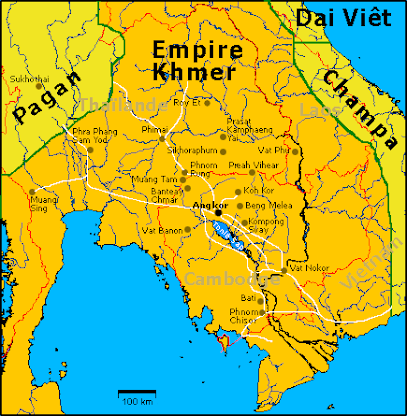
A large part of southern Vietnam, known in Cambodia as Kampuchea Krom, used to be part of Cambodia's Khmer empire centuries ago. Many ethnic Cambodians still live there.
In the Phnom Penh protest, about 100 riot police used batons to beat back the monks, blocking them from marching near the embassy.
The monks responded by punching the police and throwing water-filled plastic bottles at them. One monk was seen kicking a police officer in the groin.
Touch Naroth, the Phnom Penh police chief, said six policemen were slightly injured.
"They tried to storm the embassy, and police had the duty to protect the embassy," he said.
The police bruised seven monks on their heads or bodies, said Chan Saveth, an investigator with the nonprofit Cambodian human rights group Adhoc. He accused police of violence against the monks, who are widely revered in Cambodia.
Read more!
Tourism boom at Cambodia's 'Killing Fields'
The number of foreigners visiting Cambodia's "Killing Fields" has more than doubled from last year due to growing public interest in the Khmer Rouge tribunal, an official said Friday.
Up to 500 foreign tourists are visiting the grim execution sites on an average day, compared with 200-300 per day in 2006, said Ros Sophearavy, deputy director of a private company running the fields.
"The increase could be related to the arrest of Khmer Rouge leaders," she said.
"People hear about the Khmer Rouge tribunal and that must have prompted tourists to visit the Killing Fields," said Ros Sophearavy.
Visitors will see a 17-story stupa, or tower, that houses some 9,000 skulls of people killed during the the Khmer Rouge's brutal 1975-79 rule in Choeung Ek, some 15 kilometres (nine miles) southwest of Phnom Penh.
Many people were executed in Choeung Ek and buried in pits by the ultra-communist regime.
Up to two million people were executed, or died of starvation and overwork as the Khmer Rouge emptied Cambodia's cities, exiling millions to vast collective farms in a bid to forge an agrarian utopia.
Khmer Rouge leader Pol Pot died in 1998, one year after Cambodia first sought the United Nation's help in setting up a genocide tribunal to try regime leaders.
Established in July 2006 after nearly a decade of negotiations between Cambodia and the UN, the joint Cambodian-UN tribunal seeks to prosecute crimes committed by senior Khmer Rouge leaders.
So far five top Khmer Rouge leaders, including the regime's former foreign minister Ieng Sary, have been detained to face charges for crimes committed by the regime.
AFP
Read more!
Push for single visa across South-East Asia
Thailand and Cambodia have agreed to allow foreign tourists to enter on a single visa.
"This means a tourist can get a visa either for Thailand or Cambodia and can visit the two nations," Cambodian Foreign Minister Hor Namhong said after signing the agreement with visiting Thai counterpart Nitya Pibulsonggram.
The deal was the first of a hoped for series also involving Burma, Laos and Vietnam, he said.
"We want to see the five countries become one tourist destination," Hor Namhong said.
Thailand is aiming to have 15 million foreign tourists this year while Cambodia had 1.7 million last year, most of whom visited the ancient Angkor temples.
Earlier this month, Air Finland began the first commercial direct flight between Europe and Cambodia, where the tourism industry is growing 25 per cent per year.
Reuters
Read more!
Aussie-linked people-smuggler gets two years' jail
By Cath Hart
A NOTORIOUS people-smuggler linked to the arrival of 83 Sri Lankan asylum-seekers in international waters off Australia earlier this year has been sentenced to two years in jail by an Indonesian court.
Veteran people-smuggler Abraham Lauhenapessy, known as Captain Bram, was arrested inJune on people-smuggling charges and was last week handed a two-year jail term and fined 25 million rupiah ($3110).
His arrest, on charges of hiding, protecting, harbouring or providing livelihood to people known to have entered Indonesia illegally, was hailed at the time as a vital step in international efforts to disrupt people-smuggling syndicates in the region.
Former immigration minister Kevin Andrews described Bram's arrest as "the most significant breakthrough in terms of dealing with people-smuggling for years".
The successful sting to bring down the prominent people-trafficker followed a long-term joint operation by the Indonesian police and the Australian Federal Police.
The Howard government had confirmed that Bram had been linked to the arrival of 83 Sri Lankan asylum-seekers in international waters off Australia's west coast in June.
The Sri Lankans were transferred to Christmas Island and then to Nauru, where 74 have been found to be refugees but have not been resettled.
Seven of the remaining Sri Lankans being held on Nauru are facing criminal charges over the rape and sexual assault of a local woman.
Bram is believed to have had a long association with people-smuggling rackets in the region and had successfully evaded authorities for many years.
The Australian Federal Police involved in the fight against people-smugglers are believed to have classified Bram as a priority target for at least five years.
Authorities came close to shutting down the operations of Bram in July 2001 during a sting operation in Cambodia, when he and Pakistani people-smuggler Hasan Ayoub were arrested kilometres from the Cambodian port of Sihanoukville.
Although Ayoub was successfully charged and sentenced to 12 years' jail, Bram managed to slip through the net - reportedly after intense lobbying by the Indonesian embassy in Phnom Penh.
Read more!
Sunday, December 16, 2007
Tourism boom in Cambodia
PHNOM PENH - The number of foreigners visiting Cambodia’s “Killing Fields” has more than doubled from last year due to growing public interest in the Khmer Rouge tribunal, an official said.
Up to 500 foreign tourists are visiting the grim execution sites on an average day, compared with 200-300 per day in 2006, said Ros Sophearavy, deputy director of a private company running the fields.
“The increase could be related to the arrest of Khmer Rouge leaders,” she told AFP.
“People hear about the Khmer Rouge tribunal and that must have prompted tourists to visit the Killing Fields,” said Ros Sophearavy.
Visitors will see a 17-story stupa, or tower, that houses some 9,000 skulls of people killed during the the Khmer Rouge’s brutal 1975-79 rule in Choeung Ek, some 15 kilometres southwest of Phnom Penh.
Many people were executed in Choeung Ek and buried in pits by the ultra-communist regime.
Up to two million people were executed, or died of starvation and overwork as the Khmer Rouge emptied Cambodia’s cities, exiling millions to vast collective farms in a bid to forge an agrarian utopia.
Khmer Rouge leader Pol Pot died in 1998, one year after Cambodia first sought the United Nation’s help in setting up a genocide tribunal to try regime leaders.
Established in July 2006 after nearly a decade of negotiations between Cambodia and the UN, the joint Cambodian-UN tribunal seeks to prosecute crimes committed by senior Khmer Rouge leaders.
So far five top Khmer Rouge leaders, including the regime’s former foreign minister Ieng Sary, have been detained to face charges for crimes committed by the regime.
Read more!
Cuba, Camboya Boost Bilateral Coop
Phnom Penh, Dec 16 (Prensa Latina) Cuba and Cambodia gave a new step in favor of their cooperation with the signing of several agreements in the area of health, biotechnology, education and culture, and agriculture.
At the closure of the Third Session of the Intergovermental Commission for the Economic and Science-technique Collaboration, both parts ended talks aimed at strengthening joint actions to progress in development.
The Caribbean isle represented by First Vice Minister of the Minister for Foreign Investment and Collaboration Ramon Ripoll Diaz and Salvador Cabeiro Quintana, an official of the Ministry.
Cuban ambassador to Cambodia Gilda Lopez Armenteros also chaired talks, accompanied by Odalys Lopez Quintana, first Secretary of that diplomatic headquarters.
Prince Sisowath Chivannariddh, Secretary of State for Foreign Relations and International Collaboration, led the delegation of the Asian country.
Read more!
Saturday, December 15, 2007
Man or monster?
By Putsata Reang
The appearance of the first former Khmer Rouge leader in a special court established in Cambodia to bring that movement's surviving leaders to justice provoked a question on which the tribunal's integrity will depend: should an accused mass murderer be released pending his trial?
Kaing Guek Eav, commonly known as "Duch", presided over the deaths of more than 14,000 people at S-21, a former Phnom Penh high school turned into a torture centre. He is one of five former senior Khmer Rouge leaders who will be made to answer for their roles during Pol Pot's genocide, in which an estimated 1.7 million Cambodians perished. Until recently, Duch was the only one imprisoned, after being exposed in 1999.
The court - with its improbable blend of Cambodian and foreign judges and attorneys as well as laws - is meant to be a model for judicial reform and independent justice in a country where impunity has long been the rule.
The five red-robed judges who preside over the Extraordinary Chambers in the Courts of Cambodia (the official name) are the final arbiters of Duch's detention, but the question they are now considering belongs as much to the people of Cambodia as it does to the court. Should mass murderers be afforded the same rights as everyone else?
One of my aunts has a strong opinion on the matter. Khmer Rouge soldiers beat her father to death, and she remembers being shot at for sport by communist cadres as she and dozens of other peasants scuttled up a mountainside. She now lives one block from S-21. "Human rights are for humans," she said emphatically when I asked her about Duch's case. "He is a monster."
I once believed that, too. When I first visited Duch's house of horrors in 1990, I was 15 and full of wonder about the country where I was born but had never lived. My family escaped the Khmer Rouge on April 17, 1975, the day they claimed victory. When my mother and I journeyed home to reunite with relatives who had survived the genocide, S-21 (also known as Tuol Sleng) was among our first stops.
By then, the torture facility had been turned into a museum. I remember feeling claustrophobic as I walked down its halls and into classrooms turned into crude cellblocks. The air was stale but heavy with the stench of death in interrogation chambers barren save for a single bed frame, shackles and a chair. Flecks of dried blood peeled up from the floor. This was a place where fingernails of countless victims were ripped out, where others were strung upside down and dunked in barrels of water, where many were brutalised with metal prongs and batons. This was a place of utter brokenness. This was Duch's place.
Mostly, I remember the hundreds of black and white mug shots of prisoners and victims that covered every inch of the walls - a ghastly montage of human suffering that haunts me to this day. I couldn't help but think: this was somebody's daughter, somebody's son. This was somebody's mother or sister or brother.
Back then, I thought: What monster could do such things?
Now, that monster was sitting in a courtroom, looking scared and meek as prosecutors catalogued his alleged war crimes. Sitting in the packed auditorium where snatches of Duch's face flash by on a movie screen, I'm struck by what I see: a face that belongs to someone. This alleged perpetrator of unspeakable misdeeds is, like his victims, someone's son, someone's brother, someone's father.
This might have been only a fleeting thought had I not seen Duch's family members, who attended the hearings. Hang Seav Heang, 28, described the defendant as a gentle man, a good father. One of his sisters said he was a caring, protective brother, and she would always love him.
Outside the courtroom and in the community, most of the Khmers I talked to were, like my aunt, quick to categorise Duch as something other than human. Duch must have thought much the same thing about his victims when he ordered them to their deaths. When we start to see each other as less than human, we respond with inhuman acts.
It is this narrow, black-and-white view of humanity that has perpetuated a cycle of violence in Cambodia, where raging mobs beat to death robbery suspects and young mistresses suffer acid attacks by jealous wives. To say that Duch is a monster who does not deserve rights ignores the grey area between good and evil, between man and monster, where anything is possible. This trial is about that grey area, about that place in us all where morality decays and evil takes root and grows, the way mould prevails given the right conditions. Each of us carries this potential for rot.
There is no dispute that Duch violated the rights of thousands of Khmers. But if the basic premise of these trials is to uphold human rights, then we are obliged to extend that same principle to Duch. What does it say to the country and the world if a court convened to mete out justice flouts the law? Isn't lawlessness the plague we are finally trying to eradicate in Cambodia?
The judges have offered no indication when they will make a decision. And no one would blame them for taking their time to consider their options. This is, after all, the court's first test of fairness before the trials of Duch and four of Pol Pot's other henchmen begin next year. We all want justice, but that justice should not come at the cost of our humanity.
Read more!
Cambodia & UN Launch Three-Year Meal Programme
The United Nations World Food Programme (WFP) has announced a new, three-year programme to provide meals to 1.8 million vulnerable Cambodians, including schoolchildren, tuberculosis patients and people affected by HIV/AIDS.
At a ceremony yesterday in the capital, Phnom Penh, WFP and the Cambodian Government launched the $64 million feeding programme which, starting next year, will target the neediest and least developed regions of the South-East Asian country.
WFP Country Director Thomas Keusters called on international donors to step up their support of its programmes in Cambodia, warning that it was important to avoid a repeat of the funding crisis earlier this year that threatened to interrupt the supply of emergency food relief.
"Food assistance has an immediate impact on beneficiaries and it is often also the catalyst that will allow other programmes to be successful," Mr. Keusters said.
"What good is it to build more schools and train more teachers if the children cannot take advantage of the improved facilities because they come to school hungry? What is the benefit of HIV/AIDS/TB medical support if the people cannot afford to buy the food that is needed for the medicine to be effective?"
WFP has been operating in Cambodia since 1979, when it started supporting refugees and returnees, mainly along the Cambodian-Thai border.
Read more!
Friday, December 14, 2007
Filipino fighters forfeit gold medal bouts in SEA Games protest
It is Thailand, one of the Asian Countries. It is the same game without shame, Thailand has always been playing the fake games. Thailand win win win for fake champions's shame. Gold medals?
NAKHON RATCHASIMA, Thailand (AP): Filipino boxers forfeited six gold medal bouts at the Southeast Asian Games on Thursday in a protest against judging, and threatened not to compete in future editions of the event.
The forfeits in the men's finals came after judges for the women's finals on Wednesday awarded wins to host Thailand in all five bouts against Filipino opponents that were decided on points.
"We just wanted to send a message that some things have to be changed,'' said Manny Lopez, president of the Amateur Boxing Association of the Philippines. "Our boys lost their courage and their energy to fight after our country was dishonored in the women's finals. Our boys were commiserating with their women teammates.
You shouldn't do that to women especially. The officiating was very biased, and my opinion will be concurred by all the other countries.''
Monico Puentevella, the head of the Philippines team at these SEA Games, said team officials met Wednesday night to decide how to protest the judging, and that it was left up to each individual boxer whether to forfeit.
"It's their call, but whatever their decision may be, we will fully support them,'' Puentevella said in a statement released to media. "We understand their situation, sympathize with them and believe they will do whatever is right.''
The vocal Thai crowd was puzzled when Godfrey Castro in the flyweight final threw up his hands at the opening bell and forfeited. When Junel Catancio did the same in the bantamweight final in the next scheduled bout, the crowd began to boo and abuse the visiting fighters.
Thereafter, the Filipinos chose to fight for short stints before retiring. Junie Tizon in the middleweight final and Maximino Tabangcora in the light heavyweight final both retired at the end of the first of four scheduled rounds. Orlando Tacuyan Jr. retired at the end of the second in the featherweights, and in the lightweight final Joegin Ladon quit during the first round.
Larry Semillano in the super lightweight final was the only Filipino fighter to contest his full bout, losing on points to 2004 Olympic gold medalist Manus Boonjumnong.
The judges at the Southeast Asian Games were from neutral countries, but Lopez said they could be influenced.
"Who invites these so-called neutral judges? The hosts. Who pays their airfare? The hosts. Who pays for their accommodation? The hosts,'' Lopez said. Thursday's forfeits further sullied the reputation of the Southeast Asian Games, where medal tallies heavily favor host nations, and threatened the future of boxing at the event.
"It's bad at the Southeast Asian level,'' Lopez said . "The way things are going, I am willing not to present my boys in the Southeast Asian Games anymore. We can meet Thailand in other events which are more reliable, like the Asian Games.
"We will do a lot of hard thinking about what will happen in the future.'' Unlike professional boxing where judges make qualitative decisions on which fighter won each round, amateur boxing is judged by computerized scoring of clear legal blows landed.
Each of the five judges has a red and a blue button which they press accordingly for each clear scoring blow they see. Three out of the five judges must press the button for the same boxer within one second in order for the point to be awarded.
The Filipino boxers were underdogs in all of Thursday's bouts, with their strong Thai opponents including Boonjumong, 2007 world championship silver medalist Non Boonjumnong, 2004 Olympic silver medalist Petchkoom Worapoj and 2004 Olympic bronze medalist Suriya Prasathinphimai.
Read more!
Thursday, December 13, 2007
Angkor's legend rises

"The Legend of Angkor Wat: When History Comes to Life" is being staged in the midst of the venerable sanctuary through Jan 20.
A thousand seats arranged on a gentle gradient face the stage with no less than the five famed towers of Angkor Wat itself as the backdrop.
Built in the 12th century, the vast temple complex was dedicated to the Hindu god Vishnu. The story of the Angkor civilisation's rise and fall had been a legend among traders and explorers for a millennium until French naturalist Alexandre Henri Mouhot located the ruins in the jungle in the mid-19th century.
He was astonished to find enormous bas-relief sculptures of sandstone apsara dancers among the foliage and explored further. Gradually the scale of the lost treasure revealed itself once more.
This is the setting, once night falls, where beams of colourful light wash over the mediaeval fortress in a 50-minute, six-act performance that takes spectators time travelling back to the days of King Suryavarman II.
Seeing Angkor by night is special enough, but watching dancers emerge gracefully from the ornate stone galleries seems as though the apsaras of old have sprung back to life.
There are 150 performers in the show, all Cambodians. Most are professionals from Phnom Penh, and some are models and well-known stars of film and television, such as Tep Rindaro and Sim Solika.
The performance is in English, with Japanese and Khmer subtitles screened at either side of the stage. Images are projected on a curtain of water as well.
Every scene, replete with special effects, is so outstanding that at times you might be distracted from the historical narrative. Following the subtitles does indeed rob your attention from significant action onstage, so it's best to be content with the printed synopsis and focus on the performance. In any event, nothing is too complicated to understand.
The evening makes Angkor so much more impressive, and some of the lighting for the show is set within the temple compound itself.
The director of the show, Peung Chiang of the Department of Culture and Fine Arts, points out that multimedia technology - especially when mingled with traditional performance - makes the ancient empire more interesting for a general audience.
"Angkor Wat is like a diamond," he says. "When it's carried or covered with velvet, it's more precious and worthy. And this performance is like a dish of food. It's a combination of various ingredients ready to serve."
Japan promises $100 mln of concession loan for Cambodia to reduce poverty
The Japanese government has pledged to provide 100 million U.S. dollars of concession loan each year for Cambodia to facilitate its poverty reduction efforts, said Prime Minister Hun Sen on Thursday.
The loan will be increased by one third on annual basis and the interest rate will keep as low as 0.01 percent, he told the construction ceremony of counter-flood facilities on the Tonle SapRiver bank in Phnom Penh.
Cambodia will pay it back in 40 years, he said, without giving other technical details of the loan.
"I urge the Cambodian government officials and the Japanese experts here to quickly take the loan to help and develop the poverty reduction projects," he added.
The loan deal was reached by both parties while Hun Sen paid his recent visit to Singapore to attend the ASEAN (the Association of Southeast Asia Nations) meetings.
International institutions have put the poverty rate of the kingdom at 35 percent.
Read more!