HA NOI — The Tay Ninh People’s Committee from the southern western province has recently sent an application to the Government to allow Cambodian CVI Resort Ltd build a golf course at Moc Bai border gate between Viet Nam and Cambodia.
The project is part of the co-operative framework on social economic development between the neighbouring provinces of Viet Nam’s Tay Ninh and Cambodia’s Svay Rieng which was agreed and signed by the leaders of both sides on January 12 this year.
Under the plan, the golf course will cover an area of 120ha with half each to be located in Viet Nam and Cambodia. The golf course will consist of a park, 18 hole-course, hotels, restaurants, and tax free shops.
According to the project investors, the area in Cambodia has been granted a licence by the Cambodian goverment and they have made detailed plans for the Vietnamese goverment approval. — VNS
Read more!

Sunday, May 27, 2007
Cambodia firm tees up new golf course

'I'll never get over Cambodia'
 Many children expertly navigating bowls and pots approach tour boats to beg.
 Homes on stilts are built on quiet river banks.
 This Killing Field monument in Siem Reap is half-full of bones of Khmer Rouge victims. As many as three million people may have died during that dreadful time.
Country a paradox of both riches and tragedy
"Why are we going to Cambodia?" I kept asking my husband, who had signed up for it as an extension to our China trip last fall.
"Because it's in the neighborhood," he would reply.
What a paradox is Cambodia. We stayed in the burgeoning city of Siem Reap and found a beautiful, tropical place, filled with warm, friendly, hospitable people.
It's also a place steeped in poverty, illiteracy, and memories of the terrors suffered under the Khmer Rouge some 30 years ago.
The women mostly stay home with their children or sell things in the markets. They outnumber men almost two to one, meaning the men may have several wives and many, many children -- all of them, near as I could tell, adorable.
It's hot and humid in Cambodia, and things move slowly -- the rivers, the people (except those on motor scooters), progress. The people are struggling against terrible odds to move into a more contemporary way of life and become a modern society attractive to tourists.
And they're succeeding. We did many interesting things beyond our usual sphere of activities, such as taking an ox-cart ride, going up in an air balloon, eating lotus roots, and happening upon a colorful Buddhist wedding celebration.
.
We saw monkeys, live pigs being taken to market on motor scooters, begging children paddling around in pots on a lake, homes with TVs and stereos but no refrigerators, and a monk smoking a cigarette. ("Oh, he'll be going to Hell," explained our guide carelessly.)
We spent a fascinating morning at a silk farm, where we saw the entire process from the field of mulberry trees, the feeding of the silkworms, and the caring for the cocoons, to the dying, spinning, and weaving, and finally (perhaps my favorite part) the gift shop.
Another day we visited a lake with an entire community, including shops, school, and church, floating on its surface. More than 5,000 people live there in houseboats, relocating as indicated by fishing consitions and seasonal flooding. One home even sported a pig lounging on an attached raft.
We were captivated by assorted ruins of ancient temples. The most famous one is Angkor Wat. This is a huge, sprawling structure, and you must climb some really ghastly, steep stairs if you want to see all of it.
I declined to do this, figuring I might possibly get up, but there was no way I would ever get down. Eventually I came upon a cool first-level niche full of other overweight elderly people awaiting their more ambitious companions.
It's taken me a long time to write about Cambodia, mostly because it had such a profound effect on me. Actually, it kind of broke my heart. You can't get away from the war and the awful legacy of the Khmer Rouge. So many who lived through it refer to the most appalling atrocities with horrifying casualness.
These wonderful, poor people. Most can't even afford to love their pet dogs; they know they may be forced by hunger to eat them. How wealthy Americans are -- we can love our pets!
Why go to Cambodia? Because the people have so much culture, beauty, history and tradition to share. Because it is a society rising from its ashes with pride and determination. Because it's a very real part of our world.
I'll never get over Cambodia -- I don't think I ever should.
this story has been read 344 times
Read more!
U.S. Chevron to produce oil, gas in Cambodia in 2008
The U.S. oil giant Chevron has finished its exploration at offshore Cambodia and will start oil and gas production in 2008, local media said on Sunday.
Chevron has transferred its exploration equipment from Cambodia 's seaport city Sihanoukville to its working site and now plans to import new equipment through the port for oil and gas production, the Chinese language newspaper Sin Chew Daily quoted a municipal government official as saying.
"Senior Chevron staff members told me by phone that the exploration is completed and the rigs will start working to produce oil and gas next year," said Lou Kim Chhun, whose capacity in the government remained unclear.
Meanwhile, the Cambodian Natural Gas and Petroleum Agency confirmed that it imposes no control on Chevron's activities in Cambodia.
Chevron, together with LG from South Korea and a Japanese company, is allowed by the Cambodian government to invest and conduct exploration at its western sea shore.
At least 700 million barrels of crude oil are estimated to lie off the coast and the Cambodian government is now preparing an oil and gas management law in anticipation of oil and gas revenues starting from 2009 or 2010.
Source: Xinhua
.
Read more!
Cambodia starts wheelchair race for handicapped Olympics
Cambodia held the first round of the ANZ Royal-CNVLD Wheelie Grand Prix in Phnom Penh on Saturday to select the best racers of the kingdom for the upcoming handicapped Olympics next year in Beijing.
One man and one woman athletes aced out from 25 other contenders in Satruday's 500-meter and 5,000-meter races and they are expected to attend more races in the future, until the best ones are found for the Olympics.
Around 200 peopel watched the prix in downtown Phnom Penh, under the banners which read "You don't need legs to run like the wind."
The race was sponsored by the Australian-New Zealand Royal Bank.
Source: Xinhua
Read more!
Tug of War Over Indochina
Amid growing talk of creating an East Asian Community in recent years, Japan and China have been jockeying for the leadership role in what will be the long and arduous process of community building.
The two Asian powers have competed for stronger and closer ties with the Association of Southeast Asian Nations (ASEAN). Although the 10 ASEAN members are much smaller than Japan and China in economic size individually, they wield a strong voice in East Asian affairs as a group.
As East Asia began to move toward greater regional economic integration several years ago, China had a head start over Japan in strengthening ties with ASEAN by signing a free-trade agreement (FTA). The Sino-ASEAN FTA took effect in July 2005. Japan and ASEAN are still negotiating an FTA, although they are expected to ink the deal this year.
Two-way trade between China and ASEAN has been growing at a much faster pace than that between Japan and ASEAN. China's investment in ASEAN is also surging sharply, although the amount is still dwarfed by Japan's investment in the grouping.
China has taken a lead over Japan on the political front as well. China signed ASEAN's 1976 Treaty of Amity and Cooperation in October 2003, a few months before Japan did. Japan initially balked at signing the ASEAN treaty, which provides for, among other things, peaceful settlement of conflicts and non-interference in internal affairs, out of political consideration to its most important ally, the United States.
In 2001, China signed a "Declaration of Conduct" with ASEAN to prevent conflicts in the South China Sea, where China, four of the ASEAN members -- Vietnam, the Philippines, Malaysia and Brunei -- and Taiwan claim all or part of the Spratly Islands. In March 2005, China agreed with Vietnam and the Philippines to explore for oil in the disputed waters.
These aggressive Chinese peace overtures toward ASEAN apparently reflect a desire to assuage the perception of China among some in ASEAN as the most serious security threat to their countries and thereby to forge closer ties with the grouping. Cementing ties with ASEAN in general -- and the joint oil-exploration agreement with Vietnam and the Philippines in particular -- is also seen as part of efforts to preempt a possible U.S.-led containment of China.
The Sino-Japanese tug-of-war over greater influence in Southeast Asia has also opened a new front -- the Mekong River basin. Moves by Japan and China to help the development of the Mekong River basin have intensified in recent years.
The 4,425-kilometer Mekong River originates in Tibet and flows through China's Yunnan province, Myanmar, Thailand, Laos, Cambodia and Vietnam into the South China Sea. It is the main artery for Indochina. The Mekong basin, abundant in natural and human resources, has attracted much attention as an untapped frontier for development since the early 1990s, after an end to the civil war in Cambodia and other Cold War hostilities in the region.
The Mekong region is increasingly seen by many Japanese and Chinese companies as a promising investment destination. But for Japan and China, assistance in the development of the Mekong region has also become a very important avenue to strengthened ties with the entire ASEAN.
For ASEAN, correcting the so-called "ASEAN divide" -- the huge gap in wealth between rich and poor members -- is a high priority as the grouping accelerates its economic integration with an ultimate goal of creating a fully integrated ASEAN Economic Community by 2015. Per capita income of Myanmar, for example, is less than one-hundredth of that of Singapore. The Mekong River's development is widely believed to hold the key to the development of war-battered Indochina as a whole.
In the early 1990s, after years of civil war ended in Cambodia, Japan took the leadership role in efforts to develop the Mekong region, backed by its huge aid money, and secured a strong influence in the region. Japan also hosted an international peace conference for Cambodia in June 1990. It was the first time since the end of World War II that Japan had hosted an international conference to discuss peace in a third country. The warring factions in Cambodia signed a peace agreement in Paris in October the following year.
In 1992, Japan enacted a historic law enabling its Self-Defense Forces to participate in United Nations-sponsored peacekeeping operations abroad. Under the law, SDF troops were dispatched to join U.N. peacekeeping efforts in Cambodia prior to the country's first postwar election in the spring of 1993. It marked the first overseas mission for SDF troops. Sending troops abroad had previously been a taboo in Japan because of the country's war-renouncing, post-World War II constitution.
With the turn of the millennium, however, China began to turn the tables on Japan, while Japan rested on its laurels. China has aggressively sought to cozy up to individual ASEAN members, including in Indochina, as well as ASEAN as a whole in recent years. A greater commitment to the development of the Mekong region is part of such efforts. Unlike Vietnam, which has a relatively large economy, Cambodia, Laos and Myanmar have been heavily reliant on Thailand for economic growth. But Thailand's influence in Indochina has been eroded since the 1997-98 Asian economic crisis, and China has filled the gap.
Among other initiatives, China hosted the second summit of the Asian Development Bank (ADB)-sponsored Greater Mekong Subregion (GMS) Economic Cooperation program in Kunming, capital of China's Yunnan province, in July 2005. The GMS has Cambodia, Laos, Myanmar, Vietnam, Thailand and China as full members.
China has also offered financial and other assistance programs for the development of the GMS, has forgiven more than $1 billion in debts owed by Cambodia to China, and has expanded preferential tariffs for imports from Cambodia, Laos and Myanmar. China has set up a special fund totaling $20 million within the ADB for poverty alleviation of the region. China has also provided military as well as economic aid to Myanmar in defiance of international criticism of that military-ruled country.
It would be fair to note, though, that China has attached a particular importance to the development of the Mekong region, primarily for domestic reasons. China hopes to turn the poorer western part of the vast country into a magnet for domestic and foreign investors and thereby to correct the widening gap in wealth with the flourishing eastern coastal areas, an issue that could threaten the country's political stability and even the rule of the Chinese Communist Party.
Japan has funded infrastructure projects transcending national borders in Indochina on its own or in partnership with the ADB. China has also stepped up financial assistance for the development of that region, flexing its rapidly growing economic muscles.
Two big highway projects crisscrossing Indochina are seen by many as a symbol of the intensifying race for regional influence between Japan and China. One is the East-West Corridor project, led by Japan, to build a major highway, including the Second Mekong Friendship Bridge over the river, to link the port of Da Nang in central Vietnam, Savannakhet in southern Laos, Mukdahan in northeastern Thailand and then Mawlamyine in southern Myanmar. This project was almost completed at the end of last year.
The other is the North-South Corridor project, led by China, to build a highway linking Kunming and Bangkok via Laos. This project is expected to be completed by the end of next year. Japan balked at funding the Chinese-led project, partly for fear of lending China a hand to increase its influence southward in Indochina.
Apparently alarmed by China's rapidly growing political as well as economic influence, then-Prime Minister Junichiro Koizumi of Japan held talks with his counterparts from the so-called CLV nations -- Cambodia, Laos and Vietnam -- in Vientiane, the capital of Laos, in November 2004 for the first ever Japan-CLV summit. The second Japan-CLV summit was held in December 2005 in Kuala Lumpur.
At a foreign ministerial meeting between Japan and the CLV nations in the Philippines in January, Tokyo conveyed to the CLV nations its plan to host a ministerial meeting of Japan and five countries in the Mekong region, including the CLV nations, during fiscal 2007, which started in April, to discuss further cooperation for the region's development. In their talks earlier this month, Japanese Prime Minister Shinzo Abe also explained to visiting Laotian Prime Minister Bouasone Bouphavanh Tokyo's decision to make the Mekong region a priority target area for its economic assistance and expand aid for Laos and other regional countries over the next three years.
China remains by far the most powerful magnet for Japanese and other foreign investors in Asia. But Japanese companies have been on an investment spree in Vietnam as well in the past couple of years. Vietnam's economic size and population pale before China's. But the nation has even cheaper labor. Vietnam has become an increasingly popular investment destination for Japanese firms seeking to reduce their excessive dependence on China and spread their business risks in Asia.
The investment pact between Japan and Vietnam took effect in late 2004. Japan and Vietnam also kicked off FTA negotiations in January, separately from FTA negotiations between Japan and the entire ASEAN. Vietnam was also admitted to the World Trade Organization in January. WTO membership, which obliges Vietnam to open its markets wider to foreign competition and make its trade and investment rules and regulations fully compatible with international norms, is expected to fuel Japanese and other foreign investment in the country.
Meanwhile, Japan and Cambodia are expected to sign an investment treaty next month, and a similar pact between Japan and Laos is also in the works. Investment treaties, coupled with the full opening of the East-West and North-South corridors to traffic, might give a boost to Japanese investment in Laos and Cambodia as well as Vietnam.
In his talks with Abe earlier this month, Bouasone expressed "his strong wish and commitment to develop special economic zones in other areas besides Savannakhet to make full use of the Second Mekong Friendship Bridge and highways under the East-West Economic Corridor framework," according to their joint press statement. Many Japanese-funded companies in Thailand are becoming more interested in investing in neighboring Laos to take advantage of the closeness between the Thai and Lao languages -- many Lao people can speak or read Thai -- as well as much cheaper labor in Laos.
Meanwhile, with the construction of infrastructure such as roads and bridges and simplification of customs procedures progressing between China and Vietnam as well as within Indochina, international forwarders have begun to move to establish land transportation networks linking China and Southeast Asia. TNT of the Netherlands, for example, is preparing to complete a 4,000-kilometer-long truck transportation network from Singapore to China via Vietnam by the end of this year. Nippon Express Co., Japan's largest forwarder, also plans to activate a 7,000-kilometer network liking the Chinese commercial hub of Shanghai and Singapore early next year.
Read more!
Saturday, May 26, 2007
Russia set to conclude WTO talks with Vietnam, Cambodia in June
ST. PETERSBURG, May 26 (RIA Novosti) - Russia hopes to conclude bilateral talks with Vietnam and Cambodia on its accession to the World Trade Organization (WTO) by the end of June, Russia's economics minister said Saturday.
Moscow has signed bilateral protocols with all but two WTO members, and has yet to complete multilateral talks with its trade partners within the 150-member organization.
"I believe we will be ready to sign [an agreement with Vietnam] in June," Economic Development and Trade Minister German Gref said. "Also last details [of an agreement] are being coordinated with Cambodia."
Jose Manuel Barroso, the president of the European Commission, said following the Russia-EU summit in the Volga River city of Samara May 18 that the EU fully supports the prospect of Russia joining the global trade organization.
Earlier Andrei Kushnirenko, a deputy head of the trade talks department with the Russian Economic Development and Trade Ministry, said after joining the WTO, Russia will gain the right to defend its interests and participate in all talks on trade regulations planned for the next decade, although the country will start gradual transition to an open market economy only after a year of its accession.
Read more!
The romance of Indo-China
Ravi Teja Sharma / New Delhi May 27, 2007
Vietnam, Cambodia and Laos are worth a visit this summer.
Junk the usual summer international destinations like London and Paris and try a different kind of holiday. Check out parts of Asia so far inaccessible for many. Fly to Vietnam, Cambodia and Laos, also known together as Indo-China. There are still no direct flights to get to these countries from India but there are flights that take you there via either Malaysia, Singapore or Thailand . Once you reach, you are transported to a completely different world. Before this old world and natural beauty is lost, plan a trip fast.
After decades of war, Vietnam is finally rebuilding itself and attracting tourists in a big way. The two major cities in the country — capital Hanoi and modern Ho Chi Minh City are a major contrast and a must visit for any tourist.
Throughout the thousand years of its eventful history, marked by destruction, wars and natural calamities, Hanoi still preserves many ancient architectural works including the Old Quarter and over 600 pagodas and temples, which are quite a sight to behold. Hanoi also has 18 beautiful lakes such as Hoan Kiem Lake, West Lake, and Truc Bach Lake, which are the lungs of the city.
Ho Chi Minh City, formerly known as Saigon in the Mekong Delta, on the other hand, is one of the most important cities in Vietnam after Hanoi, being its commercial centre. Ho Chi Minh Museum, formerly known as Dragon House Wharf, Cu Chi Tunnels, museums, theatres, cultural houses are some of the places to visit. And if you like architecture, don’t miss the city’s beautiful buildings.
The two main cities to visit in Cambodia are its capital Phnom Penh and Siem Reap. Phnom Penh is located at the confluence of three rivers — the Mekong, the Bassac and Tonle Sap. The most attractive part of Cambodia are undoubtedly its unending list of temples. The temples at Angkor Wat, about six kilometres from Siem Reap, south of Angkor Thom, are the most famous.
The oldest and loveliest of Laos city’s, Luang Prabang, was founded between the sixth and the seventh centuries and is renowned for its serenity. Much of the town and its pagodas are protected as a UNESCO World Heritage Site. When in the city, don’t miss Wat Xieng Thong, a temple built in 1560 and which was used for royal ceremonies.
The other city, Vientiane was partially rebuilt during the colonial period, with French-style buildings and is small, and picturesque. It contains some pagodas, museums, wide boulevards and attractions like Patuxai and Vientiane’s Arc de Triumphed.
Read more!
A long way from Cambodia, a girl is all smiles

Staff Writer
GARDINER -- Nine-year-old Maya Hughes shouldn't be the sweet third-grader who runs and laughs with classmates; loves rainbows, gardening with her mom, and cooking hot dogs on the grill; and punctuates nearly everything she says with "please" and "thank you."
Someone who spent most of her first two years of life neglected and malnourished, unable to walk or talk, suffering from birth defects and stuck in a hammock in the back room of a Cambodian orphanage, would seem to have every reason to be angry at the world. Instead, tiny Maya has a sunny disposition so infectious it rubs off on peers and adults alike.
"Maya has a perseverance and cheerfulness she carries with her everywhere she goes," said her third-grade teacher and family friend, Liz Hall. "The amazing thing is, when she's paired up with another student, that student also ends being kinder and more patient, too.
"If I could somehow have everyone pair up with her, this would be a better world."
Her mom, Susan Potter, said adults are not immune.
When they see Potter and Maya at Hannaford shopping for groceries, some other shoppers may catch Maya's smile, and end up with a big smile of their own.
"I'll see them two aisles later, still smiling," Potter said. "She just has this aura about her. She's the single most extraordinary human being I've ever known."
Maya was born Rath Srey Mom in Phnom Penh, Cambodia, on May 11, 1998, with multiple birth defects later diagnosed as Pallister-Hall Syndrome. Her birth parents, Potter said, realized they couldn't meet her needs and left her with an orphanage. Potter said the orphanage didn't have enough food or other resources for all its children. So Maya, because she was disabled, was nearly ignored.
"She spent 23 months in a hammock in a back room, by herself," Potter said. "She was malnourished. She never had any toys to play with. She never had anyone hold her."
In April 2000, Maya was brought to the United States by the Sharing Foundation, a nonprofit foundation formed to try to improve the health and welfare of Cambodian children.
A few minutes spent with Maya recently in the River View Community School library hinted at the progress she has made.
She not only walks, she runs.
She not only talks as well as any typical 9-year-old, she talks in adult-sounding sentences starting with phrases like, "Let me tell you something."
And she has clearly bonded with her parents and teachers, hugging her mom often and saying she would miss her when Potter said she had to go back to work. She's been through 10 major surgeries -- including surgery on her teeth, hand and feet -- and dealt with complications including a bowel obstruction and fungal sepsis infection.
Maya likes many of the same things other 9-year-olds do.
"I like being with friends," she said, her brown eyes shining. "I like rainbows. Gardens. Computers. I like going to the theater."
But she also likes to clean, cook and help her mom in the garden.
Asked why she likes to help, she raised her arms from her sides and gazed back with a look of disbelief that said, without words: "How could I possibly not?"
Potter said people will complement her, as a mother, for having such a polite child.
"I tell them it's the other way around," Potter said. "When you're around her, you just behave in a more civilized, respectful manner."
By the time Maya came along, Potter was in her mid-40s and had already raised a son and daughter. She didn't have toys or a crib or other items for small children.
Soon, Maya's story got out in the community. And the community responded.
"I'd come home and find things on my porch -- a crib, toys... I still don't know where some of the stuff came from," Potter said.
Potter figures Maya is where she is, and who she is, for a reason.
"There is something different about this child," she said. "When destiny calls, you've got to be strong. I don't know what her destiny is or what she's going to do when she grows up. But there is a reason for this child to be here."
Keith Edwards -- 621-5647
kedwards@centralmaine.com
Friday, May 25, 2007
Towers of power Ancient temples of Angkor survive jungle of Cambodia

Article Last Updated: 05/25/2007 03:00:04 AM PDT
SIEM REAP, Cambodia
THE DAYS of hacking through a jungle and fending off leopards and wild elephants before entering the gates of Angkor Wat are long gone.
Most of today's visitors arrive at Angkor Wat's moat-crossing sandstone causeway by air-conditioned bus or car.
The former jungle-smothered temple deep inside Cambodia is suffocated with visitors from around the world. And that was how far my wife and I flew to join 12 friends for a mid-winter weeklong stay at a nearby guesthouse on the outskirts of Siem Reap.
Siem Reap, a little tourist village, is the gateway to the ruins of the ancient city of Angkor, capital of the Khmer kingdom from 802 until 1295. It's abuzz with a building boom. Expensive hotels, along with more humble lodgings, are springing up all over.
Tuk-tuks, a kind of rickshaw attached to a motorcycle, are toting tourists from their lodgings to an ever-expanding collection of shops, bars and restaurants. Yet, there's still enough ramshackle charm in this relatively safe and friendly place to make a stroll along its busy sidewalks a nice diversion from temple touring.
Back alleys near the old covered market draw crowds for simple and tasty Khmer fare. Curries and stir-fries share menus with dishes only for the daring. International visitors can finda taste of home. French, Italian, Chinese, Thai, Japanese, Indian, Vietnamese restaurants and even an Irish Bar have set up shop.
Only in the last decade or so has Cambodia
been able to safely welcome tourists. Civil wars and the Khmer Rouge regime kept tourists at bay. Even now, in the midst of a tourist boom, visitors are warned not to wander off the beaten path as Cambodia still suffers from a landmine epidemic that will haunt the country for years to come.
So for our first day of touring Angkor — a vast and mysterious complex and home to about 100 temples — we followed the crowd over Angkor Wat's moat before passing through its outer gate. There, we got our first glimpse of one of the world's greatest archeological sites. It's one of the largest religious monuments in the world.
And it is breathtaking.
Five massive beehive-like towers rise some 200 feet from the ground. The three-story temple complex, built between 1112-1153 as both a temple and a mausoleum for King Suryavarman II, encloses a square surrounded by intricately interlinked galleries. Its imposing grandeur struck me so much that I felt compelled to bolt from the tour-guided group.
The local guide had just started a long-winded spiel about the bas-reliefs lining the walls of the esplanades. While the bas-reliefs depict fascinating stories and characters from Hindu mythology and historical wars of Suryavarman II, I was just too excited to passively plod along.
With a reluctant nod from my wife, I followed a path into the heart of the temple. In my excitement, I scrambled up a steep rock staircase leading to the top floor of the temple, without thinking of the return trip. When I looked down from the top, I caught a sudden case of vertigo.
The narrow stair treads, only inches wide and with no handrailing, made me think no way was I crawling back down. Thankfully, the 21st century temple elders have retrofitted a railing running down the backside of the monument.
Where were my friends when I needed them? They were still marching along the corridors of the temple where the king's armies have been marching for 1,000 years. I found them just in time for the guide to wrap up his talk.
The following day, we dusted off our Indiana Jones smirks and left the crowds behind. We were headed to a temple of doom called Beng Mealea. The early 11th century Hindu temple is more than an hour from Siem Reap. To get there, you have to travel over bumpy roads running through rural Cambodia where water buffalos have been slogging through rice fields since the beginning of time.
The view from our van's windows of village life amidst the jungle set the scene for the tangle of trees, towers and vines that are Beng Mealea. In the early half of the 20th century, temple and jungle enthusiasts could combine a trip to Beng Mealea with a hunting party since the region was crawling with tigers, panthers and elephants.
In 2007, the crawling is done by tourists who must clamber over huge piles of rubble to see what Mother Nature has spared.
Because of its remote location, civil wars and the Khmer Rouge regime, tourists have stayed away from this still-off-the-beaten-track ruin.
But it's worth the trip. The temple is in a raw, unrestored state where jungle vines and monster-sized tree roots hold a death-grip on what's left of the sanctuary, giving it a haunted charm. Dappled light sneaks through the jungle canopy, making the mysterious temple all the more inviting to would-be archaeologists.
Thankfully, a few carpenters made it there before we did and had fashioned ladders and bridges along with some crude walkways through the crumbling ruins.
Also present were a team of temple guides who literally held our hands as we scrambled over fallen masonry and around huge piles of rubble, climbed over walls and squeezed through windows, (just barely for some of our full-figured friends), before passing through dark passageways on a circuitous route through the temple.
Beng Mealea was the wildest temple we explored, but not the only one left in the clutches of the jungle.
A little tamer, a lot more user-friendly and far more famous and popular is Ta Prohm. Located on the main tourist route not far from Angkor Wat, Ta Prohm receives visitors by the busload. Its status, enhanced by its star turn in the film "Tomb Raider," and its photogenic appeal make it a family favorite.
The 12th-century Buddhist monastery, unlike most other Angkor temples that were painstakingly reconstructed, has been left somewhat the way it was when European explorers stumbled upon it in the late 19th century. Like Beng Mealea, its towers and walls are wrapped in an entangled embrace of tree roots. The filtered light, the shroud of the dense jungle and the labyrinthine inner sanctuary add to the mystery of the temple — until hordes of picture-snapping tourists make you want to yell "Cut!" and to tell everyone to "Take Five!" somewhere else.
But you'd better be able to yell in Korean, as the Angkorian ruins are extremely popular with Cambodia's Asian neighbors as well as with Western visitors.
Although their popularity detracts from their otherworldliness, their towers, corridors and jumbled piles of delicately carved stone blocks sent asunder, make the ruins worth braving the crowds.
Guidebooks differ on the count, but Ta Prohm has been popular for a long time. About 80,000 people were required to maintain the temple. It was home to priests, monks, servants and 600 or so dancers. The others lived in surrounding villages and apparently embraced the temple and supported it with supplies.
Today, many temple walls probably would collapse without the embrace of the trees holding them to each other. Man-made bracing and other structural support help as well. And the only ladies we saw dancing were carved in stone on the temples' walls.
During our weeklong stay we would visit many other temples, all fascinating, but none more beguiling than the Bayon.
The Bayon temple lies within the ancient fortified city of Angkor Thom, just minutes by road from Angkor Wat. Angkor Thom was enclosed by 24 feet high walls and surrounded by a moat 100 yards wide. Snap-happy crocodiles patrolled the moat. The city, about two miles square, had five huge gates, each with a causeway crossing the moat. The 60-foot high gateways were wide enough to welcome a procession of elephants.
The court, religious leaders and officials who lived within the city walls could stand on the beautifully carved Terrace of the Leper King or the Terrace of Elephants bordering the royal plaza, and take in the passing parade. Today, visitors stand where the king once stood to take in a passing parade of a different nature.
Angkor Thom was the capital of the king's empire and apparently the love of his life. One inscription found in the city refers to Jayavarman VII as the groom and the city as his bride, according to Wikipedia.
The city is still much loved by Cambodians and visitors alike, who come to see a variety of temples that can be seen in succession on a short stroll. And none is more beloved that the Bayon.
We were transfixed during our first visit, so much so that when our friends boarded a boat to Phnom Penh, we stayed behind to spend our last few days in Cambodia in Angkor Thom.
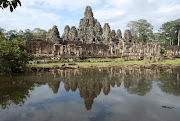
And in the heart of Angkor Thom lies the Bayon. Its 54 towers decorated with more than 200 enigmatic gigantic faces have been greeting visitors for hundreds of years. After studying a few of the faces, with their mellow, subdued, charming hint of a smile, we felt like old friends.
Their similarities to statues of the king have lead some scholars to conclude that they represent Jayavarman VII himself, in all his omnipresence.I have no idea what he was like, but the court sculptors portrayed him in all his tranquility. Whether it was real or imagined, whether they did it out of love or under threat, is a mystery.
In the late afternoon the temple emptied, save a few stragglers, a handful of saffron-robed monks and us. We were perched as high upon the temple walls as we could safely climb. The light of the day inched up the towers, darkening the passageways below.
The sun's warm glow swept over the sculpted faces with their downcast eyes and thick lips that curl slightly upwards at the edges reflecting the famous "smile of Angkor" — an endlessly fascinating smile on a face that has launched 1,000 tour buses.
If you go
-When to go. Cambodia has a tropical climate, so it's warm to steaming hot year around. June to October is the rainy season. November to February is the dry season, with January generally being the coolest month.
-Where to stay. Our group reserved all the rooms in Journeys Within Bed & Breakfast inn, nicely located a short cab ride from the airport and the main ruins, and a 10-minute tuk-tuk ride to downtown Siem Reap. The B&B is owned and run by a young couple, an American man and his English wife who made our stay more relaxing than I would have imagined possible.
We ate many of our meals at the B&B after cocktails around the pool. There's nothing like an Angkor beer or a medicinal gin and tonic after a day of temple touring. The inn's Web site is http://www.journeyswithin.
-Photography. Shutterbugs will be snap-happy with all the photo ops in the Angkor area. I was traveling light and only carrying a Canon Power Shot A710IS, a palm-sized point-and-shoot camera. Bring extra batteries and memory cards.
-Health concerns. Visit the Web site of the Center for Disease Control at http://www.cdc.gov for inoculation requirements.
-Information. Lonely Planet's guide to Cambodia is a must read. Helpful Web sites include http://www.wikipedia.org, http://www.cambypublications.com and http://www.khmernet.com. Also worth doing is googling Angkor and Siem Reap.
Building begins on border marker with Cambodia
TAY NINH — The southern province of Tay Ninh began construction of its second border marker with Cambodia yesterday.
The marker is located in the Xa Mat-Treapen Phlong international border gate area that straddles Viet Nam’s Tay Ninh and Cambodia’s Kongpong Cham provinces.
Another marker in the Moc Bai-Ba Vet international border gate area between Tay Ninh and Cambodia’s Svay Rieng Province, was the first to be built and dedicated in September of last year.
The planting of border markers comes on the heels of the Viet Nam-Cambodia Border Delimitation Treaty. — VNS.
Read more!
China Steelmakers Plan Cambodia Investment
Four Chinese steelmakers have agreed to set up a joint venture to explore and develop iron ore mines in Cambodia, seeking to improve their control over supply and pricing.
Wuhan Steel, China's fifth biggest steel mill, is leading the project with a 50 percent stake, with Shanghai-based Baosteel Group taking 20 percent, Wuhan Iron & Steel said in a notice seen Friday on its Web site.
It said Anshan Iron & Steel Group and Beijing's Shougang Iron & Steel Group would each hold 15 percent in the venture, which will explore and develop mines in Cambodia's Preah Vihear province.
The four state-owned steelmakers signed an agreement on the venture in Beijing earlier this week.
"'The steel industry has no choice but to control iron ore resources. The new venture is a strategy by steelmakers to ensure their sustained and healthy growth,"' the notice cited Li Fushun, Wuhan Steel's deputy general manager as saying.
The venture follows exploration of the area by Cambodian companies and China's National Machinery and Equipment Group that found the region may have 2.5 billion tons of iron ore reserves, Wuhan Steel said.
It did not give any financial details of the venture.
Surging Chinese demand for steel has boosted iron ore prices in recent years, prompting Chinese steel mills join forces in seeking ways to control costs.
In December, Chinese steelmakers represented by Baosteel, the country's biggest mill, agreed with major Brazilian ore producer Companhia Vale do Rio Doce SA on a 9.5 percent price increase for iron ore in 2007, down from a 19 percent benchmark price increase in the 2006 contract year and a 72 percent jump in 2005.
The Chinese steel companies have also invested in mining interests in Brazil and Australia.
China is both the world's largest consumer and producer of steel. Crude steel output rose by 19.5 percent to 423 million tons last year - about 35 percent of total production worldwide - and is forecast to climb at a similar rate to 460 million tons this year.
Read more!
Thursday, May 24, 2007
Learning to Live With the Mekong's Floods
BANGKOK, May 24 (IPS) - A Vietnamese academic has developed a small following over the past two years for his views about the waters that inundate the Mekong delta. The seminars he attends ends with participants wanting to know more.
What has created such interest is the positive twist Bach Tan Sinh, senior researcher at the National Institute for Science, Technology Policy and Strategic Studies, in Hanoi, gives to the waters of the Mekong river that overflow during the flood season.
''I have been talking about people living with floods rather than having to escape them,'' Bach said during an interview from the Vietnamese capital. ‘'Many people who are not from Vietnam hear this and want to learn more.''
It is not a view of his making, though. He conveys that when he draws from the language of the Vietnamese communities that live in the Delta and need the annual floods for their twin occupations, agriculture and fisheries. ‘'The people describe this period as ‘water rising'; it has been part of our history,'' he adds.
By contrast, the more conventional view of floods prevails further up the Mekong River, which is shared by four other South-east Asian countries, such as Burma, Cambodia, Laos and Thailand, and Yunnan, a province in southern China. This mighty river travels over a 4,880-km path, beginning in the mountains of Tibet and flowing out into the South China Sea, in southern Vietnam.
And as another monsoon season begins, with floods expected to follow, both views are being bandied among experts determined to ensure that the communities living on the banks of the Mekong are ready to cope with the excess volume of water in their midst.
A priority for these communities are efficient early warning and flood forecasting systems, said Oliver Cogels, head of the Mekong River Commission (MRC), an inter-government agency, at a recent seminar in Ho Chi Minh City, in southern Vietnam. ‘'(The MRC member countries) need the tools, data and information to help them make the right decisions.''
Not all of the MRC's members, which includes Cambodia, Laos, Thailand and Vietnam, have such flood warning systems in place to save human life, protect property, agricultural land and livestock, he added at the ‘5th Annual Mekong Flood Forum.' These concerns have increased due to the ‘'changes in land use,'' which has made more of the Mekong basin ‘'vulnerable to flood damage.''
At present, only communities living along the mainstream of the river have been benefiting from the limited flood forecasting system in place, says Nicco Bakker, chief technical advisor at the Regional Flood Management and Mitigation Centre, in Phonm Penh. ‘'But we want to provide the information for the entire basin.''
‘'Flash floods have been a problem upstream. It is caused by heavy rainfall and the flow of mud due to deforestation,'' he said over the telephone from the Cambodian capital. ‘'There are many vulnerable communities.''
Cambodia has a forecasting system in place that typifies the prevailing early warning measures along the Mekong's mainstream. Forty villages from five of the country's provinces regularly hit by the floods have been linked into a network since 2002 to share information about the river's volume and speed of water.
Another programme in two Cambodian provinces and two Vietnamese provinces focus on awareness raising. ‘'There are cultural shows and programmes in schools to prepare people ahead of the flood season,'' Thanongdeth Insisingmay, programme manager at the Bangkok-based Asian Disaster Preparedness Centre, told IPS.
‘'This will add to the people in some villages having a forecasting system of their own,'' he added. ‘'They have learnt from their own experiences. They keep in mind the flood mark from previous years before building schools, homes and the temple.''
The need for international assistance to expand these measures across the Mekong basin grows out of the impact from flooding that comes with the heavy monsoon rains. The peak flood season last from August through early October.
Thailand was hit by flash floods last year, with the northern province of Chiang Rai, past which the Mekong flows, seeing 500 houses destroyed, according to the MRC's ‘Annual Flood Report 2006'. ‘'An additional hazard associated with flash floods, particularly in the steeper landscapes of Chiang Rai province (were) mud slides which annually threaten many villages.''
Flooding in the Mekong Delta at the start of the flood season in June 2006 was ‘'extremely rapid,'' added the report about Vietnam. And the two peaks in the water level were ‘'two weeks later than usual, (with the) late October and early November water levels remained higher than normal.''
But the impact was mild in comparison to the devastation of the extreme floods in 2000, where 800 deaths were recorded in the Mekong basin, of which nearly 80 percent of the victims were women and children from river-based communities. Cambodia was among the worst hit, with a death toll of 347 people.
The following year also saw little respite, since the 2001 flood season resulted in 61 deaths in Cambodia. No deaths were reported in 2002, but the floods affected the lives of nearly 1.4 million people in seven provinces.
The Mekong River's basin stretches over a 795,000 sq km area and is home to some 55 million people, according to the MRC. The water flowing from the basin into the mainstream is substantial, it adds. ‘'So much water flows into the mainstream Mekong from the surrounding basin area that, on average, 15,000 cu metres of water passes by every second.''
Yet during the flood season new pressures emerge, MRC officials have confirmed, with the water level rising by up to three metres in a space of one to two hours.
‘'There is no reason to expect the river to behave differently this year,'' says Bakker, of the MRC. ‘'But last year there were no basin-wide floods.'' (END/2007)
Read more!
His goal: to build 300 schools
By Beverly Creamer
Advertiser Education Writer
Retired American journalist Bernard Krisher, who is devoting his retirement to raising money to build more than 300 small schools in rural Cambodia, will give two public talks in Hawai'i about his efforts.
He will speak at 6 p.m. May 31 at Temple Emanu-El, and at 10 a.m. June 2 at Central Union Church's Adult Education Committee. The public is welcome at both events.
Krisher, a former Asia bureau chief for Newsweek based in Tokyo, raises private funds that are matched or doubled by the World Bank or Asia Development Bank to build small wooden schools throughout the Cambodian countryside.
In 1993, he formed American Assistance for Cambodia and Japan Relief for Cambodia, both independent nonprofit organizations that accept private donations to fund schools.
Eight schools — four in operation and four under construction — have been made possible by Hawai'i donors, including Vanny and Jerry Clay who have become informal spokespeople for Krisher in Hawai'i.
"We just formed a 'donors club,' which meets once every three months," said Vanny Clay, in an e-mail message.
Clay, a teacher at Punahou, and her attorney husband, visited Cambodia in 2002 and saw the high level of illiteracy among children there. Clay, who is from Cambodia, heard about Krisher's work two years later, and the couple got involved. That year they visited him in Cambodia and saw five of his schools.
"We were totally amazed by the success of his program and convinced this is the way to help children," she said. "We donated funds to build a school in a very remote area in the northeastern part of the country. Our dream of providing basic education to impoverished children is now a reality."
The Clays visited the school they helped fund in 2005 and again last year to meet with students and teachers.
"We know that children are the future of the country," Clay said. "We wanted to help these children."
A school can be built for as little as $13,000 from a private donor, which is then matched by about $20,000 by one of the two international aid organizations. Schools built on land donated by a village include three to six classrooms, desks and chairs. Fully constructed schools are given to the village.
The Clays named the school they funded Mr. and Mrs. Sak Nhep School after Vanny Clay's parents.
In addition to teachers provided by the government, the Clays have hired an extra teacher to provide English and computer instruction to the children.
"We keep doing a little bit by a little bit," said Clay. "Some children walk one hour to get to school, so we want to try and buy some bicycles next year."
The school has four classrooms, 277 students ages 5 to 17, and teaches in two shifts, 7 to 11 a.m. and 1 to 5 p.m. Before starting a school day, children work in a garden, watering and caring for the vegetables that are harvested for hot meals at the school. "We want them to know about responsibility," Clay said.
To learn more about Krisher's project, visit www.cambodiaschools.com or call Jerry Clay at 535-8469.
Reach Beverly Creamer at bcreamer@honoluluadvertiser.com.
Read more!
Borei Keila Community Relocation, a derailed social project in Cambodia's capital
 A Cambdodian body was looking at On going demolishing Borei Keila
 While some have moved into the newly built apartments (back), other are left on the building site without being informed what will happen next and all the while their houses are being dismantled
 Lack of transparency by the authorities during the relocation process led to several heated discussion between the community and officials
 As of today, the poorest were left camping in squalid conditions, uncertain of their fate and what will happen next
In 2003 it was touted as a great leap forward into developing a social housing program, an alternative to the widespread forced land evictions in Cambodia. Four years later, in May 2007, men, women and children are living under tarpaulins amid the rubble of their demolished houses. This is the plight of families living at Borei Keila in the heart of Cambodia's capital.
A brief history
Borei Keila, located opposite the Bak Tuok High School in central Phnom Penh in Veal Vong commune of 7 Makara district, covers 14.12 hectares of land and it is divided into 10 communities. It houses at least 1,776 families —including 515 families who are house renters and 86 families who reportedly have HIV/AIDS. Villagers first settled on the land, the site of a former police training facility, in 1992.
In early 2003, in the lead up to the July 2003 general election, a "land-sharing" arrangement was proposed for Borei Keila, which would allow a private company to develop part of the area for its own commercial purposes while providing alternative housing to the residents there. The idea was hailed because, rather than the villagers being evicted, they would be compensated for the loss of their land by being given apartments in new buildings to be constructed on part of the site.
In June 2003, Prime Minister Hun Sen authorized a social land concession on approximately 4.6 hectares (30% of the total 14.12 hectares of land). Construction giant Phanimex Company was contracted by the government to construct 10 apartment buildings on 2 hectares of land for the villagers, in return for getting ownership of 2.6 hectares to commercially develop.
Municipal and district authorities conducted a survey of the area, and as a result a list of 1,776 families who should receive apartments was drawn up. As well as house owners, this included renters who had lived in Borei Keila for at least three years.
Construction on the first three of the 10 new apartment buildings began in September 2004.
Apartment Allocation Process
In March 2007 the first three buildings, A, B and C, were completed. On March 5, the Phnom Penh municipality allocated apartments in buildings A and B to 87 families. Over the next few weeks the municipality would allocate apartments in buildings A and B to a further 244 families. Allegations of corruption in the allocating of apartments were rife.
In order to clear land to make way for the construction of the next seven apartment buildings, the authorities quickly moved to evict other families from their houses. These families' homes were demolished without them being given apartments in the three buildings already constructed, leaving them at the mercy of corrupt community leaders and officials who demanded money in exchange for the promise of an apartment.
The reason for the authorities' haste was they wanted the land cleared in time to hold a televised ground-breaking ceremony for the construction of the seven new buildings – days before the April 1 commune elections.
As the authorities still sought to present Borei Keila as a model inner-city development project which protected the housing rights of the poor, the reality was very different. More than 100 evicted families were camped in the rubble of destroyed houses on a small strip of land.
Alerted by the worsening situation, LICADHO and UN Habitat became involved and questioned local authorities over the lack of transparency in the allocation of apartments. It was evident that at least some of the homeless families living in squalid conditions were registered in the 2003 survey and eligible for apartments.
Days before the commune elections, authorities agreed to create a joint committee, including municipal and district officials, community representatives and LICADHO and UN Habitat, to review the cases of homeless families. The committee reviewed the cases of 90 families (mostly renters) and found that 28 of them were eligible for apartments. The list was submitted to the municipal governor for a final decision.
After the commune elections, the committee process fell apart. The municipal governor did not give approval for the 28 selected families to be given apartments. The municipality began to suggest that no families who had rented (rather than owned) houses at Borei Keila would be given free apartments – despite the fact that in 2003 the municipality had committed to giving apartments to all renters who had lived there for at least three years.
Finally, only four additional families received apartments – three of them were among the 28 families considered eligible by the committee, but the fourth was not. The remaining families were not told clearly whether their cases were definitely rejected or not, and there were renewed allegations of community representatives or officials seeking bribes in return for the promise of an apartment.
In addition, there are 28 other families – who are all affected by HIV/AIDS and were given temporary shelter in a large green shed at Borei Keila after their homes were demolished – whose cases have yet to be considered. At least some of them are also eligible for apartments but there is no indication of if and when they will get them.
Ongoing Difficulties
So far, the Phnom Penh municipality has only allocated apartments to just 335 families including 14 HIV/AIDS-affected families. This leaves 181 families without apartments in hazardous health conditions. According a survey conducted by LICADHO, of the 181 families there are 123 families living under tarpaulins in the debris of destroyed houses.
The 123 families living under tarpaulins, including 248 children and 6 HIV/AIDS-affected families, face many grueling hardships. Most pressing is the lack of sanitation, which along with poor nutrition, squalid living conditions and the coming rainy season, means their situation gets worse each day. Without proper shelter or toilets, living amongst building debris and dirty puddles of water, the villagers are at great risk of diarrhea and other illnesses. Most of the people do not go to work because they are perpetually waiting for a resolution to come and are afraid of losing their property if they leave.
The 28 HIV/AIDS-affected families who are temporarily staying in the green shed – which will likely flood in the rainy season – are particularly vulnerable to poor sanitary conditions and inadequate nutrition.
Medical and Food Assistance
LICADHO's medical team has been providing treatment for homeless villagers at Borei Keila two to three times a month. The team provides medical treatment to approximately 50 to 60 villagers including about 20 children each time. The team has also referred 9 pregnant women for medical checks. LICADHO has also provided food and material assistance to villagers who have HIV/AIDS.
The Borei Keila development – which was supposed to be a model to show the government's commitment to housing for the urban poor – has been derailed. The process to allocate apartments has been rife with allegations of corruption, nepotism, an unfair evaluation criteria and a lack of transparency and commitment to honoring past promises. Unless urgent action is taken by authorities to tackle these issues, and restore transparency and fairness to the process, the credibility of the project and the government will continue to suffer. The ultimate victims will remain the families living amongst the rubble as they hope to be given apartments.
Read more!
Britain's cultural initiative in Cambodia

According to an AFP report Thursday, the radio giveaway in the rural Kompong Chhnang province is part of a larger effort begun last year to give Cambodian Muslims access to Cham-language programs
The British Embassy in Phnom Penh claimed in a statement, "The program helps to engage the Muslim community throughout Cambodia and works to promote peace, democracy, human rights, and combat terrorism."
Cambodian Muslims make up about one percent of the country's total population and have traditionally lived in tight-knit, but poor fishing communities.
While the government says it has no specific concerns that the Chams are leaning towards militancy, several Cambodians, including Muslims, were arrested over the accusation of allegedly trying to create an armed force.
MF/BGH
Cambodia, Myanmar agree to direct flights
CAMBODIA and Myanmar have agreed to direct flights between their main tourist destinations, Cambodian Foreign Minister Hor Nam Hong said Wednesday.
The flights will connect Bagan and Mandalay, Myanmar's top tourist stops, to Cambodia's Angkor temple town Siem Reap, he said after returning from accompanying the Cambodian prime minister, Hun Sen, to the reclusive state.
"Cambodia and Myanmar agree to boost the tourism industry between the two nations and attract more international visitors," he said.
"We have the same culture because we are both Buddhist, so we have to attract more tourists to both countries," he added.
Impoverished Cambodia has built a booming tourist industry on the back of the 800 year-old Angkor temples, drawing some 1.7 million foreign visitors in 2006.
But Myanmar has failed to bring in even a fraction of that number, mostly due to poor infrastructure, and its cultural treasures go largely unseen by foreigners.
Cambodia, which has close diplomatic ties with military-run Myanmar, hopes to create regional package tours that also take in neighbouring Thailand and Laos, Cambodian officials said before the start of the visit.
Direct flights between Myanmar and Cambodia's capital Phnom Penh will begin sometime in the future, Hor Nam Hong said.
Read more!
Wednesday, May 23, 2007
Brash recharges his computer skills in Cambodia banking job

Dr Brash has spent much of the past three months in Phnom Penh, helping the central bank computerise its payments systems as part of a project funded by the Asia Development Bank.
The former Reserve Bank Governor said he had been offered the job after being recommended by former Labour Cabinet minister David Butcher who was consulting on the telecommunications sector in Cambodia.
"He rang me and said they were looking for someone in the central banking area," Dr Brash said. "I said, 'well, I know quite a bit about that'."
Dr Brash said his computer skills were "rusty" but he had top-level advisers helping him with the technology. He had travelled through much of Asia, but never to Cambodia.
Police have been investigating after hundreds of Dr Brash's emails last year made it into the public arena.
Dr Brash believed they were stolen from his personal computer. Some of his emails were published in the Nicky Hager book The Hollow Men, an inside look at the wheelings and dealings of the National Party.
Besides his work with the bank, Dr Brash has also been appointed a director on the board of one of Australia's largest banks, the ANZ National Bank. Another directorship he had secured would be announced shortly, he said.
Dr Brash was the Governor of New Zealand's Reserve Bank from 1988 to 2002 before he resigned from the $500,000-a-year job to pursue a career in politics. He quit Parliament in February.
Cambodia Gets A Modest Bond Boost
It may take years for investors to confidently put their money in highly corrupt Cambodia. Yet, Cambodia’s first-ever rating by the Moody’s Corporation this week signals that the country, ruled by Prime Minister Hun Sen—a one-eyed former Khmer Rouge soldier—is not completely without hope.
Moody's rated Cambodia’s foreign-currency and local-currency government bonds at B2, a junk-bond level that indicates a high risk of default. The rating, however, is considered stable, meaning it is unlikely to be changed soon, for better or worse.
Cambodian external debt at the end of 2006 was $3.2 billion, according to Thomas Byrne, a vice president and senior analyst at Moody's. Byrne adds that virtually all the debt is from creditors including the Asian Development Bank and the World Bank. Meaning that Moody's rating is on Cambodia itself, as the nation hasn't issued any bonds yet. "What our rating is, technically, (is) a rating on the government," Byrne said.
Even so, there is reason to believe that things are turning to the better in Cambodia. "Cambodia has recently attracted significant inflows of foreign investment into such sectors as tourism, garments and energy, which should help boost the overall level of investment in the economy, as well as strengthen the balance of payments," Byrne said.
Byrne also said the inflows of foreign investment have partly offset Cambodia's account deficit and built up its foreign exchange reserves, thus providing a buffer for its external debt.
Cambodia's credit fundamentals and macroeconomic policy flexibility, however, are still hindered by its weak state of governance. Other structural problems include the financial system's high degree of dollarization, low level of intermediation and the government's weak revenue base.
Byrne says Cambodia’s future depends on the government’s ability to improve its revenue performance, the country’s competitiveness in the garment and tourism sectors and its relatively large reserves of oil and gas.
After ruling the country for over 20 years, Hun Sen recently opened up the Cambodian economy while still keeping tight political control.
In a road show in Melbourne, Australia last October, Hun Sen introduced a series of initiatives to encourage foreign investment. These included the removal of overlapping government licensing, the reduction of value-added and income taxes, and the simplification of company registration.
Hun Sen also emphasized that his government counted on foreign investment to help solve irrigation problems, build new railroads, bridges and airports, and develop petroleum reserves.
Recently, BHP Billiton (nyse: BBL - news - people ), the world largest mining company, began digging for bauxite in Cambodia. Also U.S. oil giant Chevron (nyse: CVX - news - people )drilled four exploration wells there earlier this year, and is expected to finalize its petroleum reserve estimations in the next few months.
Foreign investment in Cambodia reached nearly $4 billion in 2006. Of this, $2.6 billion came from tourism, mineral exploration, energy development and construction. Textiles production earned $552 million, and agriculture yielded $481 million. The International Monetary Fund recorded 10.5% gross domestic product growth for Cambodia in 2006.
Nevertheless, Cambodia is still heavily dependent on foreign aid. It receives nearly $600 million in financial assistance from foreign powers, totaling nearly two-thirds of the government’s annual revenue.
Read more!
Cambodia, Myanmar agree on direct flights
Phnom Penh - Cambodian Prime Minister Hun Sen returned from a three-day official visit to Myanmar Wednesday, with the country declaring it had successfully negotiated for direct flights between the two nations.
Cambodian Foreign Minister Hor Namhong, who accompanied Hun Sen, told a press conference that the two nations had agreed to the flights in an effort to boost tourism between the two culturally rich nations.
'There will be direct flights from Bagan and Mandalay ... to Siem Reap,' he told reporters without naming a date on which the first flights will be available.
Bagan and Mandalay are two cultural hubs of Myanmar, also known as Burma. Siem Reap is the gateway to the 800-year-old Angkor Wat temple and a world famous collection of surrounding temples which form the keystone of Cambodia's booming tourism industry.
Hor Namhong said the two nations shared a similar Buddhist culture and the direct flights were a natural extension to both country's tourism sectors.
He said direct flights between Myanmar and the Cambodian capital Phnom Penh were also planned in the near future.
Although opponents to Myanmar's harsh ruling military junta have tried to discourage tourism, saying it only supports a government notorious for human rights abuses, Cambodia has taken the traditional Association of South-East Asian Nations (ASEAN) line that Myanmar's politics are an internal issue for the Myanmar government.
Both Myanmar and Cambodia are members of the 10-nation ASEAN bloc and Cambodia has actively sought to increase inter-ASEAN tourism in recent years and has maintained cordial bilateral ties to Myanmar.
Hun Sen was also accompanied by Tourism Minister Thong Kong and Commerce Minister Cham Prasith on his visit, which Hor Namhong said had also further strengthened bilateral trade ties.
ASEAN consists of Brunei, Cambodia, Indonesia, Laos, Malaysia, Myanmar, the Philippines, Singapore, Thailand and Vietnam.
Read more!
THAI to replace ageing fleet to keep up with region’s carriers
THAI Airways is planning to purchase at least 46 new aircraft in order to compete with the new carriers in the Southeast Asia region, Bloomberg News has reported.
According to THAI’s 10-year business plan, the airline will be replacing 46 of its older aircraft between 2008 and 2017 with newer models. The new planes will also help THAI add new destinations to its service network.
''The company has to complete the business plan as soon as possible to maintain competitiveness in the regional airline industry,'' the airline’s president Apinan Sumanaseni was reported as saying after a board meeting yesterday.
In fact, THAI’s average fleet age is twice that of rival Singapore Airlines.
THAI will need greater capacity to compete with other carriers in Southeast Asia that are buying planes. However, expansion in Asian economies will be likely to lift passenger travel growth, according to the International Air Transport Association
Although Mr. Apinan did not disclose which aircraft THAI would buy, the airline reported in February that it would be ordering eight Airbus SAS A330-300 planes at a discount, in compensating for delays in the delivery of the six A380 superjumbos it ordered.
THAI will receive deliveries of the A330 from October next year, with the last order to be completed in 2010. These will be used to replace the six Airbus A300-600s and two Boeing 747-300s that it has been using for over 20 years.
Read more!