Cambodia on Tuesday broke ground to broaden a 40.5 kilometer section of the national road No. 6, which is a major road for tourism and trade activities.
The work began from eastern Phnom Penh's Russei Keo district to Bateay district of Kampong Cham province. The road will be widened from the current 7 meters to 26 meters.
The ground-breaking ceremony was presided over by Prime Minister Hun Sen and Chinese Ambassador to Cambodia Pan Guangxue.
Hun Sen said the project was to keep up with the rapid development of the country's economy and tourism sector.
The road connects Phnom Penh, the capital of Cambodia, to Siem Reap's Angkor, a world heritage site, and Banteay Meanchey province bordering Thailand. "It is quite essential for tourism and trade activities," he said.
The project is made possible with China's soft loan of 70.25 million U.S. dollars and the Shanghai Construction (Group) General Company will undertake the construction, which is expected to complete in 38 months.
"China is the largest donor to Cambodia's road and bridge construction," the premier said. "Every achievement today has come from the very good ties between Cambodian and Chinese leaders, especially between former Cambodian King Norodom Sihanouk and former Chinese leaders Mao Zedong, Liu Shaoqi and Zhou Enlai," he said.
"On behalf of the government of Cambodia and Cambodian people, I'd like to express sincere and heartfelt thanks to the Chinese government and people for the technical and financial supports for Cambodia's social and economic development," he said.
Meanwhile, Pan Guangxue said the government of China considered providing soft loans to Cambodia for broadening the remaining 270 kilometers national road 6 from Kampong Cham province to Siem Reap province.
"China sees this road as the artery of Cambodia's economy," he said.
He added that China would continue assisting Cambodia in its effort to develop the economy with the respect of Cambodia's independence and territorial integrity.
Read more!

Tuesday, February 14, 2012
Cambodia Begins Road Project with China's Loan

Peace Corps volunteer in Cambodia orders hearts for his family in Loveland
Evan Miller views Reporter-Herald website weekly
By Jessica Benes Reporter-Herald Staff Writer
Evan Miller, 25, visits the Reporter-Herald website every week to remind himself of home. When he saw the notice about ordering painted hearts for Valentine's Day, he ordered two as a surprise for his family.
From Cambodia.
Miller is a Peace Corps volunteer serving as a community health extension agent in Cambodia. His job is to provide health education and awareness to hospitals, schools, marketplaces and pagodas.
The hearts say "Evan M loves his family" and "Peace Corps Cambodia."
He feels blessed that he has a great support system at home in his family and wanted to show his gratitude and love in a special way.
He didn't tell his family that he had ordered the hearts. Instead, he emailed several consecutive riddles a few days before the hearts were scheduled to be posted and his family had to figure outthe surprise.
Miller requested that the hearts be posted near Anthology Book Co. on Fourth Street, because of how much time he spent there.
He said his family includes his grandmother, Mary Louise Krieger; father, John; mother, Moofie; and sister, Ivy, who all live in Loveland. It also extends to his childhood friend Nick Stahlin and the community at Anthology Book Co.
"I think the hearts were real thoughtful, although a little unexpected," laughed his grandmother. "I'm going to have to take a drive down there."
His mother said, "We are very proud of a kid who could remember us from that far away. It pretty much knocked our socks off."
Miller said that sweethearts take on a completely different significance in Cambodia. Marriages are still sometimes arranged and the wives are bought with a bride price.
Dating before age 18 is awkward as public affection is discouraged. The wedding ceremonies are wild and brightly-colored with meals and bottomless rice wine.
"I miss autumn in Colorado when the air is cool and fresh, the aspen trees turn their deep golden color and the mountains receive the first light dusting of snow," Miller said in an email. "However, the Cambodian countryside has left a lasting impression on my heart. I won't soon forget the white cranes in florescent green rice fields before harvest season or the slow, picturesque sunsets."
He is scheduled to return October 2013.
Jessica Benes can be reached at 669-5050, ext. 530, or jbenes@reporter-herald.com.
Read more!
Monday, February 13, 2012
Judge’s order draws praise
Rights groups and civil society have applauded the order to resume investigations into controversial Case 003 by the international reserve co-investigating judge last week.
Court monitors, Open Society Justice Initiative on Thursday called the decision an “important development in recognizing the inherent unfairness in the premature decision to terminate investigations”.
“The proper handling of these two cases still under investigation will be a litmus test of the court’s ability to meet the basic standards of international law, in order to bring justice for victims of the Khmer Rouge,” OSJI executive director James Goldston said in a press release after the announcement.
In a decision released on Thursday, UN-nominated Swiss judge Laurent Kasper-Ansermet had determined to reopen the investigations into Case 003 on the basis of requests for further investigation from international co-prosecutor Andrew Cayley in May last year.
Investigations into Case 003 were abruptly closed in April last year by Cambodian co-investigating judge You Bunleng and German judge Siegfried Blunk. After they closed investigations, international co-prosecutor Andrew Cayley said a serious amount of investigation into the government-opposed case still needed to be undertaken. Blunk later quit the court, citing perceptions of political interference as his motivation.
Kasper-Ansermet’s decision said the investigation into the controversial case so far had been “defective and prejudicial to all the parties.”
His Cambodian counterpart You Bunleng, who has refused to work with the UN-nominee, said in his own press statement on Friday Kasper-Ansermet’s actions were “not legally correct”.
“Is he a judge or a press officer?” You Bunleng quipped in his press statement. The Cambodian judge refuses to work with or acknowledge Kasper-Ansermet in an official capacity until the Swiss national is “appointed as a legally accredited judge”.
Ek Tha, of the Council of Ministers’ spokesbody, the Press and Quick Reaction Unit said the government had no comment on the resumption of investigations into the government-opposed Case 003, by the judge the government has refused to acknowledge.
Tribunal legal affairs spokesman Lars Olsen said he had nothing to add to the press statement of the international reserve co-investigating judge at this stage.
Ou Virak, executive director of the Cambodian Centre for Human Rights, said that the Order from Kasper-Ansermet was a “welcome bold move.”
“This is what is necessary and what is needed from the international side at the court,” Ou Virak told the Post yesterday. “I hope now the government will allow this judicial investigation process to proceed.”
Ou Virak called on the international side of the tribunal to step up to the plate in pushing back against political interference and a culture of impunity.
“This is saying more than just for Case 003 – it sends a very strong statement of principle of judicial independence and I would hope the judges in the domestic system would stand up and take notice,” he added.
Victims’ advocate and president of Civicus, Theary Seng similarly welcomed what she called change to “the stank of past UN lethargy of "seeing no evil, hear no evil”.
“The uncommon courage, integrity and persistence shown by reserve international co-investigating judge Kasper-Ansermet has buoyed the spirit of Cambodian victims and KRT watchers alike,” Theary Seng, who was orphaned by the brutal regime said yesterday.
“It is a very positive message of hope and integrity,” Theary Seng added. “But one that needs to be backed up with sustained, muscular action by the UN here as well as at Headquarters.”
Amnesty International’s Rupert Abbott told the Post government obstruction of cases 003 and 004 was shattering the reputation of the tribunal.
“The Cambodian government’s continuing obstruction of Cases 003 and 004 amounts to impunity for serious crimes committed during the period of Khmer Rouge rule in Cambodia,” Abbott said by email. “Further, this obstruction is undermining the reputation of the Tribunal and therefore risks tainting - in the eyes of the victims and the Cambodian public - judgments issued in Cases 001 and 002.”
One day before Kasper-Ansermet made his order on the resumption of investigations public, the UN jobs website posted a job advertisement for international investigators to join his team. Read more!
Saturday, February 11, 2012
Not your daughter's backpacking trip
By avoiding tours and allowing for adventures, women craft an unforgettable Asian journey
By Liisa Atva, Special To The Sun
"Please feed our fish your dead skin" read the sign over a large fish tank in the night market of Siem Reap, Cambodia. The perfect solution for sore feet after a day exploring the nearby Angkor ruins - foot spas where fish nibble away your calluses, leaving your feet silky smooth. Sitting around the tank soaking their feet, happily chatting, beers in hand, were three twenty-something young women, all with sun-bleached hair in beaded or dreadlocked strands. Cheery Australian accents intermingled with a Swedish "yah, yah." Backpackers, we presumed. We were two ladies, old enough to leave backpacking to our kids, adventurous enough to pass on a group tour, but not carefree enough to try the foot spa.
Using travel guide books, and sample itineraries from the tours we didn't book, we planned a 17-day trip through Vietnam and Cambodia. My travel companion's daughter, Julianne Austman, joined us in Hanoi for a few days at the end of her three-month back-packing trip through Australia and Southeast Asia.
We booked a hotel for the first two nights before we left Canada; the rest we sorted out along the way. As we left one hotel, we booked the next, using Expedia online, paying $120 to $130 per night until we learned that four-star hotels could be had for less than $50 dollars. Julianne began her search for a hotel upon arrival at her destination, paying no more than $12 dollars per night for hotels that had no amenities, but were clean and fairly new. Having a look at the room before taking it, Julianne ruled out those that she said had, among other things, "sheets that looked like they were from your grandmother's basement."
Hanoi offered a sidewalk smorgasbord: cinnamon-flavoured Vietnamese coffee at lakeside cafés, fresh French baguettes, and steaming pots of soups and noodles. Many street vendors provide sidewalk seating on child-sized plastic chairs and tables. As Vietnamese are typically small in stature, the tiny furniture suffices. We squeezed ourselves onto the tiny chairs after Julianne passed on back-packer lore; "the shorter the stool, the cheaper the beer."
From Hanoi we took a day tour to the Perfume Pagoda, a destination a guide book referred to as an important pilgrimage site visited by hundreds of thousands of Vietnamese annually. After several hours on a bumpy road in a rickety minivan, we reached a river and boarded a sampan. Engrossed with the dead rats floating beside us, we failed to notice until we were in the middle of the river, that there were no life jackets, and that the water was inches from swamping the sampan. Thankfully, the boat ride was short. After a hike, and a gondola ride, we reached the limestone cave wherein lay a small, unimpressive shrine, reminding us that a pilgrimage is about the journey not the destination. The tour included lunch at one of the riverside restaurants that advertise their menu by hanging dead animals out front, including at one, a freshly caught deer still dripping blood.
In Halong Bay, three hours east of Hanoi, we set sail on an overnight cruise. With hundreds of boats plying the same waters, Halong Bay is not a pristine wilderness, but the bay, dot-ted with islands of limestone hills and caves with stalagmites and stalactites, is beautiful. The twelve-cabin "Calypso Cruiser" built in 2009 resembled an old-fashioned Chinese junk, and was one of the nicest boats on the bay. A few months earlier, one of the boats sank, drowning all twelve tourists aboard. Since our boat was a newer one, we didn't let that deter us and the cruise was a trip highlight.
With a population of 90 million in an area one-third the size of British Columbia, Vietnam is crowded, and the streets choked with traffic. With ten rows of motorbikes approaching from both directions and few traffic lights, trying to cross a street can seem futile. The Vietnamese simply saunter slowly across, letting the traffic swerve around them. In Hue, my travel companion plucked up her courage and crossed the street Vietnamese style. When I was unable to do the same, a local man, chuckling at my predicament, marched over, took my arm, and led me across.
The main attraction in Hue is the Imperial City, built in 1805 and modelled after the Forbidden Palace in Beijing.
We took the local train from Hue to Da Nang; it was old, but adequate, and the fare only three dollars. According to a guide book, it was a four hour trip. After two hours, the train made its first unannounced stop. As there were no signs in English, or other English-speaking passengers to ask, we assumed that it wasn't our stop and stayed on board. As the train pulled out of the station, the conductor appeared, glanced at our tickets, threw her arms up and exclaimed, "Ah your stop!" Realizing that the next station was hours in the opposite direction, half-jokingly I asked if she could stop the train. She rushed away but soon returned saying, "Hurry, train stop, not long." The train groaned to a stop, the other passengers helped throw our luggage out, and we jumped into a pile of rubble at the side of the tracks. After we'd cheerily waved goodbye to the laughing passengers, we realized we were miles from the nearest town. We were spared a long hike by a helpful local.
Having admired a dress that Julianne had made in Hoi Ann, a shopping paradise famous for its tailors and seamstresses, we went on our own shopping spree and had 16 items custom-made in two days. Our best buys included cotton sun dresses for $15 dollars, embroidered silk dress for $30 dollars, and a cashmere wool winter jacket lined with silk for $45 dollars. The quality and service ranged from excellent at Mekong Tailor, to poor from seamstresses in the cloth market.
Although custom-made clothing can be made overnight, with an over-whelming choice of fabric, designs and tailors, three full days in Hoi Ann would have given us time for last minute alterations.
In Siem Reap, the town closest to the famed Angkor ruins in Cambodia, we stayed at the Borei Angkor Resort and Spa. The service was, by far, the best I have experienced anywhere in the world. Upon entering the lobby resplendent with mahogany wood, we were greeted by a hostess offering glasses of pandan ice tea. After inviting us to sit, she checked us in as we were serenaded by a lady playing a Khmer xylophone. Our hotel room was a luxurious retreat swathed in raw silk, with a spa-like bathroom complete with a rain shower. All this luxury cost $60 dollars per night, including airport shuttle, and an extravagant breakfast buffet.
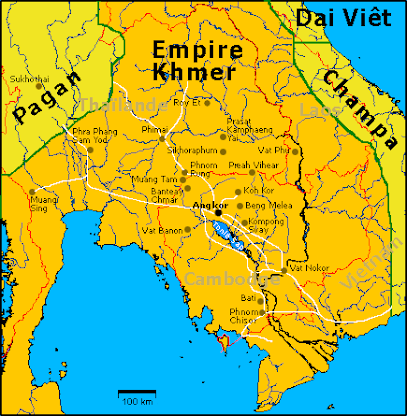
At the Angkor ruins we marvelled at their architectural complexity, elaborate carvings, and vastness. Some sources say that at its peak in the 12th century, Angkor, the former capital of the Khmer empire, was the largest city in the world, with an area of 1,000 square kilometres, and one million people. Two of the more well-known sites, Angkor Wat, and Phom Bakehng, are part of the tour group circuit, and can be crowded, especially at sunset; the perhaps even more impressive Ta Prohm site was almost empty.
During late April and early May, the weather in Cambodia was hot and steamy, with temperatures in the high 30s. We stayed cool by hiring a driver with a tuk-tuk, a carriage pulled by a motorbike ? less expensive and more fun than an air-conditioned car. Julianne opted for a cheaper "moto," a ride on back of a motorbike ? possible with a backpack, but we didn't try it with suitcases.
However, in Chau Doc, we did bring our luggage on a "cyclo," a pedal bike with a buggy in front.
A locally arranged two-day tour took us from Phnom Penh back to Vietnam through the Mekong Delta on many different modes of transportation. On the first leg, it was only the two of us in a private min-van ? possibly that of the travel agent's uncle. As the road narrowed and sightings of other tourists became scarce, we wondered what we had got ourselves into. The road became a dirt lane so narrow that an arch strung across it for a wedding had to be dismantled to let us pass. Eventually we reached the Vietnamese border crossing of Ving Xuong, where a sampan and boatman awaited us. The slow, peaceful trip down a tributary of the Mekong River evoked 1930s Vietnam.
Although the two-day tour was a budget one popular with backpackers, we modified it by paying extra to upgrade the hotels. As well, if we weren't thrilled with the looks of the restaurants that the tour guide led us to, we searched out our own.
Did we feel safe? Other than rickety boats and death-defying traffic, we had only one unsettling incident. In Ho Chi Minh City after paying a taxi fare in full, the driver swapped the fifty dong bill we'd given him for a ten from his own pocket, and then insisted that we hadn't paid him enough. When we hopped out of the taxi, he chased us menacingly, but backed off when a policeman approached. On a few occasions in Northern Vietnam we received hostile looks from older people but otherwise, young and old alike smiled, waved, or flashed the peace symbol.
Despite the mishaps, we never once wished that we'd opted for a group tour. Not only did we save money, but we had an exciting adventure with experiences we might otherwise have missed. The 17-day trip, including hotels, meals, entrance to tourist attractions and travel within Vietnam and Cambodia (but excluding airfare to and from) cost $1,500 dollars each. The $800 to $1,200 dollars saved by not taking a group tour was more than enough to finance the shopping sprees.
IF YOU GO:
WHERE TO EAT:
Hanoi: The Movenpick Hotel Hanoi serves an outstanding seafood buffet on Friday nights for $40 dollars per per-son, pricey by Vietnamese standards, but included all the French wine we could drink.
Hoi Ann: We had an excellent meal at "Streets", one of several restaurants in Vietnam that help street children learn the restaurant business.
WHERE TO STAY:
Hanoi: Movenpick Hotel Hanoi: an attractive 4-star, centrally located, $130 dollars per night
Hue: Thanh Noi Hotel: a decent 3-star, swimming pool, breakfast buffet, located across the street from the Imperial Palace, $36 dollars per night
Hoi Ann: Hoi Ann Glory: 4-star, convenient location, friendly service, break-fast buffet, $46 dollars per night
Siem Reap: Borei, Angkor Resort and Spa: 4 ½-star, excellent service, break-fast buffet, swimming pool, airport shuttle, $60 dollars per night
Ho Chi Minh City: Riverside Renaissance Hotel: rooftop pool with stunning city views, breakfast buffet, $120 dollars per night
BOOKS TO READ ON YOUR TRIP:
The Killing Fields by Christopher Hudson
First They Killed My Father by Luong Ong
The Girl in the Picture: The story of Kim Phuc, the photograph, and the Vietnam War by Denise Chong
Dogs at the Perimeter by Madeleine Thien
The Lover by Marguerite Duras
Read more!
VN big investor in Cambodia
Investment? it is sound very good Vietcong friend, we had never heard in history. But instead, we heard Yuons' encrouchment in Cambodia. How many millions of Yuons in Cambodia now?
HA NOI — Viet Nam led other ASEAN nations in investments in Cambodia last year, contributing US$631 million out of the total $880 million invested by nations in the bloc, the Council for Development of Cambodia (CDC) reported on Thursday.
Malaysia came second with $235 million and Singapore third with $14 million, according to the CDC.
Viet Nam had 17 projects in the neighbouring country last year, focusing on rubber plantations and mining, while Malaysia mainly invested in real estate investment, garment-making and rice milling.
According to the Viet Nam-Laos-Cambodia Economic Co-operation Development Association, Viet Nam has so far invested in more than 90 projects in Cambodia with a combined worth of over $2 billion. However, the association's vice chairman, Bui Tuong Lan, said the figure still fell below the potential for investments in Cambodia.
Cambodian encouraged overseas investment in agriculture, including cash crops like rubber and tea, as well as in banking, urban development, energy, and mining, all sectors in which Viet Nam had ample experience, said Lan, expressing hopes that Viet Nam's investment in the country could reach $6 billion by 2015.
Viet Nam also has an opportunity to boost trade with the neighbouring kingdom. According to the Vietnamese Trade Office in Cambodia, bilateral trade totalled about $2.8 billion last year, up 54.7 per cent over the previous year. Of the total, Viet Nam exported about $2.4 billion, a year-on-year increase of 55.6 per cent.
Viet Nam's exports included garments and textiles, cables, home appliances, food products and electrical parts, while its main imports were rubber, wood and wood products, and raw materials for the garment and tobacco industries.
Chan Nora, secretary for foreign affairs of the Cambodian Ministry of Commerce, said Vietnamese goods were popular in Cambodian market due to their good quality and reasonable prices. — VNS
Read more!
Public Row Erupts Between Tribunal Judges
“This situation raises serious concerns about the lack of impartiality of Mr. Prak Kimsan,” he wrote. “On these grounds, an application for his disqualification was submitted to the Pre-Trial Chamber calling upon Mr Prak Kimsan to step down voluntarily from any proceedings related to [cases 003 and 004].”
 |
| Judge Laurent Kasper-Ansermet was appointed as Reserve Co-Investigating Judge on 1 December 2010 |
More controversy has emerged at the Khmer Rouge tribunal, with an international Swiss judge calling for a Cambodian judge to step away from decisions regarding two controversial cases at the court.
Late Thursday, Swiss reserve judge, Laurent Kasper-Ansermet, who the Cambodian government has refused to officially approve, said in a statement that the head of the Pre Trial Chamber, judge Prak Kimsan, had failed in some of his main procedural duties regarding cases 003 and 004.
On Friday, Kasper-Ansermet’s counterpart, You Bunleng, issued his own statement, saying the Swiss judge’s statement was meant to “confuse public opinion.”
The two statements are an escalation of a series of public splits between Cambodian and international judges at the UN-backed court, which is currently trying three Khmer Rouge leaders.
The latest row comes after Kasper-Ansermet took on duties as the investigating judge in December and filed with the Pre-Trial Chamber to continue investigating two controversial cases before the court.
Cases 003 and 004 would require five more indictments of Khmer Rouge suspects and are strongly opposed by Prime Minister Hun Sen and other senior government officials.
Pre-trial judge Prak Kimsan rejected the filing on the grounds that Kasper-Ansermet’s appointment has not been approved by the Cambodian government’s judicial oversight body, the Supreme Council of Magistracy.
And that is where the major disagreement lies. The UN and Kasper-Ansermet say he does not need approval from the council to conduct duties as international investigating judge. Cambodian officials disagree.
Kasper-Ansermet said in his official statement Thursday that under UN agreements he was “under the legal obligation to investigate” both cases, which were handed up from the international prosecutor in 2008.
Kasper-Ansermet also said he “enjoys full legal authority to undertake his functions regardless of the Supreme Council of Magistracy’s rejection of his appointment as standing co-investigating judge.”
Kasper-Ansermet said Prak Kimsan failed to move his requests forward.
“This situation raises serious concerns about the lack of impartiality of Mr. Prak Kimsan,” he wrote. “On these grounds, an application for his disqualification was submitted to the Pre-Trial Chamber calling upon Mr Prak Kimsan to step down voluntarily from any proceedings related to [cases 003 and 004].”
Prak Kimsan has not responded to the charges.
However, in a statement Friday, Cambodian investigating judge You Bunleng said Kasper-Ansermet’s references to UN-Cambodian agreements were “an exaggeration.”
Reserve judges must be “legally accredited,” he wrote, without specifying whether this meant by Cambodian or international norms.
“Mr. Laurent Kasper Ansermet’s actions reflect his lack of knowledge of and respect for the Internal Rules and the legal principles governing procedures applied so far at the ECCC, and hence leads the National Co-Investigating Judge to doubt the real motives for his obstinacy and disrespect of the Law and the Internal Rules of the ECCC,” You Bunleng wrote.
The ongoing disagreements within the court have fueled widespread concerns the tribunal will only complete two cases, at a cost of nearly $200 million.
Tribunal spokesman Neth Pheaktra attributed the disagreement to an “interpretation of the law.”
However, Clair Duffy, a tribunal monitor for the Open Society Justice Initiative, called for an end “to this political fighting,” and urged the government and You Bunleng should allow Kasper-Ansermet “to do his job.” Read more!
Thursday, February 09, 2012
Judge to Probe Khmer Rouge Case Despite Cambodian Resistance
An international judge attached to Cambodia's Khmer Rouge war crimes tribunal says he has begun investigating a new case of suspected atrocities, without the support of his Cambodian co-investigating judge.
Swiss Judge Laurent Kasper-Ansermet, in a statement Thursday from Phnom Penh, said he does not need the approval of Cambodian colleague You Bunleng to move forward with the new probe. Details of the new case have not been released.
Kasper-Ansermet has the backing of the United Nations in the escalating dispute with the Cambodian government, which has sought to block the jurist from assuming his post and to limit the scope of tribunal investigations.
Kasper-Ansermet was named by the world body to fill the vacancy created when German judge Siegfried Blunk quit the tribunal last year to protest alleged Cambodian interference in judicial matters.
The tribunal has so far convicted former Khmer Rouge prison chief Kaing Guek Eav, better known as Duch. It is currently trying the three most senior surviving members of the regime, who face genocide and other charges in the deaths of up to 2 million people during the regime's 1975-1979 reign.
The Cambodian government includes many former Khmer Rouge members, including Prime Minister Hun Sen. It has voiced strong opposition to pursuing more cases, saying any further prosecutions could divide Cambodian society and spark a civil war. The government also argues that the tribunal's mandate is limited to cases against top Khmer Rouge leaders and those most responsible for atrocities.
For their part, both prosecutors and defense lawyers have for months complained of government interference in judicial matters and accused Cambodian members of the tribunal of failing to pursue other cases against key war crimes suspects.
In October, defense lawyers for defendant Nuon Chea, the number two Khmer Rouge leader, accused the prime minister and several other officials of interfering with their client's right to a fair trial. The lawyers said the interference included unlawfully blocking witnesses from testifying as well as government pressure aimed at preventing new investigations.
The government has denied the accusations.
Read more!
Viewpoint: Cambodia's garment sector faces continued challenges
With much of the success of Cambodia's garment industry based on its well-publicised commitment to basic labour standards, it's perhaps not surprising that the sector finds itself under a spotlight when it comes to wider worker welfare issues.
Indeed, several events that have taken place in recent weeks highlight some of the challenges faced by the local industry.
The most recent has been a two-day "people's tribunal", which took place this week in Phnom Penh to investigate pay and conditions at factories making clothes for brands including Adidas, Puma, H&M and Gap.
Spurred by a spate of mass faintings in at least 11 garment factories over the past year - which have been linked to low salaries and the knock-on impact on workers' nutrition, as well as poor ventilation and excessive working hours - the hearing called on international brands and retailers to take "immediate steps" to commit to a living wage for factory workers.
The minimum wage for Cambodia's garment workers rose by $5 to $66 a month in January, but remains among the lowest in Asia. Massive inflation has also meant Cambodian garment workers have seen a real wage loss of over 14% during the last 12 years.
Harrowing testimonies included one from a 27-year-old worker, a mother of a two-year-old son, working at a factory producing for Adidas. "As my income is not able to cover all my family's basic needs, I took a loan from the landlord," she explained.
"I owe him $50 in addition to $10 interest every month. Usually I can only pay the $10 interest and not start paying back the loan. If I get sick I don't have any money for treatment. I don't know what I will do if it happens. I also worry that I don't have money to support my son in going to school."
Delicate balancing act
Comments like this reflect the delicate balancing act facing international brands and retailers for whom Cambodia appeals as an ethically sound production base thanks to a monitoring programme overseen by the International Labour Organisation (ILO) - combined with the added advantage of low costs.
The industry is growing fast, with data from the Ministry of Commerce showing garment exports from Cambodia rose to US$3.47bn during the first ten months of 2011, an increase of 34% compared with the same period the year before.
And a new report from the ILO's Better Factories Cambodia initiative shows employment in exporting garment factories has reached its highest level since 2008.
There are now 345,364 workers in the 300 active factories registered with the project - a rise of 9% in the number of factories, and a 7% increase in the size of the workforce, in the six months to 31 October 2011. Fewer than 91% of the workers are women.
But while the "27th Synthesis Report on Working Conditions in Cambodia's Garment Sector" notes the industry "has demonstrated consistent compliance on indicators such as payment of the proper minimum wage and overtime wages and provision of annual leave," there is no room for complacency.
In particular it points out that "improvements can be made in other areas that contribute to the health and welfare of workers" - including triggers that may have contributed to the mass faintings, which have so far seen more than 1500 workers collapse during working hours.
Possible causes, the report notes, include poor nutrition and hygiene, the lack of a morning meal, heat stress, poor ventilation, excessive working hours, poor industrial relations and "mass psychogenic behaviour" in which one worker falls unconscious and others who witness this collapse as well.
And alarmingly, the latest research demonstrates that compliance levels are lower than 50% on several areas that are relevant to the fainting incidents, such as exceptional overtime (5%), overtime limited to two hours per day (16%), soap and water available near the toilets (48%), and acceptable heat levels (38%).
In other findings, BFC monitors found 66% of factories have at least one union, down 10% from the previous report. While no evidence of forced labour was found, seven workers were confirmed to be below the legal working age of 15. And just 5% of the factories monitored complied with legal requirements on "exceptional overtime," while 16% complied with the two-hour overtime limit.
The percentage of factories paying the $7 attendance bonus when workers take annual leave also dropped to 62%.
As well as offering a degree of industry-wide transparency not seen elsewhere, the number of incidents continue to raise questions about working conditions at Cambodian garment factories.
Speaking at a roundtable discussion on the report last week, Jill Tucker, chief technical advisor of ILO Better Factories Cambodia, said that while BFC has no enforcement power, it is still working to drive change.
"BFC needs strong and continued cooperation from all constituents in implementing its programme, especially when BFC expands its working scope in sub-contracting factories and into the footwear industry in 2012.
"In addition, BFC has worked with buyers and international brands to ensure enforcement when factories fail to comply with the law. Shifting orders is one of the means; however, this is not necessarily the preferred solution."
Read more!
Global gambling revenue up 5.6%, led by Asia growth
Global gambling revenue climbed to a record $419 billion last year, led by growth in Asia, according to Global Betting & Gaming Consultants.
Revenue rose 5.6% from $397 billion in 2010 and is forecast to reach $448 billion this year, according to Lorian Pilling, a director at Isle of Man, U.K.-based GBGC. The strongest growth was in Macau, Singapore and Cambodia, as emerging markets proved more resilient to the global economic crisis than developed countries, he said.
"It's closely linked to the wider economic situation," Pilling said by phone today. "In 2009, at the height of the crisis, gambling was hit like any other sector."
GBGC expects commercial casinos to overtake lotteries as the main source of gambling revenue this year, bolstered by openings in the Philippines in the first half of 2012. Lotteries brought in more than 28% of revenue in 2011, followed by casinos in jurisdictions such as Macau, Singapore and Cambodia, excluding U.S. tribal gaming, at just under 28%.
"Lotteries tend to do quite well in recessions, but we need a resolution in the crisis in Europe because uncertainty is hitting the market," Pilling said.
Doubts about how to resolve the European debt crisis have undermined a recovery. Greece faces a 14.5 billion-euro ($19.3 billion) bond payment on March 20 and is struggling to secure financing to avert a collapse of the economy that could spark a new round of contagion in the euro area.
Developments in China will determine how much gaming grows in Macau, Pilling said. "If China's economy does have a crash landing, it is difficult to see Macau's gaming growth rates being maintained," he said.
Gross domestic product in China expanded at an annual pace of 8.9% in the last three months of 2011 -- the least in 10 quarters and down from 9.1% in the third quarter. Growth may slow to 7.5% this quarter, Nomura Holdings Inc. estimates.
Revenue from gaming machines outside casinos in North America fell about 14% last year, while sales from lotteries rose 2%, Pilling said. Gambling revenue increased about 5.5% in Europe after shrinking almost 6% in 2010, he said.
"A strong recovery in the U.S. would help gaming revenues that have been hit hard in recent years," Pilling said. "North America will continue to recover. We're fairly cautious on Europe; growth is seen at 3.5% across all gambling categories because of the uncertainty in the euro zone."
Global gambling revenue will reach $500 billion by 2014 as several casinos in Asia are due to open in the coming years and Singapore's integrated resorts are still only in their second full year of operations, Pilling said.
Read more!
Nuon Chea Denies Role in Security Apparatus, Killings
“I was the president of the National Assembly,” he said. “How could I work for the military?”

Jailed Khmer Rouge leader Nuon Chea was given the right to order killings under the regime’s policies, a tribunal prosecutor told the court Thursday.
Dale Lysak, international deputy prosecutor for the UN-backed court, said documentation of the regime showed that the security committee, which included Nuon Chea and Pol Pot, decided on “all the killings.”
Nuon Chea, as he has done continuously during his atrocity crimes trial, denied the charges.
None of the three leaders currently on trial—Nuon Chea, Khieu Samphan or Ieng Sary—have taken responsibility for the 1.7 million or more deaths that took place under their leadership, despite a large body of evidence, research and scholarship.
“I was the president of the National Assembly,” he said. “How could I work for the military?”
Nuon Chea has so far been the only one of the three men willing to openly face the court, but he has spent much of his testimony issuing similar denials.
Citing international media reports, Lysak showed that Nuon Chea acted as leader of the Khmer Rouge at a time when Pol Pot was receiving medical treatment in China.
Nuon Chea said he wanted to see original documentation and hear recordings of his own voice before giving the accusations credence. Read more!
Wednesday, February 08, 2012
Asia’s Newest Stock Market Is Risk to Investors, Sam Rainsy Says
By David Whitehouse
Feb. 8 (Bloomberg) -- Investors in Cambodia, tied with Yemen as the world’s 164th-cleanest country for doing business, face risks in a planned stock market because of ineffective financial and legal systems, the country’s exiled opposition leader said.
“Among the little dragons of Southeast Asia, Cambodia is the least encouraging,” Sam Rainsy, 62, a former fund manager with Banque Paribas and ex-Cambodian finance minister, said in an interview in Paris. “The country needs a much longer period of preparation in terms of company accounts and corporate governance. Investors risk paying for nothing.”
Cambodia’s stock exchange may open as early as April, listing a state-run port, telecommunications operator, and manager of the capital’s water system, according to partner Korea Exchange Inc. Developing a capital market may lessen reliance on aid, equivalent to a tenth of the nation’s $11 billion economy, and the government says it has delayed starting the bourse until conditions are right.
“Frontier markets need not be perfect democracies to be lucrative investments,” said Douglas Clayton, chief executive officer of Leopard Capital, whose $34 million Leopard Cambodia Fund invests in closely held companies. “China and Vietnam are one-party states but at certain times those countries have been very good places to invest.”
Lack of support from the financial-services industry for agriculture is a constraint on Cambodia’s economic expansion, according to the Asian Development Bank. The country’s economy may grow 6.5 percent this year, according to the ADB. That’s less than an average of 8 percent from 2001 to 2010, and compares with an ADB prediction of 8.8 percent expansion for China and 6.3 percent for Vietnam.
Facing Arrest
Sam Rainsy, whose party controls 26 out of 123 national assembly seats, faces arrest if he returns to contest elections in 2013 following a 10-year conviction in absentia for removing border posts along the frontier with Vietnam, charges he says were politically motivated. Cambodia needs to tackle corruption and bolster democratic institutions to propel growth, he said.
Cambodia is ranked by Transparency International as 164th in the world by perception of corruption, behind only North Korea, Myanmar and Afghanistan in the Asia-Pacific zone, with more than 5 percent of its health budget swallowed up by graft before it leaves government coffers.
“The country is a banana republic where corruption is an ingrained part of government,” Sam Rainsy said, flanked by Buddhist miniature statues in his family’s apartment near Montparnasse in Paris. “Investors taking part in the new Cambodian stock market will be taking large, unconsidered risks because the conditions do not yet exist to create a securities market worthy of the name.”
Not Involved
The government is not involved with the charges against Sam Rainsy, and other members of his party are operating as normal, spokesman Phay Siphan said by phone from Phnom Penh, the capital. Sam Rainsy must respect the rule of law and fight his case in court, he said.
“It’s the first time Cambodia is involved with a stock market, which is why we delay and delay and delay,” Phay Siphan said. “We are not perfect, but the government and private sector are trying our best to facilitate and make everything clean, transparent and fair for everyone.”
Elections in 2008 fell short of international standards, according to European Union observers. Though fairer than earlier polls, they were marred by the use of state resources and the distribution of money by the Cambodian People’s Party, according to the EU. Prime Minister Hun Sen, 59, a former Khmer Rouge member, has held power since 1985.
Raise Taxes
Sam Rainsy, who leads a political party named after him, said he’d raise taxes and increase salaries for public servants in a bid to reduce corruption if he came to power.
His political career echoes that of his father, Sam Sary, who was a member of the Cambodian delegation that negotiated independence from France in 1954. The family was exiled to France in 1965 after Sam Sary founded a political party in defiance of the French-appointed head of state, Norodom Sihanouk.
Sam Rainsy returned as finance minister in 1993 following the nation’s first democratic elections. He lost the position in 1994 and set up his own party the following year.
“I would have done it in any case,” he said, when asked if the Sam Rainsy Party represented a continuation of his father’s political efforts.
First Listings
State-run Phnom Penh Water Supply Authority, Telecom Cambodia and Sihanoukville Autonomous Port will be the first three companies to list on the stock exchange, Shin Gil Soo, senior vice president of Korea Exchange’s emerging markets business team, said in an interview in Seoul. Several private sector companies are considering selling shares, he said, declining to name the companies.
In 2011, Korea Exchange also started a stock market in neighboring Laos. The two-stock Composite Index soared 86 percent in the first three weeks of operation a year ago. It now trades 51 percent below its Feb 2, 2011, peak.
“It’s a question of whether the stock-exchange operators can isolate themselves from an environment that is perceived to be pretty corrupt,” said Lao Mong Hay, a political analyst and retired researcher at the Asian Human Rights Commission. “Once started, I think it will run smoothly. The government cannot afford to have such a bad perception of a newly created stock exchange.”
--With assistance from Daniel Ten Kate in Bangkok, Caroline Connan in London and Saeromi Shin in Seoul. Editors: Stephen Foxwell, Jerrold Colten
To contact the reporters on this story: David Whitehouse in Paris at dwhitehouse1@bloomberg.net; Daniel Ten Kate in Bangkok at dtenkate@bloomberg.net
To contact the editors responsible for this story: Stephen Foxwell at sfoxwell@bloomberg.net; Jerrold Colten at jcolten@bloomberg.net
Read more!
Cambodia: Huge increase in cassava exports in 2011
The Ministry of Commerce in Cambodia have released figures which show an incredible growth rate of 111% in 2011 for cassava exports.
Cambodia exported 277,291 tonnes of fresh and dry cassava worth US$12.44 million in 2011, up from 131,312 tonnes worth about $4 million the year before.
Next year's exports could face challenges however, as buyers are expected to delay purchases. Some farmers have also reported a ban on Cambodian cassava in Thailand.
Cassavas exports grew because farmers increased production on increased international demand and rising prices, Ministry of Commerce secretary of state Chan Nora said.
“Farmers saw the increase in cassava price and that made them grow more.”
But the price has since fallen after farmers in Cambodia’s western provinces flooded the market with the crop, Chan Nora said.
Delayed orders in Thailand have caused difficulty for many Cambodian farmers who abandoned other crops, such as corn, to harvest cassava, he said.
Sam Yin, president of Malai Trading Company in Banteay Meanchey province, said Thai border authorities banned cassava exports from Cambodia on January 24. Farmers have been left with excessive unharvested cassava, he said.
“Now farmers are very worried because the cassava market is not stable and 50 per cent of the cassava in Banteay Meanchey has yet to be collected,” Sam Yin said, noting the surge in cassava farming in 2011.
Prices have dropped substantially since farmers turned to cassava as a cash crop, he said. But exports to Thailand could resume as soon as next month when the Thai supply of cassava runs out.
Read more!
Tuesday, February 07, 2012
PTTEP eyeing Burma, Cambodia
PTT Exploration and Production (PTTEP) sees opportunities for growth in Burma and Cambodia, said Anon Sirisaengtaksin, the firm's president and chief executive officer.
He said this yesterday at the International Petroleum Technology Conference (IPTC), hosted this year by Thailand. The seminar, which began yesterday, is a forum for businesses to exchange knowledge on the development of petroleum exploration and production technology. Given the decline in petroleum sources worldwide, new technology is needed to explore potential new sources.
Burma has high potential for petroleum production, Anon said. PTTEP has long invested in petroleum exploration and production in the country, and will soon be granted concessions to explore two more fields there.
PTTEP is investing US$2 billion (Bt62 billion) from 2011 to 2013 to build an oil rig and to produce petroleum in Burma's M9 field, and to install a 300-kilometre-long natural-gas pipeline to link the site with its existing pipelines in Kanchana-buri. Starting next year, this will enable it to deliver 240 million cubic feet per day of natural gas to Thailand and another 60 million cubic feet per day to Burma.
The company is also waiting for the government to complete negotiations with Cambodia on the countries' overlapping maritime claims. Anon said PTTEP would spend Bt600 billion to expand petroleum exploration and production business in Asean, Australia, Africa and North America.
Pailin Chuchottaworn, president and chief executive officer of PTT, said of PTT Group's overseas investments between 2012 and 2016, 50 per cent would be conducted by PTTEP, with priority given to upstream businesses.
PTT Group has investments in all Asean countries and East Timor.
Cambodian Deputy Prime Minister Sok An is attending the IPTC seminar and will visit PTT's gas-separation plant in Map Ta Phut, Rayong.
Pailin added that if the two countries could solve their overlapping maritime claims, it would bring tremendous benefits to both countries, and give Thailand access to a new petroleum source.
Read more!
People & Places: Buckhunger fundraiser to benefit needy in Cambodia
By DANNA SUE WALKER World Staff Writer
From Tulsa to Cambodia with love might be the motto for a fundraiser that Garden Deva will host from 3 to 8 p.m. Saturday at its shop at 317 S. Trenton.

People & Places: Buckhunger fundraiser to benefit needy in Cambodia
Former Tulsa restaurateur John Phillips, who has lived in Cambodia for more than three years, opened the door to Buckhunger in December 2011 and provides free, hot and nutritious meals each day to more than 200 street children in Phnom Penh, Cambodia.
Garden Deva's outdoor artwork will be draped with Cambodian flags to promote the work of Buckhunger.
"It saddened me beyond belief to see these kids sifting through garbage for something to eat," Phillips said from Buckhunger's storefront location. "We began by providing complete food service training - including a small monthly salary - to 22 unemployed and unskilled youths who now do all the food preparation, cooking, serving and cleaning."
Phillips has financed all of Buckhunger's activities to date, but with little success in generating a steady flow of contributions, the soup kitchen's future is in peril.
"We cannot allow that to happen," said Garden Deva's Lisa Regan. "When I learned about what Johnny created, I was moved to do whatever I can to help him continue his work."
The afternoon's activities will feature food and wine provided by the Garden Deva and local chefs - Aaron Snoddy of the Chalkboard, Sam Bracken of the Canebrake Resort and Tim Inman of Stonehorse in Utica Square - and music provided by local musicians Susan Herndon, Dianna Burrup, Marilyn McCulloch and Jay Lesikar.
Herndon, Burrup and McCullouch sing and write their own material, and Lesikar is an up-and-coming pianist on the Tulsa music scene.
The event will also feature auction items, including gorgeous hand-woven silk scarves flown to Tulsa from one of Phnom Penh's local markets expressly for this event.
Event organizers will be showing photographs of Buckhunger, as well as street scenes and historical images of Cambodia, a tiny country of 14 million people bordering Vietnam, Thailand and Laos.
"Cambodia is still struggling to overcome the devastating effects of the Pol Pot genocide of 40 years ago," Phillips said. "It's a country where 80 percent of the population are farmers living on less than $2 a day."
Poverty is widespread throughout Cambodia, and thousands of children are left to fend for themselves. At Buckhunger, diners are first led to a hand-washing station to promote good hygiene and then are seated at one of the facility's stainless-steel tables, where the staff of 22 provides each with a hot meal and a glass of chilled jasmine tea. For many, it is their only meal of the day.
All proceeds from the sale of items during the fundraiser will go directly to Buckhunger, and all donations are 100 percent tax deductible. In addition, Garden Deva has generously offered to donate 10 percent of sales from the afternoon to Buckhunger.
"It costs about $25 to feed two children for one month," Phillips said, "but we desperately need a steady stream of donations to continue our work."
Buckhunger's objective is twofold: to feed Cambodia's hungry children and elderly while providing training in food service for unemployed Cambodian youth.
Buckhunger's certified food-service training program for unemployed, unskilled Cambodians teaches them food handling, preparation, sanitation and commercial food practices. All students receive daily English lessons from a certified English teacher, a uniform and study materials. Many also receive full room and board.
The private, nonprofit organization exists entirely on donations. For more information, visit tulsaworld.com/buckhunger Read more!
Cambodia's inquisitive children are an inspiration
The Khmer Rouge killed the teachers first. Now the country wants to be educated again, says Robert Leveson

'Dignified and optimistic': children at The House of Peace in Santepheap, Cambodia Photo: Robert Leveson
"I don’t fear ghosts. I fear bad people.” No, this was not the film set of The Sixth Sense and I am not Bruce Willis, although we do share similar follicular features. This was Siem Reap, Cambodia, in the days before Christmas, when expectation had yet to give way to indulgence. And this was no place for indulgence, either. It was and still is a home to children – The House of Peace, Santepheap.
I first became aware of it while working in Singapore, a nation that has conquered many of Asia’s demons with discipline, order and a series of well-placed mops. A colleague who was passionately involved in “a project” made it known to me, yet in truth, I had barely registered much before bidding farewell to the Merlion, Singapore’s mascot, with one of those handy packs of tissues and heading back to Britain. But slowly, almost imperceptibly, it echoed through my mind until I found myself wedged into a low-budget aeroplane seat on my way to volunteer.
For most, this part of Cambodia is synonymous with Angkor – the ancient temple complex created in the glory days of the Khmer empire. It bestrode a beefy part of South East Asia briefly, ascending for a couple of centuries before peaking in the 12th. When the French unearthed Angkor’s ruined monuments in the early 1800s, its future as a tourist hot-spot of genuine magnificence was assured.
In more recent times, construction on a more modest and unremarkable scale has gathered pace along the road to its weathered Southern Gate. And just before the crowded ticket booth, there is a sharp right turn on to a dusty red road, which bounces you all the way to a place that, I must confess, I found equally moving.
I am a teacher by profession, and it was a service I was asked to provide for a group of about 30 secondary-school children over two weeks in December. They live in large huts, one each for the boys and girls. Below the girls’ accommodation, there is a long table where meals are shared and thanks are given for their basic, healthy food. On either side of the sleeping quarters, there is space to play and wash. In the front section, near the entrance gate, there stands a fruit tree.
Beyond the boys’ hut, a volleyball net hangs over a desolate space where many improvised ball games are played. It is on the veranda that the lessons take place, with the children (and teacher) dragging out their tables to sit and be educated. And that’s it. This is life.
Since there aren’t enough schools for children to attend in Cambodia, they are taught in half-day shifts. That sad fact was caused by the genocidal rule of the Khmer Rouge in the 1970s. The haunting spectre of the past clings to the basic organs of society here, squeezing them mercilessly as it dances across the land.
Not only are the children of Santepheap orphaned, abandoned or impoverished – “childhood” for many is a time to hunt for bottles, wander barely clothed and wide-eyed, or sell postcards and trinkets to tourists who remind them they should really be at school – but also the ghosts of the past linger greedily in their shadows, stealing what should be a precious time of growth.
Though the nation was mercilessly victimised, the people I met – especially the kids – were remarkably dignified and optimistic. They put my tendency to find fault and impediment in endeavours to shame. Take my irrepressible tuk-tuk driver. He, like many others, would often sit for hours waiting for me to stumble through a museum or temple with my trademark Clouseau-esque articulation and agility. Did he complain or succumb to the frustrations of boredom? Perhaps, but while in my company, he chose instead to smile and tell me about his work with deaf and blind children. He once showed me an encased pile of skulls beside an elaborate graveyard and proceeded to explain how he was “the only one of me left”, referring to the demise of his family 30 years ago. They killed the teachers first, he said. And as if to reverse the trend, everyone I met seemed to want to educate or be educated.
A co-worker of mine, with whose words I opened this feature, once told me passionately that her “dream” was to be a teacher. How far I felt from the UK at that moment. Always questioning and investigating, she endeavoured to teach me some local lingo and praised my pitiful pronunciation. The owner of my guest house would often lead me to the library and select useful books on history and exploring the treasures of Angkor. People in the park would stop and practise their English on me, informing me in the process about orphanages and poverty in a non-invasive fashion. Taken to extremes, I was once shown how to pour water and even the celebrated skill of peeling a banana. Gladly, I gathered that I had been doing both correctly for years. Much of this I have experienced in south-east Asia before, but never with such resonance.
But it was the children who impressed me the most. Nothing was too much trouble – even when they were clearly tired or perplexed by one of my rather naff comedy routines. Their expertly choreographed dance show (which they perform every Sunday) was genuinely entertaining. Their approach to learning was inquisitive and industrious.
In their spare time, one fixed his bike, another adjusted his belt with my hole-punch. Not in 14 years of teaching have I ever received a more genuine “thank you” than when I gave one of my students my Changi Airport souvenir pen, since hers was constantly running out – she spent the whole day trying to give it back.
I was also reminded of the insidious culture of “health and safety” back home when my inquiries as to the wisdom of allowing a boy to climb a tree and whack fruit with a stick above our heads were met with a succinct reply: “You want to go up, too?”
A donation to Santepheap is always welcomed but if you have some spare time, a visit as a volunteer is of guaranteed benefit to all concerned.
See www.santepheap.org Read more!
Monday, February 06, 2012
The other 'Killing Fields' trial continues
PHNOM PENH, Cambodia, Feb. 6 (UPI) -- Defense lawyers continued to attack the Document Center of Cambodia, claiming its archival material presented to the U.N.-sanctioned genocide tribunal is biased.
Four former senior Khmer Rouge leaders remain on trial for their part in the brief but brutal Khmer Rouge government of 1970s.
The Document Center was started in 1995 as a field office for Yale University's Cambodian Genocide Program with U.S. State Department funding. In 1997 it became an independent non-government organization with funding from several countries, including the United States, Australia, Japan and Canada.
The trial of the four Khmer Rouge leaders continues after the tribunal, the Supreme Court Chamber of the Extraordinary Chambers in the Courts of Cambodia, turned down the appeal of another Khmer Rouge member, Duch.
Also known as Kaing Guek Eav, Duch is a former math teacher and Christian convert who ran the feared Tuol Sleng prison, also known as S-21, in Phnom Penh under the Khmer Rouge government.
Duch became the first high-ranking official to be sentenced by the Chamber in Cambodia's highly political genocide trials. In 2010 he was sentence to 35 years in prison, less five years for time already spent in custody, and appealed the sentence last March.
On top of turning down Duch's appeal, the Chamber increased the 69-year-old's sentence to life in prison.
The Chamber said on its Web Site that is had considered the high number of deaths for which Duch is responsible -- a minimum 12,272 lives -- along with the extended period over which the crimes were committed -- more than three years.
These facts "undoubtedly place this case among the gravest before international criminal tribunals," the Chamber said.
The fact that Duch wasn't "on the top of the command chain in the regime" doesn't mean he should get a lighter sentence.
"There is no rule that dictates reserving the highest penalty for perpetrators at the top of the chain of command," the Chamber said.
Duch's increased sentence last week was met with cheers as well as relief by victims and their families -- fearful it might have been reduced.
However, many more Cambodians await the outcome of the ongoing trial four former Khmer Rouge cadres who were "top of the chain of command."
Ieng Sary, 86, was the regime's minister of foreign affairs and Nuon Chea, 85, was the Khmer Rouge's main ideologist.
Chea was "Brother Number Two" to "Brother Number One," Pol Pot, who died in 1998. Pot fled the country after an invading Vietnamese army toppled the regime in 1979.
Khieu Samphan, 80, was the president.
Ieng Thirith, 79, wife of Ieng Sary and Khmer Rouge social affairs minister, has been absent from proceedings because of suspected advanced Alzheimer's disease.
Their lawyers have focused on the work of the Document Center.
Jasper Pauw, a lawyer representing Chea, questioned the veracity of material collated under the Document Center's Accountability Project and handed to the prosecution, The Phnom Penh Post newspaper said.
He also asked why it was necessary for the center to, in its own words, "illuminate chains of command" during the time of Democratic Kampuchea, as the Khmer Rouge called Cambodia.
"Because we want to know who actually killed two million Cambodians," center Director Youk Chhang said. "We want to know what happened in our history."
Pauw asked if, through the Accountability Project, the center was trying to implicate senior Khmer Rouge leaders in "alleged atrocities."
Chhang said the Accountability Project's purpose was to "gather historical information for the court in order to find the culprits who committed crimes during that period," the Post reported.
Arthur Vercken, defense lawyer for Samphan, asked Chhang about the potential fabrication of documents, including one deemed by the center to have be a fake, the Post report said.
Chhang said it would be "virtually impossible" to fabricate 1 million documents.
Topics: Khieu Samphan
Read more!
China, Cambodia vow to further promote strategic partnership

Jia Qinglin (R), chairman of the National Committee of the Chinese People's Political Consultative Conference, meets with Hor Nam hong, Cambodian deputy prime minister and minister of foreign affairs and international cooperation, in Beijing, capital of China, Feb. 6, 2012. (Xinhua/Li Tao)
BEIJING, Feb. 6 (Xinhua) -- China and Cambodia on Monday vowed to further promote their ties in a meeting between top political advisor Jia Qinglin and Cambodian Deputy Prime Minister and Foreign Minister Hor Nam hong.
"China attaches high importance to its comprehensive strategic partnership of cooperation with Cambodia, and will continue to deepen bilateral substantial cooperation so as to benefit both sides," said Jia, chairman of the National Committee of the Chinese People's Political Consultative Conference (CPPCC).
He spoke highly of the development of bilateral relations, citing frequent high-level visits, strengthened mutual political trust and fruitful substantial cooperation as some of the achievements made in the area.
Jia said China appreciates Cambodia's firm adherence to the one-China policy and steady support for China on issues involving Tibet, Xinjiang and other major issues.
"Cambodia is a good friend indeed, a friend that China trusts and relies on," Jia said.
Hor Nam hong also praised the development of Cambodia-China relations in recent years. He thanked China for its assistance in Cambodia's social and economic development.
Hor Nam hong vowed to work with China to strengthen friendly exchanges and deepen bilateral cooperation so as to bring their comprehensive strategic partnership to a new high.
Jia also spoke positively of the strategic partnership between China and the Association of Southeast Asian Nations (ASEAN), as well as the important role ASEAN has played in promoting east Asian cooperation.
Jia said China is ready to join hands with all ASEAN countries, including Cambodia, to continue to contribute to the region's peace, stability and prosperity.
Hor Nam hong said Cambodia will help promote ASEAN-China ties and east Asian cooperation.
Earlier Monday, Foreign Minister Yang Jiechi held talks with Hor Nam hong, during which the two sides agreed to enhance coordination to promote China-ASEAN ties and cooperation in East Asia.
Later Monday afternoon, Hor Nam hong also met with senior legislator Lu Yongxiang, vice-chairman of the Standing Committee of the National People's Congress (NPC), China's top legislative body.
Hor Nam hong was invited by Yang to visit China from Feb. 5 to 7. Read more!
Friday, February 03, 2012
Cambodia: Stop the use of excessive force against peaceful land activists
(NewDesignWorld Press Center) - Cambodian authorities must stop the use of excessive force against peaceful land and housing activists, Amnesty International said today, after police violently dispersed a group of around 150 women protesting forced evictions in the capital Phnom Penh.
Police yesterday beat and arrested several of the women, who were peacefully protesting against last month’s forced eviction of the Borei Keila community and the situation at the capital’s Boeung Kak Lake.
“Communities all over Cambodia are peacefully resisting forced evictions and taking action to claim their rights,” said Donna Guest, Deputy Director of Amnesty International’s Asia-Pacific Programme.
“The Cambodian authorities must stop the use of excessive force against these communities, and bring to justice those responsible for such violence.”
Yesterday’s episode follows more serious incidents elsewhere in the country, where land activists were reportedly shot and injured in Kratie province in eastern Cambodian by military personnel working for a private company, and in Battambang province in the west by military police.
Several of the women protesting in Phnom Penh yesterday were half naked, as they removed their clothing in an apparent show of desperation. Police reportedly grabbed and beat the protesters, including elderly women, to the ground, before six women were thrown into a police van and detained overnight at Phnom Penh police station.
The six women included Borei Keila residents Seng Kunthea, Seng Rany, Tom Sakmony, Nen Sarith and Ath Samnang, as well as Srang Srey Tuch, a former resident of Boeung Kak Lake.
At least two of them were injured during the arrest but reportedly received no medical care, while none of them were given full access to lawyers.
Four of the detained Borei Keila women had previously been held at Prey Speu Social Affairs Center, after a peaceful protest last month against the Borei Keila forced eviction.
All six were released today without charge after being detained overnight. Phnom Penh authorities agreed to discuss the disputes with representatives from the two communities.
Women from Borei Keila are seeking compensation for damaged property and calling on the authorities to address their housing needs after more than 300 families were evicted from a development site on 3 January. The developer, Phan Imex, has failed to build the on-site housing it previously promised them.
Seven people arrested during the Borei Keila eviction remain in detention.
Residents from Boeung Kak Lake are calling for the authorities to follow through on the Prime Minister’s promise, made in August 2011, to grant land titles to remaining residents and allow construction of on-site housing around the lake.
They are also demanding that the authorities take measures to alleviate flooding caused by the company filling in the lake. Former residents are calling for additional compensation for being forced to leave their homes and relocating elsewhere.
Earlier this week, Cambodian Prime Minister Hun Sen warned against the use of violence in land disputes.
“The Cambodian government is saying one thing and authorities at the local level are doing another. Yesterday’s use of excessive force by police in Phnom Penh contradicts the Prime Minister’s call for peaceful resolutions to land disputes,” said Donna Guest.
“Instead of trying to silence these communities through intimidation and violence, the Phnom Penh authorities should listen to them. These communities have a right to a prompt solution that meets Cambodia’s international legal obligations to provide adequate housing,” said Donna Guest.
Region Asia And The Pacific
Country Cambodia
Read more!
Cambodia: Khmer Rouge judgment welcome, but raises human rights concerns
The UN-backed Khmer Rouge tribunal’s final judgment against a former prison chief in Cambodia today is an important step towards accountability but raises human rights concerns, Amnesty International said.
The tribunal’s Supreme Court Chamber upheld an earlier conviction of Khmer Rouge jailer Kaing Guek Eav, alias Duch, for crimes against humanity and war crimes described as “amongst the worst in human history”, and increased his sentence from 35 years to life in prison.
Duch was held responsible for killing at least 12,272 men, women, and children from 1975 to 1979 while he was in charge of “S21”, a secret prison run by the Khmer Rouge in a former school in Phnom Penh.
The judgment included additional convictions against Duch, but also raised human rights concerns by overturning a legal remedy he was granted after a Cambodian military court illegally detained him, without investigation or trial, from May 1999 until July 2007.
“The closure of this first case represents an important step towards achieving accountability for the mass crimes of the Khmer Rouge, and helping the Cambodian people draw a line under this tragic chapter of their country’s history,” said Rupert Abbott, Amnesty International’s researcher on Cambodia, who attended today’s judgment.
“But the decision to overturn the legal remedy for Duch’s unlawful detention and to provide no alternative may be perceived as a case of public opinion trumping human rights.”
Amnesty International considers that the July 2010 decision of the tribunal’s Trial Chamber to grant this legal remedy – a five-year reduction in Duch’s sentence as a result of the illegal detention – sent a positive message to the Cambodian justice system that human rights should be universally enjoyed and that violations must be remedied.
Another concern with the judgment is the apparent decision to leave the issue of Duch’s eligibility for parole to the Cambodian justice system, which has been criticized for its lack of independence.
Additionally, confusing findings relating to the Tribunal’s personal jurisdiction over former Khmer Rouge may have implications for other cases.
The Supreme Court Chamber’s judgment highlighted the suffering of Duch’s victims, their families and the Cambodian people, admitting several additional Civil Parties – victims who join as parties in the proceedings – whose applications had been rejected in the original verdict.
Amnesty International called on the Cambodian government to provide support for ‘moral and collective’ reparations for victims of the Khmer Rouge regime.
“Today’s judgment emphasized the important role of victims in proceedings before the Khmer Rouge Tribunal. We had hoped, however, for a more creative decision on ‘moral and collective’ reparations and urge the Cambodian government to work with victims’ groups to meet their needs in this regard,” said Rupert Abbott.
The Supreme Court Chamber issued only a summary appeal judgment today, with a full decision to be issued in due course. The judgment is final and cannot be appealed.
Read more!
Land mine left over from Cambodian conflict kills 8 farmers on tractor
By Associated Press
PHNOM PENH, Cambodia — Eight farmers have died after their tractor ran over an anti-tank mine left over from Cambodia’s 1980s civil war.
The head of the Cambodian Mines Action Center, Heng Ratana, says two others were seriously injured Friday when the mine exploded as the farmers traveled to a cassava field in Banteay Meanchey province, 190 miles (300 kilometers) northwest of Phnom Penh.
He says the area was the site of intense battles between the communist Khmer Rouge and government forces in the 1980s and early 1990s. Deminers face the task of removing an estimated 4 to 6 million land mines and other ordnance still left from more than three decades of conflict.
Heng Ratana says about 200 Cambodians were killed or wounded by mines last year.
Copyright 2012 The Associated Press. All rights reserved. This material may not be published, broadcast, rewritten or redistributed.
Read more!
Wednesday, February 01, 2012
I volunteered to build houses in Cambodia
A postmenopausal, empty-nest, middle-class woman, looking for something useful to do in the third act of her life, decides to volunteer in Cambodia on a house-building project. Call it a cliché if you wish. Or cue the laugh track of friends and family who know how useless I am with a hammer.
Volunteering internationally, I learned even before leaving, is the ultimate good deed for anyone sharing my own fortune of time, resources and health. Everyone I told about my plans thought it was noble of me to be giving back in this way.
It was hardly a selfless act, though. It was the exact opposite. At this crossroads in my life, it was an opportunity for a unique cultural experience in a country I had never visited before.
Part of my giving back, in fact, was to the project’s team leader. She happens to be an inspiring woman from Niagara-on-the-Lake, Ont., who spent years living overseas. She has organized seven of these journeys to Cambodia for families and individuals like me. She also, in the past, put those same organizational and volunteer skills to good use supporting my own work. So this was an opportunity for me to say thanks.
The project was for a homegrown organization: Tabitha Foundation Canada, an NGO based in Ottawa, with its Canadian founder at the helm of headquarters in Cambodia’s capital city, Phnom Penh. Tabitha has helped two million Cambodians in more than 15 years of operation, working in the poorest parts of the country where the average family wage is less than $1 a day.
Unlike projects in other poverty-stricken regions of the developing world, there is an extra layer of despair when volunteering in Cambodia. It is a country that has seen years of civil war and a horrifying genocide of more than 1.5 million souls.
Tabitha’s formidable and indefatigable founder, Janne Ritskes, makes it mandatory for all volunteer house builders to visit the Genocide Museum in Phnom Penh (the converted high-school campus used by Pol Pot for torture), then to see the actual Killing Fields (where those who survived the torture were brutally murdered.)
As well as providing us with the cultural context for our work, Janne made another point perfectly clear: It’s about the Cambodians, not us. In no uncertain terms, we were told to never complain about anything and to keep our emotions in check at all times. Our first real test of the latter rule happened during our visits to the memorials of the genocide.
Thankfully, Janne had also scared us during our briefing on workplace safety before we left Phnom Penh for Kampot province in the south, where we would be working. The temperatures would be hitting close to 40 degrees, among other health considerations (malaria, dengue fever and heat stroke, to name a few). So when we heard the word “water” shouted out on the half-hour by our team leader, it was not a call to drink: It meant to come and have a bucket of it thrown over your head so you don’t faint.
Over the course of the project we built 18 houses, basic shelters on stilts with one door and a window. I spent my days hammering in the floors.
There was a wide range of ages and life experiences on our 18-member team, from a 15-year-old girl travelling with her mother (the young woman never muttered a word of complaint, except perhaps to her mother for taking so many pictures of her), to a seventysomething retired educator who had bicycled through Vietnam with his wife before our work began. As we shuttled between our work site and the jungle eco-lodge where we were staying, the dynamics of the team made the conversations always stimulating.
And hilarious. As unexpected as that might sound, we laughed a lot. Although I wasn’t too amused by the captured, caged rat that fell out of my hut’s ceiling a foot from my toilet on our last morning, I had the presence of mind to take a picture of it with my BlackBerry, knowing that no one would ever believe me.
I certainly laughed at myself at the experience of leading a half-dozen women, desperate for a bathroom, to a Cambodian village storefront in search of relief. Confused by my request using the universal sign language of washing my hands, I shamelessly squatted down in front of the female shopkeeper, mimicking the Asian way. Mission accomplished.
On the final day of the project, when the houses are completed, it’s tradition to have a handover ceremony. Each family receives a quilt for their new home made by Tabitha’s own handicraft industry, another part of the foundation’s work in Cambodia. I found it harder to control my emotions during that ceremony than I did holding back my tears at the Killing Fields.
The sad history of Cambodia was too huge for me to get my head around. But watching the families happily take possession of their new homes, which by Canadian standards give new meaning to the word basic, was incredibly moving. What we had accomplished was so immediate and right before our eyes.
Who cared if a few nails didn’t get hammered in perfectly? We all could feel the difference we had made in the families’ lives. And in our own lives, too – even if that was against the rules.
Robin Pascoe lives in North Vancouver, B.C.
Read more!
Woman helps rescue boys from sex trade
 |
| Jen Jewett says she's nervous about how she'll react to seeing children as young as toddlers being sold for sex. (Courtesy of Uptown Saint John) |
Jen Jewett, of Saint John, will travel to Cambodia next month
A Saint John woman will travel to Cambodia next month to help with efforts to get children out of the sex trade.Jen Jewett will spend five weeks with an organization that's setting up a safe house and training program for boys who have been rescued from brothels.
About 60 per cent of children living in brothels there are boys, but it's seldom discussed, she said.
"In their culture, men are basically like untouchable. There's a saying that men are like gold and they can't be tarnished and women are like cloth or something and once they're stained, it's done," said Jewett.
"And I was reading about how government sometimes, if they take boys out of brothels, they will just throw them back onto the street because they don't want to acknowledge that boys have been in there too.
"It's just sort of ignored and pushed aside because they don't want to deal with that."
As a result, there are currently no safe houses designated for boys in Cambodia. That's why the missionary group, Iris Cambodia, decided to set one up, said Jewett.
"It's just a place that we will provide a safe area for them basically to try to rehabilitate themselves and teach them other skills they can use so they don't have to sell their bodies," she said. "So they can sew, or cook, or something instead."
Daunting task
Jewett won't be part of the raids on brothels, but she will help rehabilitate the victims back at the safe house.
Still, she's a bit nervous about how she will react to seeing children as young as toddlers being sold for sex.
"I love kids so much and…I can't imagine that this is happening to kids, you know, which is why it's something that I want to be involved in, but it's also really scary, the thought of what will happen when I see that. I don’t know how I'll react."
Cambodia, which borders Thailand, has one of the highest rates of child sex trafficking, said Jewett.
"It's just so common that it's not hidden, it's everywhere," she said.
"It's just part of the mindset. If parents need to provide for the rest of the family, they sell one of their kids, or kids are kidnapped into it sometimes, or sometimes they think they're going to a real job and so their parents send them off but then they end up taking them to a brothel instead of a farm or something."
Still, as difficult as the experience may be, Jewett felt compelled to get involved with the organization, whose founders she met five years ago while volunteering at an orphanage in Africa.
"I feel like it's just, you have to do something about it. It's something that's so wrong, you can't just pretend that life goes on as normal, you know?" Read more!
Head of Research Center Addresses Tribunal Over Documentation
Chhang Youk is scheduled to appear before the Trial Chamber on Thursday.
 |
Youk Chhang, a leading Cambodian genocide researcher, shows a copy of the Cambodian version of a Khmer Rouge history textbook to teachers in Takeo province. |
The head of the Documentation Center of Cambodia, which has provided hundreds of thousands of documents to the Khmer Rouge tribunal, addressed the court on Wednesday to vouch for the accuracy of the research.
Defense attorneys for three jailed regime leaders have challenged the authenticity of documents from the well-established organization, which has collected documentation on Khmer Rouge atrocities for nearly 15 years.
Chhang Youk told the court that documents were thoroughly vetted and that the age of the paper, dates, signatures and other proof are used to verify their authenticity. Chhang Youk is scheduled to appear before the Trial Chamber on Thursday.
He told the court Wednesday he had established the center for the purpose of national reconciliation in the wake of Khmer Rouge atrocities and that he hoped the UN-backed court would provide accountability for the leaders of the regime.
Read more!
Tuesday, January 31, 2012
Officials: 8 crew missing after freighter sinks off Turkey's Black Sea coast
By: Suzan Fraser, The Associated Press
ANKARA, Turkey - Turkish Coast Guard boats, tug boats and a helicopter were searching for eight crew members after a Cambodia-flagged freighter ship sank in stormy waters off Turkey's Black Sea coast on Tuesday, officials said. Three other crew members were rescued.
The ship, Vera, was sailing to Turkey's Aliaga port from Russia when it sank off the coast during a storm, regional Gov. Erol Ayyildiz said. He said police were also searching the shore for the missing crew.
Ayyildiz said the ship's second and third captains and its cook, a woman, were rescued and hospitalized.
"There is hope that the eight (missing) will be rescued," the state-run Anadolu Agency quoted Ayyildiz as saying. "They are used to the sea, they are experienced. Therefore, until we reach them, we are assuming that they are alive."
The Maritime Affairs Directorate said there were 10 Ukrainians and one Georgian crew member aboard the ship, which was carrying scrap metal.
It said at least three tug boats had joined the Coast Guard search-and-rescue effort, while Ayyildiz said a helicopter had also been dispatched.
"By the time the Coast Guard arrived in response to the distress call, the ship had already sunk," Irfan Erdem, head of the Chamber of Commerce for the region, told Turkey's NTV television.
He said a storm likely caused the ship's cargo to shift, tilting the vessel to the side and causing it to take on water.
Much of Turkey has been affected by a cold snap that has hit parts of Europe, with stormy weather disrupting maritime traffic.
The accident occurred some 10 days after another cargo ship brushed against two anchored vessels during severe weather off the coast of Istanbul, taking on water for hours before authorities pulled it ashore using a tug boat.
Read more!
Hun Sen Calls on Rubber Corp To Hand Over Shooting Suspects
“I condemn such violence and cannot tolerate it.”
Cambodia's Prime Minister Hun Sen, right, sits during a meeting at Peace Palace in Phnom Penh, Cambodia, Thursday, July 28, 2011. Hun Sen on Thursday opened the third meeting with environment ministers from the Greater Mekong Subregion countries which consists of Cambodia, China, Laos, Myanmar, Thailand and Vietnam.
Prime Minister Hun Sen on Tuesday demanded a rubber plantation turn over two security guards accused at opening fire on a gathering of villagers earlier this month.
Police say they are searching for two men who shot at a crowd of villagers who had gathered in protest to a land concession in Kratie province on Jan. 18. Four people were injured in the shooting, but no arrests have so far been made.
Hun Sen called the violence intolerable and called on TTY Corporation, which is owned by powerful business tycoon Na Marady, to turn over the security guards.
The Kratie court has issued a summons for the two guards.
At the inauguration of a new road in Mondolkiri province, Hun Sen said the company should be punished if it is found to be protecting them.
“I condemn such violence and cannot tolerate it,” Hun Sen said. “And ask the TTY Corporation to help hand over the offenders to the authorities of justice.”
Hun Sen said he had ordered Interior Minister Sar Kheng to arrest the men.
Land disputes are a growing concern in areas of more and more land concessions. Rights workers have pointed to tens of thousands affected and a potential source of widespread unrest.
Hun Sen said Tuesday he would take back land concessions if the violence continues.
Am Sam Ath, lead investigator for the rights group Licadho, welcomed premier’s words, but he said, “we will watch the effectiveness in implementation of Hun Sen’s speech.”
Read more!

Monday, January 30, 2012
Cambodia to import oil from Iran
The government of Cambodia has announced that it is planning to import and refine oil from Iran in clear defiance of recent US sanctions on Iranian oil imports.
“Cambodia will not take into account the foreign policies of other countries toward Iran when considering investment in the Kingdom,” spokesman of Cambodia's Council of Ministers Ek Tha said yesterday.
“We do not discriminate where our FDI [foreign direct investment] comes from,” he said, adding that the deepening of cooperation with Iran was strictly civilian, not military, the Phnom Penh Post reported.
According to Ek Tha, Cambodia is planning to refine crude oil that it imports from Iran at a local refinery whose construction will begin within a few months, and then sell refined products to China and South Korea starting in 2014.
Construction of Cambodia's first oil refinery, located on 365 hectares in Sihanoukville and Kampot provinces, will begin in April and finish in 2014.
Tehran and Phnom Penh signed a memorandum of understanding to cooperate on oil and gas projects last year.
Reacting to the announcement, spokesman for the US Embassy in Phnom Penh, Sean McIntosh, said members of the United Nations shouldn't ignore US policy toward Iran.
"We expect all UN members to strictly enforce UN [Security Council] relations and to consider carefully the impact of new US regulations when considering engaging in economic activity with Iran," he added.
The US President Barack Obama signed into law new sanctions against Iran which seek to penalize other countries for importing Iran's oil or doing transactions with the country's central bank. The European Union also approved new sanctions against Iran's oil and financial sectors on January 23, which will cut off crude oil imports from Iran on July 1.
The United States, Israel and their European allies accuse Tehran of pursuing military objectives in its nuclear program and have used this pretext to impose four rounds of international and a series of unilateral sanctions against the Islamic Republic.
Iran has refuted the allegations, arguing that as a signatory to the Nuclear Non-Proliferation Treaty and a member of the International Atomic Energy Agency, Tehran has a right to use nuclear technology for peaceful use.
SS/AZ/HGH
Read more!
Cambodia's ruling party wins Senate majority
PHNOM PENH, Jan 30 (Bernama) –- The ruling Cambodian People's Party (CPP) gained a majority of the votes in the country's Senate elections, receiving up to 77.81 percent, according to preliminary results provided by the National Election Committee (NEC) of Cambodia on Sunday.
The Sam Rainsy Party (SRP), which is the country's main opposition party, gained 21.93 percent of votes, reported Vietnam news agency on Monday.
According to NEC, the official election result will be announced on Feb 4, but may be postponed to March 5 if there is any complaint from political parties.
The Senate elections are taking place under observation of 131 representatives of political parties and 1,432 domestic and foreign observers.
Only two main political parties participated in this year's elections. They are the ruling CPP and SRP.
The elections will select only 57 seats out of 61 seats as two senators will be appointed by the King and two by the National Assembly.
The Senate election is held every six years. In the last election in 2006, CPP won 45 seats, followed by the royalist FUNCINPEC party with 10 seats, and the remainder went to SRP.
Read more!
Cambodia's ruling party wins more Senate seats
Jan 30, 2012 (Rasmei Kampuchea Daily - McClatchy-Tribune Information Services via COMTEX) -- ' Phnom Penh (Rasmei Kampuchea Daily/ANN) -- The ruling Cambodian People's Party (CPP) won 78.1 per cent of the vote in Cambodia's Senate elections on Sunday with the opposition Sam Rainsy Party (SRP) getting about 21.99 per cent, according to preliminary results announced by the National Election Committee (NEC).
The CPP announced separately that it had won 46 of the 57 seats up for grabs in the indirect election which was limited to less than 12,000 local councillors and national lawmakers. The SRP said it expected to win 11 seats. Two of the other four seats are appointed by the king and the other two are elected by the National Assembly.
Both parties said they were satisfied with the election environment.
Ok Kim An, an official at CPP headquarters, said: "The number of votes for the CPP rose in every province even though the increase varied from one province to another." Yim Sovan, the SRP spokesman, noted that his party had only two seats in the outgoing Senate.
The CPP and SRP were the only two parties to field candidates in the election for the Senate, the third since the upper house was established to resolve a political crisis that followed elections for the National Assembly in 1998.
The ruing party held a majority of almost two thirds in the outgoing senate with 45 seats. Funcinpec, the royalist party which has since split but still governs in a nominal coalition with the CPP, had 21 seats including two voted by the National Assembly. Since it didn't field candidates in Sunday's election, both the CPP and SRP expected to gain.
The preliminary results Sunday showed the CPP winning 8,880 votes of the 11,412 valid votes counted with the SRP getting 2,503 votes, the NEC said. A spokesman said some of the completed ballots were invalid.
Voter turnout among the those eligible to cast ballots was 99.6 per cent. The NEC said 46 of the the eligible 11,470 members of Commune Councils and the National Assembly did not vote.
After voting closed at 3 pm, the NEC said the elections had been held in a safe and secure environment.
Cambodia is scheduled to hold commune elections in June ahead of national parliamentary elections in 2013.
Read more!