The land of heroes
Our heroes
Our land
Cambodia Kingdom


Sunday, January 22, 2012

Cambodia evictions continue unchecked

In the most recent manifestation of an old injustice, 300 families were forced from their homes in a central slum.

PHNOM PENH, Cambodia — In fast-developing Phnom Penh, land is at a premium, and it's the poor who pay the price for high-end development.

It is not a new story. Around 250,000 Cambodians were evicted from their homes between 2005 and 2009, according to local human-rights groups.

And the trend continues to gather steam, despite a high-profile case last year in which the international community got involved, if only for a moment. In 2011, the World Bank froze loans to Cambodia after 20,000 families were faced with forced eviction.

But even the freeze, which stands today, hasn't stemmed the tide of evictions. The government continues to favor major development firms over the poor Cambodian majority.

In the most recent case, a major development company, Phan Imex, bulldozed the modest slum homes of 300 families in a neighborhood called Borei Keila in the capital Phnom Penh.

Anatomy of a forced eviction
Hundreds of Borei Keila residents fought against armed riot police with Molotov cocktails and rocks in a battle that began in the early morning of Jan. 3, and continued for hours with many injuries on both sides. Eight protesters were arrested in the fray, and remain in prison as of this writing.

The next day, evictees took to the streets, protesting outside international embassies for help.

“We thought we were dead,” said one woman with a recent wound on her face. She said she was sleeping in her Borei Keila apartment when bulldozers began to knock it down.

“We were not able to get anything out of the house — this is all I have, a krama [a Cambodian scarf] and some dirty clothes,” she said.

Most of the evictees wanted to remain anonymous, concerned about possible government backlash.

Their complaint?
Phan Imex had promised to build 10 new apartment buildings for 1,776 residents to replace the demolished homes, in a deal reached with villagers and the government in 2003. But Phan Imex announced in 2010 that it could only afford to build eight buildings, leaving 300 families in the lurch.

The left-out families were offered plots of land in two relocation sites instead of finished apartments. The sites, mind you, more closely resemble desolate refugee camps. Confused children, far away from the schools, roam in packs. Their families scramble to build shelters to keep off the sun, and keep out the mosquitoes.


Protesters weren’t safe from the law either: 30 women and children, peacefully protesting in downtown Phnom Penh on Jan. 11, were thrown into vans and sent to a detention center. Held without charge, the government claimed the women and children were being kept to “to figure out their real needs and intentions."
Of these, 20 of the detained women and children staged a dramatic escape on Jan. 18, climbing over the walls as security personnel looked on, taking tuk-tuks to a local NGO, the Housing Rights Task Force.
More from GlobalPost: Cambodia pushes out the poor

"This eviction shows once again that Cambodia's political and economic elite can operate with absolute impunity, without regard to the law," said Tim Malay, president of the Cambodia Youth Network, condemning the evictions in a press release.

As of last week, 100 families were living at one of the relocation sites, Phnom Bat, which is about 35 miles from the center of the capital. But Phan Imex has formally recognized only 60 families as having claim to a plot of land there, which leaves the other 40 vulnerable to potential future eviction.

The company has demanded petitioners for plots present residence documents and be "recognized" by a local authority. But finding the right documents and getting recognition is proving hard for some evictees. Many lost their paperwork when their homes were destroyed.

"The company [Phan Imex] is fully supported by the governor and the head of the government," said opposition lawmaker and human-rights activist Mu Sochua of the evictions. "There is total silence from their part, while the company calls the shots. This is total lack of accountability."

What can former residents of Borei Keila expect?

"The only thing the future holds for these Borei Keila families is the desperation of dispossession that affects a rapidly growing number of Cambodians who have been forced off their land," said Human Rights Watch Asia deputy director Phil Robertson.

"There is no better way to abuse a person's economic, social and cultural rights than to strip them of the land where they have resided for generations," he added.

When the World Bank got involved

The Borei Keila evictees face a situation similar to that of the Boueng Lake evictees, who made headlines in 2010 and 2011 as they waged their own battle against Shukaku Inc, a development company headed by a senator from the ruling Cambodian People's Party.

As Shukaku pumped sandy sludge into the inner-city lake and the homes surrounding it to make way for high-end development projects, around 20,000 families were faced with forced eviction.

Some families accepted inadequate compensation for their homes and left, but many did not. In response to the evictions, the World Bank froze loans to Cambodia in August of last year, a freeze that has yet to be lifted.

In response to the freeze, Cambodian Prime Minister Hun Sen awarded 12.44 hectares of residential land to villagers displaced by Shukaku Inc, and over 500 plots have been awarded to date, although protests and disputes continue.

One Boeung Kak evictee, Kun Chantha, joined in the Borei Keila protests this month outside the US Embassy.

“I want you to go back and ask Phan Imex what else they want from you,” a passionate Chantha told the crowd, who stood in the hot sun, largely ignored by Embassy staffers who passed in and out of the heavily fortified gates.

“Give everything to them ...” she said. “Even if you are naked, you shouldn’t be ashamed. The people who should be ashamed are the government.”

How widespread are forced evictions?

Despite the high-profile World Bank freeze, land-grabs and evictions still take place distressingly often, as the government doles out land concessions to rubber, mining, tourism and agriculture firms.

According to a recent USAID report, 7 percent of Cambodia's land outside protected areas has been granted to private firms for agro-industrial plantations.

These concessions have been made at the expense of the average Cambodian: according to the report, landlessness has been on the rise since the late 1990s, and as of 2009, an estimated 20 to 40 percent of rural households had no formal title to their property.

Cambodian law dictates that land can be taken from individuals if it's in the public interest, but the law also says the government has to pay the market value of the land in compensation to evictees, a stipulation that's rarely honored.

The reality of relocation

Evictees face hard lives at relocation sites.

There are no bathrooms, medical care is far-off, and water quality is poor. NGOs are forced to drop off food and medical supplies. Most of the men are in the city, trying to eke out a living far from their families.

A recent survey of 195 relocated or land-threatened people, conducted by local NGO Housing Rights Task Force, came back with distressing results.

More than two-thirds of households in relocated areas were over $869 in debt (in a nation where per capita gross domestic product stands at only $830 a year), while 35.7 percent of relocated people are unemployed, in comparison to 18.4 percent prior to the forced move.

Evictees vie for global spotlight

Despite protests and local media attention, the international community has paid little mind to the plight of Borei Keila residents, or to Cambodian land-grabbing issues in general.

Many feel that sweeping international action is the only way to get government attention — and specific action at that.

On Wednesday, four people protesting a local land grab were shot in Snuol, in southern Cambodia. Prime Minister Hun Sen has condemned the shootings, perpetrated by private security guards, but whether they will be brought to justice remains to be seen.

"The Cambodian government only responds to a mixture of embarrassment and fear of losing development projects," said Robertson of Human Rights Watch. "The international community has to continue to demonstrate the political will to confront these abuses whenever and wherever they occur."

But as January drags on, relocation sites fill up, and 8 Borei Keila protesters languish in prison, no condemnations like the World Bank loan freeze are forthcoming.

As one evictee said outside the US embassy, "Only the poor help the poor. The rich and powerful would never dare to come here to help us."

Sek Sokunroth (Alex) contributed reporting to this story. Read more!

Ancient Cambodian temple stirs to life

By Associated Press ..BANTEAY CHHMAR, Cambodia — It's still entwined in mystery and jungle vines, but one of Cambodia's grandest monuments is slowly awakening after eight centuries of isolated slumber, having attracted a crack archaeological team and a trickle of tourists.


A Cambodian boy leans against one of the mythical
 figures that guard the approaches to Banteay Chhmar,
 an 800-year-old temple from the days of the great Angkorian Empire.
“It takes awhile to unfold this temple — and everywhere there are enticements,” says John Sanday, the team leader, as he navigates through tangled undergrowth, past dramatic towers and bas-reliefs and into dark chambers of the haunting monastic complex of Banteay Chhmar.
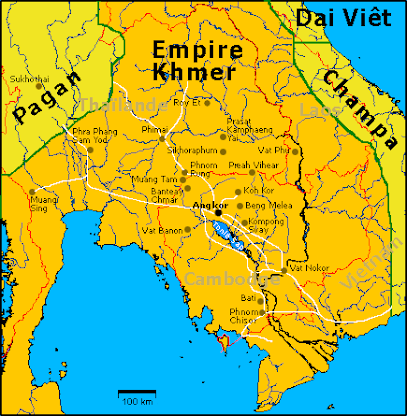
What drove Jayavarman VII, regarded as the greatest king of the Angkorian Empire, to erect this vast Buddhist temple about 105 miles from his capital in Angkor and in one of the most desolate and driest places in Cambodia remains one of its many unsolved riddles.

At its height in the 12th century, the empire extended over much of Southeast Asia, its rulers engaging in a building frenzy that produced some of the world's greatest religious monuments.

Called the “second Angkor Wat,” Banteay Chhmar approaches it in size, is more frozen in time than the manicured and made-over superstar, and has so far been spared the blights of mass tourism of recent years at Angkor.

In 2011, an average of 7,000 tourists a day visited Angkor, one of Asia's top tourist draws located near the booming northwestern city of Siem Reap. Banteay Chhmar saw an average of two a day, with no tour buses and bullhorn-wielding guides to disturb the temple's total tranquillity or traditional life in the surrounding village.

Abandoned for centuries, then cut off from the world by the murderous Khmer Rouge and a civil war, Banteay Chhmar didn't welcome visitors until 2007 when the last mines were cleared and the looting that plagued the defenseless temple in the 1990s was largely halted.

A year later, the California-based Global Heritage Fund began work at the site under the overall control of the country's Ministry of Culture and now spends about $200,000 a year on the project.

Sanday, a veteran British conservation architect, assembled a team of 60 experts and workers, some of whom were with him on an earlier restoration of the Preah Khan temple at Angkor. Others were recruited from the surrounding community and although barely literate, Sanday says they're among the best he's worked with in Asia.

Challenging them are hundreds of thousands of stone blocks from collapsed shrines and galleries scattered helter-skelter within the 4.6-square-mile archaeological site. Towers teeter, massive tree roots burrow into walls, vegetation chokes a wide moat girding the temple.

Three-quarters of the bas reliefs — rarely found at other Angkorian temples — have fallen or been looted, the most notable being eight panels depicting Avalokiteshvara, an enlightened being embodying Buddhist compassion.

Thieves sheared off four panels with jackhammers, smuggling them into nearby Thailand where two are widely believed to be decorating the garden of a Thai politician. A pair has been recovered and the others are still at the temple, although only two still stand.

“We've been struggling away with this gallery for nearly two years now,” says Sanday at another bas-relief, one depicting a figure believed to be Jayavarman VII leading his troops into battle. In vivid detail, the ancient sandstone wall springs to life with charging war elephants, soldiers plunging spears into their enemies and crocodiles gobbling up the dead.

Nature and time have proved the culprits: the vaulting protecting the 98-foot relief collapsed, exposing the wall to monsoon torrents, which seeped downward to wash away the masonry and loosen the foundations. Pressure from the weight above toppled sections of the wall or forced it to lean.

“He's going to have to come down,” says the 68-year-old architect of the king's image. A section of the wall is angled dangerously outward, he explains, so it must be dismantled, the foundations reinforced and the sandstone blocks meticulously numbered, charted, then set back into place.

Nearby, two young Cambodian computer whizzes are pioneering a shortcut to the reassembly process through three-dimensional imaging. The work-in-progress is one of the temple's 34 towers recently damaged in a severe storm.

Some 700 stone blocks from the tower have been removed or collected from where they fell and each one will be videographed from every angle. Since like a human fingerprint, no stone is exactly alike, still-to-be-finalized software should be able to fit all the blocks into their original alignment after they are repaired.

“We hope that with one push of the button all the stones will jump into place to solve what we are calling ‘John's puzzle,'” says Sanday.

When an original block has gone missing or is beyond repair, either an original stone from elsewhere on the site is used or, as a last resort, a new stone will be inserted.

“My philosophy is to preserve and present the monuments as I found them for future generations without falsifying their history. So often people tend to guess what was there,” he says.

The Global Heritage Fund, he says, is also intent on involving the community. “We can't protect Banteay Chhmar. They have to be the protectors. So they must gain some revenue from the temple,” Sanday says.

The Community Based Tourism group, which the fund supports, is training locals to become guides and devising ways to derive more income from tourism, part of which is funneled into betterment of the entire village.

Sanday and local organizers, however, hope Banteay Chhmar's remote location will spare it from a mass tourist influx. Thus he is not keen to have it listed as a UNESCO World Heritage Site, something the Cambodian government is pushing for.

“I often come here in the late afternoons, when the birds come alive and a breeze stirs,” Sanday says as fading sun rays, filtered through the green canopy, dapple the gray, weathered stones. “It's peaceful and quiet here, like it used to be at Angkor. This is a real site.”

If you go

Banteay Chhmar

Ancient Cambodian monument: There are no hotels, but Community Based Tourism runs six modest, clean homestays in Banteay Chhmar village, also arranging meals and tours. Rooms cost $7 a night. Details and contact information at visitbanteaychhma.org 


Getting there: Located about 105 miles from Angkor. Cars can be hired in nearby Siem Reap, site of an international airport, for the drive to Banteay Chhmar.

When to go: November through February are the cool, sunny months followed by scorching heat and then monsoon rains when some roads to Banteay Chhmar become impassable.


 Read more!

Lion dances performed in Cambodia to celebrate Chinese New Year

PHNOM PENH, Jan. 22 (Xinhua) -- Chinese traditional lion and dragon dances have begun performances in Cambodia on Sunday to celebrate coming Lunar New Year, which falls on Jan. 23.

The dances started from the Royal Palace, then to the Chinese Embassy in Phnom Penh before going elsewhere across the country.

The six groups of lion and dragon dances from the Chinese community in Cambodia had performed at the Royal Palace to bless Cambodia with happiness and prosperity in the New Year, Lao Shi Heng, vice-president of Chinese Association in Cambodia, said.

The groups were welcomed by Kuy Sophal, senior minister in charge of public affairs at the Royal Palace.

Later, at the Chinese Embassy, the groups were greeted by the ambassador Pan Guangxue.

"The Lunar New Year is the most important festival in China," he said, adding that it marked the end of the winter and the start of the spring.

The ambassador has also hailed overseas Chinese for promoting Chinese custom and tradition in Cambodia.

"May the Year of the Dragon bring luck, fortune and prosperity to China and the world," he said.

Traditionally, lion dance is invited by Chinese families to perform as a symbolic ritual to usher in the Spring Festival and to ward off bad luck and evil spirits.

Chinese New Year is one of the largest festivals in Cambodia, up to 80 percent of Cambodian people celebrate it every year, Cambodian Prime Minister Hun Sen said in a public speech in last January.

According to the figures from the Chinese Association in Cambodia, there are some 700,000 Chinese descendants living in Cambodia.
Read more!

Thursday, January 19, 2012

Cambodia’s ex-king heads to China for medical tests


Former Cambodian king Norodom Sihanouk, center, passes a wreath to his son King Norodom Sihamoni, right, after arriving at the Phnom Penh International Airport yesterday to go to China.Jan 20, 2012

 Cambodia’s ailing former king Norodom Sihanouk yesterday left his country again for Beijing to undergo medical tests, despite a vow to stay in his homeland forever.

The 89-year-old ex-monarch, who is a revered figure in Cambodia, smiled and waved to well-wishers as he was given a red-carpet sendoff by Cambodian Prime Minister Hun Sen and other senior government officials at Phnom Penh airport.

It is unclear how long Sihanouk, who is traveling with his wife and their son, King Norodom Sihamoni, will remain abroad.

The ex-monarch has suffered from a number of ailments in recent years, including cancer, diabetes and hypertension. He has been a frequent visitor to China, where he received the bulk of his treatment.

After returning in October from a previous stay of almost three months in Beijing, Sihanouk told his compatriots that he would never leave Cambodia again, in a speech to mark the 20th anniversary of his return from exile.

However, his medical needs have made it impossible to keep that promise, said Sihanouk’s personal secretary, Prince Sisowath Thomico.

“The Chinese doctors can travel to treat him in Cambodia, but they can’t bring their equipment with them so they asked him to go to China for a check-up,” Thomico said.

“His health is still good,” he added. “He is still strong.”

One of Asia’s longest-serving monarchs, the former king abruptly quit the throne in October 2004 in favor of his son, citing old age and health problems.

Despite abdicating, the ex-monarch sometimes uses his Web site to communicate with the outside world.
Read more!

Vietnam, Cambodia report bird flu deaths

HANOI, Vietnam (AP) — Vietnam on Thursday confirmed its first human death from bird flu in nearly two years, a day after neighboring Cambodia also logged its first fatality this year as new cases of the H5N1 virus are reported in Asia and the Middle East.

Both deaths appear to be linked to contact with poultry, and no human-to-human transmission is suspected. Other human bird flu cases have been reported recently in Indonesia, Egypt and China. Outbreaks typically flare among poultry stocks during the winter flu months, often resulting in a spate of human cases.

In Vietnam, test results confirmed that an 18-year-old Vietnamese man died of the disease Monday after being hospitalized a day earlier, said Dang Thi Thanh of southern Kien Giang province's health department.

She said the man was working at a duck farm in neighboring Can Tho City when he fell sick with a high fever and breathing problems. His house has been disinfected and those who were in contact with him remain under surveillance.

No sick or dead poultry have been reported on the two farms where the man worked or among neighboring flocks, but samples have been collected for analysis and the farms have been disinfected, said Huynh Thi Khai Hoan, an animal health officer in Can Tho City. However, many of the ducks on the farms where the man worked had already been sold.

In Cambodia, a 2-year-old boy died Wednesday after developing symptoms Jan. 3. He was reportedly in contact with sick poultry in his village, according to the World Health Organization. The country's last death occurred in August.

The virus rarely infects humans and usually only those who come in direct contact with diseased poultry, but experts fear it will mutate into a new form that passes easily from person to person.

The WHO says that globally there have been 341 human deaths from 578 confirmed bird flu cases since 2003. About 60 of those deaths occurred in Vietnam.

Before Monday, Vietnam had not seen a human bird flu death since April 2010, according to the Ministry of Health's Preventive Medicine Department.

The government has called for stepped-up efforts to fight bird flu as a massive movement of people and poultry begins ahead of the Lunar New Year festivities, which start next week.
Read more!

UN names new adviser for Cambodia Khmer Rouge trials

The United Nations has named a new special expert to advise on assistance to the Khmer Rouge trials in Cambodia.


A student reads court documents displaying portraits of Khmer Rouge leaders Ieng Sary, from right, Khieu Samphan and Nuon Chea during a UN-backed war crime tribunal in Phnom Penh, Cambodia, on 16 January, 2012
Three Khmer Rouge leaders (photos from left)
Nuon Chea, Khieu Samphan and Ieng Sary are on trial
 David Scheffer, the former US ambassador-at-large for war crime issues, is ''very well qualified to provide expert advice'', the UN said in a statement released on Wednesday.

He replaces Clint Williamson, whose term expired on 30 September 2011.

The UN-backed genocide court is seeking justice for almost two million deaths under the Khmer Rouge in the 1970s.

Mr Scheffer was involved in the establishment of the Extraordinary Chambers in the Courts of Cambodia, said the UN statement.

He was also experienced in setting up the International Tribunal for the former Yugoslavia, the International Criminal Tribunal for Rwanda, the International Criminal Court and the Special Court for Sierra Leone.

In November 2011, three top Khmer Rouge leaders - Nuon Chea, Khieu Samphan and Ieng Sary - went on trial for crimes committed during the regime's rule.

Another leader, Ieng Thirith, was found incapable of standing trial because of ill health.

Former Khmer Rouge prison chief Kaing Guek Eav, better known as Comrade Duch, was convicted of crimes against humanity in 2010 in the tribunal's first case.

Last week, a Swiss judge publicly accused his Cambodian counterpart of stopping him from revealing key information about two other possible prosecutions.

It is the latest row between judicial officials at the UN-backed court.

The Swiss judge replaced a German judge who resigned unexpectedly in October 2011, citing political opposition to further prosecutions.

The trial of Nuon Chea, Khieu Samphan and Ieng Sary continued this week.
Read more!

Cambodia still in fight to curb pirated goods

Despite continued efforts to curb intellectual-property violations in Cambodia, weak enforcement and government bureaucracy continue to stymie that progress, experts have said.

Cambodia faces many of the same IP problems as neighbouring countries, but regulation of the black market has proved largely unsuccessful, not least because the Kingdom lacks policing capacity.
Regulators have been unable to put to work the international support networks and aid available to them.

120119_07
“When we get aid from other countries, I worry that Cambodia doesn’t have the human resources to implement the project,” Var Roth San, director of intellectual property at the Ministry of Commerce, said yesterday. Still, at an ASEAN-wide IP workshop held last week in Phnom Penh, the Cambodian government said it would launch 45 enforcement projects between 2012 and 2014, he said.

On the purchasing side, Cambodians were often unaware of what intellectual property meant, Var Roth San said.

The lack of understanding – which amounted to little more than a price difference to many in the country – was also a challenge to weaning Cambodia off pirated goods, he said.

IP infringement in Cambodia, ranging from software, music and books to cigarettes, alcohol and pharmaceuticals, is pervasive, according to Sean McIntosh, spokesman for the US embassy in Phnom Penh.
Weak enforcement had failed to significantly reduce the trade, which is thought to include 95 per cent of the computer software in the Kingdom, he said.

The Cambodian government spreads management of IP issues across three ministries.

That separation among regulators was inefficient, confusing and a hindrance to enforcement, Peter Fowler, the United States Patent and Trademark Office (USPTO) intellectual property attaché for Southeast Asia, said.

“The international trend . . . is to consolidate all IP-related administration and policy functions in a single office or agency,” Bangkok-based Fowler said, adding that Cambodia’s regulation scheme was somewhat unique.

Change is coming, but slowly. Cambodia first moved to bring IP regulation under one roof in 2008, and a draft plan for a single office could be approved within a month, the Ministry of Commerce’s Var Roth San said.

The World Intellectual Property Organisation has pledged to provide technical assistance for the transition.

As ASEAN’s 2015 integration draws closer, IP issues in the region would only become more important, Fowler said.

Yet as Cambodia comes to terms with already weak enforcement, new challenges are emerging with the larger global trade in protected goods and the increasing availability of the internet.

The increased involvement of transnational criminal organisations with the movement counterfeit goods also posed a threat, Fowler said.


Read more!

Wednesday, January 18, 2012

Cambodia's export to EU reaches US$1.3b

Business Desk
Rasmei Kampuchea Daily


Cambodia's export to the EU market in 2011 reached over US$1.3 billion, increasing almost 40 per cent from 2010, according the EU ambassador to Cambodia.

"Overall, comparing the total value of exports from Cambodia to the EU in 2010 with 2011 data, an increase of 39.86 per cent can be reported. The EU is only second after US ($2,070,009,468 million, representing 45. per cent of total export of Cambodia) as destination of total Cambodian exports in 2011," Ambassador Jean-François Cautain, Head of the EU Delegation to the Kingdom of Cambodia told The Cambodia Herald in this week's interview.

He added most recent export figures for Cambodia (2011) show that the value of exports leaving Cambodia to the EU registered at slightly more than $1.3 billion, representing 28.7 per cent of Cambodia's total exports.

EU imports from Cambodia in 2011 highly concentrated in textiles and textile articles (78 per cent in 2011 compared to 64.8 per cent in 2010), footwear (9.5 per cent in 2011 against 24.8 per cent in 2010), other goods including vehicle equipment (about 7 per cent), and rice (0.5 per cent).

In the past few years, rice has been a promising export product in agriculture, especially since its coverage under Everything But Arms (the European preferential trade scheme that allows Cambodia-based firms to export sugar and other goods to the EU) since 1 September 2009, with exports to EU increasing exponentially from about $2 million in 2008 to $31.5 million in 2010. In 2011 the value of rice exported to the EU market reached $66 million, with an incredible 108.94 per cent increase in 2011 compared to the previous year.
Read more!

Extremely Rare Turtle is Released into the Wild

Southern River terrapin, fixed with a satellite transmitter, is set free to breed in the waters of Cambodia

Wildlife Conservation Society, Cambodian Fisheries Administration, and Wildlife Reserves Singapore will monitor turtle

Less than 200 adult individuals remain in the wild

Newswise — NEW YORK (January 18, 2012) – The Wildlife Conservation Society, in conjunction with the Cambodian Fisheries Administration and Wildlife Reserves Singapore, announced today the successful release of a Southern River terrapin (Batagur affinis) – one of the most endangered turtles on earth – into the Sre Ambel River in Cambodia.

The turtle was released on Monday, January 16th at a ceremony attended by officials, conservationists, and local people.

The female turtle, which weighs approximately 75 pounds (34 kilograms), is fixed with a satellite transmitter that will allow conservationists to track its whereabouts – the first-ever satellite monitoring study for this species.

Captured in the Sre Ambel River by local fishermen in April, 2011, the turtle is one of an estimated 200 adults remaining in the wilds of Cambodia, Malaysia, and Indonesia. It was voluntarily turned it over to the WCS Cambodia turtle team instead of being sold into the black market trade where it would have been sent to food markets in China.

The population in the Sre Ambel River is estimated at less than ten nesting females. Thus, this individual is extremely important for maintaining genetic diversity of this species that has already suffered drastic population declines.
WCS believes the pop
ulation has an excellent chance of recovery as the coastal mangrove forests of Southeastern Cambodia are some of the largest and most pristine in Southeast Asia, spanning some 175 square miles (more than 45,000 hectares). These habitats are crucial to numerous aquatic and terrestrial animals and are vital nursery areas for marine fisheries.

Conservationists will monitor the turtle’s movements to see how it utilizes this region. Of particular interest is how the turtle navigates through commercial fishing grounds, as well as areas where it could be threatened by other factors such as habitat destruction by sand mining or conversion of mangrove forests into shrimp farming facilities.

WCS notes that numerous studies on similar long-lived species have shown that as little as a five percent increase in annual adult mortality can cause populations to go extinct.

“By reducing the adult mortality of the Southern River terrapin, even by fractions – as little as ten animals a year per population in this circumstance – we can have immediate and long-term positive impacts on the remaining wild populations of this critically endangered species” said Brian D. Horne of the Wildlife Conservation Society.

Heng Sovannara, Deputy Director of Cambodia’s Fisheries Administration’s Conservation Department, is extremely hopeful that the release will enhance efforts to conserve the species. “By identifying areas that are most utilized by the turtles, we can pinpoint our efforts to reduce the turtles being caught as fishery by-catch as well as targeted hunting,” he said.

Dr. Sonja Luz, Deputy Director of Conservation & Research for Wildlife Reserves Singapore, said: “This project will contribute greatly to a much brighter future for this critically endangered terrapin. Hopefully, more public awareness and education opportunities will arise from this and allow us to create better protection tools and a safer environment for these amazing reptiles.”

In 2000, a small population of Southern River Terrapins, Batagur affinis, was found in the Sre Ambel after many years of being considered locally extinct.

The turtle was once considered solely the property of the King of Cambodia, but has been decimated by overhunting over the past two decades.

Following the Khmer Rouge and Pol Pot regime, the Cambodian people were left in severe poverty, and with the growing international demand for turtles in China for human consumption, literally thousands of turtles were captured and sent to China for much needed income by the country’s impoverished people.

The Wildlife Conservation Society saves wildlife and wild places worldwide. We do so through science, global conservation, education and the management of the world's largest system of urban wildlife parks, led by the Flagship Bronx Zoo. Together these activities change attitudes toward nature and help people imagine wildlife and humans living in harmony. WCS is committed to this mission because it is essential to the integrity of life on Earth. Visit: http://www.wcs.org/

Wildlife Reserves Singapore (WRS) is the parent company of award-winning attractions Jurong Bird Park, Night Safari, Singapore Zoo and the upcoming River Safari. WRS parks strive to be world-class leisure attractions, providing excellent exhibits of animals presented in their natural environment for the purpose of conservation, education and recreation. In the areas of conservation and research, WRS parks have undertaken multiple projects through collaborations with various organisations and institutions on the oriental pied hornbill, pangolin and orang utan. Highly popular with tourists and locals, Jurong Bird Park welcomed 900,000 visitors, the Night Safari, more than 1.1 million, and Singapore Zoo over 1.6 million visitors in 2010. More information can be found at http://www.wrs.com.sg/.
Read more!

4 Cambodians shot in land protest

PHNOM PENH - Private guards shot and wounded at least four people today during a land dispute in Cambodia, witnesses and a provincial official said.

Kratie province Gov. Kham Phoeun said he ordered police to investigate guards armed with AK-47 assault rifles who shot at about 100 villages who were trying to stop bulldozers from destroying their cassava plantation.

The number of protesters increased to about 300 after the shooting, and they also blocked the highway, demanding that the shooters be arrested, said Ms Neth Ratana, a wounded protester interviewed by telephone.

Officials from the landholding company could not immediately be reached for comment.

Such land disputes are not unusual in Cambodia, and have provoked protests partly because of the perception that officials are making corrupt deals at the expense of poor people.

Mr Am Sam Ath of the human rights group Licadho said nearly 20,000 people were victimised by land disputes last year, and that the issue is worsening as land prices rise.

"I am afraid that this dispute could get bigger from day to day and may affect the country's stability if the government doesn't take urgent action to solve the problem," he said.

Ms Neth Ratana, 23, said about 10 security guards standing on trucks began shooting at protesters when they surrounded the excavating equipment and forced the drivers to stop clearing the land.

She said she was slightly wounded on her knee, and that four other protesters were wounded badly enough to be hospitalised.
Read more!

Tuesday, January 17, 2012

Hospitality Technology Solutions Provider FCS Announces Partnership With Quoc Khoa Networks In Cambodia

Deal gives Cambodia hoteliers easy access to world’s leading hotel technology suite

Cambodia (WiredPRNews.com) FCS, a leading global provider of comprehensive hospitality technology solutions, announces an official partnership with Quoc Khoa Networks Limited, a new Value Business Partner in Cambodia. Quoc Koa focuses on the hospitality industry and, through the new agreement, will now offer the full suite of FCS solutions to international hotel chains and local properties in the Cambodian market.

In recent years, tourism has been the second largest source of foreign currency for Cambodia. During the first eight months of 2011, international tourist arrivals to Cambodia recorded an increase of 15% compared to the same period in 2010. Meanwhile, domestic tourism has also increased remarkably. The new partnership between Quoc Khoa Networks and FCS will strengthen the positions of both companies as providers of leading world-class hospitality solutions that are designed to help area hoteliers cope with this tremendous growth.

“The partnership with Quoc Khoa Networks enables FCS to expand our business horizons in the region, as part of our global strategy to provide the best hospitality solutions that enhance guest experiences while maximizing hotel operations and productivity,” says Theekha Leelaadison, FCS’ country manager for Cambodia. “Together with Quoc Khoa Networks, we will continue to provide innovative user experiences for hotel guests, ensuring that FCS solutions are an integral part of all hotel environments while addressing the significant growth of Cambodia’s hospitality market.”

Partnering with FCS, the world’s foremost provider of hotel technology products and services, is a major milestone for Quoc Khoa and goes a long way toward achieving its target position as the preferred one-stop-shop for any IT and telecommunications needs of Cambodia’s business community.

“We are proud to be working with FCS to jointly develop the hospitality market,” says Bui Duy Quoc Thang, general manager of Quoc Khoa Networks. “We believe that the revenue generated from FCS solutions will contribute 25% to this goal for our company. In addition, we are committed to enhancing guest satisfaction with guaranteed quality of service via FCS’ innovative and reliable hospitality products.”

For more information on the comprehensive FCS suite of hospitality technology product solutions, please visit www.fcscs.com.

About FCS Computer Systems | FCS Computer Systems (FCS), founded in 1982, is a comprehensive hospitality solutions provider with presence in more than 20 countries worldwide. With nearly three decades of experience, FCS has provided extensive solutions to more than 4,000 hotels with over 6,000 installations in 32 countries. FCS leads the way in hospitality expertise with a complete suite of innovative solutions and services. These hospitality solutions include: universal billing systems for multi-services and multi-property management; universal interfaces to industry leading PMS and PABX systems for guest information; enhanced voice mail system for guests and staff; sophisticated call center management solutions for guest service request and inter-department work order management, enhanced preventive maintenance and ad-hoc engineering systems, guest self-service portals via smart phone devices (such as iPhone, iPad, Android and Blackberry), and IP phone display applications, among others. FCS solutions also support over 30 mobility interfaces for distributing information through a wide variety of handheld devices and printers. For more information, please visit www.fcscs.com.

About Quoc Khoa Networks Limited | Quoc Khoa Networks is a subsidiary of Asia Net Group, specializing in IT and telecommunications systems and solutions. It has seven years of experience in supply and maintenance for telecom products and services, including voice and data. Quoc Khoa Networks is one of the top 10 companies in Cambodia and is widely recognized by hotel and resort guests. For more information, please visit www.quockhoanetworks.com.
Read more!

Job agencies complicit in Malaysian abuse of Cambodian maids

Beaten and robbed … Orn Eak has returned to her village home and her five-year-old son but is still scarred by her mistreatment in Kuala Lumpur and Phnom Penh. Photo: Lindsay Murdoch


Beaten, starved and treated as a slave in a Kuala Lumpur apartment, Cambodian maid Orn Eak says a one-metre snake ended her almost two-year nightmare in Malaysia.

''When the snake crawled into my employer's apartment she blamed me and kicked me out,'' says Orn Eak, 28, one of thousands of Cambodian domestic workers who have been exploited and abused in Malaysia, some of them girls as young as 13. ''I got the blame for everything, including the death of my employer's elderly mother.''

Orn Eak's body is covered in scars from beatings by a Kuala Lumpur woman aged in her 30s who employed her through a Cambodian employment agency in early 2010.

Orn Eak, who is single, with a five-year-old son, says she joined 30,000 other young Cambodian women and girls working as maids in Malaysia because her mother was struggling to survive in their village in Cambodia's Kompong Thom province, where she lives in a bamboo hut with a dirt floor and leaking roof.

In Kuala Lumpur, Orn Eak had no days off and worked from dawn into the early hours of the next morning caring for her employer's disabled mother, who was in her 70s.

Orn Eak claims the old woman once kicked her in the head after she had delayed changing her clothes while she briefly went to the toilet. Orn Eak says her employer did not speak a word to her for months.

She says she was frequently beaten and scratched and was often hungry, surviving with food she bought with money two members of her employer's family gave her for Chinese New Year.

Nine Cambodian domestic workers died in Malaysia in 2011, according to human rights and non-government organisations.

Choy Pich, 19, was reportedly beaten by her employer and dumped outside his house. She died of pneumonia.

A Malaysian opposition MP, Charles Santiago, has accused the government in Kuala Lumpur and police of ''totally disrespecting'' Malaysian laws by conducting, at best, only cursory investigations into the deaths.

Human Rights Watch, which has interviewed 80 Cambodian maids, their families and government officials, says common abuses include excessive work hours with no rest days, lack of food and irregular or non-payment of salaries, which are as low as $US133 a month.

Usually the maids' passports are taken away from them.

Many have reported sexual abuse, restrictions of movements and bans on contact with other maids.

Last October, after reports in the Cambodian media about the mistreatment of women and girls as young as 13 in Malaysia, the Cambodian government announced a ban on sending maids to the country.

But unscrupulous recruitment agencies have ignored the ban, human rights and non-government organisations say.

Orn Eak's mistreatment worsened after her employer's mother died in hospital.

''My employer said I was not doing a good job and as punishment she only allowed me to eat one packet of dried noodles a day for six weeks,'' she says. ''I felt homesick … I missed my son and mother very much but I knew I had to keep working for them.''

But Ee Tha, 55, says she received only two payments over almost two years from her daughter's Malaysian employer totalling $US270.

The employer deducted Orn Eak's flight home from her salary, which was supposed to be $US180 a month.

When Orn Eak arrived back in Phnom Penh in November, a woman picked her up at the airport and took her to the employment agency's compound.

''I told the story about the snake to a director of the company … she told me to sit in a chair,'' Orn Eak says. ''Five men came into the room and beat me … they pushed my head into a glass door and kicked me on the ground.''

Ee Tha received a message to come to Phnom Penh to take her daughter home.

''When I saw that my daughter's face and body were cut and bruised my heart dropped to the floor,'' Ee Tha says.

''I said to her, 'I'm your mother', but she did not recognise me … I burst into tears,'' Ee Tha says.

After Ee Tha refused to leave the employment agency's office with her daughter until she was given the money she was owed, an agency director finally handed over $US1200 - meaning Orn Eak earned only $1470 for almost two years' work, half what she had been promised.

Orn Eak has suffered depression and other undiagnosed illnesses since she returned to live in the village.

Social workers have verified her claims of abuse through medical and other checks.

''I have gone to the temple every day and prayed and prayed that my daughter would be OK after all this but she still has not recovered,'' Ee Tha says.

The government in Phnom Penh has been strongly pushing migrant work abroad as a strategy to increase foreign remittances, cope with unemployment and alleviate poverty.

But Human Rights Watch says the government has abdicated responsibilities for safeguarding migrants to private employment agencies, some of which are reportedly owned by, or affiliated with, government officials.

The demand for Cambodian maids in Malaysia has sharply increased since 2009 when the Indonesian government responded to several high-profile abuse cases by imposing a moratorium on its citizens working as maids there.

The ban was lifted on December 1 after an agreement under which Indonesian maids would do 200 hours of training before coming to Malaysia.

Indonesians will also be able to keep their passports and will be given a weekly day off.

But there are no safeguards for the abuse or exploitation of Cambodian maids.
Read more!

Indonesian Observer Team Will Head to Cambodia-Thai Border

In the wake of recent developments related to the border dispute between Cambodia and Thailand, Foreign Affairs Minister Marty Natalegawa said on Monday that Indonesia would continue the long-delayed plan to send an Indonesian observer team to the border.

“I can confirm this thanks to the positive outcome of discussions between the Thai and Cambodian governments,” Marty told the Jakarta Globe.

“Both countries reaffirmed their wish to have an Indonesian observer team in the 4.6-square kilometer provisional demilitarized zone as a follow up to the International Court of Justice ruling,” he added, referring to the disputed area surrounding the centuries-old Preah Vihear temple, to which both countries have claims.

The International Court of Justice defined in its July verdict a provisional demilitarized zone from which both countries must withdraw military personnel.

Marty said that Indonesia, Thailand and Cambodia would try to update the terms of references on Indonesian observer team’s deployment “to reflect the latest development.”

“One possibility is that the Indonesian observer team will work jointly with the Thai and Cambodian teams in carrying out their mission. The team will have a new task to ensure compliance in observing the provisional demilitarized zone,” he said, adding that Thailand and Cambodia had agreed to set up a joint working group to further cooperation.

In the previously agreed terms of references, Indonesia would send two teams on both sides of the border, each with 15 unarmed observers to ensure the cease fire is maintained, but the plan has been dormant since.

“Both Thailand and Cambodia expect that Indonesia continues its role [in the dispute] even after Indonesia’s chairmanship of Asean [concludes],” Marty said.

Indonesia held the rotating chairmanship of Asean last year when the dispute was escalating, and with UN backing, it acted as mediator to the two countries. Cambodia now holds the 2012 chairmanship of the 10-member states regional bloc.

The plan to send Indonesian military observer teams resurfaced at a news conference on Monday, when Defense Minister Purnomo Yusgiantoro revealed it after a meeting with the ministry’s top officials and brass.

“We will send our soldiers to the border of Thailand and Cambodia. Our troops have been trained and they will be stationed on certain points,” Purnomo said, referring to the training programs at the newly established Indonesian Peace and Security Center in Sentul, West Java, where Indonesian soldiers are trained prior to joining UN peacekeeping forces.

Armed Forces Chief of Staff Adm. Agus Suhartono added that the country’s military observer team was ready for deployment as soon as the terms of references were updated. “We will see if the previously agreed 30 personnel for two teams will still be enough or we will need to figure out a new number,” Agus said.

“In principle, the Indonesian team will only be present as observer if we were asked and endorsed by the two countries in dispute,” he added.
Read more!

Cambodia sticks to DOC on S China Sea dispute

As the chairman of ASEAN this year, Cambodia vowed to safeguard the Declaration of the Conduct of Parties in the South China Sea (DOC) and the guidelines of implementing the DOC, Deputy Prime Minister and Minister of Defense Tea Banh said on Tuesday.

"We are all aware of the DOC that was signed in Phnom Penh between ASEAN and China at that time Cambodia was ASEAN chairman in 2002," he said in a forum on Cambodia's roles in promoting security cooperation in the name of the host of ASEAN Defense Ministers' meeting and other meetings in 2012.

"Now, it is the 10-year anniversary of the DOC," he told about 100 participants who are foreign diplomats and military attach of ASEAN countries and dialogue partner countries.

"We must safeguard the DOC achieved in Phnom Penh and achievement made in Indonesia in July, 2011 that created guidelines and implementation principles for the DOC," he said.

The minister said that Cambodia would urge for cooperation from all ASEAN members and China in order to achieve the draft Code of Conduct (COC) in 2012 in the spirit of cooperation and friendship.

"As ASEAN chair, Cambodia has a clear principle: minimize dispute and increase cooperation towards establishment of ASEAN Political-Security Community by 2015," he said.

The Association of Southeast Asian Nations (ASEAN) groups Brunei, Cambodia, Indonesia, Laos, Malaysia, Myanmar, the Philippines, Singapore, Thailand and Vietnam.
Read more!

Monday, January 16, 2012

U.S. secretary of state, president to visit Cambodia this year: officials

PHNOM PENH, Jan. 16 (Xinhua) -- The United States'Secretary of State Hillary Rodham Clinton and President Barack Obama will visit Cambodia in July and November respectively to attend summits as Cambodia chairs ASEAN this year, senior officials said on Monday.

"Our Secretary of State will be here in July as well as our President will be in November," Joseph Y. Yun, deputy assistant secretary of the Bureau of East Asian and Pacific Affairs of the U. S. Department of State, told reporters after a meeting with Ouch Borith, secretary of state for Cambodia's Ministry of Foreign Affairs.

He said that the meeting is to inform Cambodia about the upcoming U.S. leaders' visits and to discuss how to build U.S.- Cambodia relationship in 2012 through these high-level visits.

"We have really had a very exciting year ahead to strengthen U. S.-Cambodia relationship," he said.

Ouch Borith said Hillary Clinton will attend the AMM (ASEAN Ministerial Meeting) and Barack Obama will attend the ASEAN-U.S. Summit and related Summits.

"This reflects increasing relationship between the United States and ASEAN," he told reporters."The presence of the U.S. President Barack Obama in Cambodia in November is a sign showing that the Cambodia-U.S. relation is better."

It will be the first time in Cambodia's history that the incumbent President of the United States visiting Cambodia.

In the meeting, both sides also discussed about the plan for Cambodian Foreign Minister Hor Namhong's visit to Washington D.C. in March this year to strengthen Cambodia-U.S. cooperation.
Read more!

LEAD: Cambodia claims final say over appointment of tribunal judge

Phnom Penh - The Cambodian government said Monday that the country's judiciary has the right to decline to appoint a United Nations-nominated judge to the Khmer Rouge war crimes tribunal.

The controversial claim was made by a government spokesman and followed unconfirmed reports from local media that judge Laurent Kasper-Ansermet was not endorsed as the court's new international co-investigating judge at a meeting of Cambodia's Supreme Council of Magistracy (SCM) on Friday.

Swiss national Kasper-Ansermet, who had been in limbo for a month until Phnom Penh convened the judicial body, was set to replace controversial German judge Siegfried Blunk. Blunk quit in October citing political interference in two cases currently under investigation, known as Cases 003 and 004.

Government spokesman Phay Siphan declined to confirm the result of Monday's meeting, but emphasised that the body had the power to decide whether to approve a judge or not.

Analysts, however, believe that the SCM may be stretching the limits of its mandate and driving the tribunal deeper into controversy.

'I think this situation has moved from bad to worse. If the SCM has rejected his appointment, it has totally overstepped its authority,' said Clair Duffy, tribunal monitor for Open Society Justice Initiative.

'It is really about Kasper-Ansermet's intention to investigate Cases 003 and 004.'

Senior Cambodian officials have repeatedly said that the government would not permit either case to reach trial at the court. In contrast, Kasper-Ansermet has taken to Twitter to emphasise his commitment to them.

On Sunday, he tweeted in French that he was determined to investigate the cases; a move that he implied could explain 'the resistance of some to my official nomination.'

Martin Nesirky, spokesman for UN Secretary-General Ban Ki-Moon, said Monday: 'We have not received any communication from the Royal Government of Cambodia' regarding the status of the Swiss judge's formal appointment.
Read more!

Sinohydro's first overseas BOT project begins operation

By Xu Keqiang

Cambodia's Kamchay Hydropower Station, the first overseas Build-Operate-Transfer (BOT) hydropower project entirely funded by Sinohydro Group, was recently completed and put into commercial operation, marking a new stage in the overseas expansion of China's hydropower industry.

The 194-megawatt Kamchay Hydropower Station cost Sinohydro 300 million U.S. dollars over four years of construction, and the company is licensed to operate the hydropower station for 40 years before transferring it to the Cambodian government.

Sinohydro has adopted the creative BOT project-financing model with limited recourse, and used the project's future revenue as collateral, in order to reduce its investment risk.

AS China's leading hydropower engineering and construction company, Sinohydro has accumulated abundant technical and talent resources in water resource development over the past 60 years. It is also one of the world's largest contractors and developers of hydropower projects, and enjoys comparative advantage over its competitors worldwide.

While holding water conservancy and hydropower construction as its core business, Sinohydro is actively expanding into the upstream and downstream sectors, investing in international resource development projects, and conducting merger and acquisition activity abroad, in order to promote its structural transformation and international business expansion.
Read more!

Malaria kills 98 Cambodians, down 35% in 2011

PHNOM PENH - Malaria had killed 98 Cambodians in 2011, a decline of 35 percent from 151 deaths in a year earlier, said a senior health official on Monday.

Last year, some 62,690 cases of malaria had been reported, said Char Meng Chuor, the director of the National Center for Malaria.

"We see our remarkable success in fighting malaria in the past year--despite the rise in malaria cases, the death toll has declined up to 35 percent," he told Xinhua over telephone. "This is thanks to people's awareness about the symptoms of the disease and they have timely sought medical treatment."

He said that with this good result, the country would definitely be able to completely eradicate the death of malaria by 2015.

"To achieve this target, we need the budget of $20 million a year in the next four years," he said.

Malaria is a mosquito-borne infectious disease. In Cambodia, the disease is often found in rainy season and mostly happens in border provinces, forest and mountainous provinces such as Pursat, Rattanakiri, Mondulkiri, Kampong Cham, and Preah Vihear.
Read more!

Cuba eyes cooperation with Cambodia

PHNOM PENH - Cuba wants to cooperate with Cambodia in the fields of agriculture and health in order to strengthen and expand bilateral ties, said the new designated Cuban ambassador to Cambodia Jose Ramon R. Yarona on Monday.

Jose Ramon R. Yarona made the comments during a meeting with Cambodia's Prime Minister Hun Sen at the Peace Palace.

He said Cuba and Cambodia have the possibility of launching cooperation in agriculture, pesticides and health, especially medicines for cancer prevention.

Meanwhile, he also invited the premier to visit Cuba at an appropriate time.

In response, Hun Sen accepted the invitation and said that he would make a visit to Cuba sometime in the future.

He recommended Jose Ramon R. Yarona to work with Cambodia's ministries of agriculture and health to seek cooperation in the proposed fields.

Cambodia and Cuba have established diplomatic relations for 50 years, but bilateral trade and investment are relatively small.
Read more!

Friday, January 13, 2012

Vietnam vet joins ‘today’s war’

By Martin Kuz

 ASMAR, Afghanistan — No mess hall, showers or two-week leave. No mail, cellphones or Internet. No drinking tea with villagers. No helping them start businesses.

Staff Sgt. Larry Marquez, an Army reservist with the 425th
Civil Affairs Battalion, is serving in Afghanistan 39 years after deploying
to Cambodia as a teenager during the Vietnam War


Much more than 39 years separates the experience of a U.S. soldier in Cambodia in 1973 and in Afghanistan in 2012. Staff Sgt. Larry Marquez has lived the difference. He was there then; he’s here now.

“The biggest change is, the guys in Vietnam, Cambodia — they were drafted. They were doing a job because they had to,” said Marquez, 55, of El Paso, Texas, an Army reservist with Company D, 425th Civil Affairs Battalion.
“The guys in Afghanistan, they want to be doing this. You can see that in their attitude.”

Marquez belonged to the minority of soldiers who signed up for the Vietnam War, enlisting at 17 with his parents’ consent.

The teenage artilleryman reported to duty in Cambodia as U.S. forces began staggering toward the exits of the longest conflict in American history prior to the war in Afghanistan.

Despite the privation that U.S. soldiers face here, for Marquez, even the most primitive outpost feels like Versailles compared to the jungle encampments of Southeast Asia. He and his fellow soldiers subsisted solely on C rations and bathed with water scooped from rivers and puddles. Air conditioning? Find some shade. Heat? Build a fire.

His unit was so deep in the bush during its yearlong, no-leave deployment that the men went without the simple comfort of what is now quaintly called snail mail.

“Email, Facebook, Skype — we didn’t have any of that stuff,” he said. “Back then, we told stories to each other to pass the time. All you had were the guys around you.”

Trading in the good life

I met Marquez at Combat Outpost Monti, a small base in Kunar province and the seventh in eastern Afghanistan where he has been stationed since deploying in July. His return to the dirt required persistence and a little serendipity.

He left the reserves in 1987 during a period of relative idleness for the U.S. military. When the Persian Gulf War began three years later, he tried to rejoin, only to see his request sucked into a bureaucratic black hole.

Finally, in 2007, following a chance meeting at a friend’s party with a reserves recruiter who offered to help him, Marquez was again in uniform.

By then, he had lost his chance to serve in Iraq with the 425th. Four years later, after taking part in peacekeeping missions in Bosnia and Russia, he headed back to a combat zone, this time as a graybeard instead of a fresh-faced teen.

“If I go out with these young guys on a patrol, they’re always asking if I need water, if I’m getting tired,” said Marquez, who apart from a tweaked hamstring has held up against the physical rigors of deployment. “They’re always watching out for the old man.”

He and his wife, Marcia, live in Carlsbad, Calif., with the youngest two of his seven children. Their home stands less than a mile from the Pacific Ocean. His civilian job as a nuclear specialist pays “extremely, extremely well.”

In other words, he traded the good life for bullets and mortars and IEDs. I asked the obvious question: What the hell was he thinking?

“I wanted to be part of today’s war,” he said. “I felt like I had something I needed to finish.”

‘Their very good friend’

In Cambodia, as an infantryman, Marquez sought to destroy. In Afghanistan, as a civil affairs specialist, he attempts to build.

He has traversed Kunar and neighboring Nangarhar province to hand out “micro-grants” of up to $5,000 to help entrepreneurs launch or expand small businesses.

Among other ventures, he has provided funding for a taxi service, bicycle repair shop and computer classes.

Along the way, he has drank a billion cups of tea with villagers looking to win him over.

“Once they find out who I am and what I can give them,” he said with a smile, “I become their very good friend.”

Vietnam slowly stabilized in the decades after the war there ended in 1975. Marquez, while unsure of Afghanistan’s long-term prospects, predicts that violence, and perhaps civil war, awaits when U.S. forces withdraw in 2014.

“As soon as we leave, it’s going to go back to the way it was,” he said. “I just don’t think the problems will be solved.”

The question of this country’s fate aside, the difference between the two wars that Marquez appreciates above all others is the reception given to returning troops in America.

“Nobody gave a crap about the soldier in the ’70s,” he said. “Today, you walk into a Jack in the Box and someone sees your uniform and buys you dinner. These young guys deserve that kind of respect.”

Spoken like a man as wise as his years.


Stars and Stripes
Read more!

Large group of U.S. tycoons visit Cambodia for investment possibilities

PHNOM PENH, Jan. 13 (Xinhua) -- A large group of 96 U.S. billionaires, mostly spouses, have been visiting Cambodia in order to explore investment opportunities, said a senior Cambodian official.

The delegation was from the United States' Chief Executive Organization (CEO) and was led by Kenneth M. Quinn, former U.S. Ambassador to Cambodia and president of the World Food Prize Foundation, and John Ruan III, a member of the CEO and chairman of the Ruan Transportation Management Systems.

On Thursday afternoon, the delegation had met with Cambodia's government officials led by Deputy Prime Minister Keat Chhon, who is also the minister of economy and finance, at the Peace Palace.

"The delegation wanted to study about Cambodia's potentials for investment opportunities," Om Yintieng, advisor to Prime Minister Hun Sen, told reporters after the meeting. "They can be new investors for Cambodia in the future."

The delegation members are from sectors of education, investment and financial consultation, banking and finance, IT, pharmaceutical and health product manufacturing, tourism, energy, food manufacturing, real estate and transportation.

During the meeting, Keat Chhon said that the delegation's visit reflected their confidence in full political stability in Cambodia and it could be a boost for the investment from the United States to Cambodia.

He also presented the group about Cambodia's potentials for investment in the fields of agriculture, agro-industry, tourism, mining, oil and gas, energy, transportation and telecommunication.

Meanwhile, John Ruan III said that the group hailed the rapid development of Cambodia in all fields and added that the visit to Cambodia was to eye the country's potentials and challenges for future investment consideration.

Om Yintieng said "Currently, Cambodia has seen increasing number of investors from the United States and Japan thanks to our efforts to fight against corruption."

They arrived in Cambodia on Wednesday night by a cruise ship for an one-week visit after visiting Vietnam.

The U.S. Chief Executive Organization has the maximum 2,000 members -- all of them are tycoons with the age of at least 50 years old, said Om Yintieng.
Read more!

Nine more Cambodian ‘loggers’ nabbed in Laos

By Tep Nimol


Nine Cambodians had been apprehended after illegally entering Laos near the Stung Treng border on Tuesday, officials said yesterday.

Sun Ban, commander at police station 701 on the Cambodia-Laos border in Siem Pang district, told the Post yesterday the nine men captured in Laos’s Champasak district were thought to have been logging illegally.

Laotian authorities had not yet provided further details to their Cambodian counterparts, he said.

Siem Pang district police chief Var Sophan said he had not yet received calls for help from the families of the men.

Under a district border agreement, the men would be released if their families paid Laos US$500 each, he said.

Tuesday’s incident comes less than a month after Laotian authorities detained 19 Cambodians for illegal logging in the same area.

Fifteen of them were released two weeks ago after their families each paid more than $450 to Laos for their freedom.
Read more!

Back Home in Cambodia With Food as Comfort

By Seth Mydans


PHNOM PENH — The really challenging thing is trying to teach his countrymen how to eat a hamburger — a culture clash that is more than culinary as he tries to fit himself, like a lost piece in a puzzle, back into the land of his birth.

His Cambodian name is Chenda Im, but after more than 30 years as a refugee in the United States, he goes by Mike, and he is the founder, owner, manager, cook and pitchman of Mike’s Burger House, which he opened on the lot of a gas station here after his return four years ago.

“I’m American, and I already know how to handle burgers,” he said, as a salsa tune played in his restaurant. “The Cambodians, they eat the bun and then a little bit here and a little bit there. I say, ‘No, you just press down on the bun and eat it.’ And sometimes they say, ‘Don’t tell me how to eat. I’ll eat it my way.”’

Mike’s experience pitching hamburgers in Phnom Penh offers a look at the particular kind of culture shock experienced by people returning to their own culture.

He is a truly hybrid Cambodian-American — a survivor of the atrocities of the Khmer Rouge period, when 1.7 million people died by execution, forced labor and starvation from 1975 to 1979; then a mail carrier for 22 years near Long Beach, California; and now one of a trickle of refugees who continue to return to restart life in the land they once fled.

It is not a large number. Over the years some have returned to enter politics and some to try their hands at businesses. Many leave after a while. One group that does not have the option of returning to the United States is made up of Cambodian-born U.S. citizens who were convicted of felonies in their adopted country and sent back here under a special deportation law.

Mike, who left at the age of 19 and is now 51, said he planned to stay. Among others who have returned and stayed are Ou Virak and Theary Seng, prominent advocates of a U.S. brand of human rights and civil society, which at this point fits a little awkwardly with Cambodia’s strong-arm form of government.

Mike is a champion of the juicy all-beef hamburger, another import that is struggling to graft itself onto the local culture. There are no international hamburger chains in Cambodia, and Americans who live here say Mike makes the only truly American burgers in Phnom Penh.

“Let me show them the way Americans eat,” Mike said, describing the training of his staff. “Show them it’s clean, safe, how to wash, really clean, from the bathroom to the kitchen. That’s the way Americans handle food. The more you keep clean, the healthier you are.”

Mike’s Burger House has been open for about six months, and with its sign advertising “I’m a Crazy Burger!” it is an almost perfect replica of any hamburger hangout attached to a gas station in the United States.

Its front counter displays packets of Americana: Pringles potato chips, Slim Jim meat snacks, Rip Rolls and Reese’s candy, Red Vine licorice, Ritz Crackers, Oreo cookies and Chips Ahoy chocolate chip cookies.

Americans who live here say Mike’s offers a little taste of home. But for many Cambodians, hamburgers remain a challenge.

“Sometimes the Cambodian people think I look down on them — ‘They don’t know how to eat’ — so I’ve got to step back and say, ‘O.K., you do it your way,”’ he said.

Mike himself seems a little uncertain about his place between the two worlds. “I have a warm feeling here, just a warm feeling,” he said. “Everywhere I go, I feel like I’m at home.”

But he also said, “My heart is still American,” and he speaks of his fellow Cambodians with some of the bafflement of an outsider.

“On the street I don’t feel it’s hard to fit in,” he said. “The only difference is the way we talk in the United States. You say something straight, and they think you’re saying something bad.”

But like Mike, all those of a certain age are children of the killing fields, when most lost relatives, and many continue to live with trauma.

“I’ve seen a lot of murdering,” Mike said.

“It’s just terrible when you see the bodies,” he said, describing one atrocity, “people screaming for help, women delivering babies on the ground. I thought, ‘How am I going to get through this? I’m going to die, I’m going to die.”’

Like many survivors of the Khmer Rouge, he also carries with him a lingering memory of hunger. “Since then, I just love to eat,” Mike said.

“Me and my dad and my sister, we ate a lot of bamboo shoots,” he recalled. “Even now I can still do a chicken soup with bamboo shoots.”

The memory spurred a panegyric to the joys of bamboo shoots.

“You can do a soup, you can do a curry,” he said. “You can dry it out and do sweet brown rice with pork. Then there’s bamboo shoots with water and salt, and along the road there’s lemon grass. You can eat it with a little rice or noodles.”

Food was an entry point for many Cambodian refugees into the U.S. economy. Hundreds opened donut shops and virtually took over the donut industry in Southern California. The Cambodian donut shop became as common locally as the Chinese laundry and the Vietnamese nail salon.

Mike took another path, and after graduating from Long Beach Community College, he landed what he said was a dream job as a mail carrier for the U.S. Postal Service.

“I was so excited!” he said, growing excited again. “Are you kidding me? The post office! They started me at $10.75 an hour — I’m a rich man!”

“I tell you, I love the job, I love the job,” he said. “You just go out there delivering the mail, you put the right mail to the houses, I was running, boom, boom, boom, boom.”

There was rain, there were dogs, there were long days, but he was happy.

“If you compare this with the killing field, it was heaven,” he said. “What are those guys complaining about? It was easy for me.”

But as his marriage collapsed and his personal life came apart, he decided to take a look at Cambodia, where he met and married a young woman, Borey Mean, who is now 29 and works side by side with him at the burger house.

It was love at first sight. “My heart just came out — boom — like popcorn!” she said, throwing her arms into the air. As for her effect on Mike, “She pulled me from the U.S.A. to here,” he said.

After returning from a visit with him to the United States, where they sampled every kind of fast food, Ms. Borey Mean said, she told her husband, “I miss hamburgers!” So, he said, “I made hamburgers, just to please her.”

“I got a kilogram of meat and brought it home,” he said. “I chopped it and pounded it. You make the meatball first, make it into a patty, and I fried it for her and put on the sauce, and she said, ‘This is it! Oh my goodness, this is it!”’

When Mike instructs his Cambodian customers on the right way to eat a hamburger, his all-American enthusiasm bursts through.

“When you bite into it, you’ve got to feel it from top to bottom,” he says he tells them. “You’ve got to sink your teeth into the soft bun, and when you hit the meat, the sauce, the crunchy iceberg lettuce, all the way down, then you’ll know what I’m talking about. Your body is going to crave it. You’ll call for more.”
Read more!

2 nonprofit medical missions prepare for Cambodia trips

By Greg Mellen Staff Writer


LONG BEACH - Two local nonprofits are in the homestretch of planning medical missions to Cambodia later this month.

Hearts Without Boundaries will be teaming with Children's Lifeline to provide cardiac surgeries to a dozen destitute children in Siem Reap.

And Cambodia Health Professionals Association of America will embark on its second trip to Cambodia, a six-day mission to treat 1,000 patients per day in Koh Kong province in southern Cambodia.

On Saturday, Hearts Without Boundaries is holding a fundraising dinner and party in advance of its mission, while CHPAA will finish packing for its journey by bundling health supplies at St. Mary Medical Center.

The two separate missions will save lives and deliver health care where they might not be otherwise available.
Hearts Without Boundaries, which has brought four children with heart defects to the United States for surgeries over the past four years, will for the first time help bring the care directly to the children in Cambodia.

Both organizations are upping the ante significantly. Hearts Without Boundaries will be assisting surgeons perform life-saving surgeries in Siem Reap; Cambodian Health Professionals, in its second trip, expects to double the number of patients it saw last year.

In recent years, HWB has assisted physicians with the nonprofit Variety Children's Lifeline in performing minor heart procedures at Angkor Hospital For Children, and taught Cambodian physicians how to perform the procedures themselves.


Last year, the hospital finally received the equipment needed to perform open heart surgery. Between Jan. 23 and Jan. 28, doctors from the University of California, San Diego Rady Children's Hospital and Children's Hospital Wisconsin will be able to perform operations and teach Cambodian health providers how to perform more advanced surgeries.

The doctors will treat a dozen patients. Six will receive open-heart surgeries.

In the United States, congenital heart defects requiring open heart surgery are typically performed in a child's first year. In Cambodia, many children never receive treatment and die young.

Peter Chhun, founder of Hearts Without Boundaries, cited a recent report that found 100,000 Cambodian children suffer from congenital defects, and 10 percent of those are in urgent need of surgery.

While bringing children to the U.S. is gratifying, Chhun hopes to be able to help fund more efficient missions like this to Cambodia, where children can be treated for a fraction of the cost. And, as Cambodian doctors are trained, they will be able to take over providing the surgeries themselves in years to come.

Last year, Cambodian Health Professionals conducted its first mission to Cambodia, called Project Angkor, and was overwhelmed by the response in the United States and abroad.

More than 50 volunteers traveled to Cambodia and provided medical and dental care to more than 500 patients per day. Even then, according to Teri Tan, who helped run the mission, between 2,000 and 3,000 had to be turned away.

This year, the group also plans to bring about 5,000 pounds in supplies, the last of which they will be preparing Saturday morning at the Health Enhancement Center Building at the St. Mary campus.

One of the volunteers on his first mission is Kosal Kom. The Long Beach dentist is a survivor of the Khmer Rouge genocide that caused the deaths of upward of 2 million Cambodians. Last year, Kom assisted with preparations but was unable to make the trip.

"This time I'm in it from A to Z," Kom said.

He and five other dentists will perform extractions and restoration where possible.

"I'm very excited," Kom said. "It gives me a feeling of satisfaction."

greg.mellen@presstelegram.com, 562-714-2093


Want to go?

What: Hearts Without Boundaries fundraiser

When: Saturday,

6 p.m. to midnight

Where: Golden Villa, 1360 Anaheim Ave., Long Beach

Cost: A donation of $35,

$20 for students, is requested
Read more!

Thursday, January 12, 2012

Let ‘the ASEAN way’ take reins in region’s democratization

High-level tourists: ASEAN foreign ministers ( from right) Marty Natalegawa of Indonesia, Wunna Maung Lwin of Myanmar, Thongloun Sisoulith of Laos, Hor Namhong of Cambodia, and ASEAN Secretary-General Surin Pitsuwan pose for photographs during a tour to the famed Angkor Wat after the ASEAN Foreign Minister’s retreat forum in Siem Reap province, some 230 kilometers northwest Phnom Penh, Cambodia, on Wednesday. AP/Heng Sinith


ASEAN enjoyed good news this week as Myanmar opposition leader Aung San Suu Kyi confirmed her parliamentary bid and her Malaysian counterpart Anwar Ibrahim was acquitted of sodomy charges by a Malaysian court.

Observers here have agreed, however, that political reforms in ASEAN will remain sluggish, and the member states have their own “ASEAN way”, which prevents any chance for the region’s own version of the Arab Spring.

“The news [from Myanmar and Malaysia] surely brings a fresh wind to ASEAN. Reforms are indeed ongoing [in the two countries],” Parahyangan University ASEAN expert Mira Permatasari said Wednesday.

“But we can’t be too optimistic over how this will impact on the region. After all, ASEAN has that ASEAN way, with its non-interference principle.”

Although allowing only slow political process, Mira said the principle was a fit for ASEAN and was partly the reason why the organization could survive since its establishment in 1967.

She added other ASEAN member states should not pressure Myanmar or Malaysia to speed up their political reforms, saying such efforts might harm stability in the region instead.

Indonesia Center for Democracy, Diplomacy and Defense researcher Teuku Rezasyah extended the call against interference to countries outside the region, saying it might be counterproductive to the ongoing reforms.

He specifically commended the Indonesian government’s respect for the ongoing political process in Myanmar, and its establishment of good communications with both the military-linked government and the opposition.

“Indonesia has been paying attention to the process, while Western nations see only the end result but hardly the process,” Rezasyah said.

Separately, University of Indonesia international relations observer Makmur Keliat said the reforms in Myanmar and Malaysia were expected to support political reforms within ASEAN in general, particularly in regards to its handling of human rights issues.

“[These reforms] might not have a direct impact, but they can hopefully ease the review of the ASEAN Charter two years from now, specifically the clauses on the ASEAN Human Rights Council,” Makmur said.

The council, established two years ago, has been considered toothless and has hardly addressed human rights issues in the region.

Political reforms within ASEAN have been subject to the close watch of Western nations, including the US and Australia.

In his visit to Indonesia on Monday, Australian Foreign Minister Kevin Rudd reiterated his government’s interest in Myanmar’s domestic affairs, commending the Indonesian government for its soft approach to the country that will chair ASEAN in 2014.

“I congratulate Indonesia through ASEAN for its fine diplomacy on Burma. This has been good work by our friends in ASEAN, and good work, in particular, by Foreign Minister Natalegawa,” Rudd said.

Indonesian Foreign Minister Marty Natalegawa recently visited Yangon in December, meeting with both his Myanmarese counterpart U Wunna Maung Lwin and opposition leader Aung San Suu Kyi.

Marty said on the sidelines of the visit that Indonesia would continue working closely with Myanmar in promoting democracy and political reforms in the country, especially through capacity building programs.
Read more!

More Silence From Khmer Rouge Leaders on Trial

“When they do not cooperate with the court, it means they have something to hide.”

Former Khmer Rouge second-in-command Nuon Chea, former President Khieu Samphan and former Foreign Minister Ieng Sary (L-R) attend their trial at the Extraordinary Chambers in the Courts of Cambodia (ECCC) on the outskirts of Phnom Penh, file photo.


Jailed Khmer Rouge leader Khieu Samphan refused to answer questions from the UN-backed tribunal on Thursday, cutting short the day’s session.

Khieu Samphan, the former head of state for the regime, is on trial for atrocity crimes alongside the regime’s ideologue, Nuon Chea, and its former foreign minister, Ieng Sary.

Nuon Chea refused to answer questions about a revolutionary magazine on Tuesday unless presented with the original copies, and Ieng Sary has said he will answer no questions from the court.

Their trial is the second of the court and likely to be its most complicated. It has taken years for this case to reach the trial stage, and the defendants have proven recalcitrant at every turn.

Trial Chamber judge Nil Nonn called an end to Thursday’s hearing early after Khieu Samphan exercised his “right not to respond.”

“When they do not cooperate with the court, it means they have something to hide,” said Lao Monghay, an independent political analyst. “But it will not be an obstacle.”

Earlier this week, prosecution at the court has questioned Nuon Chea over the creation of the regime’s armed forces, how it shared power and the establishment of security centers prior to the regime’s takeover of the country.

But in many of his responses, Nuon Chea, known as Brother No. 2 and the lieutenant of Pol Pot, said he couldn’t recall.
Read more!

Sino-Cambodian ties see remarkable progress in past year: Chinese ambassador

PHNOM PENH, Jan. 12 (Xinhua) -- The relations between China and Cambodia have seen significant progress in 2011 in terms of political, economic, trade and humanitarian cooperation, the Chinese ambassador to Cambodia Pan Guangxue highlighted on Thursday evening.

Addressing at a reception ceremony to greet the upcoming Chinese New Year at the embassy residence, the ambassador said that the Sino-Cambodian political ties had rapidly developed in the past year.

"Top leaders of the two countries had exchanged visits to strengthen and expand the bilateral ties," he said.

In terms of trade, he said, the two-way trade volume was over 2 billion U.S. dollars in 2011 and it is believed that the volume will hit 2.5 billion U.S. dollars before the year 2015.

Pan also noted that last year, many investors had come to do businesses in Cambodia and an eminent achievement of Sino- Cambodian economic tie was the launch of the China-invested 193 megawatt Kamchay hydroelectric dam in December.

On the humanitarian cooperation, the ambassador said that China had provided nearly 10 million U.S. dollars to Cambodia during the period that Cambodia had been hit the worst from the floods between August and October.

"In the past year, we had achieved a great success to flourish our bilateral ties and I believe that the good ties will continue to be stronger and stronger in years to come for the interests of the two countries' peoples," he said.
Read more!

Vagabond Tales: Lunch on Guilty Beach, Cambodia

by Kyle Ellison (RSS feed)
Lunch on Guilty Beach was a tough meal to swallow

If you look on a map of Sihanoukville, Cambodia, you'll find beaches such as Victory Beach and Independence Beach, but you'll find no such place as Guilty Beach. Regardless of what a map might say, unofficially, every beach in Cambodia is Guilty Beach.

Guilty Beach is not just a Cambodian phenomenon, but rather a global destination that can be found along coastlines the world over. It's in Los Cabos, Mexico, in the shadow of the famous Cabo arch. It's in Jaco, Costa Rica, backed up by sagging palm trees and world class surf. It's in Asilah, Morocco; it's in Mabul, Malaysia. Guilty Beach is every beach in the world where those unfortunate individuals living well below the poverty line--many of them children--work the beach in the hope of squeaking out much less than a living; most likely, they're just trying to make that night's dinner.

While beach merchants and scam artists can often be viewed as hawkers selling goods you would never want, Guilty Beach, Cambodia is thusly labeled because here it is different. Children don't prod you to buy some fake sunglasses--they simply ask for a bite of your food. Men don't sell knockoff jewelry for extra beer money. Rather, children sell bracelets while carrying their infant brother in their arms because their parents are too sick, or worse, dead.

Guilty Beach is thusly named because I no longer want that $2 plate of fried noodles, or that $1 can of beer. How can I accept that $2 plate of food when I just told an 11 year-old girl I didn't want her $2 bracelet? Then to eat it in front of her, as her eyes fail to flinch from the fried fare before me.

So why not buy the $2 bracelet? Why not donate my meal? Because the sad reality is knowing you cannot help them all; that there are no amount of bracelets that will heal this heart wrenching dilemma. Furthermore, the precedent set by rewarding begging can be far more disastrous than the apparent problems you're trying to prevent.

Finally, it's a somber truth knowing that these innocent faces, with bulging stomachs and bulging eyes, are merely working for someone above them, whether it's family or otherwise. The average tourist won't buy sliced mango from a fully grown man, but they'll open up their wallet for a child. And sadly, everyone knows it. These are merely conscripted child soldiers in a brutal reality of poverty and survival.

"They tell us to say that," the little girl confesses. She has just asked us to "open our hearts by opening our wallets." It's a heavy line that's been proven to work.

How do you deny an 11 year-old girl of $2 while she holds an infant and tries not to cry? How do you not look at all of them, 20 or 30 deep, wishing you could buy all of their bracelets so they can go play in the water like all 9 and 11 year-olds should?

Even if you buy them from two, three, or eight different children, eventually you have to tell one no, and is their pain dampened any by the fact you just helped the eight previous? The guilt is nonetheless the same. A line intrinsically must be drawn somewhere, but that line never gets any less painful, or justifiable. We gave the girl $1 for a smaller bracelet, and she left despondently, a sense of failure in her face. Nobody wins in this game.

Even more, who am I that you should even feel the need to beg to me? I don't deserve this phony pedestal you place me upon. I don't deserve this plate of food you lust after. I don't deserve to sit on this beach, in this comfortable chair, and lead an easier life than you.

Lunch on Guilty Beach was a tough meal to swallow.
Read more!

Minister: ASEAN wants more Indian visitors


Tourism and Creative Economy Minister Mari Elka Pangestu
  Image via indonesia-oslo.no
 Indonesia's Tourism and Creative Economy Minister Mari Elka Pangestu said on Wednesday that ASEAN targeted to boost the number of Indian tourists visiting the region.

“The number of Indian tourists coming to the region has been increasing from year to year. The growth has been improving,” Mari said on the sidelines of the ASEAN Tourism Forum in Manado, North Sulawesi.

“Indian tourist arrivals to the ASEAN region stood at 14 million last year. The trend has shown an improvement [in the number of tourist arrivals],” she added without further elaboration.

To lure more tourists from India, the minister continued, ASEAN would open a representative office in Mumbai to promote the region’s tourism to Indian residents.

ASEAN tourism ministers will sign a Memorandum of Understanding (MoU) on the tourism cooperation with the Indian tourism minister on Thursday.

Indian Tourism Minister Subodh Kant Sahai said that he hoped the cooperation would boost the number of tourists bound for India from the region.

“We have heritage, historical and religious tourism - everything is there. ASEAN countries share cultural roots with India somehow. [The cooperation] is a great thing,” Sahai said.

Mari said that she hoped the cooperation would boost the number of tourists from India to Indonesia.

“The number of Indian tourists coming to the region is still low compared to that of our other counterpart countries like China or South Korea,” she said, citing a lack of flight routes connecting the two countries as one of the reasons for the low number of Indian tourists coming to Indonesia.

"I hope [national flag carrier] Garuda Indonesia will open routes to India," Mari said.

According to the Central Statistics Agency, the number of Indian tourists coming to Indonesia reached 149,432 in 2011, increasing from 137,027 in 2010.
Read more!

Cambodia: Release peaceful protesters detained over forced eviction

 
The women and children are some of Cambodia’s poorest, most vulnerable people – and when they’ve stood up for their legitimate rights they’ve been rounded up and locked away.

            Some 300 families in Borei Keila had their homes destroyed on 3 January 2012


The Cambodian authorities must immediately release 24 women and six children detained yesterday while peacefully protesting their forced eviction.

The group of 30 were arrested while protesting last week’s violent forced eviction of some 300 families from the poor Borei Keila neighbourhood of Phnom Penh.

“These people never should have been arrested in the first place,” said Donna Guest, Amnesty International’s Deputy Director for the Asia-Pacific.

“The women and children are some of Cambodia’s poorest, most vulnerable people – and when they’ve stood up for their legitimate rights they’ve been rounded up and locked away. This kind of heavy-handed intimidation must stop.”

On 3 January, the families’ homes were destroyed by construction company workers accompanied by a heavy security presence. Human rights monitors and media reported that security forces used tear gas and rubber bullets against residents in an apparent use of excessive force.

Rocks, logs and bottles were thrown during clashes, and at least eight residents were arrested and remain in detention. More than 64 people were reportedly injured in the eviction.

“The authorities need to initiate a full and independent investigation into allegations of excessive force, and into why the forced eviction happened in the first place,” said Donna Guest.

The 30 women and children detained on 11 January are being held in Prey Speu Social Affairs Center in Phnom Penh, a facility regularly used by authorities to arbitrarily detain homeless people, drug users and sex workers rounded up from the streets. Human rights NGOs have reported that some detainees there have been raped or even murdered in the past.

“We have serious concerns that the 30 women and children arrested yesterday are at risk of ill-treatment,” said Donna Guest.

Amnesty International is also calling for the eight people detained during the 3 January eviction to be released, pending further investigation.

Forced evictions are a breach of Cambodia’s obligations under international human rights law, which prohibits evictions without assurances of adequate alternative accommodation, adequate notice, proper consultation, or legal safeguards.

Most of those evicted have been moved to two separate sites. Conditions at one site, Srah Po, are reportedly poor with no adequate sanitation or housing. Some families are living under tarpaulins, and others have not been given any land to settle on at all.

Borei Keila has been the home to a large poor urban community for many years. The government designated the area as a ‘social land concession’ in 2003, sharing land with a private developer which promised to build housing for the poor.

However in April 2010, the developer claimed that it could not afford to build all of the housing it had promised. The 300 families have been protesting against the company and local authority since then.
Read more!