The land of heroes
Our heroes
Our land
Cambodia Kingdom


Tuesday, May 10, 2011

Cambodians must join to oust Hun Sen


A. Gaffar Peang Meth
 Thirty-two years ago, more than 100,000 Vietnamese troops invaded Cambodia, smashed Pol Pot's Khmer Rouge guerrillas, took over Phnom Penh, installed a puppet regime in January 1979, and staffed the Hanoi-instituted Cambodian administrations with Vietnamese to oversee the puppet government's activities.

Several thousand Cambodian youths taken in 1954 by the Viet Minh for education, indoctrination and training in Vietnam -- by 1979 in their forties and fifties and fully acculturated in Vietnam -- were brought back to Cambodia.

The puppet government leaders and their Vietnamese masters allowed Vietnamese citizens unrestricted access to live in Cambodia in support of Hanoi's long-term economic and expansionist goals. The immigrants, like the Hanoi-backed Cambodian regime, were illegally installed in Cambodia.

These illegals were integrated into different aspects of Khmer society. There are Vietnamese who speak Khmer and act Cambodian, and many Cambodians who speak and enjoy Vietnamese ways, as this helps get them closer to privileges. An officer of Premier Hun Sen's army told me it's no longer easy to tell who is Vietnamese and who is Cambodian.

Nationally conscious Cambodians hate what has happened in the country, acknowledging their fear that Cambodia and the Khmer race may be subsumed by the country's eastern neighbor. As Cambodian anger mounts, Vietnamese who migrated and have lived in Cambodia since France ruled Indochina, who have families who have lived all their lives in Cambodia, also are threatened by the new arrivals. The "old" Vietnamese know no other place but Cambodia; the "new" Vietnamese are exploiters of Cambodia's resources.

Cambodians called on the Vietnamese to leave Cambodia and for Premier Hun Sen to step down. But the Cambodian-ized Vietnamese are not going anywhere, nor is Hun Sen, elected again and again.

Some Cambodians call for the "reactivation" of the 1991 Paris Peace Accord to restore individual rights, freedom and democracy in Cambodia, and protect her independence, sovereignty and territorial integrity.

The international community's $3 billion U.N.-managed peace initiative never required the Khmer Rouge and the Vietnamese-propped Heng Samrin/Hun Sen factions to disarm, nor created a politically neutral environment essential for the accords to work. The naïve nationalist KPNLF/KPNLAF and royalist FUNCINPEC/ANS were happy to empty their pockets, in the name of "national reconciliation," with hungry alligators to get closer to the seat of power.

Recall the wide-eyed international community, which thought it could make Cambodia a "success" story, leaving town after the first U.N.-organized elections in 1993.

Today, in the midst of economic crises and world political upheavals, which government would step in to implement the accords?

Hun Sen is now a recipient of so-called Chinese "aid without strings attached" -- no strings so long as Hun Sen agrees to a "one China" policy, deports the Uighurs seeking political asylum and allows unfettered Chinese investment in Cambodia. He and his ruling party can do what they please with the land and national wealth, and thumb their noses at Western financial donors and the U.N.

Frustrated, some bloggers have chided me for not providing a "solution." Actually, they wanted an ABC manual to bring Hun Sen down; ideas and thoughts seem too complicated. Yet, in my column last week, "Stop giving Hun Sen power to rule," I suggested what to do, and not do -- to converge the different efforts by individuals and groups, to disintegrate a dictatorship. A reader emailed to tell me not to "bark" too much and return to Cambodia "to fight" and he will join me. Oh dear.

Last month, an email from a friend from a different continent referenced the necessity to create a "critical mass" in Cambodia to bring a long-lasting change and led me to write on the subject.

Last week, an old Cambodian friend emailed from Phnom Penh to urge continued "fighting" on two main fronts: education and economy. "At least 80 percent of the population (of 14 million) must have at least 10 years of schooling; at least 40 percent of the population must be college graduates, and at least 10 percent must have Ph.D. degrees, ... and the GDP per capita must be at least $10,000," he wrote. Ah, the man of my dreams, I said to myself as I scratched my head. When will we reach that level of education and economic development?

Unless we do, Cambodians have every reason to worry about the disappearance of Cambodia and the Khmer race.

Only last week I quoted statistics by the U.N. Children's Fund that recorded Cambodia's net secondary school enrollment for 2005-2006 at 36 percent for males and 32 percent for females. My questions were: Out of these enrollees, how many actually attend school (which is open only a few hours per day), how many actually graduate from secondary school, how many go on to high school, etc.

So my friend's email made me want to cry to heaven for help. And when I think of the finding that nearly 40 percent of the Cambodian people live under the poverty line of $2 a day -- many live on 50 cents a day -- the suggested $10,000 GDP per capita makes me look for my spiritual balance.

Yet I cannot accept despair. And so I keep on writing and hoping more readers will not remain complacent and will join with others to do something, do many things, which will converge to create a tipping point to cause Hun Sen's government to disintegrate.

A. Gaffar Peang-Meth, Ph.D., is retired from the University of Guam. Write him at peangmeth@yahoo.com.
Read more!

Government, Adhoc To Form Land Investigation Team

Phnom Penh city workers demolish wooden houses in Boeung Kak lake as a man in the water collects his belongings in Phnom Penh, Cambodia, Jan. 14, 2011.

The government’s human rights committee and Adhoc, a local rights NGO, have agreed to establish a joint working group for investigating land disputes, which have become an increasingly thorny problem nationwide.

Om Yentieng, head of the government’s Human Rights Committee, said the working group will investigate land disputes together and issue a joint report, even if both sides are not in total agreement.

“It does not mean that the working group must have only one voice in a joint report, but that the working group works on the same case,” he said, opening a land dispute workshop in Phnom Penh Tuesday.

Om Yentieng, who is also a senior adviser to Prime Minister Hun Sen and the head of the Anti-Corruption Unit, said the working group made for a “concrete step” in addressing the problem of land disputes, where the rural poor are often ousted from their land by powerful business interests.

Findings by the working group would be put forward to the National Authority for Land Dispute Resolution, members of the government and the courts, he said. “But we do not need others to respect our decisions, because our recommendations or points of view are not a verdict. Our decisions are a light.”

Thun Saray, president of Adhoc, which has a vast network of rights workers across the country, told reporters Tuesday that a joint working group would be more productive than to have his group and the government at odds with each other.

“We want to provide the authorities our findings, testimony and recommendations for solving land disputes,” he said, adding that the courts or national land resolution committee would ultimately be responsible for solving any one issue.

Adhoc received more than 200 land dispute cases in 2010, accounting for more than 300 victims.

“We’ll work jointly to find the facts,” he said. “We’ll help to solve some complicated cases. It is good. This cooperation will not silence us from speaking out.”

Yem Ponhearith, lawmaker for the Human Rights Party, called the working group a good step toward resolving land disputes, but its success would depend on both sides’ gathering of the facts.
Read more!

Monday, May 09, 2011

Cambodia rejects Thai temple demands

Cambodian Foreign Minister Hor Namhong rejected a Thai demand to withdraw troops from an 11th-century Khmer temple at the disputed border, saying Bangkok was not sincere about peace.

'We never can withdraw our troops from our own territory. That should be very clear,' Hor Namhong told reporters on Friday after a meeting in Jakarta with Indonesian Foreign Minister Marty Natalegawa.

The Indonesians are trying to broker a ceasefire and the deployment of neutral military observers to the flashpoint area on the Thai-Cambodia border where some 18 people have died in fighting in recent months.

The issue is likely to be discussed at a summit of Association of Southeast Asian Nations (ASEAN) leaders in Jakarta starting on Saturday.

Both countries have accused each other of sparking the violence, which centres on territory surrounding the 11th century Preah Vihear temple, the most celebrated example of ancient Khmer architecture outside Cambodia's Angkor.

The World Court ruled in 1962 that the temple belonged to Cambodia but both countries claim ownership of a 4.6 square kilometre surrounding area. The temple was granted UN World Heritage status in 2008.

Cambodia has previously denied it has troops stationed at Preah Vihear itself, although it has soldiers in the contested area.

The neighbours agreed in late February to allow Indonesian observers near Preah Vihear, but Thailand has been dragging its heals on their deployment as fighting continues.

'The problem is the willingness of Thailand to accept the observers or not, that is the real problem,' Hor Namhong said.

Indonesia holds the current chair of ASEAN and has been trying to use its position to broker an end to the hostilities, which are undermining ASEAN's ambitions to create a closely integrated community by 2015.

Natalegawa said Cambodia had agreed to the terms of the observer mission but Thailand was insisting on the withdrawal of Cambodia's troops from the temple.

'We're ready (to send observers) but Thailand is saying that before the deployment of observers can be made, they require the redeployment of Cambodian troops out of the temple,' he said.

'This issue is not governed in the terms of reference. It's outside the terms of reference proper. This is where we are now.'

UN Secretary-General Ban Ki-moon has called for a ceasefire and said the neighbours should launch 'serious dialogue' to resolve the dispute, which temporarily displaced about 85,000 people.
Read more!

Gen Prawit: Troop withdrawal first

Thai Siamese crocodile Gen. Prawit cried for Khmer Troops to withdraw from Khmer Preah Vihea land.  He forgot that he is living on Khmer land.

Defence Minister Prawit Wongsuwon has supported Prime Minister Abhisit Vejjajiva's demand that Cambodia withdraw its troops from the 4.6 square kilometre disputed area around Preah Vihear before Indonesia sends its observers there.

"The prime minister has spoken clearly about this and the armed forces are of the same opinion," Gen Prawit said on Monday.

"Cambodian soldiers must withdraw from the disputed area before any other steps can be taken."

Gen Prawit said that there should be a meeting of the General Border Committee (GBC) first, to explore ways of enabling Thai and Cambodian troops to both stay in place before an agreed terms of reference is signed to allowed the Indonesian observers into the disputed area.

Foreign Minister Kasit Piromya and his Cambodian counterpart Hor Namhong were today due to meet in Jakarta to try and find a way out after the two sides remained deadlocked because Cambodia insisted in not withdrawing the troops from the disputed area, which it terms its "own territory", as demanded by Thailand.

Gen Prawit said he hoped the two sides could finally reach a common ground.

A Defence Ministry source said Gen Prawit will attend the Asean Defence Ministers Meeting (ADMM) in Indonesia on May 18-21.

He is expected to discuss with Cambodian Defence Minister Tea Banh preparations for the 8th GBC meeting, even though Cambodian Prime Minister Hun Sen wants Thailand to allow Indonesian observers into the disputed area before proceeding with bilateral meetings, said the source.
Read more!

Sunday, May 08, 2011

PMs' face-to-face meet fails to resolve conflict

By Supalak Ganjanakhundee
The Nation

PM Abhisit proposed discussing the troop withdrawal in a military-run General Border Committee (GBC) meeting, but Cambodia's Hun Sen disagreed, saying the GBC meet would not be convened before a Thai letter accepting the Indonesian observers' terms of reference had been submitted.

A tripartite meeting called by Indonesian President Susilo Bambang Yudhoyono to setฌtle the border conflict between Thailand and Cambodia yesterday made no progress as the conflicting countries remained extremely indifฌferent.

Indonesia's plan to dispatch its observers to the borderdisputed area adjacent to the Preah Vihear temple has not materialised as Thailand insists it would not sign a letter of acceptance to the Indonesian observers' term of reference (TOR) unless Cambodia withdrew its troops from the Hindu temple and its vicinฌity.

Cambodia rejected the condition- saying it would not withdraw troops from its own territory.

Prime Minister Abhisit Vejjajiva proposed to discuss the troop withฌdrawal in a militaryrun General Border Committee (GBC) meeting - but his Cambodian counterpart Hun Sen disagreed, saying the GBC meetฌing would not be convened before the Thai letter of acceptance to the TOR was formally submitted to Indonesia.

"Once Thailand has signed the TOR, the meeting of the GBC could start immediately," Hun Sen told a press conference on the sideline of the Asean summit.

Seeking a solution

As the issue came into deadlock, Indonesian President Yudhoyono, who is facilitating the peace process, recommended foreign ministers of the two nations stay one more day in Jakarta to work with Indonesian counterpart Marty Natalegawa and seek a solution. The ministers are in Indonesia for an Asean summit meeting which ended yesterday.

The border conflict between Thailand and Cambodia came to the attention of Asean following a major clash in February at the Preah Vihear temple. The United Nations Security Council (UNSC), as requested by Phnom Penh, entrusted Asean to implement a permanent ceasefire.

The armed conflict extended to other areas near Ta Mouan Thom and Ta Kwai temple in Surin in late April. The latest clash which caused more casualties prompted Cambodia's move to have the International Court of Justice (ICJ) interpret the scope and meaning of the 1962 ruling on the Preah Vihear case.

Prime Minister Abhisit charged Cambodia with igniting the military conflict to internationalise the issue, although the two countries already had many bilateral mechanisms, including the GBC, to settle the conflict.

Abhisit rejected Cambodian preฌmier Hun Sen's accusation of being an obstacle to a peaceful solution, saying it was the government in Phnom Penh that had made the issue more complicated, calling for differฌent solutions to the problem.

Cambodia called for a third party from international organisations to intervene in the Preah Vihear case but was willing to settle the conflict in areas of Ta Mouan bilaterally.

'Two areas, two approaches'

"Prime Minister Hun Sen reiterฌated two areas needing different approaches which I find hard to understand as people along the borฌder areas need equal attention and long lasting solutions," Abhisit said in another press conference.

Thailand's position was consisฌtent in having a longlasting soluฌtion and prevent further conflict, he said.

Hun Sen defended his idea that a third party was needed for the Preah Vihear, as the issue had already been submitted to the UN and the Asean had a UN mandate to participate.

"We necessarily have to respect the role of Asean, we cannot talk together secretly or quietly, he said.

"The acceptance of Indonesian observers had been agreed in the meeting of Asean foreign ministers in February and the TOR has been modified seven times already - and there were no demands for troop withdrawal and no demands for a GBC meeting before the signing of the letter of acceptance," he said.

Abhisit argued that the message of troop withdrawal had been conฌveyed to Indonesia at the beginning, not a new condition, since the presฌence of troops at the temple and in its vicinity is against the spirit of the Hague convention and world herฌitage guidelines.

"Cambodia cannot deny this conฌdition as its request to ICJ also wantฌed to have the withdrawal of Thai troops from the temple. So I find it hard to understand why Cambodia cannot accept there is a need for disฌcussion for both sides to talk about troop withdrawal from sensitive areas," Abhisit said.
Read more!

Thai PM: Cambodian troops must leave border to solve disput

JAKARTA, INDONESIA (BNO NEWS) — Thai Prime Minister Abhisit Vejjajiva on Sunday said the border conflict cannot be solved if Cambodian troops remain at the ancient Preah Vihear temple, MCOT Online reported.

“I think the problem lies in Cambodia’s refusal to withdraw its troops from the disputed area around Preah Vihear temple,” Vejjajiva said.

Prime Minister Vejjajiva held talks with his Cambodian counterpart Hun Sen in the Indonesian capital of Jakarta on the sidelines of the two-day summit of 10-member Association of Southeast Asian Nations (ASEAN). The one-hour meeting, also attended by Indonesian President Susilo Bambang Yudhoyono, the host of the ASEAN summit, ended without progress, as both ministers are meeting again on Monday.

Prime Minister Vejjajiva said Cambodia’s Hun Sen wants Thailand to sign an agreement allowing Indonesian observers to be posted at the disputed border area before bilateral talks could start. He added that Cambodia wants to ask the International Court of Justice for “temporary protection” of the Preah Vihear temple by demanding the withdrawal of Thai troops.

Both Cambodia and Thailand claim the 4.6 square kilometer area near the ancient Preah Vihear temple on their shared border, which has never been formally established. Cambodia requested Indonesian observers to mediate in the conflict but Thailand denied.

Tensions first escalated between the two countries in July 2008 following the build-up of military forces near the 900-year-old Preah Vihear temple. The United Nations Security Council urged both sides to establish a permanent ceasefire after at least 10 people were killed.

Clashes resumed in February as both nations claim the lands surrounding the ancient Hindu Temple, which has been damaged due to the conflict. The Preah Vihear temple dates back to the 11th century and is located on the Cambodian side of the border.

In 2008, it was inscribed on the World Heritage List in recognition of its outstanding universal value. It is considered an outstanding example of Khmer architecture and consists of a complex of sanctuaries linked by pavements and staircases on an 800-meter-long axis.
Read more!

Thailand, Cambodia fail to resolve border dispute

By Kathy Quiano, CNN


Jakarta, Indonesia (CNN) -- Leaders from Thailand and Cambodia failed to reach an agreement Sunday in a meeting aimed at mediating a longstanding border conflict over an ancient Hindu temple.

No resolution was reached after Indonesia's president led a meeting between the neighboring nations on the sidelines of the Association of Southeast Asian Nations summit.

However, the leaders of both countries agreed that their foreign ministers would stay another day for more talks facilitated by Indonesia.

Fighting along the turbulent border has raged since last month. Clashes around the Preah Vihear temple prompted displacement of thousands on both sides and caused at least 20 deaths.

Indonesia, which chairs the summit this year, has been trying to mediate talks between Thailand and Cambodia.

Thailand has refused to agree to a proposal that would send Indonesian observers to the disputed territory, saying Cambodia must first withdraw its troops from the area. Cambodia has rejected that demand, insisting that a team of Indonesian observers needs to be sent to the region.

Both issues are important and should be addressed together, Thai Prime Minister Abhisit Vejjajiva told reporters Sunday

"Because, after all, the objective of what we are doing should not be about scoring political points -- thinking that there is some kind of technical victory on one issue and another -- but the ultimate objective must be to achieve lasting peace," he said.

Indonesian President Susilo Bambang Yudhoyono said he hopes both countries "can come up with a more comprehensive solution, that's real and more effective. This is what ASEAN supports and what has been agreed upon by both Thailand and Cambodia."

Such security and territorial disputes overshadowed this year's summit, as the Asian leaders highlighted their efforts to achieve economic integration by 2015 and make the bloc more relevant and accessible to the 500 million people who live in its 10 member countries.

The organization also has made food and energy security top priorities. A recent report by the Asian Development Bank says rising international food prices could push 64.4 millions into poverty.

"We all agreed to conduct regional cooperation in facing the threat of food insufficiency and energy security," Yudhoyono said.
Read more!

Cambodia police 'beat striking garment workers'

Around 100 police moved in to disperse the mainly female crowd of demonstrators (AFP, Tang Chhin Sothy)


PHNOM PENH — Rights groups in Cambodia accused police of using disproportionate violence on Sunday, alleging they beat protesters at a rally by 2,000 garment workers in the capital.

Around 100 officers, armed with anti-riot shields, electric batons and guns, moved in to disperse the mainly female crowd that had formed a roadblock near Phnom Penh's airport, according to a joint statement by three rights groups.

It said the police fired warning shots into the air, deliberately drove motorbikes into the crowd, arrested two female workers and left another eight women in need of hospital treatment for their injuries.

But Phnom Penh police chief Touch Naruth said just one person was arrested, who is still in custody, and that he had seen just "one or two" of the crowd wounded, while nine of the security force were injured.

"The use of violence by police was totally disproportional to the workers? actions," said Am Sam Ath, monitoring supervisor at the LICADHO, the Cambodian League for the Promotion and Defence of Human Rights.

"The government should be supporting unions on the issue of expressive rights, rather than systemically cracking down on every form of rights activism," he said.

The statement was also issued by ADHOC, the Cambodian Human Rights and Development Association, and CLEC, the Community Legal Education Center.

The workers? dispute stems from the loss of jobs following a fire at a factory on March 30. The owner offered severance pay of $20 per year worked, which workers felt was insufficient, the statement said.

Sunday's action was intended to temporarily block the road to draw the attention of Prime Minister Hun Sen, who was scheduled to return from abroad via the airport, to the workers' situation.

"Ordinary Cambodians have no leverage, no voice and no legal recourse in situations like this. They are simply brushed aside," said Moeun Tola, Head of CLEC's labour programme.

"People are increasingly resorting to acts of desperation. Police violence is not the way to resolve the problem."

Naruth insisted police were "trying to help" the people, but said the crowd did not understand and started to throw rocks. "They cannot block the street on which all VIP people are travelling," he said.

Cambodia has come under fire from activists and observers in recent months for stifling free speech and cracking down on opponents after it introduced laws that increase the risk of arrest for voicing dissent.

In a crackdown last month on a Phnom Penh rally against mass evictions, 11 protesters were detained and others were beaten by baton-wielding police, according to rights groups.
Read more!

Saturday, May 07, 2011

Southeast Asian leaders wade into deadly Thai, Cambodian border dispute

Niniek Karmini, The Associated Press

JAKARTA, Indonesia - Southeast Asian leaders sought to help Thailand and Cambodia end deadly clashes along their disputed border, saying peace and stability were the prerequisite to larger goals of regional economic integration and security.

The two sides agreed to hold talks Sunday — mediated by Indonesia's president — as part of efforts to hammer out a lasting cease-fire.

Continued Below

But with acrimony high, it was unclear just how much could be accomplished.

Other topics on the agenda of the two-day Association of Southeast Asian Nations, or ASEAN, summit included Myanmar's bid to take over the rotating chair of the 10-member regional grouping, spiraling food and energy prices, and maritime security in the South China Sea.
The main tensions there are over the potentially oil-rich Spratly islands, claimed in whole or in part by China and four ASEAN members — Malaysia, the Philippines, Brunei and Vietnam.

The smaller nations, together with the U.S., worry that China may use its military might to seize the area outright or assume de facto control with naval patrols.

That could threaten one of the world's busiest commercial sea lanes.

Philippine Foreign Secretary Albert del Rosario raised the need for ASEAN to end a nine-year disagreement with China that has prevented the two sides from completing the guidelines of an accord aimed at preventing armed conflicts over the disputed islands.

The guidelines would allow all five of the countries to pursue joint development projects to ease tensions in the South China Sea region.

The summit that wraps up Sunday is supposed to focus on steps needed to create an integrated regional economic zone by 2015.

But Indonesian President Susilo Bambang Yudhoyono said in his opening statement that little can be accomplished without peace and stability between member countries.

To that end, he will host a meeting between the Cambodian and Thai prime ministers to try to end repeated outbreaks of fighting that have claimed nearly 20 lives in the last two weeks and sent 100,000 people fleeing from their homes.

The dispute — allegedly over control of ancient temples claimed by the two nations — has stirred nationalist sentiment on both sides.

But analysts say domestic politics is fanning the fire, especially in Thailand, where the military that staged a coup in 2006 could be posturing ahead of elections expected as early as next month.

Though agreement to accept mediation was a good sign — Thailand has previously said the matter must be resolved directly between it and Cambodia — tensions remain high.

The two sides came up with preconditions Friday for sending Indonesian observers to the border, but Cambodia quickly lambasted a request by Thailand to first remove troops from its own side of the frontier.

"Can you imagine that Cambodia withdraw from their own territory? It's nonsense!" Cambodian Foreign Minister Hor Namhong told reporters at the summit Saturday.

Thai Prime Minister Abhisit Vejjajiva insisted, however, that his country had no ill intention toward their eastern neighbour.

"We have a number of bilateral mechanisms that are functioning," Vejjajiva said, referring to Cambodia's attempt to seek a settlement through the International Court of Justice.

"This is something that we should talk about ... and prove to the world that as members of ASEAN, this can be resolved."

Myanmar's president, Thein Sein, who heads the military-backed party that overwhelmingly won general elections late last year, was expected to ask for the right, meanwhile, to chair ASEAN in 2014.

Some countries say Myanmar is ready, but others argue that, despite the recent release of pro-democracy leader Aung San Suu Kyi, the government has not yet done enough to improve human rights.

Myanmar still has more than 2,000 political prisoners.

The regional grouping is supposed to rotate its chair every year between member countries — Brunei, Cambodia, Indonesia, Laos, Malaysia, Myanmar, the Philippines, Singapore, Thailand and Vietnam.

However, Myanmar was forced to skip its turn in 2005 after coming under heavy pressure from the international community over slow progress on national reconciliation and human rights.

.
Read more!

Cambodian Prime Minister Hun Sen speaks to the media as Foreign Minister Hor Namhong, left, and others listen after Hun Sen attended a meeting at the 18th ASEAN Summit in Jakarta, Indonesia, Saturday, May 7, 2011. (AP / Achmad Ibrahim)

The Associated Press

JAKARTA, Indonesia — The prime ministers of Thailand and Cambodia agreed to meet with Indonesia's president at a summit of Southeast Asian leaders to try to find a way to end repeated deadly clashes along their disputed border, officials said.

The border issue dominated the mood at the annual meeting that also had Myanmar's bid to become chair of the regional grouping high on the agenda.

Indonesian President Susilo Bambang Yudhoyono opened the two-day summit of the Association of Southeast Asian Nations, or ASEAN, which is supposed to focus on steps needed to create an integrated regional economic zone by 2015.

But little can be accomplished, he said, without peace and stability between the 10 member countries.

To that end, Yudhoyono will host a meeting between the Cambodian and Thai prime ministers Sunday to try to hammer out a lasting cease-fire to end repeated outbreaks of fighting that have killed more than a dozen people over two weeks and forced nearly 100,000 villagers to flee.

Though agreement by both sides to accept mediation was a good sign -- Thailand has previously said the matter must be resolved directly between it and Cambodia -- it's unclear how much can be accomplished given the acrimony.

The two sides came up with preconditions Friday for sending Indonesian observers to the border, but Cambodia quickly lambasted a request by Thailand to first remove troops from its own side of the frontier.

"Can you imagine that Cambodia withdraw from their own territory? It's nonsense!" Cambodian Foreign Minister Hor Namhong told reporters at the summit Saturday.

Other security concerns on the table were terrorism following the death of Osama bin Laden and tensions over the potentially oil-rich Spratly islands claimed by China and four ASEAN nations -- a dispute that worries the U.S. as well.

Philippine Foreign Secretary Albert del Rosario told reporters that during the ministerial meeting, he raised the need for ASEAN to end a nine-year disagreement with China that has prevented both sides from completing the guidelines of a 2002 accord aimed at preventing armed conflicts over the Spratlys.

The guidelines would allow China and other claimant countries -- Brunei, Malaysia, the Philippines and Vietnam -- to pursue joint development projects to ease tensions in the South China Sea region.

Meanwhile, Myanmar's president, Thein Sein, who heads the military-backed party that overwhelmingly won general elections late last year, was expected to ask for the right to chair ASEAN in 2014.

Some countries say Myanmar is ready, but others argue that, despite the recent release of pro-democracy leader Ang Sang Suu Kyi, the government has not yet done enough to improve human rights.

Myanmar still has more than 2,000 political prisoners.

The regional grouping is supposed to rotate its chair every year between member countries -- Brunei, Cambodia, Indonesia, Laos, Malaysia, Myanmar, the Philippines, Singapore, Thailand and Vietnam.

However, Myanmar was forced to skip its turn in 2005 after coming under heavy pressure from the international community over slow progress on national reconciliation and human rights.
Read more!

Thai-Cambodia stoush overshadows ASEAN meeting

Leaders of the Association of Southeast Asian Nations (ASEAN) met in Indonesia on Saturday under the cloud of conflict on the Thai-Cambodia border and ongoing rights abuses in Myanmar.

Indonesian president Susilo Bambang Yudhoyono opened the two-day summit in his country's capital, which is expected to focus on long-term efforts to create a closely integrated regional economic zone by 2015.

Other issues expected to be addressed include the scourge of human trafficking in the region, food security, territorial disputes in the South China Sea, and East Timor's membership bid.

But even before the presidents and prime ministers of the disparate 10-nation bloc sat down in Jakarta's cavernous convention centre, their discussions had been framed by negative news from troubled member states.

Burma stole the headlines on Friday when it was announced that the military-led country and serial human rights abuser had asked to chair the group in 2014.

US-based Human Rights Watch said ASEAN, already struggling for credibility, would become the "laughing stock of intergovernmental forums" if it gave the chair to such a pariah state.

ASEAN leaders are also facing mounting pressure to help end a bloody border conflict between Thailand and Cambodia which has claimed 18 lives and temporarily displaced 85,000 people in recent months.

"We realise that to ensure a peaceful and stable East Asia region, we must ensure stability and security in our region," Mr Yudhoyono said in his opening speech.

"If conflict occurs, ASEAN must be capable of facilitating a forum for diplomacy and open dialogue with the intent of attaining common peace."

Until now, conflict resolution has been alien to a trade-focused group that works on a principle of non-interference in members' internal affairs, despite criticism over the years that it is nothing but a talking shop.

Its halting efforts to negotiate an end to the Thai-Cambodian conflict - a move described by ASEAN chief Surin Pitsuwan as a "great leap forward" -- are being closely watched as a litmus test of its lofty ambitions to create a more integrated regional economic and security community in just four years' time.

Indonesian foreign minister Marty Natalegawa met his counterparts from both countries in Jakarta on Friday and said they had agreed to accept 15 Indonesian military observers on each side of the disputed frontier.

But he said the modest observer mission, which would have no power to police a ceasefire, had yet to be dispatched because of disagreements over troop locations.

UN Secretary-General Ban Ki-moon has called for a ceasefire and said the neighbours should launch "serious dialogue", while backing ASEAN's mediation role. Washington has also said it supports ASEAN's efforts.

ASEAN groups Brunei, Cambodia, Indonesia, Laos, Malaysia, Burma, the Philippines, Singapore, Thailand and Vietnam.

Burma skipped its turn to chair ASEAN in 2006 due to international pressure for democratic reforms, but only on condition that it could ask to lead the group when it felt it was ready.

The country's president Thein Sein met Mr Yudhoyono - both former generals - in Jakarta on Thursday on what is his first trip abroad as president since he was sworn in on March 30.

Mr Natalegawa confirmed Burma's request would be discussed but suggested that a decision would be deferred until the country's "readiness" for the job could be assessed.

The military-led nation is a constant source of embarrassment for ASEAN's more democratic states, trumping other problem members such as communist Vietnam and Laos, which have significant human rights issues of their own.

Burmese opposition leader Aung San Suu Kyi was released from house arrest in November shortly after an election, the country's first in 20 years, that led to the handover of power from the military to a nominally civilian government.

Her release was welcomed worldwide, but Western governments which impose sanctions on Burma want the new government to do more to demonstrate its commitment to human rights.

In his opening speech, Yudhoyono warned fellow South East Asian states that rising food and energy prices could drive more people into poverty and urged coordinated action to fight inflation.

"History shows that the rise of food and energy prices... has always caused the increase in the number of people living in poverty," he said.
Read more!

Cambodia PM blasts Thailand at ASEAN summit

JAKARTA—A summit of Southeast Asian leaders focusing on economic integration took a dramatic turn Saturday when Cambodian Prime Minister Hun Sen blasted his Thai counterpart over a bloody border dispute.

Hun Sen took the floor of the closed-door opening session of the two-day summit in Jakarta and accused Thailand of attacking its neighbor in a contested border area near an 11th-century Khmer temple, attendees said.

One foreign minister described the fiery Cambodian leader as "quite aggressive" and observers said the assembled Association of Southeast Asian Nations (Asean) leaders were surprised at the outburst.

"It became a little dramatic, but I think that's just the way that Prime Minister Hun Sen delivers speeches," Philippine presidential spokesman Ricky Carandang said.

Thai Prime Minister Abhisit Vejjajiva told reporters after the encounter: "We had a frank discussion this morning."

"We need to resolve the problem because we don't want this to be a problem that would affect ASEAN's agenda on community building," he added.

The border spat was not on the formal agenda of the two-day summit but it is overshadowing discussions on ASEAN's long-term efforts to create a closely integrated regional economic zone by 2015.

Other issues on the table include food and energy security, territorial disputes in the South China Sea, the scourge of human trafficking and East Timor's membership bid.

But even before the presidents and prime ministers of the disparate 10-nation bloc sat down in Jakarta's cavernous convention center, their discussions had been framed by negative news from troubled member states.

Myanmar stole the headlines on Friday when ASEAN officials announced that the military-led country -- which is under Western sanctions for serial human rights abuses -- had asked to chair the group in 2014.

US-based Human Rights Watch said ASEAN, already struggling for credibility, would become the "laughing stock of intergovernmental forums" if it granted the request.

ASEAN leaders are meanwhile facing mounting pressure to help end the Thai-Cambodian conflict, which has claimed 18 lives and temporarily displaced 85,000 people in weeks of clashes.

Indonesian President Susilo Bambang Yudhoyono spoke of the dangers of rising food and energy prices, climate change and unrest in the Middle East during his opening remarks.

But without mentioning the Thai-Cambodian row, he also reminded his fellow leaders that ASEAN could no longer use the bloc's long-held principle of non-interference to shirk the need to resolve conflicts between member states.

"We realize that to ensure a peaceful and stable East Asia region, we must ensure stability and security in our region," the ex-general said.

"If conflict occurs, ASEAN must be capable of facilitating a forum for diplomacy and open dialogue with the intent of attaining common peace."

ASEAN's halting efforts to negotiate an end to the clashes are being closely watched as a litmus test of its soaring ambition to create an integrated regional community in just four years' time.

Indonesian Foreign Minister Marty Natalegawa met his counterparts from Thailand and Cambodia in Jakarta on Friday and said they had agreed to accept Indonesian military observers at the disputed frontier.

But he said the modest observer mission, which would have no power to police a ceasefire, had yet to be dispatched because of stubborn differences over troop locations.

Cambodian Foreign Minister Hor Namhong told reporters that Phnom Penh would never agree to Bangkok's demands to pull troops out of the Preah Vihear temple.

"Prime Minister Hun Sen appealed to ASEAN to help solve the problem peacefully," he said.

Thai Foreign Minister Kasit Piromya said there was little enthusiasm among ASEAN leaders for the conflict to be internationalized with direct UN involvement, as Cambodia has sought.

"I think what all the other ASEAN leaders have been saying this morning is that we should keep the conflict within the ASEAN family," he said.

UN Secretary-General Ban Ki-moon and US Secretary of State Hillary Clinton have publicly backed ASEAN's mediation role.

ASEAN groups Brunei, Cambodia, Indonesia, Laos, Malaysia, Myanmar, the Philippines, Singapore, Thailand and Vietnam.

.
Read more!

Friday, May 06, 2011

Thai resolve tests SBY's regional clout

INDONESIA'S claims to regional leadership will be roughly tested at this weekend's ASEAN leaders' summit as Thailand continues to resist its attempts to mediate a volatile border dispute with Cambodia.


President Susilo Bambang Yudhoyono is controversially considering backing Burma to chair the group, and also losing his campaign to win a place at ASEAN's table this year for tiny neighbour East Timor.

Dr Yudhoyono and Foreign Minister Marty Natalegawa have been striving to crown Indonesia's 2011 ASEAN chairmanship, and to underscore Jakarta's regional leadership, by admitting East Timor as the 11th member.

But another foundation member, Singapore, backed by the more recent joiners Vietnam and Burma, is reportedly poised to block East Timor.

Mr Natalegawa confirmed yesterday that Burma's new President Thein Sein was seeking Indonesia's support for the army-dominated regime government to take the ASEAN chair in 2014.

"I have a feeling that this is not a matter that will be decided here and now but perhaps there will be a process to ascertain the readiness of Myanmar to assume then chairmanship in 2014," he said.

Human Rights Watch's Asia deputy director Elaine Pearson said giving Burma the chairmanship after last year's "sham elections" and while the regime still imprisoned 2000 political prisoners would render ASEAN a laughing-stock in world forums.

Nine leaders gathered in Jakarta last night, without Singapore's Lee Hsien Loong, whose government is up for re-election today.

Thailand's Prime Minister, Abhisit Vejjajiva, flew in after obtaining a parliamentary dissolution from ailing King Bhumibol Adulyadej, clearing the way for an election next month. The election campaign, with nationalist fervour focused on the disputed Preah Vhihear temple complex, is likely to complicate attempts to settle the border dispute.

Mr Abhisit has refused a sideline meeting today with Cambodia's Hun Sen. The International Court of Justice in 1962 ruled the 10th-century temple, on an escarpment defining an eastern border, belonged to Cambodia, but the Thais continue to claim ownership. About 30 soldiers have died, and 150,000 villagers have been displaced, since the dispute erupted in clashes in February.

The fighting is an embarrassment to other ASEAN members, whose 2009 Political Security Community Blueprint pledges them to "rely exclusively on peaceful process in the settlement of intra-regional differences".

Cambodia's appeal for intervention to the UN Security Council, rather than ASEAN, was a slight, and even more so Thailand's reluctance to have Indonesia or other members involved.

After the February clashes, Mr Natalegawa brokered agreement with the other foreign ministers - including Thailand's Kasit Piromya and Cambodia's Hor Namhong - to station Indonesian civilian and military observers in the disputed areas, as first step towards a permanent ceasefire.

But Thai army chief Prayut Chan-o-cha and Defence Minister Prawit Wongsuwan, a retired general, rejected the presence of foreign observers at Preah Vihear.

They asserted they were only supporting long-standing government policy that the dispute should be resolved between the two countries, not multilaterally.

But the Thai military is suspected of once again contemplating an intervention in civilian politics.

After meeting his Thai and Cambodian counterparts yesterday, Mr Natalegawa said they agreed Indonesian observers should be sent, but did not expand.

Mr Hor Namhong rejected a pullout of Cambodian troops from Preah Vihear, Thailand's pre-condition for allowing observers. "We can never withdraw our troops from our own territory," he said.
Read more!

Bank of China sets to launch Cambodian branch

PHNOM PENH, May 6, 2011 (Xinhua News Agency) -- The Bank of China (OOTC:BACHY) pledges to bridge closer economic ties between the two countries, said the visiting Yue Yi, vice president of Bank of China, on Friday.

"The presence of the Bank of China in Cambodia is to strengthen and expand friendship and economic cooperation between Cambodia and China," Yue Yi said at a meeting with the governor of National Bank of Cambodia, Chea Chanto.

The Bank of China Phnom Penh Branch is scheduled to launch officially on May 7.

He said that with the bank's presence here, it will help facilitate business activities between the two countries. "We will also help to encourage more Chinese investors to Cambodia."
Meanwhile, Chea Chanto expressed his full support for the presence of the bank in Cambodia.

"The operation of the Bank of China in Cambodia reflects the trust of foreign investors on Cambodia," he said, "It's also a sign of progress in Cambodia's banking industry."

The governor said that Cambodia's banking industry, currently, is quite stable.

By the end of 2010, the customers' deposits grew by 26 percent to 4.16 billion U.S. dollars, while the customer credits increased by 26.7 percent to 3.18 billion U.S. dollars.

Also, the ratio of the non-performing loan in the banking industry has declined to only 3 percent as of April, said the governor.

Including the presence of Bank of China, there are 30 commercial banks in the country so far.
Read more!

Cambodia insists on Thailand's agreement to observers before troop withdrawal

May 06, 2011 (BBC Monitoring via COMTEX) -- [Report by Achara Ashayagachat: "Cambodia: Our Troops Will Not Leave"]

JAKARTA -Cambodia would not withdraw its troops from its own territory and was still waiting for Thailand's agreement on the Jakarta terms of reference (TOR) for the stationing of Indonesian observers near Preah Vihear, Cambodian Foreign Minister Hor Nam Hong said on Friday.

He was speaking after emerging from 30-minute talks with the Asean chairman, Indonesian Foreign Minister Marty Natalegawa, at the Jakarta Convention Centre.

Mr Hor Nam Hong said the problem with the border conflict clearly remained on the willingness of Thailand to agree with the deployment of Indonesian observers under the terms of reference.

"Cambodia has already sent a letter of acceptance to Indonesia's proposed TOR on May 2, and we hope will Thailand do likewise," said the Cambodian minister.

He thanked Mr Natalegawa on his efforts to address the border conflict and looked forward to seeing the deployment of observers.

Mr Natalegawa thanked Cambodia for the formal agreement to the terma of reference which Indonesia proposed at the special foreign ministers' meeting in Jakarta, right after the meeting at the United Nations in New York.

The UN General Assembly has tasked Indonesia will helping facilitate a solution to the border conflict between the regional partners of Asean, because Jakarta is the chairman this year. Cambodia is due to take up the rotating chairmanship next year.

Thailand has lobbied for a bilateral meeting during the 18th Asean summit, however, Cambodia was not interested in either meetings between foreign ministers or prime ministers, diplomatic sources said.

Prime Minister Abhisit Vejjajiva, in Bangkok, said before leaving for Jakarta that he has no plans to meet Cambodian Prime Minister Hun Sen during the Asean Summit to discuss the border dispute.

Hun Sen is also due to arrive today. Possibly, he would speak about the border dispute when the summit begins tomorrow, sources said.

Diplomatic sources said Phnom Penh was taking a beyond-Asean strategy, however, they wanted to show goodwill about possible options for a trilateral meeting on the sideline of the summit here, as a face-saver for Indonesia, which was embarrassed by the refusal of Thailand's military to attend last month's meeting in Jakarta.

Cambodia, sources said, was looking forward to the May 30-31 hearing at the International Court of Justice in the Hague on the Preah Vihear dispute.

The Asean chairman said before meeting with Foreign Minister Kasit Piromya at 12.30pm that he hoped a trilateral meeting could be held later today.

Cambodia has agreed with the three proposed locations - Ta Sem, Chak Chreng and Pram Makara - for the deployment of Indonesian observers on its side, while the Thai cabinet agreed on Wednesday to accept Indonesian observers on condition that there would be no foreign troops (including Cambodian troops) in the disputed territory.
Read more!

Thursday, May 05, 2011

'Effective mechanism needed for ASEAN to settle Cambodian, Thai border row'

PHNOM PENH (Xinhua) - The credibility and prestige of the Association of Southeast Asian Nations (ASEAN) may be downgraded if it has no effective mechanism to settle Cambodian and Thai border row, academics warned on Thursday.

Pou Sothirak, Cambodian senior fellow at the Singapore Institute of Southeast Asian Studies, said Cambodian and Thai border row is not only damaging bilateral relations in a critical way, but also threatening regional peace and stability.

"If no effective mediation is pursued to contain it, it will undoubtedly affect the credibility and reputation of ASEAN," he said during a two-day conference on strengthening the ASEAN political-security community through preventive diplomacy and conflict resolution mechanism.

The conference brought together representatives from the Network of ASEAN Institutes of Strategic and International Studies and members of Cambodian parliament and decision makers from various Cambodian ministries.

Pou Sothirak said that the main challenges to security community are the ASEAN principles of non-interference and the norm of not putting bilateral dispute between members on the ASEAN agenda.

"The principles of non-interference and consensus are the obstacles in the realization of the security community by 2015," he said.

"ASEAN must do something right where failure would mean that the region return to the past of using force to settle disputes," he said. "This in turn will send ASEAN straight into a danger zone of losing its role as driver of the regional security architecture. "

Nem Sowath, a board member of Cambodian Institute of Cooperation and Peace, said ASEAN has played a significant role in coping with regional security issues and threat; however, it does not have appropriate and effective regional mechanism in place when it comes to territorial disputes among its member states.

"Cambodian-Thai border conflict is a case in point. It is a testing ground for ASEAN's ability to solve issues for its member states," he said.

"It is a warning signal to ASEAN to get reformed as soon as possible, otherwise ASEAN can be divided and ASEAN credibility will be downgraded." he said.

The leaders of ASEAN countries will meet on May 7-8 in the 18th summit in Jakarta, Indonesia and the border conflict between Cambodia and Thailand will be included in the agenda.

"In my own opinion, ASEAN should establish a special working group or a conflict resolution mechanism in order to settle Cambodian-Thai border row," he said.

"We wish to see ASEAN to be stronger, more united and more relevant particularly in security issues in order to serve the interests of everyone."

Yeo Lay Hwee, senior research fellow of Singapore Institute of International Affairs said "frankly speaking, ASEAN has really not moved much progress towards confidence building, preventive diplomacy and conflict resolution mechanism."

Suchit Bunbongkam, president of the Council for Security Cooperation in Asia Pacific (Thailand), said the measures or conflict resolution mechanism should be established in order to settle issues for its member states and to prevent conflicts in the future.

"The principle of internal sovereignty and non-interference in ASEAN must be observed," he said. "For Cambodia and Thailand border conflict, we wish to see the issue be settled peacefully, not by armed forces."

Cambodian and Thai border has never been completely demarcated. Conflict has happened just a week after Cambodia's Preah Vihear temple was enlisted as World Heritage Site on July 7, 2008.

The latest flare-up had occurred from April 22 until May 3 at the 13th century Ta Moan temple and Ta Krabei temple in Oddar Meanchey province, leaving 19 people on both sides killed and nearly 100,000 civilians fled homes for safe shelters.

Both sides always blamed each other for firstly triggering the attacks.

ASEAN countries consist of Brunei, Cambodia, Indonesia, Laos, Malaysia, Myanmar, the Philippines, Singapore, Thailand and Vietnam.
Read more!

Angelia travels to Cambodia in the name of Louis Vuitton

As a natural beauty Angelina Jolie is widely known for her pouty lips and sultry eyes. She is an Academy Award winner, a mother, a wife, a UN High Commissioner for Refugees Goodwill Ambassador, and now it is confirmed that she will be the new face for Louis Vuitton.

The campaign will be shot in Cambodia by the internationally acclaimed photographer, Annie Leibovitz. Leibovitz has shot a slew of celebrities, from the George W. Bush Cabinet to a nude Vanity Fair cover of Scarlett Johansson and Keira Knightley.

Angelina reportedly banked $10 million for the campaign, which is rumored to be her largest endorsement yet. She will be joining other celebrities, such as Madonna and Jennifer Lopez, who have also represented the designer.

The location of the shoot is in Siem Reap, Cambodia, a country Angelina is more than familiar with being the birth place of her adopted son, Maddox. In 2001, prior to the adoption Angelina donned the Laura Croft gear for her part in the film, Laura Croft: Tomb Raider, filmed in Angkor Wat.

Following her adoption of Maddox in 2002, 2003 saw the inception of the Maddox Jolie-Foundation, which has since been changed to Maddox Jolie-Pitt foundation.

The foundation is committed to creating peace and stability in communities by working with impoverished rural villagers and local governments. It aims to help alleviate food shortages and increase basic necessities, such as healthcare and education.

Currently, the program is working on the Samlout 2012 project. It's priority is to achieve economic grown and reduce enviornmental destruction in the rural Cambodia Samlout district.

Since then, Angelina has returned to Cambodia on many occasions for business and pleasure. She is so beloved there that it was said that a temple was named after her.

In 2010, Rajan Zed, president of the Universal Society of Hinduism, told WENN news that Ta Prohm, a Hindu religious temple has been unofficially renamed the "Angelina Jolie Temple."

Cambodia being such an important part of Angelina's philanthropic endeavors and personal life makes for an interesting setting.

The campaign's debut is slated for this summer.
Read more!

Thai Government Blamed for Deaths During 2010 Uprising

Anti-government Red Shirt protesters clash with security forces in Bangkok, Thailand, April 9, 2010.


Human Rights Watch is urging the Thai government to prosecute those responsible for killings during last year’s anti-government demonstrations.

The rights organization also said the government is responsible for an ongoing crackdown targeting political opponents as the country heads towards nationwide elections.

It accuses the Thai government of failing to fully investigate last year’s political violence, which it blamed on both the military and opposition protesters.

Last year thousands of anti-government protesters, known as the Red Shirts, occupied Bangkok streets demanding a new election. After a months-long standoff from March to May, the government ordered the military to end the demonstrations. The clashes that followed killed 90 people, most of them civilians.

Brad Adams, the Asia Chief for Human Rights Watch, told a news conference in Bangkok that military snipers appear to have targeted civilians.

"The government cannot simply say that in the heat of attempts to clear demonstrators from the streets of Bangkok, some soldiers may have exceeded their orders," Adams said. "The government provided these orders and the army put these snipers in place and people died."

Adams said the military’s historic impunity is holding back Thailand’s rule of law and democracy.

He added a government appointed truth and reconciliation commission has been ignored by the military and not given enough resources to fully investigate the violence.

Thani Thongphakdi, a spokesman for Thailand's Foreign Ministry, defended the government’s actions.

"The events that occurred were very chaotic," he said. "And, there were a number of cases where it is unclear, both from witnesses account as well as from forensic evidence, as to the people behind the various deaths and injuries. Let me just reiterate that the investigation has not yet closed. It is still ongoing. And, we hope that a conclusion could soon be found," said Thongphakdi.

The Human Rights Watch report also criticized some Red Shirt leaders for the violence. The rights group says some of the leaders publicly welcomed armed elements known as Black Shirts who fought with Thai soldiers.

And, as the military moved in to end the demonstration, Human Rights Watch says some Red Shirt leaders encouraged looting and arson that burned tens of businesses and buildings in downtown Bangkok.

Brad Adams also criticized a government campaign of censoring opponents using laws meant to protect the monarchy from defamation, or Lese Majeste.

"The crackdown on dissent has been ongoing," said Adams. "The government has used any laws at its disposal to stifle speech, it has used the Lese Majeste law in a politically motivated manner, it has targeted one side. We have very large numbers of the Reds who have been arrested for what happened during the protests and we have no one on the government side who has been held accountable," he said.

Thani defended the government's closing down of hundreds of Red Shirt publications, radio stations, and websites since the protest, saying it was done under the rule of law.
Read more!

Dragons' Den star Deborah Meaden backs online micro-finance initiative

Dragons' Den star Deborah Meaden came face to face with entrepreneurs she described as "inspirational" during a recent trip to Cambodia with leading aid and development agency CARE International UK.


CARE took Meaden, their newly-appointed ambassador, to see how individuals in Cambodia are using loans provided to them by individuals in the UK through new micro-lending website Lendwithcare.org. Lendwithcare allows people to lend as little as £15 to entrepreneurs in poor communities around the world, enabling them to start or expand their small businesses.

Meaden met a range of entrepreneurs from poor communities, including a female farmer who used her loan to diversify her crops and rent essential farming tools, which increased her annual income. Another bought bamboo cases to sell a sweet rice snack from her stall. One was a seamstress who used her loan to buy three sewing machines, to train girls from her village for a small fee.

Unlike the business models Meaden is used to seeing, the seamstress' new venture was not all about the profit. "She decided to earn less money for herself, but involve more people in the village, simply because she treasures her community. In the UK I think that would be a very rare decision indeed," she said.

Despite her Dragons' Den persona, Meaden believes profit can't always be measured in cash terms.

"When I arrived I was expecting to sit, slightly Dragons' Den style, and ask the typical questions: 'What do you buy it for, what do you sell it for, what are your margins?' I began to realise very quickly that these are entrepreneurs in the raw; they're not looking to become millionaires, they're just looking to be able to live and be able to feed their family. They want to make enough money to keep themselves and their family safe. Once I understood this point, I realised that their output wasn't just cash," she said.

Meaden explained why she is happy to support Lendwithcare.org: "I really liked the idea of Lendwithcare. I love this idea of putting together people who have money, and want to see what their money is doing, with people who need their money. I think that's a magical combination. You get your money back, and that's good because it means the project has been successful. But really, I think the success can be measured by the change it's left behind."

Lendwithcare.org case study

Farmer Phang Seoun, 49, harvests rice and watermelons on land 10km from her home, and is raising six children alone after her husband died. Phang had struggled to afford to provide for her family and fund the tools needed to keep her business going. Phang's profile was uploaded to the Lendwithcare.org website so people in the UK could lend to her to help fund her business plans. Phang became fully funded and received her request of £261.42, which she used to buy seed, fertiliser and rental of a hand tractor used for ploughing. The resulting income will be used for food, clothing, education and for expenses of the wedding of her daughter.

Reflecting on how CARE International UK has helped Phang, Deborah Meaden said: "I believe that providing the opportunity and framework for people to help themselves is the only sustainable way forward and I saw this very clearly on my trip to Cambodia. The people there are willing to work to repair their lives; they just need even the smallest of leg-ups to get them started."

To change a life with a loan, please visit http://www.lendwithcare.org/.

How you can help

Support CARE International's poverty-fighting work around the world by taking on the CARE IT Adventure Challenge, supported by Computer Weekly. Cover a marathon on foot, bike and canoe alongside teams from across the IT industry, visit www.carechallenge.org/IT or call 020 7934 9470. Read more!

Ieng Sary back in Courtroom

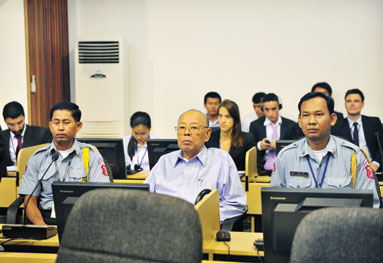
Iang Sary, who was deputy prime minister and foreign minister during the rule of the Khmer Rouge, sits through a hearing at the Khmer Rouge Tribunal yesterday


A feeble Ieng Sary appeared before Cambodia’s war crimes tribunal yesterday to challenge his provisional detention ahead of his looming trial alongside three other senior Khmer Rouge leaders.

Lawyers for the former KR foreign minister argued that judges had not rendered a sufficiently reasoned decision on the defence appeal of last year’s indictment within the window during which the court could still compel their client’s detention. The maximum time limit for pre-trial detention since Ieng Sary’s 2007 arrest has therefore now lapsed, the defence said.

The challenge follows appeals earlier this year on similar grounds by the other three defendants set to be tried in the court’s second case: former KR head of state Khieu Samphan, Brother No 2 Nuon Chea and Social Action Minister Ieng Thirith. These appeals have been rejected.

Despite this precedent, defence lawyer Ang Udom told the court yesterday that there was no legal basis to continue Ieng Sary’s detention.

“Mr Ieng Sary has the presumption of innocence and has not been convicted of any crime,” Ang Udom said.

“The most suitable remedy is to release Mr Ieng Sary on bail immediately.”

The defence recommended that Ieng Sary be released from the court’s detention facility and placed under house arrest at his expansive home in Phnom Penh.

“Brother No 3” himself, now 85 years old, managed less than an hour in court yesterday before asking to leave due to fatigue. His lawyers have requested that the court conduct his upcoming trial in half-day sessions in view of his health concerns.

Donning the loose-fitting button-down shirt of the style he has worn in previous hearings, he appeared fatigued and at one point seemed to doze off as his lawyers spoke in front of him. Early in the session, the defence asked that he be given leave for a bathroom break.

Much of the argument yesterday followed the template of previous hearings on pre-trial detention. At one point, however, defence lawyer Michael Karnavas provided a sample of the debate over Cambodia’s complicated history with the West that is sure to come at greater length in the upcoming trial.

Responding to comments from deputy prosecutor Veng Huot, who noted in passing statements of support for the tribunal from United Nations secretary general Ban Ki-moon and American secretary of state Hillary Clinton, Karnavas said the UN was not “in any position to be lecturing”, given its support for the Khmer Rouge for years following their 1979 overthrow.

“I do believe that we should be entitled to talk about the carpet bombing, by the United States, of Cambodia. We should be able to talk about the UN’s involvement after 1979,” Karnavas said, accusing UN officials of limiting the court’s jurisdiction to events between 1975 and 1979 “to ensure that those issues were not properly vented out”.
Read more!

Vaccine touted as cancer prevention

The creator of the human papilloma virus vaccine, Professor Ian Frazer, visited Cambodia yesterday and stated that vaccination prior to sexual activity was a crucial step in protecting against infections that can cause cervical cancer.

Professor Frazer told an audience at the Australian Embassy in Phnom Penh yesterday that 80 percent of HPV infections are contracted within three years of becoming sexually active.

“[About] 70 to 80 percent of women who are sexually active get the virus,” he said. “The public health benefit comes from vaccinating young women before they become sexually active.”

Genital HPV infections are primarily transmitted through sexual intercourse and are linked to most cases of cervical cancer. The HPV vaccine is administered in three doses and has been given to over 60 million women worldwide.

Professor Frazer added that two HPV vaccines on the market protect against virus types 16 and 18, which cause about 70 percent of cervical cancers.

An HPV vaccination programme began in Cambodia in June 2008.
Read more!

Cambodia, Thailand agree to border station points for deploying observers: Cambodian FM

Cambodia agreed to accept the finalized arrangements for the deployment of Indonesian observers to the disputed border areas near Preah Vihear temple after Thailand has removed a disputed station point, Cambodian Minister of Foreign Affairs and International Cooperation Hor Namhong said on Thursday.

"Cambodia replied to Indonesia, current ASEAN chair, on May 4 about the acceptance of the 7th terms of reference (TOR) for the deployment of Indonesian observers to the border with Thailand," he said at Phnom Penh International Airport before leaving for ASEAN foreign ministers' meeting on May 6 in Jakarta, Indonesia.

"This is the finalized TOR," he said.

Hor Namhong said that Cambodia has got unofficial information that Thai cabinet ministers' meeting on May 3 also agreed to accept Indonesian observers to Cambodian-Thai border.

"So, I hope the TOR for observers will be signed in the ASEAN foreign ministers' meeting on May 6 between Cambodian, Thai and Indonesian foreign ministers," he said.

"After that, Cambodia would urge Indonesia to send observers as soon as possible to ensure a permanent ceasefire," he said.

Cambodia and Thailand invited Indonesian observers to their respective border near Preah Vihear temple on Feb. 22 in the ASEAN informal foreign ministers' meeting after the deadly clashes on Feb. 4-7.

At that time, Indonesia agreed to send 15 observers to each border side of Cambodia and Thailand in order to monitor a ceasefire, but since then the sending has not happened as both sides have not agreed on TOR.

The border between Thailand and Cambodia has never been completely demarcated.

Cambodia's Preah Vihear temple was enlisted as a World Heritage Site on July 7, 2008. But Thailand claims the ownership of 4.6 square kilometers (1.8 square miles) of scrub next to the temple.

Just a week after the enlistment, Cambodia and Thailand had a border conflict, triggering a military build-up along the border, and periodic clashes between Cambodian and Thai soldiers have resulted in the deaths of troops on both sides.

ASEAN (The Association of Southeast Asian Nations) groups Brunei, Cambodia, Indonesia, Laos, Malaysia, Myanmar, the Philippines, Singapore, Thailand and Vietnam.

Source: Xinhua
Read more!

Wednesday, May 04, 2011

ASEAN Leaders Will Discuss Thai-Cambodia Conflict at Summit

An armed police officer stands guard outside the venue of the 18th ASEAN Summit - will be held on May 7-8 in Jakarta, Indonesia, May 4, 2011

Leaders from the Association of Southeast Asian Nations are gathering this week in Jakarta (May 5-8) to discuss regional economic development and mutual security issues.

Indonesia's Foreign Ministry's spokesman Michael Tene says ASEAN's role in trying to end an ongoing border conflict between Thailand and Cambodia will almost certainly be addressed when the heads of state meet May 7.

"Of course the development in Thailand, on the border of Thailand and Cambodia is one of major issues developing in our region. So it will be very natural I believe that such issues will be taken up in the summit," he said.

Indonesia took over the chairmanship of the group of 10 Southeast Asian nations this year and made it a stated goal to transform the organization from a loose association to an active participant in global economic and security matters.

But in February clashes erupted between two ASEAN members, Thailand and Cambodia. The two armies have been fighting sporadically over an area surrounding a Hindu Khmer temple, a historical landmark that both countries claim as part of their heritage.

As head of ASEAN, Indonesian Foreign Minister Marty Natalegawa saw this conflict as a test case for what the organization leadership could achieve and he has actively tried to negotiate an end to the conflict. So far his efforts have been unsuccessful, but ASEAN Secretary General Surin Pitsuwan says Natalegawa should get credit for his unprecedented diplomatic efforts.

"There has never been one single special meeting of the foreign ministers on an issue between states before, ever. We have made history under Indonesia. There has never been an attempt by the chair to go to the two capitals and holding hands and talking and try to convince that this is something that we will have to work out together," said Pitsuwan.

He says in addition to continuing to resolve the Thai-Cambodia border conflict, leaders at the summit will also likely discuss how to build on Indonesia's efforts to make ASEAN an integrated economic and political community in the future.
Read more!

Thailand, Cambodia trade blame over border battles

Thai army tanks travel on a road near the Thai-Cambodia border in Surin province April 28, 2011. REUTERS/Sukree Sukplang

* Thailand says clashes are "masterfully orchestrated"

* Thai claims baseless, Cambodia says

By Martin Petty

BANGKOK, May 4 (Reuters) - Thailand and Cambodia traded barbs on Wednesday over which side started a bloody border dispute that is set to take centre stage at a meeting of Southeast Asian leaders in Jakarta this weekend.

Fighting between the two armies appeared to have eased after 12 days of artillery and gunfire that have killed 18 people on both sides, but there was no let-up in the diplomatic battle ahead of a summit of the 10-member Association of South East Asian Nations.

Thai Prime Minister Abhisit Vejjajiva accused Cambodia of repeated attacks on Thai troops aimed at internationalising a dispute over sovereignty and influencing foreign opinion in its favour.

"Each time we clashed, it's not an accident but an intentional attempt to push the conflict to the international stage," Abhisit told reporters.

"It matches with Cambodia's strategy that the timing of each attack is linked to their goal of using the international stage (to protect Cambodian interests). We will defend our rights."

His Cambodian counterpart, Hun Sen, said on Wednesday there was a need to build trust and agree to a ceasefire but appeared to ridicule Thai troops, which he said were "shooting because they are afraid of ghosts".

Exactly why the two countries are in conflict and which side fired first remain a mystery but many analysts say there are political forces on either side that stand to gain domestically if the crisis continues.

At the centre of the latest flare-up are two 12th-Century stone-walled Hindu temples, Ta Moan and Ta Krabey, in a heavily mined jungle area that both sides claim.


DECADES-OLD ROW

The dispute over jurisdiction has been ongoing since the 1950s, when colonial power France pulled out of Cambodia. Another, more significant temple, Preah Vihear, was awarded to Cambodia in 1962 by the International Court of Justice.

Thailand insists it accepts Cambodia's jurisdiction of the 11th Century temple but is challenging its listing of the ruins as a UNESCO World Heritage Site and its management plans, because the ICJ did not rule on the 4.6 sq km (1.8 sq miles) of land around it.

Late last week, Cambodia asked the ICJ to settle the Preah Vihear issue by giving an explanation for a judgment it delivered half a century ago.

However, the request sent by Cambodia, written in French and posted on the ICJ's website on Tuesday, could become a bone of contention.

Cambodia told the ICJ that Thailand had orchestrated "serious armed incidents" between April 22 and 26, but the letter, signed by Cambodian Foreign Minister Hor Namhong, was dated April 20.

It was not immediately clear if the date entered by Hor Namhong was a mistake.

Cambodian Foreign Ministry spokesman Koy Kuong declined to comment specifically on the letter.

"The accusation by Thailand that Cambodia planned to start the fighting has no legal basis," he said.

A senior Thai Foreign Ministry official, who requested anonymity, said the letter proved the fighting had been "masterfully orchestrated" by Cambodia.

Both sides have called for calm and no meeting has yet been arranged between the two countries' leaders on the sidelines of the ASEAN summit starting on Saturday.

As chair of ASEAN, Indonesia intervened in February, at the request of the United Nations Security Council, when the conflict first flared from Feb 4-7, killing 11 troops.

Both sides agreed to allow 15 unarmed Indonesian military observers to be stationed on either side of the border to monitor the fragile peace agreement, but the plan has yet to be put in place.

Analysts say the breaching of the ceasefire on April 22 could weigh heavy on ASEAN's plans to form a regional community by 2015 and bloc Secretary General Surin Pitsuwan has urged an immediate ceasefire to prevent damage to its reputation. (Additional reporting by Ambika Ahuja and Phnom Penh bureau; Editing by Nick Macfie)
Read more!

Head of legal team to ICJ named

Veerachai Palasai, Thai ambassador to the Hague and former director-general of the Treaties and Legal Affairs Department, has been appointed head of the legal team to defend Thailand at the International Court of Justice (ICJ) on the Preah Vihear temple issue, Foreign Minister Kasit Piromya said on Wednesday.

Mr Kasit said this on his return from Geneva, Switzerland, where he met three foreign lawyers to discuss preparedness for the defence in the ICJ.

An addition to Mr Veerachai, Ithiporn Boonprakong, director-general of the Treaties and Legal Affairs Department, legal experts and historians of the Foreign Ministry will be responsible for compiling information and studying the petition filed by Cambodia with the ICJ.

Cambodia is seeking the ICJ's interpretation of its 1962 judgement on the Preah Vihear temple and accuses Thailand of aggression in attempts to claim Cambodian territory.

Mr Kasit said the ICJ has arranged for Thailand and Cambodia to attend a hearing of the ICJ on May 30-31.

Mr Veerachai will represent Thailand at this hearing. It is expected each side will take three to four hours making its points to the court.

Both countries will present their prepared documents to the court on this occasion.

The ICJ is expected to take four to five months considering the case, he said. He expected a decision early next year.
Read more!

Julie spotted in Siame Reap

International superstar Angelina Jolie was spotted at Siem Reap airport yesterday after an advertisement shoot for luxury brand Luis Vuitton reportedly finished.


Angelina Julie arrived by helicopet at Siam Reap international
 Airport following a day trip to Battambang Province yesterday

Accompanied by her children, including adopted Cambodian-born son Maddox, Jolie was seen exiting a helicopter late in the afternoon.

A small number of tourists watched on – before security guards brought out screens to shield the family – as the group was whisked away in a mini-van and two four-wheeled drives, complete with darkened windows.

The drivers were wearing uniforms of Siem Reap’s exclusive Amansara hotel.

A well-placed source said Jolie had flown from Siem Reap to Battambang province in the morning and returned later that day.

In 2003, the mega-star founded an NGO called the Maddox Jolie-Pitt Foundation, which operates out of Battambang province. It tackles conservation, education and infrastructure projects in the area.

Yesterday, the foundation’s human resources manager said he could not comment on Jolie as he had been on leave.

The star of Lara Croft: Tomb Raider is thought to have arrived in Cambodia on Saturday for filming after a production team scouted out potential locations.

An advert was shot on the banks of a Siem Reap river while an interview for Louis Vuitton was also filmed, said a source close to the shoot who wished to remain anonymous.

Khmer Mekong Films provided the back-up production for the shoot.

The filming was yesterday hailed as a boon for the Kingdom’s film production sector by Cedric Eloy, chief economic officer of the Cambodian Film Commission. “This shows that Cambodia is a safe place to shoot movies,” he said. “In some quarters it still has the image of a place with violence, but projects like this will help to change the image.

“We’ve had six feature films shot in Cambodia in the last six months, and the film industry is opening Cambodia up to the world,” he added.


Read more!

Tuesday, May 03, 2011

Cambodia takes dispute with Thailand to UN court

Thai soldiers ride on a pickup truck to the Thai-Cambodian frontline in Surin province, northeastern Thailand, Saturday, April 30, 2011. Troops from Thailand and Cambodia exchanged fire at the countries' contested border again Saturday, marking the ninth straight day of clashes

By MIKE CORDER
Associated Press


Cambodia has asked the United Nations' highest court to order Thailand to withdraw troops and halt military activity around a temple at the center of a decades-old border dispute that has flared into deadly military clashes.

Fighting in recent weeks along the disputed border region in northeastern Thailand that surrounds the Preah Vihear temple has left 16 soldiers and one Thai civilian dead.

In a request filed April 28 and made available Tuesday on the court's website, Cambodia asked International Court of Justice judges to urgently deal with its request "because of the gravity of the situation."
Cambodia claims that according to a 1962 ruling by the court the temple is on its territory and warns that if the intervention request is rejected and clashes continue, "the damage to the Temple of Preah Vihear, as well as irremediable losses of life and human suffering ... would become worse."

The border dispute has stirred nationalist sentiment on both sides. But analysts say domestic politics may also be fueling the conflict, especially in Thailand, where the military that staged a coup in 2006 could be flexing its muscles ahead of elections due in June or July.

The conflict involves small swaths of land along the border that have been disputed for more than half a century. Including the latest fighting, clashes have broken out six times since 2008, when Cambodia's 11th-century Preah Vihear temple was given U.N. World Heritage status over Thailand's objections.

Analysts say the fighting is primarily being driven by domestic tensions within each country rather than tensions between them. Neither side appears to be trying to capture territory, and few believe the conflict will evolve into full-scale war.

The fighting forced tens of thousands of villagers on both sides of the border to flee their homes. Many of them returned this week from makeshift refugee camps as the latest skirmishes eased from artillery barrages to small arms exchanges.

Rulings by the court are supposed to be final and binding on parties.

Cambodia has formally applied for an "interpretation" - a written explanation - by the court of its 1962 judgment, and argued in its written application that the court's opinion "could then serve as a basis for a final resolution of this dispute through negotiation or any other peaceful means."
Read more!

International Court Expects Temple Hearing Soon

The International Court of Justice is likely to hold a hearing on the Preah Vihear temple issue in a matter of weeks, an official there told VOA Khmer Tuesday.

Cambodia has petitioned the court to re-interpret a 1962 decision that gave Preah Vihear temple to Cambodia but left both Thailand and Cambodia claiming adjacent land.

Cambodia hopes a hearing will clarify the decision, which officials here say should include the land. Both sides claim a 4.6-kilometer stretch of land near the temple.

The disputed land has been at the center of a military standoff since 2008 that has killed dozens of people in a series of skirmishes over the years, including the deadliest clashes over the last week and a half. At least 18 have died in fighting that began April 22.

On April 28, Cambodia filed a request to the international court to clarify its 1962 decision, requesting “urgent” action to protect Preah Vihear temple, as Cambodian and Thai troops exchanged rocket and artillery fire along the border.

Biris Heim, a spokesman for the International Court of Justice, said the court will now “fix a date with all parties” so that they can appear before the court with arguments.

“It will be an oral hearing, and it can be between a few days and a few weeks,” he said.

Both Cambodia and Thailand have been notified of the case, he said, but the court will not send investigators to the field.

“Parties will provide evidence,” he said. “The court can only make an interpretation by hearing from both sides.”

Thailand, meanwhile, has begun preparing a group of experts to respond to the court, according to Thai media.

.
Read more!

"Operation Death Match" Nets Carson/Incline Man

CARSON CITY, NV - When Lawrence Joseph Read, a former Carson City/Incline Village resident filed for a passport in Buenos Aires, Argentina and again in Phnom Penh, Cambodia, he became a suspect in "Operation Death Match." He tried to use a fraudulent Nevada Driver's License with a deceased man's name.

'Operation Death Match' is a Diplomatic Security Service program that compares passport applications with state death records, and now Read is going to prison for two years for identity theft.

According to the Attorney General for the District of Nevada, he was netted because he tried numerous times to use the name, date of birth and social security number of Michael Truman Hummel, who died in 1996.

Read used a Nevada driver's license with his own picture and an Incline Village address, but somehow it had Hummel's name. Read tried once in 2003 in Argentina and again in 2006 in Phnom Penh, Cambodia. On the application in Cambodia, he listed his permanent address as Carson City, Nevada.

Under federal law, anyone who commits a crime at an American Embassy can be prosecuted by a federal judge in the area of their last-known address, which is the District of Nevada. On January 18th he pleaded guilty to one count of aggravated identity theft and on Monday he was sentenced to two years in prison.
Read more!