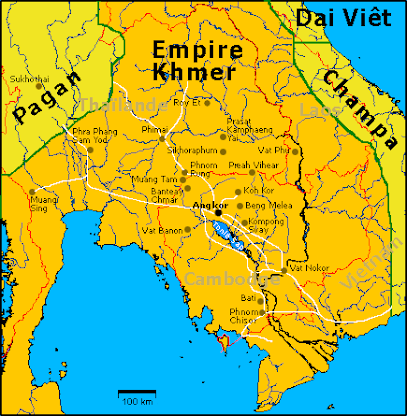
The land of heroes
Our heroes
Our land
Cambodia Kingdom


Thursday, April 07, 2011

Hilltown Ten Thousand Villages staffers visit artisans in Laos, Cambodia

By Erin DuBois
Associate Editor

With no electricity or running water, and sometimes even with no hands, villagers in Laos and Cambodia craft objects of beauty from the remnants of war. Deanna Husk, assistant manager at Ten Thousand Villages Souderton store, witnessed the transformation process during a trip Feb. 6 to 20 to visit some of the fair trade retailer’s international artisan partners.


Hilltown Ten Thousand Villages store assistant manager
Deanna Husk at the Potter's wheel with Artisans


The learning tour is an annual event for Ten Thousand Villages employees, and 12 staff members traveled to two countries, which Husk said are “every single day still affected by land mines.”

Cambodia has one of the highest rates of disabled persons in the world, due not only to land mines, but also to polio and untreated diabetes, Husk said. United Nations estimates suggest that Cambodia still has 4 million to 6 million unexploded landmines, and 7,300 casualties have been recorded from 1999 to 2008, Husk said.

Rehab Craft Cambodia is operated entirely by Cambodians with disabilities, half of whom are landmine amputees. The organization strives to improve their quality of life and their status as contributing members of society.

“The smiles on their faces really touched my heart,” Husk said during a presentation at Dock Meadows retirement home in Hatfield March 29.

Check Chan has worked his way up from messenger to production manager despite the loss of both his hands. Many employees are hired with no education or training, and working at Rehab Craft Cambodia allows them to gain valuable skills.

“They are being provided something that no one can take away,” Husk said.

Artisans incorporate renewable resources into their handiwork, carving ornaments from dried coconut shells. They also make the silk ikat purses available in Ten Thousand Villages stores. The Rajana Association employs 40 full-time staff and supports 130 families living in rural villages, selling their products in its Cambodian shops as well as in Ten Thousand Villages stores.

Dove pendant necklaces are made from bomb casings, with the word “peace” in English and Khmer stamped on the wings.

“They are making something beautiful and making money from something that is still tragic in their lives,” Husk said.

The Rajana Association logo is three elephants, a symbol of joint labor and solidarity. In the rural villages, families work together to make soap, do metalwork and weave silk, often in difficult conditions.

One learning tour participant bought 100 small baskets, allowing a family to pay its electric bill. Villager Chin Sovann previously rode her bike an hour to get to work; but with her earnings she was able to buy a motorbike, reducing her commute to 20 minutes.

“Now she can spend more time at home with her family,” Husk said.

Husk learned to weave baskets in one village without the aid of a translator.

“That moment was beautiful because of the common language” of touching and smiling, Husk said.

At Phontong Handicrafts in Laos, silk weaving is no longer a dying art thanks to founder and director Kommaly Chanthavong. Chanthavong was nominated for the 2005 Nobel Peace Prize and was invited to Washington, D.C., to be honored by first lady Michelle Obama and Secretary of State Hillary Clinton for winning the 2011 International Woman of Courage Award, Husk said. Chanthavong grew up in one of the most impoverished regions of Cambodia, and her vision is to expand silk production into the poorer areas, engaging silk farmers in the entire production cycle, Husk said.

Her granddaughter, Phoukham, is currently working in the Ten Thousand Villages Souderton store through Mennonite Central Committee’s International Visitor Exchange Program. She arrived August 2010 and will continue until July, serving in all areas of the store’s daily operations, according to Husk.

“It’s a great way for her to see the items they make in Laos sold in the store,” Husk said.

Ten Thousand Villages partners with artisans in over 38 developing countries, creating income and bringing the artisans’ products as well as their stories into its markets, according to Husk. The goal is to develop long-term fair trade relationships, treating both the artisans and the environment with respect.

Artisans receive half of the purchase price in advance and are paid in full before their products are shipped, with Ten Thousand Villages paying shipping costs. Establishing long-term relationships allows artisans to depend on future pay so that they can invest in community development.

Ten Thousand Villages employees collaborate with artisans on product design so that the artisans’ traditions can be preserved and so that the environment will be protected by using renewable resources, Husk said.

Ten Thousand Villages, a nonprofit program of the Mennonite Central Committee, operates over 150 stores across the United States. The Souderton store, which was the third store to open, began in 1975.

For more information, visit Souderton.tenthousandvillages.com  
Read more!

Group Confirms Cluster Bomb Use by Thailand

The CMC said Thailand’s ambassador to the UN in Geneva confirmed the use of the cluster munitions in 155-mm artillery shells fired during deadly border fighting in February.

An international anti-cluster bomb group has confirmed the use of the munitions by Thailand during border clashes with Cambodia in February.

The Cluster Munition Coalition said it had investigated sites inside Cambodia where the munitions fell near Preah Vihear temple and found unexploded submunitions and fragments.

At least two people were killed when they handled an unexploded bomblet that detonated and seven others have been injured in explosions, the group said in a statement.

The Coalition called on Cambodia and Thailand to prohibit the use of cluster bombs, which are scattered over a wide area and sometimes fail to detonate, leaving behind dangerous remnants.

Neither Cambodia nor Thailand are party to an international ban on such weapons.

“It’s appalling that any country would resort to using cluster munitions after the international community banned them,” Laura Cheeseman, director of the CMC, said in a statement. “Thailand has been a leader in the global ban on antipersonnel mines, and it is unconscionable that it used banned weapons that indiscriminately kill and injure civilians in a similar manner.”

The CMC said Thailand’s ambassador to the UN in Geneva confirmed the use of the cluster munitions in 155-mm artillery shells fired during deadly border fighting in February.

Thani Thongphakdi, a spokesman for the Thai Foreign Ministsry, told VOA Khmer Thursday the Thais had fired in “self defense” after Cambodia attacked with multiple rocket launchers.

“Both sides lost civilian property,” he said. “Cambodia’s BM21 multiple rocket launchers are very danger to Thai civilians. We had aimed at military targets, but not civilian targets.”

However, observers say civilians are now endangered by the munitions.

“There are around 5,000 people living in Sen Chey village that are at risk from these unexploded weapons,” Atle Karlsen of Norwegian People’s Aid said in CMC statement. “Thailand must supply information to help clear affected areas and make them safe for civilians to return home.”

Sao Cheth, who commands 30 Cambodian soldiers at Phnom Trop near the temple and was injured above the eye in February’s clashes, said he supported the group’s stance against the weapons.

“The condemnation is a right and fair thing, because the world has banned the use of cluster munitions,” he said.

Prak Phy, head of Samdech Hun Sen Natural Village, said residents there had suffered damage to their houses, property and rice fields, but no one has so far been injured by ordnance.

“I demand Thailand to be responsible for firing the cluster munitions in Cambodia, and I want Thailand to stop firing cluster munitions in Cambodia,” he said.

Authorities have explained to villagers not to touch unexploded munitions in the area, while the Cambodian Mine Action Center has set up warning signs around the dangerous areas, he said.
Read more!

Wednesday, April 06, 2011

Cambodian ex-king returns from China

PHNOM PENH - CAMBODIA'S ailing former king Norodom Sihanouk returned home on Wednesday from Beijing where he spent nine months receiving medical treatment, officials said.

Mr Sihanouk and his wife were given a red-carpet welcome by family members, Prime Minister Hun Sen and other senior government officials upon arrival at Phnom Penh airport.

A smiling Mr Sihanouk, 88, pressed his hands together and kissed them in a traditional greeting to well-wishers before getting into a car that whisked him off to the royal palace.

One of Asia's longest-serving monarchs, the revered king abruptly quit the throne in October 2004 in favour of his son, citing old age and health problems.

Prince Sisowath Chivan Monirak, deputy president of the Cambodian senate, told reporters Mr Sihanouk had kept his promise 'to come back for Khmer New Year' and that the ex-monarch's doctors 'had no problem' with his return to Cambodia.

The new year festivities, which start on April 14 and last for three days, are a popular time for families to get together. -- AFP
Read more!

Cambodia PM and ROTA officials inaugurate new school project

 There are 15,000 crowd and 200 government officials attend ceremony

 Essa Al Mannai: "The new Samdec-ROTA High Schools are built in line with our international commitment to provide quality education in countries which most need ROTA's assistance"


Doha, Qatar, 6 April 2011: The Prime Minister of Cambodia His Excellency Hun Sen joined Reach Out To Asia (ROTA) Director Mr. Essa Al Mannai, Cambodian government officials, 15,000 cheering community members and a team of ROTA representatives at the Inauguration Ceremony of the ROTA-funded new Samdech Akka Moha Sena Padei Techo Hun Sen- ROTA General and Technical High School in Vihear Suork, Kandal Province, Cambodia.

Emphasizing the ceremony's significance to the future of education in Cambodia, H.E The Prime Minister was joined by 200 government officials including The minister of Education and Ministry of Education representatives plus teachers, students and families as the local community celebrated the handover of ownership of the new Samdech High Schools.

"I have no doubt the new Samdech Akka Moha Sena Padei Techo Hun Se - ROTA General and Technical High School will become a centre of education excellence in the region. The old school - with primary, low secondary and high secondary schools in the same building - was overcrowded and running on a double shift System, the new ROTA school will cover the high secondary section which will reduce the pressure from the old school and all schools will be running on single shifts, accordingly the pressure on the teachers will be reduced and their productivity and teaching quality will be improved. The new schools are built in line with ROTA's international commitment to provide sustainable quality education in countries which most need Qatar's assistance," said Essa Al Mannai.

Located on the outskirts of Phnom Penh, the educational vision for Vihear Suork is to create an educational hub encompassing a secondary school, Vocational Training Institute and, in the long term, a University.?

Starting in July 2007, ROTA and its Cambodian partner the Monithapana Foundation and Monithapana Khasatch Kandal High School agreed plans to expand the old Vihear Suork Schools by building new primary, secondary and vocational schools. Recently renamed the Samdech Akka Moha Sena Padei Techo Hun Sen - ROTA General and Technical High School, the new name acknowledges the affection and respect the people of Cambodia have for H.E. The Prime Minister Hun Sen.

Construction of the new schools - which created temporary employment for 250 laborers and consultants, and long-term careers for 88 teachers and 18 school administration staff - began in 2009. Completed ahead of schedule in mid-November 2010, the new schools provide additional and improved access to primary and secondary education, as well as up-to-date technical skills, for 2,750 Cambodian youth each year.

With the potential to benefit more than 500,000 people in the surrounding community, the new Samdech High Schools campus boasts hi-tech science laboratories, fully equipped and multimedia enabled classrooms and a computer laboratory.

In addition, ROTA's commitment to Cambodia also provides consultancy to empower the school's administration, staff and children as they seek to identity income generation projects to increase the school's long-term financial autonomy and self sufficiency.

"Cambodia's 30-year struggle with civil war and socio-political unrest has left over 35% of the population living in poverty. ROTA's strategy enables children and youth to access primary and secondary education that is focused on local needs, thereby empowering communities with the tools to eradicate poverty by their own hands," said Essa Al Mannai.

The Samdech High Schools inauguration ceremony took place during a 5-day tour of ROTA projects in South East Asia by a team of ROTA representatives. During their stay in Cambodia, the ROTA Team visited a second project, the Kampot Traditional Music and Dance School in Kampot province. Founded in 1994, the school is unique in Cambodia as it provides cultural education focusing on traditional Khmer music, dance and vocational training to approximately 30 orphaned, disabled or vulnerable children, in addition to 170 students from the local community.

In partnership with the Khmer Cultural Development Institute (KCDI), ROTA supports the Kampot School management to integrate Cambodia's Policy on Alternative Care for Children and the UN Convention on the Rights of the Child into school policies.

"ROTA's work in Cambodia tackles two key challenges: providing access to education by funding construction of the Samdech High Schools, and helping the KCDI strengthen and improve its educational, administrative, financial, staff and student capacities," explained Essa Al Mannai.

Cambodia ranks among the poorest countries in the world (136th out of 179) and the country's 30+ year struggle with civil war and socio-political unrest has led to over 35% of the population living below the poverty line.

Barriers facing primary and secondary education in Cambodia include many children enrolled in school older than the recommended age (6 years), high number of primary school dropouts, numerous incomplete primary school buildings, low quality teacher training, lack of a sufficient core curriculum and widespread child labor.

"ROTA's mission in Cambodia is to achieve Qatar's contribution to the UNESCO Millennium Development Goals. It is important we never lose sight of quality and excellence, which is why the school has been constructed and equipped to the best standards, in line with sustainable global educational requirements," added Essa Al Mannai.

-Ends-

About ROTAReach Out To Asia is a non-profit organization launched in December 2005 in Doha, Qatar, by Her Excellency Sheikha Al Mayassa bint Hamad bin Khalifa Al Thani, daughter of His Highness the Emir of Qatar. Operating under the auspices of the Qatar Foundation, ROTA is committed to providing high quality and relevant primary and secondary education, encouraging relationships among communities, creating safe learning environments and restoring education in crisis affected areas across Asia and around the world. ROTA envisions a world, where all young people have access to the education they need in order for them to realize their full potential and shape the development of their communities.

Further information on Reach Out To Asia can be found at: www.reachouttoasia.org.

About Qatar FoundationFounded in 1995 by His Highness Sheikh Hamad Bin Khalifa Al Thani, Emir of Qatar, and chaired by Her Highness Sheikha Mozah Bint Nasser Al Misned, Qatar Foundation is a private, non-profit organization committed to the principle that a nation's greatest natural resource is its people. The headquarters of Qatar Foundation are located within its flagship project, Education City. A fourteen million square-metre campus, Education City is home to numerous progressive learning institutions and centers of research, including branch campuses of six of the world's leading universities, plus a cutting-edge science and technology park. Qatar Foundation also works to enhance the quality of life in Qatar by investing in 'Education, Science and Technology and Community Health and Development'.

For further information please contact:
Krikor Khatchikian
Senior Account Manager
Cohn&Wolfe Public Relations, Doha, Qatar
Telephone: +974 4428 3177
Email: krikor.khatchikian@cohnwolfeqatar.com
Read more!

Growing Economy at a ‘Crossroads’: ADB

The Asian Development Bank said Wednesday Cambodia’s economic growth in coming years will reach up to 6.7 percent, driven by recovery in key sectors following the 2008 economic crisis.


The bank estimated Cambodia's gross domestic
 prdoduct to grow 6.5 per cent in 2011 and 6.8 in 2012

Peter Brimble, a senior economist for the Bank, said growth in 2010 showed Cambodia on a strong footing. But he warned the country is now at a “crossroads,” with economic drivers showing a lot of potential.

“The pressure is now on to intensify efforts at meeting the longstanding challenges of accelerating economic diversification and improving the general investment climate,” Brimble said in a statement.

Poulang Doung, an economist for the Bank, said Wednesday that the country’s growth derived from recovery in clothing exports and tourism that had flagged in 2009, as well as growth in agriculture.

“We think that Cambodian recovery is firming up, but the country remains heavily dependent on a few sources of driver growth that includes the agri-sector, garment, tourism, construction and real estate,” he said.

Cambodia’s economy still relies on the US and EU markets, especially for its garment exports, he said.

Garment export to the US grew from about $1.9 billion in 2009 to $2.2 billion in 2010, according the US Department of Commerce.

Tourist arrivals, meanwhile, climbed from 2.2 million to 2.5 million during the same period, bringing in a total revenue of $1.8 billion in 2010, Poulang Doung said. The agricultural sector grew by about 4.2 percent in 2010, thanks in part to an increase in rice production.

The Bank estimated Cambodia’s gross domestic product would grow 6.5 percent in 2011 and 6.8 percent in 2012, up from a growth rate of 6.3 percent last year.

Chan Sophal, an economist and president of the Cambodia Economic Association, said he expected growth over the next two years to reach up to 8 percent, thanks to strong improvements in many sections of the economy.

The country cannot depend only on rice, garments, tourism, construction and real estate, he said, but must invest in the production of vegetables and fruit, cattle, pork, poultry, and the production of consumer goods, like sugar or furniture.
Read more!

Thailand Uses Cluster Munitions Against Cambodia

A group that campaigns against the use of cluster munitions says Thailand used the outlawed weapons against Cambodia during border clashes in February this year.

The Cluster Munition Coalition, or CMC, says it carried out two inspections of areas in northern Cambodia that were shelled by Thailand during several days of fighting in February and concluded that Thailand did fire cluster munitions.

CMC director Laura Cheeseman says Thailand’s ambassador to the United Nations in Geneva admitted in a meeting this week that his country used the weapons.

The Thai ambassador claimed his country acted in self defense and in accordance with military codes.

Cluster munitions are small bombs that are typically packed 50 to 60 at a time into an artillery shell. On impact the munitions scatter widely and are meant to explode. But they have a high failure rate, which means many remain armed and lethal, and end up killing civilians often years later.

The CMC says this is the first use of the weapons since the global Convention on Cluster Munitions took effect in 2010. The treaty, signed by 108 countries and ratified by about half of them, bans countries from producing, stockpiling and using cluster munitions. Thailand was not one of the signers, while Cambodia has signed but not yet ratified it.

Heng Ratana is the director-general of Cambodian Mine Action Center, the government agency that is tasked with ridding Cambodia of landmines and bombs. He says when news of cluster munitions first arose in February, CMAC was concerned the issue would be highly politicized.

"But from the CMAC point of view it is a humanitarian issue, because we identify cluster on the ground and we were so worried about 4 to 5,000 families will return to their community and will be affected by cluster munitions on the ground," Ratana explains.

Ratana says CMAC has already taken steps to inform people in the shelled area about the dangers of cluster munitions.

"We already provide some cluster awareness to at least around 4,000 families who are affected by this cluster already. And we also provide posters on the trees and so on, or on the walls of schools to provide that kind of awareness in place as well. So we hope that this will provide good safety for them," Ratana said.

Meanwhile, the Cluster Munition Coalition says both Thailand and Cambodia should immediately agree that neither will use the banned weapons, and that both will sign the treaty.
Read more!

Tuesday, April 05, 2011

American Laments Injustice for 1997 Grenade Attack

A Phnom Penh resident is treated for wounds at Calmette Hospital he received during a mortar attack in the capital in the late afternoon on Saturday July 5,1997. Fighting broke out between troops loyal to the rival prime ministers and shellfire hit downtown areas.

While the US FBI has closed its investigation into a deadly grenade attack on an opposition rally 14 years ago, an American injured in the attack says he has not given up.

Ron Abney, the former head of the International Republican Institute in Cambodia, was the sole American injured among at least 150 others when unknown assailants threw a series of grenades into an opposition rally in Phnom Penh.

Sixteen people died in the attack, which took place on March 30, 1997.

In September 2010, Abney filed a complaint with the New York Attorney General’s office, claiming Prime Minister Hun Sen, who was visiting the state at the time, and his subordinates had obstructed justice during an ensuing FBI investigation of the attack. Hun Sen and his representatives have repeatedly declined to comment on the case.

“It’s about those families, the cane seller, Japanese photographer, and myself,” Abney told VOA Khmer in an interview, referring to those who were injured or killed. He called the attack “attempted murder.”

“It’s not about me,” he said. “It’s never been about me.”

However, it was Abney’s US citizenship that led to an FBI investigation. The FBI interviewed witnesses in and out of the presence of Cambodian officials, in sites from Cambodia, Thailand and the US, according to FBI documents released to VOA Khmer.

The FBI interviewed former bodyguards of Hun Sen, who was co-premier at the time, questioning them about their unusual deployment at the rally and accusations they had abetted the escape of the attackers.

No conclusive results came as a result of the investigation, which was later closed, and no one has ever been convicted for the attack. The FBI concluded that Abney was not the intended target.

Morton Sklar, Abney’s attorney for the New York suit, said in an email the criminal complaint was filed as “part of a larger effort that we have been engaged in to bring pressure on Hun Sen concerning his widespread human rights abuses, past and present.”

Hun Sen can invoke immunity as the head of state as long as he is in power, Sklar added.

Samrith Duonghak, a former journalist who was injured as he covered the 1997 rally, said in an interview recently he was not able to walk for two months after he was hit with shrapnel.

“Worse than my case, some people have lost their husbands and relatives,” he said. “Per rule of law, shall we continue with this culture of impunity?”

Abney, who returns to Cambodia regularly to maintain an orphanage he established here, said he too retains a painful memory of the attack. However, he said he is not afraid to pursue justice for it.

“They always tell me, if you miss the first time with a hand grenade, you’ll miss the second time too,” he said.

Hun Sen advisers contacted by VOA Khmer declined to comment on the case. Adviser Prak Sokhun said the case was out of date. In New York last year, adviser Sry Thamarong said Hun Sen’s administration would pay no heed to Abney’s suit.

In Cambodia, Abney said, there is little remembrance of the attack, which came during a turbulent time in Cambodian politics—and just ahead of the July 1997 coup that put Hun Sen and the ruling Cambodian People’s Party firmly in power.

However, each year the opposition Sam Rainsy Party commemorates the attack, which took place at the north end of Botum Vatey park, where a memorial to victims now stands.

Abney said the case has similarly fallen off the US radar.

“I’m going to have to do a lot of work,” he said. “Now that I’m back from Cambodia, I’ll try to get the legislature involved. So I’m going to work on that every day.”
Read more!

Helping Cambodia to become mine-free by 2020

The Cambodian government hopes to make the country mine-free by 2020. The goal can only be achieved with the help of other countries. Germany gives a million a year to a mine-clearing group that employs about 350 people.

A German Bundeswehr colonel is supervising the work of a team from the Cambodian Mine Action Center. Peter Willers is 70 years old. He has been in Cambodia since January 2008 and is proud of his job.

"Luckily, we haven't had an accident yet. And if you haven't had an accident over several years then people trust your abilities. So they are not worried," he says confidently.

The demining missions sometimes last for up to three weeks, during which families are left behind. But the wives and children of the members of the mine clearing teams are aware of the importance of their job.

"Of course, I'm a bit worried when my husband is working but it's his duty as well to clear the mines. For our country and also so that he can provide for our family," says one woman.

Discipline is the keyword
After decades of war and civil war, there are still tens of thousands of mines and unexploded ordnance devices all over Cambodia. The teams use hand-marked maps that show which areas have already been cleared. They then step extremely carefully in mined areas, using sheers to remove vegetation and metal detectors to locate mines.

"What's most important is discipline," says Willers. "Nobody can afford to take a short-cut. No-one can throw down their equipment in an area that has not been demined. Basically the path to success is to keep strictly to the rules."

When a mine is found there are certain rules to follow. The metal detector has located a Soviet mine that has probably been underground for over 20 years. The 150 grams of explosive could rip off a leg and many Cambodians have lost their legs to such mines.

"What's most important is not to press on the mine from above. This one would have exploded if it there had been a load of five kilos," explains one of the team members Sun Vey.

There are some 60 thousand mine victims in the country still. What's worse is that many people walk knowingly through minefields because there is simply no other route to get back home or to work.

Making agricultural land safe again
When mines are found they have to be set off so that they are no longer a danger. Willers' team alone destroys some 20,000 mines and unexploded ordnance devices every year.

For the villagers, the organized explosions are always a relief. "We're glad that we can finally use the land again," says mayor Seng Sek.

The cleared land will probably be turned into rice paddies after decades of disuse. The demining team members hope that their work will help make Cambodia mine-free by 2020.

Author: Klaus Bardenhagen/act
Editor: Thomas Bärthlein
Read more!

Phl eyeing to import rice from Cambodia, India and Pakistan

MANILA, Philippines (Xinhua) - The Philippine government is keen on sourcing this year's rice imports from Cambodia, India and Pakistan, a senior agriculture official said today.

National Food Authority Administrator Angelito T. Banayo disclosed that he is set to meet with the ambassador of Cambodia on Wednesday for a possible rice supply deal.

"These are just initial discussions. We could buy from (these countries) if the price is right," Banayo said.

The Philippines has an existing rice supply agreement with Vietnam for a maximum of 1.5 million tons of rice. The memorandum of agreement, which was recently renewed by the government, is in force until 2013, when the Philippines expects to be self sufficient in rice.

Just recently, the NFA announced that it bought 200,000 tons of rice from Vietnam under a government to government deal.

For 2011, the Philippines had announced that it will buy 860, 000 tons of milled rice although the figure may go up if local rice production for January to June will not meet the projected production increase of 15.3 percent.
Read more!

Monday, April 04, 2011

Complainant Raises Names of More Defendants


Seng Theary, president of Centre for Justic and Reconciliation
 A US-Cambodian lawyer who lost family members to the Khmer Rouge says she will file the first civil party suit against regime cadre who are not currently in the custody of the UN-backed tribunal.

Seng Theary’s complaint names former Khmer Rouge commanders Meas Muth and Sou Met, in what she said is an effort to move the court forward on cases 003 and 004.

The court has so far only prosecuted one case, against torture chief Duch, and it is preparing for a second, against Nuon Chea, Khieu Samphan, Ieng Sary and Ieng Thirith. But the future of cases 003 and 004 remain unclear.

Those two cases, which the international prosecution has pushed forward against some judges at the court and the wishes of senior officials, would widen the scope of the tribunal and could mean more indictments.

“I want to claim full justice,” Seng Theary, who is also a complainant in the upcoming case against four jailed leaders, told VOA Khmer Monday. “I am aware that there is political interference in those cases, and I want to encourage other victims to participate in filing complaints for cases 003 and 004, where political leaders have declared the cases would not move.”

Government officials have said in the past there is no interference with the court, but Prime Minister Hun Sen and tribunal prosecutor Chea Leang have both said wider indictments have the potential of destabilizing the country.

The court has kept the names of potential defendants in cases 003 and 004 confidential. However, Meas Muth, a former division chief of the regime, and Sou Met, a central committee member, are both among a small group of cadre experts have said could be indicted in further trials.

Seng Theary’s potential complaint met with sharp recrimination from the court.

“Any names alleged by Theary Seng or anyone else is pure speculation,” tribunal spokesman Lars Olsen told VOA Khmer Monday. “And to start speculating on names of a confidential investigation under the pretext of being a civil party applicant is irresponsible and reckless and is contradictory to judicial due process.”

Seng Theary’s lawyer, Choung Chou Ngy, said Monday he had not yet filed documents with the court, but Rong Chhorng, head of the Victim’s Support Service, confirmed he had received an e-mail from her declaring her intent to file.

Meas Muth, who currently lives in a remote village in Samlot district, Battambang province, has said in the past that deaths under his watch were from “sickness, fever, lightning, drowning,” and did not constitute wrongdoing on his part. He has defended his position in the Khmer Rouge as a defender of Cambodia against foreign invasion.

Sou Met could not immediately be reached for comment.
Read more!

Provisions in NGO Law ‘Troubling’: Freedom House

The US-based Freedom House has echoed concerns from local groups that a draft law to regulate NGOs could have a detrimental effect on the country’s development.

In a statement issued Friday, Freedom House, a global watchdog for democratic principles, said the new NGO law “contains provisions that place troubling restrictions on the ability of NGOs to organize and function effectively.”

The statement comes as local groups say talks with the government over the law have yielded few changes to the draft, creating unease within the sector that the law can hamper NGO work.

Proponents of the law say it will regulate a large sector and have dismissed concerns the law will be abused to make work harder for groups that don’t see eye to eye with the government.

“The proposed law, in its current form, undermines the very basis of an independent and vibrant civil society and would have a chilling effect on democratic development in the country,” Paula Schriefer, Freedom House director of advocacy said in the statement. “These regulations should not be used as a tool to undermine fundamental freedoms related to association, expression, and assembly. Such rights are protected under the Cambodian Constitution and under the international treaties to which the Royal Government of Cambodia is a signatory.”

NGO officials met with the ministries of Interior and Foreign Affairs last week, where they raised concerns over the latest draft of the law, which they said did not take into account their main concerns.

“In general we still have our worried points,” Sin Somony, executive director of the umbrella group Medicam, told VOA Khmer on Monday. NGOs have submitted their recommendations to the government, he said.

Those concerns include provisions in the draft that bans activities of organizations not registered with the government, Freedom House said.

“The draft is also vague in scope and contains ambiguous language that could make it easier for the government to arbitrarily shut down civil society groups or deny registration,” the group said. “Additionally, the current draft has no option for an appeals process—which had been present in the original version—leaving an organization with no recourse once it has been rejected by the government.”

Nouth Sa An, secretary of state for the Interior Ministry, said Monday the NGO recommendations have been forwarded to the draft law working group and that no more consultations with NGOs will be conducted before the draft is finalized and sent to the Council of Ministers for approval.
Read more!

Newport man gived £2.5K savings for Cambodian orphans

A NEWPORT man is investing £2,500 of his savings to travel to Cambodia and help with a project to build a new orphanage out there.


Aaron Jone

Aaron Jones, 20, will fly out to the country on April 17 to spend around five months working in the Chres village school and orphanage teaching English but is also hoping to help raise funds towards a project to build a better building for the children.

Mr Jones was inspired to go on the trip after spending 10 weeks in Rajasthan, India, at the end of last year teaching English and maths as part of a project run by Christian Aid and the Government's department for international development.

After seeing the severe poverty out there, the British Gas call centre worker and nightclub photographer decided he wanted to do more to help.

This led to him saving up for the trip to Cambodia where he will teach in the orphanage and also try and pass on skills including ICT and buying and selling to help local people better their lives.

He is also hoping to raise around £1,500 to donate towards a £40,000 project the orphanage is leading to see a new building built for the children.

He said: "The orphanage they are currently in is just a shack so they really want to have a new building for the children."

To help Mr Jones with his fundraising, visit www.helpahandasia.com or call 07939254622.
Read more!

Sunday, April 03, 2011

Winery owner leads relief efforts in Cambodia

While he lives and works in the Napa Valley, John Schwartz, a partner at Amuse Bouche Winery, has strong ties to Cambodia and a passion for helping young people in need.


John Schwartz


Schwartz, 44, serves on the board for the American Assistance for Cambodia and its sister organization, Japan Relief for Cambodia. Since the mid-1990s, their Rural Schools Project has placed about 470 schools in rural Cambodia.

His nonprofit has also built an HIV clinic and an orphanage for children who have lost their parents to AIDS, while sponsoring programs intended to keep female Cambodian youths in school and away from sex traffickers.

Schwartz’ partner is Bernard Krisher — the twin nonprofits’ founder, a renowned American journalist and former Tokyo bureau chief for Newsweek magazine. Based today in Tokyo, Krisher, 80, launched the organization in 1993, according to the agency’s website.

“He and I started in the mid-’90s trying to sort of create awareness of the plight of the Cambodian people,” Schwartz said. “They’ve been through so much tragedy.”

An estimated 2 million Cambodians died during the Khmer Rouge holocaust between 1975 and 1979.

Schwartz said he and Krisher launched the sister nonprofits to help the Cambodians rebuild their nation after the tragedy.

“Bernie was good friends with (former Cambodian King Norodom Sihanouk), who asked at the time if we would help strengthen his country,” Schwartz said.

Krisher also founded the Cambodia Daily, the nation’s first English-language newspaper, in 1993 to heighten awareness about rural Cambodian conditions, foster literacy and raise money for humanitarian missions, Schwartz said.

Almost two decades later, Schwartz is continuing to help American Assistance for Cambodia’s humanitarian missions move forward. He is working with Krisher and other board members to find money and long-term planning. But drumming up dollars is particularly challenging in today’s economy, he said.

“Sustained funding is always really difficult, especially in times like this when there is only so much money to donate to charity,” he said. “Everyone is going after the same dollars.”

Schwartz said he travels to Cambodia about four times each year to aid fundraising efforts, and the Napa Valley Vintners donate wines to an annual wine auction in Cambodia.

Overall, fundraising efforts rake in about

$1 million for the organization annually, mostly to pay for building new schools, maintaining the New Life Orphanage in Phnom Penh, the nation’s capital, and the Bright Future Kids Home near the metropolis, the partners said.

Funds also cover expenses of the so-called “Girls Be Ambitious” program, which aims to educate young females and protect them from the sex trafficking industry. Overall, some 15 Cambodian staff members are based in Phnom Penh and about two dozen volunteers in the city aid the staffers’ efforts, Schwartz said.

Closer to home, proceeds from a new line of decorative wine bags — available starting next week at V Wine Cellar, Inc. in Yountville and Whole Foods Market in Napa once those stores are resupplied — will go to aiding efforts in Cambodia, Schwartz said.

The nonprofit also benefits from the sale of Cambodian silk scarves available at tasting rooms at two Napa Valley wineries, Amuse Bouche and Au Sommet.

Schwartz’s organization is among many humanitarian agencies spotlighted in “Half the Sky: Turning Oppression into Opportunity for Women Worldwide,” a book by Pulitzer Prize-winning New York Times writer Nicholas Kristof and his wife, former Times writer Sheryl WuDunn.

Focusing on the plight of poor women in Cambodia and other impoverished nations, the book is “a wake-up call for people in terms of what’s really happening in this world,” Schwartz said.

“I’m amazed at how resilient this country is,” he said. “Sixty percent of the population is under 30 years old because of the Khmer Rouge incident and (the country) is rebuilding. These children that have been dealt the wrong hands in life have an opportunity to get educated and go to college.”
Read more!

Saturday, April 02, 2011

In awe of ancient Angkor

By Julie Alcantara


                                        Entrance to Bayon Temple (photo by Jojie Alcantara)

Long before Angelina Jolie made Angkor Wat a thrilling destination to visit through her movie Tomb Raider, I was dreaming of seeing this mystical location in the dense jungle of Cambodia. How to get there didn’t occur to me.

As if teased by fate, early this year, my two buddies and I finally found ourselves packing for a trip to Phnom Penh, Cambodia for the ASEAN Tourism Forum. We figured that by leaving a day before the opening ceremony, we could travel back and forth in a day from Siem Reap to Phnom Penh. You see, we figured a lot of things. We thought that Angkor Wat could be done in a day. And so we found out that Phnom Penh is six hours away from Siem Reap. So we planned an elaborate itinerary that meant long bus rides from border to border.

Here’s how we got to Angkor Wat: We boarded Cebu Pacific from Davao to Manila, then to Ho Chi Minh City (formerly Saigon) so we could stay the night and experience Vietnam for a day. Luckily, Cebu Pacific gave us a connecting flight of Davao-Manila-Saigon with the convenience of unloading our baggage in Vietnam.

Making sure everything is well-documented, I packed two cameras, two lenses, my laptop and My Passport portable hard drive (Western Digital’s one terabyte capacity assures me of quick backup and safe transfers). I figured this thingy will cope with my trigger happy shooting for 24 hours daily, given that I suddenly decided to ambitiously embark on filming video as well (eagerly planning to launch a cinematographer’s career on YouTube).

From Vietnam, we bought bus tickets ($12 dollars) at Mekong Express office for a long 7-hour ride next day to Phnom Penh, the biggest and most progressive city in Cambodia. On board the air-conditioned bus with toilet and video, we realized how much they loved Angelina Jolie from a marathon of movies that included Tomb Raider, The Tourist, and Salt throughout the trip and back (with inserts of your Cambodian videoke MTVs).

In between border stopovers, bags in tow, we went through a line in the Vietnam immigration departure area. Mekong Express staff collected our passports and facilitated for us so we were lucky. Others in line must have waited eternally as they rode on cheaper buses. We just waited for our names to be called (which weren’t pronounced clearly) and off we went. After a few minutes, we went through the same process as we entered Cambodia (hauling luggage once more). Restaurant stopovers along the way were good and cheap, and so were snacks in the bus. This was the start of my craving for spicy frogs’ legs, but that’s another story.

In Phnom Penh, we again bought tickets at the Mekong Express for a 6-hour trip to Siem Reap, the gateway to the Angkor Complex. Surprisingly, the once sleepy town is a beautiful and modern place to stay (think Raffles Hotel for the high end or choose Hotel dela Paix, a uniquely stunning boutique hotel, where we stayed). Around the province, temples are scattered from a few kilometers away (Angkor Wat, 7kms) to as far as 55kms away in the Kulen Mountain.

With only the whole afternoon to roam the famous ruins, we got ourselves ticket passes at $20 for a day ($40 for 3 days and $60 7 days) at the entrance office and hired a tuktuk ($12 for a day) whose driver patiently waited while we traversed the safe (cleared from mines) and touristy paths.

Angkor, the capital of Khmer empire from 9th to 13th century, once governed territories of Cambodia, Vietnam, Thailand, and Laos. Khmers built hundreds of temples and Buddhist monasteries throughout Thailand, Laos, and Cambodia. In 819 A.D. King Jayavarman II (802-850) made Siem Reap province an administrative center of Khmer empire when he moved his settlement there.

The kingdom began to crumble after frequent attacks and army invasions from all sides. From the early 15th century until late 19th century, the jungle swallowed the remnants that time forgot. Only the Buddhist monks stayed and slept there, making Angkor the largest religious building in South East Asia.

Although the ruins of Angkor have been documented as early as the 16th century, French naturalist Henri Mouhot’s discovery and travel accounts in the 19th century heightened the world’s interest of the hidden wonders, and prompting the French government to launch a restoration program. Archaeological research halted during the Khmer Rouge political upheaval (70s-90s). Despite signs of barbaric pillaging, broken statues and stolen artifacts, most of the ruins remained intact and have withstood the test of dangerous times. In the 90s, Angkor was opened to the world again, and restoration continues to this day.

The Angkor golden age is said to have lasted six hundred years, over several sovereignty and religions (from Hinduism to Buddhism), with hundreds of temples built, placing a few kings in history more prominently than others for the more ambitious structures, like vast waterworks and majestic shrines. Viewing this immense UNESCO World Heritage Site the first time defies description. It was shock and awe, transporting me back to a lost time when a seemingly advanced civilization once prospered in power. Nothing can prepare you for its magnificence.

With little time left before sundown, we were only able to visit three most popular temples. The wind was chilly as we passed through huge tree-lined roads in view of bikers and ancient sanctuaries peeping from forest hills. Everything was dreamy and surreal, setting you back in a time warp.

Ta Prohm was the site Tomb Raider was first filmed so you hear guides incorporating it in their tales proudly (”this is where Angelina Jolie ran across…”). Here giant silk cotton trees mysteriously wrapped their mammoth roots like claws onto temple structures, twisting and slithering like snakes engulfing their prey, making the scene an untouched wilderness of immense artistry. King Jayavarman VII was said to have built this elaborate shrine for his mother in the 12th century. Another popular must-see temple he has built is Bayon in Angkor Thom, an ancient city complex with five sophisticated entrance gates (gopuras), columns of demon and god statues all lined up, and intricate carvings monumental history. Bayon has an exceptional architecture of 214 smiling giant faces on the towers, said to be replicas of the King.

Angkor Wat (meaning “City Temple”), the famous temple complex and a magnificent showcase of Khmer architecture, was originally built for King Suryavarman II in the early 12th century as his state temple and capital city. As the country’s top tourist attraction, it has become a powerful pride and symbol of Cambodia, appearing on its national flag. Its breathtaking, massive scale of advanced construction feature bas relief carvings of war and life, triumph and celebration, gods and beliefs, giving us glimpses to a rich empire that has left many visitors awestruck.

At sundown in Angkor Wat, we felt a newfound respect for mankind’s achievement. I highly recommend brushing up on history before your trip to prepare yourself for this people’s culture and identity. There is just no short cut to learning so many fascinating things. I bought a few books with colorful illustrations at $5 from young teens selling outside locations. I was hooked over Khmer history, its glory, downfall and mystery, of devatas and apsaras (dancing nymphs so prominently etched on walls), manmade reservoirs and moats that were built to protect them. If I go back again, I would want to stay longer and soak up in sunsets and sunrises at different vantage points, perhaps earlier than the growing throng of tourists who flock in thousands to spoil the serene view. I will most likely visit the least popular temples hidden in the jungle, despite warnings of mines.

Presently, the Apsara Authority which manages the complex, has announced that 1.15 million people visited Angkor Wat in early 2010, up by a 24 percent increase in tourist visits from the previous year. So if you want to explore the ancient architectural marvel, now is a good time before a million more people will think about it.

* * * *

Jojie Alcantara is a travel photographer and lifestyle columnist in Davao City, who explores off-the-beaten paths that she loves to share through her stories and images. Her articles and photography are featured in Mabuhay Magazine, and other publications. View them in www.pbase.com/jojie_alcantara
Read more!

Friday, April 01, 2011

Assembly Adjusts Corruption Law for Better: Analysts

Prime Minister Hun Sen said in a recent statement to the National Assembly that the amendments are needed to improve the speed and effectiveness of the law.


The National Assembly approved amendments to the country’s anti-corruption law Friday in what analysts say moves a key investigative body away from the administrative cabinet.

The amendments to the law will give more power to the head of the Anti-Corruption Body, which has executive power to conduct investigations.

A key amendment takes the ACU’s budget away from the Council of Ministers and puts it under the overall national budget, which is controlled by the Ministry of Finance.

Proponents of the amendments said Friday they would help activate anti-corruption legislation.

Om Yintieng, the head of the ACU and a senior adviser to Prime Minister Hun Sen, told lawmakers in session Friday the amendments would help him fight corruption. Under the amendments, he will now have more say in staffing the unit.

Thun Saray, president of the rights group Adhoc, said the removal of the ACU’s budget from the Council of Ministers would give the unit more autonomy, but he urged the unit to work independently and without fear of senior officials.

He also welcomed the provisions that would allow the head of the ACU more control over the unit, which he said would help improve its work and give it more prestige.

However, Am Sam Ath, head of investigation for the rights group Licadho, said the new law, as others, will only help if it is properly implemented by the ACU.

With more independence of budget, the ACU now must show the will to fight corruption, he said.
Read more!

Cambodian PM declares assets in anti-graft push

Cambodian Prime Minister Hun Sen holds up a document detailing his personal assets Anti-Corruption Unit (ACU) office in Phnom Penh. -- PHOTO: AFP

PHNOM PENH - CAMBODIAN Prime Minister Hun Sen on Friday declared his personal assets to the country's new anti-corruption unit and urged officials to follow his lead in a bid to tackle rampant graft.

'Today, I have fulfilled my obligation under the anti-corruption law,' the premier said as he personally delivered his documents to the unit's headquarters in the capital Phnom Penh.

Although the asset declaration is confidential, Hun Sen told reporters he earned a monthly salary of 4,600,000 riel (S$1,450).

He also encouraged senior government and military officials to follow his example ahead of a deadline next week. 'Don't be hesitant or afraid,' he said.

More than 100,000 state officials and heads of civilian organisations in Cambodia are required to make declarations of property, vehicles, business interests and other assets under the anti-graft law that was approved in 2010.

The confidential declarations will happen in stages and the April 7 deadline only applies to some officials, the anti-corruption unit said in a statement. -- AFP
Read more!

In Cambodia, Women Fear Death at Childbirth

By Marwaan Macan-Markar

KRAING KAOK, Cambodia, Apr 2, 2011 (IPS) - Death haunts women in this Cambodian village at a moment of happiness - when they give birth.

"Today, nothing frightens Cambodian women more than having to give birth," says Mu Sochuea, former minister of women’s affairs. "It is costly, risky and not safe for the mothers and the babies."

Cambodia has acquired the notoriety of having among the highest maternal mortality rates in the region. Five women die every day during childbirth, according to U.N. reports.

Public health experts attribute the high death toll to lack of sufficient midwives, limited health care centres, the cost of health services, and a bias in remote rural areas towards untrained traditional birth attendants.

Hak Sam Ath still fights back tears as she recalls how Ouch Lay, her eldest daughter, died at a health clinic that serves this fishing and trading community on the banks of the Stung Slot River. "She had high blood pressure at the time she had checked into the health clinic for her delivery," said Sam Ath. "But this was overlooked and she died on the night she was to give birth."

The death of mothers like 28-year-old Lay, over one year ago in this village some 60 kilometres southeast of Phnom Penh, confirms why a common saying in the local Khmer language about the dangers of childbirth still resonates in this country of some 14 million people. "The expression ‘crossing the river’ is used in Khmer to describe the moment when a woman is to give birth," says Sochuea, now an opposition parliamentarian. "It illustrates the risk and the danger of crossing a river, a totally uncertain experience, which is how childbirth is viewed by many here."

The country’s maternal mortality rates reflect this fear. There are 461 maternal mortality cases per 100,000 living births here, which is "among the highest in the region and which has not changed much since 1997," noted a report released Mar. 28 on the country’s progress towards achieving the U.N. Millennium Development Goals (MDGs) - a set of global targets to reduce poverty, ensure basic education, achieve gender equity, and overcome major health challenges.

Such frequent maternal mortality has condemned Cambodia to fall well short of meeting the fifth of eight MDGs by 2015, which specifically calls on countries to improve maternal health by reducing maternal mortality ratios. Cambodia is also trailing to meet the first MDG: slashing the number of people living in extreme poverty and hunger.

"It is highly unlikely that the original [Cambodian MDG] target of 140 deaths per 100,000 live births can be reached," revealed the ‘Cambodian Millennium Development Goals (CMDG) Update 2010’, the report that was jointly produced by the government and U.N. agencies. "The target for 2015 has therefore recently been adjusted to a more realistic level of 250, which still represents a major challenge."

To meet such a challenge in a country still struggling to rise to its feet after the 1991 peace accords - which ended two decades of deadly conflict, genocide and occupation - the U.N. has courted a prominent ally: Bun Ray Hun Sen, the wife of Cambodian Prime Minster Hun Sen. The former nurse was recognised in late February as the national champion for U.N. Secretary- General Ban Ki-moon’s Action Plan for Women’s and Children’s Health.

"We are tackling the maternal mortality issue at an extremely high level," Douglas Broderick, the U.N. resident coordinator here, told IPS. "We will be working with the first lady to raise the profile of the maternal mortality challenge in the country."

Limited numbers of midwives and skilled birth attendants in the hospitals and health centres has contributed to maternal mortality, with the rural rice- growing areas - home to nearly 85 percent of the population - being the worst hit. Nearly 40 percent of births in Cambodia are "unattended by skilled birth attendants, who could save women’s lives in case of emergencies," according to the World Health Organisation (WHO).

"Maternal mortality in rural areas is three times higher than in the urban areas," says Chea Thy, the national health advisor at the Cambodia office of Plan International, a British child rights agency. "Some health centres don’t have qualified midwives."

Midwives are paid approximately 10 dollars for assisting in a birth and the profession is struggling to attract larger and committed numbers to meet the health ministry’s national health plans. The government has set its sights on opening 1,600 health centres across the country, with each having up to two midwives. This would mark a sizeable increase from the less than 1,000 health centres that currently dot Cambodia.

The high cost of health services in a country where over a third of the population live in poverty is also fingered as an explanation of why maternal care is so poor.

"The average payment for a four to six day stay at a hospital is 130,000 riels (about 27 dollars)," Henk Bekedam, director of health sector development at the WHO’s regional office, told IPS. "That includes mothers going for delivery, a patient who has broken a leg, or somebody hospitalised for diarrhoea."
Read more!

Cambodia Honors 2 Chinese Peacekeeping Soldiers Killed in 1993 Blast

Cambodia on Friday commemorated two Chinese U.N. peacekeeping soldiers killed in a blast in the country's Cheung Prey district in Kampong Cham province on May 21, 1993.

The ceremony was presided over by Lieutenant General Nim Sovath, chief of Cambodian Defense Ministry's Department of Politics and Foreign Affairs, and Chinese Ambassador to Cambodia Pan Guangxue, with the participation of local Chinese communities and some 100 locals.

The ambassador recalled that nearly 800 Chinese U.N. soldiers were on mission in Cambodia in 1992, and there was a mid-night explosion on May 21, 1993, killing the two soldiers -- Chen Zhi Guo and Yu Shi Li, other three were wounded.

"Even though they passed away, their braveness is still kept in our hearts forever," he said, "Their sacrifices have made closer relations between Cambodia and China."

On behalf of Cambodian Royal Armed Forces, Nim Sovath expressed deepest condolences to the Chinese government and the victims' families for the death of the two Chinese U.N. peacekeeping soldiers in the engineering unit of the Chinese People's Liberation Army.

"The government of Cambodia would like to express its gratitude to Chinese Communist Party and the government of China for sending engineering forces under the U.N. umbrella to Cambodia for peacekeeping," he said, "Their sacrifices were in the cause of seeking peace and security for Cambodia."
Read more!

Cambodia Ready to Talk on Border Row: PM

Cambodia has received mixed information from Thailand about its participation in next week's meetings in Indonesia on border conflict between the two countries, said Cambodian Prime Minister Hun Sen on Friday afternoon.

"Now we have received mixed information from Bangkok on the meetings," he said in a press briefing, referring to the meetings of Cambodia-Thai General Border Committee (GBC) and Joint Border Committee on Demarcation for Land Boundary (JBC) on April 7-8 that are to be held in Bogor, Indonesia.

He said that Cambodia has already prepared itself for the meetings. Cambodia's GBC will be led by Defense Minister Tea Banh and JBC by its president Var Kimhong.

The premier made the remarks after Thai Foreign Minister Kasit Piromya on Thursday said that there is a possibility that only the Thai-Cambodian Joint Boundary Committee (JBC) meeting will be held in Indonesia, without convening a General Border Committee (GBC) meeting.

"Until now the Thai Defense Ministry still hopes that Cambodia will host the 7th GBC meeting so that the JBC meeting would be the only meeting to be convened in Indonesia on April 7-8," the Thai state media MCOT online quoted Kasit as saying.

Cambodia and Thailand's troops exchanged fire just a week after the disputed Preah Vihear temple was enlisted as a World Heritage Site on July 7, 2008. Since then, both sides have built up military forces along the border, and periodic clashes happened, resulting in the deaths of troops on both sides.

The latest clashes took place on Feb. 4-7, killing and wounding many soldiers and citizens of both sides.
Read more!

Thursday, March 31, 2011

HELP International Corp sees potential in Sri Lanka and Cambodia

It also intends to franchise education programmes in Mideast and Africa KUALA LUMPUR: HELP International Corp Bhd (HIC) is looking to expand into Sri Lanka, Cambodia, the Middle East and Africa to franchise its education programmes as well as offer professional niche courses for business continuity to rev up its revenue stream. Group chief executive Datin Chan-Low Kam Yoke said the company would be expanding into Sri Lanka and Cambodia by the third quarter and the Middle East and Africa probably by the first quarter of next year. “Sri Lanka and Cambodia are potential markets for the group. The former, for example, has a growing demand for good education coupled with rapid development taking shape in the country. In addition, the culture and history is almost similar to that of Malaysia and this bodes well for HIC to venture there,'' she said in an interview. Although the population of Cambodia was relatively small, Low said the economy was picking up, further strengthened by the discovery of oil reserves there.

Datuk Dr Paul Chan Tuck Hoong and Datin Chan- Low Kam Yoke looking at a model of its Subang 2 campus.


Since Cambodia was progressing and forthcoming in education, she added, the company felt it was a good market for the group to expand into.


Low said its colleges in the country were receiving good response from Middle East students and expected 100 plus students, which she described as a conservative figure, to enrol at its campuses by the third quarter.


Currently, 80% of HIC's revenue is derived from its local student population.


The group also has presence in Indonesia, Vietnam and China.


To date, it has more than 10,000 students in total at its campuses in Pusat BandarDamansara and Sungei Besi. It planned to set up two more in Subang 2 (near Sungei Buloh) slated in 2013 and Seri Alam in Johor in 2016.


HELP University College, which is celebrating its 25th anniversary today, is among the few listed education groups in the country which are constantly on the radar of investors.


The co-founders are Low and her husband, who is HELP University College president Datuk Dr Paul Chan Tuck Hoong.


For its first quarter ended Jan 31, HIC posted a higher net profit of RM2.73mil against RM2.42mil in the previous corresponding period. Revenue stood at RM24.3mil against RM23.5mil previously.


The group's net profit for the financial year ended Oct 31 (FY10) was RM19.1mil as opposed to RM15.5mil FY09, while revenue stood at RM105.2mil compared with RM96.6mil previously.


Chan, who is also the group president of HIC, said in collaboration with foreign universities, HELP University College planned to offer professional niche courses designed for CEOs and policy makers to prepare them to handle crises effectively, for example the nuclear crisis in Japan, among others.


He said the professional development courses would probably take off by year-end, adding that this was to ensure continuity of a business in the event of a catastrophe or crisis that would hinder growth and sustainability.


Chan said, for a start, it would get international experts in relevant expertise to conduct training at HELP colleges.


Online learning was another important source of revenue for the group as offering such courses would help to cut costs substantially and facilitate global reach of students, he said, adding that online learning was part of the group's Internationalisation, Diversification and Expansion strategy.


In this regard, it recently entered into a collaboration with Pearson e-College, a leading platform provider for top online universities in the US, and was also finalising investment in a Swiss online learning company that focused on the corporate sector.


HIC, in collaboration with the Naza Group, would also be setting up the country's first comprehensive automotive college.


The college of automotive and transportation management would offer programmes ranging from certificate to master's degrees and vocational training relevant to the industry to address the shortage of skilled workers faced by the sector.


The college would be run by a 50:50 joint venture company set up by Naza and HIC.

Read more!

Wednesday, March 30, 2011

Observers See Role for Former King on Border Issue

Former Cambodian King Norodom Sihanouk and Queen Norodom Monineath Sihanouk are greeted by students along a Phnom Penh road during during the marking of the country's 50th Independence Day in 2003.


Former king Norodom Sihanouk could be a valuable asset in the Thai-Cambodian border dispute, a Cambodian historian says.

As monarch, Norodom Sihanouk led Cambodia’s bid to regain Preah Vihear temple from Thai occupation in 1962 through the International Court of Justice.

The court determined the temple belonged to Cambodia, but Thailand continues to dispute the ownership of land nearby, an issue that has led to a prolonged, deadly military standoff.
Michel Trane, a history professor in Cambodia, told VOA Khmer in an interview that Norodom Sihanouk is a living witness to those events and could shed light on the court’s decision and the border standoff.

“Before he is gone, we should make a request to him asking his opinion,” Trane said.

Both sides remain at odds over the disputed area, with the most violent clashes, in February, followed by a peace effort led by Asean and its president, Indonesia.

Officials are scheduled to meet in Indonesia next week to hammer out the details of a potential Indonesian monitoring mission to the border to help ensure a ceasefire.

Trane said it was regretful the former king’s knowledge has not yet been tapped in dealing with the standoff, even as Cambodia prepares a legal request from the international court on the 1962 decision.

“The most regretful thing is that his great merit was not thought of,” Trane said of th former monarch, who relinquished the throne in 2004. “I remember that His Majesty fairly said that even a hand-span of land we would not lose. And he achieved this effective goal.”

Son Soubert, an advisor to the former king whose father helped prepare the legal case for Preah Vihear in the 1960s, said Norodom Sihanouk, now 88, could advise on the current dispute.

“He has a lot of experience in diplomatic affairs, legal affairs, and all of this,” Son Soubert said. “Because indeed it’s a national issue. It is not the issue of any political party or individual. There must be unity, all together, to solve our land problem.”

Government spokesman Phay Siphan said the former king does at times advise the government, including letters of support in the Preah Vihear issue. However, he said, the current dispute is not the same as the historical case.
Read more!

Friends Without A Border's Gala Features Pulitzer Prize-winner Nicholas D. Kristof

NEW YORK, March 30, 2011 /PRNewswire-USNewswire/ -- Friends Without A Border (Friends) announces that its 9th Annual Gala will take place on Thursday, April 14, 2011 (6 to 9:30 p.m.) at Espace, 635 West 42nd St., New York City. Celebrated writer Nicholas Kristof will present the inaugural Healing Cambodia Award to humanitarian Bernard Krisher. Based in New York, with chapters in Canada, Japan, and France, Friends is a 501(c)(3) organization which raises awareness and funds to support Angkor Hospital for Children, a leading pediatric hospital in post-genocide Cambodia. Founded in 1996 by photographer Kenro Izu, Friends raised the funds to construct AHC in February 1999 and continues to raise millions each year for pediatric healthcare in Cambodia. AHC is internationally respected for quality, compassionate care provided to more than 125,000 sick, malnourished, and impoverished children annually. Since 1999, AHC has treated more than 870,000 children. Bernard Krisher's contribution to the restoration and enhancement of civil society in Cambodia is unparalleled. He drew forth the assistance of many influential persons he met during his long career as a journalist and later as Tokyo Bureau Chief of Newsweek. Two-time Pulitzer Prize-winner, best-selling author, and New York Times columnist Nicholas Kristof will present the award on behalf of Friends. Mr. Kristof has earned accolades for his incisive chronicling of social injustice. Cambodia has loomed large in Mr. Kristof's examination of global poverty and the effort to defeat it. "It is a true pleasure for Abbott and Abbott Fund to join Friends Without A Border, Nicholas Kristof, and many others in honoring Bernard Krisher for his incomparable contribution to Cambodia's welfare," said Katherine Pickus, Divisional Vice President, Global Citizenship and Policy, Abbott. "We're also proud to share a broader commitment to advancing the health of children in Cambodia and countries around the world." As one of only five teaching hospitals in Cambodia, AHC has trained thousands of Khmer nurses and doctors as part of its mission to help rebuild the nation's healthcare infrastructure. Outreach programs instill preventive health, nutrition, and hygiene practices among rural residents and upgrade local health centers. Its Homecare program is the largest hospital-based pediatric HIV antiretroviral therapy program outside the nation's capital, Phnom Penh. Contact: Mayanna Prak Friends Without A Border, 1123 Broadway, Suite 1210, New York, NY 10010 mayanna@fwab.org 917-817-3224 www.fwab.org SOURCE Friends Without A Border Read more!

Tuesday, March 29, 2011

Cambodia fully supports Timor-Leste to enter ASEAN: PM

PHNOM PENH (Xinhua) - Cambodia will fully support the Democratic Republic of Timor-Leste to become the 11th member of the Association of Southeast Asian Nations (ASEAN) this year or next year, Cambodian Prime Minister Hun Sen said Tuesday. Hun Sen made the remarks during a 30-minute meeting with the visiting President of Timor-Leste, Jose Ramos-Horta at the Peace Palace. "Cambodia fully supported Timor-Leste to become the 11th member of ASEAN," said Hun Sen during the meeting. "Cambodia's support is regardless Timor-Leste is a small or big, poor or rich country, but to reflect the equal rights of the countries in the region." Hun Sen expressed his hope that Timor-Leste will be able to join the association this year or next year. Meanwhile Jose Ramos-Horta said that today Timor-Leste is full of peace and stability, and its economy has a growth of over ten percent since 2007. He added that the country now has no external debt, instead, it has money surplus deposited in the bank. "Therefore, the Timor-Leste's request to enter the ASEAN will not be a burden for any country in the bloc," said Jose Ramos- Horta. "Timor-Leste's intention to join ASEAN is to integrate into the ASEAN region and to strengthen and expand regional cooperation." Timor-Leste submitted a formal application on March 4 to join the ASEAN to the current chair of Indonesia. Koy Kuong, the spokesman for the Cambodian Foreign Ministry, said after the meeting that Cambodia and Timor-Leste also pledged to cooperate on oil and gas sector and Cambodia will send a delegation to study about the management of oil and gas in Timor- Leste. Jose Ramos-Horta, accompanied by Minister of Commerce, Tourism and Industry Gil Da Costa Alves, arrived here on Tuesday morning for a three-day state visit. Earlier in the day, he was granted a royal audience to King Norodom Sihamoni, and he will pay courtesy calls on Cambodia's Senate President Chea Sim, the National Assembly President Heng Samrin on Wednesday. ASEAN groups Brunei, Cambodia, Indonesia, Laos, Malaysia, Myanmar, the Philippines, Singapore, Thailand and Vietnam. Read more!

India fourth most corrupt nations in Asia: Survey news

India is the fourth most corrupt country after the Philippines, Indonesia and Cambodia, according to a ranking of 16 Asia-Pacific countries. India was found to be the fourth most corrupt nation among the 16 countries of the Asia Pacific region surveyed by leading Hong Kong-based business consultancy firm PERC. The Political & Economic Risk Consultancy Ltd (PERC) has rated India at 8.67 on a scale of zero to 10, with the high end being the worst case of corruption scenario, just below the Philippines (8.9 points), Indonesia (9.25 points) and Cambodia (9.27 points). Thailand was rated at 11 with a scale of 7.55, followed by China (7.93) and Vietnam (8.3). Singapore, on the other hand, was given a clean sheet with a score of 0.37, followed by Hong Kong (1.10), Australia (1.39), Japan (1.90) and the US (2.39), putting them in the top five. According to the report, civil and other local-level political leaders in India were found more corrupt than the national-level political leaders, with the former getting a score of 9.25 and the latter a slightly better 8.97. Civil servants at the city level too were rated at 8.18, worst than the civil servants at the national level. "The issue of corruption has grown and overshadowed the second term in office of the Congress-led coalition headed by Prime Minister Manmohan Singh," PERC said in its Asian Intelligence report on Asian business and politics. The report has also considered the serious allegations against the government like the 2G Spectrum allocation, scandals involving the sale of telecom licences, mismanagement of the Commonwealth Games, land scam involving high level military officers, and improper property loans made by state-owned financial institutions, among others. Prime minister Manmohan Singh has put himself in a defensive position through his inaction in almost all cases of corruption, although he himself is considered above board. Meanwhile, the recent WikiLeaks report that the ruling Congress Party paid off parliamentarians back in 2008 to pass the US-India civil nuclear deal, has also helped dent the image of the UP government led by Manmohan Singh. Read more!

Risks, Rewards as Economic Corridor Develops

Cambodia is building up its rural infrastructure in an effort to link itself to its neighbors, under an “economic corridor” project aided by the Asian Development Bank. Proponents of the southern economic corridor, part of the Greater Mekong Subregion project, say it will bring benefits to villagers like those in Kampong Thom district’s Sambo Prey Kuk temple, in Prasat Sambo district. Here, a bumpy dirty road connecting the temple to the main provincial town was recently improved. “When the road was rough, not many people came,” said Kong Sophy, who owns a restaurant near the ancient temple, where buses of tourists now visit. “But now that the road is good, more visitors are coming. So I do well in sales.” Tem Bunteng, a local tour guide, agrees that better infrastructure has improved tourism numbers to the temple, which is one of the most-visited temples in the country outside those of Angkor Wat. “The people here want a good road because it can bring in more tourists,” Tem Bunteng said. “It’s very important because this is one of the most attractive spots in the country,” Ingrid Overstegen, a Dutch tourist said one afternoon at the temple. “Tourists want to come here, and they bring money to your country, so it's good for your economy.” Economists say the connection between rural and urban areas across borders in the Mekong countries can help boost economies across the region. “There's a huge potential in tourism and agriculture,” Arjun Goswami, the ADB’s director for regional cooperation, said in an interview during a regional forum on the economic corridor last month. “Now, both of these sectors, in terms of cross-border movement of people or cross-border movement of agricultural goods and produce, depend on the husbanding of natural resources.” However, that potential can also bring some strife to communities who say they are not benefiting. That has been the case for 500 villagers from the Prey Lang forest, which spans four eastern provinces and is the site of at least two large rubber plantation concessions to Vietnamese companies. Villagers say the cross-border concessions are threatening their livelihoods from the large expanse of natural forest. While tourists were admiring Sambo Prey Kuk temple earlier this month, these villagers were holding a forum in Kampong Thom to express their grievances. “The other 20 provinces know clearly that in history, there are no other forests left in Cambodia,” Ros Soeunn, a 77-year-old villager told the forum, which had gathered under a tent in Kampong Thom town. “Only this Prey Lang still exists,” he shouted into a microphone at a gathering of lawmakers and local authorities. “Do you want to destroy it all? And where can the people live?” “You give companies millions of hectares, but your own people, nothing,” he said. “You just allow others from outside to develop, but what is development for, if the people weep bitterly?” Goswami said the risks that may come from increased development will have to be addressed. “Of course countries that have natural resources will want to use that natural resource base for growth, and other countries will want to get access to it,” he said, referring to agricultural development in general. “The issue is not trying to stop it; the issue is trying to make sure that the risks are best mitigated.” Read more!

Monday, March 28, 2011

Cambodia, DPRK defense officials meet to share experience

PHNOM PENH, March 28 (Xinhua) -- Cambodian and the Democratic People's Republic of Korea (DPRK) defense officials met here on Monday aiming to strengthen cooperation and share experience on national defense, said a Cambodian spokesman. A nine defense officials delegation from the DPRK, headed by Pak Jae-gyong, vice minister of the People's Armed Forces of the DPRK, held a meeting with Cambodian Defense Minister Tea Banh on Monday afternoon, Chhum Socheat, the spokesman for the Cambodian Defense Ministry, said after the meeting. "The delegation's visit in Cambodia is to re-strengthen cooperation between Cambodia and the DPRK in all sectors," he said. "Also, both sides have shared experience on national defense." Later in the day, the delegation met with Cambodian Prime Minister Hun Sen. Pak Jae-gyong conveyed greetings from President Kim Jong-il to Hun Sen and thanked Cambodia for the warm welcome to his delegation during the visit, the premier's spokesman Eng Sophalleth told reporters after a 30-minute meeting. Pak said the relation between the DPRK and Cambodia has been built by Marshall Kim Il Sung and former King Norodom Sihanouk and it has lasted for more than 40 years since. Pak Jae-gyong also invited Hun Sen to visit the DPRK. In response, Prime Minister Hun Sen said Cambodia is pleased to expand cooperation with the DPRK in all sectors, especially in trades and commerce, according to Eang Sophalleth. Hun Sen accepted the invitation to visit the DPRK at a proper time in the future. The delegation arrived in Cambodia on Sunday for a three day visit. They will also visit engineering schools for Cambodian armed forces. Read more!