By John PomfretWashington Post Staff Writer
IN KOH KONG, CAMBODIA Down a blood-red dirt track deep in the jungles of southwestern Cambodia, the roar begins. Turn a corner and there is the source - scores of dump trucks, bulldozers and backhoes hacking away at the earth. Above a massive hole, a flag flaps in the hot, dusty breeze. The flag of the People's Republic of China.
Here in the depths of the Cardamom Mountains, where the Chinese-backed Khmer Rouge communists made their last stand in the late 1970s, China is asserting its rights as a resurgent imperial power in Asia. Instead of exporting revolution and bloodshed to its neighbors, China is now sending its cash and its people.
At this clangorous hydropower dam site hard along Cambodia's border with Thailand, and in Burma, Laos and even Vietnam, China is engaged in a massive push to extend its economic and political influence into Southeast Asia. Spreading investment and aid along with political pressure, China is transforming a huge swath of territory along its southern border. Call it the Monroe Doctrine, Chinese style.
Ignored by successive U.S. administrations, China's rise in this region is now causing alarm in Washington, which is aggressively courting the countries of Southeast Asia. The Obama administration has cultivated closer ties with its old foe Vietnam. It has tried to open doors to Burma, also known as Myanmar, which U.S. officials believe is in danger of becoming a Chinese vassal state. Relations have been renewed with Laos, whose northern half is dominated by Chinese businesses. In a speech about U.S. policy in Asia on Oct. 28, before she embarked on her sixth trip to Asia in two years, Secretary of State Hillary Rodham Clinton used military terminology to refer to U.S. efforts: "forward-deployed diplomacy."
During a recent trip to Phnom Penh - the first of a U.S. secretary of state since 2002 - Clinton, while speaking to Cambodian students, was asked about Cambodia's ties to Beijing. "You don't want to get too dependent on any one country," she told them.
Still, China powers ahead.
China has concluded a free-trade deal with all 10 countries of the Association of Southeast Asian Nations, while a similar U.S. pact is only in its infancy. It is cementing ties with Thailand - a U.S. ally - despite recent political unrest there.
In Cambodia, Chinese firms have turned mining and agricultural concessions in Mondulkiri province in the eastern part of the country into no-go zones for Cambodian police. Guards at the gates to two of them - a gold mine and a hemp plantation - shoo travelers away unless they are able to pay a toll. "It's like a country within a country," quipped Cambodia's minister of interior, Sar Kheng, at a law enforcement conference earlier this year, according to participants at the meeting.
China's real estate development firms have barged into Cambodia with all the ambition, bumptiousness and verve that American fruit and tire firms employed in Latin America or Africa in decades past. One company, Union Development Group, of Tianjin in northern China, won a 99-year concession for 120 square miles - twice the size of Washington - of beachfront property on the Gulf of Thailand. There Chinese work teams are cutting a road and mapping out plans for hotels, villas and golf courses. The estimated investment? $3.8 billion. The target market? The nouveau riche from Beijing, Shanghai and Guangzhou.
Last month, China pledged to support the construction of a $600 million stretch of railway between Phnom Penh and Vietnam that will bring China a major step closer to incorporating all of Southeast Asia, as far south as Singapore, into its rail network.
Across Cambodia, dozens of state-run Chinese companies are building eight hydropower dams, including the 246-megawatt behemoth on the Tatay River in Koh Kong. The total price tag for those dams will exceed $1 billion. Altogether, Cambodia owes China $4 billion, said Cheam Yeap, a member of the central committee of the ruling Cambodia People's Party.
"This takeover is inevitable," said Lak Chee Meng, the senior reporter on the Cambodia Sin Chew Daily, one of the country's four Chinese-language dailies, serving a population of 300,000 Chinese-speaking Khmer-Chinese and an additional quarter-million immigrants and businessmen from mainland China. "Cambodia is approaching China with open arms. It's how the United States took over its neighborhood. It's geopolitics."
Purchasing sway
The perennial question about China's rise is when will Beijing be able to translate its cash into power. In Cambodia, it already has.
Cambodia has avoided criticizing Beijing over the dams China is building along China's stretch of the Mekong River - installations that experts predict will upend the lives of millions of Cambodians who live off the fishing economy around the great inland waterway, Tonle Sap.
Cambodia so strictly follows Beijing's "one China" policy that it has refused Taiwan's request to open up an economic office here despite the many millions of dollars' worth of Taiwanese investment in Cambodia.
China's heft was also clearly on display in December when Chinese and American diplomats went toe-to-toe over the fate of 20 Uighur Chinese who had fled to Cambodia and were seeking asylum. China said that some of the men, members of a Chinese Turkic minority, were wanted for having participated in anti-Han Chinese riots in Xinjiang in July 2009. The United States said don't send them back.
China threatened to cancel a trip by its vice president, Xi Junping, who was coming to Cambodia with deals and loans worth $1.2 billion in his briefcase. So Cambodia returned the Uighurs to China. Two days later Xi, who is on track to be China's next leader, arrived in Phnom Penh.
In April of this year, the U.S. State Department announced that to punish Cambodia, it was canceling a shipment of 200 U.S. surplus military trucks and trailers. Less than three weeks later, China donated 257 military trucks.
Cambodia has also followed China's lead when it comes to the South China Sea, a 1 million-square-mile waterway that China asserts belongs to Beijing. In July, Clinton, speaking in Hanoi, challenged China's claims to the open seas and advocated a multilateral approach to divvying up the fishing rights and offshore oil and gas that the sea is believed to contain. China opposes multilateral negotiations, preferring to divide and conquer with bilateral talks. Last month, Cambodia's prime minister, Hun Sen, backed China's approach.
China's one-upmanship with the United States continued earlier this month. A day after Clinton left Cambodia, Wu Bangguo, one of China's top Communist Party officials, arrived in Phnom Penh. During her visit, Clinton had raised the possibility that the United States might forgive a portion of Cambodia's debt to the United States; it owes $445 million. Wu was more forthright. He struck $4.5 million off Cambodia's tab; Chinese officials are considering forgiving an additional $200 million.
Only a few obstacles
China's road to domination here hasn't been without potholes. Vietnam, which ousted the Khmer Rouge regime in 1979 and installed Hun Sen, has woken up to the threat of increased Chinese influence and has directed Vietnamese state-owned companies to pour money into Cambodia. From $28 million in 2008, Vietnamese investment jumped to $268 million in 2009 and to $1.2 billion this year, according to Cambodian government statistics.
The Vietnamese military runs Cambodia's No. 2 - and soon to be No. 1 - telecommunications company. Most government officials use its services because it gives them SIM cards loaded with free minutes.
But China is quick to counter Vietnam. Chinese and Cambodian officials this month signed a $591 million loan package - Cambodia's biggest ever - from the Bank of China for Cambodia's other main telecommunications company. The only catch is that $500 million was earmarked to buy Chinese equipment from the Chinese telecom giant Huawei.
Even Cambodia's ruler, Hun Sen, has sometimes chafed at the bearhug from Beijing. In December 2009, Chinese workers finished a massive $30 million government building where the prime minister was supposed to house his offices. But Hun Sen didn't like the place, complained about its squat toilets and the fact that "it didn't even have a proper chandelier," according to a Western diplomat. There were also concerns that China had bugged the premises. So Hun Sen built new offices next door and opened both buildings last month.
Historical influence
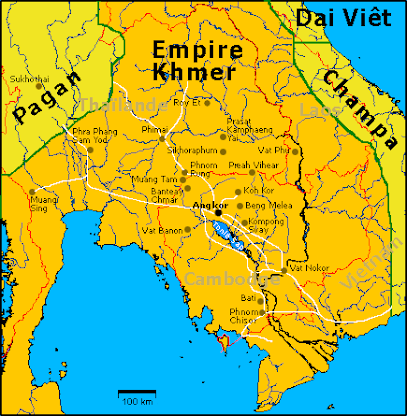
China has exercised imperial sway over Cambodia for centuries. Eight hundred years ago, Chinese troops bailed out Khmer kings; friendly Chinese warriors are carved on the side of the famed 12th-century Bayon temple near Angkor Wat. In the 1950s and 1960s, Communist China embraced the regime of King Norodom Sihanouk and provided the Khmer Rouge with inspiration, security and economic assistance throughout their bloody rule from 1975 to 1979. Sihanouk, now 88 and the king father, resides in Beijing.
Huo Zhaoguo, a Chinese manager of Union Development's massive project along the Cambodian coast, is typical of the new Chinese coming to this country. In the 1980s in Lanzhou in northwestern China, Huo struck it rich selling beans but then lost his fortune. He washed up in Cambodia in the 1990s, chasing a Vietnamese dealer who owed him money. Huo returned to Lanzhou penniless but couldn't stay. "I'd been rich there once and so everybody laughed at me," he said. "A man needs self-respect."
Huo moved back to Cambodia and opened a noodle stand. He moved up to a noodle restaurant and then met the boss of Union Development, who came to his shop searching for northern Chinese food. The boss gave Huo a chance at Union, and now Huo is overseeing road construction. Union got the land because it had the cash and the connections, Huo said.
"This country is too poor and the corruption is the same as China," he observed. "If you have power here, you have a great future."
"Cambodians feel no pressure to succeed. They even take weekends off. Not us," he said, with the air of colonial supremacy you hear from many Chinese in Cambodia. "We work."
Read more!

Sunday, November 21, 2010
China's billions reap rewards in Cambodia

Former Khmer Rouge fighter haunted by his past
 By Suy Se (AFP)
PHNOM PENH — Stumbling across the photo of his twin brother who died more than three decades ago was the last thing former Khmer Rouge fighter Uch Sokhon expected on a visit to Cambodia's genocide museum.
"I feel shocked," the 53-year-old said, gently wiping the dusty glass frame holding a black-and-white image of his brother, immortalised at the age of 20. "But it was a long time ago."
The picture is one of hundreds of mugshots of condemned prisoners on display at Tuol Sleng prison in Phnom Penh. Now a genocide museum, it was at the centre of the Khmer Rouge security apparatus between 1975 and 1979.
Some 15,000 inmates, including women and children, lost their lives and torture was routinely used to extract confessions from terrified prisoners at the facility, also known as S-21.
Sokhon and some 300 other people, mainly former Khmer Rouge supporters and fighters, recently travelled all night on buses from the northwestern Khmer Rouge stronghold of Pailin to tour the prison for the first time.
Pailin was one of the final refuges of the brutal regime, which was driven from power in 1979. Soldiers and officials fled to the remote region to re-group and try to battle the new government
The trip was organised by the UN-backed war crimes court -- which was set up in 2006 to bring ex-regime leaders to justice -- and aims to increase awareness among Cambodians about the ongoing trials.
Confronting victims as well as former soldiers and cadres with the jail and the court's work is a key part of bringing closure to the past, a court spokesman said.
"We believe it is easier for people to understand the mission of the tribunal when they see Tuol Sleng and the court with their own eyes," Lars Olsen said.
Former Tuol Sleng prison chief Kaing Guek Eav, better known as Duch, was the first to face justice at the UN-backed court.
In a landmark ruling in July, the tribunal sentenced him 30 years in jail, though the case is now under appeal.
Walking past the tiny cells that held some of the prisoners, including perhaps his own brother, and after inspecting the torture implements on display, Sokhon says he regrets his own past actions.
"I feel remorse and pain because I also used to be a fighter for Democratic Kampuchea (the Khmer Rouge)," said the teary-eyed civil servant.
Sokhon said he and his identical twin, Sokhan, both joined the hardline communist movement in 1971 aged just 15 because it was the only way to survive.
Dedicated fighters, they quickly rose through the ranks to become mid-level military commanders.
But the regime turned against Sokhan when he tried to help a relative who had caused a minor accident in February 1976.
Sokhon had left the keys in the ignition of a bulldozer he had been using to dig irrigation channels, when his cousin Thein decided to take it for a ride.
He accidentally turned the vehicle over -- an arrestable offence in the eyes of the Khmer Rouge.
Sokhon told his senior cadres his cousin was to blame for the incident, but when his twin heard the news he insisted on protecting their relative.
"I warned my brother not to help our cousin otherwise he would lose his position and be arrested," Sokhon said. "But he said he must help him.
"A few days later I was told that my brother was arrested... And I knew he had been sent to Tuol Sleng."
Despite his brother's detainment, Sokhon continued to fight for the Khmer Rouge -- even after Vietnamese forces ousted them from the capital in 1979.
He lost his right eye in 1989 when a grenade landed near him during a fight against government troops, and there are still more than 20 pieces of shrapnel lodged in his body.
After years of combat, Sokhon defected to the government in 1996 alongside the regime's foreign minister Ieng Sary. Two years later, the civil war ended.
"Now, I hate the regime very much. I am glad that the regime leaders are standing trial," he said.
Up to two million people died from starvation, overwork and execution during the four-year rule of the Khmer Rouge, led by "Brother Number One" Pol Pot, who died in 1998.
The four most senior surviving regime leaders -- including Ieng Sary -- are due to face trial next year for war crimes, crimes against humanity and genocide for their part in Cambodia's "Killing Fields" era.
Cambodian and international prosecutors have disagreed on whether to pursue more suspects and Prime Minister Hun Sen told UN chief Ban Ki-moon last month that a third case was "not allowed" because it could spark renewed civil war.
Sokhon said his own personal journey to face the past was over.
"I don't want to remember. I want it to end here. But that does not mean I still support the Khmer Rouge," he said.
Saturday, November 20, 2010
UAE Envoy presents his credentials to King of Cambodia
WAM Cambodia-Phnom Penh, Nov. 20, 2010 (WAM)--King of Cambodia Norodom Sihamoni received at his Palace UAE Ambassador to Thailand Mohammed Ali Omran Al Shamsi, who presented his credentials as Ambassador Extraordinary and Plenipotentiary of the UAE to the Kingdom of Cambodia.
He conveyed the regards of President H.H. Sheikh Khalifa bin Zayed Al Nahyan and the Vice President and Prime Minister and Ruler of Dubai H. H. Sheikh Mohammed bin Rashid Al Maktoum to the King of Cambodia and the royal family, wishing them good health.
The UAE envoy stressed keenness of the UAE to develop the bilateral relations with the kingdom, especially joint cooperation in the areas of trade, economy, tourism, health and other areas in the best interest of two peoples.
For his part, the King of Cambodia welcomed the UAE Embassy in his country and appreciated the efforts of officials to boost the bilateral relations, citing the international cooperation and humanitarian aid. In his turn, he conveyed his regards to the UAE President and the Vice President, wishing them good health and prosperity to UAE people.
WAM/MN
Read more!
Boat races kick off in Cambodia
 PHNOM PENH - CROWDS thronged a Phnom Penh lake on Saturday as Cambodia began its annual Water Festival celebrations with colourful dragon boat races.
More than two million visitors from across the country are expected to flock to the capital for three days of festivities, with boat races on the Tonle Sap lake, fireworks and parades.
This year 420 brightly coloured boats, with nearly 28,000 rowers, are lined up to take part, according to an official from the Committee for National and International Festivals.
'When I see many people like this, I am so happy,' said Bun Chhiv Meang, 59, who said visiting the festival made a welcome change from his job as a farmer.
But the Water Festival could be a muted affair for monks, who have been warned by Phnom Penh's chief monk not to mingle with the crowds and told they face a reprimand if caught looking at girls in short skirts.
Buddhist monks are highly revered in Cambodia and are not supposed to touch, or even look at, women.
The annual festival, one of Cambodia's largest and most exuberant, marks the reversal of the flow between the Tonle Sap and the Mekong river. It is also seen as a way of giving thanks to the river for providing the country with fertile land and abundant fish. -- AFP
Read more!
Film boss leaves Hollywood to help Cambodia's poor
By Bob Tourtellotte Bob Tourtellotte
LOS ANGELES (Reuters Life!) – Seven years ago a chance encounter with a poor, young girl during a backpacking trip through Cambodia changed the life of Hollywood film executive Scott Neeson.
He was on a holiday from his pampered life in California and eating at an outdoor restaurant when a 9-year-old girl came begging for money. The next night she came back, and he knew she would be there the next day and the day after that.
The studio boss asked where she came from and he was directed to the Steung Meanchey trash dump, outside the country's capital, Phnom Penh, where young kids scavenge for food or items to sell to help them survive.
In no way would the kids ever thrive, he thought, and so Neeson did something to help. He met with the girl's parents, as well another girl and her parents. He got the kids enrolled in school and provided better housing for their families.
"The whole thing for both families was about $80 per month," Neeson, 51, told Reuters in a recent interview.
Why help? He said it was mostly because he could, but also because he wanted to change.
"It was the directness of being able to help, being an A-type personality and having control to make those decisions. It was direct, and I never expected it to be so easy," Neeson said of his first experience with helping children in Cambodia.
Now, the former president of 20th Century Fox's international film division lives in Cambodia, where he moved six years ago. He runs the Cambodian Children's Fund, which aims to give children an education and/or job opportunities that will help break out of poverty.
From two girls seven years ago, Neeson's program now helps some 700 children. It has also extended services for their families and the communities in which they live. The fund provides education, healthcare and job training.
CHANGING LIVES
For the first year Neeson continued to hold down his job in Hollywood, traveling roughly once a month to Cambodia to get his organization going.
Many of the children were on their own with no parents to care for them, Neeson said, and within four months, his group was caring for nearly 90 children.
In December 2004, he abandoned his home in Los Angeles, left his boat behind and headed to Phnom Penh to work for the kids. The numbers grew quickly from nearly 90 to 150 as his programs proved successful and he raised money to build facilities.
He cited one example in which it took just six days and the equivalent of $650 to build one housing unit with a concrete floor and swinging hammocks in which to sleep.
"The whole philosophy is to build a community that heads toward self-sufficiency," he said.
Neeson is quick to talk about success stories. There are two former gang members who are now pastry chefs, a boy now in college studying hotel management and numerous people in jobs ranging from information technology to hair styling.
He is just as fast to note that for kids who spend their youngest years without parents, there are different levels of success. For some, achievements are marked simply by living a structured life and learning skills to make good decisions.
He still walks the trash dumps outside Phnom Penh at night, looking to help those who need it.
But is he happy he traded in a Hollywood life for long days of community service in Cambodia?
"It's not that simple. There are definitely things I miss. I miss my boat. I miss my dog. But in terms of regrets, there are none at all. If I hadn't found what I found, I wouldn't be as content," he said.
"I think I was looking for it without realizing it ... honestly, I knew I'd do something to help others, I never realized it was such an extreme thing."
More information on the program can be found at cambodianchildrensfund.org.
Read more!
Friday, November 19, 2010
Courtroom romance threatens child sex case
Attorneys for ex-Marine convicted of abusing underage girls in Cambodia say Vietnamese interpreter distorted testimony because of affair with federal agent.
By Scott Glover, Los Angeles Times
A costly and emotionally charged child sex case in which prosecutors traveled to Cambodia and paid to fly frightened young victims to the United States is under fire by defense attorneys amid allegations that court interpreters were biased in favor of the prosecution.
One of the interpreters assigned to the case of Michael Joseph Pepe admitted being involved in a sexual relationship with the lead investigator around the time the case went to trial in May 2008, according to documents filed in federal court in Los Angeles.
Pepe, a retired U.S. Marine captain who was working as a teacher in Cambodia, was convicted of having sex with seven girls ages 9 to 12. The girls, speaking through Vietnamese and Khmer interpreters, testified that Pepe drugged, bound, beat and raped them in his compound in Phnom Penh, the Cambodian capital.
After Pepe's conviction, prosecutors discovered and disclosed the relationship between interpreter Ann Luong Spiratos and Gary J. Phillips, a special agent with Immigration and Customs Enforcement.
Following the disclosure, Pepe's defense attorneys asked U.S. District Judge Dale S. Fischer for a new trial, arguing that the "secret … sexual relationship" between Spiratos and Phillips resulted in skewed interpretations by Spiratos and a colleague, which aided the prosecution and undermined the defense.
"Only after Mr. Pepe was convicted did the defense learn that the Vietnamese language interpreter was not the disinterested interpreter that she appeared," wrote deputy federal public defender Charles C. Brown. "We now know that what the jury heard during the trial was not what the witnesses said but what the interpreters said they said." Brown argued that Spiratos' alleged bias spread to another interpreter she brought in to work on the case.
As a result of the controversy, Pepe's sentencing has been postponed. The motion for a new trial has been pending before Fischer for nearly four months.
Thom Mrozek, a spokesman for the U.S. attorney's office in Los Angeles, said prosecutors hired experts who reviewed the translations after the trial and found no substantive differences between witnesses' testimony and what the interpreters said aloud in court. He said some of the interpretations questioned by the defense experts were done by an interpreter other than Spiratos who had no reason to put her career at risk by manipulating witnesses' testimony.
In a recent interview with The Times, Spiratos said her interpretations were unbiased.
In a hearing earlier this year, Fischer expressed concerns about the objectivity of a defense expert who was critical of interpretations by Spiratos and a fellow interpreter she brought on to help with the case. Fischer ordered prosecutors and defense attorneys to meet and attempt to reach an agreement about what discrepancies — if any — exist between the testimony and translations in order to help her decide how to proceed with the case.
The defense's new trial motion also hinted at improper conduct by one of the federal prosecutors on the case. According to the court papers, Phillips, the ICE agent, said that Assistant U.S. Atty. John Lulejian encouraged him to become involved with Spiratos. [The prosecutor and agent are not named in the court filing, but sources close to the case have confirmed their identities.]
"Wait till you see who I hired … she is Vietnamese and is very hot," Phillips said the prosecutor told him, according to a declaration he submitted to the court.
Phillips said Lulejian twice told him he should "take care" of Spiratos, an apparent reference to having sex with her, according to court papers. Phillips added that Lulejian himself was "enamored" with Spiratos and that the prosecutor showed him photographs of her that he had on his phone.
Phillips, who is the subject of an ongoing internal investigation by ICE, declined to comment through an agency spokeswoman.
Lulejian also declined to comment for this article. According to the court papers, he said he had a "professional and platonic" relationship with Spiratos and did nothing to facilitate a romantic relationship between her and Phillips.
The issue has tainted what was once a celebrated case within the Department of Justice. The prosecution team, including Phillips and Lulejian, was given distinguished service awards last year by Atty. Gen. Eric Holder for its work on the case. The situation also seems to have angered Fischer, who refused to allow defense attorneys to file their motion under seal.
"This case received media attention — at least some of which was initiated by the government. This prosecution consumed a significant amount of public funds," the judge wrote in July. "Concealing the basis for the motion — or the ruling — would promote distrust of the judicial process."
Lulejian said that when he came to suspect last year that Phillips and Spiratos had been involved in a sexual relationship, he contacted the U.S. attorney's ethics office, according court papers. Prosecutors conducted an investigation and disclosed the results to the defense.
The timeline of the relationship between Spiratos and Phillips is somewhat vague. Both filed sworn declarations with the court, but those documents are under seal, meaning they are not available for public review. According to Brown's new trial motion, Phillips stated in his declaration that the relationship began "sometime after the start of the trial or near the end of the trial." The agent recalled several instances of being romantic with Spiratos, including one time after he accompanied the victims to Disneyland and another that "possibly" occurred before one of the girls took the stand. Spiratos wrote that she began a friendship with Phillips during the trial but that it did not become intimate until early June, shortly after the verdict.
Brown wrote that Spiratos' relationship with the lead investigator went "beyond creating the unsavory appearance of impropriety." Spiratos and her colleague, he wrote, "secretly allied themselves with the [prosecution] witnesses and unfairly bolstered their testimony and at the same time sabotaged the defense."
An expert hired by the defense to analyze the interpretations done at trial found numerous discrepancies between what interpreters said aloud and the witnesses' actual testimony, court papers state.
In one instance, a girl's statement: "I didn't sleep because I was afraid of him," was translated to: "I meant that I wouldn't let him insert his penis in my vagina," defense experts said.
Some of the allegedly bogus interpretations were "at times so divergent from the actual responses that they cannot simply be attributed to good faith misunderstandings," Brown contended.
Mrozek, the U.S. attorney's spokesman, said prosecutors will be filing a detailed response to the defense allegations regarding the interpretations in coming weeks.
Spiratos said in an interview this week that she was unaware at the time of the trial that her relationship with Phillips outside of work represented a conflict of interest. She said she could not remember whether they had been intimate prior to the verdict.
"I would be a liar if I said, 'no,' " she said.
She insisted that her relationship with Phillips had no bearing on her work or on that of the other interpreter she hired for the case. Since her relationship with Phillips was disclosed, she said, she has been denied work in the federal courts — decimating her once successful business — and that Phillips and Lulejian have turned their backs on her.
"I lost everything," she said. "I feel like I'm a scapegoat. It takes two, right? Not just me."
Worse, Spiratos said, is the delay in Pepe's sentencing and uncertainty surrounding the case.
"Those little kids don't deserve this," she said.
.
Read more!
Cambodian Women Look to Malaysia for Work
Cambodian women are increasingly finding work as domestic labor in Malaysia. But in their rush to employment, some are finding little protection from abuse at work. Like many developing countries, Cambodia is trying to find ways to protect its migrant workers.
A team of oxen pulls a cart into the rice fields in northern Cambodia, where a rural way of life means few opportunities for work.
Now, young women in Preah Vihear province say they are finding opportunity as maids in Malaysia. But some of them are finding more trouble than they bargained for.
Sao Orn and her husband, Ros Chheoun, spend weeks at a time out here in the fields, harvesting what little rice grows in the hard ground. When their daughter, Champei, came to them with the idea of working in Malaysia, they had misgivings. Sao Orn says she asked her daughter not to go, even though the family is poor. But Champei insisted.
Sao Orn's worst fears were realized, when Champei came back seven months later, traumatized from severe sexual and physical abuse. Her daughter was not the same as when she had left.
These days Champei stays at home, taking care of the family pig, unable to work. And unable to trust people. "Now, people no good. People very bad, can beat me. No good also," she said.
Like many developing countries, Cambodia needs jobs for its growing population. And Malaysia wants maids to serve a growing class of professionals.
The number of Cambodians sent to Malaysia nearly quadrupled in the past year, to around 20,000. The surge comes after Indonesia banned its workers from going because of abuses.
Lured by promises of good pay, women sign up with local recruiters. But there are few safeguards for them in place and little communication back home.
E Saro, the governor of Champei's home district, Rovieng, says the government does not yet have a protective system in place.
The national government is drafting a new law that will aim to protect young women from dishonest recruiters and establish a fund to help them if they get in trouble in Malaysia.
But that is little consolation for Champei's parents, who now must worry for their daughter on top of everything else.
Champei's father says he is still angry with the recruiters who promised his daughter wealth but abandoned her when she was in need.
If I see them again, he says, I'll cut their throats.
Read more!
Thursday, November 18, 2010
Cambodia: Ten tips on visiting Angkor's temples
Michelle Jana Chan reports on how to see the Cambodian temples at Angkor at their best, in spite of the crowds.
By Michelle Jana Chan
Angkor Archaeological Park is home to hundreds of temples as well as villages, schools and farmland. Just as a millennium ago, Angkor is a vast area where people live and work. Glimpses of rural Cambodian life – immaculately uniformed children walking to school and their parents working the fields – offer humble interludes between temple visits.
Its centrepiece is Angkor Wat, Cambodia's best-preserved and beloved temple. Originally dedicated to the Hindu god Vishnu, it has remained a place of worship since its foundation. Thought to be a miniature replica of the universe, its towers, moats and concentric walls reveal an architectural sophistication, and the bas-relief with their plump figures and triumphal battle scenes reflect a healthy, wealthy period of history.
Elsewhere, in the park, some of the most elegant carvings can be found at Banteay Srei temple, decorated with sensuous celestial dancers. Ta Phrom is one of the most photographed temples, deliberately left mostly unrestored, and tangled and strangled by undergrowth, branches and roots.
The perennial favourite is the Bayon temple at Angkor Thom whose towers – like at Banteay Chhmar – are etched with enlightened bodhisattva faces. The Bayon is also decorated with enchanting bas-relief depicting ordinary Khmer life rather than the Hindu mythology seen at most other temples.
Aside from these landmark temples, there are smaller but equally moving sites like Ta Nei (resembling a diminutive Ta Phrom), Ta Som (with a four-faced tower like at the Bayon) and Banteay Samre (like a petite Angkor Wat). Built on a more human scale, they can offer some respite from their grander cousins.
Here are 10 tips on how to visit Angkor well:
1 High season runs from November to March, when the weather is usually fair. Late October and November, the country is still lush after the rains and there are fewer tourists.
2 Wear comfortable shoes with good soles; the paving at the temples is uneven and slippery when wet. Take an umbrella against the rain/sun. A torch is useful for windowless rooms.
3 Have a basic understanding of Hinduism and Theravada Buddhism. Most guidebooks have a section on this subject. A good map is available at local bookshops in Siem Reap (they do not have one at the ticket office).
4 Most tourists follow a well-trodden route: sunrise at the west gate of Angkor Wat before returning to the hotel for breakfast; late morning, Angkor Thom, Ta Phrom and Banteay Srei; after lunch, exploring more fully Angkor Wat; sunset atop Phnom Bakheng hill. Avoid this itinerary to beat the crowds.
5 This is the way I would do it. Early to bed, early to rise. Angkor opens at 5.30am and this is the best time to start exploring. After sunrise, most tourists head swiftly back to their hotels for breakfast. Instead, stay out until 9am when the temples are remarkably peaceful. Plan on a late lunch, or ask the hotel to pack a picnic. Between noon and 2.30pm, many temples are empty. The afternoons are best spent at the smaller temples. I love sunset at the fiery-red Pre Rup or East Mebon temples.
6 Ask your tour operator to assign you their best private guide. Touring temples can be wearying unless you have someone bringing the history to life.
7 At some temples children sell souvenirs and employ emotive language about how they need money for school. Buying from them will encourage them to work in this way. Most tour operators and hotels have links to NGOs, and visits can often be arranged to schools and orphanages; donating to these organisations might be a wiser way to support the local community.
8 Try to visit the National Palace Museum in Phnom Penh. This stopover works best after visiting the temples. The newly opened Angkor National Museum in Siem Reap is poorly curated but is worth an hour with a good guide.
9 A visit to the British Museum is worthwhile; it is currently hosting Images and Sacred Texts: Buddhism Across Asia, which includes artefacts from Cambodia (until April). The world's most comprehensive collection of Khmer artefacts is in Paris's Musée Guimet.
10 It is not uncommon to hear tourists say they are "templed out". Pace yourself, take breaks and visit smaller, less busy temples.
Read more!
In US Ship's Visit, a Commander's Homecoming
 U.S. Navy Commander Michael Vannak Khem Misiewicz serves as a commanding officer of the guided-missile destroyer USS Mustin.
When the US naval ship USS Mustin docks in Cambodia next month, it will be a homecoming for the the destroyer's commander.
Michael Vannak Khem Misiewicz was adopted by an American woman in 1973, as Cambodia fell to the war and the oncoming Khmer Rouge. He was raised in the US and has not returned home in 37 years.
“The purpose of the trip to Cambodia is to develop and further the relationship between the United States and Cambodia...and it’s a special trip because the Mustin is commanded by a Cambodian-American,” Misiewicz told VOA Khmer by phone from aboard his ship. “We'll help train some of the Royal Cambodian Navy and military, and we're also going there to do community relations projects.”
The USS Mustin, based in Yokusuka, Japan, is a guided missile destroyer, carrying 300 sailors onboard. The December visit to Cambodia comes on the heels of a visit by US Secretary of State Hillary Clinton, this month.
“I know it's going to be very emotional,” said Misiewicz, who was born in Kandal province but was adopted by an American woman whom his aunt worked for.
Misiewicz, whose given name is Vannak Khem, went to school in the US, not knowing what became of his family after the Khmer Rouge came to power. He graduated high school, joined the US Navy, and later went on to the Naval Academy, earning his officer's commission in 1992.
When he returns to Cambodia, he will be reunited with his aunt. His father was executed by the Khmer Rouge in 1977, but his birth mother now lives in Texas with her family.
Read more!
Cambodian lawmaker focuses on rights for women
By Bonnie Adler
Nobel Prize nominee Mu Sochua, an advocate for rule of law and rights for women in Cambodia, is a remarkable study in contrasts.
At 55, she is an exotic beauty, slender, soft-spoken, graceful and charming. She is also alarmingly brave and intensely committed. As the most outspoken female leader of the opposition party in an impoverished post-Khmer Rouge Cambodia, she risks her life in calling publicly for the cessation of sex trafficking, equality for women and an end to the corruption that is endemic to all levels of Cambodian society.
Mu Sochua made numerous appearances in Westport last week, raising awareness about her work as a Cambodian lawmaker to promote greater equality and freedom for women in her country and to publicize the deeply disturbing film documentary “Redlight,” an expose about the global issue of sex trafficking of children.
Mu Sochua is featured in the film, which focuses on the personal stories of the victims of child sexploitation and the efforts made thus far to try to stop the crime, which is so prevalent in Cambodia. “Redlight” was directed by an award-winning Israeli filmmaker, Guy Jacobsen, and was shown in Westport and Ridgefield last week with personal appearances by both Mu Sochua and Guy Jacobson.
Mu Sochua also made a day-long appearance at Staples High School, speaking with students in the about the situation in her country. She also made a special presentation to the Staples High School chapter of Teen Vital Voices, where Westport teens are learning about women empowering other women.
Mu Sochua is sponsored by Vital Voices Global Partnership, an international non-profit organization that trains and empowers emerging women leaders and entrepreneurs around the world, with the goal of creating a better world for those in impoverished and underserved countries.
The Connecticut Chapter of Vital Voices brought Mu Sochua to Westport and Ridgefield, where she participated in a number of events aimed at highlighting the devastating effects of poverty and lawlessness in her country. Her demands, made in her firm but soft-spoken voice, are for laws which Americans take for granted, such as the enforcement of the laws which make illegal the practice of sex slavery by children.
In an interview with the Minuteman, Mu Sochua said, “There is a Cambodian proverb which says, ‘Men are gold, women are just a white piece of cloth.’ Gold can be worn forever. It is always solid, but a white piece of cloth can be stained forever. In Cambodia, if you are raped, you are ruined forever. If you are divorced you are ruined forever. Society will not accept you. If you are independent of your husband you are a ‘bad woman.’
“As a Cambodian Cabinet Minister, I committed myself to changing this proverb to ‘men are gold, but women are precious gems.’ Now my supporters are known throughout Cambodia as ‘precious gems.’
“We have a large problem with domestic violence. When I was minister, we did not blame the men, but gave a picture of a family where the gold and precious gems to work together in order for the family to be intact with a sense of harmony. We did not ask women to demand equal rights, but tried to make the men understand that a sense of harmony is for the family, and that men and women should share the same responsibility to raise the family.”
At 18, Mu Sochua’s family sent her abroad to escape the Khmer Rouge and to get an education. She received a Masters degree from the University of California at Berkeley, where she was deeply influenced by the women’s movement. Those were also the years the Khmer Rouge swept through Cambodia, killing millions in just three and a half years, including Mu Sochua’s parents.
“The scar of the Khmer Rouge is so deep, it is carved into our minds, our souls. I suffer the pain of an outsider, the loss of my parents, and of course, having to grow up outside the country and reconstruct my life from then on.”
Remarkably, she says she holds no grudges and it is with that kind of attitude that she has positioned herself as leader and lawmaker and a role model to young women in Cambodia.
When Mu Sochua returned to Cambodia 18 years after she left, she was appointed to lead the Ministry for Women’s Affairs. She took the job, which she describes as “being in charge of 52 percent of the population,” far more seriously than those who appointed her ever imagined.
“I wanted to bring in western values of feminism and equality. Slowly, I slipped the ideas through, mainstreaming them into family life and culture, but at the same time saying that education is a right, quality of life and free health care are rights and women can be in charge of their own bodies.”
According to Mu Sochua, Cambodia is 85 percent rural, with an extremely high poverty rate. Four million of the 14 million population live on less than a dollar a day, a fundamental cause of the everyday violence and the rampant sex trade.
“The government is corrupt. We have the legacy of the Khmer Rouge, with violence agains women and a culture of impunity. Our present is still haunted by the genocide of the past, which occurred thirty years ago,” said Mu Sochua.
Undaunted by the enormity of the task, she fights each day to improve the situation. “As an opposition lawmaker we know things could be better. We demand a strong rule of law, accountability and the end of violence against women and the end of social stigmatization of victims.”
Not surprisingly, this kind of public opposition was met head on by the Prime Minister of Cambodia. The two clashed in a battle of words and the Prime Minister started a public campaign against her.
“His speeches against me were broadcast on the radio across the country,” she said. “He even said he would finish my political life.” The battle went on for months, and although Mu Sochua lost the lawsuit, she gained much more public recognition and took advantage of the opportunity to defend her right to justice and a fair trial, and what she calls “the right of a woman to be seen and to be considered as a human rights defender.”
She was nearly imprisoned, but the government ultimately backed off when it appeared that the publicity generated by the imprisonment would be too visible and help Mu Sochua’s cause. Instead she was fined $4,000, a king’s ransom in a country where teachers make $50 a month.
“Now I am seen totally differently, even by the Prime Minister. I am a very straightforward lawmaker, although sometimes outrageous, but I do make sense to the people. I am now widely recognized and I still continue to take these causes very seriously.”
Even as she has gained a measure of renown in her own country, Mu Sochua is broadening her battle. She is seeking funding from the United States government to help the growth of democracy in Cambodia. She is hopes to obtain funds for more entrepreneurial opportunity for women in the form of microbusinesses run by women in local villages in order to decrease the level of poverty. She hopes for greater educational opportunity and access, and funding for more radio and television access. Dreams of technology are still far off, as less than one percent of the population is computer literate. Recently, Secretary of State Hillary Clinton visited Cambodia, with a message of support for the protection of human rights. “I want delivery on that promise,” she said.
Read more!
Wednesday, November 17, 2010
Cambodian Exhibition Shows Cultural Aesthetics, History
By Jonathan Van Dyke
Staff Writer
The Second Annual Cambodian Arts and Culture Exhibition will give younger members of the community and outsiders a sense of the diverse and interesting Cambodian culture, organizers say.
“We expect probably between 500 and 600 people and it’s going to be a very diverse group,” said Richer San, exhibitions coordinator. “This year’s program is going to be much better (than last year’s).”
There will be events from 10 a.m. until 3 p.m. on Saturday, split between MacArthur Park and Mark Twain Library, that will demonstrate a number of the cultural aesthetics and history that make up Cambodian culture, San said. Admission will be free, and attendees will have an opportunity to participate in several different interactive demonstrations.
San said the exhibition also is a chance for local artisans and vendors to show off an area that not everyone in Long Beach may be familiar with.
“We do this to bring in some traffic to central Long Beach for the business folks who need this,” he said.
There will be textiles, dressmaking, weddings, games, Yantra Mantra, cooking, costuming, painting, drawing, shadow puppets, Cambodian Court Dance, music and different musical instruments.
At 11:30 a.m., curator Jeffrey Weaver of the J. Paul Getty Museum will make a special presentation on the Gods of Angkor in the community room of the Mark Twain Library. He will talk about the Getty Center’s (in Los Angeles) upcoming exhibition on the subject, which opens in February of next year.
At 2 p.m., there will be a movie screening of “Twilight.” King Norodom Sihanouk made the film in 1969, during a strong period of Cambodian cinema, San said. It follows the story of a prince falling in love, and demonstrates a great deal of what Cambodia was like before war changed it. There will be English subtitles. Former United Nations Ambassador Sichan Siv will introduce the screening.
“This is before the war came to Cambodia,” San said. “It’s going to be so important for the younger generation (to see). It shows Cambodia back in the 1960s, when it was very peaceful and vibrant.”
Both the movie and presentations will provide an important opportunity to remind the youth in the community of a heritage they may feel removed from, while introducing the rest of the community to it, San said.
“It is important,” he said. “Mainly we want to share with our neighbors and our new generation. We want to show them our heritage and rich culture — to promote harmony. People can communicate through culture.”
The Second Annual Cambodian Arts and Culture Exhibition will take place from 10 a.m. until 3 p.m. on Saturday at MacArthur Park, 1321 E. Anaheim St. The special presentation and movie screening will take place at Mark Twain Library, 1401 E. Anaheim St. Admission will be free.
For details, call Sixth District Councilman Dee Andrews’s office at 570-6816.
Read more!
Kathin in Cambodia
Re: ''About Politics'' (BP, Nov 13), wherein the article ''Vichit gets neighbourly'' raises certain points about this year's Royal Kathin ceremony in Cambodia which need clarifying.
The Foreign Ministry firmly believes that deeply rooted, people-to-people bonds will help enhance mutual understanding and hence overall bilateral relations with other countries. Great effort has thus been made to promote cultural cooperation.
The Royal Kathin Robe Offering Project is one avenue of fostering friendly ties between Thais and other countries through our shared affinity with Buddhism.
This year, the Royal Kathin ceremony in Cambodia organised by the ministry will be held on Nov 19 at the Svey Por-pe Temple. Former Thai ambassador to Cambodia, Poksak Nilubol, who is chairman of the Thailand-Cambodia Friendship Association, has graciously been designated by His Majesty the King to preside over this year's ceremony in Cambodia.
As a rule, in making arrangements for such ceremonies, the ministry _ through the Thai embassy _ coordinates with the government of the receiving country, in choosing the appropriate temple. In this particular case, the choice of the Svey Por-pe Temple was approved by the Cambodian government.
Also, it has been a practice since 2000 that Royal Kathin robes are presented alter nately at Mahanikaya and Dhammayuth temples.
Read more!
France Telecom's Stephane Richard May Direct Deals Cash to Southeast Asia
France Telecom SA may direct some of its up to 7 billion euro ($9.45 billion) war chest for emerging- markets expansion to Southeast Asia as the company’s historic turf in Africa becomes more crowded.
Europe’s third-largest phone company may look to expand in Vietnam, Cambodia or Laos, Chief Executive Officer Stephane Richard said today on the sidelines of the Morgan Stanley Technology, Media & Telecoms Conference in Barcelona.
“We said emerging markets, with a focus on Africa and the Middle East,” he said. “But we don’t exclude, naturally, that there could be a good opportunity in a region that makes sense for us we could look at.” The company could weigh deals in “Southeast Asia, which means the formerly French colonies -- Vietnam, Cambodia, Laos,” he said.
France Telecom is increasingly confronting international rivals in Africa and the Middle East, including South Africa’s MTN Group Ltd., U.K.-based Vodafone Group Plc, France’s Vivendi SA and Indian operator Bharti Airtel Ltd., all looking to offset slow-growing home markets. Southeast Asia hasn’t seen a similar push by foreign operators, with the exception of Russian operator VimpelCom Ltd.’s operations in Cambodia and Vietnam.
Separately, Richard today told investors in Barcelona that the company may consider a share buyback or other form of cash return to investors if it can’t find productive targets for increased investment.
Doubling Revenue
While the Paris-based company doesn’t have specific plans to expand in Southeast Asia, the region has “strong economic growth, and a penetration rate that is still pretty weak, so of course these are interesting countries,” Richard added. In Vietnam, France Telecom is working with the state telecom operator to install new phone lines in Ho Chi Minh province.
Emerging markets last year accounted for about 3.3 billion euros of sales at France Telecom, or about 7 percent of the total of 46 billion euros. The company is looking to double that revenue in the next five years. It has operations in Africa, including in Senegal, Cameroon, and Niger. Expansion in the Americas and large Asian countries isn’t on the table, he said.
Meanwhile, a decision by the French government, which holds 27% of France Telecom, to sell part of its stake “could be an opportunity to work also on a share buyback,” although it’s not clear when or if such a sale would occur, he said.
Home Market
France Telecom had free cash flow of 8.3 billion euros at the end of last year. The company also has projected cash flow of 8 billion euros for this year and next.
Revenue from its home market slipped below 50 percent of the total for the first time last year at the one-time state- owned monopoly, sliding to about 45 percent. France Telecom’s domestic sales fell 2 percent in the first half of the year to about 11.6 billion euros.
At home, France Telecom will face an aggressive new competitor when discount broadband provider Iliad SA enters the mobile market as the fourth French operator. Iliad’s billionaire owner Xavier Niel has pledged to force mobile prices down in France, where operators charge subscription rates higher than the European average, according to the Organisation for Economic Co-operation and Development.
To contact the reporter on this story: Matthew Campbell in Paris at mcampbell39@bloomberg.net.
Read more!
Tuesday, November 16, 2010
SimplyHelp Cambodia: A Vocational Education Mode of Success
By Lotte Goede, Donna Pulese-Murphy
Mom Phoeun, who lives in rural Cambodia, lost his father at a young age, and his mother is suffering from chronic illnesses. With cow herding being their only source of income, they could not make enough money to pay for her rising medical costs. Mom Phoeun sought relief by attending the SimplyHelp Tailoring School which had just established itself in his village. By learning a trade and distinguishing himself, Mom Phoeun is now not only able to support himself, but can also provide for the care that his mother desperately needs.
Cambodia is a country burdened with a legacy of conflict. The Khmer Rouge, led by Pol Pot, seized power in 1975. An estimated 1.7 million Cambodians died; most intellectuals and educated people were executed, and their cultural heritage destroyed. The devastation of the Pol Pot regime remains with the people of Cambodia, now one of the poorest countries in the world.
In 2001, the SimplyHelp Foundation decided to establish a branch in Cambodia. The Foundation’s two vocational training schools—a Tailoring School and a Computer School—have over 4,000 graduates, of which 85 per cent find jobs working for large companies, in banking, for non-governmental organizations or open up their own storefronts. Some go on to higher education.
Mobile Tailoring School—Sewing up Poverty Wounds
The SimplyHelp Tailoring School opened its doors officially in 2002. Many had the means to learn not only a trade but how to be self-sufficient. The school is mobile and goes to poor villages in the middle of rice fields where it is needed most. When a farming village is chosen as the school’s next destination, the village chief opens up his home and turns it into a temporary school. A highly-qualified master sewing teacher is sent from Phnom Penh to this village two or three days a week to train two assistant teachers who teach on the days she is not in the village. There are two classes per day, which allows the students to go to school either in the morning or afternoon, and to work their land the other part of the day. Students are trained for six months and classes are free. Since its inception, the school has moved eight times and, to date, has graduated 1,686 students.
The need for this type of education in rural Cambodia is staggering. In the village of Krang, for example, within three months after graduation, ten out of eighty graduates established small businesses in their living rooms with just a sewing machine and some fabric, and all of them have been able to earn good money. In other villages as well, graduates have opened tailoring shops which provide them with steady, reliable incomes—in sharp contrast to the difficulties that go along with being farmers. Some of these shops have developed into authentic-looking businesses with glass displays, beautiful clothes, and proud owners.
Tailoring School’s Social and Economic Impact
Former tailoring school graduates who have started their own businesses have taken on apprentices, thus passing on their knowledge. These apprentices pay the master tailor $150 and can stay with the tailor until they have mastered the essential skills. When asked why they choose to pay $150 to learn the trade when they can get paid to learn it at a government school, their answer is “quality!”
According to Vuthi Seng, Coordinator of SimplyHelp Cambodia, the social status of women changes after graduation. “Young Cambodian rural women traditionally have to stay home,” he says. “However, once a young lady graduates from the SimplyHelp Tailoring School in her village, which takes much less time than the two to three years required in a private school in the capital, she has a skill and can earn an income. She now has a more equal relationship with her husband; otherwise she is treated as a subject to her husband and has little decision-making power in the home.”
Additionally, not only does this heightened income affect a woman’s social status, but it affects a community at large. For instance, all students at the tailoring school are farmers and cow herders and have an average income of $1 to $2 per day. But graduates with their own businesses increase their average income from $3 to $7 per day. This extra income is not only used for basic needs, but is also re-invested in their own businesses and in their communities.
Computer School—Processing
The Possibilities
The SimplyHelp Cambodia Computer School also opened in 2002 and is located in the capital Phnom Penh. Due to the high-quality training and low cost, 200 to 250 students apply for the 100 available training spots every three months. Typically, the students selected are from low-income households, orphans, or have a disability. During these classes they learn Microsoft Word, Excel, and PowerPoint. From 2002 to 2009, the Computer School had 2,784 graduates.
The school’s teacher, Sophat Phoung, is a disabled young man from a rural area of Cambodia. Due to an accident in his early childhood, his right leg does not function anymore, which significantly reduced his job opportunities. So in 2002 he attended the computer school and worked as a volunteer after graduation. Due to his hard work and dedication, he was hired as a teacher in the school in 2003 and not only can he support himself now, but he can also provide income for his family.
Computer School’s Social and Economic Impact
There are signs that Cambodia is catching up with the rest of the information technology world as the Computer School has seen an increase in demand for more specialized computer training in QuickBooks, Photoshop, Access, and Peachtree.
A notable trend is that, although there are more male then female students, the number of female students has steadily increased over the years. Common jobs for graduates include data entry for companies or working at the cash register in supermarkets. It might not occur to people in the West that one needs to have basic computer skills to operate a cash register. Many others become business managers, administrators, or teachers, such as Ky Bun Heang, who became executive director for a Japanese NGO operating in Cambodia and specializing in the education field; Miss Chea Lida, who became a manager at one of the most successful Cambodian Banks; or Mr. Nuty, who became a provincial manager at the Department of National Treasury in Rattanank Kiri province.
SimplyHelp Cambodia is an educational model for economic and societal success, but certainly more work needs to be done. No matter how small or large, it is critical to support these kinds of vocational education endeavours which not only help individuals build a new life for themselves, but also help perpetuate a self-sustaining community.
Read more!
Economic dependence subjugates policy
In one short week over two long decades, Burma has returned to a window of potential political transition not seen since its last elections in 1990 were hijacked by the military.  From left: Burma’s Prime Minister Thein Sein, Vietnam’s Prime Minister Nguyen Tan Dung, Cambodia’s Prime Minister Hun Sen, Laos’ Prime Minister Bouasone Bouphavanh and Asean Secretary-General Surin Pitsuwan link arms during the 5th Cambodia-Laos-Myanmar-Vietnam (CLMV) summit, at the Council of Ministers in Phnom Penh yesterday.
This time, the orchestrated polls on Nov 7 have overwhelmingly sent military-backed representatives of the Union Solidarity and Development Party to parliament.
On election day, renewed fighting between the Burmese army and ethnic minority groups flared up along the Thai-Burmese border.
Less than a week later, the iconic leader of Burma's opposition, Aung San Suu Kyi, was freed from house arrest where she had been confined for 15 of the last 21 years.
The implications from these momentous times in Burma are immense for Thailand, Southeast Asia and beyond.
The contrast between the responses to the election results from the West and Burma's near-abroad was conspicuous. China and India's comments were muted. Both Asian giants have vested interests in Burma's economic development, having courted and competed for the ruling generals in Naypyidaw for strategic assets and natural resources.
As Southeast Asia's main regional organisation, the Association of Southeast Asian Nations's receptive reaction was a foregone conclusion. The elections were the culmination of Asean's longstanding policy of "constructive engagement" and its now-proven rationale for accepting the generals' Burma back in 1997. Notwithstanding dissenting voices from Indonesia and the Philippines, Asean will now want to tick the electoral box on Burma's democratic checklist and move on.
As the country most directly affected by events in Burma, Thailand also revealed its hand well before the elections. Prime Minister Abhisit Vejjajiva's initial reaction to the polls was to stick to the stated time-frame of the military-sponsored constitution of a three-month period before power is transferred to the elected government.
Although his predecessor and mentor, former prime minister Chuan Leekpai, made a point of not setting foot on Burma's soil in the late 1990s when the State Peace and Development Council was ensconced in power, Mr Abhisit not only visited Naypyidaw but came home with a multi-billion-dollar port development deal.
The Democrat Party-led government leader did not even visit Burma then, but his successor a decade later has now reversed course. Thailand's relative emphasis on human rights and democracy as its foreign policy underpinnings have gone out the window. But if pragmatism and material interests are to dictate Thailand's Burma policy, they should be rethought.
Thailand needs to come up with a longer-term energy outlook and a forward-looking immigration policy.
The port deal at Dawei (Tavoy) should be seen as part of a broader package of Thailand's growing energy dependence on Burma. More than 70% of Thai electricity generation derives from natural gas, and nearly half of that portion is imported from Burma's gas pipelines, with the rest made up of coal, hydro and petroleum sources. Renewable energy sources such as wind and solar are negligible. Nuclear power would be a viable alternative, as Vietnam's imminent construction of two nuclear power plants attests.
But for Thailand, nuclear power will need broad-based public discussions and hearings to promote trust and confidence and allay civil society concerns. Nuclear power is thus many years in the distance _ if it ever materialises.
Thailand, in short, is beset by energy insecurity. On a per-capita basis, Thailand's electricity consumption is in the range of the developed economies in the Organisation for Economic Cooperation and Development (OECD). And its foreseeable energy future is reliant on natural gas. Until it can tap into reserves in unexplored areas in the Gulf of Thailand, particularly the overlapping claims with Cambodia, Thailand's gas dependence on Burma will grow.
In turn, such dependence will constrain Thai foreign policy vis-a-vis Burma.
The fluid and precarious post-election interplay in Burma should prompt Thai leaders to start thinking about longer-term energy security.
Another serious challenge will be the demographics of economic growth. More than two million migrant workers from Burma are reportedly resident in Thailand, without corresponding rights to education and health care. Many of these migrant workers, now in their second generation, are unlikely to return to Burma even if peace and stability are restored.
A long-term comprehensive immigration policy, as opposed to the current ad hoc registration, could provide them with residency rights with access to proper education and health care. They now form the backbone of the back-breaking work in service industries, particularly construction, processed food and fisheries. If they continue to be excluded from the system and preyed on by Thai authorities for extortionist gains, they may become a source of social problems and crime in the years to come, owing to a lack of access to education and career mobility. The Thai economy can no longer thrive without these essential workers.
The more immediate demographic challenge will take place along the Thai-Burmese border.
Mr Abhisit's crass and myopic three-month reference for Burma's power transfer does not conduce to the logistical and humanitarian preparations that should be put in place.
The armed conflicts between the Burmese army and the ethnic minorities may well go on indefinitely. Largely unrepresented in parliament both at the national and regional levels following the polls, the major ethnic groups, such as the Karen and the Shan, are unwilling to lay down arms and be absorbed into the border guard forces controlled by the Burmese armies.
The growing spectre of civil war should lead Thai policy-makers and military commanders to start thinking about longer-term refugee sanctuaries along the border. It is not sustainable to receive the displaced ethnic refugees one day and repatriate them the next.
International relief agencies should be allowed and encouraged to share the burden. A longer-term refugee policy and accommodation, which has been a trademark in Thailand's foreign dealings in the past, should be formulated immediately.
The drugs production and trafficking associated with minority groups' war-financing will also need to be checked and deterred.
Burma after elections stands at a precipice. It could turn out well over a long transition, or very badly in relatively short order. The risks of continued military rule fronted by a bogus electoral regime on the one hand clashing with a pent-up and long-suffering opposition bent on going for "too much, too soon" will grow.
Thailand needs to be better prepared by providing safe havens along the border, relying less on Burma's natural gas and accommodating Burmese and Burmese minority workers who are contributing to the Thai economy for the long haul.
Read more!
Cambodian PM suggests setting up fund to advance CLV development triangle area
Cambodian Prime Minister Hun Sen Tuesday suggested to establish a Cambodia-Laos-Vietnam (CLV) Fund to mobilize financial resources to fund the projects of the Master Plan 2010-2020.
The premier made the suggestion at the 6th Cambodia-Laos- Vietnam (CLV) Summit on Development Triangle Area (DTA) held on Tuesday morning in Phnom Penh, which is aimed to further strengthen the cooperation among three CLV countries.
With the financial difficulties, Hun Sen initiated to establish a CLV Fund in order to increase capitals for development projects.
He said that "Japan has financed 20 million U.S. dollars for the development triangle area, but we have to work with Japan and seek other development partners to mobilize capital for the triangle area."
In order to fulfill the programs and projects of the Master Plan, Hun Sen also suggested "to primarily shortlisting a number of prioritized projects from our cooperation sectors," such as infrastructure, trade and investment, social development and cultural conservation, agro-industry, tourism, and environment.
"The CLV Summit is not only to strengthen cooperation among the three countries, but also to contribute to the development in the region," said Hun Sen at the opening of the 6th CLV summit.
The summit is to review the progress of the triangle development area. Hun Sen highly evaluated the achievements that have been attained, especially in the sectors of trades and investments through fairs and trade conferences.
Two agreements were signed during the summit, including the amended memorandum of understanding towards the formulation of special preferential policies for the CLV development triangle area and the Phnom Penh Declaration on the Deepening Cambodia-Laos-Vietnam Development Triangle Area.
Meanwhile, a bilateral meeting was held between Prime Ministers Hun Sen and Laos' Prime Minsiter Bouasone Bouphavanh, and an agreement on air services between the two countries was signed.
At the half-day summit, Cham Prasidh, Cambodian minister of commerce and chairman of the Joint Coordinating Committee, briefly reported on the progress made in the areas of security, foreign affairs, and socio-economic development in the past two years.
CLV Development Triangle Area (CLV DTA) is aiming at accelerating of economic growth, poverty reduction, social and cultural progress in the areas of triangle.
Geographical provinces of the triangle area are Cambodia's Steng Treng, Rattanakiri, Mondulkiri and Kratie, Laos' Salavan, Sekong, Attapeu and Champasak, and Vietnam's Gialai, Daclac, Dacnong, Kontum, and Binh Phuoc.
Source: Xinhua
Read more!
Cambodia deal will eliminate visas for short-term travellers
By Marisa Chimprabha
Phnom Penh
Published on November 17, 2010
Thai and Cambodian residents will enjoy free across-border travel from next month after the two countries sign a visa-free agreement.
Thai and Cambodian Foreign Ministers Kasit Piromya and Hor Nam Hong will sign the agreement in the presence of their prime ministers, Abhisit Vejjajiva and Hun Sen, on Wednesday today.
The signing will take place during a meeting of the Ayeyawady-Chao Phraya-Mekong Economic Cooperation Strategy (Acmecs) in Phnom Penh.
Acmecs is a cooperative network of Cambodia, Laos, Burma, Thailand and Vietnam to optimise benefits of member countries’ diverse and complementary economic strengths, as part of the Asean Community.
The visa-free agreement, to be effective around December 18, will allow Thais to stay in Cambodia without a visa for 14 days and vice versa. Anyone wishing to stay longer than that must apply for a visa.
Under common practice, a tourist visa allows a visitor to stay for 30 days.
Kasit said the agreement was a starting point for cooperation under Acmecs’ single-visa scheme for its Five Countries, One Destination campaign.
He said the agreement would facilitate travel by people of both countries.
Asked to comment on whether human-smuggling activities and cross-border crimes would exploit the visa-free agreement, Kasit said the two countries’ crime-busting agencies would need to cooperate.
The first Acmecs Summit was held on November 12, 2003, in Bagan, Burma. The Bagan Declaration established the Acmecs framework and laid foundations for a plan of action covering five sectors of cooperation ��" trade and investment, agricultural and industrial cooperation, transport linkages, tourism cooperation, and human-resource development. Later at the Acmecs ministerial meeting in August 2005, public health was established as a sixth sector of cooperation.
Thailand hosted the second Acmecs Summit in Bangkok on November 3, 2005, to review progress on its implementation as well as set its future course. Acmecs leaders agreed on a declaration to forge even closer cooperation to meet the future needs of the subregion.
They also underscored the need for closer cooperation in dealing with trans-border diseases, especially bird flu, by signing the Declaration on Partnership in Combating Avian Influenza and Other Infectious Diseases. Thailand allocated US$2.5 million (now about Bt75 million) as a seed fund to support activities under the declaration.
In January 2007, the Acmecs leaders’ informal midterm-review meeting was held in Cebu, Philippines, as a sideline meeting to the Asean Summit, and leaders agreed to adopt the plan of action.
In 2008, the third Acmecs Summit was held in Vietnam, and issued a declaration to continue support on cooperation in trade and investment; agriculture; industry and energy; transport linkages; tourism; human-resources development; and public health, as well as expressing their support for environment cooperation.
On October 6, 2009, Thailand hosted the Acmecs senior officials’ meeting in Bangkok.
Read more!
Research and Markets: Cambodia - Telecoms, Mobile, Internet and Forecasts
Research and Markets ( www.researchandmarkets.com/research/ee1583/cambodia_telecom : ) has announced the addition of the " Cambodia - Telecoms, Mobile, Internet and Forecasts : " report to their offering.
Hot competition in Cambodia's crowded mobile market as 10 operators chase subscribers
Cambodia has managed a remarkable transition in building a vibrant telecom market. Despite the country's status as one of the least developed nations in the world and whilst it remains one of the poorer countries in Southeast Asia, Cambodia's efforts to expand and upgrade its telecom infrastructure have certainly been bearing fruit. There was very little infrastructure remaining from before the tumultuous Khmer Rouge days. As a result, Cambodia bypassed rebuilding the fixed-line market and quickly launched into alternative technologies, jump-starting its telecommunications infrastructure with digital technology. Not surprisingly, mobile services have completely overwhelmed the market. By early 2010, there were ten mobile operators vigorously competing with each other in a market segment that was growing at a healthy rate. There were 5.6 million mobile subscribers (penetration 38%) in the country at the start of 2010. The market was still in a very strong expansion phase as evidenced by the keenness shown by foreign operators seeking to be part of it.
Some limited fixed-line growth had earlier come about through investment under foreign assistance, but this mainly benefited Phnom Penh and geographical coverage has not increased significantly since that effort in the 1990s. The number of fixed-line services has remained relatively static at around 50,000, but by 2009 the numbers were starting to edge upwards. In the absence of any substantial fixed-line growth, mobile telephone services continue to completely dominate the overall telecom market in Cambodia. In fact mobiles represent more than 99% of the total number of telephone services in the country.
It is worthwhile noting that wireless technology has been especially advantageous for Cambodia in achieving rapid network rollout and replacement of a fixed network badly damaged by 20 years of war. In addition to the thriving mobile networks, Wireless Local Loop (WLL) has been useful for rapid provision of a limited number of fixed-line services. However, while Cambodia has exemplified the fact that WLL offers a viable option for rapidly expanding telecom access in developing countries with low levels of fixed infrastructure, the potential of this technology has yet to be fully exploited in the country.
The expansion of Internet services has also been overshadowed by the mobile phenomenon. Internet take-up rates remained disturbingly low for many years, presenting one of the lowest penetrations in the region. Of course, the limited fixed-line infrastructure has been a major inhibiting factor in the roll-out of both dial-up and ADSL Internet services. The Internet market started to change in 2007 when wireless broadband services first began to appear in a serious manner. There has been a surge in the number of operators interested in this particular form of broadband and especially WiMAX. By early 2010 there had been a major upturn in Internet numbers on the back of the increased broadband penetration. Overall penetration remained low, however.
Market highlights.
- Cambodia's mobile market continued on its positive expansion path in 2009 and into 2010, although the annual growth slowed somewhat to 26% in 2009;
- With mobile penetration of around 40% by March 2010, the market had passed the six million subscriber milestone;
- Cambodia had ten licensed mobile operators in a crowded, highly competitive market that invited questions about its likely overcrowding and the possible need for some sort of early rationalisation;
- The development of fixed-line services continues to languish, although the market picked up a little momentum in 2009;
- The Internet segment has been languishing for some time, but there are promising signs that the widespread introduction of wireless broadband services will see a long-term surge in growth. - In 2009/10 there was evidence that this surge was starting. Internet subscriptions grew by more than 100% in 2009;
- Internet is a high priority for this emerging market with online access being crucial to national growth.
Key Topics Covered:
- Executive summary
- Key statistics
- Telecommunications market
- Regulatory environment
- Telecommunications infrastructure
- Internet market
- Mobile communications
- Cambodia's broadcasting market
- Forecasts
Companies Mentioned.
- Cambodia GSM (MobiTel)
- CamShin
- Hello Axiata (formerly TMIC)
- AZ Communications
- Viettel
- Applifone (Star Cell)
- CadComms
- GT-Tell
- Smart Mobile (Latelz)
- VimpelCom/Beeline Cambodia
For more information visit www.researchandmarkets.com/research/ee1583/cambodia_telecom :
Research and MarketsLaura Wood, Senior ManagerU.S. Fax:
646-607-1907Fax (outside U.S.): +353-1-481-1716 press@researchandmarkets.com : mailto:press@researchandmarkets.com .
Read more!
Monday, November 15, 2010
New Species of Carnivorous Plant Discovered in Cambodia
 ScienceDaily (Nov. 15, 2010) — A new species of carnivorous pitcher plant has been found by Fauna & Flora International (FFI) in Cambodia's remote Cardamom Mountains. The discovery of Nepenthes holdenii is an indicator of both the stunning diversity and lack of research in the forests of the Cardamom Mountains.
The large red and green pitchers that characterize Nepenthes holdenii are actually modified leaves designed to capture and digest insects. The pitchers can reach up to 30 centimeters long. The carnivorous strategy allows the plants to gain additional nutrients and flourish in otherwise impoverished soils.
A further unusual adaptation seen in this new species is its ability to cope with fire and extended periods of drought. Cambodia's dry season causes forests to desiccate and forest fires are common. Nepenthes holdenii exploits the clearings caused by these regular blazes by producing a large underground tuber which sends up a new pitcher- bearing vine after the fires have passed.
British photographer Jeremy Holden, who first found the plant on the FFI survey and after whom it is named, said: "The Cardamom Mountains are a treasure chest of new species, but it was a surprise to find something as exciting and charismatic as an unknown pitcher plant."
This discovery is the latest in a series of new species described from the Cardamom Mountains, including a green-blooded frog and a number of new reptiles. Jenny Daltry, FFI Senior Conservation Biologist said: "The flora of Cambodia is still poorly known and potentially holds many new species for researchers to discover."
François Mey, the French botanist and Nepenthes expert who described the plant said: "This amazing species may be the most drought-tolerant of the genus. Thanks to a large underground tuber, it has the ability to endure extended periods of drought and fires."
Francois Mey and Jeremy Holden are currently working on a book devoted to the carnivorous plants of Cambodia.
Read more!
Pharmacists Play a Significant Role in TB Control Schemes in Cambodia
By Bobby Ramakant
The private pharmacists are real partners in TB control. They help tremendously in increasing new TB case detection and treatment in Cambodia.
Senior TB advocate Hara Mihalea from PATH presented the best practice example of Cambodia at the 41st Union World Conference on Lung Health in Berlin, Germany.
Hara reported that just like India where close to 70-80% patients go to private sector on first symptom. In Cambodia, an assessment was conducted by the National TB Control Programme (NTCP)on 2004. The results showed that 75% of TB patients first seek healthcare in the private sector. These findings were very similar with the findings of the 2002 prevalence survey report.
Cambodia ranks in 21st position in the list out of 22 TB high-burden countries in the world. It is estimated that 64% of the total population in Cambodia has latent TB infection.
In Cambodia, pharmacies in the private sectors outnumbered the number of pharmacies in the public sector. More private clinics and private labs are cited.
In the year 2000, advocacy efforts began with the ministry of health and the national TB control program in Cambodia to involve other sectors. In 2004, the assessment mentioned above was conducted that clearly showed that 75% of individuals assumed to have TB first seek healthcare in private sector.
In response to this assessment, a private public mix (PPM) strategy was developed and approved in 2005. From 2006 to 2010, this PPM strategy was scaled up in 11 provinces and 42 operational districts.
Almost 2000 pharmacies from 11 provinces were engaged in TB control as partners. They were regularly referring, reporting and recording suspected TB patients. The sale of anti-TB treatment drugs went down in private pharmacies. Before PPM strategy, the team had confirmed the availability of anti-TB treatment drugs in private pharmacies. But in recent evaluation, it was found that there were no anti-TB drugs in the pharmacies participating in PPM activities. This reduces the risk of anti-TB drug resistance.
"PPM is not easy to implement. It needs persistence, collaboration and networking skills," said Hara.
There was no financial incentive for private pharmacies over the past years to help improve TB program performance. But they were recognized as equal partners in TB control. One pharmacist said that he makes merit by referring TB patients to the proper healthcare facilities.
Read more!
Sunday, November 14, 2010
Cambodian human-rights activist brings crusade to Westport
Human-rights activist Mu Sochua, a Cambodian parliamentarian who leads the opposition party and advocates for justice and rehabilitation for victims of human trafficking, cheered yesterday's release of Aung San Suu Kyi's house arrest in Burma. "We cannot stop being vigilant," Mu Sochua told 200 people gathered at Westport's Seabury Center on Saturday night.
Sponsored by the Connecticut Council of Vital Voices, an international non-profit organization that trains and empowers women in developing countries, Mu Sochua and director Guy Jacobson were in Westport to publicly screen "Redlight," a documentary film that shares the stories of four children who were kidnapped, raped and sold into prostitution before they were 14 years old.
"Redlight" will also be shown this afternoon at the Ridgefield Playhouse at 4 p.m. Sunday.
Like Aung San Suu Kyi, Mu Sochua recently learned that a lawsuit that would have sent her to prison was dismissed. However, Mu Sochua continues to campaign for her causes as she travels throughout Cambodia's small villages, talking to people and trying to help children who are vulnerable to human traffickers. "I call it `barefoot democracy,' " Mu Sochua smiled.
As vividly depicted in "Redlight," Mu Sochua also helps children who are victims of human trafficking. The goal, she said, is to turn them into survivors. Despite legislation prohibiting such crimes, corruption has allowed perpetrators to escape punishment, she said. In fact, the film blatantly stated that, even when the criminals are identified, it's the responsibility of the young victims to round up witnesses and evidence to back up their claims.
In some cases, the children's parents are the ones who sell them to the brothels. And, one mother said on camera that if she were to receive $10 a month again, she would sell her second daughter, too, when she is older. In this situation, the older sister took her sibling to Somaly Mam, a former child prostitute who now operates safe houses and rehabilitation centers for young children.
In praise of Mu Sochua's perseverance, Jacobson told those gathered that during the filming of "Redlight" he employed 40 bodyguards carrying automatic machine guns for protection. "I was told that there were contracts out on me from the Chinese and Cambodian mafias, and this was just because I was making a movie about human trafficking," he said. "This puts into perspective the work that Mu Sochua does daily -- and she does it without any bodyguards. She is an incredible woman, doing incredible work."
Shaking off the compliments, Mu Sochua, who was in exile for 18 years after her parents put her on plane to escape the genocide sweeping through Cambodia, returned to her country committed to helping rebuild it. In 1998 she was appointed minister for women's affairs. This is where her work as a champion for children's and women's rights began. A member of Parliament since 2008, Mu Sochua has spoken out against a government that she perceives as a corrupt dictatorship.
"If you're going to be for human rights, what is important is that you stand on your principles at all times," Mu Sochua said. She feels inspired and hopeful about Secretary of State Hillary Clinton's recent visit to Cambodia and her public commitment to support Mu Sochua's opposition party. She urged the Westport community to write to legislators and implore them to also support these efforts. "This is an action you can take," she said.
All proceeds from Saturday night's event will be used to support Mu Sochua's programs in Cambodia. Although she does not seek financial support, Mu Sochua expressed appreciation to the attendees for watching the film -- disturbing, at times, for its realistic and heart-wrenching portrayal of children's plight -- and she said that it's by making people aware of the existence of human trafficking that changes may occur.
Jacobson pointed out that child prostitution doesn't only occur "over there." Danelle Ragoonanan-Storph, director of Bridgeport-based Project Rescue and Assist New America, agreed that similar activities occur in Fairfield County.
Roberta Cooper, co-president of the Connecticut chapter of Vital Voices, of Westport, said she was impressed by Mu Sochua's humanitarian efforts when they initially met four years ago at one of the organization's global summits. "We've since become friends," she noted. "The response that we've had tonight shows that this is an issue that people really care about."
Contributions can be made to Vital Voices Global Partnership. They are tax-deductible. Checks may be sent to Roberta Cooper, c/o P.O. Box 3363, Westport, CT. For more information, contact Cooper at robertacooper@optonline.net.
Read more!
Cambodian Prison: A place of torture and death for innocent
PHNOM PENH, Cambodia — From a distance, the former Chao Ponhea Yat High School provided no outward evidence of the horrors that awaited me once inside when I arrived aboard a “tuk-tuk” taxicab, a small, two-wheeled canopied trailer pulled by a motorcycle.
Set on a narrow side street in this chaotic and poverty-stricken capital city of Cambodia, the complex of five three-story concrete buildings surrounded by a playground, palm trees, small shops and food stalls appeared commonplace and ordinary as my driver, 35-year-old Kosal, let me off at the front gate.
But first impressions can be deceiving.
The former school that once accommodated 1,000 students had been converted into the notorious Security 21 or Tuol Sleng Prison by the Communist Khmer Rouge regime when it won the Cambodian Civil War in the mid-1970s, and it soon became the nation's largest penal center where thousands of innocent men, women and children were interrogated, beaten, tortured and killed until it was shuttered four years later.
Now a genocide museum, the prison serves as the testament to the irrationality and cruelty of the radical Khmer Rouge movement led by the infamous “Brother Number One” Pol Pot from 1975 until 1979, when the Vietnamese army invaded Cambodia during a border dispute between the two nations that ultimately led to the defeat and flight of the Communists, the closing of the prison and the re-establishment of comparative peace and order.
During their four-year reign, the Khmer Rouge evacuated Phnom Penh and other cities, forcing their inhabitants to move to the countryside and work as slave laborers in an effort to create a fundamentalist, agrarian utopia in which money, machinery, automobiles, modern medicine, religion, private property, education and all semblances of modern civilization were abolished.
Government officials, Buddhist monks, teachers, professors, students, doctors, scientists and all those in the middle and upper classes were murdered outright by the Khmer Rouge or taken to Tuol Sleng Prison and other facilities where they were interrogated and forced to write false confessions that implicated family members, friends and neighbors before being tortured and put to death.
As I entered the prison, I was joined by a middle-aged German couple and two young Swedish backpackers.
“I hope all five of us can stay together in here. It is too terrible just for the two of us,” said the German woman as she clutched her husband's arm.
I, too, needed the company of sympathetic others. What lay before me in the museum was unspeakable. I will never be able to erase from my mind what I saw.
The former classrooms had been converted into tiny brick cells where prisoners were chained to the walls and floors before being photographed and interrogated. The windows, doors and outer corridors were covered with iron bars and barbed wire to prevent escapes or prisoners jumping to their deaths from the upper levels.
Prisoners were ordered to stand at attention in their cells during daylight hours, and when night came they were shackled together with bars and chains, instructed not to speak with their fellow inmates and forced to sleep in their underwear jammed head-to-toe against one another on the bare floors.
Following days of interrogation, the prisoners were led to windowless chambers where they underwent medieval tortures too gruesome to describe, taken to a courtyard and beaten to death with shovels, pickaxes or clubs and buried on the school grounds.
When the graves could hold no more bodies, prisoners were bound with wire, blindfolded and trucked 10 miles to the famous killing fields at Choeug Ek where they were beaten to death and thrown into mass graves.
Of the estimated 14,000 to 20,000 prisoners incarcerated at Tuol Sleng, all met death except for seven who managed to escape. More than 1.8 million Cambodians, approximately one-fourth of the nation's population, died during the four-year Khmer Rouge terror from torture, murder, starvation, overwork or disease.
Walking the halls of the prison, I arrived in a room where photographs of the prisoners taken by their captors were displayed on large panels. Several were of women holding infants in their arms. I also came upon a case holding several of the prisoners' skulls that were unearthed in the schoolyard.
The German woman in my small group burst into tears at this sight. “This is like Nazi Germany,” she cried, running outside.
More than 35 years after the depredations began, justice has finally commenced. The prison chief known as “Duch,” who has already served 11 years in prison, was convicted four months ago by a UN-backed tribunal for genocide and crimes against humanity and will serve an additional 19 years behind bars. Trials for other Khmer Rouge officials are to begin in early 2011.
Kosal, my taxi driver, told me when I left the prison, “Duch's sentence was too lenient. He should have been executed. Both my parents, two brothers and 20 of my aunts and uncles were murdered by the Khmer Rouge. There is no real justice here.”
Perhaps John Hall, associate professor of international law at Chapman University who has carried out extensive human rights field work and research in Cambodia, best articulates the reactions of those such as myself who have visited Tuol Sleng.
“I have been to the prison many times,” he told me, “and each time I am more shocked by its depravity and inhumanity. Tuol Sleng was a center of bestiality, barbarism and hopelessness.”
• David C. Henley is publisher emeritus of the Lahontan Valley News.
Read more!
Authorities demolished 78 homes
Nearly 80 homes in Preah Sihanouk province’s Stung Hav district were demolished by authorities over the weekend after a Supreme Court verdict on Friday awarded the land to a development company.
Lou Vannaret, who lives in Lek Muoy commune, said residents had been banned from returning to their dwellings since Friday when the verdict was announced, declaring the land the property of the Ly Hong Sin Company.
“Residents dared not come out and complain against them because they have military forces guarding them,” he said.
Village representative Mon Sina said 149 families had been living in the area since 1999.
But Kim Eng, deputy chief of the provincial court, said the demolitions were in accordance with the Supreme Court verdict.
“They are not homes,” he said.
“They just built them up in the wild and no one lives there. We have dismantled 78 cottages so far and we will leave the villagers to dismantle the remaining 43 huts by themselves.”
Representatives of the Ly Hong Sin Company could not be reached for comment.
Read more!
Saturday, November 13, 2010
'America's Most Wanted' investigates children sold as sex slaves in Cambodia
By Alicia Rancillio
NEW YORK, N.Y. — John Walsh has been hunting "America's Most Wanted" fugitives since 1988. On Saturday he goes undercover in Southeast Asia to investigate the sex trafficking of Cambodian children.
Accompanied by British police officer Jim Gamble, Walsh says he was shocked by what he saw.
He and Gamble went into a bar where there were 50 to 60 girls, Walsh said.
"Within two minutes a madam came up to us and said, 'What are you looking for?' and Jim said, 'We're looking for young girls.' She brought over three or four girls that were (about) 12 or 13 years old — very, very young."
Gamble told her they wanted younger girls, Walsh said. He said the woman replied, " 'What do you want? We have 6- and 7-year-old boys and girls. I can arrange that off premises.' It was disgusting and heartbreaking."
Walsh said Western pedophiles, from the United States, United Kingdom and Germany travel east to Cambodia as international sex tourists, looking to have sex with children.
He says the show choose Cambodia because it's cheap to buy a sex slave there.
"I saw many Western men that had come there not to go to the Buddhist temples, not to come there to look at the beaches, not to do anything at all but to molest and have sex with children. It's wrong, it's illegal and it has to change," he said.
Walsh said the episode will be a "tough show to watch" but said it's important to expose the reality that children are sexually assaulted by predators — many of whom are from the United States.
So far, the show has captured 1,135 criminals in its 24 seasons.
"America's Most Wanted" airs Saturdays at 9pm ET/PT on Fox.
Read more!
Vietnam, Laos, Cambodia Red Cross Societies promote cooperation

Chairman of the Vietnam Red Cross Society, Tran Ngoc Tang, said this at a conference of the Vietnam-Lao-Cambodia Red Cross Societies in Hanoi on November 13.
He said leaders of the three societies agreed with the proposal for cooperation in the 2011-2015 period.
Under the proposal, border provinces in the three countries will work closely together to share information about natural disasters and epidemics and help each other improve healthcare service.
The Vietnam Red Cross Association will help Laos and Cambodia with Red Cross staff training and provide free medical examination and treatment for Lao and Cambodian people living on the border with Vietnam.
Since the cooperation agreement between the three societies was signed four years ago, Vietnam has assisted Laos and Cambodia with healthcare services and charitable activities valued at more than VND8 billion.