PHNOM PENH, Cambodian Prime Minister Hun Sen Tuesday announced that the country will have the national committee for maritime security in next three months.
The committee will be led by Tea Banh, deputy prime minister and minister of national defense and It will contribute to fight against terrorism, kidnappers, pirates, human trafficking, crimes crossing border, and drug trafficking, the Prime Minister said at the second workshop of maritime security.
"It is time for us to create this committee to strengthen maritime security," he said, adding that "we need to provide the safety security for oil and gas exploration ships and containers cargo ships."
"We have been heavily cracking down the crimes regularly on land, we also have to consider criminals matters at sea. The criminals will be able to enter into Cambodia as fishermen and tourists," the premier said.
Cambodian sea water will not be shelter for terrorists or other criminals and the country is not the shelter for pirates, Hun Sen said. Even Cambodia has a small area of sea water, we have to strengthen capacity of maritime security, he stressed.
At the same time, he called on the countries in the world to cooperate each other to combat with terrorists and pirates, but he pointed out that it is not a time for us to compete armed forces for maritime to conquer the islands in the sea.
.
Read more!

Tuesday, May 26, 2009
Cambodia to create national committee for maritime security soon: PM Hun Sen

Cambodia's floating villages
Tonle Sap largest freshwater lake in Asia
By Michael McCarthy, Vancouver Courier
One of the great wonders of the world is the vast temple complex of Angkor Wat, spread through the jungles of northern Cambodia. Aside from the gigantic size of the complex --it was the largest city in the world in the Middle Ages before the jungle consumed it after its unexplained abandonment--one wonders why the Khmer empire was located here in the middle of nowhere, with no rivers or trading routes to support the city and its huge population. However, another great wonder of the world can be found a few miles away.
Tonle Sap is Cambodia's Great Lake and the most prominent feature on the map of Cambodia, a huge body of water stretching across the northwest section of the country. In the wet season, the Tonle Sap Lake becomes the largest freshwater lake in Asia, swelling to an expansive 12,000 square miles, and the largest freshwater floodplain in the world. More than three million people live on the floodplain around the Tonle Sap but what's interesting are the 170 floating villages found on the lake itself.
In the rainy season, a unique hydrologic phenomenon causes the Mekong River to reverse direction, filling the lake up instead of draining it. The inflow expands the surface area of lake more than five-fold, inundating the surrounding forested floodplain and supporting an extraordinarily rich and diverse eco-system. More than 100 varieties of waterbirds and over 200 species of fish, as well as crocodiles, turtles, macaques, otter and other wildlife inhabit the inundated mangrove forests. The Tonle Sap provides more than half of the fish consumed in Cambodia.
Sitting on the edge of the lake are these distinctive floating villages, many sitting on towering stilts, with their economy and way of life deeply intertwined with the lake, the fish, the wildlife and the cycles of rising and falling waters. Visiting them is not easy unless you happen to travel with your own motorboat, but not far from Angkor Wat you'll find the tiny port of Chong Khneas, where a fast ferry departs daily for the capital of Phnom Penh, a five-hour journey across the great waters. Here the Khmer and Vietnamese boat people live in their floating homes and a guided two-hour boat trip through the floating village costs $6 U.S. and is an experience worth the time and effort.
Drifting through these drowned villages on a boat is the weirdest thing. In the dry season the houses stand eerily atop stilts in a sea of mud. At the height of the rainy season, the tops of trees poke through the surface of the water in a drowned landscape. Depending on the time of the year and the depth of the lake--it can be as little as a foot deep at times--trucks and cars look like they are being driven on top of the water and villagers appear as if they are walking on the surface. Huge fish traps are placed everywhere. Some of the houses float, others are on stilts, and yet others are boats on which entire families live.
Being so close to a major tourist site like Angkor Wat, this floating village gets plenty of visitors, and the villagers have devised interesting tourist attractions like the crocodile farm, where you can get face to face with some nasty creatures who are, thankfully, kept in a pit. Just don't fall in. Then there are the snake girls, who live on barges and run up to visiting boats thrusting giant water snakes into people's faces. Certainly you can take a photo, but be prepared to pay a fee. There are even floating bars and restaurants, markets, a clinic and a school. Watching kids play basketball in the middle of a vast lake is something different. If you don't want to descend from your boat to explore, villagers will paddle out to meet you, offering excellent ice-cold Cambodian beer and snacks.
Other more remote floating villages can be visited at more time and expense, and bird watchers will go crazy floating through the giant mangrove swamps spotting the 100 different species of waterbirds. But make sure you don't fall out of the boat, because a floating clinic 200 miles away from the nearest hospital likely won't be able to patch up any crocodile attacks.
Read more!
Cambodia's entertainment industry falls sharply
Cambodia's entertainment industry has fallen sharply due to piracy and the economic crisis, local media reported on Tuesday.
The number of Cambodian companies producing films and karaoke albums has fallen more than 75 percent since mid-2008, a trend that officials and company owners attributed to increasingly widespread piracy and the economic crisis, the Phnom Penh Post quoted the new data collected by the Ministry of Culture and Fine Arts as saying.
There were 67 film and karaoke production companies registered in Cambodia last year, according to the figures cited by Sin Chanchhaya, director of the Cinema and Cultural Diffusion Department.
The most recent survey revealed that only 15 companies remained -- 11 karaoke production companies and four film companies, Sin Chanchhaya said.
"Our film industry is on its last breath," Sin said. "Most producers have been forced to shut down, and cinemas almost no longer exist."
He said that in addition to rampant piracy and the economic downturn, low-quality products and steep prices for Cambodian films had contributed to "the collapse of the industry".
Sin Chanchhaya said law enforcement officials had improved anti- piracy efforts toward the end of 2008 but that progress had not lasted.
In some cases, even those companies who have been able to continue production said they have been forced to adjust to harsh new conditions.
Read more!
Monday, May 25, 2009
Discover your inner Indiana Jones with adventures in Angkor
 The Naga causeway leading to the temple of Angkor Wat crosses a vast moat that looks more like a mighty river than a man-made defence. The temple was begun in 1112 by King Suryavarman II to honour the god Vishnu and serve as his crypt.
Photograph by: Elaine O'Connor , for Canwest News Service
I'm two hours into a backroads motorcycle ride through the Cambodian countryside -- wind cutting the baking 34-degree heat, dust flying up from the road -- and as I ride I'm treated to a parade of rural Khmer life.
Two women bicycle by in peaked straw hats, a farmer passes with a load of hay strapped to his scooter, another hauls a slaughtered hog, kids ride three to a bike, parents with toddlers sit four to a scooter.
We weave around each other, trying to avoid the worst of the road's ruts. With every teeth-rattling, spine-shattering swerve, I remember my airport taxi driver's ominous warning after I landed in Siem Reap. Three tourists die every month trying to see the wats (temples) from the back of a scooter, he'd said. I thought he was just trying to land a gig as my chauffeur.
Now, I'm not so sure.
It clearly takes a sense of adventure to get here, perhaps not on the Indiana Jones scale, but real enough. As I clutch my driver Reurm for dear life, we buzz past school girls in white blouses and blue pinafores bobbing through rice paddies spiked with lone palms and roadside shacks where naked babies play with slingshots and women dressed in traditional sampot skirts or krama scarf-turbans sell palm liquor in old Johnnie Walker bottles.
But the effort to uncover Angkor's Beng Malea -- a remote 12th-century forest shrine more than 60 kilometres from the heart of the ancient city of Angkor, which is a UNESCO world heritage site -- proves well worth my bruised tailbone.
Angkor, Cambodia's star attraction, is considered the seventh wonder of the world, and its archeological mysteries lure four million visitors a year.
The temples of Angkor ("holy city" in Khmer) were built between the 9th and 13th centuries when the kingdom was at its height, with a million people.
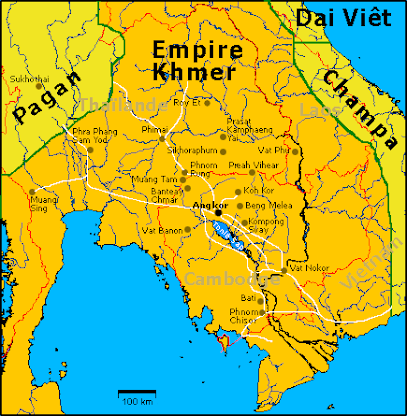
It was the seat of the Khmer empire, whose influence extended into Thailand, Laos and Vietnam, and it was the region's most sophisticated city for over 500 years. Archeologists believe it was the largest pre-industrial city in the world.
In the 13th century, faced with incursions from the Thais, the kingdom fell under attack and by 1432 the king moved the capital to Phnom Penh. Over time, the region's stunning wats or temples (the best known being Angkor Wat) with their gorgeous lotus-shaped towers, vine-twisted monuments, moats and stone-carved murals, were abandoned to the jungle.
But they were not forgotten. They were rediscovered by French naturalist Henri Mouhot in the 1860s after he wrote breathlessly of his visit to the ancient temples.
It's that sense of new discovery that comes over me as I lurch off the scooter and stumble through the as-of-yet barely touristed jungle temple early one morning and step into another world.
Beng Malea is a massive, kilometre-square crumbling monument strewn with tumbled rocks the size of small cars, set quietly in the jungle. It was built by King Suryavarman II, who also built Angkor Wat, But in contrast to Angkor Wat's tourist throngs and iconic status, Beng Malea seems forsaken, lost and abandoned. Here, the trees have taken over, their roots digging between the crevices of the stones, cracking and distorting carvings in their journey to find water -- nature returning civilization to the earth.
I spend a meditative hour wandering around its colossal walls and along the ramps in the interior of the temple that lead up to its remaining stone ramparts. It's breathtaking, all the more because it's struggling not to fall apart.
Cambodia itself has profoundly struggled, and tourism to its ruins is just beginning to help it rebuild.
The nation of 14 million was bombed during the U.S. war in Vietnam to flush out Viet Cong, creating two million refugees. A famine followed in 1975 and that same year the rebel Khmer Rouge took power. Pol Pot's Communist Party renamed the country Kampuchea and tried to return it to its agrarian roots, forcing educated Cambodians to work on farms, killing doctors and teachers and outlawing anything Western.
One to three million people were tortured, slaughtered or died from lack of food or medicine. A Vietnamese invasion in the late 1970s ousted the regime, but the Khmer Rouge rebels continued to fight in pockets throughout the countryside: 1999 was the first full year of peace in 30 years.
There are reminders of war everywhere. On the streets, it's rare to see a man over 40. At one wat-side stall, a young girl with a stack of plastic-wrapped books offered a slim volume, reading off its title: Children of Cambodian Killing Fields. That a child would have to know about her country's brutal history, let alone sell the tragic story to make a living, was a sobering thought.
But the development and dollars that accompany tourists to Angkor Wat -- arguably the country's top renewable resource -- seem to be having a positive impact.
Angkor Wat itself, the world's largest religious building, makes a profound impact.
The temple is surrounded by a huge moat that has more in common with a river than a man-made defence. Visitors approach from a causeway that spans the water and is guarded with statues of mythical serpents -- seven headed nagas -- warding off invaders.
The temple was begun in 1112 by King Suryavarman II to honour the god Vishnu and serve as his crypt. Today most tourists see it by sunrise or sunset, watching the light pick out details in the 65-metre high stone prasats (towers) and staying to examine the intricate bas-reliefs of devas and asuras (gods and demons) and 2,000 apsaras (divine nymphs) that decorate the palace.
Nearby, lie more remarkable ruins. The gates of Angkor Thom, a three square-kilometre city built by King Jayavarman VII starting in 1181, are flanked with giant, Buddha-like statues -- passing through can feel like entering another world. The otherworldly Bayon temple lies on the other side.
The Bayon, with its 37 towers chiselled with dozens of enigmatic, all-seeing Buddha faces (some say they resemble the king himself) offers an eerie introduction to Angkor's wonders. Eyes seem to follow you as you explore the temple, climbing over ruins, ducking under lintels, running fingers over the ancient bas-reliefs, and clambering up stone steps. The mysterious Bayon is one of Angkor's most affecting temples.
For those put off by the two-hour trek to Beng Malea, the temple of Ta Prohm is a fine substitute.
Ta Prohm is perhaps one of the most atmospheric of the inner temples, overgrown with thick vines with slabs of rock smothered in snaking tree roots. No wonder it was used in scenes from Tomb Raider with Angelina Jolie. The 12th-century temple has been left as it was found -- and has become beautifully meshed with the jungle.
It can be exhausting playing amateur archeologist all day in the 30- degree heat but, thankfully, Siem Reap has lots to offer in the way of rejuvenation. The city comes to life after sunset and though Siem Reap is a small town, restaurants, night markets and street stalls in the tourist-centric core remain lively well after midnight.
Start the evening with a leisurely dinner in the air-conditioned Angkor Palm restaurant near the Psar Chaa (Old Market) and admire the delicate silk wall hangings before tucking in to a Khmer feast featuring the Cambodian national dish, fish amoc. The creamy coconut-milk fish curry is served with jasmine rice, and the restaurant offers a host of other Asian bites, from pumpkin soup to a spicy papaya salad called bok l'hong and a peppery beef dish called lok lak.
For a communal dining experience share a Khmer-style hot pot (yao hon) with a friend, dipping beef, shrimp, cabbage, rice noodles and mushrooms to cook in bubbling broth. Or try a meal at Cambodian BBQ, where guests sizzle exotic meats -- crocodile, snake and ostrich are available -- on their personal phnom pleung or grill.
French colonial roots run deep in Cambodia, so good bread here is almost as common as rice, and vendors balance baguettes on their heads on their morning rounds.
For a taste of colonial cuisine try Le Malraux (named for French adventurer Andre Malraux, arrested for stealing temple bas-reliefs in the 1920s), for salade Parisienne, salmon rillettes and cream puffs amid Art Nouveau interior.
Stop for dessert at the Blue Pumpkin café, which offers exotic ice cream flavours like banana galangal, green lemon and kaffir lime, and ginger and black sesame.
After dinner, take care of wat-wandering tensions with streetside foot massages. They're a dime a dozen (actually, about $3 US for half an hour). Or enjoy an affordable body massage ($10) or pedicure ($7). Several shops also offer massages by the blind; at Seeing Hands Massage on Sivatha Road, part of the proceeds go back into training Cambodia's vision-impaired citizens in the trade.
But for a more refined experience step into Bodia Spa, a cool, inviting retreat across from the Old Market. A chilled ginger tea and cold herb-infused facecloth greet clients as they enter the white, high-design minimalist space en route to their oil body massages and herbal compresses.
Once refreshed, practise your bargaining skills at the Night Market off Sivatha Road -- where endless rows of silk scarves beckon -- or shop for social good at several local stores that support non-profit ventures. Rehab Craft near the Old Market sells handmade carvings, wallets and silks made by disabled employees and Artisan's D'Angkor trains poor youth in carving.
Top off the evening with a drink or two on the terrasse of the Red Piano, a restored French Colonial home with a sweeping corner balcony. Raise a glass of Angkor or Chang brand beers or sip a "Tomb Raider" cocktail (the restaurant was known as the place Jolie and crew hung out during filming) and toast to the spirit of Cambodia, to the beauty of Angkor, and to the adventurer in you.
If you go
- Passes to Angkor are sold at the gate of the archeological park for $20 US for one day, $40 for three days and $60 for a week. Two-day passes aren't offered. A three-day pass will give you time to see the central temples and to explore the countryside to see more remote treasures. There are as many ways to get to the ruins as there are ruins. You can hire a motorcycle, motorcycle-pulled trailer, car, mini-bus or bicycle. Feeling adventurous? Try an elephant, hot-air balloon or helicopter.
- Prepare for extreme heat -- high SPF sunblock, wide-brimmed hats, long sleeves, sun glasses and litres of bottled water are crucial. It's easy to get sunburned and dehydrated staring with awe at yet another astonishing apsara. After 10 a.m. the heat is unbearable. Hydrate early and often. Huge young coconuts, cracked open and strawed, offer refreshingly cold, sweet coconut water.
- Don't bother stocking up on Cambodian currency (the Riel; about 3,300 Riels to $1 CAD) before your trip. Most prices are stated in U.S. dollars and ATMs dispense cash in U.S. dollars. Locals prefer hard currency, though they will accept riels.
- Like Cambodian cuisine? Learn to cook it at local restaurant-led cooking schools. Le Tigre de Papier offers a morning or afternoon two-hour, two dish course for about $12. You can eat your mistakes and they'll offer dessert. The Angkor Palm restaurant also offers lessons.
- Luxury hotels have moved into Siem Reap with a vengeance. Tourists can stay at five-star resorts for three-star prices. Raffles Grand Hotel D'Angkor, Hotel de la Paix, and the Amansara are popular choices. There are plenty of reasonable guest-house options for the budget traveller that still offer air-conditioned rooms. Shadow of Angkor, Popular Guesthouse and Sala Bai Hotel are reliable options.
If you do splash out, make sure your hotel has a pool -- it can help ease the effects of the 44-degree summer heat.
- Learn more at Tourism Cambodia: http://www.tourismcambodia.com/.
Cambodian dengue fever patients rise sharply
PHNOM PENH, The number of dengue fever patients of Cambodia rose to about 1,500 until May, 960 more than the same period of last year, or an increase of about 50 percent, national media said on Monday.
The 1,500 victims were mainly spotted in Phnom Penh with 343 cases, Kampong Cham province 259 cases and Kandal province 161 cases, Chinese-language daily newspaper the Commercial News quoted officials of the Ministry of Health (MoH) as saying.
Moreover, three people died of the disease all over the kingdom, two of them died in the early of the year and the third in May, according to MoH.
The MoH has already received the assistance from Asian Development Bank (ADB) and the World Bank (WB), and plans to buy some mosquitocide and propaganda material to enhance the public understanding, according to MoH.
The rainy season from May to November is the period of the outbreak of the dengue fever nationwide. Usually, children under the 15 years old were the most fragile group to be attacked by the illness, and some 71 percent of the contaminated cases used to be children.
The government has called on the people to clean their water-saving tanks frequently, kill mosquito eggs in their tanks with pesticide, and sleep in anti-mosquito nets.
According to official figures, in 2007, a rampant year for the disease in the kingdom, 407 children died of it, out of a total of 39,851 infected cases of minors. And in last year there were 9542 people infected with the disease in the kingdom, out of them 65 were killed.
Read more!
A Helping Chinese Hand: Trade and Aid with Southeast Asia
Brian McCartan
Introduction
Long applying a carrot and stick approach to winning diplomatic allies in a sometimes ludicrous contest with Taiwan over diplomatic recognition, today China strives to establish itself as a “status quo” player in the international arena. “Softpower” replaces ideological approaches to the world, as in the sponsorship of scores of Confucius Institutes throughout the world, in hosting the Olympic Games, and even through the advent of mass Chinese tourism. “Resource diplomacy,” that is the quest to secure natural resources, is emblematic of the scale of China's economic reach. At the same time, China is increasing participation in international peacekeeping missions, notably the dispatch of civilian police to such locations as East Timor, Haiti, and Lebanon. In 2000, China established a peacekeeping training center in Hebei province. China can also be proactive on international issues, as with its leading role in the 6-Party Talks on North Korea nuclear weapons, and its 3 May 2009 call for the establishment of a peacekeeping role in Somalia. While China's “string of pearls” approach to the construction of ports and naval bases across the Bay of Bengal to the Indian Ocean may alarm, the projection of its naval assets to the coast of Africa should not surprise given the international character of the “war” against piracy. In short, with China's accession to WTO and other international fora, alongside its sustained economic growth and its position as the largest owner of foreign reserves in the world, including U.S. debt in the form of treasuries, the nation of over a billion people is carving out a central position in world affairs.
But, by taking on the world, and most notably Southeast Asia as an aid donor, as Brian McCartan outlines, China has ratcheted up. Applying a global view, we observe that, through the China Development Bank, Beijing has extended loans worth over $50 billion to the national oil companies of Russia, Kazakhstan and Brazil, alongside cooperation with Venezuela and Cuba. As a “resource investor,” China is careful to lock in long-term supply contracts. Australia also looms large in recent Chinese resource acquisitions. Such an approach differs from China's more controversial policy of investing in oil projects in unstable African states. While Nigeria, Angola, and the Middle East (Iran and Saudi Arabia) supply most of China's oil needs, China's national oil companies have also acquired interests in exploration and production.
So it should not surprise that Chinese economic integration with ASEAN is already a reality. Just as China's aid to the region now surpasses that of the U.S., we are reminded that, even prior to the current recession, Japan has slipped back in the ranks of aid donors. [Though refuted by Tokyo, Japan ranks last among developing countries according to the Washington-based Center for Global Development]. With Japan hobbled by domestic politics in its ability to sign meaningful free trade agreements with the ASEAN countries, trade pacts with China appear more attractive to many nations.
Although China cannot match Japanese investment levels in Southeast Asia reaching back to the 1960s, Japan will nevertheless be obliged to work harder to maintain its niche as the economic shadow of China looms larger. Japan is also feeling pressure from China's push to use its own currency for trade settlements in Asia and beyond. In response, on 3 May 2009, at a forum in Indonesia, Japan offered to provide 6 trillion yen in loans to financially stricken Asian countries. According to Yuzuru Takano, writing in the Asahi Shimbun (5 May 2009), the measure is “essentially a bid to entrench the yen as the region's benchmark currency at the expense of the Chinese yuan.” However, there is reason to be skeptical concerning the political reception of such a move on the part of the ASEAN countries, not to mention the U.S. Geoffrey Gunn
CHIANG MAI - A new investment fund and loan package to help alleviate the impact of the global financial crisis for Association of Southeast Asian Nations (ASEAN) represents the latest overture of China's "soft power" campaign towards the region. Many believe the aid package unveiled in Beijing this month was strategically announced to steal a commercial and diplomatic march over the economically ailing United States.
The aid package includes a US$10 billion investment fund, geared for cooperation in infrastructure construction, energy and natural resources development, and improvements in information and communications. China also announced it would extend a $15 billion line of credit over the next three to five years to needy ASEAN countries. Although the terms were not made public, the loans include preferential terms for $1.7 billion in cooperation projects.
An additional $39.7 million was earmarked for "special aid" to Cambodia, Laos and Myanmar, the 10-member groupings poorest members and closest China allies, to meet "urgent needs". China also announced it would donate $5 million to the China-ASEAN Cooperation Fund and an additional $900,000 to the ASEAN plus China, Japan and South Korea cooperation fund.
Beijing also announced increases in other forms of cooperative aid, including an offer of 2,000 government scholarships and 200 Master's scholarships for public administration students over the next five years from developing ASEAN countries. One thousand agricultural technicians will also have the chance to receive training in China over the next three years. Beijing also donated 300,000 tons of rice to an emergency East Asia reserve intended to boost food security and proposed a China-ASEAN scheme to create high-quality, high-yield crop demonstration farms in ASEAN countries.
The aid package underscores accelerating economic integration. China's trade with 10-member ASEAN has nearly doubled from $105.9 billion in 2004 to $202.5 billion in 2007. Even with the mounting global economic crisis, trade rose 14% last year to US$231.12 billion, making ASEAN China's fourth-largest trading partner. Gao Husheng, China's vice commerce minister, said at a preparatory meeting for the 6th China-ASEAN Expo on April 9 that ASEAN would likely replace Japan as China's third largest trade partner in the near future.
A proposed China-ASEAN free-trade zone would pave the way for faster trade flows. The last step in those negotiations, the signing of an investment agreement, was expected to be completed on the sidelines of the botched ASEAN summit at Pattaya, Thailand, earlier this month. Once the agreement is signed and implemented as early as 2010, annual bilateral trade volumes are expected to reach $1.2 trillion, according to figures projected in China's state-controlled media.
Chinese Foreign Minister Yang Jiechi unveiled the economic aid package for the region on April 12 during a meeting with ASEAN envoys. On announcing the package, Yang said, "As always, China firmly backs ASEAN integration and community building, and firmly supports ASEAN to play a leading role in regional cooperation."
The proposal was supposed to have been announced by Premier Wen Jiabao at the postponed ASEAN summit, which was disrupted by anti-government protesters who stormed the meeting's venue. Yang went on to call for joint efforts to reach an investment agreement conducive to the establishment of the China-ASEAN free-trade zone.
Friend in need
Economists say China's proposal would potentially give ASEAN nations hard hit by the global economic and financial crisis other emergency funding options beyond the International Monetary Fund or Asian Development Bank. The IMF's rescue packages in the wake of the 1997-98 Asian financial crisis were strongly criticized for measures perceived to favor foreign over local interests. Beijing's recent aid offers are similar and notably more generous than the $4 billion it offered to financially distressed ASEAN states, including Thailand and Indonesia, in the wake of that crisis.
Many remember how China held its fixed rate currency steady while ASEAN countries depreciated their units, allowing several countries to export themselves back to financial health. That marked a difference from Western approaches at the time, which demanded economic and financial reforms that would pave the way for greater foreign participation and ownership in distressed Southeast Asian economies.
Those economic and financial gestures underscored an important policy shift from Beijing's past destabilizing approach towards the region, marked in particular by its past support for communist insurgencies, including the radical Maoist Khmer Rouge in Cambodia and communist guerillas in Thailand. That often confrontational policy was also seen in the 1979 invasion of Vietnam and the conflict with ASEAN states over the ownership of islands in the South China Sea.
While the new measures will go some way towards facilitating a quicker regional recovery from the global economic and financial crisis, some analysts see a more opportunistic side to China's aid announcement. China's soft power campaign has taken the form of increased foreign aid, economic networking, including the establishment of free-trade areas, and cultural transmission to encourage pro-China sentiment in the region.
China's aid to the region, by some reports including a November 2008 estimate from Taiwan's Center for Asia-Pacific Studies, has now surpassed that of the US. For China the benefits of greater integration are as much political as economic. For instance, a rising tide of pro-Chinese sentiment in the region has made it easier for Chinese companies to secure deals for natural gas exploration in Myanmar, land large scale agriculture projects in the Philippines, and build transportation infrastructure in Thailand and Laos.
It all meshes with China's so-called "going out" policy, which aims to secure natural resources and economic opportunities that serve local development goals. That said, China's foreign aid activities often lack transparency; despite the rising outflows, Beijing still lacks a centralized foreign aid body or a regularized funding schedule. Nor does China publicly disclose data related to foreign aid expenditures. Some aid disbursements more closely resemble foreign direct investment (FDI), while other projects undertaken by companies with strong government ties more closely resemble aid.
Surging assistance
What is clear, however, is that China's foreign aid and government-supported economic projects have grown dramatically in recent years. Research done by the New York University Robert F Wagner Graduate School of Public Service indicates that Chinese assistance to Africa, Latin America and Southeast Asia grew from less than $1 billion in 2002 to $27.5 billion in 2006. The same research shows that sum fell modestly to $25 billion in 2007.
Although the researchers caution that some figures may be inflated, certain pledges and loans may not have been fulfilled and some multi-year projects could have been double-counted, the dramatic increase in aid flows is unmistakable. According to a February 25 Congressional Research Service (CRS) report, many of China's aid operations don't correspond to the usual definition of development assistance and that many of China's economic activities in developing countries are supported by the government.
Many economic investments could be considered aid since "they are secured through bilateral agreements, do not impose real financial risks upon PRC [People's Republic of China] companies involved, or do not result in Chinese ownership of foreign assets", the research said. In Southeast Asia, some analysts suggest that China has become one of the largest sources of economic assistance, even though it is not considered a major regional provider of traditional overseas direct assistance.
Wagner School researchers compiled a list of Chinese aid and related investment projects or offers to ASEAN from 2002-2007 and arrived at a combined total value of $14 billion. They estimated that 43% of that figure went to infrastructure and public works projects, 32% for natural resource extraction or development, 3% to military, humanitarian and technical assistance and the remaining 22% to unspecified activities.
China's assistance and economic interaction with ASEAN has come largely without the political, legal and environmental strings attached to Western country aid. It is also provided comparably faster and without the bureaucratic procedures that major aid donors, multilateral financial institutions and multinational corporations usually require.
The lack of interference in domestic affairs is especially appreciated by ASEAN's more authoritarian regimes, including Myanmar, Laos and Vietnam, and has earned a measure of public appreciation since it appears to be more respectful of national sovereignty than Western donors. China has enhanced its local reputations through various goodwill investments, including outlays for national stadiums, cultural centers and friendship roads and bridges.
These projects are often very publicly announced at regional summit meetings - such as the package planned for the Pattaya summit - and used to project an image of Chinese fraternity with its developing world brethren.
Some analysts perceive China's soft power foray with ASEAN as a struggle for dominance with the US, which for many years has been strategically linked to ASEAN. They suggest that the balance of power is starting to tilt in China's favor, as it increasingly leverages soft power initiatives into hard power gains. Certain ASEAN nations are known to view China as a useful hedge against US and Japanese influences.
China's improved relations with ASEAN are broadly geared towards providing a security hedge in the event of a conflict with the US. The majority of China's oil and gas imports still pass through the narrow Malacca Straits, a potential strategic chokepoint. With China's ascension in 2003 to the ASEAN Treaty of Amity and Cooperation in 2003, and the US still not a signatory, its not clear what stance ASEAN would take should the US and China ever become engaged in a regional conflict.
To be sure, Southeast Asian opinion is still very much divided over China and its rising influence. The maritime nations of Indonesia, Philippines, Malaysia and Vietnam are known to be uneasy over Chinese intentions, particularly with the recent advances in its naval capabilities and the unresolved claims to the disputed and potentially fuel-rich Spratly Islands.
China has made firmer inroads with the mainland countries of Cambodia, Laos and Myanmar, although even these countries try to balance Chinese influence with other big countries, including the US and India. At the same time, there is deep suspicion and angst over China's opaque plans for building a series of hydroelectric dams on the upper reaches of the Mekong River, which flows through and sustains the livelihoods of large populations in many mainland ASEAN states.
While some ASEAN countries may still be wary of China's rising regional clout, its recent aid proposal will no doubt be warmly welcomed across the region. And as the gathering economic and financial crisis hits the US's and Europe's ability to provide aid and assistance, ASEAN nations will have little choice but to rely more on its increasingly magnanimous northern neighbor.
Brian McCartan is a Chiang Mai-based freelance journalist. He may be reached at brianpm@comcast.net.
Read more!
Cambodian dengue fever patients rise sharply
PHNOM PENH, The number of dengue fever patients of Cambodia rose to about 1,500 until May, 960 more than the same period of last year, or an increase of about 50 percent, national media said on Monday.
The 1,500 victims were mainly spotted in Phnom Penh with 343 cases, Kampong Cham province 259 cases and Kandal province 161 cases, Chinese-language daily newspaper the Commercial News quoted officials of the Ministry of Health (MoH) as saying.
Moreover, three people died of the disease all over the kingdom, two of them died in the early of the year and the third in May, according to MoH.
The MoH has already received the assistance from Asian Development Bank (ADB) and the World Bank (WB), and plans to buy some mosquitocide and propaganda material to enhance the public understanding, according to MoH.
The rainy season from May to November is the period of the outbreak of the dengue fever nationwide. Usually, children under the 15 years old were the most fragile group to be attacked by the illness, and some 71 percent of the contaminated cases used to be children.
The government has called on the people to clean their water-saving tanks frequently, kill mosquito eggs in their tanks with pesticide, and sleep in anti-mosquito nets.
According to official figures, in 2007, a rampant year for the disease in the kingdom, 407 children died of it, out of a total of 39,851 infected cases of minors. And in last year there were 9542 people infected with the disease in the kingdom, out of them 65 were killed.
Read more!
Saturday, May 23, 2009
UN study advises caution over dams
MICHAEL CASEY
AP Environmental Writer= BANGKOK (AP) — A dam-building spree in China poses the greatest threat to the future of the already beleaguered Mekong, one of the world's major rivers and a key source of water for the region, a U.N. report said Thursday.
China is constructing a series of eight dams on the upper half of the Mekong as it passes through high gorges of Yunnan Province, including the recently completed Xiowan Dam, which — at 958 feet (292 meters) high — is the world's tallest. Its storage capacity is equal to all the Southeast Asia reservoirs combined, the U.N. report said.
Laos, meanwhile, has started construction on 23 dams expected to be finished by 2010 on the Mekong and its tributaries, the U.N. said, as a means to spur development and lift the country from poverty. Cambodia and Vietnam also have ambitious dam-building plans.
"China's extremely ambitious plan to build a massive cascade of eight dams on the upper half of the Mekong River, as it tumbles through the high gorges of Yunnan Province, may pose the single greatest threat to the river," the report said.
The report went onto to say that the impacts of the proposed dam development include "changes in river flow volume and timing, water quality deterioration and loss of biodiversity."
China's Foreign Ministry spokesman Ma Zhaoxu said in a regular briefing the government pays equal attention to the development of the Mekong and its protection. The Mekong is known as the Lancang river in China.
"I would like to point out that the Chinese government attaches great importance to the exploration and the protection of cross-border rivers and conducts the policy of equal attention to development and protection," Ma said.
The proposed dams would add further pressure to the Mekong, which runs through China, Myanmar, Laos, Thailand, Cambodia and Vietnam. The 307,000-square-mile (795,000-square-kilometer) river network is home to dozens of rare bird and marine species, including the Mekong giant catfish, and is a source of food and jobs for the 65 million people who live in the river basin.
The river and its vast tributary network already face threats from pollution, climate change and the effects of earlier dams that were built in China and have caused water levels to drop sharply on the upper Mekong.
Still, the U.N. report said for the time being, the Mekong's pollution levels were not at "alarming levels" while water shortages and conflicts over water on the Mekong have so far not emerged.
"The Mekong is in good condition at this time and can take more pressure such as irrigation development or industrial development," said Mukand S. Babel, one of the reports' authors.
The report, however, found several river basins in the Mekong that are under threat, including the Tonle Sap in Cambodia, Nam Khan in Laos and Sekong-Sesan Srepok in Vietnam and Cambodia due to increasing development and demand for water.
It called for countries bordering the Mekong to work more closely together to ensure that the region's growing population and expected economic development doesn't further strain the capacity of the delta.
"The time to tackle these challenges is now, otherwise the projected growth and development may impact on the basin's ability to meet future water needs," said Young-Woo Park, a U.N. regional director.
Read more!
California sex offender faces new charges in Cambodia
Formerly a patient at atascadero state hsopital, he is suspecting molesting four young boys
Jack Louis Sporich was living an idyllic retirement, splitting his time between a luxury condo in Sedona, Ariz., and a sprawling home he was having built in a tourist mecca in Cambodia.
The 74-year-old retired engineer appeared to have escaped his past, which included his classification as one of California’s most dangerous sex offenders, one who authorities suspect may have molested more than 500 young boys over the years.
Now, officials say Sporich, who won his release from Atascadero State Hospital in May 2004 without spending a single day in treatment, may have reoffended.
He has been charged in Cambodia with indecent acts against minors in a case involving four young Cambodian boys, according to an official in Phnom Penh whose organization helped investigate Sporich.
Cambodian news accounts of his arrest indicate Sporich denied the allegations, which included the claim he lured the children — ages 9 to 13 — to his home with toys and candies. The Cambodia Daily reported he also attracted youngsters by dropping dollar bills in the street.
He was arrested Feb. 2 and remains in custody in the tourist town of Siem Reap, according to Seila Samleang, executive director of Action Pour Les Enfants-Cambodia.
APLE-Cambodia is a nongovernmental organization that works closely with Cambodian police to target foreign pedophiles who exploit youngsters in that country, and Sporich had been under investigation by the group.
Samleang said in an e-mail to The Sacramento Bee the charges are misdemeanors punishable by a prison sentence of one to three years.
Sexual exploitation of children has been a problem in Cambodia for years, where the age of consent is 15.
Todd Melnik, the defense attorney who won Sporich’s release from Atascadero, said he knew nothing of the Cambodia charges. An e-mail to Sporich this week seeking comment did not receive a response.
Troubling history
Sporich is no stranger to charges of sex with kids.
He spent nine years in prison after his conviction in Ventura County on seven counts of lewd acts upon children under 14. Then, he was committed to Atascadero State Hospital as a “sexually violent predator” deemed too dangerous to be released upon completion of his sentence.
David Lehr, a Ventura County defense attorney who originally prosecuted Sporich, said he may have had as many as 500 victims, and he typically befriended boys through their parents and offered to take them on camping trips.
The parents frequently would pay Sporich for gas and the time he spent on the trips, Lehr said last week.
“If I had to pick from a list of former and current SVPs, he would be, by far, the first one I would be most concerned about,” Lehr said in an interview for a 2006 series of stories in The Sacramento Bee about sexually violent predators.
Sporich was released from Atascadero in May 2004, after two juries were unable to agree on whether he would reoffend, and he immediately moved to Arizona, where the only requirement he faced was that he register as a sex offender once a year.
He is not listed on the current sex offender registry maintained by the Arizona Department of Public Safety.
Sporich’s case was highlighted in The Sacramento Bee’s series, which revealed it was far easier for offenders to win release from Atascadero by refusing treatment than by undergoing the lengthy treatment program designed to prevent them from reoffending.
After The Sacramento Bee’s series, lawmakers introduced a number of proposed improvements to the system and voters later that year overwhelmingly approved Proposition 83.
That measure increased prison sentences for habitual and violent offenders and did away with the requirement that sexually violent predators be allowed a trial every two years. Instead, they now can petition annually for a hearing, but the burden of proof is on them to convince a court they no longer pose a threat.
Read more!
Cambodia finds three passengers traveling with A/H1N1 virus patient
PHNOM PENH, Cambodian health authorities have found the three passengers who arrived here on the same flight with a woman who was later confirmed to have A/H1N1 virus, a health official here said on Saturday.
The three, all Cambodian-Americans, were found Friday, and one of the old man now stays in Battambang province while the two others, a father and his daughter, in Kampot province, according to Sok Touch, director of the epidemic disease department at the Ministry of Health.
"We have got their samples and sent to the Pasteur Institute in Phnom Penh for testing A/H1N1 virus. The results would be available later today," he told reporters, adding that "the three's health are normal with no influenza symptoms now."
Sok Touch said that the Health Ministry has not took isolation measure to them, but asked them to have a self-isolation, and not to visit relatives as well as go to the public places in the next seven days.
The three arrived in Phnom Penh from the United States via South Korean on May 17. A Vietnamese woman traveled with them on the same flight feel unwell and hospitalized at Incheon, South Korea, and later she was confirmed of the disease.
Read more!
Friday, May 22, 2009
Cambodia, WHO declear no confirmed A/H1N1 virus in Cambodia
PHNOM PENH, Cambodian Ministry of Health and the World Health Organization (WHO) here on Friday issued a joint statement claiming there is no confirmed cases of Influenza A/H1N1in Cambodia.
"The ministry of Health would like to advise that as of May 22 2009, no cases of Influenza A/H1N1 virus have been confirmed in the country," the statement said.
Cambodian Health Ministry received an urgent letter Wednesday from South Korean Embassy warning that three Cambodian- Americans were on the same flight from the United States to South Korea with a passenger who was later confirmed to have Influenza A/H1N1. The three individuals subsequently flew on a separate flight to Phnom Penh on Sunday.
At the time of their arrival to Cambodia, the three passengers did not display influenza symptoms, according to the statement. The ministry officials are now seeking to locate these passengers to assess their well-being and to offer them testing.
"The Ministry of Health is working closely with all relevant authorities to continue to monitor the situation closely," it added.
The ministry also strongly advised people who has traveled from an affected area in the past seven days and has developed fever ...to contact with the ministry.
Read more!
Thai Deputy PM: Cambodia not issue passport to Thaksin
BANGKOK, Cambodia did not issue passport to ousted former premier Thaksin Shinawatra, according to Cambodia's Prime Minister Hun Sen, Thailand's Deputy Prime Minister Suthep Thuagsuban told reporters Friday.
"I was told by Cambodian Prime Minister Hun Sen himself that there was no issuing a passport for Thaksin," the website by The Nation newspaper quoted Suthep as saying.
Suthep was reacting to remarks by opposition Pheu Thai Party MPChalerm Yoobamrung, who earlier said Thaksin showed him the Cambodian passport among six or seven passports during their meeting last week in Dubai.
Thaksin was ousted by the military coup in September 2006 in accusation of corruption, keeping him in exile since then. Thaksin returned to Thailand in February 2008 to face corruption charges, but he later fled into exile again and was convicted in absentia.
Read more!
CPC in Talks to Buy Cambodia Oil Stake From China as Ties Warm
By Yu-huay Sun
May 22 (Bloomberg) -- CPC Corp., Taiwan’s state-owned refiner, is in talks to buy a stake in a Cambodian oil area from China and plans to “aggressively” bid for energy assets with mainland partners, company President Chu Shao-hua said.
The purchase is being negotiated with China National Offshore Oil Corp., the country’s third-biggest oil producer, from whom CPC bought a 30 percent share in a Kenyan block in December, spokeswoman Jessica Tang said. The company also plans to process more crude for China National Petroleum Corp., the parent of PetroChina Co., Chu said in an interview in Taipei.
CPC will ramp up exploration spending by 77 percent this year as part of efforts to secure supplies and meet a tenth of its petroleum needs by 2014. Warming political ties are encouraging companies in China and Taiwan to cooperate. China Mobile Ltd. agreed to buy a stake in Far EasTone Telecommunications Co. in April, the first planned investment by a state-owned mainland company in Taiwan in six decades.
China National Offshore “has a very good track record in exploration and production,” said Charles Chen, who helps manage the equivalent of $3.7 billion at JF Asset Management Co. in Taipei. “Its cooperation with CPC may help Taiwan gain oil resources in the future.”
Unlisted CPC competes with Formosa Petrochemical Corp., the island’s only publicly traded oil refiner, to sell fuels in Taiwan and in Asian markets, including China. The island imports about 99 percent of its energy needs.
‘Aggressively Pursuing’
The company may spend NT$4.6 billion ($141 million) on exploration and production this year, Chu, 61, said at CPC’s headquarters yesterday. It spent NT$2.6 billion in 2008. Current production meets 7 percent of its gas requirement and about 2.5 percent of its crude-oil needs, Chu said.
“Possible stake purchases in existing fields is an approach we’re aggressively pursuing,” Chu said. “Chinese companies are easier to communicate with than foreign ones.”
CPC and China National Offshore started a joint study in 1998 on possible cooperation in search for oil and gas in a block in the Taiwan Strait. The purchase of the block in Kenya paved the way for joint overseas exploration and the two companies renewed a 2002 agreement last year to jointly drill wells in the southern part of the Strait.
CPC may invite Chinese companies to jointly search for oil and gas in waters near the island to share costs, John Hsu, chief executive of the company’s exploration and production division, said in March.
‘Limited’ Gains
How much CPC could gain from cooperation in the near term is difficult to assess as very little information is available on the likely reserves and because exploration “requires large investments,” said Chen at JF Asset Management.
“Benefits for CPC may be limited for now, but you got to work together first and see what chances there may be in the future,” Chen said. Still, China National Offshore, “is a worthy partner.”
Relations between China and Taiwan have improved since the Kuomintang party’s Ma Ying-jeou took office in May last year as the island’s president and dropped the pro-independence stance of his predecessor, Chen Shui-bian. Ma said this week he will prioritize economic ties with China.
While China says Taiwan is part of its territory, the two have been administered separately since Chiang Kai-shek’s Nationalists fled the mainland in 1949 after losing to Mao Zedong’s Communists in a civil war.
Refining for China
Formerly known as Chinese Petroleum Corp., CPC was formed by the Nationalists government in Shanghai in 1946 and relocated to Taiwan after Kuomintang’s defeat.
The refiner may process as many as 3 million barrels of Sudanese oil for China National Petroleum in exchange for fees and parts of the refined products, President Chu said. This would help CPC better utilize its spare capacity as Taiwan’s fuel demand falls amid the recession, he said.
CPC first refined crude for the Chinese company in 2002 and processed another cargo last year, he said.
CPC operates three refineries with a total daily capacity of 720,000 barrels of crude and has investments in Africa, Southeast Asia, the U.S., Australia and Latin America.
To contact the reporter on the story: Yu-huay Sun in Taipei ysun7@bloomberg.net .
Read more!
Study shows hidden birdflu cases in Cambodia
By Maggie Fox, Health and Science Editor
WASHINGTON (Reuters) - The H5N1 bird flu virus can infect people without causing noticeable symptoms, but only rarely, according to a report published on Thursday.
A survey of more than 600 people in Cambodian villages where two children died from the virus shows seven more were apparently infected, but without having known about it.
The study, published in the Journal of Infectious Diseases, also suggests that people may become infected by swimming in ponds where infected birds have dabbled.
"Although these results cannot be considered to be representative without broader confirmation, they show that, in some settings, surveillance may substantially miss H5N1 virus infections," Dr. Sylvie Briand and and Dr. Keiji Fukuda of the World Health Organization wrote in a commentary.
The H5N1 avian influenza virus has been regularly causing outbreaks of disease in birds -- 250 outbreaks in February alone in Bangladesh, China, Egypt, India, Indonesia, Laos, Nepal and Vietnam, according to the U.N. Food and Agriculture Organization.
It only rarely infects people but is often deadly when it does. WHO says it has killed 261 people out of 424 infected since 2003.
The big fear is that is could change into a form that people can pass easily to one another, sparking a pandemic. These fears have been overshadowed at least a little by the near-pandemic of much milder H1N1 swine flu that started in March.
One big question has been whether some people have been infected without knowing it. If this is the case, the fatality rate would go down. With current numbers, the fatality rate appears to be around 60 percent but if there are more than 424 infections it would make for a lower rate.
Sirenda Vong of the Institut Pasteur in Cambodia and colleagues followed up on two deaths of children from H5N1 in 2006. They interviewed villagers and took blood samples.
ANTIBODIES IN BLOOD
"Seven (1 percent) of 674 villagers tested seropositive for influenza H5N1 antibodies and did not report severe illness," they wrote. This means their bodies had at some point fought off an H5N1 infection.
Most were male, 18 or younger, and were more likely than other villagers to have reported bathing or swimming in household ponds. They all lived in wooden houses on stilts with well or pond water as the only water source for the family and none had known contact with the two children who died.
Scientists know that birds can pass influenza viruses in their droppings and ducks, especially, can foul ponds with virus-infected droppings. The virus can live in droppings or water for up to six days.
"During the study period, most participants reported repeated direct and close poultry contact, including feeding or touching poultry (73.3 percent), collecting poultry feces for manure (50.9 percent), plucking feathers of sick poultry (31.1 percent), or collecting sick and/or dead poultry with bare hands (36.8 percent)," the researchers wrote.
But, they added, the findings suggest that transmission from sick bird to human in Cambodia was rare in 2006.
The found genetic material from the H5N1 virus in specimens taken from ponds and pond plants.
"Our results also indicate that swimming or bathing in household ponds could be a risk factor for influenza H5N1 virus infection. These small ponds are common and usually serve as a water source for backyard animals and gardening,' the wrote.
"Ducks usually have access to these ponds and may deposit large amounts of feces in ponds in which children commonly bathe and play."
Read more!
Cambodia to send fresh soldiers for de-mining operation
(PHNOM PENH) – Cambodia, one of the world’s most heavily mined countries, is sending 52 soldiers to replace some members of its group who take part in landmines clearence in southern Sudan, defence officials said on Thursday.
The group of 52 de-miners is expected to arrive in war-recovering Sudan in early June, reported the government news agency Agence Kampuchea Press (AKP). An outgoing company of Cambodian de-miners is based in Malakal, Upper Nile.
They will join the international peacekeeping mission known as UNMIS, while the outgoing solders will return home in mid-June, Royal Cambodian Armed Forces Gen. Sem Sovanny was quoted as saying.
He said that the United States had trained most of the Cambodian soldiers who will be sent to Sudan, as well as others who are preparing to be sent to Chad and Central African Republic.
Gen. Sovanny is also a director general of the National Management Centre for Peacekeeping Forces and Explosive Remnants of War. His country witnessed three decades of civil war ended in 1998, becoming one of the world’s most heavily mined countries. Its military thus has extensive experience in removing land mines.
In the past 10 years, Phnom Penh has destroyed an estimated 1.6 million landmines. Cambodia’s first demining team had arrived in Sudan in February 2006.
The Sudanese government and the former rebel SPLM signed in January 2005 a peace deal ending two decades of war in southern Sudan. In March 2005, The U.N. Security Council voted to send 10,700 peacekeepers to Sudan to monitor the peace deal, which is known as the Comprehensive Peace Agreement.
Read more!
Thursday, May 21, 2009
Chevron seeks solution to Thai-Cambodia claim talks
By Nareerat Wiriyapong
Bangkok Post, Thailand
BANGKOK, THAILAND: The US-based energy giant Chevron has called on Thailand and Cambodia to speed up negotiations over the two countries' long-awaited overlapping claims area (OCA).
While committed to its ongoing investments, the company said the OCA's rich resources would benefit economic development and energy security in both countries.
"Clearly, there's an opportunity for both countries to go in and see what's there and to use those resources for their mutual benefit. Energy security depends on [a country's] resources," said Joseph Geagea, managing director of Chevron Asia South Ltd.
"We are ready to take part in developing the area as soon as the resolution is made," said Mr Geagea, who is in charge of Chevron's upstream activities in six countries in South Asia.
Decades of border disputes between the two countries have delayed offshore exploration in the 27,000-square-kilometre area in the northern Gulf of Thailand, where multinational energy firms have been granted concessions.
Chevron and its partners are working closely with the Cambodian government on a regulatory framework for the industry, said Mr Geagea.
Chevron is the biggest multinational oil-and-gas player in Thailand, producing about one-third of the country's demand for natural gas.
In 2008 the company produced 210,000 net barrels of oil equivalent per day (boed) in Thailand. Its owned and operated Platong project is scheduled to start production in 2011 with total gas capacity of 420 million cubic feet per day (mmcfd).
Chevron's assets in South Asia also include operations in Bangladesh, China and Burma, as well as a US$4-billion gas project in Vietnam, he said. Chevron's assets in the six countries account for 48 percent of net oil and gas production in the Asia-Pacific region, where the company produces about 700,000 boed.
Chevron has confidence in the region's economy and its opportunities for the natural gas business, and ongoing projects have stayed on course despite the global recession, said Mr Geagea.
"Asia is expected to lead future energy demand growth. We do believe in Asia coming out quickest in the [economic] recovery and providing the fastest growth opportunity for Chevron," he said.
By 2030, Asia is expected to account for 52 percent of world economic growth in terms of gross domestic product, while the Asia-Pacific region will become the largest consumer of oil and gas.
The region's share of oil-and-gas demand will top 30 percent in 2030, up from 23 percent in 2005, driven mainly by increasing power generation.
Read more!
'Ghost' dollars offered for Pol Pot's shoes: report
PHNOM PENH (AFP) — A Cambodian photographer's attempt to sell the sandals of late Khmer Rouge leader Pol Pot has yielded only one bid -- 790,000 fake dollars offered in protest at the sale, a report said.
Nhem En, who photographed inmates at the regime's main torture centre and also snapped pictures at official regime ceremonies, announced last month he was selling the footwear along with two cameras.
The shoes belonging to Pol Pot, who died in 1998, were made of car tyre, while the two cameras were manufactured in Germany and Japan.
But "bidder" Pok Leak Reasey told English-language Phnom Penh Post newspaper that he was offering 790,000 fake dollar bills traditionally used to make offerings to spirits of the dead.
"And the reason why I have offered the money in ghost notes is because I want to say that all material remaining from the regime is worth nothing," he said, according to the paper.
Ghost money is used during funeral rites in many parts of Asia.
Up to two million people died of starvation, execution, overwork or torture as the Khmer Rouge, which ruled Cambodia from 1975 to 1979, dismantled society in a bid to forge a communist utopia.
The former chief of Tuol Sleng prison, Kaing Guek Eav -- better known as Duch -- is currently on trial for crimes committed during the regime.
Cambodia's UN-backed court also plans to try four other senior Khmer Rouge leaders for war crimes and crimes against humanity.
Read more!
Wednesday, May 20, 2009
Cambodia: Naga Corp, Post Tel Pick Up First Wins
The big boys are picking up points in Cambodia
Naga Corp FC and Post Tel Club each chalked up their first win of the 2009 Cambodia Premier League – three matches into the new season.
While Naga Corp did not have to struggle too much before scoring a 5-3 win over Build Bright United, the story was a little different for Post Tel when they had to comeback from being a goal down before posting a 3-1 victory over Phouchung Neak FC.
An third-minute strike from Sun Samprathna set the tone for the game as Naga Corp then raced to a 2-0 lead at the half with the second goal from Chhim Sambo in the 37th minute.
Chhim then made it 3-0 with his second strike of the afternoon in the 56th minute before Build Bright pulled a goal back off Prum Putsithy three minutes later.
Tiep Vathanak then made it 4-1 in the 73rd minute before Build Bright struck twice within four minutes to make the scoreline 4-3.
However, N. Friday made sure of the three points for Naga Corp and their first win of the season with their fifth goal deep in injury time.
In the meantime, Post Tel could not have started their game on a worse note when they conceded an early goal to Phouchung Neak through O. O. Joseph’s fourth-minute strike.
However, they bounced back in the 19th minute when Touch Sok Heng found the equaliser for the score to be at 1-1 at the break.
Eight minutes after the restart, Post Tel grabbed the lead for the first time in the game – with Sok Heng again on target.
In the 63rd minute, Phany Chamroeun then put the game beyond the reach of Phouchung Neak with the third goal for Post Tel.
With the wins, Naga Corp moved up to third at the table while Post Tel are now seventh.
1. PHNOM PENH 6 2. KIRIVONG SOK SEN CHEY 63. NAGA CORP 4 .
Read more!
Cambodian PM to attend ASEAN-South Korea Commemorative Summit
PHNOM PENH, Cambodian Prime Minister Hun Sen will lead a high-level delegation to attend the Commemorative Summit for the 20th Anniversary of ASEAN-Republic of Korea Dialogue Relation to be held on June 1-2, the official Agence Kampuchea Presse (AKP) reported on Wednesday.
After the meeting, Hun Sen will also pay an official visit to South Korea from June 3 to 5, AKP quoted the press release of the Ministry of Foreign Affairs and International Cooperation as saying.
During the official visit, Cambodia and South Korea will sign several documents, it added.
The delegation will include Deputy Prime Minister and Foreign Minister Hor Namhong, Senior Minister and Commerce Minister Cham Prasidh, Senior Minister and Minister of Land Management, Urban Planning and Construction Im Chhun Lim and other members of the royal government.
ASEAN (the Association of Southeast Asian Nations) groups Brunei, Cambodia, Indonesia, Laos, Malaysia, Myanmar, the Philippines, Singapore, Thailand and Vietnam.
Read more!
Gates Fights China Fakes, Drug Failure to Stem Malaria Disaster
By Simeon Bennett
Saron Samnith, 14, slouches in the doorway of his family’s thatched hut off a dusty track near Pailin, a city in western Cambodia. He has chills, diarrhea and a three-day-old headache -- signs of malaria.
The bout of the mosquito-borne disease, for which he tested positive, is his second in a month. The first left him comatose and in danger of dying, before medicines curbed the attack. Coursing through Saron’s veins may be the strain so dangerous that health officials --and the billionaire Bill Gates -- are racing to stop it from spreading before it kills millions.
In Pailin, a flood of counterfeit pills from China and elsewhere is helping to breed a superbug that resists even the most-effective medicine. The development threatens to unleash a global malaria “disaster” and undo decades of work to reduce illness, destitution and death, said Arjen Dondorp, a Thailand- based researcher.
“It’s a time bomb,” said Dondorp, the deputy director of the Wellcome Trust-Mahidol University Oxford Tropical Medicine Research Programme, with headquarters in Bangkok.
The World Health Organization plans to defuse the bomb with a screening and treatment program to contain and eliminate the resistant strain. The effort, in and near Pailin, may begin next month. The program is backed by $23 million from the Bill & Melinda Gates Foundation, based in Seattle.
“There’s more money put into baldness drugs than is put into malaria,” Gates told an audience in February, in Long Beach, California. “Because the disease is only in the poor countries, it doesn’t get much investment. You can’t get the economies in these areas going because it just holds things back so much.”
Doom Scenario
The risk of failure raises what Dorndop calls a “doom scenario.” In that sequence of events, migrant workers would first carry the bug to Thailand, Myanmar and India. Later the strain would spread to Africa, which already has 90 percent of the world’s malaria cases.
“We rang the warning bell in 2005 and nobody believed us,” said Pascal Ringwald, the Geneva-based WHO’s leading specialist in the malaria parasite’s ability to resist drugs. “Many people were skeptical.”
The doom scenario may be a decade away from materializing, giving the world time to prevent it, said Charles Delacollette, the head of WHO’s Mekong Malaria Programme, which covers Cambodia, Laos, Myanmar, Thailand, Vietnam and part of China.
“We don’t have many alternatives” to the antimalarial drug artemisinin, to which the parasite is becoming resistant in western Cambodia, Delacollette said in an interview in Bangkok. “That drug should be protected.”
Interpol Operations
Interpol, the international police organization based in Lyon, France, traced counterfeit drugs in Southeast Asia to China in 2006 as part of an investigation called Operation Jupiter. Last year, under Operation Storm, Interpol arrested 27 people in raids across Asia and seized more than 16 million fake pills valued at almost $7 million.
Chemical analysis of pills bought in Cambodia, Laos, Myanmar, Thailand and Vietnam found several other pharmaceutical ingredients, charcoal, and a precursor of the illicit drug ecstasy, according to an account of Operation Jupiter published in the journal Public Library of Science Medicine. Also present were spores and pollen from trees common in southern China, suggesting that at least some of the drugs were made there, the authors said.
“The evidence we have at the moment suggests China and India are sources of fake medicines, including in the case of China, fake anti-malarials,” said Paul Newton, a University of Oxford researcher who monitors counterfeit malaria drugs from an office in Vientiane, Laos.
Market Forecast
Interpol’s actions hardly dented the global market for counterfeit pharmaceuticals, which may reach $75 billion in 2010, an increase of more than 90 percent from 2005, according to estimates by the Center for Medicine in the Public Interest, a nonprofit organization based in New York. WHO says fakes, typically cheaper than real drugs, may account for as much as 30 percent of all medicines in developing nations.
“We’re talking about sophisticated, big syndicates, people who are very well organized,” said Aline Plancon, the Interpol officer who coordinated the operations. “It’s just insane. They’re making too much money, they’re betting too much on the health of people. We’ll do it again and again.”
Deadly Disease
Malaria strikes about 250 million people each year and kills more than 880,000, making it the world’s most lethal mosquito-borne disease, according to WHO.
The malady is caused by a microscopic parasite called Plasmodium, which is carried in the saliva of female mosquitoes. When an infected insect bites a person, the parasites multiply in the liver before entering the bloodstream. There they invade red cells, causing fever, chills, nausea and diarrhea. Unchecked, the bugs cause red cells to stick to the walls of capillaries, slowing blood flow. Without treatment, sufferers can die from organ failure.
The most-effective modern drugs against malaria are based on artemisinin, an ancient Chinese remedy derived from the leaves of the sweet wormwood tree. So-called artemisinin derivatives include artesunate and artemether, the key ingredients respectively in Sanofi-Aventis SA’s Coarsucam and Novartis AG’s Coartem.
Breeding Ground
While Cambodia accounts for only about 0.4 percent of the world’s malaria cases, the country is a breeding ground for strains that withstand medicines. Since the 1970s, at least three once-potent malaria drugs have failed in western Cambodia before becoming useless elsewhere in the world, according to WHO: first chloroquine and Roche Holding AG’s Fansidar, then mefloquine.
Now Dondorp and other researchers say the same thing is happening to artemisinin. In a study carried out last year and yet to be published, artesunate failed to clear malaria parasites within two days from the blood of about 70 percent of patients in Pailin compared with 7 percent in western Thailand.
For now, the drugs still clear the parasites, only more slowly -- a sign that resistance to artemisinin-based treatments is building. While Novartis, GlaxoSmithKlinePLC, Genzyme Corp. and Ranbaxy Laboratories Ltd. are developing new drugs and vaccines against malaria, those products are in the early stages of development and won’t be available for years.
Malaria ‘Disaster’
“If we lose the artemisinins at this stage, just now when we dare to mention the word ‘eradication’ again, it would be a disaster for malaria control,” said Dondorp, who led the study. “It would cause millions of deaths, without exaggeration.”
WHO aims to eliminate malaria from western Cambodia through the program backed by the Gates Foundation, the world’s biggest charity. The agency, an arm of the United Nations, plans to screen and treat about 25,000 people in the area next month, possibly expanding tests and treatment to hundreds of thousands later this year.
Those who test positive will probably be treated with Glaxo’s Malarone because it doesn’t contain artemisinin and will take the pressure off drugs that do, said Eva-Maria Christophel, a WHO medical officer implementing the plan.
In and around Pailin, Cambodia also plans to start treating patients with Chongqing Holley Pharmaceutical Co.’s Duo-Cotecxin instead of artemisinin-based drugs, said Duong Socheat, director of the nation’s malaria control program, by phone from Phnom Penh.
Fakes Abound
Fake pharmaceuticals abound in Pailin. At the city’s dusty, fly-blown Samaki Market, untrained vendors hawk cheap pills without a prescription at drugstores opposite stalls offering fried locusts. Shoppers on motorbikes squeeze through the busy, narrow lanes. The traffic moves past a woman sitting by a pile of dried fish, waving away flies with a swat made from a stick and plastic bags.
Anti-malaria pills bought by Bloomberg News at two Samaki market stalls for $5 were sold loose in clear plastic bags, with no labeling or printed information about what they contained or how to take them. Even if the drugs are genuine, taking too few of them may not cure patients and may contribute to drug- resistance, Oxford’s Newton said.
Counterfeiters have learned to fool the on-the-spot dye tests used to identify fakes by including small amounts of real medicine in the illegal copies, Newton said.
Murder
“If you make a medicine that contains no active ingredient for a disease you know can be fatal, at best that is manslaughter and at worst it is murder,” Newton said. As many as half of all artesunate pills available at shops in Southeast Asia may be fake, according to studies he has led.
While pills devoid of active ingredients won’t heal patients, those containing small amounts wipe out only the weakest parasites, enabling the hardiest to survive and spread resistance to genuine drugs.
A bigger contributor to drug resistance than counterfeiters is patients who don’t take medicines properly, according to WHO scientists.
So-called artemisinin-derivatives work by giving malaria a short, sharp shock, clearing most of the parasites from the blood within hours. The drawback is that the drugs don’t stick around in the body and, according to WHO guidelines, must be given with one of several less-powerful, longer-lasting partner medicines that mop up stragglers.
Adverse Effects
The problem is that those other drugs, such as mefloquine, an older product, cause adverse effects, including nausea, vomiting and nightmares. When the two drugs are sold side by side rather than in a single pill, some patients take only the artemisinin, paving the way for relapses and resistance.
“If you want to get rid of these resistant parasites, you in fact have to eradicate malaria from western Cambodia,” Dondorp said. “In the effort to reduce it, the last man standing will be the most resistant parasite.”
Apart from artemisinin-based drugs, there are few effective treatments for the disease. Some that do work, such as Glaxo’s Malarone, are too expensive for patients in developing countries, Dondorp said.
Insecticide-treated bed nets, credited with slashing cases and deaths in Africa, aren’t so effective in Southeast Asia, where the Anopheles diris mosquito that spreads the disease bites earlier in the evening, before its victims have taken shelter for the night.
In Pailin, Saron’s mother, Bot Yom, has lost faith in Western pharmaceuticals. She plans to rub a coin against her son’s skin until it becomes red. If the disease renders artemisinin-based drugs as useless as their predecessors, the folk remedy might be just as effective.
To contact the reporter on this story: Simeon Bennett in Singapore at sbennett9@bloomberg.net
Read more!
South Korean man charged over Cambodian marriage fraud
Phnom Penh - A Cambodian court on Tuesday charged a South Korean man with falsifying official documents as part of an alleged scheme to broker marriages between Cambodian women and South Korean men, national media reported Wednesday.
Police arrested Lee Kyung Jun, 40, Monday in Phnom Penh after another South Korean man accused him of supplying false marriage certificates, the Cambodian Daily reported.
An Interior Ministry official said Lee was accused of supplying at least 14 false marriage certificates to the man, who owns a marriage agency, at a cost of 500 dollars per person.
The official said the certificates carried the signature of a provincial administrator but were proven to be falsified after the recipient checked their authenticity with the administrator.
The ministry did not say whether the complainant's marriage service was a legal business.
Lee was detained by the Interior Ministry while officials decided whether to release him on bail.
The government in November enforced a temporary ban on marriages between Cambodians and foreigners after an International Organization for Migration report claimed a high number of local women were being married to South Korean men through illegal agencies.
The ban was lifted in January.
Read more!
Tuesday, May 19, 2009
New Exotissimo Tours Explore Hidden Charms of Southern Cambodia and Vietnam's Mekong Delta
 Exotissimo unveils diverse local cultures and undiscovered gems of Vietnam and Cambodia in two spectacular programs.
Bangkok, Thailand (PRWEB), Exotissimo Travel, a leading tailor-made travel company in Southeast Asia, presents two exciting programs that traverse Southern Cambodia and Vietnam's Mekong Delta.
In these brand new tours, Exotissimo combines well-known attractions with off-the-beaten-path sites in the itineraries. A particular focus is placed on Cambodia's emerging south, which is home to unspoiled beaches and islands that were frequented by Cambodian royalty in the 1960s. The small towns in Vietnam's Mekong Delta, an alluring region marked by countless waterways, lush paddies and floating markets, are another featured highlight.
"Maintaining a balance of classic attractions with ventures into undiscovered destinations, these new tours are designed for intrepid travelers who wish to discover the true essence of the countries visited. Along the way, the programs offer opportunities to meet locals and engage in traditional customs, creating more than just a holiday but rather a rewarding travel experience," said Anne Cruickshanks, Group Product Manager of Exotissimo Travel.
The 15-day Journey Across Cambodia - Bangkok to the Mekong Delta is an overland program that connects the bustling cities of Thailand, Cambodia and Vietnam with unique excursions to unexplored sites. Besides Siem Reap's Angkor Archaeological Park and Phnom Penh's pagodas, other highlights include visits to Sihanoukville's Ream National Park, idyllic beaches of Rabbit Island and the colonial riverside town of Kampot. A cross-border cruise along the Mekong River, combined with boat trips through the waterways and excursions to local workshops in the Mekong Delta, afford in-depth glimpses into the traditional ways of life in the region.
To view the detailed itinerary, visit Journey Across Cambodia.
The 13-day South Vietnam and Cambodia Unveiled starts in dynamic Ho Chi Minh City before heading southwards to Phu Quoc Island, one of Asia's least developed beach destinations. Crossing borders via an overland journey, travelers are shown Cambodia's tranquil coast at Kep and Rabbit Island and natural landscapes and indigenous wildlife at Kirirom National Park. Venturing deeper into Cambodia, the program leads travelers to ancient Khmer temples at Sambor Prey Kuk and Angkor Wat as well as a unique trip to a floating village in Tonle Sap Lake. This tour program can also be conducted in the reverse direction.
To view the detailed itinerary, visit South Vietnam and Cambodia Unveiled.
For other touring ideas in Indochina and beyond, visit Exotissimo multi-country tour packages in Indochina and Beyond.
About Exotissimo TravelExotissimo Travel is a premier destination management company that specializes in tailor made tours in Vietnam, Cambodia, Laos, Myanmar and Thailand. Established in 1993, the company is now a network of 15 locally-based offices staffing over 500 travel professionals, and sales offices in San Francisco, Paris, Berlin, Barcelona and Melbourne. For more information, please visit http://www.exotissimo.com/.
Helvetica, sans-serif; TEXT-DECORATION: none" href="http://www.exotissimo.com/">Maintaining a balance of classic attractions with ventures into undiscovered destinations, these new tours are designed for intrepid travelers who wish to discover the true essence of the countries visited. Along the way, the programs offer opportunities to meet locals and engage in traditional customs, creating more than just a holiday but rather a rewarding travel experience
Read more!
Cambodian farmers urged not to cut down palm tree
PHNOM PENH, Cambodia's palm wine producer urged farmers not to cut down palm trees, saying the trees could earn much money for them, the official Agency Kampuchea Press (AKP)reported on Tuesday.
Cambodian farmers could earn an income of 500 million U.S. dollars per year if the exploitation of the palm trees was made as fully as possible, AKP quoted Confirel Company, the palm wine "Jaya" producer, as saying.
The company launched its palm wine named "Jaya" in early May.
An income being earned by each palm tree could vary from 101 U.S. dollars to 224 U.S. dollars per year, the company said, urging that the Cambodian farmers not to cut down such trees.
According to the company, its palm wine named "Jaya" available for exporting to Asian countries, mainly Vietnam. The company also presented the quality of the palm drinks, and its taste could be as competitive as imported wines, it said. While the palm juice supply was provided by as many as 500 families of the Cambodian farmers in the provinces.
Besides palm wine, the company made other products from the palm juice including vinegar, sugar and jam, which had a success in the country and abroad.
As estimated, Cambodia has 2.5 million palm trees, but at least one million trees were tapped by the Cambodian farmers.
Read more!
China provides preferential loan for Cambodia's road development
PHNOM PENH, China on Tuesday provided about 73 million U.S. dollars of a concessional loan to Cambodia to build a part of main road in the northeastern part of the country to develop that area into a newly potential economic zone.
The fund will be used for building a 121km-long road, a part of national road 78 from Stung Treng province to Ratanakiri province, according to the Cambodian Ministry of Economics and Finance.
The road will be used for border-crossing trade activities, transport, and tourism with the neighboring countries in the framework of triangle development in the Great Mekong Sub-region (GMS), Keat Chhon, deputy prime minister and minister of economics and finance, said at the signing ceremony with Chinese Ambassador to Cambodia Zhang Jinfeng.
The project will be contributed to integrate the internal road system in the country and linking the road to regional road networks, he said, adding that it will connect the northeastern part of the country with central Vietnam.
The road is a blood vessel for northeastern areas, Keat Chhon said. He also thanked the Chinese government for its persistent support to Cambodia's social and economic development.
Ambassador Zhang expressed confidence that the road will be sure to help the poverty reduction in Cambodia's northeastern area and to play an important role in promoting the economic development there.
Read more!
Monday, May 18, 2009
Israel announced the nomination of its first economic attaché to Cambodia
The economic mission in Phnom Penh will function under the charge of the Israeli economic attaché in Thailand
Israel's Ministry of Industry, Trade and Labor announced last week the opening of Israel's first economic mission in Cambodia's capital of Phnom Penh.
The Government announcement noted that the economic mission in Phnom Penh will function under the charge of the Israeli economic attaché in Thailand, Tzahi Selzer. During March a first Israeli delegation of telecommunications companies visited the Southeastern Asian country. Some 15 companies took part in the delegation, including such high profile names as ECI, Gilat and Comverse, whose representatives met with top local Government officials.
The visit was part of an Israeli effort announced last year to expand economic and political ties with Cambodia. According to Selzer, Cambodia is mainly interested in Israeli companies involved in irrigation technologies, agriculture, infrastructure and medical devices.
Israel was ranked the fourth-largest foreign investor in Cambodia last year in terms of value of projects approved, with 2.75 percent of total investment, or 300 million U.S. dollars, according to Cambodian Investment Board figures.
Read more!
Flu fears, rains buoy Cambodia rat exports to Vietnam
By Ek Madra
CHREY THOM, Cambodia (Reuters Life!) - Stir-fried or grilled, Vietnamese can't seem to get enough of Cambodian rat meat, and the global influenza outbreak as well as recent heavy rains have proven a boon for both consumers and exporters.
In Chrey Thom, a Cambodian town on the border with Vietnam, motorbike after motorbike carries wooden cages full of hundreds of the plump, furry, brown rats.
The rains in the Mekong Delta area have helped boost the Cambodian trappers' catch, as more rats rush out from their flooded holes and into waiting cages.
"There were so many rodents we just can't eat them all, so we need to export lots more to Vietnam," Cambodian rat trader Kang Chanthan told Reuters. "It's good business."
"If you prepare them well and fry the meat with garlic and put some mint on it, they're tastier than chickens," he added.
Worries about swine flu, as the H1N1 influenza virus was first called, may have also spurred demand. The spread of H1N1 flu was not caused by pigs and pork, but many people and governments have reacted to the name.
"Rat meat substitutes well for pork these days," said Khe Le, adding that her family exported up to a tonne of live rats across the border on good days.
Rat meat was eaten in Cambodia under the Khmer Rouge regime in the 1970s and for some time afterwards when little else was available. The poor took to rat meat last year when the price of other meat soared, but younger Cambodians tend to avoid it.
In Vietnam, rat meat is something of a delicacy.
Online Vietnamese newspaper, VietNamNet Bridge, said more than 35 tonnes of rat meat a day was imported from Cambodia.
Cambodian officials said they did not keep records of this aspect of bilateral trade but reckoned the figure was realistic.
"The high season for catching rats has returned for the farmers in my district, where I see several thousand kilos of live rats transported every day to Vietnam," said Ly Marong, an agriculture official in Koh Thom district on the border.
Live rats sold for $1 per kilo and dead ones -- used for feeding crocodiles in Vietnam -- went for $0.37, officials said.
"Some rats are as big as piglets, 2 kilos, and that has intrigued the Vietnamese. They see them as wild animals and they find them tasty," Marong said.
Bun Tuon Simona, a Cambodian official in the southern province of Kandal, said the Vietnamese appetite for rat meat has helped a government campaign to get rid of the rodents that were destroying rice fields.
"Before, we rewarded farmers with milled rice in exchange for a rat's tail after they killed one. Now it's not a problem. They catch the rat and can sell it to make some money on top of what they get from farming," he said.
Cambodian farmer Chan Pakdeiratha, whose family has rather taken to the meat, said the rats gave birth three times a month and had about 15 babies each time.
"If we don't catch them this year, they'll destroy our crops next harvest," he said.
(Additional reporting by Lach Chantha and Chor Sokunthea)
Read more!
Cambodian youth to participate in 2009 China-ASEAN Youth Camp
PHNOM PENH, A Cambodian youth delegation will join the 2009 China-ASEAN (Association of Southeast Asia Nations) Youth Camp, to be held on May 19-26 in Nanning and Guangzhou, China, at the invitation of the Chinese Youth Federation, the official Agence Kampuchea Presse (AKP) reported on Monday.
The 10-member Cambodian delegation consists of two officials from the Ministry of Education, Youth and Sports (MEYS), two young journalists, two young entrepreneurs, two best students and two artists.
The program aims at giving an opportunity to the China-ASEAN youth to exchange their knowledge and experiences and to discuss important topic related to impacts of the global economic crisis, youth challenges and government, civil and youth organizations' measures to support the youth, said a MEYS official.
The China-ASEAN youth delegation will also visit exhibition centers, museums, ports, industrial parks and economic development zones in China.
ASEAN groups Brunei, Cambodia, Indonesia, Laos, Malaysia, Myanmar, the Philippines, Singapore, Thailand and Vietnam.
Read more!