PHNOM PENH (AFP) — Cambodia's UN-backed genocide tribunal this week resumes the trial of the Khmer Rouge's former prison chief, who is expected to admit his role in the "Killing Fields" horrors three decades ago.
When proceedings began last month, lawyers for Kaing Guek Eav -- better known as Duch -- said he would use the court to publicly ask forgiveness for his role in the 1975 to 1979 regime which killed up to two million people.
"It is an enormously important moment in the history of Cambodia," said tribunal spokeswoman Helen Jarvis. "People have been waiting for a long time, and the process will unfold over the next couple of months."
Former maths teacher Duch, 66, is one of five Khmer Rouge leaders who have been detained by the court and judges on Monday will read his charges of crimes against humanity, war crimes, torture and pre-meditated murder.
The court plans to invite Duch to personally address allegations he oversaw the torture and extermination of more than 15,000 men, women and children when he headed Phnom Penh's notorious Tuol Sleng prison, known as S-21.
"It's unique that we will spend months hearing evidence and testing it at a trial for charges that he has admitted to," said Richard Rogers, head of the Khmer Rouge tribunal's defence office.
Duch, a born-again Christian, has consistently admitted personal responsibility at Tuol Sleng since he was arrested in 1999, although maintains he did not personally torture or murder prisoners.
Most welcome the idea that Duch will at least partially confess in the court, which is seen as the last hope to deal with Khmer Rouge crimes.
"A confession is a good thing for Duch to do. If Duch pleads guilty, I will be eased in my heart," said Vann Nath, who is one of the handful who survived Tuol Sleng because his skills as an artist were deemed useful for the regime.
"We will get a kind of justice -- not compensation -- but justice that can heal our mind when the court convicts Duch and he receives the punishment," Vann Nath added.
Duch faces a maximum term of life in prison by the tribunal, which does not have the power to impose the death penalty.
The defence appears to hope that testimony by Duch will earn him a reduced prison sentence.
"The question is: What is the appropriate punishment for a man who's confessed to terrible crimes, assisted the process of justice and asked for forgiveness?" Rogers said.
The Khmer Rouge, led by "Brother Number One" Pol Pot, emptied Cambodia's cities during its time in power, exiling millions to vast collective farms in a bid to take society back to "Year Zero" and forge a Marxist utopia.
Pol Pot died in 1998.
But the Khmer Rouge court, established in 2006 after nearly a decade of negotiations between the government and UN, has faced controversy over allegations of corruption and political interference.
Amid claims that Cambodian staff paid kickbacks for their jobs, donors have shied from funding parts of the court.
It was only able to pay salaries for Cambodian staff this month after Japan provided an emergency 200,000-dollar donation.
Japan remains the tribunal's biggest donor, pledging 21 million dollars early this year after the tribunal's operating costs ballooned from the original budget of 56.3 million dollars over three years.
The tribunal has been further dogged by allegations of interference by Prime Minister Hun Sen's administration after the Cambodian co-prosecutor opposed pursuing more suspects on the grounds that it could destabilise the country.
The other Khmer Rouge members awaiting trial are "Brother Number Two" Nuon Chea, former head of state Khieu Samphan, ex-foreign minister Ieng Sary and his wife Ieng Thirith, who was the minister of social affairs.
Many here hope the tribunal will help Cambodians understand how the Khmer Rouge came to kill its own people.
"We -- the victims -- need to understand (Duch's) brutality and how he treated and executed the prisoners like animals," said Youk Chhang, director of the Documentation Centre of Cambodia, which collects evidence of Khmer Rouge atrocities.
Read more!

Sunday, March 29, 2009
Cambodia's KRouge prison chief to address court

Saturday, March 28, 2009
Across space and time
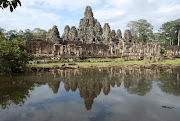
 Cultural crossovers: The Angkor Wat shares many features with Pallava and Chola temples.
 Centuries of cultural and commercial interaction between South Indian kingdoms and Cambodia led to a fascinating mutual enrichment that can be seen in the motifs and architectural styles of temples that flowed freely across the ocean.
--------------------------------------------------------------------------------
When Kulottunga I, the Chola king, was constructing or enlarging the famous Shiva Temple at Chidambaram (Tamil Nadu), Suryavarman II, the king of Cambodia and the builder of Angkor Wat, offered to send, all the way from Cambodia, a block of stone as a gift for the new construction.
The very name “Cambodia”, brings forth visions of the magnificent temple of Angkor Wat with its huge pavilions, towering spires and larger-than-life sculptures. Angkor Wat and the scores of other spectacular temples surrounding it were bu ilt by the local Cambodian or Khmer kings between the ninth and the 14th centuries A.D. The UNESCO has now included these monuments in its “World Heritage” list. Each day, thousands of visitors enjoy these monuments, many of which are in picturesque ruins. Most of the visitors are, however, simply unaware that Cambodian art and culture have a lot of Indian, particularly South Indian, elements.
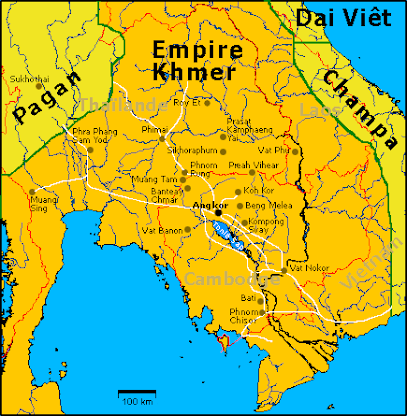
The remote origin of the intimate links between India and Cambodia forms the subject of innumerable legends. Many legends mention a young and handsome South Indian prince travelling to Cambodia, marrying a beautiful Cambodian princess and eventually becoming the ruler of that land. According to one popular legend, around the time of Christ or slightly earlier, Kaundinya, a Brahmin from India, sailed to the kingdom of Funan in Cambodia that was then ruled by a princess named Soma of the Naga dynasty. Using a divine weapon, Kaundinya defeated her in war, married her and became the king of Funan. Towards the beginning of the fifth century, another Brahmin, bearing the same name, inspired by a supernatural power, came to Cambodia where the local people welcomed him and elected him as the king of Funan. He and his successors introduced many Indian customs and laws in Cambodia. In the year 802, a powerful ruler named Jayavarman II founded the Khmer kingdom that had its capital in or around Angkor in Central Cambodia. The capture of Angkor by Thailand (Siam) in 1431 forced the Khmer rulers to shift their capital further south in the vicinity of Phnom Penh.
The cultural and commercial interaction between South India and Cambodia, in fact, dates back to a few centuries before Christ. South Indian merchants and artists regularly came to Cambodia through diverse land and sea routes. Located on the great maritime highway between India and China, Cambodia, from early times, emerged as a major commercial hub in the long distance trade network that linked China, South East Asia, Sri Lanka, India, Africa and Rome. Spices and gemstones from South East Asia reached the ports on the east coast of India (Andhra Pradesh-Tamil Nadu), from where they were shipped to the Red Sea ports of Africa and from there sent to Rome through the North African port of Alexandria. Not surprisingly, archaeologists have discovered ancient Roman objects including intaglios, coins, ceramics and lamps in the Thailand-Cambodia region. These Roman materials should doubtless have reached South East Asia through Mahabalipuram, Arikamedu, Kaveripattinam or any of the other ancient ports of Southeastern India. Interestingly, similar Roman objects have been recurrently discovered in many of these port sites.
Significant influence
Both Hinduism and Buddhism reached parts of South East Asia from India during the early centuries of the Christian era. The South Indian influence on Cambodian art and culture was, however, most vigorous and prolific during the rule of the Pallavas (third to ninth centuries) and Cholas (ninth to 13th centuries) in South India. It is well known that the use of the honorific title Varman — very common amongst the Pallava kings — was borrowed by the kings of Cambodia. The first Cambodian king to have this suffix appended to his name was Bhadravarman who lived in the fourth century and thus, was a contemporary of one of the early Pallava rulers of Kanchipuram. Significantly, Bhadravarman was a renowned scholar, well-versed in all the four Vedas and the author of several inscriptions in Sanskrit. He invited learned Brahmins from India to settle in his kingdom.
While Sanskrit language and literature spread to Cambodia from different parts of India including South India, the ornate Grantha (also called Pallava Grantha) script travelled to Cambodia exclusively from the Pallava kingdom. According to scholars, some of the birudas (titles) of the Pallava kings including Mahendravarman I appear to be in the Khmer language — the language of Cambodia. Further, Nandivarman Pallavamalla, one of the later Pallava rulers, is believed to have lived in Cambodia for some years before he travelled to Kanchi to ascend the Pallava throne. The most enduring contribution of the Pallavas to Cambodia is the cult of Ashtabhuja Vishnu (eight-armed Vishnu). In India, this form of Vishnu first originated around the Mathura region in North India, and slowly spread to Nagarjunakonda (Andhra) and from there, permeated further south to Kanchipuram. Many of the Pallava temples in and around Kanchi house sculptures of this form of Vishnu, with one temple (Ashtabhuja Perumal Temple) having the deity enshrined within the main sanctum. Initially, the Angkor Wat was a Hindu shrine dedicated to this form of Vishnu installed within the sanctum in the uppermost tier of the temple. This huge majestic monolithic image, recently restored and now kept at the entrance of Angkor Wat, is almost identical, in stylistic features, to the image within the sanctum of the Ashtabhuja Perumal Temple of Kanchi.
The Pallavas of Kanchi were contemporaries and rivals of the Chalukyas of Badami (Vatapi) in present-day Karnataka. But political differences and rivalries did not stand in the way of the exchange of art styles and ideas between these two kingdoms. Thus, we can observe Chalukyan influence in the art of Kanchi and Pallava imprints in the art of Badami and Pattadakkal in Karnataka. Again, not surprisingly, there are unmistakable parallels between the art of Pattadakkal and Angkor Wat. The most important and famous bas-relief sculpture in Angkor Wat is the one portraying the scene of the Churning of the Cosmic Ocean by the Gods and demons (samudramanthan). Miniature representations of the same scene occur on the pillars within the Angkor Wat. Sculptures exhibiting this theme occur in many other Angkor temples including the Bayon. Although the story has always been very popular in India, its representation in art has been very rare in this country. The Virupaksha Temple of Pattadakkal, however, features this scene on the face of a column. Stylistically, this sculpture is remarkably similar to the representation of the same scene in the pillars in Angkor Wat.
Again, in Angkor Wat, the bas-relief showing the Mahabharata war prominently features Bishma lying on the bed of arrows. Such a representation of Bishma is uncommon in South Indian art. A few late medieval temple wall paintings in Kerala, however, feature this theme.
Free exchange of ideas
Architecturally, the Angkor Wat shares many common features with both Pallava and Chola temples. Like the Vaikunta Perumal Temple (Kanchi) and the Sundara Varada Perumal Temple (Uttaramerur) of the Pallavas, the Angkor Wat consists of three levels or tiers, each of the upper tiers slightly smaller than the one below it, giving the structure the look of a pyramid. Again, like the Chola Brhadisvara Temple of Thanjavur, Angkor Wat too was conceived to represent the sacred mount Meru in the Himalayas. Damodara Pandita, a Brahmin scholar from Madhyadesa (Karnataka-Orissa region) in India was the chief priest of Suryavarman II, the builder of the Angkor Wat. It is believed that the king built this temple as per the guidelines provided by the Indian priest.
The friendly relation between the Chola kings and Cambodia is attested by a significant but little-known incident. When Kulottunga I, the Chola king, was constructing or enlarging the famous Shiva Temple at Chidambaram (Tamil Nadu), Suryavarman II, the king of Cambodia and the builder of Angkor Wat, offered to send, all the way from Cambodia, a block of stone as a gift for the new construction. Kulottunga gratefully accepted the unusual gift, installed it in the temple and engraved an inscription informing that the stone was from Cambodia.
The beautiful temple of Banteay Srei, around 30km from Angkor Wat, has many intricately carved Hindu sculptures betraying South Indian influence. Here, one can see the dancing Shiva (Nataraja) above the main doorway leading to the central sanctum. Close to him, there is a small, frail female figure that has been identified as Karaikal Ammaiar, the well-known Tamil saint.
The inscriptions on the walls of the temples in Cambodia frequently refer to Indian scholars and priests settling in Cambodia, often on invitation from the king. Some of these scholars were the direct disciples of Adi Sankara in South India.
Any serious visitor to the monuments in Angkor will indeed be astounded by the sweep of the South Indian elements that have engulfed Cambodian culture during different periods of history. To the students of South Indian history and art, Cambodia is a revelation, an eye-opener to the spread of our unique culture to distant lands.
(Dr. Suresh’s field research in Cambodia has been sponsored by Ramu Endowments, Chennai)
 Evidences of interactions, the eight arm Siva God is worshiped by majority in Cambodia
Ex-Khmer Rouge still dominate regions of Cambodia
By DENIS D. GRAY
ANLONG VENG, Cambodia (AP) — Just as the chief Khmer Rouge torturer takes the stand before a United Nations-backed genocide tribunal, a mausoleum fit for a king will be unveiled for another murderous leader from the same regime.
The entombed Ta Mok, known to his victims as "The Butcher," remains a revered figure in Anlong Veng because practically everyone here — from the district chief to the tourism promoter, from the wealthiest businessmen to dirt-poor farmers — was once Khmer Rouge.
This remote, rough-and-ready town is no aberration. Thirty years after the fall of their Maoist regime, former Khmer Rouge officials still run extensive enclaves across northwestern and northern Cambodia. After Anlong Veng, their last holdout, fell in 1998, Khmer Rouge officials abandoned their savage policies and took posts in the new power structure.
They appear unlikely to face justice for alleged crimes during a brutal 1975-1979 reign of terror under which some 2 million died.
"We were the former Khmer Rouge commanders so we knew the area and the people, so after we surrendered we were confident we would get similar positions — in the government, police, the military," explains Pery Saroen, 55, Anlong Veng's deputy district chief, whose superior is also a one-star army general. "When we handed over ourselves, our territory, we became part of the government. We had an agreement with the government and we knew they would forgive us."
An equivalent scenario would have been known Nazi officials and military commanders, some with blood on their hands, serving in 1975 as West Germany's mayors and ministers amid war crimes trials for their leaders.
Only five are expected to face trial. The first, Kaing Guek Eav — better known as Comrade Duch — headed Phnom Penh's notorious S-21 torture center. He is scheduled to testify at the end of the month before a joint international and Cambodian tribunal.
"It's clear that not every Khmer Rouge cadre who carried out killings and crimes is going to come before the tribunal. We don't believe it should stop at the top five most notorious figures. We could do more to bring justice to Cambodians," says Sara Colm of the New York-based Human Rights Watch, echoing criticism of many Cambodians and foreign prosecutors.
Nhem Sarath, with the non-governmental Cambodian Human Rights and Development Association, says villagers outside Khmer Rouge areas often ask why the court doesn't try the many Khmer Rouge suspected of atrocities.
"They also ask us why the powerful leaders now running the country are also not arrested," he says.
Prime Minister Hun Sen, Senate President Chea Sim and National Assembly Chairman Heng Samrin were all Khmer Rouge commanders or officials, and now are unchallenged in their power. Other top positions are filled by their one-time comrades, including Foreign Minister Hor Nam Hong and deputy prime ministers Men Sam On and Keat Chhun, who also holds the finance and economy portfolio.
Although no evidence has come to light implicating Hun Sen, a division commander, in Khmer Rouge crimes, he has sought to narrowly restrict those brought to justice because a number in his government and party are hiding skeletons in their closets.
Among the most notorious is Meah Mut, an ex-Khmer Rouge military official, who is on a prosecution "hit list" of at least five others they want to try. A brigadier general and adviser to the Defense Ministry, he lives in a lovely house amid a fruit orchard in Samlot, about 125 miles from Anlong Veng, in the northwest.
It was to this region that the Khmer Rouge leaders and thousands of followers fled when a Vietnamese invasion force toppled their regime in 1979. While Khmer Rouge in other areas of the country sought to quietly merge back into society, those in the northwest melted into the jungles and mountains to wage guerrilla war until the guns fell silent through an amnesty in 1998, the year Anlong Veng fell, and their leader, Pol Pot, died. All ex-Khmer Rouge in the region express loyalty to Hun Sen and his Cambodian People's Party.
David Chandler, a leading Cambodia historian due to appear as an expert witness at the tribunal, says the deal has proved a "standoff, a trade-off that suits both sides."
"They are not going into dissidence or to secede. They have to behave to a certain extent but Hun Sen is not going to mess with them too much," he says. "I don't think these are dedicated left-wing thinkers or performers. I think they abandoned that and got into the money and the patronage situation and are perfectly happy."
Many of the former Khmer Rouge claim to support the trial of their one-time leaders.
"To be honest, when ex-Khmer Rouge heard that the top five leaders would be tried, they said, 'We don't mind. Let's do it,'" said Nhem En, another district deputy head who was S-21's chief photographer and, like most former Khmer Rouge, points a finger at the leaders while denying any wrongdoing himself.
Ta Mok, who died a prisoner in 2006, is still much admired in Anlong Veng. His mausoleum, copied from ancient Angkorian temples by his rich grandson, will be completed almost to the day that Duch testifies.
"We regarded Ta Mok like a father who takes care of his children. He imposed restrictions and discipline but he gave us food, clothing, places to live," recalls Chat Chay, a poor laborer and former Khmer Rouge soldier. He noted how Ta Mok, whose cruelty was legendary, built roads, a hospital, a bridge and a high school building.
The town's 3,000 schoolchildren are taught nothing about their country's Khmer Rouge past, and only a few posters about the trial have been put around school grounds, says elementary school Vice Principal Reak Smey. He is one of a sizable influx of non-Khmer Rouge from other parts of the country, drawn by the possibility of acquiring land in the sparsely populated area and earning income from a lucrative cross-border trade with nearby Thailand.
"When I first arrived I was worried about having to adapt to life with former Khmer Rouge, but after a few months I discovered their honesty and kindness. The more I lived with them, the better I felt," he says, recalling that the revolutionaries had tried to instill rigid morality, albeit at the point of a gun, during their years in power. Now, he says, their virtues are being eroded by the influence of the newcomers.
Khieu Dum is a wealthy 36-year-old who owns a gas station and money exchange business. He is also the son of Khieu Samphan, who faces charges of crimes against humanity during his time as the Khmer Rouge president. An expensive Lexus sports utility vehicle sits in the son's garage at the dusty crossroads of this district of about 20,000, where the new settlers have had to be friendly because they are the powerless outsiders.
"This is a small and simple place. People just go about their business. The old (Khmer Rouge) people and the newcomers live together amiably. I have never had trouble because of my father," says Khieu Dum.
The Khmer Rouge leaders were off to a head start when the amnesty came, having amassed mini-fortunes during their days as guerrillas through smuggling of timber, gems and antiques to Thailand. Now, the upper echelons own some of the poshest houses and cars in the provinces of Pailin, Preah Vihear, Battambang, Banteay Meanchey and Oddar Meancheay — Cambodia's Khmer Rouge country.
Some have sunk into gross corruption and engage in activities, like gambling, which would have earned them summary execution in the old days. And they have certainly ditched their ideal of a classless society.
In Anlong Veng, a two-class system appears to have emerged: the rich businessmen and government officials living in town and former low-ranking soldiers who barely survive on arid land they don't own in the surrounding countryside. Thus the town witnessed both the final military defeat of the Khmer Rouge and the death of its ideals.
Chat Chay says he joined the movement as a 14-year-old after the Khmer Rouge persuaded him they would liberate the country and create a utopia of neither rich nor poor. Now, he breaks up stones at construction sites, able to use only his right hand since a head wound paralyzed his left side. He earns less than one dollar a day for his family of seven.
"The Khmer Rouge didn't do what they promised. They changed their policies," says the 51-year-old man. "I was wounded but the Khmer Rouge gave me nothing and I have also received nothing from this government."
Associated Press writer Sopheng Cheang contributed to this report.
Read more!
Focus on Cambodia's Human Trafficking is Misleading
By Alan Perry
Rory Byrne's March 23rd article "Human Trafficking On the Rise in Cambodia" from VOA News is misleading and uninformed. The first glaring error is of course the misspelling of the Capitol City of Phnom Penh in the article. Let us hope that this is a simple editorial mistake and not an indication of how well he understood his subject matter. Unfortunately I think it may be the latter.
The real problem with the article is that it lacks perspective or any other viewpoint on the Human Trafficking issue. There is no dissenting voice or opinions reported. Cambodia has become for lack of a better word the worlds favorite sex "obsession". With daily breathless reportage on Human trafficking and child sex convictions one is left with the mistaken impression that Cambodia is a place where one can simply walk down the street and pick out your favorite 13 year-old girl or boy for an hours pleasure. This is simply not the case.
I first came to Cambodia 15 years ago and now have lived here for 2 years and own a business. In all that time I have never witnessed any such activity nor could I direct anyone to any place which deals in such a thing. I have traveled widely here and employ a number of Cambodians and in conversation with them I cannot find a single person that knows about the "sex slave" trade. I do however know that it is often the families of these girls and boys who send them away or sell them into "jobs" in prostitution. Many boys are sold into the military so their family can get the stipend the government gives out for that and many escape. Most of the girls, if the truth be known, are sent into this trade by their families, not lured there by strangers. Most are free to come and go as they please because having been sent there by the parents they often will stay out of respect and fear of the parents. The parents receive a payment, the girl is expected to work for a period of time.
This is not slavery, at worst it is indentured servitude. There is a very important difference. Of course no one wants to see children sent into the sex trade by anyone, let alone their parents, but I believe the notion that there are thousands of girls chained in basements being used as sex slaves defies logic. Most of Cambodia is a crowded and busy place especially the cities. Keeping something like this from the police would be very difficult here, to say nothing of the fact that I have never seen or heard of a house here with a basement. While many of the police are corrupt not all of them are by any means and there are many levels of police in a given area. This makes it especially difficult to keep slaves locked in your "basement" without your neighbors and the police finding out and reporting on you.
The article does not at any time cite one single credible study of this problem and for good reason...none exists. Some organizations such as World Vision raise millions of dollars in the U. S., Britain and Australia beating the child sex and human trafficking drum. Only a trickle of those funds are ever spent here in Cambodia actually doing anything about the problem. A problem that I would argue is no worse than in London, Honolulu or Des Moines.
The article goes on to cite how there were girls rescued from this business by the organization named in the article, one I have never heard of previously. It is written in such a way as to leave the impression that all these girls were "sex slaves". I would defy the writer or the organization cited to bring forth one credible person with that story. It seems clear to me that what is most likely is that there was financial incentive for these girls to leave or that they felt they had no other place to go if they left on their own. Many families wont take a girl back who has shamed them by working in this industry and many continue in the business for the very good financial rewards. Consider that the average wage of most Cambodians is often cited at less than one US dollar a day. A girl or boy working in the sex trade can make 10, 20 or 100 times this in a single day. With this they buy cell phones, motorcycles, nice clothes and send money home to the family. This scenario is the real story of the sex trade in Cambodia.
Many do it as a sideline, some go to school, and others do work in brothels. some come to escape the poverty and closeness of village life. Some of the young people that turn to this trade do it because they have lost a good job in a factory due to layoffs. Consider this the next time some well meaning organization asks you to help stamp out child labor in Cambodia, Thailand or where ever: If these young people lose their jobs often the next stop is to turn to prostitution to make sure they eat everyday. This is the real story of the sex trade.
People often fall into this trap when writing or reporting on Cambodia. With little or no knowledge of the country and it's people they rely instead on those with an axe to grind, an issue to promote or in the case of some organizations, money to be raised by keeping this issue on the front burner and sounding as horrible as possible. It would be nice to have a reporter ask some hard probing questions, explore the logic and interview others with a different viewpoint. Unfortunately Mr Byrne seemingly did none of that.
Alan Perry is a resident of Sihanoukville, Cambodia, and is with DevaRaja Villa and Bungalows, Intimate Stylish Personal Attentive. Reach him at mailto:aarthurperry@gmail.com .
Read more!
Friday, March 27, 2009
Visions of Cuba and Cambodia
 By By Anne-Marie Smolski, Townsman Staff
“CUBA/CAMBODIA/CARBONARO,” an exhibit of 19 photographs, is still attracting lots of attention. Carbonaro said each time she stops by the library, she has to bring more cards about the show and business cards for her photography studio on Crest Road, since they’ve been flying off the small table in front of the exhibit. As of last week, she had sold 10 photos (they are in editions of 25 per image). Proceeds from the sales will go to nonprofit foundations helping the children of Cambodia.
As the owner of Carbonaro Photography in Wellesley for the past seven years, she has specialized in creating natural, spontaneous portraits of children and families.
What is it that drives her to the slums of Phnom Penh?
“It’s the connection to the people. I use the camera to connect with people and learn who they are,” while always being careful to be respectful, Carbonaro said. That connection builds trust, she said.
In 2005, she had the opportunity to attend a private photography workshop taught by Ernesto Bazan in Cuba. When she was studying with Bazan, who has won international awards for his documentary work, she
 used the wide-angle lens of 28 mm, to be as close as possible to her subjects. “We had to be in our subjects’ world,” she explained.
For the workshop, she had to shoot in black and white. (The photos in the exhibit are in color. She used a Canon 20-D in Cuba and a Canon 5-D in Cambodia). Part of the workshop involved documenting various elements of life in Cuba, specifically in Vinealas and Havana. Carbonaro visited homes, tobacco farms, and even attended a cock fight. The class visited a tobacco farm, where Bazan had been documenting the family for years. “They’d raise the pig, they’d slaughter the pig. The next day they’d serve it for lunch,” Carbonaro said.
She loves learning about the customs of other countries, she said. For instance, there was the time when she was photographing a young girl who was receiving a scholarship in Cambodia. Carbonaro wanted to photograph the girl with her parents, but was told they wanted to include another person because they believed it was not good to have odd numbers of people in photos. In Cuba, she found when visiting poor families in their homes they would offer her group anything they had. “If it’s offered, it’s like a gift,” she said. How do you turn down a gift?” And although she doesn’t consider herself a “political person,” she finds that once she gets into these countries, she feels compelled to find out what’s going on there.
Inspired by her trip to Cuba, Carbonaro visited Oaxaca, Mexico, in 2006. The experience was memorable in more ways than one — a member of the workshop in which she was participating got run over by a bull. “She was a real trouper,” Carbonaro said. The woman was a little scuffed up, but OK.
In 2007, she had the time and the money to visit Cambodia, where the average family earns $400 a year.
“What I’d like to do is to get back to these countries. I’d really like to set up a project where I could be there for an extended period of time and really get to know the people,” Carbonaro said.
In the meantime, she is thinking of going to Brazil in September, and would really like to go to Appalachia. “They’re the poorest of the Americans,” she said.
Called a humanitarian photographer by Word Press, Carbonaro sees her work as “shedding light on those that live in darkness. These are the people of the world that don’t have a voice. It is her vision to give them a voice, a place to be seen and be heard.
From butter to photos
Born on wheels in an ambulance, Carbonaro is from Minneapolis. She went to college in Wisconsin, at UW-Stout.
She came to Boston when she was 30. She said she thought, “I’ll get a camera and document life in Boston.” She took continuing education classes at Mass. College of Art and New England School of Photography, and recalled that she “really started to fall in love with [photography].”
At the time she was working for Land O’Lakes in consumer product sales. “I sold butter,” she said. She continued working for Land O’Lakes for seven more years, and left as a district sales manager before starting her own photography business.
As for the work she does in Wellesley and nearby towns, she said, it’s a happy job. “I give a product to my clients that they love. It’s going to bring back, hopefully, really good memories. That’s the joy, that it makes people happy.”
Married and living in Newton, she spends her free time renovating her house. She also takes courses, and likes adventure sports, such as hiking, skiing and go-cart racing. She said she enjoys “anything that is on the edge,” anything that pushes her out of her comfort zone.
box
About the exhibit
CUBA/CAMBODIA/CARBONARO is on view at the Wellesley Free Library, 530 Washington St., through March 31. In April, the exhibit moves to Boston University, at the Center for Psychiatric Rehabilitation, 940 Commonwealth Ave. In May, she’ll be showing at Coldwell Banker Hunneman in Jamaica Plain, and in September, the show will go up at the Center for Adult Education in Cambridge. Framed 16x20 prints are available for $295, with profits from the sale going to foundations that help the children of Cambodia. For more information, call 781-237-5990; www.carbonarophotography.com.
Thursday, March 26, 2009
ASIA: Fighting the spread of Artemisinin-resistant malaria
BANGKOK, 26 March 2009 (IRIN) - Scientists and health workers are racing to contain a malaria strain along the Thai-Cambodia border that is becoming increasingly resistant to Artemisinin, the best drug available to fight it, experts say.
[See also: CAMBODIA: Malaria gaining tolerance to some treatments]
Artemisinin, normally used in a combination therapy (ACT), has given hope in recent years that malaria can be eradicated worldwide.
But a key trial in western Cambodia in 2007 and other evidence has shown a tolerance to Artemisinin in the Plasmodium falciparum parasite, which causes the most deadly form of malaria.
“To prevent the spread of this [parasite], we need to be fast,” said Eva-Maria Christophel, a medical officer specialising in malaria and other vector-borne diseases with the World Health Organization’s (WHO’s) regional office for the Western Pacific.
These efforts received a boost recently with a US$22.5 million grant from the Bill and Melinda Gates Foundation to the WHO.
“A big containment effort will now start … and maybe to try to eradicate malaria from western Cambodia to get rid of the problem,” said Arjen Dondorp, deputy director of the Wellcome Trust-Mahidol University-Oxford Tropical Medicine Research Unit (MORU) in Bangkok.
“It’s sort of a timebomb, so you never know when the parasite is going to escape from western Cambodia and spread to the rest of the world,” he said.
ACT effectiveness
Experts are monitoring if ACT is becoming less effective in other areas, such as the Thai-Myanmar border.
MORU, with a global consortium of scientists, is also trying to find out how and why the falciparum parasite is becoming tolerant to Artemisinin.
Tolerance has been connected to the consumption of suboptimal doses of the drug, which do not kill the parasite. This can be due to counterfeit medicines or patients not fully following treatment regimes.
Artemisinin monotherapy, where the drug is taken alone - allowing parasites to more easily adapt to it - is also a significant factor.
ACTs are still extremely effective. However, evidence shows that Artemisinin as part of a combination therapy is starting to work later than normal, taking more than a benchmark three days to get rid of parasites.
“We are trying to find out the biological basis for that resistance,” said Dondorp.
Prevention methods
Health authorities and NGOs in Cambodia and Thailand are now trying to contain the parasite by treating all malaria cases and preventing its spread.
A major challenge is working with mobile and migrant populations, which could spread the Artemisinin-tolerant parasites.
These populations in the border area include settlers, Cambodians who work in plantations and orchards in Thailand, and loggers who spend extended periods in Cambodia’s forests.
“There are really a lot of different people who need different intervention channels,” said Christophel. “They need access to early diagnosis, appropriate treatment and then prevention measures … but how to do this is quite a challenge.”
In Thailand, which has a long-established malaria control programme, the government has created a national task-force to contain the parasite.
“We started in January to set the meeting of the national task-force for containment, and after the national task-force has met, we will launch the project,” Wichai Satimai, director of the Bureau of Vector Borne Diseases at Thailand’s Ministry of Public Health, told IRIN.
“The pattern of resistance is mostly from the east next to Cambodia, to the west, next to Myanmar. And we are quite worried about the control measures in nearby countries,” he added, citing previous experiences of emerging resistance to other anti-malaria drugs.
As part of control efforts, Thailand has established 500 malaria clinics. It also has 460 malaria posts with support from the Global Fund to Fight Aids, Tuberculosis and Malaria, where villagers are trained to detect the disease and provide treatment, Wichai said.
In Cambodia, a ban on Artemisinin monotherapy will be enforced by mid-year.
Meanwhile, authorities are stepping up efforts to fight counterfeit drugs, Christophel said. There are also plans for all villages in affected areas to have a malaria volunteer equipped with diagnostics and the right treatment.
“The thing is to now accelerate and speed things up, that’s clear,” said Christophel.
Read more!
VOA Khmer Launches New TV Program in Cambodia
Washington, D.C., March 25, 2009 - VOA Khmer Discovering, a new daily Voice of America (VOA) television product showcasing news features, begins airing across Cambodia on Monday, March 30, 2009.
(Media-Newswire.com) - Washington, D.C., March 25, 2009 - VOA Khmer Discovering, a new daily Voice of America ( VOA ) television product showcasing news features, begins airing across Cambodia on Monday, March 30, 2009.
VOA's first regular television segment in Khmer will be broadcast by National Television Kampuchea ( TVK ) on Wednesday, Thursday and Friday at 8:00 p.m. ( Cambodia time ), and at 8:00 a.m. Monday and Tuesday.
News feature programs on VOA Khmer Discovering will include feature stories in several areas, such as health, science, travel and life in America. The first show looks at jobs in the United States and space exploration, among other topics.
Information from the VOA Khmer Service ( www.VOANews.com/Khmer ), on radio and the Internet, has long been widely used in Cambodia, reprinted by blogs and other sites. VOA's weekly audience share of more than 29 percent makes it the largest international broadcaster in Cambodia.
"Television will allow us to expand our audience even more," said Chris Decherd, VOA's Khmer Service Chief.
The Voice of America, which first went on the air in 1942, is a multimedia international broadcasting service funded by the U.S. Government through the Broadcasting Board of Governors. VOA broadcasts approximately 1,500 hours of news, information, educational, and cultural programming every week to an estimated worldwide audience of more than 134 million people. Programs are produced in 45 languages.
For more information, call VOA Public Relations at ( 202 ) 203-4959, or e-mail askvoa@voanews.com.
Read more!
VIETNAM, CAMBODIA & BANGKOK-Day 7
Elizabeth A. Yarosz-Ash
At 8am we are climbing the steps on Marble Mountain (called thusly because they are) to a (you guessed it) another Buddhist temple and shrine. Women with black teeth are selling large sticks of incense at the midpoint. “You are beautiful!” is what I say to her as a compliment instead of buying some of her incense. I bought a bunch of sticks my first day in Bangkok and carry it around in my backpack. Around the back of the temple is a cave, cool and dark. Gee, sounds good as I am just a tad damp. We enter through a long, close passageway and are treated to a gigantic Buddha surrounded by humidity, spicy aroma, smoky air and moss. Sunlight plays peek-a-boo through the openings in the rock above.
Climbing further up, monks serve up another pagoda on a pavilion of mosaic tile. Witchy, Jaupon trees are budding and over the stone wall are heavy, atmospheric views of the South China Sea and China Beach. We are taken to the beach where everyone doffs their shoes (except me who gets a wave up to the knees of my jeans) and Judy flies her kite. Teeny little jellyfish-like critters dot the sand and old women in conical straw hats scrutinize the shoreline for mystery finds.
Our bus takes us to Hue (Hway), once the Imperial Capital of Vietnam. The drive takes a few hours and we pass through the mountains and the longest tunnel in southeast Asia. We see round fishing boats with people catching cuttlefish (they look like big squid). We are doled out snacks on the bus, for fear that we might waste away. They do not let you starve on this tour or go thirsty.
Here is a typical lunch menu:
Phoenix appetizer
Shrimp
Read more!
Cambodia Tribunal Web Site to Host Video Footage of Trials
Website also provides latest news, information and commentary about the trials
CHICAGO, March 26 /PRNewswire/ -- The Cambodia Tribunal Monitor web site - http://www.cambodiatribunal.org/ - will host ongoing video footage from the long-awaited Khmer Rouge trials, which are scheduled to begin Monday, March 30. On trial will be senior officials of the Khmer Rouge regime for atrocity crimes.
Launched in September 2007 in anticipation of the trials, the Chicago-based Cambodia Tribunal Monitor web site is considered the primary source for information on these historic proceedings. In addition to hosting tape-delayed video footage of the trials, the site will also provide the latest news updates, official documents regarding the trials and regular commentary from leading international experts on the court proceedings as well as on topics such as the recent history of Cambodia, politics, human rights and international law.
From April 1975 to January 1979, an estimated 1.7 million Cambodian citizens died under the Khmer Rouge regime. After nearly 10 years of negotiations, a special war crimes tribunal has commenced near Phnom Penh, Cambodia. The first to face prosecution is Kaing Geuk Eav, also known as "Duch", who allegedly oversaw mass torture and execution in prison camps, including Cambodia's notorious Tuol Sleng, or S-21, camp. The Extraordinary Chambers in the Courts of Cambodia (ECCC), as the special Cambodian court is formally known, will oversee the proceedings and is a joint partnership of the United Nations and the Royal Government of Cambodia. The trials for additional senior Khmer Rouge officials have not yet been set.
The Cambodia Tribunal Monitor was developed by a consortium of academic, philanthropic and non-profit organizations committed to providing public access to the tribunal and ensuring open discussions throughout the judicial process. The site sponsors include Northwestern University School of Law's Center for International Human Rights, the Documentation Center of Cambodia and the J.B. and M.K. Pritzker Family Foundation.
The Web site concept was conceived by Illinois State Senator Jeff Schoenberg, a Chicago-area legislator who also advises the Pritzker family on its philanthropy.
For more information on the Cambodia Tribunal Monitor web site or to interview internationally renowned legal experts, please call Patrick O'Connor at 312.573.5510 or 512.659.0858.
Read more!
CAMBODIA: The high price of jealousy
 PHNOM PENH, Sreygao is house-bound, her life destroyed after a jealous wife doused her face and neck with acid. It burned into her skin and blinded her.
“Everything has been taken from me because someone was very jealous,” she told IRIN.
Before the attack, Sreygao worked as a hostess at a karaoke parlor. Every night over beer, she flirted with and sometimes solicited sex to wealthy men, prompting an angry wife to take revenge on the 19-year-old.
“I have no face, no job, and I will suffer forever,” she said.
Deeper than scars
Acid throwing is a common form of retribution in Cambodia, usually perpetrated by jealous lovers, said William Grut, a surgeon at Vancouver-based Rose Charities, which provides free treatment.
“Whether male or female, jealousy is jealousy,” he told IRIN. “It's not a question so much for gender discussions but rather why it's so prevalent and how it can be reduced.”
Cambodia's pattern of gender blindness marks it out from Pakistan, India, and Malaysia, where it is usually the men who use acid on women for punishment or reasons of honour.
Between 1999 and 2002, the Cambodian League for the Promotion and Defense of Human Rights (LICADHO) documented 44 cases in local newspapers – the most thorough research to date, as no government body or NGO compiles data on acid attacks.
An attack occurs every 25 days, the group said in its report. But Jason Barber, a human rights consultant for LICADHO, told a radio station that the real number of attacks remained unknown since many went unreported.
Grut said the numbers available correlated with more populated areas, such as the capital, Phnom Penh, and smaller cities in Kandal and Kampong Cham.
Manifestation
I have no face, no job, and I will suffer forever.
The widespread availability of acid to replenish old batteries, weak law enforcement mechanisms, and what Grut calls “tertiary conflict injury”, have all popularised acid-throwing.
Tertiary conflict injury is a mindset in war-torn countries that problems can only be solved with violence, with beatings and acid attacks commonplace.
For decades, Cambodia has experienced coups, civil wars and a genocide in 1975-1979 that killed two million people.
“Cambodian history has regularly been very stressful for the [ordinary] person,” he told IRIN.
“This is not the same as PTSD [post-traumatic stress disorder], though arguably it may be a sort of long-term manifestation of it,” he said.
Repairing the damage
Corrective surgery is out of reach for most Cambodians, with 35 percent of the population living on less than US$1 a day, according to government statistics, so most sufferers must rely on emergency services from NGOs.
“Clearly in Cambodia, facilities are far more limited than in western countries, where one would have a long series of repetitive operations gradually working things back, reconstructing, and grafting,” Grut explained. “It would all be accompanied by very close counselling and peer assistance.”
But first, more attention needs to be paid to acid attacks as they are usually not a priority for local NGOs and government agencies, he added.
“There's not enough recognition at the NGO level, but at the street level there is,” he said. “People tend to know about acid attacks as the word goes around.”
UNOG: Council Appoints Special Rapporteur on Situation of Human Rights in Cambodia and Elects Four Members of Advisory Committee
The Human Rights Council at a midday meeting today held a general debate on technical assistance and capacity-building, after which it appointed the new Special Rapporteur on the situation of human rights in Cambodia, Surya Prasad Subedi (Nepal). The Council then elected four members of the Human Rights Council Advisory Committee, namely Halima Embarek Warzazi (Morocco), Shiqiu Chen (China), Miguel Alfonso Martinez (Cuba), and Jean Ziegler (Switzerland).
Speaking in the context of the general debate, speakers said, among other things, that one of the crucial roles of the Council was to offer technical assistance and capacity-building to States as one of the most efficient means of promoting and protecting human rights, democracy and the rule of law. The mandate to provide cooperation lay, on the one hand, in the Council’s primary objective of offering an open and balanced forum for dialogue and, on the other hand, in each State’s sovereignty to request for international cooperation. In countries where technical assistance was leading to better respect for human rights, perhaps close monitoring and increasing the resources devoted to technical assistance was more efficient. Alternatively, where technical assistance was failing, perhaps the balance needed to be shifted towards monitoring and implementation through the special mechanisms of the Council. It was necessary to have a comprehensive plan and technical assistance had to be based on a principal objective which should be based on moving the promotion and protection of human rights from the text to implementation.
Speaking this afternoon in the general debate were the representatives of the Czech Republic on behalf of the European Union, Brazil, Kuwait, United States and the Democratic Republic of Congo. Also speaking were the National Human Rights Committee of Qatar, Union of Arab Jurists, Arab Commission of Human Rights, United Nations Watch, North-South XXI, and Cercle de recherche sur les droits et les devoirs de la personne humaine.
Speaking in right of reply were Sri Lanka and Iraq.
Speaking following the appointment of the new Special Rapporteur on the situation of human rights in Cambodia were Cambodia and Japan.
The next meeting of the Council will be at 5 p.m. this afternoon when it will begin to take action on draft resolutions and decisions before the Council.
General Debate on Technical Assistance and Capacity-Building
ZUZANA STIBOROVA (Czech Republic), speaking on behalf of the European Union, said that human rights applied worldwide. They were the same for everyone, even though not all people and cultures were the same. For those fundamental rights to go beyond a mere global vision and become a part of everyday life, however, they had to be implemented by every single State. Every country had its own different situation and political conditions, which were not always favourable to the full implementation of human rights. Therefore, the European Union believed that one of the crucial roles of the Council was to offer technical assistance and capacity-building to States as one of the most efficient means of promoting and protecting human rights, democracy and the rule of law. In that respect, the European Union highly regarded the work carried out by the Special Procedures; in assisting States, they played a crucial interface between the international human rights machinery and the needs of the State at the national level.
The European Union also wished to acknowledge the importance of the work of the Office of the United Nations High Commissioner for Human Rights in building national capacities in the field of human rights through an expanding network of field presences and increased activities. The European Union and its Member States contributed extensively to technical assistance and capacity-building in the field of human rights, and support for transparent election processes had become a key component of the European Union's external relations policy. Burundi, Cambodia, Haiti and Somalia were all examples where international cooperation could play an important role in supporting national efforts in the field of the promotion and protection of human rights. The European Union also considered that the Council should improve its support to technical assistance and capacity-building activities in the Democratic Republic of the Congo by, inter alia, establishing a mandate of an Independent Expert dedicated to the situation in that country.
MARIA NAZARETH FARANI AZEVEDO (Brazil) said that the Human Rights Council and the United Nations High Commissioner for Human Rights were given a specific mandate to provide technical cooperation in the field of capacity building in human rights. The mandate to provide cooperation lay, on the one hand, in the Council’s primary objective of offering an open and balanced forum for dialogue and, on the other hand, in each State’s sovereignty to request for international cooperation. The progress achieved in the institutional building of the Council was undeniable. The Council should make sure that its co-operational dimension was also strengthened. Technical assistance and capacity building was too often perceived negatively in the Council, which did not come as a surprise.
Under the technical assistance and capacity building agenda item, the Special Rapporteurs were created. Special Rapporteurs should be seen positively and, even more so, when they were able not only to spot the problem, but to show the way and shed a constructive, helpful and practical light into the possible solutions to the problem. In addition, Brazil firmly believed that cooperation could play a central role in the actual task of promoting and protecting human rights on the ground and eventually strengthening the Council and its mechanisms.
NAWAL NAMAN (Kuwait) said that Kuwait welcomed the positive developments that resulted from the peace process in Djibouti. The Somali people had suffered from a number of crises and Kuwait had made every effort to assist the Somali people through loans and aid. Somalia faced a number of humanitarian challenges and each of them required the assistance of the Council. Kuwait voiced its support for the renewal of the mandate of the Independent Expert. The right to health required special attention and urgent intervention. Kuwait called on the international community to support the Somali authorities to enable them to discharge their duties.
LARRY RICHTER (United States) said the United Nations' mission to promote full respect for all human rights was not solely one of advocacy and reporting, though these were critical. To truly achieve the shared goal, the United Nations must also work to assist Governments to identify areas of concern and assist in the design and implementation of human rights protections. The High Commissioner's technical assistance and capacity-building programmes were crucial to this effort. The United States strongly supported the Office of the High Commissioner for Human Rights' fieldwork, and was encouraged that the High Commissioner intended to expand its regional offices. Governments should view these arrangements with the High Commissioner's Office as a demonstration of their proactive commitment to the protection and promotion of human rights. In this regard, the United States regretted that Sri Lanka continued to decline an Office of the High Commissioner for Human Rights presence, and that a number of other countries had been unwilling to host regional Office presences. The High Commissioner's good work in the field and around the world was central to the common efforts to achieve the vision of an era of implementation of human rights.
SEBASTIEN MUTOMB MUJING (Democratic Republic of the Congo) said technical assistance was a necessary tool for the promotion of human rights by the country which required such assistance or requested it. However, it usually raised the problem of inadequate mobilization of human and financial resources. This constituted a major handicap for the projects, and the expected results had difficulty in taking shape. Despite the advent of human rights, and innovation introduced with the mechanism of Universal Periodic Review, the Democratic Republic of the Congo still continued to be bound by the requirements on item 10 on technical assistance, which was decided on it by the former Commission on Human Rights. A resolution was adopted calling on the Council, the Office of the High Commissioner for Human Rights and the international community to provide technical assistance consistent to the Democratic Republic of the Congo. But all those resolutions had gone unheeded. The most recent resolutions included resolution 7/20 of 27 March 2008 and S 8/1, of 1 December 2008. This had occurred despite frequent reminders from the Government of the Democratic Republic of the Congo who continued to express its good will to cooperate with the Council. Thus the recommendations made by the Special Rapporteurs should be in the form of technical assistance.
SALEM ALMURAIKHI, of the National Human Rights Committee of Qatar, wanted to shed some light on capacity building. The Council had a number of competencies and priority had been given to the inclusion of the national human rights institutions in the Universal Periodic Review but there was no body for the inclusion of the national human rights institutions. All the executive and judicial authorities would benefit as well as the media. It was necessary to have a comprehensive plan and technical assistance had to be based on a principal objective which should be based on moving the promotion and protection of human rights from the text to implementation. The National Human Rights Committee of Qatar was ready to train human rights defenders in Somalia in order to take this country out of the situation it was in after several years of war and tribal conflict.
ASMA TOUNAKI, of Union of Arab Jurists, said the mission of the Independent Expert on the situation of human rights in Somalia should contribute to support the process of peace and security in the country, which had suffered from a series of wars. The Council and all United Nations bodies should take all the necessary measures to resolve the pressing problems facing Somalia. It was the duty of the international community to assist the people of Somalia to resolve their problems by themselves and to support the establishment of effective institutions to contribute to the stability of the country and the maintenance of security. Foreign interventions were the major factor of the tragedy of Somalia, and this was in contradiction with the principles of the United Nations and was incompatible with the basic human rights standards.
ABDEL WAHAB HANI, of Arab Commission of Human Rights, welcomed the remarkable work accomplished by the Board of Trustees of the Fund for Technical Cooperation in the Field of Human Rights. They saluted the innovation by the Board of Trustees. The Arab Commission also wished to endorse the role of the Office of the High Commissioner for Human Rights in building cooperation between the Board of Trustees and people working in the field. The Arab Commission recommended that the Board of Trustees give priority to ensure training programmes for members of civil society in this regard; and in partnership with field teams that the debates be web cast in host countries as well in host countries languages so that people working in the field as well other relevant stakeholders were able to hear the debates.
HILLEL NEUER, of United Nations Watch, said that exactly one year ago in March 2008 this Council’s Independent Expert on the Democratic Republic of the Congo reported massive abuses in that country. How did the Council respond? It eliminated his position. What had happened since? The report of the Secretary-General presented this morning described the situation in the country as a cause of serious concern. Unfortunately, the list of abuses was long and heartbreaking. According the United Nations reports, approximately 2 million people were internally displaced and thousands had been killed. United Nations Watch urged immediate action to protect innocent victims in the Democratic Republic of the Congo. It welcomed the draft resolution tabled by Canada and the European Union seeking to reinstate the Special Rapporteur.
LILY AUROVILLIAN, of North-South XXI, said the Council should do its utmost to facilitate the technical assistance work of the High Commissioner's Office, and to exercise its oversight over this work. There was concern that the technical assistance offered to the Iraqi authorities by the Office's own staff working under the United Nations Assistance Mission in Iraq might not be having the desired effect. The Council should thus urgently review this effort to determine whether it was the most effective use of resources. The Council could also wish to give attention to balancing technical assistance and the monitoring of the implementation of human rights. In countries where technical assistance was leading to better respect for human rights, perhaps close monitoring and increasing the resources devoted to technical assistance was more efficient. Alternatively, where technical assistance was failing, perhaps the balance needed to be shifted towards monitoring and implementation through the special mechanisms of the Council.
BELL HILAIRE, of Cercle de recherche sur les droits et les devoirs de la personne humaine (CRED), expressed regret with regard to the responses provided by the Independent Expert on the human rights situation in Somalia. The concern highlighted to the Independent Expert was with regard to harmonizing Sharia and customary law with humanitarian and international law. The Research Circle thus recommended the suspension of the mandate of the Independent Expert on the human rights situation in Somalia, and that the Office of the High Commissioner for Human Rights continue to monitor the situation until another mechanism could be established.
Right of Reply
YASANTAHA KODAGODA, Sri Lanka, speaking in a right of reply, said that it was regrettable that the world power that was facing terrorism was lacking sensitivity in that regard towards other countries. The military was obliged to eliminate terrorism in Sri Lanka and did so within the international standards. The International Committee of the Red Cross and the United Nations High Commissioner for Refugees were already present and monitored the situation. There was no need to add an office of the Office of the High Commissioner for Human Rights.
SAAD FATHALLAH, (Iraq), speaking in a right of reply, said with regards to the statement by North-South XXI, the remarkable improvement of the situation of human rights in Iraq was partly attributed to the technical assistance that had been extended by all United Nations agencies. The continued provision of this assistance would result in an improvement of the situation of human rights in Iraq in a manner that was helpful to the international community. Severing this assistance would cause a downgrade in the situation, which was not what the international community wished. All were thanked for extending technical assistance to Iraq and contributing to improving the human rights situation there.
Statements Following Appointment of Special Rapporteur on the Situation of Human Rights in Cambodia
SUN SUON (Cambodia), speaking after the appointment of Surya Prasad Subedi as the new Special Rapporteur on the situation of human rights in Cambodia, welcomed the appointment and looked forward to working with the mandate holder for the promotion and protection of human rights in pursuance to the resolution adopted last year concerning the appointment of a mandate holder for Cambodia. It was hoped that the Special Rapporteur would perform his duties in a spirit of cooperation and good partnership. His work should be guided by those principles that ensured universality, objectivity, impartiality and non-politicization. Cambodia believed that the new Special Rapporteur would adhere to the approach of constructive and fruitful dialogues, in order to further advance human rights to which Cambodia attached high importance.
Cambodia expressed thanks and appreciation to the members of the Human Rights Council for the endorsement by consensus of the new Special Rapporteur on human rights in Cambodia, as well as the members of the consultative group, the bureau of the Council and the President of the Council for the diligent work and good spirit in conducting the process of consultation that led to this final selection and nomination. Cambodia reiterated its sincere efforts and firm commitment to further promote and improve human rights.
OSAMU YAMANAKA (Japan) said that Japan congratulated the Special Rapporteur on Cambodia on his appointment. The Government of Japan was the main sponsor of the resolution on technical assistance to Cambodia and hoped that the Special Rapporteur would contribute to the improvement of the human rights situation in Cambodia. Japan wished the Special Rapporteur great success in that endeavour.
Read more!
Riverside man heads to Cambodia to monitor Khmer Rouge trial
By Lisa Chamoff Staff Writer
Over the past few decades, Albert Repicci has found ways to witness history.
In 1963, when he was a 24-year-old student at the University of Pennsylvania's dental school, he hopped a train to Washington, the night before President John F. Kennedy's state funeral. In 1998, he contacted then-U.S. Rep. Christopher Shays, R-Conn., and was able to secure passes to watch the House debate whether to impeach President Bill Clinton.
Today, Repicci, a 68-year-old Greenwich orthodontist and Riverside resident, will travel to Cambodia to watch as a leader of the Southeast Asian nation's infamous Khmer Rouge is tried for his crimes. The radical Communist regime was responsible for the deaths of an estimated 2 million Cambodians through execution, torture and starvation between 1975-79, in an effort to create an agrarian utopia.
Repicci will attend the trial as an unaffiliated observer.
Repicci, who has traveled to remote parts of the world performing volunteer dental work since 1980, started working in Cambodia 10 years ago.
"I have always been a student of history, and each of these places I've gone to, I've known the political turmoil that prevailed," Repicci said.
During many of his travels, Repicci said he has identified needs and helped where he could, funding an immunization program in Kenya and a well-building project in Peru.
Before heading to Cambodia for the first time, Repicci read about the growing problem of human trafficking and women being forced into prostitution. He formed a nonprofit foundation called Stop the Tears, based in Greenwich, to help exploited women and children, and helped open a sewing school in Cambodia for women to help them avoid exploitation.
His charitable work has given him a connection to the country and its violent past, which was immortalized in the 1984 movie "The Killing Fields," named for the sites where thousands were killed and buried by the Khmer Rouge.
"Being at this trial is a long-awaited venture," Repicci said.
Repicci's foundation works with the national organization Catholic Relief Services to run his charitable projects in Cambodia, and he called the director there to secure an invitation to the public sessions.
When Repicci arrives he expects to see the trial of Kaing Guek Eav, nicknamed Duch, the commander of the Tuol Sleng prison, where an estimated 20,000 people were tortured and killed. Duch is the first of five leaders slated to face the United Nations-backed tribunal.
Duch's trial is expected to begin Monday.
Last year, Repicci went to Cambodia hoping to attend pretrial hearings, but said the lawyers for the accused were so adept at getting deferrals that he never got to see them. He's kept up with the process through Cambodian English-language newspapers, and was able to visit the trial documentation center while in Cambodia. One afternoon there last year, he ended up speaking with the center's director for three hours.
Years of devastation in Cambodia are evident, Repicci said. There are many amputees, the result of land mines laid by the Khmer Rouge that still litter the countryside.
Repicci feels that by attending the trial, he is "establishing an American presence," though he won't be the only local resident in Phnom Penh next week. Benny Widyono of Stamford, a former United Nations diplomat who served in a peacekeeping mission in Cambodia in 1992, is already there.
Repicci will be accompanied by his daughter, Kelly Repicci. The 32-year-old is a licensed mental health counselor who works for a substance-abuse program in Stratford and has a private practice in Greenwich.
Kelly Repicci started traveling with her father when she was young, helping him with a project in Antigua as a first-grader. When Repicci watched the House impeachment debates, he brought his daughter, who at the time was a student at American University in Washington.
The two have both read "The Lost Executioner" by photojournalist Nic Dunlop, who confronted Duch in 1999 and got him to confess his role in the violent regime.
"I have no idea what to expect, but I've done as much research on this matter that I possibly could for the last three years," Repicci's daughter said.
Repicci remembers the chills that went down his spine during the Clinton impeachment debates, as he watched former Republican Rep. Bob Livingston announce he was resigning from Congress after his own marital infidelity was revealed. He imagines the upcoming trial will affect him even more.
"To me, it's one of these watershed events that I want to establish a presence in," Repicci said. "It's one of these rare occasions where a group of despots who had such a horrific impact on humanity are finally being brought to justice."
-- Staff Writer Lisa Chamoff can be reached at lisa.chamoff@scni.com or 625-4439.
Read more!
Wednesday, March 25, 2009
Cambodia welcomes the world of women's football
History was made today in Cambodia when the first pilot course for Com-Unity Women's Football Seminar opened in Phnom Penh, bringing the women's game to the football community of Cambodia.
The Opening Ceremony attended by Cambodia Football Federation President, Lt. Gen. Sao Sohka and the Secretary of State from the Ministry of Education, Youth and Sport, Dr. Phoeng Sakona, provided a strong start to the three-day course.
A positive tone was set right from the opening speech, with Lt. Gen Sao Sohka underlining the Cambodia Football Federation's dedication to promoting and developing women's football. He continued: "I look forward to the declaration at the end of the course to pledge our will to FIFA and our football community to develop women's football. We do not only want to help by giving moral support, but also the practical implementation of projects and activities."
FIFA representatives gave the audience a lively introduction to the world of women's football, before inviting Dr. Pheong Sakona to officially open the Cambodia Women's Football Com-Unity.
Dr. Pheong commented: "More women and girls are playing football in Cambodia and I support the idea that it is becoming more popular in this country." She continued: "Sport is very important to help reduce the social problems in Cambodia."
Also in attendance was the General Secretary of the National Olympic Council of Cambodia, Mr. Meas Sarin, in addition to a healthy turnout from NGOs based in Phnom Penh including UNICEF, Spirit of Soccer and the Indochina Starfish Foundation.
The FIFA delegation includes Michelle Cox (New Zealand), Mayrilian Cruz Blanco and David Borja (both FIFA), Windsor John (Malaysia, Development Officer Kuala Lumpur), Clare Kenny Tipton (Rep. of Ireland), Dato Yap Nyim Keong (Malaysia) and Belinda Wilson (Australia).
The next two days will be devoted to the Communications and Marketing of Women's Football. A friendly football match between the FIFA representatives and the Football Federation of Cambodia will take place at 1800hrs at the Olympic Stadium, Phnom Penh on Tuesday 24 March 2009.
Directly following the Cambodia Women's Com-Unity, a practical FIFA Coaching Course will take place from 26 to 30 March 2009 to train Cambodian women's football coaches.
Read more!
Thai troops accused of crossing Cambodia border
 PHNOM PENH, Cambodia (CNN) -- Nearly 100 Thai soldiers crossed into Cambodian territory Wednesday near a disputed border temple that was the site of clashes last year, Cambodian officials said.
The Thai army denied the claim.
Thai soldiers crossed into the area of the 11th century Preah Vihear temple about 1:40 p.m., said Phay Siphan, secretary of the Cambodian Council of Ministers.
The two sides did not fight and Cambodia has asked Thailand to pull back.
Thai Army Col. Sansern Kaewkumnerd said the troop movement was part of a normal rotation and that Thai soldiers had not gone anywhere they were not permitted to be.
For months last year, the two countries saber-rattled over the ancient temple. The nations differ on whether some territory around the temple forms part of Thailand or Cambodia.
Both countries posted troops in the area after the United Nations in July approved Cambodia's application to have the temple listed as a World Heritage Site -- a place the United Nations says has outstanding universal value.
The temple sits atop a cliff on Cambodian soil but has its most accessible entrance on the Thai side.
The International Court of Justice awarded the temple to Cambodia in 1962. Thailand claims, however, that the 4.6 sq. km (1.8 square mile) area around it was never fully demarcated.
Thailand says the dispute arose from the fact that the Cambodian government used a map drawn during the French occupation of Cambodia -- a map that places the temple and surrounding area in Cambodian territory.
The United Nations' decision re-ignited tensions, with some in Thailand fearing it will make it difficult for their country to lay claim to disputed land around the temple.
Last year's flare-up began July 15, when Cambodian guards briefly detained three Thais who crossed into the area. Once they were let go, the three refused to leave the territory.
Cambodia claimed Thailand sent troops to retrieve the trio and gradually built up their numbers. Thailand denied that, saying its troops are deployed in Thai territory.
Read more!
Scientists find new solutions for the arsenic-poisoning crisis in Asia
(PhysOrg.com) -- Every day, more than 140 million people in southern Asia drink groundwater contaminated with arsenic. Thousands of people in Bangladesh, Cambodia, India, Myanmar and Vietnam die of cancer each year from chronic exposure to arsenic, according to the World Health Organization. Some health experts call it the biggest mass poisoning in history.
Arsenic Removal System - www.equinox-products.comTop Whole House Arsenic Well Water Filter. Free Ship. On Sale 30% Off.
Activated Alumina DD6F200 - www.DeltaAdsorbents.comDesiccants, Silica Gel, Sorbead Mole Sieve 3A Ethanol, ORDER NOW!
More than 15 years ago, scientists pinpointed the source of the contamination in the Himalaya Mountains, where sediments containing naturally occurring arsenic were carried downstream to heavily populated river basins below.
But one mystery remained: Instead of remaining chemically trapped in the river sediments, arsenic was somehow working its way into the groundwater more than 100 feet below the surface. Solving that mystery could have significant implications for policymakers trying to reverse the mass poisoning, said Stanford University soil scientist Scott Fendorf.
"How does the arsenic go from being in the sediment loads, in solids, into the drinking water?" said Fendorf, a professor of environmental Earth system science and a senior fellow at Stanford's Woods Institute for the Environment.
To find out, he launched a field study in Asia in 2004 with two Stanford colleagues: Chris Francis, an assistant professor of geological and environmental sciences, and Karen Seto, now at Yale University. The initial study was funded with a two-year Woods Institute Environmental Venture Projects grant. Five years later, the research team appears to have solved the arsenic mystery and is working with policymakers and government officials to prevent the health crisis from escalating.
"The real thing is, how do we help the people who are there?" Fendorf said. "But first, we have to understand the coupling of hydrology—the way the water is flowing—with the chemistry and biology."
Finding a study site
Arsenic-laden rocks in the Himalayas feed into four major river systems: the Mekong, Ganges-Brahmaputra, Irrawaddy and Red. Epidemiologists first identified arsenic poisoning in the 1980s in the Ganges-Brahmaputra Delta in Bangladesh. The sudden occurrence of the disease was linked to the increased use of wells for drinking water.
Read more!
Tuesday, March 24, 2009
Cambodians seek justice
 Cambodians Kim San, left, Sun Dary and Sokyoom Kem listen to Dr. Leakhena Nou explain how they can provide testimony for the war crime tribunals. Nou, a Cal State Long Beach professor, founded the Applied Social Research Institute of Cambodia. (Diandra Jay/Staff Photographer)
A professor at Cal State Long Beach is trying to change that by giving Cambodians the opportunity to give testimony that could be used in the U.N.-backed Khmer Rouge tribunals being conducted in Cambodia.
Dr. Leakhena Nou, a medical sociologist at CSULB, is making it her mission to get the word out. And she's doing it one person and one community group at a time. One day it's at the United Cambodian Community. Another it's at McBride Park. A session in Orange County is planned. The more groups, the more testimonies, the better.
"It's a matter of human rights," Nou says of victims speaking out. "They have a right to be part of truth and reconciliation for their suffering and for their own healing."
And while justice may only seem symbolic and too-long delayed, Nou feels it is vital for healing and empowerment for the survivors and the generations that follow.
Nou typically starts by asking groups how many of them were victims of the Khmer Rouge, how many have bad dreams, how many would like justice.
The hands go up, the stories often gush forth.
An elderly Cambodian tells how she lost her entire family to atrocities. Another tells of her husband being pulled from a rice paddy and led to his execution. Another tells of losing 10 children. The stories emerge, each as heart-rending as the next.
For years these victims have mourned the dead but felt powerless to do anything about it. They still suffer from nightmares, depression and post-traumatic stress disorder.
Aaron Va works with the Asian and Pacific Islander Older Adults Task Force. Like Va, the people in his group are survivors. He says all have stories they want to tell but don't know where to go. And they still fear consequences of speaking out.
On Friday at 10 a.m. at McBride Park, genocide survivors will have a chance to fill out information forms and provide testimonials that will be forwarded to the victims' unit of the Extraordinary Chambers of the Courts of Cambodia, which is overseeing the trials.
If there is enough interest, more opportunities will be offered.
Last Wednesday, Nou and a pair of associates attended a Women's Health Forum at the UCC, and on Monday they met with the Asian and Pacific Islander group.
Each time, planned short presentations unfurled into long discussions followed by question-
and-answer sessions about the roles of victims in the tribunals.
All victims and relatives of victims of acts of genocide during the Khmer Rouge reign between April 17, 1975, and Jan. 6, 1979, have the right to file complaints that will be brought to the ECCC.
Through a program called the Cambodian Diaspora Victims' Participation Project, Nou's nonprofit group - Applied Social Research Institute of Cambodia - and the Asian Pacific American Institute are gathering victim statements that could become part of the official court proceedings.
Law students and translators will help victims fill out official information forms.
However, time is short as the courts recently announced they will only take complaints for a limited time.
Sean Butler, an attorney helping Nou and her group, said a program has been set up to make it easier for victims to fill out the forms.
"This may be the only opportunity you have (to participate in the trial)," Butler told the crowd.
The first tribunal in Cambodia is currently under way against Kaing Geuk Eav, also known as Duch, who allegedly oversaw the mass torture and execution in prison camps, including Cambodia's notorious Tuol Sleng, or S-21, camp.
A second trial is slated for alleged Khmer Rouge leaders Noun Chea, Khieu Samphan, Ieng Sary and Ieng Thirith. The court will stop taking complaints 10 days before the second trial, which has not been scheduled.
It is unknown if there will be any more trials or defendants in the perennially cash-
strapped courts.
Victims have two avenues to provide testimony. One is as a civil party, but that requires legal representation in Cambodia and could require travel to participate in the trials. The second avenue, which is free and the one Nou and Butler are assisting in, is for complainants who want to get their stories on the record without being required to testify.
Butler stressed that testimony is voluntary. However, he added that defense attorneys have the right to contact complainants.
And that's what worries some of the elders, who still fear retribution for having their names on the record.
One man worried he'd be targeted when he returned to Cambodia if he testified. Others were mistrustful of the proceedings.
Butler said the best defense for the victims was to testify in large numbers. Similar efforts are being organized in Lowell, Mass., Portland, Ore., Virginia, Chicago and elsewhere. However, Butler could not guarantee absolute safety from threats.
Joshua Bender, who is helping Nou, told the group that his family was victimized by the Nazi Holocaust.
"What helped me understand what happened to my family is the stories and the testimony of my grandparents," Bender said. "Because they had the courage to tell their stories, my community can keep its traditions. I hope through your courage your grandchildren can understand."
"We hope courage comes in large numbers and can help to heal the scars," Butler said.
People interested in testifying and groups with survivors who would like to become involved can contact ASRIC on-line at www.apa.nyu.edu under research and special projects or by calling Nou at 562-985-7439.
greg.mellen@presstelegram.com, 562-499-1291
Thailand, Cambodia to hold new talks on overlapping maritime areas in early April
BANGKOK, The Thailand and Cambodia Joint Border Commission (JBC) plans to hold a fresh round of negotiations on overlapping maritime areas between the two countries in early April, Thai Foreign Minister Kasit Piromya said on Tuesday.
The two neighboring countries in 2000 signed a memorandum of understanding in a bid to solve contested claims covering 20,600 square kilometers, which are potentially rich in natural gas and oil.
Following a number of talks in the past, however, no tangible outcome has been seen, the Thai News Agency reported.
Cambodian Prime Minister Hun Sen has urged the Thai government to accelerate the process to settle down the overlapping maritime areas' dispute between the two countries, Kasit said.
The joint meeting will take place on April 2-3 in Cambodia's Siem Reap, Panithan Watanayakorn, deputy secretary-general to the Thai Prime Minister said.
The meeting will also consider the land border demarcation since the Thai-Cambodian border has never been fully demarcated due partly to the border is littered with landmines left from decades of war in Cambodia.
The Thai government under former premier Samak Sundaravej approved a 1.4 billion baht (40 million U.S. dollars) worth of fund for a mine clearing operation along the border, but there has been no progress.
Read more!
Cambodia to send troops to 2 African nations
PHNOM PENH, Cambodia: Cambodia will contribute troops to U.N. peacekeeping forces in Chad and the Central African Republic, marking the poor Southeast Asian country's second military mission abroad in three years, the prime minister said Tuesday.
Prime Minister Hun Sen did not specify the number of Cambodian troops or when they would depart.
He said he decided "two weeks ago to send our forces to Chad and the Central African Republic" based on a request from U.N. Secretary General Ban Ki-moon. He made the comments while presiding over a university graduation ceremony in the capital, Phnom Penh.
The United Nations recently took over peacekeeping duties in the two African countries from the European Union.
Eastern Chad and northeastern Central African Republic have been seriously affected by fighting across the border in Sudan's Darfur region, where up to 300,000 people have been killed and 2.7 million have been driven from their homes since 2003.
Government spokesman Khieu Kanharith said the Cambodian contingent would consist of noncombat forces and would perform only humanitarian duties. He said it was too soon to say how many troops would go and when.
In April 2006, Cambodia sent 135 soldiers to help U.N. peacekeepers clear mines in war-torn Sudan.
That same year, Hun Sen rejected U.S. requests for the deployment of Cambodian troops in Iraq. He said he questioned the overall legitimacy of the war in Iraq and that it remained too dangerous for Cambodians to operate there.
Read more!
Monday, March 23, 2009
Cambodian PM rejects UK report of political unrest
PHNOM PENH, Cambodian Prime Minister Hun Sen here on Monday rejected a UK report that the kingdom is among the top 5 countries at high risk of political instability amid the global economic climate.
"We have political stability and live in peace now, but they still labeled us negatively," he told the opening ceremony of the annual work-review meeting of the Health Ministry, while mentioning the report issued by the Economist Intelligence Unit (EIU), a British think tank.
"We know that their assessment had other purposes inside," he said, adding that EIU was just afraid of assessing other neighboring countries in turmoil now.
Due to the current global financial crisis, the EIU report classified the risk of social upheaval and political unrest as high or very high in 95 countries, and ranked Cambodia the fourth in terms of such threat.
Read more!
Human Trafficking on the Rise in Cambodia
By Rory Byrne
Pnom Phen
Every year in Cambodia, hundreds of girls are trafficked and sold into brothels where they are forced to work as sex slaves. Although precise figures are unavailable, analysts say that the rate of trafficking is soaring. Many of the victims endure years of torture and abuse in brothels, resulting in lasting physical and psychological damage.
Despite recent efforts by the Cambodian authorities to curb the country's huge illicit sex industry, analysts say it is continuing to thrive. Although many brothels have closed their front doors, their back doors remains wide open. Other brothels are using hairdressers or beauty shops to front their illicit trade.
Although some sex workers do the job to escape poverty, many of those working in brothels are victims of human trafficking who are held against their will and forced to work as sex slaves.
Founded by a former sex slave, The Somaly Mam Foundation was set up in 1996 to rescue and rehabilitate victims of human trafficking.
Since then, the group has rescued more than 5,000 girls from brothels throughout Cambodia and is now caring for more than 250 former sex workers, more than half of whom were under 18 years of age.
Somaly Mam says that the trafficking problem is getting worse every year. She blames organized crime and corrupt officials for running the industry.
She says that criminal networks have set up a structured people-trafficking system. She says agents go from village to village, looking for girls whom they lure away with promises of marriage or a good job. She says that, because many of the victims are poorly educated, they fall for the trick and when they come to the city they get locked in a brothel.
Trafficking victims are enslaved, tortured
Trafficking victims in Cambodia typically endure years of torture and abuse.
Vann Sina was lured from her village with an invitation to a Christmas party when she was just 13 years old. When she arrived in Phnom Penh she was locked in an underground cellar.
She says she was beaten a lot and had to serve many clients. She says that if she refused she was tortured with electric shocks or forced to eat hot chilies. She says that if she did not receive 15 or more clients every day she was starved and beaten.
Life in a brothel is a living hell, says Somaly Mam, as she recalls her years of abuse:
She says that, if you have never lived in a brothel, you cannot understand how bad it is. She says she had to receive more than ten clients a day and that most of them were drunk, smelled bad and were very violent. She says that the terror she endured was so bad it is indescribable.
Years spent locked in a brothel takes a huge mental and physical toll on the victims.
As well as the scourge of AIDS and other sexually transmitted diseases, many are psychologically damaged by their experiences
Most of the girls who arrive at the Somaly Mam Foundation require years of therapy, says chief doctor Ma Ly.
She says that most of the girls who come to the center have severe mental problems. She says they get angry easily, they shout a lot and many of them just want to die. She says she tries to encourage them to love themselves again, but that can take years of therapy.
The Somaly Mam Center creates a loving environment where former victims can make new friends and attempt to recapture their lost childhoods.
Somaly Mam says the center tries to teach them to love themselves again, but that they must never forget what happened to them.
She says, just because you have lived in a terrible situation, it does not mean that you are a bad person. She says that she has survived by reshaping her past and turning it into something positive.
Mental treatment may take years
As well as treating victim's mental and physical injuries, the Somaly Mam Foundation provides further education and job training to help the girls find employment after they leave the center.
But the main aim is to teach the girls that their lives have meaning and that they can have a bright future.
A woman says that, when she was in the brothel, she never thought she could escape from that hell. She says she thought her pain was for a lifetime but that today she feels much better.
Analysts say there are more victims of human trafficking today than at the height of the trans-Atlantic slave trade.
Without a greater effort to stamp it out, thousands other girls in Cambodia and around the world will fall victim to this modern-yet-ancient form of slavery.
Read more!