PHNOM PENH, Despite concerns over the impact of the global credit crunch on local financial institutions, Cambodian banks are expanding their network of ATMs to provide customers with easier access to their money, national media reported Monday.
In Channy, president and chief executive of ACLEDA Bank, told the Phnom Penh Post that the growth of ATMs has boomed in the last few years as living conditions improve and greater progress is made in modernizing the kingdom's bank sector.
"In 2007, (we) had 20 ATMs. Now, we have 60 ATMs with plans to reach 100 by the end of this year," In Channy said.
"Our ATMs have been installed in all parts of Cambodia," he said.
"Our long term expansion strategy will include an expansion of our network to 500 ATMs and 240 branch offices nationwide," he added.
Meanwhile, Kunkanel Nong, a marketing manager at the Canadia Bank, said that Canadia currently operates 48 ATMs throughout Cambodia, up from 25 in 2007, and that the bank expects to reach 60 ATMs by the end of this year.
The first ATM in Cambodia was introduced by Canadia Bank in June 2004, according to the National Bank of Cambodia's (NBC) 2007annual report.
Read more!

Monday, February 16, 2009
Cambodia's ATM networks grow despite crisis

News leak on ex-military chief angers Cambodian government
PHNOM PENH, Cambodia, The Council of Ministers have chastised the press for publishing information from a leaked government document that revealed it began probe into the real estate holdings of recently removed military chief Ke Kim Yan, national media said on Monday.
The publishing of information contained in the official minutes of a meeting of the Council of Ministers held on Jan. 23, one day after Ke Kim Yan's ouster as Commander in Chief of Royal Cambodian Armed Forces (RCAF), amounted to "incitement and provocation of a bad political environment," English-Khmer language newspaper the Cambodia Daily quoted a statement of the council as saying.
"The government is investigating to find the people who leaked its internal documents and will take strict measures against these individuals," the statement added.
The minutes, which found their way into the hands of several media outlets late last week, revealed that Ke Kim Yan was removed in part because of his land dealings.
According to the minutes, "the Council of Ministers has been informed and commented on the termination of the position of commander-in-chief from HE Ke Kim Yan based on two reasons:
"First, reforming the RCAF rank and file by adhering to work effectiveness in the military rank and file.
"Second, involvement with land issues by a top and powerful person in the military rank and file and doing business by using the name of military for personal gain."
The minutes went on to describe a resolution by the Council of Ministers to have both military and government bodies investigate Ke Kim Yan's land dealings.
Since his removal, ruling party and military officials have repeatedly claimed that his ouster was solely to promote reforms within the military.
Read more!
Cambodia genocide trial to begin
PHNOM PENH, Cambodia: The first trial of a Khmer Rouge leader was to begin Tuesday as part of efforts by a U.N.-assisted genocide tribunal to punish those responsible for the deaths of an estimated 1.7 million Cambodians after more than three decades of delayed justice.
When the communist Khmer Rouge came to power in 1975 after five years of bitter civil war, many of their countrymen thought peace was at hand. But in their effort to remake society, they instituted a reign of terror that lasted nearly 4 years and ended only by an invasion by neighboring Vietnam.
To get even one of the Khmer Rouge leaders on trial is seen as a breakthrough, as many victims feared that the defendants, now aging and infirm, would die before facing justice. But there are real concerns that the process is being politically manipulated and that thousands of killers will escape unpunished.
"It's going to be a very big day for the Cambodian people because the justice that they have been waiting for 30 years it starting to get closer and closer," said tribunal spokesman Reach Sambath.
Kaing Guek Eav — better known as Duch, who headed the Khmer Rouge's largest torture center — is the first of five former Khmer Rouge leaders scheduled to stand trial. He is charged with crimes against humanity.
Duch, 66, is accused of having committed or abetted a range of crimes including murder, torture, rape and persecutions at S-21 prison in Phnom Penh — formerly a school — where up to 16,000 men, women and children were held and tortured, before being put to death.
The prison, also known as Tuol Sleng and now a genocide museum, provides gruesome evidence.
Khmer Rouge leader Pol Pot's Maoist plan for a peasants' paradise collapsed under a disastrous agricultural policy and rampant paranoia about supposed traitors; thousands were executed, while many more died of starvation, exhaustion and disease.
Duch's hearing before the Extraordinary Chambers in the Courts of Cambodia, as the tribunal is called, will deal with procedural issues, and testimony is expected to begin only in late March. Up to 1,000 people are expected to attend the hearing, which will last two or three days, Reach Sambath said.
The trial comes 30 years after the fall of the Khmer Rouge, 13 years after the tribunal was first proposed and nearly three years after the court was inaugurated.
The tribunal has been plagued by political interference from the Cambodian government, allegations of bias and corruption, lack of funding and bickering between Cambodian and international lawyers.
Some observers believe Prime Minister Hun Sen — a former Khmer Rouge officer himself — is controlling the tribunal's scope and reach by directing the decisions of the Cambodian prosecutors and judges.
Others in detention facing trial are Khieu Samphan, the group's former head of state; Ieng Sary, its foreign minister; his wife Ieng Thirith, who was minister for social affairs; and Nuon Chea, the movement's chief ideologue.
"I think the possibility is definitely there that this can deliver justice," said Heather Ryan of the New York-based group Open Justice Initiative, which seeks to work with the court and NGOs to ensure that international standards of justice are met.
"But ... there are hurdles that need to be overcome before we get to that point and unless and until the government of Cambodia and the United Nations demonstrates seriousness about getting over those hurdles I think there will be a serious doubt the ultimate value of these trials."
Read more!
Sunday, February 15, 2009
Document links RCAF shake-up to land deals
PHNOM PENH, The official record of a Council of Ministers meeting held the day after the Jan. 22 dismissal of RCAF (Royal Cambodian Armed Force) Commander-in-ChiefKe Kim Yan said that the government has ordered an investigation of the former military leader and his business associates over several land deals across the country, national media reported Saturday.
CPP (the Cambodian People's Party) and military officials have repeatedly claimed that the ouster Ke Kim Yan was solely to promote reforms within the military, but according to the minutes of a Jan. 23 meeting of the Council of Ministers, land issues were also at play in the decision, the Cambodia Daily newspaper said.
According to the meeting minutes, "The Council of Ministers has been informed and commented on the termination of the position of commander-in-chief from HE Ke Kim Yan based on two reasons:
"First, reforming the RCAF rank and file by adhering to work effectiveness in the military rank and file.
"Second, involvement with land issues by a top, powerful person in the military rank and file .. and doing business by using the name of military for personal gain."
The minutes go on to describe a resolution by the Council of Ministers to have both military and government bodies investigate Ke Kim Yan's land dealings.
However, newly appointed RCAF Commander-in-Chief Pol Saroeun and Defense Minister Tea Banh both said they are not looking into Ke Kim Yan's properties.
"Anything relating to Ke Kim Yan has ended since his termination from the position of RCAF high commander," Tea Banh told the Cambodia Daily.
Read more!
Cambodia's KRouge trial to test court's credibility: HRW
PHNOM PENH (AFP) — Cambodia's UN-backed genocide tribunal must resolve claims of political interference if it is to meet international standards when its first trial starts this week, a rights group said Sunday.
The court will on Tuesday formally open the long-awaited trial of the Khmer Rouge regime's former prison chief, Kaing Guek Eav, better known as Duch, who is the first of five leaders detained by the tribunal.
But the run-up to the trial has been marred by claims that the government is interfering to stop the prosecution of further suspects, as well as allegations that Cambodian court staff paid kickbacks for their jobs.
"Any hint of political manipulation at the tribunal will undermine its credibility with the Cambodian people," said Sara Colm, Cambodia-based senior researcher at Human Rights Watch.
"Until allegations of corruption and improper interference by the government are investigated and resolved, the tribunal?s integrity as a legitimate and independent court will remain in question."
Duch, 66, faces charges of crimes against humanity, war crimes, torture and pre-meditated murder for his role in running S-21, the Khmer Rouge's notorious main prison, during the 1975-1979 regime.
The other Khmer Rouge members awaiting trial are "Brother Number Two" Nuon Chea, former head of state Khieu Samphan, ex-foreign minister Ieng Sary and his wife Ieng Thirith, who was the minister of social affairs.
But rows between international and Cambodian co-prosecutors over international prosecutors' wishes to bring more suspects to trial have dogged the tribunal.
The Cambodian government has been accused of trying to scupper further trials amid fears that it could target former Khmer Rouge members currently in top posts in Prime Minister Hun Sen's administration.
"By allowing political considerations to block additional indictments, the Khmer Rouge tribunal is failing the most basic test of its independence and its credibility," said Colm of the New York-based rights group.
Colm urged stakeholders in the tribunal, including the government and the international community, "to ensure that the court is able to act independently and free of political interference or consideration."
Read more!
Saturday, February 14, 2009
Travel: Angkor, the mysterious temple complex of Cambodia
 By Ellen Creager Detroit Free Press
“Who made you?” I whispered. “Were you lonely when nobody came to visit for 400 years?”
No answer. Just a smile.
That is the fascination of Angkor, the mysterious temple complex of Cambodia. As at the pyramids of Egypt or the temples of the Maya, visitors here must infer the nature of a civilization from the astounding architecture left behind.
Angkor, located in the city of Siem Reap in central Cambodia, probably should have been a winner in 2007’s New Seven Wonders of the World contest. In scope and beauty, it easily beats Mexico’s Chichen Itza and possibly even Peru’s Machu Picchu. It likely lost because fewer people have seen it than the other attractions. Although 2 million tourists a year visit Angkor now, the site was basically covered by the jungle from 1500 to 1900, then off-limits to visitors due to war and political instability in Cambodia from the 1960s to 1998.
Its masterpiece is Angkor Wat, a funky temple built in the 12th century in honor of the Hindu god Vishnu. Stunningly original, the temple’s five towers were built using porous clay foundations and sandstone exteriors. Put together with an unknown mortar, its stones were stacked like a Jenga puzzle, each piece fitting atop the other into tall spires.
Yet Angkor Wat is only one of 72 major temples, and the Angkor ruins area is more than 1,000 miles square.
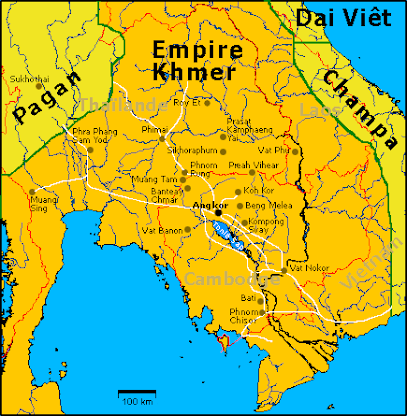
The rise-and-fall story of Angkor is dramatic enough to fill 10 history books. Between the 12th and 15th centuries, the great Khmer Empire spread over what are now parts of Laos and Thailand, Vietnam and Cambodia. Its center was Angkor, the home of the kings, temples, fountains and gold.
A series of attacks by the Siamese and exhaustion of the land by over-farming led to the abandonment of the city in the early 15th century, historians believe. That’s when most of Angkor fell victim to the jungle for 400 years. There it sat, while nations rose and fell, while America was discovered, while Shakespeare wrote Hamlet.
When French archaeologists in the late 19th century rediscovered Angkor and started pulling the vines away and looking at what remained, they were astonished. We still are.
It takes all day for even a bare-bones tour. You can start before sunrise and watch the sun come up over the towers of Angkor Wat, stay all day, then watch the sun go down from a hill nearby.
Some of the ruins have been sufficiently restored so that you can wander the halls and climb the steps. Yet most are only partly put back together, giving the ruins a tumble down feel, as if you’d just stopped by after an earthquake.
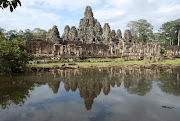
Angkor Wat, built in the early 12th century by King Suryavarman II, is the star of Angkor. But I preferred the Bayon, a nearby temple with 49 towers emblazoned with nearly 200 huge carved images of a pleasantly smiling face. Historians believe the images represent either King Jayavarman VII, who built the temple in the late 12th century, or the Buddhist “compassionate being” Lokesvara, or both.
Yet, the Bayon is not just a happy-face ruin. It’s also an ancient art gallery, with wonderful bas-relief murals depicting the ordinary life of the Angkor people — gambling, in childbirth, dancing, cooking, playing, hunting and fishing. These murals not only are a kind of Facebook posting of daily life back then, they illuminate the high standard of living at Angkor in its heyday, when people had enough to eat, safety, leisure and time to create such art.
You don’t need a guide to visit the Angkor complex, but I would recommend it. The complex is so huge that it helps to have someone show you high points you might miss on your own.
Many tourists get around by tuk-tuk, a cart with an awning pulled by a motorcycle driver. Other sightseers visit by car, van, tour bus, bicycle or even by elephant, depending on what kind of tour they book.
Inside the complex, it’s not just sightseers. Local people gather sheaves of rattan, the reed used to weave baskets. Cattle wander amid the chaos. An ice cream truck parks in a field. At most of the popular temples and sites, persistent children sell sticky rice, baskets, scarves, bracelets, guidebooks, bananas, pineapple chunks and Fanta Orange.
The average tourist needs at least two days to see Angkor, but archaeology buffs will want to stay longer.
One of the most photo-friendly sites is Ta Prohm, a temple-monastery. Today, visitors can see the temple much as it was found in the early 1900s, with giant kapok tree roots winding through the doors and windows, so that the stone temple appears to be part of the natural landscape. Also lovely is Neak Pean, a pond with a fountain as elegant as anything you’d find at Versailles.
Today, the Angkor Wat complex is in no danger of fading away. Huge luxury hotels have opened pell-mell outside the park just in the last three years. About 3,000 new hotel rooms are about to be added to the 7,000 already here.
Naturally, environmentalists aren’t happy about the unregulated hustle and bustle right next to a UNESCO World Heritage site. They worry about the water table under Angkor being sucked dry by hotel wells. They worry that the site’s fragile ruins can’t handle the traffic.
Still, I keep thinking that the kings who built Angkor would probably love all the attention.
From the 1960s to 1998, Cambodia was either at war, crippled by the genocidal Khmer Rouge regime, or unstable. Now, the fledgling democratic nation is trying to make up for lost time in expanding tourism at a frenetic pace in Siem Reap/Angkor, the destination for half of all tourists to Cambodia.
Ready or not, Tourism Cambodia expects up to 3 million tourists at Angkor by 2010.If you go . .
GETTING THERE: Fly into Siem Reap’s 2-year-old Angkor International Airport from nearby Bangkok, Thailand; Hanoi or Ho Chi Minh City, Vietnam; or Singapore. No direct flights from the U.S.
VISA: Needed but easy to obtain through Cambodia’s e-visa program. Get it before arrival for $25 at http://evisa.mfaic.gov.kh/e-visa/vindex.aspx.
LODGING: Most hotels in Siem Reap are new and less than a mile from the gates of the Angkor complex. Try Tara Angkor (about $90-up, www.taraangkorhotel.com).
MONEY: Cambodia uses the riel, but it also uses U.S. dollars; no need to exchange money.
TOURS: Most tourists to Angkor go as part of a larger tour of Southeast Asia. However, it is possible to fly in on your own and hire an Angkor guide through your hotel.
TICKETS: A one-day ticket to Angkor is $20; a 3-day pass is $40; purchase at the Angkor entrance gate; if you’re on a tour your guide will take care of this.
SHOPPING: Siem Reap has nice handicrafts at local markets and roadside shops. Look for textiles, baskets and marble statues of Buddha.
OTHER TIPS:
Take a break from the heat every two hours while touring the ruins. Weather can be humid and in the 90s. Wear a hat and sunscreen; carry water.
Read up on Hinduism and Buddhism and the history of Cambodia to better appreciate what you are seeing.
Try to shoot Angkor photos in late afternoon when the light is best. Also shoot in black and white for a quaint result.
Learn a little of the Khmer language, although most Cambodians who deal with tourists speak some English. For instance, “Angkor” means city. “Wat” means temple.
Masters of Cambodia's killing fields face justice at last
 Vann Nath, centre, and Bou Meng, to his right, pictured in 1980 with other survivors. Both will be in court this week as their tormentor goes on trial
Anne Barrowclough in Phnom Penh
Him Huy, a seasoned executioner at Tuol Sleng, studied the list of names of people he would kill that night. When the silent, terrified prisoners had been lifted on to his lorry he drove them out to the pretty orchard on the outskirts of Phnom Penh. There, he took them one by one to the ditches that had been freshly dug, forced them to kneel and clubbed them to death with an iron bar.
“Sometimes it took just one blow, sometimes two,” he told The Times. “After I clubbed them someone else would slit their throats. But every time I clubbed someone to death I would think, tomorrow, this might be me kneeling here, with one of the other guards killing me.”
In the orgy of cruelty unleashed on Cambodia during the insane years of Pol Pot's rule, Tuol Sleng, formerly a high school, was to become a symbol of the apocalyptic state the Khmer Rouge created. Enveloped in secrecy and identified only by the code name S-21, it existed solely to interrogate and kill the men and women incarcerated behind its walls, the vast majority of whom would never leave it alive.
From 1976, until Vietnamese troops took over Phnom Penh in January 1979, as many as 17,000 men, women and children were taken to S-21 to be interrogated for counter-revolutionary crimes, and then killed. Only 14 are known to have survived, although recent evidence suggests that five child prisoners may have escaped and still be alive today.
Thousands of innocents died here - but so too did members of Pol Pot's own circle, Khmer Rouge soldiers and the prison's own guards. “Out of my interrogation unit of 12, only I survived,” said Prak Khan, a soldier who became a torturer at the prison.
The man who presided over the atrocities of Tuol Sleng with fanatical devotion was Kang Kek Ieu, also known as Comrade Duch, who was posted to S-21 in 1976. He goes to trial this week, accused of crimes against humanity.
Today Cambodia is, on the surface, a peaceful country with a thriving tourist industry. Casual conversations with Cambodians reveal nothing of the horrors of the Khmer Rouge years. But behind the superficial serenity, the people are still traumatised by their memories. In interviews with The Times, the prison survivors, guards and even those who carried out the worst atrocities described Duch as a man of almost sub-human cruelty, who instilled terror into prisoners and guards.
Bou Meng, an artist who was taken to S-21 in 1977, remembers how Duch would visit the room where he and dozens of other prisoners were shackled to the floor. “He ordered me to beat the man beside me with a bamboo cane while he watched,” he said. “Then Duch ordered the man to beat me. You could see the pleasure in his face.” Duch was a frequent visitor to the torture rooms, where he drove the interrogation units to ever-harsher techniques as they worked through the day and night in four-hour shifts.
“The sound of screaming was all around us all the time,” said Vann Nath, a former prisoner and now a renowned artist.
Duch brought the orderly mind of a dedicated teacher to S-21. He kept a meticulous record of the prison's workings and read every confession. Often, he would send them back with corrections marked in red pen, as if they were the test papers of a reluctant student. “Sometimes the confessions came back saying, ‘must get more from the prisoner',” said Prak Khan.
The prisoners were deemed guilty simply because they had been accused - and it was the interrogators' duty to force them to admit that guilt.
Many admitted to crimes they did not even understand. “I had not even heard of the CIA,” said Bou Meng. “But they beat me with bamboo rods and electric cables until I confessed that I worked for the CIA and the KGB.”
“We kept torturing them until they confessed,” said Prak Khan. “If they didn't, the torture got worse. We pulled out their finger and toenails and gave them electric shocks. Sometimes we would tie a bag over their head so they suffocated. We'd take it off just as they were about to fall unconscious. If they still didn't confess, they'd be killed.”
Some inmates were sent to a clinic to “donate” blood to the army hospitals. Prak Khan, whose interrogation room was adjacent to the doctors' clinic, said: “They would bring the prisoners blindfolded and tie them to the beds with their legs and arms spread out. They attached lines to their arms. The tubes led to a bottle on the floor. They pumped all the blood out until the bodies were limp. Then they threw the bodies into pits outside.”
The routine was always the same for the prisoners taken to S-21. Told they were being taken from their homes to work as teachers, doctors or mechanics, they were handcuffed on arrival, photographed and forced into cells, often 60 at a time, where they were shackled by the ankle. They were banned from speaking to guards or each other. At night they were not allowed even to turn over without permission.
“If the guards heard our shackles they would beat us,” said Chum Mey, a mechanic. He spent his first two weeks being tortured day and night. “They pulled out my fingernails and toenails. Then they put electric wires in my ears. I heard the generator and then I felt the fire coming out of my eyes. After 12 days and 12 nights I signed their confession and they took me to a big room with other prisoners. Every night we waited to hear the trucks come. If midnight arrived and they hadn't come we knew we would live another 24 hours.”
The guards lived through their own hell. Him Huy, known to the prisoners as “Cruel Him”, said: “One day I would be guarding prisoners with another soldier and that afternoon the other soldier would be arrested. You always expected to be arrested.”
Prak Khan often recognised old friends among the people taken into S-21. “When I heard the names of people I knew, I pretended I didn't know them,” he said. “If I showed I recognised them I would be killed too.”
After the Vietnamese invaded Cambodia in 1979, Duch disappeared into the jungle. In 1996 he met a group of American missionaries and converted to Christianity. A journalist discovered him working as a medical orderly in 1999 and he was arrested, at last, by the Cambodian police. On Tuesday Bou Meng, Chum Mey and the S-21 guards will be among the scores of Cambodians who will crowd into a courtroom to see their tormentor brought to trial.
Duch has since apologised to the survivors of S-21 but it is not enough. “He asked my forgiveness,” said Bou Meng. “I could not give it to him.”
POL POT'S EMPIRE
In 1975 the army of the Khmer Rouge, a Maoist guerrilla force, took Phnom Penh. Their leader, Pol Pot, claimed he wanted to create a Utopia of radical egalitarianism in which money was abolished, possessions were banned and private property was destroyed in favour of rural collectives
He unleashed a reign of terror which converted a peaceful, sleepy country into a huge concentration camp. Cambodians became slaves in a new Stone Age, likened to oxen and exhorted by their leaders to admire the beast who eats “where we tell him to eat” and “never thinks of wife and children”
1.7 million people, a quarter of the population, died of famine and disease or were executed for “counter-revolutionary crimes”
Thousands were killed for wearing spectacles, which marked them out as intellectuals. Knowing a foreign language became a death sentence; babies and the elderly were murdered because they were useless for work
The mass graves in which the victims were thrown are still being uncovered; it is estimated that a minimum of 20,000 killing fields are scattered through Cambodia.
No other country has lost so great a proportion of its population in such a short period in the pursuit of an ideal
Pol Pot's rule ended in 1979 when Cambodians opposed to his regime joined Vietnamese forces to overthrow the Khmer Rouge. He and a substantial number of troops retreated to the Thai-Cambodian border, set up a new headquarters and continued a civil war for the next decade
After Pol Pot ordered the murder of a loyal deputy he was tried by a “people's tribunal” of his own colleagues and sentenced to life imprisonment. He died in his own bed shortly afterwards
Read more!
Friday, February 13, 2009
Cupid highlights revealing depths of Cambodia's generation gap
 Written by Chhay Channyda and Mom Kunthier
Where's the love this Valentine's Day? Apparently, not at Phnom Penh's Bak Touk High School, where director Sok Sovanna tells the Post he's imposed a "love-free" zone during what he calls a very un-Cambodian holiday.
"I don't support Cambodian youth celebrating Valentine's Day because it is not a part of Khmer culture, such as Khmer New Year or P'chum Ben," Sok Sovanna said.
"This is part of Western culture that makes our young people overwhelmed with joy and leads them to forget about their studies."
However, the adamant director acknowledged that his authority on this point does not extend beyond school grounds.
"I don't care if [students] celebrate outside school by giving gifts to loved ones. But if I see students doing such things in my school, I will re-educate them not to show their romantic love here," he said.
Sok Sovanna's "Cupid crackdown" could have an unintended economic impact.
Flower-sellers have done a brisk trade in recent years by setting up stalls near high schools and other areas where students gather. They may find business slow anywhere near Bak Touk High School.
--------------------------------------------------------------------------------
If we celebrate in a good way, it will not have a negative impact on our tradition.
--------------------------------------------------------------------------------
"At my school, there will be no flower-selling inside or outside. This is our rule to enforce discipline among our students," he said.
Jeopardising tradition
Resistance to the holiday is not simply a matter of enforcing parochial discipline but preserving national culture, Miech Ponn, an adviser to the Mores and Customs Commission within the Buddhist Institute, told the Post.
Miech Ponn challenged the capital's love-crazed youth to consider whether their culture will be lost as more young people become enamoured with Western traditions.
"I do not know how they celebrate Valentine's Day in Western countries, but the way we bring in their culture into Cambodia is too overwhelming," Miech Ponn said.
"We seem to bring in outside culture to destroy our own. I think many Cambodians just don't understand their own traditions very well."
If they did, he added, they would find little need to look towards the West.
"Valentine's Day means a loving day. We already have this in Cambodia. It's P'chum Ben and Khmer New Year, during which children and young people show their respect and love, and they make amends to anyone they have wronged. This is our traditional way of showing we love each other," Miech Ponn said.
"I understand globalisation, but if we bring such culture in, why do other countries not take some of our culture back with them? In the end, we expand their culture by forgetting our own," he added.
Celebration of love
But on a day given over to the celebration of friendship and love, questions of tradition or even geo-cultural trends are the last things on young people's minds.
Sok Liya, 18, a student at Indradevi High School, has no boyfriend but plans to celebrate the day by going out to eat with her friends.
"Valentine's Day is good for people who have love and can spend time with their lovers. But even though I don't have a boyfriend, I will spend time with my classmates and have fun," she said.
However, she cautioned young women planning a romantic day with the men in their lives to think of their security.
"[Some men] think that they can do whatever they want," she said.
Sok Chamroeun, 23, a student at Sisowath High School, is preparing for his first Valentine's Day with his girlfriend. Part of those plans will include ditching his studies for the day and purchasing flowers and gifts for his true love.
"I think Valentine's Day is a special occasion for me because I will be able to tell my girlfriend about my honest heart and my feelings for her," Sok Chamroeun said.
He added a word of advice to those who might look down on the holiday or dismiss it as another example of young Cambodian people losing touch with their heritage.
"I know some people will use this holiday to behave badly and in a way that contradicts their culture. But for me, if we celebrate in a good way, it will not have a negative impact on our tradition," Sok Chamroeun said.
"I don't think Valentine's Day is a bad day, as some people say. On this day, all people - young and old - can celebrate together. We don't focus simply on youths."
Experts cast doubt on launching stock exchange market in Cambodia
Hun Xen's stock exxchange in Cambodia is something that should be laughing at. While Cambodia had no corruption law and high ranking government officials are the culprits, stock exchange is the big meal for those tigers, and we could see the failures (loosing stocks) will be suicides and hanging themselves
By Xia Lin
PHNOM PENH, Experts have express their doubt and lack of confidence, as the Korea Exchange (KRX) plans to sign an official agreement with the Cambodian government next week to help launch the kingdom's proposed stock exchange market in December, national media said on Friday.
Some observers warned that the timing of the initiative could create problems as Cambodia faces reduced economic growth, increased unemployment and the threat of rising non-performing loans, said English-language daily newspaper the Phnom Penh Post.
"I think that currently, the environment is not good enough to proceed with the stock market in Cambodia," Kang Chandararot, economist and president of the Cambodia Institute for Development Study, told the newspaper.
Cambodia would risk losing investors' confidence, if it rushed prematurely into establishing an exchange, he said.
Nguon Meng Tech, director general of the Cambodia Chamber of Commerce, urged the government to postpone launching the exchange until 2012, saying that not enough Cambodian investors understood how a bursae worked.
"Most Cambodian business old hands have little knowledge about a stock exchange. So, how can they throw money at it?" he said.
Meanwhile, Minister of Finance and Economy Keat Chhon said on Thursday that "we will put our efforts into achieving a (December) target" although the government could not "set an official date for the establishment of the stock market."
"The global financial crisis, of course, impacts the stock market. But we won't abandon our plan to establish an exchange due to the crisis," he said.
KRX manager Inpyo Lee expected institutional investors and foreigners to be the main source of liquidity in the early stages of the Cambodian exchange.
Although there had been no formal agreements signed, investment and retail banks had expressed interests as institutional investors, he said.
About 30 companies would be listed by the time the exchange was operating "normally," he said.
The stock exchange market was mulled and prepared years ago amid common prosperity and development of the country, but finally came into shape as the national economy slowed down right after 3 years of double-digit growth from 2005 to 2007.
The Cambodian economy was estimated to grow by only 7 percent in 2008 and the government is trying to maintain a 6 percent growth in 2009.
However, the International Monetary Fund (IMF) said that Cambodia's economy will come under intense pressure in 2009 as tourism, garments and construction take a hit from the global economic meltdown.
"Cambodia's exceptional growth performance is coming under increasing strain from the global economic crisis and weakening external demand", said an IMF report, adding that foreign direct investment will decline and foreign reserves could fall to about 1.9 billion U.S. dollars.
The report predicted 4.8 percent economic growth for Cambodia in 2009.
The World Bank has forecast 4.9 percent Gross Domestic Products (GDP) growth for Cambodia this year.
Read more!
Officials refuse certain foreigners to adopt Cambodian children
PHNOM PENH, The Cambodian government officials have refused foreign single parents, gay parents, low-income parents and parents with two children to adopt Khmer offspring, national media said on Friday.
They made this opposition clear during meetings with representatives from France and U.S. here this month, said English-language daily newspaper the Phnom Penh Post.
This opposition will become an outright ban when a draft law on adoption, currently being reviewed by the Council of Ministers, is approved by the National Assembly, Koy Kuong, spokesman for the Ministry of Foreign Affairs and International Cooperation, told the newspaper.
The law is expected to pass soon, and will make it legal for Cambodian parents to give up their children for adoption, he said.
Currently, only Cambodian orphans can be adopted.
Minister of Foreign Affairs and International Cooperation Hor Namhong met with Jean Paul Monchau, the French official responsible for overseeing international adoptions, on Feb. 3 and voiced concern about the potential psychological effects such adoptions have on children, according to a ministry press release.
Ouch Borith, secretary of state at the ministry, also raised the same points during a Monday meeting with Janice Jacobs, the assistant secretary of state for consular affairs at the U.S. State Department, it said.
Read more!
Dung is key to tracking elusive Cambodian tiger
By SOPHENG CHEANG
PHNOM PENH, Cambodia (AP) — A dog trained to sniff for tiger droppings will help conservationists determine if the big cats still roam one of Cambodia's largest nature reserves.
Starting next week, Maggie, a German wirehaired pointer, will begin scouring the undergrowth and sniffing for tiger scent on trees at the 1,158 square mile (3,000 square kilometer) Seima Biodiversity Conservation Area in northeastern Cambodia.
The unorthodox move to employ a dog trained in Russia to search for signs of tigers comes after camera traps and field surveys failed to find the big cats last year. The last sign of a tiger was in 2007, when a paw print was spotted in the park.
"We think this is the best method when we have a large area and not that many tigers," said Hannah O'Kelly, a wildlife monitoring adviser for the New York-based Wildlife Conservation Society, which along with the wild cat conservation group Panthera is spending about $30,000 to bring Maggie and a second dog from Russia to Seima later this year.
Hiring the two dogs is part of a $10 million, 10-year initiative by WCS and Panthera, also based in New York, called "Tigers Forever." It aims to increase the numbers of tigers by 50 percent in Cambodia, China, India, Indonesia, Laos, Myanmar, the Russian Far East and Thailand through a range of measures that include better monitoring, assessments of threats and efforts to minimize the dangers facing the big cats.
The campaign was launched in 2006 to combat a dwindling tiger population in Asia. Across the continent, the number of tigers has plummeted to as few as 5,000 tigers from a high of 100,000 a century ago due to poaching, habitat loss and other threats. It is unclear how many tigers remain in Cambodia.
Men Soriyun, a project manager for Seima Biodiversity Conservation Area, said he felt that dogs offered the best hope of finding the tigers and that the method could be used by other national reserves.
"The best way to find tigers in the jungle is to use dogs because they can find tigers by their smell," Men Soriyun said.
Cambodia is the first country in Asia to employ the dogs to search for tigers, a method pioneered in Russia's Far East region which has hundreds of tigers spread across several thousand miles (kilometers).
Since then, dogs have been used to search for jaguars in South America and leopards in Africa.
All six dogs taught to search for tigers were trained by wildlife biologist and WCS consultant Linda Kerley in Russia's Lazovsky Nature Reserve. The best dogs for the task, she said, are hunting or sheep herding dogs that can easily detect the musky smell of the tiger's scat, excrement left by a wild animal.
"We don't want a dog that will hunt tigers," said Kerley, who accompanied Maggie to Cambodia. "We want a dog that wants to hunt for the scent of the scat."
The effort is part of a larger campaign by conservationists worldwide to mine animal droppings for genetic information that can save endangered species.
Elephant dung, for example, was used two years ago to calculate the population of pachyderms in Malaysia's Taman Negara National Park.
Read more!
Thursday, February 12, 2009
Justice in Cambodia: will an exact copy of the Chea Vichea case end with the same outcome?
On December 31st 2008, Born Samnang and Sok Sam Oeun were released – on bail for now – after spending almost five years behind bars for the murder of Chea Vichea, president of the Free Trade Union of Workers of the Kingdom of Cambodia (FTUWKC), at the end of a process marred by irregularities. The case of Thach Saveth, who was arrested for the killing of another member of the FTUWKC steering committee, Ros Sovannareth, presents striking similarities with that of Born Samnang and Sok Sam Oeun. He appeared on Wednesday February 11th before the Court of Appeal, who will only issue its verdict on February 18th. Once again, civil society calls for the case to be dismissed and denounces the inconsistency of the evidence against the 27-year-old paratrooper.
A long and dubious process
Some trade unionists and activists from human rights organisations are present in the courtroom to support Chan Sopheak, better known under his military name, Thach Saveth. Arrested on July 24th 2004, he was sentenced on February 15th 2005 to 15 years of prison for “premeditated murder” and has since been locked in a jail in the province of Kampong Cham. The victim, Ros Sovannareth, had been shot with four bullets by two unidentified men on a motorbike on May 7th 2004, in Phnom Penh.
In his confessions to the police, the former member of the 911 unit of the paratrooper brigade claimed that on May 7th, he was leaving Anlong Veng to travel to the province of Kampong Speu, where he was to attend the wedding of one of his relatives. On the evening of the crime, he was making a stop in Siem Reap, according to his statement. Before the judge of the Court of Appeal, Thach Saveth's memory was now blurry. “This all goes back a long time ago. He has forgotten,” his lawyers argued.
This is the second time that this case has come before the Court of Appeal. The first time, on December 27th 2007, the Court had confirmed the ruling of the Municipal Court of Phnom Penh. However, Thach Saveth had then been sentenced in absentia – the Court had claimed that he was detained too far from Phnom Penh for him to attend – which he had challenged by requesting the Court of Appeal to review his case again. Before that, the Municipal Court had held a summary trial – nearly one hour only, which is slightly less than Wednesday's hearing before the Court of Appeal. The United Nations Special Representative of the Secretary-General for human rights in Cambodia had then described the trial as “characterized by breaches of procedural rules and the absence of the most basic standards of fair trial” “Continuing patterns of impunity in Cambodia ”. “The trial judge placed the burden on the accused to prove that he was not in Phnom Penh at the time of the incident and dismissed the testimony of the three witnesses that supported his alibi.”
Common points with the Chea Vichea case
In a soft voice, the defendant repeated to the judge on Wednesday what he has been saying since he was arrested, “I have never committed any offence. I did not even know the victim! And as a paratrooper, I did not have the right to carry a weapon.” Thach Saveth talked about his arrest, which hardly followed the rules as it was carried out “without any arrest warrant”, as reminded by the local human rights NGO Licadho. “The police detained me without explaining why to me. They threatened to kill me to force me to acknowledge I was guilty, but I did not give in. Afterwards, at the Municipal Court, I was shown the pictures of four men and asked if I knew them. I recognised my own portrait of course – they had taken that photograph during my arrest. But the other faces, I had never seen them in my life!” He was reportedly arrested for being a drug addict, by the same Tuol Kork district police who arrested Born Samnang and Sok Sam Oeun. Officers who have since been removed...
Next, the defence called a witness. Some confusion then followed. As soon as he approached, Thach Saveth exclaimed, “But I do not know him?!” while his mother, who was in the audience, shouted, “Yes, you know him!” The judge then asked the man to introduce himself. “My name is Cheth!” “Good. What is your family name?” “Cheth!” The judge persisted, “But when you work, how do you introduce yourself?” “Well, Cheth!” Laughters were heard in the audience while the court decided to dismiss the witness without hearing him. “In the future, follow the rules when you make a request for a witness to be heard,” the judge commented in a remark to the lawyers.
Prosecution witnesses at serious issue
The defence for Thach Saveth then requested that the Court re-examines the minutes of the statements of the witnesses for the prosecution. Witnesses who were heard only by the police and never appeared in a hearing, in breach of the adversarial principle. Witnesses whose testimonies do not match, some describing Thach Saveth as the killer, others as his accomplice, the motorbike driver. The judge of the Court of Appeal rejected the request and explained that the Court's only prerogatives were to review the cases transmitted by the Municipal Court and the police, not to interrogate the witnesses...
The Prosecutor called for the sentence to be held up on the basis of the statements of the four prosecution witnesses, while the defence had brought no exonerating evidence. As for the lawyers, they called for the case to be dismissed: their client was not in Phnom Penh on the day of the murder, he did not carry any weapon – for that matter, the weapon of the crime was never found – and the prosecution witnesses contradicted one another while they had never taken an oath as required by the procedure. “In a word, there is no evidence. This is a completely fabricated case!” Finally, the defendant spoke imploringly to request that the Court provides him with justice and claim his innocence.
A leader of another trade union suspected but never investigated
Contacted by telephone after the hearing, Chea Mony, president of the FTUWKC, stated that he did not believe the person arrested was the real killer, as in the case of the murder of his brother Chea Vichea. “In the complaint filed by the wife of Ros Sovannareth [now a refugee abroad] against the killers of her husband, she accused a leader of the Cambodian Union Federation (CUF), a pro-government union, that was in conflict with the FTUWKC within the [Trinuggal Komara] factory where Sovannareth used to work. But shortly after his murder, that person who was suspected stopped all of his union activities...” Sovannareth and other FTUWKC members had complained about receiving threats from the CUF leader. Not long after Sovannareth's murder, the chief of the criminal police of Phnom Penh had declared that the killing was to be connected with the conflict between the two unions within the factory. A hypothesis that has always been discarded by the judicial system.
Call to follow the example of the Supreme Court
On January 2nd 2009, while it welcomed the decision by the Supreme Court to release Born Samnang and Sok Sam Oeun, the International Labour Organisation (ILO) also encouraged in the same statement the government “to continue in the direction set by the Supreme Court” by revitalizing the investigation into the murder of Ros Sovannareth in particular.
Kek Galabru, president of Licadho, declared on Wednesday February 11th, that “[T]he Appeal Court [had] an opportunity to show that Cambodia's judiciary is not taking one step forward, two steps backwards” and called the Court to “issue a verdict which is based on an objective and impartial review of all the evidence in this case.” In a statement published on the same day, her organisation expressed concern over the attitude of the judges and prosecutor and considered they had failed to respect the presumption of innocence that the defendant must be entitled to before the verdict.
Read more!
KRouge trial unlikely to heal Cambodia's wounds
 TRAPAING SVA VILLAGE, Cambodia (AFP) — Every day, Chhum At sees the former Khmer Rouge members who murdered her three brothers, two uncles and an aunt in this village near the Cambodian capital.
"We feel hot inside with hate and we still want to take revenge. But outside we speak with them," she says at a memorial where bones of the regime's victims are piled like kindling, mixed with tattered clothing and bits of rubbish.
As Cambodia's UN-backed war crimes tribunal prepares to prosecute a handful of senior leaders from the brutal 1970s communist movement, there is lingering hostility here that won't be resolved in a court.
Chhum At, 40, says she can't forgive her childhood under the Khmer Rouge: kept from her mother, she was forced to work in rice paddies and heard screams in the middle of the night as people were clubbed at a nearby "killing field".
Researchers believe the regime killed over 10,000 people at this village 50 kilometres (30 miles) south of Phnom Penh -- a fraction of the estimated 1.7 million who died of overwork, starvation, execution and torture in an attempt to create a Marxist utopia.
When proceedings begin Tuesday against Kaing Guek Eav, alias Duch, the first of five leaders due to be tried, it's far from clear whether that will help Cambodians in places like this village put their past behind them.
A recent survey by the University of California, Berkeley found the majority of Cambodians still harbour feelings of hatred towards members of the Khmer Rouge responsible for violence.
Nearly half of the respondents said they were uncomfortable living in the same community with former Khmer Rouge members, while 71 percent said they wanted to see former cadres suffer in some way.
Meanwhile, 40 percent of Cambodians said they would take revenge against former Khmer Rouge members if they could.
"People in the village sometimes accuse each other and then everything will come out. They'll say: 'You killed my relatives,'" Chhum At says.
"When those arguments happen, sometimes we want to kill each other. But we cannot kill or we will go to prison," she adds.
Youk Chhang, director of the Documentation Centre of Cambodia, which researches Khmer Rouge crimes, said people will need more than the trials of a handful of leaders to recover from the brutal past.
"I think most of the revenge has been done and the rest is a grey area that is difficult to deal with. It's more emotional, more of a trauma," he said.
Former Khmer Rouge cadres in this village say they are not worried about revenge, and most have made their peace with the past.
Chuon Chhon, who worked as a guard at the local Khmer Rouge prison, says he had nothing to do with the mass graves in the area.
"Many of my relatives were killed -- cousins, uncles, aunts -- I couldn't help them. I could only help myself," Chuon Chhon says.
"I also feel hurt. Of course I pity the other people. I was a low rank -- I couldn't help anyone," he adds.
Sao Phen, 63, who arrived in the village with the 1979 Vietnam-backed invasion force that toppled the Khmer Rouge, says there have been fewer revenge attacks over the past five years.
"People still have anger in their minds, but they don't show it publicly. It is better than before, when people would try to kill someone who accused them of killing their relatives," Sao Phen says.
He speculates that the upcoming trials, which put the blame for atrocities on a handful of senior leaders, may have helped reduce violence if they had been staged sooner. But, he adds, relationships change over time.
"Sometimes people avoid each other, but their daughter and son fall in love. When they get married, under Cambodian tradition their families are in an alliance. So how can they take revenge?" Sao Phen says.
But even if senior leaders are convicted and spend the rest of their lives in jail, Chhum At says she'll remain angry with former Khmer Rouge members in the village.
"If the trial can have a verdict soon, I will be very happy," she says.
"But after the trial it will continue to be like this, because we don't know what to do."
Read more!
IMF predicts hard landing for Cambodian economy
PHNOM PENH, Cambodia's economy will come under intense pressure in 2009 as tourism, garments and construction take a hit from the global economic slowdown, according to the International Monetary Fund (IMF).
"Cambodia's exceptional growth performance... is coming under increasing strain from the global economic crisis and weakening external demand," English-language daily newspaper the Phnom Penh Post on Thursday quoted an IMF report as saying.
Foreign direct investment will decline and foreign reserves could fall to about 1.9 billion U.S. dollars, it said.
"Cambodia could experience a pronounced liquidity contraction and possible large reserve loss," it said.
Meanwhile, the report predicted 4.8 percent economic growth for Cambodia in 2009, but IMF Resident Representative John Nelmes warned that the projection will be downgraded.
"We are taking a close look at the growth projection... Since November, when the projection was made, the global crisis has intensified," he told the newspaper.
The World Bank has forecast 4.9 percent Gross Domestic Products(GDP) growth for Cambodia this year, while the Economist Conference, which belongs to the same company that publishes The Economist magazine, even said that it will nose-dive to 1 percent.
Read more!
Wednesday, February 11, 2009
Cambodia approves prisoner transfer deal with India
PHNOM PENH, The Cambodian government has approved an agreement that will enable transfer of prisoners between the country and India, said English-language daily newspaper the Phnom Penh Post on Wednesday.
"It is a response to international law," said Phay Siphan, spokesman of the Council of Ministers.
According to the agreement, if an Indian national were to be arrested, convicted and sentenced for a crime in Cambodia, he or she could be transferred to India to serve out the resulting sentence, and vice verse, he said.
Sau Raj Ray, first secretary of the Indian Embassy, said that a memorandum of understanding on prisoner transfer was once signed in 2007 when Cambodian Prime Minister Hun Sen visited India.
"This is part of an ongoing bilateral exchange," he said.
There are now 1,500 to 2,000 Indian nationals living in Cambodia, and in 2008 around 880 Cambodians visited India, he said, adding that there are no Cambodian prisoners in Indian jails and no Indian prisoners in Cambodian jails either.
Read more!
Cambodia plans to register chapei, khol with UNESCO
PHNOM PENH, The Cambodian Ministry of Culture and Fine Arts plans to submit applications to register chapei, a form of sung storytelling, as well as khol, a type of theatrical performance, under UNESCO's Intangible Heritage of Humanity program, said English-language newspaper the Phnom Penh Post on Wednesday.
Meas Sarun, general director of technique of culture, told the newspaper that he did not know when the applications will be completed.
Meanwhile, UNESCO country director Teruo Jinnai said that the process of approving the applications will likely take about one year.
His office would assist in revising and polishing both applications before they are sent to UNESCO headquarters, where experts will evaluate them and then submit them to a vote by member states, said Teruo Jinnai.
Cambodia currently registered with UNESCO two World Heritage sites, namely the Angkor Wat and the Preah Vihear Temple, as well as two cultural entities including Royal Ballet and sbeik thom, a form of shadow puppetry.
Read more!
Khon Kaen Sugar Cuts Sales Growth Forecast to Zero
Feb. 11 (Bloomberg) -- Khon Kaen Sugar Industry Pcl, Thailand’s biggest publicly traded miller, cut its sales growth forecast to zero from 20 percent as the global recession caps prices and said it may book losses on two overseas plants.
“Our sales may be flat or slightly higher” in the year to October, President Chamroon Chinthammit said today in an interview in Bangkok, the Thai capital. “We are being realistic as the price is not as high as our expectation.”
The global recession has hurt commodity prices, including for food staples, amid concern that reduced consumer spending will erode demand. There may be a loss between 30 million baht ($856,000) and 40 million baht this year from Khon Kaen Sugar’s two mills in neighboring Laos and Cambodia, Chamroon said.
“The outlook for Khon Kaen Sugar is not so bright this year, said Touchcha Pattarasaengthai, an analyst at Trinity Securities Ltd. “Operations in Laos and Cambodia aren’t very good,” and may lose a total of 150 million baht, Touchcha estimated.
Khon Kaen Sugar, which has a market value of 9.8 billion baht, lost 58 percent over the past year compared with the SET Index’s 45 percent drop. Eight of the 10 analysts whose calls are tracked by Bloomberg advise investors to buy the shares, which traded unchanged today at 6.35 baht at 10:23 a.m.
Global Recession
Thailand, Southeast Asia’s second-biggest economy, may enter its first recession in a decade this quarter, according to the Finance Ministry. Recessions in the world’s largest economies will last for years, according to a forecast yesterday from BP Plc Chief Executive Officer Tony Hayward.
“We can’t say that the recession has no effect on us, although sugar is a food staple,” Chamroon said, without giving a 2009 profit forecast. Sugar and molasses accounted for 79 percent of Khon Kaen’s sales in the 12 months to last October.
The Laos and Cambodian plants may begin test runs in March instead of this month as originally planned, and have yet to start full production, Chamroon said. The delay was caused by regulatory issues, the company president said.
Raw-sugar futures on ICE Futures U.S. in New York have gained 6.6 percent over the past year, and traded yesterday at 13.5 cents a pound. The white-sugar contract on London’s Liffe exchange has advanced 9.7 percent and was at $391.10 a ton.
No growth in sales in the year to October 2009 would be Khon Kaen Sugar’s worst performance since 2005, when revenue shrank 5.7 percent, according to Bloomberg data. Last year, sales advanced 24 percent to 11.07 billion baht and profit rose 2.8 percent to 859.5 million baht.
Khon Kaen Sugar Assistant Vice President Chanachai Chutimavoraphand forecast in September that revenue may expand by a fifth this year. The gain would be driven “mainly by higher prices,” Chanachai said then, adding that some forward sales contracts had been agreed at about 13 cents a pound.
To contact the reporter on this story: Rattaphol Onsanit in Bangkok at ronsanit@bloomberg.net
Read more!
IMF warns global downturn poses risks for Cambodia
WASHINGTON, The International Monetary Fund on Tuesday warned that Cambodia faces "serious challenges" from the impact from the global economic downturn and financial crisis, which would significantly slow its growth in 2009.
In its annual review of Cambodia, the IMF said the crisis will potentially affect economic activity, capital inflows and the banking system in the southeast Asian country.
The fund suggested that any response by Cambodia should involve supportive fiscal and monetary policies, as well as improvements in financial sector oversight, public services delivery and competitiveness.
It said plans to ease fiscal policy in 2009 were "broadly appropriate" and recommended that the increase in government spending target social and infrastructure projects.
Turning to monetary policy, the IMF said it saw room for a moderate easing in interest rates as credit growth declined and demand pressures abate.
The IMF also called for greater exchange rate flexibility, calling it "the appropriate medium-term objective." (Reporting by Lesley Wroughton; Editing by Leslie Adler)
Read more!
Tuesday, February 10, 2009
Slow food movement begins to take root in Cambodia
Written by NORA LINDSTROM
A growing number of people in the Kingdom are determined to promote organic produce and celebrate taste and the senses over expedience
Founded in Italy in 1986, the slow food movement has grown in response to the rise of fast food and fast living. In two decades, the movement has blossomed into a global network of people, organisations, businesses and whole cities supporting the concept of eco-gastronomy - the recognition of the strong connection between the plate and the planet.
Starting at the table, the movement promotes an unhurried way of life founded on the idea that everyone has a right to culinary pleasure but that everyone must also take responsibility to protect the heritage of food, tradition and culture that make this celebration of the senses possible.
"The idea of slow food is very challenging in many ways," said Manuel J Garcia, owner and manager of the chain of Boddhi Tree restaurants and guesthouses in Phnom Penh. "It tests our rigid concept of how we approach things, of living in the fast lane."
Some six months ago, Boddhi Tree, with its three establishments, became one of the first businesses in Cambodia to join the slow food movement.
"Ever since its beginning, the Boddhi Tree restaurant has been very much into the healthy side of cooking. We are concerned about how we get our produce, and how that is linked to development more generally," Garcia said. "It's about looking at the whole picture of why we're in the hospitality industry, why we provide food for customers and where that food comes from. I think most of our customers understand and appreciate the values associated with slow food."
--------------------------------------------------------------------------------
The idea of slow food ... tests our rigid concept of how we approach things, of living in the fast lane.
--------------------------------------------------------------------------------
While Garcia suspects Boddhi Tree is the only member of the movement in Cambodia, he is keen to create an expanding network of businesses that use organic produce.
"The organic market here is unstructured, so the idea is for us to be the centrepoint for others who are entering the business. We are now working on building links between suppliers and buyers," Garcia said.
Going organic
Garcia explained how there has been talk - even at the government level - of taking advantage of Cambodia's relatively clean soil and jumping into organic agriculture.
"They found that the land in Cambodia hasn't been exposed to chemicals or pesticides, mainly due to 30 years of war," he said. "And really, the quality of the produce in Cambodia is just exquisite - much higher than in the rest of the region."
The level of organic production in the Kingdom is, however, still difficult to measure.
According to Garcia, Phnom Penh has a few stable suppliers, such as the Farmers Association, along with several small household producers who grow fruit and vegetables organically but do not necessarily know how to promote their crops.
"At Boddhi Tree, we currently get deliveries twice or three times a week from the Farmers Association, but if we could identify the independent producers, we could also buy directly from them," Garcia said.
Nature & Sea, another Phnom Penh restaurant that markets itself as encouraging healthy food and promoting consumer consciousness, also buys its organic foodstuffs from the Farmers' Association.
"If [the association doesn't] have what we need, though, we will buy it from the supermarket," manager Seng Phalla said. "Key for us is that we serve quality, clean food to our customers."
Consumer choice
At the moment, most customers of both the Boddhi Tree and Nature & Sea are either foreign tourists or expats.
"We sometimes have Khmer customers, but many Khmers don't understand about organic produce," Seng Phalla said. "Foreigners, on the other hand, have already come to value organic."
Garcia similarly admitted that nearly all of Boddhi Tree's patrons are from overseas, though he surmised that there might be a small group of wealthier middle-class Cambodians ready to embrace the concept of slow food.
Chamroen Ouch and Dara Dy, who were enjoying lunch at locally run Khmer Village Restaurant that serves organic and local produce, seem to belong to that group.
"In my family, we are very conscious of what we eat. Organic food is good for the health and tastes better," Chamroen Ouch said. "I think there is an increased understanding of the benefits of organic food among Cambodians."
While many young Cambodians living in the capital are eagerly embracing the concept of fast food, often regarded as espousing values quite opposite to eco-gastronomy, Garcia is nevertheless conciliatory.
"I don't think the rise of fast food in Cambodia is a threat at all. There is space in the market for all kinds of business enterprises. It's great to have fast food around one corner and slow food around the other. I have nothing against it."
More information on the slow food movement is available at www.slowfood.com
Read more!
Chicagoans Remember the Cambodian Genocide
Chicago's Albany Park neighborhood is home to the only Cambodian genocide memorial outside of Cambodia.The Killing Fields Memorial is located in Chicago's Albany Park neighborhood on the northside. Worldview Producer Nissa Rhee visited the memorial to see how Chicagoans are remembering the genocide.
When the Khmer Rouge overthrew the government of Lon Nol in 1970, Cambodians were war weary. With the help of the U.S., they had been fighting both the Communist Khmer Rouge insurgents in the northwest and Viet Cong soldiers on their border for several years.
Kompha Seth was a sergeant in the Cambodian army. He had just finished attending a U.S. military training in Thailand when the Khmer Rouge took power.
Because of his connections with Americans and the previous anti-Communist government, Kompha feared for his life. He was given the choice to stay in Cambodia or go to the United States.
SETH: Pretty, pretty hard to make a choice in those time, you know, because my family lived at home and pretty hard to make a choice. So, I don’t know why but I’m still not understand how I made the decision at that time. So I forced myself to come to the U.S. with my pain, by myself. I left my family back home. It’s pretty hard for me.
Kompha left his two sons—age 8 and 2—behind with his wife. They were all killed.
He thought that his brother’s family died as well, but his sister-in-law contacted him after the genocide. She showed him some family mementos she had buried near her house for safekeeping before the Khmer Rouge soldiers came. After the genocide, she returned home and dug them up. He showed me a picture of him as an 18-year old taped to his office wall.
SETH: This is my picture. She told me that she you know hide it in the ground with a plastic bag. When the events over she go back and then she pulled all of the evidence you know, my letter, my picture, everything. So that’s why I believe that it’s real.
His sister-in-law told Kompha that the Khmer Rouge forced them to walk many miles to an agricultural labor camp. Many people died from starvation and disease. Others were executed and thrown in mass graves, called killing fields.
RHEE: Was she able to tell you how your wife or your children died?
SETH: Oh yeah, yeah. She…I don’t want to describe. You know, it was so much painful. When I talk. She still cries when she talks with me by phone. She’s crying.
Out of their 25 member extended family, only Kompha and his sister-in-law are left. Kompha has dedicated his life to making sure that what happened during the genocide is not forgotten. He is now the Executive Director of the Cambodian Association of Illinois, the organization that houses the Killing Fields memorial.
SETH: Among the unluckiest, I’m the luckiest. That’s why we work hard to create this memorial, you know, to honor those who cannot make it. It’s the place where people come to heal the past, and also the place to honor those who cannot survive.
ambi: "Cambodian Dream" song played by Master Song San
The memorial is in the Association’s Heritage Museum, behind an exhibit on the renewal of Cambodian culture after the genocide. Its black granite walls are a solemn contrast to the colorful weavings and intricate wooden sculptures that fill the front of the museum.
Charles Daas is the Museum Director.
DAAS: What you see essentially are 80 glass panels that are back-lit. And each of these panels represents 25,000 people that perished during the Killing Fields period.
RHEE: And I see a white flower, and it says “We continue our journey with compassion, understanding and wisdom.”
DAAS: The phrase signifies the way in which the Cambodian people have approached having lived through a genocide. It’s also a window into their Buddhist beliefs which is this concept of unconditional love and compassion. That they move on from this tragic period in history and they continue to live and to thrive. The flower itself is a sacred flower in Cambodia. But it was also chosen to represent the life after this dark chapter in Cambodian history.
The museum is a gathering place for Cambodian-Americans searching for their heritage.
ambi: Kong Toch instrument
EAP: This instrument needs a lot of coordination. You have to use a lot of flexibility from one side to the next to the other side. You really need to have great body control with this.
On Sundays, young Cambodian-Americans like Kimsour Eap gather in the museum to practice traditional Khmer music. The music classes are one part of the Association’s mission to renew Cambodian culture, much of which was destroyed in the genocide.
Kimsour is practicing the Kong Toch. He sits on a pillow in the middle of the instrument – a circular series of small gongs. He comes to the music class to reconnect with his Cambodian culture.
EAP: It’s meaningful for all young people, like us, like me actually. To see what it’s like to be a part of Cambodian civilization, to be a Cambodian person period. To come here to see all of this museum, to see this display. To think about back in time what’s going on in Cambodia. It’s great.
Kimsour was born in Cambodia six years after the Khmer Rouge was ousted from power. And his family’s history during the genocide remains a mystery to him.
EAP: You know what, I don’t really know much about it. They don’t really want to talk about it, ‘cause it’s so much painful to even think about.
That reticence of Cambodians to discuss the genocide is one of the biggest obstacles the Association faces.
DAAS: Even though we have this museum, even though we have the memorial, I think that most people continue to be unaware of what really happened in Cambodia.
Again, Museum director Charles Daas.
DAAS: What is most disheartening for me is that genocide actually has a pattern. That this isn’t just something that happens. That one genocide occurs and people actually mimic or learn from that. And so I think one of the difficulties for me is that even though we have this wonderful facility and this beautiful memorial, which again while it’s a memorial to the Cambodian people, it’s a memorial to anyone who’s been victim to war to torture and to genocide. I think the hardest thing for me is that there are so many people who don’t know that this happened and how important it is for them to understand this.
Cambodians celebrated the 30th anniversary of the end of the Khmer Rouge regime last month. But as the Cambodian Association of Illinois will tell you, the genocide still is a dark shadow on the lives of Cambodian-Americans. It will take a long time before the wounds heal. And until then, the Cambodian community will keep renewing, and keep remembering.
Read more!
Cambodian Garment Workers Face Poor Prospects
By Michael Sullivan
The impoverished Southeast Asian nation of Cambodia is another victim of the global economic slowdown.
Two-thirds of Cambodia's export earnings come from the garment industry, which employs about 360,000 people — almost all of them women. Most earn less than $100 a month. But in a country as poor as Cambodia, every little bit helps.
Now, even that little bit is under threat.
Even makers of such seemingly recession-proof garments as underwear are feeling the pinch.
Take, for instance, Whtex Garments in Phnom Penh. Six months ago, the factory had more than 500 workers in the packing department alone, manager David Teo says. Now, there are fewer than 300.
Whtex Garments supplies underwear for Wal-Mart, Kmart and Disney, among others. Teo says more than 90 percent of his production goes to the U.S. But orders in the last few months, he says, are down 30 percent.
Six months ago, the factory packed more than 100,000 pieces a day.
"Now, we hardly pack 60,000, 70,000 a day," he says. As for the future, Teo says that he doesn't know what will happen next month — and everyone is worried.
It's repetitive, mind-numbing work. And it doesn't pay much, either. Workers here bring home between $70 and $100 a month — with overtime. Nobody pretends to like the job, but many are grateful for it.
Pou Chan Thon, 28, has been working at the Whtex factory for three years and says she is worried about losing her job. Her parents are farmers, and she sends them about $30 a month. Without that money, she says, they literally couldn't survive.
A few miles away, Sin Sary, 23, irons and folds track suits at Global Apparels. There are more than 3,000 workers at this factory, which manufactures sports clothes for Adidas and Puma.
I'm worried, the young woman says, because there are rumors going around that the factory will be closed or suspend production for a time. She says she doesn't know what she or her family will do if she's laid off.
But she better start thinking fast. Management hasn't told the workers yet, but about 800 are to be furloughed for the next two months, maybe longer. And these two factories aren't isolated examples.
Van Sou Ieng, chairman of the Cambodian Garment Manufacturers Association, says factories are losing orders from a host of U.S. companies — among them, Gap, Levi's, Wal-Mart and Nike. "Everywhere, actually," he says.
He says about 90 factories have already closed or curtailed production in the past few months, and he predicts another 30 will close by the end of March.
But union leader Chea Mony is skeptical. He says unscrupulous manufacturers are using the crisis as an excuse to close factories and move them elsewhere — without compensating workers.
Van Sou Ieng admits a handful of manufacturers have done just that — but only a handful, he says.
Meanwhile, economist Kang Chan Dararot worries about what will happen next. The Cambodian economy, he says, simply can't absorb those now being laid off from the country's two biggest industries.
"Poor families [are] very deeply involved in these two sectors — construction and garment industry. And now, so many people have been laid off. There [are] very grave prospects for … 2009," he says.
It's a future that may involve risky choices for laid-off workers desperate for cash.
Some out-of-work garment workers are already finding their way into karaoke parlors and go-go bars.
On a recent night, two young women working at a go-go bar in Phnom Penh say they were laid off last month. They haven't told their parents — and don't plan to, either. They are hoping to make enough working at the bar to continue sending money back home.
Many in Cambodia believe there will be more women in the same situation if garment orders are reduced further. Some worry the entire industry may be at risk if buyers — and manufacturers — decide to go elsewhere, like Bangladesh, where prices and wages are lower and labor standards weaker.
Read more!
Cambodia shares the pain
By Stephen Kurczy
PHNOM PENH - After months of official denials and upbeat forecasts, Cambodian Prime Minister Hun Sen said for the first time last week that the country's economy is not immune to the rising global financial and economic crisis. As key business sectors, including garments, tourism and construction, all show signs of weakness, the premier finally said the government must do more to stave off a crisis.
"It is clear that if the [government fails] to take timely and appropriate measures to manage the crisis, the effects of the global financial crisis and economic downturn will become a real cause for Cambodia's financial system and economy to fall into a dangerous crisis," Hun Sen said during an address to the Cambodian Economic Forum. He also took the occasion to lower the government's 2009 gross domestic product (GDP) growth forecast to 6% from 7% previously.
Although still higher than most outside projections - including the International Monetary Fund's 4.75% growth forecast - economists say the premier's disclosure represents a significant policy shift. The day before the February 5 forum, Cheam Yeap, a lawmaker from Hun Sen's ruling Cambodian People's Party and the chairman of the National Assembly's Finance Commission, said the global financial crisis would have "no impact" on Cambodia.
Those denials, however, had become statistically difficult to defend. The Economic Institute of Cambodia, an independent think tank, showed that exports in the first half of 2008 grew by only 6.7%, or about half the 12.6% rate recorded over the same period the previous year. That included a severe downturn in the crucial garment export sector: at least 22 garment factories were closed by the end of last year, shedding over 20,000 jobs in the process.
Tourism also saw declining growth in the second half of 2008, with arrivals dampened by an armed border dispute with neighboring Thailand and the closure of Bangkok's Suvarnabhumi Airport, through which many tourists transit to Cambodia. Tourism arrivals were up a mere 5.5% year on year, the first time annual growth was below 18% since the 2003 severe acute respiratory syndrome (SARS) scare of that year. It was also the first year since then that visits to Angkor Wat dropped, with visitor numbers down about 50,000 visitors to 1.05 million overall.
The booming construction sector, which had been driven largely by South Korea investors, has also been hit by the global turmoil. Douglas Clayton, chief executive of Cambodia's first investment fund, Leopard Cambodia, warned last September that local land values would fall as Korean investors pulled out of ventures because of sub-prime loan related problems back home.
By November, South Korean developer GS Engineering & Construction announced it was halting for at least one year construction on its US$1 billion, seven-skyscraper complex, and that it would scale back its original plan to only three buildings. With the economy slowing and South Korean investors heading for the exits, it's increasingly unclear from where the high-spending expatriates will arise to fill the high-end, high-rent complex.
Economically linked
Some analysts and commentators had earlier suggested that small, financially undeveloped Asian economies like Cambodia, which lacked exposure to toxic subprime products and had diversified their past reliance on exports to US and European markets, might "decouple" from deteriorating financial conditions in the West and maintain strong growth momentum.
But recent statistics show that "we can't say anymore that Cambodia is decoupled" from the wider global turbulence, said Stephane Guimbert, country economist for the World Bank. "Since we prepared [our 4.9%] projection [for Cambodian 2009 growth] in November 2008, most of the developments in the global economy have pointed to a deeper crisis than expected at that time," he said.
In part that's because Chinese demand for the region's products, many of them intermediate goods destined finally for Western markets, is not holding up as strongly as some had hoped. The IMF recently halved its 2009 growth forecast for Asia to 2.7%. During a February 2 teleconference announcing the Asia revision, IMF managing director Dominique Strauss-Kahn referred to the previous decoupling theory as "a funny story". "We have always been arguing here that there was not such a thing [as decoupling]," Strauss-Kahn said.
John Nelmes, the IMF's local resident representative, predicts Cambodian GDP growth will likely fall below 4.8% in 2009 and only recover to 5% to 6% next year if larger global economies implement well coordinated fiscal and monetary policies. If accurate, Cambodia's growth is expected to fall by half of recent trends; between 2004 and 2007, GDP growth averaged 11.1% annually.
"Looking forward to the near term, the global crisis is likely to take a heavy toll on Cambodia," Nelmes told Asia Times Online.
Until now, integration with global markets had buoyed the Cambodian economy. With the implementation of more market-oriented reforms, including measures to lure foreign investment, average per capita annual income more than doubled to $593 in 2007 from $285 in 1997. Now many fear a reversal of fortunes that could drive more Cambodians, already estimated at 35% of the population, back under the poverty line. Cambodia's poor were already hard hit by last year's spike in inflation, which soared to 25% last May before moderating to an overall annual rate of 13.5%.
Guimbert and others say Hun Sen's government should move to stimulate the economy through fiscal outlays towards agriculture, infrastructure and social safety nets. The World Bank also recommends more structural reforms so that Cambodia will be better-positioned to benefit when the global economy rebounds. Those suggestions include streamlining export processes and the establishment of a national arbitration center to allow foreign investors to bypass the country's notoriously corrupt courts for business disputes.
The World Bank ranked Cambodia 135 out of 185 countries surveyed for their overall business climate and in mid-2008 ranked it below every other Association of Southeast Asian (ASEAN) nation except Myanmar in three main categories: control of corruption, government effectiveness and rule of law.
That assessment was echoed last week by the United Kingdom-based environmental watchdog Global Witness in a new investigative report that accused Hun Sen's government of cornering and "pillaging" the country's growing mineral and petroleum industries. [See accompanying story]
Hun Sen says such assessments represent a double standard in light of the recent incompetence and corruption witnessed in the Western financial industry. "Rich countries are only blaming poor countries for corruption - they never blame one another," Hun Sen was quoted saying in the local media. "Powerful nations no longer have the right to advise small countries."
Stephen Kurczy is a Cambodia-based journalist.
Read more!
Cambodian refugee serves fellow immigrants at San Bernardino's Asian-American Resource Center
 Rodrigo Peña / The Press-Enterprise
Rasmey Sam founded the San Bernardino center in 1995 because there was no place for Inland Asian immigrants to turn for help in their own languages, and in the context of their own cultures, he said.
The Press-Enterprise
Thirty years ago, Rasmey Sam was a young Khmer Rouge follower who had been brainwashed with the ideology that led the Cambodian government to murder an estimated 1.7 million of its citizens. He was taught to hate his parents and others with "contaminated" ideas.
Today, Sam leads the Asian-American Resource Center, the Inland area's only comprehensive organization for Asian immigrants. He devotes his life to helping immigrants instead of learning why to despise fellow Cambodians.
The Inland area's Asian-American population increased by 60 percent between 2000 and a 2005-07 Census estimate, to more than 217,000, or almost 6 percent.

But the Asian population here is not as concentrated as in parts of Orange and Los Angeles counties, where some cities are half or two-thirds Asian. That can make it more difficult to reach potential clients, Sam said.
Sam founded the San Bernardino center in 1995 because there was no place for Inland Asian immigrants to turn for help in their own languages, and in the context of their own cultures. Employees speak Vietnamese, Korean, Cambodian, Mandarin and Cantonese. One speaks Spanish. Many of the more than 5,000 clients are Latin American immigrants.
Clients take English and citizenship classes, get documents translated, learn how to use computers, and receive information on low-income utility programs. Seniors enjoy Vietnamese lunches and learn about nutrition, and young people get help with their homework.
The group opened a satellite office in Rubidoux in 2003.
Sam earned a degree in business administration from Cal State San Bernardino in 1995 and quickly began researching how to start a nonprofit organization. One of his marketing professors, Victoria Seitz, helped him.
"He's really, really smart," Seitz said. "He could have used his knowledge to make a lot of money. Instead, he's using it to help his community. He wants to do the right thing."
Richard Chong, president of the Khmer Buddhist Society of San Bernardino, said the resource center is indispensable in helping Asian immigrants adjust to life in the United States.
The center started in a one-room office in downtown San Bernardino. It now sits in a 3,800-square-foot building south of downtown.
Sam was a young child when the communist Khmer Rouge took over Cambodia in 1975. They murdered politicians, intellectuals and others who they saw as part of a dangerous educated elite. They ordered residents of cities to move to the country in a plan to turn Cambodian into a fully peasant-oriented economy.
Sam's father and grandfather were early victims of the genocide. His dad was chief of police for the capital, Phnom Penh, and his grandfather was a one-star general, and thus immediately seen as enemies of the new regime, Sam said.
He, his mother, two brothers and two sisters were forced into the countryside to attend "re-education camps." His mother was seen as a lost cause, because she was older and seen as hopelessly corrupted. She spent her days doing backbreaking work in the rice fields.
The Khmer Rouge concentrated on children like Sam, whose minds were still malleable.
"They did a good job on me," Sam said. "If they had given me a gun, I probably would have shot people."
Yet even the vaunted children had to scrounge for food. Sam sometimes ate insects. One sister starved to death.
After Vietnamese troops toppled the Khmer Rouge in late 1978, Sam returned to Phnom Penh before escaping to a Thai refugee camp because of continuing instability.
He arrived as a refugee in Monterey Park in 1982. The second family he lived with moved to Rialto in 1986, and he graduated from Eisenhower High School there.
Sam is officially 36 years old, but believes he's probably 38 or 39. Workers at the Thai refugee camp he stayed at often put back children's ages so they would receive more education to make up for time lost in the camps, he said.
Sam barely knew his father, but he thinks of him often. His memory helps guide and inspire Sam.
"I was 5 when my dad was taken away," Sam said. "But he's my role model. I feel obligated to represent my family and do good for the people."
Reach David Olson at 951-368-9462 or dolson@PE.com
Park reopens on Thai-Cambodian border
BANGKOK, A long-popular park along a disputed stretch of the Thailand-Cambodia border known for its cliffs and vistas reopened Tuesday after being closed for months.
Tourists hadn't been able to take in the scenery of Pha Mor E-Daeng cliff and the rest of Khao Phra Viharn national park in Si Sa Ket since last July. Cambodia's ancient Khmer temple ruins of Preah Vihear remain closed, however.
Kalayani Thammajari, chairwoman of the Si Sa Ket tourism association, said the reopening was widely welcomed by local businesses, the Bangkok Post reported.
"We are ready for tourists as we have waited for months for this," Kalayani said. "We expect massive tourist arrivals. Many of them are likely to come for a glimpse of the disputed area."
Thai Lt. Gen. Wibulsak Neepal said it's hoped the reopening will alleviate tensions between troops the two countries have stationed in the disputed region. He said reopening the park should encourage Cambodia to open the doors to its mountaintop temple once more.
He said he had invited his Cambodian counterpart, Gen. Chea Mon, to his army's headquarters in Nakhon Ratchasima for talks about cutting troop levels in half.
"(But) we will not leave the area. It is part of our territory too. Our troops must be present to exercise our sovereignty," he said.
Read more!
Monday, February 09, 2009
NGO website barred in Cambodia for releasing scathing report
PHNOM PENH -- The website of UK-based corruption watchdog the Global Witness has been blocked for some local web users following its release of a scathing report on Cambodia's nascent oil and mining industries last week, national media said on Monday.
AngkorNet, one of the kingdom's leading internet service providers (ISP), had blocked the site over the weekend in a manner consistent with a deliberate attempt to prevent access, English- language newspaper the Phnom Penh Post quoted Norbert Klein, editor of the online Cambodia Mirror, as saying.
"This doesn't happen automatically. Somebody somewhere must have done something," he said, adding that the block could either have originated with the ISP itself, or "somewhere further upstream."
AngkorNet representatives confirmed the Global Witness site was barred to its customers, but could not provide further details into the reasons for the restricted access.
The 70-page "Country for Sale" report accused corrupt ruling elites of monopolizing the kingdom's mining and oil industries, aided by a "total lack" of transparency.
The report has drawn fierce criticism from Cambodian government officials since its release on January 5.
Read more!
Thailand bars Cambodian rice, cassava
 Written by Thet Sambath
Protectionism aimed at other crops, too: officials, traders
THAI authorities have closed the border to agricultural products from Cambodia at all checkpoints between the two countries due to Thai farmers protesting the competition posed by cheaper Cambodian exports, officials and traders said.
In what is being seen as a protectionist measure on Thailand's part, Cambodian sources on the border told the Post that Koh Kong, Pursat, Battambang, Pailin, Banteay Meanchey, Oddar Meanchey and Preah Vihear provinces are all affected. Cassava and rice were being blocked - the main products barred - and may not reach export markets, traders said. At some crossings, corn, beans and sesame have also been barred, they said.
"The Thai authorities have told us they must close to imports of Cambodian agricultural products because their people are protesting at [government] offices against crops imported into their country because it brings prices down," Sok Pheap, chief of the Cambodia-Thailand Border Relations Office, said Sunday.
Cambodian dry cassava was selling for 2.1 baht (six US cents) per kilogram Sunday compared to 2.6 baht (7.5 cents) per kilogram in Thailand. Similarly, corn was slightly cheaper in Cambodia at 6.2 baht per kilogram - in Thailand it was 6.8 baht per kilogram.
Early last week, some crossings had been kept open, meaning Cambodian exports were still getting through, but since that time the border has been completely closed to Cambodian agricultural produce, said Sok Pheap.
--------------------------------------------------------------------------------
They didn't tell us when they will again allow crops to be imported.
--------------------------------------------------------------------------------
"In a meeting, they didn't tell us when they will again allow [Cambodian] crops to be imported into their country," he added.
Keo Narin, a Cambodian army officer in Military Region 5 in O'Beichon commune, O'Chrouv district, Banteay Meanchey province, said Sunday that cassava, corn, rice and other crops are being stored in houses and rice fields along the border.
"The [border] closure continues, so farmers are trying to keep their goods from going bad in the hope the gates will open again in the near future," he said.
Smuggling continues
Despite the blockade, some Thai and Cambodian businessmen are continuing to smuggle agricultural products across the border, he added, but trade is well down.
Ung Oeun, governor of Banteay Meanchey province, said Sunday that he has asked Thai officials in neighbouring Sa Keo province to have a meeting at the end of this month to discuss the issue.
"We will ask them [the Thais] to resume normal border trade," said Ung Oeun, adding that there had been no orders from Phnom Penh to initiate counter-protectionist measures.
Despite the blockade, there was some good news for Cambodian traders. One exporter, Som Mab, said Sunday: "I was told by the Thai authorities this weekend that they will allow Cambodian rice to be imported into Thailand in two days' time." In Pailin, dry cassava was already being allowed through, he added.
Read more!