By David Montero Correspondent of The Christian Science Monitor
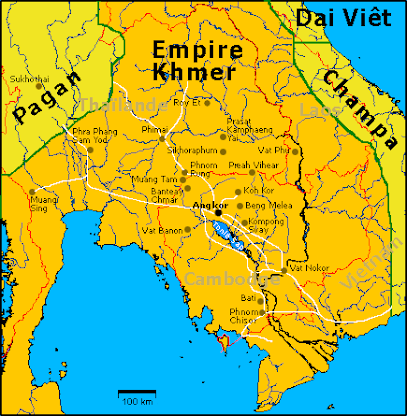
PHNOM PENH, Cambodia - The farm fields of this country once fed the legendary civilization of Angkor, the world's largest empire in the 9th century. Tomorrow they may feed the megacities of the United Arab Emirates, Kuwait, and Qatar.
Reeling from food prices that have doubled on average from a year ago, several Gulf countries are pursuing land deals worth billions of dollars in Cambodia, according to recent statements by Cambodia's government. Those countries would lease land, grow rice and corn, and then ship it home – potentially saving millions by bypassing world markets.
The race for farmland in Cambodia underscores how countries desperate to boost farming amid an ongoing food crisis are turning to global outsourcing, hoping to grow their own food on land abroad. Japan has bought up plots in Brazil, South Korea large tracts in Madagascar, in a trend poised to change global land ownership and agricultural production.
While it may bring succor to countries squeezed by high prices, it may also incite conflict and poverty, some experts warn. In August, Jacques Diouf, director-general of the UN's Food and Agricultural Organization, warned against creating a kind of food "neocolonialism," with rich countries securing food supplies at the expense of poor farmers.
From his office in Dubai, Mohammed Raouf can see the global food crisis closing in on the Gulf states. Growing food at home is not viable – in Saudi Arabia, Mr. Raouf points out, farmers have tried for 15 years, unsuccessfully, to grow wheat in the desert.
As a result, Gulf nations must import about 80 percent of staple foods. And the price of those imports has ballooned from $16 billion in 2006 to $20 billion in 2007, according to the Arab Organization for Agricultural Development.
Land acquisitions abroad are the only viable response, Raouf and others say. "For the Gulf countries ... under current technology, it is impossible to guarantee their food security internally, because they lack water resources and arable lands," Raouf, program manager of environment research at the Gulf Research Center, a Dubai think tank, writes in an e-mail. "So this [is] the best policy option now to follow…"
In recent months, Cambodia has positioned itself as a solution: of 6 million hectares (about 15 million acres) available for cultivation, only 2.5 million are currently used, the government says. It's been wooing the Gulf, hosting delegations of Arab leaders, and hopes to finalize concessions worth up to $3 billion with Kuwait and Qatar. As Prime Minister Hun Sen said in a recent radio address, "Those countries have oil but no rice. I think the Gulf can become our rice market."
The marriage of rich countries seeking land and poor countries seeking cash has accelerated since 2007, goaded by troubling statistics: as populations rise globally by 1 to 2 percent, agricultural production is not keeping pace. Investment has slumped, and farmland is disappearing as nations transform countrysides into urban centers.
The result has been a quiet but dramatic redrawing of the world's land ownership. China may have a lot of land mass, but much of the arable land it has is rapidly being turned over to industrial use, and tens of millions of its former farmers have moved to the cities for work. So it now is negotiating deals to buy more than 2 million hectares of land in countries as far flung as Mexico, Tanzania, and Australia. The United Arab Emirates is seeking some 800,000 hectares in Pakistan alone, while Saudi Arabia is negotiating for 1.6 million hectares in Indonesia, according to statistics compiled by Grain, an environmental organization based in Spain.
Such deals may look good on paper, bringing cash and possibly technology transfers. But many in Cambodia – as elsewhere – are concerned. They worry that poor countries could undercut their ability to feed themselves by selling land, especially in times of food crisis.
"We still need to develop our agricultural technology on our own land,," says Meas Nee, country director of Village Focus International, a nongovernmental organization that focuses on farmers' livelihoods. "If this kind of investment is not carefully planned, all the investment will be done at the expense of the rural poor and farmers."
Another concern is that land may be unfairly taken away from farmers. Cambodia is already reeling from extensive land disputes, and local newspapers daily report on cases of poor farmers being kicked off their land. In many cases, local police and government officials are said to be responsible, making way for private businesses to set up agricultural projects.
No one knows for certain how many people have been dispossessed in recent years, but it is estimated to be in the tens of thousands, according to several local and international human rights organizations, including Amnesty International.
In Laos, farmers are accusing Chinese of kicking them off their land. When it was announced that Egypt hoped to buy 840,000 acres of land in Uganda, a public uproar ensued, resulting in the Ugandan government denying the transaction. It remains unclear if that deal will go through.
"The land deal could trigger a conflict over land and also raise other political issues. We could see a reversal of our socioeconomic progress," says Arthur Bainomugisha, director of research at ACODE, a think tank headquartered in Kampala, Uganda.
Here in Cambodia, critics worry that land deals could be made without local consultation and could result in more people being kicked off their land.
Cambodian farmers would still be able to work on the land that foreign countries buy, but critics worry that companies would not be able to provide as many jobs as they might potentially take away. "The companies can make jobs, but in our observation, they cannot make the jobs enough," says Thun Saray, the executive direction of Adhoc, a local human rights organization.
"If the government permits land sales to foreign countries, where will Cambodians who need land go? How can they survive?"
Read more!

Sunday, December 21, 2008
Wealthy countries seek land in Cambodia, Madagascar, and Brazil.

Australian prefers Thai jail to home
A MELBOURNE man who has been living in shocking conditions in a crowded Bangkok immigration jail cell for more than four years is refusing to accept Australian Government help to return home.
Colin Hansch, 61, has told Thai authorities he would rather stay in jail than return to Australia, even though he has only a mat to sleep on and receives a small daily serve of rice and soup.
"I've not been back to Australia for 30 years. I don't want to go back, I've got nothing to go back to," he said.
Mr Hansch, a computer engineer who left Melbourne in 1967, is worried he will not be able to obtain a passport to travel overseas again if he accepts the offer. It is believed he wants to be able to visit Malaysia or Cambodia.
"I think they [Australia] don't want to give me a passport … they don't want to set a precedent giving a passport to somebody while they are in custody," he said.
#A spokesman for the Department of Foreign Affairs in Canberra said Mr Hansch had repeatedly rejected an offer from the embassy in Bangkok to issue a limited-validity document to let him return home immediately.
Mr Hansch has been held at the immigration centre in Bangkok, just around the corner from the Australian embassy, since September 2004. He was transferred there, supposedly pending deportation, after serving two years in a Bangkok jail for assault causing serious bodily harm, which related to a dispute with a bar girl in the beach resort of Pattaya.
He shares a large cell on the immigration centre's second floor with up to 100 illegal immigrants. Fights often erupt. He spends much of his time listening to FM radio and reading books.
The department spokesman said Australian consular officers have provided assistance to Mr Hansch while he was in jail and now at the immigration centre.
For 12 years Mr Hansch worked as a computer engineer for a US firm in Thailand. He has also worked as a computer engineer in the US and at the former Woomera defence site in South Australia.
"Thai authorities have informed the embassy that Mr Hansch is subject to deportation following completion of his criminal sentence and must travel directly to Australia," the foreign affairs spokesman said.
"The embassy is not able to issue Mr Hansch with a full-validity passport as he has been unable to satisfy documentation requirements to enable the issue of a full-validity passport."
There are about two dozen Australians among thousands of foreigners in Thai jails, most of them for drug-related offences.
There is an agreement with Thailand under which prisoners can transfer to Australian jails, but the process is very bureaucratic.
A Melbourne man, Harry Nicolaides, 41, has been in prison in Bangkok since August 31 on charges of lese majeste, which can carry up to 15 years' jail. He is scheduled to appear in court on January 19.
Read more!
Saturday, December 20, 2008
Pitt's coming of age
By Lawrie Masterson
BRAD Pitt is the first to concede his life can be chaotic. He and partner Angelina Jolie have busy careers. Both are heavily involved in humanitarian issues and then there's that tribe of children.
But in the next breath, Pitt readily admits he and Jolie, 33, are keen on the idea of adding to their family.
And he doesn't seem troubled about how they might find the time.
"We have our ways," Pitt says with a smile.
"There are some dry spells. There are a few moments in the desert, but mum and dad can get very creative."
For the record, this was the roll call at the Pitt-Jolie breakfast table last time we checked -- Maddox, 7, (adopted from Cambodia), Pax, 5, (adopted from Vietnam), Zahara, 3, (adopted from Ethiopia) and biological children Shiloh, 2, (born in Namibia) and six-month-old twins, Knox and Vivienne (born in France).
"It is chaos at moments, but there's such joy in the house," Pitt says.
"I look down and there's our boy from Vietnam and our daughter from Ethiopia and our girl born in Namibia and our son from Cambodia and they are brothers and sisters, man.
"It's such a sight of elation and, given our jobs, we have the capability to provide a home. But, let me tell you, it's selfish, too, because the rewards have been extraordinary."
Pitt says the safety of his family is "the only thing that keeps me up at night" -- that and having to pitch in on the nappy-changing duties.
"Sure, there's the janitorial aspect of it all, but it's the worry, because they just mean so much to me."
The whole question of mortality and the joys and sadness that come with love and family have weighed more heavily on Pitt lately as he has absorbed the experience of making The Curious Case of Benjamin Button, his third film with director David Fincher and a hot Oscar favourite.
Adapted by screenwriter Eric Roth (Forrest Gump, 1994) from a 1920s story by F. Scott Fitzgerald, The Curious Case of Benjamin Button is about a man who is born in his 80s and ages backwards.
As the people most important in his life -- such as his adoptive mother, Queenie (Taraji P. Henson), and his greatest love, Daisy (Cate Blanchett), -- reach middle and old age, Benjamin "progresses" towards childhood.
"When we began this, David was already dealing with the death of his father and Eric had to deal with the death of his mother," Pitt, 45 last Thursday, says.
"About a month into shooting, Angie's mother passed away, so this whole idea of mortality and the family being finite and the individual being finite was first and foremost.
'T HE thing I walked away with was that time is short. I don't know if I have a day or if I have 10 days or 10 years or 40 years. Am I half way or close to the end?
"I don't know, so I've got to make sure I don't waste any of those moments on any kind of pettiness or bitterness or laziness and that I surround myself with what's most important to me and the people most important to me.
"I had a friend who worked at a hospice and he said people in their last moments do not discuss their successes, their awards, what book they wrote or what they accomplished.
"They only talk about their loves and their regrets and I think that's very telling."
Director Fincher and his team used groundbreaking computer-generated effects to transpose Pitt's heavily made-up face on to the bodies of older and sometimes much smaller actors for various scenes in the film, which clocks in at almost three hours.
"Fincher described it as me getting to drive the performance with the technology," Pitt says.
"I spent a couple of days just making faces I'd be embarrassed to show anybody else and they mapped every muscle contortion into the computer.
"I said I would never do a film with prosthetics and then what does Fincher bring me? A film with prosthetics and I can't say no to him.
"The make-up guys will tell you they got it down to 2 1/2 hours, but they're full of s---. The best we did was 4 1/2 hours. The first day I think it was, like, six hours."
A bonus for Pitt was that much of the film was shot in New Orleans, where he has been working on a project to build 150 affordable, aesthetically pleasing and environmentally friendly homes for families displaced by Hurricane Katrina, but that is not how he refers to the disaster that almost washed the city off the map in August 2005.
"I call it levee failure," he says.
"There's a misconception it was an act of God that happened down there, but it wasn't. It was man-made failure.
"We first wanted to be a catalyst to help people return, but we also saw this opportunity to be a proving ground for high-performance buildings, for a greener approach.
"When I left recently, the (power) meters were running backwards. Suddenly this is the greenest, most advanced neighbourhood in the US, so there's a template there that needs to be standardised and replicated because it works. There's no reason why some of this shouldn't work in Haiti or across Asia.
"There's something at play here that I think is bigger than just the starting point."
Pitt is working on his next movie, Quentin Tarantino's World War II film Inglourious Basterds which he describes as "outrageous, the World War II film to end all World War II films. I don't know how they do another one after this".
Pitt has not wanted to be separated from his brood, so they have travelled together between Germany, where the movie is shooting, the US and France, where they have set up another home.
"I've been dragging them back and forth from continent to continent, so I'm going to have to give them a break pretty soon," he says.
T HE new home in Nice is high on their list because, as the father of the family dubbed "most wanted" by the world's paparazzi says, the locals pay them hardly any attention.
"We were looking for a place where our kids could run free and not be hassled and there's a good relationship between us and the area," he says.
"We find it a good base for the family."
Pitt's command of the French language, however, still leaves much to be desired.
"I am in ecole (school)," he says. "But my seven-year-old rips it. He's fantastic. It's really humiliating, but we're very proud of him."
The Curious Case of Benjamin Button opens on Friday.
Read more!
One Laptop Per Child a Solar Movement
No electricity? No problem. The One Laptop Per Child project has solar-powered laptops for kids in the most remote corners of the world
By Andy Patrizio
The One Laptop per Child (OLPC) program has suffered the occasional bumps in the road due to squabbling here in the U.S., but now that it's finally out and being deployed, the program is seeing success in the most remote parts of the world.
Usually, the OLPC XO laptop requires a power outlet, but the OLPC organization also has been shipping solar-powered laptops for some of the most remote, rural and poorest locations.
According to the group, more than 500,000 Internet-capable, solar-powered laptops have been distributed to children in places like Rwanda, Ethiopia, Mongolia, Cambodia, Afghanistan, Haiti, and Nepal. These children learn, play, program, and have access to thousands of books in their language, as well as millions on the Internet.
OLPC restarted its Give One, Get One (G1G1) program last month, the second time for the program. Last year's effort supported the production of over 150,000 XOs. This year the XO laptops will be shipped to donors through Amazon.com.
Like last year's program, donors can give $199 to give a laptop to a child in the developing world and/or give $399 to give a laptop to a child in the developing world and get a laptop for themselves.
OLPC is making its pitch with two new videos on YouTube; the rather disturbing Skills video, and the more uplifting Zimi's Story, in which an African girl thanks her unknown benefactor for her laptop.
Thus far the deployments seem to be going well, at least on the recipient side. The blog maintained by people in the field handing out these laptops reported on its most recent deployment in impoverished Nepal, where 135 laptops were given out to students. None were stolen or lost, but one was seriously damaged when the child who owned it cleaned it carefully with soap and water.
Clearly the proper care and maintenance of electronics needs to be added to OLPC training classes. But the quality of the laptops is dubious, if this deployment is any indication. Of the 135, eight had a bad motherboard, five had bad microphones, and four had bad keyboards.
Read more!
Friday, December 19, 2008
Rainy-Day Rice
 Dictator, Hun Xen of Cambodia is plowing his rice field in the rainy season with lots of his ducks following him to catch minnows and snails.
It's a major step forward for weatherproof crops, increasingly touted as essential to the long-term future of the world's food supply. Advances in biotechnology have improved this ancient grain, which accounts for up to 70 percent of daily calories for people living in Asian countries. Imperiled by constant floods, rising sea levels and natural disasters, submerged rice survives just four days when deprived of light and oxygen. These new varieties last eight to 18 days.
The advance is urgently needed. "At least [58,000 square miles] of land in South and Southeast Asia are vulnerable to flooding, and floods will only increase," says Dave Mackill, a senior scientist with Manila's International Rice Research Institute (IRRI). In 2007, Cyclone Sidr destroyed 1.25 million tons of rice in Bangladesh; last year, multiple typhoons wiped out rice paddies in Vietnam.
To find a suitable template for the flood-resistant rice, Mackill turned to India's water-tolerant FR13A rice. Farmers stopped using the strain because of its poor yield, but its resilience intrigued him. To pinpoint the part of the rice genome carrying the trait, Mackill crossbred a hardy derivative of FR13A with another rice strain and derived 4,000 other rice plants from that cross. Geneticist Pamela Ronald of the University of California at Davis then searched the plants' DNA and unearthed Sub1A, a gene that triggers the grain to conserve energy when it is underwater. To create the final rice strain, Mackill cross-pollinated a Sub1A-containing plant with a high-yielding, better-tasting Indian rice variety.
In the coming years, IRRI researchers will supplement Sub1-class rice with a gene that resists flooding during the sensitive germination stage (something the Sub1 genes can't do). Also on the agenda: drought- and salt-resistant rice, now testing in nearly every Southeast Asian tropical country and China. Asia's inland and coastal areas often have salt-filled soil, which stunts rice growth.
The IRRI has already made its rice seed available to other research institutions and has been distributing it to Asian farmers for free. When sold by other seed growers on the commercial markets, the price should rival that of common varieties. "We anticipate adoption wherever submergence is a regular problem," Mackill says. If the rice is a success, climate-resistant crops may spread across the developing world, as well as the developed.
Cambodian PM urges wayward monks to follow Buddha's rules
PHNOM PENH, Cambodian Prime Minster Hun Sen has appealed to the Kingdom's Buddhist clergy to behave, saying that monk's misdeeds are causing citizens to lose respect for religion, national media reported Friday.
"If monks causing social problems, it is very difficult for me," Hun Sen said during the closing ceremony of the 17th monk congress, according to the Phnom Penh Post.
Hun Sen urged the community of monks to respect the rules by which monks must live, the Post said.
He said he had been shocked when he saw Buddhist monks dancing in a recording on one of his children's mobile phones, and mentioned an unidentified temple where the chief monk had collected money from ceremonies to buy himself a car.
However, he said this did not reflect on the overall spiritual health of the nation.
"These are individual monks making problems. Citizens should not consider it an issue of the whole religion, but equally, we must not be careless over the issue," Hun Sen said.
Read more!
China tops list of investing countries in Cambodia
PHNOM PENH, China topped the list of foreign investing countries in Cambodia in the past 14 years, with total amount reaching 5.707 billion U.S. dollars, national media on Friday quoted official source as saying.
South Korea trailed China with 2.749 billion U.S. dollars, followed by Malaysia with 2.199 billion U.S. dollars, officials of the Cambodian Investment Committee told Chinese-language newspaper the Jian Hua Daily at a commercial seminar held here on Thursday.
From 1994 to October 2008, Cambodia has attracted 24.768 billion U.S. dollars of foreign investment in all, with 24 percent of the investment used for service sector, 22 percent for industry,5 percent for agriculture and the rest for construction and others, the paper said.
Read more!
Enjoy Jolie with Cambodian Beef (VIDEO
BY GERRY WEISS
Movie: Best of Angelina Jolie
Dinner: Cambodian Marinated Beef With Lime Sauce
The Movie: Seems like there are two camps when it comes to the popularity of Angelina Jolie.
Some like the 33-year-old actress for her Oscar-winning film roles, her dedication to her family and her adopted children, and her tireless work with charities worldwide.
Some dislike Jolie, citing her secret affair and subsequent relationship with Brad Pitt, her cockiness and coldness in interviews, and her stunning movie star looks that tend to overshadow her somewhat inconsistent performances.
Either way, Jolie is someone we all take notice of. And when it comes to the big screen -- a place where she's recently hinted about retiring from -- Jolie's done plenty over the years to accumulate an impressive resume.
Her latest film to come to DVD is the slick action flick "Wanted," with Morgan Freeman and James McAvoy (co-star of both "The Last King of Scotland" and "Atonement). In "Wanted," McAvoy plays a bored office worker who discovers he's the son of a professional assassin. After his father is murdered, Jolie trains him to follow in his dad's footsteps. Let the adventure begin!
So when you go to rent "Wanted," here are some older Jolie films to check out as well.
She won the best supporting actress Academy Award in 1999 for "Girl, Interrupted," a true story in which she plays a wildly menacing sociopath in a mental hospital. Winona Ryder was the big star heading into that movie, but all the talk afterward was about Jolie's memorable turn.
Read more!
Thursday, December 18, 2008
Scientists discover green-blooded frog
 Cambodia (ChattahBox) — A new species of frog with some very unique characteristics has been living in a very rough neighborhood. The Samkos bush frog has green blood and turquoise bones has been discovered living in a former stronghold of Pol Pot’s Khmer Rouge forces.
The frog is one of four previously unknown species discovered as part of a project to rebuild the country’s science base from the devastation left by the dictator’s regime. Smith’s frog, Rana faber, the Aural horned frog, Megophrys auralensis, and the Cardamom bush frog, Philautus cardamonus, are the other three species discovered by researchers from FFI during their surveys of Cambodia in the Cardamom mountains
The Samkos bush frog is so small and well camouflaged in the jungle habitat that researchers are able to track it down only by listening for its distinctive “rising trill” call. It is thought to breed in temporary pools created by heavy rain.
The unusual color of the blood and bones is caused by biliverdin, a pigment that would usually be processed in the liver as a waste product but which in the frog is passed back into the bloodstream.
Conservationists believe that the pigment helps serve two important purposes. To help camouflage the amphibian because it shows green through the translucent skin. It is also suspected that it also serves to make the frog, Chiromantis samkosensis, taste nasty to predators.
Read more!
Cambodia bans poultry from Kandal province after human infection
Cambodian officials have banned all poultry from Kandal province outside the capital Phnom Penh, to try to contain an outbreak of birdflu which has infected a 19-year-old man.
Agriculture ministry workers have destroyed 326 birds in the past week, and say any poultry found within three kilometres of Kandal province must be culled.
The 19-year-old is recovering in hospital, after it was confirmed he contracted the lethal H5N1 form of the bird flu virus in Kandal.
"Our experts have carefully taken control of the area and looked into the issues very closely," said ministry spokesman Kao Phal.
He says a government ban on selling or transporting poultry in the area will be in force for the next 30 days.
"We are educating the residents to love their lives rather than keep going on with their dangerous businesses," he said.
Officials say residents have been cooperating with the ban, and staff from the agriculture and health ministries are continuing to monitor the outbreak.
"We will continue to search for suspected cases for the next 10 days around the area," health ministry spokesman Ly Sovann said.
The teenage patient is the first person to be infected by bird flu in Cambodia this year.
Prior to 2008, seven Cambodians have been infected with the virus since it emerged in Asia in 2003.
While all previous patients have died, health officials say the man is expected to survive.
Read more!
Wednesday, December 17, 2008
Clare pharmacist to volunteer in Cambodia
 Clare pharmacist Tim Siv will spend six weeks in Cambodia working in orphanages and schools during the Christmas holidays.
Mr Siv, whose parents fled Cambodia when he was three years old, will return to the town of his birth to give back to his former community where he also plans to build a playground for local children.
And he won’t be travelling light - planning to pack his suitcases with toothbrushes, tooth paste, tennis balls and other useful items which are normally in short supply in that country.
“It’s something I have always wanted to do (return to Cambodia) in terms of giving back,” Mr Siv said.
This is where my heritage is and it will be a big experience for me. The house I was born in is still there,” Mr Siv said.
Although this will be a personal visit for Mr Siv he will participating in local aid work, teaching English and undertaking other community work.
“I just hope to make an impact on someone’s life while I am over there,” he said.
Cambodia opens 17th annual Congress of Religion
PHNOM PENH, Cambodia on Wednesday opened the two-day 17th annual Congress of Religion in Phnom Penh to monitor the improvement of morality and behavior in the religious field and its role for reducing poverty.
"The religion field has contributed strongly to the social and political stability of the country and helped the society improve its morality, environment and poverty reduction," said Senate President Chea Sim at the opening ceremony.
"From now on, there is a good chance for us that we all join together to keep the peace and harmony of the country and stick to non-violent way to advance the society," he added.
Meanwhile, Minister of Cults and Religious Affairs Min Khin said that Cambodia not only takes care of Buddhism which is the major religion of the country, but also other sects.
Cambodia has 4,307 Buddhist pagodas with 55,583 monks, 4 Buddhist universities and 12 Buddhist high schools, he said.
The kingdom also has 320,167 Muslims with 244 mosques and 333 Islamist schools, some 800,000 Christians and about 20,000 people with other religious believes, he added.
Read more!
Cambodia kills 320 fowl after bird flu outbreak
Cambodian authorities killed some 320 ducks and chickens Wednesday southeast of the capital where a man last week became the country's eighth human case of the disease.
The Agriculture Ministry sent 30 veterinarians to kill the fowl after laboratory tests Tuesday showed that three ducks and one chicken had contracted the deadly H5N1 virus in the village where a man fell sick, said Kao Phal, the ministry's director of animal health and food production.
A 19-year-old man in Kandal province, 18 miles (30 kilometers) southeast of Phnom Penh, tested positive for bird flu last Thursday. The man fell ill after touching a dead chicken, said Ly Sovann, a health ministry expert on bird flu.
The man remained hospitalized in the capital. The seven previous Cambodian victims of the disease died.
"His health is getting better day by day, but we need him to remain in the hospital for monitoring," Ly Sovann said.
Bird flu remains hard for people to catch, but health experts worry the virus could mutate into a form that passes easily among humans, sparking a pandemic. So far, most human cases have been linked to direct contact with infected birds.
At least 246 people have died worldwide from the virus since 2003, according to the World Health Organization.
Read more!
Tuesday, December 16, 2008
Cambodian vessel detained for poaching in Russia's Far East
VLADIVOSTOK, December 16 (RIA Novosti) - A Cambodian trawler with 14 Russian crew members onboard has been escorted to the Russian port of Nakhodka, in the Primorye Territory, after being detained for poaching crab, a regional coast guard chief said on Tuesday.
"The crew members did not obey border guards' instructions to stop the vessel. The captain tried to sink the vessel and twice ordered the crew to open the Kingston valves," said Vladimir Lakizo, who heads the region's Border Guard Service for the Russian Federal Security Service.
Kingston valves allow sea water to enter a boat's fuel, water and ballast tanks, and can be used to scuttle a vessel.
The border guards discovered more than 5,000 crabs onboard the vessel, which had already been detained in early 2008 for poaching, although at that time there was not enough evidence to impound the vessel, Lakizo said.
A total of 19 boats, including 11 foreign vessels, have been detained by Russia since the start of the year, he added.
This year, Russia has launched a crackdown on the illegal export of crab and other seafood. Since January, Russia's border guards have returned to the sea more than 246,000 live crabs, with an estimated commercial value of over 170 million rubles ($6.1 million).
Read more!
Experts predict Cambodian real estate market to recover by 2010
PHNOM PENH, Dec. Economists said that the nearly one billion U.S. dollars in foreign aid pledged to Cambodia by donor nations last week could boost the country's sagging real estate market as early as 2010, national media reported Tuesday.
Kang Chandararot, president of the Cambodia Institute for Development Study, told the Phnom Penh Post that he expected the real estate market will rebound in two years, largely on the strength of foreign aid.
"If the government uses the aid to develop the country...then I think real estate may begin to stabilize," he was quoted as saying by the Post.
But he cautioned that aid would not boost prices to the unprecedented levels seen last year.
Local real estate peaked in 2007 and 2008, partly driven by South Korean investment.
The market started to drop in September, although low transaction volume and scant figures make the depth and impact difficult to assess.
Kang Chandararot said foreign investment would be key to rebuilding the sector, but that other factors, such as the global economic crisis and border tensions with Thailand, could remain obstacles to growth.
Hang Choun Naron, secretary general for the Ministry of Economy and Finance, agreed that the sector was poised to recover.
"I (think) the real estate market will return to normal within the next two or three years," he told the Post.
Read more!
Monday, December 15, 2008
Justice, Interrupted
Cambodia's Khmer Rouge tribunal risks becoming a sham.
By JAMES A. GOLDSTON
No court can be considered legitimate if its judges and prosecutors submit to political diktat. Tragically, the United Nations-backed court in Phnom Penh investigating and prosecuting those most responsible for the Khmer Rouge's crimes in Cambodia is at risk of doing just that.
The Court, called the Extraordinary Chambers in the Courts of Cambodia, has indicted a mere five people for the murder of close to two million between 1975 and 1979. Last week, the court's international co-prosecutor, Robert Petit, proposed that an undisclosed number of additional suspects be formally investigated -- a prelude to indictment. According to a Dec. 8 press release from Mr. Petit's office, his local counterpart, co-prosecutor Chea Lang, opposed the move. Because the process for resolving disputes between prosecutors is confidential, Ms. Lang's reasons for opposing additional investigations are unknown.
Mr. Petit has filed a formal "statement of disagreement" indicating his commitment to press ahead with additional charges. Under the Court's complicated structure, he can do this if authorized by the pre-trial chamber, an organ of the Court responsible for overseeing proceedings prior to trial and resolving disputes between co-prosecutors and co-judges. Prime Minister Hun Sen has in the past suggested that trying "four or five" people would be enough. Although most Cambodian officials today say that the government would not limit the number of people charged, the attitude persists that trying more people might be detrimental or destabilizing. Absent agreement between the two co-prosecutors, the Court's judges will be asked to resolve the dispute.
If ever there was a moment to show that the Court is not a tool of the Cambodian government, this is it. Unfortunately, court rules provide that this issue must be addressed out of public view. All should understand, however, that the court's very legitimacy to Cambodians and the international community is at stake. The Court must operate as transparently as possible in the coming days.
That will be difficult, given that the Court is the product of 10 years of negotiation between the U.N. and the Cambodian government. As a hybrid court, it has an awkward structure. The international and domestic co-prosecutors and co-investigating judges must agree before proceeding on major decisions. Where consensus cannot be achieved, a "super-majority" composed of at least one international judge is required for most significant action. This fragile arrangement has given rise to much skepticism about the Court's capacity to reverse a long Cambodian history of improper interference in judicial operations.
In the past year, too, serious allegations of corrupt employment practices on the Cambodian side of the court have emerged. The U.N. investigated the matter in September, but did not release its findings. A pervasive lack of openness at the Court has not helped. This is an especially serious situation as any forthcoming judgments will be potentially vulnerable to crippling legal challenges.
Yet the Court's greatest challenge by far is the new roadblock preventing further prosecutions. It has long been suggested that the limitation of charges to the five accused -- all former Khmer Rouge members, unconnected to any current senior government figures -- was a central part of the "unwritten bargain" that led the government to accept the Court. A number of senior figures in the current government apparently fear the potential consequences of establishing a model of transparency and accountability that might be applied more generally. Given the scale of the crimes and the breadth of criminal responsibility, any judicial process that arbitrarily narrows its focus to only those individuals would be a sham.
It is time for the donor governments that support the Court -- including Japan, France and the U.S., which recently pledged its first contribution -- to insist that the Court operate as a court of law. Anything less would be a betrayal of the memory of two million dead and numerous others who endured physical and psychological wounds. Both the victims of the Khmer Rouge and the next generation of Cambodians deserve an honest, judicial accounting of one of the worst atrocities of the 20th century.
Mr. Goldston is the executive director of the Open Society Justice Initiative, which provided advice and technical assistance during some early stages of the tribunal.
Read more!
Association of South East Asian Nations Enacts New Charter
By Katie Hamann
The charter of the Association of South East Asian Nations now has official status, binding members to an enhanced legal framework. But as Asia begins to experience the full force of the global economic crisis it may be some time before the grouping begins to operate as a European Union-style community.
More than four decades after it came into being the Association of South East Nations on Monday become a legal entity and perhaps a new force for unity for its 10 members.
Speaking at a meeting of ASEAN foreign ministers, Indonesia's President Susilo Bambang Yudhoyono called the charter's ratification a momentous moment, signaling the transformation of ASEAN.
"The charter can be the basis for speeding up and strengthening our regional interfaces. By virtue of its provisions we can enhance the process by which we are transforming ASEAN from a loose association to an ASEAN community, resting on the pillars of political security cooperation, economic cooperation and socio-cultural cooperation," said Mr. Yudhoyono.
The charter includes commitments to the principles of democracy, the rule of law and good governance and respect for and promotion of human rights.
ASEAN's members are Brunei, Burma, Cambodia, Indonesia, Laos, Malaysia, the Philippines, Singapore, Thailand and Vietnam.
They are home to half a billion people. In terms of development, they range from wealthy modern Singapore and Brunei to impoverished, agrarian Laos and Cambodia. Politically, members include democratic Philippines and Indonesia, and military-ruled Burma.
ASEAN's Secretary-General Surin Pitsuwan says that all members have work to do on the charter's commitments.
"Democracy, it's a yo-yo in the system, it's a yo-yo in the region. Some countries used to be ahead of others, now they are behind. They are all in the process of transforming themselves to become more open, more participatory, more democratic. None of them is perfect," he said.
The charter was to have been inaugurated at the annual ASEAN summit in Thailand this month, but a political crisis there forced its postponement. Monday's meeting at the Jakarta secretariat was convened specially to enact the charter.
The charter opens the door to a single ASEAN market within seven years. However, the unfolding global economic crisis may yet block that goal. There are fears that the crisis may slow efforts to negotiate the free trade agreement.
ASEAN has also come under attack for failing to address human rights abuses by its member, particularly in military-ruled Burma.
Political analysts say the group will likely stick to its tradition of not interfering in each other's affairs.
But Secretary-General Surin says human rights advocates now have a legal document to add weight to their claims.
"And those of you out there who are interested in the issue of human rights can always make noise referring to this document. It has to begin somewhere, rooms for improvement. But to say this piece of paper, this document is worth nothing is not true," added Surin.
The postponed ASEAN summit is now planned for next February or March.
Read more!
Cambodian King meets with senior Chinese legislator
PHNOM PENH, Cambodian King Norodom Sihamoni here on Monday met with visiting Chen Zhili, vice chairperson of the Standing Committee of National People's Congress (NPC), China's top legislative body.
Sihamoni highly praised the achievements of China's 30 years of reform and opening-up, as well as the developments of bilateral relations.
The Cambodian royal family has been committing to strengthen Cambodia-China relations, Sihamoni said, adding that the friendship between the two countries is increasingly striking root in the hearts of the people.
The royal family, the Cambodian government and people appreciate the precious supports and aids provided by the Chinese government and people for Cambodia's national construction, he said.
Cambodia will work together with China to advance bilateral relationship unceasingly, he added.
Sihamoni reaffirmed that the royal family, the Cambodian parliament, government and people would adhere to the one-China policy and support the great cause of peaceful reunification of China.
For her part, Chen said that in the past 50 years since the establishment of diplomatic ties between China and Cambodia, the friendly relations jointly created by leaders of the two countries have sustained the fierce test of international drastic changes, and keeps consolidated and developed, becoming valuable treasure of the two sides.
She said that the comprehensive cooperative partnership between China and Cambodia is enjoying sound development, which serves the fundamental interests of both sides.
She believed that with joint efforts, China and Cambodia will advance the cooperative partnership to a new high.
Chen also said the Chinese NPC would like to strengthen cooperation and exchanges with the Cambodian National Assembly and Senate, so as to contribute to the bilateral relations.
Chen is on a five-day visit to Cambodia starting last Friday.
During this visit, she also met with Cambodian Senate President Chea Sim, National Assembly President Heng Samrin and other senior officials.
Read more!
Sunday, December 14, 2008
Milton teens back from Cambodian school
By Tricia Pursell
MILTON — Their bus arrived at the Milton Senior High School around 10 a.m. Saturday, and as they were filing out, they shivered against the cold morning air, shared some hugs, gathered their luggage, and hurried to their cars.
After 38 hours of traveling by plane and by bus, eight students and six teachers and chaperones were understandably tired and glad to be home.
“I’m very glad to be home,” Milton student Sarah Haas said. “To have American food again, my own bed again.”
“We crossed the international date line heading east, so we spent Friday, crossed it, and spent Friday again. In theory, we got home before we left,” said Michael Conn, history and world cultures teacher at Milton. It takes a toll on everyone’s body, he added.
But the joy and satisfaction they experienced during the trip to Cambodia far outweighed any fatigue.
“It was truly a remarkable experience,” Conn said. He is credited for planting the dream and inspiration in the hearts of his students to build a school in previously war-torn Cambodia.
“My daughter and I went to Cambodia last year, where we saw the level of poverty and the plight of children there, and it just really touched both of us,” Conn said. “When I came back, I felt like I needed to do something. When school started in the fall, I showed my students pictures of what I saw in Cambodia. We started talking, and we decided we wanted to do something to help the children.”
He found an organization that was building schools in Cambodia, and after some research, presented the idea to his students.
“The kids were very excited about it, then went and got the approval of the superintendent. In November, we went to the school board in rural Cambodia, and everywhere we went, there was strong support. It started with the kids; the kids wanted to do something. I presented them with what I saw, and there was genuine concern, compassion, and an outpouring of support for doing something to help the kids.”
Conn calls Larissa Luu, a senior at Milton, the face of Team Cambodia. “Every time I spoke somewhere, she was right there with me, making presentations,” he said. Three other students designed T-shirts, labeled “Educate Cambodia,” the sale of which raised several thousand dollars for the school. The team raised $30,000 in four and a half months, Conn said.
‘There wasn’t a dry eye’
On Thursday, they saw the school firsthand.
“When we got off the bus at the school — which was as rural as a school can be — all the students were lined up, and in uniforms,” Conn said. “As we approached, they all started to applaud. The elders of the village were also there.”
“There wasn’t a dry eye during the ceremony,” said Bryan Noaker, principal of Milton Senior High School.
“It made me feel so proud of everybody back here at home,” Luu said. “It was kind of like a hero’s welcome. Something you can’t experience in the United States.
“Seeing those kids and how appreciative they were of a little schoolhouse,” Luu said, “changes your perspective, makes you rethink everything.” “The happiest moment of my life was when we saw the school,” said Haas. “I will always remember that. Nothing can stop that for me. It made everything so worth it.”
The approximately 150 students at the school, all at the seventh-grade level, had been attending classes there for about a week before this dedication ceremony took place. The school is labeled “Milton School” in both English and Cambodian languages.
“It was so touching. We all cried. All 14 of us cried,” Conn said. “None of us will forget the images of our bus pulling away, many of the children running alongside the bus. None of us will ever forget that experience as long as we live.”
At the killing fields
Just one day earlier, the group had visited the killing fields outside Phnom Pen, where thousands of people were brutally killed during the rule of the Khmer Rouge, firmly set on “ethnic cleansing.” As a result of these killings, Conn said half of the population of Cambodia is 19 years of age or younger.
The location of the Milton School in Cambodia is part of the region hardest hit by this rule.
“These two consecutive days were the most moving days of the trip,” Conn said. “But different emotions.”
When the group visited these killing fields, Haas was ironically celebrating her birthday. “It was so sad,” she said. It was so overwhelming. The places where they were located were so peaceful and so beautiful, but what happened there was so horrible. We can’t imagine.”
“What these people had been though, is almost incomprehensible, but their spirit is still there,” Conn said. “The children are beautiful, bright-eyed. They just need opportunity. These are not people that are incapable of helping themselves. They just have suffered a huge setback. They just need tools.”
Spark of hope
And that’s what the Milton students have given them. The money they raised, matched by other organizations, built the school, supplied solar panels for power, teachers, textbooks, a well for fresh water supply and a computer with access to the Internet.
“We saw the level of poverty, but we saw at least there was a spark of hope that these kids could learn new skills and new knowledge that could provide a better life for themselves and their families,” Conn said. “What a lesson for our kids.”
Every two to three years of the school’s existence, Conn said they will need to raise an additional $2,500 to support the expected growth of the school.
“My hope is, after seeing the school and seeing the need in that part of Cambodia, we can even do more,” Conn said. “I would love for us to take a group back there in the next year or two and stay more at the school, spend more time at the school, do some activities with them.”
But in the meantime, life goes on for the students at Milton Area High School.
“We expect the students back in school on Monday, with some stories to tell, I’m sure,” Conn said.
Read more!
Thongchai wins Cambodian Open by 6 strokes
BANGKOK, Thailand: Thongchai Jaidee of Thailand completed back-to-back wins by taking the Cambodian Open on Sunday, shooting a 6-under 66 on the final day to win by six strokes.
Thongchai finished at 24-under 264. Singapore's Lam Chih Bing shot a final-round 65 to finish second, with Thailand's Chawalit Plaphol (67) a further two shots back in the second staging of the Asian Tour event.
A week earlier, Thongchai won the Vietnam Masters, during which his second child was born.
"My son was born on a very good day and I believe he has given me all the luck," Thongchai said.
"I only had four bogeys throughout the four rounds and I know that my game is all coming back now."
The Volvo Masters of Asia, beginning Dec. 18 in Bangkok is the final event on the 2008 calendar.
Read more!
Economic crisis unites Asian giants
 The leaders of Japan, South Korea and China have called for a regional crisis fund to be set up to help tackle the effects of the global economic downturn.
The three nations also pledged on Saturday not to create new trade barriers over the next 12 months and called for an urgent capital infusion into the Asian Development Bank at the meeting in the Japanese city of Fukuoka.
The leaders of the Northeast Asian powers, which account for 75 per cent of the region's economy and two-thirds of its trade, agreed to "strengthen co-operation" at the summit, the first between the three nations alone.
Taro Aso, Japan's prime minister, Wen Jiabao, the Chinese premier, Lee Myung-Bak, South Korea's president, said in a joint statement issued after the meeting that Asia was "expected to play a role as the centre of world economic growth in order to reverse the downward trend of the world economy".
Currency swaps
The three countries, along with the 10-nation Association of Southeast Asian Nations (Asean), had in October agreed to create an $80bn joint fund by next June to avert regional financial turmoil.
The fund would supercede the Chiang Mai Initiative, a system of bilateral currency swaps set up after the 1997-98 Asian financial crisis.
However, much of the significance of the meeting was symbolic as China and South Korea refused to have high-level meetings until 2006 with Japan over disputes related to the second world war.
"Co-operation between ... our three countries to overcome difficulties will have real significance as the financial crisis has a big impact on economies around the world," Wen told Aso before they were joined by Lee.
China, Japan and South Korea have agreed to hold similar meetings every year in the future.
Subramaniam Pillay, an associate professor in international finance with Nottingham University in Malaysia said that the summit was historic.
"Prior to this, the countries had only met on the sidelines of other summits, like Asean summits," he said."It is a good move because these
countries are the
engines of growth for the rest of east
Asia.""Co-operation
between ... our three countries to
overcome difficulties will have real
significance as the financial crisis has a
big impact on economies around
the world" Wen Jiabao, Chinese
premier
Out of the three North Asian economies, South Korea has been hit hardest by the global financial crisis, with the country's central bank saying that the country is set for its slowest growth in over a decade.
Seoul has committed $130bn to prop up its banking system and another $25 billion in fiscal spending and tax cut plans to stave off a recession.
Japan said on Friday that it will boost its existing stimulus plans and increase its reserve fund for bank rescues to $131bn.
But the package may not be enough to tackle the recession in Japan, Jan Friederich, a senior economist with the Economist Intelligence Unit, told Al Jazeera.
"I think the additional stimulus that Japan has announced is not really that strong. Japan has a very large public debt burden and therefore is quite reluctant to increase that burden much more. It is really not enough to prevent the economy from further recession."
Tokyo has not said whether it will act to stop a surging yen from pushing the Japanese economy deeper into recession.
China, which is also facing a slowdown of its hitherto surging economy, on Wednesday said it will boost public spending and cut taxes.
Beijing has already launched a four trillion yuan ($586bn) stimulus plan but Liu Mingkang, China's senior banking regulator, said on Saturday that the country may experience outflows of capital and could face deflation.
Territorial disputes
The Northeast Asian nations also discussed territorial matters.
Aso told the Chinese prime minister that Japan was concerned by the entry of Chinese boats into waters near disputed southern islands known as the Senkaku in Japanese and the Diaoyu in Chinese, a Japanese official said.
Wen said that the territory belonged to China but said that dialogue would solve the issue.
Tokyo had protested to Beijing on Monday after the ships spent nine hours near the islands, which are claimed by Japan, China and Taiwan.
South Korea and Japan are also in dispute over a group of islets which lie near fertile fishing grounds and possible maritime deposits of natural gas.
However, the subject of Japan's pre-1945 colonisation of Korea and its aggression on the Asian mainland in the first half of the last century have not made the summit agenda.
Read more!
Saturday, December 13, 2008
Vietnam boosts legislative ties with Laos and Cambodia
This is another cooperation that Vietnam hungry for. A one or two cooperation agreement is enough all countries in the Triangle. But all of cooperations are never been good for Cambodia. Vietnam is always insisting for any thing from Cambodia.
VietNamNet Bridge - Vietnam will continue its legislative cooperation with Laos and Cambodia , including exchange of experiences and mutual assistance in policy making and encouraging people to support commitments made by the countries.
The idea was shared by Vice Chairwoman of the Vietnamese National Assembly Tong Thi Phong with her guests, Deputy Prime Minister and MP of Cambodia Men Sam An, and Vice Chairman of the Lao NA’s Committee for Cultural and Social Affairs Pholsena Phonethep, during their meetings in Hanoi on Dec. 13.
The two foreign officials are leading delegations to attend the Asian Forum of Parliamentarians on Population and Development (AFPPD) which is held in Hanoi from Dec. 13-14.
Phong and her guests exchanged views on social affairs of common concern, such as gender equality, childcare and protection.
She appreciated the Cambodian and Lao delegations to the AFPPD and the role of Cambodian and Lao MPs in boosting the traditional relationship and comprehensive cooperation between Vietnam , Laos and Cambodia .
The guests expressed thanks to the Vietnamese NA, Government and people for their wholehearted assistance to the national construction and development of both Laos and Cambodia.
Read more!
Perils of Pakistan -- Will It Prove to be Obama's Cambodia?
President-elect Obama has committed himself to stepping up the war against the Taliban in Afghanistan. It is not an overstatement to say that he will risk his whole presidency, and perhaps even unwittingly put nuclear weapons in the hands of terrorists who might use them to attack the United States, if he leaps too far into neighboring Pakistan in pursuit of elusive victory.
The rub, as the Vietnam and Iraq wars showed us all, is unintended consequences. Our military leaders can, and almost certainly will, make a strong case to Obama that there is no way to defeat the Taliban and their allied tribes in Afghanistan without cleaning out their sanctuaries just over the Afghan border in Pakistan.
I can hear frustrated U.S. commanders on the ground in Afghanistan making the same kind of argument to Obama's team tomorrow that I heard yesterday in Vietnam when I was a combat correspondent there.
I could empathize with this lament, for example, that I heard in 1968 from a 9th Division infantry battalion commander, whose mission was to rid his area -- South Vietnam's rice bowl, the Delta -- of the stealthy Viet Cong guerrillas: "I can have my kids chase the Viet Cong all day and all night. But whenever they catch up to a good number of them, they just run over the border into Cambodia where we can't go. All I'm really doing down here is buying time with my kids' lives for the diplomats to settle this thing."
His was among the impressive military arguments I heard for either invading Cambodian border sanctuaries or getting the United States out of the otherwise unwinnable Vietnam War.
President Lyndon Johnson resisted invading Cambodia. He had concluded that this would only widen the war, infuriating an already skeptical Congress. Early on in Johnson's presidency he confided to Defense Secretary Robert McNamara, but not the public, that he saw the war as a no-win. Secret tapes of Johnson's conversations, since made public, document him saying this to McNamara on Feb. 26, 1965: "I don't think anything is going to be as bad as losing, and I don't see any way of winning."
His successor, Richard Nixon, who took office in 1969 after the Vietnam War had ruined Johnson's presidency, including his dream of building a Great Society, rushed into Cambodia where Johnson had feared to tread.
First, Nixon authorized, without telling the public, secret bombings of Cambodia, which had tried to stay neutral. Then on April 30, 1970, Nixon announced he had ordered the invasion of Cambodia with U.S. and South Vietnamese troops to "clean out" the enemy's border sanctuaries.
Now think "Pakistan" to hear the same ring. Four days later -- on May 4, 1970 -- National Guardsmen killed four student anti-war protesters on the campus of Kent State in Ohio.
Those two events, coming right on top of each other, mobilized anti-war lawmakers in Congress to curb the president's war-making powers and to cut off the money the South Vietnamese army needed to continue fighting the war after U.S. troops left the field under Nixon's Vietnamization strategy.
The military defeat Johnson had feared all along, without saying so publicly, came in 1975 when Communist North Vietnam conquered capitalist South Vietnam.
Nixon's invasion of Cambodia, even though his announced purpose was just to clean out the border sanctuaries, contributed to Cambodia's political turmoil.
The invaders also failed to achieve the military objective of finding and destroying the Communist headquarters in Cambodia known as COSVN for Central Office for South Vietnam.
The Communist Khmer Rouge in the aftermath of the invasion toppled the pro-American leader of the country, Lon Nol, and wiped out the upper classes in a bloodbath that some reports estimated murdered 2 million Cambodians. Again, unintended consequences.
Fast forward to Pakistan today. President Asif Ali Zardari, husband of Benazir Bhutto, a Muslim moderate who was assassinated in December while campaigning in parliamentary elections, is already complaining about U. S. military strikes against alleged al Qaida and Taliban targets in Pakistan's border regions.
An American-led ground invasion of Pakistan under the same "clean out" rationale Nixon used could cause such political turmoil that the bad guys might get their hands on one or more of Pakistan's nuclear weapons. The Stockholm International Peace Research Institute estimates Pakistan has at least 60 nuclear weapons.
Imagine a worst case scenario of terrorists sneaking just one nuke into New York City and setting it off at lunch hour. Thousands of people could be incinerated, skyscrapers toppled and the air poisoned for years.
The Bush administration, Congress and the media have been rightly faulted for not worst-casing the American invasion of Iraq before it was ordered in 2003. History warns that those who fail to learn from history are doomed to repeat it.
Obama needs to look long and hard at the worst unintended consequences of leaping into Pakistan. While he's at it, the new president should consider what would happen if U. S. forces captured or killed Osama bin Laden. Osama's deputies would feel compelled to retaliate against the United States in a spectacular way. Does Obama want another 9/11? Better to keep American fingerprints off the deed if it is done.
Read more!
Friday, December 12, 2008
Singaporean group introduces "floating" toilets in Cambodia
CAMBODIA: In rural Cambodia, only 16 per cent of residents have a proper toilet -- the lowest rate in Southeast Asia.
However, one Singaporean group is working to change that.
On Cambodia's great lake, Tonle Sap, water stretches for miles in every direction.
But getting clean drinking water and proper sanitation is another story entirely.
Homes here are floating platforms and must move seasonally, and outhouses are simply a wooden plank over the open water.
Water and sanitation issues are of crucial importance to people who are on Tonle Sap, where safe drinking water comes at a price and toilet facilities are rudimentary.
People have no choice but to contaminate the very same water they use for drinking and washing.
Singaporean non-governmental organisation Lien Aid aims to make a difference in this community of about 10,000 people.
They are introducing the concept of "floating" toilets which are affordable, locally-made, and therefore sustainable.
"It is actually a simple system… We're going to use locally available buckets where they can collect the faeces. We are going to use some locally available agent to dry the faeces, that is, using ashes and other local material," said the CEO of Lien Aid, Sahari Ani.
One key to the project is that locals will have to source and build their own toilets, to ensure that all parts of the community are involved.
"The toilet that we introduce to the community -- they are very happy to get that one and they try to find their own resources to contribute to the project," said the director of the Department of Rural Health Care, Ministry of Rural Development, Chea Samnang.
A young couple, who has two children with another on the way, says they are happy to have a simple and hygienic toilet.
They worry that people's lifelong habits will be difficult to change.
But they hope the affordable toilets will catch on with the lake's residents, just like other modern conveniences that have done so.
And it is testimonies like theirs that makes this project look set to be flush with success.
Read more!
Cambodia confirms new human case of bird flu
PHNOM PENH, Cambodia: Cambodia's Health Ministry confirmed on Friday the country's eighth human case of virulent bird flu since 2005.
The ministry said in a statement with the U.N.'s World Health Organization that a 19-year-old man from Kandal province, southeast of the capital Phnom Penh, was confirmed to have the deadly H5N1 strain of the virus in laboratory tests Thursday.
The case, the first this year in Cambodia, comes a day after a senior World Health Organization official warned that Asian nations must remain vigilant against the disease.
The World Health Organization says there have been 246 confirmed fatal cases of the disease in humans worldwide since 2003.
The man is being treated at Calmette Hospital in the capital. Cambodian health and agriculture ministry officials have been sent to the victim's village to ensure that there is no further spread of the disease.
Ly Sovann, a health ministry expert on bird flu, said the victim became sick after touching a dead chicken that had been raised at his home.
"The boy is being treated at hospital now but his health is getting better day by day," Ly Sovann said. "If nothing changes with his health, he will be released from hospital soon."
The seven previous Cambodian victims of the disease had died.
On Thursday, the World Health Organization's regional chief urged Asian governments not to let down their guard against bird flu, saying a new outbreak among poultry in Hong Kong showed the disease still poses a threat.
"This is an indication that we have to remain vigilant," Shigeru Omi said in Malaysia. "Constant vigilance is the key."
Omi said the outbreak in Hong Kong was "not unexpected because the virus is still circulating in the world, and certainly in this part of the world."
Twenty countries had outbreaks of the disease during the first nine months of 2008, down from 25 during the same period last year, U.N. officials have said.
Some officials worry that the public has largely lost interest because the virus has so far not mutated into a much-feared form that could spread easily among people. It remains hard for people to catch, with most human cases linked to contact with infected birds.
Read more!
'Frost/Nixon' Langella brilliantly transforms into disgraced president
By Bill Goodykoontz
Say the name Nixon to most people older than 45 and all sorts of images are conjured up, most of them unpleasant: Watergate, resignation, the 18-minute gap, Cambodia, etc.
Say the name to most people younger than 45 and . . . who? President or something?
Frost/Nixon ought to change that. Not saying it will, but it should.
Ron Howard's film adaptation of Peter Morgan's play is outstanding, boasting a tremendous performance by Frank Langella as Richard M. Nixon. Somehow it turns a series of televised interviews between a disgraced former president and a lightly regarded, on-the-way-down television host into an outright thrilling drama.
A neat trick, and Howard pulls it off with aplomb.
It's all the more impressive given that Frost's interviews, which took place in 1977, three years after Nixon resigned, weren't exactly earth-shattering news - then or now. Nixon saw them as a way to rehabilitate his image but was, to some degree, exposed again by the medium that had long plagued him (the televised debates with John F. Kennedy in 1960 helped lead to his defeat). Plus - and this is certainly true in the film - Nixon wanted the money, the then-unheard-of $600,000 that Frost ponied up for the chats.
Frost, too, had an ulterior motive. Considered a lightweight (particularly by the Nixon camp), he wanted to establish legitimacy - and, as portrayed by Michael Sheen (like Langella, reprising his stage role), to reclaim a regular table at Sardi's.
The film begins with Nixon's resignation. After coming offstage from the taping of a vapid TV show in Australia, Frost catches a TV broadcast of Nixon leaving Washington and, nothing if not savvy, immediately wants to know how many people watched the resignation the night before.
So begins an odyssey, back-and-forth negotiations between Frost's people - he hires researchers, played by Sam Rockwell and Oliver Platt, both good but underused - to get him up to speed on Nixon's career, though Frost shows a decided lack of interest in playing along. Nixon, meanwhile, is buoyed by loyal aide Jack Brennan (Kevin Bacon), who choreographs a performance that will allow the former president to use Frost as a stooge, basically having his say unimpeded.
Ever crafty, Nixon isn't above knocking Frost back a step with a quip or a comment just before the cameras turn on. Clearly out of his depth, Frost is steamrollered - until a fateful, drunken call inspires Frost to up his game and get to work.
Complaints have been lodged that playwright Morgan plays fast and loose with the facts. So what? Sometimes fiction is the best way to get at fact, something that is evidenced by Langella's performance. Though he's clearly worked on perfecting the awkward gait, the jowly voice, he doesn't look especially like Nixon. Yet he embodies him - his essence, the paranoid intelligence, the need for approval. It's not an impersonation, it's a transformation, and it's brilliant.
Howard keeps the pace brisk, light when it needs to be, heavy when that's called for. Along with Langella, he turns Frost/Nixon into one of the most entertaining history lessons imaginable.
Read more!
Thursday, December 11, 2008
China-Cambodia Friendship Radio launched
 Wang Gengnian (R), president of China Radio International (CRI) and Tan Yan, president of Radio National Kampuchea (RNK) touch the location points of Beijing and Phnom Penh on a map with painting brushes to inaugurate the Phnom Penh China-Cambodia Friendship Radio in Phnom Penh, Cambodia on Dec. 11, 2008. The Chinese-Cambodian joint-venture FM radio started broadcasting on Thursday. (Xinhua Photo)
 Wang Gengnian (R), president of China Radio International (CRI), is interviewed by local reporters after inaugurating the Phnom Penh China-Cambodia Friendship Radio in Phnom Penh, Cambodia on Dec. 11, 2008. (Xinhua Photo)
The launch of the radio service is part of the activities that have been designed to celebrate the 50th anniversary of the establishment of diplomatic relations between China and Cambodia, Zhang Jinfeng, Chinese Ambassador to Cambodia, said at the launching ceremony.
With the new radio service in place, its programs will help transmit information and further promote exchanges between the two nations, she added.
Listeners in Phnom Penh and surrounding areas will easily enjoy CCFR programs ranging from news on China and the world to Chinese and Cambodian music programs, according to a press release from CRI.
The CCFR, with a frequency of FM 96.5 MHz, broadcasts from 6 a.m. (2300 GMT) to 24 p.m.(1700 GMT) local time everyday, the release said.
The programs are in Cambodian, Chinese and English, it added.
Anti-corruption measures needed to strengthen Cambodia genocide court: UN
[JURIST] UN and Cambodian government officials said Wednesday in a statement [UN News Center report] issued after a series of high-level meetings that they needed to address ongoing problems facing the Extraordinary Chambers in the Courts of Cambodia [official website] in its efforts to try former Khmer Rouge officials suspected of crimes against humanity by "enhancing its human resources management, including anti-corruption measures." The statement, however, provided few details and a UN Secretariat delegation led by Assistant-Secretary-General for Legal Affairs Peter Taksoe-Jensen cancelled a scheduled press conference [Asia Times report] before leaving Phnom Penh.
In September a New Zealand judge serving on the court warned colleagues and prosecutors [JURIST report] at a meeting of court officials that its upcoming genocide trials "are so important for the people of Cambodia [that they] must not be tainted by corruption." The court has thusfar received little funding from international donors partly due to allegations of kickbacks for positions and other irregularities [Phnom Penh Post report]. Outgoing US Ambassador Joseph Mussomeli [official profile] said in September that the US will begin providing direct financial aid to the ECCC once the tribunal takes adequate measures against corruption .
The ECCC plans to try as many as eight suspects [JURIST report] for their roles in the Khmer Rouge regime, which is generally held responsible for the genocide of an estimated 1.7 million Cambodians [PPU backgrounder] between 1975 and 1979. In June, court officials announced plans [JURIST report] to complete operations a year early because of limited funding but said they would still be able to prosecute all the suspects.
Read more!
Golf: Davies grabs opening lead in Cambodian Open
SIEM REAP, Cambodia: Welshman Rhys Davies carded an eight-under-par 64 on Thursday to take the first round lead in the 300,000-dollar Johnnie Walker Cambodian Open and promised to make amends for last week's heartbreak.
Two-time Asian Tour winner Anthony Kang of the United States was a shot further back on 65 while Indonesia's Rory Hidayat posted a 66 to take third place. Thailand's Chawalit Plaphol was in fourth place on 67.
Compatriot Thongchai Jaidee, Thaworn Wiratchant together with Australia's Gavin Flint, Malaysia's Airil Rizman and Korea's Park Jae-bum are bunched together in fifth on matching 68s.
Davies came agonisingly close to his maiden win on the Asian Tour last week when he lost in a play-off to Thailand's Thongchai Jaidee at the Hana Bank Vietnam Masters.
But after his strong start Thursday, with nine birdies against a single bogey, the Welsh rookie is hoping it will be his turn to be rewarded this week.
"I played really well today. I just went out there, got very focus, hit a lot of good shots and was rewarded with a low score today," said Davies.
"Last week was a great week too. But I can't dwell over one little shot which I couldn't control and missed in the play-off. It's a new week, great start and I hope it continues," he added.
Meanwhile, Kang who is seeking to end his Asian Tour title drought since 2001, also impressed by firing eight birdies against a lone bogey to finish a shot behind Davies at the Phokeethra Country Club.
"I'm really happy with my iron shots, my distance control and I hope it continues for the next three days. I've two more events left for the year and I hope to end it well," said Kang.
Thailand's Chawalit also bolstered his chances of winning his third Asian Tour title after grabbing the early morning lead.
"I'm quite pleased with how I've played today. If there's any aspect of my game which I can credit to, it'll be my putting and tee shots," said Chawalit.
Defending champion Bryan Saltus of the United States began his defence with a 72 to end the day in tied-43rd place.
Leading first round scores:
64 - Rhys Davies (WAL)
65 - Anthony Kang (USA)
66 - Rory Hidayat (INA)
67 - Chawalit Plaphol (THA)
68 - Thaworn Wiratchant (THA),Thongchai Jaidee (THA), Gavin Flint (AUS), Airil Rizman (MAS), Park Jae-Bum (KOR)
Read more!
Wednesday, December 10, 2008
Cambodian economy to slow in 2009: World Bank
PHNOM PENH: Cambodia's economic growth will slow to 4.9 percent next year amid the global financial crisis, less than half the country's expansion
pace of previous years, the World Bank said Wednesday.
"Cambodia, compared to many other countries in the region, is even more open to the external environment," Stephane Guimbert, the World Bank's senior economist for Cambodia, told a press briefing.
The Bank said Cambodia's economy averaged 11.1 percent growth from 2004 to 2007, but due to lower demand from other countries for its main industries - garments, construction and tourism - it has slowed to 6.7 percent this year.
Vikram Nehru, the World Bank's chief economist for East Asia and the Pacific, said the financial crisis has also come at an unfortunate time for the impoverished country's banking system.
"This particular crisis hit when bank credit was growing very rapidly, and now with the sudden decline of tourism and export earnings this is going to obviously hit the banking system as well," Nehru said by video from Tokyo.
"Cambodia was unlucky to be caught in the crisis at this particular time."
Unveiling the World Bank's update on the economies of East Asia, Guimbert said he believed the Cambodian government had been right to address slowing growth by including fiscal stimulus in its national budget for next year.
The Cambodian parliament this week approved a 1.8-billion-dollar budget for 2009 which included increased spending on education, infrastructure and agriculture.
Guimbert added that he thought Cambodia needed to improve the competitiveness of its garment industry by addressing labour disputes and facilitating trade, and that the country must invest more in agriculture.
"Although the price of rice has declined since May and June, it is still higher than before," Guimbert said, recommending farmers invest in fertiliser to increase their crop yields.
Despite the recent double-digit economic growth, underemployment, where someone's work earns only a meagre return, remains high in Cambodia, one of the world's poorest countries. Some 35 percent of the country's 14 million people live on less than 50 cents a day.
Read more!
Cambodia to fight corruption at genocide tribunal
Hybrid Tribunal is made from Human element of white men and Cambodians, hopefully the Khmer Rouge Tribunal will be cleaned of corruptions. But so far any White men who didn't know about acting corruption, Cambodia had taught them and they had been adapting very well. The UN should look into those white men who are in the Tribunal very closely.
PHNOM PENH, Cambodia (AP) — The United Nations and the government of Cambodia have agreed in principle to strengthen measures to prevent corruption among staff at the country's genocide tribunal.
The partners said in a statement Wednesday that they would meet to ensure the tribunal is administered in a "transparent, fair and efficient manner."
Cambodian personnel at the U.N.-assisted tribunal have been accused of graft twice in the past two years.
The tribunal will try senior members of the communist Khmer Rouge, whose radical policies caused 1.7 million deaths when the group was in power in 1975-79.
The statement was issued after a meeting Tuesday between U.N. legal affairs expert Peter Taksoe-Jensen and Cambodian officials.
Read more!
Russia cancels 70 percent of debt to Cambodia
PHNOM PENH, Cambodia — Russia has agreed to cancel most of Cambodia's $1.5 billion debt owed to Moscow since the 1980s, an official said Tuesday.
The vice chairman of Russian Parliament, Valery A. Yazev, told the Cambodian government during a visit last month that up to 70 percent of the debt was being canceled by Moscow, said Cheam Yeap, the chairman of the Cambodian parliament's finance commission.
Cheam Yeap was replying to questions by lawmakers in parliament during a debate on Cambodia's $1.8 billion national budget for 2009, which was approved Tuesday by the parliament's lower house.
During the 1980s, Cambodia was a close Russian ally and relied heavily on Moscow for weapons, food and infrastructure equipment.
Cambodia is one of the world's poorest countries and is heavily reliant on foreign aid.
Cambodia also owes the US government over $300 million, Cheam Yeap said, adding that most of it was borrowed in the 1970s.
He said Cambodia has asked the US government many times to reduce the debt or cancel it, but there has been no response from Washington.
Deputy Finance Minister Ouk Rabun, also speaking during the budget debate, said Cambodia owed more than $2.3 billion to various countries. This amount does not include the amounts owed to the US and the forgiven Russian debts.
In addition, the International Monetary Fund also canceled last year an $82 million debt owed by Cambodia.
Ouk Rabun said most of the debt, which is in the form of soft loans, was spent on infrastructure and social welfare projects.
"We can't leave those broken roads without repairs," he said.
Cambodia's 2009 budget includes about $400 million to be spent on health, education, agriculture and other social welfare projects. More than $200 million will be spent on national defense and security. - AP
Read more!
Cambodian Prince Ranariddh appointed chief advisor to King Sihamoni
PHNOM PENH, Cambodian Prince Norodom Ranariddh has been appointed King Norodom Sihamoni's chief advisor, English-Khmer language newspaper the Cambodia Daily on Wednesday quoted royal sources as saying.
King Sihamoni appointed his half-brother in a royal decree dated Dec. 6, with the prince's new position holding a rank equivalent to prime minister, said Oum Daravuth, member of the Royal Palace cabinet.
The appointment came as the culmination of months of speculation that the prince would abandon his political career fora role in the Royal Palace.
Ranariddh used to head the royalist Funcinpec Party and served as prime minister of the first government of the Kingdom of Cambodia.
He was dumped as party president in late 2006 and then sued by Funcinpec for embezzling money while selling party estate.
He received sentence over the lawsuit, stayed overseas for months, and finally escaped imprisonment due to a pardon from the king.
Read more!
Tuesday, December 09, 2008
Cambodia arrested 50% more human traffickers in 9 months
PHNOM PENH -- In the first nine months of this year, Cambodian police brought 75 cases of human trafficking to court and arrested 107 traffickers, a 50 percent increase compared with the same time period last year, national media reported Tuesday.
The police have strengthened enforcement and successfully worked with local authorities nationwide, Bith Kim Hong, director of the Anti-human Trafficking and Juvenile Protection Department, was quoted by the Phnom Penh Post as saying.
"We hope that we will keep the human trafficking situation under control in the next few years with the continued cooperation of law enforcement and local authorities," he said.
"Each human trafficker was sentenced to 10 to 28 years in prison," he added.
While the police celebrated these numbers, opposition party members said more needs to be done to end human trafficking in Cambodia.
Sam Rainsy Party lawmaker Mu Sochua told the Post that, too many Cambodians are still falling victim to human traffickers.
"We have many good laws, but if we do not find out the real issue, we will not combat trafficking well," Mu Sochua said.
Read more!
Cambodia supports moving ASEAN summit
PHNOM PENH - Cambodian Prime Minister Hun Sen on Monday backed a proposal for crisis-hit Thailand to relinquish hosting a summit of the Southeast Asian bloc ASEAN originally scheduled for this month.
Thailand said last week it was delaying the meeting until March due to its ongoing political turmoil, which saw anti-government protesters occupy both of its capital's airports.
Speaking at Cambodia's national assembly, Hun Sen strongly backed a suggestion from Singapore that the bloc consider staging the summit in January at the Jakarta-based secretariat of the 10-member ASEAN.
"We understand Thailand's difficulties, but Thailand should understand the other nine members of ASEAN -- they should not become hostages of Thailand's political crisis," Hun Sen said.
"So I think the proposal of the Singaporean prime minister is a good way to resolve the problem."
Singapore's Prime Minister Lee Hsien Loong last week said postponing the summit was a setback for all of Southeast Asia.
He added that the meeting should not be delayed too long during the current global financial crisis, which he said is affecting all ASEAN members.
Thailand currently holds the rotating chairmanship of ASEAN, which groups it with Brunei, Cambodia, Indonesia, Laos, Malaysia, Myanmar, the Philippines, Singapore and Vietnam.
Read more!
Thai commitment to resolving the Thai-Cambodian problem concerning the Temple of Phra Viharn and its adjacent areas through peaceful means and existin
With reference to the press conference by Mr. Sompong Amornvivat, then Deputy Prime Minister and Minister of Foreign Affairs of Thailand, on 13 November 2008 regarding the outcome of the Third Thai-Cambodian Foreign Ministers' Meeting held in Siem Reap on 12 November 2008, at which Mr. Sompong notified that Thailand and Cambodia were able to agree on most of the issues on the table with only two issues pending due to the deviation in substance from the negotiating framework already approved by the Thai Parliament ,and as a result, the Ministry of Foreign Affairs would have to seek the Cabinet's decision to submit the two pending issues for Parliament's consideration at the earliest opportunity, the Ministry of Foreign Affairs wishes to report on the progress made on this matter as follows:
1. The Cabinet decided on 19 November 2008 to submit the outcome of the Third Thai-Cambodian Foreign Ministers' Meeting, in particular the two pending issues namely (1) the question of how the temple should be called in the Provisional Arrangements between Thailand and Cambodia - the name used by the Thai side being "Phra Viharn, while that used by the Cambodian side "Preah Vihear", and (2) the details of troop redeployment, to which Cambodia had proposed certain changes. The Parliament scheduled to consider the outcome of the Third Thai-Cambodian Foreign Ministers' Meeting on 24 November 2008. However, due to some inconveniences to the Parliament, the matter has not yet been taken up as scheduled.
2. The Ministry of Foreign Affairs had consultations with a number of members of the parliament both from the government and opposition parties. The main objective of the consultations is to provide the Parliament a better understanding of the outcome of the Third Thai-Cambodian Foreign Ministers' Meeting, in particular the two pending issues, and of the necessity and urgency of its consideration. It is expected that the matter would be among the top priorities when the Parliament resumes its session.
3. The current situation in Thailand does not in any way affect Thailand's firm commitment to pursuing peaceful settlement of the matter through the existing bilateral framework and boundary mechanisms, especially the Thai-Cambodian Joint Commission on Demarcation for Land Boundary (JBC). The JBC held its special meeting in Siem Reap on 10-11 November 2008, the results of which were submitted by the Cabinet for Parliament's consideration at the same time as those of the FM III.
Read more!
Consolation victory for Myanmar
Substitute Myo Min Tun saved Myanmar's blushes, scoring a later winner to give his side a consolation victory against Cambodia in the AFF Suzuki Cup on Tuesday.
Goals by Moe Win and Yazar Win Thein put Myanmar in control at the Jalak Harupat Stadium in Bandung but Kouch Sokumpheak struck just before half-time and Khim Borey converted a penalty to draw the Cambodians level with 13 minutes left.
But Tun ensured that Myanmar would bow out of the tournament with a win when he fired home a loose ball five minutes from time.
With both sides already eliminated from the competition after losing their first two Group A games against Singapore and Indonesia, there was little at stake and little intensity during a dull first half-hour.
Myanmar had the better of the possession but very nearly fell behind in the 28th minute when Khim Borey turned Moe Win in the box and sent his low shot just wide of the right-hand post.
That scare appeared to rouse Myanmar from their slumber as striker Yan Paing made a quick burst down the left channel and fired a shot across goal that Samreth Seiha got his fingers to.
But Myanmar took the lead from the resulting corner as Yazar Win Thein floated the ball in to Moe Win, whose header from close to the penalty spot looped past goalkeeper Seiha and a defender on the line.
Yan Paing missed a glorious opportunity to extend the lead, sending an unchallenged header wide, but Thein made no mistake in the 35th minute, side-footing home after a low ball by Soe Myat Min was deflected into his path by Tieng Tiny.
It was the 11th goal conceded by Cambodia in three games but to their credit, the Indochinese side battled on and got a goal back five minutes before the break as Kouch Sokumpheak saw his initial shot saved by Htet but made no mistake with the follow-up.
Zaw Lynn Tun was fortunate to only receive a yellow card for pulling down Sokumpheak as he looked to break clear on goal seven minutes into the second half.
But an equaliser arrived in the 77th minute when Cambodia were awarded a penalty after Htet sent Sun Sovannarith sprawling in the box.
Borey maintained his composure to draw the sides level, stroking the ball down the middle as Htet dived to his left.
But with just five minutes remaining, Cambodia failed to clear their lines and Myo Min Tun capitalised to fire home the winner from six yards out.
Read more!
Russia cancels 70 percent of debt to Cambodia
PHNOM PENH, Cambodia — Russia has agreed to cancel most of Cambodia's $1.5 billion debt owed to Moscow since the 1980s, an official said Tuesday.
The vice chairman of Russian Parliament, Valery A. Yazev, told the Cambodian government during a visit last month that up to 70 percent of the debt was being canceled by Moscow, said Cheam Yeap, the chairman of the Cambodian parliament's finance commission.
Cheam Yeap was replying to questions by lawmakers in parliament during a debate on Cambodia's $1.8 billion national budget for 2009, which was approved Tuesday by the parliament's lower house.
During the 1980s, Cambodia was a close Russian ally and relied heavily on Moscow for weapons, food and infrastructure equipment.
Cambodia is one of the world's poorest countries and is heavily reliant on foreign aid.
Cambodia also owes the US government over $300 million, Cheam Yeap said, adding that most of it was borrowed in the 1970s.
He said Cambodia has asked the US government many times to reduce the debt or cancel it, but there has been no response from Washington.
Deputy Finance Minister Ouk Rabun, also speaking during the budget debate, said Cambodia owed more than $2.3 billion to various countries. This amount does not include the amounts owed to the US and the forgiven Russian debts.
In addition, the International Monetary Fund also canceled last year an $82 million debt owed by Cambodia.
Ouk Rabun said most of the debt, which is in the form of soft loans, was spent on infrastructure and social welfare projects.
"We can't leave those broken roads without repairs," he said.
Cambodia's 2009 budget includes about $400 million to be spent on health, education, agriculture and other social welfare projects. More than $200 million will be spent on national defense and security. - AP
Read more!
Monday, December 08, 2008
Cambodian NGOs, officials fight to ban toxic pesticides
PHNOM PENH, Dangerous pesticides pose serious health risks to farmers and consumers, say NGOs and agricultural officials who have rallied for a national ban, national media reported Monday.
Cambodia spends nearly 30 million U.S. dollars on chemical sprays every year, many of which are illegal in the countries where they are manufactured, according to the Phnom Penh Post.
Cheang Sovannrath, a project officer with the nongovernmental group Chemical Spray Reduction and Sustainable Agriculture, said the campaign, which included a march through Phnom Penh, aims to educate consumers about the dangers of chemical sprays and encourage the government to stop importing them.
"I think this campaign can sound an alarm for consumers and authorities to restrict the import of chemical sprays," Cheang Sovannrath said.
Meanwhile, the campaign is supported by the NGO Forum on Cambodia.
"I think if we don't start this kind of campaign now, we will face real danger in the future," said Keam Makarady, research project coordinator for the Cambodia Center for Study and Development in Agriculture (CEDAC).
Ninety percent of chemical spray users have suffered adverse health effects, with at least 10 percent of these experiencing serious problems, he said.
Read more!
Give the gift of a better world
By CAROL PUCCI
This is the time when I look under my desk where I store some of the oddball travel gadgets sent my way during the year. It’s a reminder that few of us really need a plastic cup holder that hooks to the side of a suitcase, a disposable pillow or a GPS-trackable dog collar.
Here’s a suggestion: If you’re looking for a holiday gift for the globe-trotter on your list, chuck the junk and instead consider a gift that gives back to the people in the countries we visit.
A few ideas:
• Support a banking system that’s not in need of a bailout. Give a gift certificate for a loan through Kiva.org, and let a friend or family member discover how far $25 can stretch.
This past year, I tracked the progress of two women with whom I forged a special connection: Nguyen Thi Nama, with six children and a small business selling groceries in Vietnam, and Diana Beleva, a Bulgarian sock peddler. I loaned them each $25 through Kiva, a San Francisco nonprofit that links third-world entrepreneurs with first-world lenders who pool their money into short-term, interest-free business loans.
My two business partners paid the money back a few months ago, and I recycled the cash into new loans, this time for Phan Ny, a blacksmith in Cambodia, and Joise Yabu, who sells rice and fried eggs at a hotel in Sudan.
Kiva has so far arranged nearly $50 million in loans in 41 countries. Vetted by micro-financing organizations in their home countries, the borrowers pay the money back in monthly installments. Pictures, bios and updates appear on Kiva’s Web site.
The program has become so popular that lenders sometimes outnumber borrowers. The recipient of your gift certificate may have to wait awhile to find an entrepreneur to support, but once the two connect, your gift truly will be one that keeps on giving. See www.kiva.orgfor details.
• Shop for handmade crafts, jewelry, textiles and other gifts at stores and online retailers dedicated to supporting fair wages and decent working conditions for third-world artisans.
Ten Thousand Villages, a nonprofit trading organization sponsored by the Mennonite Church, sells the work of artists from more than 30 countries.
Far East Handicrafts in Seattle, supplies handmade arts and crafts from artists and cooperatives in Nepal, Cambodia, Vietnam and Laos, where the organization supports medical and educational projects. Gifts under $50 include wind bells, singing bowls and handmade paper products.
Nonprofit Aid to Artisans works with retailers to develop new markets for products that foster artistic traditions and help communities in countries such as India and Mozambique. Check its Web site for a list of retailers that carry its products, or buy online.
Andy and Tammy James opened Market Street Traders after vacationing in Thailand. They bought $500 worth of goods from a remote village after an elder told them that was enough money to send all the village kids to school for a year.
Global Exchange, a San Francisco-based international human-rights organization, operates an online Fair Trade store stocked with items such as hand-woven leaf earrings from Swaziland and laptop sleeves made by a women’s cooperative in Rwanda.
• Buy a gift subscription to a publication that promotes responsible, sustainable travel. When my favorite, Transitions Abroad,, ceased print publication, subscriptions were transferred to a Canadian publication called Verge,. Yearly subscriptions are $25.
International Travel News targets active and armchair travelers with articles and reader advice on budget travel and independent adventuring, much of it aimed at older travelers. This 100-page plus monthly packs hundreds of useful tips into each issue. Travelers do most of the writing. A subscription is $24 or call 800-486-4968.
• Build a school, help protect a forest or send a child to school. Dozens of organizations in the Pacific Northwest support third-world relief efforts. One of my favorites is Friendship with Cambodia of Eugene, Oregon. I traveled to Cambodia a few years ago with its founder, Bhavia Wagner, the author of “Soul Survivors,” a book about women and children who survived the Khmer Rouge.
In the United States, we dream of college educations, houses and good-paying jobs. In Cambodia, villagers dream of raising $15-$20 to buy a bicycle or a few pots and pans to use to start a business that can support a family. You can help.
The economic downturn is taking a toll all over the world, especially in countries that depend on tourism. The U.S. dollar is gaining strength just about everywhere. If you have a job and the money, it’s a good time to start planning a trip. Travel itself is the best gift of all, and, for now at least, it’s on sale. Happy holidays!
Read more!