PHNOM PENH (AFP) — Police across Southeast Asia have arrested 27 people and seized 6.6 million dollars worth of counterfeit anti-HIV drugs, antibiotics, and other medicines, Interpol said Tuesday.
The global police organisation said 16 million fake pills, also including anti-malaria and anti-tuberculosis drugs, were netted in Operation Storm, a five-month sting that ended in September.
Nearly 200 raids were carried out in Cambodia, China, Laos, Myanmar, Singapore, Thailand and Vietnam with the support of Interpol and the World Health Organisation, it said in a statement.
The crackdown targeted individuals and groups involved in the manufacture and distribution of four classes of counterfeit medicines identified as posing "a significant public health risk," Paris-based Interpol said.
The operation "will provide a blueprint for future actions in targeting this type of criminal activity which affects every corner of the globe," Interpol Secretary General Ronald K. Noble said in the statement.
The results of the operation were released Monday at the start of an international law enforcement training seminar on combating counterfeit drugs in Cambodia, Interpol said.
Read more!

Tuesday, November 18, 2008
Fake drugs worth 6.6 million dlrs seized in Asia: Interpol

Is Pakistan Obama's Cambodia?
by George C. Wilson
President-elect Obama has committed himself to stepping up the war against the Taliban in Afghanistan. It is not an overstatement to say that he will risk his whole presidency, and perhaps even unwittingly put nuclear weapons in the hands of terrorists who might use them to attack the United States, if he leaps too far into neighboring Pakistan in pursuit of elusive victory.
The rub, as the Vietnam and Iraq wars showed us all, is unintended consequences. Our military leaders can, and almost certainly will, make a strong case to Obama that there is no way to defeat the Taliban and their allied tribes in Afghanistan without cleaning out their sanctuaries just over the Afghan border in Pakistan.
I can hear frustrated U.S. commanders on the ground in Afghanistan making the same kind of argument to Obama’s team tomorrow that I heard yesterday in Vietnam when I was a combat correspondent there.
I could empathize with this lament, for example, that I heard in 1968 from a 9th Division infantry battalion commander, whose mission was to rid his area — South Vietnam’s rice bowl, the Delta — of the stealthy Viet Cong guerrillas:
“I can have my kids chase the Viet Cong all day and all night. But whenever they catch up to a good number of them, they just run over the border into Cambodia where we can’t go. All I’m really doing down here is buying time with my kids’ lives for the diplomats to settle this thing.”
His was among the impressive military arguments I heard for either invading Cambodian border sanctuaries or getting the United States out of the otherwise unwinnable Vietnam War.
President Lyndon Johnson resisted invading Cambodia. He had concluded that this would only widen the war, infuriating an already skeptical Congress. Early on in Johnson’s presidency he confided to Defense Secretary Robert McNamara, but not the public, that he saw the war as a no-win. Secret tapes of Johnson’s conversations, since made public, document him saying this to McNamara on Feb. 26, 1965: “I don’t think anything is going to be as bad as losing, and I don’t see any way of winning.”
His successor, Richard Nixon, who took office in 1969 after the Vietnam War had ruined Johnson’s presidency, including his dream of building a Great Society, rushed into Cambodia where Johnson had feared to tread.
First, Nixon authorized, without telling the public, secret bombings of Cambodia, which had tried to stay neutral. Then on April 30, 1970, Nixon announced he had ordered the invasion of Cambodia with U.S. and South Vietnamese troops to “clean out” the enemy’s border sanctuaries.
Now think “Pakistan” to hear the same ring. Four days later — on May 4, 1970 — National Guardsmen killed four student anti-war protesters on the campus of Kent State in Ohio.
Those two events, coming right on top of each other, mobilized anti-war lawmakers in Congress to curb the president’s war-making powers and to cut off the money the South Vietnamese army needed to continue fighting the war after U.S. troops left the field under Nixon’s Vietnamization strategy.
The military defeat Johnson had feared all along, without saying so publicly, came in 1975 when Communist North Vietnam conquered capitalist South Vietnam.
Nixon’s invasion of Cambodia, even though his announced purpose was just to clean out the border sanctuaries, contributed to Cambodia’s political turmoil.
The invaders also failed to achieve the military objective of finding and destroying the Communist headquarters in Cambodia known as COSVN for Central Office for South Vietnam.
The Communist Khmer Rouge in the aftermath of the invasion toppled the pro-American leader of the country, Lon Nol, and wiped out the upper classes in a bloodbath that some reports estimated murdered 2 million Cambodians. Again, unintended consequences.
Fast forward to Pakistan today. President Asif Ali Zardari, husband of Benazir Bhutto, a Muslim moderate who was assassinated in December while campaigning in parliamentary elections, is already complaining about U. S. military strikes against alleged al Qaida and Taliban targets in Pakistan’s border regions.
An American-led ground invasion of Pakistan under the same “clean out” rationale Nixon used could cause such political turmoil that the bad guys might get their hands on one or more of Pakistan’s nuclear weapons. The Stockholm International Peace Research Institute estimates Pakistan has at least 60 nuclear weapons.
Imagine a worst case scenario of terrorists sneaking just one nuke into New York City and setting it off at lunch hour. Thousands of people could be incinerated, skyscrapers toppled and the air poisoned for years.
The Bush administration, Congress and the media have been rightly faulted for not worst-casing the American invasion of Iraq before it was ordered in 2003. History warns that those who fail to learn from history are doomed to repeat it.
Obama needs to look long and hard at the worst unintended consequences of leaping into Pakistan. While he’s at it, the new president should consider what would happen if U. S. forces captured or killed Osama bin Laden. Osama’s deputies would feel compelled to retaliate against the United States in a spectacular way. Does Obama want another 9/11? Better to keep American fingerprints off the deed if it is done.
Read more!
Monday, November 17, 2008
Cambodia's inflation rate declines in October
PHNOM PENH, Cambodia's consumer price index grew by 18.12 percent from October 2007 to October 2008, marking a decrease of inflation rate this year, national media said on Tuesday.
The inflation rate stood at 22 percent in August and 20 percent in September, according to official figures.
While prices remain high compared with last year, some price changes that occurred month to month recently have slowed or reversed compared with previous trends, English-Khmer language newspaper the Cambodia Daily quoted official report as saying.
The financial crisis and the falling value of U.S. dollars have take a toll on the Cambodian economy, it quoted experts saying.
The high inflation seems to be decreasing in Cambodia, it quoted a bank source as saying.
From 2005 to 2007, Cambodia experienced double-digit economic growth and inflation became apparent at the beginning of this year.
Read more!
CAMBODIA: Arsenic in Mekong putting 1.7 million at risk
PHNOM PENH, 17 November 2008 (IRIN) - Arsenic contamination of the Mekong River and groundwater is putting millions of residents at risk of severe illness due to arsenic poisoning, the UN and NGOs warned.
After surveying wells along the Mekong, which flows through Lao PDR, Cambodia and Vietnam, the UN Children's Fund (UNICEF) and governments concluded that as many as 1.7 million people were at risk of arsenic poisoning, whose long-term symptoms include skin lesions and cancer.
Twenty-one percent of the Vietnamese population is exposed to arsenic above the World Health Organization's acceptable level of 10ppb (parts per billion). It is found not just in groundwater but in bottled water, tap water, even fish, according to the Vietnam Ministry of Health.
In Cambodia and Laos, the precise numbers of people exposed to arsenic contamination is not yet known, though UNICEF and government agencies are compiling a report to be released later this year.
In some provinces along the Mekong River in Vietnam and Cambodia, residents are exposed to 30 times the acceptable level of arsenic, according to data from the Vietnam Ministry of Health.
Water containing arsenic above 300ppb could cause cancer within three to four years, the Health Ministry said.
Arsenic has no taste or smell, and can take years of slow build-up before symptoms are revealed, making it especially hazardous and hard to detect.
Contamination caused by sedimentation
"Arsenic contamination in the Mekong is understood to have been caused by recent sedimentation," Thowai Sha Zai, chief of UNICEF's water, environment, and sanitation (WES) division in Vietnam, told IRIN.
Sedimentation refers to the process whereby sediment accumulates, often with the side-effect of accumulating naturally occurring arsenic through chemical interactions.
In the 1990s, a lot of poorly planned NGOs built wells for villages and did not fully understand the long-term situation after they left.
"It is not known if this has been caused by other reasons as well, such as industrial pollution, since there has been no scientific study or evidence on that," he added.
Clearing arsenic from water supplies is costly, so authorities in Cambodia instead paint contaminated wells red and instruct residents to use them only for washing clothes and dishes.
In Vietnam, UNICEF and the government have provided rural residents with special filters to strain the water to reduce their exposure.
Yet some villagers remain scared of poisoning, even if only using the water for washing clothes. "We have abandoned many wells," Le Giau, a Vietnamese Mekong resident at the Vietnam-Cambodia border, told IRIN, adding that they were afraid of what could happen to them if they wore clothes with arsenic residue.
Since clean drinking water is hard to come by, some residents collect rainwater.
"In the 1990s, a lot of poorly planned NGOs built wells for villages and did not fully understand the long-term situation after they left," said one Cambodian NGO employee in Phnom Penh, who asked not to be named. "Many were short-term volunteer programmes that didn't teach people about the dangers of arsenic from their wells."
Arsenic poisoning became a public health crisis in India and Bangladesh at the time, and later gained more attention in Cambodia, Laos, Vietnam, and China, which all depend on the Mekong.
gc/bj/mw.
Read more!
Sunday, November 16, 2008
Buddha-shaped termite nests in Cambodia
PHNOM PENH--Hundreds of devout Cambodians have flocked to see five unusually shaped termite nests that look like seated figures of Buddha, witnesses said Sunday.
The iconic insect homes appeared on the cement floor of 56-year-old Kuong Keo Ry's house near Phnom Penh, shortly before a traditional death festival held in October when she was mourning her late husband.
"I am happy that my house has been chosen. After other people and I pay respect to the Buddha shapes, we all feel content," the widow told AFP by telephone.
She said she first became curious about the nests in October because she would sweep them away every day -- but that the wood-munching bugs would rebuild them overnight.
Over the past month around 50 to 60 people had come to her house every day to view the Buddhas, Kuong Keo Ry said.
A journalist who went to see the termite Buddhas said he was "thrilled" by them.
"It's like a miracle to me," said Sok Samnang, who hosts a Cambodian television show.
"One night after we put jasmine ornaments around the five Buddha shapes, they became higher. Each of them is 50 centimeters (19 inches) tall and looks exactly like a seated Buddha," he said.
Cambodian Buddhist scholars have said that the Buddha shapes represent apparitions of deities.
"I've never seen anything like this before in my life. I believe the termites are trying to bring us a message from God," said devout Buddhist San Son, 60, who visits the nests regularly to pray.
Buddhism permeates all aspects of culture in Cambodia, despite attempts to eradicate it by the former Khmer Rouge regime.
Read more!
Forgotten for 400 years, Angkor is a tribute to civilization and nature


"Who made you?" I whispered. "Were you lonely when nobody came to visit for 400 years?"
No answer. Just a smile.
That is the fascination of Angkor, the mysterious temple complex of Cambodia. As at the pyramids of Egypt or the temples of the Maya, visitors here must infer the nature of a civilization from the astounding architecture left behind.
A stunner in the jungle
Angkor, located in the city of Siem Reap in central Cambodia, probably should have been a winner in last year's New Seven Wonders of the World contest.
In scope and beauty, it easily beats Mexico's Chichen Itza and possibly even Peru's Machu Picchu. It likely lost because fewer people have seen it than the other attractions.
Although 2 million tourists a year visit Angkor now, the site was basically covered by the jungle from 1500 to 1900, then off-limits to visitors due to war and political instability in Cambodia from the 1960s to 1998. Its masterpiece is Angkor Wat, a funky temple built in the 12th Century in honor of the Hindu god Vishnu.
Stunningly original, the temple's five towers were built using porous clay foundations and sandstone exteriors. Put together with an unknown mortar, stones were stacked like a Jenga puzzle, each piece fitting atop the other into tall spires.
Yet Angkor Wat is only one of 72 major temples, and the Angkor ruins area is more than 1,000 miles square.
There are ways to tour Angkor responsibly, says the International Centre for the Study of the Preservation and Restoration of Cultural Property. Don't touch and don't take anything except photographs. Wear soft-soled shoes so sharp heels don't leave marks. Don't brush backpacks or bags against the monuments. Avoid climbing on them except where allowed. Don't leave graffiti or litter, and talk softly.
Especially, I'd add, when talking to the carvings.
Riches to ruins
The rise-and-fall story of Angkor is dramatic enough to fill 10 history books.
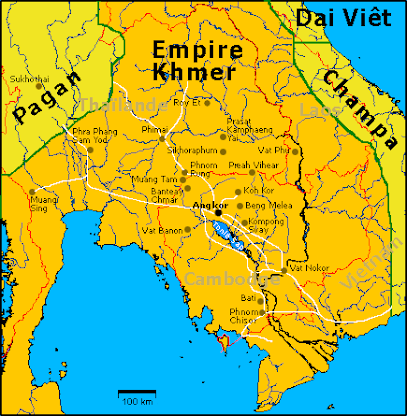
Between the 12th and 15th centuries, the great Khmer Empire spread over what are now parts of Laos and Thailand, Vietnam and Cambodia. Its center was Angkor, the home of the kings, temples, fountains and gold.
A series of attacks by the Siamese and exhaustion of the land by overfarming led to the abandonment of the city in the early 15th Century, historians believe.
That's when most of Angkor fell victim to the jungle for 400 years. There it sat, while nations rose and fell, while America was discovered, while Shakespeare wrote "Hamlet."
When French archaeologists in the late 19th Century rediscovered Angkor and started pulling the vines away and looking at what remained, they were astonished. We still are.
Ancient art gallery
It takes all day for even a bare-bones tour. You can start before sunrise and watch the sun come up over the towers of Angkor Wat, stay all day, then watch the sun go down from a hill nearby.
Some of the ruins have been sufficiently restored so that you can wander the halls and climb the steps. Yet most are only partly put back together, giving the ruins a tumbledown feel, as if you'd just stopped by after an earthquake.
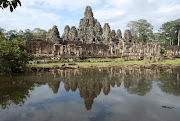
Angkor Wat, built in the early 12th Century by King Suryavarman II, is the star of Angkor. But I preferred the Bayon, a nearby temple with 49 towers emblazoned with nearly 200 huge carved images of a pleasantly smiling face. Historians believe the images represent either King Jayavarman VII, who built the temple in the late 12th Century, or the Buddhist "compassionate being" Lokesvara, or both.
Yet, the Bayon is not just a happy-face ruin. It's also an ancient art gallery, with wonderful bas-relief murals depicting the ordinary life of the Angkor people -- gambling, in childbirth, dancing, cooking, playing, hunting and fishing. These murals not only are a kind of Facebook posting of daily life back then, they illuminate the high standard of living at Angkor in its heyday, when people had enough to eat, safety, leisure and time to create such art.
Locals and tourists
You don't need a guide to visit the Angkor complex, but I would recommend it. The complex is so huge that it helps to have someone show you high points you might miss on your own.
Many tourists get around by tuk-tuk, a cart with an awning pulled by a motorcycle driver. Other sightseers visit by car, van, tour bus, bicycle or even by elephant, depending on what kind of tour they book.
Inside the complex, it's not just sightseers. Local people gather sheaves of rattan, the reed used to weave baskets. Cattle wander amid the chaos. An ice cream truck parks in a field. At most of the popular temples and sites, persistent children sell sticky rice, baskets, scarves, bracelets, guidebooks, bananas, pineapple chunks and Fanta Orange.
The average tourist needs at least two days to see Angkor, but archaeology buffs will want to stay longer.
One of the most photo-friendly sites is Ta Prohm, a temple-monastery. Today, visitors can see the temple much as it was found in the early 1900s, with giant kapok tree roots winding through the doors and windows, so that the stone temple appears to be part of the natural landscape. Also lovely is Neak Pean, a pond with a fountain as elegant as anything you'd find at Versailles.
Too popular?
Today, the Angkor Wat complex is in no danger of fading away. Huge luxury hotels have opened pell-mell outside the park just in the last three years. About 3,000 new hotel rooms are about to be added to the 7,000 already here.
Naturally, environmentalists aren't happy about the unregulated hustle and bustle right next to a UNESCO World Heritage site. They worry about the water table under Angkor being sucked dry by hotel wells. They worry that the site's fragile ruins can't handle the traffic.
Still, I keep thinking that the kings who built Angkor would probably love all the attention.
From the 1960s to 1998, Cambodia was either at war, crippled by the genocidal Khmer Rouge regime or unstable. Now, the fledgling democratic nation is trying to make up for lost time in expanding tourism at a frenetic pace in Siem Reap/Angkor, the destination for half of all tourists to Cambodia.
Ready or not, Tourism Cambodia expects up to 3 million tourists at Angkor by 2010.
Contact ELLEN CREAGER at 313-222-6498 or ecreager@freepress.com.
Saturday, November 15, 2008
Cambodian FM names 9 new ambassadors
PHNOM PENH, Foreign Minister Hor Namhong has named new ambassadors to nine countries, including Kuwait, which is to receive Cambodia's first diplomatic posting there, and Japan, where the minister's son Hor Moniroath is expected to head the Cambodian mission, state media reported Saturday.
The Japanese government had been notified of the appointment, which is awaiting the approval of the Cambodian and Japanese governments, Foreign Ministry spokesman Koy Kuong was quoted by the Cambodia Daily as saying.
"We have notified the Japanese government but we haven't received any response yet. We need the agreement of the host country first before sending the new ambassador," he said.
Hor Namhong's son Hor Nambora is currently serving as Cambodia's ambassador to the United Kingdom, making Hor Moniroath's appointment the second top diplomatic posting in the minister's family.
Japan is Cambodia's largest bilateral aid donor, according to the Cambodia Daily.
Read more!
Thailand protests Cambodia over religious ceremony at disputed temple
BANGKOK, Nov 15 (TNA) - Thailand’s Ministry of Foreign Affairs lodged a protest against Cambodian authorities who performed a religious ceremony at a temple located in Thai territory.
In an Aide-Memoire dated November 13, the Thai government protested Cambodia’s Kathin ceremony which was held at Keo Sikha Kiri Savara pagoda on November 12.
Thai officials in the border province of Si Saket reported seeing around 500 Cambodian people at the temple.
"Such action was considered a blatant and willful violation of Thailand’s sovereignty as the crowd had entered Thai soil without permission from the Thai government," said the aide-memoire.
The statement also mentioned Thailand still maintained its standpoint in working constructively and closely with Cambodia within the existing framework of the Thai-Cambodian Joint Boundary Commission on Demarcation for Land Boundary or JBC to resolve their border conflict in a peaceful manner. (TNA)
Read more!
A reason for the little ones to smile
MediaCorp DJ Carol Smith joins Operation Smile mission to Cambodia to help less fortunate children
FOR the first nine years of his life, the people in Thanh’s village called him “Sut” — which means “split lip” in Vietnamese — as a result of his cleft lip. On his first day of school, he was teased so badly by the other children that he refused to go back.
All this changed, however, after he received cleft lip surgery from medical specialists during an Operation Smile mission trip to the southern Vietnamese city of Vung Tau.
Thanh is just one of more than 115,000 children and young adults who have received free surgeries for facial deformities such as cleft lips, cleft palates, facial tumours and burns since Operation Smile was founded in 1982. Every year, the international medical charity coordinates medical missions to 26 countries in Latin America, Asia, Europe, the Middle East and Africa.
Operation Smile Singapore serves as a resource centre for the Asian region, covering Cambodia, China, the Philippines, India, Thailand, Vietnam and Singapore. It is also the adopted charity of MediaCorp radio station Class 95FM for 2008.
This November, as part of a partnership between MediaCorp and DBS, Class 95FM DJ Carol Smith will join an Operation Smile mission to Cambodia as a non-medical volunteer, where she will accompany beneficiaries and their families through the entire process.
Explaining why she “jumped at the opportunity” to be a part of this mission, the 33-year-old radio personality said: “The child beneficiaries of Operation Smile have been through a lot of discomfort, fear and anxiety. All of us know what it’s like to be ostracised for being even a little different, so imagine what these children go through.”
In developing countries, one in 500 children are born with correctable facial deformities, which can be life-threatening and emotionally traumatising. Around the world, 200,000 children are born every year with a facial deformity and tens of thousands remain untreated. Many of these children have difficulties eating or speaking, and some are kept out of school.
On a typical two-week Operation Smile mission, approximately 300 to 500 patients receive free medical evaluations, and an average of 100 to 150 are given free surgical treatment.
Besides changing these children’s lives through surgeries which can take as little as 45 minutes, Operation Smile provides education and training to medical volunteers in its partner countries, and provides key medical equipment – laying the groundwork for sustainable healthcare systems.
Carol — who is currently single, although she half-jokingly revealed that she hopes to have enough children for “a football team one day, if not more” — said: “I get a lot of joy from interacting with children because of their innocence, charm, and purity. I think Operation Smile brings hope to each child, and I’d like to be there to comfort them, and be their friend on their journey of hope.”
In addition to helping to “put a smile on the children’s faces” this November, Carol hopes to accomplish two other key goals: To better understand their circumstances, and to bring their plight to the attention of others.
She said: “I’d like to be part of the journey of the beneficiaries while I am there, to get a real feel of life as seen through their eyes, and to listen and bring back their stories to share with fellow Singaporeans – who will, hopefully, be moved to help in their own way.” LYNETTE KOH MediaCorp DJ Carol Smith joins Operation Smile mission to Cambodia to help less fortunate children
FOR the first nine years of his life, the people in Thanh’s village called him “Sut” — which means “split lip” in Vietnamese — as a result of his cleft lip. On his first day of school, he was teased so badly by the other children that he refused to go back.
All this changed, however, after he received cleft lip surgery from medical specialists during an Operation Smile mission trip to the southern Vietnamese city of Vung Tau.
Thanh is just one of more than 115,000 children and young adults who have received free surgeries for facial deformities such as cleft lips, cleft palates, facial tumours and burns since Operation Smile was founded in 1982. Every year, the international medical charity coordinates medical missions to 26 countries in Latin America, Asia, Europe, the Middle East and Africa.
Operation Smile Singapore serves as a resource centre for the Asian region, covering Cambodia, China, the Philippines, India, Thailand, Vietnam and Singapore. It is also the adopted charity of MediaCorp radio station Class 95FM for 2008.
This November, as part of a partnership between MediaCorp and DBS, Class 95FM DJ Carol Smith will join an Operation Smile mission to Cambodia as a non-medical volunteer, where she will accompany beneficiaries and their families through the entire process.
Explaining why she “jumped at the opportunity” to be a part of this mission, the 33-year-old radio personality said: “The child beneficiaries of Operation Smile have been through a lot of discomfort, fear and anxiety. All of us know what it’s like to be ostracised for being even a little different, so imagine what these children go through.”
In developing countries, one in 500 children are born with correctable facial deformities, which can be life-threatening and emotionally traumatising. Around the world, 200,000 children are born every year with a facial deformity and tens of thousands remain untreated. Many of these children have difficulties eating or speaking, and some are kept out of school.
On a typical two-week Operation Smile mission, approximately 300 to 500 patients receive free medical evaluations, and an average of 100 to 150 are given free surgical treatment.
Besides changing these children’s lives through surgeries which can take as little as 45 minutes, Operation Smile provides education and training to medical volunteers in its partner countries, and provides key medical equipment – laying the groundwork for sustainable healthcare systems.
Carol — who is currently single, although she half-jokingly revealed that she hopes to have enough children for “a football team one day, if not more” — said: “I get a lot of joy from interacting with children because of their innocence, charm, and purity. I think Operation Smile brings hope to each child, and I’d like to be there to comfort them, and be their friend on their journey of hope.”
In addition to helping to “put a smile on the children’s faces” this November, Carol hopes to accomplish two other key goals: To better understand their circumstances, and to bring their plight to the attention of others.
She said: “I’d like to be part of the journey of the beneficiaries while I am there, to get a real feel of life as seen through their eyes, and to listen and bring back their stories to share with fellow Singaporeans – who will, hopefully, be moved to help in their own way.” LYNETTE KOH MediaCorp DJ Carol Smith joins Operation Smile mission to Cambodia to help less fortunate children
FOR the first nine years of his life, the people in Thanh’s village called him “Sut” — which means “split lip” in Vietnamese — as a result of his cleft lip. On his first day of school, he was teased so badly by the other children that he refused to go back.
All this changed, however, after he received cleft lip surgery from medical specialists during an Operation Smile mission trip to the southern Vietnamese city of Vung Tau.
Thanh is just one of more than 115,000 children and young adults who have received free surgeries for facial deformities such as cleft lips, cleft palates, facial tumours and burns since Operation Smile was founded in 1982. Every year, the international medical charity coordinates medical missions to 26 countries in Latin America, Asia, Europe, the Middle East and Africa.
Operation Smile Singapore serves as a resource centre for the Asian region, covering Cambodia, China, the Philippines, India, Thailand, Vietnam and Singapore. It is also the adopted charity of MediaCorp radio station Class 95FM for 2008.
This November, as part of a partnership between MediaCorp and DBS, Class 95FM DJ Carol Smith will join an Operation Smile mission to Cambodia as a non-medical volunteer, where she will accompany beneficiaries and their families through the entire process.
Explaining why she “jumped at the opportunity” to be a part of this mission, the 33-year-old radio personality said: “The child beneficiaries of Operation Smile have been through a lot of discomfort, fear and anxiety. All of us know what it’s like to be ostracised for being even a little different, so imagine what these children go through.”
In developing countries, one in 500 children are born with correctable facial deformities, which can be life-threatening and emotionally traumatising. Around the world, 200,000 children are born every year with a facial deformity and tens of thousands remain untreated. Many of these children have difficulties eating or speaking, and some are kept out of school.
On a typical two-week Operation Smile mission, approximately 300 to 500 patients receive free medical evaluations, and an average of 100 to 150 are given free surgical treatment.
Besides changing these children’s lives through surgeries which can take as little as 45 minutes, Operation Smile provides education and training to medical volunteers in its partner countries, and provides key medical equipment – laying the groundwork for sustainable healthcare systems.
Carol — who is currently single, although she half-jokingly revealed that she hopes to have enough children for “a football team one day, if not more” — said: “I get a lot of joy from interacting with children because of their innocence, charm, and purity. I think Operation Smile brings hope to each child, and I’d like to be there to comfort them, and be their friend on their journey of hope.”
In addition to helping to “put a smile on the children’s faces” this November, Carol hopes to accomplish two other key goals: To better understand their circumstances, and to bring their plight to the attention of others.
She said: “I’d like to be part of the journey of the beneficiaries while I am there, to get a real feel of life as seen through their eyes, and to listen and bring back their stories to share with fellow Singaporeans – who will, hopefully, be moved to help in their own way.” LYNETTE KOH
Read more!
Friday, November 14, 2008
68,000 poor families of Cambodia receive emergency food assistance from ADB
PHNOM PENH, Over 68,000 poor families of Cambodia have received emergency food assistance following the Asian Development Bank (ADB) Board of Directors' approval of the project last month, said an ADB press release here on Friday.
"This assistance is making a very real difference in the lives of Cambodia's most vulnerable, particularly its children," said ADB Country Director Arjun Goswami.
"Putting food on the tables of Cambodia's poorest families, just one month after the project's approval, is a commendable accomplishment by the government," he said, adding that food distribution has been supervised by independent NGO monitors.
One of the primary objectives of ADB's emergency food assistance is to help support Cambodia's efforts to ameliorate the food price inflation shock on the poorest and most vulnerable families in the seven provinces around the Tonle Sap Lake, and in three urban slums around Phnom Penh, said the release.
The project targeted the poorest 20 percent of poor families in 200 selected communes, it added.
The ADB, based in Manila, is dedicated to reducing poverty in the Asia and Pacific region through inclusive economic growth, environmentally sustainable growth, and regional integration.
Established in 1966, the ADB is owned by 67 members, 48 from the region. In 2007, it approved 10.1 billion U.S. dollars of loans, 673 million dollars of grant projects, and technical assistance amounting to 243 million dollars, according to the release.
Read more!
EU blacklists Cambodia's Siem Reap and all Angolan carriers
By David Kaminski-Morrow
Cambodia's Siem Reap Airways International and all carriers from Angola have been added to the European Commission's 'blacklist' of banned airlines.
But the update, released today, gives no specific information on whether the Commission has acted against any carriers from the European Union.
Phnom Penh-based Siem Reap Airways does not operate directly to Europe, but the European Commission states that the carrier "does not operate in compliance" with Cambodian safety regulations, nor does it meet ICAO standards.
"Significant concerns have also been expressed by ICAO with regard to the ability of the Cambodian civil aviation authorities to implement and enforce the international safety standards," says the Commission in a statement.
Angolan flag-carrier TAAG had already featured on the blacklist but the Commission has extended the ban to all airlines from the southern African state.
It says the blanket ban on Angola is based on "significant safety concerns" brought up by ICAO in an audit last month. The Commission adds, however, that it will continue "close consultation" with Angolan authorities with a view to completing a plan of corrective measures.
Angola is one of several countries - among them Indonesia, Kyrgyzstan and several African states - on which an all-inclusive prohibition on European services has been imposed.
Ukrainian carriers Ukraine Mediterranean Airlines and Ukraine Cargo Airways remain on the blacklist for failing to prove that they have implemented corrective actions on safety deficiencies.
"The Commission, together with member states, will visit both carriers before considering any modification of the operating ban," says the EC, which adds that it is pressing the Ukrainian authorities to strengthen safety standards.
Gabonese operator Nouvelle Air Affaires similarly stays on the blacklist, because there is "no evidence" of progress on corrective measures. All Gabonese carriers, except for Gabon Airlines and Afrijet, are blacklisted.
Read more!
Cambodia to unveil hybrid rice to interest investors
PHNOM PENH, A newly developed Cambodian high-yielding hybrid rice variety will be presented in Kampong Thom province on Monday to interest investors in large-scale cultivation, national media said on Friday.
Louis Kek, director of Malaynesia Resources, part of the Malaysian-Cambodian joint venture responsible for the new variety's development, said that his company is holding discussion with foreign investors to cultivate 50,000 hectares of this kind of rice in the province.
Singaporean and Middle Eastern investors had been invited to inspect the first harvest of a 2-hectare test plot of the Cambodian Super Hybrid Rice, he was quoted by English-Khmer language newspaper the Cambodia Daily as saying.
The project will enlarge its production area in the province to200 hectares in the next growing season, he said.
"We are ready for large-scale implementation. I expect it to become widely accepted because of the increase in yields," he said, adding that 7 to 8 tons of yield of rice variety per hectare over the traditional 2.5 tons of yield of other types.
Cambodia used to lead the Southeastern Asian countries in exporting rice, but later lagged behind due to years of war. The government in recent years has established plans to improve its rice production for export and foreign currency income.
Read more!
Thursday, November 13, 2008
The end of an NGO era in Cambodia
By Craig Guthrie
PHNOM PENH - With an overwhelming electoral mandate, robust economy and a potential bounty of oil and gas revenues, Cambodian Prime Minister Hun Sen feels in a strong enough position to move against the non-governmental organizations (NGOs) which have been a perennial thorn in the strongman's side since he took power more than two decades ago.
In late September he called for the revival of a controversial law which would require the country's more than 2,000 associations and NGOs to complete a complex registration process and submit to stringent financial reporting requirements. The draft law is expected to be passed by Hun Sen’s Cambodia People's Party (CPP)-dominated National Assembly in the coming months.
"Cambodia has been heaven for NGOs for too long," he said in a speech broadcast on national radio on September 26, adding that he had given up hope of reading any positive reports written by international or local NGOs. "The NGOs are out of control ... they insult the government just to ensure their financial survival."
By enacting the law, Hun Sen could recalibrate the government's terms of engagement with the Western-led aid community, on which his government has heavily relied for decades to finance its budget. The move comes as private-led foreign investment has fueled the country's economic rise, led in the main by China and South Korea.
"Many of the services provided by NGOs today will one day either be privatized or the revenues of the government will grow to such an extent that the functions currently being done by NGOs will be taken over by the government," said Brett Sciaroni, chairman of Cambodia's International Business Association.
The NGO law's enactment would be a symbolic power shift between Hun Sen's CPP-led government, further emboldened by its landslide victory in this year's general election, and the Western-backed NGOs which have long chastised it over human-rights abuses and corruption allegations.
International aid agencies have for decades held the purse strings on the aid which has sustained the national economy since it emerged from the horrors of the Khmer Rouge, the ultra-Maoist regime which systematically attempted to transform Cambodia into an agricultural utopia between 1975 and 1979, and a subsequent decade-plus of civil war.
Some contend it was the Khmer Rouge's economic failures, including a devastating countrywide famine that killed many and stalked the regime's traumatized survivors, which set the stage for Cambodia's now decades-long dependence on foreign aid.
The British aid agency Oxfam began programs soon after the Khmer Rouge's 1979 ouster, despite incurring the wrath of the United States and the United Kingdom governments for helping the Hanoi-sponsored regime put in place by the invading Vietnamese.
Jacques Beaumont from the United Nations Children's Fund, and Francois Bugnion from the International Red Cross (IRC), who both arrived in Phnom Penh in 1979, were pivotal players in that humanitarian effort. They finally persuaded the IRC, which was fearful of being seen as compromising its political neutrality, into launching what turned into its most significant relief operation since World War II.
But the comprehensive aid experiment did not begin in earnest until after the signing of the 1991 Paris Peace Accords, which by and large ended the country's debilitating civil war. Since then myriad NGOs have come to Cambodia to work on everything from demining to microfinance, orphanages to agri-business, public health issues to snaring globe-trotting pedophiles.
The demining NGOs in particular made great progress, clearing an estimated 25,000 hectares of mined territory between 1992-2003. Cambodia has also been hailed as a global success story in fighting HIV/AIDs transmission, led by NGO-organized education programs and health aid. Prevalence rates have fallen by nearly half, from 3% in 1997 to 1.6% in 2006.
Fractious relations
But Hun Sen's government's relationship with NGOs and international aid agencies has often been fractious, epitomized by its tumultuous interactions with the environmental watchdog Global Witness over its consistent accusations of high-level government links to illegal logging, and with the UK-based rights lobby Amnesty International for its criticism of state-sponsored forced evictions across the country.
The World Bank also suspended US$11.9 million in funds in 2006 for seven sanitation projects when it found evidence of rampant extortion, bribe-taking, bid-rigging and procurement manipulation, leading Hun Sen to claim the multilateral lender was trying to tarnish his government's credibility. The bank only agreed to unfreeze the projects' funding in 2007 after the government promised to strengthen anti-corruption measures.
Despite Cambodia's recent economic boom, including a skyrocketing average 11% gross domestic product (GDP) growth over the past three years, a sizable portion of the nation's real income still derives directly from donor nations in amounts wrangled out each year at annual Consultative Group meetings.
The meetings were for years characterized by vague promises from the Cambodian government in response to weak demands by donors for reform, including the long-delayed adoption of an anti-corruption law. But in the past two years these demands have become less relevant with the surge in aid from China, which typically has less good governance or transparency conditions attached.
While Chinese aid is generally funneled through vast infrastructure projects - including hydropower and road projects - usually contracted to Chinese companies, Western nations' share of the average US$600 million in annual aid arrives through international aid agencies and NGOs. The process has been widely cast as a corrupt, inefficient gravy train, giving some traction to Hun Sen's complaints.
"In the 1980s, there was a popular T-shirt satirizing US Army recruitment commercials with the slogan, 'Join the army. Travel to exotic, distant lands. Meet exciting, unusual people. And kill them'," Brad Adams, executive director for Human Rights Watch's Asia Program, was quoted saying to Action Aid in 2005. "In the new millennium, it could be rephrased, 'Join the aid community. Travel to exotic, distant lands. Meet exciting, unusual people. And make a killing'."
This is still the case in Cambodia, Adams told Asia Times Online. "You can start with all the foreign consultants making more than $10,000 per month, almost always tax free. This is a huge drain on the aid budget for Cambodia and in many cases the consultants produce nothing of value for the country."
Many analysts and expatriates agree that NGOs and their workers suffer from an image crisis among the Cambodian public, partly due to their comparatively high salaries and lifestyles, which are far adrift from the 35% of the population which lives on less than $0.50 a day.
Country directors for prominent international aid agencies typically receive a $250,000 annual package, which includes a spacious villa in the capital's upmarket "NGO-ville" area, a four-wheel-drive vehicle - usually emblazoned with the logo of their donor agency or charity - and fees paid for the capital's better international schools.
The aid watchdog Action Aid estimated in 2005 that the 700 or so international consultants working for NGOs in the country earned more than Cambodia's 160,000 civil servants put together. "In 1993, yes, 99% of foreign consultants were justified; now, 5% are justifiable. The others are embedding and enabling the mentality of dependency," Center of Social Development director Theary Seng said in June.
Arne Sahlen, a founding member of the Cambodia Support Group, a 25-year-old volunteer organization, echoes Hun Sen's comments that fundraising has overtaken the focus on the actual progress of several NGO projects. According to Sahlen, "vast" resources are being swallowed up on pursuing donors that could be invested on direct project needs. "The need to please donors has warped the focus to not necessarily what is best for the project but what may look best on an application," said Sahlen.
Others contend that several NGOs are actually impeding the development of a self-sustaining private sector, mainly through the alleged abuse of their not-for-profit status to pursue business opportunities. That status helps them avoid taxes and other unofficial costs that private businesses pay, giving non-profit an unfair competitive advantage in the market, they say.
Cambodians now understand the word NGO, especially in the local context, to be a for-profit enterprise, said Sophal Ear, the author of The Political Economy of Cambodia, Aid and Governance. "It's all a business and this is just another way to avoid taxes," he said. "When not covered by donors, capital costs for NGOs have largely been privatized, through an extensive network of 'donations' to the ruling party by Oknhas [politically connected tycoons] politicians, and civil servants."
Discretionary powers
The NGO law, known formally as the Law on Organizations, was first written over a decade ago and aims to address such complaints. It would require NGOs to submit for government approval documents detailing their structure, goals, funding resources, properties and even logos. It also entails fines and imprisonment for any NGO which fails to submit annual reports to the Ministry of Economy and Finance.
Many fear the discretionary powers the law will give the government in monitoring and sanctioning NGOs - rather than vice versa. Hun Sen no doubt had his one good eye on the anticipated bounty of future oil and gas revenues when calling for the controversial law's revival. Chevron, the US energy giant, discovered oil off Cambodia southwestern coast in 2005 and analysts have predicted the find could generate anywhere between $200 million and $2 billion in annual revenues for the government when full-scale production begins in 2010.
The government is still awaiting a key assessment from Chevron of the supposed find, and both sides have more recently played down expectations. Nonetheless, NGOS are already warning of a possible "resource curse" similar to places like Nigeria, where corrupt governments pilfered and wasted earnings derived from energy exports.
"NGOs are trying to tell us how to use the oil money, but this is of no interest to us. What is important is how to make our resources profitable," Hun Sen said in a recent radio broadcast speech.
Despite his criticisms, there are reasons for concern. A new NGO coalition has begun work to oversee the transparency of the management of future oil funds. Led by the NGO Forum, it has given little information on its structure, but has said it plans to ensure the potential financial benefits from the windfall are managed in a socially responsible manner, and that benefits filter down to the impoverished grassroots.
The World Bank, which also aims to monitor the government's oil revenue management, noted in May that international aid is often poorly managed in key sectors, with the problem of "fragmented" assistance especially acute in health and education.
In the health sector, 22 donors are currently working with over 100 NGOs to deliver $110 million in Official Development Assistance (ODA) per year through 109 projects - yet use of the national system remains at just between 13% to 18%, said the bank. The vast majority of rural Cambodians are forced to use an expensive yet rudimentary private healthcare system which is more reminiscent of poorer African than neighboring Asian nations.
The education system is also beset by severe underfunding, with thousands of graduates churned out from poorly regulated "international" universities with degrees that often leave them ill-prepared to enter the job market. Until now, the only paying option for many graduates was to work in donor agencies and international NGOs. But if Chinese and South Korean private investment flows hold up and the country's hoped-for energy bonanza is realized, that may all soon change if Hun Sen has his NGO-curbing way.
Craig Guthrie is a former reporter for the Mekong Times newspaper in Phnom Penh. He has covered Cambodian affairs since 2004.
Read more!
Cambodia to host ministerial trade conference of least developed countries
PHNOM PENH, Nov. 13 (Xinhua) -- Cambodia will host a meeting of ministers of industry and commerce from around 49 of the world's poorest countries described as "least developed" on Nov. 19-20 in Siem Reap province to discuss issues related to international trade, a press release said Thursday.
The conference aims to search for solutions to common problems faced by the poorest nations in their integration to global trade, the press release from the office of Cambodian government said.
One of the main topics of discussion is "Aid for Trade" (AfT), a package of incentives designed to help overcome structural and resource constraints of least developed countries in exchange for more speedy trade reforms, it said.
South-South Cooperation for Poverty Reduction is also on the agenda of the meeting, it added.
Cambodian Prime Minister Hun Sen is to open this event, the release said.
The Cambodian government, the United Nations Industrial Development Organization (UNIDO) and the World Trade Organization (WTO) are jointly organizing this conference.
Read more!
'Progress' in Thailand-Cambodia row
 The foreign ministers of Thailand and Cambodia say they have made progress in resolving a festering border dispute, and have agreed on steps to begin demarcating disputed territory that sparked a deadly military clash last month.
Following talks in the Cambodian capital, Phnom Penh, the two sides said they had also tentatively agreed to redeploy their troops and clear land mines in the area near the ancient Preah Vihear temple.
"We have made a big practical step forward," Hor Namhong, Cambodia's foreign minister, said at a press conference after the meeting.
It is not yet clear, however, when the redeployment would begin, because the Thai side will first have to submit to parliament documents it negotiated with Cambodia.
"We have achieved 99 per cent, but there still remain a few points on which I need to seek approval from the Thai parliament first," Sompong Amornvivat, Thailand's foreign minister, told reporters.
In October three soldiers were killed and 10 wounded in a brief but intense exchange of gunfire between Thai and Cambodian troops.
The clash had raised fears of a war between the neighbours who have argued over the disputed stretch of jungle for decades.
In 1962 the World Court awarded ownership of the 14 century Preah Vihear temple to Cambodia, but sovereignty over the surrounding land has never been clearly resolved.
Read more!
Wednesday, November 12, 2008
Monks see Buddha in wasp nest
By Matt Russell
Experts are skeptical, but the Cambodian Buddhist community is abuzz over what they believe is a miracle at their temple in southeast Rochester: A wasp nest in the shape of a seated Buddha.
The nest, which is nestled in the eaves high above the entry to the Buddhists' one-story gathering hall, was spotted last week during a large celebration in which community members give monks new robes.
"Instead of the celebration we were having, we were paying attention to the beehive," said 35-year-old monk Sokunthea Thun.
Elder members of the Cambodian Buddhist community said they have never seen an apparition of the Buddha in their lifetimes.
"The Buddha is trying to tell everybody to seek peace in their lives," said 70-year-old Voeun Sor of Rochester, a Cambodia native who has lived in the United States for 20 years.
The location of the nest is typical for paper wasps, said Kirk Payne, a naturalist at Quarry Hill Nature Center in Rochester.
"They'll make a comb that can be kind of be wave-like," he said. "I can imagine how they could make a shape like an undulating, Buddha-like figure."
The Buddha-shaped formation could actually be made of four different nests formed over the last two to four years, said Robert Jeanne, an entomology professor at the University of Wisconsin-Madison.
"If you want to read miracles into that, that's your privilege, but I wouldn't be inclined to do that," he said.
Beehives appear to have a special significance in Cambodian Buddhism: Honey collecting is a common activity in Cambodia, where Buddhist temples feature honeycomb-shaped towers.
Indeed, a beehive is prominently featured in a colorful painting on the temple grounds in Rochester, a fact that 76-year-old monk Moeun Ngop pointed out Monday afternoon while asserting the wasp nests were a miracle.
The Buddha wasn't trying to send a message with the nests, but the insects were trying to communicate a Buddhist message, Thun said.
"Bees can do this kind of miracle, so humans can also do miracles," he said. "Everywhere in this world, we humans need to follow in the bees' path to make peace and serenity."
Read more!
Cambodia, Vietnam to build processing plant to boost trade
PHNOM PENH, Nov. 12 (Xinhua) -- Cambodia and Vietnam have agreed to build a new industrial processing factory aimed at boosting the two countries' agricultural exports, national media reported Wednesday.
The factory will promote cooperation between the two largely agricultural countries and raise quality standards on export goods such as beans, corn, palm sugar and cashew nuts, the Phnom Penh Post said.
Officials say the products would be aimed at the local and export markets.
"The factory will be constructed near the border between both countries in order to capitalize on each country's resources," HorNamhong, Cambodian Minister of Foreign Affairs and International Cooperation, was quoted as saying.
News of the partnership follows Prime Minister Hun Sen's return from a state visit to Vietnam, where he signed a trade agreement to increase cross-border commerce.
Trade between Cambodia and Vietnam reached 1.7 billion U.S. dollars through the first eight months of this year, Hor Namhong said, up from 1.19 U.S. dollars billion in 2007.
"Vietnam has more modern technology, capital and human resources than Cambodia, so (the new factory) will offer a significant tool to develop our economy," he said.
Le Bien Cuong, the commercial counselor at the Vietnamese embassy in Cambodia, said hopes were high that the factory would be completed soon, and that the plant would raise the quality of local products to international export standards.
Read more!
Cambodia, Thailand promise border troop withdrawal
PHNOM PENH (Reuters) - Cambodia and Thailand pledged on Wednesday to start marking out disputed bits of border next month and withdraw troops in January to avoid a repeat of last month's armed clashes at the 900-year-old Preah Vihear temple.
After three days of negotiations by a joint border committee in the Cambodian resort town of Siem Reap, Thai Foreign Minister Sompong Amornwiwat said "99 percent" of the problems had been resolved.
He did not elaborate other than to say the agreement had to be approved by Thailand's parliament, as required by the constitution.
At a joint press conference broadcast on Cambodian television, Cambodian foreign minister Hor Namhong said the troop withdrawal would make way for joint teams to clear the thousands of landmines that litter much of the jungle-clad border.
"We have decided to plant border pillars in the disputed area first because we are trying not to have a repeat of the conflict," Hor Namhong said.
One Thai and three Cambodian soldiers died in last month's exchange of rifle and rocket fire, which both sides accused the other of starting.
The Hindu temple, which sits on the escarpment that forms the natural border, has been a source of tension for generations.
The International Court of Justice awarded it to Cambodia in 1962, but the ruling did not determine the ownership of 1.8 square miles (4.6 sq km) of scrub next to the ruins, leaving considerable scope for disagreement.
Read more!
HIV Testing for Global 'One Million Tests' Campaign Begins During Cambodia's National Water Festival
AHF Cambodia CARES Donates 20,000 Kits to Government Testing Programs and Commits to Test 10,000 Individuals; Hard-hit Country Will Test 30,000 People Throughout November
PHNOM PENH, Cambodia, Nov 12, 2008 (BUSINESS WIRE) -- As part of an ambitious global effort to test one million people for HIV in observance of the One Million Tests World AIDS Day 2008 campaign, AHF/Cambodia CARES launched its inaugural testing effort during the annual Water Festival, the largest festival in the Cambodian calendar which marks the end of the rainy season. AIDS Healthcare Foundation (AHF), the largest AIDS group in the US which currently provides AIDS medical care and services to more than 83,000 individuals in 22 countries worldwide in the US, Africa, Latin America/Caribbean and Asia, spearheaded the worldwide initiative to test one million people in conjunction with the observance of this year's World AIDS Day.
AHF Cambodia CARES, which operates 11 free AIDS treatment clinics throughout the country, has taken a leadership role in Cambodia's HIV testing efforts by donating 20,000 kits to government HIV testing programs. In addition, AHF Cambodia CARES has also committed to testing 10,000 individuals. As a result, one of the countries in the Asia Pacific region that has been hardest-hit by the HIV/AIDS epidemic will test 30,000 people for HIV throughout the month of November.
"With the beginning of the Water Festival today, AHF Cambodia CARES was pleased to get an early start and launch our country's participation in the World AIDS Day 2008 One Million Tests campaign. At four sites in Phnom Penh, AHF Cambodia CARES tested 250 individuals. Of these, three people were found to be HIV-positive, and each has been counseled and linked to a clinic for follow up care and access to lifesaving antiretroviral treatment," said Chhim Sarath, M.D., AHF Country Program Coordinator for Cambodia.
Cambodia is one of the poorest nations in Asia and also has one of the most rapidly growing HIV/AIDS epidemics in the region. The HIV epidemic has spread beyond high-risk groups such as sex workers, male police officers, factory workers, mobile populations, injection drug users and men who have sex with men, to the general population.
The number of Voluntary Counseling and Testing (VCT) centers in Cambodia has increased dramatically over the last 5 years (only 12 sites in 2000 to 199 sites by the first quarter or 2008). Of the current 199 VCT centers, 180 are supported directly by the government, while 19 are supported by non-governmental organizations.
About AHF
AIDS Healthcare Foundation (AHF) is the nation's largest non-profit HIV/AIDS organization. AHF currently provides medical care and/or services to more than 85,000 individuals in 22 countries worldwide in the US, Africa, Latin America/Caribbean and Asia. Additional information is available at www.aidshealth.org
SOURCE: AIDS Healthcare Foundation CAMBODIA
AHF Global (Phnom Penh)
Chhim Sarath, MD, Country Program Manager
+855-12-912-124
chhim.sarath@aidshealth.org
or
UNITED STATES
AIDS Healthcare Foundation
Ged Kenslea, Communications Director
+1-323-860-5225
Mobile: +1-323-791-5526
gedk@aidshealth.org
Read more!
Tuesday, November 11, 2008
Cambodia, Thailand make limited progress in border talks
Cambodia and Thailand have agreed to conduct a joint survey of border markers placed along the two countries' disputed land
boundary more than a century ago.
They say the survey is expected to be completed by the end of the year.
Negotiators have also agreed that both sides will jointly remove landmines in the contested area around the 11th century Preah Vihear temple.
Talks aimed at ending the tense military stand off between the two countries began in the Cambodian city of Siem Reap on Monday.
Cambodia's chief negotiator says despite some progress , many issues remain to be solved.
Discussions between two countries' foreign ministers are scheduled for later today (Wednesday).
Read more!
Monday, November 10, 2008
Russia could write off Cambodia's $1.5 bln debt
 MOSCOW, November 10 (RIA Novosti) - Russia is discussing with the Cambodian leadership the possibility of writing off most of Cambodia's debt, which stands at around $1.5 billion, a senior Russian lawmaker said on Monday.
"Russia and Cambodia are holding talks to write off Cambodia's debt of around $1.5 billion. The principal sum (about 70%) of the debt could be written off as part of Russia's participation in the Paris Club of Creditor Nations," said Valery Yazev, deputy speaker of the lower house of Russia's parliament, after a trip to Cambodia and Laos.
Yazev said the debt's outstanding part could be divided into two and settled at concessional interest rates.
The vice-speaker said the next round of negotiations on settling Cambodia's debt to Russia would be held early next year in Moscow.
Read more!
Cambodian gov't rejects IMF s gloomy economic report
PHNOM PENH, Nov. 10 (Xinhua) -- Cambodian government officials have rebuffed a gloomy economic forecast by the International Monetary Fund (IMF), saying the Kingdom's predicted growth slowdown would not be as dire as the world body suggests, national media reported Monday.
At the culmination of a two-week mission Friday, the IMF announced that lower foreign investment, as well as runoff effects from the global financial crisis, would push Cambodia's economic growth down to 4.8 percent in 2009, from a previously predicted rate of nine percent.
But in a prepared speech Sunday for the 55th anniversary of Independence Day, Prime Minister Hun Sen said he was confident the government's strong economic record protected it against such a depreciative outlook, according to the Phnom Penh Post.
"During the last four years, Cambodia has maintained an economic growth of two digits," he was quoted as saying.
"In the fourth mandate, the government will ensure the achievement of economic growth of around seven percent a year and pull down the inflation rate to one digit," he added.
Cambodian Finance Minister Keat Chhon told the Post last week that economic growth would be no lower than 6.5 percent for 2009.
Read more!
Water Festival fears for illegal detainees in Cambodia
A human rights group is concerned that the upcoming Water Festival in Cambodia could see another surge of illegal detentions and hidden abuses for the capital Phnom Penh's homeless and sex workers.
Writing etched into the walls of one so-called "social rehabilitation center" suggests that people are being detained against their will and abused, according to rights group LICADHO.
The group has called on the Cambodian government to shut down the centres, including one that was once a Khmer Rouge death-camp in the 70s.
In recent years the camp has been turned into what the Government describes as a "Social Rehabilitation Centre."
Human rights group LICADHO says, however, it's one of several illegal prisons that keep the homeless and destitute off the streets and out of sight.
The Cambodian Government has repeatedly claimed the island camp and other similar centres are voluntary and have denied accusations of abuse.
But last week LICADHO monitors gained access to a facility in Kampong Speu province.
LICADHO'S director, Naly Pilorge says what they found was evidence that contradicts Government claims the centres are for rehabilitation.
"My colleagues entered the facilities and went into the rooms where people were detained," she said.
"Immediately they saw drawings and writing both in Khmer, in Thai and also in English of obviously former detainees that had written appeals and their situation here in those rooms. There was a number of drawings of women who implied that they had been sexually abused and raped. There was one writing in English - on one hand they said 'life' and the other was 'hell'. And there was also counts of days like you see in prisons at times all over the world where people count how many days and how many nights they have been detained.
"We have interviewed people, we have seen people who are neglected, abused and with these drawings it's obvious to us that this is a place where people are unlawfully detained and seriously abused," she said.
She says those interviewed are describing situations of the "worst you can imagine."
"Starting from not having food and water and this was obvious from the first time we went to these centres, as soon as the gates were open people ran to the grounds outside and started eating grass and leaves, so it was obvious that people were not getting enough to eat.
"We have allegations of gang rapes and sexual abuse. We also have information about beatings, very severe beatings leading to the death of people," she said.
Ms Pilorge says during many public holidays and particularly Water Festival, the Cambodian Government "wishes to maintain its image of the 'Kingdom of Wonder' and therefore the government continues to detain people who they believe contradict that image.
Read more!
Cambodia, Thailand begin border talks
Cambodia and Thailand made a "big step" by agreeing to an agenda to resolve a long-running border dispute that erupted in deadly fighting last month, Cambodia's lead negotiator said.
Officials from the two countries met in the Cambodian tourist hub of Siem Reap to begin three days of talks aimed at hammering out territorial claims and ending a four-month military stand-off that spilled into a deadly shootout near the ancient Preah Vihear temple last month.
"We have moved forward with a big step in resolving the border issue," Va Kimhong, head of Cambodia's border committee, told reporters at the end of a meeting in which the two sides agreed to an agenda for defusing tensions.
The negotiator added the two countries would make it a priority to demarcate territory around the 11th century Khmer temple as soon as it is cleared of landmines.
"We have also agreed to determine the location that needs to be measured in area around Preah Vihear temple," he said.
In earlier opening remarks, Mr Va said only about 60 per cent of the border between the two countries had been demarcated, despite an agreement to have lines properly drawn by the end of 2006.
"It is so important that both our countries should have clear border lines in order to solve the problem and avoid incidents," he said.
He called for both sides to cooperate in a friendly manner and "avoid using weapons and armed forces."
The foreign ministers of both countries are scheduled to meet on Wednesday, officials said.
Shortly after a round of talks failed last month, troops from the two countries clashed on October 15 on disputed land near the temple, killing one Thai soldier and three Cambodian troops.
Two rounds of emergency talks after the October clashes made little progress, with both sides only agreeing not to fire on each other again.
The Cambodian government has since announced that it plans to double its military budget next year to 500 million dollars.
The Cambodian-Thai border has never been fully demarcated in part because it is littered with landmines left over from decades of war in Cambodia.
The most recent tensions between the neighbours began in July when the temple was awarded UN World Heritage status, rekindling a long-running disagreement over ownership of the surrounding land.
- AFP
Read more!
Sunday, November 09, 2008
Cambodian police chief dies in helicopter crash: govt
 Good news: The suprem Mafia leader, Hok Landie, dead. The cold blood killer Hok Landead is the notorious Mafia in Hun Sen regime and the one that took responsible for all crimes in Phnom Penh. God punished him.
PHNOM PENH (AFP) — Cambodia's top policeman died in a helicopter crash in bad weather that also claimed the life of a top-ranking army general, a government spokesman told AFP Sunday.
Chief of police Hok Lundy and General Sok Sa Em were passengers in a helicopter that came down shortly after it took off Sunday from Phnom Penh airport, ministry of interior spokesman Khieu Sopheak said.
"In the helicopter there was a pilot, a co-pilot, the national police chief and the deputy commander of the military. All four died," Khieu Sopheak said.
Khieu Sopheak said the helicopter came down in southeastern Svay Rieng province.
"The reason for the crash was bad weather. There was a heavy rain," he added.
He said radio contact had been lost 15 minutes after it took off from Phnom Penh airport at around 7:20 pm (1220 GMT).
Hok Lundy, head of the country's police for over a decade, had been routinely criticised by international organisations for alleged human rights abuses and corruption within his force.
Hok Lundy was also accused of involvement in politically motivated killings and drug trafficking.
Human rights groups protested a decision to allow him a visa to the United States last year after the State Department refused him a visa in 2006 due to allegations he was involved in trafficking prostitutes.
Arrangements were being made for a traditional Cambodian funeral for the police chief, Khieu Sopheak said.
Read more!
Cambodia vows economic growth at 7%
 Cambodian Prime Minister Hun Sen said yesterday he was committed to maintaining annual economic growth of seven percent, after warnings that the country's red-hot economy would soon slow.
Hun Sen, addressing crowds at Independence Day celebrations, vowed to maintain high GDP growth despite the global financial slowdown, and said the government was committed to reducing poverty by more than one percent per year.
"The government are well aware that the strategic plans are highly ambitious amid the global economic crisis," Hun Sen said at Phnom Penh's Royal Palace.
"But we depend on our experience, our achievements and determination, and we are very positive that the country will accomplish its visions."
The International Monetary Fund recently said that Cambodia's economy is expected to flounder next year as the world crisis deepens.
The country has enjoyed double-digit growth over the past few years, but that will likely ease to 6.5 percent this year and 4.8 percent in 2009 as the crisis deepens, IMF official David Cowen said on Friday. After being written off as a failed state after the devastating 1975-79 Khmer Rouge regime and several decades of civil war, Cambodia has struggled back in recent years to become an improving economic success story.
But despite recent growth, under-employment - where someone's work earns only a meagre return - remains high in Cambodia, while about 35 percent of the country's 14 million people live on less than US$0.50 a day.
Read more!
Saturday, November 08, 2008
Cambodia and Vietnam agree rail link: Foreign Minister
PHNOM PENH (AFP) — Cambodia and Vietnam have signed a deal to link their railways, Cambodia's foreign minister said Saturday, helping revive long-running plans to link Asia by rail.
Foreign Minister Hor Namhong said China would help Cambodia with the railroad link to Vietnam, which will cost more than 500 million dollars.
"China has promised to build the railroad from Phnom Penh to Vietnam as part of the project to create a link from Singapore to Kunming in China," Hor Namhong said on his return from regional meetings in Hanoi, Vietnam.
"The railroads are very important for Cambodia's economy because we can then export goods to other southeast Asian countries at low cost," he told reporters at Phnom Penh International airport.
Cross-border trade between Cambodia and Vietnam totalled 1.7 billion dollars in the first eight months of this year, Hor Namhong added.
Cambodia is linked to its western neighbour Thailand by a track that is no longer in use.
Cambodia's civil war only ended in the 1990s, and trains throughout the impoverished nation crawl along dilapidated tracks.
It has long been a dream to connect Asia by rail, and many of the gaps in the railway are in Southeast Asia, with only Singapore, Malaysia and Thailand operating cross-border links.
The Asian Development Bank has stepped in with funds to help overhaul Cambodia's railways, a project many hope will be finished within the next few years.
Read more!
Friday, November 07, 2008
IMF says Cambodian economic growth to slow in 2009
PHNOM PENH, Cambodia (AP) — Cambodia's economy will grow by a modest 4.8 percent next year due to slowdowns in key sectors and a drop in foreign direct investment caused by the global economic crisis, the International Monetary Fund said Friday.
The projected decline for 2009 comes after several years in which Cambodia, one of the poorest nations in Southeast Asia, has enjoyed strong growth. The economy expanded about 10.3 percent last year, according to the IMF.
Finance Minister Keat Chhon said in April that the economy grew an average 11.1 percent annually in 2004-2007. The government has forecast a growth rate of 7.2 percent for this year.
David Cowen, IMF's deputy division chief for Asia and Pacific Department, said growth this year would drop to around 6.5 percent, the same projection given by the Asian Development Bank last month.
He spoke at a press conference wrapping up his two-week mission to discuss the economic outlook with Cambodian officials and donor representatives.
"After a robust start, growth momentum eased over the course of 2008, and more recently, the economy has begun to experience adverse effects from global financial stress," the IMF said in a statement.
Foreign direct investment in 2009 is expected to be 25-30 percent lower than the $750 million the country has received this year, Cowen said.
Cowen said Cambodia, which has a very narrow production and export base, will not be immune to the slowdowns seen in the U.S., Europe and Japan.
He said garment exports — Cambodia's main dollar-earning industry — will weaken further, as will the tourism industry.
Construction, which has benefited from a recent real estate boom, will also slow down "partly as a result of tighter global liquidity conditions," the IMF statement said.
Read more!
Cambodia: HIV-positive Man Arrested In Teen Sex
PHNOM PENH, CAMBODIA: An HIV-positive Cambodian man was arrested after allegedly paying an underage orphan to have unprotected sex with him at a rural treatment center for the disease, police said Friday (7 Nov).
Phat Sarath, 37, was arrested Thursday (6 Nov) after his wife informed police she had walked in on her husband having sex with the 15-year-old girl, said Ngan Sary, a district police chief of Takeo province in southern Cambodia.
Phat Sarath and his wife are both HIV positive and have been receiving life-prolonging treatment at the local center, which provides care for HIV-AIDS patients and also houses orphans, he said. Takeo province is 40 miles (65 kilometers) south of capital, Phnom Penh.
The girl was an orphan who lived at the center. Phat Sarath is accused of having paid her 5,000 riel ($1.25) on three occasions in October to have sex with him, the policeman said.
"He knows that he is HIV-positive and still had sex with the girl without using a condom. His act is unforgivable," Ngan Sary said. He could face up to 30 years in prison.
Under a Cambodian law on HIV/AIDS prevention and control, the man could face 10 to 15 years in prison for having unprotected sex while knowingly infected with the HIV virus.
Sex with a minor under age 18 carries a sentence of up to 15 years, Ngan Sary said. The man has not been formally charged.
In 2006, an HIV-positive Cambodian man was sentenced to 10 years in prison for intentionally trying to infect his wife with the virus that causes AIDS. (AP)
Read more!
Subregional summit pushes Single Visa Scheme for five SE Asian countries
By Han Quao
HANOI, Delegates attending the 3rd ACMECS Summit called for the implementation of Single Visa Scheme on Friday to facilitate entry into five southeastern Asian countries including Cambodia, Laos, Myanmar, Thailand and Vietnam.
ACMECS is short for Ayeyawady-Chao Phraya-Mekong Economic Cooperation Strategy. Ayeyawady, Chao Phraya and Mekong are three mother rivers that culturally and historically unify these five countries in heart of Southeast Asia.
"ACMECS shall expedite the implementation of single visa for tourists outside ACMECS to boost tourism in this area,"said Oknha Kith Meng, president of the Cambodian Chamber of Commerce on Friday at ACMECS Business Forum, which was held on the sideline of the summit.
The move, allowing a tourist with one visa to travel through five ACMECS countries, will help ACMECS countries move towards the goal of"Five Countries, One Destination," said the chamber official.
The five southeastern Asian countries are rich in tourism resources, with well-known tourist spots in each country, like Ha Long Bay in Vietnam, Luang Prabang in Laos, Siem Reap in Cambodia, Bagan in Myanmar and Sukhothai in Thailand.
The Cambodian chamber official said tourism has contributed significantly to the Cambodian economic growth. In Cambodia where double digit growth has been registered for the past four years, tourism sector grew 18.5 percent in 2007 over the previous year.
As a pilot project for ACMECS Single Visa Scheme, Cambodia and Thailand signed agreement on the implementation of ACMECS Single Visa last year. According to Thai Prime Minister Somchai Wongsawat, Thailand is now amending laws and regulations in response to the agreement.
In addition to the single visa for ACMECS countries, delegates at the summit also proposed the issuance of ACMECS Travel Card. With similar function as the APEC card, ACMECS card will be issued to people of ACMECS countries, first to business persons maybe, for traveling within the five member countries, without applying for any visa, according to a proposal submitted by the ACMECS Business Council at the summit.
To boost the dynamic cooperation within ACMECS framework, the council also proposed that ACMECS should expedite the granting of border pass to residents living in border areas and motor vehicles to travel across the border and go further into another country.
Considering that Thailand is a country with right-steering-wheel vehicles, the council urged other ACMECS member countries to allow the use of right-steering-wheel vehicles for tourism purpose and enable Thai tourists to drive and visit four neighboring countries.
The current global financial crisis has posed difficulty on many sectors and tourism is hit hard. To deal with this, delegates at the summit called for closer cooperation within ACMECS framework, which has just echoed the theme of this year's summit "Deepening Cooperation Towards A More Effective And Dynamic ACMECS".
Read more!
Thursday, November 06, 2008
Backgrounder: Cambodia-Laos-Myanmar-Vietnam (CLMV) Summit
HANOI, The 4th Summit of Cambodia, Laos, Myanmar and Vietnam (CLMV) will open on Thursday in Hanoi, Vietnam.
The CLMV Summit is an annual event. The first CLMV Summit was held in November 2004 in Vientiane, Laos, with the adoption of the Vientiane Declaration on enhancing economic cooperation and integration among CLMV countries.
According to the Vientiane Declaration, the seven areas of cooperation among CLMV countries are as follows: trade and investment, agriculture, industry and energy, transport, information technology, tourism and human resource development.
The Declaration showed strong commitment of CLMV countries to strengthen and enhance cooperation among CLMV countries and promote CLMV integration into cooperation frameworks under the Mekong sub-region, ASEAN and the whole region.
The Declaration also called for international assistance for CLMV countries to narrow the development gap between them and other regional countries.
Each year, the CLMV Senior Officials' Meeting and Ministerial Meeting are held prior to the CLMV Summit.
Read more!
Tuesday, November 04, 2008
China to increase cooperation with Cambodia in anti-drug work
 BEIJING, Chinese State Councilor Meng Jianzhu on Tuesday called for more cooperation with Cambodia in anti-drug work.
Meng, who is also Chinese Minister of Public Security, made the remarks during the talks with Cambodian Deputy Prime Minister and Minister of Interior Sar Kheng.
Hailing the sound growth of Sino-Cambodian relations, Meng said the police authorities of the two nations also enjoyed increasing exchanges and pragmatic cooperation in recent years.
He also hoped the two sides work together to fight against transnational crimes and illegal immigration, and increase cooperation in repatriating criminal suspects and law enforcement training, in a bid to safeguard domestic stability of the two countries and push forward bilateral relations.
Sar Kheng said the Cambodian government valued the relationship with China, and was ready to expand bilateral cooperation in anti-drug work and cracking down on transnational crimes.
The two sides signed a cooperation memorandum of understanding between the Chinese and Cambodian governments on prohibiting illegal trafficking and abuse of drugs.
Read more!
US rockers The Click Five to play Cambodia's Angkor Wat
 PHNOM PENH (AFP) — American rock band The Click Five plans to play a concert at Cambodia's famed Angkor Wat temple next month as part of a campaign to fight human trafficking, organiser MTV music channel said Monday.
The December 7 concert by the group, who are popular in Southeast Asia, is part of a series of music shows in Cambodia organised by MTV and the US Agency for International Development to raise awareness in young people about human trafficking in the region.
"What we have is the chance to reach out and create a lot of interest about human trafficking," Matt Love, spokesman for the MTV Europe Foundation, said of the concert.
Cambodia has struggled to shed its reputation as soft on human trafficking, and earlier this year suspended marriages between foreigners and Cambodians amid concerns they were being used to traffic poor, uneducated women.
The US State Department refused a visa to Cambodia's police chief Hok Lundy in 2006 due to allegations he was involved in trafficking prostitutes.
The previous international recording artist to perform at Angkor Wat, built in the 12th century and listed as a UNESCO World Heritage Site, was tenor Jose Carreras who sang for a charity gala dinner there in 2002.
Read more!
UPDATE: Many Challenges To Cambodia's Oil Upstream Hopes
SINGAPORE -(Dow Jones)- Cambodia is facing a wide range of challenges in developing its oil and gas upstream sector, even as it moves cautiously ahead with an offshore exploration project led by U.S. oil major Chevron Corp. (CVX), a senior government official said Tuesday.
The Cambodian National Petroleum Authority is also pushing for construction of the country's first oil refinery and mulling the establishment of a national oil company, but global interest in the country's hydrocarbons potential is lacking, progress on a petroleum law has been slow, and a long-running maritime acreage dispute with neighboring Thailand has yet to be settled.
"It's very difficult - when we opened (upstream blocks for) bidding in 1991 or 1992, nobody was interested," CNPA Vice-Chairman Ho Vichit said on the sidelines of the Asia Oil and Gas Investment Congress.
"So, we approached companies...to do direct negotiations," he said, attributing the poor investment interest to Cambodia's limited track record in terms of oil and gas reserves.
The country only started formal seismic surveys in January and has yet to finalize results, Ho said.
More than 10 foreign companies are drilling in Cambodia's six offshore blocks, including China National Offshore Oil Corp.
The government is optimistic that a consortium headed by Chevron remains on track to begin producing oil from offshore Block A next year, but the U.S. company has downplayed any firm timetables.
Ho said there are some technical challenges to overcome as reserves are spread over a wide are in small pools, but he said the project won't be shelved.
Earlier, Ho told the conference in Singapore that "it's premature to speculate" how much of the oil or gas discovered in 2005 can be pumped from offshore Block A, about 200 kilometers off the southern coast.
"It must be recognized that hydrocarbons shows (evidence) alone do not make...an oil or gas field, let alone an oil or gas field that might be viable for commercial development," he said.
The idea of a national oil company - the CNPA would play the role of regulator in such a scenario - remains at "a very preliminary stage," Ho said.
Cambodia's draft petroleum law, which would provide a legislative framework for extracting oil and gas, also remains "complicated" and is still some way from reaching the ministerial level, a step required before any approval by the national assembly. Ho also cited the need to translate the final document into languages suitable for potential investors as another factor contributing to the delay.
Meanwhile, the government is still negotiating with Thailand to jointly develop three offshore areas near Block A following a 2001 memorandum of understanding; a fourth area is claimed entirely by each side.
Ho wouldn't comment on whether the political upheavals in Bangkok have slowed progress in the talks.
For the downstream sector, Cambodia has contracted Japanese firm Toyo Engineering Corp. (6330.TO) to assist with a feasibility study to build a refinery.
A 50,000 barrel-a-day facility is being considered, tiny by international standards but perhaps an important first step to ease pressures from high petroleum import prices.
Cambodia, which doesn't subsidize domestic fuel prices, imports about 1 million metric tons a year of refined oil products, Ho said, pegging the country's economic growth around 7% a year.
Read more!
Monday, November 03, 2008
Vietnam-Cambodia to sign visa exemption agreement
VietNamNet Bridge - The Cambodian Prime Minister, Hun Sen, will pay an official visit to Vietnam on November 4-5 at the invitation of his Vietnamese counterpart Nguyen Tan Dung, to reinforce the traditional friendship and comprehensive cooperation between the two countries.
During the visit, the two PMs will discuss measures to boost cooperation across all fields, particularly with regard to the economy, trade and investment, to accelerate land border demarcation and landmark plantation, and promote coordination between the two countries at regional and multilateral forums.
The first visit of PM Hun Sen during his fourth term (September 2008-2013) will be made in the context of growing bilateral relations under the motto “best neighbourliness, traditional friendship and comprehensive and long-lasting cooperation”.
The two countries have exchanged a number of visits by high-level delegations. After his coronation in October 2004, Cambodian King Norodom Sihamoni twice visited Vietnam, first in March 2006 and again in June 2008. Vietnamese President Nguyen Minh Triet visited Cambodia in February 2007.
Last March, PMs Hunsen and Nguyen Tan Dung had a meeting at the 3rd Greater Mekong Sub-region summit (GMS3) in Vietiane, Laos.
The two sides convened the fourth meeting on cooperation and development of their border provinces in February 2008 and the third session of the Joint Commission for Economic, Cultural and Scientific-Technological Cooperation last October.
During the official visit to Vietnam, PM Hunsen will attend the third Ayeyawadi-Chao Phraya-Mekong Economic Cooperation Summit (ACMECS) and the fourth Cambodia-Laos-Myanmar-Vietnam Summit (CLMV) in Hanoi from November 4-7.
The two countries have enjoyed significant progress in their economic, trade and investment cooperation. Two-way trade has been steadily increasing, from $180 million in 2000 to almost $1.2 billion in 2007. It hit $903 million in the first half of 2008 hit. They have set a target of $2 billion in two-way trade turnover by 2010.
Vietnam’s investment in Cambodia reached the $100 million mark in 2007.
The two countries’ levels of cooperation in matters such as education and training, energy, health care, transport, and national security and defence have advanced considerably.
The two sides have enjoyed a good working relationship in dealing with issues related to the borderline and border security and order, and have agreed to complete the border demarcation and landmark plantation project by 2012.
The two countries have also worked to increase cooperation within a number of international organisations, such as the Association of Southeast Asian Nations (ASEAN), and other regional and international cooperation mechanisms, including the Mekong River Commission (MRC), the Greater Mekong Sub-region (GMS), the East-West Economic Corridor Development Programme (EWEC), and the Ayeyawady-Chao Praya-Mekong Economic Cooperation Strategy (ACMECS).
The two sides planed to sign a visa exemption agreement, the agreement on the point of connection for the Singapore – Kunming railway, the agreement on commodity transit, the cooperation agreement between the Radio Voice of Vietnam and the Cambodia Royal Radio, and the cooperation program between the Ministry of Information and Communications of Vietnam and the Cambodia Information Ministry.
The two countries are negotiating to admen the agreement on waterway transportation and other agreements on mining, industry and energy.
Vietnam and Cambodia also agreed to complete planting land border landmarks by 2012.
Xuan Linh
Read more!
Cambodia braces for Independence Day, Water Festival
PHNOM PENH, More than 10,000 security personnel will be posted on Phnom Penh's streets as the Cambodian capital heads into a week of holidays that will see millions of visitor arrivals, national media reported Monday.
Starting with Independence Day on Nov. 9 and culminating five days later with the end of the annual Water Festival, city authorities say they will have to tackle a host of problems, the Phnom Penh Post said.
The first priority is keeping order on the roads to preventing tens of thousands of revelers from packing too tightly into Phnom Penh's narrow riverfront to view the three days of Om Tuk boat races.
Ya Kim Ey, chief of Phnom Penh's Military Police, told the Postth at street and building closures in the past years have backed up traffic around key sites.
"According to previous reports, we have seen problems in areas where many people like to gather - particularly near the Royal Palace," he said.
"Streets are closed on both sides and people get trapped in traffic jams," Ya Kim Ey added.
He added that police will be deployed at additional sites this year to lessen congestion caused by street closures.
Most of the riverfront will be closed to vehicle traffic during the Water Festival.
Phnom Penh's Unity Committee, which is responsible for helping organize the festivities, said in a statement that some 5,353 military polices will join a contingent of 4,000 municipal polices and 653 gendarmeries.
The Unity Committee said security forces will be concentrated in several areas where large crowds are expected to gather, including around the Independence Monument, along Sothearos Boulevard, at the park in front of the Royal Palace and at Wat Phnom.
Read more!