And now the end, the end is near - and so i face a long bus journey..................more about that later.
Actually its the 21st June and i'm writing this in Phnom Penh, Cambodias Capitol, slowly updating 3 weeks worth of events - really I'd forgotten how long this took, I've just been and trained for the first time in that 3 weeks and feel quite ill - I've never been anywhere so polluted or poor for that matter. Its how I imagine india would be. People living on the streets and defacating on the streets, it makes me sad and actually unhappy at myself that i can complain about so many menial things. the Cambodians? I have never met a nation that complains less, I am yet to meet a Cambodian who hasn't been amazing in their own way! Actually I have been in tears at one point in the last 3 weeks and will eventually get round to why, but its also been an amazing place, that will never leave me, unfortunately for reasons of horror. However there have been some great times too, anyway back to where I left off...........
After leaving the muay thai camp and making the short flight to samui from phuket I wasn't feeling too good, so went pretty much straight to bed and hit the docs the next morning. The suspicion was Dengue fever so I bought a few DVD's and hit my bed for a few days. I said bye to the few people I wanted to say bye to and had a few farewell drinks and left on the longest journey of my trip so far.
10am my bus pickes me up to take me to the pier, for the 11am boat to donsak. At 1.30pm I board a coach for what was about a 3 hour drive to Surat Thani Train Station my overnight train to bangkok. I had a few hours to kill and arrived back at the trainstation only to find my train was delayed for what would eventually be 5 hours due to an accident. There isn't much to do in Surat Thani and still not feeling myself I was just wanting a bed and some sleep.......instead I was watching everyone in the station board trains headed for the same place i wanted to go and get to their beds while I waited in a deserted train station in a deserted town - Surat Thani is not a good place to get stuck! Really it couldn't have been planned better - my Ipod had broken the day before and I didnt have a book I hadn't read, it was a looooooong wait!
Well it eventually arrived and i had a nice comfortable bed made up for me in a dorm style carriage, on the lower bunk with my own window and a fan close by. It was noisy and, in truth, a bit smelly but I slept like a baby until about 8am when the noise from other passengers waking forced me to open my eyes! The remainder of the journey was spent watching the countryside pass bye, trying to photograph temples in the distance, and getting excited knowing I was about to return to Bangkok - a place I love, in small doses.
The train ride itself is an event, at each stop traders jump on with an array of food and drinks and are happy to have a bit of a laugh and a joke - you have tounderstand they can seem quite forceful but in reality there doing what they have to, just to stay alive in many cases. Engage them, have a joke - tyhe Thai people really know how to smile.
Eventually around noon I reached my hotel and just in time too, a thunderstorm of massive noise hit as soon as I got to my room, I had a bath! My first bath in 3 months, and i do love my baths, it was heaven and slept off the last of the groggyness either from the Dengue or the 24 hours of travelling and waiting around.
The Reclining Buddah was on my agenda for the next day, and you'll have to excuse me 'cos i have no idea what day it was, nor what day it is now, but beleive me thats not even a slight issue. The philosphy of Buddhism amazes me and i've had time on this trip to read alot about it, it was nice to see such an iconic statue and learn about the history of the temple (pictures will follow). My guide had me bowing and kissing floors all over the place. I had a nice end to the day, getting my fortune told by a Buddhist Astronomer, apparently my favourite colour is pink! I am sure anyone who knows me could of told him that! He was quite accurate in some things tho, I need to keep moving around until late 2009 (I had told him nothing of my trip) then find a job, but not in my home country and amongst other things i'll live till 81 - good to know eh?
Later on that day I was introduced to what have turned out to be a great group of people, who have made the time I have spent in Cambodia more special than I am sure it woould have been had I came alone. We went out for a good first night meal seen a baby elephant and after mentioning I was interetsted in an eye brow piercing and was promptly led into the next piercers we passed! (pierced eyebrow picture to follow). We had a few beers, and called it a night.
Early start the next day for our journey to the border of Cambodia, we had 2 minibuses between 14 of us, BIG leather seats, lots of room to stretch out and air con to keep us cool, I wondered what we'd be travelling in on the Cambodian side of the border........................
Read more!

Saturday, June 21, 2008
Sick of Thailand....as if!

Summer in Cambodia changed her life
BY LAURA ALBANESE
Willi Rechler admits that, before last summer, she had been a little selfish. The Jericho High School senior lived a moderately comfortable existence and, while always involved in philanthropy, hadn't so much seen how the rest of the world lived. All of that, she said, changed.
Rechler, who helped to found the Amnesty International Club in tenth grade, wanted to see firsthand the situations that concerned her. She joined a travel program with Putney Student Travel and booked a ticket to Cambodia, a country still recovering from the genocidal reign of the Khmer Rouge, not knowing what to expect.
"I went there with an open mind," she said. "What I learned in Cambodia changed me. I have a different perspective on the world."
She learned about the effect of genocide and was particularly struck by the lack of medical care. She also saw a community struggling to grow out of its past difficulties and progress toward modernization.
"It really gives me a lot of hope," Rechler said. "Before I went, I tried to be compassionate and watch documentaries, but this is a whole other perspective."
What she saw, she said, has made her involved in the situation in Darfur and motivated her to petition for inclusion of genocide studies in the curriculum. Jericho recently started offering the class.
"One of the best moments was my brother coming home and yelling at me because he had a test on the curriculum," she said. "When I have a decision to make on anything, I just think about what I learned and it makes me want to make the world a better place."
Similar sentiments have also led her to organize the Cambodian Children's Fund, a fundraiser that raised over $4,000. Rechler also hopes to continue her studies of different cultures at Yale, where she'll be attending this fall.
Read more!
Chinese companies to build hydro-power plants for Cambodia
PHNOM PENH, June 21 (Xinhua) -- The China National Heavy Machinery Corporation (CNHMC) has signed BOT agreements with the Cambodian government to build the Stung Tatay hydro-power plant in Koh Kong province, according to the Chinese Embassy here Saturday.
CNHMC will construct the project of 246 megawatts in five years at 540 million U.S. dollars, according to the agreements signed here Friday.
After the construction is completed, CNHMC can still operate the plant on the Tatay River for 37 years to generate electricity and sell it to the Cambodian government. When the BOT period terminates, the plant will be transferred to Cambodia.
The Cambodian government approved the project on June 13 in order to obtain more electricity, help maintain appropriate power price and promote economic growth and development of the country.
On the same day, the Cambodian government also gave green light for China's Michelle Corporation to build the Stung Russey Chrum Krom hydro-power plant of 338 megawatts in the same province at 495.7 million U.S. dollars.
Both projects will also harmonize with the people's living conditions there and the overall development of those areas, according to a government statement.
Cambodia has been in extreme shortage of power. Electricity even sells one U.S. dollar per kwh in some rural areas.
The government has been pursuing a strategy to develop hydro-power projects along the Mekong River to meet the desperate demand for electricity.
Read more!
A boost for Cambodia's health system
The World Bank says it supports implementation of Cambodia's new Health Strategic Plan.
The plan aims to improve healthcare and preventive health with particular emphasis on women, children and the poor.
The bank's office in Phnom Penh says it will give Cambodia's government a 30 million US dollar credit to support the program from this year to 2015.
The other donors include, Australia, Britain, the U.N.and France.
Cambodias's secretary of state at the Ministry of Health, Eng Huot, says there have been improvements in the health of Cambodians over the past decade.
However, several challenges remain, including a high rate of women dying in childbirth, poor nutrition, high healthcare costs and the rise of non-infectious diseases.
Read more!
Friday, June 20, 2008
Thai protestors storm Government House
Thousands of anti-government protestors surrounded the Thai cabinet's headquarters Friday, demanding the immediate resignation of Prime Minister Samak Sundaravej and his ministers.
The demonstrators of the People's Alliance for Democracy (PAD), which led similar mass protests against former prime minister Thaksin Shinawatra in 2006, broke through police blockades to force their way into Government House which they had surrounded Friday afternoon.
'PAD protestors have no weapons, so if there is any shooting, it is not by us,' PAD leader Chamlong Srimuang said, urging the demonstrators not to attack police while breaking through their barricades.
The protesters, estimated at 5,000 strong, shouted, 'Put Thaksin in prison,' as they took their places outside Government House, which was closed Friday.
The PAD has vowed to camp outside Thailand's seat of government until Samak and his cabinet resign, accusing them of mishandling the economy and diplomacy, and of acting as 'nominees' for Thaksin and his cronies, who were barred from power by a Constitutional Tribunal ruling last year.
A similar siege on Government House in 2006 when Thaksin was prime minister ended with tanks rolling on the streets of Bangkok. The military staged a coup against Thaksin Sep 19, 2006, charging him with corruption, undermining the monarchy and dividing the nation.
After 15 months under a military-appointed government, Thailand held a general election Dec 23, 2007 that was won by the People Power Party (PPP), that promised a return to Thaksin's populist policies. PPP leader Samak, a right-wing politician, was chosen to head the party because of his close ties with Thaksin.
'We want Samak and his cabinet to get out,' said Janikha Korkhalong, 45, one of the protestors. 'Just what this government has done on the Phra Viharn issue is enough reason for them to go.'
The Thai government this week backed a Cambodian proposal to list the Preah Vihear Hindu temple, the subject of a bitter ownership dispute more than 40 years ago, as a Unesco World Heritage Site next month.
The decision has irked many in Thailand who still believe the ancient Khmer border temple - called Phra Viharn by Thais - belongs to their country although the International Court of Justice in The Hague passed it to Cambodia in 1962.
There is a widespread belief that the cabinet approved the Cambodian proposal as part of a Thaksin business deal. Thaksin Wednesday announced plans to invest in a hotel-casino project on Cambodia's Koh Kong island.
Read more!
Cambodia destroys 30 tonnes of safrole-rich oil, key ingredient of Ecstasy
PHNOM PENH, Cambodia — Cambodian authorities working with Australian police have destroyed an enormous stockpile of safrole-rich oil, a key ingredient used in producing the synthetic drug Ecstasy.
Officials say the 30 tonnes of oil could have produced 245 million tablets of the drug with a potential street value of $7.3 billion.
The oil - extracted from the roots of the sassafras tree - was burned over a three-day period that began on Wednesday.
Lt.-Gen. Lour Ramin of the Cambodia police says members of the Australian Federal Police oversaw the burning of the oil in a remote village in Cambodia's Pursat province, about 160 kilometres northwest of the Cambodian capital, Phnom Penh.
Australian officials say Cambodian authorities have been working since 2002 to stem distillation of the oil.
In addition to cracking down on the drug trade, they are trying to preserve the sassafras tree, a rare species that grows mainly in Cambodia's Cardamom Mountains. Officials say that in order to distill oil from the roots, the entire tree is cut down.
Philip Hunter, an official from Australian Federal Police, said the destruction of the oil "was a significant blow to the trade of illicit drugs in the region."
"These seizures demonstrate that Cambodia faces the challenges of suppressing drug production for regional export, as well as challenges faced as a transit centre for regional and international drug market,"
At the request of the Cambodian government, an Australian police team of four technicians and two forensic chemists travelled to Pursat province this week to help destroy the oil.
Read more!
EU to deploy election observation mission in Cambodia
BRUSSELS, (Xinhua) -- The European Commission will deploy an independent election observation mission for Cambodia's National Assembly elections scheduled on July 27 2008, Commissioner for External Relations and European Neighborhood Policy Benita Ferrero-Waldner said on Thursday.
The EU Election Observation Mission (EOM), with a total of 113 short and long term observers, will monitor Cambodia's fourth parliamentary elections since the signing of the Paris Peace Accord in October 1991.
The mission will be led by Martin Callanan, member of the European Parliament.
"Over the last decade Cambodia has taken many important steps towards democracy and in particular in the field of human rights," said Ferrero-Waldner.
She said the EU "has been and will remain actively engaged in supporting Cambodia in a wide array of areas including education, judicial reform, fighting corruption and increasing transparency within the government."
"Because of the importance the EU attaches to these elections, I have decided to deploy an EU EOM to support and undertake a comprehensive assessment of the entire election process," she said.
Read more!
Cambodia Using `Subtle' Intimidation, Sam Rainsy Says
By Daniel Ten Kate
June 20 (Bloomberg) -- Cambodia's ruling party is using ``subtle'' measures to intimidate voters before next month's general elections rather than outright violence as in the past, opposition leader Sam Rainsy said.
``Even though there is less violence, less deaths, the ruling party is using more subtle means to achieve the same goals,'' he said by phone from the capital, Phnom Penh. Government spokesman Khieu Kanharith didn't answer repeated calls for comment.
Sam Rainsy, who leads a party named after him, may see parliament lift his immunity so he can face defamation charges for accusing Foreign Minister Hor Namhong of working as a prison official during the rule of the Khmer Rouge between 1975 and 1979.
Cambodia's economic growth over the past four years, including a 9.6 percent expansion in 2007, has bolstered Prime Minister Hun Sen, who last week predicted victory for his ruling Cambodian People's Party in the July 27 election. International human rights groups have accused the CPP of using the justice system to intimidate journalists and opposition members in the run-up to the vote.
The ruling party has also linked Sam Rainsy to the Cambodian Freedom Fighters, a U.S.-based dissident group that made a failed coup attempt in 2000.
``By making accusations against me, they want to create a general panic among my supporters or potential supporters so they are afraid to vote for me,'' said Sam Rainsy, 59.
Assembly Meeting
The opposition leader probably won't be stripped of his immunity and arrested before the election because parliament isn't in session and may not meet again before the ballot, said Hang Chhaya, director of the Khmer Institute of Democracy in Phnom Penh.
``We can say with a sigh of relief that the democratic climate has changed and improved,'' Hang Chhaya said. ``Political violence is very minimal.''
Dam Sith, a candidate of the Sam Rainsy Party and editor of the Khmer Conscience newspaper, was released on bail June 15 after Hun Sen, 56, wrote a letter to the Phnom Penh Municipal Court calling for his release. He was jailed for printing Sam Rainsy's comments about Hor Namhong.
``I proposed to the authorities that I was willing to go to jail if they free the journalist,'' Sam Rainsy said, referring to Dam Sith. ``If they want to arrest me I am not complaining.''
Sam Rainsy's party won 24 of 123 seats in the previous election five years ago. He spent most of 2005 in exile in France and was sentenced to jail for 18 months in absentia for defaming Hun Sen.
Victory Forecast
The CPP will probably win at least 81 seats, up from 73, and receive 73 percent of the vote versus 64 percent in the 2003 election, Hun Sen told the Mekong Times, a Phnom Penh-based English-language daily newspaper, earlier this month.
About 10 Sam Rainsy Party lawmakers defected earlier this year to join Hun Sen's CPP. Sam Rainsy said it was ``normal'' to lose members of parliament before an election.
``It's common for the ruling party to try to lure and to buy opposition lawmakers,'' said Sam Rainsy, who characterized his chances against the CPP as ``David versus Goliath.''
``The CPP uses both the carrot and the stick to win,'' he said. ``We'll judge our popularity by the actual results on election day.''
Ngor Sovann, a former Sam Rainsy Party lawmaker who left the party to join the CPP, said members of parliament who switched sides lost faith in Sam Rainsy as a leader.
``The Sam Rainsy Party cannot win,'' he said in a phone interview. ``Many of us lost confidence in Sam Rainsy because of injustice and cronyism within the party.''
Economy Grows
Cambodia's economy grew by at least 10 percent between 2003 and 2006, according to data compiled by the World Bank.
Hun Sen wants to develop oil and mineral resources to attract international investment and reduce Cambodia's dependence on clothing exports and tourism for growth. About a third of the country's 14 million people live on less than 50 cents a day and 90 percent live in rural areas.
Cambodia has become a more vibrant democracy in the past five years due largely to advances in technology rather than through government changes, Sam Rainsy said.
``The trends are in favor of democracy because people are more educated with the improvement in communication systems and mobile phones,'' he said. ``People are more aware, less afraid and more critical.''
Read more!
Thursday, June 19, 2008
New ASEAN after Myanmar cyclone: Secretary-general
SINGAPORE -- A new Association of South-East Asian Nations (ASEAN) has emerged from its response to cyclone-hit Myanmar, showing the world that it can "take on the responsibility placed on it", Secretary-General Surin Pitsuwan said here Wednesday.
"It just so happened that we are being baptized by the Cyclone Nargis. That is the test of our new ASEAN," he told a one-day ASEAN Leadership Forum on Wednesday morning.
Cyclone Nargis hit the Irrawaddy Delta of Myanmar and left more than 133,000 people dead or missing in early last month.
He told some 100 officials, business leaders and experts that foreign relief teams "have been given full support from the Myanmar government and reached the areas where they wanted to go."
The southeast Asian bloc, established in 1967, groups Brunei, Cambodia, Indonesia, Laos, Malaysia, Myanmar, the Philippines, Singapore, Thailand and Vietnam.
Meanwhile, Surin was optimistic about ratification of the ASEAN Charter, which was signed by member countries' leaders in Singapore summit last November.
He said the Charter could be approved by all members by the time of the Bangkok summit at the end of this year.
The Charter means to transform the 10-member bloc into a more rules-based community. Thailand, Myanmar, the Philippines and Indonesia have yet to approve it.
Read more!
'A new Asean'
Singapore - The Cyclone Nargis disaster in Burma showed the world that a revitalised Association of Southeast Asian Nations can "rise to the occasion," Asean Secretary-General Surin Pitsuwan said on Wednesday.
According to Mr Surin a new Asean has emerged from its achievements. "We are being baptised by Cyclone Nargis," he told the 5th Asean Leadership Forum in Singapore.
It has been more than six weeks since the cyclone hit, leaving a trail of devastation followed by three weeks of international outrage as the military junta obstructed foreign aid and volunteers.
Recalling the frustration and anguish of the World Bank and many Western countries which sent ships and planes packed with relief supplies, Surin said he was repeatedly asked, "Can Asean do something?"
"With 2.4 million people teetering between survival and death," Asean became the mechanism for getting aid to the worst-hit areas such as the Irrawaddy Delta in the south, helping sort out objections to helicopters and sending in nearly 300,000 volunteers, Surin told government and business leaders in addition to civil society groups.
"The teams have been given full support and reached the areas where they wanted to go," Surin said. "That's a new Asean ready to take on responsibility."
Aid workers said thousands of survivors of the storm are yet vulnerable to sickness and many are without adequate food and supplies.
A meeting of Asean volunteers will be held July 24 to collect information from their experiences "for the future," Surin said. "We have achieved a certain degree of competence."
Amid the concerns of the international community, "We have made progress," he said.
Asean, which groups Singapore, Thailand, Malaysia, Indonesia, the Philippines, Brunei, Laos, Cambodia, Vietnam and Burma, has long been labelled as ineffective by critics.
SUrin expressed confidence that the Asean Charter could be approved by all members by the time of the Bangkok summit at the end of the year. Thailand, Burma, the Philippines and Indonesia have yet to approve the document designed to unite the countries into an economic bloc, set democracy as a goal and create a human rights body.
Asean "must continue to work as a cohesive body and integrate quickly, so as to provide member countries with the ability to respond to external challenges with greater resilience and unity," said Lee Yi Shyan, Singapore's minister of state for trade and industry.
He cited rising oil prices, increased food costs, global warming and worsening pollution as some of the long-term challenges facing the region.
"In addition, we continue to face ongoing security threats in the form of terrorism and pandemic flu," Lee said. "If we are not prepared, we risk our countries becoming disoriented from the resulting shocks."
Read more!
Ambassador expects more S Korean investment to Cambodia
PHNOM PENH, June 19 (Xinhua) -- South Korean ambassador to Cambodia Shin Hyun-suk has said that he expected more investment from his country to the kingdom, local media reported Thursday.
"I am optimistic about further (South) Korean investment (to Cambodia)," Shin Hyun-suk told the Mekong Times in an interview.
In 2007, Cambodia became the 6th biggest host of South Korean investment after China, the U.S., China's Hong Kong region, Vietnam and Malaysia, he said.
"Recently, some South Korean investors who had invested in China and Vietnam have been moving into Cambodia. With this trend, South Korean investment in Cambodia has been diversified," he added.
Initially, South Korean investment was concentrated on the garment manufacturing sector, he said, adding that banking, agro-industry, manufacturing, real estate development and IT sectors are the dominating fields of South Korean investment in Cambodia now.
Beginning in the late 1990s, South Korean investors began to look at Cambodia as the country regained political and social stability, Shin Hyun-suk said.
In particular, South Korean investment in Cambodia has increased sharply since 2006, as Cambodia recorded high economic growth and achieved further political and social stability, he added.
Read more!
Wednesday, June 18, 2008
Kep: Cambodia's Secluded Beach Retreat
Kep was once the beach resort of Cambodia. Located near the luxury hotel, casino, and hill station atop Bokor Mountain, it was part of a popular retreat for French colonial administrators. After independence and the end of French Indochina in the mid-1950s, the officials of the Royal government and the small middle class of Phnom Penh became the main patrons there. All that came to an end in with the rise of the Khmer Rouge; Kep was sacked and abandoned. Since Cambodia re-opened to tourism in the late 1990s, the port city of Sihanoukville has become the main focus of beach activities in Cambodia. However, as Sihanoukville becomes more and more like a bad knock-off of the Thai beach city of Pattaya, the quiet, seaside charms of the village of Kep are coming more to the fore.
Getting There
Kep can be reached from Phnom Penh by bus or share-taxi, with the share-taxi costing perhaps ten times as much. Depending on the bus company in question, you will be boarding the bus to the neighboring town Kampot, which will run past Kep on its way there, and drop you off just outside of the village.
The simplest way to get back and forth from Kampot, the nearest town, is to bargain for a trip on the back of a fellow's motorbike ("moto"). This is a common means of transport in Cambodia, and pretty much anyone passing on a motorbike may be willing to double as a bike-taxi.
It is also possible to get to Sihanoukville by share-taxi, but these must be chartered.
What to Do
Kep is a small fishing village, set off of a strip of sand and pebble. These are typically busy on the weekend, but quiet during the week. Kep is a popular weekend holiday location for expats and middle class Khmers from Phnom Penh. The expats will be mostly French and working for the UN or some other NGO, and are getting a kick out of being in their former colonial retreat. Very few "proper" international tourists find their way to Kep, so when the weekend visitors go home, these will be the only tourists around, creating a very tranquil, sleepy atmosphere during the week.
The beach road is lined with seafood shacks. Kep is famous for its crabs, which are caught on a line and then kept in a shore cage for the utmost freshness. You can either have the crabs there, or take them back to your guesthouse/hotel for cooking. Also, neighboring Kampot is the center of Cambodia's pepper plantations. Once upon a time, no fine French restaurant would dare to have served anything but Kampot pepper. Furthermore, fresh green peppercorns are a completely different culinary experience from dried pepper. So, be sure to sample the crabs, any dish that features pepper sauce, and preferably fresh crabs in fresh pepper!
The walk along the beach road can take on a creepy atmosphere. If you turn away from the seashore, you will see ruin after ruin. These were the villas owned by well-to-do Khmers, sacked and the abandoned by the Khmer Rouge. They stand as a shabby, mute testament to a very different Cambodia, now long gone.
Alas, the beach at Kep is not very good. In the 1960s, the King had sand dredged from Sihanoukville and brought to Kep to maintain a nice-but-half-artificial beach. However, there is a good beach on nearby Koh Tunsay (Rabbit Island), which can be reached by fishing boat for a modest fee. Make a nice day trip of it. The waters are calm, crystal clear, and host a lot of fish if you wish to snorkel around. The island itself is small, home to very few permanent residents, and so more than likely there will be fewer than 15 people, tourists and Khmers, on the island at any given time.
Also, the Kep Lodge has begun arranging snorkeling trips. While there are plenty of fish off Rabbit Island, there are no corals. The snorkeling day trip will take you to Koh Saran, with two snorkeling sites boasting the extreme rarity of a virtually untouched coral reef.
Trips to the ruined resort atop Bokor mountain can be arranged either by renting a sturdy motorcycle and going alone, or by going up to Kampot. It is also possible to easily visit the pepper plantations around Kampot.
Where to Stay
Kep is not yet Sihanoukville, but there is still an ample selection of places to stay, suiting all prices ranges. The most well-known is the Beach House, a standard mid-range hotel at the far end of the Beach Road. Offering some intimate, simple luxury is the Kep Lodge (who also run the snorkeling trips), featuring only six modern bungalows on the property.
However, if you can do without air conditioning, the author strongly recommends Le Bout du Monde Guesthouse. Run by a young French couple (the wife's parents were Khmer refugees), the place evokes the feel of a tropical paradise playhouse. The guesthouse's restaurant specializes in authentic Khmer seafood. It is one of the most charming places in the world to get a little simple, rustic peace and quiet.
Read more!
Thais rally over Cambodia border dispute

BANGKOK, Thailand (AP) — Thousands of demonstrators accused the Thai government Wednesday of yielding a disputed border region with an ancient temple to Cambodia, the latest trouble for the embattled prime minister who has been facing daily protests calling for his resignation.
Led by the People's Alliance for Democracy, about 5,000 people gathered in front of the Ministry of Foreign Affairs and accused the minister, Noppadon Pattama, of giving into the Cambodians in exchange for business concessions.
The Preah Vihear temple, dating back to the 11th century, has been the subject of a boundary dispute since the 1950s. The International Court of Justice ruled in 1962 that the cliffside temple was within Cambodian territory.
Accusing the government of corruption and abuse of power, demonstrators have been holding sometimes violent protests since May 25 to demand the resignation of Prime Minister Samak Sundaravej and his coalition government.
The protesters say Samak is merely acting as a proxy for former Prime Minister Thaksin Shinawatra, who was ousted in a military coup in September 2006.
The political discord heightened Wednesday after opposition Democrat Party lawmakers lodged a no-confidence motion against Samak and seven other Cabinet members over alleged conflict of interest and mismanagement.
The Preah Vihear temple issue resurfaced as Cambodia was preparing to apply to UNESCO for the temple to be listed as a World Heritage Site, a process that requires the inclusion of a map.
Sondhi Limthongkul, a key leader of the anti-government alliance, alleged that Noppadon gave up some territory near the temple in exchange for his "boss" — Thaksin — getting concessions to develop a casino complex on Cambodia's Koh Kong island.
Noppadon served as Thaksin's lawyer and continues to have close ties with him.
Waving Thai flags, the protesters held up placards reading, "Thailand is not for sale," and "Bandit government sold Thai soil to Cambodia."
Noppadon denied the allegations.
"The minister of foreign affairs deserves flowers instead of brickbats," Noppadon said, adding that not "a single square centimeter" of Thai soil was lost during recent negotiations with Cambodia.
He said Cambodia had drawn up two maps, one of the temple and the other of the adjacent area.
Noppadon said the Cambodians will present only the temple map in their upcoming request to UNESCO. The second map, which includes the disputed boundary, will not be an issue and thus Thailand has not yielded any territory, he said.
Samak's People Power Party won general elections last December. His new Cabinet is packed with Thaksin's allies and relatives, and critics say rehabilitating the former leader is among the new government's top priorities.
A court disbanded Thaksin's Thai Rak Thai party last year and banned him from public office until 2012.
Cambodia's genocide tribunal to get more Japan funding
Japan has agreed to donate nearly $US3 million to Cambodia's genocide tribunal as it prepares to bring former Khmer Rouge leaders to trial.
A spokeswoman says the funding will go to the operations of the United Nations-backed court's administration office.
Court officials are also in New York this week seeking some $US100 million so the tribunal can continue operations.
They are set to meet potential donors on Friday.
Japan has already contributed more than $US21 million to the tribunal.
The radical Maoist Khmer Rouge regime, which ruled Cambodia from 1975 to 1979, is blamed for the deaths of up to two million people by execution, starvation and excessive work.
Read more!
Cambodia lawmaker in court threat
The Khmer Rouge regime and the Mafia associates have continoued terrorizing Cambodia until today. The former Khmer Rouge leaders are still in power keeping intimidation, threating and even killing innocences under the UN' nose. By Guy Delauny
The Phnom Penh municipal court has asked the National Assembly to remove Sam Rainsy's parliamentary immunity from prosecution.
Cambodia's foreign minister has brought allegations of defamation and disinformation against him.
Sam Rainsy has described the legal moves as a "political threat".
If the National Assembly agrees with the court's request, the opposition leader could be called in for questioning, prosecuted and possibly jailed.
A conviction for defamation no longer results in a prison term. The law was changed after an outcry over its use to detain several human rights activists two years ago.
But Sam Rainsy also faces a charge of disinformation - which does allow for a custodial sentence.
Election run-up
The Foreign Minister, Hor Namhong, pressed charges over remarks the opposition leader made about him in a speech.
Prime Minister Hun Sen has also ordered an investigation into allegations that Sam Rainsy Party officials were connected to domestic terrorist groups.
Sam Rainsy himself has dismissed both sets of allegations as attempts to intimidate voters in the run-up to the general election.
But a government spokesman accused the opposition leader of playing "dirty tricks".
The leader of Cambodia's second-largest opposition party, Prince Norodom Ranariddh, is currently in self-imposed exile.
He faces an 18-month jail term for breach of trust if he returns to Cambodia.
Cambodian real estate market heated up by S Korean projects
By Long Heng, Xia Lin
PHNOM PENH, June 18 (Xinhua) -- South Korean investor GS Engineering and Construction held here Wednesday the ground-breaking ceremony for the construction of its 52-story skyscraper, the tallest one to be built in Cambodia and latest one to stir up the heated market and trigger off mixed comments.
Cambodian Deputy Prime Minister Sok An said at the ceremony that the construction shows the close relations between South Korea and Cambodia and the confidence of foreign investors for Cambodia in its political and economic stability.
"The project will provide hundreds of jobs and contribute to the economic development of our country," he said.
The skyscraper, a model role from the private sector in developing the country, will become the historic building and the tallest in Cambodia and become a center of tourism, culture and engineering. he added.
GS Engineering and Construction, the largest real estate developer in South Korea, will take 45 months to complete the billion-dollar International Finance Complex (IFC) project near the Tonle Bassac River around March 2012, according to a press release.
The 68,461 square meters project includes a 52-story office block, a 32-story residential block with 275 units, an international school and a shopping mall with 1,064 units, it said.
"The plan is to expand business domain not just to architecture and housing, but to a broader area of plant, civil engineering and development," it added.
GS Engineering and Construction president and CEO Kevin Kab Ryul Kim said that the recent interest of the Cambodian government in city development welcomes South Korean company's development projects with advanced technologies like us.
"IFC Phnom Penh projects will open the gates to more South Korean companies entering the Cambodian market," Kim said, adding that with this project, GS will lead the real estate and development market of Cambodia, newly rising in the Indochina peninsula.
The plan is to expand business domain not just architectures and housing, but to a broader areas of plant, civil engineering and development, he added.
Meanwhile, Mu Hion Woo, the developer's Chief of Business Division in Cambodia, told local media earlier last week that the project is not only a business but also a contribution to the development of Cambodia.
"If you want to see the potential of Cambodia, you can see it in this project," he added.
Currently, a second South Korean real estate developer is constructing a 42-story skyscraper of comprehensive functions, namely the Golden Tower, in downtown Phnom Penh and a third one developing a satellite city named Camko in the suburbs.
These South Korean projects will transform the skyline of the capital, as it is now dominated by buildings only four- or five-story high.
And, the GS project seems to compete with the Gold Tower and the Camko City in the ever booming real estate market of Phnom Penh.
The three mega projects are widely considered as new achievements of the Cambodian government led by Prime Minister Hun Sen. People are waiting and want to see them turned into reality.
Chan Sophal, president of the Cambodian Economic Association, expressed concern over the new buildings' inconsistency with the previous style of the city.
"We all welcomed the construction of the highest skyscrapers in Phnom Penh and other places in Cambodia. We also requested for the government to conserve the houses built in the French colonial era," he told Xinhua.
If conservation and development work well with each other in style and construction, Phnom Penh will be a city both modern and classic, more beautiful and with more cultural hints, he said.
In addition, he asserted that these projects has mirrored the confidence of foreign business people in the political and economic stability of the country and will therefore bring in more foreign investors and benefit the local people.
However, Chan Sophal is also worried that skyscrapers can't really meet the market demands.
The skyscrapers have drawn much public attention, because the Cambodians never saw these things before, but in regard of their essential choice, they prefer to live at the ground floor of a house with a garden and some trees.
"Only rich people will buy apartments at the skyscrapers, because the price is unaffordable for most people," he said.
Some wealthy people subscribe to houses at the top floor of these skyscrapers, but they won't live there.
"They buy them for investment. When sold again, there will be profits," he added.
Nov Rathana, general manager of the Gold Tower project, said that his project will finish in May 2011, adding that market competition is a good impetus for developers.
Sung Bonna, director of the Sung Bonna Real Estate Agency, said that house and land are hot topics for the Cambodians now.
"People like to talk about land, house and their prices. Most of them buy land and houses for investment, and expect fat rewards when they sell them out," he said.
According to industry statistics, land and house prices have spiraled in Phnom Penh and neighboring provinces as result of 10 years' stable development of the country. Top villa in downtown Phnom Penh now sells over one million U.S. dollars, 10 times the previous price.
The mega development projects of skyscrapers have just fueled the vogue and drive land and house prices even higher, said Sung Bonna.
"Phnom Penh still has huge land, waiting for us to develop," he added.
Read more!
Tuesday, June 17, 2008
ASEAN+3 nuclear safety forum kicks off in Bangkok
BANGKOK, (Xinhua) -- Experts and officials on nuclear energy safety from the 10 ASEAN countries and its three regional partners -- China, Japan and South Korea, gathered here Monday to convene the first ASEAN+3 Forum on Nuclear Energy Safety.
The two-day forum, the idea of which was initiated by Thailand at last November's East Asia Summit in Singapore, was co-hosted by Thailand and China. It is to provide an academic platform for exchanging experience and technologies in a bid to promote regional cooperation on nuclear safety issue.
At the opening ceremony on Monday, Thai Foreign Minister Noppadon Pattama noted that the ASEAN+3 framework was established in 1997 to respond to the Asian financial crisis, and now it can play a role to cope with a new crisis, which is "no less significant, no less urgent" than the 1997 financial crisis, -- the challenge of long-term energy security in the wake of skyrocketing oil prices.
The Association of Southeast Asian Nations (ASEAN) groups Thailand, Vietnam, Indonesia, Malaysia, Myanmar, Laos, Cambodia, Brunei, the Philippines and Singapore.
In face of rising oil price, which has increased over 100 percent in about one year to the current level of 135 U.S. dollars a barrel, countries, especially developing ones which are "too reliant on oil and thus too vulnerable to the unprecedented oil price shock", are looking at alternative sources of energy, particularly those renewable, sustainable, and clean, Noppadon said.
Nuclear energy is one of these sources of energy that many countries, including those in Southeast Asia, have growing interest in exploring.
To address public concern about nuclear safety, a critical issue to the development of nuclear energy, Thailand and other ASEAN countries have agreed on the Southeast Asia Nuclear Weapon-free Zone Treaty. A Plan of Action adopted last year calls for the establishment of a regional nuclear safety regime.
Noppadon also noted that the forum is fitting and timely as theASEAN+3 process comprises both countries that have great expertise in nuclear technology for peaceful purposes -- referring to China, Japan and South Korea, and countries that are in great need of such technology -- the ASEAN countries, while all countries under the framework share the political will to enhance greater regional cooperation on energy security.
According to the International Atomic Energy Agency (IAEA), among ASEAN countries, governments in Thailand, Vietnam and Indonesia have already launched plans for building their first nuclear power plants.
The Thai government has planned to build nuclear power plants with a total generating capacity of 4,000 MWs in 13 years from now, with the first plant put in operation in the year 2020, accounting for about 10 percent of total power generation.
Panels have been set up to conduct a detailed study of the project from 2008 to 2010, after which a final decision will be made whether to implement the nuclear program based on assessment of Thai public opinion.
Wang Zhongtang, Assistant Administrator of National Nuclear Safety Administration of China, in delivering a keynote speech at the opening, said China has obtained experience on design, manufacturing, construction and operation of nuclear power plants in over 20 years of efforts since it started the construction of its first nuclear power plant.
The Chinese government has launched a nuclear power development program -- by 2020, a 58-GW total capacity of nuclear power will be in operation or under construction, accounting for 4 percent of the general power capacity of China. Now China has 11 units in operation and eight units under construction, with a total capacity of about 16 GWs.
Wang told Xinhua that China is very willing to share its experience and technologies with any ASEAN countries on nuclear energy safety, as it believes that "there is no national boundaries as regards nuclear safety," and that enhancing cooperation on the issue is of benefit to countries involved, to the region as well as the whole human society.
Among its experiences, China believes that "a strong independent nuclear safety authority is vital, a systematic legal system is fundamental, prudent and scientific assessment and review mechanism is important; the environmental impact monitoring system is also the key elements to convince the public confidence."
Read more!
Cuscapi may pay dividend by 2010
SHAH ALAM: Cuscapi Bhd, a homegrown software solutions developer, may reward its shareholders with a dividend by 2010 if its regional expansion bears fruit.
“We intend to move towards a dividend-based company, but first the numbers need to be justified. Nevertheless, we will continue to look into ways of rewarding our shareholders through dividends as our business grows,” its chief executive Danny Leong Kah Chern told The Edge Financial Daily in an interview.
Cuscapi, formerly known as Datascan Bhd, expected contribution from its international business to double in the current fiscal year ending Dec 31, 2008 (FY08) from 8% in FY07, backed by its presence in China, he said.
The Mesdaq-listed firm had in March 2008 established a wholly-owned subsidiary, Cuscapi Beijing Co Ltd, to tap into China’s fast-growing food & beverage (F&B) industry.
Our plan is to always make profit, or at least break even, within the first year of our expansion into a specific overseas market. For China, we expect to see earnings coming in by the second quarter (ended June 30, 2008),” he said, adding that Cuscapi had allocated RM2 million for its expansion into China.
Leong said Cuscapi, which is mulling the transfer of its listing to the Main Board by 2010, also planned to gain a foothold in Thailand by year-end. It will then explore the possibility of forming joint ventures with local players in Indonesia, the Philippines and the Middle East .
It has been reported that the company is also planning to float its overseas assets in London, Singapore or Hong Kong in the next three years.
“This is the year for us to grow our presence regionally, but we will always make sure our bottom line won’t be affected much. Our strategy is for the long term,” Leong said.
He also said the company would be able to sustain its earnings growth amid higher operating expenses partly via the recurring income from its managed services, which contributed about 23% to its total revenue of RM38.7 million in FY07, a 4% year-on-year increase.
The company’s net profit for its first quarter ended March 31, 2008 (1QFY08) dipped 84.28% to RM210,000 from RM1.34 million a year earlier despite revenue increasing by 6.19% to RM7.89 million from RM7.43 million, due to higher operating costs and international business development.
Cuscapi said it had secured Kentucky Fried Chicken (KFC) Cambodia as its client with the installation of its solution for restaurant operations in the KFC store in Phnom Penh.
“Cuscapi’s entry into the Cambodian F&B market is timely as the market is growing well, spurred by the tremendous growth potential of the country’s tourism sector,” said Leong.
The implementation for the second KFC outlet in Cambodia is scheduled to begin at the end of the month.
Read more!
Japan's Hino Motors Ltd launches in Cambodia
Phnom Penh - Hino Motors Ltd of Japan has opened its first Cambodian branch to take advantage of the booming construction sector, local media reported Tuesday.
The Mekong Times reported the Japanese transport vehicle giant would be angling for the dump truck, cargo truck and concrete mixer market, which is currently dominated by second-hand vehicles.
Construction is one of Cambodia's fastest growing markets as political stability continues, real estate prices soar and foreign investors seek new markets.
Hino is just the latest multinational corporation to invest in Cambodia - a move welcomed by government officials, the Mekong Times said.
Read more!
Hun Sen faces few challengers as Cambodia vote nears
PHNOM PENH (AFP) — With nearly six weeks until Cambodia's general election, almost everyone says they already know the result.
Prime Minister Hun Sen, Southeast Asia's longest-serving leader besides the sultan of Brunei, has spent much of his 23 years in power ruthlessly undermining his political rivals, who are now so weakened that analysts say none have much hope of success.
Cambodia has 57 parties, but only 11 are running in the July 27 poll -- less than half the number that contested the last national election five years ago.
Hun Sen's Cambodian People's Party (CPP) towers above them all.
"Who will win? The CPP. No doubt about that. Even without taking into consideration threats, pressure and vote buying, the CPP is the one with the people on the ground," said Cambodian political analyst Chea Vannath.
The CPP was installed by communist Vietnam in 1979, after Hanoi invaded and toppled the Khmer Rouge -- the genocidal regime behind Cambodia's infamous "Killing Fields."
While the CPP has dropped its communist ideology, it retains a ubiquitous presence across the country and a tight grip on every level of government.
"Government and administrative offices throughout the country are very extensive and tightly controlled," said Lao Mong Hay, senior researcher at the Asian Human Rights Commission.
Opposition members have already accused Hun Sen of buying off their supporters by offering them attractive jobs, a charge the premier has brushed off.
"They say that we are buying people. We are the ruling party -- we have the right to appoint them to positions of power," Hun Sen said last week, during one of his daily televised speeches given at events big and small across the country.
Hun Sen, 55, became prime minister in 1985 and has single-mindedly focused on staying in power, publicly vowing to remain in office until he turns 90.
He actually lost his first election to a royalist party in UN-backed polls in 1993, but bargained his way into becoming a "second prime minister" and then reasserted total control in a 1997 coup.
Hundreds of people were killed in the run-up to elections the following year. Protests against Hun Sen's victory were put down violently.
The last national election in 2003 was far less violent, but plunged the kingdom into a year of political stalemate as parties wrangled over forming a coalition.
The party's current coalition partner, the royalist Funcinpec, has been hobbled by infighting and the ouster of its leader, Prince Norodom Ranariddh, who has formed his own eponymous party.
With their ranks divided, analysts say the royalists appear spent as a political force.
The main opposition Sam Rainsy Party is expected to win few votes outside the capital. Hun Sen rival Kem Sokha has formed a new Human Rights Party that will be cutting its teeth in the polls.
Some 8.1 million people are registered to vote at 15,000 polling stations, under the eyes of more than 13,000 domestic and international observers.
During his rule, Hun Sen has steered the impoverished country out of the ashes of civil war and grown the economy by opening up to trade and tourism.
Garment exports and tourism have brought double-digit economic growth, but Cambodia remains one of the world's poorest countries. Some 35 percent of its 14 million people live on less than 50 US cents a day.
Spiralling inflation has raised concerns about CPP's management of the economy.
"You can see the price of gasoline goes up every day," analyst Chea Vannath said. "I'm sure it will be one of the main concerns."
But he predicted Hun Sen would nonetheless romp to victory.
"The Cambodian people are traumatized by past experiences, so they don't show up on the street," she said.
Read more!
Cambodia, FAO vigilant over re-occurrence of bird flu
PHNOM PENH, June 17 (Xinhua) -- It is important for Cambodia to remain vigilant for possible re-occurrence of avian influenza, as Cambodia shares borders with Vietnam and Thailand where outbreaks of the pathogenic virus continued to occur, said a statement here Tuesday.
The UN Food and Agriculture Organization (FAO) and the Cambodian Ministry of Agriculture, Forestry and Fisheries in their joint statement said that they have been organizing public awareness and education activities to warn Cambodians of the danger avian influenza poses to their poultry and to their health.
Village meetings in Svay Rieng, Takeo, Kampong Cham and Kampot provinces, all bordering Vietnam, have been conducted since April, drawing 4,000 people from 25 villages, it added.
"The ministry and FAO have been working together to provide technical and communication skills training to veterinary officials, village animal health workers and village chiefs, so they will be able to educate the public on actions they can take to prevent avian flu infection," said Kao Phal, Director of the Department of Animal Health and Production at the ministry.
Although Cambodia hasn't had any outbreak since April 2007, it does not mean that the risk of AI is not present anymore, said the statement.
"FAO, with support from the United States Agency for International Development and Germany, will continue to strengthen the government's laboratory capacity to detect bird flu, improve bio-security in the backyard farms and in the markets, as well as in disease surveillance and early response to minimize the risks of avian flu," said Etienne Careme, FAO Emergency Program Coordinator.
In addition, both sides will organize a community forum on avian influenza in Pouk District, Siem Reap province, on June 19.
While not located along the border with Vietnam and Thailand, Siem Reap is among the provinces with the largest poultry population and represents an important trade center for poultry, majority of which is sourced from its villages, said the statement.
Siem Reap experienced an AI outbreak in poultry in two villages in February 2004.
In Cambodia, bird flu has killed seven people, including a 12-year-old girl in Kampong Cham province, the latest case of its kind.
Read more!
Monday, June 16, 2008
Safety In Biotechnology To Be Discussed In Asean Workshop
Bandar Seri Begawan - The Asean Centre for Biodiversity (ACB) in cooperation with Cambodia's Ministry of the Environment will host a workshop on "Risk Assessment of Genetically Modified Organisms (GMOs)/ Living Modified Organisms (LMOs) and Enforcement of Bio-safety Regulations" from June 22 to 24 in Siem Reap, Cambodia.
The three-day workshop will provide a venue for sharing up-to-date scientific information on bio-safety and risk assessment, enhancing national and regional capacity to address bio-safety issues, and strengthening cooperation in the Asean region.
Experts from the Canadian Ministry of Environment, the Federal Environment Agency of Austria, the Third World Network, the Convention on Biological Diversity Secretariat, and theAsean Secretariat will serve as technical speakers and facilitators. The participants will include those technical experts involved in regulatory assessment and bio-safety compliance activities from Brunei Darussalam, Cambodia, Indonesia, Lao PDR, Malaysia, Philippines, and Vietnam.
Bio-safety is the term coined to describe efforts to reduce potential risks from biotechnology and its products such as GMOs and LMOs. It was identified as a critical issue by the Convention on Biodiversity (CBD) in 1992. Years later, the Cartagena Protocol on Bio-safety was adopted in 2000 to ensure that while maximum benefits are reaped from biotechnologies, adequate safety measures will be in place to guard against possible risks to humans and the environment.
"Since Asean member countries are mostly developing nations which have limited technical and scientific staff who can implement bio-safety regulations and assess risks involved with GMOs and LMOs, this workshop is both timely and necessary," said Rodrigo Fuentes, executive director of the European Union-funded ACB, an intergovernmental regional centre of excellence that actively promotes knowledge sharing and capacity building among members of the Association of Southeast Asian Nations. For more information on the workshop and on ACB, contact (+6349) 536-2865 and (+6349) 536-1044, e-mail contact.us@aseanbiodiversity.org, or visit www.aseanbiodiversity.org. -- Courtesy of Borneo Bulletin
Read more!
Khmer Rouge victims given a voice in Cambodia trials

For Ly Monysar, "Only killing them will make me feel calm. I want them to suffer the way I suffered. I say this from the heart."
Sok Chear, an office worker, and Ly Monysar, a security guard, are two of the millions of Cambodians who suffered for four years in the late 1970s under the brutal Communist Khmer Rouge, who caused the deaths of 1.7 million people.
Today, three decades later, five aging former Khmer Rouge leaders have been arrested and are awaiting trial. And Sok Chear and Ly Monysar have an innovative role to play in the tribunal, where the first case is expected to get under way this autumn.
They are two of hundreds of people who have applied to the court to be recognized officially as victims of the Khmer Rouge and to bring parallel civil cases against them.
They will have the chance, not to beat and torture them but to seek symbolic reparations - a monument, perhaps, or a museum or a trauma center.
It is a controversial experiment in this unusual hybrid tribunal, which is administered jointly by the United Nations and the Cambodian government, cobbling together elements of both local and international law.
"For the first time in history the internal rules of a tribunal will give victims of crimes the possibility to participate as parties," said Gabriela González Rivas, deputy head of the tribunal's victims unit.
Victims have been included in other comparable tribunals like the International Court of Justice, but their role has been more limited.
As civil parties, the victims here will have standing comparable to those of the accused, including the rights to participate in the investigation, to be represented by a lawyer, to call witnesses and to question the accused at trial, according to a court statement.
"Participation in these types of proceedings is a tool of empowerment," Rivas said. "People can tell their story, feel that what happened to them is a consideration, a recognizing that what happened to them shouldn't have happened."
The inclusion of victims is part of the evolution and refining of the mechanisms of international justice, said Diane Orentlicher, special counsel of the Open Society Justice Initiative, in an interview by telephone from New York.
"There has been a growing recognition, after 15 years of international and hybrid courts like this one, not to exclude victims from the justice that is being dispensed on their behalf," she said. "This is one of the frontier issues in ongoing efforts to improve ways in which war crimes trials are carried out."
The Cambodia tribunal has been criticized for compromising international standards of justice with its awkward admixture of Cambodian law and its vulnerability to manipulation by the country's strongman, Prime Minister Hun Sen.
The participation of victims is drawing more criticism, partly from people concerned for the rights of the accused and the preservation of the presumption of innocence.
Victor Koppe, a defense attorney for one of the Khmer Rouge leaders, called the presumption of innocence "the most fundamental issue" in a case whose defendants have already found a place in history books as the perpetrators of the killings.
"The question is whether or not everything in this tribunal is institutionalized in such a way that only guilty verdicts can come," he said.
Other critics say the court is being distracted by social agendas from its core task of seeking justice for crimes against humanity.
"I would put this under the category of therapeutic legalism," said Peter Maguire, a specialist in international justice and author of "Facing Death in Cambodia."
"The task of an international criminal court is to convict the guilty and exonerate the innocent," he said. "To ask more of it than that is asking way too much of any criminal trial."
For many people, though, these related benefits are the main purpose of the trials in a country that has never fully come to grips with its tormented past.
The trials will offer a catharsis and a measure of healing, they say, and will set a base line for an end to impunity in this still raw and sometimes lawless country.
"This is an invention of the 1990s where people freighted the trials with all this baggage," said Maguire. "How do you measure closure, how do you measure truth, how do you measure reconciliation? These are not empirical categories."
These added elements can also encumber an already tortuously slow process, the critics say.
Almost two years of the tribunal's budgeted three-year mandate have passed since it was set up in August 2006, after nearly a decade of contentious negotiation between the United Nations and the Cambodian government.
Nearly a year has passed since the first of the five defendants was charged in the case. A new budget has been submitted, and most analysts are confident that more money will be found from international donors to extend the life of the tribunal. But as Maguire put it, this court needs to get hustling.
So far, Rivas said, her office is processing about 1,300 applications to participate from people who say they are victims. About half of them seek to be civil parties, while the other half offer evidence that could be submitted to prosecutors. Most names have been channeled through a documentation center or through human rights groups.
Ten people have been accepted so far as civil parties, she said.
As the number grows, it is likely that they will be combined into class actions representing religious or ethnic groups, victims of particular crimes or other parties.
Theary Seng, 37, a Cambodian-born American lawyer who lost her parents to the Khmer Rouge, is organizing two groups of orphans - including Sok Chear and Ly Monysar - to bring civil cases.
In February, Seng became the first - and so far the only - victim to address the court, standing face to face with a man she blames for the deaths of her parents.
Though her words were addressed to the court, she said, her eyes were locked directly with those of the defendant, Nuon Chea, 81, the most senior of the five imprisoned leaders - the man Sok Chear said she wanted to flay.
In a short statement, Theary Seng contrasted the legal protections that Nuon Chea is receiving with the arbitrary arrest and abuse she said she and her younger brother suffered as children under the Khmer Rouge.
Nuon Chea, the Khmer Rouge ideologue, was sometimes known as Brother No. 2 to Pol Pot, the Khmer Rouge leader, who died in 1998.
"He was stoic, stoic," said Theary Seng, recalling the confrontation. "He's completely stoic. Eighty percent of the time I was addressing him in my statement. He didn't break the stare."
Nearly one-fourth of the Cambodian population died between 1975 and 1979 from execution, torture, starvation and overwork in the mass labor brigades the Khmer Rouge created.
Today, though, most of the survivors are as stoic as their victimizers. When asked about the tribunal, most simply say they want to know who caused their suffering and why.
But the approach of the court sessions has aroused the feelings of many people, and those who have applied to be counted as victims are among those with the strongest emotions.
Sok Chear, 32, who said she was raped and brutalized as a girl by the Khmer Rouge, remains inconsolable over the loss of her father, an engineer, who disappeared into the hands of the black-clothed cadre and never returned.
"We were always waiting for him to come home, but he never came," she said. "We were always waiting and waiting. Even now, I still look around. Maybe my father is still alive."
Tears still come when she talks about him.
"He gave me rice to eat, and I want to repay him," she said, "even one plate of rice, my gift to him, even one plate for him to eat from his daughter."
Ly Monysar, 41, is a broken man, poor and sick and bitter, his voice quavering as he tells of the loss of his entire family when he was a boy of 9.
He sustains himself with fantasies of revenge every bit as chilling as the calculated brutality of men like Nuon Chea.
"I want to kill all those people who did this to me," he said.
"And if I can't, I'll come back in the next life and find them. I'll create my own genocidal regime and take my revenge on them all."
.
One man helps Cambodia rebuild trust
 BATTAMBANG, Cambodia - A timeless problem nearly ruined the Buar Sramum's marriage: Her husband, a fish seller, doesn't make enough money, and the money he makes he often mismanages, making it even harder in this impoverished village to feed the couple's three children. When Mrs. Sramum berated her husband, things got heated, and they argued bitterly for weeks.
Disputes like this are rarely discussed publicly in Cambodia, but they are a common cause of domestic abuse. They are also one strand in a larger set of village conflicts contributing to human rights violations and violence in Cambodia's countryside, including land disputes, petty crimes, and conflicts over resources such as water and cattle.
Central to the problem is that there is often nowhere to go for help: Decades of war and poverty have left Cambodia's legal system in disarray. Courts are often too far away or too expensive for the rural poor.
But the Sramums – like thousands of others – didn't become another statistic, thanks to Monychenda Heng, a former Buddhist monk who is helping to restore two of the most precious resources Cambodia lost in the devastating years of the Khmer Rouge: trust and hope.
Since 2002, Mr. Heng's organization, Buddhism for Development, has pioneered the concept of dispute resolution committees in seven northwestern provinces. The committees – which include five to nine members culled from the community, including two seats mandated for women – listen to both sides of a dispute. Then they offer advice, usually free of charge, sometimes at a nominal fee of about 50 cents.
The results are radical – not necessarily for the advice given, but for the fact that poor people like Mrs. Sramum can seek mediation at all.
Today she and her husband are not fighting any more. "The committee gave advice to my husband that he should change his attitude, because he always gets angry when he comes from the field after work," she says, prompting a sheepish grin from her husband, and laughter from the people sitting around her.
In the couple's Norea commune, a village of 991 families in Battambang Province, about 1,000 community leaders have been trained in conflict resolution. Of 33 complaints referred last year to the local conflict resolution committee, 30 were resolved, with two others referred to a local court and one to provincial authorities.
Local authorities praise the committees for reducing violence and filling holes in Cambodia's legal system. "The number of domestic violence cases has decreased according to yearly statistics. People believe the system works," says Sok Sambath, Norea's chief.
The success rate is just one of the many small victories that Buddhism for Development, founded in 1995, believes can add up to a better future for Cambodia.
Mr. Heng knows from personal experience that hope is an incremental enterprise. When he was young, his aspirations of becoming a monk were seemingly derailed when the Khmer Rouge swept to power. Like thousands of others, Heng and his family fled to a refugee camp near the border of Thailand in the late 1970s. It was there that he met the Venerable Pin Sem, his spiritual master, and incubated his Buddhist approach to social development.
Under Pin Sem, he saw that the principles of Buddhism – physical development, emotional development, and compassion – could be a tool to inspire the economic and social development Cambodia needed to get back on its feet. And as he educated himself, he began teaching children about Cambodia's history, so that they wouldn't forget what their country was and what it could be again.
Ten years later, in the late 1990s, Heng not only returned home to his native Battambang Province, but won a scholarship to Harvard University – no small feat for a poor refugee with no formal education.
Heng says the practical necessities of life at Harvard compelled him to give up the monkhood, but that the Buddhist principles continue to underpin his group's work. With donations from the US and Denmark, Buddhism for Development has trained an army of facilitators, youths, and volunteers, including many monks and nuns, to undo the Khmer Rouge's painful social and economic legacies. They teach farmers to plant better seeds, dispense microloans, and care for patients.
Heng is careful to point out that his organization is not trying to spread Buddhism, and highlights that many of his beneficiaries are Muslim communities – as in Norea commune, where almost half the families are Muslim.
Perhaps Buddhism for Development's most important work is that of its small-scale dispute-resolution committees. "Trust among Cambodian citizens has broken apart.... Low education and illiteracy – especially at the grass-roots level, where the majority citizens are living – make people more vulnerable to conflicts," Preap Kol, a community development activist who has worked with Heng, writes in an e-mail. "In this context, a project to provide [a] mechanism [for] conflict resolution at the village level is important."
Read more!
Sunday, June 15, 2008
Democrat calls for FM to reveal Cambodia's new map
Thailand is always trying to find the way around. it even had been trying to claim Ankor Wat Temple as theirs. Thailand is afraid of loosing a square inch to Cambodia but they already encroaching hundred square Kilometers on Cambodia land.
The Democrat party called on the Foreign Ministry on Sunday to reveal the new border lines for Preah Vihear Temple proposed by Cambodia in its bid to list the temple as a Unesco World Heritage site.
Deputy party leader Alongkorn Polabutr expressed concern the ministry appeared to be withholding details of the Cambodian proposal.
Phnom Penh's bid to make Preah Vihear Temple a protected site reached a stalemate last year when Bangkok objected to a map attached to the proposal.
Bangkok said it included overlapping zones between both countries and they had to be demarcated first.
Several rounds of negotiations followed and Cambodia agreed to propose a new map which Foreign Minister Noppadon Pattama said did not include the overlapping areas.
He doubted the government would compromise on the issue that could benefit former prime minister Thaksin Shinawatra who was reportedly keen about investing in Koh Kong province in Cambodia.
Alongkorn said the ministry should make the issue transparent by showing details of the map to the public before Unesco considers the Cambodian proposal between July 2 and 10.
The Cabinet is scheduled to endorse Cambodia's new map next week, enabling Phnom Penh to submit its proposal to Unesco.
Thailand and Cambodia claimed ownership of the temple until the World Court ruled in favour of Cambodia in 1962.
Alongkorn said yesterday was the 46th anniversary of that ruling.
It should be noted the World Court ruled that only the temple, not the areas around it, belonged to Cambodia, he said.
A seminar on the controversy was conducted in Si Sa Ket province yesterday, where many panellists expressed doubts on the Thai government's expected admission of Cambodia's new map.
Last week, some residents in Si Sa Ket called for the removal of Cambodian communities from overlapping areas.
Read more!
Vietnam-Cambodia Friendship Association holds national congress
Our ancesters said "a friend in need is a friend in deed". So Cambodia is a friend in need for Communist Yuon to get some deeds. Cambodia has lots of thing for Yuon to steal including encroachments of Rubber Plantions.
VietNamNet Bridge - The Vietnam-Cambodia Friendship Association (VCFA) re-elected Vu Mao as President for the 2008-2013 period at its 3 rd National Congress in Hanoi on June 14.
Addressing the event, President of the association Vu Mao, stressed the important strategic relations between Vietnam and Cambodia , saying that bilateral relations are seeing positive developments on the basis of mutual benefits, traditional friendly neighbourliness and comprehensive cooperation.
Over the past five years, the VCFA has actively and creatively renewed its activities, improving the people-to-people diplomatic work, strengthening the traditional friendship and solidarity, and comprehensive cooperation between Vietnam and Cambodia .
The congress defined the VCFA’s focal tasks in the 3 rd term, namely to promote the education on the two countries’ traditional friendship, solidarity and comprehensive cooperation, attach importance to economic, trade, scientific and technical cooperation; continue to develop the organisation, improving the quality of its activities and strengthening its leadership.
The VCFA will create opportunities for former Vietnamese experts and volunteer soldiers to visit their former combatant fields in Cambodia , and organise exchange meetings for students and business clubs of the two countries.
Cambodian Ambassador to Vietnam Vann Phal highly appreciated the traditional friendship, solidarity and fine cooperation in the spirit of “good neighbourliness, traditional friendship, and long-tern, durable and comprehensive cooperation” between the two countries.
The congress also passed its revised charter and elected a new 39-member executive committee.
(Source: VNA)
Read more!
Adventurers drawn to the beauty of Cambodia
 By Jenny Hammond
Compared with its high profile neighbors, wartorn Vietnam and the idyllic paradise of Thailand, Cambodia tends to fly under the radar. But that does not mean this fascinating country has any less to offer.
After three decades of war, Cambodia is now at peace and attracting more and more tourists with the promise of Indiana Jones- or Tomb Raider-type adventures.
Undoubtedly Cambodia is a beautiful country, quite different from its neighbors.
For starters there are vast expanses of bright red earth house communities where the homes are built on stilts to protect residents from floods in the rainy season and the odd rogue snake, while at the same time providing shelter for livestock below.
The view feels more like something out of Africa than Asia with mango trees nestled along the sides of bumpy roads where smiling locals sell juicy slices of pineapples to weary passers-by.
Cambodia was ravaged during the war years and still has the highest number of unexploded land mines in the world. But with a vast expanse of magnificent horizons and some of the world's most breathtaking man-made structures, the horrific past is being replaced by the wonder of the country's rich cultural heritage.
The biggest attractions on the tourist trail are the temples of Angkor which are among the most incredible structures on Earth in spite of thousands of years of wear and tear and, more recently, clumsy tourist feet.
Situated near the sleepy town of Siem Reap, the temples were only rediscovered by the Western world in the 1860s although they still housed a wealthy working monastery.
The discovery generated a great deal of international interest in Cambodia, with well-known explorers swooping on the country to document their travels throughout the area. But in the last part of the last century, visiting Cambodia became difficult as the country was forced into conflict with neighbors.
With Cambodia and its relics now safe to visit following its recent past, tourism is becoming a booming industry.
And most are heading straight for Angkor. The temples of Angkor, capital of Cambodia's ancient Khmer empire, rival each other in size, detail and beauty, but Angkor Wat, the largest religious structure in the world, stands proud near the center of them all.
Angkor Wat is the best example today of man's devotions to the gods through its sheer size and intricate carvings. More than 3,000 individually carved "heavenly nymphs" adorn the structure while the high turrets of the temple all point west leading many to believe the monument was built as a tomb - the west symbolically points towards death.
A note to remember for visiting this temple is that it is lit at night between 7:30pm and 9pm so a visit at this time allows a brief escape from both the heat and the distracting tour bus crowds.
But in spite of Angkor Wat's size, it is by no means the best of the many monuments spreading throughout a thick forest.
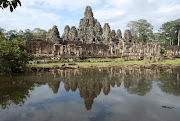
Heading north from Siem Reap, you first come across Angkor Wat, then the walled city of Angkor Thom where stone faces of tranquil Buddhas stare serenely into the thick jungle.
To the east of the city is the mesmerizing temple of Ta Prohm intertwined in a jungle wilderness and Banteay Kdei that offers intricate stone carvings.
Restorations are underway in many of the structures, but the beauty of Ta Prohm is embellished by the way nature has reclaimed the temple with massive trees winding around the structure, breaking up walls as if they were made of sand.
Like a giant octopus enveloping the temple, the tree trunks and roots - often more than 30 centimeters wide - wind through the crevices while birds chatter noisily in the tree tops above.
With temperatures often exceeding 30 degrees Celsius, young local children run to tourists touting cold refreshments as well as a myriad of craft items such as flutes, bags, postcards and books.
While many parents have been lost in conflicts, maimed by land mines or even killed by poisonous snakes, the children still welcome visitors with wide smiles and fluent English greetings.
After the architecture, the hospitality in Cambodia is the most notable aspect of a visit there, as locals are quick to wave happily at foreign faces - making it a top destination for anyone seeking culture, beauty, kindness and an incredible adventure.
Tourists help in Cambodia's struggle against war, poverty

The Philadelphia Inquirer
SIEM REAP, Cambodia - Let's be honest: It was the specter of tigers, temples and tom yam soup that led my husband and me to honeymoon in Southeast Asia. We wanted an adventure to remember, on a continent where neither of us had been.
But as I researched our trip, I realized that we should spend at least a little time practicing "voluntourism," giving back to people who are still struggling for the basics after decades of war and poverty.
We found a way to have it all in Siem Reap, Cambodia, home of the ancient temple complex Angkor Wat, and Ponheary Ly, a tour guide who considers it her mission to help educate as many Cambodian children as possible.
I found Ly, a Siem Reap native and survivor of dictator Pol Pot's labor camps, through the Asia message board on Fodors.com. Ly, 44, is a veteran guide who has arranged private tours of Angkor Wat and other Siem Reap attractions in both English and French - languages she learned in secret during the Vietnamese occupation of Cambodia - since 2000.
A former English teacher, Ly has also worked for seven years to enroll children in Cambodian schools. While public school in the country is ostensibly free for the first three years, many rural children do not have the $12 necessary for shoes, school supplies or uniforms, she said.
"As a teacher, I knew about the difficulties of the kids and families who couldn't send the kids to schools," she said. "Also, I found that the kids are smart, but they don't have any occasion to show how smart they are. To build the country, we have to build the education for all people, especially the kids."
It's a message that Ly's clients - mostly Americans who prefer independent travel with native guides to packaged tours - could support. In addition to touring the temples, more and more visitors asked Ly whether they could visit the schools and donate money for bicycles, supplies and uniforms.
One such convert
Lori Carlson, formerly of Austin, Texas, was one such convert. When she visited here in 2005, Carlson was struck by Ly's background and dedication. On her return to the States, she founded the Ponheary Ly Foundation (www.theplf.org), a registered nonprofit that channels money directly to the schools.
Carlson, 48, raised $90,000 for five schools - and quit her job to move here to work full time with Ly. She formed a board of directors for the PLF, which distributed school supplies to 1,955 children.
"I believe the travelers who go to visit the temples at Angkor Wat understand they bear at least some of the responsibility to gently nudge these children toward school rather than reinforce the idea that it's good to stand on the corner and beg dollars from tourists," she said.
With such strong advocates, Don and I were excited to meet Ly and do our part. We arrived here to find a city undergoing massive change. The number of tourists visiting Angkor Wat, a UNESCO World Heritage Site since 1992, has exploded in recent years, spurring an increase in hotels, shops, restaurants and other businesses.
While the influx of dollars has been good for many Cambodians (merchants prefer U.S. dollars to the Cambodian rial), it's disconcerting to see barefoot bicyclists ride past $800-a-night hotels. Young children hawk maps, books and trinkets near the temple grounds; tuk-tuk drivers fight over $1 fares.
That's not to say that Don and I eschew luxury (it was our honeymoon, after all). We turned down a $20 room at Ly's simple guest house, primarily because it didn't have a pool, which we considered essential to deal with the area's crushing humidity. At $95, our poolside room at Bopha Angkor was spacious yet not ostentatious, and the package included daily breakfast, a traditional Khmer dinner and a massage.
More than 300 temples
Just a few hours after we landed, we went to Angkor Wat with Ly's brother Dara as our guide. There are more than 300 temples in the complex, but Dara steered us to the ones that would provide the most interesting backdrops for my husband, the photographer.
As we sweated in the 90-degree heat, I asked Dara about his family's experience under the Khmer Rouge. He told us that his father, a teacher in Siem Reap, was among the first wave of educated people to be killed under Pol Pot's regime. As a result, Dara and his siblings were sent with their mother to the countryside to work.
It's a sobering tale, and we heard more from Ly over the next few days. Ly, who was 13 when the Khmer Rouge came to power, and her siblings survived, mainly because villagers would leave food for them at night.
"We were given this much rice," Ly told us, holding up the tip of her finger.
Dara would "crawl out on all fours, like a cat" to get extra food; sometimes, actual cats or monkeys would have gotten to the rations instead, she said.
Still, the extra nourishment kept the family alive - and the Khmer Rouge noticed. Officials asked her mother why her children were still alive when so many other youngsters had died, Ly said. When her mother refused to answer, she was horribly beaten.
Such atrocities were common in the Pol Pot years. Yet most Cambodians don't like to talk about the time under the Khmer Rouge, Carlson said. It's rare to find it discussed in schools, primarily due to the country's Buddhist beliefs, which hold that people - even war criminals - are responsible for their own karma.
Understands what's important
Ly is different, Carlson said. She understands that it's important to talk about the past so it doesn't happen again. We were talking in Ly's van, on our way to deliver lunch to the 476 children at Knar school, out in the Cambodian countryside. On the road, we saw men on bikes toting crates filled with piglets and open huts with children playing in the dirt.
Cambodian families expect all children, no matter how young, to contribute economically, Ly told us. Which is why even the kids who are lucky enough to go to school attend for a half day; at home, they are needed for chores, farm work or other ways to make money.
Incentives
In addition to a donation made before our trip, we gave Ly $40 for lunch, which buys two noodle packets for each child. That's essential, Carlson said, because if the child received only one packet, he or she would take it home to the family instead of eating it. The school tries to feed the children at least once a day to make sure they have enough energy to learn, Carlson said.
We arrived at Knar School, which consists of several one-story classrooms. As Don carried the boxes of noodle packets into the rooms, the children's eyes grew wide. They straightened in their seats and thanked us by pressing their hands together and bowing.
Carlson and Ly showed us around the school and talked about the improvements that have been made. Incentives such as bicycles, uniforms, and extra noodle packets show the families that there are tangible benefits to their children attending school, Carlson said.
"I would like to have my country be the same as the other countries," Ly said, with Cambodian children able "to have good education to work well to get out from the poor life."
The children seemed to love school, showing off their uniforms and books. An impromptu game of soccer ensued, with Don in the thick of it. It was an emotional sight for me, which sparked later discussion: Although we had been together several years, Don and I had never talked about the greater good we could accomplish as a couple.
It's a conversation that all newlyweds should have, wherever their honeymoon takes them. For us, road-testing our fledgling marriage in an underdeveloped country not only gave us the adventures we sought, but also set the course for a more permanent path. And that's definitely a trip worth taking.
Cambodian Cabinet approves 2 hydroelectric dam projects to be built by Chinese companies
PHNOM PENH, Cambodia: The Cambodian Cabinet has approved plans for Chinese companies to build two hydroelectric plants beginning the end of this year, a government official said Saturday.
Environmental groups say the dams threaten the country's ecosystem and the livelihoods of thousands.
Both dams will be located in Koh Kong province in southwestern Cambodia, said Seng Savorn, a spokesman of the Council of Ministers.
China National Heavy Machinery Corp. will take until at least 2014 to complete a US$540 million dam, which should be able to generate up to 246 megawatts of electricity, he said.
Another Chinese company, Michelle Corp., is to build a US$495.7 million dam intended to generate up to 338 megawatts of electricity, he said. The project is due to be completed in 2015.
Electricity generation in Cambodia remains largely undeveloped, with most power plants using fossil fuels. The impoverished Southeast Asian nation also buys electricity from neighboring Vietnam and Thailand.
Power costs in Cambodia are among the highest in the world, and only about 12 percent of its 14 million people have access to electricity, according to the World Bank.
Electricity prices are also a major source of complaint from investors in Cambodia.
In a bid to meet future electricity demand, the government has identified 14 potential hydroelectric dam sites across the country.
Environmentalists have voiced concerns about the impact those projects will have.
In a report earlier this year, U.S.-based International Rivers Network said "poorly conceived hydropower development could irreparably damage" Cambodia.
"Large hydropower projects can incur significant environmental and social costs that risk undermining sustainable development," said the report released in January.
Seng Savorn dismissed the concerns, saying the projects were studied thoroughly before they were approved by the Cabinet.
Read more!
Saturday, June 14, 2008
President Arroyo appeals for
President Gloria Arroyo appealed for the passage of the Asean Charter for further economic integration within the Association of Southeast Asian Nations, or Asean, the Philippine government said in a statement on Friday.
Economic integration within Asean is imperative to face the challenges of globalization, the Chief Executive said during an Independence Day reception on Thursday in Malacañang.
“Certainly, economic integration among Asean nations is imperative if we, as a region, are to take advantage of the expanding global trade and economic opportunities,” the President added.
Mrs. Arroyo said strong global engagement and the establishment of an Asean Charter would “certainly” open more opportunities for its member-countries.
“We are thrilled at the prospect of a vibrant Asean. We hold great hope for the Asean Charter, which will be the first and the boldest step toward the creation of a regional economic community,” she added.
During its chairmanship, the Philippines pushed for the establishment of an Asean Charter to create a single regional community by 2015, that was eventually signed by the Asean leaders in Singapore, and is now up for ratification by the member-countries, the statement said.
“As for the passage of the Asean Charter, we would love nothing more than to see Asean consolidate its gains and move closer together. However, we’ll leave this up to the Philippine Senate which has been asked to review the charter for ratification,” the President said.
According to Mrs. Arroyo, the Philippines is doing its part to “create a world that is more humane.” She cited the “sympathy” extended to the people of Sichuan province, which was recently hit by a devastating earthquake, and the medical teams sent to Myanmar to help the people there recover from a deadly cyclone.
The President said the Philippines is also coordinating with Asean neighbors in sending financial aid to Myanmar.
Asean groups Brunei Darussalam, Cambodia, Indonesia, Laos, Malaysia, Myanmar, the Philippines, Singapore, Thailand and Vietnam.
-- Xinhua
Read more!