The land of heroes
Our heroes
Our land
Cambodia Kingdom


Monday, June 16, 2008

Khmer Rouge victims given a voice in Cambodia trials


PHNOM PENH: If Sok Chear had her way, she would slice the elderly man into ribbons and pour salt into his wounds. She would beat him up and torture him and give him electric shocks to make him talk.

For Ly Monysar, "Only killing them will make me feel calm. I want them to suffer the way I suffered. I say this from the heart."

Sok Chear, an office worker, and Ly Monysar, a security guard, are two of the millions of Cambodians who suffered for four years in the late 1970s under the brutal Communist Khmer Rouge, who caused the deaths of 1.7 million people.

Today, three decades later, five aging former Khmer Rouge leaders have been arrested and are awaiting trial. And Sok Chear and Ly Monysar have an innovative role to play in the tribunal, where the first case is expected to get under way this autumn.

They are two of hundreds of people who have applied to the court to be recognized officially as victims of the Khmer Rouge and to bring parallel civil cases against them.

They will have the chance, not to beat and torture them but to seek symbolic reparations - a monument, perhaps, or a museum or a trauma center.

It is a controversial experiment in this unusual hybrid tribunal, which is administered jointly by the United Nations and the Cambodian government, cobbling together elements of both local and international law.

"For the first time in history the internal rules of a tribunal will give victims of crimes the possibility to participate as parties," said Gabriela González Rivas, deputy head of the tribunal's victims unit.

Victims have been included in other comparable tribunals like the International Court of Justice, but their role has been more limited.

As civil parties, the victims here will have standing comparable to those of the accused, including the rights to participate in the investigation, to be represented by a lawyer, to call witnesses and to question the accused at trial, according to a court statement.

"Participation in these types of proceedings is a tool of empowerment," Rivas said. "People can tell their story, feel that what happened to them is a consideration, a recognizing that what happened to them shouldn't have happened."

The inclusion of victims is part of the evolution and refining of the mechanisms of international justice, said Diane Orentlicher, special counsel of the Open Society Justice Initiative, in an interview by telephone from New York.

"There has been a growing recognition, after 15 years of international and hybrid courts like this one, not to exclude victims from the justice that is being dispensed on their behalf," she said. "This is one of the frontier issues in ongoing efforts to improve ways in which war crimes trials are carried out."

The Cambodia tribunal has been criticized for compromising international standards of justice with its awkward admixture of Cambodian law and its vulnerability to manipulation by the country's strongman, Prime Minister Hun Sen.

The participation of victims is drawing more criticism, partly from people concerned for the rights of the accused and the preservation of the presumption of innocence.

Victor Koppe, a defense attorney for one of the Khmer Rouge leaders, called the presumption of innocence "the most fundamental issue" in a case whose defendants have already found a place in history books as the perpetrators of the killings.

"The question is whether or not everything in this tribunal is institutionalized in such a way that only guilty verdicts can come," he said.

Other critics say the court is being distracted by social agendas from its core task of seeking justice for crimes against humanity.

"I would put this under the category of therapeutic legalism," said Peter Maguire, a specialist in international justice and author of "Facing Death in Cambodia."

"The task of an international criminal court is to convict the guilty and exonerate the innocent," he said. "To ask more of it than that is asking way too much of any criminal trial."

For many people, though, these related benefits are the main purpose of the trials in a country that has never fully come to grips with its tormented past.

The trials will offer a catharsis and a measure of healing, they say, and will set a base line for an end to impunity in this still raw and sometimes lawless country.

"This is an invention of the 1990s where people freighted the trials with all this baggage," said Maguire. "How do you measure closure, how do you measure truth, how do you measure reconciliation? These are not empirical categories."

These added elements can also encumber an already tortuously slow process, the critics say.

Almost two years of the tribunal's budgeted three-year mandate have passed since it was set up in August 2006, after nearly a decade of contentious negotiation between the United Nations and the Cambodian government.

Nearly a year has passed since the first of the five defendants was charged in the case. A new budget has been submitted, and most analysts are confident that more money will be found from international donors to extend the life of the tribunal. But as Maguire put it, this court needs to get hustling.

So far, Rivas said, her office is processing about 1,300 applications to participate from people who say they are victims. About half of them seek to be civil parties, while the other half offer evidence that could be submitted to prosecutors. Most names have been channeled through a documentation center or through human rights groups.

Ten people have been accepted so far as civil parties, she said.

As the number grows, it is likely that they will be combined into class actions representing religious or ethnic groups, victims of particular crimes or other parties.

Theary Seng, 37, a Cambodian-born American lawyer who lost her parents to the Khmer Rouge, is organizing two groups of orphans - including Sok Chear and Ly Monysar - to bring civil cases.

In February, Seng became the first - and so far the only - victim to address the court, standing face to face with a man she blames for the deaths of her parents.

Though her words were addressed to the court, she said, her eyes were locked directly with those of the defendant, Nuon Chea, 81, the most senior of the five imprisoned leaders - the man Sok Chear said she wanted to flay.

In a short statement, Theary Seng contrasted the legal protections that Nuon Chea is receiving with the arbitrary arrest and abuse she said she and her younger brother suffered as children under the Khmer Rouge.

Nuon Chea, the Khmer Rouge ideologue, was sometimes known as Brother No. 2 to Pol Pot, the Khmer Rouge leader, who died in 1998.

"He was stoic, stoic," said Theary Seng, recalling the confrontation. "He's completely stoic. Eighty percent of the time I was addressing him in my statement. He didn't break the stare."

Nearly one-fourth of the Cambodian population died between 1975 and 1979 from execution, torture, starvation and overwork in the mass labor brigades the Khmer Rouge created.

Today, though, most of the survivors are as stoic as their victimizers. When asked about the tribunal, most simply say they want to know who caused their suffering and why.

But the approach of the court sessions has aroused the feelings of many people, and those who have applied to be counted as victims are among those with the strongest emotions.

Sok Chear, 32, who said she was raped and brutalized as a girl by the Khmer Rouge, remains inconsolable over the loss of her father, an engineer, who disappeared into the hands of the black-clothed cadre and never returned.

"We were always waiting for him to come home, but he never came," she said. "We were always waiting and waiting. Even now, I still look around. Maybe my father is still alive."

Tears still come when she talks about him.

"He gave me rice to eat, and I want to repay him," she said, "even one plate of rice, my gift to him, even one plate for him to eat from his daughter."

Ly Monysar, 41, is a broken man, poor and sick and bitter, his voice quavering as he tells of the loss of his entire family when he was a boy of 9.

He sustains himself with fantasies of revenge every bit as chilling as the calculated brutality of men like Nuon Chea.

"I want to kill all those people who did this to me," he said.

"And if I can't, I'll come back in the next life and find them. I'll create my own genocidal regime and take my revenge on them all."

.
Read more!

One man helps Cambodia rebuild trust

BATTAMBANG, Cambodia - A timeless problem nearly ruined the Buar Sramum's marriage: Her husband, a fish seller, doesn't make enough money, and the money he makes he often mismanages, making it even harder in this impoverished village to feed the couple's three children. When Mrs. Sramum berated her husband, things got heated, and they argued bitterly for weeks.

Disputes like this are rarely discussed publicly in Cambodia, but they are a common cause of domestic abuse. They are also one strand in a larger set of village conflicts contributing to human rights violations and violence in Cambodia's countryside, including land disputes, petty crimes, and conflicts over resources such as water and cattle.

Central to the problem is that there is often nowhere to go for help: Decades of war and poverty have left Cambodia's legal system in disarray. Courts are often too far away or too expensive for the rural poor.

But the Sramums – like thousands of others – didn't become another statistic, thanks to Monychenda Heng, a former Buddhist monk who is helping to restore two of the most precious resources Cambodia lost in the devastating years of the Khmer Rouge: trust and hope.

Since 2002, Mr. Heng's organization, Buddhism for Development, has pioneered the concept of dispute resolution committees in seven northwestern provinces. The committees – which include five to nine members culled from the community, including two seats mandated for women – listen to both sides of a dispute. Then they offer advice, usually free of charge, sometimes at a nominal fee of about 50 cents.

The results are radical – not necessarily for the advice given, but for the fact that poor people like Mrs. Sramum can seek mediation at all.

Today she and her husband are not fighting any more. "The committee gave advice to my husband that he should change his attitude, because he always gets angry when he comes from the field after work," she says, prompting a sheepish grin from her husband, and laughter from the people sitting around her.

In the couple's Norea commune, a village of 991 families in Battambang Province, about 1,000 community leaders have been trained in conflict resolution. Of 33 complaints referred last year to the local conflict resolution committee, 30 were resolved, with two others referred to a local court and one to provincial authorities.

Local authorities praise the committees for reducing violence and filling holes in Cambodia's legal system. "The number of domestic violence cases has decreased according to yearly statistics. People believe the system works," says Sok Sambath, Norea's chief.

The success rate is just one of the many small victories that Buddhism for Development, founded in 1995, believes can add up to a better future for Cambodia.

Mr. Heng knows from personal experience that hope is an incremental enterprise. When he was young, his aspirations of becoming a monk were seemingly derailed when the Khmer Rouge swept to power. Like thousands of others, Heng and his family fled to a refugee camp near the border of Thailand in the late 1970s. It was there that he met the Venerable Pin Sem, his spiritual master, and incubated his Buddhist approach to social development.

Under Pin Sem, he saw that the principles of Buddhism – physical development, emotional development, and compassion – could be a tool to inspire the economic and social development Cambodia needed to get back on its feet. And as he educated himself, he began teaching children about Cambodia's history, so that they wouldn't forget what their country was and what it could be again.

Ten years later, in the late 1990s, Heng not only returned home to his native Battambang Province, but won a scholarship to Harvard University – no small feat for a poor refugee with no formal education.

Heng says the practical necessities of life at Harvard compelled him to give up the monkhood, but that the Buddhist principles continue to underpin his group's work. With donations from the US and Denmark, Buddhism for Development has trained an army of facilitators, youths, and volunteers, including many monks and nuns, to undo the Khmer Rouge's painful social and economic legacies. They teach farmers to plant better seeds, dispense microloans, and care for patients.

Heng is careful to point out that his organization is not trying to spread Buddhism, and highlights that many of his beneficiaries are Muslim communities – as in Norea commune, where almost half the families are Muslim.

Perhaps Buddhism for Development's most important work is that of its small-scale dispute-resolution committees. "Trust among Cambodian citizens has broken apart.... Low education and illiteracy – especially at the grass-roots level, where the majority citizens are living – make people more vulnerable to conflicts," Preap Kol, a community development activist who has worked with Heng, writes in an e-mail. "In this context, a project to provide [a] mechanism [for] conflict resolution at the village level is important."
Read more!

Sunday, June 15, 2008

Democrat calls for FM to reveal Cambodia's new map

Thailand is always trying to find the way around. it even had been trying to claim Ankor Wat Temple as theirs. Thailand is afraid of loosing a square inch to Cambodia but they already encroaching hundred square Kilometers on Cambodia land.

The Democrat party called on the Foreign Ministry on Sunday to reveal the new border lines for Preah Vihear Temple proposed by Cambodia in its bid to list the temple as a Unesco World Heritage site.

Deputy party leader Alongkorn Polabutr expressed concern the ministry appeared to be withholding details of the Cambodian proposal.

Phnom Penh's bid to make Preah Vihear Temple a protected site reached a stalemate last year when Bangkok objected to a map attached to the proposal.

Bangkok said it included overlapping zones between both countries and they had to be demarcated first.

Several rounds of negotiations followed and Cambodia agreed to propose a new map which Foreign Minister Noppadon Pattama said did not include the overlapping areas.

He doubted the government would compromise on the issue that could benefit former prime minister Thaksin Shinawatra who was reportedly keen about investing in Koh Kong province in Cambodia.

Alongkorn said the ministry should make the issue transparent by showing details of the map to the public before Unesco considers the Cambodian proposal between July 2 and 10.

The Cabinet is scheduled to endorse Cambodia's new map next week, enabling Phnom Penh to submit its proposal to Unesco.

Thailand and Cambodia claimed ownership of the temple until the World Court ruled in favour of Cambodia in 1962.

Alongkorn said yesterday was the 46th anniversary of that ruling.

It should be noted the World Court ruled that only the temple, not the areas around it, belonged to Cambodia, he said.

A seminar on the controversy was conducted in Si Sa Ket province yesterday, where many panellists expressed doubts on the Thai government's expected admission of Cambodia's new map.

Last week, some residents in Si Sa Ket called for the removal of Cambodian communities from overlapping areas.
Read more!

Vietnam-Cambodia Friendship Association holds national congress

Our ancesters said "a friend in need is a friend in deed". So Cambodia is a friend in need for Communist Yuon to get some deeds. Cambodia has lots of thing for Yuon to steal including encroachments of Rubber Plantions.

VietNamNet Bridge - The Vietnam-Cambodia Friendship Association (VCFA) re-elected Vu Mao as President for the 2008-2013 period at its 3 rd National Congress in Hanoi on June 14.

Addressing the event, President of the association Vu Mao, stressed the important strategic relations between Vietnam and Cambodia , saying that bilateral relations are seeing positive developments on the basis of mutual benefits, traditional friendly neighbourliness and comprehensive cooperation.

Over the past five years, the VCFA has actively and creatively renewed its activities, improving the people-to-people diplomatic work, strengthening the traditional friendship and solidarity, and comprehensive cooperation between Vietnam and Cambodia .

The congress defined the VCFA’s focal tasks in the 3 rd term, namely to promote the education on the two countries’ traditional friendship, solidarity and comprehensive cooperation, attach importance to economic, trade, scientific and technical cooperation; continue to develop the organisation, improving the quality of its activities and strengthening its leadership.

The VCFA will create opportunities for former Vietnamese experts and volunteer soldiers to visit their former combatant fields in Cambodia , and organise exchange meetings for students and business clubs of the two countries.

Cambodian Ambassador to Vietnam Vann Phal highly appreciated the traditional friendship, solidarity and fine cooperation in the spirit of “good neighbourliness, traditional friendship, and long-tern, durable and comprehensive cooperation” between the two countries.

The congress also passed its revised charter and elected a new 39-member executive committee.

(Source: VNA)
Read more!

Adventurers drawn to the beauty of Cambodia

By Jenny Hammond


AFTER decades of unrest, Cambodia is coming into its own as a destination for travelers eager to embrace architecture, adventure and smiles, writes Jenny Hammond.

Compared with its high profile neighbors, wartorn Vietnam and the idyllic paradise of Thailand, Cambodia tends to fly under the radar. But that does not mean this fascinating country has any less to offer.

After three decades of war, Cambodia is now at peace and attracting more and more tourists with the promise of Indiana Jones- or Tomb Raider-type adventures.

Undoubtedly Cambodia is a beautiful country, quite different from its neighbors.

For starters there are vast expanses of bright red earth house communities where the homes are built on stilts to protect residents from floods in the rainy season and the odd rogue snake, while at the same time providing shelter for livestock below.

The view feels more like something out of Africa than Asia with mango trees nestled along the sides of bumpy roads where smiling locals sell juicy slices of pineapples to weary passers-by.

Cambodia was ravaged during the war years and still has the highest number of unexploded land mines in the world. But with a vast expanse of magnificent horizons and some of the world's most breathtaking man-made structures, the horrific past is being replaced by the wonder of the country's rich cultural heritage.

The biggest attractions on the tourist trail are the temples of Angkor which are among the most incredible structures on Earth in spite of thousands of years of wear and tear and, more recently, clumsy tourist feet.

Situated near the sleepy town of Siem Reap, the temples were only rediscovered by the Western world in the 1860s although they still housed a wealthy working monastery.

The discovery generated a great deal of international interest in Cambodia, with well-known explorers swooping on the country to document their travels throughout the area. But in the last part of the last century, visiting Cambodia became difficult as the country was forced into conflict with neighbors.

With Cambodia and its relics now safe to visit following its recent past, tourism is becoming a booming industry.

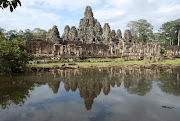
And most are heading straight for Angkor. The temples of Angkor, capital of Cambodia's ancient Khmer empire, rival each other in size, detail and beauty, but Angkor Wat, the largest religious structure in the world, stands proud near the center of them all.

Angkor Wat is the best example today of man's devotions to the gods through its sheer size and intricate carvings. More than 3,000 individually carved "heavenly nymphs" adorn the structure while the high turrets of the temple all point west leading many to believe the monument was built as a tomb - the west symbolically points towards death.

A note to remember for visiting this temple is that it is lit at night between 7:30pm and 9pm so a visit at this time allows a brief escape from both the heat and the distracting tour bus crowds.

But in spite of Angkor Wat's size, it is by no means the best of the many monuments spreading throughout a thick forest.

Heading north from Siem Reap, you first come across Angkor Wat, then the walled city of Angkor Thom where stone faces of tranquil Buddhas stare serenely into the thick jungle.

To the east of the city is the mesmerizing temple of Ta Prohm intertwined in a jungle wilderness and Banteay Kdei that offers intricate stone carvings.

Restorations are underway in many of the structures, but the beauty of Ta Prohm is embellished by the way nature has reclaimed the temple with massive trees winding around the structure, breaking up walls as if they were made of sand.

Like a giant octopus enveloping the temple, the tree trunks and roots - often more than 30 centimeters wide - wind through the crevices while birds chatter noisily in the tree tops above.

With temperatures often exceeding 30 degrees Celsius, young local children run to tourists touting cold refreshments as well as a myriad of craft items such as flutes, bags, postcards and books.

While many parents have been lost in conflicts, maimed by land mines or even killed by poisonous snakes, the children still welcome visitors with wide smiles and fluent English greetings.

After the architecture, the hospitality in Cambodia is the most notable aspect of a visit there, as locals are quick to wave happily at foreign faces - making it a top destination for anyone seeking culture, beauty, kindness and an incredible adventure.
Read more!

Tourists help in Cambodia's struggle against war, poverty


By Chris Gray
The Philadelphia Inquirer

SIEM REAP, Cambodia - Let's be honest: It was the specter of tigers, temples and tom yam soup that led my husband and me to honeymoon in Southeast Asia. We wanted an adventure to remember, on a continent where neither of us had been.

But as I researched our trip, I realized that we should spend at least a little time practicing "voluntourism," giving back to people who are still struggling for the basics after decades of war and poverty.

We found a way to have it all in Siem Reap, Cambodia, home of the ancient temple complex Angkor Wat, and Ponheary Ly, a tour guide who considers it her mission to help educate as many Cambodian children as possible.

I found Ly, a Siem Reap native and survivor of dictator Pol Pot's labor camps, through the Asia message board on Fodors.com. Ly, 44, is a veteran guide who has arranged private tours of Angkor Wat and other Siem Reap attractions in both English and French - languages she learned in secret during the Vietnamese occupation of Cambodia - since 2000.

A former English teacher, Ly has also worked for seven years to enroll children in Cambodian schools. While public school in the country is ostensibly free for the first three years, many rural children do not have the $12 necessary for shoes, school supplies or uniforms, she said.

"As a teacher, I knew about the difficulties of the kids and families who couldn't send the kids to schools," she said. "Also, I found that the kids are smart, but they don't have any occasion to show how smart they are. To build the country, we have to build the education for all people, especially the kids."

It's a message that Ly's clients - mostly Americans who prefer independent travel with native guides to packaged tours - could support. In addition to touring the temples, more and more visitors asked Ly whether they could visit the schools and donate money for bicycles, supplies and uniforms.

One such convert

Lori Carlson, formerly of Austin, Texas, was one such convert. When she visited here in 2005, Carlson was struck by Ly's background and dedication. On her return to the States, she founded the Ponheary Ly Foundation (www.theplf.org), a registered nonprofit that channels money directly to the schools.

Carlson, 48, raised $90,000 for five schools - and quit her job to move here to work full time with Ly. She formed a board of directors for the PLF, which distributed school supplies to 1,955 children.

"I believe the travelers who go to visit the temples at Angkor Wat understand they bear at least some of the responsibility to gently nudge these children toward school rather than reinforce the idea that it's good to stand on the corner and beg dollars from tourists," she said.

With such strong advocates, Don and I were excited to meet Ly and do our part. We arrived here to find a city undergoing massive change. The number of tourists visiting Angkor Wat, a UNESCO World Heritage Site since 1992, has exploded in recent years, spurring an increase in hotels, shops, restaurants and other businesses.

While the influx of dollars has been good for many Cambodians (merchants prefer U.S. dollars to the Cambodian rial), it's disconcerting to see barefoot bicyclists ride past $800-a-night hotels. Young children hawk maps, books and trinkets near the temple grounds; tuk-tuk drivers fight over $1 fares.

That's not to say that Don and I eschew luxury (it was our honeymoon, after all). We turned down a $20 room at Ly's simple guest house, primarily because it didn't have a pool, which we considered essential to deal with the area's crushing humidity. At $95, our poolside room at Bopha Angkor was spacious yet not ostentatious, and the package included daily breakfast, a traditional Khmer dinner and a massage.

More than 300 temples

Just a few hours after we landed, we went to Angkor Wat with Ly's brother Dara as our guide. There are more than 300 temples in the complex, but Dara steered us to the ones that would provide the most interesting backdrops for my husband, the photographer.
As we sweated in the 90-degree heat, I asked Dara about his family's experience under the Khmer Rouge. He told us that his father, a teacher in Siem Reap, was among the first wave of educated people to be killed under Pol Pot's regime. As a result, Dara and his siblings were sent with their mother to the countryside to work.

It's a sobering tale, and we heard more from Ly over the next few days. Ly, who was 13 when the Khmer Rouge came to power, and her siblings survived, mainly because villagers would leave food for them at night.

"We were given this much rice," Ly told us, holding up the tip of her finger.

Dara would "crawl out on all fours, like a cat" to get extra food; sometimes, actual cats or monkeys would have gotten to the rations instead, she said.

Still, the extra nourishment kept the family alive - and the Khmer Rouge noticed. Officials asked her mother why her children were still alive when so many other youngsters had died, Ly said. When her mother refused to answer, she was horribly beaten.

Such atrocities were common in the Pol Pot years. Yet most Cambodians don't like to talk about the time under the Khmer Rouge, Carlson said. It's rare to find it discussed in schools, primarily due to the country's Buddhist beliefs, which hold that people - even war criminals - are responsible for their own karma.

Understands what's important

Ly is different, Carlson said. She understands that it's important to talk about the past so it doesn't happen again. We were talking in Ly's van, on our way to deliver lunch to the 476 children at Knar school, out in the Cambodian countryside. On the road, we saw men on bikes toting crates filled with piglets and open huts with children playing in the dirt.

Cambodian families expect all children, no matter how young, to contribute economically, Ly told us. Which is why even the kids who are lucky enough to go to school attend for a half day; at home, they are needed for chores, farm work or other ways to make money.

Incentives

In addition to a donation made before our trip, we gave Ly $40 for lunch, which buys two noodle packets for each child. That's essential, Carlson said, because if the child received only one packet, he or she would take it home to the family instead of eating it. The school tries to feed the children at least once a day to make sure they have enough energy to learn, Carlson said.

We arrived at Knar School, which consists of several one-story classrooms. As Don carried the boxes of noodle packets into the rooms, the children's eyes grew wide. They straightened in their seats and thanked us by pressing their hands together and bowing.

Carlson and Ly showed us around the school and talked about the improvements that have been made. Incentives such as bicycles, uniforms, and extra noodle packets show the families that there are tangible benefits to their children attending school, Carlson said.

"I would like to have my country be the same as the other countries," Ly said, with Cambodian children able "to have good education to work well to get out from the poor life."

The children seemed to love school, showing off their uniforms and books. An impromptu game of soccer ensued, with Don in the thick of it. It was an emotional sight for me, which sparked later discussion: Although we had been together several years, Don and I had never talked about the greater good we could accomplish as a couple.

It's a conversation that all newlyweds should have, wherever their honeymoon takes them. For us, road-testing our fledgling marriage in an underdeveloped country not only gave us the adventures we sought, but also set the course for a more permanent path. And that's definitely a trip worth taking.
Read more!

Cambodian Cabinet approves 2 hydroelectric dam projects to be built by Chinese companies

PHNOM PENH, Cambodia: The Cambodian Cabinet has approved plans for Chinese companies to build two hydroelectric plants beginning the end of this year, a government official said Saturday.

Environmental groups say the dams threaten the country's ecosystem and the livelihoods of thousands.

Both dams will be located in Koh Kong province in southwestern Cambodia, said Seng Savorn, a spokesman of the Council of Ministers.

China National Heavy Machinery Corp. will take until at least 2014 to complete a US$540 million dam, which should be able to generate up to 246 megawatts of electricity, he said.

Another Chinese company, Michelle Corp., is to build a US$495.7 million dam intended to generate up to 338 megawatts of electricity, he said. The project is due to be completed in 2015.

Electricity generation in Cambodia remains largely undeveloped, with most power plants using fossil fuels. The impoverished Southeast Asian nation also buys electricity from neighboring Vietnam and Thailand.

Power costs in Cambodia are among the highest in the world, and only about 12 percent of its 14 million people have access to electricity, according to the World Bank.

Electricity prices are also a major source of complaint from investors in Cambodia.

In a bid to meet future electricity demand, the government has identified 14 potential hydroelectric dam sites across the country.

Environmentalists have voiced concerns about the impact those projects will have.

In a report earlier this year, U.S.-based International Rivers Network said "poorly conceived hydropower development could irreparably damage" Cambodia.

"Large hydropower projects can incur significant environmental and social costs that risk undermining sustainable development," said the report released in January.

Seng Savorn dismissed the concerns, saying the projects were studied thoroughly before they were approved by the Cabinet.

Read more!

Saturday, June 14, 2008

President Arroyo appeals for

President Gloria Arroyo appealed for the passage of the Asean Charter for further economic integration within the Association of Southeast Asian Nations, or Asean, the Philippine government said in a statement on Friday.

Economic integration within Asean is imperative to face the challenges of globalization, the Chief Executive said during an Independence Day reception on Thursday in Malacañang.

“Certainly, economic integration among Asean nations is imperative if we, as a region, are to take advantage of the expanding global trade and economic opportunities,” the President added.

Mrs. Arroyo said strong global engagement and the establishment of an Asean Charter would “certainly” open more opportunities for its member-countries.

“We are thrilled at the prospect of a vibrant Asean. We hold great hope for the Asean Charter, which will be the first and the boldest step toward the creation of a regional economic community,” she added.

During its chairmanship, the Philippines pushed for the establishment of an Asean Charter to create a single regional community by 2015, that was eventually signed by the Asean leaders in Singapore, and is now up for ratification by the member-countries, the statement said.

“As for the passage of the Asean Charter, we would love nothing more than to see Asean consolidate its gains and move closer together. However, we’ll leave this up to the Philippine Senate which has been asked to review the charter for ratification,” the President said.

According to Mrs. Arroyo, the Philippines is doing its part to “create a world that is more humane.” She cited the “sympathy” extended to the people of Sichuan province, which was recently hit by a devastating earthquake, and the medical teams sent to Myanmar to help the people there recover from a deadly cyclone.

The President said the Philippines is also coordinating with Asean neighbors in sending financial aid to Myanmar.

Asean groups Brunei Darussalam, Cambodia, Indonesia, Laos, Malaysia, Myanmar, the Philippines, Singapore, Thailand and Vietnam.
-- Xinhua
Read more!

Friday, June 13, 2008

Thai govt expected to endorse new map of Preah Vihear next week

The Cabinet is expected to endorse Cambodia's new map next week enabling Phnom Penh to submit its proposal to list the Hindu temple of Preah Vihear as a World Heritage Site, Foreign Minister Noppadon Pattama said Friday.

The military was reportedly dissatisfied with the new map Cambodia sent to Thailand as it encroached on some 10 metres of Thai territory.

"I have worked with Cambodia on the issue and there is no problem now," Noppadon told reporters.

Cambodian Prime Minister Hun Sen and his deputy Sok An were very cooperative in settling the differences, he added.

Thailand and Cambodia have locked horns since Bangkok opposed Phnom Penh's plan to list the temple with 4.6 square kilometres of overlapping area claimed by both sides.

After several rounds of negotiations, Cambodia agreed last month to list only the temple and sent the new drawing of the proposed site for Thailand's consideration.

Residents in northeastern Si Sa Ket province protested, wanting the Cambodian community to be removed from overlapping areas.

Sompong Sucharitkul, former Thai ambassador to The Hague, said the Kingdom had never admitted to Cambodia's sovereignty over the temple despite the International Court of Justice's (ICJ) ruling in 1962 in favour of Cambodia.

The government should not commit to anything that could be deemed as recognition of Cambodia's sovereignty, said the former diplomat, who was close to the case when it was being considered by the ICJ.

Foreign Ministry spokesman Tharit Charungvat said the government had handled the case with transparency and would not allow the country to lose any sovereignty over territory.

"We are working on the World Heritage issue, so please do not mix this up with other issues that could complicate the matter and create misunderstandings between the two countries," Tharit said.

The protest in Si Sa Ket is over the boundary demarcation, which the ministry says is a separate issue from the World Heritage Site.
Read more!

French company to invest $250 mln to develop resort in Cambodia

PHNOM PENH, June 13 (Xinhua) -- A French-financed company will invest 250 million U.S. dollars to develop the Ream area in Cambodia's port city of Sihanoukville into a resort, according to Ieng Sophallet, assistant to Prime Minister Hun Sen, here Friday.

Alain Dupuis, French citizen and director of the Ream Resort Development Company, met with Hun Sen here Thursday to find support from the government for his project, he added.

Khmer-language newspaper the Rsamei Kampuchea Friday quoted Alain as telling the premier that his company will construct five-star hotels, other accommodation facilities, golf course, leisure places along the beach and motor-boat sporting project for tourists in the Ream region.

The premier welcomed the investment and requested the company to work with the Council for Development of Cambodia to achieve success, it added.

Construction of the project will start in late 2008 and be finished in 2010.

Sihanoukville is Cambodia's major sight-seeing destination. Sandy beach and clean sea used to attract tens of thousands of travelers annually.
Read more!

Chinese language skills seen as gateway to better job in Cambodia

PHNOM PENH, June 13 (Xinhua) -- While English remains the most popular foreign language among students in Cambodia, Chinese is fast catching up as young Khmers increasingly view it as a gateway to better jobs in the country's growing industrial and tourism sectors, according to the June 13-26 edition of the English-language bi-weekly the Phnom Penh Post.

The biggest Chinese school in Cambodia is the Duan Hoa Chinese School, which has two branches in Phnom Penh and over 7,000 students, the newspaper said.

The school has been open since 1992 and caters mainly to Chinese students, although some Cambodians and Vietnamese also study there, said administration manager Kim Hean.

"Often, students are trying to learn Chinese so they can join the families business or find work in a private company, especially working in factories or in the tourism industry as many Chinese investors are coming to Cambodia now," Kim Hean was quoted as saying.

China has emerged as one of Cambodia's largest investment partners, and is heavily involved not only in the garment sector, but construction and other industries.

"I learn Chinese because I saw how many Chinese companies and factories there are in Cambodia and I want to be able to work at these places," said Chea Sokbouy, who is now studying in Grade 11 at Duan Hoa.

Another Chinese language school, the Chhung Cheng Chinese School, is popular with Chinese-Khmer families, said the deputy director of the school, ChanTirin.

Of the 2,000 pupils at Chhung Cheng, most come from Chinese or Chinese-Khmer families who, while continuing to study in Cambodian state-run schools, realize the value in today's society of speaking two languages.

Tirin said that preserving the Chinese language in Cambodia was an important motivation for many students, but securing a high-paying job also remained a driving force for learning Chinese.

Besides, Cambodian Prime Minister Hun Sen set to sign a sub-decree that will put the Chinese language on the national curriculum at university level, undersecretary of state at the Ministry of Education Chea Se said.
Read more!

Thursday, June 12, 2008

Call to oppose Cambodia may lead to unnecessary rift

By comment & analysis
Supalak Ganjanakhundee
Published on June 12, 2008

Democrat Party deputy leader Alongkorn Pollabutr appeared to have misled some people and may be sparking unnecessary rifts with Cambodia when he suggested the government should remain opposed to Phnom Penh's move to list the Hindu temple of Preah Vihear as a World Heritage site.

If entertained, such a suggestion could mean a revision of an agreement that Foreign Minister Noppadon Pattama and Cambodian Deputy Prime Minister Sok An sealed in Paris last month.

Thailand and Cambodia had locked horns since last year when Bangkok opposed a Cambodian proposal to list the temple as a Unesco (United Nations Educational Scientific and Cultural Organisation) World Heritage site as Phnom Penh had annexed 4.6 square kilometres of overlapping area claimed by both sides.

After rounds of negotiation since the previous government, Cambodia finally agreed to propose listing only the temple that is clearly under its sovereignty.

The Cambodian authority had sent a new map of its annexation to Thailand for consideration and Bangkok was expected to find it satisfactory.

The Cabinet will endorse the map soon to enable Cambodia to submit its proposal to be listed as a protected site when the Unesco heritage committee meets in Canada next month.

The opposition Democrats blamed the government for mishandling the case.

Allowing Cambodia to list the temple means giving up Thai sovereignty over the Preah Vihear, they said.

Sompong Sucharitkul, former Thai ambassador to The Hague who said he was close to the case when the conflict was in the International Court of Justice (ICJ), wrote in an article that Thailand had never conceded that the temple belonged to Cambodia despite the court's ruling in 1962.

It was right that the Thai government at the time announced its disagreement to the ICJ's ruling in favour of Cambodia.

But such an announcement contradicted the action since the Cabinet on July 10, 1962, agreed to hand the temple to Cambodia.

Thai authorities then withdrew troops from the temple and removed Thai nationals out of the area.

Sompong's statement that the current government should not change its position and recognise Cambodian sovereignty over Preah Vihear could be somewhat misleading since it had de facto already changed its position and recognised Cambodia's sovereignty 46 years ago.

De jury, the ICJ's ruling in 1962 was deemed the final decision and there was no appeal procedure.

Thailand has the right to ask for a revision only if it finds some new evidence, but such rights lasted only 10 years after the ruling.


The foreign minister at the time was Thanat Khoman and he was also a former Democrat leader.
He reserved the right to refile the case if there is a new international law relating to the case in favour of Thailand. More than four decades on, no such new law had emerged.

The rush to discredit the government by ignoring and tinkering with historical fact to shore up nationalistic sentiment is not healthy for Thailand since such sentiment may lead to negative terms with that country and escalate into what could be a needless conflict. Any misunderstanding with Cambodia should be avoided around this time since Cambodia is to hold a general election next month.

If some Cambodian parties decide to pick on the issue of Preah Vihear to whip up anti-Thai sentiment for their own gains, it could cause a lot of trouble and perhaps strain cordial relations.

Thailand has already learned a valuable lesson that just a false statement over Khmer temples could lead to its embassy being gutted in January 2003.

The fire went beyond the embassy grounds, igniting an anti-Thai rampage that destroyed Thai properties and interests in that country, some of which cannot be compensated by money alone.

Diplomatically speaking, cooperation with Cambodia is certainly more sensible than pushing for a response.

Read more!

Cambodia Intimidates Media, Opposition Before Vote, Groups Say

By Michael Heath

June 12 (Bloomberg) -- Cambodia's government, led by Prime Minister Hun Sen, is using the justice system to intimidate journalists and the opposition before next month's general elections, Amnesty International and Human Rights Watch said.

Dam Sith, a candidate of the Sam Rainsy Party and editor of the Khmer Conscience newspaper, was arrested for questioning the role of Hor Namhong, the foreign minister, during the rule of the Khmer Rouge movement, the groups said in a statement.

The arrest ``demonstrates how the criminal justice system is used and abused to silence government critics,'' said Brittis Edman, a researcher at London-based Amnesty. It ``sends a message of fear to journalists and other media workers in the lead-up to national elections.''

The ruling Cambodian People's Party will repeat its victory of 2003 when elections are held July 27 in the South Asian country of 14 million people, Hun Sen said earlier this week. Sam Rainsy spent a year in exile in France from February 2005, during which he was jailed for 18 months in absentia for defaming the prime minister.

Cambodia's economy expanded 9.6 percent in 2007, after growing by at least 10 percent during the previous three years, according to data compiled by the World Bank.

Hun Sen wants to develop oil and mineral resources to attract international investment and reduce Cambodia's dependence on clothing exports and tourism for growth. About a third of the population live on less than 50 cents a day and 90 percent live in rural areas.

Intimidation Pattern

Dam Sith's arrest is part of a pattern of intimidation against the opposition and independent media in the run-up to the election, Amnesty International and Human Rights Watch said.

On May 21, Hun Sen threatened the independent Beehive radio station after it broadcast programming from opposition parties, according to the groups. A week later, independent radio station Angkor Ratha had its license, issued less than six months earlier, revoked after it sold air time to opposition parties, the groups said.

Hun Sen said his party may win two-thirds of seats in the 123-member parliament, the Mekong Times reported yesterday.

The party will probably win at least 81 seats, up from 73, and receive 73 percent of the vote versus 64 percent in the 2003 election, the Phnom Penh-based English-language daily cited him as saying. The Sam Rainsy Party won 24 seats in the last ballot.

Hun Sen formed a coalition government in July 2004 with the royalist Funcinpec party, which won 26 seats in 2003.

Opposition Members

Dam Sith, who is running for election in Phnom Penh, was arrested as Hun Sen's CPP presses opposition members to join the party and punishes those who refuse, Amnesty International and Human Rights Watch said.

In March, police detained local Sam Rainsy Party leader Tuot Saron in Kampong Thom. Tuot Saron is still in detention and faces charges of illegal confinement after seeking to assist a former party colleague following her alleged defection to the CPP, according to the groups.

The court issued arrest warrants against three other local Sam Rainsy Party leaders, who are in hiding after avoiding arrest, the groups said.

Cambodia's attention has been focused on five former leaders of the Khmer Rouge who are facing trial this year at a United Nations-backed genocide tribunal for crimes allegedly committed during the regime's 1975-1979 rule.

The Khmer Rouge forced the population out of cities as it tried to establish an agrarian state, killing an estimated 1.7 million people through starvation, disease or execution.

The regime was ousted when Vietnamese forces invaded Cambodia, plunging the country into civil war. Most fighting stopped after the 1991 Paris Peace Accords that called for a cease-fire and democratic elections, which were held in 1993.

Penal Code

Two years after the elections, Cambodia passed a Press Law that provides some protection to journalists, Human Rights Watch and Amnesty said. It's rarely used. Instead, the so-called 1992 UNTAC Law, Cambodia's current penal code, is used in most legal cases against journalists or media representatives.

``There's little room for critical or opposition journalists in Cambodia, and those who express dissent risk harassment, intimidation and, at times, imprisonment,'' Sara Colm, senior researcher at New York-based Human Rights Watch, said in the statement.

Dam Sith has been charged with violating articles 62 and 63 of the UNTAC Law. His newspaper, Khmer Conscience, is one of the few in Cambodia that is not affiliated with the government or the CPP, which controls all television and most radio stations.

To contact the reporter on this story: Michael Heath in Sydney at mheath1@bloomberg.net.

Read more!

Taiwan's Chunghwa Telecom to enter Cambodia

TAIPEI, June 12 (Reuters) - Chunghwa Telecom (2412.TW: Quote, Profile, Research, Stock Buzz) (CHT.N: Quote, Profile, Research, Stock Buzz), Taiwan's largest telecommunications operator, said on Thursday it expected to launch telecom services in Cambodia, as part of a plan to expand overseas.

The company will collaborate with Vietnam's military-run operator Viettel, which it had set up a $30 million joint venture with in May, said a Chunghwa Telecom spokeswoman.

The firm declined to give a specific timeline for when the services would be launched or any investment figures.

Chunghwa Telecom had said it started investments in Vietnam and Thailand and planned to invest in every Southeast Asian country besides Myanmar.

Viettel, fully owned by the Vietnam military, has become a dominant telecoms operator in Vietnam, taking up about a third of the mobile phone market.

In 2006, it became Vietnam's first telecoms firm to invest abroad when it started Voice Over Internet Protocol (VOIP) services in Cambodia, and later expanded into mobile phone, fixed-line and Internet services.

Viettel competes with Vinaphone and MobiFone, both mobile phone providers owned by state-run Vietnam Posts and Telecommunications (VNPT).

On Thursday, shares of Chunghwa Telecom fell 2.48 percent, outperforming the benchmark TAIEX's 3.39 percent drop.

Chunghwa Telecom takes up about a 39 percent share of Taiwan's mobile telecoms market, and it competes with smaller local rivals Far EasTone Telecommunications Co Ltd (4904.TW: Quote, Profile, Research, Stock Buzz) and Taiwan Mobile Co (3045.TW: Quote, Profile, Research, Stock Buzz). ($1=T$30.5) (Reporting by Sheena Lee; Editing by Ben Tan)

Read more!

Wednesday, June 11, 2008

Cambodian PM: CPP boasts strong basis to win election

The major ruling Cambodian People's Party (CPP) boasts strong basis to win the next general election in July, said Prime Minister Hun Sen in an exclusive interview with English-Khmer language newspaper the Mekong Times Wednesday.

"CPP began building its support base in 1993 with the winning of 51 seats at the National Assembly (NA), then 64 seats in 1998 and 73 (out of 123) seats in 2003. This basis is the foundation of (CPP's) support when it faces difficulties," he said.

Meanwhile, in the current third mandate government, (Cambodia) achieved double-digit economic growth, poverty has been reduced, and people's living conditions and the physical infrastructure has improved, he said.

These (achievements) will attract people in the upcoming election, said Hun Sen, also vice president of CPP.

The July 27 parliamentary election is to establish the fourth government of the kingdom. Altogether 11 parties have been approved to vie for the 123 seats in NA.

Source:Xinhua
Read more!

Cambodia: Release Jailed Editor

Journalists and Opposition Members Under Attack as Elections Near

(London, June 11, 2008) – The Cambodian government should release a jailed opposition newspaper editor and candidate, and end its intimidation of journalists and opposition party candidates in the lead-up to National Assembly elections in July, Amnesty International and Human Rights Watch said today.

On June 8, military police arrested newspaper editor Dam Sith, 39, who is also running as a candidate for the opposition Sam Rainsy Party (SRP), after his newspaper published allegations about the current foreign minister.

“Dam Sith’s arrest demonstrates how the criminal justice system is used and abused to silence government critics,” said Brittis Edman, researcher for Amnesty International. “His arrest sends a message of fear to journalists and other media workers in the lead-up to national elections next month.”

Dam Sith’s newspaper, Moneaksekar Khmer (Khmer Conscience), quoted allegations by opposition leader Sam Rainsy over the role of the current minister of foreign affairs, Hor Namhong, during the period of Khmer Rouge rule from 1975-1979. Hor Namhong filed a criminal complaint against Dam Sith for disinformation, defamation and libel under Cambodia’s 1992 penal code. Human Rights Watch and Amnesty International believe that public officials who consider themselves defamed should not seek redress through the criminal law in order to protect their reputation.

Moneaksekar Khmer is one of the few newspapers in Cambodia that is not affiliated with the government or the ruling Cambodian People’s Party (CPP) of Prime Minister Hun Sen, which also controls all television and most radio stations.

Human Rights Watch and Amnesty International said that the arrest of Dam Sith is part of a pattern of intimidation by the government against opposition and independent media in the run-up to the July elections. On May 21, Hun Sen threatened the independent Beehive radio station for running programming from opposition parties, stating: “You have one channel; we have 39 channels. If you curse me, you will receive bad merit. Those who [previously] cursed me already disappeared from the world.”

On May 28, the government shut down independent radio station Angkor Ratha (FM 105.25) in Kratie province. The station, whose headquarters is in Siem Reap province, was granted a license to broadcast in January 2008. The Ministry of Information abruptly cancelled the license for the station’s Kratie broadcasts after it sold air time to opposition parties.

“There’s little room for critical or opposition journalists in Cambodia, and those who express dissent risk harassment, intimidation and, at times, imprisonment,” said Sara Colm, senior researcher at Human Rights Watch.

Amnesty International and Human Rights Watch called on the Cambodian authorities to respect and protect the right to freedom of expression, allowing journalists to report news and express opinions about politics without retribution.

Dam Sith, who is running as an opposition candidate in the capital Phnom Penh, was arrested in the midst of an intense campaign by the ruling CPP to induce opposition members to join the CPP and punish those who refuse. In March 2008, police arrested and detained local opposition SRP leader Tuot Saron in Kampong Thom. Tuot Saron is still detained and faces charges of illegal confinement after seeking to assist a distressed former party colleague following her alleged defection to the CPP under controversial circumstances. The court issued arrest warrants against three other local SRP leaders, who avoided arrest and remain in hiding.

“Arrests and other politically motivated legal actions are being used to intimidate, coerce and silence opposition members and journalists,” said Colm. “With elections pending, it’s crucial that Cambodians are able to receive information from a variety of news sources, and that opposition candidates are able to campaign without fear of reprisals.”

The right to freedom of expression is guaranteed in the Cambodian Constitution and enshrined in international human rights law. As a party to the International Covenant on Civil and Political Rights (ICCPR), Cambodia is obliged to promote and protect these rights and ensure that people can fully enjoy them.

The 1995 Press Law provides for some protection of journalists, but is rarely used. Instead, the so-called 1992 UNTAC Law, Cambodia’s current penal code, is used in most legal cases against journalists or media representatives. These cases often violate the right to freedom of expression.

Dam Sith has been charged with violating articles 62 and 63 of the UNTAC Law. Article 62 criminalizes the publication, distribution or reproduction of false information that “has disturbed or is likely to disturb the public peace.” Amnesty International and Human Rights Watch consider the provision to be too vague and sweeping, enabling the government to intimidate and prosecute those who are exercising their right to freedom of expression.

Article 63 provides that allegations against public figures “which the author, the journalist, editor, or producer knows to be false” may constitute defamation. The article does not carry a custodial sentence. This article also restricts the right to freedom of expression in violation of international law and standards.

“It is time for Cambodia to repeal provisions in its laws that allow individuals, including journalists, to be criminally prosecuted for peaceful speech,” said Edman. .
Read more!

Tackling Cambodia's landmine legacy

By Philippa Fogarty


On a wooded hillside above a village in north-west Cambodia, a man speaks into a radio.

Figures in body armour and visors head downhill to shelter from the sun under some trees.

A whistle sounds and then a siren. A few minutes later a loud crack echoes around the countryside. Grey smoke floats into the air.

The first landmine of the morning has been destroyed.

It was a Chinese-made type 72A - a small, green object that blows off the leg that treads on it or the arm that picks it up.

The team head back up the hill. There are many more mines to go.

This is a scene that is repeated day after day across Cambodia, one of the most heavily mined countries in the world.

Between four and six million landmines are thought to have been laid during the country's three decades of civil war.

Khmer Rouge fighters, Vietnamese troops and government forces all planted devices, but did not record where or how many. Huge areas of land were contaminated, particularly in western border regions where the fighting was fiercest.

Across the country, victims of landmine blasts are a strikingly visible presence. More than 40,000 people are thought to have lost limbs.

Work to remove the mines has been going on ever since the conflict ended, and a great deal of progress has been made. But there is a lot still to do.

"Cambodia still has a significant landmine problem," says Rupert Leighton, Cambodia country director of the Mines Advisory Group. "They are not starting to dry up yet."

Casualties have fallen significantly in recent years, from more than 2,000 annually in the early 1990s to less than a quarter of that in 2006.

This is because the movement of displaced people has subsided, people know more about landmines and more clearance has been carried out. There are also fewer people facing acute hunger, meaning fewer people foraging in the forests.

The key issue now, says Mr Leighton, is the fact that so much land still cannot be used - at a time when competition for it has become fierce.

Ten families

Boeung Prolite lies 6 km ( 4 miles) from the Thai border, not far from the former Khmer Rouge stronghold of Pailin.

For more than two decades a guerrilla conflict raged in this area - and both sides laid mines extensively.

People began settling in Boeung Prolite in the 1990s, when the fighting wound down.

About 30% of villagers are former Khmer Rouge fighters, the rest are new arrivals from other provinces. They live in simple wooden houses and grow crops for subsistence and sale.

On high ground above the village lies a mine field about the size of 19 football pitches.

This one was laid mainly by the Khmer Rouge and, as well as 72As, contains type 69s - small grey mines which spring upwards to explode at waist height.

Nine casualties have been recorded on this minefield over the years. The last was in 2002, a farmer who wanted to plant more crops.

Roeu Sokhom heads the team that is clearing the site. He, a deputy supervisor, a medic, a driver and 12 deminers began work there in early March after the initial site survey was complete.

Using metal detectors to examine every inch of ground, working in high heat and humidity, they have already destroyed dozens of mines. They expect to complete the job by the end of June.

When it is done, 10 local families, comprising a total of 59 people, will be able to farm there, Roeu Sokhom says.

Some have already moved in to plant up earth cleared only days before, such is their hunger for land.

'Finish line'

One of the mine clearers is 26 year-old Khoeun Sokhorn. She lives with her family in a village near Pailin and has been a deminer for two years.

In 2002, she went into the forest to gather firewood. The area had been classified as "suspect", but people had been going there for years and everyone thought it was safe. A landmine blew off her right leg.

She wants to clear mines so that no-one else gets hurt the way she did, she says. She is proud that the number of casualties is continuing to fall.

But when she finds a mine, there is no flash of triumph - she just reports it to her supervisor and moves on to the next one.

She says she will clear mines as long as there is work for her. She does not need to look for another job yet.

"We will never clear all the mines out of Cambodia, but in 10 years we have a reasonable chance of saying that the worst areas have been cleared," says Mr Leighton.

"It depends on funding and also on how we define the finish line - are we talking about impact-free or casualty-free?"

"We could go on working in Cambodia forever, but the law of diminishing returns would mean that we become more and more expensive."

In Khoeun Sokhorn's village there are several mine fields that need to be cleared.

She is married and she has a three-year-old daughter.

The little girl does not know what a landmine is yet. But, Khoeun Sokhorn says, she is old enough to know that she must not go into certain parts of the forest.
Read more!

Tuesday, June 10, 2008

Plane abandoned at Hanoi airport

Vietnamese authorities say they are mystified as to who owns a Boeing 727 which has been abandoned at Hanoi's Noi Bai airport.

The plane was flown in from Siem Reap in neighbouring Cambodia in late 2007 and has been unclaimed ever since.

An airport official told the BBC that they believe the owners could be an airline based in Cambodia.

The official said that if it remains unclaimed, the plane will have to be sent for scrap.

The plane has a Cambodian flag on its fuselage and is emblazoned with the name Air Dream, but the authorities say they have no information about the airline.

Earlier, one security official at Noi Bai airport told the BBC’s Vietnamese Service that the plane belongs to bankrupt budget Cambodian airline Royal Khmer, but this is not certain.

Permission was originally given for the plane to remain at the airport while essential maintenance was carried out but these repairs have not been done.

Online newspaper VietnamNet reported that the owners could be unable or unwilling to pay the required airport parking fees.

Read more!

Cambodian progress leaves poor behind

I was driving south in the United States as my wife read out loud the April 26 New York Times column "Last Breakfast in Cambodia" by Sichan Siv, former United States ambassador to the United Nations Educational, Scientific and Cultural Organization. He described his last bowl of Kuytiev noodle soup on April 17, 1975, the day armed Maoist Pol Pot Khmer Rouge radicals entered Cambodia's capital as victors.

Siv, then manager for humanitarian relief CARE, had missed the April 12 U.S. airlift out of Cambodia as he was busy with a relief meeting elsewhere. Subsequently, he spent a year in Pol Pot's "slave labor camps" where he survived two death sentences, then escaped, was jailed in Thailand, and finally was allowed to resettle in the U.S.

Thirty-three years later, Siv's column's datelined at Angkor, ancient Khmer ruins he visited during the Cambodian celebration of New Year. The Khmer Rouge and Vietnamese troops never permitted those traditional celebrations, Siv says, "But now Cambodia is free again and the festivities are in the open." Yet, Siv also observed, "Cambodia today is not unlike the Cambodia of my youth -- there is deep poverty and enormous wealth side by side. There is unrest beneath the surface ... ."

Siv's writing takes me to the March 27 statement by Ron Abney, director of the International Republican Institute, who was injured in Phnom Penh by the March 1997 hand grenade attack on the opposition Sam Rainsy Party protesters. The attack brought the U.S. Federal Bureau of Investigation to Cambodia. No result was revealed.

Abney's statement reads: "Cambodia hasn't really changed. Everything looks shinier and tourists who fly from their own country to Bangkok or Hong Kong to Siem Reap and its five-star hotels and then back to their homes talk of how wonderful it is to see all the changes. They should travel about an hour from Siem Reap in any direction and see what has happened to the homeless who used to pack the streets of that great city.

"In Cambodia everybody votes but nobody counts," the statement charges.

Country for sale
Ironically, on the day Siv's "now Cambodia is free again" appeared in the Times, in England The Guardian's Adrian Levy and Cathy Scott-Clark's 11-page "Country for sale" (guardian.co.uk) reported, "Almost half of Cambodia has been sold to foreign speculators in the past 18 months -- and hundreds of thousands who fled the Khmer Rouge are homeless again."

The British claimed that Russian investor Alexander Trofimov bought Snake Island, or "Koh Puos," from Cambodia in 2006, and in 2007 Cambodia's islands of Russei, Ta Kiev, Bong, Ouen, Preus, Krabei, Tres "were all snapped up by foreigners" who also negotiated to buy "public beaches" as well. The "super-rich, predominately British, French and Swiss speculators, fuelled by a high-risk machismo, came hunting for profits of 30 percent or more. Their interest was land speculation ...," the article says, and the writers accuse authorities of permitting investors "to form 100 percent foreign-owned companies in Cambodia that can buy land and real estate outright -- or at least on 99-year-plus-99-year leases. No other country in the world countenances such a deal." The article was floated on the Internet by Cambodian groups, but I was amazed by the lack of discussion about it.

Economic development comes in many forms and shades. In "Angkor Wat: A Temple to Tourism?" Susan Postlewaite writes in the April 21 Business Week, "Siem Reap, Cambodia, home of the famous ruins, is booming, and luxury hotels, galleries, golf courses and spas are rising to meet demand." Of the 2.1 million tourists who visited Cambodia in 2006, almost half went to Angkor Wat. "Everyone is happy. The government is happy, the prime minister is happy," Postlewaite quoted a consultant for the Cambodian Association of Travel Agents, about the international arrivals.

Getting a makeover
Postlewaite's "Real Estate Boom in Cambodia's Capital" in the June 2 Business Week reminds, "A decade ago, Phnom Penh lacked even a single traffic light. Today, as land speculators rake in profits and new developments lure tenants, the dilapidated capital ... is getting a makeover. All over the city, shanty towns and old villas are being sold for land value and razed to make way for high-rise apartments, office buildings, shopping malls, and new villas." Postlewaite mentioned a 42-story "residential building," a 52-story skyscraper, both funded by money from South Korea.
The sales manager for the $240 million Korean-funded Gold Tower 42 skyscraper that's expected to be completed in three and a half years was quoted as boasting, "We are 80 percent sold out," with "high-ranking Cambodians and some foreigners from other Asian countries" plunking down deposits. And don't worry that foreigners are not allowed to own real estate in Cambodia. "You can get (Cambodian) citizenship" if your investment is of a certain size; "It's a contribution to the country," Postlewaite quoted a Western law firm in Phnom Penh.

Postlewaite says opposition leader Sam Rainsy called "many of the real estate deals 'shady.'" She writes, "The scramble for prime land has led to widespread evictions of people without clear land titles to the properties," and references a human rights group's report in Phnom Penh as claiming more than 50,000 people were evicted for development in 2006 and 2007, where "a developer wants to build a new township that will have condos, a hotel, and shopping."

"There is no balance between the big development and the rights of the people," a human rights lawyer told Postlewait.

A. Gaffar Peang-Meth, Ph.D., is retired from the University of Guam, where he taught political science for 13 years. Write him at peangmeth@yahoo.com.

Read more!

Cambodia marks 1962 Preah Vihear verdict

Phnom Penh (dpa) - Cambodia's King Norodom Sihamoni on Tuesday endorsed a ceremony to mark the anniversary of the International Court ruling that awarded an ancient border temple to Cambodia over Thailand, according to a letter received Tuesday.

In a letter to the head of the Khmer Civilisation Foundation, Moeung Son, the king congratulated their efforts to organise the June 15 ceremony and wished them success.

"I deeply thank you for this information and would like to admire this ceremony's organisation to remember this event," the king wrote.

The foundation is a newly formed group of archeologists, business people, interested citizens and legal consultants formed to lobby for Cambodian interests of the once-disputed 11th century Preah Vihear temple perched on the Thai border.

King Sihamoni was a former ambassador for Cambodia to the United Nations Educational, Scientific and Cultural Organisation (Unesco).

Cambodia rejected an offer for Thailand to co-manage the Hindu temple that dates to the Khmer Empire, and asked Unesco to list it as a World Heritage site.

Thailand disputes the border around the temple but seems to have resigned itself to the World Heritage listing after recent UN-brokered talks in Paris, although it remains a sensitive cross-border issue.

The temple, known as Prasat Phra Viharn by Thais, is sacred to both sides and was previously occupied by Thailand, but the International Court in The Hague ruled it to be Cambodian in 1962.


Read more!

Monday, June 09, 2008

Private Equity Funds Turn Toward Cambodia

As Vietnam’s overheated economy teeters on the brink of crisis, its neighbor Cambodia is being labeled the next frontier market for private equity.

That should be good news for a country that often is in the headlines only for its bloody past, but it also raises an important question: Can foreign investment flourish in a state notorious for corruption, weak laws and business secrecy?

While finding suitable targets in Cambodia may be difficult enough, private-equity buyers are also certain to face challenges when they try to exit years from now. “This really is a frontier market,” said Chris Leahy, a managing director in Singapore at risk consultant Kroll Inc.

In a sure sign Cambodia has arrived on the global investment map, finance luminaries Marc Faber and Jim Rogers have poured praise on the country’s investment prospects. “Cambodia offers an enormous potential for future capital gains,” Mr. Faber wrote in a recent newsletter for acolyte investors. Faber and Rogers are advising some of the private-equity firms that will pour upward of $500 million into Cambodia from already completed and continuing fund-raising.

Last month, 22 mainly U.S. fund managers met in Siem Reap, Cambodia’s base for temple tourism, to assess the opportunities.

They aren’t the first. Malaysian interests have been active in the country for years and South Koreans are investing in banking and property, including a $2 billion satellite city on the outskirts of the capital, Phnom Penh.

The expatriate business community in Cambodia has long railed against negative perceptions of the country. One refrain: ‘Cambodia is more than a pile of skulls’ - a reference to Phnom Penh’s gut-wrenching “killing fields” museum. Roughly 1.7 million people, a fifth of the population, were killed during the communist Khmer Rouge’s reign of terror from 1975 to 1979. Special attention was paid to exterminating the educated. Three decades later, the consequences continue to ripple through the country; a lack of skilled people hampers efforts to lift millions out of grinding poverty.

Another legacy of that era, corruption, is well documented. Transparency International, of Berlin, ranked Cambodia the 14th most corrupt out of 179 nations in its 2007 study.

It is also difficult to enforce legal rights and business contracts. “There are issues in Indonesia or Philippines enforcing rights but it’s much harder in Cambodia,” said Kroll’s Leahy. “A creditor needs more than 400 days to get a claim enforced, and that’s assuming the court decides to side with a foreign creditor’s claim,” he said, citing a World Bank report.

Given the perception that large-scale business activities require an unsavory accommodation with powerful figures in the government, staying small may be the key to success for private equity investors.

“We want the small- and medium-sized investments below the political radar screen,” said Douglas Clayton, a managing partner of Leopard Asia, which is raising $100 million for its Cambodia fund. Leopard’s fund opened for subscription in April and has so far raised $11 million. It’s targeting investments between $5 million and $15 million, with a preference for minority stakes and a willingness to start businesses from scratch.

Douglas said the group sees opportunities in food processing, the garments industry, agribusiness and property. Its first deal is a minority stake in a 250-unit condominium in Siem Reap. The projected return for the fund’s $2.5 million investment in the condo is 60%, well above its target for returns of 25%.

But finding enough suitable opportunities to absorb several hundred million dollars of private equity capital is another issue facing investors. The challenge is finding companies with accounting and management standards that approach international norms, said Peter Brimble, managing director of the Cambodia Emerald Fund, which is aiming to raise $100 million after splitting from Leopard late last year.

The money can be absorbed if the economy continues to grow strongly and the government continues to improve transparency and legal standards, Mr. Brimble said. “As we dig deeper into this country and connect with the entrepreneurial class we are finding a lot of opportunities,” he said.

“Five hundred million dollars is really just a few golf courses and hotels. A lot more could be absorbed,” said Douglas Broderick, the U.N. Development Program’s resident representative in Cambodia.

–Stephen Wright

Read more!

UN extends breakfast program for Cambodian schools

By KER MUNTHIT

PHNOM PENH, Cambodia (AP) — Last minute funding to buy rice has allowed the U.N. World Food Program to resume free breakfast for hundreds of thousands of Cambodian children, the agency said Monday.

The program ended this month because of rising rice prices. But a $5.4 million infusion from WFP headquarters in Rome meant an extension through the end of the school year on July 5, said Paul Risley, a spokesman for the WFP in Bangkok.

Thomas Keusters, the WFP's program director for Cambodia, said he was "delighted" after receiving the news.

"We're going to deliver food to all 1,344 schools so that the school-feeding program can continue until the 5th of July," he said Monday.

Classes will resume in October and Keusters said the fate of the meal program "will very much depend on the donations we will receive in the coming weeks and months."

Facing a budget shortfall because of the rising cost of food, the U.N.'s food agency said three months ago that breakfast stocks at Cambodian schools would run out before mid-June. Five local suppliers defaulted on contracts to provide rice because they could get higher prices elsewhere, program officials said.

It was just one of many WFP programs facing cuts amid a $755 million shortfall in the U.N. agency's budget. But in recent days, the WFP received a $500 million donation from Saudi Arabia along with a total of $300 million from the United States, Australia and Europe.

Cambodian school officials, some of whom ended their program and others who were about to, expressed joy about the latest news.

"I am very happy if that is true," said Nheng Vorn, principal of Choumpou Proek school, about 40 miles west of the capital, Phnom Penh.

His school's rice supply ran out May 27, and the staff cooked the last 64 pounds of peas on Friday for the students.

About six miles from Nheng Vorn's school, the Sangkum Seksa school was set to end its meal program this week.

"But maybe there will be no need to close it if we will really get more rice," the school's principal Tan Sak said.
Read more!

Sunday, June 08, 2008

U.S. pays to rebuild temple in Cambodia

restoration - A sacred temple in the historic Cambodian city of Angkor has received a $978,700 US grant to undergo the second phase of a restoration project.

The World Monuments Fund received the grant from the U.S. State Department and will use the money to rebuild and stabilize the severely damaged east elevation at Phnom Bakheng, the oldest temple in the city, fund spokeswoman Holly Evarts said in a telephone interview.

The temple, built by Khmer King Yasyovarman I in 907 AD, represents Mount Mehru, the mythical home of Hindu gods. Perched on the highest point of the Angkor alluvial plain, its stunning sunsets attract hundreds of tourists daily.

Read more!

Cambodia sends off third batch of UN peacekeeping deminers to Sudan

PHNOM PENH, June 8 (Xinhua) -- Cambodia sent off its third batch of deminers here Sunday at the Bochentong Air Base to take part in the UN peacekeeping missions in Sudan.

"Today's send-off is evidence of the willingness of the Royal Government of Cambodia and the Cambodian people to provide essential security and support to those in conflict," said Douglas Broderick, UN resident coordinator in the kingdom.

The third batch consists of 139 staff members, 15 of whom had left on June 2 for camping work, said a military press release.

Ke Kim Yan, Commander in Chief of the Royal Cambodian Armed Forces (RCAF), told the send-off ceremony that Cambodia has participated in "the UN peacekeeping operation on humanitarian mine clearance in Sudan for the third consecutive year."

So far, Cambodian deminers have cleared 57,542,488 square meters of areas in Sudan, he added.

RCAF Lt. Gen. Sem Sovanny said that the third batch of deminers will replace the second one, who will return from Sudan to Cambodia Tuesday.

Along with consistent economic growth, Cambodia has also been seeking to enlarge its international military presence. It has joined two multinational military exercises respectively in Mongolia and Bangladesh, since peace was established in the kingdom in 1997.
Read more!

Saturday, June 07, 2008

Noppadon hails preah vihear proposal

Cambodia's new annexe map for a proposal to list the Hindu temple of Preah Vihear as a World Heritage Site does not claim 4.6 square kilometres of overlapping territory, Foreign Minister Noppadon Pattama said yesterday.

Following an agreement between the two countries in Paris last month to list only the temple itself as a heritage site, Phnom Penh on Thursday sent the new map to Bangkok for consideration.

"I have seen the map, which makes clear that Cambodia no longer claims the overlapping downhill area as part of the temple for the World Heritage Site," Noppadon said in a press briefing.

However, the Supreme Command's Royal Thai Survey Department will use satellite imaging to verify the map and location on the ground, he added.

If there is no objection, the National Security Council and the Cabinet will endorse the map and respond to Phnom Penh within a week, enabling Cambodia to send its proposal to the United Nations Educational Scientific and Cultural Organisation by the middle of this month. Unesco's World Heritage Committee will make a final decision on the proposal at a meeting in Canada in July.

Even though Cambodia won its claim to Preah Vihear in the International Court of Justice in 1962, its proposal to list the temple as a Unesco heritage site was opposed by Thailand because the map appended by Phnom Penh showed an area claimed by both countries as part of the temple site.

The agreement reached by Noppadon and Cambodian Deputy Prime Minister Sok An in Paris will end not only conflict with Cambodia, but also allegations made by street protesters that the foreign minister might cause Thailand to lose its territory.
Read more!

Cambodian kids enjoy last free breakfast after suspension of UN food aid

PHNOM PENH, Cambodia: Students at a rural elementary school in Cambodia enjoyed their last free breakfasts in class after the United Nations World Food Program stopped supplying rice and other food because of soaring global prices.

Besides directly providing nutrition for children, the WFP breakfasts have provided an incentive for parents to send their children to school rather than sending them to work in the fields or stay home to look after younger siblings.

WFP said Wednesday that the program will be resumed later, probably around October, as the agency provides US$1.2 billion (€763 million) in new assistance to help tens of millions of people in 62 nations hardest hit by the food crisis.

Meanwhile, though, Cambodia educators must convince parents to keep their children in the classroom.

The principal of Choumpou Proek school, about 43 miles (70 kilometers) west of the capital Phnom Penh, said he has been meeting with village leaders and families to encourage children to keep going to school, even without the benefit of extra nourishment.

The free breakfast program in Cambodia began in 2000 and has recently been benefiting about 450,000 rural students. The World Food Program feeds almost 89 million people worldwide, including 58.8 million children.

Choumpou Proek principal Nheng Vorn — who did not know the program is supposed to be restarted — said his 612 students enjoyed a final free breakfast of steamed yellow split peas with salt — but no rice.

The school's rice supply ran out May 27, so staff cooked the last 64 pounds (29 kilograms) of peas for the students, Nheng Vorn said by telephone from the school in a village in Kampong Speu province. The WFP also provided soybeans and cooking oil.

Even though the school is in a rice-growing area, the farms cannot produce enough of the staple to feed the entire community. WFP selected schools in poorest communities for the breakfast program.

The U.N.'s food agency said three months ago that breakfast stocks at the 1,344 rural schools under its program would run out before mid-June, and stopped sending rice supplies in March.

The cutoff began after five local suppliers defaulted on contracts to provide rice because they could get a higher price elsewhere, program officials said.

The price of rice tripled in the first four months of the year as the world food crisis deepened.

Soaring fuel prices have driven up the costs of fertilizers, farm vehicle use and transporting food to markets. Speculation and increased consumption of meat and dairy goods in China, India and other booming developing nations are also considered major factors in the food price hikes.

About six miles (10 kilometers) from Nheng Vorn's school, Sangkum Seksa school principal Tan Sak said his students have been eating breakfasts of steamed peas with salt since their WFP rice ran out two weeks ago.

The school's kitchen will shut down next week when the peas run out, he said.

Similar situations were occurring around the country and all over the developing world.

In Burundi, Kenya and Zambia, hundreds of thousands of people face cuts in food rations after June. In Iraq, 500,000 recipients will likely lose food aid. In Yemen, it's 320,000 households, including children and the sick.

Most, if not all, will now benefit from WFP's newly announced commitment to renew aid.

Coco Ushiyama, WFP's acting director for Cambodia, said in an interview last month that it was "really a tough decision" to end school food aid in favor of continuing programs benefiting orphans of HIV/AIDS and tuberculosis, who are in "more desperate need" of food aid.

She expressed concern that the end of free breakfasts could reverse gains already made in trying to improve education for rural children.

Read more!

Controversial Russian company starts developing resort on Cambodian island

PHNOM PENH, Cambodia (AP) - A Russian company broke ground Saturday on a US$300 million island resort project along Cambodia's southwest coast, despite one of its partners being jailed in the country for alleged sex crimes.

Prime Minister Hun Sen presided over a ceremony marking the start of work on a 2,970-foot (900-meter) bridge that will link Koh Puos _ Snake Island _ with a coastal beach in the port city of Sihanoukville.

Cambodia's government signed a deal with Koh Puos Investment Group Ltd. in 2006 that allows it to develop and manage resorts on the island for 99 years.

The company is run by a group of Russian businessmen, according to its Web site.

One of the group's partners, Alexander Trofimov, was sentenced in March by a Cambodian court to 13 years in prison on charges of sexually abusing a 14-year-old girl.

Trofimov was arrested last October over allegations that he had abused as many as 19 girls since 2005, but was charged only in the case of the 14-year-old. He has denied the accusation.

Cambodian Transport Minister Sun Chanthol said the bridge will cost about US$31.3 million and be completed at the end of 2010.

He said it will help develop Koh Puos «into a world-class resort.

The new resort is part of impoverished Cambodia's efforts to promote the country's beaches as a new tourist destination and a key source of cash, following the success it has had in drawing visitors to its famed Angkor temples.

Sihanoukville is about 115 miles (185 kilometers) southwest of the capital, Phnom Penh.


Read more!

Environmental concerns raised about Angkor of Cambodia

PHNOM PENH, June 7 (Xinhua) -- The International Coordinating Committee of Angkor held its 17th technical meeting this week in Siem Reap town, focusing on how the tourist destination can avoid becoming a victim of its success, the Cambodia Daily newspaper said Saturday.

Experts at the meeting have pointed out that the number of tourists and resulting traffic is taking its toll on the area, the newspaper said.

One major problem is sewage, said Shinji Tsukawaki of the Kanazawa University in Japan who is part of the environmental study project Environment Research Development Angkor Cambodia.
With 2 million annual visitors staying an average of five days in Siem Reap town, 1 million tons of human wastewater is deposited into the soil each year, Shinji Tsukawaki said.

The effect of sewage on soil and underground water requires urgent monitoring and measures, he said.

In addition, TS Maxwell of Germany's University of Bonn, who is involved in the Angkor Inscriptions Survey Project, told the meeting that the thousands of visitors who tour Angkor's temples each day could damage stone inscriptions by simply touching them.
Read more!

Cambodia: Zongzi becomes a tool of affection relay

By Xia Lin

PHNOM PENH, June 7 (Xinhua) -- Top herbal wine producer of Cambodia Ear Cheam Heng has ordered dozens of Zongzi on eve of the Dragon Boat Festival on June 8 as seasonal gifts for his friends, business partners as well as relatives.

"The Zongzi was well-made, because I ordered it from the Old Place Seafood Restaurant, the most genuine Cantonese cooking place in town," he said.

Each time the festival comes, Ear Cheam Heng would like to treat his personal and commercial friends with this typical Chinese food, to foster closer ties and lubricate his business environment.

In China, people have the tradition to have Zongzi a pyramid-shaped dumpling made of glutinous rice wrapped in bamboo or reed leaves, during the Dragon Boat Festival which was designed to commemorate an ancient major-pillar poet.

In Cambodia, where around 7 percent of its 14 million population are thought as Chinese Cambodians and some 200,000 Chinese people from the mainland, Hong Kong, Macao and Taiwan get employed in various industries, the tradition enjoys rebirth and even wide-ranging popularity.

Chinese restaurants usually bear the top notch in the Zongzi craze, as owners can be the happiest harvesters in the particular season.

Robin Chang from Taiwan has been running catering trade in Phnom Penh for years. He is fortunate to marry Madame Chang, who insists on making all the meat-mushroom zongzi selling at their restaurant by herself.

And, their advertisement on local newspapers looks totally different from those of others.

"It is hand-made, not by staff members, but by my wife herself," his recipe can always be retold, but never replicated elsewhere in town.

Other bosses can't find so trustworthy and professional hands, so they turn to rely on multifarious, sometimes luxurious fillings that gourmand can find as surprise while eating Zongzi

One restaurant run by local Chinese Cambodians is marketing Zongzi stuffed with super yolk, another by immigrants from Beijing adopts red bean and bacon, and a third, or the boldest, directly puts in abalone and sea cucumber.

As a common understanding, Zongzi can be sold not only as alternative or classic food, but as spiritual pacifier.

"If you miss hometown and family, why not have a Zongzi of ours? It cures your homesickness," Zongzi advertisements usually read like this.

They are truly affective while appealing to the mass Chinese people working in garment factories and for hydro-electric projects.

A local Chinese-Cambodian enterprise even invented the idea of selling Zongzi to raise charity money for the earthquake victims in Sichuan province, China.

"No matter you buy one or a lot more, your care can be always felt in there, because it is not ordinary Zongzi but charity Zongzi reads a letter from the enterprise for local people.

Really, Zongzi can do more than stuffing stomach. It comforts and enriches your mind.

Commercial News, the longest running Chinese-language daily newspaper in Cambodia, on June 6 published a whole page of stories about Zongzi elaborating on its origin, style, cookery and health hints.

"When the stories are read, the tradition and the culture are preserved and inherited," said editor in chief Liu Xiaoguang.

Out of coincidence or mutual influence, local ethnic Khmers also enshrine the habit of making and eating Zongzi which is called in Cambodian language as Num Chang if in pyramid shape and Num Sawm if in rectangular shape.

The pronunciations derive from the Chaozhou dialect of China. Most Chinese Cambodians are rooted in Chaozhou, a region in Guangdong province in southern China.

However, either Num Chang or Num Sawm only contains minced glutinous rice inside bamboo leaves, without any filling. The rice is soaked in alkali water and tastes a little bitter. So, refined white sugar is a necessity when you enjoy a Cambodian Zongzi

When a countryside person returns to Phnom Penh for work, he will always bring some home-made Num Chang for his boss and colleagues.

"Rice and bamboo leaves from outside the city always taste fresh, natural and true," said Socheat, a maid serving foreign family in town.

Zongzi is food in its original sense and can become a tool of affection relay when we study its social sense, said Eang Heng, a 68-year-old Chinese Cambodian who was born here and traveled in most provinces of China when he was young.

"Whether in China or Cambodia, it may look different, but just plays the same role," he added.
Read more!