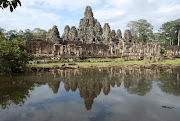
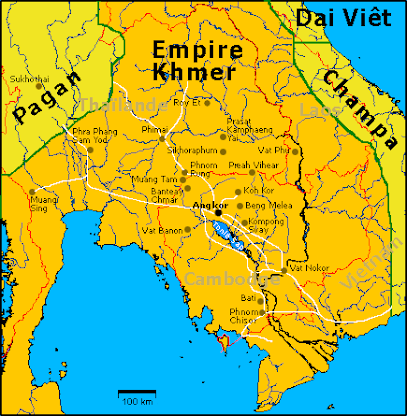
BANGKOK - THAILAND'S prime minister said on Tuesday he would not block attempts by neighbouring Cambodia to have the disputed Preah Vihear temple complex listed as a United Nations World Heritage site.
Thailand and Cambodia have historically both laid claim to Preah Vihear, an ancient Hindu site perched high on a mountaintop on the Thai-Cambodia border.
Newly-elected Thai Prime Minister Samak Sundaravej said his government had reached an agreement with their neighbour allowing Cambodia to propose Preah Vihear temple - but not the surrounding land - as a World Heritage site.
'Cambodia and Thailand are preparing to issue a joint communique, but first I have to inform the Thai people,' Mr Samak told reporters on Tuesday as he returned from an overnight trip to Cambodia, his first as prime minister.
'Cambodia confirmed that they will propose only the temple site for World Heritage status, not the surrounding area,' he added.
Thai Foreign Minister Noppadon Pattama said the communique would also stipulate that Thailand and Cambodia must jointly manage the area surrounding Preah Vihear.
The United Nations culture organisation Unesco ruled last year against granting the temple coveted World Heritage status, but recognised it as a significant international site.
Rumours swirled that Thailand had blocked Cambodia's efforts to have Preah Vihear listed, but Cambodian officials denied that and said they expected the temple would be accepted this year after they submit a management plan to the World Heritage Committee.
A dispute with Thailand in 2003 over Cambodia's Angkor Wat temple - the most significant symbol of the country's ancient Khmer empire - sparked a night of riots that saw Thailand's embassy and several Thai-owned businesses burned and looted in the Cambodian capital, Phnom Penh.
Disagreements over Preah Vihear, which sits on Cambodian soil but can only be easily accessed from Thailand, have long plagued Thai-Cambodian relations.
Former Cambodian king Norodom Sihanouk took Thailand to the World Court in 1962 over the two countries' claim to Preah Vihear. The court ruled that the temple belonged to Cambodia. -- AFP
Read more!

Wednesday, March 05, 2008
Thailand, Cambodia agree on UN plan for disputed temple

Wiregrass Man, "The Father of Baseball in Cambodia"

However, for one man, it's much more than a game. For Joe Cook it's an escape from a violent past.
Now Cook is using that game to teach kids about the country that took him in.
He's your average joe, but he doesn't look like it.
He and his family were forced from their native Cambodia to escape the genocide of the Khmer Rouge in early 1980's.
"Everything was just overwhelming at the time," says Cook.
Baseball opened up so much for Joe. It makes him feel American.
He's married with two children, and working as a chef in Dothan.
His first trip back to Cambodia was in 2002. It was on that trip that he made the decision to take the game that gave him so much back to the kids of Cambodia.
"I'll bring gloves, balls and I'm going to teach you how to play baseball," says Cook.
With his promise, Joe and the people of Baribo built their own field.
Joe's dream hasn't been easy to accomplish, though.
He doesn't make much money and what he does earn goes to paying bills and his family.
It's the passion for baseball in Cambodia that keeps him going.
Cook says, "I throw balls to the kid, they throw back to me, there's so much joy in that kids eye."
In December of 2007 Cambodia's first national baseball team competed in the Southeast Asian games.
Cook was able to be a part of that experience, because to many, he's the father of baseball in Cambodia.
"They always come up to me, ask me questions to learn about new things," says Cook.
Renewed fears for rare Mekong dolphin in Cambodia
PHNOM PENH (Reuters) - A sharp drop in the number Mekong dolphins born in Cambodia has renewed fears for the survival of the rare mammals, wildlife experts said on Wednesday.
Only three baby dolphins, one of them dead, were found during an annual survey conducted in late November, down from six newborns in previous years, Touch Seang Tana told Reuters.
Their weight had also dropped to under 2 kg (4.4 lb) from 5 kg (11 lb) in the 1980s, the chairman of the Commission for Mekong Dolphins Conservation said.
"A group of 10 full-grown dolphins living in the upper Mekong River had no babies at all this year," he said, blaming a shortage of fish and rising water temperatures which might have affected their reproductive systems.
There are about 150 dolphins living in the upper Mekong River, up from only 90 before a 2006 ban on net fishing in the eastern provinces of Kratie and Steung Treng.
Conservationists had hoped for a surge in newborn dolphins after the ban was imposed.
"Global warming may be a possible indirect threat to the dolphin population, particularly if their fitness is reduced," said Teak Seng of the World Wildlife Fund.
"Dolphins are very sensitive to changes in their environment such as water temperature and quality. Other factors may be more influential such as diseases and water pollution," he said.
Read more!
Monday, March 03, 2008
CNVLD Announces Annual National Disability Awards
The Cambodian National Volleyball League (Disabled) (CNVLD) has caught the spirit of the Recommendations of the Second International Conference on Accessible Tourism with its new National Disability Awards program.
As part of its ongoing commitment to promoting the Rights of Persons with a Disability, the CNVLD is proud to announce the inaugural CNVLD Annual National Disability Awards recognising commitment to accessibility and support in the Cambodian corporate sector.
After signing the UN Convention on the Rights of Persons with a Disability in October 2007, the Cambodian Government recently passed its domestic disability law.
Rising investment in Cambodia has also led to rapid urban development in the capital Phnom Penh. In response to Cambodia’s changing landscape, the CNVLD National Disability Awards aim to encourage local corporate sector social responsibility in Disability Rights and Access.
The 2008 CNVLD National Disability Awards will be presented for:
• Best Access: Hotel /Hospitality
• Best Access: Retail
• Best Access: Educational Institute
• Best Access: Restaurant
• Best Employer
• Best Corporate Support for Disability Rights
The CNVLD will assess the disability friendliness of some of Cambodia’s leading businesses based on a number of criteria including accessibility (entrances, steps, ramps, lifts, helpfulness / understanding of staff, use of facilities), positive employment and support for disability issues.
The inaugural 2008 CNVLD National Disability Awards winners will be announced on 1st September 2008. Category winners will be presented their awards along with the year’s best athletes by H.E Ith Sam Heng Minister of Social Affairs, Youth and Veteran’s Rehabilitation at the 2008 National Volleyball League Finals at the Olympic Stadium at the end of September 2008.
Award winners will receive unique a Cambodian trophy produced from destroyed AK-47s by Armed Art and a framed certificate. Award winners will also be provided stickers to promote their Accessibility Friendly’ status in their premises. Each winner will also be specially profiled on the CNVLD website.
Read more!
Small loans make a BIG difference
South Medford freshmen use idea from Nobel Prize winner to make Third World entrepreneurial dreams a reality
By Paris Achen
Lim Um, 55, wanted to buy a motorbike to help her and four of her seven children transport cookies and vegetables from their home 10 miles outside Phnom Penh, Cambodia, to sell at the market in the capital city.
Some students at South Medford High School recently loaned her about $25 to help her do so as part of a freshman world studies activity making microloans, small loans to poor entrepreneurs in developing countries with no collateral.
"It's awesome to be able to donate what is spare money to us, and to people there it makes a huge difference in their life," said freshman Kimberly Brown.
For the past month, the students in teacher Dave Lefkowitz's social studies classes have been making the loans online through Kiva, a nonprofit group in San Francisco.
Kiva participants loan some or all of the requested amount, and the borrower makes payments like any traditional loan.
Lefkowitz thought the concept devised by Bangladesh Professor Muhammad Yunus would be a good learning tool to connect students to other parts of the world, some of which they already study. Yunus won the Noble Peace Prize in 2006 for the role microfinance has played in helping to lift people out of poverty and provide their children with a better future.
"I'm a believer that teaching people facts is boring," Lefkowitz said. "For most of us, if we're not getting involved in society, we are only going halfway. I think you've got to get involved, and if we haven't taught students how to get involved we haven't done our job as teachers."
Lefkowitz's five world studies classes have loaned a total of about $425 to 17 people in Central America, South America, Africa and Asia. Another $170 raised by two students at a dance two weeks ago is waiting for distribution.
The students collect no interest on the loans. Instead, Kiva's field partners, usually small banks in the 41 countries, collect the interest on the loans in exchange for their services.
Kiva has facilitated more than 35,300 loans equaling more than $23.6 million in the past two years since its Web site was launched two years ago.
The average loan request is about $550.
As students scrolled through loan candidates on the Kiva Web site on a Thursday morning, the excitement was palpable.
The class selected Lim Um based on the number of children she has.
"Pay it," one student shouted, as if he were urging on his home football team to score a touchdown.
The class cheered as Lefkowitz clicked on Lim Um's name and typed in a credit card number to make the loan.
He also took the opportunity to review the characteristics of Cambodia, as the class has recently been studying the monsoon weather phenomenon in Asia. He quickly quizzed them on their knowledge of Buddhism, a dominant religion in the country, before moving on.
"I think doing this helps us learn where people are coming from and what other countries are like and teaches us to be more grateful for what we have," said freshman Kris Leitz.
About one-third to one-half of the world's population earns $2 day. That equals the price of a large cup of soda, noted freshman Jed Hamilton.
Teacher Joshua Wallace's Spanish class also has joined in after two of his students who are in Lefkowitz's class made a presentation about microloans. Wallace's class will translate letters between some of the Central and South American loan recipients and Lefkowitz's classes.
"That will take us one step further to see how the money is being used," Lefkowitz said.
Students said they were amazed to learn that poor people in developing countries have a better rate of loan repayment than middle-class Americans. Kiva loan recipients have a repayment rate of more than 99 percent.
"It kind of blows my mind because people in Third World countries have to struggle to pay these loans back," said freshman Corie Davis. "Those who don't have to struggle aren't as likely to pay it back. I don't know why that is, but maybe it's because people in Third World countries know what it's like to live without things."
Reach reporter Paris Achen at 541-776-4459 or pachen@mailtribune.com.
Read more!
Thai PM visits Cambodia to strengthen bilateral relations

The prime minister and his delegation left for Phnom Penh, the Cambodian capital, Monday morning on a two-day visit, after having made his first visit abroad since assuming the premiership in an official visit to Laos last weekend.
Foreign Minister Noppadon Pattama said the Thai premier's visit to Cambodia was aimed at strengthening ties between the two countries
Gen. Anupong Paochinda, Thailand's Army chief, who also accompanied the prime minister, said the main issue to be discussed with Cambodian authorities is border demarcation, which has not achieved much progress in the past.
Among the agenda items is the Cambodian request for a loan from Thailand to build a road with the budget of Bt1.4 billion (currently US$43.75 million).
Land development, oil and gas exploration in disputed, overlapping Thai-Cambodian geographic areas, are expected to be dealt with on the agenda, said Mr. Noppadon.
Speaking about the ancient Preah Vihear Khmer temple ruins, which Cambodia has proposed to the United Nations Educational, Scientific, and Cultural Organization (UNESCO) for designation as a World Heritage site, Mr. Noppadon said Thailand can discuss the issue to reach a solution with the neighbouring country. However, Cambodia said the issue won't be considered.
"The International Court of Justice in the Hague ruled (in 1962) that Preah Vihear temple belongs to Cambodia, but the move by Cambodia to push the temple on the UNESCO World Heritage list should neither affect Thailand's rights in the overlapping zone nor at the border," the Thai foreign minister said. (TNA)-E004
Cambodia launches second post-war census
PHNOM PENH, March 3 (Xinhua) -- With a budget of over six million U.S. dollars and a staff of almost 40,000 officials, Cambodia's second post-war population census began on Monday, local media reported.
The 10-day census is a major undertaking, the Mekong Times newspaper said, citing San Sy Than, director general of the Planning Ministry's National Institute of Statistics (NIS).
Each interviewer will gather data on 120 families, he added.
Census officials have been trained and notified families that a census would be taking place, San Sy Than said, explaining that basic demographic, economic, cultural and social information will be gathered.
"We will also gather family-related information about residential situations and household equipment," he was quoted as saying.
This work will help identify the number and characteristics of the people and to estimate population growth from the village level to the Kingdom as a whole, he added.
The Planning Ministry will announce the preliminary results of the census in August and the complete data by 2009, San Sy Than said.
Cambodia held the first post-war census in 1998, which showed the kingdom had a population of 11.4 million people.
Read more!
Sunday, March 02, 2008
US soldier's remains flown home from Cambodia
Phnom Penh - The remains of a US soldier believed to have been missing in action since the Vietnam War period were flown home from Cambodia Saturday. The unidentified soldier's remains are the 29th of a total of 55 US military personnel recovered who went missing in action in the South-east Asian nation during the late 1960's and early 1970's.
The soldier's remains were found in the Thai border province of Koh Kong, more than 300 kilometres south-west of the capital, the US embassy in Phnom Penh said.
It said the remains were being flown to a military facility in Hawaii in an effort to identify them before being awarded a full military funeral.
Read more!
Selling the largest Hindu temple in the world
Angkor Wat is celebrated, the world over, as a temple of steroid-induced proportions, buried for centuries in the forests of northern Cambodia before being rediscovered by modernity. Visitors such as I, expect to ‘stumble upon’ a giant temple rising about 700 feet in the air amidst the isolation of an intrusive forest.
In today’s global tourism industry, Angkor Wat is portrayed as that rarity, the last chance to truly discover.
There is some truth to this image. Before it was ‘discovered’ in 1840 by a French adventurer, it had not yet entered European imagination. During much of the late twentieth century, when global tourism really took off, Angkor Wat (means city temple) remained inaccessible due to a catastrophic civil war in Cambodia.
Besides, Angkor Wat is probably the largest Hindu temple in the world.
Built by King Surya Varman in the early 12th century, it is dedicated to lord Vishnu. Even the Creator of the Universe would have gasped at the scale of this creation—one square kilometer in size, and built on multiple levels. The artistry of each panel is intricate.
I spot a horde of Hindu tourists, aggressively explaining to their befuddled Cambodian guide that this is actually ‘their’ culture.
The truth is Hinduism in Cambodia dates back to the first century AD, brought by Indian traders from the kingdoms of Magadha (East Bihar) and Tamil Nadu. By the time of the Angkor era, this influence had flowered into a distinct culture of which Angkor Wat is the most enduring example.
So much for the product. Now the packaging.
Even at the time of its so called discovery, Angkor Wat was being administered by some one thousand Buddhist monks. Today, chattering groups of pliant tourists arrive in chartered planes to the nearby airport, Siem Reap. The scatter of shops around the temple sites—some mom and pop, some more enticing—sell every possible packaged memory. The entire area seems like a giant well run hotel.
This gilt-edged wrapping paper, however, is torn at places, revealing contradictions. In sharp contrast to the booming Asian Tigers that surround it, the Cambodian countryside is stark, famished and numbingly poor. Entirely different is Siem Reap, an artificial city, meant to service the many rich western and Japanese tourists who come to visit the Angkor temples. There are super markets everywhere, and the architecture is Baroque-meets-Surya Varman.
The obvious poverty of Cambodia seems to give way to a bubble of smooth highways and air-conditioned modernity. The economy seems as fissured: I could pay in Riel (the Cambodian currency), Baht or in US dollars.
Even the culture that was peddled as Khmer (the majority ethnic group in Cambodia) seemed hybrid. Like in neighbouring Thailand, the Angkor massages on offer in Siem Reap reflected the specific tastes of our globalised times. Eastern European women offer their white skin for the post-colonial Asian, and Nigerians peddle their bodies, rumoured to be well endowed, to Japanese women.
It may seem petulant to emphasise this lack of ‘authentic’ history here. After all every country packages its attractions in bubble wrap for outside tourists. But Angkor Wat’s history has been repackaged for its own people. For Cambodia has had to wrestle with notions of history like few others.
From 1974 to 1979, a far left Maoist regime controlled Cambodia. Until it was overthrown, the Khmer Rouge had succeeded in killing a tenth of Cambodia, forced the entire urban population to the countryside, and sought to radically reshape Cambodian society. Worse (if at all possible) was to follow.
During their fourteen years of exile and guerrilla warfare from the northern jungles, it laid ten million landmines across north Cambodia—one for each Cambodian.
Today, Cambodia enjoys a tenuous peace, and seeks to put behind its immediate past. The Angkor temples are now packaged for Cambodians, as a symbol of national unification.
Even the current Cambodian national flag carries an etching of Angkor Wat. But the phantoms of a grisly past cannot be wished away. Some temples in the Angkor area are still inaccessible due to landmines, and I saw many amputees hobbling across the temple stones.
Read more!
Saturday, March 01, 2008
Southeast Asia holidays now from just $1,530
See the sights in Borneo, Singapore, Langkawi, or Cambodia
www.Shermanstravel.com
Book by: ASAP
Travel by: Various through March 2008
The deal
Southeast Asia holds many a treasure for adventurous travelers, including some of the world’s most spectacular manmade wonders and natural marvels. We found well-priced deals to get you there, from Cambodia’s stunning Angkor Wat temples to the rainforests of Borneo and the island paradise of Malaysia’s Langkawi. Air and hotel packages to these stellar destinations now start at only $1,530!
Borneo holiday from $1,530
Just off the coast of Malaysia lies the captivating island of Borneo, with its lush jungles; a strong indigenous culture; and beguiling historical sights. Now you can visit it with the Asian Affair Holidays special at a super-low price of $1,530! This five-night holiday covers air from San Francisco or Los Angeles (just $60 extra from New York); lodging with daily breakfast at one of two luxurious resorts — the Shangri-la's Tanjung Aru Resort or Rasa Ria Resort; and a lunch-inclusive day trip to scenic Coral Island. This low price is good for travel between March 27 and 31 only.
Singapore & Langkawi for $1,688
Another terrific Southeast Asian destination is Malaysia’s Langkawi archipelago in the Andaman Sea. Rich in folklore and legends, this cluster of 99 islands provides an ideal tropical retreat. You can check it out, together with Singapore, with the Asian Affair Holidays package for $1,688. Good for departures through March 31, this six-night city and beach escape comes with airfare from San Fransisco or L.A. ($60 extra from N.Y.); airport transfers; deluxe lodging; and a couple of tours (a half-day city tour of Singapore and a half-day island-hopping tour in Langkawi).
Singapore & Cambodia for $1,570
Another trip we recommend: combine the city-state of Singapore and Cambodia’s marvelous Angkor Wat temple complex and you’re in for a real treat! This exact itinerary is currently on sale by Asian Affair Holidays for $1,570. Good for departures through March 31, it covers airfare from L.A. or San Fransisco ($60 more from N.Y.); two nights’ upscale lodging in Singapore, with a half-day city tour; three nights in the jungle town of Siem Reap (the gateway for Angkor Wat), with two full-day temple tours; all transfers; and daily breakfasts.
The dollars
The rates above are listed per person, based on double occupancy. Accommodation may be wonderfully affordable once on the ground, but the cost of flying to Southeast Asia is known to break the bank. Indeed, if you take only the cost of airfare to these far-flung destinations, you’ll found it can rise as high as the price of these hotel-inclusive packages.
The catch
Make sure you get all the right jabs!
Read more!
Friday, February 29, 2008
ASEAN countries suffer huge economic loss from poor sanitation
BALI, Indonesia, Feb. 28 (Xinhua) -- Four countries in Southeast Asia, Cambodia, Indonesia, the Philippines, and Vietnam have suffered 9 billion U.S. dollars economic loss annually due to poor implementation of sanitation, about 2 percent of their combined GDP, a recent study conducted by the World Bank has said.
The study said that Indonesia, the biggest Southeast Asia economy, had suffered the most losses of 6.3 billion U.S. dollar per year.
Indonesia has struggled to save its state budget from the impact of the global economic slowdown, soaring oil price and commodities, as well as high inflation pressure. The government has planned to widen the budget deficit from 1.7 percent of the GDP or 73.3 trillion rupiah (about 7.97 billion U.S. dollars) to 2percent of the GDP or 83.7 trillion rupiah (some 9.1 billion U.S. dollars).
"Should sanitation be improved, the losses can be reduced and it can help reduce the deficit," an expert of the World Bank who goes with single name Saputra told Xinhua at a workshop on sanitation here.
Health and water impacts are the largest contributors to overall costs, said the study. The health costs were dominated by premature death, especially in youngsters, while water-related costs were dominated by access to clean drinking water, it said.
Overall 4.8 billion U.S. dollars were lost annually to sanitation-related diseases, of which 3.35 billion U.S. dollars lost in Indonesia, one billion U.S. dollars in the Philippines, 260 million U.S. dollars in Vietnam, and 187 million U.S. dollars in Cambodia, it said.
Diseases resulted from poor sanitation impact expenditure patterns, productivity and the income of household, government and enterprises, it said. On water, countries which have abundant internal freshwater resources, suffered significant freshwater pollution from human activities.
ASEAN countries have a combined population of 580 million with a gross domestic product of 1.1 trillion U.S. dollars.
Read more!
Exotiq RE reveals expansion plans
By Robert Carry
Exotiq Real Estate has revealed that it plans to further expand its services in Southeast Asia with Malaysia, Vietnam and Cambodia all set to be targeted.
The resort-based realtor, founded in 2001, currently has 11 offices in six locations spread across Indonesia and Thailand and a database of 4000 property listings is also planning to open offices in Australia and New Zealand.
Dominique Gallmann, one of the founders of the brand and current director for operations in Indonesia, said the company´s open approach has been key to its success to date: “We provide transparency in a largely unregulated marketplace with high quality, un-biased, property advice that is difficult to find in an environment where agents are typically trying to sell their own developments.”
The massive number of units Exotiq has on file has also been key to successfully matching buyers and homes. Angus MacLachlan, co-founder and director for operations in Thailand explains, “Each office in the network specializes in its local territory and contributes its listings to a central database. This allows us to pull together virtually every decent property on the market, creating enormous choice for our clients.”
Read more!
Thursday, February 28, 2008
Hun Sen Slams UN for Giving Asylum to Refugees in Cambodia
Cambodia's prime minister slammed the UN's refugee agency Thursday for using Cambodian territory to grant political asylum to foreign refugees without first consulting his government.
Prime Minister Hun Sen said the Cambodian office of the United Nations High Commissioner for Refugees has granted asylum to refugees from Afghanistan, Pakistan and Nigeria.
"What right does it (UNHCR) have to use Cambodian territory to provide foreign nationals with political asylum without seeking permission from the Cambodian authorities," Hun Sen said in a speech at a development conference.
He did not say how many refugees were in Cambodia or how long they had been there. He said he ordered the foreign affairs and interior ministries to look into the issue with the UNHCR.
Toshi Kawauchi, a UNHCR protection officer, declined to comment on the issue, saying in an e-mail his office is "not in a position to discuss the numbers and other details of the refugees."
The relationship between Cambodia and the UN agency has been rocky in recent years, especially over the issue of refugees fleeing neighboring Vietnam.
Thousands of Vietnamese hill tribe people known as Montagnards have fled to Cambodia since 2001, when Vietnam's communist government cracked down on protests against land confiscation and restrictions on religious freedom. Many have been resettled in the United States, and a small number have voluntarily returned to Vietnam.
Read more!
Deputy PM attends Vietnam-Cambodia meeting on border co-operation
Yuon Communist always need border cooperations from Cambodia side, but there were no cooperations from Yuon Hanoi side for Cambodia. The more cooperation mean more Yuon immigrant free flowed into Cambodia with creeping political organizations in every province.
Permanent Deputy Prime Minister Nguyen Sinh Hung arrived in Cambodia on February 27 to attend and co-chair the fourth Vietnam-Cambodia meeting on development cooperation in border provinces held in Sihanoukville from Feb. 27-28.
After an official welcome ceremony, Deputy PM Hung exchanged views at a closed session with Cambodian Deputy PM and Minister of Interior Sar Kheng on Vietnam-Cambodia bilateral ties and cooperation between border sharing provinces.
In the evening, Deputy PM Sar Kheng hosted a banquet for Deputy PM Hung his delegation.
At a senior officials meeting (SOM) held the same day, the two sides reviewed their cooperation in implementing agreements reached at the third meeting, which was held in Vietnam ’s An Giang province in 2006. They discussed measures to promote cooperation between border provinces in security, economy, culture, education, vocational training and health care.
The two sides approved contents of documents which will be presented at a plenary session on February 28. (VNA)
Read more!
Cambodia bans songs deemed to incite marital infidelity
Phnom Penh - The titles of the three songs banned from public broadcast for inciting infidelity say it all, according to Cambodian government and cultural officials, local media reported Thursday. The offending songs, If I Can't Be First Can I Be Second?, Love Another's Husband and May I Have a Piece of Your Heart Too? have been banished from the nation's thousands of karaoke restaurants, Khmer-language Koh Santepheap reported.
"We are searching for other songs which affect people's honour, especially that of women," the paper quoted Phnom Penh governor Kep Chuktema as saying.
The three songs are all written to be sung by women, but pop music analysts said Thursday they are relatively obscure tunes.
The ban is a further step by the government to crack down on unfaithfulness and "uphold cultural values."
Cambodia passed a controversial monogamy law in September 2006 which would see adulterers punished by up to 250 dollars in fines and a year in jail, though only one case has so far gone to court.
Although an outwardly conservative culture, the practice of keeping second wives, or mistresses, remains common, and many karaoke girls seek out "sweethearts" to supplement their earnings.
"People can still play the songs in private - this is only a public ban," one official said on condition of anonymity. "I don't think music has much to do with it, but it's an official request."
Read more!
Wednesday, February 27, 2008
Cambodia suspends to release alleged terrorists
PHNOM PENH, Feb. 27 (Xinhua) -- The Cambodian Supreme Court here on Wednesday delayed to release verdict for three men charged with attempted murders of diplomats by suicide bombing and explosion against western countries' embassies in Phnom Penh.
Haji Chiming Abdulazi, 42, and Muhammady Alaludim Mading, 46, both Muslim from Thailand, as well as Cambodian Muslim Sman Esma El, 30, were already sentenced to life in jail by the Phnom Penh Municipal Court and the Appeal Court.
"We delayed to release verdict for the case and we will declare it on March 13," said Khim Pon, president of the Council of Judgment, after over four hours of hearing.
The trio were charged with planning to murder diplomats through suicide bombing and explosion against western countries' embassies in Phnom Penh, including those of United States, Britain and Canada, said prosecutor Chhoun Chantha in the courtroom.
"They were also linked with regional terrorist group the Jemaah Islamiyah," he added.
The group's leader, Hambali, was arrested by the Thai authorities in February 2004, after reportedly staying for six months in Cambodia, he said.
They were connected with international terrorism group the Al-Queda and their acts were of international terrorism, he said.
The Cambodian police authorities arrested the three men in cooperation with the U.S. Federal Bureau of Investigation (FBI), Chhoun added.
Read more!
Tuesday, February 26, 2008
Cruising Cambodia has never been so luxurious - Feature
Phnom Penh - Cambodia may not be the first place cruise liner passengers think of as the perfect luxury layover, but Cambodian officials are determined to change all that. With its pristine white sand beaches, some of the best diving in the region, inexpensive seafood delicacies and legalized gambling, Cambodia's main problem in the past has been that its ambitions have outstripped its infrastructure.
But all that is changing, says tourism minister Thong Khon.
"So far we have 1,000 rooms in Sihanoukville, but we are planning to have 1,000 more by 2009," he says. "The ministry, the private sector and local authorities are all working hard to improve infrastructure."
Sokha Hotel Group, owner of the 5-star Sokha Beach Resort, has just announced plans for a second 5-star resort just a few beaches away. Like its sister hotel, the resort also plans a private beach.
The developments appear to be paying off. So far this year five cruises carrying US, Asian and European tourists have docked in Sihanoukville, bringing 4,832 visitors, equal to the entire 2007 total, according to the port's general director Lou Khim Chhun.
The country's only deepwater port, Sihanoukville Autonomous Port is located about 240 kilometres from the capital and Chhun says that although the lack of infrastructure caused cruise ship visitors to dip by half last year, 2008 is already shaping up as a bumper year.
The port, touted to be one of the first companies listed on a Cambodian stock exchange planned for 2009, has already constructed a special dock dedicated to cruise liners.
Chhun admits he is rubbing its hands at the prospect of wealthy tourists entering the country by sea, taking advantage of the newly refurbished airport at Sihanoukville to fly to the ancient Angkor Wat temples, and returning to wine, dine and enjoy the several plush casinos.
"We have the capacity for four to five cruises to pass through per week, which equates to 4-5,000 visitors. I believe Sihanoukville is ready to extend its services as a cruise port. We certainly plan to host more and more," Chhun says.
Opportunities for day trips abound. The area's mushrooming dive companies speak of whale sharks, rare pink dolphins and untouched coral reefs.
Dugongs are known to inhabit areas near the municipality. Nearby Ream National Park's virgin forests teems with wildlife.
Sokha Hotel Group just announced yet another luxury resort for the former French hill station of Bokor in nearby Kampot province and with oil from offshore reserves expected to begin flowing within two years, infrastructure looks set to continue to develop rapidly.
Cambodia has won over some powerful allies. Royal Caribbean Cruises has named Sihanoukville as a prime layover for its flagship Rhapsody of the Seas and is enthusiastic about it on its website.
"Cambodia is best known as the occasional side trip to Angkor Wat ... on your way to or from Thailand. But all that is changing with the revitalization of Sihanoukville, Cambodia's one and only beach resort," the cruise giant gushes.
Royal Caribbean Cruises Asia-Pacific managing director, Rama Rebbapragada, has predicted Cambodia will also benefit as a port of call from Hong Kong's planned new cruise terminal.
As people rediscover the charm of cruise holidays, the 10-member Association of South-east Asian nations of which Cambodia is a member continues to push itself as a major player.
ASEAN Cruise Working Group chairman, Kevin Leong, estimates the sector in the Asia-Pacific is expected to grow by more than 40 per cent from 1.07 million in 2005, to 1.5 million by 2010, reaching 2 million in 2015.
Cambodia's ambitions are slightly more modest, but no less integral to its plans for its already booming tourism industry.
"This year is the first time we will attract more than 5,000 cruise visitors. It's a big step forward and we are very optimistic about our future," Thong Khon says.
Read more!
Food inflation hits Cambodia's poor, threatens hunger
 Cambodian women are cutting fishes making Prahok(salt fish fermented) for the price of triple due to scarcity of fishes in this year.
It is the 45-year-old farmer's fourth unseasonably cold dawn in this quiet Muslim neighbourhood on the outskirts of Phnom Penh, where her extended family has set up camp with others from their village in the southern province of Takeo.
Like tens of thousands of rural Cambodians, they have joined the annual migration to the river to buy enough fish to make a year's worth of prahoc, a pungent fermented paste that is the only source of protein for many in the country's impoverished rural regions.
But the rice brought they from home has nearly run out and the fish have yet to appear in the large nets strung across the river in front of their camp.
The crude bamboo and metal mesh processing stalls on the riverbank are silent -- and February is the last month of the fishing season.
A sudden drop-off in the numbers of prahoc fish has seen their price more than triple this year, up to as high as 50 US cents a kilogramme from around 12 cents, putting this most basic of Cambodian commodities out of reach for many.
While not normally a benchmark by which to measure food security, prahoc prices have highlighted the spiralling costs of staple goods that are threatening Cambodia's poorest with hunger.
"We eat prahoc every day. Last year we made so much that we could sell some or trade it for rice," Doem Lao said, sitting in a tight circle with other village women and a few young children, while their men stood further up the river bank smoking cigarettes in anticipation of another long day spent waiting.
"This year I'm not at all hopeful. Some of us have left already. We're not going to have enough prahoc. We're not even going to have enough rice," she said.
Across Asia the cost of food is rising, for a variety of reasons, from higher demand and spiking global oil prices to environmental factors like global warming which disrupt the normal agricultural cycles.
But while other regional governments have responded by cutting import tariffs or establishing national food stockpiles, Cambodia appears reluctant to step in and halt the continuing upward climb of food costs.
For poor Cambodians, this means that in addition to losing their traditional staples like prahoc, they are not able to supplement their already meagre diets with other foods, particularly meat.
"Everything now is so expensive," said another village woman, Bhum Sap, rattling off the current prices of chicken, pork and beef, which can cost as much as five dollars a kilogramme, a fortune for Cambodia's estimated 4.6 million people struggling to live on less than one dollar a day.
Cambodia, in some ways, has become a victim of its own economic success. The country has recorded economic growth averaging 11 percent over the past three years, spurred on by a galloping tourism sector and strong garment and building industries.
Growing interest by foreign investors and a real estate boom that has helped create more than a few overnight millionaires have resulted in an unprecedented explosion of wealth.
But the sudden influx of cash into the fragile economy has not come without its pitfalls.
Over the past year inflation has spiked at 10.8 percent, compared with 2.8 percent at the end of 2006, driving up the cost of food and other staple goods and pushing the most vulnerable deeper into poverty.
"About 8.5 percentage points of December's inflation rate of 10.8 percent was accounted for by food price inflation," said the International Monetary Fund's Cambodia representative John Nelms.
For as many as 2.6 million people living in extreme poverty, the situation has been worsening over the last several years, which have been marked by poor harvests brought on by natural disasters such as flood or drought.
"Too many Cambodians still suffer from hunger and malnutrition for some or most of the time," the World Food Programme (WFP) said on its website.
The unrelenting rise in food costs only adds more depth to their misery.
"WFP is very concerned about the general increase of the cost of the staples, in Cambodia as well as elsewhere," the agency's country director for Cambodia, Thomas Keusters, told AFP.
Food inflation has even affected aid efforts at a crucial time, as aid agencies anticipate the need for more handouts in rural areas facing a leaner than normal year ahead.
In January last year, the WFP paid 237 dollars per metric tonne of rice, a cost that has now risen to 367 dollars a tonne, Keusters said.
"For every dollar received from the international and local donor community, we buy 55 percent less rice. With the general increase in the cost of food, the need for food assistance will not decrease," he said.
"On the contrary. As Cambodia faces new challenges such as climate change, changes in food availability, high energy prices, globalization and many more, we all need to strategise better," he said.
Monday, February 25, 2008
Senior Chinese leader meets Cambodian official
BEIJING, Feb. 25 (Xinhua) -- He Guoqiang, a senior leader of the Communist Party of China (CPC), met here on Monday with Keo Puth Rasmey, chairman of Cambodia's Funcinpec Party and deputy prime minister.
He, a member of the Standing Committee of the Political Bureau of the CPC Central Committee and secretary of the Central Commission for Discipline Inspection (CCDI), said that relations between China and Cambodia had maintained smooth development, with fruitful cooperation in various fields.
He said that China treasured the traditional friendship with Cambodia and would always be Cambodia's good neighbor, friend and partner.
He applauded Cambodia's adherence to the one-China policy.
He said that the CPC was ready to increase exchanges with the Funcinpec Party through high-level visits and youth exchanges, in a bid to advance China-Cambodia relations continuously.
He briefed Rasmey about the 17th CPC National Congress, as wellas the upcoming "two sessions", or the annual sessions of the National People's Congress (NPC) -- the parliament -- and the National Committee of the Chinese People's Political Consultative Conference (CPPCC), the top advisory body.
He also talked about China's struggle against recent weather disasters and preparations for the Beijing Olympics.
Rasmey said that Cambodia and the Funcinpec Party would firmly stick to the one-China policy and the Funcinpec Party would further promote friendly cooperation with the CPC.
Wang Jiarui, head of the International Department of the CPC central Committee, also attended the meeting.
Read more!
Sunday, February 24, 2008
French Colonial Class Stirs Property Investment in Cambodia
Longstanding and reputable overseas property investment specialists David Stanley Redfern Ltd have recently presented their stunning 1-2 bedroom French Colonial apartments in the emerging property market of Cambodia.
/24-7PressRelease/ - NOTTINGHAM, UK, February 24, 2008 - Available with a guaranteed 10% net return for the first 2 years and an expected 15%-20% capital growth to follow in light of Cambodia's thriving economy, this opportunity is one that's certainly not to be missed.
With just a 1000 reservation fee to secure the property and the 65% 'pay upon satisfactory completion' offer that's attached, the fail-safe purchase of a high demand apartment in the Cambodian capital is a whole lot more affordable and obtainable than you might imagine. Foreign investment in Cambodia between 2004 and 2005 increased by an astounding 450% and when combined with Cambodia's already strong tourism industry and its expected increase of 20% per year for the coming 5 years, tenancy is surely rewarding as well as being as good as guaranteed. With Cambodia's future and all investments made in it looking so promising, the financial benefits are clear but, what do you get for your money?
There's more to Cambodia than its cascading waterfalls, exotic tropical life and ancient relics from an austere but nonetheless auspicious cultural heritage. Modern day Cambodia enjoys a lifestyle not too dissimilar to any enjoyed in the developed western world and cinema, nightclubs, wining and dining are commonplace.
A handful of annual festivals and celebrations are also held, with anything from ploughing, paying respects to loved ones passed and performing arts being the featured theme, reflecting Cambodia's contrasting and simplistic sense of tradition. Understandably a popular tourist destination being the location of the auspicious Royal Palace, Phnom Penh is Cambodia's capital city and host to a number of accommodating local amenities that include restaurants, shops and various other attractions, so to hear that the only thing missing from the Cambodian property landscape are the highly sought after 'western' style apartments like the ones offered with this opportunity, is not only good news, it's time sensitive news.
Assertive and shrewd investors out there are sure to take advantage of these remaining apartments and so if this could be for you, you at least owe to yourself to contact David Stanley Redfern Ltd for an obligation-free chat about the varying specifications and services on offer, as well as any other queries or concerns you might have.
Find out more at http://www.davidstanleyredfern.com/investment-property/cambodia/property/french-colonial-apartments.php
About David Stanley Redfern
David Stanley Redfern Ltd is one of the U.K.'s leading overseas property investment specialists. The reasons for this are an incomparable range of international properties spanning 40 destinations worldwide, and unrivalled customer care, which lasts long after the purchase has been completed. Experienced, professional staff and membership to the overseas property market's regulatory body: the Association for International Property Professionals, as well as their stringent due diligence procedures gives buyers the confidence that any purchase with David Stanley Redfern is a safe one.
DSR have just branched out into the _a href="http://www.overseaspropertyrentals.com"_Overseas Property Rentals_/a_ industry.
Media enquiries should be directed to Liam Bailey: media@davidstanleyredfern.com
Read more!
Cambodia to restore its historic rail links
The Asian Development Bank (ADB) and the Royal Government of Cambodia will be working together to restore around 600 kilometres of rail track between Thailand and Cambodia over the next two years.
“This is one of the last steps in the creation of a regional railway that will stretch from Singapore to Beijing,” said ADB President Haruhiko Kuroda at a ceremony in Sisophon, Cambodia. “Soon, trains will be running from Singapore to Sihanoukville.”
Another 48 kilometres of track near the Thai border will also be restored under the initiative.
Cambodia’s railway rehabilitation project will be funded by a $42 million concessional loan from the ADB. The authority will also appoint an international railway operator to operate, maintain and invest in the railway over the next 30 years.
The upgrade will not only revitalise Cambodia’s railways, but also enhance trade through reduced transport costs. The railway will also help ease traffic on Cambodia’s roads.
The project forms a vital component of the Greater Mekong Subregion’s southern corridor which links Thailand, Cambodia and Vietnam.
Read more!
Saturday, February 23, 2008
Pol Pot murdered Scot in Cambodia
MORE THAN 1.5 million people died in the killing fields of Cambodia, but one of the most puzzling footnotes in the slaughter and destruction of that country is the unsolved murder of the only British victim - the first Westerner caught up in the violence.
Gunmen burst into Scottish academic Malcolm Caldwell's Phnom Penh government guesthouse and shot him repeatedly in the chest and leg, killing him instantly. He was found with his apparent assassin slumped by his body and also riddled with bullet holes. At the time, the BBC reported he was killed by Vietnamese agents to discredit Pol Pot, but 30 years after the murder documents newly obtained by the Sunday Herald under the Freedom of Information Act reveal that the genocidal dictator himself ordered the assassination, early in the morning of December 23, 1978.
Just hours earlier, the 47-year-old father of four had met the despot, demanded to see deposed leader Prince Sihanouk and had asked about missing Cambodians and ministers, most of whom, it transpires, were already dead.
According to the classified documents, journalist Wilfred Burchett had seen an official Cambodian report a year later which said: "Caldwell was murdered by members of the National Security Force personnel on the instructions of the Pol Pot government."
An unnamed British civil servant adds: "Caldwell told Burchett he had every intention of asking some pointed questions and that he was absolutely determined to see Sihanouk.
"It is likely, therefore, that he upset his hosts, who were probably concerned that a prominent supporter/apologist of the Pol Pot regime might report in a critical vein on his return home.
"Matters probably came to a head after a private interview which Caldwell had with Pol Pot."
The papers also reveal a chilling account of the murder from eyewitness Richard Dudman, made five days later at the British embassy in Washington. The journalist for the St Louis Dispatch told officials of the moment a young gunman shot at him and Caldwell in the Khmer Rouge VIP guesthouse at 12.55am.
Born in Stirling into a middle-class Tory-voting household, Caldwell went on to get a double first at Edinburgh University by the time he was 21. He became a Marxist academic at London University's School of Oriental and African Studies and a left-wing activist, serving as head of CND in 1968-70.
A supporter of the Khmer Rouge, he was one of the first Westerners allowed into the country after 1975, and travelled to Cambodia with Dudman and fellow American journalist Elizabeth Becker just as the true horror of the genocide was becoming apparent.
Caldwell had spent three weeks touring the country surrounded by Khmer Rouge minders but had seen and surreptitiously photographed the impoverished peasants.
Dudman reported that in Phnom Penh he knocked on Caldwell's door as a young uniformed man appeared in the corridor with a machine gun on his shoulder and a pistol in his hand and fired at the two men. Dudman ran into his room and two shots were fired into the door. Then he heard more shots. 90 minutes later, a Cambodian security officer told Dudman that Caldwell was OK and he had to stay in his room.
But, Dudman then said, "An hour later a high ranking foreign office official told me Malcolm Caldwell was dead and asked me to witness the scene."
Dudman went to look and saw the open door of Caldwell's room and saw his dead body "supine, eyes wide open and body soaked in blood".
He estimated Caldwell had been hit at least three times. The official told Dudman that the dead gunman had shot Caldwell and then shot himself.
Becker's account indicates that the murder scene could have been staged. The Washington Post journalist found herself face to face with the killer and ran back into her room and hid in her bath.
After the shots, she then heard bodies being dragged up and down stairs on three different occasions. Dudman and Becker later noticed that there were bloodstains on the stairs and corridor.
The Foreign Office officials speculate that because of the time lapse and Becker's account, it was very possible that Caldwell's murder scene had been stage-managed.
Read more!
Asian Countries Discuss Issues Surrounding HIV/TB Coinfection
Health officials from nine Asian countries on Wednesday met in Phnom Penh, Cambodia, to discuss strategies for curbing the spread of tuberculosis among people living with HIV/AIDS in the region, DPA/Earth Times reports.
At the meeting, representatives from Cambodia, China, Fiji, Laos, Malaysia, Mongolia, Papua New Guinea, the Philippines, Vietnam and the World Health Organization voted to implement measures to expand HIV and TB testing among people diagnosed with one of the diseases, as well as to maximize early access to antiretroviral drugs.
Shigeru Omi, regional director for WHO's Office for the Western Pacific, said that people who are newly diagnosed with TB have "insufficient access to HIV testing, resulting in the late diagnosis of HIV coinfection" (DPA/Earth Times, 2/20). Omi said that between 25% and 50% of people diagnosed with TB in the Western Pacific region die because they do not have adequate access to HIV tests.
According to a statement released by WHO, HIV-positive people who develop TB are 10 times more likely to die earlier than those who do not have TB. The number of TB cases in the Western Pacific region accounts for about one-third of the global TB burden, Xinhuanet reports (Xinhuanet, 2/20).
Reprinted with kind permission from http://www.kaisernetwork.org. You can view the entire Kaiser Daily Health Policy Report, search the archives, or sign up for email delivery at http://www.kaisernetwork.org/dailyreports/healthpolicy. The Kaiser Daily Health Policy Report is published for kaisernetwork.org, a free service of The Henry J. Kaiser Family Foundation© 2005 Advisory Board Company and Kaiser Family Foundation. All rights reserved.
Read more!
Friday, February 22, 2008
Former Khmer Rouge leader to 're-enact' crimes for judges

The Khmer Rouge's chief interrogator who headed the notorious prison where 14,000 Cambodian men, women and children met their deaths is to return to the scene of his alleged crime next week to stage a ghoulish "re-enactment".
The extraordinary scene will see 65-year-old Kaing Guek Eav, known as Duch, guide investigating judges from Cambodia's UN-backed genocide trial through the Tuol Sleng torture centre almost three decades after he fled the advancing Vietnamese troops that ended the Khmer Rouge's four-year reign of terror.
Several of only seven people who survived their incarceration in the former school in Phnom Penh's suburbs will join the party next Wednesday.
Afterwards they will give taped evidence in a "confrontation" with their Khmer Rouge jailer at the tribunal's headquarters.
A day earlier, Duch, who is charged with crimes against humanity along with four other senior Khmer Rouge leaders, will be taken to the Killing Fields of Choeung Ek on the capital's outskirts where most Tuol Sleng inmates were murdered and buried in shallow graves.
Duch, who was a maths teacher before joining the revolution to establish a peasant utopia, will explain to the French co-investigating judge, Marcel Lemonde, and his Cambodian counterpart, You Bun Leng, the details of what happened there in the years after 1975, when up to 1.7 million people died.
The first war crimes trials are due to begin later this year, confounding the fears of many of the Khmer Rouge's victims that the communist ideologues responsible for killing a quarter of the population through torture, execution, disease and starvation might never be brought to justice.
Almost a decade of wrangling over the ground rules governing the tribunal and many petty disputes between the Cambodian judges and lawyers and their international counterparts had threatened to kill off the process before it started.
But the arrests of four senior Khmer Rouge leaders, and the detention by the tribunal of Duch, who was already in military custody, has seen the process move swiftly forward.
The defendants have unsuccessfully appealed their detention orders and have even been confronted by their victims in emotional court testimony.
The re-enactment is part of the judges' investigative process to gather evidence against Duch, who has acknowledged his role in the Killing Fields after finding Christianity.
However, he contends that he was merely following Pol Pot's "verbal orders from the top".
Duch will be accompanied by his lawyers as he walks the judges around the two sites in private. Both serve as a memorial and museum to the dead but will be closed to the public during the re-enactment.
The Killing Fields memorial at Choeung Ek is a glass tower of piles of victims' skulls discovered in the surrounding shallow pits. Duch allegedly sat under a tree watching as Khmer Rouge executioners murdered their victims.
Classrooms at Tuol Sleng remain much as they were left in 1979, with metal-framed beds to which victims were chained before being electrocuted to make them confess to non-existent crimes, invariably of being CIA agents.
Paintings by one Tuol Sleng survivor, Van Nath, graphically portraying other tortures carried out there, adorn the walls of some rooms. The vividly-coloured oils sit beside the stark black-and-white photographs of the thousands brought to the prison.
"For the re-enactment Duch will be assisted by his lawyer," said Lemonde. "This is a normal investigative action, the aim of which is to clarify the declarations by each of the participants, using photos, audio-visual recordings and 3D reconstructions."
Faber Sees a Holiday in Cambodia for Investors: William Pesek

There, 25 miles (40 kilometers) north of the temples of Angkor, you'll find a small nature preserve. The Angkor Centre for Conservation of Biodiversity is one of a handful of efforts to protect Cambodia's wildlife that sprang up during the last nine years of peace.
It's mostly a breeding facility for critically endangered animal species. There, you will come face to face with gibbons, lemurs, turtles, scores of local birds and even native bees. The scene may offer one of the best reasons for investors to pay more attention to Cambodia.
When most think of Cambodia, extreme poverty springs to mind. While stability since 1998 is raising living standards, a third of the nation's 14 million people live on less than 50 cents a day. Much of the blame goes to lingering fallout from the mass killings by the Khmer Rouge from 1975 to 1979.
There's a cruel irony to the fact that Cambodia's No. 2 tourist attraction is the infamous ``Killing Fields,'' one of the sites where an estimated 1.7 million died under dictator Pol Pot. Nearby, hawkers still sell Dead Kennedys T-shirts, a nod to their 1980 song ``Holiday in Cambodia.''
Bullish
Yet waves of tourists are making their way to Cambodia, pumping up its $7 billion economy. Until recently, most made a beeline for Siem Reap, where Angkor's magnificent temples rise defiantly from dense forests. These days, more are exploring the nation's capital, Phnom Penh, and the fast-growing selection of beach resorts.
In 2007, tourist arrivals topped 2 million. For an economy that depends largely on the garment sector -- it accounts for 80 percent of exports -- increasing tourism is a big plus. It will help sustain the roughly 10 percent growth of the past four years.
Together with efforts by conservationists around the country, strong growth explains why investors such as Marc Faber are bullish on Cambodia. Both show that after decades of struggling to survive, Cambodians are getting serious about preserving their heritage and competing in the globalization age. Cambodia, in other words, is becoming a normal country.
``Cambodia offers an enormous potential for future capital gains,'' says Faber, the Hong Kong-based investor and publisher of the Gloom, Boom & Doom report. ``It may take some time, as was the case for Vietnam and India, where stocks languished for a number of years before huge upward trends in asset prices developed. But patience was amply rewarded.''
Contrarian Bet
The Asian Development Bank continues to pump fresh aid into the economy. ADB President Haruhiko Kuroda was in Cambodia this week to christen a project to rebuild decades-old railway tracks to spread the benefits of growth.
More importantly, the government is stepping up efforts to attract foreign capital. It plans to set up a stock market in 2009 and officials are working to diversify the economy. Prime Minister Hun Sen recently visited India and appealed to technology firms to invest in Cambodia.
Of course, Cambodia is a contrarian investment with a capital ``C.'' For every positive trend cited in this column, one can find a reason, or two, to avoid the place.
While Cambodia has great promise, says Simon Ogus, chief executive of DSG Asia Ltd. in Hong Kong, it has a long, long way to go before many investors are willing even to consider putting money there. For one thing, he says, ``the monetary system is 95 percent dollarized'' and the country lacks a bond market.
Poverty
Cambodia's challenges run deeper. Crushing poverty means all too many aren't being educated to compete globally. Good roads, bridges, and power systems are in short supply. The export-dependent economy is vulnerable to a U.S. slowdown and rising fuel costs.
Corruption means double-digit growth doesn't get very far anyway. In Transparency International's 2007 Corruption Perceptions Index, Cambodia ranked 162nd -- behind Bangladesh, Zimbabwe and Tajikistan.
Cambodia also is sitting on a discovery that will either attract investors or have them aggressively avoiding the country: oil. While deposits are still being estimated, the potential of Cambodia's petroleum industry is attracting interest from BHP Billiton Ltd. and Chevron Corp.
Next BRICs
The question is what happens to billions of dollars of oil revenue. Corruption-prone governments have a poor track record of using such wealth wisely, too often suffering the ``oil curse.'' Since weak institutions oversee its underdeveloped economy, Cambodia's odds aren't great.
Then again, what if Cambodia surprises skeptics? That's a big ``if,'' given the prime minister's failure to eradicate corruption and crack down on illegal logging.
Yet investors are searching for the next generation of developing-market stars now that the ``BRIC'' economies -- Brazil, Russia, India and China -- and Vietnam have been discovered. Watching neighboring Vietnam thrive also may inspire Cambodia's government.
If oil profits are used to improve education, reduce poverty and upgrade infrastructure, investors who took a chance on Cambodia will be, in Faber's words, amply rewarded.
(William Pesek is a Bloomberg News columnist. The opinions expressed are his own.)
Thursday, February 21, 2008
Cambodia builds two statues for famous monk and musician
PHNOM PENH, Feb. 21 (Xinhua) -- The city government of Phnom Penh on Thursday held inauguration ceremony for the statues of a famous monk called Choun Nat and a musician called Krom Ngoy to honor their efforts and contributions to help the Cambodian society in the 19th and 20th centuries.
"We built their statues to respect and honor their efforts while they were alive in helping Cambodian society," Major Kep Chuktema said while addressing the ceremony.
The statues, which were made of copper and gold, were over two meters in height.
Choun Nat's statue is located in Hun Sen Park and Krom Ngoy's statue is in a Public Park in front of the Cambodiana Hotel.
Choun Nat (1883-1969), was former Buddhism Patriarch, or Chief of Cambodian monks. He is also linguist, poet, writer and literateur.
Choun Nat, who made great contribution in composing the Khmer language dictionary, is known as the most impressive literature and cultural promoter that Cambodia ever produced.
Krom Ngoy (1865-1936), was a musician for Tro-Ou, which is a kind of Khmer musical instrument.
He played Tro-Ou to educate people about everyday life and morality of Khmer people. His words became codes of morality of Cambodian people.
Read more!
Cambodia to deport U.S. veteran for false threat
PHNOM PENH (Reuters) - Cambodia will deport a U.S. veteran who told journalists that militants were planning a rocket attack on the U.S embassy in Phnom Penh, deputy police chief Sok Phal said on Thursday.
Gerald Forbes, 63, of Hawaii, was arrested for sending e-mails to journalists asking them to spread the warning the embassy would be rocketed, then overrun, he said.
"He admitted he did it because he was angry with the slow reception of his pension. In fact there was no group to commit an act of terror," Sok Phal told Reuters without further explanation.
He said Forbes, in the country on a tourist visa, would be deported and never allowed to re-enter Cambodia.
"He has no money for a flight ticket, so we're arranging the ticket for him," Sok Phal said.
A U.S. spokesman said the embassy "never thought it a credible threat", but riot police were sent to guard the embassy on Monday night, when Forbes said the attack would take place.
(Reporting by Ek Madra; Editing by Michael Battye and Jerry Norton)
Read more!
Wednesday, February 20, 2008
Khmer Rouge leader halts Cambodia genocide court cooperation: report
PHNOM PENH (AFP) — The French lawyer defending Khmer Rouge leader Khieu Samphan at Cambodia's genocide tribunal has said his client will no longer co-operate with the UN-backed court, a report said Wednesday.
Jacques Verges, nicknamed "the Devil's advocate" for his defence of some of the world's most notorious criminals, said Khieu Samphan would not speak to court officials until thousands of pages of evidence against him is translated into French.
"In a trial, there is a human being and this human being is fighting," Verges was quoted as telling the English-language Cambodia Daily.
He also told the paper that without a translation of the court documents, which are in English, he would not be able to adequately defend his client.
Verges, a fierce anti-colonialist, reportedly befriended Khieu Samphan and other future Khmer Rouge leaders while at university in Paris in the 1950s.
In a long career, he has acted for Nazi war criminal Klaus Barbie and Ilich Ramirez Sanchez, better known as Carlos the Jackal.
Tribunal co-investigating judge Marcel Lemonde told AFP that other suspects detained by the UN-backed court have also invoked their right "to remain silent at every stage of the proceedings."
But he said this would not hamper the court's investigation into their alleged crimes.
"We have to organise the investigation differently, that's it," he said in an email.
So far five people have been detained by the tribunal, including former Khmer Rouge ideologue Nuon Chea, the most senior surviving leader of the 1975-79 regime which oversaw one of the worst chapters of the 20th century.
Up to two million people died of starvation and overwork, or were executed by the communist Khmer Rouge, which dismantled modern Cambodian society in its effort to forge a radical agrarian utopia.
Cities were emptied, their populations exiled to vast collective farms, while schools were closed, religion banned and the educated classes targeted for extermination.
Read more!
US embassy in Cambodia receives threat
The US embassy in Cambodia received a terrorist threat prompting authorities to dispatch police and military police to protect it, a government official said.
Khieu Sopheak, the spokesman of Cambodia’s Ministry of Interior on Tuesday (Feb 19) confirmed that there was a threat against the US embassy.
“The threat was sent through a media company, which informed the US embassy on the threat. The US embassy told the authority and we sent our forces to protect the embassy,” the spokesman said. “In addition, we also made an investigation and now we know the identity of the suspect.”
He declined to give more details about the suspect.
During his visit to Koh Kong, Joseph Mussomelli, the US ambassador confirmed the threat. “However, we should not pay too much attention to the threat as it doest not pose any security or safety threat to us,” the US ambassador said. “We are not concerned about the threat.”
The ambassador said American officials in Cambodia still feel secured and safe to move around.
A police source said hundreds of police and military police—both in uniform and civilian clothes—were sent to protect the US embassy and the residence of the US ambassador following the threat. The armed forces were also deployed near the French and British embassies.
Read more!
Tuesday, February 19, 2008
Foreign Minister: PM won't meet Thaksin in Cambodia
(BangkokPost.com) - Foreign Minister Noppadon Pattama denied rumours that Prime Minister Samak Sundaravej is going to meet with ousted premier Thaksin Shinawatra during his visit to Cambodia.
Mr Samak is scheduled to go to Cambodia on March 3 as the first visit to Asean countries after he becomes prime minister.
Mr Samak's trip came amid news reports that Mr Thaksin will play golf with Cambodia's prime minister Hun Sen.
"I do not want to give any opinions regarding the ousted premier, and I do not want people to perceive that he has any power in the current government," Mr Noppadon told reporters. "The prime minister's visit is on behalf of the government."
He added that the Preah Vihear temple is expected to be discussed during Mr Samak's visit to the neighbouring country.
Read more!
ADB opens rail project in Cambodia
Agence France-Presse . Phnom
Penh The Asian Development Bank Monday launched a multi-million dollars project to restore Cambodia's devastated railways in a key step towards the creation of a regional rail system.
Approximately 600 kilometres of track destroyed during Cambodia's protracted civil war will be rebuilt at a cost of 42 million dollars, the ADB said.
'This is one of the last steps in the creation of a regional railway that will stretch from Singapore to Beijing,' ADB president Haruhiko Kuroda said in a statement. 'Soon, trains will be running from Singapore to Sihanoukville,' Cambodia's only deep-water port on the country's southern coast, added Kuroda, who was speaking at an inaugural ceremony near Cambodia's border with Thailand.
Rail service in Cambodia remains unreliable, with trains running only intermittently. But for impoverished Cambodians, rail travel is one of the few affordable transportation options, and an unofficial train service flourishes along some portions of the country's battered track system.
These small trollies, built out of bamboo platforms and powered by motor-scooter engines, are known locally as 'bamboo horses' and ferry people and goods across large swathes of the countryside.
Read more!
Spanish queen arrives in Cambodia
Phnom Penh - Queen Sophia of Spain arrived in Cambodia Tuesday for a five-day visit at the invitation of Cambodian monarch, King Norodom Sihamoni. The wife of King Juan Carlos will visit a number of Spanish-funding humanitarian projects during her stay, including an anti-human trafficking organization, and a demining project, according to a schedule obtained from a palace source.
She is also scheduled to attend a gala dinner with King Sihamoni on Wednesday as well as visiting the ancient Angkor Wat temple complex in the northern province of Siem Reap before flying out Saturday.
Queen Sophia had scheduled a visit to Cambodia last year but returned home minutes after landing at the airport due to a family bereavement.
Read more!
Monday, February 18, 2008
Bringing baseball to Cambodia

A ball hit off the water buffaloes grazing in the outfield is in play, but a ball lost in the adjoining rice paddy is not. And timeout must be called whenever a motorcycle approaches on the dirt road that cuts through the outfield.
"You can't put it in perspective with words," said Jim Small, managing director for Major League Baseball's operations in Asia. "You just need to see it."
But even then you can't always believe what you're seeing.
Shirtless children in plastic flip-flops batting cross-handed. Adults who insist on trying to pitch with both hands wrapped tightly around the ball. And slides that aren't so much slides as they are baserunners falling down, then rolling.
"Teaching baseball in Cambodia," Joe Cook said, "it's not easy."
Cook, a Cambodian refugee who survived the Khmer Rouge genocide to escape to the United States, has spent the last five years trying to turn the former killing fields of his homeland into fields of dreams for a generation that has known little more than war, poverty and despair.
Along the way he's lost his life savings, his car and nearly his marriage. And, Cook insists, some people in Cambodia would like to see him dead.
"I want to walk away from this. I do. But these kids," he said, pointing to a photo of three shoeless children in torn clothes toting bats and gloves through a rice paddy, "baseball brings smiles to their faces."
In December, thanks to Cook, Cambodia fielded a national baseball team for the first time in the Southeast Asian Games in Thailand. It was a milestone as inauspicious as it was historic: Cambodia's first four hitters struck out without even touching the ball, and it took four games for the team to get its first hit.
By then Cambodia had been outscored, 67 to 1 -- which, according to Cambodian ground rules, added up to a tremendous victory.
"We didn't win a damn game. But winning is nothing," Cook said a month later. "The biggest deal is we showed up. We had the guts to be there. We're satisfied with that."
Whether they show up again, however, is anybody's guess. Although the other five baseball teams that played in the Southeast Asian Games are supported by organized and relatively well-financed national organizations, the Cambodian team is supported largely by Cook and whatever donations his nonprofit organization can scrape together.
Lately that hasn't been much. Two months before the games, Cook was far short of the $50,000 he figured it would take to get Cambodia to the competition.
He was also half a world away, in the tiny southeast Alabama town of Dothan, working as a chef at a Japanese steakhouse.
Mark Dennis, a Dothan businessman, helped Cook obtain more than $41,000 in loans, wiring the final $4,500 himself from a neighborhood pharmacy less than an hour before the registration deadline.
"It seems like he's overcome so much to get to this point," said Dennis, who last month took over the bookkeeping for Cambodia Baseball. "I just had a hard time seeing him fail that close."
Despite the victory of showing up in Thailand, Cook hardly feels like a winner these days. He's $41,500 in debt, and Cambodia Baseball has just $1,585 in the bank.
"I've spent all my savings," Cook said, fighting back tears during a recent interview while sitting on a sofa in his cramped second-floor apartment. "I'm so frustrated. I've had enough of this. Do you know how stressed I am? It's a disaster right now."
The apartment's carpet is shabby and stained, the walls grimy and in need of paint. The sofa, which sits next to a broken coffee table, is both an office and a bed for Cook, who leaves the bedroom to his wife and daughter. During his last trip to Cambodia in December, his 4-year-old Hyundai XG350 was repossessed and both the gas and electricity were turned off.
He wasn't thrown out of the apartment because his boss pays the $450 monthly rent.
"I'm the grandfather of baseball in Cambodia," he said. "Yeah, that's great. But I live in a poor way."
About the same time Cook dived headfirst into Cambodian baseball, he also filed for divorce from his wife, Veasna Puk Van. The couple quickly reconciled, but the new stresses are testing that tenuous truce.
"We talk about this all the time," Cook said while translating for Van, who speaks little English. "She thinks it's too much. She's asked me to give it up. We don't have anything."
Major League Baseball has sent coaches to Cambodia, donated $10,000 in equipment and a container to ship it in and paid for Cook to fly back and forth from Alabama -- contributions worth more than $50,000 over the last two years alone.
Then when Small heard Cook planned to outfit his national team in second-hand uniforms donated from Little League teams in Dothan, Major League Baseball stepped forward again and got Majestic, the official supplier for big-league teams, to alter some stock Dodger uniforms, changing the cursive script across the chest from "Dodgers" to "Cambodia."
"When I got to the field in Bangkok the Cambodians were working out on a practice field, and the first thing I was struck with was how great they looked," Small said. "They looked like ballplayers. That's the highest compliment I could give them."
But in accordance with Major League Baseball's policy regarding international baseball programs, Small hasn't been able to give any money.
Local companies and schools in south Alabama have also helped collect, store and ship equipment to Cambodia, but few have donated cash.
And aside from some assistance with visas and other travel documents, the Cambodian government has been more a hindrance than a help, Cook said, greeting him with red tape rather than open arms.
Cook said he had spent about $300,000 on Cambodian baseball since the fall of 2002 -- huge chunks of it coming out of his pockets or those of family members.
But he can't go on that way.
"I'm burning out. I can't do this alone," he said. "I don't want to do anything with baseball in Cambodia anymore. Period."
Father Frank Cancro, a Catholic priest in North Carolina who visited the first baseball field in Cambodia, chuckled when he heard that.
"He's said that at least three times since I've known him," Cancro said. "But he hasn't quit."
As a result, from a misshapen diamond carved out of the middle of a jungle near the village of Baribor five years ago, Cambodian baseball has spread to more than 50 teams in four age divisions in three provinces. Cook estimates there are more than 100 schools, 5,000 children and 2,000 adults playing some form of baseball in Cambodia.
But with regular trips to Cambodia too expensive and too difficult to arrange around his work schedule, Cook directs his fledgling coaches by Internet, downloading videos sent to him from Cambodia each night, analyzing them, then e-mailing back his comments. His website keeps track of the effort and solicits donations.
"I need 2 1/2 years to go to Cambodia," said Cook, 37, a slender man with close-cropped black hair and wire-rim glasses. "To build structure, to build an organization, to teach coaches."
Cook's love affair with baseball began shortly after a Christian aid organization rescued him and what was left of his family from a Philippine refugee camp in 1983, relocating them to Chattanooga, Tenn.
Cook, whose legal name is Joeurt Puk (he began using Cook after taking his first restaurant job), said he spent nearly half his childhood in Cambodia living off tree bark, insects and grass in labor camps run by the genocidal Khmer Rouge. Along the way he lost his father and two sisters, was nearly killed when a booby trap exploded next to him, then survived an artillery barrage that pounded the road he and hundreds of others were following on their escape to a Red Cross camp across the border in Thailand.
Arriving in Chattanooga as a 12-year-old, he was introduced to a number of marvelous things he had never seen before, such as a flush toilet, television, radio, the mirror.
And baseball.
"Seeing kids running around without having to worry about booby traps or gunshots, explosions. America was like heaven," Cook said. "I didn't know how to grip the ball. I didn't know nothing. But baseball at that time, it was fun.
"I finally found myself happy in America for the first time."
He eventually wed Van, a political refugee from Cambodia seven years his senior, in an arranged marriage that produced two children, a stocky 10-year-old boy named Ankorwat, after the ancient Cambodian temples, and a shy, dark-eyed 5-year-old daughter, Sumuri.
And though he had to start working at a young age, lying about his birth date on a job application and never playing organized baseball beyond Little League, he never forgot the transformative power the game had on his life.
And that wound up turning his life around again nearly six years ago, when he returned to the Thailand border to reunite with his sister Chanty, who everyone assumed had been killed by the Khmer Rouge.
"The community where I was at, it was like nowhere else I had ever heard of," Cook said of the poverty he saw in Baribor. "I saw the happiness in their faces. And my heart just opened. The school got me. The community got me.
"That's what changed my life. So I told the kids, 'When I come back, I'm going to bring baseball. I'm going to bring the American gift.' "
A few months later he made good on the pledge, returning with enough second-hand bats, balls and gloves to field two teams. Working with some schoolchildren, he hacked a clearing out of the jungle, built a crude infield and a tiny pitcher's mound.
The field had unusual dimensions, and just 20 players showed up for the first game on Nov. 26, 2002. Yet that was enough to give the sport the locals called "throwball" a foothold.
"It's called baseball," Cook repeatedly corrected, insisting the children use the English words for bases, bats, balls and everything else associated with the sport.
Fields -- along with English lessons -- soon started sprouting in other towns. Cook built a shelter for abandoned children and began providing meals and schoolbooks. He hired a pair of former teenage prostitutes to work as scorekeepers and administrative assistants after first teaching them to read and write. And then Cook, who started attending church shortly after arriving in the U.S., began offering Christian Bible study classes to a population that is more than 95% Buddhist.
"I've seen the benefit of this," said Cancro, the North Carolina priest who visited Baribor. "I've seen the books and things that have gone to the schools."
Cook insists the country's insular government has cast a wary eye on him and his program.
"The government was very suspicious of what I was doing," he said. "I guess I am in danger because I'm bringing American influence to the homeland. Baseball in Cambodia, it's going to be a way of change."
The government disagrees.
"No, no," said a spokeswoman at the Royal Cambodian Embassy in Washington, who would give her name only as Chey. "If he was in danger, why would he keep going back to Cambodia? There is no danger there."
But things are changing, just as Cook predicted.
Small, who was in Thailand for the Southeast Asian Games, said the poor, shy children he had seen in Baribor seemed different after putting on their sparkling white jerseys with their homeland written across their chests.
"How cool for them to have a chance to represent their country," he said. "How many of us have ever been able to say that? [And] the Cambodian cheering section. There were probably 15 friends and relatives of Joe's that had come over. Most of them had never been out of Baribor, let alone been on a bus before.
"But they were there to cheer their team. They were so proud."
Which might be why Cook, at least so far, has been unable to quit.
"He's overcome so much to get to this point," said Dennis, the Dothan businessman. "He's a little guy in a big adventure."
Cambodia Rejects US Claim on Debt
Phnom Penh, Febr. 17 (PL) Cambodia rejected this Monday the United States' complaint about the 339 million dollar debt contracted by Lon Nol's regime after defeating the monarchy in 1972.
The Cambodian government declared the illegal administration of the country was responsible for the indebtedness and, therefore, the current executive has no responsibility whatsoever in the liquidation of such an amount, said its official spokesman, Khieu Kanharith.
Phnom Penh's reaction occurred after the US undersecretary of State to East Asia and the Pacific, Scout Marcial, urged Cambodia to sign an agreement to renegotiate the debt.
The government spokesman rejected Washington's demand relating to the outstanding bills of General Lon Nol (1972-1975) due to the low interest financing of farming products.
Read more!
Sunday, February 17, 2008
DEVELOPMENT-CAMBODIA: Urban-Rural Divide Set To Widen
By Marwaan Macan-Markar
BANGKOK, Feb 18 (IPS) - Phnom Penh’s skyline is set for a dramatic change, now that South Korean companies have confirmed plans to build two skyscrapers in the Cambodian capital. The 42-storey Gold Tower is scheduled to be completed by 2011, while a 53-storey structure will be ready the following year.
Such a transformation will invariably serve as visual symbols of the direction this nation has taken on the road to development. It will add to the impressive numbers Cambodia’s has recorded over the past two years, with the economy growing by 11 percent in 2006 and nine percent in 2007.
The likelihood of more tall towers wrapped in glass following these two appears possible. The South-east Asian country ‘’received more than 1,500 requests for construction projects worth 1.5 billion US dollars in the first nine months of 2007,’’ the ‘Phnom Penh Post’ newspaper reported recently, quoting Urban Planning and Construction Minister Im Chhum.
Yet such a picture only confirms why Cambodia is increasingly becoming a country with deep economic divisions, with the economic boom concentrated in only three urban centres -- Phnom Penh, Siem Reap and Sihanoukville -- at the expense of its rural areas, where 80 percent of the country’s 14 million people live.
A new study by a U.N. agency lays bare the extent of food insecurity, high malnutrition and the ‘’food poor’’ in one of this region’s poorest countries still struggling to put behind it the nightmare of a brutal war and oppression that lasted over two decades. ‘’The mix of food products available in Cambodia should normally be adequate for a balanced diet, but productive capacity or purchasing power of many households is limited,’’ states the World Food Programme’s (WFP) ‘Food Security Atlas’.
Currently, close to 35 percent of Cambodians, or some 4.6 million people, live below the poverty line of one U.S. dollar a day. Of that, 90 percent come from rural areas, states findings by the WFP. ‘’In 2005, over 630,000, or 37 percent of Cambodian children aged under five years were suffering chronic protein-energy malnutrition ( or stunting),’’ adds the WFP, quoting figures from the Cambodian Demographic and Health Survey Report.
Cambodian’s classified as ‘’food deprived’’ amount to 21 percent of the population, close to three million people, states the WFP, drawing on the 2007 Food Insecurity Assessment, conducted by, among others, the U.N. Food and Agriculture Organisation. The ‘’food poor’’ are those who eat less than the minimum diet to supply basic energy requirements.
The appearance of Siem Reap among the 10 provinces described as ‘’hot spots’’ due to ‘’high malnutrition rates’’ by the WFP in its mid-February study illustrates the two faces of Cambodia’s development story. For years, the city of Siem Reap has seen rapid growth, with many plush hotels coming up, to cater to the planeloads of tourists flying into the city. Its main draw: the majestic Angkor Wat and the surrounding temples built during the 14th century and before.
Yet the tourist dollars that have been pouring in have not trickled beyond the city’s borders. ‘’Siem Reap is one of the poorest provinces in the country,’’ Thomas Keusters, head of WFP’s Cambodia office, told IPS by phone from Phnom Penh. ‘’Tourism is only focused in the city. But only 15 miles away from the city centre, people are very poor.’’
The Cambodians left out from the city’s growth are those with little education in the province who cannot find jobs in the hotels, adds Keusters. ‘’The people who have found employment are those who can read and write and can help the tourism sector.’’
Cambodia’s weak education system beyond the main urban centres was highlighted Thursday in a report on education trends in the region released by the United Nations Education, Scientific and Cultural Organisation (UNESCO). It has one of the ‘’highest repetition rates’’ of school children in the first grade, at 24 percent, revealed the ‘2008 Education for All Global Monitoring Report’.
In addition, Cambodia and Laos ‘’have the lowest early childhood care and education coverage in South-east Asia, with only nine percent and eight percent of children aged three to five enrolled in pre-primary school, respectively,’’ added the UNESCO study.
Even the World Bank admits that despite Cambodia’s success on some fronts -- such as reducing the number of people living in poverty from 47 percent of the population in 1994 to 35 percent a decade later -- inequality is a problem. During the past 10 years, the consumption power of the country’s richest 20 percent grew by 45 percent, as against an only eight percent rise in the consumption power of the poorest 20 percent, the Bank noted in its 2007 study of equity in Cambodia.
This economic divide exposes what ‘’growth rates do not show, about who is benefiting and who are the losers,’’ says Shalmali Guttal, a senior researcher at Focus on the Global South, a Bangkok-based think tank. ‘’The ordinary people in the rural and urban areas have been losing for years. There is a systemic problem in the distribution of resources.’’
The prospect of immediate change for the economically marginalised appears remote, she explained in an interview, because of the poor being deprived or denied access to land in the rural areas or even to fish in the country’s largest lake. ‘’Fishing concessions have been sold to private companies and the local fishing communities have a little catch, depriving them of income and their main source of protein.’’
Amnesty International (AI) is the latest human rights group to raise the alarm about the harsh measures used by the administration of Prime Minister Hun Sen to support a trend of forced evictions in the urban and rural areas to acquire land for commercial ventures and ‘’development’’ projects. It warned that 150,000 Cambodians are in danger of losing their homes and lands to projects that cater to the whims of the country’s wealthiest.
Vireak and Sopheap are just two people from a village of subsistence farmers near the coastal town of Sihanoukville who were affected last April, said the London-based rights lobby in a mid-February report. Most of the village ‘’was burned to the ground by law enforcement and military officers, forcibly evicting more than 100 families,’’ states AI.
‘’The Cambodian government has adopted policies, supported by international donors, aimed at developing and improving the lives of the poor. But such policies are in stark contrast to the realities experienced by Vireak, Sopheap and other victims of forced evictions, who sink deeper into poverty through the actions of the authorities,’’ added AI.
Read more!
ADB president arrives in Cambodia for visit
PHNOM PENH, Feb. 17 (Xinhua) -- Asian Development Bank (ADB) President Haruhiko Kuroda arrived in Phnom Penh Sunday for his first official visit to Cambodia.
Kuroda is scheduled to meet with senior Cambodian government officials on Monday to discuss ADB's assistance programs in this country and the important role of regional cooperation in the Southeast Asia region, an ADB news release said.
Kuroda will also travel to Sisophon in northwest Cambodia to launch a new railway rehabilitation project and will sign a package of five grants and loans that will help spur job creation, expand educational opportunities, and enhance growth, it said.
Cambodia has received over one billion U.S. dollars in assistance since joining ADB in 1966, according to the news release.
Between 2004 and 2007, ADB has provided six grants and nine loans to Cambodia totaling 250 million U.S. dollars, it said, adding that ADB plans to provide an additional 50 million U.S. dollars in assistance this year.
Read more!