The land of heroes
Our heroes
Our land
Cambodia Kingdom


Monday, February 18, 2008

Bringing baseball to Cambodia


Joe Cook found joy in baseball after he fled Cambodia's killing fields. He's driven, perhaps obsessed, to bring the game home.


DOTHAN, ALA. -- The baseball ground rules are different in Cambodia.

A ball hit off the water buffaloes grazing in the outfield is in play, but a ball lost in the adjoining rice paddy is not. And timeout must be called whenever a motorcycle approaches on the dirt road that cuts through the outfield.

"You can't put it in perspective with words," said Jim Small, managing director for Major League Baseball's operations in Asia. "You just need to see it."

But even then you can't always believe what you're seeing.

Shirtless children in plastic flip-flops batting cross-handed. Adults who insist on trying to pitch with both hands wrapped tightly around the ball. And slides that aren't so much slides as they are baserunners falling down, then rolling.

"Teaching baseball in Cambodia," Joe Cook said, "it's not easy."

Cook, a Cambodian refugee who survived the Khmer Rouge genocide to escape to the United States, has spent the last five years trying to turn the former killing fields of his homeland into fields of dreams for a generation that has known little more than war, poverty and despair.

Along the way he's lost his life savings, his car and nearly his marriage. And, Cook insists, some people in Cambodia would like to see him dead.

"I want to walk away from this. I do. But these kids," he said, pointing to a photo of three shoeless children in torn clothes toting bats and gloves through a rice paddy, "baseball brings smiles to their faces."

In December, thanks to Cook, Cambodia fielded a national baseball team for the first time in the Southeast Asian Games in Thailand. It was a milestone as inauspicious as it was historic: Cambodia's first four hitters struck out without even touching the ball, and it took four games for the team to get its first hit.

By then Cambodia had been outscored, 67 to 1 -- which, according to Cambodian ground rules, added up to a tremendous victory.

"We didn't win a damn game. But winning is nothing," Cook said a month later. "The biggest deal is we showed up. We had the guts to be there. We're satisfied with that."

Whether they show up again, however, is anybody's guess. Although the other five baseball teams that played in the Southeast Asian Games are supported by organized and relatively well-financed national organizations, the Cambodian team is supported largely by Cook and whatever donations his nonprofit organization can scrape together.

Lately that hasn't been much. Two months before the games, Cook was far short of the $50,000 he figured it would take to get Cambodia to the competition.

He was also half a world away, in the tiny southeast Alabama town of Dothan, working as a chef at a Japanese steakhouse.

Mark Dennis, a Dothan businessman, helped Cook obtain more than $41,000 in loans, wiring the final $4,500 himself from a neighborhood pharmacy less than an hour before the registration deadline.

"It seems like he's overcome so much to get to this point," said Dennis, who last month took over the bookkeeping for Cambodia Baseball. "I just had a hard time seeing him fail that close."

Despite the victory of showing up in Thailand, Cook hardly feels like a winner these days. He's $41,500 in debt, and Cambodia Baseball has just $1,585 in the bank.

"I've spent all my savings," Cook said, fighting back tears during a recent interview while sitting on a sofa in his cramped second-floor apartment. "I'm so frustrated. I've had enough of this. Do you know how stressed I am? It's a disaster right now."

The apartment's carpet is shabby and stained, the walls grimy and in need of paint. The sofa, which sits next to a broken coffee table, is both an office and a bed for Cook, who leaves the bedroom to his wife and daughter. During his last trip to Cambodia in December, his 4-year-old Hyundai XG350 was repossessed and both the gas and electricity were turned off.

He wasn't thrown out of the apartment because his boss pays the $450 monthly rent.

"I'm the grandfather of baseball in Cambodia," he said. "Yeah, that's great. But I live in a poor way."
About the same time Cook dived headfirst into Cambodian baseball, he also filed for divorce from his wife, Veasna Puk Van. The couple quickly reconciled, but the new stresses are testing that tenuous truce.

"We talk about this all the time," Cook said while translating for Van, who speaks little English. "She thinks it's too much. She's asked me to give it up. We don't have anything."

Major League Baseball has sent coaches to Cambodia, donated $10,000 in equipment and a container to ship it in and paid for Cook to fly back and forth from Alabama -- contributions worth more than $50,000 over the last two years alone.

Then when Small heard Cook planned to outfit his national team in second-hand uniforms donated from Little League teams in Dothan, Major League Baseball stepped forward again and got Majestic, the official supplier for big-league teams, to alter some stock Dodger uniforms, changing the cursive script across the chest from "Dodgers" to "Cambodia."

"When I got to the field in Bangkok the Cambodians were working out on a practice field, and the first thing I was struck with was how great they looked," Small said. "They looked like ballplayers. That's the highest compliment I could give them."

But in accordance with Major League Baseball's policy regarding international baseball programs, Small hasn't been able to give any money.

Local companies and schools in south Alabama have also helped collect, store and ship equipment to Cambodia, but few have donated cash.

And aside from some assistance with visas and other travel documents, the Cambodian government has been more a hindrance than a help, Cook said, greeting him with red tape rather than open arms.

Cook said he had spent about $300,000 on Cambodian baseball since the fall of 2002 -- huge chunks of it coming out of his pockets or those of family members.

But he can't go on that way.

"I'm burning out. I can't do this alone," he said. "I don't want to do anything with baseball in Cambodia anymore. Period."

Father Frank Cancro, a Catholic priest in North Carolina who visited the first baseball field in Cambodia, chuckled when he heard that.

"He's said that at least three times since I've known him," Cancro said. "But he hasn't quit."

As a result, from a misshapen diamond carved out of the middle of a jungle near the village of Baribor five years ago, Cambodian baseball has spread to more than 50 teams in four age divisions in three provinces. Cook estimates there are more than 100 schools, 5,000 children and 2,000 adults playing some form of baseball in Cambodia.

But with regular trips to Cambodia too expensive and too difficult to arrange around his work schedule, Cook directs his fledgling coaches by Internet, downloading videos sent to him from Cambodia each night, analyzing them, then e-mailing back his comments. His website keeps track of the effort and solicits donations.

"I need 2 1/2 years to go to Cambodia," said Cook, 37, a slender man with close-cropped black hair and wire-rim glasses. "To build structure, to build an organization, to teach coaches."

Cook's love affair with baseball began shortly after a Christian aid organization rescued him and what was left of his family from a Philippine refugee camp in 1983, relocating them to Chattanooga, Tenn.

Cook, whose legal name is Joeurt Puk (he began using Cook after taking his first restaurant job), said he spent nearly half his childhood in Cambodia living off tree bark, insects and grass in labor camps run by the genocidal Khmer Rouge. Along the way he lost his father and two sisters, was nearly killed when a booby trap exploded next to him, then survived an artillery barrage that pounded the road he and hundreds of others were following on their escape to a Red Cross camp across the border in Thailand.

"I was starving and I just wanted to end my life," Cook said.

Arriving in Chattanooga as a 12-year-old, he was introduced to a number of marvelous things he had never seen before, such as a flush toilet, television, radio, the mirror.

And baseball.

"Seeing kids running around without having to worry about booby traps or gunshots, explosions. America was like heaven," Cook said. "I didn't know how to grip the ball. I didn't know nothing. But baseball at that time, it was fun.

"I finally found myself happy in America for the first time."

He eventually wed Van, a political refugee from Cambodia seven years his senior, in an arranged marriage that produced two children, a stocky 10-year-old boy named Ankorwat, after the ancient Cambodian temples, and a shy, dark-eyed 5-year-old daughter, Sumuri.

And though he had to start working at a young age, lying about his birth date on a job application and never playing organized baseball beyond Little League, he never forgot the transformative power the game had on his life.

And that wound up turning his life around again nearly six years ago, when he returned to the Thailand border to reunite with his sister Chanty, who everyone assumed had been killed by the Khmer Rouge.

"The community where I was at, it was like nowhere else I had ever heard of," Cook said of the poverty he saw in Baribor. "I saw the happiness in their faces. And my heart just opened. The school got me. The community got me.

"That's what changed my life. So I told the kids, 'When I come back, I'm going to bring baseball. I'm going to bring the American gift.' "

A few months later he made good on the pledge, returning with enough second-hand bats, balls and gloves to field two teams. Working with some schoolchildren, he hacked a clearing out of the jungle, built a crude infield and a tiny pitcher's mound.

The field had unusual dimensions, and just 20 players showed up for the first game on Nov. 26, 2002. Yet that was enough to give the sport the locals called "throwball" a foothold.

"It's called baseball," Cook repeatedly corrected, insisting the children use the English words for bases, bats, balls and everything else associated with the sport.

Fields -- along with English lessons -- soon started sprouting in other towns. Cook built a shelter for abandoned children and began providing meals and schoolbooks. He hired a pair of former teenage prostitutes to work as scorekeepers and administrative assistants after first teaching them to read and write. And then Cook, who started attending church shortly after arriving in the U.S., began offering Christian Bible study classes to a population that is more than 95% Buddhist.

"I've seen the benefit of this," said Cancro, the North Carolina priest who visited Baribor. "I've seen the books and things that have gone to the schools."

Cook insists the country's insular government has cast a wary eye on him and his program.

"The government was very suspicious of what I was doing," he said. "I guess I am in danger because I'm bringing American influence to the homeland. Baseball in Cambodia, it's going to be a way of change."

The government disagrees.

"No, no," said a spokeswoman at the Royal Cambodian Embassy in Washington, who would give her name only as Chey. "If he was in danger, why would he keep going back to Cambodia? There is no danger there."

But things are changing, just as Cook predicted.

Small, who was in Thailand for the Southeast Asian Games, said the poor, shy children he had seen in Baribor seemed different after putting on their sparkling white jerseys with their homeland written across their chests.

"How cool for them to have a chance to represent their country," he said. "How many of us have ever been able to say that? [And] the Cambodian cheering section. There were probably 15 friends and relatives of Joe's that had come over. Most of them had never been out of Baribor, let alone been on a bus before.

"But they were there to cheer their team. They were so proud."

Which might be why Cook, at least so far, has been unable to quit.

"He's overcome so much to get to this point," said Dennis, the Dothan businessman. "He's a little guy in a big adventure."
Read more!

Cambodia Rejects US Claim on Debt

Phnom Penh, Febr. 17 (PL) Cambodia rejected this Monday the United States' complaint about the 339 million dollar debt contracted by Lon Nol's regime after defeating the monarchy in 1972.
The Cambodian government declared the illegal administration of the country was responsible for the indebtedness and, therefore, the current executive has no responsibility whatsoever in the liquidation of such an amount, said its official spokesman, Khieu Kanharith.

Phnom Penh's reaction occurred after the US undersecretary of State to East Asia and the Pacific, Scout Marcial, urged Cambodia to sign an agreement to renegotiate the debt.

The government spokesman rejected Washington's demand relating to the outstanding bills of General Lon Nol (1972-1975) due to the low interest financing of farming products.

Read more!

Sunday, February 17, 2008

DEVELOPMENT-CAMBODIA: Urban-Rural Divide Set To Widen

By Marwaan Macan-Markar

BANGKOK, Feb 18 (IPS) - Phnom Penh’s skyline is set for a dramatic change, now that South Korean companies have confirmed plans to build two skyscrapers in the Cambodian capital. The 42-storey Gold Tower is scheduled to be completed by 2011, while a 53-storey structure will be ready the following year.

Such a transformation will invariably serve as visual symbols of the direction this nation has taken on the road to development. It will add to the impressive numbers Cambodia’s has recorded over the past two years, with the economy growing by 11 percent in 2006 and nine percent in 2007.

The likelihood of more tall towers wrapped in glass following these two appears possible. The South-east Asian country ‘’received more than 1,500 requests for construction projects worth 1.5 billion US dollars in the first nine months of 2007,’’ the ‘Phnom Penh Post’ newspaper reported recently, quoting Urban Planning and Construction Minister Im Chhum.

Yet such a picture only confirms why Cambodia is increasingly becoming a country with deep economic divisions, with the economic boom concentrated in only three urban centres -- Phnom Penh, Siem Reap and Sihanoukville -- at the expense of its rural areas, where 80 percent of the country’s 14 million people live.

A new study by a U.N. agency lays bare the extent of food insecurity, high malnutrition and the ‘’food poor’’ in one of this region’s poorest countries still struggling to put behind it the nightmare of a brutal war and oppression that lasted over two decades. ‘’The mix of food products available in Cambodia should normally be adequate for a balanced diet, but productive capacity or purchasing power of many households is limited,’’ states the World Food Programme’s (WFP) ‘Food Security Atlas’.

Currently, close to 35 percent of Cambodians, or some 4.6 million people, live below the poverty line of one U.S. dollar a day. Of that, 90 percent come from rural areas, states findings by the WFP. ‘’In 2005, over 630,000, or 37 percent of Cambodian children aged under five years were suffering chronic protein-energy malnutrition ( or stunting),’’ adds the WFP, quoting figures from the Cambodian Demographic and Health Survey Report.

Cambodian’s classified as ‘’food deprived’’ amount to 21 percent of the population, close to three million people, states the WFP, drawing on the 2007 Food Insecurity Assessment, conducted by, among others, the U.N. Food and Agriculture Organisation. The ‘’food poor’’ are those who eat less than the minimum diet to supply basic energy requirements.

The appearance of Siem Reap among the 10 provinces described as ‘’hot spots’’ due to ‘’high malnutrition rates’’ by the WFP in its mid-February study illustrates the two faces of Cambodia’s development story. For years, the city of Siem Reap has seen rapid growth, with many plush hotels coming up, to cater to the planeloads of tourists flying into the city. Its main draw: the majestic Angkor Wat and the surrounding temples built during the 14th century and before.

Yet the tourist dollars that have been pouring in have not trickled beyond the city’s borders. ‘’Siem Reap is one of the poorest provinces in the country,’’ Thomas Keusters, head of WFP’s Cambodia office, told IPS by phone from Phnom Penh. ‘’Tourism is only focused in the city. But only 15 miles away from the city centre, people are very poor.’’

The Cambodians left out from the city’s growth are those with little education in the province who cannot find jobs in the hotels, adds Keusters. ‘’The people who have found employment are those who can read and write and can help the tourism sector.’’

Cambodia’s weak education system beyond the main urban centres was highlighted Thursday in a report on education trends in the region released by the United Nations Education, Scientific and Cultural Organisation (UNESCO). It has one of the ‘’highest repetition rates’’ of school children in the first grade, at 24 percent, revealed the ‘2008 Education for All Global Monitoring Report’.

In addition, Cambodia and Laos ‘’have the lowest early childhood care and education coverage in South-east Asia, with only nine percent and eight percent of children aged three to five enrolled in pre-primary school, respectively,’’ added the UNESCO study.

Even the World Bank admits that despite Cambodia’s success on some fronts -- such as reducing the number of people living in poverty from 47 percent of the population in 1994 to 35 percent a decade later -- inequality is a problem. During the past 10 years, the consumption power of the country’s richest 20 percent grew by 45 percent, as against an only eight percent rise in the consumption power of the poorest 20 percent, the Bank noted in its 2007 study of equity in Cambodia.

This economic divide exposes what ‘’growth rates do not show, about who is benefiting and who are the losers,’’ says Shalmali Guttal, a senior researcher at Focus on the Global South, a Bangkok-based think tank. ‘’The ordinary people in the rural and urban areas have been losing for years. There is a systemic problem in the distribution of resources.’’

The prospect of immediate change for the economically marginalised appears remote, she explained in an interview, because of the poor being deprived or denied access to land in the rural areas or even to fish in the country’s largest lake. ‘’Fishing concessions have been sold to private companies and the local fishing communities have a little catch, depriving them of income and their main source of protein.’’

Amnesty International (AI) is the latest human rights group to raise the alarm about the harsh measures used by the administration of Prime Minister Hun Sen to support a trend of forced evictions in the urban and rural areas to acquire land for commercial ventures and ‘’development’’ projects. It warned that 150,000 Cambodians are in danger of losing their homes and lands to projects that cater to the whims of the country’s wealthiest.

Vireak and Sopheap are just two people from a village of subsistence farmers near the coastal town of Sihanoukville who were affected last April, said the London-based rights lobby in a mid-February report. Most of the village ‘’was burned to the ground by law enforcement and military officers, forcibly evicting more than 100 families,’’ states AI.

‘’The Cambodian government has adopted policies, supported by international donors, aimed at developing and improving the lives of the poor. But such policies are in stark contrast to the realities experienced by Vireak, Sopheap and other victims of forced evictions, who sink deeper into poverty through the actions of the authorities,’’ added AI.
Read more!

ADB president arrives in Cambodia for visit

PHNOM PENH, Feb. 17 (Xinhua) -- Asian Development Bank (ADB) President Haruhiko Kuroda arrived in Phnom Penh Sunday for his first official visit to Cambodia.

Kuroda is scheduled to meet with senior Cambodian government officials on Monday to discuss ADB's assistance programs in this country and the important role of regional cooperation in the Southeast Asia region, an ADB news release said.

Kuroda will also travel to Sisophon in northwest Cambodia to launch a new railway rehabilitation project and will sign a package of five grants and loans that will help spur job creation, expand educational opportunities, and enhance growth, it said.

Cambodia has received over one billion U.S. dollars in assistance since joining ADB in 1966, according to the news release.

Between 2004 and 2007, ADB has provided six grants and nine loans to Cambodia totaling 250 million U.S. dollars, it said, adding that ADB plans to provide an additional 50 million U.S. dollars in assistance this year.
Read more!

Saturday, February 16, 2008

Agent Orange still looms large/Doctors in Cambodia report many babies born with deformities

Makoto Ota/Yomiuri Shimbun Staff Writer

The proportion of babies born with disabilities in eastern Cambodia is more than 50 times higher than in other parts of the country, according to local doctors.

While the reason for the higher rate has not officially been confirmed, it is generally believed to result from the use of Agent Orange, a dioxin-containing defoliant, by U.S. forces during the Vietnam War.

The scale of the damage wrought by use of the chemical in Cambodia is still unclear as there has been little research into the victims. Local doctors have called for an official survey on the effects.

In Preah Pdaw, Kampong Cham Province, a village with a population of about 1,000, Srey Neang delivered her first baby in November 2005.

However, the baby had male and female genitals and three legs, one of which had two toes. "My doctor told me my baby was born like this because of my karma. I was so sad," Srey, 23, said.

Meanwhile, in the Ponhea Krek district of the province, a 25-year-old couple had their fourth baby in October 2006. But the couple said it was born with no eyes and that the skin all over its body was chapped.

The mother said she had given birth three times before and that all three babies had the same condition and had since died.

Near the border with Vietnam there are numerous reports of babies being born with disabilities similar to those of Agent Orange victims, such as those with their fingers joined or missing, or with a cleft lip.

A doctor at the province's central medical center said, "About 5 or 6 percent of the 200 babies born here each month have deformities." This compares with less than 0.1 percent in Phnom Penh.

"In 1966 and 1967, military aircraft flew over almost every morning, dispersing light yellow powder that killed all the trees," said Meng Bang, 67, the village chief of Trameng in the province, about five kilometers from the Vietnam border.

During the war, the Cambodian government repeatedly complained to the U.S. government about the use of the chemical, prompting the United States to compensate owners of dead trees in 1969, official U.S. documents show. He said they received compensation in 1967, which showed the U.S. government privately recognized the damage caused by the chemical.

A doctor living in Phnom Penh has been conducting his own research into the effects and victims of Agent Orange in the country.

"I'm sure that dioxins have been causing deformities in babies," he said. "So it's important to conduct comprehensive epidermal research in areas near the border to prove there's a relationship between the dioxin and the deformities."

But he added, "It's difficult to secure funds and staff for that, so I'm going to have to rely on support from other countries."

Read more!

Convicted Khmer Rouge Commander Dies

PHNOM PENH, Cambodia (AP) — Sam Bith, a former Khmer Rouge guerrilla commander serving a life sentence for masterminding the abduction and murder of three Western tourists in 1994, died Friday, a government spokesman said. He was 74 years old.

Sam Bith was sentenced to life in prison in December 2002 after being found guilty of conspiring to kill Australian David Wilson, Briton Mark Slater and Frenchman Jean-Michel Braquet, all tourists, in 1994.

Information Minister Khieu Kanharith announced that Sam Bith died at 9:30 p.m., without disclosing a cause of death. Sam Bith's wife, Khem Ri, said he had been "very sick" with diabetes and high blood pressure and had been hospitalized 10 days earlier.

Sam Bith had served as a Khmer Rouge commander in southwestern Cambodia, where a train carrying the three foreign backpackers was ambushed on July 26, 1994.

About a dozen Cambodians were also killed and many others injured in the armed attack by Khmer Rouge rebels at Phnom Voar, or Vine Mountain, 62 miles southwest of Phnom Penh.

The rebels held Wilson, Slater and Braquet under miserable conditions and killed them three months after the attack when protracted government negotiations for their release failed.

Two other former Khmer Rouge field commanders — Nuon Paet and Chhouk Rin — are serving life sentences for their involvement in the murders.

The Khmer Rouge ruled Cambodia from 1975-79, implementing radical communist policies that led to the death of some 1.7 million people through starvation, disease, overwork and execution.

After being ousted from power, Khmer Rouge leaders fled into the jungle to fight a guerrilla war until the late 1990s, when they defected to the government en masse.

By the late 1990s the guerrilla group had become undisciplined, and many commanders acted like local warlords or bandit leaders.

Sam Bith defected from the Khmer Rouge to join the government in 1997 and received a general's rank in the Cambodian army, but he was arrested in May 2002 after being implicated by another former Khmer Rouge official in the killings.

In convicting him in 2002, a judge said Sam Bith had given an order to his subordinates on Sept. 28, 1994, to kill the foreigners.

Sam Bith had pleaded innocent and claimed in court he had already been relieved of his position as a regional commander by Khmer Rouge leader Pol Pot weeks before the train ambush. Pol Pot died in 1998, just before the communist group collapsed in 1999.
Read more!

Cambodia to host 6th Mekong Flood Forum

PHNOM PENH, Feb. 16 (Xinhua) -- The Mekong River Commission (MRC) will hold the 6th Annual Mekong Flood Forum on May 27-28 in Phnom Penh, a MRC press release said on Saturday.

The forum aims to raise awareness of the current state of data collection, transmission and exchange, especially in the fields of water level and rainfall, at the national and regional levels in the Mekong River Basin, it said.

Another objective is to exchange information about the database systems and the tools used for dissemination of flood forecast and early warning, it said.

It will also provide an opportunity for participants to discuss the emerging needs related to flood forecast and to share the progress each country has made towards a holistic and balanced flood management plan, it said.

Stakeholders from MRC member countries, namely, Cambodia, Laos, Thailand and Vietnam, donor agencies and scientists from the Mekong Basin and the international community, dialogue partners such as China and Myanmar, as well as international and national civil society organizations, are expected to join the forum, it added.

MRC is a regional organization responsible for the general safe management of the Mekong River.
Read more!

Friday, February 15, 2008

Cambodia: No Rush to Repay US Debt

PHNOM PENH, Cambodia — Cambodia has more pressing concerns than repaying millions of dollars it owes the United States, a government spokesman said Friday, rebuffing Washington's latest demand for settlement of loans from the 1970s.

"We have many affairs to attend to," said government spokesman Khieu Kanharith, noting that repaying $339 million to the U.S. was not high on Cambodia's priority list.

The comments came a day after Scot Marciel, the U.S. State Department's deputy assistant secretary for East Asian and Pacific affairs, urged Cambodia to sign a draft agreement on repaying the debt. Marciel made the remarks Thursday in Washington in testimony before the House Foreign Affairs Committee's Subcommittee on Asia.

The outstanding debt stems from rice, cotton and other agricultural commodities financed by low-interest loans the U.S. provided to Cambodia during the regime of Gen. Lon Nol in the early 1970s.

Lon Nol came to power in a 1970 coup that ousted Prince Norodom Sihanouk. The United States was the main financial and military supporter of Lon Nol's regime until it was toppled by the genocidal Khmer Rouge movement in April 1975.

The two countries have not yet come up with a repayment plan, partly because the Cambodian government refuses to accept responsibility for debts incurred by the Lon Nol regime, and partly because of a disagreement over the amount of debt owed, Marciel said.

After years of deadlock, Cambodia agreed "in principle with the amount of principal it owed" in 2006 but then refused to sign a draft bilateral agreement drawn up by the U.S., Marciel said. Cambodia has subsequently demanded additional concessions, including a lower interest rate, he said.

He said Cambodia also does not deserve any debt reduction from the U.S. because it is neither heavily indebted nor facing crisis of external balance of payments.

"Cambodia has accumulated arrears to the U.S., while paying other creditors on time, and in at least one case, early," Marciel said.

About $154 million of Cambodia's debt "would be due immediately," if the 2006 agreement is implemented this year, he said.

Khieu Kanharith said immediate payback was unlikely.

"Even if we have to repay it, we can't repay it because that would severely affect our financial and economic situation," he said.

Despite recent economic growth, Cambodia still relies on hundreds of millions of dollars in annual foreign assistance for development.

The government spokesman added that the United States "has not compensated the Cambodian people" for its bombing of Cambodia during the Vietnam war either.

The difficulties Cambodia faces today as it tries to rebuild after more than two decades of civil war "are also partly the result of the American bombing."

Read more!

Studying Angkor's demise, archaeologists warn of repeating the past


SIEM REAP, Cambodia: By destroying vast tracts of forest to enlarge their farm land, inhabitants of the wondrous city of Angkor lit the fuse to an ecological time bomb that spelled doom for what was once the world's largest urban area.

So believe archaeologists engaged in groundbreaking research into the ancient civilization of Angkor.

And they are warning that history could repeat itself through reckless, headlong pursuit of dollars from tourists flocking to see Angkor's fabled monuments.

"It's just a weird cycle. It seems like Angkor is self-repeating itself," said Mitch Hendrickson, who recently led an excavation as part of research into Angkor as a human settlement.

Conservationists have long expressed concerns about the state of the monuments, especially the stress from the tourist invasion. They also say the uncontrolled pumping of underground water to meet rising demand of hotels, guesthouses and residents in the adjoining town of Siem Reap may be destabilizing the earth beneath the centuries-old temples so much that they might sink and collapse.

"There's just so much building going on without any concern about the long term. Things are moving so fast in Siem Reap today that it's going to chew itself up very quickly and become unsustainable," said Hendrickson, an archaeologist from the University of Sydney, Australia.

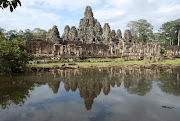
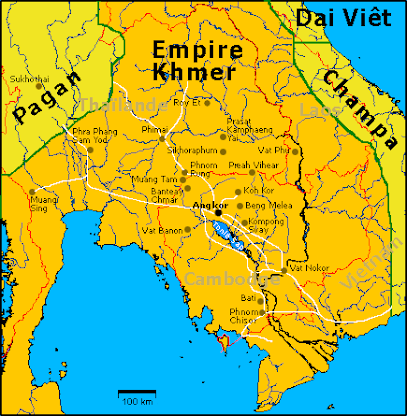
From their city, Angkorian kings ruled over most of Southeast Asia during their pinnacle between the 9th and 14th centuries, overseeing construction of architectural stone marvels, including Angkor Wat, regarded as a marvel of religious architecture.

While the 1431 invasion from what is now Thailand has long been regarded as a major cause of Angkor's fall, archaeologists from the Australian university's Greater Angkor Project believe earlier ecological forces led to the city's demise.

Their findings supported a theory in the early 1950s by Bernard-Philippe Groslier, a prominent French archaeologist, that the collapse of Angkor resulted from over-exploitation of the environment.

Angkor's inhabitants started rice farming from the low lying area near the Tonle Sap lake just south of Siem Reap town, said Roland Fletcher, another archaeologist with the project.

But gradually, they cut down natural forest to extend their farm land up to the slope of Kulen mountain, 50 miles (80 kilometers) to the north, said Fletcher, who led 10 archaeologists to excavate various sites near the Angkor complex.

Flooding ensued, and huge amounts of sediment and sand were washed down to fill up canals — thus probably choking the vital water management system.

Using NASA's airborne imaging radar data, the project has conducted numerous aerial and ground surveys across nearly 1,200 square miles (3,108 square kilometers) which revealed that the city — with about 1 million inhabitants — was far larger than previously thought.

It covered some 385 square miles (997 square kilometers) and featured a sophisticated hydraulic system that proved too vast to manage.

Angkor was "a huge low-density, dispersed urban complex" comparable to Los Angeles and "by far the most extensive preindustrial city on the planet," Fletcher said.

Its water network included an artificial canal used for diverting water from a natural river about 15 1/2 miles (25 kilometers) north of Angkor, and two mammoth, man-made reservoirs known as the East and West Barays.

"They (people) probably didn't necessarily need any of this extra water ... because just a rain-fed rice agriculture is quite sufficient to feed a very substantial population," said Damian Evans, a project member.

One theory, he said, was that the Angkorian kings built the water system just "to demonstrate their power and their authority to rule."

But he said only excavations and soil analysis could yield more clues.

"It's a process of going to those sites on the ground and looking for finer detailed information like the profiles of the canals underneath the ground and the types of sediment that lie within those canals," he said.

Armed with a printed digital map of the Angkor area, Evans and Fletcher toured an excavation site at the West Baray where archaeologists dug trenches to seek traces of an ancient channel through the bank. They were trying to determine whether the channel really existed and could have served both as water inlet and outlet.

The reservoir is walled by four banks — now covered with jungle — each 40 feet (12 meters) high, 331 feet (100 meters) wide and about 12 miles (19 kilometers) in length. It can store up to 1.8 billion cubic feet (50 million cubic meters) of water.

Fletcher called it "the single largest artifact and piece of engineering in the preindustrial world."

"All of this work is aimed at understanding how the water management system of Angkor functioned ... and how it stopped working," he said, adding that forest clearance is "the current key piece of information" about the ecological peril that caused Angkor to tumble.

Although past environmental problems were associated with deforestation, they also underline the menace the tourism boom is posing to the temples, the researchers say.

"The same types of things which we knew were problems of Angkor are essentially being repeated in our modern day context in the Angkor area — things like unsustainable use of water, massive overdevelopment without any consideration of the long-term effects," Evans said. "There's definitely lessons to be learned from what happened here before."
Read more!

RIGHTS-CAMBODIA: Painter to Meet His Jailer at Khmer Rouge Trials


By Marwaan Macan-Markar


BANGKOK, Feb 15 (IPS) - Sometime this year, two men who stood on either side of the genocide unleashed in Cambodia in the 1970s may finally face each other in a special war crimes tribunal in Phnom Penh.

For one of them, Vann Nath, it is a moment that he has waited patiently for over almost three decades. He was one of only seven people who came out alive from Tuol Sleng, a high school in the Cambodian capital that was converted into a prison during the Khmer Rouge regime’s brutal grip on power from April 1975 to January 1979. At least 14,000 people who were imprisoned there were not as fortunate. They were all tortured and killed.

The other is Kaing Khek Eav, or ‘Duch’, who was the chief jailer of Tuol Sleng, or S-21, as it was known by the extremist Maoist group. He is currently under custody, along with four other surviving leaders of the Khmer Rouge, of the U.N.-backed war crimes tribunal. The Extraordinary Chambers in the Courts of Cambodia (ECCC), as the special tribunal is officially called, is expected to hear its first case this year.

’I have been hoping for this tribunal for nearly 30 years. I wanted the Khmer Rouge leaders to face justice for what they did,’’ says Nath, who has carried the torment of his one year in S-21 since he found freedom in January 1979. ‘’I will go and attend the trial of Duch to see if the tribunal will deliver a good verdict.’’

But the 61-year-old, who has a shock of white hair and thick black eyebrows that have whitened at the edges, is prepared to do more. ‘’I am ready to go and testify if the court needs me as a witness,’’ he said in an interview during a recent visit to Bangkok. ‘’I think it is a secret of the court: to invite me or not.’’

Such an appearance will inevitably add to Nath’s legendary status in his country. For not only is he an inmate who witnessed the horrors that unfolded in S-21, but he has made it his mission, since his freedom, to tell the story of his nightmare through paintings that have a raw, immediate and blunt quality. They are frozen moments of agony that have flowed from his memory.

The exhibitions of his paintings since 1980 -- the first in the Tuol Sleng Genocide Museum -- have scenes of prisoners being whipped and their fingernails pulled out, of one having his neck sliced by a Khmer Rouge guard, and of a mother being beaten as her baby is grabbed from her hands by a prison guard. His most recent exhibition, which opened in Bangkok this month, has disturbing portraits of prisoners in chains and an emaciated figure of Nath being led away by two prison guards.

They are paintings, moreover, that have come to graphically represent the horror of the Khmer Rouge regime, which was responsible for killing close to 1.7 million people, nearly a quarter of the country’s population at the time. Most of the Cambodian victims, even babies, were either executed or died due to forced labour or starvation. Among them were two of Nath’s sons, who died of starvation while he was imprisoned.

But dredging up such memories for his next canvas brings little relief or creative joy. ‘’When I paint the scenes of prisoners being dragged by the guards, it is still very hard for me,’’ he explained in a flat, controlled tone of voice. ‘’They bring back memories of my time there. It makes me go into the painting and remember the painful moments of that dark period.’’

In fact, a book Nath wrote about his experience in S-21 confirms how close to the truth his images of torment are. During an encounter with ‘’the former butcher of Tuol Sleng,’’ as he described a former prison guard, Nath asks him how accurate the images of the prison were. ‘’No, they are not exaggerated,’’ the guard had said during that early 1996 meeting. ‘’There were scenes more brutal than that.’’

‘’Did you see the picture of the prison guards pulling a baby away from his mother while another guy hit the mother with a stick?’’ Nath writes in his book, ‘A Cambodian Prison Portrait’, of the question he next posed to the now freed Khmer Rouge guard. ‘’What did you and your men do with the babies? Where did you take them?’’

‘’Uh ... we took them out to kill them,’’ the guard replies. ‘’We were ordered to take all of them to be killed.’’

‘’You killed those small babies? Oh God!’’ writes Nath of his pained response. Then, he adds: ‘’My words dried up. His last statement was not a lie. All these years, in the back of my mind, I had always thought that they had spared the children.’’

Yet the ‘Painter of Tuol Sleng’ is the first to admit his work as an artist, which evokes so much pain, is also the reason why he survived the prison. For when Nath, who was born into a poor farming family, was arrested and dragged into S-21, he was singled out for his talent. Till then, he had been a painter of billboards in Battambang, a city in north-west Cambodia some 300 km from Phnom Penh.

He was ordered by the prison’s tormentors to paint the portrait of a man he had little knowledge of -- Pol Pot, the Khmer Rouge leader. His first painting, in black and white, was based on a black-and-white photo of the reclusive tyrant. Later, he shifted to a painting in colour.

He knew, then, that he was painting for his survival. There was no provision for error. Some of the other imprisoned painters who had been ordered to do likewise had been executed for their failure.

The final arbiter was Duch, who had said ‘’good’’ and ‘’it’s all right’’ after studying one of Nath’s portrait of Pol Pot.

Yet how good Nath was in the eyes of Tuol Sleng’s chief jailer came to light after the Khmer Rouge was driven from power by the Vietnamese army. In 1980, while working at the Tuol Sleng Genocide Museum, Nath was shown a list by a researcher examining the prison’s documents.

It was a list of prisoners that Duch had authorised to be killed on Feb. 16, 1978. On it was Nath’s name. But next to it was an entry written in red ink. ‘’Keep the painter,’’ it is reported to have said.
Read more!

Next Stop for Big Oil: Cambodia?

By Susan Postlewaite

As Chevron and partner Mitsui Oil explore offshore, skeptics worry that Cambodia will fall prey to the "oil curse"


In the world of $90-a-barrel oil, oil companies have plenty of incentive to search in unusual places for the fossil fuel. One of the newest energy frontiers is in the clear blue waters off the coast of Cambodia. Here, where fishing sampans sail among scattered, picturesque islands in the Gulf of Thailand, U.S. oil giant Chevron (CVX) has drilled 15 exploratory wells 150 kilometers offshore from the tourist town of Sihanoukville. If all goes according to plan, Chevron will begin extracting oil and gas from these wells by 2011.

Onshore, many Cambodians are watching—some hopefully, others nervously—about what oil might mean for one of the world's poorest nations. Prime Minister Hun Sen has recently called discussion about the oil finds "premature" and "speculative," and will say little about the prospects, which Chevron initially estimated at 400 million barrels. That's not much compared to neighboring Indonesia, with 4.3 billion barrels in reserve, or Malaysia, with 3 billion. But for a poor country like Cambodia, which has precious few energy resources, it's a big deal. Quietly, the premier has been lining up undisclosed partners for a small domestic oil refinery while the Cambodia National Petroleum Authority has begun talking about setting up a national oil company.

How important is oil for Cambodia? The International Monetary Fund produced a "moderate economic scenario" last year that showed revenues to the government from oil could be $174 million when Chevron's production starts in 2011, peaking at $1.7 billion annually after 10 years. For a country with a total national budget of just $1.2 billion, such a windfall could bring such benefits as raises for public teachers now paid $80 a month, rebuilding the education and health systems destroyed during the Khmer Rouge era, or bringing electricity and clean water to the bypassed rural areas that make up almost all of the country. "There are a lot of uncertainties about the amount of oil available," says IMF Resident Director John Nelmes, who explains the $1.7 billion estimate is a conservative one based on total reserves of 500 million barrels.

Overlapping Claims With Thailand
Of course, the size of the estimated oil reserves hardly ranks Cambodia with the big leagues. But the current picture in Cambodia could change. In addition to Chevron's Block A, five other blocks licensed for exploration are so far unexplored. And in an overlapping claims area with Thailand there are huge unexplored oil fields that cover an area as much as all six existing blocks combined. Cambodia and Thailand signed a memorandum of understanding in 2001 to resolve the overlapping claims, but no progress has been made since then and diplomatic ties worsened after Cambodians burned down the Thai Embassy in Phnom Penh in 2003. Cambodia's Deputy Prime Minister Sok An says negotiations are expected to resume soon and he's willing to split the claims "on a 50-50 basis."

The question is, how should an undeveloped country like Cambodia proceed in tapping those resources? The possibility that Hun Sen's government might set up a state-owned oil company and a state-owned refinery horrifies some foreign advisors who worry that Cambodia could fall victim to what economists call the oil curse. That's the phenomenon of corruption in developing countries with state-owned companies that control abundant oil reserves. It's too easy for corrupt government officials to skim profits from state-controlled oil companies, says Warwick Browne, a former extractive industries project manager for Oxfam America in Cambodia.

Having a Phnom Penh-controlled oil and gas company would be "a very bad move," says Browne, adding that such state-owned entities "are black holes for corruption." He says a small national oil refinery would probably not be profitable and the government would have to subsidize sales to the population while forgoing the opportunity to earn needed foreign exchange by exporting to neighboring countries.

Other Obstacles
Government officials won't discuss these questions publicly. Chevron, after three years of exploration at a cost of more than $120 million, says in a public statement that the undersea reservoir has a complex design and contains "small dispersed fields, rather than one core field." Translation: It will take more technical expertise and cost more to extract. With partner Mitsui Oil Exploration (Moeco), Chevron is considering a third round of exploratory drilling in 2008 and 2009.

Another complication: a recent dispute between the joint venture and the government over the way Chevron would eventually be taxed on royalties. The two sides are expected to compromise eventually but won't discuss the matter. Even so, production will probably begin by 2011 under terms of Chevron's and Moeco's license with the government. (Chevron officials in Bangkok declined to comment.)

The licensing of the other blocks taking place is raising eyebrows. Browne says the information about the contracts is kept secret in the hands of Deputy Prime Minister Sok An, who signs the concessions, and Te Duong Tara, head of the Cambodia National Petroleum Authority. (Both declined BusinessWeek requests for interviews.) Quietly, the CNPA over the past year has handed out licenses for the five other blocks to three Chinese companies and two international partner groups.

Beefed-Up Security
One block went to a consortium including Singapore Petroleum, Malaysia's Resourceful Petroleum, and Thailand's PTTEP International. Another went to a consortium led by Indonesian company Medco Energi Internasional Tbk with partners Kuwait Energy and Sweden's Lundin Petroleum. The others went to Chinese companies, including Chinese National Offshore Oil (CNOOC) and China Petrotech Holdings.

Meanwhile offshore, the Cambodian Navy recently ordered patrols to ensure security in the Gulf surrounding the oil fields, an area where Cambodia and Thailand have had a border dispute.

Now all eyes are on Chevron. A petroleum consultant who asked to remain anonymous says the other companies are waiting to see; their contracts allow for six years of exploration before production is required. "They're gambling. Very often they sit back and wait and see if there are any hits. The strategy is to wait, watch, and then decide whether to drop out or resell their license," the consultant says.

Calls for Anti-Corruption Laws
The government is growing impatient with all the pessimists. Hun Sen, in a rare and testy public mention of oil, assured 600 people at a Nov. 7 investment conference in Phnom Penh that the country knows how to avoid the oil curse. "Cambodia is on the right path," the Prime Minister said. "I am hopeful Cambodia will be able to benefit from the sector in the near future."

Opposition party leader Sam Rainsy in December urged lawmakers to adopt an anti-corruption law before the oil begins flowing to prevent government "looting of the nation's oil wealth."

Andrew Symon, petroleum researcher with Menas Asia, a research company from Britain, says he's optimistic about the potential: "It's an exciting area and very contentious politically. If there were to be gas this would be very significant for Cambodia," But, he wryly notes, "There's no shortage of voices wanting this to be a curse. It almost makes it seem it should be left in the ground."

Whether Cambodia, with no oil expertise, will be able to, as U.S. Ambassador Joe Mussomeli put it last February, use its oil resources for "tossing off the shackles of the Pol Pot regime" remains to be seen. According to Mussomeli, oil has been a "horrific curse" in many nations, "rendering the population destitute while a small, corrupt elite siphons off revenue that should go to improving the welfare of all the people." He has called for Cambodia to sign onto a "transparent policy framework" that ensures no one misuses the revenues.
Read more!

Thursday, February 14, 2008

Cambodia Tribunal: Up to 8 Defendants

PHNOM PENH, Cambodia (AP) — Cambodia's genocide tribunal expects to try up to eight suspects over the Khmer Rouge's brutal rule, while seeking to nearly double its staffing levels to 530, according to a tribunal planning document.

The cap on the number of prosecutions was noted in a document that outlines the tribunal's proposal to increase its budget to $170 million — a sharp increase from the original $56.3 million.
The document with the revised budget estimate — presented to donor nations in New York last month — was obtained Wednesday by The Associated Press.

The tribunal, which opened its offices in early 2006 after years of wrangling between the Cambodian government and the U.N., took five suspects into custody last year and hopes to begin their trials later this year.

Starvation, overwork, lack of medical care and execution led to the deaths of an estimated 1.7 million people during the 1975-79 communist Khmer Rouge regime.

The budget document says more money is needed to expand services and personnel to allow the tribunal to operate through March 2011, instead of December 2009 as had been anticipated earlier.

"This extension is based on a more realistic expectation of the work of the court, with a maximum number of eight detainees," it said. The document did not explain how the number had been arrived at, or who the additional suspects might be.

The five senior Khmer Rouge leaders under detention — including the group's former head of state, Khieu Samphan, and its foreign minister, Ieng Sary — are charged with war crimes and crimes against humanity.

There are fears that the aging and infirm defendants could die before facing justice. The group's leader, Pol Pot, died in 1998.

Officials authorized to speak for the tribunal could not be reached for comment Wednesday.

The tribunal has been dogged by allegations of corruption and delays. Donors have pressed it for reforms and more transparency in its conduct.

"The tribunal will have to explain clearly what kind of reforms they are undertaking with regards to administration and why they have chosen a budget like this," said Tom Barthel Hansen, a Danish Embassy official, whose country contributed about $500,000 to the original budget.

He said it was not yet clear how his government would respond to the new request.
Read more!

Wednesday, February 13, 2008

Cambodia a promising market for LPI Capital

KUALA LUMPUR: LPI Capital Bhd is upbeat on its prospects in Cambodia, where it set up CampuBank Lonpac Insurance Plc last August with Public Bank Bhd.

Executive director Tee Choon Yeow said Cambodia was a “very promising” market for the group.

“Cambodia is a completely new market and there are only about five licensed insurers in this country. At the same time, the insurance industry penetration is very low, less than 10%. We are looking forward for more profit in Cambodia,” he said after the company AGM yesterday.

LPI Capital, which has a 45% interest in CampuBank Lonpac Insurance, provides general and personal insurance products through subsidiary Lonpac Insurance Bhd.

The company aimed to be the leading general insurer in Cambodia, Tee said, adding that CampuBank Lonpac Insurance currently had no agents but would soon be recruiting.

He believed its operation in Cambodia would contribute positively to the group going forward. Currently, overseas operations contribute about 12% to the group’s revenue with the bulk of it from Singapore.

Tee said LPI Capital would not discount the prospects of venturing into Vietnam since it would be able to leverage on Public Bank’s presence in the country.

LPI Capital, he said, had been conducting feasibility studies in Vietnam and, if it were to venture into Vietnam, it would possibly use the same model in Cambodia.

Meanwhile, LPI Capital intends to maintain the levels of its interim and final dividends.

“We believe in paying high dividends and we expect to maintain the dividend payout,” Tee said.

For the financial year ended Dec 31 (FY07), LPI declared an interim dividend of 30 sen, a final dividend of 55 sen and a special dividend of 25 sen per share.

LPI posted a net profit of RM87.8mil on revenue of RM551.6mil in FY07, up from RM78.1mil and RM473.5mil respectively in FY06.

Earnings per share improved to 63.8 sen from 56.6 sen previously.
Read more!

Media watchdog concerned about Cambodia

Phnom Penh (dpa) - Paris-based journalism watchdog Reporters Without Borders expressed concern about Cambodian press independence in the lead-up to national elections in July in its annual report released Tuesday.

The group also said it was concerned that three journalists had reportedly received death threats for covering logging issues and that it believed one newspaper had been temporarily closed after reprinting part of a report on the issue made by anti-corruption non- government organization Global Witness.

"Prime Minister Hun Sen ... can count on the support of the majority of the broadcast media (and) the highly-politicised written press struggles to maintain its role of challenging authority," the international journalism watchdog claimed.

A May 2007 Global Witness report on illegal logging which claimed that high ranking officials were involved in the industry was quickly banned from distribution in Cambodia, and many of the officials named in it have accused it of being defamatory. Some journalists said the ban illustrated a lack of freedom of information in Cambodia.

"Ahead of legislative elections scheduled for July 2008, there are fears that the ruling party will tighten its grip still further on electronic media," it said in the report.

Minister of Information Khieu Kanharith has repeatedly said he defends the right to a free press in Cambodia and strenuously denied allegations that the media is muzzled. Media in Cambodia is regarded by analysts as one of the most open in the 10-member Association of Southeast Asian Nations (ASEAN).

Read more!

Temple area 'should be jointly managed'

PIYAPORN WONGRUANG

The area around the ancient Preah Vihear temple on the Thai-Cambodian border, which has been proposed as a World Heritage site, should be managed jointly by the two countries to avoid stirring up conflicts between them, a seminar was told yesterday.

Associate Professor Surachart Bamrungsuk, a military strategy expert at Chulalongkorn University's political science faculty, said at the seminar that the site proposed by Cambodia also covers a disputed common border area.

Therefore, until the dispute could be settled, the area should be jointly managed by the two neighbours so they could feel at ease with one another in dealing with the issue.

It is virtually impossible now to delay Cambodia's world heritage site application, and therefore working together would be the best way out, he said.

Under the joint management concept, both Thailand and Cambodia would benefit, said Assoc Prof Surachart.

The area could be developed into the region's new tourism magnet, he added.

It is unlikely that world heritage status for Preah Vihear would rule out Thailand's claim of sovereignty over the disputed area since it has nothing to do with border demarcation, he said.

''Demarcation problems in this region are a legacy of colonisation in the past, and obviously they are not easy to fix. However, we may find a way out of this if we just look beyond the border and look for an opportunity during a crisis,'' the academic said.

In 2001 Cambodia officially asked the United Nations Educational, Scientific and Cultural Organisation to put Phreah Vihear on the World Heritage List, and has since developed its proposal without Thailand's participation. Thailand last year protested against Cambodia's proposal at a World Heritage Committee meeting in New Zealand.

This resulted in a recommendation that the two neighbours work together on how to manage the site. Thailand is still waiting for Cambodia's response.

Preah Vihear is a cluster of ancient Khmer temples that sit atop a cliff in a border area claimed by both Thailand and Cambodia.

The International Court of Justice in 1962 ruled that Cambodia has sovereignty over the temple ruins and parts of their surroundings.

Read more!

Tuesday, February 12, 2008

Democrats Abroad vote in Cambodia primary

02-12) 04:00 PST Phnom Penh, Cambodia -- Cambodia's capital played host to a U.S. primary for the first time last week , drawing U.S. citizens from around the country.

Held at a quirky restaurant called USA Donuts, the vote offered a mix of American traditions never seen before in Phnom Penh. Dozens of expatriates cast ballots in the Democratic primary, choosing mostly between Sens. Barack Obama and Hillary Rodham Clinton. Dozens more snatched up hard-to-find foods such as Fruit Loops, Kraft Macaroni and Cheese, and Stove Top stuffing.

The vote at the doughnut shop is part of the Democrats Abroad program to determine 22 delegates who will attend the Democratic National Convention in Denver. Voting in the global primary, conducted online and at 76 polling places in 33 countries, began Feb. 5 and ends today for an estimated 6.5 million Americans who live overseas. In Cambodia, about 1,800 Americans are registered as residents, according to the U.S. Embassy.

The program was conceived as a way to boost participation in the nomination process, especially for those who might not have requested absentee ballots in time for their home-state primaries or those who cannot return home to attend caucuses. Democrats Abroad has been given state-level recognition by the Democratic National Committee. Its counterpart, Republicans Abroad, does not have similar recognition by the GOP, but the organization works to generate support of Americans overseas for Republican candidates.

Observers say turnout for the overseas Democratic voting - both live and online - has been high and results will be announced later this month. In Cambodia, organizers said 78 percent voted for Obama, 21 percent supported Clinton and 1 percent remained uncommitted. They also said the entire program is a test-run for individual states looking to use a similar Internet-based system.

Every element at the doughnut shop- food, music and ballots - seemed out of place in Cambodia, where locals are just beginning to confront their recent past in trials against the aging leaders of the genocidal Khmer Rouge regime of the 1970s. And even though voting has become commonplace, accusations of deep-seated corruption and blatant vote buying have been widespread.

Yet the American voters were generally giddy to be participating in a live electoral process so far from home. Regardless of age, almost everyone bobbed their heads to the eclectic mix of voter-themed music heard on the restaurant's boom box. Many more grinned or whooped it up as their ballots slid into a locked, silver vote box.

"Living abroad, it's easy to feel disconnected," said 30-year-old Carlyle Gollogy of Santa Cruz, who works as an administrative assistant at a local nonprofit hospital. "Being here today, it eliminated a lot of the (red tape) by giving you an accessible way to be part of the process."

Many voters also said they want to see a change in Washington's foreign policy.

"I think this is probably the most important and exciting election in my lifetime," said Susan Hagadorn, a San Francisco native who has lived in Cambodia for three years and works as a consultant for nonprofit organizations. "There's a deep dissatisfaction about how America is viewed from abroad. That we can come together to do something about that here, through voting, an American tradition, is really exciting."

Wayne Weightman, who helped organize Saturday's vote, agreed, saying he eagerly voted for a former Hawaii classmate, whom he knew as Barry.

Obama "was always this amazing guy who could talk to anyone," Weightman said. "To realize that you knew someone who has the possibility of making it so foreigners abroad can stop apologizing for their country, well that's just inspiring."

USA Donuts was an obvious choice for the polling site, event organizers said. Owner Johnny Ly is a 39-year-old Cambodian refugee who fled during the Khmer Rouge era with his family to Long Beach, where they operated a doughnut shop.

Ly moved back to Cambodia in 2000 to open an American-style doughnut shop. He now runs two stores with a third on the way. He imports special flour from California so that his pastries have just the right chewy consistency. The rest of his wares are shipped by relatives, who shop at Costco and Wal-Mart.

Ly gets a kick out of catering to Americans, whose culture he adopted during his 20 years in the United States.

"To be part of an election. That is American," said Ly.

Read more!

Cambodia urged to stop evictions

By Guy De Launey
BBC News, Phnom Penh

Human rights organisation Amnesty International has called for an end to forced evictions in Cambodia.

Thousands of families have already been moved from their homes in the centre of the capital Phnom Penh, and more evictions are set to follow.

The authorities say this is a necessary part of Cambodia's development.

But in its report Amnesty disputes this, and says there has been a lack of accountability and consultation with local communities.

Members of threatened communities from across Phnom Penh are fighting on, although their homes may soon be reduced to rubble.

They have held a series of meetings to express solidarity and plead for help from outsiders.

The site of the latest gathering illustrates the size of the challenge they are facing.

'Legal title'

Dey Krahom was once a vibrant slum community. Now there are empty spaces where some residents have given up and abandoned their homes.

There's no need for evictions to take place in order to develop
Brittis Edman
Amnesty International

The gaps are filled with rubble, razor wire and garbage. Bulldozers belonging to the property developers park nearby.

Many residents say they hold legal title to their land and that threats and intimidation are being used to force them to leave.

Brittis Edman from Amnesty International says developers should adopt a cooperative approach instead.

"There should be discussions with the communities before an eviction is decided and the best option would obviously be to develop while the community is here, and develop the community as it is."

But that seems unlikely to happen. The Phnom Penh authorities have said they are committed to developing the city in partnership with private companies.

So far, that has meant relocating residents to sites that are in most cases a long way from the city centre, while developers build high-end housing and shops.


Read more!

Trip to Cambodia life-changing

By Marcus Stickley

A group of Nayland College students say a two week trip to Cambodia visiting aid projects in the struggling country has changed their lives.

"The poverty never leaves you," says Alison Paton, the teacher who accompanied 13 Nayland students, and one from Taranaki, on the two week trip.

Several students had never been outside of New Zealand before they left last month.

Each student had to raise $3500 to go on the trip and the group donated a further $1600 to seven different aid projects including schools, an orphanage and a hospital which they visited.

The students also helped build a house for a family whose father had fallen ill.

They saw the extreme poverty in Cambodia, visiting people living in a rubbish dump in the capital Phenom Phen and others living in a village where they struggled to grow rice.

Some poor Cambodians they met had copper streaks in their hair from malnutrition.

Paige Bowler-Brendt, 16, said the trip made her appreciate "what we've got compared to what they've got".

The group visited Teuol Sleng, a former school turned into a prison by the Khmer Rouge to torture intellectuals and others who opposed them.

Since the regime was deposed in 1979 the building has been left as a museum complete with faded splatters of blood on the walls.

Most students left the museum with tears running down their faces, having heard the personal story of one of the museum's guides who had lived through the horror of losing family during the Khmer Rouge's reign.

The students said the country was still recovering from that period but they were impressed by Cambodians' resilience.

Bronwyn Ewers, 17, said Cambodia had something that New Zealand had lost.

"They've got that closeness of community."

For may of the students the trip has changed or reinforced what they want to do when they leave school.

Kayleigh Shaw, 18, had planned to go to Europe when she finished school but she now wants to return to South East Asia to do volunteer work.

Money went further in helping other people there, she said.


Read more!

Sunday, February 10, 2008

Cambodia to host part of ASEAN Football Confederation Cup Tournament

PHNOM PENH, Feb. 10 (Xinhua) -- Cambodia will host part of the ASEAN Football Federation Cup Tournament in October for Laos, Brunei, The Philippines, East Timor, and Cambodia, said a sports official here on Sunday.

Three winners out of the five countries will then go to Thailand or Indonesia to vie with Thailand, Singapore, Vietnam, Malaysia, Indonesia and Myanmar, said Keo Sarin, deputy secretary general of the Football Federation of Cambodia (FFC).

"We are trying to be successful in hosting part of the tournament," he added.

The ASEAN (the Association of Southeast Asia Nations) Football Confederation Cup Tournament derived from the Tiger Cup soccer match and is currently one of the most important sports events in the region. Read more!

'They all had to be eliminated'

Kang Khek Ieu was known as 'Cambodia's Himmler', a torturer who oversaw the deaths of 17,000 people. As he prepares to go on trial, he gives a chilling insight into the Khmer Rouge – the most detailed account yet from a top henchman

Exclusive by Valerio Pellizzari, Phnom Penh

He was Pol Pot's trusted henchman, the brilliant mathematician who calmly fashioned an efficient apparatus of torture and death out of a Phnom Penh high school and who oversaw, during the Khmer Rouge's reign of terror, the interrogation and cudgelling to death of some 17,000 Cambodians.

In the West he has been called "Cambodia's Heinrich Himmler"; since Pol Pot himself and his lieutenant Ta Mok cheated justice by dying, he is the most vivid symbol of the Khmer Rouge left alive. His name is Kang Khek Ieu, but he is better known by his nom de guerre, Duch (pronounced "Doik"). This spring, 28 years after fleeing Cambodia ahead of the Vietnamese army, his trial for mass murder may finally get under way.

Now, in the first interview he has given since his capture more than eight-and-a-half years ago, he talks freely about how and why he sent 17,000 Cambodians to their deaths in the killing fields.

And even as he waits to confront the proof of his crimes, it is clear that, for him, there was never any choice: anybody who was thought to pose a threat to the revolution had to be tortured and killed. Asked whether he had any moments of uncertainty, any doubts or feelings of rebellion while he set about wiping out his country's entire intellectual class, he answered: "There was a widespread and tacit understanding.

"I and everyone else who worked in that place knew that anyone who entered had to be psychologically demolished, eliminated by steady work, given no way out. No answer could avoid death. Nobody who came to us had any chance of saving himself."

The command had come from above, he said. "All the prisoners had to be eliminated. We saw enemies, enemies, enemies everywhere." He could not have rebelled or fled, he insisted. "If I had tried to flee, they were holding my family hostage, and my family would have suffered the same fate as the other prisoners in Tuol Sleng. If I had fled or rebelled it would not have helped anyone."

Between 1975 and the beginning of 1979, under Pol Pot, two million men and women, almost a third of the Cambodian population, were brutally eliminated by the Khmer Rouge – an extreme Marxist movement that aimed to take Cambodia back to "Year Zero", cutting it off from the outside world and imposing their leaders' vision of an "agrarian utopia".

Of its two million victims, more than 17,000 – party officials, diplomats, Buddhist monks, engineers, doctors, teachers, students, musicians and dancers, were brought to a former school in the heart of Phnom Penh that had been converted into a torture centre. Only six came out of it alive.

Codenamed S-21, the centre was run by Duch, a former maths teacher who had become the head of the regime's secret police. In the former classrooms, over a period of 40 months, Duch oversaw the extermination of the entire Cambodian intellectual class with mathematical rigour.

Confessions were extracted by primitive torture: prisoners were strapped to iron beds, suspended upside down from ropes, threatened with drowning, tormented with knives and pincers, locked in tiny cells. Then, at night, they were taken by lorry to the outskirts of Phnom Penh and killed in the rice fields. The Khmer Rouge were obsessed with killing by night.

Now at last, after years of argument between the Cambodian government and the United Nations, the surviving members of the Khmer Rouge hierarchy are finally being brought to justice. They will be tried under a hybrid UN-Cambodian tribunal known as the Extraordinary Chambers in the Courts of Cambodia; the pre-trial hearings began in November and are still going on. Pol Pot, of course, is long dead, having died under house arrest before he could be tried in 1998. The bloodiest of his comrades, Ta Mok, died in 1996. But five senior leaders including Khieu Sampan, the Khmer Rouge president, await trial.

Duch made his first appearance in court in November when his lawyer asked for him to be let out on bail because his "human rights had been violated, even if he was not beaten or tortured". A ripple of ironic laughter ran round the courtroom. The request was rejected.

My quest to interview Duch had begun nearly three years ago. I first visited S-21, soon after the fall of the Khmer Rouge. Since his arrest more than eight years ago, nobody from the outside had even clapped eyes on him. Now, finally, I was looking at this frail, 66-year-old man with his protruding, irregular teeth, bug eyes and washed-out grey clothes. I was confronting the mystery of the banality and the innocence of evil.

Throughout our interview, his voice was low, respectful like a mantra, a Buddhist prayer, rather than what it really was; the soundtrack of a nightmare still freighted with questions. His mild-mannered almost frail appearance in no way suggested the role of a mass murderer.

For the interview, the rules were strict: no tape recorder, no camera, no talking to him directly in French or English but only through a Cambodian interpreter. General Neang Phat, Cambodia's Secretary of State, and other generals were sitting in the same room, listening to and scrutinising this indefinable and unfathomable man. Some of them, too, have evil memories of the Khmer Rouge years. But Duch was the exact picture of the banality and innocence of evil.

Duch, the nickname he assumed when he was young and joined the guerrillas, told me that the torture centre at Tuol Sleng was set up in August 1975, four months after the Khmer Rouge entered Phnom Penh, and began work two months later.

"I was given the task of creating it and starting it up, although I never found out why they chose me. Before 1975, when the Khmer Rouge lived in hiding, in the jungle, or in the liberated zones, I was the head of Office 13, I was the chief of police in the special zone bordering on Phnom Penh."

He described a routine of bureaucratic monotony. "Every day I had to read and check the confessions. I read from seven in the morning until midnight. And every day, towards three in the afternoon, Professor Son Sen, the minister of defence, summoned me. I had known him since my time as a high school teacher. It was he who had asked me to join the guerrillas.

"He would ask me how my work was going. Then a messenger would arrive, an envoy, who collected the confessions that were ready and took them to Son Sen. These messengers were the only links between one office and another."

I wanted to know if Duch had any moments of uncertainty, doubts, feelings of rebellion while he was wiping out his country's entire intellectual class.

He admitted the idea had crossed his mind. "When the work started at Tuol Sleng, I asked my bosses now and then, 'Do we really have to use all this violence?' Son Sen never answered. Nuon Chea, the No 2 Brother in the power structure, who was above him, told me: 'Don't think about these things.'

"I personally had no answer. Then with the passing of time, I understood. It was Ta Mok who had ordered all the prisoners to be eliminated. We saw enemies, enemies, enemies everywhere.

"I was cornered, like everyone in that machine, I had no alternative. Pol Pot, the No 1 Brother, said you always had to be suspicious, to fear something. And thus the usual request came: interrogate them again, interrogate them better."

Sometimes Duch was tempted to be merciful, he claimed – and his superiors began to mistrust him. He recalled the time a cousin was brought to S-21.

"I knew him well, we had formed sincere family ties but I had to eliminate him anyway. I knew he was a good person but I had to pretend to believe that confession extorted with violence. So in order to protect him I didn't analyse those statements too rigorously. And on that occasion my superiors began to lose full trust in me. At the same time I didn't feel safe any more."

But the moment of official doubt passed. The interrogations and executions continued, remorselessly until the end.

"You kept your post until the end," I said. "Did you always carry out your orders thoroughly?"

Duch answered: "I obeyed. The work carried on until 7 January 1979, when the Cambodian liberation forces, supported by the Vietnamese, conquered Phnom Penh. There was no escape plan, no pull-out plan ..."

But, after the fall of the Khmer Rouge, the executioner blended back in among his countrymen, and disappeared, as so many did in the post-war chaos, swallowed up by the void.

Many years later he was converted to Christianity by American missionaries. His true identity was discovered in 1998 and soon afterwards he was arrested. He remains the most disquieting witness of the political madness planned by the Khmer Rouge, after the death of Pol Pot and Ta Mok, the one-legged "butcher".

I asked him how he converted to Christianity and why that happened. "I became convinced that Christians were a force, and that this force could beat Communism. At the time of the guerrilla war, I was 25 years old, Cambodia was corrupt, Communism was full of promise and I believed in it. But that project failed completely."

So if Duch has repented now, what is his attitude to all those thousands of victims of his violence? There was no alternative for people like himself, trapped inside the machinery of the Khmer Rouge, he said.

"If someone goes looking for guilt, and the various degrees of guilt, I say that there was no way out for anyone who entered the power system conceived by Pol Pot. Only at the top did they know the real situation in the country, but the intermediate functionaries did not know. And then there was that obsession with secrecy.

"Of course, you are asking me whether I could have rebelled, or at least fled. But if I had tried to flee, they were holding my family hostage, and my family would have suffered the same fate as the other prisoners in Tuol Sleng. If I had fled or rebelled it would not have helped anyone."

Read more!

Saturday, February 09, 2008

Newlyweds lend a hand in Cambodia's struggle against war, poverty

By Chris Gray, The Philadelphia Inquirer

SIEM REAP, Cambodia -- Let's be honest: It was the specter of tigers, temples and tom yam soup that led my husband and me to honeymoon in Southeast Asia. We wanted an adventure to remember, on a continent where neither of us had been.

But as I researched our trip, I realized that we should spend at least a little time practicing "voluntourism," giving back to people who are still struggling for the basics after decades of war and poverty.

We found a way to have it all in Siem Reap, Cambodia, home of the ancient temple complex Angkor Wat -- and Ponheary Ly, a tour guide who considers it her mission to help educate as many Cambodian children as possible.

found Ly, a Siem Reap native and survivor of dictator Pol Pot's labor camps, through the Asia message board on Fodors.com. Ly, 44, is a veteran guide who has arranged private tours of Angkor Wat and other Siem Reap attractions in both English and French -- languages she learned in secret during the Vietnamese occupation of Cambodia -- since 2000.

A former English teacher, Ly has also worked for seven years to enroll children in Cambodian schools. While public school in the country is ostensibly free for the first three years, many rural children do not have the $12 necessary for shoes, school supplies or uniforms, she said.

"As a teacher, I knew about the difficulties of the kids and families who couldn't send the kids to schools. Also, I found that the kids are smart, but they don't have any occasion to show how smart they are. To build the country, we have to build the education for all people, especially the kids."

It's a message that Ly's clients -- mostly Americans who prefer independent travel with native guides to packaged tours -- could support. In addition to touring the temples, more and more visitors asked Ly whether they could visit the schools and donate money for bicycles, supplies and uniforms.

Lori Carlson, formerly of Austin, Texas, was one such convert. When she visited here in 2005, Carlson was struck by Ly's background and dedication. On her return to the States, she founded the Ponheary Ly Foundation (www.theplf.org), a registered nonprofit that channels money directly to the schools.

As of December, Carlson, 48, had raised $90,000 for five schools -- and quit her job to move here to work fulltime with Ly. She formed a board of directors for the PLF, which distributed school supplies to 1,955 children last fall.

"I believe the travelers who go to visit the temples at Angkor Wat understand they bear at least some of the responsibility to gently nudge these children toward school rather than reinforce the idea that it's good to stand on the corner and beg dollars from tourists," she said.

With such strong advocates, Don and I were excited to meet Ly and do our part. We arrived here to find a city undergoing massive change. The number of tourists visiting Angkor Wat, a UNESCO World Heritage Site since 1992, has exploded in recent years, spurring an increase in hotels, shops, restaurants and other businesses.

While the influx of dollars has been good for many Cambodians (merchants prefer U.S. dollars to the Cambodian rial), it's disconcerting to see barefoot bicyclists ride past $800-a-night hotels. Young children hawk maps, books and trinkets near the temple grounds; tuk-tuk drivers fight over $1 fares.

That's not to say that Don and I eschew luxury (it was our honeymoon, after all). We turned down a $20 room at Ly's simple guesthouse, primarily because it didn't have a pool, which we considered essential to deal with the area's crushing humidity. At $95, our poolside room at Bopha Angkor was spacious yet not ostentatious, and the package included daily breakfast, a traditional Khmer dinner, and a massage.

Just a few hours after we landed, we went to Angkor Wat with Ly's brother Dara as our guide. There are more than 300 temples in the complex, but Dara steered us to the ones that would provide the most interesting backdrops for my husband, the photographer.

As we sweated in the 90-degree heat, I asked Dara about his family's experience under the Khmer Rouge. He told us that his father, a teacher in Siem Reap, was among the first wave of educated people to be killed under Pol Pot's regime. As a result, Dara and his siblings were sent with their mother to the countryside to work.

It's a sobering tale, and we heard more from Ly over the next few days. Ly, who was 13 when the Khmer Rouge came to power, and her siblings survived, mainly because villagers would leave food for them at night.

"We were given this much rice," Ly told us, holding up the tip of her finger. Dara would "crawl out on all fours, like a cat" to get extra food; sometimes, actual cats or monkeys would have gotten to the rations instead, she said.

Still, the extra nourishment kept the family alive -- and the Khmer Rouge noticed. Officials asked her mother why her children were still alive when so many other youngsters had died, Ly said. When her mother refused to answer, she was horribly beaten.

Such atrocities were common in the Pol Pot years. Yet most Cambodians don't like to talk about the time under the Khmer Rouge, Carlson said. It's rare to find it discussed in schools, primarily due to the country's Buddhist beliefs, which hold that people -- even war criminals -- are responsible for their own karma.

Ly is different, Carlson said. She understands that it's important to talk about the past so it doesn't happen again. We were talking in Ly's van, on our way to deliver lunch to the 476 children at Knar school, out in the Cambodian countryside. On the road, we saw men on bikes toting crates filled with piglets and open huts with children playing in the dirt.

Cambodian families expect all children, no matter how young, to contribute economically, Ly told us. Which is why even the kids who are lucky enough to go to school attend for a half day; at home, they are needed for chores, farm work, or other ways to make money.

In addition to a donation made before our trip, we gave Ly $40 for lunch, which buys two noodle packets for each child. That's essential, Carlson said, because if the child received only one packet, he or she would take it home to the family instead of eating it. The school tries to feed the children at least once a day to make sure they have enough energy to learn, Carlson said.

We arrived at Knar School, which consists of several one-story classrooms. As Don carried the boxes of noodle packets into the rooms, the children's eyes grew wide. They straightened in their seats and thanked us by pressing their hands together and bowing.

Carlson and Ly showed us around the school and talked about the improvements that have been made. Incentives such as bicycles, uniforms, and extra noodle packets show the families that there are tangible benefits to their children attending school, Carlson said.

"I would like to have my country be the same as the other countries," Ly said, with Cambodian children able "to have good education to work well to get out from the poor life."

The children seemed to love school, showing off their uniforms and books. An impromptu game of soccer ensued, with Don in the thick of it. It was an emotional sight for me, which sparked later discussion: Although we had been together several years, Don and I had never talked about the greater good we could accomplish as a couple.

It's a conversation that all newlyweds should have, wherever their honeymoon takes them. For us, road-testing our fledgling marriage in an underdeveloped country not only gave us the adventures we sought, but also set the course for a more permanent path. And that's definitely a trip worth taking.

TWO SIDES OF CAMBODIA

There are no direct flights to Siem Reap from the United States. You can fly there from various Asian cities, including Bangkok, Hong Kong, Singapore, Kuala Lumpur, Ho Chi Minh City, and Hanoi.

We stayed at Bopha Angkor (www.bopha-angkor.com), booking the "Poolside Evasion package." The cost was $285 for both of us for three nights, including airport transfers, breakfast, a dinner, and a massage for two.

We booked Ponheary Ly as a guide by e-mail (ponhearyyahoo.com). Ly charged us $145 for 21/2 days of touring, which included three half-day sessions at Angkor Wat, the visit to Knar School, and a visit to the floating village on Tonle Sap lake.

MORE INFORMATION: To donate or read more about the Ponheary Ly Foundation, go to www.theplf.org. Or e-mail Lori Carlson at donatetheplf.org.

CAMBODIA TOURISM: www.tourismcambodia.com

ANGKOR WAT: www.angkorwat.org
Read more!

Friday, February 08, 2008

U.S. telecommunications firm to expand into Cambodia

PHNOM PENH, Feb. 8 (Xinhua) -- U.S. telecoms firm 3P Networks has negotiated with the Cambodian government to buy up the rights to frequencies, enabling it to offer cutting-edge multimedia services for the country, said a press release received here on Friday.

3P Networks Inc is currently in the final stage of negotiations with the Cambodian government to acquire significant frequency spectrum in order to implement unique cost-effective telecommunication solutions in Cambodia and in neighboring countries, it said.

Buying into Cambodia will enable a foothold for expansion into Laos and Vietnam, it said.

"Affordable and reliable telecommunications are critical for developing countries in their efforts to both attract investment capital and stimulate a robust domestic environment," it added.

The firm offers multiple products including TV, fixed and wireless Voice over Internet Protocol (VoIP) and broadband, which are very much in their infancy in Cambodia.

Read more!

EU delegation doubts land concession policy of Cambodia

PHNOM PENH, Feb. 8 (Xinhua) -- A European Union (EU) delegation here on Friday expressed doubt about the land concession policy ofthe Cambodian government and also provided ways to address its negative effect.

Some companies with land concessions from the government have been exploiting the soil and the people originally living there, said Harmurt Nassauer, chairman of the delegation of the European Parliament, the executive body of EU, for relations with the countries of the Association of the Southeast Asia Nations (ASEAN).

Their exploitation has led to confrontation and deprived the country of chances for sustainable development, he said at a press conference held upon the delegation's conclusion of its five-day visit to the kingdom.

"Field trips to some provinces told us that the land concession policy has become nightmare for the forestry-dependent communities," he said.

However, he added, the tension can be removed if both sides have good will and the companies do more good things to benefit the local communities.

Meanwhile, vice chairwoman Giovanna Corda told the press conference that some companies with land concessions have been exploiting the land through logging, which is negative for Cambodia.

The government must not allow them to ruin the country and proper management should be in place to protect these precious assets for all of us, she said.

The companies should help the local communities, like building schools and health care centers, but not destroy the nature and the people's living environment without thinking about the future, she added.

During its visit, the delegation respectively met Prime Minister Hun Sen, Deputy Prime Minister Sok An, Minister of Commerce Cham Prasidh and other government and parliamentary leaders.

It also traveled to Kampong Chhnang and Pursat provinces and visited some EU-funded forestry projects, according to the release.

Cambodia has more than 200 kinds of trees, but the tree coverage rate has decrease from 70 percent to the current 35 percent due to lack of protection and over logging.

Major developer can have hundreds of hectares of land for development if the government approves his plan. Concession period used to reach 99 years for such developers.

Read more!

Money woes threaten Cambodia's Khmer Rouge tribunal


The tribunal trying Cambodia's former leaders says it needs to triple its $56.3 million budget to try up to eight defendants

Phnom Penh, Cambodia - The top surviving Khmer Rouge leader appeared in court this week for the first time, three decades after the virulent communist regime allegedly oversaw the deaths of some 1.7 million people in Cambodia.

Nuon Chea, thought by many to be the movement's chief ideologue, is facing charges of war crimes and crimes against humanity at a United Nations-backed tribunal that began work in 2006.

His presence in the docket should be a sign of success for the court, which many hope will undercut decades of impunity that have plagued this tiny nation. But the fitful progress of Cambodia's hybrid tribunal has once again bogged down under budget woes, a lingering management scandal, and real worries that the tribunal's five aging defendants could die before judgments come in.

The Extraordinary Chambers in the Courts of Cambodia (ECCC) now plans to spend $170 million to try up to eight defendants, a process it anticipates could take until March 2011, according to a Jan. 30 budget estimate.

That's a big increase from the court's initial three-year budget of $56.3 million – an amount unfathomable to many ordinary people in Cambodia who live on less than $1 a day.

Helen Jarvis, a tribunal spokeswoman, emphasizes that Cambodia's court looks like a bargain compared with tribunals in Rwanda and the former Yugoslavia, which have cost about $150 million a year. The Cambodian side of the court will start to run out of money in a matter of weeks, but donors have yet to publicly commit any funds.

"We recognize that a certain increase of the budget is justified," said one Phnom Penh diplomat on condition of anonymity. "We, however, are waiting for official clarification of these new figures and for detailed explanation of the considerable increase," he added.

Donor skepticism surged last year after reports revealed severe problems in hiring and management on the Cambodian side of the court. Allegations that Cambodian staff had to give money in exchange for their jobs have yet to be put to rest.

Now donors are looking for reassurance that their money will be well spent. The European Commission, which funds the Cambodian side of the court, has initiated an independent review to determine whether the court has made adequate reforms. Results may come in this month.

The United States, which has funded every major multinational criminal tribunal except the International Criminal Court (ICC), has yet to provide direct funding to the ECCC, despite signs late last year that the State Department was warming to the idea. President Bush's fiscal year 2009 budget request, released this week, doesn't include money for the tribunal, and the US Embassy in Phnom Penh says the issue is still being reviewed.

Some Cambodia watchers in Congress, which barred direct funding pending assurances that the court can meet international standards, remain skeptical.

"Congress remains sober about Cambodia, generally, and the KRT [Khmer Rouge tribunal], specifically," a senior congressional aide said by e-mail. "Those donors who have put funding on the table are griping how dollars were used and abused, and the administrative shortfall/concerns are well known. We will watch closely those international jurists who wrestle with the challenges every day; the greater stink they raise over corruption or political interference, the less chance Congress or other donors will want to pony up."

Meanwhile, the slow drama of justice plays out in a courtroom on the outskirts of Phnom Penh. Nuon Chea on Thursday asked to be released from the tribunal's detention center, where he has been held since his Sept. 19 arrest. He rose to address the court with the help of two guards. "I have no intention to flee my beloved country."

Chuon Choeun, a farmer brought to view the hearing by a nonprofit group, was one of about 100 Cambodians in attendance. He had never seen Nuon Chea before and even though he couldn't understand much of the legal rules under discussion, he found his first glimpse of the man he once believed was all powerful both bracing and strange.

He expected Nuon Chea to look more brutish, somehow. "His face looks fine. He's not nasty. His face is finer than mine."

Read more!

Thursday, February 07, 2008

Chinese company to construct hydro-electric station in Cambodia

PHNOM PENH, Feb. 5 (Xinhua) -- Three BOT (build, operate and transfer) agreements were signed here on Wednesday for a Chinese company to build and develop the Kirirom III Hydro-electric Station in Kaoh Kong to meet the power demand from Kaoh Kong, Kampong Speu and Phnom Penh.

Zhao Shouhe, president of the China State Grid Xin Yuan International Investment Co. LTD., and vice president Wang Hong inked the agreements with Cambodian Minister of Economics and Finance Keat Chhun, Cambodian Minister of Mines and Energy Suy Semand other government officials.

Charged Affaires of the Chinese Embassy in Cambodia Duan Jinzhu and Economic and Commercial Counselor Sun Weiren also joined the ceremony.

A press release from the Cambodian side said that the project won approval from both governments after more than two years of field research and expert study.

It will enjoy benefits in dual sectors of society and economy, satisfying the Cambodia's power need on condition of safety and high efficiency and generating incomes and taxes for both governments, it added.

The project is located in Koh Kong province in southwest Cambodia, 159 km away from Phnom Penh, the capital of Cambodia, and 120 km away from Sihanoukville, the major port city of Cambodia.

The 47-million-dollar power plant will have an installed capacity of 18 megawatts. The plant will be finished in three years and have 30 years of granted on cession.

Read more!

Wednesday, February 06, 2008

3P Networks Update on Cambodia Telecom Frequency Negotiations

Striving for Low Risk - High Returns”

NEW YORK--(BUSINESS WIRE)--3P Networks Inc. (OTCBB:TPNW) (“the Company”) is currently in the final stage of negotiations with the Royal Cambodian Government to acquire significant frequency spectrum in order to implement unique cost effective telecommunication solutions in Cambodia and in neighboring countries.

As disclosed in a news release dated December 10, 2007, the Cambodia transaction qualifies as the foothold required for a rapid and strategic expansion into the region, specifically in the emerging economies of Laos and Vietnam. Affordable and reliable telecommunications are critical for developing countries in their efforts to both attract investment capital and stimulate a robust domestic environment. While assisting Cambodia’s long term growth and higher GNP-per-capita targets, the Company will also succeed in significantly enhancing shareholder value.

The Company’s strategy is to rapidly build value via credible cash flows from an established and continually expanding subscriber base in areas where valuations are considerably below standard industry benchmarks. In the briefest of terms, the acquisition of the available telecommunications concession will meet the necessary return-on-investment criteria from the perspective of the inherent risks in creating business opportunities in the developing world.

The Company continues to look for takeover targets in the heavily undervalued regions of the world, subject to the availability of quality management. The opportunity in Cambodia has led to the suspension of the Company’s previously announced (August 20 and October 18, 2007) acquisition and financing of certain Caribbean assets. The current opportunity is a direct result of the Company’s joint venture with a boutique investment-banking firm in Phnom Penh—Diversified International Projects.

About 3P Networks: TPNW

3P Networks’ management has decades of experience providing telecommunication technologies to developing nations. Much of the focus has been in technologies which assist in the “custom bundling” of multiple products including TV, fixed and wireless VoIP and broadband connectivity, all in a common platform. The Company’s management realizes that aggregating subscribers is the name of the telecommunications game; the growth-oriented markets of the niche South East Asian region (in and around Cambodia) offer a unique window of opportunity. For more information please access the company’s website at www.3pnetworksinc.com.

About Diversified International Projects

Diversified International Projects Co. Ltd. (D.I.P.) represents and promotes financial enterprises, institutions and investors in the Asia region. Over the past 20 years, D.I.P. principals have been involved in a number of significant transactions, particularly related to investment and property development activity, and are well positioned to represent financial enterprises as well as develop, implement and market financial-related services to markets in the fast expanding Asian region.

This document contains certain forward-looking statements. Such forward-looking statements, by their very nature, involve known and unknown risks, uncertainties and other factors, which may cause the actual results, performance or achievements of 3P Networks Inc. (“the Company”), or industry results, to be materially different from any future results, performance, or achievements expressed or implied by such forward-looking statements. Those trading in shares of the Company should access independent and qualified investment advice, particularly where claims made in forward-looking statements deserve expert attention. Any valuation of the Company’s shares currently depends upon the success the Company will achieve in its merger and acquisition strategy in and around Cambodia, in South East Asia, and upon the overall growth of that region. Such a valuation is also conditioned by the nature and quantum of financing available from time to time.

Read more!

Queenco Leisure buys land in Cambodia for 10 mln usd to build beachfront resort

LONDON (Thomson Financial) - Queenco Leisure International Ltd said it has purchased 9 hectares of land in Sihanouk Ville, a coastal area in the south-west of Cambodia, for 10 mln usd, which it plans to develop as a destination beachfront resort and casino, including hotels and conference centres.

The casino developer and operator said as part of the acquisition, it has also acquired exclusive rights from the Cambodian government for the stretch of beach immediately in front of the site.

'Along with the expansion of Sihanouk Ville's airport, the area is being transformed as a tourist destination, with a growing local economy, as both foreign and domestic investors recognise the future potential of the area,' chief executive Dror Mizeretz said.

Today's announcement follows the company's acquisition of 48 hectares of land in Sihanouk Ville in February 2007, Queenco added.

tfn.newsdesk@thomson.com

Read more!