Phnom Penh (dpa) - Paris-based journalism watchdog Reporters Without Borders expressed concern about Cambodian press independence in the lead-up to national elections in July in its annual report released Tuesday.
The group also said it was concerned that three journalists had reportedly received death threats for covering logging issues and that it believed one newspaper had been temporarily closed after reprinting part of a report on the issue made by anti-corruption non- government organization Global Witness.
"Prime Minister Hun Sen ... can count on the support of the majority of the broadcast media (and) the highly-politicised written press struggles to maintain its role of challenging authority," the international journalism watchdog claimed.
A May 2007 Global Witness report on illegal logging which claimed that high ranking officials were involved in the industry was quickly banned from distribution in Cambodia, and many of the officials named in it have accused it of being defamatory. Some journalists said the ban illustrated a lack of freedom of information in Cambodia.
"Ahead of legislative elections scheduled for July 2008, there are fears that the ruling party will tighten its grip still further on electronic media," it said in the report.
Minister of Information Khieu Kanharith has repeatedly said he defends the right to a free press in Cambodia and strenuously denied allegations that the media is muzzled. Media in Cambodia is regarded by analysts as one of the most open in the 10-member Association of Southeast Asian Nations (ASEAN).
Read more!

Wednesday, February 13, 2008
Media watchdog concerned about Cambodia

Temple area 'should be jointly managed'
PIYAPORN WONGRUANG
The area around the ancient Preah Vihear temple on the Thai-Cambodian border, which has been proposed as a World Heritage site, should be managed jointly by the two countries to avoid stirring up conflicts between them, a seminar was told yesterday.
Associate Professor Surachart Bamrungsuk, a military strategy expert at Chulalongkorn University's political science faculty, said at the seminar that the site proposed by Cambodia also covers a disputed common border area.
Therefore, until the dispute could be settled, the area should be jointly managed by the two neighbours so they could feel at ease with one another in dealing with the issue.
It is virtually impossible now to delay Cambodia's world heritage site application, and therefore working together would be the best way out, he said.
Under the joint management concept, both Thailand and Cambodia would benefit, said Assoc Prof Surachart.
The area could be developed into the region's new tourism magnet, he added.
It is unlikely that world heritage status for Preah Vihear would rule out Thailand's claim of sovereignty over the disputed area since it has nothing to do with border demarcation, he said.
''Demarcation problems in this region are a legacy of colonisation in the past, and obviously they are not easy to fix. However, we may find a way out of this if we just look beyond the border and look for an opportunity during a crisis,'' the academic said.
In 2001 Cambodia officially asked the United Nations Educational, Scientific and Cultural Organisation to put Phreah Vihear on the World Heritage List, and has since developed its proposal without Thailand's participation. Thailand last year protested against Cambodia's proposal at a World Heritage Committee meeting in New Zealand.
This resulted in a recommendation that the two neighbours work together on how to manage the site. Thailand is still waiting for Cambodia's response.
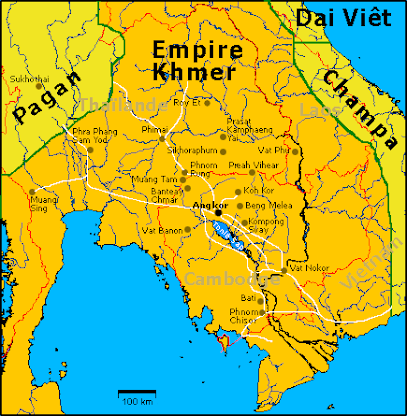
Preah Vihear is a cluster of ancient Khmer temples that sit atop a cliff in a border area claimed by both Thailand and Cambodia.
The International Court of Justice in 1962 ruled that Cambodia has sovereignty over the temple ruins and parts of their surroundings.
Read more!
Tuesday, February 12, 2008
Democrats Abroad vote in Cambodia primary
02-12) 04:00 PST Phnom Penh, Cambodia -- Cambodia's capital played host to a U.S. primary for the first time last week , drawing U.S. citizens from around the country.
Held at a quirky restaurant called USA Donuts, the vote offered a mix of American traditions never seen before in Phnom Penh. Dozens of expatriates cast ballots in the Democratic primary, choosing mostly between Sens. Barack Obama and Hillary Rodham Clinton. Dozens more snatched up hard-to-find foods such as Fruit Loops, Kraft Macaroni and Cheese, and Stove Top stuffing.
The vote at the doughnut shop is part of the Democrats Abroad program to determine 22 delegates who will attend the Democratic National Convention in Denver. Voting in the global primary, conducted online and at 76 polling places in 33 countries, began Feb. 5 and ends today for an estimated 6.5 million Americans who live overseas. In Cambodia, about 1,800 Americans are registered as residents, according to the U.S. Embassy.
The program was conceived as a way to boost participation in the nomination process, especially for those who might not have requested absentee ballots in time for their home-state primaries or those who cannot return home to attend caucuses. Democrats Abroad has been given state-level recognition by the Democratic National Committee. Its counterpart, Republicans Abroad, does not have similar recognition by the GOP, but the organization works to generate support of Americans overseas for Republican candidates.
Observers say turnout for the overseas Democratic voting - both live and online - has been high and results will be announced later this month. In Cambodia, organizers said 78 percent voted for Obama, 21 percent supported Clinton and 1 percent remained uncommitted. They also said the entire program is a test-run for individual states looking to use a similar Internet-based system.
Every element at the doughnut shop- food, music and ballots - seemed out of place in Cambodia, where locals are just beginning to confront their recent past in trials against the aging leaders of the genocidal Khmer Rouge regime of the 1970s. And even though voting has become commonplace, accusations of deep-seated corruption and blatant vote buying have been widespread.
Yet the American voters were generally giddy to be participating in a live electoral process so far from home. Regardless of age, almost everyone bobbed their heads to the eclectic mix of voter-themed music heard on the restaurant's boom box. Many more grinned or whooped it up as their ballots slid into a locked, silver vote box.
"Living abroad, it's easy to feel disconnected," said 30-year-old Carlyle Gollogy of Santa Cruz, who works as an administrative assistant at a local nonprofit hospital. "Being here today, it eliminated a lot of the (red tape) by giving you an accessible way to be part of the process."
Many voters also said they want to see a change in Washington's foreign policy.
"I think this is probably the most important and exciting election in my lifetime," said Susan Hagadorn, a San Francisco native who has lived in Cambodia for three years and works as a consultant for nonprofit organizations. "There's a deep dissatisfaction about how America is viewed from abroad. That we can come together to do something about that here, through voting, an American tradition, is really exciting."
Wayne Weightman, who helped organize Saturday's vote, agreed, saying he eagerly voted for a former Hawaii classmate, whom he knew as Barry.
Obama "was always this amazing guy who could talk to anyone," Weightman said. "To realize that you knew someone who has the possibility of making it so foreigners abroad can stop apologizing for their country, well that's just inspiring."
USA Donuts was an obvious choice for the polling site, event organizers said. Owner Johnny Ly is a 39-year-old Cambodian refugee who fled during the Khmer Rouge era with his family to Long Beach, where they operated a doughnut shop.
Ly moved back to Cambodia in 2000 to open an American-style doughnut shop. He now runs two stores with a third on the way. He imports special flour from California so that his pastries have just the right chewy consistency. The rest of his wares are shipped by relatives, who shop at Costco and Wal-Mart.
Ly gets a kick out of catering to Americans, whose culture he adopted during his 20 years in the United States.
"To be part of an election. That is American," said Ly.
Read more!
Cambodia urged to stop evictions
By Guy De Launey
BBC News, Phnom Penh
Human rights organisation Amnesty International has called for an end to forced evictions in Cambodia.
Thousands of families have already been moved from their homes in the centre of the capital Phnom Penh, and more evictions are set to follow.
The authorities say this is a necessary part of Cambodia's development.
But in its report Amnesty disputes this, and says there has been a lack of accountability and consultation with local communities.
Members of threatened communities from across Phnom Penh are fighting on, although their homes may soon be reduced to rubble.
They have held a series of meetings to express solidarity and plead for help from outsiders.
The site of the latest gathering illustrates the size of the challenge they are facing.
'Legal title'
Dey Krahom was once a vibrant slum community. Now there are empty spaces where some residents have given up and abandoned their homes.
There's no need for evictions to take place in order to develop
Brittis Edman
Amnesty International
The gaps are filled with rubble, razor wire and garbage. Bulldozers belonging to the property developers park nearby.
Many residents say they hold legal title to their land and that threats and intimidation are being used to force them to leave.
Brittis Edman from Amnesty International says developers should adopt a cooperative approach instead.
"There should be discussions with the communities before an eviction is decided and the best option would obviously be to develop while the community is here, and develop the community as it is."
But that seems unlikely to happen. The Phnom Penh authorities have said they are committed to developing the city in partnership with private companies.
So far, that has meant relocating residents to sites that are in most cases a long way from the city centre, while developers build high-end housing and shops.
Read more!
Trip to Cambodia life-changing
By Marcus Stickley
A group of Nayland College students say a two week trip to Cambodia visiting aid projects in the struggling country has changed their lives.
"The poverty never leaves you," says Alison Paton, the teacher who accompanied 13 Nayland students, and one from Taranaki, on the two week trip.
Several students had never been outside of New Zealand before they left last month.
Each student had to raise $3500 to go on the trip and the group donated a further $1600 to seven different aid projects including schools, an orphanage and a hospital which they visited.
The students also helped build a house for a family whose father had fallen ill.
They saw the extreme poverty in Cambodia, visiting people living in a rubbish dump in the capital Phenom Phen and others living in a village where they struggled to grow rice.
Some poor Cambodians they met had copper streaks in their hair from malnutrition.
Paige Bowler-Brendt, 16, said the trip made her appreciate "what we've got compared to what they've got".
The group visited Teuol Sleng, a former school turned into a prison by the Khmer Rouge to torture intellectuals and others who opposed them.
Since the regime was deposed in 1979 the building has been left as a museum complete with faded splatters of blood on the walls.
Most students left the museum with tears running down their faces, having heard the personal story of one of the museum's guides who had lived through the horror of losing family during the Khmer Rouge's reign.
The students said the country was still recovering from that period but they were impressed by Cambodians' resilience.
Bronwyn Ewers, 17, said Cambodia had something that New Zealand had lost.
"They've got that closeness of community."
For may of the students the trip has changed or reinforced what they want to do when they leave school.
Kayleigh Shaw, 18, had planned to go to Europe when she finished school but she now wants to return to South East Asia to do volunteer work.
Money went further in helping other people there, she said.
Read more!
Sunday, February 10, 2008
Cambodia to host part of ASEAN Football Confederation Cup Tournament
PHNOM PENH, Feb. 10 (Xinhua) -- Cambodia will host part of the ASEAN Football Federation Cup Tournament in October for Laos, Brunei, The Philippines, East Timor, and Cambodia, said a sports official here on Sunday.
Three winners out of the five countries will then go to Thailand or Indonesia to vie with Thailand, Singapore, Vietnam, Malaysia, Indonesia and Myanmar, said Keo Sarin, deputy secretary general of the Football Federation of Cambodia (FFC).
"We are trying to be successful in hosting part of the tournament," he added.
The ASEAN (the Association of Southeast Asia Nations) Football Confederation Cup Tournament derived from the Tiger Cup soccer match and is currently one of the most important sports events in the region.
Read more!
'They all had to be eliminated'
Kang Khek Ieu was known as 'Cambodia's Himmler', a torturer who oversaw the deaths of 17,000 people. As he prepares to go on trial, he gives a chilling insight into the Khmer Rouge – the most detailed account yet from a top henchman
Exclusive by Valerio Pellizzari, Phnom Penh
He was Pol Pot's trusted henchman, the brilliant mathematician who calmly fashioned an efficient apparatus of torture and death out of a Phnom Penh high school and who oversaw, during the Khmer Rouge's reign of terror, the interrogation and cudgelling to death of some 17,000 Cambodians.
In the West he has been called "Cambodia's Heinrich Himmler"; since Pol Pot himself and his lieutenant Ta Mok cheated justice by dying, he is the most vivid symbol of the Khmer Rouge left alive. His name is Kang Khek Ieu, but he is better known by his nom de guerre, Duch (pronounced "Doik"). This spring, 28 years after fleeing Cambodia ahead of the Vietnamese army, his trial for mass murder may finally get under way.
Now, in the first interview he has given since his capture more than eight-and-a-half years ago, he talks freely about how and why he sent 17,000 Cambodians to their deaths in the killing fields.
And even as he waits to confront the proof of his crimes, it is clear that, for him, there was never any choice: anybody who was thought to pose a threat to the revolution had to be tortured and killed. Asked whether he had any moments of uncertainty, any doubts or feelings of rebellion while he set about wiping out his country's entire intellectual class, he answered: "There was a widespread and tacit understanding.
"I and everyone else who worked in that place knew that anyone who entered had to be psychologically demolished, eliminated by steady work, given no way out. No answer could avoid death. Nobody who came to us had any chance of saving himself."
The command had come from above, he said. "All the prisoners had to be eliminated. We saw enemies, enemies, enemies everywhere." He could not have rebelled or fled, he insisted. "If I had tried to flee, they were holding my family hostage, and my family would have suffered the same fate as the other prisoners in Tuol Sleng. If I had fled or rebelled it would not have helped anyone."
Between 1975 and the beginning of 1979, under Pol Pot, two million men and women, almost a third of the Cambodian population, were brutally eliminated by the Khmer Rouge – an extreme Marxist movement that aimed to take Cambodia back to "Year Zero", cutting it off from the outside world and imposing their leaders' vision of an "agrarian utopia".
Of its two million victims, more than 17,000 – party officials, diplomats, Buddhist monks, engineers, doctors, teachers, students, musicians and dancers, were brought to a former school in the heart of Phnom Penh that had been converted into a torture centre. Only six came out of it alive.
Codenamed S-21, the centre was run by Duch, a former maths teacher who had become the head of the regime's secret police. In the former classrooms, over a period of 40 months, Duch oversaw the extermination of the entire Cambodian intellectual class with mathematical rigour.
Confessions were extracted by primitive torture: prisoners were strapped to iron beds, suspended upside down from ropes, threatened with drowning, tormented with knives and pincers, locked in tiny cells. Then, at night, they were taken by lorry to the outskirts of Phnom Penh and killed in the rice fields. The Khmer Rouge were obsessed with killing by night.
Now at last, after years of argument between the Cambodian government and the United Nations, the surviving members of the Khmer Rouge hierarchy are finally being brought to justice. They will be tried under a hybrid UN-Cambodian tribunal known as the Extraordinary Chambers in the Courts of Cambodia; the pre-trial hearings began in November and are still going on. Pol Pot, of course, is long dead, having died under house arrest before he could be tried in 1998. The bloodiest of his comrades, Ta Mok, died in 1996. But five senior leaders including Khieu Sampan, the Khmer Rouge president, await trial.
Duch made his first appearance in court in November when his lawyer asked for him to be let out on bail because his "human rights had been violated, even if he was not beaten or tortured". A ripple of ironic laughter ran round the courtroom. The request was rejected.
My quest to interview Duch had begun nearly three years ago. I first visited S-21, soon after the fall of the Khmer Rouge. Since his arrest more than eight years ago, nobody from the outside had even clapped eyes on him. Now, finally, I was looking at this frail, 66-year-old man with his protruding, irregular teeth, bug eyes and washed-out grey clothes. I was confronting the mystery of the banality and the innocence of evil.
Throughout our interview, his voice was low, respectful like a mantra, a Buddhist prayer, rather than what it really was; the soundtrack of a nightmare still freighted with questions. His mild-mannered almost frail appearance in no way suggested the role of a mass murderer.
For the interview, the rules were strict: no tape recorder, no camera, no talking to him directly in French or English but only through a Cambodian interpreter. General Neang Phat, Cambodia's Secretary of State, and other generals were sitting in the same room, listening to and scrutinising this indefinable and unfathomable man. Some of them, too, have evil memories of the Khmer Rouge years. But Duch was the exact picture of the banality and innocence of evil.
Duch, the nickname he assumed when he was young and joined the guerrillas, told me that the torture centre at Tuol Sleng was set up in August 1975, four months after the Khmer Rouge entered Phnom Penh, and began work two months later.
"I was given the task of creating it and starting it up, although I never found out why they chose me. Before 1975, when the Khmer Rouge lived in hiding, in the jungle, or in the liberated zones, I was the head of Office 13, I was the chief of police in the special zone bordering on Phnom Penh."
He described a routine of bureaucratic monotony. "Every day I had to read and check the confessions. I read from seven in the morning until midnight. And every day, towards three in the afternoon, Professor Son Sen, the minister of defence, summoned me. I had known him since my time as a high school teacher. It was he who had asked me to join the guerrillas.
"He would ask me how my work was going. Then a messenger would arrive, an envoy, who collected the confessions that were ready and took them to Son Sen. These messengers were the only links between one office and another."
I wanted to know if Duch had any moments of uncertainty, doubts, feelings of rebellion while he was wiping out his country's entire intellectual class.
He admitted the idea had crossed his mind. "When the work started at Tuol Sleng, I asked my bosses now and then, 'Do we really have to use all this violence?' Son Sen never answered. Nuon Chea, the No 2 Brother in the power structure, who was above him, told me: 'Don't think about these things.'
"I personally had no answer. Then with the passing of time, I understood. It was Ta Mok who had ordered all the prisoners to be eliminated. We saw enemies, enemies, enemies everywhere.
"I was cornered, like everyone in that machine, I had no alternative. Pol Pot, the No 1 Brother, said you always had to be suspicious, to fear something. And thus the usual request came: interrogate them again, interrogate them better."
Sometimes Duch was tempted to be merciful, he claimed – and his superiors began to mistrust him. He recalled the time a cousin was brought to S-21.
"I knew him well, we had formed sincere family ties but I had to eliminate him anyway. I knew he was a good person but I had to pretend to believe that confession extorted with violence. So in order to protect him I didn't analyse those statements too rigorously. And on that occasion my superiors began to lose full trust in me. At the same time I didn't feel safe any more."
But the moment of official doubt passed. The interrogations and executions continued, remorselessly until the end.
"You kept your post until the end," I said. "Did you always carry out your orders thoroughly?"
Duch answered: "I obeyed. The work carried on until 7 January 1979, when the Cambodian liberation forces, supported by the Vietnamese, conquered Phnom Penh. There was no escape plan, no pull-out plan ..."
But, after the fall of the Khmer Rouge, the executioner blended back in among his countrymen, and disappeared, as so many did in the post-war chaos, swallowed up by the void.
Many years later he was converted to Christianity by American missionaries. His true identity was discovered in 1998 and soon afterwards he was arrested. He remains the most disquieting witness of the political madness planned by the Khmer Rouge, after the death of Pol Pot and Ta Mok, the one-legged "butcher".
I asked him how he converted to Christianity and why that happened. "I became convinced that Christians were a force, and that this force could beat Communism. At the time of the guerrilla war, I was 25 years old, Cambodia was corrupt, Communism was full of promise and I believed in it. But that project failed completely."
So if Duch has repented now, what is his attitude to all those thousands of victims of his violence? There was no alternative for people like himself, trapped inside the machinery of the Khmer Rouge, he said.
"If someone goes looking for guilt, and the various degrees of guilt, I say that there was no way out for anyone who entered the power system conceived by Pol Pot. Only at the top did they know the real situation in the country, but the intermediate functionaries did not know. And then there was that obsession with secrecy.
"Of course, you are asking me whether I could have rebelled, or at least fled. But if I had tried to flee, they were holding my family hostage, and my family would have suffered the same fate as the other prisoners in Tuol Sleng. If I had fled or rebelled it would not have helped anyone."
Read more!
Saturday, February 09, 2008
Newlyweds lend a hand in Cambodia's struggle against war, poverty
By Chris Gray, The Philadelphia Inquirer
SIEM REAP, Cambodia -- Let's be honest: It was the specter of tigers, temples and tom yam soup that led my husband and me to honeymoon in Southeast Asia. We wanted an adventure to remember, on a continent where neither of us had been.
But as I researched our trip, I realized that we should spend at least a little time practicing "voluntourism," giving back to people who are still struggling for the basics after decades of war and poverty.
We found a way to have it all in Siem Reap, Cambodia, home of the ancient temple complex Angkor Wat -- and Ponheary Ly, a tour guide who considers it her mission to help educate as many Cambodian children as possible.
found Ly, a Siem Reap native and survivor of dictator Pol Pot's labor camps, through the Asia message board on Fodors.com. Ly, 44, is a veteran guide who has arranged private tours of Angkor Wat and other Siem Reap attractions in both English and French -- languages she learned in secret during the Vietnamese occupation of Cambodia -- since 2000.
A former English teacher, Ly has also worked for seven years to enroll children in Cambodian schools. While public school in the country is ostensibly free for the first three years, many rural children do not have the $12 necessary for shoes, school supplies or uniforms, she said.
"As a teacher, I knew about the difficulties of the kids and families who couldn't send the kids to schools. Also, I found that the kids are smart, but they don't have any occasion to show how smart they are. To build the country, we have to build the education for all people, especially the kids."
It's a message that Ly's clients -- mostly Americans who prefer independent travel with native guides to packaged tours -- could support. In addition to touring the temples, more and more visitors asked Ly whether they could visit the schools and donate money for bicycles, supplies and uniforms.
Lori Carlson, formerly of Austin, Texas, was one such convert. When she visited here in 2005, Carlson was struck by Ly's background and dedication. On her return to the States, she founded the Ponheary Ly Foundation (www.theplf.org), a registered nonprofit that channels money directly to the schools.
As of December, Carlson, 48, had raised $90,000 for five schools -- and quit her job to move here to work fulltime with Ly. She formed a board of directors for the PLF, which distributed school supplies to 1,955 children last fall.
"I believe the travelers who go to visit the temples at Angkor Wat understand they bear at least some of the responsibility to gently nudge these children toward school rather than reinforce the idea that it's good to stand on the corner and beg dollars from tourists," she said.
With such strong advocates, Don and I were excited to meet Ly and do our part. We arrived here to find a city undergoing massive change. The number of tourists visiting Angkor Wat, a UNESCO World Heritage Site since 1992, has exploded in recent years, spurring an increase in hotels, shops, restaurants and other businesses.
While the influx of dollars has been good for many Cambodians (merchants prefer U.S. dollars to the Cambodian rial), it's disconcerting to see barefoot bicyclists ride past $800-a-night hotels. Young children hawk maps, books and trinkets near the temple grounds; tuk-tuk drivers fight over $1 fares.
That's not to say that Don and I eschew luxury (it was our honeymoon, after all). We turned down a $20 room at Ly's simple guesthouse, primarily because it didn't have a pool, which we considered essential to deal with the area's crushing humidity. At $95, our poolside room at Bopha Angkor was spacious yet not ostentatious, and the package included daily breakfast, a traditional Khmer dinner, and a massage.
Just a few hours after we landed, we went to Angkor Wat with Ly's brother Dara as our guide. There are more than 300 temples in the complex, but Dara steered us to the ones that would provide the most interesting backdrops for my husband, the photographer.
As we sweated in the 90-degree heat, I asked Dara about his family's experience under the Khmer Rouge. He told us that his father, a teacher in Siem Reap, was among the first wave of educated people to be killed under Pol Pot's regime. As a result, Dara and his siblings were sent with their mother to the countryside to work.
It's a sobering tale, and we heard more from Ly over the next few days. Ly, who was 13 when the Khmer Rouge came to power, and her siblings survived, mainly because villagers would leave food for them at night.
"We were given this much rice," Ly told us, holding up the tip of her finger. Dara would "crawl out on all fours, like a cat" to get extra food; sometimes, actual cats or monkeys would have gotten to the rations instead, she said.
Still, the extra nourishment kept the family alive -- and the Khmer Rouge noticed. Officials asked her mother why her children were still alive when so many other youngsters had died, Ly said. When her mother refused to answer, she was horribly beaten.
Such atrocities were common in the Pol Pot years. Yet most Cambodians don't like to talk about the time under the Khmer Rouge, Carlson said. It's rare to find it discussed in schools, primarily due to the country's Buddhist beliefs, which hold that people -- even war criminals -- are responsible for their own karma.
Ly is different, Carlson said. She understands that it's important to talk about the past so it doesn't happen again. We were talking in Ly's van, on our way to deliver lunch to the 476 children at Knar school, out in the Cambodian countryside. On the road, we saw men on bikes toting crates filled with piglets and open huts with children playing in the dirt.
Cambodian families expect all children, no matter how young, to contribute economically, Ly told us. Which is why even the kids who are lucky enough to go to school attend for a half day; at home, they are needed for chores, farm work, or other ways to make money.
In addition to a donation made before our trip, we gave Ly $40 for lunch, which buys two noodle packets for each child. That's essential, Carlson said, because if the child received only one packet, he or she would take it home to the family instead of eating it. The school tries to feed the children at least once a day to make sure they have enough energy to learn, Carlson said.
We arrived at Knar School, which consists of several one-story classrooms. As Don carried the boxes of noodle packets into the rooms, the children's eyes grew wide. They straightened in their seats and thanked us by pressing their hands together and bowing.
Carlson and Ly showed us around the school and talked about the improvements that have been made. Incentives such as bicycles, uniforms, and extra noodle packets show the families that there are tangible benefits to their children attending school, Carlson said.
"I would like to have my country be the same as the other countries," Ly said, with Cambodian children able "to have good education to work well to get out from the poor life."
The children seemed to love school, showing off their uniforms and books. An impromptu game of soccer ensued, with Don in the thick of it. It was an emotional sight for me, which sparked later discussion: Although we had been together several years, Don and I had never talked about the greater good we could accomplish as a couple.
It's a conversation that all newlyweds should have, wherever their honeymoon takes them. For us, road-testing our fledgling marriage in an underdeveloped country not only gave us the adventures we sought, but also set the course for a more permanent path. And that's definitely a trip worth taking.
TWO SIDES OF CAMBODIA
There are no direct flights to Siem Reap from the United States. You can fly there from various Asian cities, including Bangkok, Hong Kong, Singapore, Kuala Lumpur, Ho Chi Minh City, and Hanoi.
We stayed at Bopha Angkor (www.bopha-angkor.com), booking the "Poolside Evasion package." The cost was $285 for both of us for three nights, including airport transfers, breakfast, a dinner, and a massage for two.
We booked Ponheary Ly as a guide by e-mail (ponhearyyahoo.com). Ly charged us $145 for 21/2 days of touring, which included three half-day sessions at Angkor Wat, the visit to Knar School, and a visit to the floating village on Tonle Sap lake.
MORE INFORMATION: To donate or read more about the Ponheary Ly Foundation, go to www.theplf.org. Or e-mail Lori Carlson at donatetheplf.org.
CAMBODIA TOURISM: www.tourismcambodia.com
ANGKOR WAT: www.angkorwat.org
Read more!
Friday, February 08, 2008
U.S. telecommunications firm to expand into Cambodia
PHNOM PENH, Feb. 8 (Xinhua) -- U.S. telecoms firm 3P Networks has negotiated with the Cambodian government to buy up the rights to frequencies, enabling it to offer cutting-edge multimedia services for the country, said a press release received here on Friday.
3P Networks Inc is currently in the final stage of negotiations with the Cambodian government to acquire significant frequency spectrum in order to implement unique cost-effective telecommunication solutions in Cambodia and in neighboring countries, it said.
Buying into Cambodia will enable a foothold for expansion into Laos and Vietnam, it said.
"Affordable and reliable telecommunications are critical for developing countries in their efforts to both attract investment capital and stimulate a robust domestic environment," it added.
The firm offers multiple products including TV, fixed and wireless Voice over Internet Protocol (VoIP) and broadband, which are very much in their infancy in Cambodia.
Read more!
EU delegation doubts land concession policy of Cambodia
PHNOM PENH, Feb. 8 (Xinhua) -- A European Union (EU) delegation here on Friday expressed doubt about the land concession policy ofthe Cambodian government and also provided ways to address its negative effect.
Some companies with land concessions from the government have been exploiting the soil and the people originally living there, said Harmurt Nassauer, chairman of the delegation of the European Parliament, the executive body of EU, for relations with the countries of the Association of the Southeast Asia Nations (ASEAN).
Their exploitation has led to confrontation and deprived the country of chances for sustainable development, he said at a press conference held upon the delegation's conclusion of its five-day visit to the kingdom.
"Field trips to some provinces told us that the land concession policy has become nightmare for the forestry-dependent communities," he said.
However, he added, the tension can be removed if both sides have good will and the companies do more good things to benefit the local communities.
Meanwhile, vice chairwoman Giovanna Corda told the press conference that some companies with land concessions have been exploiting the land through logging, which is negative for Cambodia.
The government must not allow them to ruin the country and proper management should be in place to protect these precious assets for all of us, she said.
The companies should help the local communities, like building schools and health care centers, but not destroy the nature and the people's living environment without thinking about the future, she added.
During its visit, the delegation respectively met Prime Minister Hun Sen, Deputy Prime Minister Sok An, Minister of Commerce Cham Prasidh and other government and parliamentary leaders.
It also traveled to Kampong Chhnang and Pursat provinces and visited some EU-funded forestry projects, according to the release.
Cambodia has more than 200 kinds of trees, but the tree coverage rate has decrease from 70 percent to the current 35 percent due to lack of protection and over logging.
Major developer can have hundreds of hectares of land for development if the government approves his plan. Concession period used to reach 99 years for such developers.
Read more!
Money woes threaten Cambodia's Khmer Rouge tribunal

Phnom Penh, Cambodia - The top surviving Khmer Rouge leader appeared in court this week for the first time, three decades after the virulent communist regime allegedly oversaw the deaths of some 1.7 million people in Cambodia.
Nuon Chea, thought by many to be the movement's chief ideologue, is facing charges of war crimes and crimes against humanity at a United Nations-backed tribunal that began work in 2006.
His presence in the docket should be a sign of success for the court, which many hope will undercut decades of impunity that have plagued this tiny nation. But the fitful progress of Cambodia's hybrid tribunal has once again bogged down under budget woes, a lingering management scandal, and real worries that the tribunal's five aging defendants could die before judgments come in.
The Extraordinary Chambers in the Courts of Cambodia (ECCC) now plans to spend $170 million to try up to eight defendants, a process it anticipates could take until March 2011, according to a Jan. 30 budget estimate.
That's a big increase from the court's initial three-year budget of $56.3 million – an amount unfathomable to many ordinary people in Cambodia who live on less than $1 a day.
Helen Jarvis, a tribunal spokeswoman, emphasizes that Cambodia's court looks like a bargain compared with tribunals in Rwanda and the former Yugoslavia, which have cost about $150 million a year. The Cambodian side of the court will start to run out of money in a matter of weeks, but donors have yet to publicly commit any funds.
"We recognize that a certain increase of the budget is justified," said one Phnom Penh diplomat on condition of anonymity. "We, however, are waiting for official clarification of these new figures and for detailed explanation of the considerable increase," he added.
Donor skepticism surged last year after reports revealed severe problems in hiring and management on the Cambodian side of the court. Allegations that Cambodian staff had to give money in exchange for their jobs have yet to be put to rest.
Now donors are looking for reassurance that their money will be well spent. The European Commission, which funds the Cambodian side of the court, has initiated an independent review to determine whether the court has made adequate reforms. Results may come in this month.
The United States, which has funded every major multinational criminal tribunal except the International Criminal Court (ICC), has yet to provide direct funding to the ECCC, despite signs late last year that the State Department was warming to the idea. President Bush's fiscal year 2009 budget request, released this week, doesn't include money for the tribunal, and the US Embassy in Phnom Penh says the issue is still being reviewed.
Some Cambodia watchers in Congress, which barred direct funding pending assurances that the court can meet international standards, remain skeptical.
"Congress remains sober about Cambodia, generally, and the KRT [Khmer Rouge tribunal], specifically," a senior congressional aide said by e-mail. "Those donors who have put funding on the table are griping how dollars were used and abused, and the administrative shortfall/concerns are well known. We will watch closely those international jurists who wrestle with the challenges every day; the greater stink they raise over corruption or political interference, the less chance Congress or other donors will want to pony up."
Meanwhile, the slow drama of justice plays out in a courtroom on the outskirts of Phnom Penh. Nuon Chea on Thursday asked to be released from the tribunal's detention center, where he has been held since his Sept. 19 arrest. He rose to address the court with the help of two guards. "I have no intention to flee my beloved country."
Chuon Choeun, a farmer brought to view the hearing by a nonprofit group, was one of about 100 Cambodians in attendance. He had never seen Nuon Chea before and even though he couldn't understand much of the legal rules under discussion, he found his first glimpse of the man he once believed was all powerful both bracing and strange.
He expected Nuon Chea to look more brutish, somehow. "His face looks fine. He's not nasty. His face is finer than mine."
Thursday, February 07, 2008
Chinese company to construct hydro-electric station in Cambodia
PHNOM PENH, Feb. 5 (Xinhua) -- Three BOT (build, operate and transfer) agreements were signed here on Wednesday for a Chinese company to build and develop the Kirirom III Hydro-electric Station in Kaoh Kong to meet the power demand from Kaoh Kong, Kampong Speu and Phnom Penh.
Zhao Shouhe, president of the China State Grid Xin Yuan International Investment Co. LTD., and vice president Wang Hong inked the agreements with Cambodian Minister of Economics and Finance Keat Chhun, Cambodian Minister of Mines and Energy Suy Semand other government officials.
Charged Affaires of the Chinese Embassy in Cambodia Duan Jinzhu and Economic and Commercial Counselor Sun Weiren also joined the ceremony.
A press release from the Cambodian side said that the project won approval from both governments after more than two years of field research and expert study.
It will enjoy benefits in dual sectors of society and economy, satisfying the Cambodia's power need on condition of safety and high efficiency and generating incomes and taxes for both governments, it added.
The project is located in Koh Kong province in southwest Cambodia, 159 km away from Phnom Penh, the capital of Cambodia, and 120 km away from Sihanoukville, the major port city of Cambodia.
The 47-million-dollar power plant will have an installed capacity of 18 megawatts. The plant will be finished in three years and have 30 years of granted on cession.
Read more!
Wednesday, February 06, 2008
3P Networks Update on Cambodia Telecom Frequency Negotiations
Striving for Low Risk - High Returns”
NEW YORK--(BUSINESS WIRE)--3P Networks Inc. (OTCBB:TPNW) (“the Company”) is currently in the final stage of negotiations with the Royal Cambodian Government to acquire significant frequency spectrum in order to implement unique cost effective telecommunication solutions in Cambodia and in neighboring countries.
As disclosed in a news release dated December 10, 2007, the Cambodia transaction qualifies as the foothold required for a rapid and strategic expansion into the region, specifically in the emerging economies of Laos and Vietnam. Affordable and reliable telecommunications are critical for developing countries in their efforts to both attract investment capital and stimulate a robust domestic environment. While assisting Cambodia’s long term growth and higher GNP-per-capita targets, the Company will also succeed in significantly enhancing shareholder value.
The Company’s strategy is to rapidly build value via credible cash flows from an established and continually expanding subscriber base in areas where valuations are considerably below standard industry benchmarks. In the briefest of terms, the acquisition of the available telecommunications concession will meet the necessary return-on-investment criteria from the perspective of the inherent risks in creating business opportunities in the developing world.
The Company continues to look for takeover targets in the heavily undervalued regions of the world, subject to the availability of quality management. The opportunity in Cambodia has led to the suspension of the Company’s previously announced (August 20 and October 18, 2007) acquisition and financing of certain Caribbean assets. The current opportunity is a direct result of the Company’s joint venture with a boutique investment-banking firm in Phnom Penh—Diversified International Projects.
About 3P Networks: TPNW
3P Networks’ management has decades of experience providing telecommunication technologies to developing nations. Much of the focus has been in technologies which assist in the “custom bundling” of multiple products including TV, fixed and wireless VoIP and broadband connectivity, all in a common platform. The Company’s management realizes that aggregating subscribers is the name of the telecommunications game; the growth-oriented markets of the niche South East Asian region (in and around Cambodia) offer a unique window of opportunity. For more information please access the company’s website at www.3pnetworksinc.com.
About Diversified International Projects
Diversified International Projects Co. Ltd. (D.I.P.) represents and promotes financial enterprises, institutions and investors in the Asia region. Over the past 20 years, D.I.P. principals have been involved in a number of significant transactions, particularly related to investment and property development activity, and are well positioned to represent financial enterprises as well as develop, implement and market financial-related services to markets in the fast expanding Asian region.
This document contains certain forward-looking statements. Such forward-looking statements, by their very nature, involve known and unknown risks, uncertainties and other factors, which may cause the actual results, performance or achievements of 3P Networks Inc. (“the Company”), or industry results, to be materially different from any future results, performance, or achievements expressed or implied by such forward-looking statements. Those trading in shares of the Company should access independent and qualified investment advice, particularly where claims made in forward-looking statements deserve expert attention. Any valuation of the Company’s shares currently depends upon the success the Company will achieve in its merger and acquisition strategy in and around Cambodia, in South East Asia, and upon the overall growth of that region. Such a valuation is also conditioned by the nature and quantum of financing available from time to time.
Read more!
Queenco Leisure buys land in Cambodia for 10 mln usd to build beachfront resort
LONDON (Thomson Financial) - Queenco Leisure International Ltd said it has purchased 9 hectares of land in Sihanouk Ville, a coastal area in the south-west of Cambodia, for 10 mln usd, which it plans to develop as a destination beachfront resort and casino, including hotels and conference centres.
The casino developer and operator said as part of the acquisition, it has also acquired exclusive rights from the Cambodian government for the stretch of beach immediately in front of the site.
'Along with the expansion of Sihanouk Ville's airport, the area is being transformed as a tourist destination, with a growing local economy, as both foreign and domestic investors recognise the future potential of the area,' chief executive Dror Mizeretz said.
Today's announcement follows the company's acquisition of 48 hectares of land in Sihanouk Ville in February 2007, Queenco added.
tfn.newsdesk@thomson.com
Read more!
Saturday, December 29, 2007
Tourists complain of difficulties, negative experiences
VietNamNet Bridge – The number of foreign travelers to bordering nations, Laos and Cambodia, are half those coming to Vietnam. However, international visitors’ complaints reveal that Vietnam has much to learn from its neighbors.
Where has all the hospitality gone?
A traveler nicknamed Eileen 76 on the Lonely Planet tourism forum, wrote: “My friends and I just got back from a five day trip to Hanoi, Vietnam and frankly, it was a trip from hell.
Why? From the moment we stepped on the plane (AirAsia), you get ignorant and stubborn Vietnamese who turned on their mobiles mid-flight! Not one, but several, despite sterm reprimands from the stewardess.
The next day, I had my mobile stolen from my backpack. We were standing on a sidewalk near the lake, trying to figure out which road we were on and where to go when I felt a tug from behind. I turned around and saw a guy standing too close to me. I yelled at him and my first reaction was to quickly check my bag to see whether my digicam and money were missing.
The ‘expletive’ yelled back but I ignored him and walked away when I realized that, thank god, that I still had my money and camera. It was 2 to 3 minutes later that I suddenly remembered my phone, which was kept in another outer compartment and sure enough, it was gone!! And so was the sketchy man!!
To add insult to injury, a shopkeeper was sitting and saw the whole thing, and yet, he did nothing! We were less than one meter away from him. What’s wrong with these people anyway?
Oh, who can forget the horrendous traffic. Normal traffic rules don’t exist here. As far as I know, red means stop, while green means go. But to the Hanoians, both colors meant the same thing – go, go, go. I lost count of the number of times we were nearly mown down by motorbike when a pedestrian light was clearly green and intersecting traffic lights were red.
I know they like to honk at anything and everything that moves, but does that mean it absolves them of all responsibility? I mean, just coz you honked while riding your bike against traffic and nearly crashing into pedestrians, does not necessarily mean you can simply shrug it off with the excuse ‘I used my horn didn’t I’?
I’ve been to Cambodia where the traffic was equally chaotic (in Phnom Penh at least), but at least there was method to the madness. There, you just cross and drivers will automatically avoid you, provided you don’t make any sudden moves or freeze halfway. But try to apply that system in Hanoi, and you’re liable to lose a few limbs, if not your life.”
Regarding service quality, Eileen wrote: “And what’s up with Hanoian’s attitude anyway? They’re rude, crude and uncouth. OK, so they don’t really speak English. Fine. I can accept that. What I can’t stomach is the way they don’t even look you in the eyes when you speak to them.
There was this incident at the Water Puppet Theatre where we wanted 3 tickets for the 8.30pm show. The ticketing girl curtly said "no" but tore three tickets and gave them to us. We asked (politely) what does no mean – is it no, there are no more seats for the 8.30 show or no, you don’t have VND20,000 seats?? (There were two classes of seats - VND20,000 and VND40,000).
She just mumbled No again and eventually figured out the tickets she sold us were VND40,000 for the 9.15pm show. We told her we wanted the cheaper seats and again, got the mumbled no.
During the entire (one-sided) conversation, the girl was scribbling on some papers on her desk! And she didn’t even look up while we were trying to communicate!!! In the end we gave up and just gave her the money. But what happened if a person didn’t want tickets but just some information?
We encountered the same sour-faced and negative attitude among merchants around the Old Quarter market area when we asked them to take some pictures. For example, we went out to sampled biahoi (the austere local beer halls). The restaurant owner’s smile turned sour and her attitude immediately changed for the worst when we asked 2 simple questions: 1. How much (a reasonable enough request); and 2. Can I take a picture?
And let’s not forget the attitude of Hanoians in general. They either poke (if you’re lucky), shove or ram you aside if you happen to walk a little slower or disrupt their route. And what about their inability to queue? What’s worse is they think its their god-given right to cut queue? Is all this really necessary?
And before all you guys take potshots at me, note that I’m an Asian and as polite as possible, with smiles and thank yous (in the local language) to the people I meet whenever I travel. I’ve been to a number of countries, from Asia to Europe and in all my travels, never have I experienced a colder, ruder or more selfish people than in Hanoi. What happened to the reputed Vietnamese hospitality touted by everyone?
Although Vietnam is more developed than its immediate neighbors Cambodia & Laos, it still has a lot to learn from them. They should learn from their regional peers how to be warm and friendly. It’s a smile here or a friendly greeting there that really makes a visitor feel welcome and makes all the difference in the world.”
She concluded: “Thank you very much, Hanoi, for your "wonderful" hospitality. Return to Vietnam??? Not in this lifetime. Give me Cambodia or Laos or even Thailand anyday.”
A tour guide that doesn’t like tourists
An Australian visitor, Harry Ledger, who lived in Vietnam for ten months, shared the same opinion. He wrote about his “hard” trip to Ha Long Bay on BBC. According to Ledger, a tour guide named Nguyen slept and snored the whole way from Hanoi to Ha Long, except for when he led visitors to a souvenir shop, which offered items for double Hanoi prices.
This tour guide sometimes mumbled negatively and Ledger remembers most him saying “I don’t like tourists. But foreign girls are really beautiful and you will see that when you go to Ha Long.”
At noon, Ledger’s group stopped to eat lunch at a restaurant located near a railway station. It was terrible with overdone and cold food like prisoner rations. But “superintendent” Nguyen told Ledger that he hadn’t acquired a taste for Asian food because he was a foreigner.
Ledger wrote that he had lived in Asia for years, at least ten months in Vietnam and that lunch was the worst meal he had eaten here.
“But I and other visitors knew that if we complained, nothing would change. Finally, we arrived at the wharf. I saw hundreds of cranky boats swarming, aimed at the tourists. And a rickety, double-deck, 45-seat boat was ours,” he wrote.
In another article on BBC, Ledger related the desperation of another western visitor, Anna Skodvedt-Sundling, who wished for a quick end to her trans-Vietnam tour.
This Swedish girl, 26, was among the increasing number of independent tourists traveling to Vietnam on a trans-Southeast Asia tour. The girl said she was disappointed. Everything becomes uninspiring and she only wanted to go to Laos quickly because each day she was forced to argue so often with merchants over being cheated out of money. She thinks Thailand is more hospitable and convenient.
Ben Harper, from the UK, said: “When I had my pocket picked in Saigon, police told me to report the theft to tourism police. But tourism policemen couldn’t speak English so I had to return to the local police station. When I got there, they told me it was too late and threw me out. They thought it was funny.”
The above complaints are specifically aimed at tourist managers and Vietnamese locals.
Read more!
She Was Supposed to Be Dead
When Kate Webb reported from the battlefields of Cambodia, she kept her chestnut hair cropped G.I.-short and wore jeans and loose shirts to obscure her breasts. This was 1971. Only a handful of women were full-time correspondents in Vietnam, and even fewer women roughed the front lines next door in Cambodia, where military officers believed foreign women were, at best, a distraction. At worst, they were bad luck.
Bad luck was a virus among foreign correspondents in Cambodia. Unlike in Vietnam — where Webb arrived four years earlier at age 23 with a philosophy degree, a one-way ticket from Australia, a Remington typewriter, $200 in cash and a whiskey-and-cigarette voice so soft people leaned in to hear her — there were no reliable phone lines in Cambodia to call your editor in an emergency. There were no American military hospitals to sew up your bullet wounds; no helicopters to evacuate you when things got bloody. By April 1971, several years before the Killing Fields, at least 16 foreign correspondents were missing and 9 were dead.
On April 7, it was Webb’s turn. A 28-year-old bureau chief for United Press International, Webb was covering a clash on Highway 4, south of Phnom Penh. As bullets flew from every direction between North Vietnamese and United States-backed Cambodian troops, Webb and her Cambodian interpreter plunged into a ditch. By the time they eventually belly-crawled their way out, four other refugees from the attack had joined them: a Japanese photojournalist and his Cambodian interpreter along with a Cambodian newspaper cartoonist and a Cambodian photographer.
Throughout that afternoon and night, the six of them crept through the wooded foothills of Cambodia’s Elephant Mountains, holding their breath as they stood within inches of chatting North Vietnamese soldiers. At 11:30 the next morning, tired, thirsty, their clothes and skin shredded by branches, they were crouching in the underbrush when they looked up to see two skinny North Vietnamese soldiers with AK-47’s. The soldiers bound Webb’s arms behind her back with wire, vine and tape and roped all of the captives together in a single line. They confiscated their notebooks, their ID cards, their cameras, their watches. Then they took one thing that Webb held dear: a gold Chinese charm that she wore around her neck. She had clung to that charm in foxholes and always came out alive. Now without it, she felt naked.
After a soldier tossed her and other prisoners’ shoes into the trees, laughing, Webb was forced to walk barefoot on the hot asphalt and through woods littered with bamboo splinters and stones, until another soldier brought Webb a pair of thongs. She winced, knowing they had been stripped from a dead paratrooper.
Following a week of night marches, they arrived at a military camp where Webb slept in a hammock and alternated between stretches of numbing boredom and piercing fear. Why, she wondered, hadn’t they shot her? Did they believe her during the interrogations when she said she wasn’t an American, wasn’t with the C.I.A., wasn’t a soldier? Maybe they would turn her over to the Khmer Rouge, where death — perhaps preceded by starvation — was almost certain. Maybe they planned to march her to the Hanoi Hilton, where United States pilots were being brutally tortured. There are worse things than a single bullet to the head.
As Webb would later write in her memoirs, “On the Other Side: 23 Days With the Viet Cong,” there wasn’t all that much that separated soldier from prisoner. Both subsisted on two meals a day of rice and pork fat in a salted broth and wrestled with hunger, malaria, homesickness. Webb and a soldier she nicknamed Li’l Abner compared their scarred feet (his were worse) and, in French, discussed the Renaissance, the Reformation and the Napoleonic Wars. Three weeks into captivity, Webb had lost 25 pounds — down to 105, on her 5-foot-7-inch frame — and shook with fever from two strains of malaria. She longed to take a bath, to shave her legs, to eat an orange.
She was not, however, dead. On April 21, 1971 — while Webb was sitting in the jungles of Cambodia — this newspaper ran her obituary. Near Highway 4, two Cambodian officers had found a woman they believed was Webb with a bullet in the chest. In accordance with Cambodian military procedures, they cremated the body.
Around that same time, the North Vietnamese were telling Webb about their plans to free her. They figured out a drop-off spot where Cambodian forces might rescue them. And on April 30 — following what Webb would call a “Mad Hatter’s” farewell party with tea, cigarettes, candy and bananas — Webb and the other captives made their final night march, this time with their possessions returned, save for their notebooks and cameras. In the predawn darkness, the soldiers and their former prisoners said fast farewells and Webb and the others walked onto Highway 4 waving a small piece of white cloth. “Miss Webb,” said a Cambodian officer who spotted her on the roadside, “you are supposed to be dead!”
That night Webb stayed at a friend’s empty apartment, where three hot baths washed the filth from her skin and 15 glasses of iced orange juice finally quenched her thirst. A bed with clean sheets awaited her, but Webb chose the balcony; she missed her hammock. She thought about the soldiers she had nicknamed Dad, Gold Tooth and Mr. Lib, who risked their lives to walk her to safety.
Another journalist might have parlayed three weeks of captivity into celebrity status. Webb got back to work instead. For the next three decades, she wrote for wire services from Cambodia, Sri Lanka, Afghanistan, Indonesia, Korea, Hong Kong, the Philippines and India, living outside the usual expat neighborhoods, learning the languages, outreporting many of her younger colleagues and using her own modest income to supplement the salaries of in-country wire-service staff.
When she finally retired from front-line reporting at age 58, she returned to Australia, where her family had lived since leaving New Zealand when she was a child. There, she tended her garden and sketched nature scenes. And on some nights, with a cigarette in one hand and a beer in the other, and a rapt audience of friends and family, she told stories about a few of the places she had seen.
Read more!
Tuesday, December 25, 2007
Group raises $13,000 for school in Cambodia
CLINTON (AP) — Chris Willemsen and a group of friends are giving an unusual holiday gift this year — a new school to a village in the Cambodian province of Kompong Thom.
They raised the money by selling cookies and lost-andfound clothing, organizing a ride along the Erie Canal and asking for donations.
“I didn’t realize just how generous people are,” said Willemsen, a part-time instructor at Hamilton College.
A weekend holiday concert at the community arts center pushed Willemsen’s group over the $13,000 needed to pay for a school through American Assistance for Cambodia, a nonprofit organization that has built nearly 400 schools in rural Cambodia since 1999.
Ultimately, the group wants to raise $30,000 for improvements.
Read more!
Protest march urges quick trial of Khmer Rouge leaders
PHNOM PENH, Cambodia — About 600 protesters marched in the Cambodian capital of Phnom Penh on Tuesday to call for speedier trials for the former leaders of Khmer Rouge regime.
A long-delayed, United Nations-backed tribunal is seeking accountability for atrocities during the Khmer Rouge's 1975-79 rule, under which an estimated 1.7 million people died from starvation, disease, overwork and execution.
The marchers, including students and Buddhist monks, walked 3 miles to the tribunal's office on Phnom Penh's outskirts.
"If the process of the trial continues to be too slow, then the aging former Khmer Rouge leaders will be die before facing trial," said Yin Kean, a 72-year-old nun. "I wish to see these leaders taken to court soon so that they will reveal who is responsible for the deaths of Cambodians under their regime."
The genocide trials are scheduled to begin next year. Five high-ranking former leaders are in detention after being charged with crimes against humanity and other charges.
Tribunal spokesman Reach Sambath welcomed the marchers.
"Their presence here is a very significant step, showing that this court has received support from the entire Cambodian population," he said.
Read more!
Monday, December 24, 2007
Dreamcatchers: A New Day, new lives
By K.C Johnson
The garbage dump in the Cambodian village of Stung Mean Chey still exists, and the work never ends.
Children spend all day, every day sifting through the squalor and stench, hoping to find enough redeemable material within the trash to bring home $10 per month for their families.
Less than two miles away, close enough to see the dump from their rooftop deck, a new day dawns for 47 children who have escaped their dreary existence thanks to the vision of one man and the generosity of strangers.
'I have a clean place to live, new and clean clothes, enough food and I get education. A very different life from what I had.'
Davy Hem, 14 years old The day begins with a shower and shampoo, a freshly cooked meal and camaraderie throughout the six-bedroom villa. Then comes Khmer school from 7 to 11 a.m., a walk back to their new home for lunch and English school from 1:15 to 4:30 p.m.
After school comes homework and housework, not to mention play time and shared stories of what these children, ages 6 to 21, now can achieve.
'I like to go to school and study both Khmer and English. I like to learn more so I can get a good job.'
Channa Chen, 11 years old One year ago, the Tribune profiled the efforts of Bill Smith, the official photographer for the Bears, Bulls, Blackhawks and the United Center. Fascinated by the Far East since his first trip there in 1991, Smith, 57, stumbled across the horrifying conditions at the Phnom Penh Municipal Garbage Dump in February 2002.
With financial help from friends and family, Smith helped empower 37 children with schooling, clothing and food at an annual cost of $600 per child. But, like those children he wanted to help, Smith always had bigger dreams.
'I could see what we were doing was helping them, but it wasn't enough,' Smith says. 'They couldn't take full advantage of their school because they had no place to study. They still were getting sick, drinking bad water, not getting enough food or sleep because they still lived in ramshackle conditions near the dump.
'I envisioned a shelter where kids could live during the week. When you live in homemade shacks and tents, anything's an upgrade. So I envisioned an empty storefront building where we put cots and had electricity, water and meals, and it would be huge.'
Kind of like readers' response.
Hearts opened Shortly after Smith's story ran, contributions started pouring in. People who long had worked in the same building with Smith had no idea what this quiet, humble man had been achieving for years.
'That's where true charity is, when you're doing things for people and nobody knows about it,' says Joe O'Neil, the Bulls' longtime senior director of ticket operations and a close friend of Smith's for 25 years.
Some officials from the three teams Smith works for made substantial contributions, wishing to remain anonymous. More common was the retired grandmother from Iowa, who scribbled a note to the Tribune saying she didn't have much to contribute but wanted to help.
In all, 160 readers each sent in $600 to sponsor a child. Many more offered general donations ranging from $25 to $5,000. In all, Smith said people he had never met contributed more than $150,000.
'Contributions were from all over the country, too, not just local,' Smith says. 'People's heartstrings were touched, and they wanted to help the kids.'
Thus, the work began in earnest for Smith; his wife, Lauren; his sister, Sharon Powell; and O'Neil and his wife, Susan, who were now on the board of a foundation called 'A New Day Cambodia.'
Smith and O'Neil traveled to Cambodia last February to scout out and secure a house they could rent, renovate and furnish. Cary Telander, the daughter of Sun-Times sports columnist Rick Telander, lived in Cambodia and served as an initial administrator.
They began the Keystone Kops adventure of setting up a home for 47 members of their new extended family.
'We called carpenters who made bunk beds, bought refrigerators and stoves and rice cookers,' Smith recalls. 'We asked around at markets and got good prices, but we bought one small rice cooker that became a running joke. You can't cook for 50 kids like that.
'You don't realize how much space you need in the kitchen to feed 50 kids, even though they're mainly eating rice and pork. We had to feel our way through. But we figured it out.
'Our fridge even has the little thing where you can get purified water out of the door.'
And on July 9, the A New Day Cambodia center opened its doors.
More to do Smith, by now well known when he visits the dump, hand-picked the children with the help of a local motorbike driver he and his wife have known for years, along with three teenage girls he and his wife removed from the dump five years ago. Those helpers speak the language and ...
Read more!
Saturday, December 22, 2007
CHALLENGES 2007-2008: Short Shrift for Human Rights in South-east Asia
By Marwaan Macan-Markar
BANGKOK, Dec 22 (IPS) - For nearly 30 years Cambodians have grappled with a question that no one in the country could answer with certainty: will the surviving leaders of the Khmer Rouge regime face justice for the genocide they perpetrated on their own people in the mid-1970s?
The wait may be over in the New Year. Events through 2007 suggested that the special war crimes tribunal established to try the Khmer Rouge leaders for killing nearly 1.7 million men, women and children is expected to open in 2008. Significant in this regard was the arrest this year of five major leaders of that extreme Maoist movement that ruled the country during 1975-79.
The hunger for justice among ordinary Cambodians, who lost relatives to Khmer Rouge brutality, was evident in late November when large crowds gathered at the special court on the outskirts of Phnom Penh to hear the bail hearing of Kaing Khek Eav, also known as ‘Duch.’ He headed the notorious Toul Sleng prison, where nearly 14,000 people were tortured before being executed. Duch’s bail application was rejected by the U.N.-backed war crimes tribunal.
But such events are rare on South-east Asia’s political terrain. Acts by most of the ten governments in this region during the year confirm that a greater priority is placed on state security than human security. And those who campaigned for human rights and political and civil liberties were often at the receiving end of rough, and at times brutal, measures unleashed by elected and non-elected governments.
‘’Human rights have deteriorated across this region in 2007. Even the few signs of hope have vanished,’’ Anselmo Lee, executive director of Forum-Asia, a Bangkok-based regional right lobby, told IPS. ‘’Governments are still interested in protecting themselves at the expense of the rights of their people.’’
Consequently, activists like Lee are pursuing a wait-and-see approach to judge the move by the Association of South-east Asian Nations (ASEAN), a 10-member bloc of the countries in the region, to improve its human rights record through a new regional charter. At a summit in Singapore in November, government leaders backed the new ASEAN constitution’s call to protect and promote human rights and to create a regional human rights body.
‘’The inclusion of human rights in the charter and the plan to create a regional human rights body are positive developments. They offer a window of opportunity,’’ says Lee. ‘’But we have to wait and see how serious this language is and how effective the new human rights mechanism will be.’’
ASEAN’s members include Burma and Thailand, which were under the grip of military juntas, Singapore and Malaysia, which are one-party states where opposition voices are kept in check through harsh laws, and Brunei, which has an absolute monarchy.
The region also accounts for Laos and Vietnam, which have repressive communist regimes; and Cambodia, Indonesia and the Philippines, which have varying shades of democracy hampered by a culture of impunity that has enabled abuse of power by some quarters, including the military and officials in government.
Military-ruled Burma, in fact, emerged as a human rights embarrassment for the region, following a harsh crackdown of peaceful street protests in September. The anger in some South-east Asian capitals was palpable as officials, normally known for bland diplomatic statements, opted for sharp language to criticise their regional neighbour.
Vietnam escaped a similar rebuke despite Hanoi unleashing the police on anti-government protestors in Ho Chi Minh City in July. Thousands of uniformed and plainclothes policemen were used to crush a movement led by farmers demanding compensation for lands that were seized by officials for new ‘development’ projects.
Malaysia, one of the region’s more affluent countries, did not take too kindly to rare protests by the country’s ethnic Indian minority in November. Their complaints of economic, educational and cultural discrimination were met by police using batons and tear gas. Kuala Lumpur accused the leaders of this marginalised community of having ‘’terrorist’’ links and arrested them under the country’s harsh Internal Security Act, a British colonial-era relic that enables the authorities to keep detainees behind bars indefinitely.
The Philippines, on the other hand, was the subject of worry among human rights monitors for the spate of extra-judicial killings that continued unabated through the year. In November, a special U.N. investigator released a report that accused the country’s armed forces of killing leftist sympathisers in an effort to wipe out communist insurgents and left-wing activists.
The death toll in 2007 was 68 people, a dramatic drop from the 209 victims who were murdered in 2006 in that archipelago. At the beginning of this year, Filipino human rights groups like Karapatan revealed that over 830 people had fallen victim to extra-judicial killings since 2001, when the current president Gloria Macapagal-Arroyo began her term in office.
Indonesia, an emerging beacon of democracy after ending a 30-year-long dictatorship in the mid-1990s, had a mixed record in trying to deepen its human rights culture. Jakarta won some praise by human rights groups for progress on two international human rights treaties, the 1996 International Covenant on Economic, Social and Cultural Rights and the 1966 International Covenant on Civil and Political Rights. The region’s largest country took steps to implement both documents this year.
Yet Indonesian human rights activists castigated their government for dragging its feet on investigating rights violations and for failing to go after perpetrators while marking World Human Rights Day on Dec. 10. ‘’We can still see a lot of impunities; there’s no significant improvement in human rights protection in the country,’’ Soetandyo Wignjosoebroto, a leading human rights activist, was quoted as saying during the occasion in an issue of ‘The Jakarta Post’ newspaper.
And the prospect of the region having a better record in the New Year appears remote because governments are reluctant to broaden the language of human rights, says Sinapan Samydorai, president of Think Centre, a Singapore-based rights lobby group. ‘’There is very little human rights education in the South-east Asian schooling system.’’
‘’It is a way of preventing people to know what their rights are,’’ he added, during a telephone interview from the city-state. ‘’And I don’t mean only political rights, but labour rights, economic rights and the rights to information.’’
Read more!
Thursday, December 20, 2007
Cambodian ambassador criticizes UN envoy
By EDITH M. LEDERER -- Associated Press Writer
UNITED NATIONS (AP) Cambodia's U.N. ambassador complained to Secretary-General Ban Ki-moon that the U.N. human rights investigator who just visited the country insulted the Khmer government and displayed "unacceptable" arrogance.
In a letter to Ban obtained Wednesday by The Associated Press, Ambassador Kosal Sea said the government is now considering whether the U.N. special envoy for human rights in Cambodia, Yash Ghai, is "still necessary," as the 1991 Paris peace agreement between opposing factions stipulates.
During a Dec. 1-10 visit to Cambodia, Ghai heaped criticism on the government for alleged rights violations and called the judiciary "a perversity." He predicted that Cambodians eventually were "going to rise" against the government.
Cambodian Prime Minister Hun Sen has vowed to never meet Ghai, accusing him of focusing only on the negative and ignoring the government's efforts to address human rights concerns. Hun Sen shunned the Kenyan constitutional lawyer during his recent trip.
International human rights groups on Tuesday backed Ghai and urged the government to engage with him. The groups include Human Rights Watch, the Asian Human Rights Commission, the Asian Forum for Human Rights and Development, the International Federation for Human Rights and the World Organization Against Torture.
Read more!
Cambodian PM says ex-Khmer Rouge officials have comforts in detention
PHNOM PENH, Cambodia (AP) - A U.N.-backed tribunal is holding former Khmer Rouge head of state Khieu Samphan in a comfortable room that bears no resemblance to the notorious torture cells his regime operated, Cambodia's prime minister said Thursday.
Khieu Samphan, 76, has been detained at the tribunal in the capital Phnom Penh since his arrest Nov. 19. The genocide trials are scheduled to begin next year, and Khieu Samphan is one of five high-ranking former Khmer Rouge members detained.
«He was offered a place with good conditions but he still complains about the difficulties of staying there,» Prime Minister Hun Sen said, noting the facility was nothing like the murderous Khmer Rouge's infamous torture center, Tuol Sleng.
«He ordered people jailed at Tuol Sleng for interrogation and torture, but he never discusses the difficulties of those people,» Hun Sen said.
Khieu Samphan's lawyer had complained the room was too small, according to tribunal spokesman Reach Sambath.
Detention cells at the tribunal have fans, beds with mattresses, radio, television, a window and a private toilet, he said.
The long-delayed tribunal is seeking accountability for atrocities during the Khmer Rouge's 1975-79 rule, under which an estimated 1.7 million people died from starvation, disease, overwork and execution.
Khieu Samphan was arrested at a Phnom Penh hospital after undergoing treatment for a stroke. He has been charged with crimes against humanity and war crimes.
He also faces charges related to his support of the Khmer Rouge policy of committing «murder, extermination, imprisonment, persecution on political grounds and other inhumane acts.
Four other surviving Khmer Rouge officials are in custody at the tribunal, including Kaing Guek Eav _ alias Duch _ who ran Tuol Sleng, Ieng Sary, the Khmer Rouge's ex-foreign minister, and his wife Ieng Thirith, its social affairs minister. All three were charged with crimes against humanity; Ieng Sary was also charged with war crimes.
Former Khmer Rouge ideologist Nuon Chea is also awaiting trial for war crimes and crimes against humanity.
Read more!
Wednesday, December 19, 2007
Cambodian cops turn to hair clippers
Phnom Penh - Frustrated Cambodian police have resorted to hitting fashion-conscious party drug users where it hurts most to curb their criminal habits - by ruining their expensive hairdos.
Deputy Military Police Chief of the Thai border province of Banteay Meanchey, Ou Borin, said his men had swapped weapons for clippers, shaving unsightly shapes into repeat offenders' coiffures.
"They have been warned about drugs but they still take them, so we have begun shaving a cross across their heads and a circle just above their eyebrows to remind them," he said by telephone.
"We have 100 juveniles and young people here just today awaiting charges. We don't have the food or the space, and afterwards they just do it again and come back, so we are trying a different method."
Several local newspapers featured a picture of 10 newly clipped young and once-hip offenders aged between 18 and 23 Wednesday.
In increasingly affluent Cambodia, better-off youth spend vast amounts of their income on designer clothes and elaborate haircuts and rinses, imitating pop music idols of Thailand and Korea.
"The police ask them to go home or educate them, but they just insult us. We can't do anything with them because they never listen. We hope this will get a message to them," Borin said. - Sapa-dpa .
Read more!
Tuesday, December 18, 2007
International human rights groups back UN envoy's criticism of Cambodian government
PHNOM PENH, Cambodia: International human rights groups voiced support Tuesday for a U.N. envoy's criticism of Cambodia's human rights situation, which has drawn an angry response from Prime Minister Hun Sen.
The groups urged Phnom Penh to engage in dialogue with Yash Ghai, the U.N.'s special envoy for human rights in Cambodia, who was shunned by Hun Sen during a 10-day visit earlier this month.
During his visit, Ghai heaped criticism on the government for alleged rights violations and called the judiciary "a perversity." He predicted that Cambodians were eventually "going to rise" against the government.
"All of his findings have been repeatedly raised in the past by local and international rights groups, U.N. agencies and bilateral and multilateral donors," Sara Colm, senior researcher for New York-based Human Rights Watch, said in a statement.
The statement was also signed by the Asian Human Rights Commission, the Asian Forum for Human Rights and Development, the International Federation for Human Rights and the World Organization Against Torture.
During his visit, Ghai met with many poor Cambodians who say they have been forced from their land by commercial developers.
"There's no denying the facts. Expropriation of the land of Cambodia's poor is reaching a disastrous level, the courts are politicized and corrupt, and impunity for human rights violators remains the norm," said Basil Fernando, executive director of the Hong Kong-based Asian Human Rights Commission.
Hun Sen has vowed to never meet Ghai, accusing him of focusing only on the negative and ignoring the government's efforts to address human rights concerns.
Hun Sen's attacks on Ghai were "outrageous" and showed "contempt" for the United Nations, said Anselmo Lee, executive director of the Bangkok-based Asian Forum for Human Rights and Development.
The International Federation for Human Rights and the World Organization Against Torture are based in Paris and Geneva respectively.
Read more!
Monday, December 17, 2007
Cambodia Buddhist Monks, Police Clash
Dozens of Buddhist monks kicked, punched and hurled bottles at baton-wielding police in Cambodia's capital Monday at a demonstration to demand religious freedom for monks in neighboring Vietnam.
The clashes erupted as about 40 monks approached the Vietnamese Embassy in Phnom Penh to submit a petition against authorities' alleged mistreatment of Buddhist monks in the communist country.
The protesters accused Vietnamese authorities of arresting and defrocking several ethnic Cambodian monks over the past few months.
Authorities let only a few state-sponsored religious organizations operate in Vietnam, a situation that has led to altercations there with some groups including Buddhists.
A large part of southern Vietnam, known in Cambodia as Kampuchea Krom, used to be part of Cambodia's Khmer empire centuries ago. Many ethnic Cambodians still live there.
In the Phnom Penh protest, about 100 riot police used batons to beat back the monks, blocking them from marching near the embassy.
The monks responded by punching the police and throwing water-filled plastic bottles at them. One monk was seen kicking a police officer in the groin.
Touch Naroth, the Phnom Penh police chief, said six policemen were slightly injured.
"They tried to storm the embassy, and police had the duty to protect the embassy," he said.
The police bruised seven monks on their heads or bodies, said Chan Saveth, an investigator with the nonprofit Cambodian human rights group Adhoc. He accused police of violence against the monks, who are widely revered in Cambodia.
Read more!
Tourism boom at Cambodia's 'Killing Fields'
The number of foreigners visiting Cambodia's "Killing Fields" has more than doubled from last year due to growing public interest in the Khmer Rouge tribunal, an official said Friday.
Up to 500 foreign tourists are visiting the grim execution sites on an average day, compared with 200-300 per day in 2006, said Ros Sophearavy, deputy director of a private company running the fields.
"The increase could be related to the arrest of Khmer Rouge leaders," she said.
"People hear about the Khmer Rouge tribunal and that must have prompted tourists to visit the Killing Fields," said Ros Sophearavy.
Visitors will see a 17-story stupa, or tower, that houses some 9,000 skulls of people killed during the the Khmer Rouge's brutal 1975-79 rule in Choeung Ek, some 15 kilometres (nine miles) southwest of Phnom Penh.
Many people were executed in Choeung Ek and buried in pits by the ultra-communist regime.
Up to two million people were executed, or died of starvation and overwork as the Khmer Rouge emptied Cambodia's cities, exiling millions to vast collective farms in a bid to forge an agrarian utopia.
Khmer Rouge leader Pol Pot died in 1998, one year after Cambodia first sought the United Nation's help in setting up a genocide tribunal to try regime leaders.
Established in July 2006 after nearly a decade of negotiations between Cambodia and the UN, the joint Cambodian-UN tribunal seeks to prosecute crimes committed by senior Khmer Rouge leaders.
So far five top Khmer Rouge leaders, including the regime's former foreign minister Ieng Sary, have been detained to face charges for crimes committed by the regime.
AFP
Read more!
Push for single visa across South-East Asia
Thailand and Cambodia have agreed to allow foreign tourists to enter on a single visa.
"This means a tourist can get a visa either for Thailand or Cambodia and can visit the two nations," Cambodian Foreign Minister Hor Namhong said after signing the agreement with visiting Thai counterpart Nitya Pibulsonggram.
The deal was the first of a hoped for series also involving Burma, Laos and Vietnam, he said.
"We want to see the five countries become one tourist destination," Hor Namhong said.
Thailand is aiming to have 15 million foreign tourists this year while Cambodia had 1.7 million last year, most of whom visited the ancient Angkor temples.
Earlier this month, Air Finland began the first commercial direct flight between Europe and Cambodia, where the tourism industry is growing 25 per cent per year.
Reuters
Read more!
Aussie-linked people-smuggler gets two years' jail
By Cath Hart
A NOTORIOUS people-smuggler linked to the arrival of 83 Sri Lankan asylum-seekers in international waters off Australia earlier this year has been sentenced to two years in jail by an Indonesian court.
Veteran people-smuggler Abraham Lauhenapessy, known as Captain Bram, was arrested inJune on people-smuggling charges and was last week handed a two-year jail term and fined 25 million rupiah ($3110).
His arrest, on charges of hiding, protecting, harbouring or providing livelihood to people known to have entered Indonesia illegally, was hailed at the time as a vital step in international efforts to disrupt people-smuggling syndicates in the region.
Former immigration minister Kevin Andrews described Bram's arrest as "the most significant breakthrough in terms of dealing with people-smuggling for years".
The successful sting to bring down the prominent people-trafficker followed a long-term joint operation by the Indonesian police and the Australian Federal Police.
The Howard government had confirmed that Bram had been linked to the arrival of 83 Sri Lankan asylum-seekers in international waters off Australia's west coast in June.
The Sri Lankans were transferred to Christmas Island and then to Nauru, where 74 have been found to be refugees but have not been resettled.
Seven of the remaining Sri Lankans being held on Nauru are facing criminal charges over the rape and sexual assault of a local woman.
Bram is believed to have had a long association with people-smuggling rackets in the region and had successfully evaded authorities for many years.
The Australian Federal Police involved in the fight against people-smugglers are believed to have classified Bram as a priority target for at least five years.
Authorities came close to shutting down the operations of Bram in July 2001 during a sting operation in Cambodia, when he and Pakistani people-smuggler Hasan Ayoub were arrested kilometres from the Cambodian port of Sihanoukville.
Although Ayoub was successfully charged and sentenced to 12 years' jail, Bram managed to slip through the net - reportedly after intense lobbying by the Indonesian embassy in Phnom Penh.
Read more!
Sunday, December 16, 2007
Tourism boom in Cambodia
PHNOM PENH - The number of foreigners visiting Cambodia’s “Killing Fields” has more than doubled from last year due to growing public interest in the Khmer Rouge tribunal, an official said.
Up to 500 foreign tourists are visiting the grim execution sites on an average day, compared with 200-300 per day in 2006, said Ros Sophearavy, deputy director of a private company running the fields.
“The increase could be related to the arrest of Khmer Rouge leaders,” she told AFP.
“People hear about the Khmer Rouge tribunal and that must have prompted tourists to visit the Killing Fields,” said Ros Sophearavy.
Visitors will see a 17-story stupa, or tower, that houses some 9,000 skulls of people killed during the the Khmer Rouge’s brutal 1975-79 rule in Choeung Ek, some 15 kilometres southwest of Phnom Penh.
Many people were executed in Choeung Ek and buried in pits by the ultra-communist regime.
Up to two million people were executed, or died of starvation and overwork as the Khmer Rouge emptied Cambodia’s cities, exiling millions to vast collective farms in a bid to forge an agrarian utopia.
Khmer Rouge leader Pol Pot died in 1998, one year after Cambodia first sought the United Nation’s help in setting up a genocide tribunal to try regime leaders.
Established in July 2006 after nearly a decade of negotiations between Cambodia and the UN, the joint Cambodian-UN tribunal seeks to prosecute crimes committed by senior Khmer Rouge leaders.
So far five top Khmer Rouge leaders, including the regime’s former foreign minister Ieng Sary, have been detained to face charges for crimes committed by the regime.
Read more!
Cuba, Camboya Boost Bilateral Coop
Phnom Penh, Dec 16 (Prensa Latina) Cuba and Cambodia gave a new step in favor of their cooperation with the signing of several agreements in the area of health, biotechnology, education and culture, and agriculture.
At the closure of the Third Session of the Intergovermental Commission for the Economic and Science-technique Collaboration, both parts ended talks aimed at strengthening joint actions to progress in development.
The Caribbean isle represented by First Vice Minister of the Minister for Foreign Investment and Collaboration Ramon Ripoll Diaz and Salvador Cabeiro Quintana, an official of the Ministry.
Cuban ambassador to Cambodia Gilda Lopez Armenteros also chaired talks, accompanied by Odalys Lopez Quintana, first Secretary of that diplomatic headquarters.
Prince Sisowath Chivannariddh, Secretary of State for Foreign Relations and International Collaboration, led the delegation of the Asian country.
Read more!
Saturday, December 15, 2007
Man or monster?
By Putsata Reang
The appearance of the first former Khmer Rouge leader in a special court established in Cambodia to bring that movement's surviving leaders to justice provoked a question on which the tribunal's integrity will depend: should an accused mass murderer be released pending his trial?
Kaing Guek Eav, commonly known as "Duch", presided over the deaths of more than 14,000 people at S-21, a former Phnom Penh high school turned into a torture centre. He is one of five former senior Khmer Rouge leaders who will be made to answer for their roles during Pol Pot's genocide, in which an estimated 1.7 million Cambodians perished. Until recently, Duch was the only one imprisoned, after being exposed in 1999.
The court - with its improbable blend of Cambodian and foreign judges and attorneys as well as laws - is meant to be a model for judicial reform and independent justice in a country where impunity has long been the rule.
The five red-robed judges who preside over the Extraordinary Chambers in the Courts of Cambodia (the official name) are the final arbiters of Duch's detention, but the question they are now considering belongs as much to the people of Cambodia as it does to the court. Should mass murderers be afforded the same rights as everyone else?
One of my aunts has a strong opinion on the matter. Khmer Rouge soldiers beat her father to death, and she remembers being shot at for sport by communist cadres as she and dozens of other peasants scuttled up a mountainside. She now lives one block from S-21. "Human rights are for humans," she said emphatically when I asked her about Duch's case. "He is a monster."
I once believed that, too. When I first visited Duch's house of horrors in 1990, I was 15 and full of wonder about the country where I was born but had never lived. My family escaped the Khmer Rouge on April 17, 1975, the day they claimed victory. When my mother and I journeyed home to reunite with relatives who had survived the genocide, S-21 (also known as Tuol Sleng) was among our first stops.
By then, the torture facility had been turned into a museum. I remember feeling claustrophobic as I walked down its halls and into classrooms turned into crude cellblocks. The air was stale but heavy with the stench of death in interrogation chambers barren save for a single bed frame, shackles and a chair. Flecks of dried blood peeled up from the floor. This was a place where fingernails of countless victims were ripped out, where others were strung upside down and dunked in barrels of water, where many were brutalised with metal prongs and batons. This was a place of utter brokenness. This was Duch's place.
Mostly, I remember the hundreds of black and white mug shots of prisoners and victims that covered every inch of the walls - a ghastly montage of human suffering that haunts me to this day. I couldn't help but think: this was somebody's daughter, somebody's son. This was somebody's mother or sister or brother.
Back then, I thought: What monster could do such things?
Now, that monster was sitting in a courtroom, looking scared and meek as prosecutors catalogued his alleged war crimes. Sitting in the packed auditorium where snatches of Duch's face flash by on a movie screen, I'm struck by what I see: a face that belongs to someone. This alleged perpetrator of unspeakable misdeeds is, like his victims, someone's son, someone's brother, someone's father.
This might have been only a fleeting thought had I not seen Duch's family members, who attended the hearings. Hang Seav Heang, 28, described the defendant as a gentle man, a good father. One of his sisters said he was a caring, protective brother, and she would always love him.
Outside the courtroom and in the community, most of the Khmers I talked to were, like my aunt, quick to categorise Duch as something other than human. Duch must have thought much the same thing about his victims when he ordered them to their deaths. When we start to see each other as less than human, we respond with inhuman acts.
It is this narrow, black-and-white view of humanity that has perpetuated a cycle of violence in Cambodia, where raging mobs beat to death robbery suspects and young mistresses suffer acid attacks by jealous wives. To say that Duch is a monster who does not deserve rights ignores the grey area between good and evil, between man and monster, where anything is possible. This trial is about that grey area, about that place in us all where morality decays and evil takes root and grows, the way mould prevails given the right conditions. Each of us carries this potential for rot.
There is no dispute that Duch violated the rights of thousands of Khmers. But if the basic premise of these trials is to uphold human rights, then we are obliged to extend that same principle to Duch. What does it say to the country and the world if a court convened to mete out justice flouts the law? Isn't lawlessness the plague we are finally trying to eradicate in Cambodia?
The judges have offered no indication when they will make a decision. And no one would blame them for taking their time to consider their options. This is, after all, the court's first test of fairness before the trials of Duch and four of Pol Pot's other henchmen begin next year. We all want justice, but that justice should not come at the cost of our humanity.
Read more!
Cambodia & UN Launch Three-Year Meal Programme
The United Nations World Food Programme (WFP) has announced a new, three-year programme to provide meals to 1.8 million vulnerable Cambodians, including schoolchildren, tuberculosis patients and people affected by HIV/AIDS.
At a ceremony yesterday in the capital, Phnom Penh, WFP and the Cambodian Government launched the $64 million feeding programme which, starting next year, will target the neediest and least developed regions of the South-East Asian country.
WFP Country Director Thomas Keusters called on international donors to step up their support of its programmes in Cambodia, warning that it was important to avoid a repeat of the funding crisis earlier this year that threatened to interrupt the supply of emergency food relief.
"Food assistance has an immediate impact on beneficiaries and it is often also the catalyst that will allow other programmes to be successful," Mr. Keusters said.
"What good is it to build more schools and train more teachers if the children cannot take advantage of the improved facilities because they come to school hungry? What is the benefit of HIV/AIDS/TB medical support if the people cannot afford to buy the food that is needed for the medicine to be effective?"
WFP has been operating in Cambodia since 1979, when it started supporting refugees and returnees, mainly along the Cambodian-Thai border.
Read more!