PHNOM PENH INTERNATIONAL AIRPORT, Cambodia(Sept. 6, 2007) -- Marines from Marine Aircraft Group 36, 1st Marine Aircraft Wing, delivered almost 2,000 pounds of school supplies, clothing and toys to the Catholic charity Maryknoll at the Phnom Penh International Airport in Cambodia Aug. 29.
Sister Regina Pellicore, Maryknoll’s project director for health and education in Cambodia, accepted the donation for her organization, which, among a myriad of other charitable endeavors, works to educate underprivileged Cambodian children.
“What we want to provide for the children is a good education as well as other social services,” Pellicore said. “I believe Cambodia’s future lies in education, and this contribution will help to educate 1,200 children.”
MAG-36 service members collected materials from the military community on Okinawa for months and unit leaders enlisted help from the U.S. Embassy to find an organization that could best use the donation to benefit Cambodia’s people, according to Army Maj. Chris Mills, chief of the Embassy’s Office of Defense Cooperation.
“The embassy has a strong relationship with Maryknoll,” Mills said. “Many of these children are already struggling just for survival, and what (Maryknoll does) is truly commendable. We’re very happy to be able to support that.”
MAG-36 Commanding Officer Col. Ben Mathews and MAG-36 Sgt. Maj. James Peterson personally delivered the donation to Sister Pellicore. The unit leaders made the trip on a KC-130 from Marine Aerial Refueler Squadron 152 during a two-part mission to deliver the materials and pick up a detachment of service members from Marine Wing Support Squadron 172 who completed civil assistance projects in southern Cambodia Aug. 26.
“With MWSS-172 down here, we saw an opportunity for a good delivery,” Mathews said. “We’re going to try and keep this going for years to come.”
Read more!

Friday, September 07, 2007
MAG-36 Marines make investment in Cambodia’s future

Cambodia Humanitarian Mission rewarding for dental office
KAMPONG SOM PROVINCE, Cambodia(Sept. 6, 2007) -- Ask Lt. Nick Peterson how his first humanitarian mission in the Navy went, and he might say it was like pulling teeth. That is to say it was routine for Peterson, a dental officer who deployed to Cambodia in mid August with a detachment from Marine Wing Support Squadron 172. Routine, not because dental care is his job, but because the 31-year-old Salt Lake City native is, in the truest sense of the word, a humanitarian.
A quick look at his resume reveals a couple obvious points that qualify him for the title: a two-year stint between high school and college as a Mormon missionary in Guatemala, and five trips to the Caribbean during dental school as a student leader for the Dominican Republic Humanitarian Project.
What his resume doesn’t show is exactly how deep his passion for helping people goes, or for that matter, how deeply passionate he is in general. Whether he’s discussing photography, his wife and three boys, his love for Spanish, basketball, his faith, serving others, dentistry, or why Macintosh computers are better than PCs, he often speaks with a hint of urgency, and his bright, blue eyes widen.
“I’m very passionate,” he says. “Almost obsessive compulsive. When I want to do something or I enjoy something, I’m almostconsumed by it. I’ve always enjoyed serving people and causes. I like helping and making people happy.”
That consuming passion has been a driving characteristic in Peterson’s life. He says he grew up in Utah in “kind of a bubble,” referring to his privileged American middle-class lifestyle. At 19, he took the first step to burst that bubble by volunteering for his church mission, a common step for practicing Mormons, who work in pairs and have to fund their own missions.
“You’re on your own, and it’s very militaristic,” Peterson said. “You’re on the honor system. You’re preaching the gospel, but you’re also there to serve in whatever capacity you can and help people.”
In Guatemala, he says, he gained a great appreciation for Latin American culture, the Spanish language and cultural diversity in general.
“The dental path came about from me seeing other medical professionals helping people in Guatemala,” he said. “I saw it as an opportunity to use my passion for Spanish and the people.”
After Guatemala, the next step was college. Working as a tutor and teaching English as a second language to high school students, he put himself through the University of Utah, graduating with a bachelor’s degree in Spanish in 2001.
His application to the Case School of Dental Medicine in Cleveland was anchored by a personal statement describing his passion for humanitarian work and how he wanted to use dentistry to that end.
Once he got in, it didn’t take him long to demonstrate how sincere he was. Working with the G-3 Foundation, an organization run by an American dentist that provides dental care and education to those in need, he organized groups of 10 to 30 students for the Dominican Republic trips.
“Doing humanitarian work in a Spanish-speaking country was a dream come true,” he said.
His work in the Caribbean helped prepare him for Cambodia, but there was one distinct difference: in Cambodia, he was the only dentist.
“Essentially,” he explained. “What we just did in Cambodia – we used to do the same thing with grass roots fundraising and a much bigger group (of dentists).”
Operating independently, Peterson felt more pressure than he had on previous humanitarian trips. He knew he was ultimately responsible for the care of all patients, and he didn’t have other dentists to fall back on.
But experience and perseverance overshadowed apprehension. Peterson knew how to be a leader, and he knew how he wanted things to run in his field clinic.
“His experience helped a lot,” said Petty Officer 3rd Class Robert Rexroat, one of Peterson’s dental technicians in Cambodia. “He’s a very organized leader, and everything went smooth because we had good communication and workflow.”
The workflow in Peterson’s makeshift clinic was simple. In the remote southern region where the detachment’s humanitarian efforts were focused, oral hygiene standards fall far short of the American model. If a patient sat down in one of the three plastic chairs lined up in a dingy room at the Ma’Ahad El-Muhajirin Islamic Center, he was looking for relief from pain; he was asking Peterson to extract the painful, decaying teeth in his head. No fillings. No cleanings. Just relief.
It’s assembly-line dentistry, but it’s efficient under the circumstances, Peterson says. During the five days that he saw patients, he extracted about 175 teeth from 115 patients. And he said the expression “like pulling teeth” would be more accurate if it were “like pulling extremely decayed teeth.” At one point, he had to reference a textbook to spin himself up on using a mallet and chisel to section particularly difficult teeth.
“Usually you have a drill to do that,” he said.
The primitive conditions and unfamiliar procedures didn’t faze Peterson. In fact, they fueled him even more, says Rebecca, his wife of nine years. “He was thrilled to be able to do this kind of thing again,” she said. “When he was there, he was saying how he felt so comfortable in these situations. He feels part of his calling in life is to serve people of other cultures who don’t have as much as he does.”
Peterson summed up that sense of calling with a scripture from the book of Luke: When someone has been given much, much will be required in return.
“In our fast-paced American life, we sort of take things for granted,” he said. “Every time you go to impoverished places and countries, one thing that always sticks out is the inherent joy and happiness the people have despite the difficulties they face. When you see that these people have never seen an iPod or a computer and they make toys out of bottle caps, you start to count your blessings and realize that a lot of things you have are not important.”
At the top of Peterson’s list of important things in life are God and family. And perhaps it is his deep spiritual sense that binds him to his fellow man with an uncanny level of devotion.
“When a person prays to whomever or whatever they believe in, it’s not like God appears to them and hands them the answer or the help,” he says. “People are the answer to other people’s prayers.”
To the unfaithful, Peterson’s homily may sound like the romantic ramblings of a zealot, which he is not. He doesn’t weigh the value of helping others on a spiritual scale; he just helps people. He is that special breed of man who will never pass up a motorist broken-down on the side of the road; the kind who goes out of his way to help a stranger carrying a heavy load.
Despite that, he’s quick to deflect the suggestion that his benevolence is extraordinary.
“I truly feel that I don’t do nearly enough,” he says.
That’s how he sees it, but the woman who knows him best offered another perspective.
“If there were more people like Nick,” said Rebecca. “I think the world would be a better place.”
Read more!
Thursday, September 06, 2007
Cambodia's MobiTel to buy telecommunication materials from Singapore
MobiTel, Cambodia's largest mobile phone service provider, signed an agreement to purchase 150 million U.S. dollars worth of telecommunication materials from the Singapore-based Alcaltel-Lucent Company, officials said on Wednesday.
"Today we signed the purchase agreement of telecommunication materials from Alcatel-Lucent Company to further advance the availability of world-class cellular phone services in Cambodia," said Kith Meng, chairman of MobiTel.
The agreement will allow a major expansion of MobiTel's rural network, increasing the access to modern communication for many more people throughout Cambodia, he said.
Pierre-Alain Cadillon, vice president and head of the South Asia regional unit of Alcatel-Lucent, said that the expansion over the next four years will bring a new range of mobile communication services, ranging from voice mail, video transmission, mobile TV to internet access, to more three million subscribers in Cambodia.
Kith Meng said that MobiTel borrowed money from banks of the United States and Australia to finish the purchase, and the Cambodian government also provided support.
Kith Meng and Pierre-Alain Cadillon signed the agreement here Wednesday in the presence of Cambodian Deputy Prime Minister Sok An.
Cambodia opened the mobile telecommunication sector to private capital in 1992. Currently, around 21 percent of the kingdom's 14 million population adopt mobile phone as their major communication solution.
Source: Xinhua
Read more!
China, Cambodia pledge cooperation in fighting corruption
Senior officials of China and Cambodia called on Wednesday for more cooperation in combating corruption.
"China would like to deepen exchanges and cooperation with Cambodia in various fields including fighting corruption and administrative supervision," said He Yong, deputy secretary of the Central Commission for Discipline Inspection of the Communist Party of China (CPC), when meeting with Cambodian Minister of the National Assembly and Senate Relations and Inspections Men Sam An.
He also briefed Men Sam An on the great efforts the Chinese government has made in building an honest and clean government, and in fighting against corruption.
Men Sam An hailed China's great achievements and success in reform and opening-up drive, and in the fight against corruption.
She said Cambodia would like to step up exchange and cooperation with China in the fields of administrative supervision and fighting against corruption.
Source: Xinhua
Read more!
S. Korean company starts building schools for Cambodia
The Booyoung Co., Ltd from South Korea has started to build 300 school buildings in Cambodia, local media said Wednesday.
"This donation from South Korea is good and real humanitarian behavior which aims at developing the human resources in Cambodia, " Cambodian Deputy Prime Minister Sok An was quoted by the Koh Santepheab newspaper as saying.
Cambodia needs cooperation and donation from national and international community to achieve its education development goals, Sok An said at the opening ceremony of construction for four school buildings in Banteay Srey district in Siem Reap Province.
Sou Phearin, Siem Reap provincial governor, said that the Booyoung company will build 44 school buildings with 260 rooms in the province, according to the newspaper.
Source: Xinhua
Read more!
Wednesday, September 05, 2007
Vietnam, Cambodia plan coastal tourism

The plan is part of a cooperation framework between Cambodia, Vietnam and Thailand on opening a sea route linking southern coastal cities in the three countries.
The Cambodia ministry said local businesses would invest some US$3.7 million in building infrastructure and services in the Kep, a Cambodian beach town, to serve the tourism route.
Under the plan, tourists will travel on ship from Kep to Ha Tien in Vietnam and vice versa.
The Cambodia government also has decided to upgrade the international airport in the coastal city of Sihanoukville to facilitate flights to and from Siem Reap.
The number of tourists to Cambodia is on the rise, with nearly 2 million travelers in 2006.
Along with the garments industry, Cambodia aims to make tourism one of the country’s spearhead industries.
Source: TTXVN
Cambodia's ruling party reiterates support for one-China policy
The ruling Cambodian People's Party (CPP) on Wednesday in Phnom Penh issued a statement to reiterate its adherence to the one-China policy and said no to the Taiwan authority's efforts to re-open its representative office in Cambodia.
"For the last many years, we have noticed that there were many efforts by Taiwan to re-open its representative office in Cambodia. All these efforts didn't effect, because the Royal Government of Cambodia, which is led by Prime Minister Hun Sen, has always strictly respected the one-China policy and CPP also adheres to the same stance," said the statement.
CPP's stance is based on the principle of sovereignty, said the statement, adding that "we respect the sovereignty of our friends, our friends will also respect our sovereignty. The respect of our friends' sovereignty is as precious as the respect of our own sovereignty."
The principle of one-China policy can't be discussed, bargained and exchanged and it is the principle that we can't walk back from, it said.
"CPP would like to reiterate the stance that we accept the one- China policy only. We only recognize the People's Republic of China, which has official diplomatic relations with the Kingdom of Cambodia and wide-ranging relations in other sectors," it said.
While CPP is still in power, Cambodia will strictly respect the one-China policy and will not allow any presence of representative office of Taiwan in Cambodia, it said.
"We can only accept the presence of Taiwanese business people and investors in their private capacities," it added.
Source: Xinhua
Read more!
Tuesday, September 04, 2007
Joyce Meyer Ministries Touches Nation of Cambodia
ST. LOUIS, Sep. 4 /Christian Newswire/ -- It is estimated that over 2 million people lost their lives during a genocide in Cambodia that took place in the 70s. In an effort to bring dreams back to life, Joyce Meyer Ministries recently held Hope Cambodia: 30 Days of Hope from July 14 to August 12.
Over the course of the month, Joyce Meyer Ministries was able to touch the lives of over 160,000 people. The Million Leaders Mandate (a training program for leadership) was launched, and there were five different leadership seminars in five different regions of the country.
With the help of our friends and partners, fifteen Hope Centers have been established. These centers will house at-risk children and serve as churches, schools, food distribution and community centers. A hospital is being constructed and arrangements have been made for a mobile medical unit.
In addition, more than eighty medical professionals volunteered to provide basic health and dental services, which are often uncommon because of poverty. The medical professionals treated more than 9,000 patients.
Joyce Meyer Ministries also partnered with Prison Fellowship and was able to visit twenty-five prisons, which house over 11,000 prisoners, delivering care packages containing hygiene items and a book to them.
"Being a part of Hope Cambodia has been a life-changing experience for all of us. Whether it's been a visit to the Hope Center, which cares for the wholeness of local Cambodian children, or a trip to one of the many amazing medical centers, God is at work here, and it's a privilege to see it firsthand," said David Meyer, CEO World Missions.
Joyce Meyer Ministries is an international nonprofit organization that focuses on reaching people through media, with a potential audience of 3 billion people. In addition, Joyce Meyer Ministries provides millions of meals to people every year, supports and provides major medical care in remote areas, operates and fully supports over fifty orphanages worldwide, and provides other humanitarian aid and disaster relief around the world. For more information, please visit www.joycemeyer.org .
Read more!
AIDS Infection Rate Drops in Cambodia

Reth is a tuk-tuk taxi driver in Phnom Penh. He was diagnosed as HIV positive in 1997.
He nearly died from an AIDS-related illness about five years ago before free drug therapy became available.
Today, about 80 percent of all HIV-positive people in Cambodia receive free life-saving anti-retroviral drugs. International aid groups largely pay for the medications. U.N. officials say Cambodia spends about $49 million in public and private funds to combat the virus. "Now I make power enough, that I can do a job, anything, it's no problem now," says Reth.
The number of AIDS cases here has fallen in the last decade from 3.2 percent of the population to 0.9 percent today. Credit is given to condom distribution programs and education on how to prevent transmission of the virus.
The United Nations AIDS co-ordinator in Cambodia, Tony Lisle, says the government has done a good job. "I think the main reasons behind this remarkable success is the enormous commitment of government. I think very strong partnerships between government and civil society, NGOs, and other partners to ensure that we had a very, very comprehensive program that addressed the high points of the epidemic, the epicenter of the epidemic, which is basically sex workers and their clients."

Cambodia is poor and is recovering from decades of conflict. Thousands of women see no choice but to become sex workers.
Health workers, like Dr. Sophal Kaing, teach safe-sex practices in brothels. "We prevent HIV from (by) using 100 percent condom use. It means she use the condom to (with) every client, even her sweetheart."
One Cambodian prostitute says, "We have to beg the customer, we have to talk to him. And if he still does not agree to use a condom, I will refuse to have sex with him."
Despite the progress, experts warn there remains a chance the infection rate could still rise, particularly among gay men, injecting drug users and so-called indirect sex-workers -- women working in bars and clubs.
Tony Lisle from UNAIDS adds, "I think the biggest challenge for all the partners who are at the front line of the response is to really ensure that we address indirect sex work (ers) and their clients because behavioral trends are changing, people are moving to sweethearts and indirect sex work so that's what we really need to keep our accelerator on."
Despite these dangers, experts say the lesson from Cambodia is that if the political will is there, the disease can be contained, even in the poorest nations.
Cambodia seeks investors for economic expansion
PHNOM PENH: Cambodia’s private sector met Tuesday with government officials for talks on the future of the economy, with a clear call from businesses for the country to seek more foreign investment.
The underlying point from business leaders was that investment must be encouraged, even if that meant loosening controls in sectors on which the government has historically kept a firm grip.
Chief among these is the country’s real estate market, which in the past few years has enjoyed an unprecedented boom as land prices soar and dozens of building projects get underway in the capital.
Business people have urged the government to deepen its investment base by opening property ownership to foreigners for the first time — a measure that many expect could dump tens of millions of dollars into the economy and spur on greater industrial growth.
Under the current rules, foreign property investments must be made in the name of a Cambodian national, and many are unwilling to risk losing their assets to unscrupulous local partners.
While Cambodia’s investment law was amended in 2005 to allow foreign ownership of permanent fixtures, the legislation has yet to be implemented and the initiative has floundered.
“This is already a sector of the economy that is dynamic, but foreign ownership of apartments, condominiums and other such structures on the land will help spur further economic growth,” said Bretton Sciaroni, an American lawyer who serves as the chairman of the International Business Club.
“Such a regulatory development will provide a dramatic indication that Cambodia has an investor-friendly environment,” he added.
After decades of turmoil, Cambodia has emerged as a rising economy in the region — posting an average of 11 percent growth over the past three years on the back of strong tourism and garment sectors.
But these economic pillars are by no means insulated from growing regional competition, and officials said moves must be made to protect the gains made over nearly a decade of rapid expansion.
Cambodia’s 2.5 billion-dollar textile industry has posted double-digit export growth year-on-year and employs some 350,000 workers, making it the country’s largest industrial operation.
But it also continues to be buffeted by labour disputes which will become especially critical next year when restrictions against Chinese garment exports expire, forcing Cambodia into greater competition with this Asian giant.
“In short, there are too many unions,” said Van Sou Ieng of the Garment Manufacturers Association of Cambodia (GMAC), urging greater government regulation of the more than 1,000 workers’ groups.
Illegal strikes, sometimes as many as two a day, and repercussions against workers who do not walk off the job are also endemic, he told government leaders.
“The frequency of these occurrences ... is becoming alarming, and if left unattended and unresolved, they will destroy Cambodia’s reputation for attracting and maintaining investors,” he said.
The tourism sector, which has also enjoyed significant yearly growth, must also adapt if it is to attract both visitors and investors, business leaders said.
Already, several private companies have been granted licenses to develop Cambodia’s islands off its southern coast as the country tries to scale up its resort offerings.
Officials Tuesday also mooted for the first time the revival of a national air carrier that is hoped to take advantage of growing regional tourism.
The country’s last national carrier, Royal Air Cambodge, was shuttered in 2001 after running up losses of 30 million dollars.
Domestic air routes are expected to prove vital to developing some of Cambodia’s more remote locations, as well as encouraging travelers to seek sights beyond the famed Angkor temples in northwest Cambodia, which remain its most popular tourist draw.
“National carriers are an important tool for promoting destination tourism for any country,” said Ho Vandy, president of the Cambodian Association of Travel Agents. afp
Read more!
Cambodia's long look backwards; doctors struggle to heal a troubled country

"It is not something clear, but it is probably relevant to the Khmer Rouge," says Chhim, one of only 26 psychiatrists providing care for a rising tide of Cambodians who are no longer able to cope with the damage caused by the brutalities of the past.
"I listen to so many stories. I dream about being in a kind of trap, a cage," says Chhim, himself a survivor of the apocalypse that engulfed Cambodia in the late 1970s, explaining the personal toll exacted by confronting, again and again, other people's demons.
Chhim, who directs the Transcultural Psychosocial Organisation (TPO), one of the country's few mental health facilities, warns that worse could be yet to come as a genocide tribunal forces Khmer Rouge victims to re-live atrocities inflicted by the regime.
But the psychological fallout of the trials only highlights a much broader need for mental health services in one of the region's most traumatised countries.
"The incidents of mental illness are getting higher from year to year, but still a lot of psychological problems are not being cared for," says Dr Ka Sunbaunat, dean at the University of Health Sciences and director of the National Programme for Mental Health.
Some 30 percent of Cambodia's nearly 14 million people reportedly suffer from a debilitating mental condition -- from anxiety and chronic unexplained physical pain to unpredictable mood swings or sudden eruptions of rage.
Millions more are thought to be plagued by less profound problems, but the true extent of mental illness in Cambodia -- caused as much by today's crushing poverty, neglect and abuse as by past upheavals -- is unknown.
What is clear to Chhim and other healthcare providers is that Cambodia is woefully unprepared to address this issue, with one psychiatrist for every half a million people.
"At the government mental health clinics, one psychiatrists sees over 30 patients a day -- you would be exhausted. I can see only three or four a day in order to provide good care," he says.
As many as 100 people line up each day outside Phnom Penh's municipal referral clinic, where the government established a psychiatric ward two years ago, one of 61 now open throughout the country.
They wait for a chance to speak with the psychiatrist on duty, or perhaps to see one of a handful of medical residents drafted from the nearby university.
"Sometimes we have problems. With mental patients you have to spend time and when we're overcrowded like this there is not enough time," says Dr Chak Thida, walking briskly amidst the dozens of mostly middle-aged men and women arriving one recent morning at the clean and, for Cambodia, well-equipped clinic.
But even with facilities such as this, Chak Thida says, "we need more resources ... we need more psychological education for the public. People don't know that they are ill".
A decade of peace following the country's long civil conflict has ironically led to an eruption of mental health problems, as Cambodians, freed from the daily traumas of war, have time for perhaps unwanted reflection, stirring sometimes devastating memories, doctors say.
"After the Khmer Rouge the trauma was still going on -- people were struggling to survive. Somehow even if they felt pain, they put it aside," Chhim says.
"For Cambodia the fighting stopped less than 10 years ago, so the people have just started getting on with their lives and that pain is starting to come back."
But many do not understand the cause of that pain, and a majority of mental health cases are often un-diagnosed or mis-treated.
As many as 80 percent of Cambodians going to see general practitioners are actually suffering from psychological trauma, Ka Sunbaunat explains.
"They don't believe they have psychiatric health problems -- they believe this is normal for everybody after the war," he says.
Doctors say they are battling ignorance or heavy social stigmas that often associate mental problems with witchcraft or sorcery.
"There is no recognition of mental health, most of the people we meet never come to us straight away -- they go to traditional healers, they think that their problems are caused by black magic," Chhim says.
Chhim's TPO is engaged in an ambitious public education campaign that he says reaches as many as 10,000 people a year.
The group trains traditional village authority figures such as monks to recognise the symptoms of mental trauma, and organises counselling sessions for alcoholics or victims of domestic violence. Substance abuse and physical attacks are the most common causes and affects of mental trauma today, Chhim says.
"To help people deal with trauma, a lot of things have to be involved, we need a holistic approach bringing in things like religion and social justice," he says.
"We are purely community-oriented. We train the stakeholders, especially the traditional healers, the monks, the nuns, those who help the people in the communities with their problems so that they are able to recognise these problems and provide support."
Ahead of the Khmer Rouge trials, TPO is preparing a campaign to deal specifically with mental issues that are expected to arise as a result of dredging up the blackest chapter in Cambodia's modern history.
Chhim says the group plans to distribute leaflets detailing the symptoms of post traumatic stress syndrome and other related illnesses, a well as provide counselling for those directly involved in the trials as witnesses.
"The tribunal can trigger memories," Chhim says. "The people who experienced these terrible events will (re-live) the experience when they hear about investigations or crimes. It will reactivate the traumatic memories."
Up to two million people died of starvation and overwork, or were executed by the communist Khmer Rouge which took over the country in 1975 and set about erasing modern Cambodia and trying to create an agrarian utopia in its place.
Millions were exiled to vast collective farms, while money, schools and religion were outlawed. The educated, including doctors, were systematically hunted down and killed.
Khmer Rouge leaders called the first year of their rule "Year Zero".
For most Cambodians it was simply the end of the world -- the fall of the regime in 1979 was followed almost 20 years of famine and conflict, the effects of which still echo today.
"Some people say the Khmer Rouge (regime) was so long ago that maybe the Cambodian people forgot," Chhim says. "But actually we don't forget. People have not had the chance to deal with this."
While some healthcare experts hope the trial will bring into sharp relief the failings of the current system, others are less optimistic.
"From the beginning people believed the tribunal had some miraculous healing power, when in fact it does not," says Ka Sunbaunat.
"My parents died. After a year of trial my parents remain dead -- how can I feel better? We should think about what Cambodian people are really suffering from.
"People who are victims (of the Khmer Rouge) suffer more from the poverty and hardship in their daily lives."
Cambodia's garment mills face impasse
Phnom Penh, Cambodia - Not much gets made in Cambodia except clothes.
Garments account for an astonishing 80 percent of this impoverished Southeast Asian nation's exports, and the World Bank estimates that the industry, which was worth $2.5 billion last year, helps support – directly or indirectly – about 1 in 5 Cambodians, according to government estimates.
US trade policy essentially created Cambodia's garment industry, thanks to a 1999 bilateral deal that granted Cambodia preferential access to US markets in exchange for guarantees on labor standards. Now some argue that US trade policy – in the form of high tariffs – is helping to undo it.
The irony is especially acute because many observers now look to Cambodia as a model of labor-friendly manufacturing, and they say that if Cambodia fails, it will mean the death not just of one industry in one nation, but of the dream of ethical manufacturing itself.
"There was a door for small countries like Cambodia," says Cambodia's minister of commerce, Cham Prasidh. "Now there is no more door. Those who can produce cheaper and faster will sell more."
And that means China.
Shifts in the global garment industry are favoring more developed nations, like China, over the world's poorest. US quotas that benefited Cambodia have expired – or will soon – and the question Cambodia now faces is how to compete with nations that have better infrastructure, more qualified labor forces, deeper supply chains, faster productivity growth, and cheaper electricity.
One easy answer for Cambodia would be to have its major trading partner – the United States, which accounts for nearly two-thirds of Cambodia's garment exports – eliminate its tariffs. Cambodian officials have been lobbying Congress since 2004 to cut those tariffs, which last year averaged nearly 16 percent. China paid, on average, just over 3 percent on its top US exports.
Mr. Cham led a delegation to Washington in July to drum up support in Congress for the TRADE Act, a bipartisan bill introduced in the Senate in February that would slash tariffs on goods from 14 poor Asian nations, including Cambodia.
The US already provides generous trade benefits to many of the world's poorest countries through regional agreements in Africa and the Caribbean, and the EU and Canada already grant Cambodia access to their markets nearly duty- and quota-free.
Cambodian officials are hoping that later this month, House Democrats will introduce legislation that would exempt all of the world's poorest nations, including Cambodia, from tariffs.
Roland Eng, Cambodia's former ambassador to the US, maintains that legislation favoring poor countries won't affect the level of US imports, merely the pattern. "Instead of importing from China, you will import more from least-developed countries," says Mr. Eng. "We're not preventing jobs from going to the US; we're preventing jobs from going to China," he adds.
For an underdeveloped nation, Cambodia already pays relatively more in duties than some developed economies. Edward Gresser, the director of the trade and global markets project at the Washington-based Progressive Policy Institute, said in an e-mail that as of mid-2006, the US had collected $196 million in tariffs on $1.1 billion worth of Cambodian goods, but only $199 million on $27 billion in imports from Britain.
For its part, the US Embassy in Phnom Penh says that the United States is considering trade benefits for Cambodia, but within the stalled Doha round of negotiations at the World Trade Organization. Government and garment-industry officials in Cambodia are hoping for a faster, more localized solution. They say they can't afford to wait.
Next year, US safeguards on Chinese garment imports are set to expire and international monitoring of Cambodia's factories, a cornerstone of Cambodia's 1999 trade deal with the US, may also cease. That could spell the end of Cambodia's labor-friendly garment sector, which has been held up as a model by the industrialized world.
But despite the good intentions, Cambodia's good labor practices cost money in the long term, and Van Sou Ieng, the chairman of the Garment Manufacturer's Association of Cambodia, says it will be hard to live up to those standards if Cambodia can't compete on price, which he says is impossible without tariff relief.
Eng says the social and economic costs of a garment sector slowdown would be enormous. Most garment workers are women, who have left the traditionally protective structures of family and village that govern rural life. Unemployed, Eng says they will be particularly vulnerable to HIV infection and human trafficking. "All the social efforts of the past ten years will be in vain," he says.
It wasn't supposed to be that way. Rachel Louise Snyder, author of the forthcoming book "Fugitive Denim: A Moving Story of People and Pants in the Borderless World of Global Trade," says that if Cambodia's garment industry fails, the ramifications will extend far beyond the borders of this tiny nation.
"The industrialized world has set them up as an example of great positive social change that can be achieved with political and economic will," says Ms. Synder, who lives in Phnom Penh. "What does it say to the rest of the world if we allow them to fail?"
Read more!
Monday, September 03, 2007
Netherlands failing to tackle sex tourism
Children's aid organisation Terre des Hommes says Dutch tourists travelling abroad are still able to engage in illegal sex with minors without fear of prosecution, five years after a new law aimed at curbing this criminal activity took effect.
The law empowered the Dutch justice authorities to prosecute Dutch tourists here in their home country for sex crimes committed abroad, but since it came into effect in 2002, only two men have been charged.
In a new report, Terre des Hommes focuses on Cambodia, a country visited by over 100,000 sex tourists each year according to some estimates. It is not known how many of these visitors are Dutch.
Piece of candy
There is rampant poverty in Cambodia, accompanied by a widespread sex industry in which many children work, both in brothels and on the streets. "They can be bought with just a piece of candy," says Terre des Hommes' researcher Lucien Stöpler.
It is a well-known fact that the Cambodian police do not have the resources needed to stop the annual invasion of sex tourists. For this reason, those Western countries where many of these tourists come from have agreed to assume more responsibility.
Two prosecutions
Prosecuting sex tourists in their home countries is a good start, according to Terre des Hommes, but not if the justice authorities simply sit back and wait for someone to get arrested in Cambodia. While only two Dutch nationals have been prosecuted in the Netherlands for sex tourism since 2002, Terre des Hommes believes the actual number of Dutch sex tourists must be far greater. The title of the organisation's latest report speaks volumes: 'What We Don't See, Doesn't Exist'.
In other European countries, meanwhile, more progress has been made. "The United Kingdom has a system in which they train the Cambodian police in technical investigative methods," says Stöpler.
"British police officers also go out to Cambodia to help track down British sex tourists and to ensure that they are actually convicted. The Netherlands could certainly follow this example."
No idea
So far, the Dutch authorities have had almost no contact with their Cambodian counterparts, and this - according to Stöpler - is where the problem starts. The Cambodian police have no idea what signs to look for when searching for suspected Dutch sex tourists, he adds.
Terre des Hommes has begun its own small-scale training programme in Cambodia, but Stöpler says a much bigger effort is needed.
"You need to invest time and money in this problem. The country is still emerging from a civil war, it is very vulnerable, and the children of Cambodia would be greatly helped by more vigorous efforts to track down their abusers."
Unwilling
So is it ignorance, or unwillingness on the part of the Dutch authorities that's causing the failure to tackle this problem? The Terre des Hommes' report says it is mainly the latter.
"The Dutch justice ministry did not want to cooperate with my research into this problem," says Lucien Stöpler.
"That is, as far as I am concerned, an indication that the ministry is not interested in this problem. That is why it has not freed up any resources to deal with it."
Terre des Hommes has decided to submit its report directly to the Dutch parliament in the hope that it will be able to spur the justice minister into action.
Read more!
With uncertainty ahead, Cambodia turns to US to buoy garment sector

Trade officials, led by Commerce Minister Cham Prasidh, were in Washington in July urging US Congress to pass legislation that would slash tariffs on goods from 14 of Asia's least developed countries, or LDCs, including Cambodia.
The measure is the only way to insulate Cambodian manufacturers from a changing global industry that increasingly favours larger producers, like China, with better infrastructure and cheaper production costs.
"We know our quality is the same as the Chinese, we are fighting only over the price," said Cham Prasidh, adding that US tariffs on Cambodian garment exports are between 15 and 25 percent.
"If we don't pay the duty, it means we are competitive," he told AFP in an interview last week.
"Our economy is mainly based on our export of garments ... anything that is affecting this sector is affecting the whole Cambodian economy."
Some 70 percent of all Cambodian textiles go to the US, said Ken Loo, secretary general of the Garment Manufacturers Association of Cambodia (GMAC).
Continued access to that market is crucial to the survival of the garment sector, which was worth 2.5 billion dollars last year and employs more than 330,000 people, mostly young women supporting families in rural Cambodia.
"If we are able to get a reduction or exemption ... it would definitely go a long way to ensure the continued growth and survival of the industry," Loo said.
Cambodia's garment sector was sent into a spin in the first months of 2005 following the end of US textile quotas that guaranteed the country protection from larger competitors.
Factories began closing in rapid succession and thousands of workers were made jobless.
"Safeguard" restrictions imposed on some Chinese textiles in mid-2005 by the US and European Union stabilised the sector, even spurring it on to greater growth.
But while Cambodian trade officials had lobbied Washington for tariff reductions since 2004, their efforts have taken on a greater urgency amid rising fear that the end of Chinese restrictions this year and next could again throw the industry into crisis.
"Our industry suffered significantly" in the months immediately following the expiration of the US quotas, said Loo.
"If safeguards are removed and no new mechanism put in place to restrict China, our industry will suffer similarly," he added.
Foreign diplomats are also closely watching developments, keenly aware of the industry's importance to Cambodia's economic health.
"The entire economy hinges on the success of the garment sector and America must absolutely get rid of the tariffs" if the sector is to survive, said one Western diplomat.
Cham Prasidh said his delegation met with more than 20 members of the US Congress during the July trip, and that "all of them were very supportive."
The Tariff Relief Assistance for Developing Economies, or TRADE Act which cuts tariffs to the 14 Asian LDCs, is already before the US Senate.
A parallel bill extending duty relief to all least developed countries is expected to be brought before the House of Representatives, Cham Prasidh said.
"Some (Congress people) have agreed to co-sponsor, but many of them are waiting to see the new legislation first," he said.
Other US officials point out that tariff relief for poor nations is already being considered within the Doha round of World Trade Organisation negotiations.
But those talks broke down last year, and Cham Prasidh said Cambodia -- as well other poor nations -- cannot wait for a Doha resolution.
"We don't know when these talks are going to be completed -- maybe this year, maybe not," he said.
"So that is the reason why we try to ask that LDCs get this quota-free and duty-free access as an early harvest rather than leave us to wait until the end of the Doha rounds," he added.
"The situation is very critical," he said, but efforts are being frustrated by a fluid political situation in Washington.
Several lawmakers who backed the original legislation are no longer in office, and US presidential elections next year only add to the political uncertainty.
"We continue to believe there is a slim chance to push this bill to be introduced and passed, because they have to find an option," Cham Prasidh said.
"Our bill is so instrumental for the LDCs, and everybody agreed with this perception," he added.
"The only question is whether the political environment will allow this type of bill to be passed."
Cambodia can 'terminate' genocide tribunal if ex-king prosecuted: official
A Cambodian cabinet minister has said that the Cambodian government could "terminate" the Extraordinary Chambers in the Courts of Cambodia (ECCC) [official website; JURIST news archive] if it "illegally" attempts to charge former King Norodom Sihanouk [official website; BBC News profile] with crimes committed during the Communist Khmer Rouge's control of Democratic Kampuchea [BBC News backgrounder] from 1975-79, according to Cambodia Daily [media website] Monday.
Sihanouk was the symbolic head of state for the regime of Pol Pot until he was forced out of office in 1976. Information Minister Khieu Kanharith said that because the ECCC operates under Cambodian law [text as amended 2005, PDF], it may be disbanded if it attempts to violate the immunity granted to Norodom Sihanouk by Article 7, Paragraph 3 of the Cambodian constitution [text].
The now-retired king resumed office again in 1993 and then stepped down in 2004 in favor of his son; he has not been questioned or investigated by the ECCC, but last month a letter from the US-based rights group Cambodian Action Committee for Justice and Equality called for Sihanouk's immunity to be stripped so that he could be charged. The government immediately issued a statement rejecting the idea [People's Daily Online report], emphasizing that the issue was "clearly and definitively excluded at the time of the former king's retirement." The People's Daily has more.
The UN-backed ECCC was established in 2001 to investigate and try those responsible for the Cambodian genocide that occurred between 1975-1979 and resulted in the deaths of approximately one-third of the Cambodian population. To date, no top Khmer Rouge officials have faced trial. Last month, the ECCC brought its first charges against Kaing Khek Iev [TrialWatch profile; JURIST report], better known as "Duch", who was in charge of the notorious S-21 prison in Phnom Penh.
Read more!
Cambodia's organic farming efforts bear fruit
By Lach Chantha
TAKEO, Cambodia (Reuters Life!) - More Cambodian farmers are turning back the clock and using natural fertilizers as a drive to reintroduce organic farming bears fruit.
Khim Siphay is producing a lot more rice and vegetables on his farm these days and he pays very little for the fertilizers or pesticides he relies on.
"Using pesticide or fertilizers kills important insects and causes the soil to become polluted," the 46-year-old farmer said.
"I use compost and it helps keep the soil good from one year to another. All of my family members help make the compost."
Three-quarters of Cambodia's 13 million population depends on agriculture in a country where the average daily income is less than $2 making cost-efficient, and healthier, organic farming attractive.
The shift is part of a project started by a non-governmental organization, Centre d'Etude et de Developpement Agricole Cambogien (CEDAC) to wean farmers off harmful and expensive chemicals.
When the project was launched in 2000, there were only 28 farmers willing to go back to the old-fashioned way. Now, there are around 60,000 throughout the country and the farming method is endorsed by Cambodia's Ministry of Agriculture.
Rice yields per hectare for farmers who have gone organic have almost doubled and seed requirements have fallen by 70 to 80 percent, according to CEDAC. This means an income rise per hectare to $172 from $58, as organic rice is sold at a premium.
"The important point of organic farming is that farmers don't need to spend money on fertilizers and pesticide so they spend less money on farming," said CEDAC official Yang Saing Koma.
Read more!
Ex-Khmer Rouge stronghold bets the pot on casino boom

Landmines -- thousands of them -- lie unseen, in some places only metres (yards) from the road.
But the hidden killers are one of the few reminders left of the war that raged a decade ago across this remote hill country in Cambodia's western-most reaches.
The tanks that were commonplace have since given way to truck convoys rumbling across from Thailand, past casinos and highrise hotels that residents hope signal a rebirth for this former Khmer Rouge stronghold.
These ex-guerrillas, whose misguided dream of a classless agrarian utopia had violently rejected the fruits of capitalism, are now in the business of making money.
On the roads leading to the border, some 30 kilometres (18 miles) away from Pailin town, garish billboards emblazoned with playing cards and roulette wheels suggest riches are waiting for gamblers -- mostly Thais flocking to Cambodia for one-day high stakes excursions -- at the Diamond Crown and Caesar casinos.
More than a dozen casinos dot the borders with Vietnam and Thailand, raking in an estimated tens, if not hundreds of millions of dollars each year and fueling the economies of several hard-scrabble Cambodian cities along the way.
The largest, Poipet in Cambodia's northwestern corner, has emerged as a key gaming centre and trading hub with Thailand.
Considered by many as a magnet for vice, Poipet is still viewed with envy in this stripped down frontier town of tidy but stunted buildings whose illicit gem and timber trade financed the Khmer Rouge during the communist movement's last years.

"Poipet is much bigger than Pailin, we cannot compare," said the town's deputy governor Ieng Vuth.
Until recently, Pailin was Cambodia's "wild west," cut off from the rest of the country, the final refuge of a murderous regime that at the height of its power in the late 1970s had killed nearly a quarter of the country's people.
The town today is still a rambling low-slung place that chokes in dust during the dry season and is a hard two-hour drive from the nearest city Battambang.
Roads into town are lined with single-storey stalls -- cutters and dealers wringing the last few dollars out of a gem trade that dried up years ago. The surrounding hills are bare, logged out in the 1980s and 1990s.
The gaming industry seems the quickest route to stardom for a tiny municipality with little else to offer other than its proximity to Cambodia's biggest source of punters: Thailand.
"The big money for the border area is in casinos -- our market is for Thais," said Ieng Vuth, whose father Ieng Sary served as the Khmer Rouge's foreign minister during the regime's 1975-79 rule.
Thais, who are banned from gambling in their own country, come across by the hundreds each day and are thought to play as much as 100 million dollars a year in Cambodian casinos.
Besides the Caesar and Diamond Crown, a third casino, the Krom, is staffed and running in Phrum village, an otherwise desolate outpost between Pailin and Thailand that has become a cluster of gambling dens and at least four hotels.
A fourth casino is also in the works, Ieng Vuth said.
Young women, neatly dressed in skirts, vests and bow ties, shuttle back and forth between the casinos and the adjacent hotels. At the Diamond Crown, a huge annex is being built to handle the overflow of visitors.
"When I saw Pailin for the first time it was a jungle area, but now it is developed and has many buildings," said Chhim Sovann, a 37-year-old fruit dealer who moved to the area 10 years ago after the Khmer Rouge defected en masse to the government and effectively crippled the movement.
"Now, Pailin is becoming a money making town," he told AFP, standing in front of the Caesar, a colonnaded gambling den bejeweled with lights across its white facade.
Hopes are that the money from Pailin's casino boom will pave the way for other development. The area is most seriously lacking roads, and Ieng Vuth said this is discouraging both investors and visitors.
Elsewhere in Cambodia, record numbers of tourists have dumped billions of dollars into the economy over the past two years, and Pailin -- behind the curve by several years -- wants to take advantage of this unprecedented boom.
"Pailin has many hills and waterfalls, and we want to develop those areas as tourist destinations," Ieng Vuth said.
"If we talk about natural assets, Pailin is so beautiful. When we have good roads many people will go back and forth."
Foreign investment in the sector, though, remains disappointing, he said.
"Many investors have studied about tourism development, but they have not signed contracts yet," he added.
Still, signs that Pailin is slowly emerging as a tourist destination are already appearing.
Tidy brick and tile homes or freshly painted guesthouses have sprung up among the tin-roofed shacks, giving Pailin the quaint, prosperous appearance of a small Thai town.
The Hang Meas hotel, originally a spartan way-station for traveling government and NGO officials, has had a karaoke and discotheque installed, while foreign tourists, non-existent here only a few short years ago, can be seen wandering past lively fruit vendors and smiling children.
"Pailin has huge potential for economic development. We have many nice resorts," said Khlok Nguoy, cabinet chief of Pailin Municipality, adding that hundreds of South Korean tourists have already begun visiting the area.
Sunday, September 02, 2007
Roundup: Cambodia proud to host ASEAN U17 football championship
Cambodia was very proud to organize the ASEAN (the Association of Southeast Asian Nations) Football Federation (AFF) U17 Championship Tournament 2007, which went smoothly until the end, said Kek Ravy, vice-president of the Football Federation of Cambodia, here on Saturday.
He made these remarks after Thailand won Laos 3-2 in the final match in Saturday afternoon to become the champion and Vietnam beat Indonesia 4-3 to took the third place in the morning.
The tournament aimed at developing young players in ASEAN countries with professional skills in the football field. "I hope that someday in the future Asia will win the World Cup of FIFA," he said.
"We attracted thousands of spectators and it was a historical event here," he said.
There will be another match of AFF U16 in October 2007 in Indonesia, he said, adding that six teams, namely Cambodia, Hong Kong of China, Laos, Indonesia, Vietnam and Japan will join it.
During the final match, Thailand scored all its three goals in the first half of the match, while Laos had two in the second half of the match.
Laotian Coach Soulivanh Xeunvilay said his team was happy to be the runner-up.
"In the second half of the match, my boys presented dominant performance in the field," he said at the press conference held after the match.
Thai coach Prayoung Khunan told reporters that in the second half of the match, as his players were exhausted and had weak power, the Laotian team mounted up its pressure.
"We are very happy and lucky to win the Laotian team for the final match," he said.
The Thai team received the cup from Thong Khon, Cambodian Tourism Minister and president of the Olympic Committee of Cambodia.
All the matches of the tournament were done in order, despite of heavy rain now and then.
The only stain was the small-scale riot on Aug. 25, after Cambodia won Brunei 2-0 but the angry fans thought the team should have been able to score more goals.
During the violence, some 200 spectators smashed windows on four vehicles with wooden sticks and threw rocks at the military police guarding the Olympic Stadium.
Except Philippines, all ASEAN countries sent teams to the match.
The first ASEAN U17 football championship was held in 2005 in Thailand, with Myanmar being the winner, and the second in 2006 in Vietnam, with Vietnam the winner.
Source: Xinhua
Read more!
Cambodia mission marks sixth humanitarian mission for Pennsylvania Marine
By SGT. ETHAN E. ROCKE
KAMPONG SOM PROVINCE, Cambodia - It was a long trip from Pennsylvania to Cambodia's remote, southern farmlands. It started in August 2004 for Cpl. Tyson Barnhart, a graduate of Somerset Area High School, when he left his home in Somerset for recruit training at the Marine Corps Recruit Depot, Parris Island, S.C.
Three years later, the 21-year-old combat engineer, who enlisted in the Marine Corps to get a positive start on life, has spent a great deal of time improving other people's lives during six humanitarian assistance missions.
Barnhart is one of 45 service members deployed to Cambodia's Kampong Som Province with a detachment from the Okinawa-based Marine Wing Support Squadron 172, part of the 1st Marine Aircraft Wing.
The Marines and sailors are providing humanitarian assistance to the approximately 500 residents of the Ma'Ahad El-Muhajirin Islamic Center, a school for 15- to 20-year-old students from Cambodia's religious minority Cham, an ethnic group of Islamic peoples in Cambodia, Vietnam and Thailand that is considered to be descended from the ancient kingdom of Champa, which dates back more than a millennium.
The detachment of mostly Marine combat engineers is completing several renovations at the center during a 10-day engineering civil assistance project that began Aug. 15. A team of 10 Navy medical and dental personnel is also providing medical care and preventive medicine training for the center's approximately 500 residents.
The engineers will make several infrastructure and cosmetic improvements at the center including rewiring and improving electrical equipment that powers the center and installing ceilings in classrooms and ceiling fans in the center's mosque.
Humanitarian assistance missions in the Pacific are common for the III Marine Expeditionary Force, the parent command for 1st Marine Aircraft Wing, and Barnhart is one of two MWSS-172 Marines participating in a civil assistance project in Cambodia for the second time in two years.
“I enjoy this kind of work,” he said. “It's a good opportunity to help less fortunate people and see other cultures and parts of the world I never would have seen otherwise.”
Barnhart's sixth civil assistance project is part of the Cambodia Interoperability Program, which is intended to build on the relationship between the U.S. and Cambodian governments and develop interoperability between U.S. forces and the Royal Cambodian Armed Forces.
Far removed from the battlefields of Iraq and Afghanistan, the mission in Cambodia is a reminder for Barnhart that the organization he joined does more than fight battles.
“I never thought I would be doing something like this when I joined,” he said. “I thought I'd be going to Iraq right off the bat, but I've seen how important this kind of mission is, too. “
Barnhart was welcomed by Nasiet Ly, an English teacher at the center, as he spoke to the American humanitarians during a small opening ceremony Aug. 15. “We are very thankful for the help, and we hope to build on the warm relationship between the U.S. and Cambodian people,” he said.
A spokesman for the U.S. Embassy in Cambodia relayed a message from Chargé d'Affaires Piper A.W. Campbell, praising the Okinawa service members for their role in enhancing the relationship between the two countries as well as the Muslim community.
“Providing assistance to Cambodia's Muslim population is an important part of the United States government's outreach efforts here, and we sincerely appreciate the significant contributions MWSS-172 has made to this ongoing commitment,” Campbell said.
The scope of Barnhart's efforts may pale in comparison to the U.S. government's broader humanitarian relief and support across the globe, but he said it's a gratifying thought knowing that his small contribution here is impacting the lives of people in need.
“When you're used to the simple amenities that we have as Americans - running water, plumbing, constant electricity - you get humbled seeing the way these people live,” he said. “I've done this kind of thing a lot now, and I'm glad every time I help people in need.”
Read more!
Cambodia: Finding lost glories

From the top of the 10th century Bakheng temple, Angkor Wat rises above the jungle in the distance.
Some sit on the steep steps after clambering up them. Others look through the telescopes, while below some take an elephant ride.
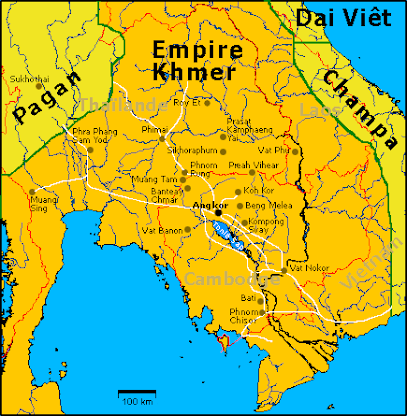
Angkor, the glory of the Khmer civilisation, which shaped Cambodia from the 9th to the 14th centuries, covers a vast area and has about 100 temples.
Since Angkor Archaeological Park's temples were designated a World Heritage Site and opened to tourism in 1993 - after 30 years of war - the place has boomed. Last year 1.7 million foreign arrivals were recorded , a 20 per cent increase over 2005. It's estimated by 2010 there could be as many as five million visitors.
Most tourists come only for two days to Siem Reap, the town next to Angkor Wat.
Already problems such as hotels pumping underground water for their own use are worrying locals and those working to protect the area. But others would like to see the tourists stay longer.
This is also a suggestion made by Associate Professor of Archaeology at the University of Sydney, Roland Fletcher, who has been working at Angkor since 1998 and is a project director on the Greater Angkor Project and the Living with Heritage Project.
"The Cambodian government would really like people to stay longer for the straightforward reason it would bring more tourist income into Cambodia. But the other side of it is the hotels would be washing all their laundry every two days, which is wasteful and not environmentally desirable at all."
One of the key things archaeologists are discovering about the site, says Fletcher is it's true size. "It's huge. Everybody's used to the idea of Angkor as a group of temples with Angkor Thom in the middle but in fact the Angkor urban area covers nearly 1000sq km instead of the 200sq km of the central temple area."
He says Angkor was a low-density medieval city, spread out with houses surrounded by rice fields, with a huge system of canals and human-built reservoirs known as barays.
"The Angkorian world essentially removed the forest to grow rice so this entire landscape was rice fields with houses surrounded by economic trees like palm trees. After the 16th century the forest took over again.
"It was an urban landscape. The Ta Prohm has a record on its walls of 12,640 people who worked for it on a daily basis - the administrators, cleaners and dancers."
For tourists coming to Cambodia there's much more than Angkor to see. Temples built over four centuries that once formed part of the vast Khmer empire are scattered across the country. These sites are gradually becoming more accessible. But more time is needed to visit - and appreciate - them.
Fletcher hopes tourism can be developed to take visitors on to Tonle Sap lake and up to the hills. "There could be walks through the rice fields and down these giant canals, some of which are 40km long."
IF YOU GO:
As well as seeing the monuments there's great shopping in Siem Reap, restaurants offering international cuisine, accommodation from five star to guest houses, traditional dancers, bars in Pub Street and great local spas.
Archaeological park tickets at the official ticket office: one day, US$20 ($28), three day, US$40 ($57) or one week, US$60 ($85).
Where to stay: La Residence d'Angkor, is a centrally located riverside Khmer-style hotel. Prices are from $192 a room a night for a Royal Deluxe river view room.
* Diane Plater was a guest of Orient-Express Hotels, Trains & Cruises, flying Qantas to Bangkok, then Bangkok Airways to Siem Reap
- AAP
Saturday, September 01, 2007
Bush speech doesn't tell full story on Cambodia
President Bush's VFW speech was full of untruths and half-truths about Vietnam.
The killing fields he refers to came about due to the CIA-sponsored deposing of the Cambodian government of Prince Sihanouk in 1970, after the prince declared Cambodia neutral during the Vietnam War.
It is estimated 800,000 Cambodians were killed by the bombs dropped from B-52 bombers on Cambodia. Estimates of those killed by Pol Pot and the Khmer Rouge are over 1.7 million.
Ironically, it was Vietnam that in 1978 invaded Cambodia and finally deposed the murderous regime of Pol Pot.
The Vietnamese have commented on Bush's speech and say that America would never have prevailed there because the Vietnamese were fighting for their own country.
The Republican-friendly media fails to point out the inaccuracies in Bush's speeches or the fact that he cleverly injects 9/11 every time he mentions Iraq, as if Iraq had made the 9/11 attack, which of course, Iraq did not.
The media also doesn't report that the only people allowed within eyesight of Bush at these events are meticulously screened to ensure Bush will have no protesters.
It is not reported that his press conferences are not really press conferences, but are only scripted events, with the Bush people providing the questions.
The media in this country is mostly Republican-friendly, and Democrat-critical, which makes it very difficult for Democrats to get fair treatment in the media.
I feel that citizens should not only work to make sure a Democrat occupies the White House in '08, but also work to turn out of office all of the congressmen that shirked their oversight duties, and allowed the Iraq tragedy to happen
Read more!
PAEDOPHILE TO ESCAPE JUSTICE ON THE RUN IN CAMBODIA
 By Pual Bull
A Paedophile who is on the run from police in Derby remains at large abroad because British authorities have no powers to extradite him.
Former special constable Ian Bower, who lived in Ilkeston, has even faced fresh child sex charges while on the run in Cambodia, where he has been teaching English to youngsters.
But because the UK does not have an extradition agreement with the country, he has been allowed to stay in Cambodia after being cleared of the latest counts against him.
The pervert, who was sentenced in September 2004 to three years and nine months for offences against children and downloading child pornography in the UK, fled a Derby bail hostel in February last year.
Derbyshire police said he would be arrested if he ever returned to the UK because his decision to leave meant he was in breach of the terms of his prison release conditions.
The 42-year-old was arrested in Cambodia in January, on the outskirts of the capital, Phnom Penh, on suspicion of debauchery, which is the Cambodian legal term for sexual offences against children.
After being held in custody for several months, Bower was finally cleared at the end of June of abusing two boys, aged 12 and 14.
The Evening Telegraph understands that Bower, who was placed on the Sex Offenders' Register in the UK, has decided to stay in Cambodia, which will make it impossible for British police to catch him unless he is deported.
A Derbyshire police spokesman confirmed Bower was "wanted" for recall to prison for breaching his licence.
He said: "If he comes back to the UK, he will be arrested for that reason.
"With there being no formal process in place [between the UK and Cambodia], we can't force him to come back to this country."
Bower, who used to live in Ilkeston but whose last UK address was in Bramcote, Nottingham, was sentenced in 2004 for two counts of indecent assault on a male and two counts of gross indecency with a child.
He was also convicted of downloading scores of indecent images of children being sexually abused.
At his trial in 2004, the court heard that Bower had spent hours on his computer in a loft conversion office after moving in with his then girlfriend and her two children at their home in Derbyshire Drive, Ilkeston, in 1999.
The couple separated in July 2002 and police became involved in October of that year when they examined a computer found at Bower's mother's address.
They found 38 indecent images of children under the age of 16 and two films containing images of boys performing sexual acts.
Ninety one images of children were found to have been deleted from the computer but were recovered by the Computer Crime Investigation Unit.
Bower was eventually released on licence from prison on condition that he resided at the Burdett Lodge bail hostel in Bass Street, Derby.
But he went missing in February last year and, when he was arrested in Cambodia, it was discovered he had been teaching English to children in the country since April 2006.
Both the Prison Service and the Probation Service monitor an offender's release into the community.
The Probation Service has said that travel abroad is prohibited under standard licence conditions.
The Home Office has also said that sex offenders who are subject to notification requirements must tell police if they intend to travel abroad for more than three days.
A spokeswoman for the Child Exploitation and Online Protection (CEOP) Centre, which acts as a focal point in tackling child abuse and monitors offenders abroad, said: "We do talk with authorities in Cambodia and non-government organisations.
"We would desire to get any individual that has gone missing from their registration back to the UK, where they can be managed appropriately within the community."
A Foreign Office spokesman said: "We have been asked by this individual not to discuss his case publicly and we will abide by his wishes."
An official at the Royal Embassy of Cambodia, in London, declined to comment.
Read more!
Interview: Cambodia's Rising Star Keo Sokngon
Lethal with both feet, Keo Sokngon is the captain of the Cambodian national Under-17 team where his hard work has proven to be inspiration to his team. And while the goals might not have been free-flowing as he would have liked, there is no doubt that striker Sokngon is the rising star of Cambodian football
Tell us a little bit about where you are from?
I was born in Kratie province which is located some 300km away from the capital city of Phnom Penh. And from there I started to play football first with the schools before I was spotted to play here in the city.
How old were you when you first started playing football?
I was six-years-old then and the reason why I chose football was because of all the games which I've played, I love football the most.
Your first team?
Roka Kandal School. I've never played for the national age-group teams for Cambodia before. This Under-17 team is my first national team assignment in an international competition.
Who do you play for at the moment?
Previously, I played for the Kratie Province Football club – before they changed the name to Moha Garuda FC - I've been with them since I was 15-years-old. The team is currently playing in the Cambodian Second League where we are all looking forward to playing in the higher Cambodian Premier League in 2008.
How many goals have you scored for Moha Garuda FC? A: I've scored 18 goals from 13 matches. Q: Have you always played as a striker?
Always – I like to score goals and of course, I've been told that it is my natural position.
Who do you fashioned your playing style after?
Thierry Henry. I feel that we have a similar built and I like the way he moves forward.
What do you think of Cambodian football at the moment?
Cambodian football is developing. The level is higher than before. So there is a lot of excitement for the future. The football management currently (in the Football Federation of Cambodia) is working very hard for the game to grow further and in the right direction.
Do you harbour any thoughts of playing abroad some day?
Of course – it is the ambition of any footballer to hone their skills to the highest level. I would like to change clubs to get more experience and high level competition. But more that importantly, I would like to join clubs with good coaches.
Where do you think you would like to go?
Vietnam for the V-League. The standard is higher than it is in Cambodia. Perhaps given the opportunity, I hope to play for Hoang Anh Gia Lai (HAGL) some day.
Now that you part of the Cambodian national Under-17 team, do you have any intention of playing for the senior Cambodian national team?
Of course, I would like to be part of the Cambodian national team for the Asean Football Championship qualifiers next year. I don't think that it will be hard to fit in though because the older players in the team will guide me through.
What do you think of Cambodia's chances for the qualifiers of the Asean Football Championship next year?
It will not be easy for sure but I believe that we can be competitive.
Read more!
THRIVING DENS
The number of Thais crossing to Poipet has increased under this government, to 3,000 a day. Most go to gamble
STORIES BY NAOWARAT SUKSAMRAN, PHOTOS BY TAWATCHAI KEMGUMNERD, SA KAEO
Casinos are doing a thriving business in the border town of Poipet in Cambodia.
Each day, 3,000 Thais enter Cambodia through the Klong Luek-Poipet checkpoint in Aranyaprathet district. The daily figure shoots up to almost 10,000 during the long holiday period.
The above figures only include passport-holders, as Sa Kaeo residents can seek border passes to enter the neighbouring country.
Over 80% of Thai holiday-makers entering Cambodia through the checkpoint end up in casinos. The rest either head for Siem Reap or Phnom Penh.
Cambodian casinos opposite Sa Kaeo are the most popular destinations for Thai gamblers as they can be easily reached.
Immigration officer Pol Lt-Col Sompong Kaenchan said the number of gamblers dropped dramatically during the previous administration when the Thai border authorities were ordered to tighten border crossing regulations and told to install closed-circuit cameras at the checkpoints.
The same government flirted with the idea of legalising gambling, to stop the flow of money across the border to Cambodia.
Business picked up after the easing of regulations to facilitate visitors who are now only required to show their passport to gain entry.
One gambler said the casinos in Cambodia are a boon for Thai gamblers.
"Whenever police step up raids on gambling dens in Bangkok, gamblers flock to border casinos," he said.
Eu-ee, a travel agent, said casino operators provide gamblers with free transportation. Every morning, double-decker buses await gamblers at Lumpini park and some major department stores.
Gamblers travelling in a group can ask for a pick-up at a designated location in Bangkok or nearby provinces, such as Saraburi, Nakhon Ratchasima and Nakhon Pathom.
Any gambler ordering gambling chips worth 10,000 baht or more at any of the casinos is entitled to a free ride, free food as well as free accommodation.
The ride can cost you 100 baht if you have to pay out of your own pocket, he said.
Serm Chantapan, chief of Ta Yak tambon organisation administration, said some local people have made a fortune providing transportation for the gamblers. However, when many tried their luck at the gambling tables they ended up losing even their vehicles.
The TAO chief said he has time and again tried to discourage Sa Kaeo people from gambling through all sorts of measures. Teachers are told to regularly lecture their pupils in school on what harm gambling could bring to the family so that they could get the message across to their parents.
"The casinos are no good to our economy as the social impact is immense, not only on our community, but the whole country," Mr Serm said.
The hope of making a quick fortune has also kept the locals away from hard work. "Betting pays off better than selling vegetables and fish in a market," one vendor said.
She pointed out many vendors crossed the border to play slot machines and pocketed 300-500 baht a day, much higher than the daily earnings of 100-200 baht they generally make in a market.
Such a mindset has given business operators in the province a headache.
Ratri Saengrungruang, who runs a tour agency, said besides the labour shortage, job-hopping was another problem as many prefer to spend their time in a casino where they can earn big tips.
It is no secret that Thai politicians own many gambling dens in neighbouring countries, where they can make lavish income and also launder their ill-gotten gains.
"Politicians-turned-casino owners enjoy privilege. They need not step out of their car for customs clearance, especially after the closed-circuit cameras were installed, as the images were also relayed to the Prime Minister's Office," a source said.
A veteran politician, whose business at the Golden Triangle went down, now runs two casinos in Poipet. Among Thai casino operators are an oil trader and a steel importer, said the source. "Casino earnings are their accumulated capital, and part of the earnings will be injected into the upcoming election," said the source. According to a report published in a Cambodian daily, US$16 million in tax went into Cambodian government coffers last year from 24 legal casinos on the Thai-Cambodian border.
Read more!
Thai traders in border dispute
Chanthaburi _ Cross-border traders in Chanthaburi sought help from provincial authorities yesterday after local Cambodian officials reportedly banned Thai trucks from going any further than 500 metres across the border to pick up produce for sale. The ban has caused perishable goods to be left stranded at the border, local Thai traders said.
About 40 crop traders from Soi Dao district yesterday petitioned Chanthaburi Governor Panus Kaewlai for help after Cambodian authorities in Battambang province reportedly imposed restrictions on Thai trucks crossing into Cambodia.
Trucks were not allowed to travel more than 500 metres over the border, they said. The traders complained they could not pick up produce that they had already paid for, which will rot if it is not collected in the next few days.
Sombat Juengtrakul, chairman of the cross-border traders group in Soi Dao district, said no trucks from the Thai border had entered Cambodia since the ban was imposed.
Cambodian authorities reportedly claimed right-hand drive vehicles were not allowed in Cambodia and that therefore, Thai trucks were refused entry.
Mr Sombat said some Thai farmers who planted crops on rented plots in Cambodia also suffered losses as they could not transport their crops back across the Thai border.
It is the fifth time that such a ban has been imposed this year, he said.
Lertla Nakhaket, chief of Chanthaburi commerce association, said local authorities would hold urgent talks with Battambang officials to find a solution.
Read more!
The rise and rise of a Cambodian capitalist
By Shawn W Crispin
PHNOM PENH – Kith Meng's is the bold new face of Cambodian capitalism. Widely considered the country's richest entrepreneur, the Sino-Khmer businessman presides over a sprawling business empire held under his Royal Group of Companies which has leveraged into and helped drive Cambodia's recent economic boom.
With impeccable political connections - including not least his role as a personal advisor to Prime Minister Hun Sen - Kith Meng, 37, has secured a growing trove of lucrative government
concessions, licenses and land deals that his Royal Group has in sometimes controversial fashion translated into big business profits.
Those include his controlling stakes in CTN television, mobile telecom leader Mobitel, the Camlot lottery company and a 45% stake in a commercial banking joint venture with Australia's ANZ Bank, where he serves as board chairman and reportedly drives strategic decision-making.
Last year he purchased the swanky Cambodiana Hotel, newly established the Infinity Insurance company and accumulated extensive property holdings and development concessions in the capital Phnom Penh, in what his critics contend are often opaque deals brokered with various line ministries. (Kith Meng could not be reached through his Royal Group for comment.)
His growing service sector empire has drawn both favorable and unfavorable comparisons to neighboring Thailand's telecom tycoon-cum-prime minister Thaksin Shinawatra's commercial and political ascent. He reportedly will seek a seat on the national senate at upcoming elections and some Phnom Penh-based analysts see him one day as a potential successor to the 55-year-old Hun Sen, who they note rose to political prominence through his military prowess rather than business acumen.
A former refugee from political violence, Kith Meng's is one of Cambodia's most compelling rags to riches stories. His father, Kith Peng Ike, a Sino-Khmer businessman and landlord, was singled out as a "class enemy" during the Khmer Rouge's genocidal purges and he reportedly died from starvation in one of the radical Maoist group's labor camps.
Kith Meng and his family fled the country for Australia, where he was raised and educated. He returned to his war-torn homeland in the early 1990s to help his elder brother, Sophan Kith, to develop the resurrected family business, which upon reestablishment was first known as the Royal Cambodia Company. The enterprise started modestly, supplying furniture, food and office equipment to the United Nations authority that ushered Cambodia's rocky transition from civil war to parliamentary democracy.
In 1991 the Royal Group won the rights to distribute exclusively Canon copiers throughout the country and it quickly spun those monopoly revenues into a joint venture in 1993 with Motorola to establish one of Cambodia's first wireless communication networks. It later did a deal with Luxembourg's Millicom International Cellular, which over the years has grown into the country's leading mobile telecom outfit, Mobitel.
In 1994 Sophan Kith died under mysterious circumstances and, peculiar to cultural norms of seniority as the youngest sibling, Kith Meng took control over the family business. He now serves as both the company's chairman and chief executive officer and his cut-throat approach to business expansion has rapidly transformed the Royal Group into Cambodia's leading service sector conglomerate.
Young gun
As a Western-educated, 37-year-old entrepreneur, Kith Meng's resume stands out among the older generation of ethnic Chinese businessmen who dominate Cambodia's traditional economy. Cambodian politicians have long relied on Sino-Khmer businessmen to run crucial sectors of the national economy, similar to the ethnic-based government-business nexuses seen in Thailand and Indonesia.
In Cambodia that privilege comes with a royal title known as Okhna, which is bestowed on those who make sizable financial contributions to the royal family. Kith Meng is believed to be one of the youngest businessmen to ever receive the honorific and his meteoric commercial rise includes his recent selection as the head the Cambodian Chamber of Commerce.
As Cambodia becomes more integrated into the global economy, Kith Meng has emerged as the government's de facto spokesman for selling the country to potential foreign investors as a profitable and desirable place to do business. He is regularly seen on local television wining and dining foreign business delegations. On the Royal Group's website is a pitch to potential foreign investors to help build its proposed Royal Caesar Casino, which it's billing as "the largest and most dazzling gaming facility in the Cambodia hemisphere".
Beyond the diplomacy and hype, there is much more at play to Kith Meng's growing prominence than mere spin-doctoring. Some political analysts contend that Hun Sen has played an instrumental role in cultivating and mobilizing the young entrepreneur's modern business image in a vigorous public relations effort to shirk his and his government's notorious reputation as the "Mafia on the Mekong".
Cambodia emerged from nearly three decades of civil war only to become known as a regional hub for illicit business, including rampant money laundering, drug smuggling, human trafficking and illegal logging. Hun Sen and his Cambodia People's Party's (CPP) have been directly linked to shadowy figures reputedly involved in illicit businesses, including his established ties to businessman Theng Bunma, who has contributed millions of dollars to the premier's past election campaigns and also implicated by US authorities for alleged drug trafficking.
As Cambodia's aboveground economy booms, state concessions are no doubt providing rich new sources of legitimate revenues for Hun Sen's government. It is unknown whether Kith Meng contributes funds directly to his CPP, but his concession payments to line ministries are no doubt bolstering state coffers. One Phnom Penh-based Western businessman who spoke on condition of anonymity and claims to have personally conducted the due diligence research on the Royal Group's recent joint venture with Australia's ANZ Bank says that his in-depth investigations failed to turn up any "dirty laundry" in Kith Meng's past or present business dealings.
Reborn landed gentry
That's not to say his business practices lack for controversy. Kith Meng's style has reportedly ruffled feathers among the more established Okhna represented in the Cambodia Chamber of Commerce, whereby the older generation of Sino-Khmer businessmen have bristled at his perceived patronizing lectures about globalization and at what some of them reportedly view as his overly direct Western-style of interaction.
Whether those complaints stem from genuine pique or instead heartfelt fear of Kith Meng's expanding reach into other Okhna's once monopolized markets is unclear. One Western aid agency representative, who spoke with Asia Times Online on condition of anonymity, says that soon after launching last year’s joint venture with ANZ Bank, Kith Meng pushed to expand the bank's local branch network much faster than ANZ first planned. That aggressive strategy, it turns, has paid off handsomely through a fast growing market share of deposits and the lion's share of loans in the nascent home mortgage market.
Other times, critics say, Kith Meng's Royal Group pushes too hard. In June 2006 police armed with batons, tear gas and AK47 assault rifles evicted at least 20 families from a contested land plot worth several million dollars next to Phnom Penh's Preah Monivong Hospital which the government had controversially awarded to the Royal Group for development. The resident families were reportedly given US$500-$1,500 in compensation and trucked to a relocation site 30 kilometers outside the capital which lacked electricity and water.
Similar complaints have arisen from his plans for the landmark Bassac Theater. In 2005, the culture ministry granted the concession, which called on the Royal Group to rehabilitate the damaged structure in exchange for the rights to outfit the theater's surrounding land with new offices and a conference center. The company has since decided to demolish the historic building and evict the scores of artists who after the Khmer Rouge's "class enemy" purges took refuge in the old theater.
Those same artists have resurrected the traditional Khmer art forms that the Maoist movement aimed to destroy and after squatting at the historic site for over a decade, each has received $300 to abandon an area where land prices now top $1,000 per square meter. The irony of such deals is not lost on Kith Meng's critics, who contend that the Royal Group is capitalizing on the legal vacuum for adjudicating land ownership rights created by the Khmer Rouge's destruction of the national land registries.
On the Royal Group's website, Kith Meng says in a statement that the company's origins trace "back to the early days of the Khmer Rouge occupation" – meaning, presumably, the property and businesses his father maintained before the radical Maoist movement killed him and drove his family, including a young Kith Meng, into exile. In Cambodia's latest capitalist incarnation, government connections often trump historical claims and reassert old social class divisions, of which Kith Meng's and the Royal Group's fast expanding commercial domain is living proof.
Shawn W Crispin is Asia Times Online's Southeast Asia Editor.
Read more!
1.5 mln child workers exploited in Cambodia: rights group

"The reality of poverty is that it is indiscriminate and affects not only adults but also children," the group Licadho said in a statement.
"This sadly forces many young children to engage in domestic and manual labour to support their families, with a large proportion working under severe conditions."
Nearly 90 percent of child labourers in Cambodia, one of the world's poorest countries, work as unpaid help for their families, according to the World Bank.
About 250,000 of them work in seven of the 16 sectors nationally recognised as hazardous, which include begging, waste scavenging, factory work or mining, the bank says.
Both the World Bank and rights groups have urged tougher legislation that would curb such practices.
Following years of civil unrest and government mismanagement, Cambodia remains mired in poverty, with 35 percent of its 14 million people living on less than 50 US cents per day.
Education often becomes the first victim in the daily struggle to survive, with a majority of child labourers being forced out of school at an early age.
"These children do not have an opportunity to receive an education and most of them face exploitation and physical and verbal abuse, every day," Licadho said.
The group this month launched a two-year awareness-raising campaign that hopes to expose employers and government officials to the dangers faced by child labourers.
"Governmental authorities, civil society and the private sector must work together to rescue child labourers and provide them with physical and mental rehabilitation services," the group said.