The land of heroes
Our heroes
Our land
Cambodia Kingdom


Sunday, May 13, 2007

New Light on U.S. Air War in Cambodia


[Analysis] Campaign fallout with Khmer Rouge may parallel dynamics in Iraq

United States bombings in Afghanistan have "given a propaganda windfall to the Taliban." [1] Is history repeating itself? In 1975, Pol Pot's genocidal Khmer Rouge forces took power in Cambodia after a massive U.S. bombing campaign there. New information reveals that Cambodia was bombed far more heavily during the Vietnam War than previously believed -- and that the bombing began not under Richard Nixon, but under Lyndon Johnson.

In the fall of 2000, 25 years after the end of the war in Indochina, Bill Clinton became the first U.S. president since Richard Nixon to visit Vietnam. While media coverage of the trip was dominated by talk of some 2,000 U.S. soldiers still classified as missing in action, a small act of great historical importance went almost unnoticed. As a humanitarian gesture, Clinton released extensive Air Force data on all American bombings of Indochina between 1964 and 1975. Recorded using a groundbreaking IBM-designed system, the database provided extensive information on sorties conducted over Vietnam, Laos, and Cambodia.

Clinton's gift was intended to assist in the search for unexploded ordnance left behind during the carpet bombing of the region. Littering the countryside, often submerged under farmland, this ordnance remains a significant humanitarian concern. It has maimed and killed farmers, and rendered valuable land all but unusable. Development and de-mining organizations have put the Air Force data to good use over the past six years, but have done so without noting its full implications, which turn out to be staggering.

The Bombing Database


The still-incomplete database (it has several "dark" periods) reveals that from October 4, 1965, to August 15, 1973, the United States dropped far more ordnance on Cambodia than was previously believed: 2,756,941 tons' worth, dropped in 230,516 sorties on 113,716 sites. Just over 10 percent of this bombing was indiscriminate, with 3,580 of the sites listed as having "unknown" targets and another 8,238 sites having no target listed at all. Even if the latter may arguably be oversights, the former suggest explicit knowledge of indiscretion. The database also shows that the bombing began four years earlier than is widely believed -- not under Nixon, but under Lyndon Johnson. The impact of this bombing, the subject of much debate for the past three decades, is now clearer than ever. Civilian casualties in Cambodia drove an enraged populace into the arms of an insurgency that had enjoyed relatively little support until the bombing began, setting in motion the expansion of the Vietnam War deeper into Cambodia, a coup d'etat in 1970, the rapid rise of the Khmer Rouge, and ultimately the Cambodian genocide. The data demonstrates that the way a country chooses to exit a conflict can have disastrous consequences. It therefore speaks to contemporary warfare as well, including U.S. operations in Afghanistan and Iraq. Despite many differences, a critical similarity links the war in Iraq with the Cambodian conflict: an increasing reliance on air power to battle a heterogeneous, volatile insurgency.
"We heard a terrifying noise which shook the ground; it was as if the earth trembled, rose up and opened beneath our feet. Enormous explosions lit up the sky like huge bolts of lightning; it was the American B-52s."
--Cambodian bombing survivor, Kampong Thom

The Kampong Thom Bombings

On December 9, 1970, U.S. President Richard Nixon telephoned his national-security adviser, Henry Kissinger, to discuss the ongoing bombing of Cambodia. This sideshow to the war in Vietnam, begun in 1965 under the Johnson administration, had already seen 475,515 tons of ordnance dropped on Cambodia, which had been a neutral kingdom until nine months before the phone call, when pro-U.S. General Lon Nol seized power. The first intense series of bombings, the Menu campaign on Vietnamese targets in Cambodia's border areas -- which American commanders labeled Breakfast, Lunch, Supper, Dinner, Dessert, and Snack -- had concluded in May, 1970 shortly after the coup.

Nixon was facing growing congressional opposition to his Indochina policy. A joint U.S.-South Vietnam ground invasion of Cambodia in May and June of 1970 had failed to root out Vietnamese Communists, and Nixon now wanted to covertly escalate the air attacks, which were aimed at destroying the mobile headquarters of the Viet Cong and the North Vietnamese Army (vc/nva) in the Cambodian jungle. After telling Kissinger that the U.S. Air Force was being unimaginative, Nixon demanded more bombing, deeper into the country: "They have got to go in there and I mean really go in ... I want everything that can fly to go in there and crack the hell out of them. There is no limitation on mileage and there is no limitation on budget. Is that clear?"

Kissinger knew that this order ignored Nixon's promise to Congress that U.S. planes would remain within thirty kilometres of the Vietnamese border, his own assurances to the public that bombing would not take place within a kilometre of any village, and military assessments stating that air strikes were like poking a beehive with a stick. He responded hesitantly: "The problem is, Mr. President, the Air Force is designed to fight an air battle against the Soviet Union. They are not designed for this war ... in fact, they are not designed for any war we are likely to have to fight."
.
"Anything that flies, on anything that moves"

Five minutes after his conversation with Nixon ended, Kissinger called General Alexander Haig to relay the new orders from the president: "He wants a massive bombing campaign in Cambodia. He doesn't want to hear anything. It's an order, it's to be done. Anything that flies, on anything that moves. You got that?" The response from Haig, barely audible on tape, sounds like laughter.

The U.S. bombing of Cambodia remains a divisive and iconic topic. It was a mobilizing issue for the antiwar movement and is still cited regularly as an example of American war crimes. Writers such as Noam Chomsky, Christopher Hitchens, and William Shawcross condemned the bombing and the foreign policy it symbolized.

In the years since the Vietnam War, something of a consensus has emerged on the extent of U.S. involvement in Cambodia. The details are controversial, but the narrative begins on March 18, 1969, when the United States launched the Menu campaign. The joint U.S.-South Vietnam ground offensive followed. For the next three years, the United States continued with air strikes under Nixon's orders, hitting deep inside Cambodia's borders, first to root out the Viet Cong (VC)/North Vietnam Army (NVA) and later to protect the Lon Nol regime from growing numbers of Cambodian Communist forces. Congress cut funding for the war and imposed an end to the bombing on August 15, 1973, amid calls for Nixon's impeachment for his deceit in escalating the campaign.

The Secret Bombing of 1965

Thanks to the Air Force database, we now know that the U.S. bombardment started three-and-a-half years earlier, in 1965, under the Johnson administration. What happened in 1969 was not the start of bombings in Cambodia but the escalation into carpetbombing. From 1965 to 1968, 2,565 sorties took place over Cambodia, with 214 tons of bombs dropped. These early strikes were likely designed to support the nearly 2,000 secret ground incursions conducted by the CIA and U.S. Special Forces during that period. B-52s -- long range bombers capable of carrying very heavy loads -- were not deployed, whether out of concern for Cambodian lives or the country's neutrality, or because carpet bombing was believed to be of limited strategic value.

Nixon decided on a different course, and beginning in 1969 the Air Force deployed B-52s over Cambodia. The new rationale for the bombings was that they would keep enemy forces at bay long enough to allow the United States to withdraw from Vietnam. Former U.S. General Theodore Mataxis depicted the move as "a holding action ... The troika's going down the road and the wolves are closing in, and so you throw them something off and let them chew it." The result was that Cambodians essentially became cannon fodder to protect American lives.

The last phase of the bombing, from February to August 1973, was designed to stop the Khmer Rouge's advance on the Cambodian capital, Phnom Penh. The United States, fearing that the first Southeast Asian domino was about to fall, began a massive escalation of the air war -- an unprecedented B-52 bombardment that focused on the heavily populated area around Phnom Penh but left few regions of the country untouched. The extent of this bombardment has only now come to light.

Exceeding the World War II Payload

The data released by Clinton shows the total payload dropped during these years to be nearly five times greater than the generally accepted figure. To put the revised total of 2,756,941 tons into perspective, the Allies dropped just over 2 million tons of bombs during all of World War II, including the bombs that struck Hiroshima and Nagasaki: 15,000 and 20,000 tons, respectively. Cambodia may well be the most heavily bombed country in history.

A single B-52d "Big Belly" payload consists of up to 108 225-kilogram or 42 340-kilogram bombs, which are dropped on a target area of approximately 500 by 1,500 metres. In many cases, Cambodian villages were hit with dozens of payloads over the course of several hours. The result was near-total destruction. One U.S. official stated at the time, "We had been told, as had everybody ... that those carpetbombing attacks by B-52s were totally devastating, that nothing could survive." Previously, it was estimated that between 50,000 and 150,000 Cambodian civilians were killed by the bombing. Given the fivefold increase in tonnage revealed by the database, the number of casualties is surely higher.

The Cambodian bombing campaign had two unintended side effects that ultimately combined to produce the very domino effect that the Vietnam War was supposed to prevent. First, the bombing forced the Vietnamese Communists deeper and deeper into Cambodia, bringing them into greater contact with Khmer Rouge insurgents. Second, the bombs drove ordinary Cambodians into the arms of the Khmer Rouge, a group that seemed initially to have slim prospects of revolutionary success.

Pol Pot himself described the Khmer Rouge during that period as "fewer than five thousand poorly armed guerrillas ... scattered across the Cambodian landscape, uncertain about their strategy, tactics, loyalty, and leaders."

Years after the war ended, journalist Bruce Palling asked Chhit Do, a former Khmer Rouge officer, if his forces had used the bombing as anti-American propaganda. Chhit Do replied:

"Every time after there had been bombing, they would take the people to see the craters, to see how big and deep the craters were, to see how the earth had been gouged out and scorched ... The ordinary people sometimes literally shit in their pants when the big bombs and shells came. Their minds just froze up and they would wander around mute for three or four days. Terrified and half crazy, the people were ready to believe what they were told. It was because of their dissatisfaction with the bombing that they kept on co-operating with the Khmer Rouge, joining up with the Khmer Rouge, sending their children off to go with them ... Sometimes the bombs fell and hit little children, and their fathers would be all for the Khmer Rouge."
A Cambodian witness responded to an earlier publication of this article by writing:
"I could not agree with you more based on my experiences during the bombing in Takeo around 1972. The bombings were [spreading] further into towns and villages. My parents' house was hit by the bombs, and we had to move to the opposite side of the country. We had known [that] almost the entire village that survived from the bombings had joined forces with the Khmer Rouge."


The Nixon administration knew that the Khmer Rouge was winning over peasants. The CIA's Directorate of Operations, after investigations south of Phnom Penh, reported in May 1973 that the Communists were "using damage caused by B-52 strikes as the main theme of their propaganda," and that such propaganda was "effective." But this does not seem to have registered as a primary strategic U.S. concern.

"They are murderous thugs, but we won't let that stand in our way"

The Nixon administration kept the air war secret for so long that debate over its impact came far too late. It wasn't until 1973 that Congress, angered by the destruction the campaign had caused and the systematic deception that had masked it, legislated a halt to the bombing of Cambodia. By then, the political as well as the social damage was already done. Having grown to more than two hundred thousand troops and militia forces by 1973, the Khmer Rouge captured Phnom Penh two years later. They went on to subject Cambodia to a Maoist agrarian revolution and a genocide in which 1.7 million people perished. Now the burgeoning U.S.-China alliance led Washington to quietly support the Khmer Rouge regime. Secretary of State Henry Kissinger told Thailand's foreign minister on November 26, 1975, "You should also tell the Cambodians that we will be friends with them. They are murderous thugs, but we won't let that stand in our way."

The Nixon Doctrine had relied on the notion that the United States could supply an allied regime with the resources needed to withstand internal or external challenges while the U.S. withdrew its ground troops or, in some cases, simply remained at arm's length. In Vietnam, this meant building up the ground-fighting capability of South Vietnamese forces while American units slowly disengaged. In Cambodia, Washington gave military aid to prop up Lon Nol's regime from 1970 to 1975 while the U.S. Air Force conducted its massive aerial bombardment.
Bombing Iraq

U.S. policy in Iraq may yet undergo a similar shift. Bombing is likely to play a key role in a continued U.S. occupation. Moreover, as Seymour Hersh reported in the New Yorker in December 2005, a key element of any drawdown of American troops will be their replacement with air power. "We just want to change the mix of the forces doing the fighting -- Iraqi infantry with American support and greater use of air power," said Patrick Clawson, the deputy director of the Washington Institute for Near East Policy. [2]

Critics argue that a shift to air power will cause even greater numbers of civilian casualties, which in turn will benefit the insurgency in Iraq. Andrew Brookes, the former director of air power studies at the Royal Air Force's advanced staff college, told Hersh, "Don't believe that air power is a solution to the problems inside Iraq at all. Replacing boots on the ground with air power didn't work in Vietnam, did it? "

It's true that air strikes are generally more accurate now than they were during the war in Indochina, so in theory, at least, unidentified targets should be hit less frequently and civilian casualties should be lower. In addition, many of the indiscriminate bombardment tactics used in the past, such as those that destroyed much of Tokyo and killed 100,000 of its citizens in a single night, are no longer deemed morally acceptable. Yet lessons from Cambodia's agony remain unlearned. Civilian deaths have been the norm during the Iraq and Afghanistan campaigns, as they were during the bombing of Lebanon by Israeli forces over the summer. As in Cambodia, insurgencies are the likely beneficiaries. To cite one example, on January 13, 2006, an aerial strike by a U.S. Predator drone on a village in a border area of Pakistan killed 18 civilians, including five women and five children. The deaths undermined the positive sentiments that may have been created by the billions of dollars in aid that had flowed into that part of Pakistan after the massive earthquake months earlier. A key question remains: along with its humanitarian and moral hazards, is bombing worth the strategic risk?

If the Cambodian experience teaches us anything, it is that miscalculation of the consequences of civilian casualties stems partly from a failure to understand how insurgencies thrive. The motives that lead locals to help such movements don't fit into strategic rationales like the ones set forth by Kissinger and Nixon. Those whose lives have been ruined don't care about the geopolitics behind bomb attacks; they tend to blame the attackers. The failure of the American campaign in Cambodia lay not only in the civilian death toll during the unprecedented bombing, but also in its aftermath, when the Khmer Rouge regime rose up from the bomb craters, with tragic results. The dynamics in Iraq, or even Afghanistan, could be similar.
Read more!

Saturday, May 12, 2007

UNICEF helps local government build pre-schools in Cambodia


By Guy Degen

SVAY RIENG PROVINCE, Cambodia, 11 May 2007 – Every weekday morning, Nita, 5, joins her friends at the Banteay Kraing Village community pre-school. Small sandals and shoes are neatly lined up in a row outside the wooden shelter that houses the school.

Inside, the walls are adorned with bright watercolour paintings. A local volunteer teacher asks the class to name animals drawn on a whiteboard.

For children such as Nita, these simple and stimulating activities are not only fun but essential for early childhood education, helping to ensure that they will enter primary school at the appropriate age. Yet only 14 per cent of all three- to five-year-old children in Cambodia are enrolled in pre-schools – most of them in affluent urban areas.

A safe learning environment

UNICEF’s child rights programme in Cambodia, known as ‘Seth Koma’ in the Khmer language, is working with rural communities to build pre-schools that provide children with a safe learning environment, including access to clean water and latrines.

Local commune councils select the land and UNICEF supports them with funds for constructing pre-school shelters, playgrounds, wells and latrines, as well as providing basic school supplies. UNICEF also helps train volunteer teachers in nutrition, health, hygiene and early childhood development, and provides them with a small incentive payment for their efforts.

In the past year, UNICEF has assisted about 900 pre-schools in six rural provinces, helping to bring early education to some 20,000 children.

.
Preparation for formal schooling

“Currently the Cambodian Government doesn’t have the necessary funds to provide early childhood education to all Cambodian children, especially in the rural areas,” says UNICEF’s Seth Koma Programme Officer, Tessa Rintala.

As a result, she adds, there are problems with children enrolling in school at a later age, dropping out or repeating classes.

“UNICEF believes that community pre-school education actually better prepares children for formal schooling and aids them to be more socialized and adjusted for school life,” notes Ms. Rintala.

‘The education she needs’

A two-hour pre-school class provides Nita with a positive daily routine. Her parents are divorced and her mother lives in Phnom Penh, where she works in a garment factory. Nita and her elder sister live with their grandmother and a young cousin.

Nita’s grandmother believes pre-school is giving Nita a head start in life, explaining: “Without her father she is much more vulnerable. Community pre-school gives her the education she needs.”

Nita says she is looking forward to going to primary school next year when she turns six. Having attended community pre-school since she was three, Nita will be on track to enrol at her local primary school with her friends at the right age.
Read more!

TA PHRAYA A POTENTIAL NEW GATEWAY TO CAMBODIA

Shorter and more convenient route to famed Banteay Chhmar temple ruins found for tourists

Story by PLOENPOTE ATTHAKOR

A major battlefield during the peak of border conflicts with Cambodia in the 1970s, Ta Phraya has now turned into a potential gateway for tourists to visit Thailand's neighbouring country. Ratri Saengrungrueng, chairwoman of a tour operators club in this eastern province, said the route to Cambodia from Ta Phraya, which is an alternative to the Aranyaprathet checkpoint, has gained popularity with tourists wishing to visit the famous Khmer temple ruins of Banteay Chhmar _ a gigantic 12th-century Bayon sanctuary housing a four-faced monument and a magnificent bas-relief depicting a 32-armed Bodhisattva lokeshvara.

''The ancient ruins are in Banteay Meanchey's Thma Pouk district, just 47km from the Thai-Cambodian border,'' Mrs Ratri said.

She pointed out that border regulations, however, remain a major obstacle as the Ta Phraya checkpoint is open only to Ta Phraya residents, who are required to obtain a border pass from the Ta Phraya district chief for the visit.

Non-residents cannot do so and must either seek the provincial governor's written permission or enter Banteay Meanchey through the conventional route via the Aranyaprathet checkpoint, a distance of 119km altogether. [It is 49km from the checkpoint to Sisophon town, and another 70km from the town to the ancient ruins.]

''Last month our club organised a trip to Banteay Chhmar via Ta Phraya for members of tour agencies.,'' she said.

''They all agreed it was a fastastic route. The dirt road is in acceptable condition, and if open to tourism should greatly benefit the local economy,'' she added, noting that the Burapa Tourism Association _ an umbrella tourism promotion organisation for Nakhon Nayok, Sa Kaeo, Prachin Buri, Chachoengsao and Samut Prakan _ has pledged to push for its opening.

The Ta Phraya-Thma Pouk route is much more convenient than the other route as tourists can do a return trip within one day and also have enough spare time to explore the other attractions along the way, including the smaller Banteay Tuop ruins and a beautiful temple with a sacred Buddha in it, she said.

''The new route is an opportunity for local hotels and restaurants to exploit as well, as non-residents are likely to stay overnight in Sa Kaeo, either before or after the Banteay Chhmar journey. It's a trickle-down effect,'' she said.

Currently, tourists entering Cambodia through the conventional Aranyaprathet route have to stay overnight in Sisophon. Hotels in Sisophon are not very impressive, said Mrs Ratri.

It would do tourism a lot of good if the Thai government eases border regulations and authorises lower-ranking officials, like the district chief, to grant permission to non-residents, instead of waiting for the governor to do so on a case-by-case basis which is too time-consuming.

''We have to admit that Sa Kaeo itself is no tourism magnet for visitors. But the Ta Phraya route could make a difference,'' said Mrs Ratri.

However, her proposal has been given a cool reception by the provincial authorities. ''Those in power never see its importance,'' she said.

A provincial official has responded to her call by saying that the governor does not have the power to change any border regulations. Besides, he said, the change may not be worthwhile given the small number of travellers expected to go there.

However, Ta Phraya district chief Thammasak Rattanathanya has endorsed the idea.

He said the proposal is very interesting as it could help bolster the border economies of both Thailand and Cambodia if implemented.

''I will do whatever I can in my capacity to facilitate tourism,'' he said.

Governor Surapong Pongtadsirikul was not available for comment yesterday.
Read more!

Friday, May 11, 2007

Cambodia losing millions to beer smuggling

Beer smuggling cost Cambodia's Government $US22 million in lost tax revenue last year, according to an economic think tank, which warns that contraband alcohol was on the increase.

Millions of bottles and cans of beer imported from Singapore and Thailand simply disappeared at the Cambodian border before being taxed, the Economic Institute of Cambodia (EIC) said in a report commissioned by two local breweries, Cambrew and Cambodia Brewery Limited.

"With weak governance and law enforcement, 'contraband' beer has ... been booming," the EIC said, adding that the smuggled brew accounted for 29 per cent of the country's total beer market, far outstripping legal imports at 6 per cent.

The EIC says the Japanese beer Asahi, the cheapest foreign brand on the market, made-up the largest percentage of imported beer.

"It is crucial the government take energetic measures to combat 'contraband' beer, especially along the Thai border," it added.

Business experts say the losses represent about 3 per cent of Cambodia's total budget revenue, and have wider implications for anyone trying to produce locally.

According to Bretton Sciaroni, who co-chairs a monthly working group on law, taxation and good governance for the private sector, says the Swiss foods giant Nestle closed its factory in Cambodia several years ago because its locally produced products could not compete with smuggled goods.

Cambodia's Parliament has yet to pass anti-corruption legislation that has been demanded by the country's donors.

-AFP
Read more!

17 May Norweigan National day Celebration in Cambodia

" We have not yet started any preparations for it, but i am sure we will be soon get together a small group of enthusiasts and pull it together. Usually, the small Norweigan school with their teacher, Elisabeth Gjemmested, performs for the group, we always have a small parade, some games, and we eat lovely food" says Caroline Rusten the wife og the Minister councilor in Cambodia who is in charge of the 17 May celebrations last year and also this year.

Please check at the Embassy in Cambodia or visit www.emb-norway.or.th/info/consulatecambodia.htm


Organizer(s) :
Royal Norwegian Consulate
Royal Norwegian Consulate, Phnom Penh
The Honorary Consulate covers all Cambodia.
Honorary Consul: to be appointed
Postal address: P.O. Box 34, Phnom Penh, Cambodia
New office address: House No. 18, Street 57 (Corner Street 294), Sangkat Boeung Keng Kang I, Khan Chmakar Morn, Phnom Penh, Cambodia.
Opening hours: Tuesday 09.00 - 11.30 and Thursday 12.00 to 16.00
Tel: +85 5 23 211 972 / +85 5 23 216 232 / +85 5 23 217 720
Fax: +855 23 215 078
E-mail: rb.cambodia@scn.online.com.kh
Read more!

Shaven Head and Mourning from Cambodia to ‎Virginia Tech‎

The connection to HOLOCAUST COMMEMORATION DAY and the Virginia Tech shooting massacre will be linked forever in some peoples hearts--because they will fall on the same day every year: April 16.

Fascinatingly, a Holocaust survivor was one of the heroes who died on April 16 protecting his classroom of students from death and horrors. His name was Liviu Librescu who was born in Romani but had lived in Jerusalem. As teacher myself I honor and mourn the victims. Thank God for heroes.

Even the pro-gun lobby Fox news noted that a 76-year-old professor who survived the Holocaust was shot to death while saving his students from the Virginia Tech assailant, students said.

Fox News continued that Liviu Librescu, was an internationally respected aeronautics engineer who taught at Virginia Tech for 20 years. Fox clarified that Librescu saved the lives of several students by barricading his classroom door before he was gunned down in the massacre, according to e-mail accounts sent by students to his wife.

Later, the Fox report added a comment from the man's son, Joe: "My father blocked the doorway with his body and asked the students to flee,"


In addition, according to Fox, one Virginia Tech graduate student Philip Huffstetler stated. "We should be in such great debt to his family for the rest of our lives."

SHAVEN HEAD AS SYMBOL OF MOURNING IN WAKE OF MASSACRE

On April 17th I [Kevin Anthony Stoda, the author] personnally learned via CNN News about the Virginia Tech massacre of 32 students--and others being left with physical and mental scars for life.

I was traveling to Angkor Wat in Cambodia the day those horrible events happened on Holocaust Day. I asked my tour guide whether he thought such a rampage of death by a single shooter could occur in his homeland?

Recall that just three decades ago, this Cambodian's family had been put in prison by the Khmer Rouge and that his other family members had suffered greatly in the era known around the world as THE KILLING FIELDS.

The guide shook his head--saying NO WAY. Today, in Cambodia not even the regular policemen have access to guns. In short, as Americans try to claim that this sort of violence could happen in any land--THE LAND OF THE KILLING says no way, not possible here anymore.

When will it be impossible in the USA--my homeland?

In recognition and commemoration for these 32 victims in Virginia, on that April 17, 2007 I took a vow to shave my head for 32 days--not 33 days which would include the perpetrator with or among the victims.

I've shaved my head before for mourning and commemorative dates. Sadly most of these dates come in April each year.

April 19 commemorates the WACO catastrophe, Ruby Ridge shootings, and the OKC Bombing. April 20 is both Hitler's birthday and the date of the Colombine High School shooting massacre in Colorado. For the victoms, the shaven head in concentration camps was a symbol of shame for men and women in Auschwitz and other Holocaust sites around Europe during the 1930s and 1940s.

On the other hand, besides shame mourning or atonement is another reason for shaving one's head--as the prophet Job performed in shaving his head after he lost nearly all his family members through a devil-inspired set of catastrophes in Biblical times.

Further, as with Buddhism in Camboida, a lot of religions use the shaving of one's head as a marking of a point of renewal in one's life or commitment to one's vowas to live better.

In short, shaving one's head is a commitment or recommitment to faith.

For example, Muslim males who go to Mecca for Haj (or for Omra), and they shave their heads. In turn, in both Hinduism and Buddhists--even females who become monks--shave their heads.
I wish to both mourn the senseless murders in Virginia and ask my country to consider a renewal of its heart, soul, and mind--especially concerning guns and the right to have them.

I think it is time for Americans to reconsider the American Constitution and its wording or miswording concerning possession of weapons.

In this way, the Consitution can join concerned American law enforcement officials in making the USA a safer place.

Historically, America has been far too slow to revise its consitution at many junctions in its history. It was, for example, too slow in banning slavery [ over 65 years] and even slower [taking over 130 years] to give women political voting rights.

Cognizant of these histories of shortcomings in our BELOVED CONSTITUION, I think hunting-guns should be permitted but more regulated than now. Other weapons need to be more completely and throughly regulated

Moreover, concerning the treatment of America's poor and isolated peoples , it is high time that universal health care--including MENTAL HEALTH CARE-- be made available to all citizens immediately.

There is good reason to believe that if American law enforcement officials and America's justices had overseen the mental health care of Cheong Song-Hui in the 2005-2007 period, this crazy and disturbed killer of 32 people at Virginia Tech in Blacksburg would never have committed those infamous acts or atrocities.

God help America improve in all these areas in 2007 and beyond!!!! .
Read more!

Vietnam grants amnesty to conspirator 22 years after imprisonment

Vietnam has granted amnesty to a local man who was sentenced to life in prison for treason and conspiring against the state 22 years ago, local newspaper Vietnam News reported Thursday.

According to an announcement on the amnesty issued by the Ministry of Public Security on Wednesday, State President Nguyen Minh Triet pardoned the man named Phan Van Ban based on his letter which pleads for clemency, and the state's humanitarian policies on amnesty.

In the letter, Ban, who had already served 22 years of his sentence, cited his advanced years and wish to be reunited with his family in the United States as the primary reasons for his request.

The letter also contains an apology to the Vietnamese government and people for his action as well as his new-found belief and confidence in the government in terms of handling socioeconomic reforms.

He pledged not to repeat his offences, vowed not to do anything harmful to the country in the future, and thanked the government and state president for his freedom.

Ban, given a life sentence by the People's Court of southern Dong Nai province in November 1985, once served as a policeman in the U.S-backed Saigon regime.

He joined an extremist organization called "The Internal Army for the country's Recovery" led by Truong Van Lan, and soon got promoted to Lieutenant Colonel of the organization in which he became personal assistant to Lan, the report said.

Ban, who led a battalion and two regimes that operated in southern Ba Ria Vung Tau province, was integral to the group's propaganda work and set out to distort information to the public on the country's direction and the government's action.

After printing documents and leaflets that his accomplice distributed in January 1985, Ban and the rest of the syndicate were arrested by local police.

Right after his release on Wednesday, Ban left Hanoi capital for the United States.

Source: Xinhua
Read more!

Dismissal of tourism minister draws mixed reaction in Cambodia

The removal of Tourism Minister Lay Prohas on Tuesday by a directive from Prime Minister Hun Sen has led to mixed reaction, local media on Thursday quoted sources as saying.

Government spokesman Khieu Kanharith refused to identify the exact reasons behind the dismissal, but explained that the replacement of the co-ruling Funcinpec Party's Lay Prohas by Tourism Secretary of State Thong Khon from the major ruling Cambodian People's Party (CPP) was a normal action to restructure the ministry and it didn't stem from any mistakes that Lay Prohas made, Cambodian language newspaper the Chakraval reported.

However, an unidentified official alleged that Funcinpec leaders suspected that Lay Prohas planned to defect to the opposition Norodom Ranariddh Party, thus making his position untenable, it reported.

Meanwhile, tourism officials said on condition of anonymity that the decision was down to Lay Prohas' indifference towards CPP officials working at the ministry, another Cambodian language newspaper the Rasmei Kampuchea reported.

Funcinpec Rural Development Minister Lu Laysreng expressed dismay on learning of the decision, saying that "I would like to express regret for the fact that Tourism Minister Lay Prohas has been removed from his position."

"Even the Funcinpec permanent committee does not know of the removal," Cambodian language newspaper the Moneaksekar Khmer quoted him as saying.

Funcinpec Secretary General Nhiek Bun Chhay declined to comment on the removal, but said that Hun Sen had the right to remove officials if he felt that they were not working properly.

Koul Panha, director of the Committee for Free and Fair Elections, said the removal of Lay Prohas was another step by CPP to consolidate its power in the more lucrative ministries, English language newspaper the Cambodia Daily reported.

Lay Prohas was appointed as Tourism Minister in 2004. The number of tourists to the kingdom has grown to 1.7 million in 2006, a 20 percent rise over 2005.

"Lay Prohas is very impressive. He is the best among the former ministers," the Cambodian Daily quoted Moeung Sonn, director of the National Association of Tourism Enterprises, as saying.

Son Chhay, director of the fifth permanent committee of the National Assembly, said that the legislative body will hold a session on May 17 to vote for the formal appointment of Thong Khon as Tourism Minister, said the Rasmei Kampuchea.

Funcinpec officials now heads seven of Cambodia's 25 ministries. According to an agreement with CPP in 2004, Funcinpec can hold 40 percent of the government posts. But the deal was no more valid in the eyes of both sides, as the political conditions have changed in the past years.

Source: Xinhua
Read more!

Four Points by Sheraton Angkor, Cambodia set to open in 2009

Starwood has signed its first Four Points by Sheraton hotel in Cambodia and the Indochina region: Four Points by Sheraton Angkor, Cambodia. Scheduled to open in 2009, the hotel will feature 150 rooms, 8,500 square feet of meeting space, 3 restaurants, a health club, spa, swimming pool and a business center. The hotel will be located on Road No. 6 which links Siem Reap international airport to Siem Reap town. The hotel is a 10-minute drive from the airport, a 5-minute drive to the city and a 10-minute drive to the heritage site of Angkor temples.

“We are thrilled about the choice location of our new hotel in Angkor and are honored to partner with TTY Corporation Co., Ltd to manage this exciting new addition to our portfolio in the Indochina region, which will provide the Four Points by Sheraton brand with a great presence.

Cambodia’s tourism industry has continued to experience very strong growth for the past few years, with an average growth rate of close to 20%. In particular, over 50% of travelers to Cambodia visit Siem Reap. Although there are a number of upper upscale international and local hotels in Siem Reap, there are no internationally branded upscale hotels present in Siem Reap.

The introduction of Four Points by Sheraton Angkor will be an exciting addition to the market and will offer travelers to this city more options in terms of guest experiences and accommodation,” said Wayne Buckingham, Regional Vice President for Starwood Hotels & Resorts, Thailand and Indochina region.

Besides Four Points by Sheraton Angkor, Starwood is currently developing eight other new hotels in Thailand and the Indochina region: Le Meridien Pattaya Resort, Le Meridien Chiang Mai Resort, Le Meridien Chiang Rai Resort, Le Meridien Bangkok, Le Meridien Suvarnabhumi Golf Resort & Spa, W Retreat & Residences, Koh Samui, Sheraton Hua Hin Resort, Vana Belle Samui Resort & Spa, a Luxury Collection hotel. Read more!

General Electric to open office in Cambodia

PHNOM PENH, May 11 (Xinhua) -- U.S. multinational General Electric (GE) plans to open an office in the Cambodian capital of Phnom Penh this year, local media reported Friday.

GE's interest in Cambodia is mostly focused on health sector equipment and machinery, the Cambodia Daily quoted Joseph Mussomeli, U.S. ambassador to Cambodia, as saying.

Representatives from the U.S. technology and services conglomerate were part of a delegation of U.S. executives that met with senior Cambodian officials Wednesday, said Mussomeli.

In addition to GE, the delegation included representatives from ConocoPhillips, Oracle, Federal Express and ITT Defense, according to a statement issued by the group.

The GE executives discussed the possibility of bringing diagnostic machinery and materials to Cambodia, whose health facilities were still lacking such equipment, said Cambodian Health Minister Nuth Sokhom, who has met with the delegation.

Bretton Sciaroni, president of the American Cambodian Business Association, said the GE executives also expressed interest in power plants during their visit, the newspaper said.
Read more!

Wednesday, May 09, 2007

Cambodia eyes APEC membership

Cambodia wants to be a member of the Asia-Pacific Economic Cooperation (APEC), said a senior official here on Tuesday.

"We want to be an APEC member because we want to integrate our economy into the region and the world," said Cambodian Deputy Prime Minister and Minister of Foreign Affairs and International Cooperation Hor Namhong.

However, whether Cambodia becomes an APEC member or not is not important because the East Asia Forum is still very important for the country, he added.

In addition, many members of the APEC are in the East Asia Forum, and the forum is always held in the countries of the Association of Southeast Asian Nations (ASEAN), he said.

The East Asia Forum brings together the 10 ASEAN countries plus China, Japan and South Korea.

Source: Xinhua
Read more!

Tuesday, May 08, 2007

Cambodian villagers searching gold at Khmer Rouge-era grave

Hundreds of villagers are hunting for golden treasure in Southern Cambodia where a Khmer Rouge-era grave has been recently discovered, an official said Tuesday. But police are now guarding the site in Kampot province from further pillaging by the villagers, said Khieu Sokhon, a provincial district police chief.

He said the site has several small graves holding remains of Cambodians who died during the Khmer Rouge's 1975-79 rule.

He said a group of Vietnamese soldiers on Saturday excavated the site to look for remains of their fellow soldiers who died during their occupation of Cambodia in the early 1980s but found only bones of Cambodians.

After the Vietnamese soldiers left, Cambodian villagers, armed with hoes and spades, flocked to dig up the graves because they thought valuable jewelry was among the buried bones, he said.

He said the villagers unearthed some 120 bodies and found just several earrings.

"We have now deployed police at the site to prevent people from digging it up," Khieu Sokhon said.

Digging Khmer Rouge-era graves for valuables was common after the now-defunct communist movement was overthrown by Vietnamese troops in 1979.

Khmer Rouge implemented radical policies that led to the death of some 1.7 million people from starvation, disease, overwork and execution. Those who perished were mostly buried in mass graves.

Kampot province is about 130 kilometers (80 miles) southwest of the capital Phnom Penh.
Read more!

A nation emerges


By Greg Mellen, staff writer


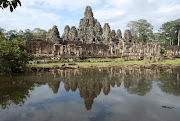
The majestic Angkor Wat temple complex. Blinded, disfigured men, hands (if they have them) out, muttering "land mine, land mine." The elegant, gilded swoops of the royal palace. Half-naked children at play in murky, disease-infested waters. The festivity of dawn in Phnom Penh along the riverwalk. Political corruption and repression. Economic vigor through tourism and expected oil revenues. Staggering rural poverty, low literacy and daunting school dropout rates. A warmth of spirit and serenity. The psychic scars of the Killing Fields and the perpetually stalled attempts to prosecute Khmer Rouge perpetrators.

It may sound like a bromide, but Cambodia is a land of immense contrasts. And after spending a week there last year as part of a journalism fellowship, that was the overriding sense I had - the stark contrasts, the curious disconnects.

What is the real Cambodia? Is it in the ubiquitous cartoon-like "happy painting" Cambodia artwork of French

painter Stef? Is it in the silence of a Khmer Rouge atrocities survivor? I guess like all things it's somewhere between, found possibly in the enigmatic half-smile in the slowly crumbling Buddha faces on the Bayon temple in Angkor Wat.
On the road

Traveling to Cambodia as a journalist was not like being a tourist. Excursions to museums, to shop, to stroll along the riverfront, to sit over cocktails at the Elephant Bar or Foreign Correspondents Club had to be squeezed in among official visits.

Don't get me wrong. No complaints. It was a magical, staggering, exhilarating and exhausting week.

The most "touristy" activity was speed-touring the 402-square kilometer Angkor Wat complex of Hindu and Buddhist temples, trying to take in in three hours what locals say takes a minimum of three days to begin to appreciate.

We were literally doing a drive-by of the Buddhist Bayon, the second most recognizable temple in the complex, before we pleaded with the local minister of tourism to stop. Dusk amid the temples was an exquisite reflective moment amid a flurry of information gathering.

In a nutshell, Cambodia is one of the almost forgotten nations of Southeast Asia. Flanked by the so-called Asian Tigers of Thailand and Vietnam, it is like the poor bumpkin cousin of those two dynamos.

Cambodia also is a nation that still shrinks in the shame of its past. In April 1975, as Saigon was falling in South Vietnam, a much less publicized yet sinister piece of history was evolving just to the west. The Khmer Rouge rode victoriously into Phnom Penh on April 17. Within days, it emptied the capital and embarked on a quest to create a pure agrarian state. What ensued was a genocidal campaign that came to be known as the Killing Fields. By the time its reign ended with the Vietnamese invasion in 1979, somewhere between 1 million and 3 million Cambodians had died from executions, disease and starvation.

The shadow of the horror, the shame of it, has left an immense scar on the Khmer heart. And many believe it may take a generation of leaders who didn't live through that time to fully restore the country.

That generation is coming of age and its challenges are formidable.

Still, Cambodia is a nation that would seem to be brimming with potential: for trade with its neighbors, through tourism to the awe-inspiring Angkor Wat, to the rowdy eclecticism of Phnom Penh and to the pristine beaches of Sihanoukville; from oil reserves found in the Gulf of Thailand; from a burgeoning young population ready to put the sad, broken legacy of the Killing Fields behind it.

And yet it seems, for every reason of hope, there is a hidden motive or agenda, for every success, there's a contravening reality. And at the end, there is the Cambodian, his face in that half-sardonic smile. He's seen it all before. He's seen much worse.

During a crowded week, my journalist compatriots and I met with all kinds of officials: United Nations, U.S. Embassy and assorted Cambodian ministry officials. We met commune leaders, garment factory representatives and textile labor overseers. And members of the understated Extraordinary Chambers in Courts of Cambodia, which has achieved only extraordinary delays in its attempts to launch tribunals against the dwindling numbers of surviving Khmer Rouge leaders.

Many of these people were there to tell us a tale of a revitalized Cambodia, a rejuvenated people pulling themselves up from the ashes of the past.

A stitch in time

So we learn about the booming garment and textile business. We learn that workers are unionized, there is a $45-a-month minimum wage and 80 percent of workers make more than that, thanks to the unions. There is international oversight that guarantees protections for workers against child abuse, excess hours, delayed paychecks and substandard working conditions.

About 250,000 workers, mostly women from poverty-stricken rural areas, work in the garment industry. Most send money home to their families, and officials estimate that 2.5 million to 3 million Cambodians benefit from the garment industries.

Most of these protections were put in place through a 1999 agreement in which the United States guaranteed to import a quota of goods in exchange for the improvements.

All good news. Except ... In Cambodia it seems there is always an "except."

We learn that many of the women earning these wages live in overcrowded, substandard conditions. Many have to find outside work, and often this includes prostitution. And this in turn adds to the HIV/AIDS problems in the country.

At its best, the garment industry is notoriously unreliable and transient. Companies look for the best deals and the cheapest labor supplies. Several of the export-quota agreements Cambodia signed have expired, and there is fear that by instituting the U.S.-inspired protections, the country has priced itself out of the cheap labor pool.

Finally, in a theme that seems recurrent throughout the Cambodian economy, the industry is 90 percent foreign owned, meaning they have no reason to remain in-country. The chances for Cambodians to advance in the management in the foreign companies are virtually nil.

Banking on Angkor

Tourism is booming in Cambodia. At the ancient Angkor Wat complex of temples built between the 9th and 12th centuries, the number of tourists has tripled since 2001. In the gateway town of Siem Reap, 17 hotels were under construction when we visited, which boosted to 100 the number of hotels in the town. Another 150 are planned.

The population in Siem Reap has grown from 100,000 to 150,000 since 2002 and created more than 29,000 jobs in tourism. About 500,000 tourists visited last year for the World Culture Expo alone.

Again, seemingly good news. Except there is fear that Angkor Wat could literally sink under the weight of tourism.

Millions of pairs of feet are wearing away the ancient ruins, which tourists are allowed to scamper over virtually unimpeded. Millions of pairs of hands are rubbing away amazingly detailed bas-relief artwork on temple walls. And the water demands of those millions are severely taxing the environment. The water table is being sucked dry and could cave in on itself. Coincidentally, it was failed irrigation that led to Angkor Wat being deserted 500 years ago.

Millions of foreign dollars are and have been spent to build infrastructure and to replenish the water table and meet tourist needs. But studies have showed that the Bayon is sinking into the sandy earth and cracks in its base are widening.

Like the garment industry, tourism is notoriously fickle. And, as in the garment industry, the overwhelming number of hotels and tourist businesses are foreign-owned. Although there are a number of schools in Siem Reap offering classes in hotel management, as of October, not one Cambodian had risen to the level of general manager in a major hotel.

Striking oil

Then there is oil. Estimates of discoveries of oil beneath Cambodian waters in the Gulf of Thailand range anywhere from 700 million to 2 billion barrels, as well as trillions of cubic feet of natural gas. At $60 to $70 a barrel for oil, the spigot into Cambodia could be considerable indeed. Furthermore, Cambodia and Thailand may be nearing an accord to explore for petroleum in an overlapping offshore area claimed by the two countries.

Spread out over 20-25 years, Cambodia could see annual sales in excess of $7.5 billion per year, which is about twice the country's current gross domestic product.

So exciting is the news that the United Nations Development Program issued a Strengths, Weaknesses, Opportunities and Threats report that, among other things, cautioned strongly about the so-called "oil curse."

Nigeria is the poster child for such a negative outcome. With $29 billion in oil exports in 2004, before prices spiked, Nigeria saw only a meager 2 percent climb in gross domestic production, a number exceeded by the growth in population. In other words, overall Nigeria was becoming poorer.

And then there were these words from U.S. Ambassador Joseph Mussomeli, reported in the International Herald Tribune, "This will be a watershed event for this country one way or another. Everyone knows that it will be either a tremendous blessing or a terrific curse. They are unlikely to come out unscathed."

How Cambodia will handle its possible windfall, which could begin flowing into the country as early as 2010, is anyone's guess. Given the nation's history of endemic corruption, the prospects of an oil benefit to the rural farmer may be bleak.

So, of the three pillars that would seem to girder Cambodia's growth, all are shaky at best. And when all three are undergirded by a history of autocratic rule, indifference and corruption, optimism might seem, as philosopher Jeremy Bentham proclaimed, "nonsense upon stilts."

Hanging onto hope

And yet for all that, I couldn't help but find myself buoyed by the ineffable positive spirit of the people: the survivor of the notorious Tuol Seng S-21 prison, who sat next to a Khmer Rouge interrogator and would not lay blame; children in the countryside who flock to visitors with happy faces; students learning English and excitedly talking about their future employment prospects; and educators eager to impart not only reading and writing, but citizenship and civic involvement to the next generation.

I can only hope that hope survives. That when the rest is all cleared away, there is still that.

When I think about Cambodia, I find myself ironically reminded of a line from "The Great Gatsby" and tempted to insert the word Cambodia for Gatsby, and trying not to fall into defeatism.

"No - Gatsby turned out all right at the end; it is what preyed on Gatsby, what foul dust floated in the wake of his dreams, that temporarily closed out my interest in the abortive sorrows and short-winded elations of men."

Greg Mellen can be reached at greg.mellen@presstelegram.com or (562) 499-1291.
Read more!

Cambodia’s Mobile Market is Growing at an Annual Rate of Around 35%

DUBLIN, Ireland--(BUSINESS WIRE)--Research and Markets (http://www.researchandmarkets.com/reports/c56097) has announced the addition of 2007 Asia - Telecoms, Mobile and Broadband in Cambodia, Laos and Vietnam to their offering.

This Annual Publication: Telecoms, Mobile and Broadband in Asia – Cambodia, Laos and Vietnam profiles three countries which once made up the French colonial entity known as Indochina. These neighbouring countries – Cambodia, Laos and Vietnam – are still in relatively early stages of their telecommunications development with expanding national infrastructure and growing subscriber bases across all market segments.

Continuing to shun fixed-line services, Cambodia’s healthy mobile market has passed the 1.5 million subscriber milestone and was continuing to grow at an annual rate of around 35% coming into 2007. Fixed-line services were languishing at around 42,000, with no sign of a revival in interest in this segment of the market. Surprisingly, given the apparent interest in communications, Internet penetration has remained particularly low, with the services on offer being notably expensive in comparison to other countries in the region. As the country’s efforts are directed towards strengthening its telecommunications infrastructure, Cambodia must continue to address its political problems and build its economy. Now that the country has entered a period of relative political stability, an increased effort is required to put the necessary administrative institutions and regulations in place. The telecom sector remains in need of serious regulatory reform. The good news is that foreign investor confidence appears to have returned and there are many positive signs that the economy is strengthening in a sustained manner.

After years of economic struggle, Laos has finally been reporting positive news on this front. With a number of substantial hydro-electric and mining projects now a reality, the country is at last moving forward in a confident fashion. Attention is now turning to building its national infrastructure, including telecommunications. Laos still only had a fixed line teledensity of less than two telephones per 100 people by early 2007. More foreign investment is needed to boost the telecoms sector and, most importantly, given that it is a relatively small market; the government must be judicious in deciding and licensing how this investment happens. The Lao Telecom joint venture formed by the government with the Thai company, Shinawatra, in 1996 was a wasted opportunity. Lao Telecom allowed the five year period of market exclusivity to pass without any serious attention to infrastructure building. When the market was opened up to competition in 2002, foreign capital finally started to flow into the sector, although not as much as the government would have liked. The mobile phone market took off in early 2003, with the number of subscribers increasing sevenfold in just 2 years. The Lao telecom sector still has many issues to address. Despite the recent rapid opening up of the market, the regulatory progress continues to lag behind development and has the potential to derail the progress already made if reform is not speeded up.

After a period in which foreign investors appeared to be avoiding Vietnam’s telecom sector, the country has become the target for a fresh new round of investor interest. This follows a period in which the government seemed content to ‘go it alone’. During this time, the introduction of a limited level of competition into the telecoms market, combined with a generally improved economic climate, saw some healthy growth in the sector. More recently the move to allow an increase level of ‘equalisation’ (the Vietnamese government’s word for ‘privatisation’) has sent a clear message to investors that the rules are changing in a positive way. The investment mood has been further boosted with Vietnam finally winning accession to the World Trade Organization, a step that was formally confirmed in early 2007. This adds to the already positive climate for the telecom sector expansion. As well as strong growth in its mobile sector, there has been equally strong – and some might say, surprising - growth in the country’s fixed line subscriber base. Fixed-line services have been continuing to expand at an annual rate of 100%; fixed teledensity has passed 32%. At the same time, the government’s reticence about the Internet has not stopped this segment of the market gaining a strong foothold. Internet user penetration was running at a healthy 18% in early 2007. Increased foreign investment remains the key to overall expansion. It is still not totally clear what form the government’s involvement in the telecom sector will take.

Key highlights:

-Vietnam’s mobile market had passed the 16 million subscriber mark coming into 2007. The annual growth rate in this market segment was running at around 85% and looked set to continue.

-The 2006 year saw a remarkable surge in Vietnam’s broadband Internet market with subscriber growth running at an annual rate of almost 200%. Interest in broadband services was finally picking up; but broadband penetration remains low (2% of households) we can expect continuing strong growth in this market segment.

-Vietnam received a boost to its economy generally and the telecom sector in particular with its accession to the WTO in early 2007.

-In Cambodia, mobile services continue to dominate the local market; in what is still a relatively poor country, (GDP per capita of US$430 in 2006), more than 1.5 million people subscribe to a mobile service. The market is continuing to expand at around 40% per annum.

-According to ministry figures, mobile subscribers in Laos passed the one million mark in December 2006. Recent growth in mobile has been rapid in this country of only 6 million people and the market looked set to continue to expand at an annual rate of about 40% in 2007/08.

-All three countries are making some progress with regulatory change and structural reform within their respective telecom sectors. To the outside observer, however, progress is often painfully slow. This can cause serious concern among those companies wishing to invest.

Mobile penetration and annual growth - 2007

Country Penetration Annual growth

-Cambodia 15% 37%

-Laos 21% 40%

-Vietnam 30% 60%

Topics Covered

1. CAMBODIA

1.1 Key statistics

1.2 Telecommunications market

1.3 Regulatory environment

1.4 Telecommunications infrastructure

1.5 Internet market

1.6 Mobile communications

1.7 Broadcasting market

2. LAOS

2.1 Key statistics

2.2 Telecommunications market

2.3 Regulatory environment

2.4 Fixed network operators in Laos

2.5 Telecommunications infrastructure

2.6 Internet

2.7 Mobile communications

2.8 Broadcasting market

3. VIETNAM

3.1 Key statistics

3.2 Telecommunications market

3.3 Regulatory environment

3.4 Telecommunications infrastructure

3.5 Fixed network operators in Vietnam

3.6 Internet market

3.7 Broadband market

3.8 Content and e-services

3.9 Mobile communications

3.10 Broadcasting

3.11 Forecasting

4. GLOSSARY OF ABBREVIATIONS

Tables and Exhibits

For more information visit http://www.researchandmarkets.com/reports/c56097
Read more!

Cambodia to amend labor law to reduce nighttime pay for garment workers

PHNOM PENH, Cambodia: Cambodia's Prime Minister Hun Sen said Tuesday his government is pushing ahead with a planned amendment of the labor law to reduce nighttime pay for garment factory workers, who are paid twice as much as those on the day shift.

He said the move is crucial for creating more jobs in an industry, a major hard-currency earner for the impoverished Southeast Asian nation.

The country currently has 300 garment factories that employ 355,000 workers. But only about 10 of the factories run night shifts because the higher pay is a "disincentive," said Ken Loo, secretary-general of Garment Manufacturers Association in Cambodia.

He said lowering nighttime payment will not only create more jobs at the factories but will also increase peripheral economic activities for those operating transport and selling food to the workers at night.

"We've been pushing for this (amendment) for the last seven years, and it's only now that we are making some headway," Loo said. "With the industrialization of the country, we need to embrace the concept of shift."

Under the current law, wage for dayshift garment workers is about US$50 (€37) a month, but the amount is doubled to US$100 (€74) a month for those working at night.

The National Assembly, the country's lower house of parliament, will soon debate and mostly like pass the amendment requested by the government, Hun Sen said. The proposed amendment will allow for an increase of only 30 percent over the daytime payment, he said.

Last year's garment exports from Cambodia were worth about US$2.8 billion (€2 billion), with about 70 percent of the shipments going to retailers in U.S. market, Loo said.

Chea Mony, president of Cambodia's Free Trade Union which has claimed to have 74,000 members, on Tuesday threatened to call a strike against the amendment.

He criticized the government for kowtowing to the garment industry's demand and said the amendment will be disadvantageous for the workers.

"This government has claimed such a move would attract more investment. I do not see it will. Reducing workers' earning is not the factor for luring investors to Cambodia," he said.

The government should instead eradicate corruption, which is scaring investors away, he said.
Read more!

US and China tug at ASEAN unity

By Michael Vatikiotis

SINGAPORE - Something has changed in Southeast Asia, and no one seems to want to talk about it.

Over the past 40 years, countries of the region have fostered a tradition of loose but often effective multilateral cooperation in the shape of the Association of Southeast Asian Nations. Of late, however, the ASEAN spirit of consultation and consensus appears to be fading. In part that's because ASEAN has grown, now comprising 10 members instead of six. And the expansion, pulling in economic laggards Vietnam, Cambodia, Laos andMyanmar, has understandably diluted the old bonhomie among the original six members - Thailand, Malaysia, Indonesia, Singapore, Brunei and the Philippines.

But the grouping is also being fragmented by intensifying US-China competition for regional influence, which is putting a premium on bilateralism with the big powers at the expense of ASEAN's ambition toward more regional multilateralism.

The framework for regional cooperation among the original six members expanded as economies boomed in the 1990s. Dialogue partners were taken on, and larger East Asian and South Asian neighbors were brought into the circle. Now, however, the global focus of attention has swung away from economic growth in ASEAN toward growth in China, which has weakened considerably ASEAN's incentive to bond as a region.

The result has been a return to reflexive bilateral engagement. Witness the recent signing in Bali of a bilateral extradition treaty and defense-cooperation agreement between Singapore and Indonesia. Both these landmark deals were tough to negotiate and brought the two sides into a degree of friction with one another. The question arises: Where was ASEAN in all this?

Why hasn't the organization crafted a regional mechanism to ensure that ill-gotten gains squirreled away from one country can be traced and recovered in a neighboring one? The question can equally be asked: What do Singapore and Indonesia need a bilateral defense agreement for in an era when regional security cooperation should be the goal? Indonesia has proposed an ASEAN security community, but the idea has languished near the bottom of official agendas at recent ASEAN meetings.

In the 1990s, Indonesia, Malaysia and Singapore frequently met at a high level in a more explicitly multilateral context. There were optimistic joint declarations to create zones of joint economic development, such as Sijori (Singapore, Johore and Riau) and the Northern Growth Triangle encompassing North Sumatra, the Malaysian island of Penang, and southern Thailand.

Nothing came of these projects because, while the leadership may have been willing to invest in joint development, little effort was made to break down political and bureaucratic barriers among the countries involved. More is the pity, since a regional framework like the Indonesia-Malaysia-Thailand Growth Triangle, if seriously implemented, might well have dampened conflicts in Aceh and southern Thailand by providing local people with higher levels of economic growth and fostering a benign sense of regional identity that didn't threaten individual countries' sovereignty. In both cases, economic marginalization has fueled historical nationalist sentiment.

But nationalism at the state level remains as strong a political impulse today as it was half a century ago, and there is little sign of regional borders dissolving. Today, wealthy Singapore says it is different from other countries; Indonesia now thinks it is more democratic than others; and Thailand is looking inward as it confronts prolonged political crisis. Vietnam goes its own way, and Myanmar is drifting further apart from the rest of Southeast Asia.

Fading multilateralism
In other words, ASEAN nowadays is suffering from a lack of firm commitment to multilateral cooperation.

To be sure, a multitude of meetings are still held: ASEAN exists as a complex matrix of official meetings on one subject or another. However, this is also part of the problem: ASEAN has been delegated by the leadership, which turns up once a year to preside over summits that are increasingly venues for bilateral engagement on the sidelines rather than multilateral agreement at the main event. The recent announcement of an ASEAN bilateral summit with the United States to be held in Singapore in September will no doubt serve as a case in point.

Lately, ASEAN has been hijacked by bigger geopolitical forces. As China, the US and to a lesser degree India vie for regional influence, the arena of cooperation and integration has been greatly expanded. And ASEAN is arguably now part of a greater East Asian whole.

Some of the more interesting regional discussions are now held under an ASEAN Plus Three umbrella that includes China, Japan and South Korea, including this weekend's multilateral meeting in Japan to discuss the creation of a regional bond market and pooling part of the region's collective US$2.7 trillion in foreign reserves to shield regional currencies against financial speculation.

Such initiatives signal the changing power dynamic in the region being driven in large part by China's recent economic emergence. So long as China lacked the confidence to flex its diplomatic muscle, Beijing hid behind ASEAN's preceding familiarity and credibility with big Western trading partners. This started to change after 2003, when China harnessed ASEAN to its own notion of a regional framework, one that is less dependent on the West.

Much hope is now pinned on a new ASEAN charter due to be unveiled in Singapore at the end of this year. The document, once approved, is expected to reinvigorate ASEAN, endow its moribund secretariat with new powers and breathe new life into the notion of a single community. A more empowered secretary general will aim to restore some luster to this once-respected vehicle for regional diplomacy.

But perhaps the problem is not one of internal dynamics. Perhaps instead ASEAN is less a victim of its own weakness than a hostage to the new global order - one in which multilateral bodies have been damaged or weakened by the clumsy unilateralism of big powers, principally the US and China.

The United States, for example, insists on negotiating free-trade agreements bilaterally rather than with ASEAN as a whole, a deal that might have accelerated ASEAN's own incarnation as a free-trade area. Whenever ASEAN has floated notions of stronger regional management of the financial or security environment, such institutions as the World Bank and the International Monetary Fund have expressed fears about losing supervisory control.

On the security front, the US has always been concerned about the ASEAN Regional Forum established in 1994 with ASEAN as convener and chairman. The idea of a security forum in which the United States is not in a dominant position simply wasn't acceptable to Washington, which has mostly characterized the forum as toothless.

The so-called "global war on terror" since 2001 has further weakened ASEAN's autonomy over security concerns, with the US linking its own concerns to bilateral trade and aid. No doubt this security priority will be front and center at the commemorative bilateral ASEAN summit in September.

ASEAN enjoyed the peak of its success at the end of the Cold War, when superpower rivalry was at its nadir. This allowed ASEAN to steer its own economic and security policies and get a feel for real regional cooperation.

Now the cycle is reversing itself as US-China rivalry for regional influence intensifies and individual ASEAN member states need to demonstrate strong bilateral ties with both Washington and Beijing to benefit from access to preferential trade and security agreements.

Today, the leaders of Southeast Asia are forced to keep busy burnishing ties with the major powers as well as each of their neighbors - which are often likewise striking bilateral deals - rather than relying on their foreign ministers to sort things out collectively over a few cold drinks after a round of golf at one of those old-fashioned ASEAN meetings.

For all these reasons, just as individual countries pay less heed to the United Nations these days, so ASEAN as a grouping no longer invites the scrutiny, analysis and respect that it once did.

Michael Vatikiotis is the regional representative of the Center for Humanitarian Dialogue based in Singapore.
Read more!

Charlie heads to Cambodia

By Gazette reporter

TAUNTON School pupil Charlie Walker is one of several students trying to raise money to make his way to Cambodia on a community project.

The initiative is run by the World Challenge organisation, which helps young people get to countries that would benefit from outside help.

For Charlie and his school friends the first project is expected to be in an orphanage assisting in the general running of the home and providing ongoing support to the orphans and staff.

advertisementTime will be taken out to spend a couple of days trekking through the jungle before a second community project begins.

The trip will last one month, with each student having to raise £3,000 - the money will go towards transport and accommodation.

Students have come up with their own initiatives to raise money for the trip - Charlie has his own website at www.100villas.co.uk, while others have taken on part-time jobs, a female student has completed a 15km run and raised £400.

Preparations have included fitness training and learning skills that will be needed in Cambodia, including putting up a hammock.

Taunton School will also be participating in fundraising projects - so far they have had an Easter egg sale and sold roses.

*For this and all the top local stories get the Somerset County Gazette on Thursdays.
Read more!

Cambodia's largest union threatens strike if wages decrease

Phnom Penh - Members of Cambodia's largest and most powerful union will call a national strike if the National Assembly votes to decrease night wages this month, its president said Monday.

Chea Mony, president of the Free Trade Union of Workers of the Kingdom of Cambodia (FTU), warned that the union's members would strike if the National Assembly decides to lower night wages from 200 to 130 per cent of day rates in a vote scheduled for May 17.

'The workers will strike and the union will support them. It is their constitutional right to do so under Chapter 13 of the Cambodian Constitution,' Mony said.

He said the FTU has 70,000 members. Most of these are in the garment industry.

Garment manufacturers have complained that Cambodia's high overheads and wages compared to other garment producing nations could make it a less desirable production base in coming years compared to cheaper countries such as Bangladesh and neighbouring Vietnam.

Cambodia relies heavily on its garment sector, which along with tourism and construction is one of three pillars on which the narrowly based national economy is firmly fixed.

Mony also warned that the issue would become a political hot potato in the lead-up to the 2008 general elections scheduled for next July for the ruling Cambodian People's Party if it used its numbers to force the bill through.

Mony took over as president of the prominent union after his brother and founding president, Chea Vichea, was shot dead in 2004. The union is generally seen as sympathetic to the opposition Sam Rainsy Party.
Read more!

Thailand gives neighbours a lift

By Daniel Ten Kate
Advertisement

A few months ago, Larry Cunningham of Phuket One Realestate had a Hong Kong-based client looking to invest US$50 million in Thailand.

“We showed them several large sites, and they were making all the right moves,” he says. But then Thailand’s military-installed government shocked investors on December 18 by introducing a 30% reserve requirement on all foreign funds. For Cunningham’s client, $15 million would need to sit in an interest-free account for one year.

The proposition killed the deal with Phuket One. But the property fund still wanted to invest the money in the region, and chose Cambodia instead.

The experience typifies a trend property developers have seen of late: Thailand’s loss is very much the gain of other countries in the region.

Vietnam, Cambodia and Malaysia are all benefiting from the government’s poorly implemented capital controls and proposed changes to foreign ownership laws. Investors who would’ve never given those countries a look are now making inquiries, and, in some cases, closing deals.

“Absolutely Thailand’s problems have benefited neighboring countries,” says Robert Collins, managing director of Agency and Investment Services for Savills (Thailand) Limited. “Malaysia in particular has benefited, and to some extent the residential side in Vietnam.”

But though Thailand’s regional competitiveness is lagging for the moment, the news isn’t all bad by any means. Most property developers agree that once the government gets its act together and sets clear economic policies that restore certainty to the market, Thailand will again be the top choice for property funds and investors.

“Thailand doesn’t have a natural competitor in the region,” Collins says. “If ownership structures become clear or sentiment reverses, we’ll see a huge outpouring of pent-up demand. It might not happen until next week or for another year. But the exciting mix and interest in Thailand is not going away.”

Until the military ousted elected premier Thaksin Shinawatra in a coup last September, Thailand’s property market was looking up. High economic growth, well-developed infrastructure and plenty of exotic tourist destinations made Thailand an attractive play for major property funds.

“Institutional investors have always had a stronger interest in Asia’s bigger property markets like Japan, Korea, China, Hong Kong and Singapore,” says Aliwassa Pathnadabutr, managing director of CB Richard Ellis (Thailand) Co., Ltd. “Interest has been growing in Thailand in recent years as part of the globalization of the property industry and the availability of investment properties in Thailand.”

That upward climb was knocked off kilter by the interim government’s unclear policy measures at the end of last year. The nationalist rhetoric of several key ministers, including former finance minister Pridiyathorn Devakula and Commerce Minister Krik-Krai Jirapaet, troubled investors whose holdings were based on a nominee legal structure that was suddenly deemed illegal after decades of widespread acceptance.

Although Pridiyathorn has seen been removed and his replacement, Chalongphob Sussangkarn, has toned down the patriotic bluster, it remains unclear what the new policy will look like. The capital controls remain, albeit watered down, while several drafts of the Foreign Business Act are floating around (see story).

The confused regulatory climate has led property funds to take another glance at Vietnam, Cambodia and Malaysia. But though these countries are perceived to be more business-friendly at the moment, the lack of infrastructure in some areas is still limiting sales.

“Thailand’s problems have increased the level of interest in Vietnam, but we are very underdeveloped in terms of development in both the retail/residential condo and office markets as well as the tourist/resort and hospitality sectors,” says Marc Townsend, managing director of CB Richard Ellis (Vietnam) Co., Ltd.

Vietnam’s economy is humming along at seven to eight percent per year, however, and the country just entered the World Trade Organization. Although WTO entry provides mostly a symbolic boost, many investors see a good opportunity to jump in early in what looks to be a promising growth story.

“Vietnam is suddenly the flavour of the month,” said Alastair Orr Ewing, chairman of Chesterton Petty Vietnam Ltd, the longest running real estate agent in the country with a staff of 230. “WTO entry has focused attention and the vital statistics look excellent. It is a ground floor opportunity in a market with great potential.”

Andrew Brown, country head of Jones Lang LaSalle Vietnam Ltd, said “the attractiveness of the Vietnamese market is driven by the strong work ethics, social and political stability, lower labour costs, attractive tax incentives and overall government support in the country. Another key factor in Vietnam´s favour has been the MNC´s drive for the so-called China plus one scenario, wherein they seek to reduce their excessive dependence on China and to more evenly spread their business risk in Asia.”

The legal structure in Vietnam is different than Thailand primarily in that it offers leases up to 50 years that are often renewable. Thailand offers 30-year renewable leases, but it remains unclear if they are binding if the freehold owner dies. This has led some property developers here to offer money-back guarantees to lure investors, but nearly all agree the government should offer a 90-year lease.

“The biggest problem facing the property market in Thailand is not necessarily the actions, but the perceptions of what the government is doing,” says Phuket One’s Cunningham. “I have clients who bought condominiums or leasehold sending urgent emails asking if their purchase is safe and secure even though they are not affected by the foreign business law changes. What the government must do is create something positive, and the easiest way to do that is increasing the percentage of condos that foreigners can buy from 45 percent to 75 percent or 90 percent, and offer 90-year leases.”

In Cambodia, laws are very much still being developed, and property values are difficult to ascertain. Still, the government has taken early steps to make the property market more attractive, in part by cracking down on land grabbing by corrupt soldiers and bureaucrats.

After years of isolation, Cambodia is finally seeing some high economic growth rates and an emerging middle class in Phnom Penh. The prospect of an oil discovery in Khmer waters of the Gulf of Thailand has increased optimism about Cambodia’s economic prospects. Beachfront property in Cambodia from Sihanoukville to Kep is becoming very attractive to investors who want to purchase virgin territory.

Coincidentally, foreigners can own land in Cambodia through a nominee structure in the same way foreigners did so in Thailand for decades. But after Thailand’s recent crackdown on nominees, investors may want to think twice.

Foreigners can’t own land in Vietnam, but Malaysia offers freehold ownership on properties costing more than $70,000. In addition, foreigners can get 60-year leases, 10-year renewable visas and take out loans from local banks, benefits not awarded to foreign investors in Thailand.

“Malaysia offers extremely sensible limited freehold property rights,” said Collins from Savills. “Of 1,500 foreigners that bought freehold in Malaysia, I’d say about 1,000 of them would´ve bought in Thailand if a similar package was available here.”

Malaysia certainly has plenty of upsides. Laws are clear and buying property is much easier than in other countries in the region. Moreover, the government is openly welcoming foreigners to invest through campaigns like “Malaysia My Second Home.”

The Malaysian economy is growing steadily at about six percent per year, higher than Thailand, which will grow between four and five percent this year. The Malaysian government is also close to completing a trade deal with the US that will likely give a further boost to trade and investment.

For property developers, however, beachfront property in Malaysia is very difficult to own, as most is reserved for Malays only. In addition, the nightlife and entertainment generally pales in comparison to that of Thailand.

When it comes to luxury housing in resort areas, Thailand is in a league of its own. Destinations like Phuket, Koh Samui, Pattaya, Krabi and Hua Hin all have unique personalities and easy access. Resort areas in Vietnam or Cambodia are much more difficult to get to.

“Nice resort locations in Vietnam are not easy to access,” Collins said. “A buyer based in Hong Kong who has a resort for weekend use can fly direct to Phuket and take a 15-minute car drive or fly to Vietnam and take a taxi drive and then a one-hour boat ride. There’s quite a bit difference in terms of convenience.”

Thailand is also a much more mature market than others in the region. The value represented in Cambodia and Vietnam now could quickly evaporate if a flood of foreign money enters and creates a bubble.

In that regard, many developers were not opposed to restrictions on foreign ownership in the Thai market. But many said those restrictions should be carefully thought out so as not to dampen the overall investment climate and hinder economic growth.

“The leading economies such as Japan are much more open to foreign institutional property investors,” said CBRE Thailand’s Aliwassa. “As the other countries are liberalizing their country´s economies and property policies, Thailand has become more restrictive, which will weaken its position in the competition to attract property funds and investors.”

All in all, property developers here are eager to hear some good news and see the Thai market catch up with Singapore, Hong Kong, Japan, Korea and China. The new finance minister may have stopped the free fall into economic nationalism, but actions speak louder than words.

“I’m sick of turning on CNN and the BBC and seeing international news programs telling people not to purchase in Thailand,” says Cunningham from Phuket One. “The government must make changes now to send out a positive vibe that Thailand does welcome foreigners.”
Read more!

Cambodia inviting for Vietnamese investors

VietNamNet Bridge – While competition in many areas is fierce in the domestic market, some companies in HCM City have begun to approach a neighbouring market – Cambodia.

The Dong Thien Joint Stock Company has nearly stopped its business in Vietnam to focus on a sand exploiting project in Cambodia. Its branch in Cambodia has been set up already and will become operational this June.

Assistant to Dong Thien’s General Director, Nguyen Phuc Son, said that the VND20 billion (US$1.25 million) sand exploiting project in Cambodia was the biggest one of Dong Thien to date. The company can exploit up to 7,000 cu.m of sand each week to export to Vietnam.

“Sand in Cambodia meets Vietnam’s standards for construction sand. The local market is now short of this material so the market for sand is extremely large,” said Mr Phuc.

Only one hour by bus from HCM City, Cambodia has become an attractive destination for many companies in the city thanks to its low labour cost, spacious land, and open market.

Twenty-seven Vietnamese companies have opened branches, representative offices and invested in projects in Cambodia. This number is double compared to two years ago. Main fields for Vietnamese investment are health, agriculture, transport, telecom, and hydro power production.

The Ministry of Planning and Investment (MPI) has recently licenced the Saigon Trade Corporation (Satra) to form a joint venture with Sokimex Group to build big plants to process cashews and seafood, to breed cows and to build a supermarket in Cambodia.

Four travel companies, the Saigon Mekong Joint Stock Company, Saigontourist, Cho Lon Tourist, and Fiditour, have cooperated with Cambodian partners to bring tourists from HCM City to Phnom Penh and Siem Reap by land, air and water.

The US$10.5 million Cho Ray-Phnom Penh hospital project is underway, in which the Saigon Health Investment Joint Stock Company is contributing two-thirds of the capital and the remaining is coming from Cambodian partners. The representative office of this joint venture has been set up and is waiting for an investment licence from the Cambodian government.

However, investment in Cambodia still faces many difficulties. A project between the Viet Nga Infrastructure Investment Joint Stock Company and the Mong Reththy Group to establish a joint venture to build a road from the hub of Phnom Penh to Cambodia’s international airport in the form of build-operate-transfer (BOT) was canceled at the last minute because of some problems such as site clearance.

Nguyen Van Hung, representative of a rubber company in the southern province of Dong Nai which has a rubber growing project in Cambodia, also had to abandon his project due to problems associated with site clearance.

Deputy Director of the Department of Planning and Investment of the southern province of Tay Ninh, Tran Luu Quang, complained that even Vietnamese agencies caused problems for companies investing in Cambodia. He gave an example that many companies in Tay Ninh that want to grow cashews and cassavas in Cambodia but when they import cashews and cassavas to Vietnam as materials they face difficulties in customs formalities.

“Because of high import tax rates and no preferences, many companies are discouraged and leave their projects unfinished,” Mr Quang said. He said he hoped that relevant bodies like the Ministries of Trade and Finance and customs agencies would address these problems.

(Source: VNE)
Read more!

Interest conflict over Khmer Rouge History in Cambodia


By Erika Kinetz
Special to The Washington Post
Tuesday, May 8, 2007; Page A14

PHNOM PENH, Cambodia, May 7 -- In a country where half the students who enter grammar school never finish, Cheak Socheata, 18, is among the most privileged of her generation: She made it to college.

But even Cheak, a first-year medical student at Phnom Penh's University of Health Sciences, has learned next to nothing in school about the Khmer Rouge, who in a little less than four years in power executed, tortured and starved to death an estimated 1.7 million Cambodians, about a quarter of the population.

"I just heard from my parents that there was mass killing, Cheak said. "It's hard to believe." Her high school history teacher told her the basics -- the Khmer Rouge ruled Cambodia from 1975 to 1979 -- and advised her to read about the rest on her own, she recalled.

Nearly three decades after the Khmer Rouge were overthrown, a battle over history is underway in Cambodia. On one side are forces eager to reckon with the past, both in school and at a special court set up to try the surviving leaders of the Khmer Rouge. Many teachers, students and activist groups say more should be taught about the Khmer Rouge years, which is virtually absent from school curriculums now.

Blunting these demands is a government whose top leaders were once associated with the now-defunct communist movement and who seem loath to cede control over such a politically sensitive chapter of Cambodian history.

"Suppose that ever since 1945, Germany had been ruled by former Nazis," said Philip Short, author of "Pol Pot: Anatomy of a Nightmare," a biography of the Khmer Rouge leader published in 2004. "Would the history of the Nazi regime be taught honestly in Germany today? This is now Cambodia's problem."

A new high school textbook about the era, the first written by a Cambodian, was recently published by the Documentation Center of Cambodia, an independent institute in Phnom Penh that specializes in Khmer Rouge history. In "A History of Democratic Kampuchea," author Khamboly Dy, 26, spells out in 11 detailed chapters the rise, reign and fall of the Khmer Rouge, who called themselves the Communist Party of Kampuchea and the country, Democratic Kampuchea.

A Cambodian government review panel deemed the book unsuitable for use in the regular curriculum. Instead, the panel said the book could be used as supplementary reference material and as a basis for the Ministry of Education to write its own textbook.

"It's a start. The door is open," said Youk Chhang, director of the Documentation Center, which has been pushing to get a textbook into classrooms since 1999.

Short said Khamboly's text is hard to fault on substantive historical grounds. "It deserves to be not merely an approved textbook for Cambodian schools but a compulsory text, which all Cambodian schoolchildren should be required to study," he said.

Its sidelining reflects the failure of the country's current leaders to move beyond their Khmer Rouge past, he said. Prime Minister Hun Sen, National Assembly President Heng Samrin and Senate President Chea Sim were all middle-ranking Khmer Rouge officials, he said.

The three men left Cambodia for Vietnam in the late 1970s and returned with Vietnamese army forces that overthrew Pol Pot in 1979. Today, their political legitimacy rests in part on their credentials as men who helped free Cambodia from the Khmer Rouge tyranny.

Heng Samrin said it was unfair to implicate him and other top officials of the ruling Cambodian People's Party in the crimes of the Khmer Rouge.

In an interview with a Cambodian journalist, he maintained that the term "Khmer Rouge" refers only to people who joined the National United Front of Kampuchea, which in the first half of the 1970s fought the U.S.-backed Lon Nol government but later betrayed the revolution and killed innocent people.

He and his colleagues only fought to liberate Cambodia from Lon Nol and his imperialist henchmen, he said. "We were not involved in the Khmer Rouge regime," he said, adding that he had been only a "simple soldier."

Khamboly said that picking his way through politically charged points was the most difficult aspect of writing the book, which was printed with $10,000 from the Soros Foundation's Open Society Institute and the National Endowment for Democracy. By citing sources, focusing on survivor stories and seeking neutral language, Khamboly said, he hoped to avoid political tussles.

It wasn't enough. The committee that reviewed the text criticized it for giving too much attention to the years after 1979, when Cambodian factions fought a long civil war, and for tracing the roots of the Khmer Rouge back to the struggle against French colonization and to Ho Chi Minh's Indochinese Communist Party.

Committee members also said naming individuals associated with the Khmer Rouge government was "unnecessary" and a threat to their safety.

History "should be kept for at least 60 years before starting to discuss it," said committee member Sorn Samnang, president of the Royal Academy of Cambodia, a graduate school, according to the minutes of a Dec. 14 meeting of the review panel.

There is a long-standing political debate in Cambodia over whether Vietnam liberated or invaded the country when it ousted the Khmer Rouge.

Khamboly's book uses neither term, saying only that Vietnamese forces "fought their way into Cambodia."

"We use facts," Khamboly said. "Whether they invaded or liberated the country is an interpretation."

But in Cambodia, as in other post-conflict states, there are few facts that belong to everybody. In a Sept. 19 letter to Hun Sen, the premier, his education adviser, Sean Borat, generally praised the book but took issue with Khamboly's failure to characterize the Vietnamese action as a liberation.

He also objected to the book's characterization of Cambodians who returned with the Vietnamese in 1979 as "Khmer Rouge defectors." That phrase, Sean Borat wrote, must be deleted because "the Cambodian People's Party did not originate from Khmer Rouge soldiers but from a massive movement that emerged to oppose the brutal regime led by Pol Pot."
The offending phrase was removed from the final version of the book.

Young Cambodians haven't been formally taught much about the Khmer Rouge in school since propaganda texts of the 1980s, when Cambodia was ruled by the communist government that the Vietnamese installed. Those books depicted the Khmer Rouge with such graphic ferocity that some children grew up thinking they were actual monsters.

These books were taken out of use in 1991, when U.N.-brokered peace talks ended more than a decade of civil war and led to elections.

In 2002, a 12th-grade history textbook touching on the Pol Pot years was introduced but quickly recalled after controversy arose over the book's omission of the 1993 electoral victory of the royalist Funcinpec party. A new version of the text has yet to appear. Ministry of Education officials say they plan to publish a new book in 2009; they blame the delay on lack of funds.

In the meantime, Cambodia's youth are "a lost generation," said Chea Vannath, former president of the Center for Social Development, a local rights group. In the absence of a shared national story about the Khmer Rouge, a thousand conversations, fractured by politics, rumor, myth and the varieties of human experience are being passed down to a sometimes skeptical younger generation.

"When a kid doesn't eat all the rice on the plate, his mother tells him, 'If you were in the Pol Pot regime, you would die because you don't have enough food,' " said Nou Va, 27, a program officer at the Khmer Institute for Democracy, a nonprofit group that recently produced a documentary film about the generation gap. "The kid says, 'Oh, she's just saying that to blame us. I don't believe it.' "

The battle for history is also being waged at a former military headquarters on the outskirts of Phnom Penh, where a special tribunal set up by the United Nations and the Cambodian government is struggling to bring to justice those leaders of the Khmer Rouge who survive. (Pol Pot died in 1998.)

Efforts to establish the court go back a decade. Despite recent signs of progress toward convening trials, many observers have concluded that the Cambodian government is not ready for a truly independent inquiry into this chapter of the nation's past.

"Were Hun Sen and his colleagues to permit an honest appraisal of the past, it would be the best proof that they have finally broken with that past and moved out from under the shadow of their Khmer Rouge origins," Short said. "Unfortunately, all the signs continue to point in the opposite direction."

Cheak, the medical student, has a more immediate concern. It's about Khamboly's new book. "Where," she asked, "can I get a copy?"
Read more!

Monday, May 07, 2007

How wide should the door be open for foreign retailers?


VietNamNet Bridge – It is clear that Vietnam needs to do a lot of things to develop the local distribution network and help its enterprises become stronger before foreign retailers land in the market. The uncertainty lies in the details.

Time is precious

Vietnamese retailers will have two more years to strengthen themselves before foreign retailers land in the market in 2009, when the market door opens for them, said Deputy Minister of Trade Nguyen Thi Kim Ngan, adding that Vietnamese enterprises do not have much time.

Hoang Tho Xuan, Director of the Domestic Market Policies Department under the Ministry of Trade, said that the biggest problem now is the lack of a comprehensive distribution network development strategy, and that local authorities project the network expansion just by ‘feeling’.

“In many localities, advantageous places are reserved for agencies’ headquarters, while markets and supermarkets are ‘hidden’ in corners or put on disadvantageous positions. The investors of the markets and supermarkets seem to ignore the habits of local residents,” Mr Xuan said.

Huynh Van Minh, Director General of Satra, said that the corporation is building a 4ha supermarket at the Moc Bai border gate in Tay Ninh Province. A traditional market has appeared, adjacent to the supermarket, in front of which is a duty-free shop. As such, four markets co-exist in the border area with low population.

“The high density of distribution centers would make the business operation less effective,” said Mr Minh.

He has pointed out that the bad programming of distribution network development is the main reason behind the overlapping and waste of sources.

Meanwhile, Mr Xuan has acknowledged that until now, the Ministry of Trade (MoT) still has not drawn up the detailed programme on traditional market and supermarket development nationwide.

He said that one of the key solutions to develop the domestic trade is to change the viewpoint on trade development. Meanwhile, according to him, “MoT has not received any sums of money sourced from the official development assistance (ODA) for trade development”.

Therefore, MoT is intensively promoting for an ODA project on trade development provided by the Finnish Government worth more than $20mil, which would focus on distribution network development. Mr Xuan stressed that it is imperative to make heavy investment in trade as in other fields.

Wal-Mart to enter Vietnam?

Under the WTO commitments, from January 2007, foreign investors can set up distribution joint ventures, in which they can hold up to 49% of capital. The capital contribution ratio would be raised to 50% in 2008. From 2009, Vietnam will open its market door for 100% foreign owned retailers.

Will the giant retailers like Wal-Mart, JC Penny, Target or Metro land in Vietnam in 2009?

“They are likely not to enter Vietnam immediately after January 1, 2009,” said Tran Quoc Khanh, Director of the Multilateral Trade Policies Department under MoT.

According to him, big retailer groups in the world seek the way to penetrate a market only when they find out that the income of the population of that country increases high enough to ensure high purchasing power, and ensure profit for the retailers.

Mr Khanh said that when negotiating the issues relating to the retail market opening, Vietnam has successfully maintained the principle of ‘licensing based on the demand of the national economy’, i.e Vietnam will consider every concrete project to decide whether to license.

“With such a provision, Vietnam will be able to limit the number of retail points to be set up by foreign investors, by setting up technical requirements,” said Mr Khanh.

He has announced that MoT is thinking about whether to set up the requirements to be applied nationwide, or to let local authorities to set up requirements after considering local specific conditions. For example, Vietnam should not limit the opening of trade centers in several provinces in the north. However, it would limit the number of supermarkets in Hanoi, HCM City or Bien Hoa City. In these localities, we may set up the regulation that only one supermarket is allowed to be set up in the area with the population of 50,000 people.

Mr Khanh has also reminded that it is necessary to keep a balance when programming trade development. The retail industry is considered a ‘sensitive’ branch, as it has big impacts on the life of small businessmen. However, in fact, the retail industry only can help create jobs, while the wholesale sector is really the important sector as it can create the biggest added value.

Huynh Van Minh, Director General of the Saigon Trade Corporation (Satra):

We are trying to speed up the implementation of the projects in order to get prepared for the fierce competition to come in 2009.

Satra has contributed to the establishment of the Trade Infrastructure Development and Investment Joint Stock Company (VDA), which will focus on developing the depot network in different regions of the country, build up big supermarkets, and make financial investment in big enterprises.

We need the support from the State to run the projects smoothly. Complicated procedures prove to be the biggest barrier for retailers: it takes time and money to set up a new distribution point.

Phan Thi Van Anh, Deputy Director General of Saigon Outlet Mall:

Saigon Outlet Mall has just opened a branch in Binh Duong, which has the investment capital of $30mil. It is too early to make sure about the success, however, I believe in the success of the mode of outlet mall, i.e every producer (or sole distributor) has its pavilion with large premise to sell their products directly to clients


(Source: Tuoi tre).
Read more!

Keepers of peace honoured

AUSTRALIA’S peacekeepers will be honoured with a memorial on Anzac Parade in Canberra.

The Federal Government initially will contribute $200,000 toward construction and a committee will be charged with raising the remainder and setting up a process to choose a design.

In his weekly radio address, Prime Minister John Howard paid tribute to Australia’s peacekeepers working in a variety of countries, including Somalia, East Timor and Cambodia.

“The memorial will commemorate the proud tradition of service and sacrifice of Australia’s peacekeepers,” Mr Howard said.

“It will be a fitting acknowledgement of the professionalism and dedication of past and present peacekeepers and the families and loved ones who have always supported them.”

Mr Howard said Australia was the first nation to deploy peacekeepers when it sent them to Indonesia 60 years ago.

“(Since then) Australia has been making an invaluable contribution towards restoring order and maintaining calm in troublespots throughout the world,” he said.

“All Australians benefit from this important work.”
Read more!