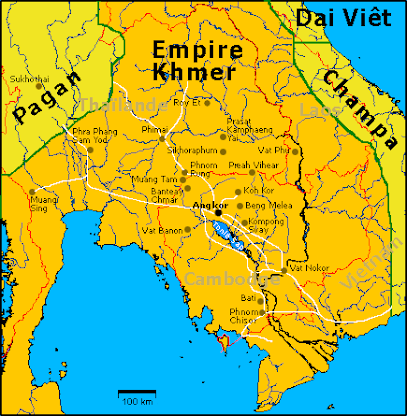
The land of heroes
Our heroes
Our land
Cambodia Kingdom


Monday, January 15, 2007

Chaotic Streets of Phnom Penh update


Posted by Admin / 14. January 2007, 19:55
Cambodia’s capital Phnom Penh is arguably the most chaotic city in south east Asia. The roads, sometimes French style boulevards and at other times dirt tracks with holes, uneasily host a variety of pedal bikes, motor bikes and large jeeps which compete for space at every intersection and set of traffic lights. The motor bikes win if only by sheer force of numbers. There are said to be over a million bikes in a city not yet three times that number in terms of population. It’s certainly the traffic that leaves the most lasting impression on the casual visitor. Over the past 12 months, Phnom Penh has improved slightly from the natives’ point of view. Although the city is host to thousand upon thousand of near destitute people who throng the sea wall areas, free toilet portacabins have started to appear which is an improvement on the health and hygiene front.
Phom Penh traffic is truly chaotic. The building boom in commercial property, housing blocks and hotels is clearly providing more jobs and even the police have smartened up their appearance in terms of their uniforms. However, they are still harassing motor bike drivers at random who aren’t wearing a pair of goggles. For some reason, these are seen as more important than a crash helmet. Visa situation It has never been easy to obtain multi-entry or non-immigrant visas in Phnom Penh at the Thai embassy and that remains the situation today. The most you are likely to get is a single entry tourist visa (60 days) for Thailand and you are likely to be told not to come back for another one. Multiple entry tourist visas in the countries bordering Thailand seem to be decidedly a no-no. For the time being at any rate. We met one man who had secured a single entry non-immigrant “B” visa (90 days) but he was clearly applying for a work permit in Thailand and had a pile of company papers and a registration certificate from the Chonburi labour office to prove the point. A couple of other guys were trying to get multiple entry non-immigrant “O” visas to support their Thai wives. They eventually got a single entry apiece, but were told to apply inside Thailand if they wanted a one year permit. Accommodation A night’s stay in a lodging house can cost as little as US$3 but nobody is suggesting it’s luxurious. You can find a crop of these guest houses in the Independence Monument area or in some streets near to the Central Market. Then there’s a grouping of mid-price hotels for around US$20-50, some of which are located on the boulevard overlooking the estuary. Finally, there are the plush hotels from around US$60-$150 per night which are beginning to abound all over town. The Cambodiana and the Sunway are too of the most popular and can be booked, along with dozens of other choices, on the internet. It’s customary to throw in a free American breakfast, and the best rates seem to be reserved for package tourists, mainly from France and Japan, or for “rack” clients who just walk up to the front desk and ask for a discount.
Restaurants Prices in the eating houses tend to be cheap and excellent value. On the estuary boulevard, the foreign correspondents’ club – which is open to all – serves a variety of wholesome dishes both Asian and European. It’s also Phnom Penh’s main gossip shop although you probably won’t have heard of the guy or gal under the microscope. Nearby, also on the sea front, are a growing number of pubs-with-grub. We enjoyed several meals in the British run Hope and Anchor where a soup, bangers and mash and a beer will leave lots of change from a 10 dollar bill. For some reason nobody seems to understand, the Indian restaurants which number six or seven are amongst the best in Asia. The food in all of them is excellent and main courses start at around three dollars. How much more you pay depends on the surroundings rather than the dishes themselves. The Indian nosheries are also good for vegetarians – the people who don’t fancy eating anything which once had a face – and both north and south Indian cuisine is rich in non meat and non fish choices. Eating in the top class restaurants is expensive even by Thai standards. But many of them put on evening or weekend buffets which can be worth a visit. For example, the Sunway which is located near the recently opened American embassy, has several international buffets a week for a very fair US$18.50. Finally, at the other end of the scale, it’s best to avoid street kitchens and food stalls. They are strictly for the locals and no assumptions should be made about the quality of water used in the washing up or the personal hygiene standards of the operators.
Sight seeing: All the places to go are only a few minutes by motorbike taxi, except the notorious Khmer Rouge “Killing Fields” which require a limousine taxi for the 30 km round trip at about 30 dollars. Many tours start with the downtown, huge temple site Wat Phnom (temple on a hill) and take in the museum near the royal palace, mainly stone artefacts and ruins. It’s as well to remember that Cambodia had an advanced civilization at a time when medieval Brits were going around in the dark and looking for trouble with clubs and knives. Not much has changed.
Ghastly reminder of Cambodia’s pastEveryone has to go and see Toul Sleng, the prison where thousands of men, women and children were tortured and butchered in the era of the Khmer Rouge thirty years ago. Many people have found the visiting experience very moving indeed, perhaps the more so because of the thousands of photos of inmates staring down at you from the walls. Another place worth a quick look is the Russian Market although the piles of marijuana once on sale have disappeared for all time.
Night life: It’s tame by Pattaya standards. There are nightclubs dotted around the central areas including the once famous or infamous Heart of Darkness which attracts the Camodian jet set and their Oddjob type minders. There are plenty of beer houses, Pattaya style, the most popular being on the waterfront or near the independence monument. Keep well clear of the port area where assorted tarts try to entice unwary visitors into tiny shacks and where you are more likely to lose your wallet than your virginity. The only sort-of gay bar is the Salt lounge where foreigners seem to outnumber the locals. If none of the above applies, you could try the Naga casino in the government offices’ district. Most of the floor space is given over to hungry slot machines and to baccarat. Those looking for a blackjack game might be disappointed as there are only two tables, with all the seats mostly occupied by rich locals who never seem to go home. The casino isn’t allowed to advertise and many city guide maps don’t include it. It’s a short distance from the Cambodiana hotel and open 24 hours, 365 days a year. Food and drink is free whilst you are betting.
However, an entertainment complex and luxury hotel are currently being built next to the gambling den. Getting there Bus trips from Thailand are only for the hardy or the foolhardy. The el-cheapo flights start at around 3,000 baht round trip and Thai is currently offering the same for 8,500 baht. Don’t forget that the el cheapos are subject to more delays and amalgamations. The tourist visa on arrival at Phnom Penh airport costs US$20 and the departure tax a steep US$25. Taxis to and from are a set price at US$7. Take US dollars with you for all bills and you’ll receive change in that currency. The local currency, the riel, is only used by tourists for very small transactions under one dollar. There are no coins in use in the country and no ATM machines.
Read more!

Sunday, January 14, 2007

China-ASEAN Free Trade Area

China and the Association of Southeast Asian Nations (ASEAN) countries signed The Agreement on Trade in Services of China-ASEAN Free Trade Area on Sunday in Cebu, the second largest city of the Philippines.

The agreement was signed at the 10th China-ASEAN Summit attended by Chinese Premier Wen Jiabao and leaders of the 10 ASEAN member countries.

The signing is another major achievement in China-ASEAN economic cooperation and trade. It will mark a key step forward in the building of the China-ASEAN Free Trade Area and lay the foundation for full and scheduled completion of the China-ASEAN FTA.
The following are some basic facts about the China-ASEAN free trade area.

On Nov. 4, 2002, then Chinese Premier Zhu Rongji and leaders of the 10 ASEAN nations signed at the sixth China-ASEAN summit the landmark Framework Agreement on ASEAN-China Comprehensive Economic Cooperation, marking the beginning of the process of setting up a China-ASEAN free trade zone.

Under the agreement, the free trade zone would be completed by 2010, and the four new ASEAN members -- Laos, Cambodia, Myanmar and Vietnam -- have been allowed an additional transitional period of five years and are slated to complete the building of the free trade area in 2015.

The China-ASEAN free trade area, which will comprise China, Brunei, Cambodia, Indonesia, Laos, Malaysia, Myanmar, the Philippines, Singapore, Thailand and Vietnam, is expected to be one of the biggest free trade areas in the world.

The China-ASEAN free trade area will have a total population of 1.8 billion and a combined gross national product of 2 trillion U.S. dollars when completed in 2010.

The estimated total trade volume of 1.2 trillion U.S. dollars will make it the third largest market in the world, after theEuropean Union and the North American free trade area.

Since 2003, China and ASEAN have held consultations on agreements concerning the building of the free trade area. Beginning from July 1, 2005, China and ASEAN countries started their tariff-reducing process. The two sides will gradually reduce or cancel tariffs on 7,000 kinds of products.

By 2010, China and six old ASEAN member nations -- Brunei, Indonesia, Malaysia, the Philippines, Singapore and Thailand will impose zero tariffs on most normal products, while China and the other four new ASEAN members -- Cambodia, Laos, Myanmar and Vietnam -- will do the same in 2015.

Source: Xinhua Read more!

Villagers Oppose More Dams in Vietnam

ENVIRONMENT-CAMBODIA:Villagers Oppose More Dams in Vietnam

Sam Rith - Newsmekong*PHNOM PENH, Jan 14 (IPS) - Chao Chantha, one of 10 community representatives from the north-eastern Cambodian province of Stung Treng became agitated as officials of the Electricity of Vietnam (EVN) fielded questions at a meeting called to discuss the neighbouring country's plans to build more dams on its side of the border.

''We have no hope that Vietnam will give any compensation to Cambodian people affected by their dams,'' Chantha, 46, said on the sidelines of the Jan. 12 meeting. Cambodian activists say this was the first time in more than a decade of Nordic aid-backed hydro-planning along rivers shared by Vietnam and Cambodia that Nordic consultants and the state-owned EVN met with affected residents and non-government organisations (NGOs). ''Since 2004, we have been experiencing unnatural floods two to three times a year. We are aware that the floods are caused by hydroelectric dams built upstream in Vietnam,'' Chantha explained, referring to construction activity that started in 2003 for a series of dams in the Srepok river basin.

Chantha says that in her village in Banmei, 83 families are already negatively affected by dams across the Srepok that flows into Cambodia. For two years, releases of water have unleashed floods that caused rice plants to rot. Their livelihoods affected, most residents are being forced to go to other provinces and find work in the garment or construction industries. A few families have decided to stick it out, but their crops are ruined by repeated flooding.

Thun Bunhean, who comes from Deilo village in Lumpat district in Rattanakkiri, said: ''During last year's floods, the water flowed very fast so that we did not have enough time to prevent our cows, pigs, chickens and ducks from being carried away by the waterà and now we have nothing to eat.'' In the Rattanakkiri and Stung Treng provinces, 11,000 villagers living along the Srepok have been facing negative impacts from hydropower development of the river basin, said Bean Sokun, dialogue project officer for the Sesan, Srepok and Sekong Rivers Protection Network (3SPN). Many fear that the Srepok projects will bring the same environmental and economic impact from that others experienced from the time dam projects began in the basin of the Se San river, a Mekong tributary shared by Vietnam and Cambodia, a decade ago.

The affected villagers, including from the Yali Falls dam, are still awaiting compensation. The Srepok and Sesan rivers merge some 30 km east of Stung Treng. In August-September 2006, 3SPN, a group banded together in the wake of the adverse impact of the cross-border dams, reported that villages, houses, schools, pagodas, and roads have already been inundated by fast-moving waters from the dammed Srepok. In mid-September, over 1,000 hectares of rice fields in Rattanakkiri were submerged, the group added. But EVN vice president Lam Du Son told the 20 community representatives from Rattanakkiri and Stung Treng, NGOs and others at the meeting here that the dams in Vietnam cannot yet have caused problems to Cambodians living downstream. ''We have not yet completed the dam to curb the Srepok river's water,'' said Du Son, referring to the fact that the dam does not yet store water and does not impact flow yet.

"Last year's floods might have been caused by storms -- not the dams." Plans for hydropower projects on the Srepok river basin upstream in Vietnam include four dams -- the Buon Kuop (280 Mw), Buontua Srha (86 Mw), Srepok 3 (220 Mw) and Draylinh (28 Mw). Two other projects are at the feasibility study stage, such as Srepok 4 (70 Mw) and Duc Xuyen (49 Mw), according to Luong Van Dai, director of appraisal for EVN. Do Son's remarks did not satisfy Tep Bunnarith, executive director of the NGO Culture and Environment Preservation Association (CEPA). "What he (Lam Du Son) replied was just his ideas, it is not factual information that he collected from the people who are the victims.

In nature, floods happen in the rainy season, but recently the floods occurred in the dry season.'' While the two sides stuck to their respective positions, the fact that a face-to-face venue was held on the issue is an indicator of the gravity of the issue. The Jan. 12 meeting was actually called to take up the environmental impact assessment (EIA) report done by the consulting firm SWECO Groner with funding from Swedish and Norwegian aid agencies, Sida and Norad.

''This discussion is to strengthen cooperation between the two countries by finding ways to keep the environmental impact to the minimum -- as the speech of Prime Minister Hun Sen said, no one benefits, no one loses," said Mok Mareth, minister for environment, and vice chair of the Cambodia National Mekong Committee. ''And if after we discuss, we cannot find any way to reduce impacts, that means the impact remains serious, and that the plan (for hydropower development) would not be continued.

'' A draft version of the EIA report, Cambodian NGOs say, predicts major changes for people living along the river on the Cambodian side of the border, ranging from unpredictable water fluctuations, riverbank erosion, water pollution and impact on fish migration. The EIA report is part of Vietnam's master plan study that looks into potential dam sites in the country. But at the Jan 12 meeting, representatives of the Srepok communities sought a suspension of dam construction, compensation from dam builders, and a stop to the financing of dam projects that had no people's participation and EIA processes.

If dams are ultimately built upstream, they would like a notification system for water releases and fluctuations to be set up for Cambodian communities. "We are still concerned that the draft EIA report would get approval from the two governments when they do not agree with our recommendations on what's lacking in the report," said Bunnarith. ''Our other concern is that Vietnam would not pay any compensation to Cambodians who are the victims of the dams because when we asked Vietnam about that, they replied that hydropower development is the important agenda of the three governments (Vietnamese, Cambodian and Lao).

" EVN's Du Son pledged that his government would implement dam projects with bilateral agreements, follow international treaties, look to having the citizens of Vietnam and Cambodia gain income, reduce environment impact and improve the Srepok EIA report.

Tore Hagen, vice president of SWECO Groner, acknowledged that his Company could only manage a ‘'rapid EIA report'' on the Cambodian part of the Srepok. His team spent only a few weeks in Rattanakkiri and Stung Treng in November 2005. "To complete the EIA report, it takes at least one more year because the work force needs to research during different seasons in Cambodia," explained Hagen. Read more!

Analysis: Congress Presses Bush on Iraq

Sunday January 14, 2007 5:01 AM

By ROBERT H. REID
Associated Press Writer

Congressional opposition to President Bush's decision to send more troops to Iraq has opened a new front in an increasingly complex war, setting the stage for political battles whose effects may be felt long after U.S. forces have come home.

The battle could well subvert administration efforts to bolster the power of the presidency, which many Bush supporters believe was undermined in the wake of another unpopular war a generation ago.

As if Sunni nationalists, Islamic extremists, foreign fighters and Shiite militias were not enough, Bush must now battle the Democratic leadership in Congress, as well as influential figures in his own Republican party, who oppose his plan to throw 21,500 more troops into the fray. The battlelines are reminiscent of the political struggles that occurred during two other unpopular wars - Korea and Vietnam.

Those half-forgotten struggles produced sweeping changes in the U.S. political landscape that persisted long after the guns fell silent.

Democratic leaders of Congress, fresh from victory at the polls in November, hope to force a vote on the Bush plan in the House and Senate, thereby isolating the president politically.
Although those votes will be nonbinding, Gov. Bill Richardson of New Mexico said on MSNBC he expects them to be followed by measures ``that restrict troop funding and all kinds of financial support for the war.''

During a visit Saturday to Baghdad, Sen. Hillary Clinton told ABC News that instead of sending more U.S. troops to Iraq, it is time to start redeploying American forces out of the country.
A showdown between Congress and the White House could have far-reaching implications not only for Iraq but for American foreign policy as well.

In the best case scenario, the prospect of an American military departure might spur Iraq's ethnic and sectarian factions to reach a political settlement to spare the nation further bloodshed. But it could also encourage Sunni and Shiite extremists to grab as much power as possible before the Americans leave.

Bush's plan is reminiscent of the furor unleashed by President Nixon's 1970 decision to invade Cambodia during the final stage of the Vietnam War.

The Cambodian incursion, as it was known at the time, occurred at a time when the U.S. public was clamoring for an end to the conflict in Southeast Asia.

In seeking to justify his decision, Nixon said the goal was to destroy North Vietnamese sanctuaries in Cambodia and force Hanoi back to negotiations.

Last week, Bush said the reinforcements were necessary to bring stability to Baghdad so that the Iraqis could reach a political agreement. Military analysts are divided over whether Bush's plan can succeed, and the administration has refrained from a detailed explanation of what it would do if it fails.

But the 1970 invasion simply drove the North Vietnamese deeper into Cambodia. Five years
later, both South Vietnam and Cambodia fell under communist rule. Nevertheless, the showdown over Cambodia cast a long shadow over American politics for a generation.

The invasion enraged Congress, triggering legislative battles that culminated in the War Powers Act of 1973 that sets limits on a president's power to wage war without congressional approval.
Although the act's constitutionality has never been fully tested in court, Congress has invoked it on several occasions, setting conditions and limitations on the use of U.S. forces in the Middle East, Africa, Haiti and the Balkans.

Vice President Dick Cheney and others have cited the 1973 law as a major element in a series of Vietnam-era legislation that have severely undermined presidential authority to this day.
However, wartime showdowns between presidents and Congress occurred long before the Vietnam conflict.

Those political struggles reflect an ambiguity in the Constitution, which grants Congress the power to declare war but includes no language defining such a de Southern states in rebellion and ordered a blockade of their ports, triggering four years of war.
Eight months into the conflict, Congress established a joint committee to oversee the war, holding hearings into Union failures on the battlefield at a time when the very survival of the nation was in peril.

Critics complained at the time that the committee used newspaper leaks to discredit some of Lincoln's generals, undermining Northern morale at a time when Union victory was by no means certain.

Similar complaints were raised again during World War II when a little-known senator from Missouri, Harry Truman, chaired a committee investigating military waste and fraud.
Critics accused Truman of undermining the war effort. But his committee was credited with saving billions of dollars by uncovering waste and war-profiteering.

Truman's efforts won him the Democratic vice presidential nomination in 1944 and propelleduth Korea to block an invasion from the communist North. Public support for the war waned after China entered the conflict, which bogged down in a stalemate. The war became so unpopular that Truman decided against seeking re-election in 1952.

Republican war hero Dwight D. Eisenhower won the White House after promising to halt the fighting, which ended with a cease-fire on July 27, 1953. Read more!

Khmers rely on British defence


The Sunday Times
January 14, 2007
Michael Sheridan, Phnom Penh
BRITISH lawyers appointed to defend the leaders of the Khmer Rouge are to challenge the legal foundations of the international tribunal set up to try them for crimes against humanity.
They have drawn a bitter response from Cambodians who have campaigned for three decades to bring the Khmer Rouge to justice for the murder of an estimated 1.7m people between 1975 and 1979.
“This is all very philosophical,” said Youk Chhang, head of the Cambodia Documentation Centre, which has recorded the bloody excesses of the regime’s killing fields, “but what about the victims?”
At least four surviving leaders of the extreme communist movement are expected to be indicted
within months. They include “Duch”, the regime’s head of internal security, who oversaw the torture and murder of 10,499 “spies and traitors” and 2,000 children at the notorious Tuol Sleng detention centre.
Pol Pot, the Khmer Rouge leader, died in 1998. But Nuon Chea, his deputy, Ieng Sary, the foreign minister, and Khieu Samphan, the nominal “head of state”, all now in their late seventies, are liable to face trial.
“This is probably the most shaky tribunal in terms of its legal basis,” said Rupert Skilbeck, a war crimes barrister named by the United Nations as principal defender. Skilbeck, 35, and his deputy, Richard Rogers, 37, are controversial figures in Phnom Penh as Cambodia’s rulers and
foreign powers wrestle for influence over the verdict of history.
“There has to be a strong defence for a fair trial and there has to be a fair trial for the court to be legitimate,” said Rogers. “That’s important for the victims and for Cambodia.” The British lawyers argue that there is a fundamental flaw in the tribunal because most of the judges are Cambodians appointed by the present regime.
This condition so worried Kofi Annan, the former United Nations secretary-general, that the UN negotiated a clause allowing it to withdraw if the process was not free and fair.
“Both sides have pledged to establish a tribunal that meets international standards and will deliver justice to the Cambodian people,” said Helen Jarvis, the tribunal’s chief of public affairs.
She said the rules ensure that verdicts can only be reached unanimously or by a majority including both the Cambodian and foreign judges.
Skilbeck is also to challenge a plan to conduct part of the trial in secret. On that, at least, the British team is in accord with investigators at the documentation centre, who have built up a massive archive on Khmer Rouge crimes.
“Look at this,” said Youk Chhang, reaching into a box to extract a sheaf of yellowing, handwritten documents. “Statements by villagers naming the Khmer Rouge for killing their husband or wife, 1.6m of them, each one signed and with a thumbprint. They have waited for this day. We have to have this court. For us, it is a classroom.”
The two defenders have yet to meet their clients, but Nuon Chea gave a hint of his defence strategy in an interview: “It was not us who killed our people. Our enemies killed them.”
Read more!

Saturday, January 13, 2007

Thailand calls for action on Burma

(BangkokPost.com, Agencies)Cebu, Philippines

The failure of a US resolution condemning Burma at the United Nations means Southeast Asian neighbours will have to deal with the dispute, Foreign Minister Nitya Pibulsonggram said."I think we should perhaps redouble our efforts to see what we can do to help one another in terms of keeping this matter - give it a regional focus the way it should be - rather than to have it internationalised," he said.

The 10-member Association of Southeast Asian Nations, currently holding its annual summit on the central Philippines island of Cebu, declined to take a position on the US resolution. Indonesia abstained on the resolution, but both China and Russia used their vetoes.China was tight-lipped about Burma's crackdown on pro-democracy activists here at the Asean and East Asian summits. But Beijing was quick to direct criticism at Washington's resolution, which it said did not warrant Security Council attention.

"The situation in Myanmar does not constitute a threat to regional and international peace and security," Chinese Foreign Ministry spokesman Liu Jianchao said in Beijing, according to the official Xinhua news agency on Saturday. "If the Security Council passed a resolution on the (Burma) issue, that would have exceeded the duties of the Council laid out in the United Nations Charter." The US resolution urged Burma to release political prisoners, move toward democracy and stop attacks against minorities, many of whom are used for forced labour.

Earlier this week, Asean foreign ministers told member-state Burma it must make more progress on its "roadmap" for national reconciliation and democracy. But critics of Burma's hardline rule said the time had come for firmer action from international organisations. "I think the United Nations' human rights council has been examining this issue closely for over a decade, but there has never been any result. That's why we need the Security Council," Debbie Stothard of the Alternative Asean Network on Burma told the Reuters news agency. Read more!

Ex-Khme Rouge denied genocide

Jan 12, 8:11 AM (ET)

PHNOM PENH, Cambodia (AP) - A former Khmer Rouge leader denied in an interview published Friday that the regime whose extremist policies wiped out much of Cambodia's population in the 1970s committed mass murder.

Nuon Chea, 80, who was second only to Khmer Rouge leader Pol Pot, is expected to go on trial before a joint Cambodia-United Nations tribunal later this year on charges of genocide and crimes against humanity.

"Why should we have killed our own people? I do not see a reason," the English-language Phnom Penh Post quoted him as saying. "We wanted a clean, illuminating and peaceful regime."
An estimated 1.7 million people died as a result of the 1975-79 communist regime. Some were executed, while others died of starvation, disease and overwork.

None of the leaders have been held accountable for the atrocities. Pol Pot died in 1998, but Nuon Chea and several other top deputies still live freely in Cambodia.

Nuon Chea also said any documents linking him to the regime's crimes "were manipulated," including photographs of human skulls.

"Those photographs with skulls now being presented do not mean a thing. Modern technology can do this," he told the Post, a biweekly published every other Friday.

The comments outraged Youk Chhang, a Khmer Rouge survivor and leading genocide researcher, who called Nuon Chea "disrespectful and arrogant."

"The Khmer Rouge did not regard us as humans. They took away our love, our family, soul, belief. We were not humans in their eyes. We were their enemies," Youk Chhang said. Read more!

UN, Cambodia dig into Vietnam's human trafficking control policy

Delegations from UN agencies and Cambodia flocked to Vietnam for a conference to exchange experience with the host in implementing the Governmental programme on preventing and fighting cross-border women and girls trafficking.

The two-day conference was wrapped up in the southwestern border province of An Giang on Jan. 12, with a call to strengthen cooperation between the United Nations Children's Fund (UNICEF), the International Organisation for Migration (IOM), Cambodia and Vietnam on this issue.

Cambodian participants said they have learnt a lot from the Government of Vietnam in the implementation of relevant policies such as its 130/CP programme and the neighbouring province of An Giang in implementing these policies, from receiving and taking care of victims and taking preventive measures.

The senior Cambodian Governmental delegation and UN agencies' representatives also paid field-trips to pilot projects in Chau Thanh and Tan Chau districts, where victims have been given help to reintegrate into the local community. (VNA) Read more!

Countries move to narrow gap between ASEAN members


12:43 13/01/2007

VietNamNet Bridge – Prime Minister Nguyen Tan Dung, on Jan 12, underlined the significance of the organisation of the Cambodia, Laos, Myanmar and Vietnam (CLMV) summit, saying that the meeting demonstrated their determination to narrow the development gap between them and other ASEAN members.
The PM made the statement during the CLMV Summit held on the sidelines of the 12th Association of Southeast Asian Nations (ASEAN) Summit which is currently being staged in Cebu, the Philippines.PM Dung proposed that the four countries establish a joint co-ordination mechanism and diversify their forms of cooperation, with attention being paid to areas of trade, electricity, mining, rubber and coffee planting.

The PM expressed his wish for Cambodia, Laos and Myanmar to work closely with Vietnam to successfully organise the 2nd ASEAN Integration Development Cooperation Forum (IDCF). During the CLMV Summit, the Cambodian, Lao, Myanmar and Vietnamese leaders agreed upon 31 measures for their 2006 action plan, which is aimed at helping them to make full use of their potential and advantages.

They approved a joint statement and decided to hold their next summit in Vietnam late this year. The same day, Deputy PM-cum-Foreign Minister Pham Gia Khiem attended the Ministerial Meeting of CLMV and Japan during which participants discussed measures to enhance friendship and cooperation, particularly in the area of economic-trade.

Japan announced aid of US$52mil to help accelerate economic cooperation with ASEAN member countries. It also said it would provide US$40mil for CLMV, US$20mil of which is allocated to the Cambodia-Laos-Vietnam (CLV) Development Triangle. Japan recommended organising the Ministerial Meeting between Japan and five Mekong sub-region countries in 2007 in Tokyo in order to increase dialogue and cooperation.

Vietnam, Laos and Cambodia proposed that Japan continue to support the Development Triangle area, and particularly consider financing the 12 infrastructure projects that they had presented Japan at the first summit of CLV and Japan in November, 2004 in Vientiane.
(Source: VNA)
Read more!

Friday, January 12, 2007

Onwards and Upwards for Hun Sen

As 2006 drew to a close, Prime Minister Hun Sen could look back on the year as one of continuing success as he consolidates his position as the currently unchallenged political leader of Cambodia. Four years ago, in December 2002, he boldly stated that he would like to rule for a further ten years, and nothing in recent times appears likely to prevent him having his wish. At the same time his Cambodian People's party (CPP) has no reason to believe that it can be challenged as the kingdom's leading party as it begins to prepare for the elections due in 2008.

In particular, the closing month of 2006 witnessed the further political decline of his potentially most important opponent, Prince Norodom Ranariddh. It has been clear for some time that Ranariddh's leadership of FUNCINPEC (the United Front for an Independent, Neutral and Cooperative Cambodia) was increasingly tenuous. Party members were critical of Ranariddh's prolonged absences from Cambodia and of his very public infatuation with a new mistress.

Whether it was clear to Ranariddh, or not, a combination of dissatisfaction with his leadership and a readiness on the part of senior FUNCINPEC members, including notably the party's Secretary-General, Nhiek Bun Chhay, to contemplate working more closely with the CPP, ultimately sealed his fate.

On 18 October, at a special party congress, FUNCINPEC stripped Ranariddh of his party leadership, replacing him with the Cambodian ambassador to Germany, Keo Puth Reasmey. As a sop to Ranariddh the congress awarded him the title of 'historic leader.'

Ranariddh and his dwindling band of supporters have now formed a new party incorporating his name, but it seems proper to conclude that they will struggle to overcome the coalition that has now been cemented between the CPP and FUNCINPEC.

Meanwhile, Sam Rainsy and his eponymous Sam Rainsy Party (SRP) seem unable to play much more than a gadfly role. Despite having returned to Cambodia from exile, following his being granted a pardon by King Sihamoni after Rainsy apologised for his attacks on both Hun Sen and Ranariddh; and, stating that he could now work in harmony with the government, he has reverted to form as a vehement critic. Having denounced the results of the village chiefs elections held in June, in which the CPP won 99.5 per cent of the vote, Sam Rainsy went on to compare Hun Sen's rule to that of Robert Mugabe in Zimbabwe and then, in August, to say that, 'The CPP regime is the continuation of the Khmer Rouge regime. There is no difference between the two regimes.'

During the year, there were, of course, various developments that can be cited as reflections of Cambodia's far from perfect political system. These include the dubiously legal eviction of squatter communities from prime development land in the capital; the allegations of serious corruption and malfeasance made by the former Under-Secretary of State at the Ministry of the Interior, Hen Pov, who fled Cambodia in July and, at the time of writing was fighting extradition in Malaysia; and, the allegations made by Human Rights Watch of deliberate government interference in the preparations for the much-delayed Khmer Rouge Tribunal (the Extraordinary Chambers of the Courts of Cambodia).

Yet none of these issues has prevented Hun Sen and the CPP remaining in power. What is more, and reflecting the international community's concern to support the government, against the possibility of any alternative being worse, the Cambodia Consultative Group gave the kingdom an increased aid guarantee of US$601 million when it met in March. This was followed by China's providing an almost matching sum of US$600 million at the time of Premier Wen Jiabao's visit in April, a gift as Hun Sen has pointed out that came without 'strings'. Then, in November, when Hun Sen was visiting China, Wen Jiabao gave him further assurances of China's intention to increase its aid.

Economically, Cambodia has survived better than many observers predicted, not least it has successfully weathered the 2005 cut-off of the Multilateral Fibre Agreement as the garment industry has undergone labour market reforms that have enabled it to increase market share.

Although the country will continue to be dependent on aid for the foreseeable future, both the IMF and the ADB have commended the administration for maintaining sound macroeconomic stability. What is more, the discovery of commercial quantities of oil and gas in Cambodian waters in the Gulf of Thailand promise the possibility of diversifying the economy's present reliance for revenue away from the garment and tourist industries.

It is just as well that there are reasons for optimistic judgments to be made about the future of Cambodia's economy, since the challenges that lie ahead are enormous. None are more challenging than those associated with Cambodia's demographic profile and the implications it has for politics and the economy in the future. Today, 70 per cent of the population are aged under 30 years of age, and 52 per cent under 18 years. As an ever-growing number of young people are coming onto the labour market, it is currently estimated that there is a need to find 200,000 new jobs each year. For those who have completed some form of tertiary education, the estimate is that only one in nine of the 8,000 students graduating each year is able to find a job. These statistics are a sobering qualification to the political success that Hun Sen has achieved through the year and are just as important as the legitimately expressed concerns of human rights groups about the continuing culture of impunity and pervasive corruption that exist in the country.

WATCHPOINT: As has been the case for several years, any development that has the capacity to bring Hun Sen's leadership into question would be a significant development. (The fact that it is not possible to be more specific is a reflection of the power of Hun Sen's current situation.) Read more!

Researchers call on Cambodia to enrich exports

Researchers from the Cambodian Economic Institute have called on the government to enrich and expand the kingdom's exports, which has enjoyed a rapid growth but with limited types of products.

Cambodia's volume of exports rose to 3 billion U.S. dollars in 2005 from 1.4 billion U.S. dollars in 2001, while its dominating portion went to textiles and other products only shared a little contribution, according to a seminar held by the institute here on Thursday.

For example, in 2005 as the exports amounted to 2.9 billion U.S. dollars, textiles accounted for 2.29 billion U.S. dollars or 79 percent, while formal agricultural products 3 percent, informal agricultural products 13 percent and transit trade products 5 percent, the seminar quoted the statistics from the country's central bank as saying.

Therefore, Cambodia has to enrich and expand the variety of its export products in order to tap the overall potential of its producing capability and balance any risk arising from the current monotony, analysts said at the seminar.

Tourism and textiles or garment have been Cambodia's major pillars of foreign currency attractions since it embarked on the road of market economy some 10 years ago.

Source: Xinhua Read more!

Thursday, January 11, 2007

Is Southeast Asia Becoming China's Playpen?

China never had to exert massive military might or economic investment to gain influence in Southeast Asia. After the US extended diplomatic recognition to the mainland in 1972, members of the Association of South-East Asia Nations (ASEAN) followed suit. During the Cold War, the US aimed to dilute Soviet influence in the region and encouraged collaboration. With the US increasingly distracted in the Middle East, China has deepened its roots in Southeast Asia through extended engagement and economic diplomacy. “China has gained its influence in Southeast Asia less by ‘muscles’ and more by skillfully exploiting changes in the international and regional environment, absent any wise and strong US engagement with the region,” writes Singapore-based analyst Sheng Lijun. As the ASEAN summit convenes in the Philippines, members remain divided about the balance of power in the region: Some welcome China’s growing influence, while others long for a US counterweight. ASEAN expects to be the driving political force in Southeast Asia, so the two powers must likewise pursue balance, neither pushing too hard nor neglecting the region. – YaleGlobal

As China gains strategic advantage in Southeast Asia, the region seeks balance

Sheng Lijun
YaleGlobal, 11 January 2007.

Southeast Asia, here we come: Chinese Foreign Minister Li Zhaoxing arrives in the Philippines for a summit meeting with ASEAN leaders, where China's profile is rising.

SINGAPORE: China’s diplomatic success in Southeast Asia has often been fortuitous. Changes in the international and regional strategic environment, together with US absent-mindedness and negligence of the region, have played a major role in a closer embrace of China and Southeast Asia. History shows how the international as well as the regional strategic landscape can change overnight.

That happened with US rapprochement with China in 1972, forcing Association of South-East Asia Nations (ASEAN) nations such as Thailand, Malaysia and the Philippines to swiftly change their respective policies on China and establish diplomatic relations with Beijing, despite no fundamental changes in China’s Southeast Asia policy and no massive increase in China’s military muscle and economic attractiveness.

When Deng Xiaoping stepped into power in 1978, eager to open China up and push into Southeast Asia, a blessing in disguise soon followed – Vietnam’s occupation of Cambodia from 1979 to 1989. China made good use of this “occupation” and effectively kick-started its initial cooperation with ASEAN. This engagement, lasting more than a decade, laid a solid foundation for relations in the subsequent years. The US, concerned about Soviet influence in the region, acquiesced and even encouraged this strong engagement. Once again China succeeded in going deeper into Southeast Asia without massive increase in its military muscle and economic attractiveness.

Just as ASEAN put the Cambodia issue onto a backburner, the Cold War ended and new uncertainties emerged in the region. Deciding against a passive wait for changes, ASEAN took the initiative and actively pursued engaging all the major powers in the region. Up until the end of the Cold War, ASEAN attempted policy that would push all extra-regional big powers out of the region. Realizing that it was impossible to push them out of the region, ASEAN, from the 1990s, began what it called “constructive engagement” with all of them. Under the policy, major powers balance one another while ASEAN is the primary driving force for a constructive balance. For this purpose, ASEAN needed China’s political backing to play its role as the primary driving force in this process. Under this backdrop, China scored an easy diplomatic success by building its first official ties with the ASEAN grouping in 1991.

The ASEAN-China relationship in the early was tentative at best. Not long after came a big push: the Asian economic crisis in late 1997. While the US, for its own reasons, was slow to come to rescue, China readily responded to ASEAN’s acute need, with an immediate promise not to devalue its currency, the Renminbi, and further destabilize the region. By November 1997, the lukewarm relationship evolved to the level of annual ASEAN+China summits.

This momentum receded as ASEAN countries withstood the shockwaves of the economic crisis, but then came another boost: The 9/11 terror attacks, which plunged the US into a seemingly endless war against terrorism. The increasing focus of the US on homeland security, Central Asia and the Middle East was accompanied by a negligence of Southeast Asia. In 2001, China made a diplomatic masterpiece by proposing a free-trade agreement with ASEAN to accelerate its cooperation with ASEAN, thus maintaining and even building its momentum in Southeast Asia.

The brief examination of recent history tells us that China has gained its influence in Southeast Asia less by “muscles” and more by skillfully exploiting changes in the international and regional environment, absent any wise and strong US engagement with the region – together providing strong “pulls” for ASEAN toward a China that is more than willing to “push” into the region.

Many observers have noted only the Chinese “pushes” without seeing ASEAN’s “pulls” and their strategic background. Without such “pulls,” however, China’s “pushes” will not get far and may backfire. Take the warming in China-Indonesia relations for example: The two nations have declared each other as strategic partners, which may have a lot to do with Muslim Indonesia’s intention to use China to balance the excessive US pressure against Islamic extremists in the country.

Indonesia’s overture to build defense ties with China and buy Chinese weapons can be interpreted as a tactical rather than a strategic re-orientation, a means to pressure the US to lift its arms embargo on Indonesia.

Myanmar and Cambodia both have close relations with China. In the case of Myanmar, the US has chosen not to engage with its government, likewise rejecting trade or investment. US trade sanctions and embargo against Myanmar still stand. China is Cambodia’s top investor and trade partner. The US, for political reasons, still has no significant trade or investment in Cambodia. If the US changes its policy and prioritizes these two countries, China may find it difficult to maintain its primacy there.

While there is less public talk of a “China threat,” Washington can take some comfort from the fact that distrust of China remains deep-rooted in the region and may grow if a rising China enters too deep. ASEAN countries have not joined the China bandwagon but “hedge,” engaging China while developing robust ties with the US and other extra-regional powers to balance China. Asian countries generally do not have much trust for one another and the US is perceived as the least distrusted of all major powers. Asian nations need the US as a balancer and double insurance when they develop their relations with China. ASEAN is aware that without a strong relationship with the US, China may take ASEAN for granted.

A vigorous but balanced relationship with the US is seen as not only security insurance but also an incentive for China to offer more economic sweeteners. Barring a sudden and major change in the international strategic landscape and a disaster in US Southeast Asia policy that would unexpectedly boost China’s influence by default, the more China pushes in deepening its relations with ASEAN, the more ASEAN may feel that it needs a strong relationship with the US and other extra-regional power to keep the balance.

The US is, thus, still favourably poised to keep and enhance its position in this region. However, as illustrated by recent history, success depends less on “muscles” and more on “brain” that can quickly exploit any changes in the strategic environment, less on how many resources a country has but on how much it is willing to spend. Washington does not lack the resources, but the willingness to use them profusely for the region, at least for now.

How deep can China push into Southeast Asia? At the moment, there is an active balance in the region, and any power that seeks dominance will likely push other powers, together with ASEAN, into a stronger resistance to maintain this balance. Any success China has in pushing further is less likely due to its growing “muscles” but more due to an ever-changing international and regional strategic environment that may suddenly multiply those “muscles” for a much deeper penetration. In this sense, continued US negligence of the region and absent-mindedness to the ever-changing strategic environment in the region will cost it dearly.

Sheng Lijun is a senior fellow of international relations at the Institute of Southeast Asian Studies, Singapore. Read more!

Microsoft donates 100,000 USD to ECCC in Cambodia

Microsoft Singapore, part of U.S. computer giant Microsoft CorpCK, donated 100,000 U.S. dollars to the U.N. side of the Extraordinary Chambers in the Courts of Cambodia (ECCC), local media said on Thursday.

"It would be nice if there were more," Helen Jarvis, chief of public affairs at the ECCC, was quoted by the Cambodia Daily as saying.

The fund was put toward the court's general operating budget, ECCC public affairs officer Peter Foster said. "It came with no strings attached," he added.

This is the first donation from a private company to the court, the paper said. The tribunal still faces a budgetary shortfall of nearly eight million U.S. dollars, most of it on the Cambodian side, it added.

After six years of talks, the U.N. and Cambodia agreed in 2003 to set up the ECCC to jointly hold trial of the former Democratic Kampuchea (DK) leaders. Formal trial is expected to begin in mid-2007 and the entire process will take three years at the cost of 56.3 million U.S. dollars.

The DK ruled Cambodia between 1975 and 1979 and was accused of being responsible for the death of 1.7 million people.

Source: Xinhua Read more!

Parents offer $20,000 reward for information about a missing son

Student Eddie Gibson was 19 when he went missing on a trip to Cambodia in October 2004. Now, his devastated parents have returned to the country to offer a $20,000 reward for information. Here, his mother Jo, 52, tells of her heartache.

Jo, ground crew for British Airways, lives in Hove, Sussex, with her second husband, Tony Clarke, a 51-year-old businessman. She has two other sons, Elliott, 28, and Max, 18:
My happy life as Jo Gibson-Clarke, mother of three gorgeous sons, ended and another began at 7.15pm on November 1, 2004. I was standing with my former husband, Mike, waiting for our teenage son, Eddie, to return from a trip to Cambodia.

Waiting in the arrivals hall at Heathrow for Eddie to run into my arms, I could barely contain my excitement. But the minutes passed and the stream of back-packers gradually reduced to a trickle. Then the doors swung shut.

All the passengers had arrived - and Eddie wasn't there. It is almost impossible to describe the waves of shock and terror that ripped through me. Every day since then has been a living hell. I miss Eddie with a passion. His loss has ripped a hole in my heart that nothing can fill.
I hope he's alive, but as each day passes I know that's increasingly unlikely. But until his father and I know for certain what has happened to Eddie, we can't rest.

Now, when I hear mothers blithely planning their teenage children's gap years, my stomach churns. As they muse over the exciting challenges and mind-expanding experiences offered abroad, I want to scream: 'No, no, no.' Are they totally blind to the potential dangers?
When Eddie set off excitedly to the Far East before starting at Leeds University, I was every bit as naive and trusting. His friends were all doing the same thing. In my innocence, I even looked back to my own youth and recalled weeks spent Inter-Railing around Europe with two girlfriends.

But, as I've discovered, travelling around Europe is utterly different to backpacking around one of the most deprived areas of the world, where drugs are rife, foreigners are exploited for their money and life is cheap. If parents could see the truth - as I've been forced to - they'd think again.

Though Eddie came back safely from his gap year, he found it impossible to settle. Three weeks after starting university, he secretly withdrew £3,000 from his bank account and booked a flight to Bangkok. When we eventually spoke to him, he told us he was returning in three weeks. We haven't seen him since.

Today, I'd give anything to turn back the clock. Until Eddie left home, his life had been utterly charmed. In fact, I used to worry that he had almost had it too easy. He wasn't just good looking - 6ft tall with a smile that melted hearts - but charming and talented.
Sadly, Eddie's father Mike, 61, and I separated when Eddie was 11 and divorced in 2000. However, we are still extremely close. Eddie saw his dad regularly and Mike even came around every Sunday for family lunch.

I've agonised over whether Eddie was affected by the divorce, but I honestly don't believe he was. When I remarried, he was delighted to find himself with two stepbrothers - Tony's sons Jeremy, 21, and Matthew, 20.

Eddie was good at everything. Moving from his private prep school to Cardinal Newman School, Hove, and then on to Brighton and Hove sixth form college, he excelled at rugby, tennis and swimming while managing to get excellent levels.

He was always so focused. He knew what he wanted of life and went for it. were thrilled when he got a at Leeds University to read international management and Asian-Pacific studies. And when suggested a gap year, Mike and agreed happily.

Eddie was already well-travelled. We had taken family holidays every-where from South Africa to Cuba, Eddie was so sensible and resourceful that we didn't worry him. So in late 2003, he left Australia and the Far East with gang of seven friends, including stepbrother.

Tony and I joined him in Australia in January 2004, two before his 19th birthday. They were among the happiest days of my life. I took Eddie to the hairdressers - he wanted a few highlights. He was so hand-some and charming, all the stylists clustered around him. I felt immensely proud.

Later, we lunched beside Sydney Opera House and talked and talked. He was my son, but he also my friend. He held my in his enormous hands. It so sweet. When Eddie returned home May, he filled his room with souvenirs - Buddhas, candles and photos. He'd kept a diary and had taken hundreds of photos, which he loved to show us. He spent the rest of the year helping Mike at his commercial finance business.

I worried that after such an intense and exciting time, Eddie would find it hard to settle back down to his studies. But he reassured me that he'd learned the value of education and was determined to get a good degree. 'The people I've met in Cambodia are the poorest in the world, but they're also the kindest and happiest,' he told me. 'But I know that I need more in my life - and for that I need a degree.' Although money wasn't his priority, he talked of going into business.

So on September 15, 2004, I drove him to Leeds and settled him into his room. When I kissed him goodbye, I was convinced he was starting one of the best chap-ters of his life. He seemed so happy and excited about the future. How could I have guessed I'd never see him again?
I still don't know what happened in the next few weeks. No one does. Eddie wasn't naturally secretive, but once he was focused on something, he was single-minded. He didn't even tell his old schoolfriend, Josh - a room mate - that he was unhappy.

But one Sunday night, just a few days before he left, he rang me. 'I just want to hear your voice, Mum,' he said. I was touched but surprised. A few days later, he rang again and said he wasn't getting on very well with part of his course and was considering swopping. He was always so capable and sensible that I didn't worry unduly. But we now know he had already made up his mind: he was going back to Cambodia.

Preparing the way, he rang Mike and me to explain the battery was low in his mobile phone and we might not be able to reach him for a few days. Then, on October 4, he took a flight to Bangkok via Dubai, due to return on November 1. Once in Bangkok, he quickly moved to Cambodia, crossing the land border at Poipet - though, of course, we didn't know that then.
We only realised our son was missing when he failed to ring. His room mates hadn't seen him. He hadn't breathed a word. We were frantic.

Then, on October 20, I got an e-mail out of the blue from Phnom Penh. Reading it, I was horrified, but relieved. At least he was safe - or so I thought. He explained that he was terribly sorry to disappoint us, but that he'd realised after only one week at university that it wasn't for him. He felt he had to sort out his life and would be coming back home on November 1. He even gave me the flight number. I e-mailed back, reassuring him I wasn't angry, but making him promise he'd never, ever scare me like that again. Did he ever even read my e-mail? I don't know.

I heard once more from him, on October 24, when he sent another e-mail saying that he was coming home - then nothing. When he failed to arrive on the flight, we hoped against hope there'd been a mistake. We expected a knock on the door any second. Every time I heard a car draw up, I ran to the window. But it was never Eddie.

At first, the police refused to take us seriously. After all, Eddie was 18 and, supposedly, a seasoned traveller. But we knew it was totally out of character. We were so anxious that in December that year Mike flew out to Cambodia with Eddie's brother, Elliott, to try to find him. We've been out several times since.

Last June, British police even sent out a team - but no one has been able to find anything. We simply cannot rest until we know what has happened to him. Even if Eddie is dead, it will be better than living in this terrible limbo. That's why Mike and I have come back to Cambodia. We've had a private investigator on the case for two years, but he's uncovered nothing useful.
Now we're offering a $20,000 reward for information. That's a fortune in a country where the average policeman earns just $300 a year. We desperately hope it will tempt people to tell the truth. Someone must know something.

Being here is incredibly difficult. Eddie adored the country - and trusted the people implicitly. But I look around and all I see is danger. Scratch the surface and it's there. I've toured beaches, bars and backpackers' hang-outs and been horrified by the scenes. Do these kids' parents have the faintest idea what their children are up to? British teenagers are stoned out of their heads on cheap, potent drugs. Heroin, marijuana and metham-phetamines known as yabba or 'Nazi speed' are as cheap and easy to come by as cigarettes.

The British Ambassador has told us that every year tourists are found dead in their hotel rooms, killed by drugs which are more powerful than they bargained for. There are also tales about Cambodian 'taxi girls' - locals who make themselves available to the Western men for the duration of their stay - turning the tables on their clients and keeping them high on yabba while relieving them of their cash.

I am convinced that Eddie wasn't into drugs. Video footage we have seen of him just eight days before he was vanished taken by Ami - a local girl whom Eddie befriended - show him looking as clear-eyed as ever. Besides, Eddie hated being out of control and rarely even got drunk.
He was so health-conscious that when he helped me by doing the weekly shop, he'd return with loads of fruit and vegetables — not the usual biscuits and crisps most teenagers are into. Even his bed-room was neat and tidy.

My greatest fear is that someone killed him for his money. Eddie arrived with £3,000 — enough to feed a family for ten years in Cambodia. I don't know how discreet he was. Life is cheap: Cambodia's recent history of disorder and death during Pol Pot's regime has hard-ened people. The first time a kindly local explained that Cambodians would not think twice about killing my son for his money and then sim-ply burying the body, I felt sick. Now I suspect it's the truth.
Ami told me she loved Eddie — they met at a tourist bar - and was surprised when he disappeared without a word.

When her father died while Eddie was in Cambodia, knowing money was short, Eddie paid for his funeral - a gesture of typical generosity. We even have a video of him at the funeral, eight days before he disap-peared, looking fit and well.
It would be tempting to suspect Ami, but having visited her humble shack, I can see her life hasn't changed. If she stole from Eddie, where has the money gone? We have found records of Eddie booking into various hostels and I've spoken to the guide who helped him cross the border from Thailand, but no one can shed any light on why he didn't get on that plane back home.

We know that the border area between Thailand and Cambodia is particularly lawless, notorious for drugs, prostitution and gambling. Did someone murder Eddie hours before he was due to catch his flight home to safety? I just don't know.

We've had e-mails from students returning from the area, saying they think they met Eddie, and every time my hopes rise. They e-mail photos but then, as the images download, they're not Eddie - and I feel I've lost him all over again. There should be a health warning on countries like Thailand and Cambodia. If you want to go some-where and be unaccountable, it's the ideal place because there are no rules. Most visitors return safe and well, but when something goes wrong there is no safety net.

Eddie believed himself so resourceful - but he was a nice, middle-class boy from Sussex and had been wrapped in cotton wool all his life. What did he really know of the world? I try not to blame myself, but I look back at how calmly I let Eddie leave for the Far East and I feel like screaming. We haven't changed his room: it's still full of his souvenirs from Thailand and Cambodia. I treasure them for his sake. Eddie will be 22 on January 26. We won't celebrate, but we will mark the day with a small family party — as we did for his 21st. It's very hard.

We all grieve in different ways. His elder brother Elliott is convinced that Eddie has been murdered and feels we should all move on. For my part, I am in limbo. I gave him life, I loved him: I can't rest until I know what's happened. I carry his photo in a locket around my neck.
I cling to the hope that one day Eddie will walk through the door, with a huge smile on his face and a wealth of stories. If I didn't believe that, I'd go mad.

• If you have information or want to find out more about Eddie, go to www.missingpersons.org or phone the Missing Persons Helpline on Freephone 0500 700 700. Read more!

Gun Play for Tourists a Remnant of Cambodia's War-Torn Past

09 Jan 2007 World Politics Watch Exclusive

PHNOM PENH, Cambodia -- For the cool price of $555, Lan Kosal will escort a client to a remote location in the Cambodian countryside to blow up a cow with a rocket-propelled grenade launcher, a grizzly form of entertainment popular among some backpackers visiting this poor Southeast Asian nation.The use of the Soviet-era launcher and its artillery is the relatively inexpensive part of the package, said Lan. "The real cost is the cow. You have to buy it before we let you kill it," he explained matter-of-factly.

Many tourists, he noted, aren't interested in firing bazookas at bovines or tossing hand grenades at a flock of chickens, another ghoulish attraction offered from the Kambol firing range he manages just outside of the Cambodian capital. Most just want the opportunity to fire a few dozen rounds from Cold War stalwart weaponry like the Russian AK-47 -- a favorite the world over among developing nations' armies and rebel and paramilitary groups alike -- or the U.S. M-16. Each is readily available for target practice and reasonably priced for firing ($30 for a 30-round clip) at the Kambol Shooting Range. So are Uzis and an array of handguns, even a Thompson machine gun made famous as the weapon of choice among American gangsters during the heyday of Al Capone and prohibition.

All manner of firearms are priced on the range's neatly laminated "menu" from which the everyone from the merely gun-curious to the arms enthusiast can choose. According to Lan, his stockpile is a remnant of decades of conflict, dating back to the days of World War II when Japan occupied the country. By the mid-1960s, Cambodia had allowed the North Vietnamese to set up bases within its territories, from which they launched attacks on the U.S.-backed southern Vietnamese forces.

By the early 1970s, the tables had turned. Cambodia was now fighting against the forces of communist North Vietnam while also combating communist Khmer Rouge guerrillas. In 1975, when the Khmer Rouge wrested control of the country and began its genocidal campaign to eradicate nearly 2 million people, the country was awash in weapons. Now, some 30 years later, the weaponry that shaped Cambodia's violent past has resurfaced in ranges like Kambol and a handful of others near Phnom Penh.British backpacker and gun novice Tom Janson shook his head in disbelief while perusing Lan's stockpile, before settling on an AK-47.

"You can't go anywhere in England and do something like this," said Janson, who showed solid marksmanship while firing from 50 yards at paper targets emblazoned with a man's head and torso. By Cambodian government accounts, you can't do it here either. Government officials have repeatedly denied the existence of the firing ranges operating around the capital, claiming they have been closed for nearly a decade.

The most recent edition of the Lonely Planet travel guide to Cambodia notes that officials here decided "enough was enough" and that shooting ranges were no longer conducive to prompting the peaceful image the country has been cultivating after years of killing. The guide's account coincides with a law passed in 2005 regulating the use of weapons, which states that only the Ministry of the Interior and the Ministry of National Defense are permitted to operate firing ranges.

However, Lan told World Politics Watch that the government is aware of his operation and that soldiers from the nearby army base use his range for target practice in the morning. He also said that the government takes a percentage of his profits, a claim refuted by officials when questioned. Whether the government is profiting from tourists looking to pop off a few rounds or kill farm animals is a minor concern for many Cambodians, who are grateful the government has made weapon eradication a priority of late. Since the late 1990s, Cambodia has made a concerted effort round up the hundreds of thousands of illegal weapons littering the country.

Some 130,000 weapons have been collected and more than 180,000 destroyed, said the Geneva-based Small Arms Survey in their 2006 country report on Cambodia. The effort has paid off according to the country's English-language newspaper, the Phnom Penh Post. The paper has reported that the use of firearms in all acts of violence declined from 80 percent in 1994 to 30 percent in 2004.

Despite that success, arms eradication groups aren't keen on gun ranges like Kambol operating outside the law."Foreigners firing these weapons, it is illegal and it undermines the laws in place," said Prak Tepvichet, director of the Phnom Penh office of the global Working Group for Weapons Reduction."It's a problem of law enforcement," he said. It might be illegal, but for tourists seeking thrills, it's a chance to unleash a whole lot of heavy firepower. Read more!

Monday, January 08, 2007

Cambodian daily hails economic development in Vietnamese province

10:59 08/01/2007

The Light of Cambodia, one of the largest dailies in Cambodia, has recently carried an article, highlighting Viet Nam’s southern province of An Giang for “Tra” and “Basa” farming.

The paper hailed the socio-economic development in An Giang with two key products; fish and rice; saying the export of Tra and Basa catfish contributed most to the province’s export turnover of about 400 million USD in 2006.

The paper elaborated that the province was farming fish in about 3,200 cages, exporting 190,000 tonnes of fish a year in addition to 2.9 tonnes of food in paddy equivalent. Also in 2006, An Giang’s GDP growth rate reached 9 percent.

The province has a population of 2.2 million living in 11 districts, including four districts bordering Cambodia, and has two international border-gates with Cambodia. Read more!

DJ: Plantation Companies Rush Abroad To Secure Land

8/01/2007 By: By Matthew Walls

Despite swelling coffers thanks to soaring commodity prices, Asian plantation companies can't find enough of the one asset they need most - land. Shortage of land at home is fundamentally changing the way these companies plan future expansion, in the process benefiting countries which still have arable land in plenty.

Advertisement"The Chinese, the Vietnamese, the Thais, the Malaysians are all interested in planting (rubber) in other countries, because land is not available in their own countries," says Hidde Smit, secretary general of the International Rubber Study Group.

China's Hainan State Farms, for example, has established a rubber nursery in Myanmar as a first step and plans to develop 300,000 hectares of rubber plantations in Laos and Myanmar in less than ten years, with a total rubber output estimated around 500,000 tons. In November, the state-owned Vietnam Rubber Group said it would lease 50,000 hectares of land in Cambodia to grow rubber, starting 2007. That area could be doubled in four years. This follows upon another investment in Cambodia in April by Hainan State Farms, which leased 62,659 hectares of land, at a cost of CNY1 billion ($12 7 million), to grow rubber.

In the Philippines, two provincial governments from China plan to develop 200,000 hectares of land for rice and corn cultivation and another 40,000 hectares for a bio-fuel crop such as cassava or sugar cane. And in Indonesia, Malaysia's Sime Darby, now in the process of merging with two other state-owned palm oil giants, is working to double its land bank to 200,000 hectares by 2008. "The biggest reason Malaysian companies come to Indonesia is land," said Witjaksana Darmosarokoro, director of the Indonesian Palm Oil Research Institute.

What began as a trickle is now a steady flow, expected to continue for years given the rising demand for these commodities. While observers say it is difficult to foresee the scope and speed of this outward investment, none doubt the growth of foreign-owned plantations will boost output in general while shifting a significant proportion of production to lower-cost countries.

Strong Demand, High Prices Spark The Scramble The rush to get trees into the ground as quick as possible began a few years ago but is accelerating now as commodity prices are at levels unseen in years or even decades in some cases. With oil prices hovering above $60 a barrel, palm oil's potential as a biofuel, for example, has greatly expanded the scope for its use. Natural rubber supply, meanwhile, is expected to see a deficit in the next 6-10 years.

Demand for other commodities, such as sugar cane and corn which are linked to biofuels, has also risen with the run-up in oil prices. Palm oil prices are currently around MYR2,000 a metric ton, the highest level since 1998 when prices averaged MYR2,377. Natural rubber futures, meanwhile, rallied to a 26-year high in July during a supply crunch. While some of those gains have been surrendered since then, a widely expected supply deficit for the next 6-10 years will keep its prospects buoyant, analysts say.

To capitalize on these favorable trends, plantation companies need to find and develop land quickly, but this is becoming increasingly difficult at home. Land suitable to grow rubber and oil palm, for example, is either saturated, as in China, coveted by real estate developers, or fragmented into small holdings, as in Malaysia, making consolidation into economic holdings difficult. That has forced investors to look at countries so far considered risky investment destinations. "The big problem is that the belt in which rubber grows is politically unstable," said industry veteran George Sulkowsky, managing director of Centrotrade, a rubber dealer with offices in Europe, the US and Southeast Asia.

Decades of isolation brought about by wars in Cambodia and Africa, autarchy in Myanmar and political upheavals in Indonesia and the Philippines have until recently kept most investors away from the plantation sector in these countries. But that has also left these countries with "a lot of land ripe for outside investors," said Steven Schipani, a consultant to the Asian Development Bank.

New Investments To Ease Supply Shortages The explosion of new investments by Asian plantation companies in neighbouring countries could help ease future shortages of palm oil and rubber, and by doing so, keep prices at levels that don't force consumers such as tire makers and energy users to seek substitutes. According to IRSG's Smit, the new investments in rubber plantations might increase output by 1 million tons in the next 10 years, from around 9 million tons expected to be produced this year.

Similarly, palm oil's use as a biofuel has begun putting a strain on edible oil supplies, and Indonesia's vast potential to expand production offers some relief, said Dorab E. Mistry, director of Godrej International Ltd., part of India's Godrej Group. While oilseeds have to compete for land with other crops in most parts of the world, "the one area where production does not face such competition is Indonesia," said Mistry. But the prospect is not without risks.

Overproduction is the greatest danger presented by this new expansion, analysts said. Consider as well that these investments may be converting rainforest into monoculture plantations, or transforming farmers into laborers. There is also the issue of immigrant labor. Following Chinese and Vietnamese investment to Laos, Cambodia and perhaps Myanmar will likely be immigrant farmers. NGOs in Laos say northern Laos is already under significant Chinese influence and that process will intensify once newly planted rubber trees are ready to be tapped in about six years from now. "

The government of Laos, lacking any sort of tools to analyze the rubber phenomena, has not even thought about this issue, said David Bluhm, an agro-forestry consultant, who co-authored a study on Laos' rubber industry for the German non-governmental organization GTZ. "(At) some point I think the government will have to ask itself some tough questions about rubber and social demographics." (Allan Sun in Beijing, Reuben Carder in Jakarta and Benjamin Low in Kuala Lumpur contributed to this article.)

This article was reproduced with the kind permission of Dow Jones Newswires, as part of its Asia-Pacific Market Outlook 2007. Copyright 2007 Dow Jones & Company, Inc. All rights reserved. Copying and redistribution prohibited without permission of the publisher. Asia-Pacific Market Outlook 2007 is designed to provide factual information with respect to the subject matter covered, but its accuracy cannot be guaranteed.

Dow Jones & Co. is not a registered investment adviser, and under no circumstances shall any of the information provided herein be construed as a buy or sell recommendation, or investment advice of any kind. The series contains forward-looking articles on new Asian bond issues, Chinese initial public offerings, mergers and acquisitions in Japan, foreign exchange forecasts, commodity investor flows and Asian oil refiners amongst other issues, written by Dow Jones Newswires reporters within the region.

The articles provide market forecasts and insights to give you an edge in your business. We hope you enjoy them and wish you a prosperous 2007. To find out more about Dow Jones News, go to www.djnewswires.com Read more!

Tourism Helps Revive Cambodia from the Ravages of War


January 8,2007 11:08 AM
By Kamarul Ariffin Mohd Yassin PHNOM PENH (CAMBODIA)
Jan 8 (Bernama) -- The first sight of Angkor Wat, a magnificent Hindu temple made of stone blocks and intricate stone carvings, leaves visitors awestruck. More astounding is the fact that the ancient temple has withstood the test of time since the 9th century.
A 14-member delegation from Malaysia led by Deputy Tourism Minister Datuk Donald Lim Siang Chai visited the temple during the Visit Malaysia Year 2007 (VMY07) campaign in Cambodia recently. Located in the Siem Reap district, about 308km to the north of the capital city of Phnom Penh, Angkor Wat was once the flourishing Hindu empire of the Khmer people under King Jayavarman II. The temple structure based on Khmer and Hindu architecture took 30 years to complete and was once the Khmer people's cradle of civilisation.
But the glorious distant past of the Indochina nation is overshadowed by a more recent dark past. The atrocities during the Khmer Rouge regime from 1975 to 1979 under Pol Pot saw the annihilation of up to 1.7 million people or 21 percent of the nation's population then.
TOURISM IMPORTANT The civil war ended in the late 1980's and there was national reconciliation following the United Nations' sponsored election in 1993.Realising the potential of its tourism assets, the new government immediately adopted an open sky policy to lure foreign airlines and tourists. According to the statistics from the Tourism of Cambodia agency, more than 1.4 million Koreans, Japanese and American tourists visited the country in 2005.Angkor Wat remains the jewel of the nation's tourism industry. Several more historical temples like Bayon and Banteay-Srei, and the scenic beaches of Sihanoukville and the French colonial architecture in Phnom Penh complement the travellers' itinerary.
DARK PAST NOW MONEY-SPINNER The nation's dark past is now being capitalised as a tourism product. The famous 'Killing Fields' of Choeung Ek, located about 15km from Phnom Penh, serves as a grim reminder of the country's violent past. Cheoung Ek is one of the thousands of killing fields in Cambodia and a memorial made from 8,000 skulls of the victims of the genocide greet tourists. As for those keen on shopping, they can expect something different as Phnom Penh still lacks modern shopping centres like the ones found elsewhere in Asia. But the Toul Tom Poung or the Russian Market fulfills any visitor's needs. Other than souvenirs and Cambodian silk, the market is renowned for rubies, sapphire and emeralds. But there is a setback. The transactions are conducted in American dollars and not the local riel and this often annoys shoppers.
LAND OF OPPORTUNITIES The rising number of tourists and the political stability over the years has opened up business opportunities for the locals and outsiders including from Malaysia. Francis Anthony, 61, the WonderWorld Travel & Tours operator here told Bernama: "Though the development here is slow compared to elsewhere in Asia, there are clear signs of more commercial activities and better living standards for its people." Anthony who hails from Ipoh, Perak, has been residing here for the past 15 years and is married to a local, Tith Chanthary, 40. Today he considers Cambodia his second home."Initially, I started by providing transportation services but it drove me crazy when people started calling for the services way past midnight."Then I opened a tourism agency with my wife and we are now promoting Cambodia as a holiday destination to Malaysians and also the other way round," he said.
He thinks the foreign investment in the tourism sector has largely helped Cambodians to escape poverty. The tourism sector not only offered employment opportunities but also the market for locally-made souvenirs and precious stones.
VISIT MALAYSIA YEAR 2007 Looking at the new-found wealth of the Cambodians, Malaysia's Tourism Ministry targeted more than 15,000 Cambodian tourists during Visit Malaysia Year 2007. In 2005, 10,000 Cambodians visited Malaysia. The numbers are expected to increase based on the fact that during the first eight months of 2006, a total of 9,703 Cambodians visited Malaysia. MAS currently operates 10 weekly flights from Kuala Lumpur to Phnom Penh while AirAsia has seven including to Seam Reap .
The executive manager of Mekong Discovery, Kelvin Tan, 40, said the target could be achieved as more and more Cambodians were touring foreign lands."The Cambodians now have the buying power due to the political stability and economic growth and we should capitalise on this," said Tan who has been residing in Cambodia for about nine years now.
Tan, who hails from Kuala Lumpur, will be promoting Malaysian tour packages in Cambodia during Visit Malaysia 2007."We will also take the opportunity to woo the Korean, Japanese and European tourists who converge in the Siem Reap district to see Angkor Wat to come and visit Malaysia," he said. Tan feels Siem Reap can be utilised as a transit point for visitors to Malaysia as there is direct air service between Siem Reap and Kuala Lumpur operated by AirAsia.--
BERNAMA
Read more!

Sunday, January 07, 2007

Cambodia pledged to proceed Khmer Rouge trial

The Cambodian government reiterated its pledge to prosecute former leaders of the Khmer Rouge, a senior official said Sunday. Chea Sim, president of the ruling Cambodian People's Party (CPP), marking the anniversary of the 1979 defeat of the Khmer Rouge, lashed out criticism of the slow pace of the promised trials. "We wish that those entities who constantly look at the process in a negative way would take a more balanced approach to their stance and activities and stop trying to blackmail the Cambodian judicial system, sovereignty, national honour and distort history to suit their own political agendas," Chea Sim said. "The CPP undertook the struggle to save the people and has constantly searched for justice for the victims of the genocidal regime," he said.

The 56-million-dollar joint UN-Cambodian trial process finally began its prosecution phase in July, but has stalled again amidst fierce wrangling over internal rules needed to proceed. Critics including New York-based Human Rights Watch have accused the government of meddling in the process and of lacking the political will to move swiftly ahead with the trial, budgeted to take just three years. Some critics have expressed doubts that the resolve of the government, which still contains a number of former Khmer Rouge cadre who defected and fled to Vietnam to form the nucleus of the movement which would return to defeat Pol Pot's regime. Pol Pot died in 1998, while another prime candidate for trial, Ta Mok, died in hospital last year.

Other candidates are elderly and complaining of ill health, and advocates of a trial have warned it must proceed with haste or risk never taking place at all. Read more!

Friday, January 05, 2007

Cambodia hotel: It's the One


By Christopher Cox
Travel + Leisure

(Travel + Leisure) -- Ancient Siem Reap, a stone's throw from Angkor Wat, introduces a new way to design a hotel: with just one bedroom. Christopher Cox checks into the One to see if it offers singular service that lives up to its name

THE OVERVIEW Home to the Raffles Grand Hotel d'Angkor, Amansara, and the up-and-coming Hôtel de la Paix, Siem Reap is no stranger to luxury. But the new One Hotel Angkor is putting a modern spin on the concept with something the town has never seen before -- a one-room hotel. Think of it as your own stylish pied-à-terre. While the row house's wooden jalousies, potted plants and thatched roof are straight out of a Graham Greene novel, the neighborhood itself is of the moment, with art galleries, a day spa and owner Martin Dishman's funky lounge, Linga Bar, just across the street. 415/992-5431 or 855-12/755-311; www.theonehotelangkor.com; $250 a night.

THE PENTHOUSE The second story's shaded breakfast area overlooks the cobblestoned street; an open-air Jacuzzi is screened by yellow palms. There's also a queen-size day (or night) bed. Just mind the low-hanging ceiling fan.

THE SERVICE An alfresco massage? Done. A private car and guide to the ruins? No problem. The best caipirinha in town? Coming right up the stairs. Staff members are shared with the nearby Linga Bar, so there are occasional delays -- but there are four of them to each one of you.

THE MASTER BEDROOM A curvaceous, king-size platform bed, custom-made from phdeak wood, dominates the 320-square-foot space. We love the slide-out night tables built into the base of the bed, and the angled, five-foot-high headboard, which offers ideal support for viewing the 32-inch flat-screen television.

THE BATHROOM Everything is built for two: a doorless, three-foot-wide shower; a seven-foot-long step-in tub; and a vanity (set into the back of the bed) with deep twin sinks. Harnn & Thann's spa-quality lemongrass soap and aromatherapy shampoo are a nice local touch.

THE AMENITIES It's all about you in a one-room hotel. Guests are issued a complimentary mobile phone while in residence; order from any area restaurant (menus are provided), and a staffer will fetch your meal for you. Of course, certain services (such as turndown slippers and morning pastries) are automatic.

THE AREA The One is set on the Passage, a pedestrians-only lane between the souklike Psar Chas (Old Market) and rowdy Pub Street, in the heart of the former Colonial Quarter. For tranquillity, try Amansara; at the One, you're knee-deep in city flavor.

THE DESIGN Accessories are a mix of the international (iPod, egg chairs) and the indigenous (artisan Sopheap Pich's split-bamboo lamp; designer Eric Raisina's hand-loomed silk pillows). A side table-closet cleverly brackets the bed, though the drawers are a bit cramped. And the room's multiple levels could present an after-dark challenge. (T+L Global Hotel Guide) Read more!

Commercial area opens in Vietnam-Laos-Cambodia border


Roads to the Bo Y commercial area are being expanded

Vietnam inaugurated a 2,000 sq. m commercial area Friday in an economic zone at the Bo Y checkpoint with Cambodia and Laos. The Bo Y economic zone was established in 2005 to promote economic exchanges in the Viet Nam-Laos-Cambodia development triangle.
Some 54 investors have registered to invest nearly 11 trillion VND (US$687.5 million) in the zone to build new urban areas, factories, tourism facilities, and bonded warehouses.
Fourteen projects have been allocated land, and construction has started on nine of them.
Source: VNA
Read more!

Embattled Cambodia prince postpones his day in court

By DPA
Jan 5, 2007, 12:45 GMT

Phnom Penh - Embattled Cambodian politician Prince Norodom Ranariddh skipped a scheduled court appearance Friday after his lawyer applied for a delay to ensure other sacked former royalist Funcinpec Party colleagues could appear with him.

Ranariddh was ousted as president of the governing coalition partner Funcinpec along with a number of prominent loyalists in an October 18 party election result engineered by his bitter rival, Funcinpec secretary-general Nhek Bun Chhay.

The prince has filed a complaint with the Phnom Penh Municipal Court claiming the election was unconstitutional and as such, the royalist Funcinpec Party is illegal and therefore ineligible to compete in the April commune elections under its current leadership.

'Today the prince was in Kampong Cham province. He still plans to go to the court but asked to delay because he wants all sacked Funcinpec leaders to be present and he wants to face Nhek Bun Chhay personally in the court,' the prince's spokesman Ork Socheat said by telephone.

Socheat also confirmed that Ranariddh, who chose to leave Funcinpec rather than accept the title of 'historical president' left to him by the party's new regime, and form his own Norodom Ranariddh Party (NRP), had visited US Ambassador to Cambodia Joseph Mussomeli Thursday.

'The prince met with the US ambassador because the NRP will use all means to protect our party because, as you know, on October 18 a group dared to topple Ranariddh from Funcinpec and now we seek any means of support for justice,' Socheat said.

In a speech broadcast on national radio Friday, Prime Minister Hun Sen reiterated previous warnings that anyone plotting a coup against him would be arrested in their homes, but the reference appeared general and not aimed at any party or person in particular.

Ranariddh, whose slide from power began with his resignation as National Assembly chief last year, also faces a barrage of counter lawsuits from Nhek Bun Chhay, including charges that he embezzled millions of dollars from the party earned by the sale of Funcinpec headquarters.
Ranariddh has dismissed the allegations as politically motivated mudslinging. However, his resignation from Funcinpec to form his own party meant he was stripped of his parliamentary seat and therefore political immunity and if convicted he potentially faces jail.

Analysts have given Ranariddh little chance of winning his suit against the legality of the new Funcinpec leadership, which is headed by former Cambodian Ambassador to Germany Keo Puth Rasmei, pointing out that the election results have already been ratified by the Ministry of Interior. Read more!

Roundup: Cambodia cherishes ambition to tap potential of rice production

As its rice production chalked up an harvest again in 2006, Cambodia, a traditional agricultural country with rice as its major crop and staple food, has been fueling its dream to build a rice exporters' coalition in order to share more profits and procure economic power.

The kingdom's rice production rose to six million tons in 2006, five percent higher than 2005, according to the Cambodian Sin Chew Daily on Thursday.

Market also responded positively in 2006 as rice price jumped to a range between 120 U.S. dollars and 135 U.S. dollars per ton, while seeds of top-quality fragrant rice were sold at 180 U.S. dollars per ton, the paper quoted statistics form Ministry of Agriculture and Fisheries as saying.

However, Pu Kea, Chairman of the Rice Hulling Mills' Association in Battambang province, told reporters that huge profits went to the exporters from Malaysia, Singapore and African countries, while the farmers and the mill owners could only make limited incomes from simple processing procedures.

"They don't have enough money to run export business," Pu Kea said.
Pu Kea found echo with Prime Minister Hun Sen, in his perception of the kingdom's awkward situation of surrendering profits to foreigners instead of its own planters and processors.

Back to Dec. 20, 2006, as part of his efforts to turn the table, Hun Sen called on Laos, Myanmar, Thailand and Vietnam to join hands with Cambodia to form an association of rice exporting countries to stabilize rice price and share more profits from rice sales.

An association of the rice exporting countries along the Mekong River could be important for the world market, he said, adding that the association was somewhat like the Organization of the Petroleum Exporting Countries (OPEC).

The association could have said in rice price adjustment and play a role in balancing OPEC's influence, he said.

"If they want cheaper rice, then they should decrease oil prices," he added.
According to official statistics, Cambodia planned to export 1. 5 million tons of rice in 2006. Annual rice exports in the region of the Mekong River stand at over 10 million tons, almost half of the world's annual rice exports.

Source: Xinhua Read more!

Parties joining Cambodia's commune councils election up to 12

Another party submitted its candidates' registration forms for Cambodia's 2007 commune councils election, bring the number of participating parties up to 12, the National Election Council (NEC) said on Thursday.

The new participant, Cambodian Progress Party, will compete in one commune in one province, according to a press release from NEC.
Before its entry, 11 political parties have submitted their candidates' registration forms, NEC said earlier on Thursday.

These political parties are Cambodian People's Party (CPP), Funcinpec Party, Sam Rainsy Party (SRP), Norodom Ranariddh Party, Khmer Democratic Party, Sangkum Jatiniyum Front Party, League for Democracy Party, Hang Dara Democratic Movement Party, Khmer National Party, Democratic Society Party and United People of Cambodia Party, it said.

CPP is to compete in 1,621 communes in 24 provinces or municipalities, Funcinpec in 763 communes in 23 provinces or municipalities, SRP in 992 communes in 23 provinces or municipalities, Norodom Ranariddh Party in 769 communes in 22 provinces or municipalities, and Khmer Democratic Party in 30 communes in seven provinces or municipalities, it said.

In addition, Sangkum Jatiniyum Front Party in 42 communes in 10 provinces or municipalities, League for Democracy Party in 11 communes in five provinces, Hang Dara Democratic Movement Party in 47 communes in four provinces, Khmer National Party in two communes in one province, Democratic Society Party in one commune, and United People of Cambodia in four communes in three provinces, it added.

The 2007 commune councils election's process started on Sept. 21, 2006, and will end on May 23, 2007. April 1 will be the polling day, ballot counting, and publishing of results at polling stations.

Source: Xinhua Read more!

Cambodia's ex-king regrets continued violence, sex abuse in his country

The Associated Press
Thursday, January 4, 2007

PHNOM PENH, Cambodia: Cambodia's retired King Norodom Sihanouk bemoaned killings, child sexual abuse and other violent crimes in his country, in a New Year message to his fellow citizens.

Sihanouk, 84, said he has been "very perturbed morally and psychologically" by such acts as jealous husbands killing their wives, women cutting off their partners' penises and jealous women throwing acid at their husbands' mistresses.

The former king, who is being treated for various ailments in Beijing, implored fellow Cambodians to refrain from violence.

"Please stop acid throwing, killings ... pedophilia, rape," he said in his handwritten message dated Monday and seen on his official Web site Friday.
Sihanouk also took aim at the pedophiles, who "maltreat, torture, kill children." The message was written in French.

"All these crimes or acts of cruelty are anti-Buddhist and dishonor our country, nation and race," Sihanouk said. "They are unacceptable."

He did not mention any specific incidents. Sex offenses against minors remain a major problem in the impoverished Southeast Asian country, and many of the abusers are foreigners preying on poor children.
___ Read more!